
Is today’s short story the next Eternal Sunshine meets Memento meets Primer?
Genre: Science-Fiction
Premise: In the future, where time-jumping is common, a married couple suspects that an old friend is trying to erase their pasts so that they never meet.
About: The short story sale strikes again! This time, writer John Ridley, who won an Oscar for the screenplay, “12 Years A Slave,” is venturing outside his comfort zone. The socially-conscious creator of American Crime will be taking a crack at his first full-blown sci-fi project, and directing it as well. The short story he’s adapting was written by Robert Silverberg, who’s won both Hugo and Nebula awards for his science-fiction work. Needle in a Timestack was written in 1966, where it first appeared in Playboy (cue busting those old Playboys out of the basement and looking for the next short story to adapt!). Or maybe I’ll do it for you.
Writer: Robert Silverberg
Details: about 25 pages

Here’s the dirty little secret about getting short fiction noticed in Hollywood…
The story doesn’t have to be perfect.
All you need is a clever marketable hook.
That’s because short stories aren’t beloved novels. They don’t have a Twitter army waiting to decry every character and plot change. Screenwriters and directors know that they can do whatever they want with a short story and nobody will make a fuss. After reading the Arrival screenplay, I went back and read Ted Chiang’s original short story the script was based on. It was borderline incomprehensible. I’m talking alarmingly bad. But it had a cool premise at the heart of it: A linguist has a limited amount of time to figure out how to communicate with a recently arrived alien species. And that’s all that mattered. Eric Heisserer did the rest.
But this is why I’m so underwhelmed by a lot of the short stories that get bought in town, such as the last big one, We Have Always Lived on Mars. Marketable premise. But bad bad story. Today is hopefully different in that the person who discovered this story is an Oscar-winning screenwriter. Usually, when a real writer likes another piece of writing, there’s something to it. So I’m going into this optimistically. Let’s check it out…
The year is 2026 and time traveling has become a common thing. They call the act of going back in time “phasing.” And while it’s relatively harmless, there are people who phase in order to change the present in their favor.
That’s what Tommy Hambleton’s been doing. You see, Tommy married the love of his life, Janine, only to have her divorce him months later, and move on to Tommy’s good friend, Mikkelsen. Mikkelsen has now been married to Janine for a decade and lives in constant fear of getting phased.
It’s happened three times already – Tommy phasing them. Each time the ultimate goal of breaking them up (so that Tommy can be with Janine again) has failed. But still, parts of their past have changed. This last one delayed their marriage by a full 6 months.
You know you’ve been phased when the taste of cotton enters your mouth, a twist on waking up hungover. Also, like waking up from a dream, you only have a couple of hours before the memories of your previous life disappear forever, and this new present becomes your unquestioned reality.
Mikkelsen now knows that it’s only a matter of time before Tommy succeeds, but before he can stop him, another phase happens. Mikkelsen wakes up in a bachelor pad. He’s never been married. He immediately Facetimes Janine, who has a dwindling memory of their marriage. When he suggests finding each other, she confesses that it’s pointless. She’s been married to Tommy for a decade. He’s her whole life now. Besides, in a few hours, they’ll never know the other existed.
Mikkelsen realizes there’s only one thing left to do. He has to go back in time, to before he and Janine met, and convince Tommy to never meet her in the first place. Is it possible? Only time will tell.
This was great.
It has some problems, like every time-travel premise. If time-travel is as easy as buying groceries, the timeline’s going to be way more screwed up than having the color of your car change, which is what they’re saying the average time jump results in here. And time travel never works when the bad guys have an unlimited number of redos when their plan keeps failing. See: All Terminator sequels.
But the basic premise is fascinating.
What if you were married to the love of your life, yet you lived in fear that at any second, that life could be taken away from you… and you wouldn’t even know it.
You’re so happy and yet two seconds later, you’re miserable.
I can see why a screenwriter would fall for this idea. There are a lot of ways you could adapt it. You could go with the most obvious version. This version would eliminate time-phasing as a recreational activity. There would be no knowledge of time travel and the setting would be modern day or the near future.
Mikkelson would wake up or experience a strange JOLT and realize that something was very wrong. His wife of ten years, his kids, they’re all gone. He tells friends about this, maybe the police. They think he’s crazy. But he knows he’s not. And he has to get his wife back. With his memory fading, he tracks down information that leads to the discovery of phasing, and then he goes back in time to fix his timeline.
That would be the most “movie” version of this idea.
But there’s something to be said about living in fear of a time phase. There’s so much suspense built into that setup. So even though that route is more complicated (setting up the rules of world-wide time travel would be a plot-hole filled nightmare), it’s also more original. Ridley would probably have the first act sit in that suspense, then the first act turn would be him waking up without his wife.
Then again, he could make this really cerebral and eliminate the “going back in time” part altogether. We stay in the present the whole movie, where we’re constantly being time-phased. Things keep changing and he has to try and remember the past to fix it, sort of like Eternal Sunshine of the Spotless Mind.
Regardless of the direction he takes, Ridley’s in for a rude awakening. As long time Scriptshadow readers know, time-travel is a nightmare to write. And this one has some unique challenges. I like the “you have 2 hours before you forget everything” rule but this isn’t 1966 anymore, when Silverberg wrote the story. Everybody has a personal video camera wherever they go. You can tape yourself saying everything you remember about your previous reality so that it never fades away. I guess the feelings would still fade away, but I don’t know man, it sounds like it’s going to be complicated to figure out.
I wish him luck, though. Everyone keeps complaining about getting the same old stuff in the theater. This is different.
[ ] What the hell did I just read?
[ ] wasn’t for me
[ ] worth the read
[x] impressive
[ ] genius
What I learned: If you’re writing or adapting short stories, the thing you want to look for is an EMOTIONAL CORE. This is the magic ingredient that elevates something from average to great. Needle in a Timestack isn’t some big dumb time-travel idea. It’s a story about two people who love each other and then that love gets ripped away. As an audience, we are going to connect on a deeper level with that loss than had this been a couple of robots fighting each other, which is what most sci-fi movies amount to these days.

We have some big players today. Former Amateur Offerings contestants who made some noise. Some people who have done well in contests. And writers whose scripts I’ve personally read and know them to be good. So I expect this weekend to be a hard-fought competition. You know the rules. Read as much as you can from each script and vote for your favorite in the comments section. The script with the most votes gets a review next week!
And if you believe you have a screenplay that’s better than anything Hollywood is making at the moment, submit it for a future Amateur Offerings! Send me a PDF of your script, along with the title, genre, logline, and why you think people should read it (your chance to pitch yourself or your story). All submissions should be sent to Carsonreeves3@gmail.com.
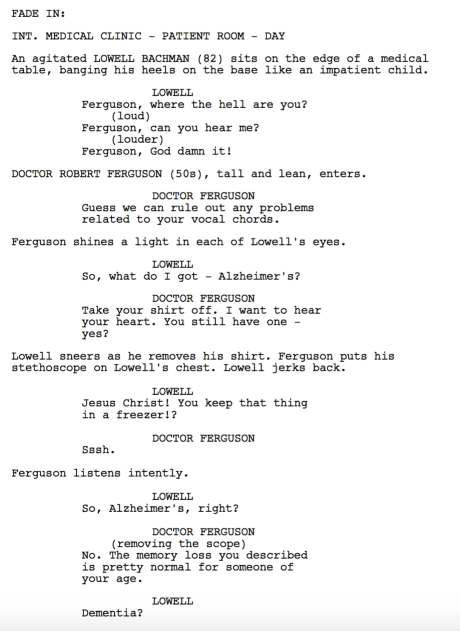
Title: The Last Statesman
Genre: Dramedy
Logline: An old and cranky local politician goes publicly bananas in an effort to draw attention to an important social issue. This inadvertently puts the career of his son, the Governor of California, at risk.
Why You Should Read: This is a character driven dramedy with a lot of funny moments mixed in with an important social mission. Our hero knows he is in the last inning of life and is going to go out swinging even at the risk of damaging his own political legacy and ruining his son’s chance of building his own . So, yeah – he’s a a bit of an asshole. But an asshole you will root for.
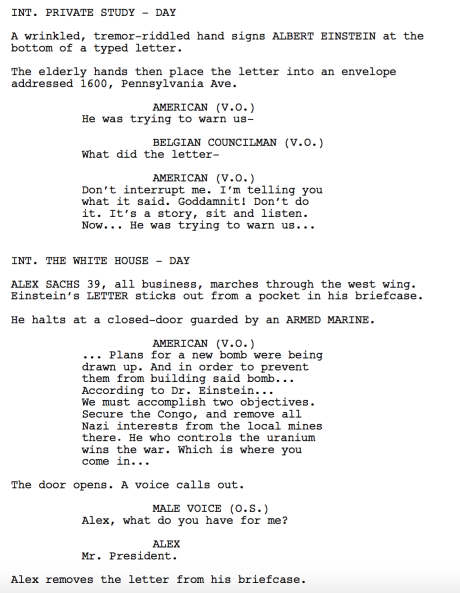
Title: The Last Ride To Midnight
Genre: Action-Adventure
Pitch: “Butch Cassidy and the Sundance Kid set in WW2”
Logline: As Hitler nears completion of his own nuclear bomb, two American spies pose as Nazi officers in a desperate bid to locate and destroy Germany’s secret nuclear facility.
Why You Should Read: This script has certainly been around the block a few times over the last year. It was read by the head of UCLA’s screenwriting department and referred from there to more contacts. It made it into the semi-finals of the Big Break contest. And most of the feedback throughout all that time was pretty good. But something was missing. It never seemed to gain the momentum required to reach the finish line.
So, I decided to tear it apart. AGAIN! I wanted to lean it out. I wanted the reader to be more involved. Instead paragraph after paragraph of detail, I tried to just keep it simple; allow the reader to put two and two together. It’s a new style for me but I think it really punches up the story and engages those reading it.
My goal with this script has always been to write a WW2 story that’s fun, action-packed, comical at times, but also explores the reality that these two men must address when faced with the question “Does the end justify the means”. Hopefully this draft accomplishes all of that. Thanks and good luck to everyone else.
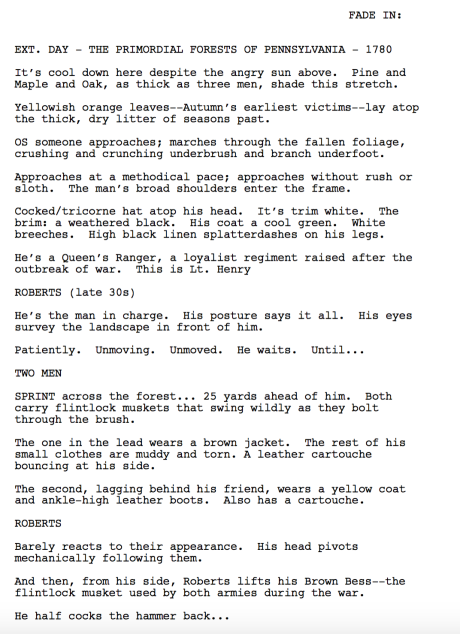
Title: Deadlock
Genre: Period/Action
Logline: Pennsylvania, 1780. A veteran haunted by his past takes one last shot at redemption when he hides an injured patriot from British pursuers; but, when the man is discovered a standoff erupts threatening the only thing the veteran has left to lose: his son.
Why You Should Read:
1) It’s a very fast 92 pages.
2) I researched the dialog meticulously using 18th century dictionaries; so, the characters’ voices are unique, accurate, and nuanced.
3) Six characters. One location. This allows producers to make an action-packed period piece for a very small price tag.
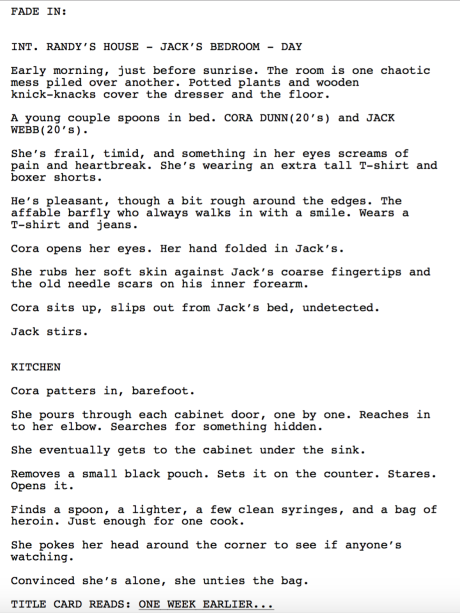
Title: Falling Stars
Genre: Drama
Logline: A young heroin addict falls in love with her sponsor, as a looming drug test threatens to send her to rehab.
Why You Should Read: This script came out of a desire to tell a drug addiction story that ended with a sense of hope. That a person can get better if they really want to and that their situation isn’t necessarily a death-sentence. I’m a big fan of Requiem for a Dream, Trainspotting and Panic in Needle Park, and they were kind of the jumping-off point for my telling of this story. But they, like so many other drug addiction films, all seem to end in this downward spiral of futility. I know that’s the reality for so many people out there, but it doesn’t have to be. And movies are supposed to be a reflection of the world we want, if not necessarily the one we have, aren’t they? You’ve read one of my scripts before (for my silent samurai film, Onna-bugeisha) and you seemed to enjoy my writing style, despite the lack of dialog, but I assure you, the characters speak in this one. I hope you enjoy!
Title: Captain Susan: Pirate Queen (and all powerful master she-bitch from the furthermost reaches of hell)
Genre: Adventure Comedy
Logline: When a young woman with #metoo anger-related issues hits her head and believes she’s a pirate queen, she acts out on a group of hapless guys in an attempt to even the score.
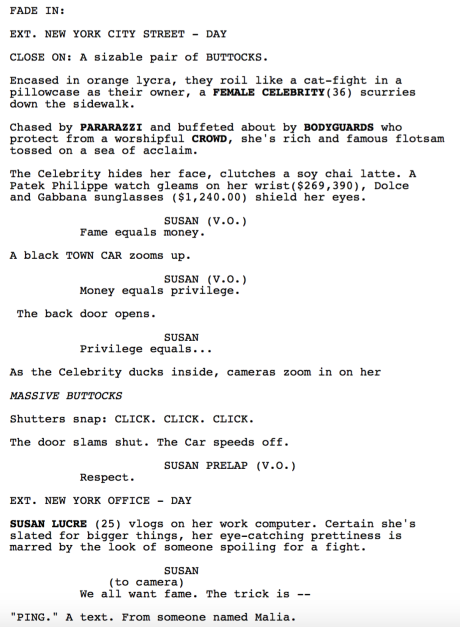
Why You Should Read: This script began life as Let’s Be Famous, which was featured on Scriptshadow in August of 2017. It was basically a story which started as one idea and then veered into another and SS notes reflected that there was a disconnect. The feedback was spot on and made me realize my main character had gone off the rails after the midpoint without a proper set-up for her behavior.
The odd behavior of my character in the back half became the most interesting aspect of the story to me, so, I embraced it and discovered there was a #metoo component already present, which only needed to be developed. The revision resulted in Captain Susan: Pirate Queen, a story about an angry young women who acts out on a somewhat innocuous group of guys. I’ve tried to tackle the #metoo movement in an unexpected way and rather than have men be the bad guys, show how we all need to recognize when we act badly and try to remedy those behaviors. I also wanted to write something a tad darker than my usual fare and although no one dies in this story many, many spankings are given.
Susan was a tricky character to write, she might not be entirely sympathetic, but hopefully I’ve made her compelling enough for an audience to want to follow.
I hope you enjoy this new version and a big thank you to Carson and others who gave me notes on Lets Be Famous. I guarantee you’ll see evidence that I was listening.
NEW TOP 25 SCREENPLAY REVIEWED IN NEWSLETTER!

By now, you should have received a hot-off-the-presses juicy Scriptshadow Newsletter served animal style! Today’s newsletter includes a new Top 25 screenplay that came out of nowhere. I’m talking this is the LAST person I expected to write a Top 25 script. One thing I’ll tell you that puts this script above so many others, is that it’s a MOVIE. You read it and you can see the movie. Everybody writes these self-masturbatory “feels” scripts about post-impressionist Sweden or some nonsense. I’m not saying these scripts can’t become movies. But they’re not built to be movies. This script is built to be a movie.
Anyway, if you didn’t get my newsletter in your Inbox, check your SPAM and PROMOTIONS folders. It should be in there. If you don’t see it there, feel free to e-mail me at Carsonreeves1@gmail.com with the subject line: “NEWSLETTER” and I’ll send it to you. If you’re not on my mailing list and want on, do the same. Send “NEWSLETTER” to the above e-mail.
Also, I’ll be putting an Amateur Offerings post up later today. Probably late afternoon. If you’ve got a script that you think would do well, you still have time to submit. E-mail me at carsonreeves3@gmail.com and include the title of your script, the genre, a logline, a pitch to myself and other readers on why we’d enjoy your script, and, finally, an attached PDF of your screenplay.
Recently, I’ve been reading a lot of consultation scripts with scene issues. Writers are staying inside of their scenes for too long. My advice for this has always been the same. The average scene should be somewhere between 1.5 and 2.5 pages. Anything over that needs justification. If you’re writing a big set piece, that’s justification. If you’re writing the climax, that’s justification. If you’re writing a big confrontation between two characters, that’s justification. Otherwise, you should be keeping your scenes lean and mean.
However, it occurred to me, that as often as I gave this advice, I’d never actually tested it. I was going mostly on feel and, admittedly, the advice that had been handed down to me long ago. So today I decided to change that. Get some real world data. What I did was I chose three screenplays, and counted how long each scene was. I then divided the scenes by the page number to get an actual average of pages per scene.
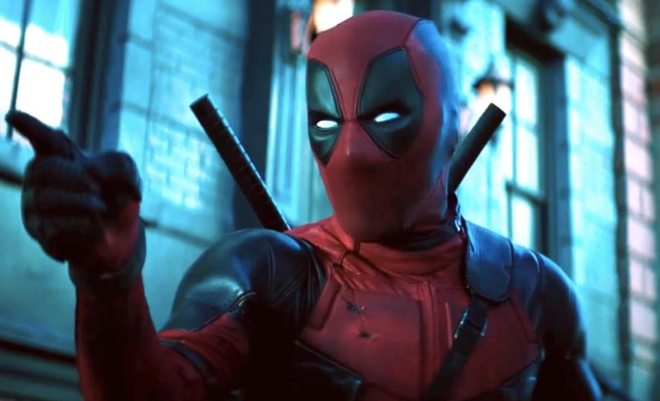
This process was trickier than I expected. There’s some subjectivity in what constitutes a scene. For example, Deadpool does a lot of bouncing back and forth in time. Sometimes, when we bounce to the past, it’s for an isolated scene. Other times, it’s part of a series of scenes you could argue are one continuous (montage) scene. So I had to use my judgement on which was which.
Also, I didn’t want to break down scene numbers into quarters, as it would get too messy. So if a scene was, say, 65% of a page, I would round down to half a page. If it was 75% of a page, I rounded up to a full page. I didn’t measure down to the millimeter or anything, which, when going through the whole script, gave me some imperfect page counts. That’s why the numbers don’t add up EXACTLY to the official page count. With that said, it’s accurate enough for the purposes of this article.
Here’s what I came up with…
DEADPOOL (ORIGINAL SPEC DRAFT)
1.5, .5, 3, 10, 3, 2.5, 2.5, 1, 1.5, .5, 4, 2.5, 2, 1.5, .5, 2, 4.5, 3.5, 1.5, 1, 2.5, 1, 2, 1.5, .5, 1, 3, .5, 2, 2, 2, 1.5, 1.5, 4, 3, 1, 2, .5, 1, 3.5, 2, 14, 6, 3
Page Count: 113
Number of Scenes: 44
Average: 2.6 pages per scene
THE BABADOOK (SHOOTING SCRIPT)
3.5, 3, .5, 1, .5, 2.5, 3, .5, 1, 3, 1, .5, 2.5, 1, 3, .5, 2, 1, 1.5, 1, 1, 1, 2.5, .5, 1, 1, 1, 2, 6.5, 1, 2.5, 1.5, 2, 1.5, 1, 2, 1, 3.5, 1.5, 1, 3, .5, 1, .5, 1, .5, 3, 1.5, 2, 2.5, 6, 2, 5, 2.5, .5, 2.5
Page Count: 100
Number of Scenes: 56
Average: 1.8 pages per scene
THE HANGOVER (ORIGINAL SPEC DRAFT)
1.5, 4, 2.5, 3, 3, 2.5, .5, 2.5, .5, 5, 4.5, 1, 1.5, 4.5, 1, .5, 3.5, 1, 4, 7, 3.5, 4, 4.5, 1, 1.5, 8.5, 3, 2.5, 5, 1, .5, 6, 2.5, 1.5, 1, 1.5, 1, 2, 5.5, 1
Page Count: 111
Number of Scenes: 40
Average: 2.7 pages per scene
So what did I learn here? Well, writing style has a lot to do with how many scenes you’re going to have. Jennifer Kent (The Babadook) had a lot of brief scenes with her protagonist in a car coming back home. Or sitting in a room while her kid was asleep. She seemed to be drawn to moments, as opposed to writing fully fleshed out scenes.
On the flip side we’ve got The Hangover, which has the most long scenes of our three examples. A reason for that may be that comedy needs to rev up in a scene before it gets going. And also, there’s more dialogue in a comedy, since the characters are making lots of jokes. This naturally leads to longer scenes.
Deadpool is such a crazy script with all the jumping around. But I wanted to include at least one action script. Not surprisingly, the long scenes in the script are the major set-pieces. But I was surprised how short some of the scenes were. I remembered being in the theater and watching Wade Wilson yap his mouth off in a bar for awhile. But in the script, those scenes are under 3 pages.
Despite all of this, the average scene length is surprisingly close to the advice myself and others have been giving. Deadpool and Hangover are a little over 2.5 pages per scene. But that might have dropped had I been stricter about what a scene is and isn’t. Likewise, with Babadook being a very stream-of-conscious type movie, you could make the argument that many of those individual scenes were part of bigger scenes. With those adjustments, all of these movies would be in that 1.5-2.5 page sweet spot for how long the average scene should be.
I want to make it clear though that this doesn’t mean every scene should be 2 pages. A scene should be as long as it needs to be. If all you need to convey is that a character is an asshole, take half a page and show him cut someone in line at Starbucks. Boom, you’re done. But if you’ve got your hero and your villain, who you’ve been building up for 80 pages, finally confront each other in a diner (Al Pacino and Robert DeNiro in Heat), of course that scene should be longer.
What you don’t want is to make newbie mistakes like coming into a scene too early. Or leaving a scene well after the scene is clearly over. I’ll see this happen in comedy specs a lot. The writers want to get as many jokes in as possible and therefore a 3 page scene becomes a 6 page scene with half the impact. The lesson I would take away from today is that if your scene is over 2.5 pages long, there better be a good reason for it. It has to be an important scene in some capacity.
I hope that helps!
Carson does feature screenplay consultations, TV Pilot Consultations, and logline consultations. Logline consultations go for $25 a piece or 5 for $75. You get a 1-10 rating, a 200-word evaluation, and a rewrite of the logline. If you’re interested in any sort of consultation package, e-mail Carsonreeves1@gmail.com with the subject line: CONSULTATION. Don’t start writing a script or sending a script out blind. Let Scriptshadow help you get it in shape first!
Genre: TV Pilot – 1 Hr. Drama
Premise: A family is turned upside-down when their flight back from vacation experiences an impossible phenomenon.
About: The high-concept network show is back! We’ve got this one premiering on NBC in the fall. And we’ve got a new zombie show, The Passage, also in the fall, coming from Fox. Manifest is created by Jeff Rake (The Mysteries of Laura) and newcomer, Matthew Fernandez. It’s being produced by Robert Zemeckis.
Writers: Jeff Rake & Matthew Fernandez
Details: 60 pages
Here’s something I’ve never shared on the site.
I’m obsessed with plane crashes. I’m talking, after a plane crash, I will hunt down the black box recording and listen to it repeatedly. I will read accident reports. If there’s a flight that had turbulence so bad it was reported in the news? I will eviscerate the internet to find in-flight cell phone footage of the event. I have watched every single episode of both plane crash shows, Mayday, and Air Disasters.
This may have something to do with my mom being convinced that every plane we were on growing up was going down. Hearing the words, “I have a bad feeling about this flight, I don’t think we should get on it,” was as common a phrase to me growing up as “Do you want me to make you a sandwich?”
This has fueled my morbid curiosity about plane crashes and mysterious plane occurrences (that Malaysian flight was an obsession of mine for over a year), and it’s also led me to want to write or produce or find the ultimate plane-related project. I’m open to pitches. So if you’ve got a good idea, throw it up in the comments. Don’t limit the genre. The best plane-related story to date is plane/horror hybrid, “A Face in the Window,” (from The Twilight Zone movie). If you want to know what I looked like on every flight through my 20s, this is an accurate depiction.
It shouldn’t be a surprise, then, that I’m obsessed with this Manifest show. As soon as I heard about it, I screamed, “I MUST FIND THIS SCRIPT!” I’m such an easy sell with this material that I’d be shocked if I didn’t like it. But it’s a script, so you never know. Let’s check it out.
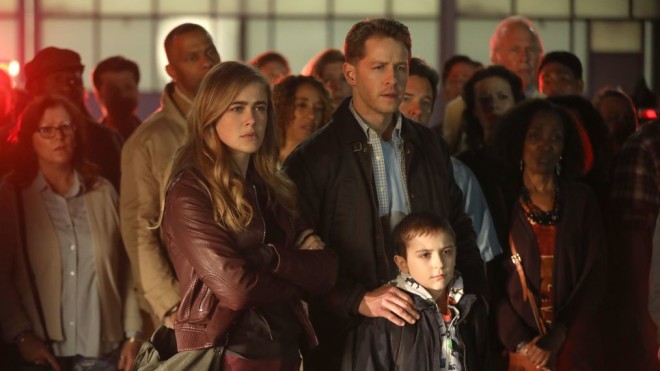
Ben and Grace, a married couple in their 30s, are at the airport after a Jamaican vacation with their twins, 10 year old Cal and Olive. Cal, we quickly learn, has leukemia, and will be lucky if he makes it past six months. Also with them are Ben’s sister, Michaela, a cop who’s recovering from a traumatic car crash, and Ben’s parents, Steven and Karen.
When the opportunity to give up seats for money-vouchers arises, Ben suggests that him, Cal, and Michaela take them, since the Mayo Clinic is bleeding them dry and a little extra cash will help. So Grace, Olive, and the parents take this flight, and Ben, Cal, and Michaela the next.
That flight is uneventful except for a brief bout of severe turbulence. Once they arrive in Baltimore, they find themselves oddly moving towards a warehouse instead of a gate. A group of federal agents are waiting for them. Once outside, they’re told that their plane disappeared 5 years ago, and that everyone on board was assumed dead. But the real kicker is when he informs them that they’ve all missed their connecting flights.
After a lot of questioning, the miracle passengers are allowed to go home. Olive is now 15 years old, which makes the twin connection between her and Cal a lot weirder. Grace had given up hope on Ben, and can’t believe that he’s returned. Ben’s mother died. Oh, and good news for Cal. In the five years that he’s been gone, they found a breakthrough treatment for his cancer. It’s looking like he’ll be cured.
The rest of the pilot focuses on Michaela, who keeps hearing voices in her head. One voice keeps telling her to “let them free!” and grows louder when she’s jogging past an old junkyard. She eventually breaks into the junkyard, where the voice guides her towards an old shack. She opens it to find two girls who were recently kidnapped and is heralded as a hero.
The only person she can tell about this power is Ben and he tells her to keep it quiet. He has a feeling that the government isn’t going to let these weirdos integrate back into society easily. And if they give them any reason to snatch them back into custody, they’ll take it. And so Michaela, along with the rest of the passengers, begin their new life after this bizarre event.

We’ve talked about this before. The high-concept TV show is a tough one. It gets you eyeballs early. But you have to wonder if a show can sustain itself if the coolest event that happens in the entire series occurs in the first five minutes.
If you look at shows like X-Files – that show ensured that every episode would be high-concept. Then there’s Lost. The brilliance of that show was that the exciting plane crash was only the beginning. The island itself was the real star.
I’m not convinced that there’s much of a story here beyond the awesome teaser. The only character with anything going on is Nostradamus Michaela. And my problem with that is, her premonition power doesn’t evolve organically from the event on the plane. I mean, you can explore premonitions without a 5 year plane trip, can’t you?
As is the case with every TV show, the characters need to be great. That’s the key to adding longevity to your show. I would go so far as to say you should spend just as much time writing backstory for your six biggest characters as you spend writing the pilot itself. And when I say that, I mean EACH character. Not combined.
You may balk at that but what do you think is going to happen if you slap some half-realized characters on the page? The reader can tell. Trust me. It’s so easy for me to tell when a writer has put a lot of work into someone, when they’ve put barely any time into them, and when they’ve put in just enough.
That’s definitely how I feel about these characters. Who’s the stand-out here? Michaela I guess? And even she’s vague (when we meet her she’s unsure if she wants to get married, yet when she arrives in the U.S., she’s devastated to find out her fiancé has moved on to someone else). Cancer Boy has no personality or development outside of the fact that he has cancer. Cancer can’t define a character. There’s gotta be more there.
And yet… dammit… because I like plane stuff and weird sci-fi stories, this still kept my interest until the end. The moment early when the family decides to split onto two planes – that was a pro screenwriter move right here. Most writers would’ve had the family on the plane together. It was so much more interesting to split them up and see the family reunite afterwards.
I just question whether they have enough to move forward. This needs more mysteries. It needs more questions. Either more characters needed the premonition power or each character needed their own unique power. I hope I’m wrong. I still miss the trippy WTF world of Lost, where you never knew what was coming next week. Is there a mind out there that can recreate that excitement? I hope so.
[ ] What the hell did I just read?
[ ] wasn’t for me
[x] worth the read
[ ] impressive
[ ] genius
What I learned: Network TV shows (and all TV shows to some degree) need to embrace their soapy elements. TV is about character. Which means plots are going to be dictated by character. That means things like death, cancer, cheating, pregnancies, characters romantically getting together – these will fuel a lot of your plot points. Not all at once! You will spread them out over the course of the season. But when something big needs to happen, soapy reveals are usually your go-tos. So here (SPOILER), a late reveal is Grace (the wife) having a hushed call with a man. We realize that she’s fallen in love with someone else, and is deciding when the best time to tell Ben is. It sounds a bit hacky, but TV thrives on this stuff as long as you don’t overdo it.
