
Genre: Dark Comedy Thriller
Premise: (from Black List) A darkly comic crime thriller concerning three groups of people dealing with blackmail gone wrong.
About: Kill Shelter appeared on the bottom half of last year’s Black List. It’s written by newcomers Eric Beu and Greg Martin. The two won the 2015 Script Pipeline TV Writing Contest with a pilot called Beechwood. Martin was originally a composer and has gotten work on some major network shows. Eric Beu mainly wrote short fiction before moving to Los Angeles to team up with his friend Greg and start writing screenplays.
Writers: Eric Beu & Greg Martin
Details: 94 pages

Please be good Please be good Please be good Please be good.
Those are the words going through my mind whenever I open a script.
Why? Because MY JOB IS SO MUCH EASIER WHEN I LIKE SOMETHING. That’s why. Damn. You’re so pushy.
Here’s something you may not know. Screenplays? They’re time machines. No, I’m serious. They are. If you find your way into a bad screenplay? You will be reading for 5 hours and look up to see that you’re on page 12 and only 20 minutes has gone by. Conversely, if you read something good? You can be reading for 10 minutes and you’re already done with the script.
There have been times – times I’d like to forget – where I’ve actually gone backwards in time reading a script. I once read a script for 3 hours only to find out that I hadn’t made it past the title page. Those are the days I hate the world.
So color me Happy Henry when I time-traveled through Kill Shelter fast enough to finish in time for The Bachelorette. And can I just say something? Brett? You’re not there for the right reasons. You need to tell Becca.
Bennett, our shlubby un-hero, is a closed caption transcriber and a loser. But he’s going to be dead in a few minutes so it doesn’t matter. Bennett is visited at his home by an intimidating man named Gordon. Bennet gives Gordon a mysterious thumb drive and Gordon gives him 90 thousand dollars.
Except as soon as the trade is made, Gordon shoots Bennett dead. Gordon must now get this thumb drive, which clearly has some incriminating evidence on it, back to his employer. Except while he was shooting Bennett, he dropped the drive, and now there are four adorable Siberian Husky puppies standing side by side, as if in a picture, staring at him.
It takes Gordon a second to realize that one of these puppies ate his thumb drive. Shit. Now what? He grabs all four puppies and takes them with him.
Little does Gordon know, halfway down the block, pet vets slash scatterbrains Liz and Paola were coming to retrieve those puppies, as they had evidence Bennett was neglecting them (he was – stupid Bennett). Paola, a Game of Thrones enthusiast, brought a real-life Game of Thrones replica sword to intimidate Bennett into giving them the puppies. Except now the puppies aren’t with Bennett. They’re with this other guy. Who’s this other guy? They start following him.
We jump back a couple of days where we meet Bennett before all this happened, and learn that he was lucky enough to overhear a live-mic situation on a news show he was close-captioning where the head anchor, psychopath Grant, was banging an intern who’s not his wife. This, we realize, is how Bennett got himself into this mess. He tried to blackmail Grant with the audio.
We bounce back and forth between Bennett, Grant, Liz, Paola, and Gordon, as well as bouncing back and forth in time, gradually putting the puzzle pieces together just as all five parties (well, four, since poor Bennett’s dead) smash together in one final bloody battle. Of course, the only thing you care about is are those adorable puppies okay? They can’t let anything happen to those adorable puppies, can they? No way a writer would hurt even a fictional puppy, yes? Eh, you’ll have to read Kill Shelter and find out for yourself, sucker.
I really liked this.
For starters, I liked how the script was designed for us to play catch-up. We see Bennett. We see this mean dude. They make an exchange. We don’t know what for. He kills Bennett. We cut to three days earlier when Bennett is alive. Now we’re wondering, “What did this guy do to get into this mess?”
It’s simple but intriguing questions like this that buy you pages. And that’s all you’re trying to do as a writer. You’re buying pages of interest from your reader. If you can come up with one mystery here, another there, you can buy as many as 20-30 pages from the reader. So these guys had me right away.
I loved all the weird choices. I loved how Paola carried around a Game of Thrones sword that was so big and heavy she could barely lift it.
There’s this whole thread where Bennett has this bizarre Joseph and the Technicolor Dreamcoat 30,000 dollar bullshit vest that supposedly cures back pain. It’s got a Siri operating system and it lights up and whines at anyone who enters Bennett’s place to please “plug it in.” How do people come up with this stuff?
And what a GENIUS move it was to take a comedy staple – two stoner dudes who stumble around aimlessly in pursuit of the MacGuffin – and turn them into women. I didn’t realize until reading this script that I’ve never seen that before. These characters have ALWAYS BEEN DUDES. Not only did it freshen up the story. Liz and Paola KILLED. They stole the script.
Usually when I read zany scripts like this, the writers aren’t good with the peripheral stuff. They don’t care, for example, about anybody’s backstory. They’d rather come up with the next zany plot point. But these guys are different. EVERYBODY has a motivation, sometimes elaborately so.
For example, we find out that these puppies came from Liz’s dog. But not just any dog, a dog that was dying. A dog that was able to have these puppies right before death. I mean, how much more motivation does a character need to save puppies?
And Bennett too! He’s got this entire backstory where his mom got in a car accident. There were complications. He had to put her in a home. And that home is costing him a ton of money. Which means he can’t keep up with his student loan payments. Which is why, of course, he has to blackmail the news anchor.
And no – in case you were wondering – it wasn’t endless chunks of exposition that gave us this information. These guys are masters at saying a lot quickly.
I have to give them props. Despite a potentially messy setup (time jumping and multiple protags) I was never confused. A big reason for this is they give each character a strong memorable introduction (remember when we talked about that?). When you DON’T have strong character intros and try to write these “bounce around” scripts, we always forget who’s who. Even if a character was introduced 10 pages ago.
The only gripe I have about this script is that they don’t know what to do with these movies anymore – the zany dark ensemble comedies. They’ve never done well at the box office outside of the Coen Brothers. But these days it’s even worse. They get discarded onto Netflix with barely any marketing, and you never hear about them again. I just don’t know that I would recommend writing a script like this unless you’re using it as a writing sample. With that said, I hope this one bucks the trend because it’s a darn good script.
[ ] What the hell did I just read?
[ ] wasn’t for me
[xx] worth the read
[ ] impressive
[ ] genius
What I learned: Read this script STRICTLY for character introductions. Note how you know exactly who each character is after their first scene. I read too many scripts with boring, vague, or weak character intros and it’s always those scripts where I have to keep checking my notes. “Who’s this again?” “Wait, who is this person?” Once you learn how to write strong character introductions, you make the reading process a thousand times easier for the reader.
Many have called The Truman Show the best spec script ever written. Today I’m going to remove the film from memory, read the script fresh, and determine if that’s true.
Genre: Drama/Fantasy
Logline: A life insurance salesman slowly discovers that his entire life is actually a television show.
About: In 1997, hot upstart screenwriter Andrew Niccol, whose first feature film, Gattaca, was about to hit theaters, had just finished a new script called The Truman Show. The script, which was being read in every Hollywood circle as fast as they could get a copy delivered (no PDFs back then), was getting the kind of coverage that no script before it had received. We’re talking geniuses across the board. Many people were calling it the greatest screenplay ever written – easily the best spec ever written. With Scott Rudin producing and Peter Weir directing, the film would make the controversial choice to cast Jim Carrey in the lead. The movie did all right, and had its fans. But many remember it as a slightly-better-than-average film that couldn’t live up to the potential of its premise.
Details: 128 pages – Draft that sold
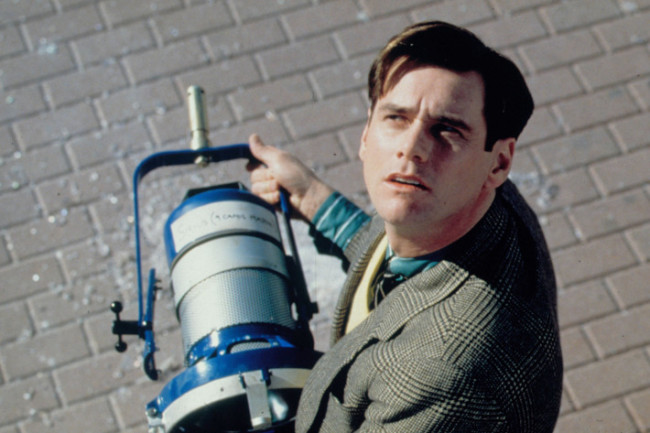
The Truman Show, whether you believe it’s a great script or not, was castrated by the one thing I hate most about Hollywood. That the town is more interested in putting together a great package than they are making a good movie. People want to parade their production around town, claiming they have “this” super hot director and “this” A-list actor. They don’t care if any of these people are actually right for the movie. As long as they can throw the perfect package in their rival agency’s (or studio’s, or productions company’s) face, they’re happy.
Jim Carrey doomed this movie. Doomed it. Look, I don’t know how much better the film would’ve been without him. But you could tell they saw an actor on one of the hottest streaks in Tinseltown history and allowed THAT to dictate their decision. As opposed to someone who was a better fit for this description: “TRUMAN BURBANK, thinning hair, a body going soft around the edges, appearing older than his thirty-four years sits at the wheel of his eight-year-old Oldsmobile Cutlass Supreme.”
People tried so hard to believe Jim Carrey was a good actor. There was that whole weird method acting Man on the Moon thing that cinephiles fell for for some reason. But Carrey has proven himself to be, at best, an average dramatic actor. And this movie needed someone who could act.
Luckily, I have a Forgetachine. It allows me to go back in time and forget certain things. So what I’m going to use it for today is forgetting The Truman Show movie. Everything about it. Jim Carrey. Ed Harris. All of it. This will allow me to read the screenplay the way Hollywood first read it back in 1997, and determine if it’s really the greatest spec script ever written. Wanna come with?
The Truman Show follows a 34 year old Truman Burbank, who lives in Queens, New York. Truman lives an average life as a life insurance salesman whose daily highlight is perusing magazines at a local magazine stand.
His wife, Marian, seems to be bored by his very existence. His best friend, Marlon, who he’s known since high school, is the only person he can share anything with. Lately, he’s been complaining that he’s never done anything daring with his life, never gone anywhere. He wants to change that.
Meanwhile, we see strange things start to happen around Truman. For example, a giant light just… falls in front of his car one day. Seemingly from nowhere. And whenever Truman isn’t looking, nearby people watch him, whisper about him.
Eventually we arrive in a giant room where a man named Cristof observes a series of people answering a single phone, one by one, each telling the person on the other end that, no thank you, they’re not interested in insurance. We then cut to Truman at work, and we realize that he’s the one making these calls. What the heck is going on?
Truman starts having bigger suspicions that something is up. And things go nuclear when his father, who he watched drown when he was seven, turns up looking like a homeless man. The father seems to be about to tell Truman something before men in uniform grab him and haul him away.
Truman begins walking into buildings he’s always passed by in his life, only to find out that they’re hollow shells. Finally, he gets on a boat, determined to get the hell out of this place, only to get to the edge of a city he now realizes is a giant movie set. He walks into the control room, confronts Cristof, the man who’s controlled his entire life, before storming out of this facade existence for good.
The Truman Show screenplay is a classic example of a killer concept that doesn’t stick the landing.
This specific concept, where the hero lives in a false reality, is tricky, because it’s hard to expand that storyline out for 120 minutes. Once we realize that we’re in a false reality, it isn’t clear why we should care anymore. We need the story to mature into something else.
A good example of this is another 90s movie, The Matrix. Once Neo realizes he’s in The Matrix, they don’t then spend the rest of the movie having him wonder if he’s really in the Matrix or if it’s all a figment of his imagination. He gets transported into the real world, maturing the storyline into something else entirely.
We don’t do that here. And you can feel Niccol stressing to extend his concept out for as long as possible. There’s a good 40 pages where we’ve clearly established that Truman knows the city isn’t real. The outside world knows this. Truman’s aware of it. The actors know he knows. Yet the story doesn’t evolve. Truman walks around a bunch, challenging everyone to admit that this is a facade (in one scene, which I’m almost positive was ditched for the movie, he takes a woman’s baby from her and threatens to slam it into the pavement if she doesn’t admit that she knows his name).
While I don’t remember how much of this was changed for the film, I do remember leaving that movie disappointed with the ending. Because the thing with these high concepts is that they generate bigger expectations, which makes it even harder to stick your landing, because you’re not just trying to write a normal great ending, you’re trying to write a great ending worthy of a great concept.
I’ll tell you this, though. Reading this script reminded me of how different writing was in the 90s, back in the spec age. In those days, because concept was king, writers were trying to keep your interest with story. You had people adding twists and turns and surprises into their screenplays. The Truman Show – a man finds out that his whole life is a TV show. The Sixth Sense – Our main character is dead. The Matrix – we’re living in a computer. Tarantino – every one of this scripts was built on surprising plot developments.
These days, we’ve supplanted this with spectacle. Studios are more interested in a giant set-piece than a clever plot development. And I think that’s the reason a lot of movie writing has gotten stale recently. Writers have lost the “unexpected story development” muscle because it’s no longer required of them.
And that’s where The Truman Show shines the brightest. I can imagine reading this for the first time, seeing a giant light fall from the sky in front of our protagonist’s car and thinking, “What the fuck is going on right now??” Seeing random men in an unidentified room answering Truman’s life insurance phone calls. “Who are these men?” “Where is this going??” It would’ve been exciting.
And the script has a dream lead role situation. A character who’s been lied to his whole life then one day awakens, no longer willing to to stick to the script. I could see actors everywhere wanting to play that part. And there’s some really interesting thematic questions as well – how much control do we have over our lives? Is there such thing as fate? Can we change the world around us if we exert our will to such a degree that it has no choice but to submit? These are universal questions that resonate with a lot of people. So if I’m reading this script, I’m not just thinking “clever concept.” I’m thinking, “Oh, this is addressing some deeper questions here.” And you don’t usually get that in a spec – both of those things. You get one or the other.
So it makes sense why this script made so much noise at the time. But you still have to stick the landing. Niccol probably needed to take this through a few more rewrites to figure out a midpoint twist that brought new life into the plot. Because while I was determined to see Truman overcome and expose what was being done to him, I got bored watching him spin his wheels while doing so.
It was an interesting reading experiment nonetheless. For those of you interested, here’s a copy of the script. Make a screenwriting course of it. Read the script and watch the movie and figure out why this never became anything more than an average film.
Script link: The Truman Show
[ ] What the hell did I just read?
[ ] wasn’t for me
[xx] worth the read
[ ] impressive
[ ] genius
What I learned: We’ve forgotten how to use surprises in screenwriting. We’re being conditioned to believe that spectacle is the most important thing moving forward. I’ll prove this to you. What’s the biggest surprise in the last five Marvel superhero movies? Don’t look. Close your eyes and try to figure it out. Okay ready? It’s when The Vulture turns out to be Liz’s father in Spider-Man: Homecoming, right? That’s the plot development that got a big “whoooaaa” from the audience. And that’s not because it was the greatest twist in the world. It’s because audiences aren’t used to that sort of thing anymore – where they’re entertained by a story development as opposed to an action scene. So note to writers. If someone can write a script with a series of good surprises or one great surprise, your spec will probably make some noise.
It should be an incredible weekend. Or should I say, incredibles weekend? Heh heh. Get it? Cause of the Incredibles 2 movie with the baby. Why I haven’t segued into stand up comedy at this point is beyond a mystery.
But seriously, I have a question for you guys. I’ve read numerous stories over the years of famous writers going to a specific motel in the desert and not leaving until they finished their book/script. Does anybody know what motel that is? I want to say it’s near Joshua Tree but I’m not positive. I feel like some of our esteemed historians can help me find the answer. Oh, and while you’re working through that, check out some new scripts!
The rules to Amateur Offerings are simple. Read as much as you can from each script and vote for your favorite in the comments. The script with the most votes gets a review next week!
And if you believe you have a screenplay that’s better than anything Hollywood is making at the moment, submit it for a future Amateur Offerings! Send me a PDF of your script, along with the title, genre, logline, and why you think people should read it (your chance to pitch yourself or your story). All submissions should be sent to Carsonreeves3@gmail.com.
Title: Heroes of the Penitentiary
Genre: TV – One Hour Pilot
Logline: The pilot for this episodic anthology Mafia series tells the true story of Chris Rosenberg, a Jewish American who—en route to pursuing his futile lifelong dream of becoming the mob’s first non-Italian inductee—caught the lustful eye of sadistic Gambino capo Roy DeMeo and became a willing participant in one of the most notorious murder sprees in American history.
Why You Should Read: The pilot tells one of the more explosive, untold stories in American history in recounting the exploits of the DeMeo crew, who devised a systematic method of murder in a human slaughterhouse where 100s were killed. At its heart though, the pilot is the biography of Chris Rosenberg, a Jewish American who grew up in an all Italian neighborhood and gravitated towards the mob. He caught the eye of sadistic Gambino capo Roy DeMeo and joined his crew, eventually becoming a remorseless killer. It’s a fascinating character study because Chris came from a good family (his brother went on to be a doctor) so it begs the question: what drives someone to be this way? Is it genetics? Environment? Experience? We’ll never know, but my hope is if you enjoy dark human stories, especially ones told from the perspective of dark protagonists, you’ll like this one. You can think of it as Goodfellas on acid or Nightcrawler / Good Time meets the mob.
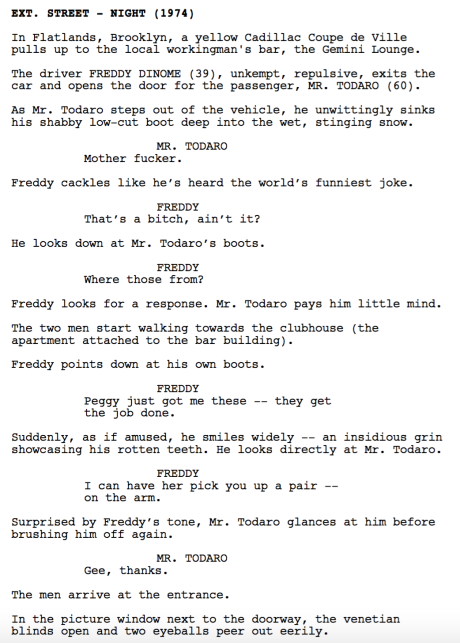
Title: Color of Fire
Genre: Crime Drama
Logline: While struggling to find his footing in society, a homeless ex-con is coerced by undercover cops into stealing from his former gang, jeopardizing the lives of his newfound friends.
Why You Should Read: I’m an avid reader of ScriptShadow that needs his daily fix in order to function normally at work. The characters hit me before the concept did; in a sense, this idea wouldn’t exist without them. I was also in a bad place last summer just after moving out here to Los Angeles: facing living on the streets, dealing with psychotic roommates, barely living off of spare change leftover from a writing assignment two months prior. I needed the protagonist to get out of his slump before I could get out of mine. This script isn’t structured in typical fashion, and it has nothing to do with trying to “break the rules.” I’ve followed the rules plenty and I’m a firm believer in them. I’m also a firm believer in doing something genuine, and allowing it to be different. Hopefully this comes through in the screenplay.
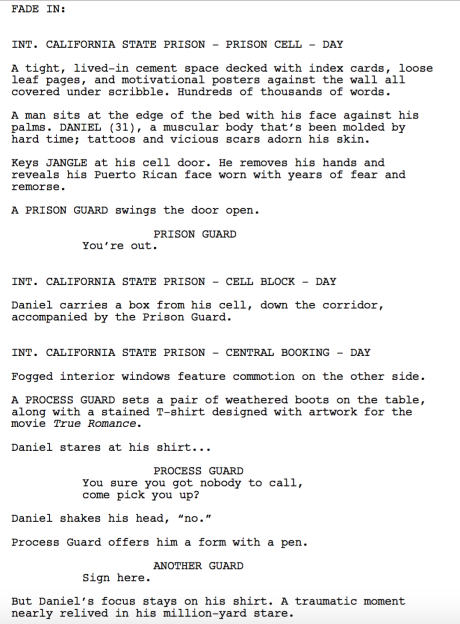
Title: Under the Vultures
Genre: Western
Logline: As a zombie plague spreads throughout the Old West, a reformed outlaw must escort a sick girl to sanctuary while being pursued by his old gang and the undead.
Why You Should Read: The first scene won the Opening Scene Contest right here on Scriptshadow. Thanks to some helpful feedback, both the scene and the script have come a long way since then. The concept is both simple and marketable: cowboys versus zombies. And Hollywood has yet to produce a feature film to mainstream audiences. With additional help from the Scriptshadow community, this could be that film. Thank you, and hope you enjoy.
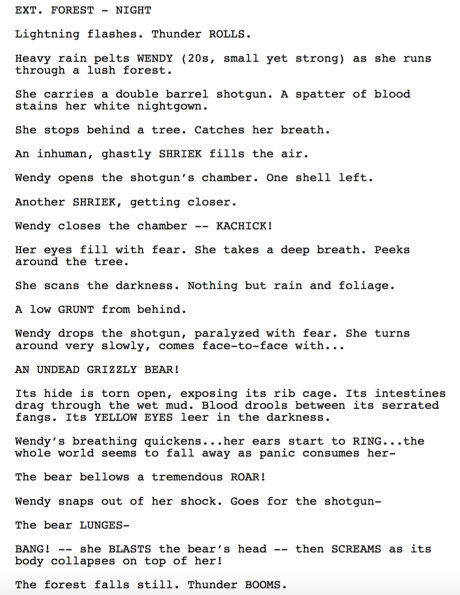
Title: Witness
Medium: TV Pilot
Genre: Ensemble Thriller
Logline: A lawyer, a US Marshal’s Agent and a big pharma exec turned FBI informant will work to take down the billionaire CEO that has just released a controversial drug that may be damaging children’s brains.
Why You Should Read: This pilot is the highest rated pilot I’ve ever written, making it into the top 5 on the pilot section of the Blacklist website. I’d love to get feedback on how to take it to the next level though, so I’d love for your readers to take a look. It’s slightly non-linear in its approach and I know not everyone will love that, but it’s intentional.
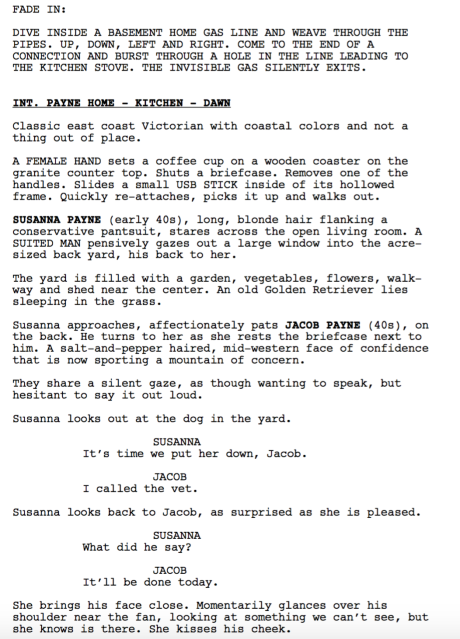
Title: THE OFFERING
Genre: Horror
Logline: A troubled young woman who wakes up chained to a tree in the middle of the woods must solve the mystery of what is happening and who put her there, and find a way to escape before someone, or something, comes for her.
Why You Should Read: After recently completing a micro-budget debut feature “The Ferryman,” I decided there were too many characters and locations for my small film-making mind to deal with, so my next project is going to be this one character, one location script, or “contained horror”. Feedback so far has called it “The Wicker Man” meets “The Babadook” but I’m probably going to stick “High Noon meets “The Ritual” on the poster when it’s made. Give it a read and see what “Something meets Something” you think it is! But seriously I’d love to know what the Scriptshadow community thinks of it, any feedback at all on where I can improve this in further drafts would be hugely appreciated. Oh, this comes with concept art, too.
With financiers and mini-studios and Blumhouse and A24 and Focus and Amazon and Netflix’s industrialization of the production process, more movies are being made than ever before. Yet you still can’t get your script sold, or even noticed for that matter. What’s up? I’m going to address that right now. Here are 10 things you can focus on that will improve your chances of getting your script purchased.
1) Is your concept marketable? – If your concept isn’t a proven successful movie template (contained horror, guy with a gun, action-comedy, etc.) or a current trend (biopics, true stories, WW2, etc.), you’re not going to get a lot of interest. Less interest equals less reads equals less of a chance someone says yes.
2) Can your movie be made for under 5 million dollars? – Put simply, the less your script costs, the more production companies can afford to make the film. Which increases your selling options exponentially.
3) Negative attitude – Lots of writers believe that the journey is impossible. They’ve convinced themselves that the big evil conglomerate known as Hollywood is conspiring against you. This becomes a self-serving prophecy as everything you do is dictated by negativity. For example, if you query a producer, the e-mail is dripping with a bitter subtext, which puts the producer off, so they never bother getting to your script. I know this because I receive these e-mails. Writing is hard. But breaking in is harder. You have to stay on the path and continue to be positive. This is how most artists break into their respective industries. Positivity and persistence.
4) Keep pumping out material – Work hard on each script, but don’t be the writer who keeps hitting people up with a new revised version of a script they’ve already read several times. Everybody likes NEW. NEW is almost as important as MARKETABLE in Hollywood. There’s nothing more powerful than being able to say, “I’ve got this NEW script you have to read.” To be more specific, try and write 2 scripts a year, and promote those scripts for 6-9 months. While you’re promoting, you should be concurrently working on your next two scripts.
5) Do you know how to write a query letter? – I can suss out 95% of bad writers just by reading their query letters. They spell words wrong. They use weird fonts. Their grammar is off. They ramble aimlessly. If you can’t even say “Hi” correctly, I know there’s no point in opening your script. So get feedback on your queries before sending them out. And put more of a premium on presentation going forward.
6) Are you blanketing the world with your screenplays? – This is where I see most writers fail. They don’t get their scripts out to enough people. Get coverage. Get notes from me. Submit to Amateur Offerings. Submit to the Black List. Submit to Page. Submit to Sundance Labs. Submit to Nicholl. Get a writing group. Trade reads with them. Cold e-mail managers, agents, and producers. Hell, cold call them. A writer was just telling me that he cold-called a mid-major production company, asked for the head guy, and was shocked when they sent him through. It gave him the confidence to call other managers and agents, and while not all of them took his call, more of them took it than he expected. And he was able to send his script out to a handful of them. But the point is, this is a numbers game. If 2-3 people a year are reading a script, you’re never going to break in. The odds aren’t in your favor. Set a goal to get a script to 10 people a year at least (that could be contest readers, writing group friends, whoever).
7) Are you being realistic about where you are on your journey? – If you’re pissed off that nobody’s giving you the time of day on your third ever completed screenplay, or if this is your first year screenwriting, you may need to accept that you’re not ready yet. I mean in what business does someone shoot to the top .001% of the company in a year? You haven’t even figured out how to order coffee yet. You have to be realistic. Get a handful of scripts under your belt, get to at least 3000 hours (5000 would be better) of practice, and then start sending your stuff out there.
8) Are you getting into your story quickly? – Readers are quick to judge. Think about how many of you won’t even open a script after reading the FIRST PAGE on Amateur Offerings. Believe me when I say busy producers and agents are doing the same. There are caveats to this. If the script comes highly recommended, they’ll read it no matter what. But if you’re a newbie, chances are your script is coming with zero fanfare. Even a few seconds of boredom could get you the hook. So get into your story quickly, even if it’s an indie-drama. The Social Network starts with an intense breakup. Juno starts with a 16 year old getting a pregnancy test. Don’t make excuses. Hook the reader immediately and they’ll give you their attention.
9) Have you given us one great character? – One of the first things producers and agents ask when they’re reading a script is, “What actor can we send this to?” If you don’t have a compelling or fascinating or unique or complex or scene-stealing character (doesn’t have to be the hero – just one of the characters in your script), it seriously lowers everyone’s interest in the project. I always say, write a character that an actor would die to play. Recent examples include Harper from yesterday’s script, the mom in Hereditary, Jennifer Lawrence’s character in Red Sparrow, or JK Simmons’ dual-roles in Counterpart.
10) Is your script under 110 pages? – It better be. You can start writing 120 page scripts when you’re established. But right now you’re an unknown spec writer. Nobody knows you and therefore they don’t owe you anything. One of the first things a reader does is check the page count. If they see 120 pages from an unknown writer, I GUARANTEE YOU they’re rolling their eyes and going into your script with a chip on their shoulder. Keep your break-in script lean and mean. Trust me on this.
Genre: Dark Comedy/Satire
Premise: (from Black List) When a liberal white girl who knows exactly how to fix society accuses her equally liberal professor of hate speech, it throws the campus and both their lives into chaos as they wage war over the right way to stop discrimination.
About: Today’s script is a perfect example of workshopping something until it’s solid enough to make some noise in the industry. Writers Emma Fletcher and Brett Weiner first got their script accepted into the Sundance Screenwriters Lab, where they got some notes from professionals, and were able to then rewrite the script (presumably several drafts) and get it on last year’s Black list (with 7 votes). Let this serve as a reminder. Pursue every screenwriting avenue you can afford. And if you can’t afford any, there are plenty of free options (Ahem, Amateur Offerings). This is a “No thank you” business. So the only way to break in is by getting as many people to read your script as possible. Then, and only then, do you have a chance of landing that life-changing “yes.”
Writers: Emma Fletcher & Brett Weiner
Details: 115 pages

“I want to open it up to anyone who had an uncomfortable moment, a difficult feeling, or an experienced micro-aggression.”
One of the many great, and terrifyingly accurate, lines from today’s script.
Social Justice Warrior is so accurate at times, that you wonder if it’s a satire, or if this is the world we live in.
It was only a matter of time before somebody wrote a script on this topic. The question was whether it would be any good. Lucky for these two, they got it workshopped at one of the best places in the world to get a script workshopped – Sundance. Getting the tone right is so hard with satire and I’m sure the people at Sundance helped them nail it.
18 year old freshman Harper Penzig (female, white, cisgender) is so taken by classmate Deshaun Barnes’ story of discrimination that she immediately declares herself a fierce advocate for race and LGBT equality.
A few days later, in a European Intellectuals class, Harper takes exception with professor Susan Brodbeck’s (female, 40’s, white, cisgender) use of the word “ugly” in the sentence: “In your reading, Oppel claims that Nietzche is actually employing irony here to comment on societal attitudes that he finds ugly.”
Harper immediatley raises her hand and says she has a problem with the word ugly as it “alienates important segments of our community.” Specifically as it relates to her sort-of trans-friend Liz, who’s also in the class, and has been called ugly before. Liz, for the record, couldn’t give a shit about Harper’s argument.
When Susan refuses to apologize for her use of the word, Harper takes her fight to the school Dean, demanding a hearing for Susan violating the right that all classrooms must be safe spaces.
Within days, Susan has recruited a small army to picket in front of the history department, calling for Susan’s resignation. When Susan realizes this problem may affect her tenure, she apologizes to Harper. But Harper’s already on a roll, uploading her protest to social media.
Meanwhile, Harper starts “SAFES,” a group that will define every single word and action that constitutes hate. Beginning with a “Privilege Walk,” Harper shows everyone in the group just how privileged and, therefore, hateful they are. Which only reinforces how important the group is. Can a white man eat a burrito? Is this not cultural appropriation? SAFES says it indeed is.
Eventually, Harper’s fight goes viral, and she gets drunk on her social media power. Every injustice is instantly uploaded, where half the world can celebrate and the other half decry her. After awhile, the lines become blurred. Is she doing this because she believes in it? Or is she doing it for the attention?
In the end, Harper and Suzanne will battle it out, in a “safe space” room of all places. Whoever comes out in one piece may dictate the direction of social justice for us all.
This script was great.
What made it so great will surprise you, since I rarely talk about it on the site.
Social Justice Warrior built its entire plot around a thematic question: “Have we gone too far in our quest for social justice?” Every scene was built around that question. And what’s so great about the script is that it gives both sides an equal voice. Harper and Susan have several debate scenes together and in each one, they both make solid points. I bring this up because I read so many scripts where the writer has a clear agenda. So when he’s (she’s? they’s?) writing argument scenes, the point he agrees with always gets the best argument. This script proves that it’s way more interesting when you make the debate even because the writer has to keep reading to get to the conclusion.
For those of you who want to construct screenplays around a thematic question, here’s something to keep in mind. It doesn’t work unless the question is a) charged and b) difficult to answer. So if you built your script around the thematic question, “Is it okay to steal if you’re poor?” that’s not a question people are dying to know the answer to. SJW is built around a charged question that people have intense opinions on. And that means readers are going to keep turning the pages.
There are a few plot related things I want to bring up as well. The script starts off with Harper’s pursuit of getting Susan fired. I could see an early iteration of this script where that was the only plotline. If that were the case, the plot would’ve been too thin. So Fletcher and Weiner added the SAFES plot, where Harper’s goal is to define hate speech and implement it around the school.
As a screenwriter, you’re always feeling out if you have enough plot or if you need more. If you need more, this is an option – using dual-goals. Goal #1: Get Susan fired. Goal#2: Define hate speech for the school. This allows us to bounce back and forth between two storylines, keeping each of them fresh.
I also liked Fletcher and Weiner’s choice to make sure EVERYBODY in this story had something at stake. A common mistake is to only give stakes to your hero. But we had it for our “villain” as well. Susan is going to lose tenure if Harper wins this battle. And the Dean gets a call from the president that if this keeps blowing up, he’ll be fired.
What this does is it gives WEIGHT to these characters’ scenes where there otherwise wouldn’t be any. Because Susan has so much riding on this, we can feel her desperation in her scenes. If tenure was never mentioned, her scenes become infinitely less dramatic. Who cares if she loses this battle? As far as we’ve been told, her job will remain the same.
Finally, I liked the message of the script. That there are legitimate strides that need to be made in the area of social justice. At the same time, there are narcissists out there using the cause as a weapon to gain attention. And because they’re the loudest voices, they get propped up as the faces of the movement, which places said movement in a negative rather than a positive fight.
Where is all of this social justice headed? We’ll need a sequel about a year from now to find out.
[ ] What the hell did I just read?
[ ] wasn’t for me
[ ] worth the read
[x] impressive
[ ] genius
What I learned: Thematic questions result in dialogue-heavy scripts. If you want to write a lot of good dialogue, you might try building your script around a thematic question. That’s because you’ll spend many scenes having characters debate the question. And questions that don’t have easy answers are often fun to write and to read. Social Justice Warrior was 95% dialogue for that reason. It set up its question then it let its characters battle for the answer.
