
Search Results for: F word
I dug into my 2020-2021 archives and found the ten best screenplays of the last two years!
If you’re anything like me (and if you’ve been on this site for long enough, I’m assuming you are), you’re wondering, “What happened to all the great scripts?” These days, an “impressive” on Scriptshadow is as rare as a Twitter user admitting they were wrong. Paula Cole had this soulful moody tune where she asked, “Where have all the cowboys gone?”
Well I’m asking a similar question: “Where have all the screenwriters gone?”
My first thought was that I was a victim of recency bias. I was probably forgetting some great scripts just because the current strawberry crop was yielding such tiny berries. So I decided to go back through my posts and find the last ten “impressives” that I gave. I scrolled down through one page of entries – didn’t find my ten impressives. Then a second page. Still hadn’t gotten ten. Then a third! Keep in mind, these WordPress pages list 100 blog entries per page!
At a certain point, I stopped looking for impressives and just looked for scripts that left an impression on me. They might not have been great. But they were memorable. Which is almost as good. I forget most of the screenplays I read within a week of reading them. Which is a lesson unto itself. Because when you boil down screenwriting, what you’re trying to do is create something that sticks with a reader – that gets inside of them. How many elements from your screenplay can you say are unique enough or strong enough to be memorable?
So here are the ten. After we go through them, we can talk about what we learned.
Title: Towers
Genre: Drama
Logline: A businessman’s obsession with his competitor leads him down a rabbit hole of self-discovery, fantasy, and delusion.
Rating: [x] double worth the read
Analysis: This is one of the most unexpected scripts on the list because I typically don’t like these types of screenplays – where the writer is playing with reality in such a way that you don’t know what’s real and what isn’t. I’ve found that most writers use this approach as an excuse to get sloppy and write fantastical questions they never have to worry about answering. In short, they’re always messy. But Towers is different. It’s weird. It reminded me of the underrated, “Little Children,” about how the fragile mind deals with a mid-life crisis. I always say if you’re going to write something weird, don’t be afraid to be weird. Towers has its buttoned-up middle-management main character become obsessed with drag racing. It’s odd in a really cool way.
Title: Birdies
Genre: Comedy/Satire
Logline: When Tabitha, a struggling foster kid, wins a contest to become part of the BIRDIES, a popular daily YouTube channel featuring the radiant and enigmatic Mama Bird and her diverse brood of adopted children, she soon learns that things get dark when the cameras turn off.
Rating: [x] impressive
Analysis: Birdies is a great example of mixing the old with the new, which is one of the best ways to come up with good ideas. The script is basically a reverse “Annie” with a social media twist. The thing I remember most about the script was how it nailed the pressure of succeeding in this emerging entertainment world, and the lengths people will go to keep those views up – namely, abusing children. One of the best ways to make a script memorable is to go to dark places. And what’s darker than exploiting children for money and fame? What’s impressive is that the script somehow manages to do this while also being funny. That’s a fine tightrope to walk.
Title: Lakewood
Genre: Thriller
Logline: Told in real time, a young mother out for her morning jog gets word that there’s been a school shooting at the high school her son attends.
Rating: [x] impressive
Analysis: While weird scripts get the nod for “most memorable” in most cases, I’m a sucker for a bare bones good idea with great execution. That’s what Lakewood is. It does two things really well. First, it takes an old idea and comes at it from a fresh angle. A school shooting where we’re never at the school. Instead, we stay with a mother of someone at the school who’s trying to get information on what’s happening. Second, the execution is flawless. It’s hard to write a bare-bones story, which is what this is. It’s one woman with a phone. Chris Sparling is the master at taking a stripped-down premise and keeping the train moving. He knows exactly how much character development the audience needs. He knows exactly how much exposition they need. And everything else is about propelling the story forward. Great stuff.
Title: Ambulance
Genre: Action
Logline: After a bank robbery gone wrong, two brothers attempt to use a stolen ambulance as a getaway car.
Rating: [x] impressive
Analysis: “Ambulance” is a lot like Lakewood in that it moves fast. But the plot is way more intricate. And that’s what drew me in. I loved how the writer, Chris Fedak, followed different characters along different paths before finally bringing them together into this wild ride on this ambulance. I mean you talk about ‘energy’ – which is a word I don’t often use when referring to screenplays – but there is a clear energy on these pages that I rarely see. It was like each of these paragraphs were being blasted out of a nuclear reactor. This is such an intense script.
Title: Voicemails for Isabelle
Genre: Rom-Com
Premise: A low-level TV writer struggles to cope with the death of her little sister by continuing to leave her voicemails chronicling the shitshow that is dating in LA. When the phone number is unknowingly transferred, a cocky New York real estate agent begins receiving the voicemails, and feels compelled to meet their creator.
Rating: [x] double worth the read
Analysis: Voicemails for Isabelle is easily the most unlikely entry on this list. In addition to rom-com bias (I enjoy, maybe, one romantic comedy script every 18 months) this concept isn’t exactly fresh. Nobody leaves voicemails anymore. So how did this script overcome that issue? Because of writer Leah McKendrick’s incredible ear for dialogue. The dialogue SINGS in this script, so much so that you literally forget you’re reading a script every time a new scene starts. The interesting think about Leah is she never formally learned screenwriting. She just really liked writing dialogue scenes between people. Clearly, she’s amazing at it. Cause this rom-com rom-rocked.
Title: They Cloned Tyrone
Genre: Sci-Fi/Comedy
Logline: A group of friends in a crime-ridden black community are thrown into disarray when they learn they’re being experimented on by evil white people.
Rating: [x] wasn’t for me
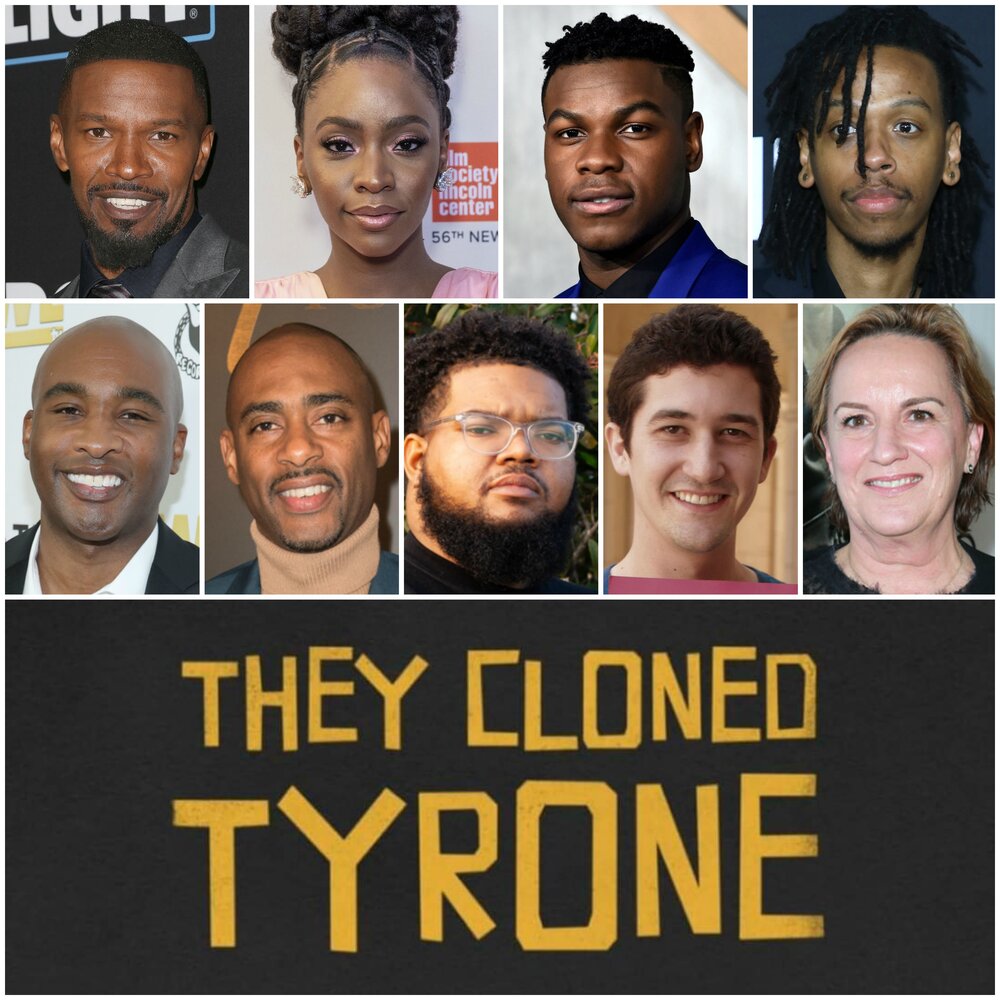
Analysis: The only ‘wasn’t for me’ on the list! So why does it make the list? When I first read this, it came off as too wacky for me. But as I was scrolling through all of the scripts I’d reviewed in WordPress, when I got to They Cloned Tyrone, I remembered it immediately. First off, that goes to show how important a good title is. But it also highlights the power of weirdness and how, if you’re writing a script that hits the same beats as every other script (aka, you’re writing a “John Wick” clone), it’s nearly impossible to make that memorable. But if you’ve got black people discovering that their entire community is being run by a series of underground white puppet-masters who are cloning and experimenting on them… it’s rare someone’s going to forget that. I still think this script is too goofy for its own good. But it’s stayed with me.
Title: Street Rat Allie Punches Her Ticket
Genre: Sci-Fi/Fantasy
Premise: An 18-year-old skateboarding “rat” named Allie finally gets her chance to leave the garbage dangerous futuristic city she’s grown up in. But will she be able to leave her fellow “rats” who must now fend for themselves?
Rating: [x] impressive
Analysis: One of my favorite things about reading is thinking I’m in for two hours of boredom only to end up having the time of my life. Sci-Fi/Fantasy is probably the single hardest genre to get right. You’re not just inventing characters. You’re not just inventing a plot. You’re inventing AN ENTIRE UNIVERSE. And almost every writer I know who’s tried to tackle this combo ends up writing exponentially inferior ripoffs of concepts from Star Wars or Lord of the Rings. Not only did Nicholl-winner McKnight overcome that obstacle, but he constructed an early-Spielbergarian protagonist in Allie. Remember one of the 10 Commandments in screenwriting:. If you write us a sympathetic likable main character, we will want to follow them through anything. McKnight nails that commandment.
Title: Resurrection
Genre: Thriller/Drama/Horror
Logline: A single mother in New York City begins seeing a mysterious older man from her past around town and becomes convinced that he’s come back into her life to kill her daughter.
Rating: [x] impressive (TOP 25!!!!)
Analysis: For someone who claims they hate vague narratives, I sure seem to prop a lot of these vague scripts up. I think what I really dislike is vague narratives DONE BADLY. Resurrection is all about this woman who’s losing her mind. She becomes convinced she’s being followed by a controlling ex-boyfriend who’s back to make her life miserable. Yet the person she believes is this man who keeps telling her he doesn’t know who she is. So it’s another, “What’s real and what isn’t?” plot. But what makes Resurrection stand out is its weird and daring choices. There’s a scene in this movie where the guy tells our heroine that he ate their baby that is so freaky I can’t even begin to describe it. This script is on another level. Another level of f&%$d up.
Title: All The Old Knives
Genre: Thriller
Logline: Two CIA operative former lovers meet for dinner and try to figure out what happened five years ago with a complicated hostage plane takeover in Vienna they were involved in.
Rating: [x] double worth the read
Analysis: I love contrast in screenplays. I love when writers balance one extreme against another. Here, we have this intense horrifying hostage situation being played against a soft easy-going dinner between two former lovers. Usually, movies will opt for one kind of narrative or the other. Rarely do they include both. So while jumping back and forth between these narratives is jarring, it’s also exciting. And each narrative has a compelling question attached to it. What happens during this hostage situation? Does everyone live or die? And, with the dinner, will these former lovers end up together again? The script also has some fun twists and turns. All The Old Knives doesn’t stick the landing. But the preceding handspring into a double front flip sure is entertaining.
Title: The Laborer
Genre: Horror
Logline: A pair of out-of-work immigrant brothers catch a break when they are hired as day laborers for a house in the Hollywood Hills, only to find out that it’s home to a vampire.
Rating: [x] impressive
Analysis: This was one of my more controversial ‘impressive’ picks but I still contend that it’s a great screenplay. I always like when writers combine situations that don’t traditionally go together. When I think of two day laborers doing work on a house, I don’t imagine them discovering a vampire being housed in the basement. From there it becomes this clever commentary of how the rich take advantage of the poor. Also, it’s unpredictable. If there’s any theme that you get from these scripts I’ve celebrated today, it should be that most of them are unpredictable. And that’s often because the writers will write these scenes that take you somewhere you didn’t expect to go. There’s a bath house scene in The Laborer that took me to that place. The Laborer is weird and unexpected in all the right places.
So, there it is! What conclusions can we draw from these scripts? What unifying factor helps them stand out from the pack? Well, there seems to be three distinct lessons here. Number one, “write weird with a purpose.” Write something weird, like The Laborer or Towers or Resurrection, but have a purpose. Don’t be David Lynch where you have no idea where you’re going and don’t care. Even if the parts of your story are vague to the audience, you, the reader, should always know the truth. Number two, twist a familiar concept. Birdies is a 2021 “Annie.” Lakewood is an unexpected update on a mass shooting movie. The writer tells the tale from a new point of view. And number three, be clever with your execution. When I read Ambulance and Street Rat, I was constantly impressed by the way the story evolved and came together. Characters intersected in surprising yet always believable ways.
What about you guys? What have some your favorite scripts been over the last year and what qualities would you say are consistent in them?
Reminder: Comedy Showdown deadline is June 17th! Here’s where you can find info on submitting and here is a list of all the comedy writing posts so far! Keep rewriting!
Genre: Horror
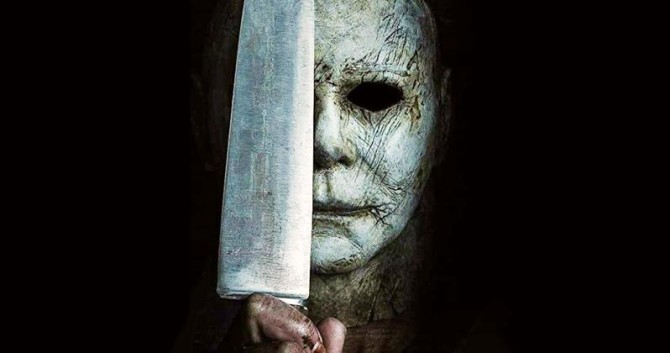
Premise: A continuation of the 2018 reboot of the franchise, Halloween Kills follows the immediate aftermath of Laurie Strode killing Michael Myers.
About: After Jason Blum waved his magic wand over the Halloween reboot, resulting in one of the biggest box office surprises of 2018, you knew that a sequel was coming. This movie is gearing up for big Halloween run, hitting theaters October 15th.
Writer: David Gordon Green, Danny McBride, and Scott Teems
Details: 116 pages
One of the reasons I don’t typically review sequel scripts is because they’re not relevant to you. As an aspiring screenwriter, you’re trying to get your first script through the system. If you are so lucky as to ever be able to write a sequel to one of your scripts, you will have achieved what .0001% of the people who ever come to Hollywood achieve. So why write a review geared to such a tiny percentage of people?
Well, I’d argue there’s something to learn when it comes to SSS (Sequel Suckage Syndrome). From Iron Man 2 to Matrix Reloaded to It Chapter 2 to Jumanji Welcome to the Jungle. I could go on. Something in the sequel DNA seems to invite lameness. So, what if we could identify that lameness and make sure we don’t make the same mistake in our original scripts? That knowledge could come in handy.
Halloween Kills takes inspiration from its 80s roots, specifically The Karate Kid Part 2 and Back to the Future Part 2, starting IMMEDIATELY AFTER the events of the previous film. If you don’t remember what happened, 70 year old Laurie Strode lured Michael Myers to her remote house into her basement “kill box” which she’d designed specifically for him. She then shot him and lit the house on fire.
You would THINK that Laurie would’ve learned by now that bullets and fire don’t keep Michael Myers down. And in a scene that felt more like a Jason Statham movie than a horror flick, a group of firefighters try to put out the fire, only to get their brains splattered over the walls by Mister Myers.
Meanwhile, Laurie (who doesn’t speak a full sentence in this movie until page 60, by the way) is hurried to the hospital to deal with her wounds from the Myers showdown. Once Laurie, her daughter (Karen), and her granddaughter (Allyson), get situated in the hospital, we jettison across town to a bar where we meet some random people named Lonnie, Marion, Lindsey, and Tommy. I couldn’t tell these characters apart if you gave me an entire week to study. But I think they’re one of the last few people in town who remember what Michael Myers did to this place. So they’re gathering to “remember.”
When word leaks that Michael escaped (keep in mind nobody in town yet knows that Laurie had this big fight with Michael Myers – we’re only a couple of hours removed from the events of the last film), the “Michael Rememberers” head out into town to try and find him. While you’d think that Michael would need to rest after getting shot and set on fire, he goes right back to picking off naughty members of society, killing a farming couple experimenting with their new drone. Then a few high schoolers back in the middle of town. Michael’s got to keep adding to that body count! No rest for the weary.
When granddaughter Allyson learns that Michael’s still out there, she becomes convinced she knows where he’s going – BACK HOME. So she grabs her mom, Karen, and they head to the Myers household to finish what grandma started. As you would expect, (spoilers) this turns out to be a very bad idea and Michael is able to handle them easily. He then grabs Karen’s phone right as Laurie tries to call her. Laurie is met with an intense breathing on the other end. She knows it’s Michael. And she tells him… SHE’S COMING FOR HIM!
What’s the number one reason sequels suck?
NOT ENOUGH TIME TO WRITE THE SCRIPT.
That’s it.
If you want to boil it down to one issue, that’s the one.
If you want to get more specific, lack of time leads to messiness. Sequels always feel clunky. After the first 15 minutes, scenes start to lack organic transitions. We’ll be in a bar watching two people fight then jump across to two doctors talking in a hospital. There’s a connection only in the vaguest sense. But, mostly, it feels like the writers are making up the story as it goes along.
Also, without time, you don’t have the opportunity to fix your biggest errors. And Halloween Kills has a HUGE error. It doesn’t have a main character!!! Yesterday we discussed the effects of a weak main character. But I’ll take a weak main character over NO MAIN CHARACTER any day of the week.
Laurie is sidelined to coma duty for most of the movie, which leaves us wondering who’s driving the plot. In a sense, it’s Michael. He’s the one who needs to be stopped and, therefore, the audience understands the goal. But they don’t have a principle character who they can follow as he/she tries to achieve that goal.
Allyson is the one here who has the final battle with Michael. But Allyson spends the first half of the movie tending to her grandmother. Static. In a hospital. I feel like a broken record saying this but one of the worst things you can do to your script is create characters who stand around.
It’s a movie. You want your characters going out there and doing something.
Strangely enough, we do have that here. But it comes via the barfly brigade of Lonnie, Marion, Lindsey, and Tommy, four characters I have no feel for and, quite frankly, have no idea why they’re in the script. They just show up at a bar and babble about Michael Myers as some vague entity who did bad things 40 years ago. These cannot be your protagonists.
But this is what happens when you rush a script. It’s messy. You’re just trying to get some semblance of a story down.
What sucks is that they hinted at a much more interesting story. The police kept referencing that in the bus crash (where Michael escaped), that there was a second murderer who escaped as well. So I thought they were going to pull a James Cameron where he stands in front of the studio execs, writes down on the white board: Michael Myers…….. waits dramatically, and then adds an extra ’s.’
“Michael Myers’s.”
But on serious note, two killers gives you more options. You could’ve used the second killer as a decoy. Maybe he has a mask as well and masquerades as Michael, confusing the authorities. Possibly even leading to a fake-out ending where they think they kill Michael, only to realize they killed the other guy, and the real Michael is back at the hospital. You also could’ve had Michael fight the other killer. That’s unique and something we haven’t seen from the franchise yet. But despite mentioning this other killer half a dozen times, he never shows up in the movie. Weird.
It’s crazy to me. The failure of today’s and yesterday’s scripts boil down to very standard screenwriting errors. A passive main character (Army of the Dead) never works. Especially in an action movie. And a lack of a main character is one of the hardest types of screenplays to pull off, especially in a Hollywood movie, where GSU is demanded. You can’t have the G (goal) if there’s no C (character).
So that’s the lesson I would leave you with today. If you are in a situation where you have to write a script fast, make sure the foundations are in place. Strong interesting main character, clear goal, high stakes, plenty of urgency. Cause if that stuff isn’t in place, you don’t have a chance. Which is what we saw today.
[ ] What the hell did I just read?
[x] wasn’t for me
[ ] worth the read
[ ] impressive
[ ] genius
What I learned: If the bulk of your movie has your key characters standing around, I STRONGLY RECOMMEND YOU RETHINK YOUR MOVIE.
Genre: Action/Horror/Zombie
Premise: A team of misfits is tasked with going into a zombie-infested Las Vegas to retrieve 200 million dollars locked in a safe in the basement of a casino.
About: Army of the Dead is one of Netflix’s biggest releases ever and mega-director Zack Snyder’s follow-up to Justice League. Co-writer Joby Harold started his writing career with the 2007 Hayden Christensen film, Awake. He would later write King Arthur: Legend of the Sword. Co-writer Shay Hatten was just 26 years old when he wrote this and even younger when he wrote John Wick 3.
Writer: Story by Zack Snyder. Screenplay by Shay Hatten and Joby Harold
Details: 2 hours and 20 minutes long
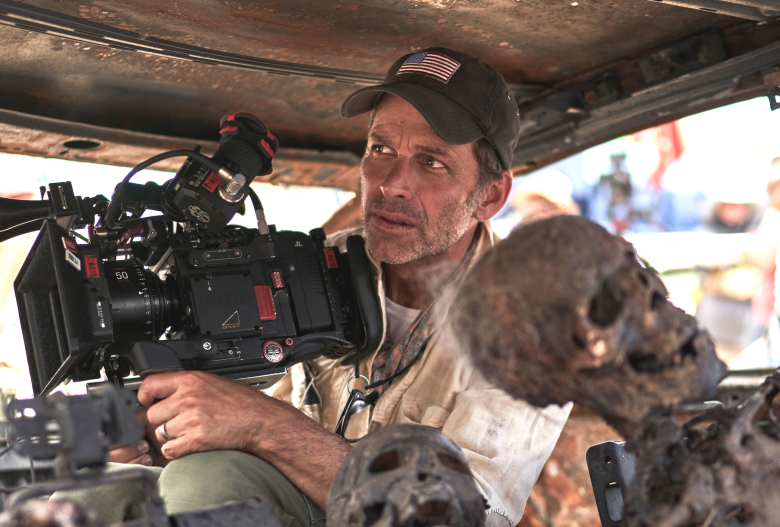
One of the most frustrating things when watching a movie is being out of tune with the director. A director is not unlike someone you meet at a party. Sometimes you gel with a person – you like their sense of humor, you have similar interests, you like their opinions on things – and other times you get stuck with someone who feels like they live on a different planet from you – they bring up boring topics, they have an odd sense of humor, they rave about TV shows you wouldn’t touch with a ten foot pole.
That’s not to say I’m the “right” guy at the party and the other person is “wrong.” It just means we see the world differently. That’s how I feel whenever I watch a Zack Snyder movie. Every choice he makes feels bizarre to me.
For example, one of the things he kept doing in this movie was not light his actors. There’s a specific reason why this is irritating. I want to see the characters’ faces! I want to see every little nuance, especially if the scene is an emotional one.
There’s a scene about 30 minutes into the movie where Dave Bautista is talking to another character late in the day. Snyder adjusts the camera to focus on the sunset and not on the actors to the point where it’s very hard to make out Bautista’s expressions. It’s annoying and actively works to hurt the scene.
And that doesn’t even touch on the bigger problems I have with Snyder, such as his over-reliance on melodrama. His over-reliance on slow motion and dramatic score. His pretentiousness. This is a man who wanted to not only do a four hour Justice League cut, but reframe it in 4×3 (television) format for no reason, then make the entire thing black and white. That’s the trifecta of pretentiousness right there.
The best thing about Army of the Dead is its setup. After a military caravan carrying top secret cargo crashes in the desert, the cargo, which turns out to be zombies, overwhelms the caravan before hightailing it to nearby Vegas, where they infect the entire city. The military walls up the city to keep the zombies inside and schedules a tactical nuclear strike in a week.
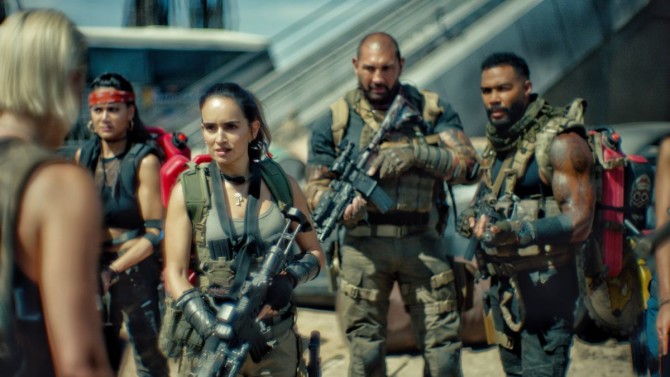
A group of mercenaries, led by former soldier Scott Ward (Dave Bautista), is then tasked by a rich Japanese man to get inside the city, head to a casino, and break into its safe, where 200 million in cash is sitting. Scott recruits all his old buddies, some above board, most of them below it, and off they go into a seriously zombie infested Vegas.
When they get there, they realize there’s a sort-of “zombie hierarchy.” There are regular zombies and then there are “Alphas.” The alphas seem to be able to communicate and plan. They also have super strength, which I suppose is why the military was interested in them. At the very top of the food chain are the King and Queen zombie. Do with that what you will.
Long story short, we eventually learn that the Japanese businessman never wanted the money. He wanted the queen zombie’s head. I think because it would give him access to the military’s secret sauce of turning people into killing machines. Unfortunately, the group falls apart quickly, divided off into their own little sub-groups, where they get picked off one by one. In the end, the original goal goes out the window and the only thing that matters is getting out of Vegas alive.
This is a cool concept right?
I love the idea of mixing a zombie movie with a heist movie. The exotic location of Vegas is a perfect backdrop for a zombie flick. The task actually makes sense for once in these movies. Of course there would still be money in Vegas. Of course people would try and get their hands on it before the city blew up. Conceptually, this is strong stuff.
So why was the movie so bad?
There are a few reasons.
The biggest is that, under no circumstances, can your hero ever be the 6th or 7th most memorable character in your movie. I’m not sure what the writers were doing with Scott Ward. I think they wanted to make him a big softie. Touchy-feely type. Whatever led to that choice hurt this movie bad. Because Ward barely says anything. When he does speak, it’s soft and mumbled. He’s not particularly active. In many scenes, he drifts into the background.
I’ll give you an example. There’s a big scene when they first get into Vegas where their guide surprises them by “feeding” one of the assholes on their team to the alphas. She says this is necessary if they want permission to run around the city. It’s a long drawn out scene where she shoots the asshole, they wait for the alphas to come, and, finally, they come drag the asshole away.
During this ENTIRE SCENE, Scott Ward says nothing. During this ENTIRE SCENE, Scott Ward does nothing. Don’t you think the star of the movie – actually, scratch that – the LEADER OF THE GROUP should have an opinion about someone offering up one of their men to the zombies without his permission??? That moment solidified Scott Ward as an empty leader and weak character. I guarantee nobody who watched this cared about him after that moment.
The other big issue is the zombies. This critique is a little more complex, though. I’m the first one who will tell you that if you’re going to write a zombie screenplay, you need to evolve the mythology. So I get why we have alphas. I get why we have zombies who are stronger.
On the other hand, you have to understand why the mythology of anything has worked for so long and make sure that any changes you make don’t undermine that mythology. The reason zombies are terrifying is because they don’t reason. They are mindless. There is no horror situation more visceral than a horde of zombies closing in on a character with nowhere left to run. You’ve eliminated all that in one fell swoop with these intelligent scheming zombies.
Late in the script, we get this scene where one of the tougher soldiers gets cornered in a room with an “Alpha” zombie. The alpha decides… ehhh, I don’t want to bite you. I want to FIGHT YOU. So him and the alpha zombie fight. Is this a fresh new way to deal with zombies? Yes. Does it make the zombie mythology better? Not even a little bit. Once you have a strong intelligent zombie who wants to fight you, you no longer have a zombie. You have a human. You can put as much makeup on him as you want. But he’s the same as a human.

Even when Army of the Dead occasionally locked into a good moment, it would screw it up. There’s a potentially great scene where the team enters a hallway that’s packed with zombies. But the zombies are all frozen for some reason. Someone says, “Oh yeah, they’re hibernating. We can walk through them just don’t make any sudden movements.”
Having to walk through a packed crowd of sleeping zombies who could wake up at the slightest noise is a great scene idea. The problem is, they didn’t set it up. You need to set stuff like this up beforehand for it to fire on all cylinders. You needed a scene 15 minutes earlier where they’re walking through a room and there are a couple of zombies not moving and THAT’S when someone says, “Oh yeah. They’re hibernating.” This establishes the hibernating premise so it’s an official part of the mythology.
That way, 15 minutes later, when they see the crowd of still zombies, the audience already knows what’s going on. They know this is a group of hibernating zombies. They know this is going to be terrifying getting through them. And it all feels more natural because the rules have been established. Telling us all of this at once creates a “making it up as we go along” feel to the storytelling that turns audiences off.
Despite half its running time being in slow motion, the movie did have a few nice moments. (Spoilers) One of my favorites was when Scott had this really intense heartfelt conversation with his ex-girlfriend and in the very next moment, a zombie walks over and, while the ex was turned away from Scott, grabbed her head and spun it around, cracking it, so that it finished facing Scott. I certainly didn’t expect that to happen!
And there were a few other funny moments with the crew. But, all in all, Snyder’s incessant indulgences as a filmmaker mixed with superhero zombies and an inability to spot a protagonist that needed a complete reimagining, doomed this movie. Which is too bad. I was hoping to have fun with this one.
[ ] What the hell did I just watch?
[x] wasn’t for me
[ ] worth the stream
[ ] impressive
[ ] genius
What I learned: The worst thing you can do in these movies is have the audience know exactly who’s going to survive. Kill off people they don’t expect and you will have the audience on guard. Army of the Dead succeeded in this department. I was positive the ex-girlfriend was going to live. And the second she didn’t, I perked up. Because I realized I was no longer going to be able to predict what happened next.

Don’t write a single paragraph in your script that’s more than three lines long – You are writing a spec script and you are an unknown screenwriter. Those two things equal an impatient reader. Never give them an excuse to give up on your script. Keep the action lean so the eyes fly down the page.
Cut out 50% of your backstory – We tend to think the audience needs more information about the hero’s past than they do. Only include the BARE MINIMUM of backstory and not a word more. Have you ever heard of a movie called Chinatown? Won a few awards. Considered by some to be the best screenplay ever. Did you know that in the original script there was this big long monologue from Jake (the main character) about this terrible thing that happened to him in Chinatown? But, ultimately, Robert Towne realized it wasn’t important for anybody to know. So he cut it. If the monologue that explains why a movie is titled what it is can be cut, you can certainly ditch all the excess backstory in your script.
Give your three biggest characters AMAZING IMPOSSIBLE TO FORGET introductions – I’ve read so many scripts where I’ve forgotten the second or third biggest character in the script. And when I go back in the script to figure out why I forgot them, it’s almost always because they had a weak introduction. It should go without saying that your hero needs a big memorable introduction. But it’s also the case for your second and third biggest characters. Don’t introduce them as, “Brenda, 25, bright and fun” and then have them say two lines in the scene. Give them an action or a difficult choice or a monologue or SOMETHING that makes them instantly memorable. Go check out Clementine’s introduction on the train in Eternal Sunshine of the Spotless Mind. Tell me you don’t remember that character instantly.
Either your villain or your hero needs to be pushing the story forward – If any other characters are pushing the story forward, you’re probably doing it wrong. You want to either put the plot on your hero’s back, meaning he’s carrying the plot forward (Arrival – Decode the alien’s language) or the villain’s back, meaning he’s trying to accomplish something (The Invisible Man – the dead husband attempts to drive his ex-wife insane). Often in movies, it’s the villain who will carry the plot initially (Darth Vader in Star Wars – retrieve the stolen Death Star plans) and, at some point, the hero will be the primary carrier (Luke is determined to save the princess and, eventually, blow up the Death Star).
In a key scene, write your hero into a corner that even you don’t know how to get them out of – I can’t stress this one enough. Too many writers write their heroes into “difficult situations” that aren’t difficult at all because they knew how they were going to get the character out of the problem from the get-go. If you already know how to get them out of the problem, chances are the reader does as well. You want the opposite effect. You want the reader to think, “How the hell are they going to get out of this pickle?” If you don’t know, they won’t know. Yes, it’s harder to figure out how to get them out of that pickle. But nobody said writing was easy.
Give your scenes a beginning, middle, and end – Too many writers these days rush through scenes, creating scene fragments. Treat each scene like its own little mini-movie, even if it’s short. Give it a setup (character goal), some conflict (something gets in the way of the goal), and a resolution (they either succeed or fail at obtaining the goal). So, for example, maybe a cop is trying to extract information out of a witness to a murder. That’s the goal: to get the information. However, as soon as he starts asking questions, the witness is worried about incriminating herself. She wonders out loud if she should have a lawyer present. The cop assures her that they’re just talking. Nothing she says is going to get her in trouble. But now she’s on guard, not as open (conflict!). Finally, the cop either gets her to give him the information or fails. The scene is over.
Eliminate AS MANY ACTION LINES BETWEEN DIALOGUE LINES as is humanly possible – Readers love uninterrupted dialogue. They hate when Joe says something to Jane, then you tell them that Joe lights a cigarette, then you have Jane respond. “But Carson. What if it’s important to show that he lights the cigarette?” Nobody cares if your character is smoking a cigarette. The exception would be if the cigarette plays into the scene later, such as it accidentally starts a fire. If you must tell them, tell them before the dialogue begins, not during. And this goes for any ultimately unimportant action.
Eliminate every single dialogue line where your character is talking directly to the reader – For example, if it’s important that the audience know that the hero’s mother is dead, don’t have them say, “That reminds me of when my mother died. I still don’t know if I’m over it.” Look for another solution. Maybe your hero saved his mother’s last voicemail to him and he plays it whenever he misses her. “Hey Brett, it’s me. Just checking to make sure you and Liz are still coming for dinner tonight. Dad’s looking forward to meeting her. Love you. Bye.”
As the rewriting process goes on, place heavy emphasis on the third act – Whenever we write a script, we prioritize the first act. We rewrite it over and over and over again because it’s the first thing we see when we open the script. Meanwhile, our final act gets neglected. Technically speaking, your final act is usually 4-5 drafts behind your first act because you haven’t spent nearly as much time on it. So stop obsessing over making those first few scenes perfect and spend that time getting your third act up to speed. It almost always has catching up to do.
And the hardest tip of all….
Hold yourself to a higher standard with every single scene – Grade every scene in your script HONESTLY on a scale of 1-10. Do not show anybody your script until every scene is at least a 7. Preferably, it should be an 8 or higher. If you hear yourself thinking stuff like, “But this is just a normal scene to get my hero from A to B. It’s not meant to be special.” That’s a good sign you either need to get rid of the scene or rewrite it. You want every single scene to be entertaining. For reference, the average scene I read from an amateur screenwriter is a 4. The scenes aren’t unique or entertaining at all. They’re just moving the story along without the drama required to keep the reader engaged.
Today’s screenplay cleverly combines the core relationship of Terminator 2 with the wacky video game premise of Jumanji: Welcome to the Jungle.
Genre: Action/Adventure/Comedy
Premise: After a marauding warrior from a popular video game dies, he is reincarnated in our world and discovers the god he’s always worshipped turns out to be a 13-year-old Asian kid from New Jersey.
About: I was just talking about this project on Monday. It’s the spec script Amazon picked up from Jeff Chan and Andrew Rhymer for high six-figures. David Leitch, who is not so quietly building an empire, is producing. It’s amazing how fast your star can rise in this town. This guy was a life-long stuntman. Now his movies are responsible for over 2 billion dollars at the box office and he’s producing everything in town. Yowzers!
Writers: Jeff Chan & Andrew Rhymer
Details: 111 pages
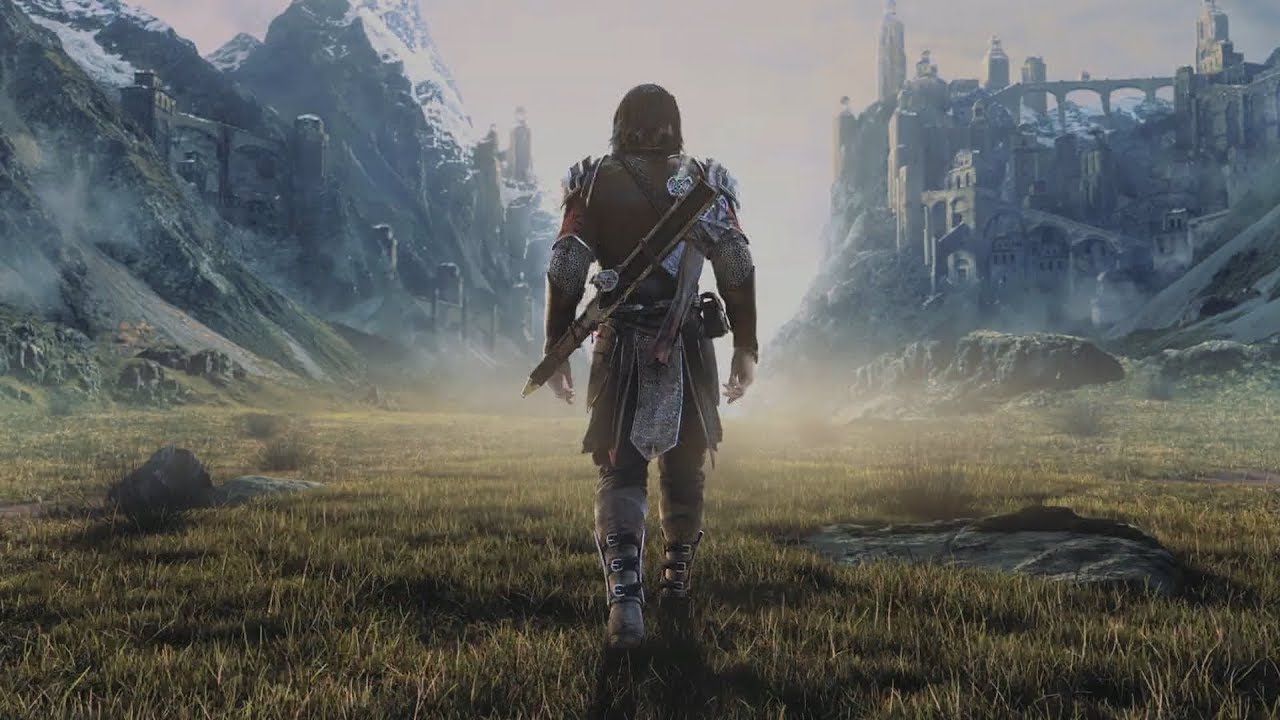
I’m a sucker for these concepts. I love when people from one realm are dropped into another realm. I loved Enchanted’s concept. I thought Jumanji: Welcome to the Jungle was fun. Elf was a classic, of course. Fish-out-of-water ideas are some of the best ideas you can come up with because they’re a perfect fit for the movie formula.
I liked what today’s writers did. They basically looked at Jumanji and said, “What if we went in the other direction?” Take a character from the game world and place them in the real world. When screenwriting websites tell you to come up with ideas that “are the same but different,” this is exactly what they mean.
If Johnson and Chen had instead came up with an idea about four female friends who get sucked into a video game, that would’ve been “the same but the same.” That’s how most writers think. Their ideas are only one degree different from the idea that inspired them. You need to go two or three degrees before you get into “same but different” territory.
13 year old Edwin from New Jersey has found solace from his father’s cancer bout in the video game, Lord of Etyrium. He plays all the time with his best friends Benji and Soo. But when Edwin’s father dies, Edwin becomes too violent within the game. He has his hulking character, Valor, kill a bunch of peaceful troglodytes. Or kick down the wall to one of the cities, exposing everyone to monsters and beasts.
After a while, Benji and Soo don’t like playing with him anymore. This sends Edwin even deeper into the game. Here, he continues Valor’s violent streak. That is until his mom screws up the game, accidentally killing Valor. A depressed Edwin is sitting around the next night when a mysterious person from online sends him a special file. Edwin opens it and Valor appears in front of him in his room! “What strange realm is this?” he asks. “It’s New Jersey,” Edwin answers.
Valor is determined to head out into New Jersey and kill as many people as possible. Why wouldn’t he? Edwin has instilled him with violence. Edwin does everything he can to calm Valor down. And that’s when he learns that Edwin is “the” Edwin – the god that controls him! Valor swears allegiance to Edwin, agreeing to help him with anything he needs. Edwin shrugs his shoulders and thinks… hmmm. And so off to school he goes to have Valor scare the shit out of some bullies. Valor even helps him tap into his masculinity and ask a girl out!
Unfortunately, the NSA gets word that a hulking barbarian man is running around New Jersey scaring the crap out of people. Which, it turns out, is just the latest in a series of strange things happening around the state. It turns out whoever sent Edwin that file sent it to other players as well. Valor is just one of several beasts wreaking havoc. With the NSA on his tail, Edwin must enlist the help of his former friends to find the porthole back to Etyrium so he can send Valor back before he’s killed!
There’s a fine line between what makes these concepts work and not work. When they don’t work, they seem so silly as to be ridiculous. When they do work, they can be magical. And Valor works.
The scene that convinced me this was a real script and not someone fudging their way through a fun concept, happened around the halfway point. Valor asks Edwin why he’s so depressed and Edwin confesses that his father recently died. Here’s Valor’s response…
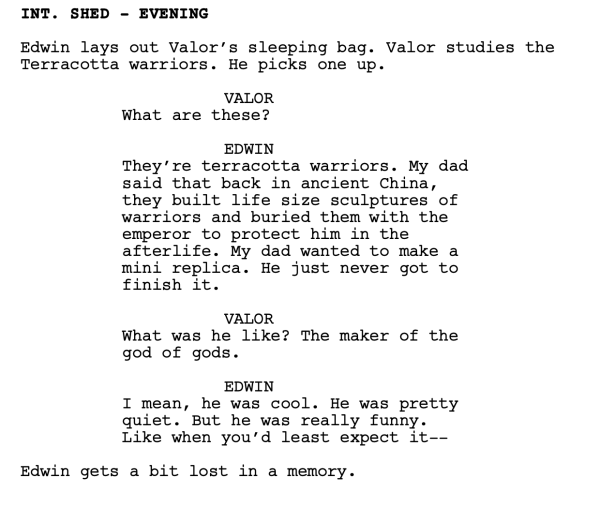
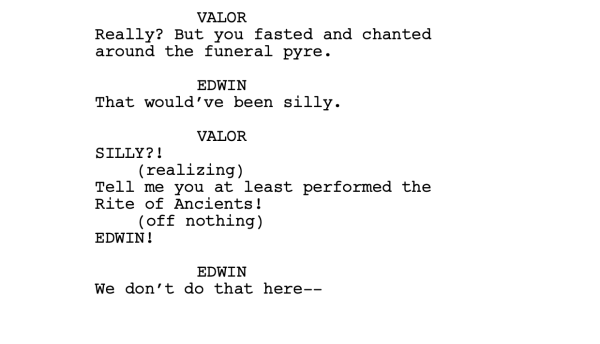
Valor then convinces Edwin to go out into the street and perform this ritual. Of course, since Valor is socially clueless, he starts belting the ritual at the top of his lungs. Edwin, meanwhile, is begging him to go back inside. But Valor keeps yelling at him to participate. Which only makes Edwin more embarrassed. But Valor keeps pushing and pushing until Edwin joins in, gradually losing himself to the ritual and having a massive breakthrough/breakdown where he finally mourns the loss of his father.
It’s a wonderful scene for a few reasons. But the main one is the contrast. Whenever you’re writing a big scene, you’re always looking for contrast. If it’s a light scene, you’re looking to contrast it with darkness. If it’s a dark scene, you’re looking to contrast it with lightness. If Valor had stayed in Edwin’s room with him, patted him on the back, and told him his dad loved him, it would’ve been the worst scene you could’ve possibly written. It’s the fact that the writers contrasted the sadness of losing a father with this big goofy video game chant that makes the scene a winner.
The real winner of the script, though, is Valor himself. He’s really funny. He’s so dialed in to the world of Etyrium that virtually everything he says is hilarious. Like when Edwin wakes up one morning, Valor is mischievously holding the neighbor’s dog. Edwin asks him what he’s doing. “I was about to slay this feral hound as a blood sacrifice to you. We can use the remains for a morning stew!” He’s got about 50 lines like that.
The only problem I had with the script was that it didn’t establish a goal for the characters until too late. It would’ve been nice if they had some adventure to go on here on earth, at least to give the characters a goal. But the only thing driving the plot through the first half of the screenplay was the NSA chasing them, which didn’t have much impact because it took them too long to figure out where Valor was.
Eventually, we learn that the goal is to get Valor back to his world. But that goal shows up around page 75. We needed it a lot earlier. Still, I can see why Amazon bought this. It’s perfect Lord of the Rings adjacent programming (Amazon is spending 1 billion on a Lord of the Rings show). But even without that, there’s so much potential for a franchise here. You have so many directions to go with a sequel. I can already imagine tons of creatures from Etyrium entering our world, leading to a giant battle. Which would be expensive. But guess who has lots of money?
[ ] What the hell did I just read?
[ ] wasn’t for me
[xx] worth the read
[ ] impressive
[ ] genius
What I learned: On Deadline.com, this was the logline for Valor: “After a marauding warrior from a popular video game dies, he is reincarnated in our world and discovers the god he’s always worshipped turns out to be a 13-year-old Asian kid from New Jersey adjusting to life with a single parent.” You’ll notice that, in the opening logline I used, I eliminated “adjusting to life with a single parent.” Why? Because you want to end your logline with a BANG. Not a dragged-out whimper. The “bang” is the shock of the god being a 13 year old Asian boy from New Jersey. Every word you add after that weakens the logline. Nobody wants to read, “Superman is tasked with stopping a group of evil aliens hellbent on destroying our planet… and also some people in his life are starting to realize he’s Clark Kent.” Why would you ever include that last part? END YOUR LOGLINE WITH A BANG!!!!
Carson does feature screenplay consultations, TV Pilot Consultations, and logline consultations. Logline consultations go for $25 a piece or $40 for unlimited tweaking. You get a 1-10 rating, a 150-word evaluation, and a rewrite of the logline. They’re extremely popular so if you haven’t tried one out yet, I encourage you to give it a shot. If you’re interested in any consultation package, e-mail Carsonreeves1@gmail.com with the subject line: CONSULTATION. Don’t start writing a script or sending a script out blind. Let Scriptshadow help you get it in shape first!