
Search Results for: F word
These sci-fi submissions did not make the Science Fiction Showdown. Find out why!
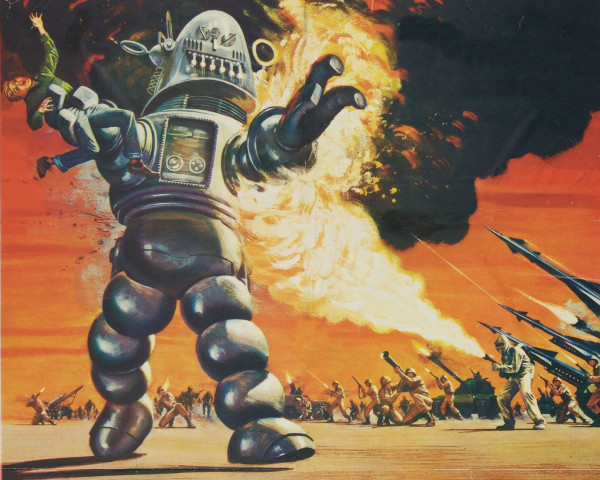
One of the most frustrating things that writers go through is sending their scripts out there only to get rejected time and time again, and having no idea why. I had two instances this week where writers e-mailed me and wanted to know what they were doing wrong.
In one instance, a writer said they had sent their script out to half a dozen contests but that it didn’t advance in a single one. What was wrong? The other writer conceded that his concept wasn’t very good but that if I’d read the script, I’d realize how amazing it was. I sympathize with both of these writers. You spend months, sometimes years, working on a script and then nobody seems to care. You feel like you’re doing something wrong but you don’t know what.
Well, I’m going to clear it up for you. There are two areas you have to execute to break into this business and they must be completed in order. One, you must execute the concept (come up with a compelling concept that makes people want to read your script). And two, you must execute the script (write a script that entertains from the first page to the last). Except for rare situations, it doesn’t work when you only execute one of these.
The reason you need to execute the concept first is because it doesn’t matter that your script is genius if nobody wants to read it. A lot of writers turn a blind eye to this reality. They convince themselves that as long as they write a great script, it won’t matter. Well, it does matter because you need to get people to read the thing and they’re not going to read the thing if it sounds boring.
If you pass that test, the hard part begins because, now, you have to keep people entertained for 110 straight pages and even the best writers in the business struggle to do that. Most amateur screenplays I read fall somewhere between “sub-par” and “average.” That won’t do. I’ll say it again. As an amateur writer – someone who isn’t getting the benefit of the doubt – you have to entertain the reader on page 1, page 2, page 3, page 4, page 5, all the way to page 110. You don’t get any pages off.
But again, none of that matters if you don’t get the concept right because people aren’t even going to give you their time if you don’t do that. Look at the concept that won Amateur Showdown last week. “When a photosensitive alien force blacks out the sun, a dysfunctional family must survive together in a perpetually dark world full of predatory creatures, while trying not to lose the only thing that can protect them: the light.” That’s a movie concept right there. You can see that trailer. You can see that movie making money.
I don’t think enough writers think of concepts that way. They come up with something they think is cool and turn a blind eye towards what anyone else thinks of it. To that end, I’m going to go through some of the sci-fi concepts that were submitted to me for Sci-Fi Showdown and take you into my head as to why they didn’t pass the “concept” test. I’m hoping to not only help the writers who sent these in. But to show you, the readers, how people receive ideas and what makes them say yes or no. Let’s take a look…
Title: The Billionaire Battle Royale
Genre: Sci-fi, Action, “Dystopian”
Logline: 2045–in a world that has combated wealth inequality by hosting an annual fight to the death between billionaires, the inner circle of the world’s richest man tamper with the event to ensure he loses.
Analysis: This one falls under a category I occasionally see with concepts which is that it’s presented as a serious story when it sounds like it could be a comedy. I imagine 2045’s version of Elon Musk fighting 2045’s version of Jeff Bezos and there is nothing in that scenario that makes me think I could take it seriously. On top of that, the central conflict isn’t very interesting – one of the teams ensures their guy loses. Feels like you could come up with a way bigger conflict than that. There are shades of The Purge and Hunger Games here that might entice some. Curious what others think of this idea.
Title: Surrogate
Genre: Contained Sci-Fi/Thriller
Logline: To pay for an exhibition, a starving fine art photographer agrees to be a surrogate for a wealthy couple, but confined to a lavish house, her mind and body start to unravel.
Analysis: One of the more common movie concepts I get sent is characters going crazy. What I’ve found is that these scripts are extremely execution-dependent. Coming up with a story where someone gradually loses their mind for 100 pages is a lot harder than you think. In my experience, almost all of these scripts go off the rails, becoming muddy and uninteresting the further the protagonist progresses into crazyville. Also, this logline isn’t doing the concept any favors. It doesn’t tell us WHAT is going on in the house to cause her descent into madness. Which means that the only thing we have to go on is that she’s stuck in a house. That isn’t very compelling to me which is why I didn’t pick this.
Title: Astaroth’s Children
Genre: Sci-Fi/Horror
Logline: When stranded on an abandoned space station, a crew of military freelancers encounter the survivors of a horrific scientific project gone wrong. Unable to contain the effect, an agoraphobic engineer must destroy this threat to humanity’s existence.
Analysis: The reason I passed over this is pretty simple. It sounds like every video game ever. Resident Evil. Doom. Halo. You can’t just repackage the same movie (or game). You gotta give us something different. There wasn’t anything in this concept that made me think I haven’t already seen this story before. That’s something you gotta think about when you’re putting together your logline (preferably before you write the script). Does this sound too much like other movies we’ve seen? If so, you may want to think twice about writing it.
Title: Infiction
Genre: Sci-Fi
Logline: A female con artist is allowed to ply her trade against an alien group in human form to help them grasp humanity’s evolutionary need for fiction.
Analysis: I read this logline several times and struggled to understand it. By the way, this is one of the biggest reasons to get a logline consult. To see if your logline is clear. A female con artist is allowed to ply her trade? Her trade of con-artistry? Or a different trade? “against an alien group in human form” – had to read that several times to understand it. “to help them grasp humanity’s evolutionary need for fiction.” The stakes of the story are that aliens want to know why we write books like Harry Potter? The stakes need to be much higher than that for a movie.
Title: Future Shock
Genre: Sci-Fi Thriller
Logline: New York’s last ‘accountable’ cop has one night to find four prison-escapees fitted with pacemakers designed to kill them if they leave the city.
Analysis: The idea seems to contradict itself. Four people have escaped prison. Presumably, their goal is to flee the city. A cop must stop them from fleeing the city. But why is he needed if they’re all going to blow up the second they try to leave the city anyway? Problem solved, right? Unless this is a movie about saving bad people from dying. But that doesn’t seem to be the writer’s focus. Wouldn’t this work better if one of the prison escapees was the protagonist? Also, don’t put quotes around words unless it’s clear why you’re doing so. I’m not sure why ‘accountable’ needs quotes around it. This may seem like a nitpick, but every single script I’ve read where someone has put quotes around a random word in a logline has been bad.
Title: E-TEN
Genre: High concept/Sci-fi/contained thriller
Logline: An insecure hotel janitor and 5 other guests are held captive in a small library where a mysterious voice tells them to find the perfect political system for humanity under 90 minutes if they don’t want to be gassed to death. Things get out of control as they soon realize the game is hiding a traitor…and an axe.
Analysis: There’s nothing realistic about this setup. Why would someone pick six random people and tell them that if they don’t solve something that nobody’s been able to solve in 4000 years, they’re all going to die in 90 minutes? Why would you think these people were capable of doing this? And why so dramatic? If coming up with the perfect political system is important to you, wouldn’t you want to give them an adequate amount of time to do so? This concept didn’t make sense to me.
Title: Earthbound
Genre: Sci-fi
Logline: When an inmate in a prison orbiting Neptune finds that she’s pregnant, she begins a desperate attempt to escape and reach Earth, a place she’s only heard rumors about.
Analysis: This is one of those ideas that kind of sounds like a movie. But my first question after reading it was, “Why did you wait until now?” If getting to earth was important to you, then try to get to earth regardless of whether you’re pregnant or not. Now, if what you’re saying is that she needs to get to earth because they’re going to terminate her baby the second they realize she’s pregnant? Or if she knows the only chance her child has if she raises it on earth, well then that needs to be included in the logline. And the fact that it isn’t included in favor of the vague, “a place she’s only heard rumors about,” indicates to me someone who hasn’t written enough to know how to craft an effective logline. I know every writer hates writing loglines because of this very reason. What do you choose to include or not include? But the thing about loglines is that if you stay in the game long enough, you figure out how to write them effectively, and so when I read a good logline, I know that’s a writer who’s been at this for awhile and knows what they’re doing. In the past, when I see little mistakes like this, I’ve found that the script reflects those mistakes. It has problems as well. And while “Earthbound” may very well be the exception to the rule, I’ve been burned too many times to take a chance on it.
Title: REMOTE
Genre: Sci-fi Drama
Logline: A dysfunctional family’s devoted android confronts the true nature of his role in humanity’s impending demise.
Analysis: This logline starts out okay. But then it becomes waaaaay too general. We go from a “dysfunctional family” (a very contained story) to “humanity’s impeding demise.” Where’s all the stuff in between? Remember, a logline isn’t supposed to tell people the generalities of the story. It’s not a teaser. It’s supposed to tell you the specifics of the story and what’s going to happen. I have no idea what happens in this story (which is the problem) so I can’t accurately fix this logline. But here’s an example of a more specific version: “A dysfunctional family’s devoted android must find and destroy its maker before being updated with the latest software, which will have it turn on and kill its family.” That’s admittedly a dumb idea but do you see how specificity in the plot explanation creates a clearer movie than “confronts the true nature of his role in humanity’s impending demise?” There are actual specific tasks being alluded to, something the reader can visualize.
Obviously, subjectivity plays a role in picking loglines. So my analysis here should not be seen as the end all be all. But this is a pretty accurate breakdown of how your loglines will be received. Do some market research BEFORE you write a script. Send your friends five loglines and ask them to rank them 1-5. What happens when you’ve spent 6 months on a script is that you become emotionally attached to the idea and can’t see it clearly. Whereas when you’re still in the idea stage and several people tell you the idea isn’t good, it’s easier to let it go.
Curious to see what you guys thought of these loglines. Did I overlook any?
Are you sending your screenplay out into the world without getting professional feedback? That is dangerous, my friend. I can tell you exactly what they’re going to criticize you for and help you fix those problems ahead of time. I do consultations on everything from loglines ($25) to treatments ($100) to pilots ($399) to features ($499). E-mail me at carsonreeves1@gmail.com with the subject line “CONSULTATION” if you’re interested. Chat soon!
Today’s horror experience has me convinced there should be another Scriptshadow Showdown before the end of the year. Details coming soon!
Genre: Horror
Premise: After losing her baby, a young woman starts to have visions of a mysterious killer massacring his victims.
About: This one comes from James Wan, he of Aquaman fame. Wan is jetsetting back to his horror roots! Malignant only made 5.7 million at the box office this weekend but it’s tough to judge that number since it was available on HBO Max for free. Malignant also decided to keep its twist out of the marketing, which was a brave move, seeing as doing so would’ve, at the very least, doubled its revenue.
Writers: Story by James Wan and Ingrid Bisu. Script by Akela Cooper
Details: 110 minutes

When I pressed play on this movie, my first thought was, “Why the hell is James Wan going back to horror???” He’s directed Fast and Furious movies. He turned a so-so superhero into a billion dollar franchise. As much as I love horror, it is the stepping stone genre to bigger and brighter pastures. It didn’t make sense for someone this big to go back to it.
But after doing a little digging, I learned that James Wan’s wife came up with this idea. My assessment of the project immediately shifted upon hearing this news. Just to be clear, I don’t dislike when people in relationships work together. However, what I’ve learned is that it’s harder for a couple to see an idea clearly when they’re seeing it through the prism of, also, managing their relationship.
Two of the biggest movie stars in the world – Angelina Jolie and Brad Pitt – made a movie together and ten people saw it. Branjelina couldn’t see through their own relationship enough to recognize how boring their concept was.
For 90 minutes, while watching Malignant, I felt bad for James Wan. I figured his wife came to him with this idea. He wanted to make her happy so he agreed to direct it. He ends up having to release this unwatchable ridiculous horror movie… Good husband move. Bad artistic move.
But then something magical happens in Malignant. The twist arrives. And that twist is SO GOOD that it becomes the first twist in history to retroactively make the entire previous 90 minutes awesome.
In order to fully understand how this can be, you need to watch this movie. The film can’t be discussed without its twist. So I’m going to be discussing that here. You can read my review first. But you’re going to be robbing yourself of a really fun movie-watching experience.
The ridiculous plot of Malignant goes something like this. There’s this pregnant woman named Madison who was adopted as a child. She loses her baby when her abusive boyfriend beats her up. And now she’s trying to pick up the pieces in a creepy old house she moved into.
Meanwhile, a serial killer (or serial kidnapper) is out there killing and kidnapping people, then taking them back to his Hunchback of Notre Dame clock tower and stringing them up to the ceiling like a spider. I’m not kidding. This really happens.
From there, two of the cheesiest cops you’ve ever encountered in a movie try to find the killer. But they’re so bad at their jobs (not to mention talking to each other in a believable way) that they keep missing the killer. That is until Madison comes to them, with her sister in tow (who’s up for “Most Random Character of the Year”) and says Madison’s been having visions of the killer killing these people! The cops reluctantly bring her into the fold and start to get closer to finding the killer.
Meanwhile, Madison’s sister heads off to learn more about her adopted sister. She’s only recently found out Madison was adopted. This leads her to a psychiatric hospital and an old video tape of who her sister really is. And here, my friends, is where the big twist arrives. Spoilers ahead.
Have you ever heard about those people who have rare disfigurements where they have, like, some teeth and a nose partially growing out of their neck? Well, it turns out Madison had the most extreme version of this disfigurement. An entire second person was growing out of her back. And this disfigured thing had its own personality and everything.
So the hospital eventually had to cut the thing out. But, the only way they could do that was to shove the remainder of the thing’s face back into Madison’s skull. This “thing,” who calls himself “Gabriel,” has taken over her mind and is the actual serial killer. But it’s not just that. Since this thing grew out of her back, it’s learned to readjust Madison’s muscular-skeletal alignment and walk around backwards, resulting in some legitimately creepy offbeat physicality.
Madison finally recognizes that this thing has been taking over her body and fights back. But Gabriel isn’t letting the body go that easily. Only one of them will win out. Who will it be???
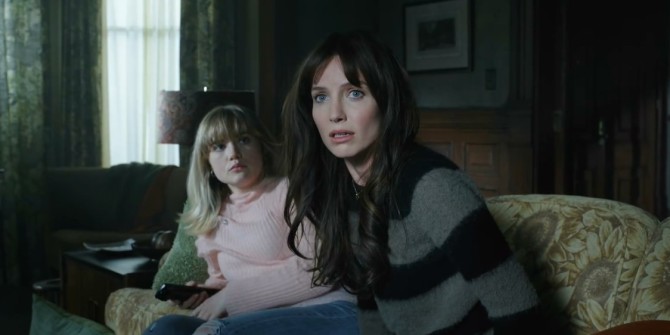
I don’t know how Malignant did it.
The second that image arrives on screen – where we see old footage of Madison, as a little girl, with this secondary monster thing growing out of her back – everything about the movie changed in an instant. It goes from stupid and nonsensical to “holy shit, holy shit, holy shit.” There’s this funny shot of the sister watching the video, horrified, that’s so over-acted, it’s ridiculous. And yet you’re reacting the exact same way she is.
But the genius of Malignant is that it doesn’t end with that shot. There are a lot of movie twists that don’t have legs. This one has ‘deadlift a thousand pounds’ legs. Because, while we’re watching this horrifying old video tape, we cut to Madison, who’s in jail with a bunch of women who are bullying her, and she turns around and opens up the back of her skull, allowing “Gabriel” to peek out, and she/Gabriel starts slaughtering everyone.
But not facing them. She kills them all backwards because Gabriel can only see out of the back of her head. This means that Madison’s bones need to twist and crack in a certain way so that they’re usable behind her. And that leads to an utterly unique fighting style that you’ve never seen before.
Why am I making a big deal out of this? Well, every horror movie these days either does the upside-down creepy crab-walk thing. Or they turn scary people backwards. But nobody ever comes up with a reason for why these people are backwards. It’s lazy writing.
The fact that these three figured out a way to not only have it make sense that the entity walked backwards, but then asked the question, how would something like this operate? And then built an entire backwards fighting style around it? – it was awesome. There’s no other word for it. I love when writers DO THE WORK and figure out why things are happening instead of throwing stuff onscreen with only a vague sense of how they work. They really thought about this character.
One of the creepiest images I’ve seen in a long time is when Gabriel takes over the body, Madison’s mind goes dead. So he’s running around, killing everyone, and, occasionally, we’ll spin around to see Madison’s face, which is in a dead stasis state. The fact that she’s doing these horrible things and is helplessly along for the ride was creepy as hell.
So how does it make the previous 90 minutes better?
Because once you realize how absurd this idea is, it allows you to not take everything so seriously. Any movie that ends with a functioning human tumor shouldn’t result in you getting mad because the cop character is boring. When you watch it a second time – which I plan to – you just laugh your ass off at the fact that this cop is such a tool.
Leading up to the movie, I kept hearing this word being bandied about – “bonkers.” Bonkers can either be a good thing or a bad thing. Sometimes people use the word for a movie that falls apart so spectacularly that they want to validate spending two hours on it so they say it was “BONKERS!” But Malignant really is bonkers. It’s so out there. It’s so weird. The movie is all over the place. I mean at one point they randomly show you that underneath the city is a second dead city that this city was built on top of. And then they just keep going on with the movie and never mention it again. It’s so silly and so stupid and so random. But I dare anyone to watch it and not be riveted by the third act.
The confusing thing is that so many of these horror movies start strong and fall apart. But this movie somehow does the opposite. And if there’s a preference between the two, that’s the one you want to use. You want start weak then finish with a bang. I mean, you want to do both, of course. But there’s nothing like the feeling of a movie that ends on a high. And WOW did this leave on a high. James Wan and his wife are geniuses!
[ ] What the hell did I just watch?
[ ] wasn’t for me
[ ] worth the stream
[x] impressive
[ ] genius
What I learned: Where you place your big twist has a major effect on the third act. You can put it late in the third act, like The Sixth Sense does, and just allow people to finish on that adrenaline high. Or you can put it at the beginning of the third act and use the reveal to drive those last 25 minutes, like Malignant does. Once we learn she’s the killer and has this tumor thing controlling her, we watch her become this killing machine all the way up until the final scene. Every movie is different so you should assess this tip on a case-by-case basis, but I like the ‘beginning of the third act’ twist a lot because you get to stay with the twist (and play with the twist) longer.
Genre: Drama
Premise: A low level blackjack card counter with a dark past makes a risky decision to get staked by a big investor in an attempt to make a lot of money.
About: This is the latest script from Paul Schrader, writer of Taxi Driver. The movie stars Oscar Isaac and has made a lot of fans on the ‘serious critic’ circuit, currently standing at 93% on Rotten Tomatoes.
Writer: Paul Schrader
Details: 94 pages
Readability: Fairly fast (very dialogue driven)

Paul Schrader is a hard writer to figure out. The reason everyone knows his name is because he wrote one of the biggest films of the 70s, Taxi Driver. And, yet, if you asked anyone why they liked the movie, they would inevitably tell you it was because of the directing or the acting. I don’t think a lot of people look at Taxi Driver and think, “Wow, the writing was awesome.”
Contrast that with another famous 70s film, Chinatown, where the writing is very much at the forefront of why people loved it. In these instances where you’re not sure if the writer deserves the recognition that’s given him a career, you look at their body of work. And Paul Schrader’s body of work seems to stir up more questions than answers. He wrote Raging Bull four years later in 1980. But, after that, he has a bunch of movies that fell short of expectation. The Last Temptation of Christ. The Mosquito Coast. Affliction. Even 1999’s Bringing Out the Dead, which got some buzz, ultimately fell short of the mark.
If there’s a lesson to be learned from Schrader’s career, it would be how important a great character is. He found that captivating haunted conflicted man in Travis Bickle and that carried the movie. Cause Taxi Driver is – I hate to say it – not a very well-plotted script. But we don’t care because we’re so interested in the character. And as we learned with White Lotus, a character can become the plot as long as their internal conflict is strong enough that the audience wants to stick around to see if he can resolve it.
While all of you are angrily constructing your “White Lotus isn’t in the same stratosphere as Taxi Driver” comments, I’m going to summarize The Card Counter’s plot. I’ll meet you on the other side…
42 year old William Tell is a card-counter who travels across the country using his special skill of counting blackjack cards to always beat the house. The trick to Tell’s longevity is that he bets small and wins small, trying to keep his winnings under a thousand dollars at every casino. That way, he won’t draw attention to himself.
That changes when a 40 year old woman named La Linda watches him clean up one night and asks him if he wants to be staked by an investor so he can win a lot more money. Tell says no thanks and, a few days later, visits a military-themed exhibition where a speaker recalls his experiences in Iraq.
A 20 year old kid named Cirk pops up and tells Tell he recognizes him. It’s at this point that we learn Tell’s history. He was once an interrogation officer at Abu Ghraib. Tell got screwed because he was caught in several of the infamous pictures that surfaced from the torture camp even though he did not, himself, participate. Cirk tells Tell that he wants to kill the real man responsible for the torture who never had to face any consequences.
The next day, even though Tell has no interest in helping Cirk harm this man, he invites him to come with him to gamble across the country. He also calls La Linda up and tells her he wants to get staked. He’s got a new plan. Make a ton of money really fast and then ditch gambling for good.
You may be thinking that Tell then goes off and plays a lot of blackjack, right? Because the script is called The Card Counter? Well you would be stupid then because, instead, Tell decides to play poker! Where is this script going? What’s going to happen next? I wish someone could tell me because I certainly don’t know.
When I started reading this script, my first thought was, “Whoa, this is really good.” When La Linda sits down with Tell and says, “I want to back you for a lot more money so we can both win a lot more money,” and Tell lays out why that’s a bad idea but decides to do it anyway? Everything looked great. I was all in for that movie.
And then the torture backstory started. At first I thought, “Okay, this is kind of interesting. It certainly makes Tell a more complex character.” But then the torture storyline kept getting bigger and bigger and bigger. Until the gambling plot was relegated to second fiddle.
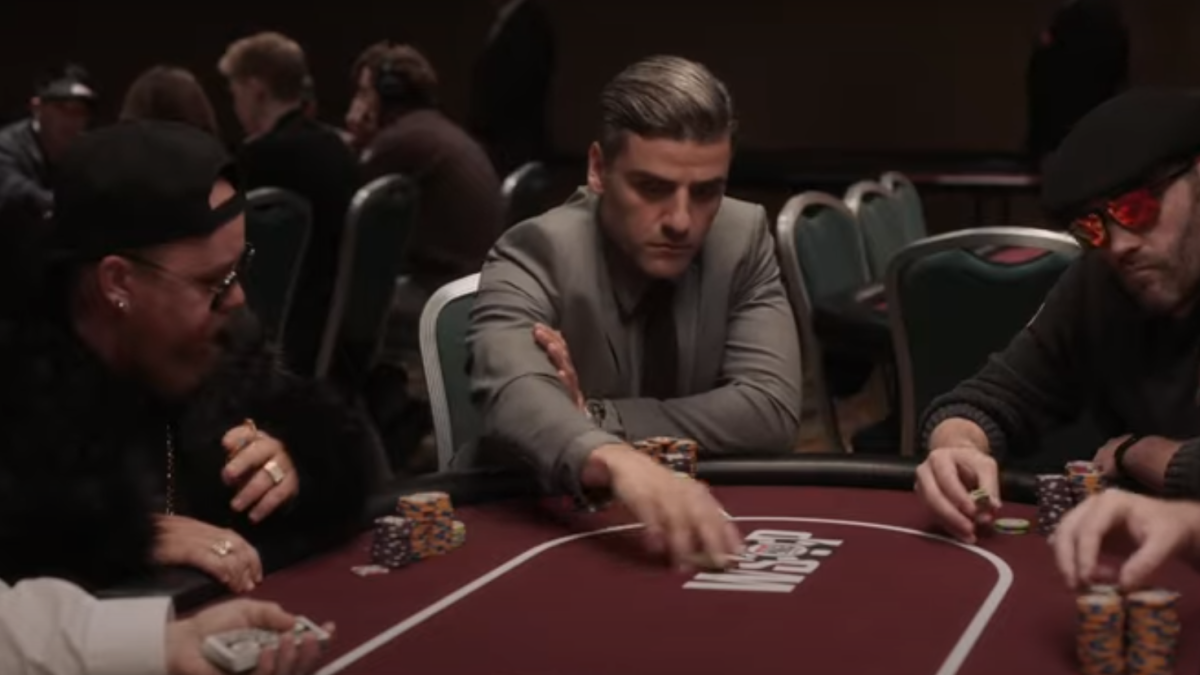
Clearly, Schrader had two movie ideas and decided to combine them into one script. I see this happen every once in a while and it always feels like a good idea to the writer at the time. The idea is that you never would’ve written either script individually because you were afraid there wasn’t a big enough story. So combining the two scripts immediately feels like it solves the problem. But I’m telling you, two-idea scripts rarely work. There’s this constant cage match going on between the ideas as they fight for script superiority and the reader is never entirely sure what the script is about. So I highly advise against it.
It’s so sad when screenwriters make a bad choice in a good script. I know everybody here looks at screenwriting from the writer’s side. But to give you some perspective from the reader’s side, it’s so rare that you actually read something that pulls you in. However, even when this rare exciting feat happens, there’s always a voice in the back of our head saying, “Please don’t screw it up please don’t screw it up.” Because, unfortunately, that’s what usually happens. A bad choice is made and the whole script falls apart.
When the producer of The Shawshank Redemption, Niki Marvin, read the script for the first time, she had to put it down after the end of the second act because, in her words, it was so good that she couldn’t keep reading in case it fell apart. I didn’t understand that at the time but I understand it now.
Look, at least some of this could’ve been avoided by using a different title. “The Torturer” (or some other title about torture). Readers get the most pissed off when you pull a bait and switch on them. You’ve promised one movie, which the reader is excited about, but then give them something else. At least you guys now know what you’re in for so you won’t be as upset as I was about The Card Counter. But either way, I’m confused by the odd choice.
Even beyond that, the script had issues. It makes little sense why Tell invites Cirk to come with him other than Schrader was determined to add a “mentor-mentee” relationship to the story. You’ve established Tell as this loner who doesn’t get close to anyone. But now he’s inviting a 20 year old kid to spend the next few months with him? Even Schaeder seems to acknowledge the ridiculousness of the contrivance, having Tell utter this line via voice over a mere five minutes into their first leg of the trip: “Who is this insolent little prick? How did I ever end up here? I should just pull to the side of the road now, toss him on the ground, and stomp on his fucking head until it cracks wide open.”
To summarize, I don’t think The Card Counter ever figures out what it wants to be. It’s about a blackjack player… who plays poker. It’s about a loner… who invites someone on the road with him. It’s about gambling… except it’s about torture. It’s thematically all over the place and I’m guessing that the main reason it’s got good reviews is because Oscar Isaac gives a strong performance. No way it’s because of the writing.
I don’t recommend this one.
[ ] What the hell did I just read?
[x] wasn’t for me
[ ] worth the read
[ ] impressive
[ ] genius
What I learned: Be aware of how influential a title can be on the reader. It’s the first thing they see so it creates a strong expectation. If your script then deviates from that title, expect disappointment from the reader. This script should’ve been titled The Poker Player or The Torturer long before it was titled The Card Counter.

I originally had no desire to watch this show. It was actually one of you guys who made me check it out. I don’t remember who said it but the comment was essentially: “This is the first show that I’ve loved where I disliked every single character.”
I thought to myself, “Hmmm, that’s interesting.” For those who don’t follow screenwriting, here’s a little inside baseball for you. There’s an unofficial ongoing competition between all screenwriters to create the most popular piece of media but only using unlikable characters. Anybody can create something popular with likable characters. But it’s only the *truly talented* writers who can create something popular with unlikable characters. It seems like creator Mike White may have just won that competition.
To give you a little background, this is not a show that White spent years trying to make. Quite the opposite, actually. With the arrival of Covid, HBO found themselves in a pinch. They needed contained show ideas that had little risk of spreading Covid. So they ran around to a bunch of creators and asked them if they had something that could be shot on a single set.
With that being the only edict, White came up with this idea: group of rich people spending a week at a luxurious Hawaiian resort. He wanted to explore the constant interaction, on these islands, between rich and poor people. But HBO threw White a curveball. They needed to start shooting in three months. So Mike White proceeded to write six episodes, which were 60 pages each mind you, in just three months, while simultaneously preparing to direct the series.

Which may be the most shocking detail about White Lotus of all. Because this is some of the best character work I’ve enter encountered. I’m talking EVER. And, usually, it’s the character creation that takes the longest to get right. It’s hard enough to come up with one memorable character. White Lotus somehow comes up with ten. Even if you don’t like this show, it’s impossible to forget these characters. You will be thinking of them years from now.
Which is why I wanted to do an entire week of analysis on the show’s character development, starting with the pilot episode. To be clear, in 95% of the amateur scripts I read, I don’t remember a single character in the scripts 72 hours later. With this show, it’s the opposite. These people are ingrained in my mind for the rest of my life. That’s how strong the character creation was. And I’m curious to delve into the material to find all the little tricks of the trade Mike White used to achieve this.
For those who haven’t seen the show, the premise is simple. A group of very rich people come to a Hawaiian island resort to spend a week of high-end relaxation. They include Shane Patton, an exorbitantly rich 30-something mama’s boy who lives off his parents’ money. He’s come here with his new wife, Rachel, a drop dead gorgeous writer who was dirt poor when she married Shane.
You then have the Mossbachers. You have Nicole, a genuine woman who has become one of the most successful female CEOs in the US. You have her husband, Mark, who came from a rich family but lives in the shadow of his richer more famous wife.
You have their 19 year old daughter, Olivia, who uses her family’s wealth when it’s convenient, such as to be a “queen bee” at school. But then tells everyone around her that she identifies as a socialist in order to play the victim role. Olivia’s ultimate socialist act is befriending a poor Latina girl named Paula, who she’s brought with her on the trip. But don’t feel bad for Paula. Paula uses her friendship with Olivia as a way to climb the social ladder and wield the same power Olivia uses to control those around her.

The runt of the family is 16 year old Quinn, an anxious kid who’s so socially awkward that he buries himself in his phone and tablet. He’s got classic “weird kid” syndrome, where, although the parents would never say so out loud, they’re terrified he won’t be able to make it in the real world.
From there, you’ve got two wild-card characters. There’s 60 year old Tayna McQuoid, a socialite who’s draped in money although where she got it is anyone’s guess. This eccentric oddball has come here on a spiritual journey to spread her mother’s ashes in the ocean.
And then you have one of my favorite characters ever. Yes, I just said *EV-ER*. As in, this character deserves to be placed in the pantheon of greatest TV characters of all time – Armond, the hotel manager. Armond starts off as the only person in this story who seems to have their shit together. But as we’ll eventually find out, there’s nothing further from the truth.
Before we start, it’s important to note that this is a TV show but White treats it like a long movie. The characters *will* arc. That wouldn’t happen if this was a multiple season TV show. In multiple-season shows, you keep your characters struggling with their fatal flaws throughout the series. It would be weird if you wrapped their internal struggles up after one season. I bring this up because the approach to character development in this show should be seen through a “feature film” lens as opposed a “TV show” lens, if that makes sense.
In today’s article, I’m going to show you how Mike White lays the foundation for the character development that occurs throughout the rest of the show. Remember that any effective character development depends heavily on the introduction of those characters. If you don’t effectively set up who these characters are, we won’t care where they go. Which is why character introductions are so important. Okay, let’s take a look.
The writers who go on to become professionals in this business understand that character introductions are one of the most crucial components of a screenplay and, therefore, require a disproportionate level of focus. Character introductions achieve two things. One, they tell us who the character is. And two, they explain to us what the character is going to be fighting, and hopefully overcoming, over the course of the story.
Now, what’s important to note in any ensemble story is that you may not be able to perfectly set up your characters the first time we meet them. Due to the fact that some environments allow for better introductions for some characters and weaker intros for others, it’s okay to DELAY some of the scenes where you truly tell us who a character is.
For example, the first official “this is who these characters are” introduction in White Lotus occurs on the boat heading to the island. All of our main characters are on this boat. But we focus specifically on friends Olivia and Paula. They’re perched in the upper deck, bitchily making assumptions about everyone on the boat. There is no doubt, after this scene, that these two are bitches.
Again, we could’ve then cut to the other characters on the boat and tried to establish them within this environment as well. But Mike White felt it wasn’t the ideal setting to do so. So he delayed their “this is who these characters are” moments. It isn’t until newly married couple Shane and Rachel are in their suite that we appropriately establish them.
Instead of jumping into exciting honeymoon sex, Shane looks around and realizes, wait a minute, this is the wrong room. His mother bought them the best room in the hotel. But they’re in some… lesser room. In Shane’s high-end world, this is unacceptable. He begins looking around and confirming his suspicions despite the fact that the room is still huge and gorgeous. This moment gives us a crystal clear understanding of who Shane is, especially after Rachel reminds him that it wasn’t *him* who paid for the room. It was his mother.
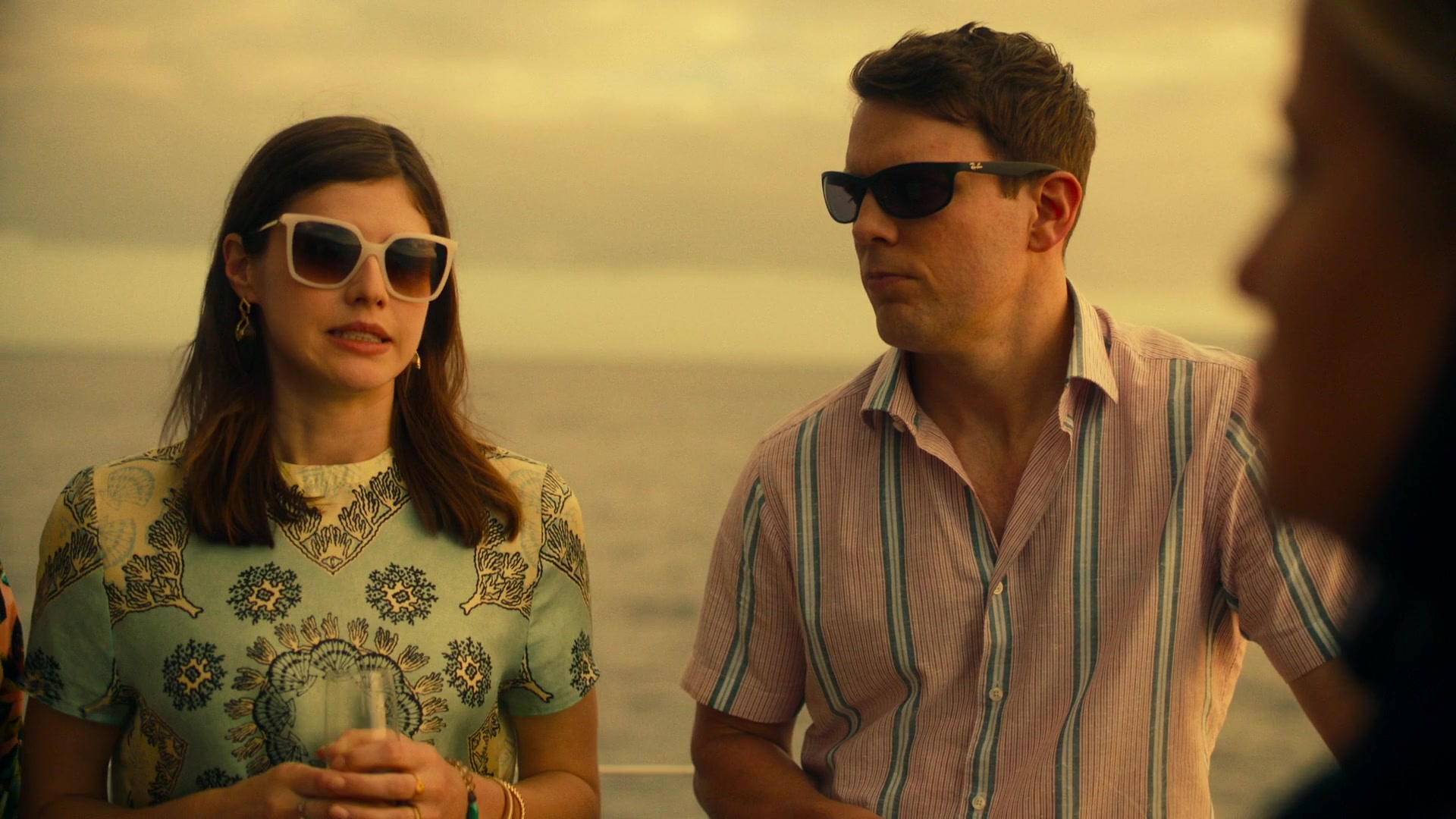
We’re about to get nerdy so pay attention, because the way White sets up Rachel is sneaky and something not a lot of writers consciously know how to do. You see, it’s easier to set characters up who are ACTIVE – who are creating the circumstances that are affecting the situation. That’s what Shane is doing. He’s charging round, creating this ‘problem’ of not being in the right room.
Meanwhile, Rachel isn’t active, yet we still get a good feel for her. This is how we do it: You can establish who someone is through their REACTIONS to what’s happening around them. In this case, Shane is bitching about the room. Yet here Rachel is, standing in the nicest hotel room she’s ever been in in her life. So that’s the argument she’s making. “Who cares? We’re on our honeymoon. This place is amazing. Let’s just enjoy ourselves.” In her reaction to Shane’s freak-out, we get just as good of a feel for her as we do Shane’s character, even though Rachel is reactive instead of active. We understand that she comes from a poor family. We also understand that she doesn’t need everything to be perfect to be happy. She’s much more down-to-earth.
We do the same thing for the rest of the hotel guests. Socialite Tanya has an awkward exchange with one of the helpers in her room as she can’t find her bags even though they’re right behind her. This woman is so out of touch with reality that she doesn’t even know where her 14 bags are despite the fact that they were literally placed behind her 30 seconds ago.
We then switch to Mark and Nicole’s room with a close-up shot of Nicole inspecting Mark’s penis. I’m not sure I love the idea of introducing someone via their penis. But the flip side of that is that so many character introductions are forgettable. And this one definitely isn’t. Also, to Mike White’s credit, it’s organic to the situation. Mark just had tests for testicular cancer and he’s waiting on the results. So we clearly understand where this guy’s head is at after this scene.
Of all the characters in White Lotus, Nicole probably has the weakest introduction. White tries to do the same thing he did with Shane and Rachel where we introduce Nicole via her reaction to her husband’s cancer situation. But it’s not as clear who she is after this moment as it was with Rachel. There is a good line in the exchange, though, that provides some insight into their marriage. He asks her if his testicles look different. Her response is, “I don’t know. I haven’t seen them for a while.” That tells us that these two don’t get intimate often, which indicates their marriage isn’t perfect. It’s little touches like this that you need to add if you want to get to that next level of character development.
Finally, we get Armond’s big introductory scene, and this one is a little more complex, so you have to pay attention to understand its genius. Basically, Shane comes to the front desk to complain about being in the wrong room. Armond is overtly polite with him. He says he’s sorry but that’s the room they booked. Then, as soon as Shane and Rachel leave, Armond turns to the new helper, Leilani, dropping the friendly act to inform her how these people are all evil and you have to tell them whatever they want to hear to keep them happy.

In other words, the beauty of this character is the distance between how he must outwardly act and what he actually feels, which is contempt and hatred for everyone. If Armond was a genuinely happy person and enjoyed helping people, he wouldn’t be interesting at all. It’s the contrast between how he must act and what he feels that creates this powder keg of a character who we’ll see deteriorate over the course of the show.
There’s another little character trick going on here with Armond that you can use yourself. Whenever you have a mentor-student relationship, it’s easier to get inside the mentor’s head because he’s constantly explaining what’s in his head and what he’s feeling to the student. Normally, it’s hard to convey thoughts to the reader/viewer. But you can tell us EXACTLY what someone’s thinking if you’ve written in this dynamic.
“See, in that instance, you just have to stay calm and tell them that they’re right. These people are leeches. They’ll take whatever they can. You put on a smile, tell them they’re right, but then stand firm as you explain that you’ve done everything you can do.”
Another great character-writing tip you can take from White Lotus is that Mike White is so focused on creating great characters that he even gives his secondary characters storylines. Leilani is an overweight helper here on her first day of work who has a secret. She’s nine months pregnant. But she’s terrified to tell anyone because she’s afraid she’ll lose her job. Over the course of the day, her water breaks, and she tries to hide it from everyone.
You’ll note that when Armand stops her, later, to ask her a series of questions, it’s a much more intense interaction than you would normally get between two people because WE KNOW Leilani’s secret, that she’s about to burst. We can see the pain in her eyes, along with her desperate attempts to appear normal. This is the kind of detail that professional writers bring to the table that I rarely see in amateur work. So it’s a good habit to develop, especially in television writing where there are a lot of characters.
So there you have it. Lots of great character work to learn from. Tomorrow we’ll get into, once you’ve established your characters, what to do with them. Seeya then!
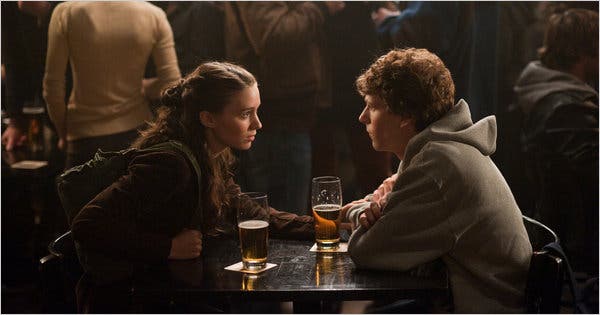
Earlier this week, I pointed out that two out of three of Demonic’s first scenes were “sitting down and talking” scenes. I said that I knew, as soon as I watched those scenes, that the movie was doomed. “Sitting down and talking” scenes are the worst types of scenes you can write. They’re stagnant. They’re visually uninteresting. They lack imagination. And they’re just straight up uninspired.
And yet, as several of you have pointed out, you see them ALL THE TIME in movies. How can I possibly say to NEVER use “sitting down and talking” scenes when there are so many of them? To answer this, we have to understand why the majority of “sitting down and talking” scenes are shot.
They’re shot because they ARE THE CHEAPEST AND EASIEST SCENES TO SHOOT. So what will often happen is that a day is running long, you need to get the scene in, so you scrap your more elaborate idea and settle for a “sitting down and talking” scene. This happens all the time. It’s important to note that nobody wants to do this. They’re forced into it by circumstance. So when you see that, that’s often the reason – time and money.
But here’s the thing – as a spec screenwriter, you never have to worry about that. It’s not your job to save money or time. It’s your job to write the most entertaining script possible. In other words, you have zero excuse to write a “sitting down and talking” scene.
I’m sure many of you are thinking of dozens of “sitting down and talking” scenes that you’ve liked and that it’s unlikely were dictated by a rushed production schedule. The opening scene between Zuckerberg and Erica in The Social Network. The fake orgasm scene in When Harry Met Sally. Vincent and Mia at Jack Rabbit Slims in Pulp Fiction. DeNiro and Pacino in Heat.
If it’s such a bad idea to write a “sitting down and talking” scene, why do these scenes exist? It basically comes down to philosophy. If there’s a designed PURPOSE to sitting your characters down to talk, it’s okay to write a “sitting down and talking” scene. Where it’s not okay, is when you don’t know what to do, so you fall back on sitting your characters down and having them talk to each other.
When it comes to the When Harry Met Sally scene, that scene is building up to a huge moment – when Sally fakes the orgasm. Let me ask you a question. Does that scene work if they’re in the car together? No. It requires them being in a big public space with a lot of people around. In other words, the scene was designed around that restaurant. So sitting down and talking made sense.
With Vincent and Mia, the Jack Rabbit Slim’s sequence is a stand-in for a sex scene. The dancing is them having sex. Quentin uses the dinner portion, then, as foreplay. Them eating at the table is all about the sexual tension building between them so that it can explode out on the dance floor. Again, sitting down and talking is by design. It’s not because Quentin couldn’t think of anywhere to put his characters.
Another time when it’s okay to sit your characters down to talk is when the situation warrants it. For example, if you’re writing a romantic comedy and you’re building up to the first date, it makes sense that your characters might sit down at a restaurant for their date.
But this is where things get tricky because I’d argue that you could come up with something more interesting than a restaurant date. Set the date up for the restaurant, but when they get there, they find out that the restaurant doesn’t have them down for a reservation. So they can’t eat there. What do they do? I don’t know, but you’ve already created a much more interesting date than had you sat them down at a table to talk for an entire scene.
Do you see what I’m getting at? Yes, you can write “sitting down and talking” scenes. But there are always better options out there. And those are the options you should be exploring.
Often, the reason we write “sitting down and talking” scenes is due to a mistake we made before we started the script. A story without a proper engine will leave your script sputtering along, fertilizing the pages with very little to do. When there’s nothing for your characters to do, you’re going to start sitting them down to talk – anything to fill up pages.
Look at Raiders of the Lost Ark. Do you remember any scenes in that movie where two people are sitting across form each other just to chat? There might be two or three. But I’m going to bet that, if there are, there’s tons of tension in those scenes, which still makes them entertaining.
The reason Raiders of the Lost Ark doesn’t have many sitting down and talking scenes is because the story engine is so powerful. There’s some of the best GSU (goal, stakes, urgency) in any movie ever. Goal – Find the ark, Stakes – if you don’t, Hitler uses it to destroy the world, Urgency – you got to find it before Hitler does, and he has his entire army looking for it.
When you have strong GSU, YOUR CHARACTERS ALWAYS HAVE SOMETHING TO DO. They don’t have time to sit down and talk. That’s why sitting down and talking scenes are bad. They’re a symptom of a deeper problem – that your story doesn’t have a powerful enough plot engine.
Now things get trickier when you’re writing character pieces. By their very nature, character pieces don’t have giant story engines. I don’t know if movies like Moonlight or Minari have any story engine at all. Also, since those movies are more character driven, the set pieces are built around character interaction. And if your characters are constantly interacting, it’s only a matter of time before they’re sitting down to do so.
When you find yourself in this place, you have to have a creative mindset. Only sit your characters down to talk as a last resort. For example, let’s say you want to write a scene between two characters at a coffee shop. What if you, instead, had them talk on the way to the coffee shop? Or on the way to somewhere else?
Sure, if you have a wife and a husband discussing a problem, you can sit them down at the breakfast table and have them hash the problem out. Alternatively, you could make it so the husband is late for work, and the argument is happening as he rushes to get his clothes on, get the kids ready, and get out the door. That’s a much more interesting way to approach the scene.
With all that said, there are times when you do want to sit your characters down to talk. The biggest of these is when you’ve built up a ton of tension between characters and don’t want any distractions for when they collide. The most obvious example of this is the DeNiro Pacino diner scene in Heat. I had no problem with that being a “sitting down and talking” scene because the movie had done such a great job building up to that moment.
Again, to be clear, this scene is BY DESIGN. It’s not because the writers didn’t know what to do and, therefore, sat the characters down to talk to each other. It was carefully orchestrated. Their sitting down and talking is crucial to the design of the movie.
A few last points about these scenes. If you’re a dialogue master, you’re allowed to write more of these scenes than the average writer. Tarantino has quite a few “sitting down and talking” scenes in his movies. But he’s also one of the top 5 dialogue writers in the world. And great dialogue neutralizes the boredom that typically occurs during a “sitting down and talking” scenario.
The worst type of “sitting down and talking” scene is the exposition “sitting down and talking” scene. If you do that more than once in your script, I guarantee you the reader will stop reading. That is the epitome of a lack of creativity – when you’re so boring that the only scene idea you can think of is your characters sitting down and talking, and then, on top of that, you bore us to death with a bunch of exposition.
Finally, in television, you’ll have more sitting down and talking scenes. They have less time and less money in television so they have no choice but to shoot more of these scenes. But that doesn’t give you a free pass to make the scene boring. If anything, it should challenge you to make the scene entertaining in spite of these restrictions. Make sure there’s tons of conflict or tension or sexual tension or unresolved problems between the characters invovled. White Lotus does a great job of this. When the characters sit down for, say, dinner, they’re rarely on the same page with each other, which creates lots of unresolved conflict that plays out during their conversations, keeping things entertaining.
Can you write “sitting down and talking” scenes? Of course you can. But only if they’re by design and only if you’ve done everything in your power to come up with a better option but came up empty.
Good luck!