
Search Results for: F word
Rumors of found footage films being dead are greatly exaggerated. The Line of Sight screenplay proves that they’re alive and well!
Genre: Action/Found Footage
Premise: The best soldiers in the world, Delta Force Three-One, are called in to save the highest ranking U.S. official left after all of the major U.S. cities are destroyed by a mysterious attack.
About: This script was purchased last year by WB and finished on the Black List. F. Scott Frazier hit a dream hot streak when he sold three specs last year, Line Of Sight, Autobahn, and a big alien Children of Men type script. Frazier first came to my attention with his breakthrough screenplay, The Numbers Station, which I reviewed a couple of years ago, and is now in production. As for Line of Sight, Ben Affleck is rumored to be playing one of the leads.
Writer: F. Scott Frazier
Details: 116 pages (This is an early draft of the script. The situations, characters, and plot may change significantly by the time the film is released. This is not a definitive statement about the project, but rather an analysis of this unique draft as it pertains to the craft of screenwriting).

I got one word for you: PICTURES!
Yaaaaay!
That’s right. One of the first things you see when you open Line Of Sight is pictures. They’re there to help you imagine all the chaos that’s going on in the script. And believe me, there’s a lot of chaos!!! So what do I think of pictures in scripts? Well, considering I predicted 5 years ago that art would become a much bigger part of screenplays in the future, I’m performing my “I told you so” dance as we speak.
And I’m all over this trend. When the new site launches (I swear – it IS coming), we’ll have artists for you to hire to create concept art for you own scripts. It’s going to be rad!
Back to Line Of Sight. Okay, so here’s the truth. I didn’t really know which characters were which here. A big reason for that was that we got a “bulk introduce.” A bunch of Delta-Force Three-One soldiers were thrown at us all at once – a death-knell for readers remembering characters, as I’ve discussed before. However, surprisingly, this wasn’t as big of a deal to me as you might expect.
Why?
Because I saw the group as one singular character. Think about it. That’s what Delta Force Three-One is – a group of men who move and think like one. So in that sense, the entire group was a protagonist, and that was good enough to get me emotionally involved. I wouldn’t advise this approach to other screenwriters out there. But it worked in this specific case.
Part of the reason for that was that the event was so huge. America’s just been attacked. It looks like all the major cities have been hit. And here’s this Delta force team in Washington DC, finding out that almost the entire top level of government, including the president, have been killed.
There’s one biggie left though, the speaker of the house, who’s still alive somewhere inside Washington D.C. An obliterated communications network, however, leaves only one operator able to guide our team to the speaker’s location. So they arrive in the city, which they are shocked to see has been blown to bits. It’s a war zone.
We’re seeing all of this found-footage style through the helmet cams of the soldiers. So we’re hopping back and forth between each feed, which is an ingenious way to go about it because one of the issues with found footage is that you’re often limited to one camera. Being able to jump around to each soldier frees things up a bit.
Anyway, they locate the speaker and begin the arduous process of escorting him across town. But they quickly learn that something’s up with the remaining factions of government and not everybody is who they say they are. So oftentimes they’ll run into an official who claims he’s there to help, when really, he’s working for the other side – whatever mysterious side that may be.
So Three-One makes a bold move, deciding to ignore all orders and complete their original mission – get the speaker to the other side of the city. Naturally, the movie wouldn’t be any fun if they didn’t encounter some opposition along the way, and there’s plenty of that. On top of this, they’re trying to figure out what happened here. Who is it that attacked the U.S.? How did they do it? And what’s their ultimate plan? Delta Force Three-One is used to getting orders and following them. They’re not trained to care about the big picture. But in this situation, they’re going to have to figure out the big picture if they plan on surviving.
Line of Sight is probably the most no-brainer purchase of the past year. A found footage angle to a multi-city large-scale military attack. I can see the trailer already. If you put pre-District 9 Neil Blomkamp on this, after he made all those cool Halo mini-movies? He might’ve made one of the greatest summer flicks ever.
Since The Disciple Program, I’ve been talking to more and more people around town, the people who either facilitate deals or purchase scripts. And the more I talk to them, the more I hear the same thing. They want movies. They want something that audiences are going to show up to.
What F. Scott Frazier unabashedly does is he writes movies that people would show up to. And as simple of a concept as that is – 80% of aspiring screenwriters out there DO NOT do this. They write completely unmarketable plain bland ideas.
As a writer, you gotta put your producer hat on every once in awhile. You gotta ask, “Is someone really going to put millions of dollars into this idea to bring it to life?” That simple question can erase years of misguided writing.
I don’t want to scare anybody away or get anyone angry. But this seems to be a reality of the business a lot of writers ignore. They want to stay “true” to their vision. They don’t want to “sell out.” That’s where I disagree with them. Good writers pick high concepts and then build characters and themes inside those concepts that they’re able to explore on a deeper level. Look at District 9. It was a big idea. There were spaceships and aliens and robots. But guess what – the writer was able to use the idea to say something bigger. He used his characters to explore issues of greed and power and fear and hypocrisy. He was able to kill two birds with one stone. Why can’t you?
And I’m not saying Line of Sight did that, because I’m not sure it did. What I’m saying is, if character development floats your boat, there’s no rule that says you can’t develop characters inside of big ideas.
As for the script itself, one of the cool things about found footage is it allows you to see a really big situation through the eyes of a few people. So instead of jumping to Paris to see it get blown up like you would a Roland Emmerich movie, you’re stuck with the person or people who have the camera. You’re experiencing the event through a singular point of view. And in many ways, that’s scarier than seeing the big picture.
As for the script’s faults, I would’ve liked to have seen more moments that showed off what Delta Force Three-One could do. It seemed like the majority of their impressiveness came from pre-established maneuvers that were somewhat boring. And I suppose that’s what it’s really like (It’s not Die Hard where you’re blindly jumping down elevator shafts), but it would’ve been fun to see a little more inventiveness from these guys. Let’s see them improvise a little.
The other thing that bothered me was that it wasn’t clear how this attack was being executed. From my understanding, every major city in the US was hit. And as we find out later (spoiler!), this isn’t another country invading us. It’s an army put together on the fly. So even in the best case scenario of say them having 20,000 soldiers, how the hell are you going to contain 10 of the biggest US cities with 20,000 people? I suppose you could make the argument that the bombs blew up enough of the cities to allow for easy containment. But still, you’re asking to contain maybe 3 million survivors alone in Los Angeles. Are 2000 soldiers really going to be able to do that?
But like I said, this is an exciting idea. It’s totally a movie. It’s something that hasn’t been done before (found footage with a military attack). Screenwriters everywhere can learn a lot about the business by understanding why a script like this sells.
[ ] Wait for the rewrite
[ ] wasn’t for me
[x] worth the read
[ ] impressive
[ ] genius
What I learned: Roadblock scenes always work! They have built in tension, anticipation and suspense. But the key to making them shine is to add one element that makes things as difficult as possible on your heroes. Line of Sight does this perfectly. Earlier, Delta Three-One killed some soldiers and stole their uniforms in order to impersonate the attacking army. But they did it so quickly, they didn’t realize that their youngest member was putting on the highest ranking uniform. They only realize this AS THEY’RE APPROACHING a roadblock. All of a sudden, the youngest and least capable member of their team will have to convince the invading soldiers to let them pass. This is exactly how to create a great roadblock scene – add an element that makes passing the roadblock look unlikely.
Knights. Zombies. Guaranteed awesomeness or guaranteed awfulness? Read a script from a very UNIQUE screenwriting team and come to your own conclusion.
NEW Amateur Friday Submission Process: To submit your script for an Amateur Review, send in a PDF of your script, a PDF of the first ten pages of your script, your title, genre, logline, and finally, why I should read your script. Use my submission address please: Carsonreeves3@gmail.com. Your script and “first ten” will be posted. If you’re nervous about the effect of a bad review, feel free to use an alias name and/or title. It’s a good idea to resubmit every couple of weeks so your submission stays near the top.
Genre: Zombie/Period
Premise: (from writers) A war-battered knight returns from the Crusades to find his homeland terrorized by victims of a lethal fever who rise from the dead, hungry for human flesh. Sir Thomas shepherds survivors to the Castle Bridgenorth, where he leads a war of attrition against an army of the undead – even as he battles his own demons.
About: Zombie Knights was sort of the sleeper logline hit of our mini-logline contest a few weeks ago that produced “Breathwork” and “Soundtrack.” Here was their “why you should read our script” argument in their query letter: “Hollywood, they say, is looking for the same — but different. Our screenplay is an effort put a fresh spin on the tried-and-true zombie flick by setting it in the Middle Ages. We also try to use the format to address greater themes of faith and humanity. And, oh yeah, with lots of killing zombies with axes and swords and maces and stuff.”
Writer: Clint & Taylor Williams
Details: 103 pages
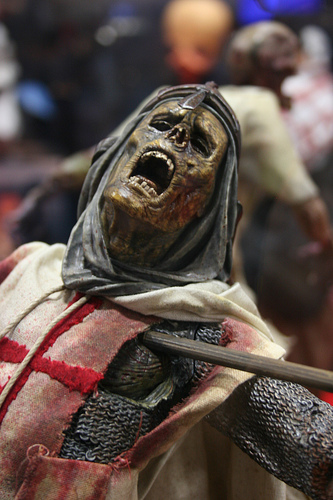
Well this is a first. I can safely say that I’ve never read a script by a father-son writing team before. In fact, this may be the first father-son writing team in the HISTORY OF SCREENWRITING. That’s pretty cool but, man, I’m assuming it would cause some unique challenges. I mean what happens when the son gets grounded and the Nicholl deadline is days away? “No, you can’t go see your friends tonight! But could you clean up the dialogue in the dungeon scene?” Awk-warrrrrd.
As for the age-old complaint that we have YET ANOTHER ZOMBIE SCRIPT, I’ll give it to the Williams’s…es that a middle ages setting does feel different. But I don’t care if it’s set in the Paleolithic ages – bottom line is the script has to deliver. So is Zombie Knights one of those freaking crazy ass sprinting zombies from 28 Days Later or is that half-bodied pathetic one-armed dragging zombie from the pilot of The Walking Dead?
It’s the 11th Century when things like polio and leprosy were commonplace. Catch a couple of those miscues and you could actually BECOME a zombie without being a zombie. Add on to that that you had to hunt your own food and we are talking major suckage.
But what sucks even more is that a terrible plague is spreading through the land. It makes the dead rise up and want to eat your brains. Of course, since it’s a thousand years before George Romero and Wikipedia, nobody knows what this disease is. They do know that if they shoot the diseased through the head with an arrow, though, they die. And that’s good enough for now.
After coming back from a work trip (also known as the Crusades) a group of knights led by rough and tumble Thomas and the clean-cut Clinton, realize that the place they left no longer exists. Everybody’s dying and after they die, they get up and try to eat you. While these strange undead creatures are harmless by themselves, they’re quite dangerous in bulk.
And when the bulks get too bulky, our Crusaders realize they have to flee the city and find safety somewhere else. So they take all the remaining townspeople and take a field trip across the land until they find an abandoned castle. Hey, zombies may be dangerous but they ain’t too good at scaling walls, so it seems like a good place to set up camp.
Things are nice and safe for awhile, but the zombie hordes outside the castle keep getting bigger, making a trip to the grocery store that much more difficult. Naturally, supplies get low and they realize that if they don’t find a way out of this undead mess, they’re going to starve to death. So the group comes up with the idea to dig a tunnel underneath the castle, Great Escape style. But will they be able to pull Operation Dirty Fingernails off in time? Click the script link below and find out for yourself.
Okay, Zombie Knights. A neat idea. Some solid writing. But a lot of beginner problems. Beginning with the very first scene.
Why are we opening a movie with knights being welcomed back from battle? I understand that it introduces the characters. I understand that it sets up how important these characters are. But it’s not a SCENE. A scene has decisions to be made. It has choices for your heroes. It has a PROBLEM that needs to be solved. That’s when a scene is exciting/interesting. And if there’s any scene that needs to be exciting and/or interesting, it’s your first one. Cause that’s the scene that’s either going to draw your reader in or not.
I would start this movie off with the crusaders in battle, beating ass and taking Old English names, and then at the end of the battle, after everyone’s been slaughtered, one by one, the dead bodies start getting up. What the f*ck is going on??? They have to defeat each of them a second time! This is off the top of my head and you’d probably need another 10 drafts to come up with a cool original version of it, but THAT’S a scene. THAT’S something happening. People galloping in on horses isn’t a scene. And it definitely isn’t an opening scene.
This opening is then clouded by the death-knell – a dozen characters being introduced all at the same time. Ahhhhhhhhhhhhh!!! Why God why?? The bulk-introduce is a well-known script-killer. You’re practically begging the reader to forget every character in your script by doing this.
Anyway, this is followed by a strange montage sequence of our knights fighting a bunch of battles over the years. However it wasn’t clear that time was actually passing (there was no mention of any “MONTAGE” anywhere, which was the source of the confusion) so we had this sort of comical scenario where our heroes would fight a HUGE battle, go have lunch in the forest, go fight another HUGE battle, go have dinner in the forest, go fight another HUGE battle, go have breakfast in the forest. It was funny. It was like they defeated 8 huge armies in two days. A simple “MONTAGE” slug would’ve helped this.
Then, when they get to the castle, we run into a problem I’m always warning you guys about. The “sit still and wait” problem that occurs when you place your characters in a static location. It’s just not interesting to watch people hang out and wait. Waiting is boring. Audiences want characters who are ACTIVE. That’s why the “stuck in places” movies that work are the ones where the characters are desperately trying to get out (i.e. Aliens).
The next problem is that there’s no urgency at all. I think the characters actually have months to hang out in this castle. That’s not a movie. And it’s definitely not a zombie movie, where we have to feel the urgency of the zombie threat getting closer. If I were the Williams’s…es, I would make this a 1 week deal. They get to the castle, the zombies start scratching at those rocks, and bit by bit they’re able to dig pieces of that wall off. They’re getting closer and closer to getting in. So our guys build the tunnel and you play those two angles against each other. Our guys have to finish the tunnel before the zombies break through that wall.
Because if you don’t have urgency in a movie like this, you don’t have a movie.
Also in this kind of movie, you need conflict. You need people disagreeing with each other about how shit needs to be done. That way the characters aren’t just fighting zombies, they’re fighting each other. Drogo, a character who joins the group before they get to the castle, should be this character. He needs to be the dissenter. He needs to be the one who wants to do things differently. And it can’t be polite either. It needs to be some heavy ass conflict where you’re wondering if these guys are going to kill each other before the zombies kill them.
Like I said, this was well-written, but it needs some stronger storytelling. Goals, urgency, conflict, that sort of stuff, before this zombie script can play with the big boys.
Script link: Zombie Knights
[ ] Wait for the rewrite
[x] wasn’t for me
[ ] worth the read
[ ] impressive
[ ] genius
What I learned: Tell a story with your scene! That opening scene really bothered me because there was no story being told. It was just introducing characters. You have to entertain the audience, remember. Look at the opening scene in Aliens. We’re in some frozen ship. We’re not really clear what’s going on. Some sort of lazer thing starts cutting through the door. There’s mystery here. There’s anticipation. Something INTERESTING is happening. And this approach shouldn’t just be used for your opening scene. ALWAYS try to tell a story in your scene.
What I learned 2: The bulk-introduce. Guys, stay away from the bulk-introduce if at all possible. Because if we start mixing up your characters right away because they’re lost amongst a dozen introductions? We’ll be confused during every aspect of your story because we’re going to keep saying, “Who’s this character again? What’s their relationship to the story?” And that’s a script-killer.
This is a very exciting moment for me because I’m interviewing my first OSCAR WINNER. Simon Beaufoy wrote 2008’s Academy Award winning Slumdog Millionaire. He also wrote The Full Monty and 127 Hours. But the reason I wanted to interview Simon was because of his new film, “Salmon Fishing In The Yemen,” which is a script I read a long time ago and loved! It’s one of those movies all screenwriters should seek out because it’s just really well written. – My relationship with Simon is funny. I think he both loves me and hates me. Loves me for my review of “Salmon Fishing” and hates me for my review of “127 Hours.” But even after that unflattering review, he still agreed to an interview! I love me some Simon Beaufoy!

SS: Simon, thank you for stopping by our community here on Scriptshadow. Now I chatted with you once a long time back and you mentioned you’d visited the site. Have you since recovered from this visit? Don’t tell me you actually came back in the meantime.
SB: I remember there was an outbreak of brickbats (what ARE brickbats, really?) on your site round the time 127 Hours was about to be released. I love the passion of the contributors to the site even if I am sometimes dumbfounded by the certainty of opinion of people who haven’t even seen a film or read the script, but still feel they have a valid point of view….A forum for screenwriters can only be a dangerous thing for a species who live in the dark and eat only bananas and chocolate. But dangerous is usually good.
SS: Let’s jump right into your newest film, Salmon Fishing. As you already know, I loved this script. So let me ask you this. Was it a difficult script to write? And if so, what was the most difficult thing about it?
SB: Thanks for loving the script. You’re a generous soul. People assume that because the entire novel was made up of emails, interviews, diary entries and news reports (an epistolary novel) that finding a structure was the most difficult part of adapting it. But actually, the most difficult part of this particular adaptation was cracking the problem that this was essentially a love triangle with one of the three people in the triangle absent. Film doesn’t like absence much- whereas in novels, that’s fine. I had to do some radical things to the original novel to address this complication.
SS: When you sat down to write it – or really when you sit down to write any script – what is the single most important thing that you need to get right? What story element gets all of your focus and why?
SB: The single most difficult element to get right when I sit down to write is the strength of the coffee. Everything else is secondary. I rarely get it right and it puzzles me endlessly. Same coffee, same amount of water, different taste each day. Why? It definitely tastes better in a white cup, but still, something is going on that I can’t get to the bottom of.
Tone is most hard to keep uniform throughout a script. Especially when adapting a novel. The tone is one of the few things I promise to keep the same as the original material- character being the other, though the two tend to be interwoven anyway. Everything else is up for grabs, usually. There’s no intrinsic merit in a ‘faithful adaptation’ as far as I can see. The very reasons why a novel might be incredibly successful as a novel are often the very opposite of what might make it a good film. There’s no intrinsic merit in a ‘faithful adaptation’ as far as I can see. There is merit in turning a wonderful idea with wonderful characters into a wonderful film.

SS: Let me ask you this because it’s a problem I’ve personally dealt with and I know other screenwriters who love these kinds of movies deal with. When you write something like Raiders or Pirates, movies with big concepts where the characters are always on the move trying to achieve things, it’s fairly easy to keep the story moving (as the concept practically moves it along for you). But it’s different when you write a character piece with a lot more talking and a lot more character development. What’s the key, in your opinion, to making these movies move along quickly? How do you prevent them from becoming slow and boring?
SB: I’ve never written one of those huge movies, so I’m not even sure I understand the problem you are suggesting. I am self-taught, mostly by the Landmine School of Education. I’ve never read a How To book on screenwriting. I work instinctively, from the first principle of my process (and life) that plot comes from character, not the other way round. So interesting people do interesting things. If the story is boring, you’re at the wrong party. Sometimes I’ve found my narrative slowing up and I usually find the answer is that the main character has become passive, has stopped doing and is being done to. With some notable exceptions (can’t actually think of any right now….help!) passive main characters don’t work in films. It’s like driving with the parking brake on.
SS: For me, the thing that always sticks out the most in your movies are your characters. Can you give us your process for character-building? What is the key to writing a great character in your opinion?
SB: Authenticity. Is the story of a man spending his life tracking down a beautiful woman in a city of twenty million indians- via a gameshow- true? No. Do you believe it? Weirdly, yes. That’s authenticity.
SS: Now it’s been over a year since I read the script, but if I remember correctly, Fred, the main character, is a rather prickly sort. When you write characters that are in danger of coming off as unsympathetic to the audience, are you conscious of that? And if so, what do you do to endear them to the audience more so that they root for them?
SB: Fred is not at all likeable for a good deal of the script. That’s the point, really. But we see the possibility of a kind, funny person trapped inside a dull shell, too scared to be the person he could be. And we want him to succeed. Many years ago, Alfred Uhry read a treatment of mine for another film and had only one question: “do we like him?” I answered with all sorts of clever stuff about how he was a complicated, layered person at a crossroads in his life, blah blah and he just repeated the question: “do we like him?” It took a long time to really understand the simple and perfect beauty of that question. It really is that simple and that complicated. Do we like Fred? He’s spectrum autistic, rude, humourless, apparently passionless. But in a moment of weakness (as far as he’s concerned) he reveals his care and love for Harriet by making her a duck sandwich. And in that moment, ridiculously, we like him. After that, anything’s possible.
SS: Another thing I’ve noticed about your work is that your movies tend to have strong themes. Since theme is such an elusive term in the craft of screenwriting (it seems like everyone I talk to has a different take on it), could you give us your personal definition of it and how you use it to craft your stories?
SB: Theme….what a strange question.
SS: I’m a very strange person.
SB: Of course the work has themes. Every film that is more than an anecdote has themes: it’s what underpins everything that aspires to being more than the newspaper that wraps up the takeaway fish and chips. How can you inspire, worry, uplift, depress, piss off people without themes? It is part of the architecture that keeps the building up.
SS: As long as I’m picking your brain about all these tough screenwriting issues, I’d be dumb not to bring up the Second Act Black Hole – This is, of course, the last 30 or so pages of the second act where most screenplays go to die. How do you tackle the Black Hole? What do you focus on to keep the script moving until you get to that 3rd act?
SB: Thanks for flagging up a previously unknown ailment. I’m sure I’ll forever after have Second Act Black Hole syndrome now. I’d no idea they existed. Until now. There are slow bits. I end up cutting them. Or actually, I usually amalgamate them into another scene. It’s a good game to see if you can squeeze two scenes into one. It usually works and usually makes the remaining scene much juicier.

SS: You’ve been in the business for almost 20 years now. Can you give us a couple of the most important lessons you’ve learned about screenwriting in that time? Your big “Ah-Ha!” moments?
SB: There’s only one that I really stick to now that I feel I’ve discovered it (the hard way). Your main character needs to be active, not passive, needs to be driving the story. Film is a kinetic medium- it’s not called the movies for nothing. Keep your central character moving, discovering, learning.
SS: You’ve obviously worked closely with Danny Boyle on a number of projects. What are some of the things you’ve learned from him that have made you a better writer?
SB: I learned 9) from Danny. I’d suspected as much for a long time. But there’s no way you can have a passive character with Danny. He doesn’t understand the word. His film making embodies the potential of the camera to move around subjects, time, characteristics, places.
SS: What would you tell all the screenwriters out there who are trying to break in? What’s the one piece of advice you’d want them to know?
SB: See 9. And add the need for authenticity. It’s only my opinion, but without authenticity, I switch off. I know I’m at a movie. I want to be IN the movie.
SS: Okay so you gotta tell me. What’s it like winning an Oscar and walking up on that stage? Was it the coolest thing ever? Can you please give me a play by play of what was going on in your head as it happened?!
SB: I can’t remember a thing about it. Only the bar backstage afterwards. Utterly silent and empty and stocked with everything in the world- as far as my blasted brain could process- including a barman who calmly said, “congratulations, sir, what can I get you?” I had a Martini and sat there entirely on my own for five minutes, thinking, “what the hell just happened?”
Note: No review today.
For those playing catch-up, Twit-Pitch was a contest I held where anyone could pitch me their screenplay as long as it was contained within a single tweet. These are the Top 100 from a list that included nearly1000. These 100 will send me the first ten pages of their scripts, from which I’ll pick 20-25 full scripts to read. To read a discussion of the loglines and contest, head over to the 1300-comment post that occurred afterwards. You should also follow me on Twitter for updates, as I’ll occasionally be tweeting my responses to pages.

There’s been a lot of discussion about what I picked and what I didn’t pick and I wanted to give you guys some insight into why I chose what I chose. I’ve run a few logline contests now and I’ve learned a few things in the process. The first is, wacky comedies tend to be the worst written scripts I read. The more broad something is, the less the writer seems to care about character and story (instead focusing solely on the jokes). And as you know from reading the site, character and story are the most important things to me. So that might explain why I didn’t pick that many comedies despite the fact that there were some pretty funny ideas out there. I was tired of getting burned.
The other thing I learned is that loglines that end with a vague mystery usually result in vague unsatisfying screenplays. So if you wrote something like, “A man discovers a secret room in his house that leads to a horror that he could’ve never imagined.” There’s just not enough information there. If I’m going to take two hours to read a script, I want to know what the script is about. So many of these loglines didn’t get chosen.
Now let me get into why I chose some of the ideas I did. You’ll notice that a lot of the ideas I picked contained irony. A writer who understands the value of irony in storytelling is usually ahead of the writer who doesn’t. In other words, if I was to come across this logline…
A lawyer wakes up on the day of his biggest trial only to learn that he cannot tell a lie.
I’d pick it over this one…
A lawyer wakes up on the day of his biggest trial only to learn that he can hear people’s thoughts.
Both of those ideas are high concept but the second one doesn’t contain any irony. The lawyer can really be anybody. So it’s not nearly as exciting of an idea.
Also, since everything that happened with The Disciple Program, I’ve been fortunate enough to talk to a lot of producers in the industry. And the thing I continue to hear is, “Bring me a movie I can sell.” Not “Bring me a movie that can win a BAFTA.” Not “Bring me a movie that will fill me with emotion.” But, “bring me a movie I can sell.” That’s not to say that emotion and character development and plotting aren’t important. You guys know now how much I value all of these things. But if those things aren’t inside a package a producer can put on a poster, or sell to the next guy above him, then they’re not interested. Remember, Good Will Hunting sold as a thriller. It wouldn’t have sold as a character piece.
So when I looked through these loglines, there was that little voice in the back of my head reminding me: Is this something you can give Producer A or Producer B and they’ll be interested? The only real producer in town who can get significant character development movies made without having to jump through a million hoops is Scott Rudin. And it’s hard to get to that guy.
Finally, my taste factored into this. You guys all know that I like time travel stuff. I’m also a bit of a sci-fi geek. So you saw a lot of those ideas here. I’m not really into witches and covenants, so loglines like those were at a disadvantage. And you know, sometimes I just took chances. I know the loglines weren’t traditionally ‘sound,’ but something said to me, “This sounds like a unique writer.” The Detroit salt mines one. It felt different. The dwarf opening a pizza shop. It felt different. The dead whale one. It felt different. And those were simply chosen on gut. Unfortunately, that’s not something you can predict when you’re constructing your idea. You never know which gut is going to be looking at your logline.
Now, on to the Twit-Pitch 100. The first 76 were my original picks, and the last 24 were new picks. I chose these by going back through the comments section in the massive Twit-Pitch post and seeing what people liked. I also browsed back through the pitches myself and added a few that didn’t hit me the first time.
I decided to bypass the direct-messaging I promised earlier because it takes a ridiculous amount of time to direct tweet on Twitter for some reason. Therefore, anybody who was favorited and anybody who shows up in the 23 alternates here, you have until Sunday midnight (pacific time) to send me your first 10 pages (to carsonreeves3@gmail.com with subject line: TWIT-PITCH). I’ll let you know next week what the due date is for the entire script, which will be roughly 2 months. Enjoy the pitches!
1) A pill-pushing psychiatrist must connect with his patients when a dissatisfied customer curses him with all of their disorders.
2) Early 1980s New Jersey: a 12-year-old decides to profile the local mob boss for his seventh grade English project.
3) North Atlantic, 1825. A whaling Captain and his mutinous crew are trapped on the body of a dead whale and must fight for survival.
4) A “This American Life” type documentary covering a monster attack on NYC, using found footage, like the 1st anniversary of 9/11
5) Werewolves on The Moon: It’s always a full moon on the moon.
6) After winning a nationwide lottery a man must decide what to do with his prize, fifteen minutes of advice to give to his younger self
7) Genesis Y2K: A Christian broadcasting network hires two failed filmmakers to create a TV series of the Bible before the apocalypse
8) After being framed for his father’s murder, an ex-Army medic goes on the run and uncovers a vast secret buried in Detroit’s salt mines
9) West Side story but hip-hop. Rival barber shops: Hella Cutty vs. Get Faded. Step it up 3 meets Leprechaun in the hood
10) On a dare, a young woman shaves her head… only to discover a pirate’s treasure map tattooed onto her scalp
11) When his fiancee gets promoted, a man must plan their wedding on his own. But he risks losing his bride when he becomes a groomzilla.
12) A troubled teen suspects his father may be trying to kill him for a life insurance payout when he’s involved in several “accidents”
13) A man trying to solve the mystery of his con artist grandfather must overcome his own beliefs and the resistance of his broken family.
14) An uptight half-white half-Latin man confronts his repressed heritage when he’s mistaken for a druglord while on business in Guatemala
15) An orphan grows up in a projection booth. He must use all he learned from movies to survive outdoors or lose his true love
16) A group of friends returns from a time-travel fieldtrip to find a nerdy student has altered his past turning him into a living legend.
17) A hoarder finds the girl of his dreams only to lose her in his apartment.
18) A TV executive is held hostage by the characters from a show he recently cancelled, who demand they be put back on the air.
19) An astrophysicist Jesuit priest suffers a crisis of faith triggered by the discovery of a destroyed civilization lightyears from home.
20) One man unaffected by a world inexplicably frozen in time, seeks a way to end the stasis, and finds to his peril that he’s not alone.
21) Firstclass: Mailmen vs. meter maids, battle in the secret civil servant war for control of the streets while trying to get disability.
22) A down on his luck Ice Cream Man agrees to transport stolen stem cells to Mexico only to find these cells are not from this planet.
23) A team of animals organize to fight the omnipotent Taxidermist after he inflicts their community with a deadly parasite
24) A 30 year old woman who dated twins in college believes that one of them was “The One”, if only she could remember which.
25) Two guys have one weekend to battle for the coveted ‘Godfather’ title to their best friend’s new daughter.
26) A terrorist with a $10 mill bounty, a callous soldier of fortune and a mysterious man with no name walk into a bar in Afghanistan
27) Secrets revealed, lives evaluated and relationships SLAUGHTERED after a small town reality cast deals with the murder of their lead.
28) A paranormal debunker is unknowingly invited to investigate a home by a ghost who is terrified by another evil entity lurking upstairs
29) Ex-CIA assassin unionizes an eclectic group of freelance hitmen to “negotiate” with their mob employers. Norma Rae meets RED
30) When the world’s biggest superhero agreed to grant a dying boy’s last wish, he didn’t count on the boy wishing for all his powers
31) When a suicide cult oddly resurrects in a small town, an ex-cop must uncover the truth, and find his own dead son has also risen
32) 9 strangers wake in a deserted Mexican town besieged by killing machines: they must discover why they’ve been brought there to survive
33) In 1903 North Carolina, the Wright bros attempt the first flight, but shenanigans arise when they fall in love with the same woman
34) The ghost of a legendary star gets tangled up in his own biopic when he needs the help of the heartthrob cast as him
35) Small town funeral home begrudgingly inherited is failing so the owner starts killing for business. Soon, his model goes national.
36) Can it get any worse than living next door to a serial killer? It can if you live on CRIMSON ROAD… the whole street is full of them.
37) Driven into exile by a goblin invasion, a mythological dwarf struggles to adapt to life as a pizzeria owner in upstate New York
38) When a lonely masochistic chubby chaser is abducted by two fat lesbian serial killers, it’s the best thing that ever happened to him.
39) Determined to find a date for his high school reunion, a loser hires a lifecoach who turns out to be his old school bully
40) An imprisoned Japanese-American doctor and a Caucasian nurse fall in love amid mounting tension inside a WWII internment camp
41) ORBIT – A team of astronauts orbiting the Earth find they may be the world’s only hope during a devastating alien attack.
42) When a billionaire sociopath is sent to death row, he offers $100 million cash to anyone that can successfully break him out
43) SPECIMEN – An amnesiac surgeon who wakes up chained to a steel slab must uncover why doctors are performing grisly operations on him.
44) While investigating a popular student’s unexplained disappearance, a high school psychologist realizes her stepson is a prime suspect.
45) After a series of murders, three survivors must help police piece together the previous night’s events. Rashomon meets Reunion
46) RE-ENACTMENT: A civil war expert and his son must fight to survive a reenactment organized by a dangerous southern cult
47) Douche Patrol: Two partners in the newly created Douche Patrol try to expose a plot to douchify the masses through a reality TV show
48) An ex-cop awakes in an alternative reality where normal people are locked up in mental institutions and society is runned by lunatics
49) After checking into a hotel to escape her abusive husband, a woman realizes guests in the next room are holding a young girl hostage.
50) 3 days after his wife and child die, a man discovers he can travel into the past, one day at a time, as long as he never falls asleep.
51) ActingCoach:a hi-school drama teacher becomes coach of the varsity basketball team, forcing his theater philosophies on the jocks
52) With his favorite fast-food sandwich facing its final week before it’s phased out forever, an obsessed man leads a protest to save it.
53) 3 men kill a friend for suspiciously losing their winning lotto ticket, only to later discover the missing ticket was in fact a loser
54) Head of time travel program learns world’ll be destroyed in 25 years and must stop the terrorist responsible: his 25-year-older self.
55) Desperate to divorce but cash-strapped, ornery newlyweds must put their feuding aside to sell their house, much less agree on a price.
56) AIRBORNE An outbreak of a lethal, unknown virus threatens the passengers and crew of a commercial airliner, forcing it to stay aloft
57) Futuristic re-imagining of SLEEPING BEAUTY. A young woman, cryogenically frozen for 100 years, is discovered in deep space.
58) A warrior sets out to track and kill the last giant – a lonely, anguished creature… and last link to an ancient, beautiful world.
59) The little known true story of how Matisse & Picasso went from being fierce rivals to BFFs.
60) To save his Mom’s home, an obnoxious 40 year old is given one chance: enter the teen TV quiz he had a meltdown on 25 years ago.
61) A group of last-minute shoppers trapped in a mall on Christmas Eve are stalked by a demon-possessed Santa. Horror/Comedy
62) A lowly museum curator races to find Pandora’s box before the resurrected Greek gods destroy the modern world.
63) A famous chef has a nervous breakdown and recovers while working at McDonald’s, where he rediscovers his love for food.
64) RomCom-Man loves woman whose dreams predict future, but future she sees isn’t with him. Can he convince her to choose love over fate?
65) A car thief finds a drug mule tied up in the trunk of his latest grab, then finds himself in the sights of the man who wants her back
66) Emilie can control time at will. When she’s hired to change a key event in a mathematical genius’s life, time begins to collapse
67) A lifelong bachelor accidentally proposes to his clingy girlfriend then tries to trick her into dumping him, but the tables soon turn
68) After forced to choose between her two children during a fire, Sarah fears she is now being haunted by the dead son she left behind.
69) A divorced dad adopts a puppy to fix his family but troubles arise when his ex’s new boyfriend joins his Puppy Kindergarten class
70) DEVIL’S DUE: A cave rescue team fights to escape a collapsing abandoned mine stalked by inhuman ghouls who can mimic victims.
71) After running away from home, an eight foot tall teenager stumbles upon a retirement town for sideshow performers.
72) When a U-Boat vanishes in the 1940s, it leads a team of American GIs to a terrifying secret trapped beneath the ice of Antarctica
73) A dwarf on the run from the mob impersonates the 7-year-old host of an irreverent children’s TV show.
74) After thwarting a terrorist hijacking, passengers debate what to do with the surviving bomber, who’s still set on finishing the job
75) ‘The Tradition’ 1867 After losing her father, a woman unwittingly takes a job as a maid at a countryhouse of aristocratic cannibals
76) After perfecting the ability to send data backwards in time, a brilliant quantum physicist must avert his future murder.
AND NOW – FOR THE ALTERNATES (YOUR PICKS!)
77) The Lipschitz Affair: When an art heist interrupts a wedding at the Guggenheim, everyone’s a suspect — even the bride and groom
78) The Shit List: With the help of his best friend, an underachiever seeks revenge on the people he blames for ruining his life #tp12
79) When a solar storm strands a lonesome geologist in the Canadian wild, she must journey through the dark to survive. “Borealis”
80) When fired by God, a hardworking guy decides to change path and ends up appointed CEO of Hell (, Inc).
81) A bridge appears over the Miss. river. A city official forms a blockade, but news that it travels you back in time starts a hysteria.
82) A chicken farmer watches in horror as his simple life is manipulated by a documentary filmmaker into a feature film.
83) Documentarian interviews Environmentalist Leader only to discover he’s a pawn of the Mob, disposing of bodies in newly created parks.
84) 22yrs old and tired of the pain and suffering of being a real boy,Pinocchio embarks on a journey to get turned back into a puppet.
85) A team of scientists lands on Mars to begin the terraformation process, but Mars fights back in RED MENACE.
86) A mundane father returns to his childhood imaginary world, only to find it has been corrupted by his life as an adult.
87) After a chance encounter, a young couple reunites a few months later only to find their love threatened by a dark secret.
88) It’s 1901. Terrorists have just taken over the White House. And only Theodore Roosevelt can stop them.
89) A high school senior discovers there is a conspiracy to stop him from having sex before graduation.
90) 3 girls spend their last summer before high school rebuilding a old fort and their crumbling friendship.
91) A bounty hunter has 30 days to catch his nemesis before the last spaceship departs, leaving him stranded and alone on a dying earth.
92) BLACKHATS: A hacker for hire finds himself in a deadly web of corporate espionage after being hired to steal the 1st sentient A.I.
93) Haunted by his daughter’s death, a reclusive CIA interrogator saves a suspect he’s ordered to torture; a young girl of alien origin.
94) Ecotourists stranded in a radioactive ghost town at Chernobyl face the threat of wolves, disfigured locals & their own social meltdown
95) 1022 BC. Family corruption and fierce enemy tribes plague the young warrior David as he plots his own rise and ascension to Israel’s throne.
96) Chris Kartje @chriskartje
When, on Xmas Eve, Santa lands on a frat house & eats all the pot cookies, itʼs up to the last sober Jew to be his designated driver.
97) A failed Elvis impersonator travels back in time to steal the life & career of the real Elvis.
98) New York 2029. The whole city is a walled in maximum security town for the wealthy. The world most dangerous criminal just dropped in.
99) Trapped in an increasingly nightmarish limbo, a dead boxer keeps returning to the ring, desperate for the win that’ll change his fate.
100) A rising young actress struggles to keep her sexuality a secret while falling for her female castmate & trying to succeed in Hollywood
While you may not be able to go back in time and Twit-Pitch a better logline, you can head back in time with today’s screenplay, Safety Not Guaranteed.
Genre: Indie-Comedy
Premise: Based on a real ad, SNG is about a small-time group of journalists investigating an ad in the classifieds that states – “WANTED: Somebody to go back in time with me. This is not a joke. P.O. Box 322 Oakview, CA 93022. You’ll get paid after we get back. Must bring your own weapons. Safety not guaranteed. I have only done this once before.”
About: Yes, this story is based on a real ad. However, if I’m to understand it correctly, the rest of the script is completely made up. While the writer, Connolly, has a distant TV movie credit back in 2005, this seems to be his first “real” produced credit. Rising star Jake Johnson, along with the weird chick from Parks and Recreation, star. The film debuted at Sundance, where it was received well.
Writer: Derek Connolly
Details: 93 pages (This is an early draft of the script. The situations, characters, and plot may change significantly by the time the film is released. This is not a definitive statement about the project, but rather an analysis of this unique draft as it pertains to the craft of screenwriting).

I like these scripts with pseudo-magical premises. I like that there’s the possibility of stuff we haven’t figured out yet or can’t understand. Shit, I even liked K-Pax with Kevin Spacey! Actually that’s not true. I liked it for 45 minutes and then it got stupid (“You’re an alien. No, you’re an abused child!” Uhh, what??). I guess what I’m saying is, I like the idea that there’s more out there and I enjoy movies that explore that possibility in a grounded way.
Which leads us to Safety Not Guaranteed, a whimsical little drama/comedy that feels like it was born inside Sundance’s womb, with the intention of playing there once then disappearing forever, kind of like that old Apple commercial that only played once during the Super Bowl.
The script starts out in disastrous territory, introducing us to our lead character, Darius. Now when I say “Darius,” tell me what the first image that comes to mind is. Is it a 13 year old Caucasian girl? Ding ding ding! If you guessed yes, you’d be correct! Except I know you didn’t. Because no intelligent person would. So I will make this plea for the 842,000th time. Do not give your female characters male names. And if you’re going to give them a name that’s usually popular in another ethnicity, you better have a darn good reason for why. It’s not clever. It’s confusing to the reader.
So yeah, right away, I was ready to kick this script’s ass. However, as I was putting on my ass-kicking boots, the story slowly started to rebound (how could it not? It started at such a low point). We learn that the now 22 year old Darius is an assistant at a weird but assumingly popular magazine where she’s desperate to move up. I like characters who want to move up. Makes them active. I stopped tying my boots.
As the employees gather to pitch their latest story ideas to the editor, one of the lead writers, 29-year-old Jeff, pitches his idea on a classified ad about a guy asking for a partner to go back in time with. The guy lives up the coast in a beach town called Ocean View, and he figures he could take a couple of assistants up there and interview the guy. The editor agrees so Jeff chooses Darius and the overtly shy Arnau.
On their way up, Darius pleas with Jeff to get her name on the article while Arnau sits in the back doing his best to look confused (something he’s very good at). Once we get there, we find out Jeff wasn’t interested in the story at all. He actually came here to reconnect with a girlfriend he hasn’t seen since childhood.
Darius is pissed that her boss is a fraud but it actually opens up a great opportunity, since she can now write the article herself. So she goes off to meet the mysterious adster, Kenneth, and finds him as weird as advertised. He’s a terribly awkward combination of autistic and paranoid, convinced that some Men in Black are on to him, trying to prevent him from his mission (just out of curiosity – Why do crazy people always think the government is after them? Is there a Crazy Handbook out there that requires this?).
Kenneth takes to Darius immediately and she goes along with it to get the story. But the more she gets to know him, the more she starts to understand him. He wants to go back in time to prevent a girl’s death. That hits close to home because Darius’s mother died a decade ago and she, too, wishes she could go back and save her.
The closer we get to the big jump, the closer the Men in Black dudes close in. Jeff and pointless Arnau start to question whether Darius has lost her mind because she’s actually starting to believe him. Oh, and then there’s Kenneth, racing around, stealing materials from local corporations, trying to finish up his time machine, which puts the community on high alert. This means they have to speed up the time table. And as the big launch approaches, everybody – the characters and us – are wondering, is this real? Or is Kenneth crazy?

Safety Not Guaranteed started out as one of those “trying too hard to be a hip indie comedy” films that make you laugh and groan in equal measure. Everybody wears a vintage sweater. Everybody’s ironic. And everybody has a perfect little quip in response to a line of dialogue. In other words, if films had necks, you’d want to strangle this one.
But then the screenplay stops trying to impress us and starts focusing on the characters. And when that happens, it actually gets pretty good. I really liked our heroine, Darius. I liked how she hid behind this wall, afraid to feel, afraid to show emotion. I like how she masked it by making fun of others. And I loved how that wall eventually began to drop as the story went on. A little Screenwriting 101 here. Walls are good! Characters who have walls give you a natural place to go with them (breaking those walls down). So add walls to your characters!
I also liked a lot of the choices the writer made, specifically how he wanted the story to remain ambiguous. For example, Kenneth is going back in time to save this girl. (Spoiler) Yet later, Jeff tells Darius he did some investigating and found out the girl Kenneth is going back to save is still alive. When Darius confronts Kenneth about this, he’s confused, but then starts to wonder, does that mean they already went back in time and succeeded? And it was at that moment that I really started to appreciate the script. It genuinely had you wondering – is this real or isn’t it?
I also liked Jeff’s journey. Jeff is clearly a ladies man whose flaw is that he only sees people from the outside. So when he finds the girl from his childhood who’s now… a lot bigger, he has to decide if he’s willing to make a commitment to someone he’s not attracted to. Watching him battle this and come to terms with his flaw was surprisingly touching.
But you can’t win them all, and the game of Anau was definitely lost. I mean could there be a more pointless character in screenplay history? I don’t know if they just wanted a funny Indian guy in the trailer or what but this character was a disaster. His goal was to get laid? Or something? Huh?
Really, that’s the only thing I didn’t like, well besides the Darius name thing of course. The only reason this doesn’t rank higher is because it carries that Sundance Indie tag that seems to limit a story’s ceiling. I can’t really explain it other than to say those movies only tend to be so enjoyable. And while I did enjoy this, I wouldn’t go out telling everybody they have to read it. Still, if you like this kind of story, you should definitely check it out. It’s pretty solid.
[ ] Wait for the rewrite
[ ] wasn’t for me
[x] worth the read
[ ] impressive
[ ] genius
What I learned: Beware the “show off” first act. Some writers feel it’s necessary in the first act to prove how good of a writer they are and therefore push too hard. It’s the equivalent of a first date where you’re trying realllllly hard to be funny or cool. It never comes off natural because you’re pressing. The best dates are when you just relax and be yourself. Your first act should be similar. Don’t try to impress anybody or prove that you’re a great writer (overly quirky dialogue, overly cute names, false “movie” moments). Just tell your story!