
Search Results for: F word
Today’s script would’ve easily won Tagline Showdown!
Genre: Horror
Premise: A group of friends find their lives disrupted after experimenting with a new drug that first makes them hear something, then see something, then become hunted by something.
About: This script finished pretty high on last year’s Black List and comes from new screenwriter, Sean Harrigan.
Writer: Sean Harrigan
Details: 110 pages
 Halle Bailey for Shae?
I would say that if everyone in Hollywood were told that they could only market one genre and their paycheck would depend on those movies doing well, they’d choose Horror. Cause Horror is the most dependable genre in the business.
With that being said, there still seems to be an underlying ignorance to which of these films is going to do well and which will do poorly.
Big marketing campaigns were put together for Immaculate and The First Omen and both of them tanked.
Whereas this nothing little Australian horror film, Talk to Me, comes out of nowhere and becomes a mini-hit.
What gives?
The answer is more complicated than I’d like to admit. I know that the studios test all their horror movies ahead of time and if they get a certain score, they release them theatrically. In essence, they already know if the movie is going to play well. This is why Talk to Me got a wide release. Cause they saw how well audiences were responding to it.
But then you have stuff like The First Omen and Immaculate, which the studios had decided they were going to release wide even before they made them – one because of its rising star and the other because it was a franchise – despite the fact that their test screenings told them they were duds.
Whenever I get confused, I go back to basics. Come up with an original idea and then write a script that exploits that idea as much as possible. That’s why I loved The Ring. That’s why I loved The Others. That’s why I loved The Orphanage. That’s why I loved the original Scream.
Does “First You Hear Them?” achieve this? Let’s find out.
24 year old Shae Howland is so focused on dealing with her mother’s struggles with addiction that she hasn’t been able to begin her post-college career. In the meantime, the African-American aspiring nurse spends her nights with her Filipino roommate, Poppy, and gay Mexcian best friend, Javier (talk about a writer who knows what the Black List wants) spend their nights going out and having fun.
One night, while out at the club, the group tries a new drug – a sort of mangy brown pill. The clan has no idea where the drug came from or what it does but who cares! They’re young and invincible. It turns out it doesn’t do much. They get an average high, dance around, then everyone goes home.
But the next morning, Shae starts hearing a tapping noise, like someone nearby is tapping on a window – this, even when Shae’s nowhere near a window. The others confess to hearing the same thing but when they take another of the mangey pills, the sound goes away.
Soon, Shae’s ex-boyfriend Carson (cool name) comes into the mix. He seems to have a beat on this new drug and tells everyone that they have to keep taking the drug. “Or else what?” Or else they’ll not just hear them, they’ll see them. And if they don’t take the drug again, they won’t just see them, they’ll be hunted by them.
Carson tells the group that they need to secure more pills. Unfortunately, they’re expensive. So everyone’s going to need to get as much money as possible out of their bank accounts ASAP. Cause if they don’t get product soon, they’re going to move into the second phase (“Then you see them.”). From there, they’re only hours away from entering the third phase, which is when these things come after them. Once that happens, it’s game over.
In the upcoming weeks, I’m going to be placing a lot of focus ON DIALOGUE. I just wrote a book about it. It’s fresh in my mind. So I want to explore when writers excel at dialogue and when they falter.
If you’ve read my dialogue book, you know that I say, every single decision you make BEFORE you write your script is going to affect the dialogue. That includes genre. If you remember, I point out that Horror is one of the “non-dialogue-friendly” genres. It’s not known for birthing good dialogue.
So you already have an uphill battle ahead of you.
However, I also point out that if you’ve got a young cast, you can supercede this issue. People between the ages of 14-25 tend to have more colorful creative conversations. They’re using slang more often. They’re more playful with each other. And when you have younger characters, you’re looking to be more creative with the dialogue in general.
So I was disappointed with the lack of memorable dialogue here. It was all standard stuff. Not a single character had any unique identifiable phrases they used (something I talk about in the book). Every conversation was used strictly to push the scene forward and nothing more. Which is exactly what I told you not to do. You have to add some flair! You have to entertain, not just exposit.
Here’s an example on page 20.

Note that the only purpose of this dialogue is to get to the next scene. It has no beginning, no middle, no end. It is a scene fragment. Not a scene. It’s almost impossible to create good dialogue from scene fragments. The dialogue doesn’t have a chance to grow.
The only scene in the entire script where the dialogue is actually built to entertain is in the scene I’ll use for today’s “What I Learned.” But even that scene didn’t milk the dialogue for everything it could’ve been.
To be fair, as I said in the book, Horror is not built for dialogue. Every genre has the thing that it’s best at. Horror is best at scaring. So all that really matters is, does the script scare us?
It does. Just not enough.
The script leans almost too heavily into its premise in that the first rule (“First you hear them”) of the three doesn’t allow for a whole lot of scariness. We don’t even get our first “SEE THEM” moment until more than halfway into the screenplay. That’s a looooong time to wait to be scared.
That leaves the first 60 pages as basically “sound scares.” Are you scared by sounds? I suppose if I thought those sounds could turn into a killer monster, I might be. But here, I just felt that the sounds were annoying. It’s annoying that I want to brush my teeth but I have to hear tapping while I’m doing it. My preference is a non-tapping teeth-brushing evening.
Of course, once we get to the SEE THEM part, it gets scarier. And there is this naturalistic suspenseful arc to the game. Sort of like how, in The Ring, we knew that in 7 days, we were screwed. Here, we know that, after we hear them, after we see them, they come for us. So that suspense somewhat makes up for the inactivity.
I just wanted more to happen.
And it goes back to the dialogue. If your characters would’ve had more interesting conversations and weren’t muttering perfunctory things to get through the scenes, I would’ve been more entertained in the meantime. But if you’re giving me weak dialogue and no big scares for 60+ pages in a horror script, I’m going to complain.
I’m not saying this movie won’t be good. It’s got a great tagline (“First you hear them. Then you see them. Then they come for you.”). In fact, it would easily win Tagline Showdown this month. It even has a little depth to it. There’s a message here about how, when you become addicted to drugs, the high is your “normal.” So you have to keep doing drugs just to feel “normal.” If you stop, you descend into misery.
But I still gotta be entertained, man. And this script was only entertaining in spurts.
[ ] What the hell did I just read?
[x] wasn’t for me
[ ] worth the read
[ ] impressive
[ ] genius
What I learned: In my dialogue book, I talk about the importance of situational writing. Situational writing is when you build your scene around a familiar situation that has rules, which, in turn, gives the scene structure. In one of the better scenes in the script, we see situational writing in practice. Our group, who is moving into the second phase of the rule (“Then you see them”), gets stopped by a couple of cops. Here’s how the scene plays out.


If today’s dialogue talk intrigued you, I have over (that’s right, OVER) 250 dialogue tips in my new book, “The Greatest Dialogue Book Ever Written.” You can head over to Amazon and buy the book, right now!

I believe in fighting for the little guy.
I believe in giving non-traditional movies platforms to do well at the box office.
So I admire Jordan Peele using his muscle over at Universal to get them to give Monkey Man a 3000 theater release.
But the one thing I believe in more than anything when it comes to screenwriting is writing a story that people understand.
Cause it doesn’t matter if you’re a 300 million dollar Marvel movie or a 5 million dollar indie movie – if we watch your trailer and we’re not sure what your movie is about?
YOU’RE EFFED.
You are capital “E,” EFFED.
You can’t tell me after watching the Monkey Man trailer that you knew what it was about. It was all over the place. Which is why the movie barely cleared 10 million dollars on this, its opening weekend, despite getting the holy grail of movie release scenarios: 3000+ theaters.
Peele was trying to give Patel the same career-making break that he got: Make that passion project you’ve been slaving over forever, put it up on the big screen, and watch everyone come.
Except the only people who came were the people who visit sites like this or live in Los Angeles or run errands for busy agents at WME. No actual regular people saw this movie because they watched that trailer and they said, “I don’t know what I’m looking at.”
Don’t believe me? What was the last big movie that released an “I don’t know what I’m looking at” trailer thinking everyone was going to show up and no one did? Beau is Afraid.
How did that movie do again? I’ll give you a hint. Nobody saw it. Why didn’t they see it? Because you watched that trailer and you had no idea what you were looking at.
All this ties back to screenwriting, guys. Come up with a strong, but also CLEAR concept. Make the story simple to understand. If you do those two things, people will read your script. People will like your script. People will want to make a movie out of your script. When that movie is finished and a trailer debuts, people will want to watch that movie. So, lots of people will show up for that movie.
It’s a very simple formula.
I’m surprised Peele, who’s been championing this movie, doesn’t know this. It’s the very reason everyone in the world knows his name. GET OUT was so easy to understand when you saw the trailer: White girl brings home black boyfriend to meet her rich white parents. We immediately understood that simple premise.
I’m sure a few people will chime in and give a couple of examples of complex weird movies that have done really well at the box office. Yeah, it does happen. But it happens an infinitesimally smaller amount of time because the only time those movies do well is when they’re AAMMMMMMAAAAZZZZING and, as a result, the word of mouth spreads. But they have to be perfect in their execution of what they’re trying to do.
So, yeah, if you think you’re capable of making one of the top 30 nontraditional movies of all time, then sure, write something super complex that can’t be conveyed in a trailer. But I mean most of those top 30 movies are top 30 out of luck. George Lucas had a million things go wrong in the making of Star Wars, obliterating his original vision of the film, yet that weird concoction of mistakes somehow resulted in a masterpiece. You just can’t plan this stuff.
But I’m getting off track!
The point is: Come up with a good idea, make it clear, and we’ll show up.
Funny enough, this is the exact reason why two other recent films did poorly at the box office.
We have The First Omen, which barely made 8 million bucks this weekend and then Immaculate, the Sydney Sweeney horror movie that did poorly a couple of weeks ago.
Both films have clearer premises than Monkey Man. But not by much. Note how there’s no way to tell what either movie is about if you just look at the posters. I’m not saying that your movie has to be picture-perfect-poster-clear. But it’s usually a bad omen (sorry, had to do it) if it isn’t. Cause it probably means there’s something not clear enough about your story.
Even the title of “The Omen” is weak-sauce. I see it and I’m not sure what it means or what the movie is about. That’s usually a bad sign. Then the trailer starts and, okay, someone gets pregnant with maybe a demon. And then the rest of the trailer is just scary images. Where’s the story? What’s the endgame???
Remember that old Wendy’s commercial? “Where’s the beef?”
“Where’s the story?”
And then with Immaculate, you’re talking to the inaugural card-carrying member of the Sweeney Fan Club here. If there was anybody who was an easy sell to go see a Sweeney movie, it was me.
So why didn’t I go?
Cause I watched the trailer and I wasn’t clear what the movie was about after the nun gets pregnant. It seemed like she walked around a lot and, occasionally something weird would happen around her, and then she’d walk some more. That’s not a narrative. There is no story in that. If a trailer is having a hard time conveying the basic story, that’s a huuuuuuuge indication that the script is weak.
As much as it pains me to admit, the reason Godzilla x Kong is killing at the box office is because it’s so easy to understand in all three phases of what I discussed above.
The Title
The Poster
The Trailer
But let’s just say that you like to write more challenging offbeat stories. Are you screwed? No. Those stories are actually the ones that get screenwriters noticed. Cause all the readers in Hollywood are reading the same predictable stuff. So some offbeat subject matter with a challenging story is going to stand out, as long as it’s written well.
But that’s probably going to be the extent of how far the script goes. It will get you meetings, which may get you jobs, which hopefully gets your career up and running. But stuff like that rarely gets made into movies because, when it does, it loses people money, like Monkey Man is going to do.
Right now, at this very instant, Jordan Peele is having to make some very difficult apology calls. He’s the one who made Universal release this wide when they wanted to release it on streaming.
We’re going to be having this discussion all over again in a couple of weeks when Challengers comes out, the Zendaya tennis movie. You guys know I liked the script. It was unique. It was challenging. And, unlike most of these scripts, someone took a chance on it and it got made. Which is awesome for the writer.
But no one’s going to see it. Because nobody who watches that trailer is going to understand what it’s about. A sex triangle tennis story? Like, come on, man. I’m Mr. Tennis and I’m not paying to see that movie. I’ll see it on streaming. Which is my point. These scripts get you noticed. If you’re lucky, they get made and go on streaming, which gives you that IMDB credit, which helps start your career.
But if you want that 3000 theater release, you have to write John Wick. You have to write Bullet Train or Smile. Things that people understand in under five seconds.
It’s not a bad thing. Almost every story you’ve ever fallen in love with has been simple. You’re just adding to that legacy.
Two years in the making, the definitive book on writing dialogue is finally here. You can buy the e-book RIGHT NOW over on Amazon. Those of you who receive my newsletter already know this (if you want to sign up, e-mail me at Carsonreeves1@gmail.com). The rest of you? What are you waiting for? It’s only $9.99, which gets you an unheard-of number of dialogue tips. A lot of these tips are things you can start applying immediately to improve your dialogue.
If you’ve already purchased a book, go write a review. Love it or hate it, it helps! I want to share all this knowledge I’ve accumulated with as many people as possible. So go get it!
One more announcement. This month is Tagline Showdown. Every month, I do a logline showdown. You send in your title, genre, and logline for your script. I post the best five loglines on the site. People on the site vote for their favorite. The winning logline gets a script review the following week.
This month we’re adding a twist! In addition to the usual information, you’re also going to send in your movie tagline. A movie tagline is the fun line they put on the poster. For example, The 40 Year Old Virgin tagline is, “The longer you wait, the harder it gets.” Army of Darkness: “Trapped in time. Surrounded by evil. Low on gas.” Memento: “Some memories are best forgotten.”
Start sending in those entries. Here are the details on how to submit!
What: Tagline Showdown
I need your: Title, Genre, Logline, and Movie Tagline
Competition Date: Friday, April 26th
Deadline: Thursday, April 25th, 10pm Pacific Time
Where: Send your submissions to carsonreeves3@gmail.com
Genre: Supernatural Thriller
Winning logline: A young war widow awakens naked on an Alaskan military base and fights for survival as she’s hunted by her father’s vengeful soldiers after a whole platoon was ripped apart overnight.
Winning Movie-Crossover Pitch: American Werewolf In London eats Memento
About: Not only did this logline + movie-crossover win the Showdown, it is the payoff of an earlier setup (to use a couple of screenwriting terms). You may remember that David sent in this logline for a consult and I published the process via an official post.
Writer: David Laurie
Details: 99 pages
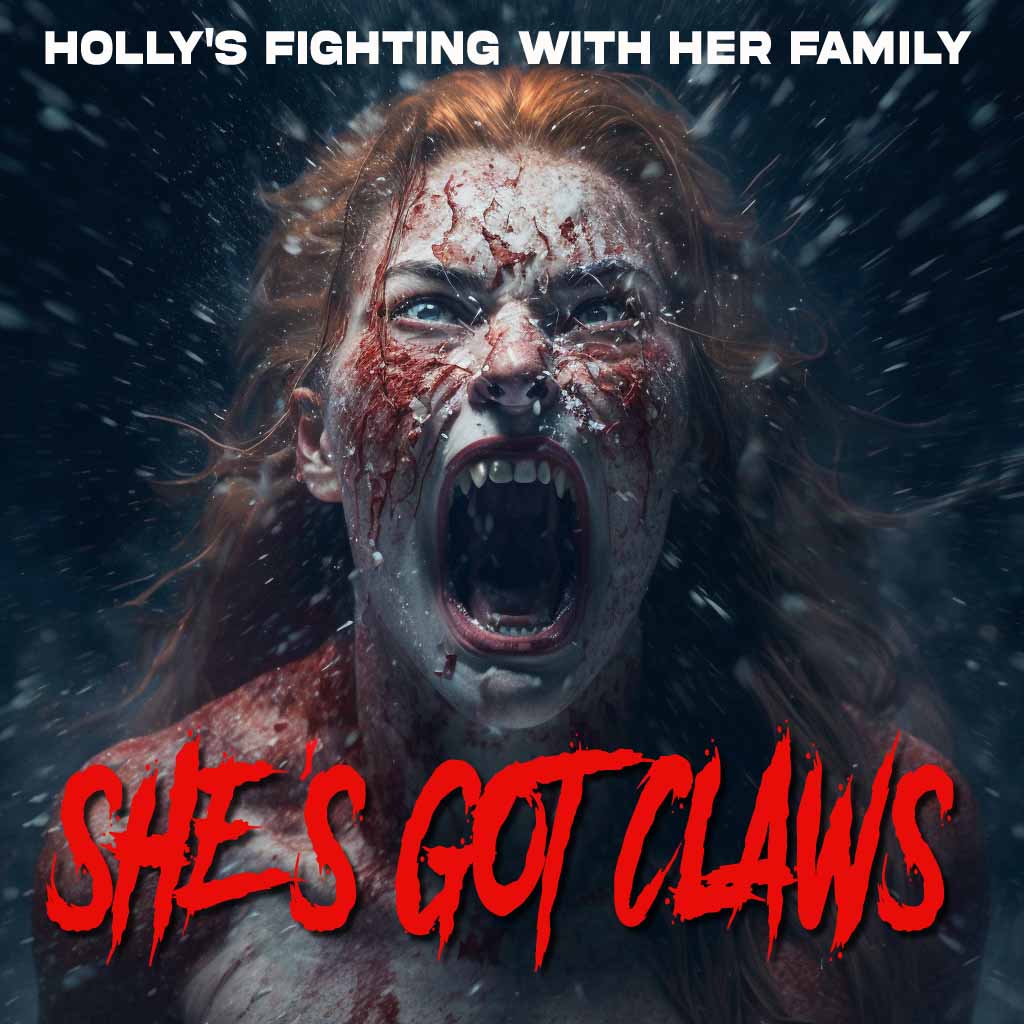
Excellent job by David. He didn’t actually make it into the traditional showdown. For this showdown, I added one entry for the best movie-crossover pitch regardless of logline. That’s how David got in. And boy did he take advantage, winning the competition!
David is best known around these parts for the killer logline he won with in his last Amateur Showdown review. You can read the review of that script here.
Call of Judy didn’t blow us away but maybe She’s Got Claws will. Let’s find out!
A woman named Ivy in Afghanistan turns into a cat werewolf thing and kills a bunch of people. We then cut to Alaska where we meet Holly, who we will later find out is Ivy’s sister.
Holly wakes up outside some guy’s place. She walks in, looks at herself in the mirror, and sees a lot of blood. She stumbles outside and finds people looting apartment buildings. She meets up with some cops who take her to the station.
Once there, the Marines (or special forces) show up and claim to be looking for something dangerous. The head of the group is Holly’s father, whom Holly avoids. Although we don’t know why, we get the sense that she needs to stay as far away from this man as possible.
Figuring that whatever happened last night that resulted in her waking up naked and bloody is probably related to this marine infiltration, Holly slips out and meets up with one of the cops, Miguel, at his house. It’s unclear if Miguel knows she’s a cat-werewolf or if he just senses she wants to get away from these marines.
As the seemingly amnesia-ridden Holly tries to put the puzzle pieces of what happened back together, we occasionally jump back in time, where we meet other players. There’s Elizabeth, who hates Holly. We get the sense that Cat-Holly may have killed her husband. And then there’s Ivy, who Holly had some massive sibling rivalry with courtesy of their father. There are also some sinister scientific labs in their past.
When we jump back to the present, the Marines are hunting down Holly, who, taking a page from The Hulk’s book, is forced to become the cat once again to kill them off. Then Ivy herself arrives in town, turning this sibling rivalry into a primal to-the-death showdown. Or will Holly team up with her sister to take down the real problem here – Daddy? That’s the ultimate question that must be answered in.. She’s Got Claws.
The aim for this review is to be constructive because I know how much time and effort David has put into this craft. There’s an aspect to David’s writing that’s holding him back. And if he doesn’t fix it, he’s not going to advance to the next level.
That issue is LACK OF CLARITY in the writing. It’s what I experienced reading his last script. It’s what I experienced in our e-mail exchanges. And I experienced it again here.
It’s such an important issue that it’s hard for me to even diagnose today’s story because I probably only understood 60-70% of what was happening due to the lack of clarity in the writing.
What’s frustrating is that it’s hard to explain *why* there’s a lack of clarity. It’s not immediately apparent when you’re reading the script. David obviously knows how to construct sentences and paragraphs and he has a very active vocabulary and a vivid writing style.
But there are two areas in particular that kept causing problems.
One, sometimes there will be something in a sentence that either is highly unclear or, at the very least, unclear enough that I had to re-read it. This is fine if it happens a few times during the script. But it happened a few times every page.
Two, whenever a new situation arrived in the script, it wasn’t set up clearly enough. Again, there’s some gray area here. I *mostly* understood what was going on. But it always felt like the situations were presented clumsily. You could never quite see them as clearly as you wanted to.
Let’s go into some examples of both of these issues. We’ll start with the first one. Here are a series of sentences from the script.
-“Ali is still upright. Staring with one eye. Ivy pulls a face.”
What does “pull a face” mean? I *kind of* understand it. But I could be wrong. And that’s the problem. You want your reader to *definitely* understand. Not kind of understand.
-“He shoots. THREE RAPID. We SQUEAL. Jump back from the edge.”
Is “three rapid” referring to the shots? Then why not say, “THREE RAPID SHOTS?” It’s a small thing but it makes a big clarity difference.
-“We pad slowly round toward the front—“
I don’t know what this means. What does it mean when you “pad?”
-“He always nods hi to his reflection and has not exactly gelled with Alaska’s low key ways.”
This is in reference to a character intro. I don’t know what to make of this. You’re saying that this character, EVERY SINGLE TIME HE EVER WALKS NEAR A MIRROR, nods hi to the reflection? A) Why would someone nod hi to themselves? And B) Why would you nod hi to yourself in every mirror for the rest of your life?
-“Same Frankensteins. Same table. SNOW BLOWER THRUM drifts in.”
This is one of the easier lines to discern what’s going on. But still, “Snow blower thrum” is not an everyday phrase so when it’s presented in this quick staccato manner, it requires a re-read.
-“He cups his hand around his phone and rolls a die onto it.”
I’ve read this one a ton of times and I still don’t understand what it means.
I would implore David to stop writing in this style. I understand why he’s doing it. It’s part of his voice. But it’s undermining the clarity of the story. I would try to write a couple of scripts in proper English. Full sentences with subject, verb, and object. “John ate the taquitos.”
Cause I don’t think that these scripts are going to be clear enough until that change is made. Then, once you master that, you can start to pepper your voice back into your storytelling. Remember, your unique voice doesn’t matter if the reader can’t understand what you’re saying.
The second issue is an inability to clearly set up your major plot beats. For example, in Titanic, you don’t start with the ship hitting the iceberg. You have to set everything up first.
We meet Holly waking up from something bad happening. She walks into this apartment of a guy and sees herself bloody in the mirror. So my assumption was she slept with this guy then inadvertently turned into a were-cat and killed him. Then we go outside and, out of nowhere, the marines (or special forces) are in town cleaning the town out, supposedly to find this killer were-cat. But… she literally *just* killed someone and nobody knows about it yet. How are the marines there?
Later in the script, it’s mentioned that they came because she slaughtered a bunch of military people the previous night. So I go back and re-read that part of the script and realize that before we introduce Holly, we show glimpses of this animal killing people. So I thought, “Oh, okay. She didn’t kill the guy in the apartment. She killed people before she got to that apartment. But then where was the guy in the apartment? Did she kill him too? Was he gone on vacation?” It just seemed like it could’ve been set up clearer.
Holly is then taken to the police station, although I wasn’t entirely sure why. I think because she needed to be evacuated from town like everyone else?
From there, she sneakily exchanges texts with cop, Miguel, for some reason. I’m not sure why. I don’t know if she knows Miguel from before or if she just showed up in town yesterday? I don’t know! To be honest, I didn’t even know this was a military base UNTIL AFTERWARDS when I re-read the logline. When I was reading the script, I assumed it was a town.
She then sneaks away when the cops and marines aren’t looking and travels to Miguel’s house, where they meet up. I’m not sure why she goes there. I’m not sure why they need to team up.
This is what I mean when I say it’s like reading through fog. I would always feel as if I *mostly* understood why things were happening. But it was shaky enough that I was always doubting whether I was comprehending the moment.
As frustrating as this is for David to hear, it’s just as frustrating for me to explain because I want to fix this for him and I don’t know how. I wish it was as easy as “Do A, B, and C.” But there are minute details I haven’t identified that are playing into my inability to follow along.
All I know is that when I’m reading a good script, everything is crystal clear. Every word, every sentence, every beat, every action, every plot development, every character motivation. That’s not an issue that ever even comes up when I’m reading a good script. Clarity and presentation are a given. And that’s not happening here. It wasn’t happening in Call of Judy either.
Which means I can’t even assess the overall story.
I’m going to call on you guys here cause some of you are better at this than me. Read the first ten pages of She’s Got Claws. Tell me if you experience the same issues I had. If enough of you didn’t, I will concede I’m bad at reading. But, if you do, explain what you think is going on as specifically as possible. Because I want to help David. And I want to be better armed to help writers in the future who have this issue.
I still think this has movie potential. These dual-cat-human killers running around and ripping up Marines – I could see people paying for that. The script does have some gnarly imagery. But we need a way clearer AND cleaner story.
Script link: She’s Got Claws
[ ] What the hell did I just read?
[x] wasn’t for me
[ ] worth the read
[ ] impressive
[ ] genius
What I learned: You have to be aware of what your weaknesses are as a screenwriter and write around them. David has lack-of-clarity issues. When you have lack-of-clarity issues, you don’t want to write Memento, something with a lot of intricate flash-backing (which I didn’t get into in the review). We’re having a hard enough time following the present storyline. Prove you can tell a clear concise simple story first. Then you can get fancy.
An excerpt from my upcoming book, “The Greatest Dialogue Book Ever Written”
There was a time when I didn’t think I was ever going to finish this book. There were too many technical obstacles (mainly regarding how ebooks interpret screenplay-formatted text) that required endless troubleshooting. But I’m SOOO excited that I’m finally about to release the book because I truly believe it will be the seminal book on dialogue for the next 50+ years.
It’s a book with 250 dialogue tips. This in an industry where you’re lucky to find someone who can give you 10 dialogue tips. And I just can’t contain how thrilled I am that I can finally share it with you. I already posted the opening of the book the other week. In today’s post, I’m including a segment from the “Conflict” chapter. This is arguably the most important chapter in the book and it contains 21 tips total.
TIP 121 – Make sure there’s conflict built into the relationship of the two characters who are around each other the most in your movie/show – Who are the two characters who will be around each other the most in your script? You need to build conflict into the DNA of that relationship specifically. That way, almost every scene in your movie is guaranteed to have conflict. John and Jane in Mr. and Mrs. Smith, Tony Stark and Steve Rogers in Civil War, Allie and Noah in The Notebook, Lee and Carter in Rush Hour, Danny and Amy in the Netflix show, “Beef.”
TIP 122 – Using worldviews to create conflict – Okay, but how do you build conflict into the DNA of a relationship? One way is to give characters different worldviews. Have them see the world differently. If you do this, your characters will be at odds with each other for an entire movie as opposed to one or two scenes. In the Avengers movies, Tony Stark’s worldview is he’s willing to get dirty to protect the universe. Steve Rogers’ worldview is governed by honesty. He wants to play by the rules. That difference in their worldviews is why the two butt heads so much.
TIP 123 – Embrace the word “NO” – “No” is the OG conflict word. Without it, most conversations become boring. Let’s say your hero tells his wife, “I’m going to the store,” and she replies, “Okay.” How is that going to result in an interesting conversation? Or your assassin asks his handler, “Is it okay if I skip this assassination? I don’t think it’s safe enough.” And the handler replies, “Sure, no problem.” When people agree with people, the conversation immediately stops. This is why you want to integrate “No” (and all forms of it) into your dialogue. Here’s an example from the HBO show, White Lotus. In it, 23 year old Albie has fallen in love with a local Italian prostitute who owes her pimp money. Albie wants to help pay her pimp off, so he comes to his rich father to ask for money.
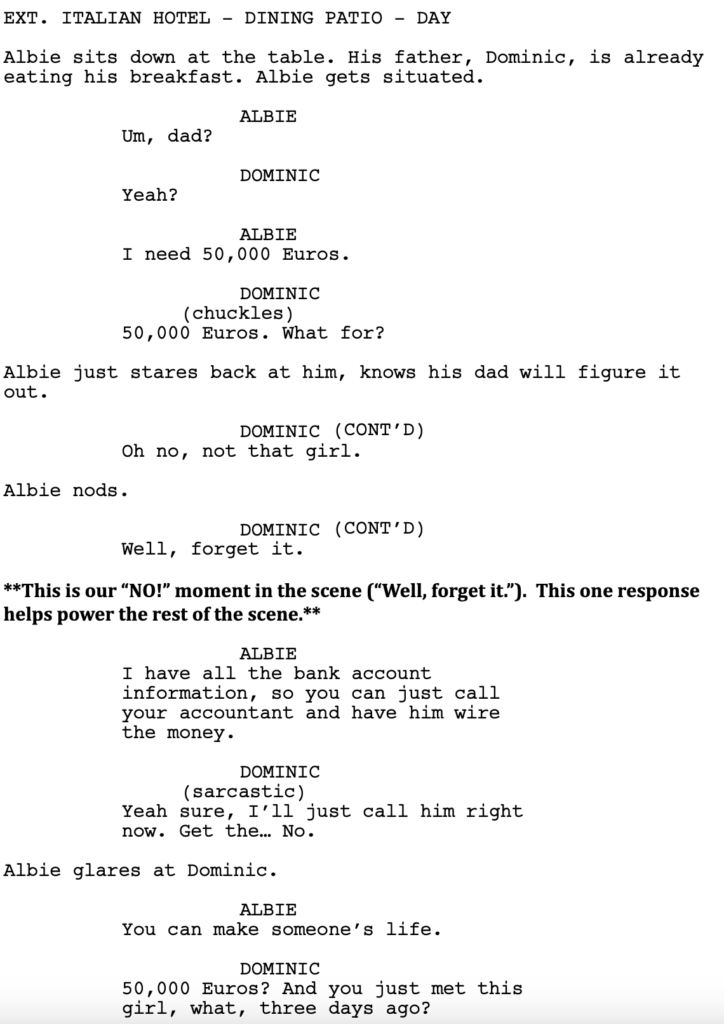
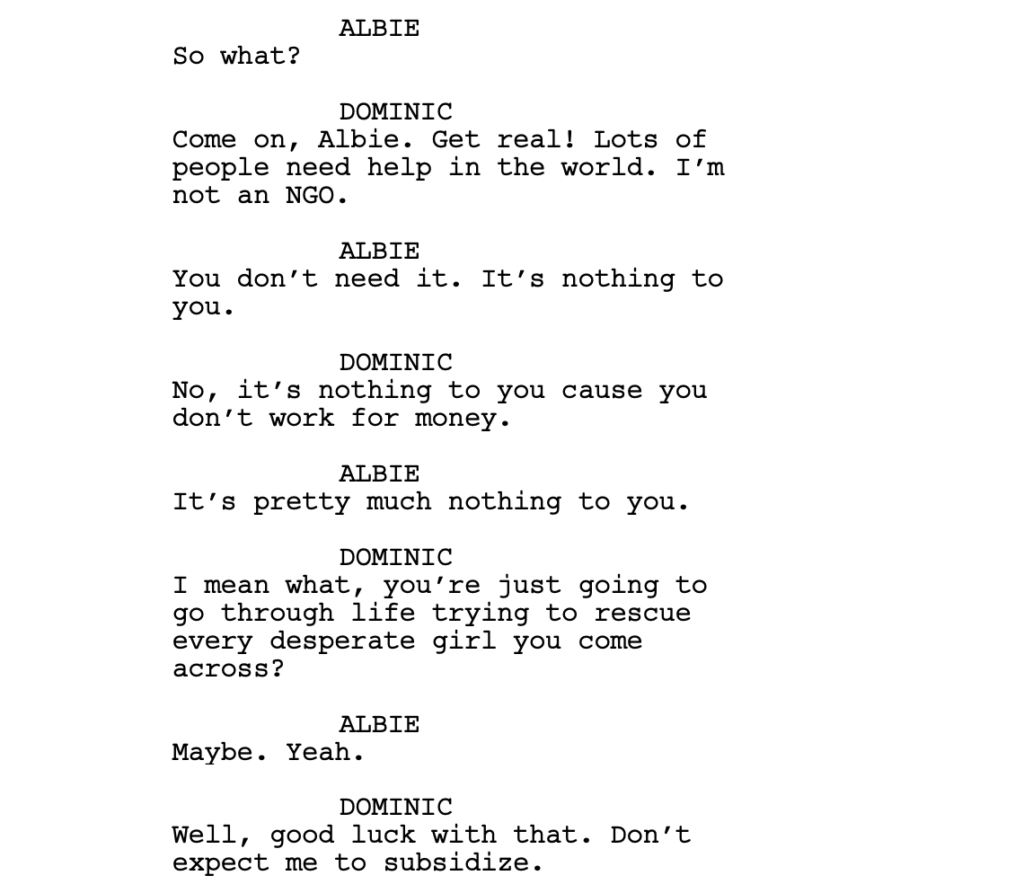
TIP 124 – Make them work for their meal – The reason “No” is so great for dialogue is that it forces your character to work for their meal. They don’t get a free pass. The above scene goes on for another three minutes and Albie has to resort to offering something to his father to get the money. That’s what makes the scene entertaining – that he has to work so hard for his meal. And he wouldn’t have had to do it if his dad had said, “Yes.”
The Scriptshadow Dialogue Book will be out within the next two weeks. But there’s a chance it could be out A LOT SOONER. So keep checking the site every day! In the meantime, I do feature script consultations, pilot script consultations, short story consultations, logline consultations. If you’ve written something, I can help you make it better, whether your issues involve dialogue or anything else. Mention this post and I will give you 100 dollars off a feature or pilot set of notes! Carsonreeves1@gmail.com