
Search Results for: F word
How to immediately gain 50% more interest in your script
Genre: Crime/FBI
Premise: Two FBI agents are pitted against a crew of bank robbers–and each other–as they grapple with order and chaos inside their department and home lives.
About: This script finished with 11 votes on last year’s Black List. Screenwriter Will Hettinger wrote on the series, Painkiller, last year.
Writer: Will Hettinger
Details: 115 pages
 Jon Hamm for Gamen?
I’m gonna jump right into it.
How do you gain 50% more interest in your screenplay?
Four words.
“Inspired by True Events.”
That’s what today’s script says on its title page and the best thing about it is that it only needs to be barely true. You can have the smallest most smidgeon-ish tiniest teeniest connection to a true story but if there’s a thread you can pull on, you damn well better say your script is inspired by true events.
Cause when you hand those four words over to a movie exec, dollar signs start appearing over their heads accompanied by the “ding ding ding ding” sounds of hundreds of slot machines.
50-something Robert Gamen is a tough FBI vet who lives to work in the gray. He likes mixing it up, crossing lines, crossing back, pushing the envelope. And right now he’s determined to take down the Armenian mob based up in Glendale, Los Angeles.
Assistant Senior Agent in Charge Katie Martin is in charge of Gamen’s crew and realizes that, in order to get the most out of the operation, she needs a translator. So she recruits the nerdy Andy Walsh, a former Air Force soldier who left the nitty gritty action of the Middle East to work as a translator at a desk.
Gamen and Andy seem to like each other all right. Gamen is more of a ladies man whereas Andy is dedicated to his wife. The two spend many nights hanging out outside Armenian bars and clubs listening in on bugged Armenian thugs in the hopes of figuring out where all their money is going.
But Gamen has a secret. He uses his Armenian operation as a cover to go rob banks with a crew of fellow agents. Andy is the only one inside Gamen’s crew who doesn’t know about the bank-robbing thing. But over time, he senses there’s more going on under the surface. Eventually, he’ll be thrown into opposition with his own group, and must decide whether to take out the partner he’s become so close to.
I have a question for you guys.
I know a lot of you don’t like romantic comedies. So, when you are forced to watch a romantic comedy (after your girlfriend mercilessly hassles you for two years), can you tell a good one from a bad one? Or are they all equally bad to you?
I ask this because these crime scripts all read the same to me. They all have the same perceived problems.
They’re either not covering a unique enough angle or the characters feel like the exact same characters I see in all of these movies.
But maybe that’s just me. Maybe I don’t understand these films.
All the crime films I have understood: Godfather, Goodfellas, Training Day, Heat…
They all had one thing in common: BIG MEMORABLE CHARACTERS.
You know what’s great about having big memorable characters? EVERY ONE OF YOUR SCENES IMPROVES. Because your scenes all have the benefit of operating with these big personalities.
When Tommy DeVito (Joe Pesci) in Goodfellas says, “Funny like how? Like I’m a clown? I amuse you?” That scene is amazing because that character is so amazing.
With Final Score… Gamen is fine. Andy is fine.
But do either of them have personalities that pop off the page? Do they say things that are memorable? Do they have backstories or internal conflicts that make them compelling?
There’s a bigger question at stake here… are screenwriters okay with writing an approximation of the types of movies they like? Are they happy with merely giving you a taste of what it’s like to read a good script in this genre? Or do they want to give you the full meal?
Most screenwriters are perfectly fine giving you a taste. And that’s not enough for me.
You also have to be aware of what genre you’re writing in and meet the bar of that genre. Yesterday, I covered Road House. I said I didn’t mind that the villain was one-dimensional. But there’s a reason for that. Road House is silly fun. Nobody’s going into that genre expecting to be moved or learn something about life. They just want to have fun.
But a movie like Final Score has a higher bar because it’s aiming at a higher-IQ audience. Therefore, you can’t get away with straight-forward obvious facsimiles of characters we’ve already seen in this genre. We need more.
I’m going to keep saying this until the end of time: 95% of screenwriters vastly underestimate how high the bar is.
And I get it!
I get that you see trash in theaters and on TV all the time. The Marvels. Citadel. Ricky Stanicky. The 6000th Walking Dead spinoff.
And that makes you think the bar is low. But the bar is always higher than you think it is. Which means, when you’ve come with a solid character, you’re not done. You have to figure out how to push that character and make them good. And then, once you’ve done that, you’ve got to push that character and make them great.
Cause the difference between that effort is the difference between Emma Stone’s character in Poor Things and Dakota Johnson’s character in Madame Webb.
THE READER KNOWS WHEN YOU DIDN’T PUT IN ENOUGH EFFORT. You cannot and will not EVER FOOL THEM.
I’m mad about this because I see it EVERY SINGLE DAY. Reading one script after another. I can tell the writer didn’t put all of themselves into the characters or the script. And look, sometimes you get that rare newbie writer who puts every ounce of their being on the page but they don’t yet understand the craft enough to make it work.
Still, I’d much rather read that than yet another one of these “lottery” scripts. I call them lottery scripts because they’re not good enough to sell on their own. They’re good enough to go into the big Hollywood Lottery slush pile where their success will be determined by luck.
Don’t you want to write a script that doesn’t depend on luck?
Pick a unique and marketable concept. Outline a plot that moves all the way through the story. Come up with at least one extremely memorable character. If you do those three things, you’re ahead of almost everyone you’re competing against.
I’ll give you one snippet of the dozens of red flags that signaled to me I was reading a script that didn’t meet the bar. About halfway through the script, the boss woman asks Andy, “How’re you finding SA Gamen? You’ve been with him for months. What’s your impression?”
There are two MAJOR things wrong with this line. One, I had no idea it had been months since they were together in the first place. If you questioned me on their time spent together, I may have guessed a week or two. The fact that you’re not clear to the reader about how much time has passed is a major red flag. Cause it means time doesn’t matter in your script.
But also, it’s a red flag that your story is taking that long in the first place! And that we don’t have any clear ticking time bombs guiding the story. I’m not saying every movie needs a deadline and tons of urgency. But this is a movie with guns and crime. These movies need urgency!!!
Or, if they don’t have overarching urgency, you need each individual timeline within the story to have urgency. For example, your story may cover an entire year. But pages 30-50 need to cover the gearing up for a specific heist. Or bust. “We’ve got one week to pull this off.” Now you’ve developed urgency for the next 20 pages.
Or else your story is just floating in the ether. We don’t feel any need for the characters to achieve anything. And if that’s where you are, your story’s dead. We need a reason to keep turning the pages. Urgency is a huge reason.
It’s funny, I threw on Next Goal Wins on Hulu the other day cause it was free. By the way, I had to scour the service to find it. That’s how much it didn’t want anyone to watch it. It’s about this Samoan soccer team that’s terrible. Then a new coach comes in and tries to teach them the game.
There’s an early practice session where the players are all haphazardly stumbling around the field randomly kicking balls in any direction they see fit. There’s no effort. There’s no purpose. Sometimes I feel like 95% of screenwriters approach screenwriting the same way. They don’t take it seriously enough.
The funniest thing about this rant is that today’s script is not a bad script. It’s fine. BUT ALL THAT FINE DOES IS PUT YOU IN THE LOTTERY. You have no agency over your career with fine. You’re dependent on everyone else. But when you put your heart and soul into a good idea and you have a strong enough understanding of the craft to execute a good story and you make it a priority to hold the bar up high and surpass that bar?
You’re unstoppable.
You’re literally unstoppable because so few other writers are doing that.
[ ] What the hell did I just read?
[x] wasn’t for me
[ ] worth the read
[ ] impressive
[ ] genius
What I learned: Direct subtext – I see writers do this every so often. They’ll use their parentheticals to directly tell you what the subtext of the dialogue is. In this case, we’re just meeting the characters so we don’t yet know who’s sarcastic, who lies, who says one thing but means another. In that case, the writer has to directly tell the reader what the subtext is for them to get it. Here, we’re seeing Gamen and Assistant Special Agent in Charge Katie together for the first time…

Genre: Action
Premise: When a Florida Keys bar starts attracting the wrong crowd, they hire a reclusive ex-UFC fighter who had a traumatic exit from the sport, to get things back in order.
About: Based on the original film from 1989. This is the movie that director Doug Liman fought the evil Jeff Bezos over. Liman made the movie for MGM right before Amazon bought MGM. So the film went from a theatrical release to a streaming release in a heartbeat. Which destroyed Liman. You can watch a fun little vignette of the story over on Casey Neistat’s channel. Fun note here. The script was written by two guys with almost no credits. Anthony Bagarozzi only has one other credit in The Nice Guys and Chuck Mondry is credit-free. I point this out because it means that YOU could be the next writer of an 80 million dollar film. You just have to write a great spec script that impresses folks like Doug Liman. Now if only there was someone out there helping you write a great screenplay…
Writer: Anthony Bagarozzi & Chuck Mondry
Details: 120 minutes
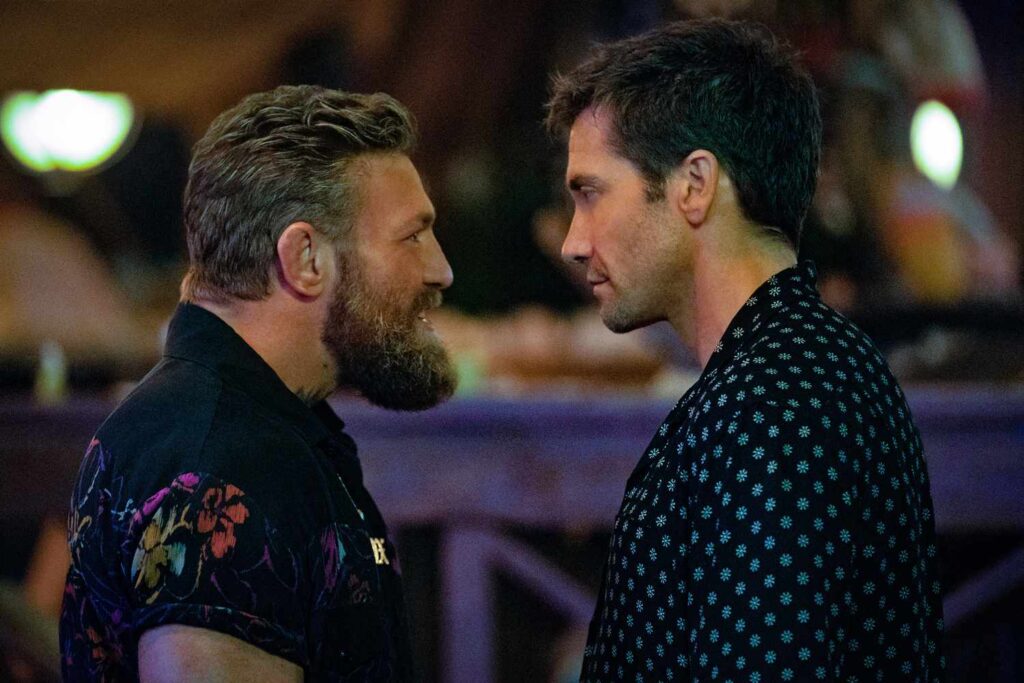 Best casting of the year?
I know I’ve demolished The 3-Body Problem enough already. But I just saw the latest promo picture for the ill-fated show: a woman with a sword.
Isn’t this a movie about aliens coming to earth?? What is even going on with this show!!??
Anyway, let’s come back to the present. Or should I say, the past. That’s because today’s movie might as well be set in 1989, when the original movie debuted. This is a throwback if I’ve ever seen one, which is ironic to say, since I never saw the first film.
Alas, that made this movie fresh to my eyes and I couldn’t be happier, cause it was like getting to see a 1989 movie made in 2024 for the first time, if that makes sense.
I get Doug Liman’s frustration with this film being released on streaming. It’s not an ego thing like it is with most filmmakers. This film was genuinely made to play in front of an audience. It’s got a lot of those silly lines that work well in a theater (Dalton crawls into Knox’s boat and Knox squares up against him. Knox: “Looks like we’ve got our own little octagon.” Dalton: “What?? Who taught you shapes?”).
And then it has these big fun fights in the bar that are practically begging for audiences to “oof” and “ohhhhh” while watching. It also has way bigger production value than your typical “dudes fighting” movie. It truly feels like something that was meant to be seen in the theater. And it would’ve crushed Ghostbusters Afterlife if it went theatrical. I’m guessing it would’ve had a 75 million dollar opening.
Alas. I’m sure everyone involved in the film will be just fine.
A woman who’s inherited a Florida Keys bar called The Road House shows up at some back door fighting bar in the middle of nowhere where she watches a fighter walk away when he realizes his next opponent is Dalton (Jake Gylenhaall). Wherever Dalton goes to fight, potential fighters walk away. As for why, we’ll find out later.
She recruits the reluctant Dalton with hard cash to come protect The Road House against its increasingly violent clientele. Long story short, a local jerk face named Ben Brandt is trying to scare the owner off so he can destroy the bar and develop the land into something more profitable.
Dalton shows up and immediately makes his mark, taking down five of the town’s toughest thugs while barely breaking a sweat. When this gets back to Ben, he isn’t sure what to do. But then the choice is made for him. His super-thug father, from behind bars, hires a guy even more dangerous than Dalton, Knox (Connor McGregor), to come in and take Dalton down.
Knox shows up and challenges Dalton immediately. The two fight to a stalemate but you get the sense that Knox was only in third gear. The promise is that another fight is coming. And when it happens, Knox is going to go all out. Along the way we learn that the reason everyone’s afraid of Dalton is that he willingly killed his best friend in the ring. So if he can do that, what can he do to someone he *doesn’t* know? We’ll see when these two psychopaths square off in a final battle.
GOOD MOVIE!
Good. Movie.
As I watched Road House, it occurred to me that the movie was quite different than a lot of Hollywood films I watch these days – the main difference being: it was stationary.
We’re not going anywhere. We’re stuck in one location. The reason that’s relevant for screenwriters is because it can be difficult to power a narrative that stays in one place.
But there is one tried and true way to do so. And that’s through CONFLICT.
For stories that stay in one place, you need to pack them with more conflict than your average script. Because, otherwise, where is the entertainment going to come from? In a movie like The Beekeeper, we’re always going somewhere. In a movie like Wonka, we’re constantly traveling around the city.
But The Road House takes place… AT THE ROAD HOUSE. So there isn’t as much to work with.
Therefore, the writers pack the script with conflict. When Dalton comes in, he immediately has to clean up the thugs that have infected the bar. Once he does that, Big Bad Ben comes in and threatens him. After that happens, a local mobster comes in and tries to kill him. After that happens, Knox comes in and starts threatening him.
And then, of course, Dalton has his own inner conflict to deal with. He killed his best friend in the ring and it haunts him every second of his life. It’s the reason he hates fighting, he hates doing this. Because every time he beats someone up, he has to be reminded that he killed his own friend in the same way.
Dalton’s entire character journey is resisting going “over the top.” He knows if he gets pushed too far, he will crack, and turn into the same guy that killed his best friend. There’s a great moment later in the movie where Dalton finally admits to the bad guys that “he’s afraid.” We’re sitting there thinking, “Oh no. Dalton’s given up??” But then he finishes the thought. “I’m afraid of what I’ll do to you now that you’ve pushed me too far.” It is the culmination of his inner conflict. He has no choice but to give into it if he’s going to save The Road House.
That’s the reason this movie works. The main character works and the writers pummel him with conflict. Things are never easy for Dalton, even as the best fighter in the world.
You know what else I liked about this movie? It harkened back to a time when bad guys were just bad because they were bad. Knox is such an over-the-top villain with no other motivation than he wants to crack some skulls and I loved him for it. It was total 1980s villain energy.
There’s a moment (mini-spoiler) where Knox has essentially defeated Dalton in the final fight and Ben Brandt, who’s injured, stumbles up and screams, “Finish him! Take him out!” You might as well have just copy and pasted the final tournament battle in The Karate Kid. It was the epitome of 1980s one-dimensional villainy.
You may be thinking, “But Carson, don’t you like complexity in villains? Shouldn’t screenwriting purists be promoting depth and motivation in their antagonists?” Sure. IF THE MOVIE CALLS FOR IT. Every movie is different. This is a movie about protecting a bar. It’s not that deep, nor is it trying to be. When you write something like that, you don’t need outrageous character arcs for your villains.
In fact, they can hurt your script if you’re not careful. I’ve seen writers try to imprint elaborate character arcs onto characters in simplistic stories and it’s like dressing up in a tuxedo for dinner at McDonald’s.
The only thing I didn’t like about the movie was that some of the fighting mechanics felt fake. It’s funny because, back in the 80s, the fighting was fake as well. The actors swung, purposefully missed, and we used camera angles and punching sound effects to make it look like a real punch.
Nowadays they’re doing this weird thing where it looks like they’re punching the air and then they’re retroactively digitally placing the actors faces in the punching line so it, theoretically, looks like a real hit. The problem is that the actors who are hit aren’t reacting to being hit properly. That’s the fake part.
To be fair, sometimes this was less apparent than others. But they need to perfect this technology if these fights are going to resonate. We have all this technology. The fighting in movies can’t be going backwards.
All in all, a VERY fun viewing experience. I say you all check it out.
[ ] What the hell did I just watch?
[ ] wasn’t for me
[xx] worth the stream
[ ] impressive
[ ] genius
What I learned: To create a character that pops, contrast their external with their internal. Dalton is the most dangerous man in the world. Yet he walks around smiling and being nice to everyone. Before he beats up the five thugs in his opening scene at The Road House, he pauses and asks them, “Does everybody here have health insurance?” He wants to know that they’ll be okay once he beats them up. He even drives them to the ER afterward!
An excerpt from my upcoming book, “Scriptshadow’s 250 Dialogue Tips”
It has been promised. But as of yet, it hasn’t been delivered.
Over the next month, I’ll be including excerpts from my upcoming dialogue book, which I’m planning on releasing a month from now. Here is the introduction to the book. The world of screenwriting is about to change forever.
What you’re about to read is the introduction to the book…
Not long after I started my website, Scriptshadow, a site dedicated to analyzing amateur and professional screenplays, I was hired by an amateur writer to consult on a script he had written. The writer had completed a couple of screenplays already and was excited about his most recent effort, a crime-drama (“with a hint of comedy”) he felt was the perfect showcase for his evolving skills. Although I won’t reveal the actual script for privacy reasons, we’ll refer to this screenplay as, “Highs and Lows,” and we’ll call the writer, “Gabe.”
Highs and Lows was about a guy obsessed with a rare street drug and, to this day, it is one of the worst screenplays I have ever read in my life. We’re talking 147 pages of unintelligible nonsense, a script so aggressively lousy, I considered submitting it to the CIA as a low-budget alternative to waterboarding.
After I put together the notes on Highs and Lows, I spent a good portion of the day debating whether I should call Gabe and aggressively suggest he pursue a different career path. I’d never done such a thing before. But, in my heart, I knew that if this man pursued this craft, he may very well end up wasting a decade of his life. If it wasn’t for my girlfriend ripping the phone out of my hand and telling me there was no way I was going to destroy this writer’s dreams, I would’ve made the call. Instead, I sent him his notes, detailing, as best I could, what needed to be improved and how to do so, and moved on.
Cut to five years later and I was contacted by a different gentleman (we’ll call him “Randy”) for another consultation. In stark contrast to Gabe’s script, I experienced what every reader prays for when they open a screenplay, which is a great easy-to-read story with awesome characters. But it was the dialogue that stood out. Randy wasn’t ready to challenge Tarantino just yet but the conversations between his characters were always clever, always engaging, and always fun.
I sent his script out to a few producers and one of them ended up hiring him for a job. He wrote back, thanked me, and mused that he’d come a long way since our first consultation. “First consultation?” I said to myself. “What is this guy talking about?” I looked back through my e-mails to see if we had corresponded before and nothing came up. But then I dug deeper and discovered that I *had* worked with Randy before. Under a different e-mail address.
The owner of that e-mail?
Gabe. Which was a pen name he had used at the time.
This was not possible. Randy wrote with confidence. Gabe wrote like he’d accidentally fallen asleep on his keyboard. I went back and re-checked, checked again, checked some more, only to return to the same baffling conclusion. This page-turning Tour de Force was written by the same writer who had written one of the worst screenplays I’d ever read!
After my denial wore off, I got in touch with Gabe and asked him the question that had been eating at me ever since I confirmed his identity: “What in the world did you do differently this time around?” I especially wanted to know how his dialogue had skyrocketed from a 1 out of 10 to an 8 out of 10. His answer is something I’ll share with you later in the book, as it’s one of the most important tips you’ll ever learn about dialogue.
But for now, I want to emphasize the lesson Gabe’s dramatic improvement taught me, something I remind myself whenever I read a not-so-good screenplay: You are always capable of improving as a screenwriter. If Gabe could go from worst to first, so can you.
Which is why I want to share with you one of the biggest lies you’ll encounter when you begin your screenwriting journey. I heard it a bunch when I first started screenwriting and I still hear it today: “You either have an ear for dialogue or you don’t.” This faulty statement, which you’ll hear mostly from snobby agents, jaded executives, and impatient producers, is dead wrong.
Writing good dialogue can be learned.
Let me repeat that:
Writing good dialogue can be learned.
To be fair, doing so is challenging. More so than any other aspect of the craft. Aaron Sorkin, who many believe to be the best dialogue writer working today, admits as much. In an interview with Jeff Goldsmith promoting his film, The Social Network, Sorkin confessed that while storytelling and plotting are built on a technical foundation, making them easy to teach, writing dialogue is more of an instinctual thing, and therefore hard to break down into teachable steps.
Indeed, dialogue contains elements of spontaneity, cleverness, charm, gravitas, intelligence, purpose, playfulness, personality, and, of course, a sense of humor. This varied concoction of ingredients does not come in the form of an official recipe, leaving writers unable to identify how much of each is required to write “the perfect dialogue.” Which has led many screenwriting teachers to throw up their hands in surrender and label dialogue, “unteachable,” which is why there hasn’t been a single good dialogue book ever written.
When screenwriting teachers do broach the topic of dialogue, they teach the version of it that’s easiest on them, which amounts to telling you all the things you’re NOT supposed to do. My favorite of these is: “Show don’t tell.” Show us that Joey is a ladies’ man. Don’t have him tell us that he’s a ladies’ man.
“Show don’t tell” is actually good screenwriting advice but why do you think screenwriting teachers are so eager to teach it? Because it means they don’t have to teach dialogue! If you’re showing something, you’re not writing any conversations.
Or they’ll say, “Avoid on-the-nose dialogue.” Again, not bad advice. But how does that help you write the dialogue that stumbles out of the mouth of Jack Sparrow? Or sashays out of the mouth of Mia Wallace? In order to write good dialogue, you need to teach people what *to* do, not what *not to* do.
If you ever want to test whether a self-professed screenwriting teacher understands dialogue, ask them what their best dialogue tip is. If they say, “go to a coffee shop and listen to how people talk,” run as far away from that teacher as possible because I can promise you they know nothing about dialogue. If someone is giving you a tip where there’s nothing within the tip itself that teaches you anything, they’re a charlatan.
What the heck is good dialogue anyway?
Good dialogue is conversation that moves the scene, and by association the plot, forward in an entertaining fashion. “Entertaining” can be defined in a number of ways. It could mean the dialogue is humorous, clever, tension-filled, suspenseful, thought-provoking, dramatic, or a number of other things. But it does need those two primary ingredients.
• It needs to push the scene forward in a purposeful way.
• It needs to entertain.
What prevents writers from writing good dialogue? That answer could be a book unto itself but in my experience, having read over 10,000 screenplays, the primary mistake I’ve found that writers make is they think too logically.
When they have characters speak to one another, they construct those characters’ responses in a way that keeps the train moving and nothing more. They get that first part right – the “move the story forward” part – but they forget about the “entertain” part. Don’t worry, I’ve got over a hundred tips in this book that will help you write more entertaining dialogue.
Yet another aspect missing from a lot of the dialogue I read is naturalism – the ability to capture what people really sound like when they speak to each other. You are trying to capture things like awkwardness, tangents, authenticity, words not coming out quite right. You’re trying to mimic all that to such a degree that the characters sound like living breathing people.
And yet, while being true-to-life, you’re also attempting to heighten your dialogue. You’re trying to make every reply clever. You’re trying to nail that zinger. You’re giving your hero the perfect line at the perfect moment. How does one combine realism with “heightened-ism?” That’s one of the many paradoxes of dialogue.
So I understand, intellectually, why so many teachers are terrified of dialogue. The act of writing movie conversation is so intricate and nuanced that the easy thing to do is leave it up to chance and tell writers that they either have an ear for it or they don’t (or to go to a local coffee shop and “listen to people talk”).
But dialogue is like any skill. It can be learned. It can be improved. And I dedicated years of my life looking through millions of lines of dialogue, ranging from the worst to the best, to find that code. And I believe I’ve found it. By the end of this book, you’ll have found it as well.
It won’t be easy. This is stuff you’ll have to practice to get good at. But, once you do, your dialogue will be better than any aspiring writer who hasn’t read this book. That much I can promise you.
So let’s not waste any more time. I’m going to give you 250 dialogue tips and I’m going to start with the two biggest of those tips right off the bat. If all you ever do for your screenwriting is incorporate these two tips, your dialogue will be, at the very least, solid. Are you ready? Here we go.
TIP 1 – Create dialogue-friendly characters – Dialogue-friendly characters are characters who generally talk a lot. They are naturally funny or tend to say interesting things, are quirky or strange or offbeat or manic or see the world differently than the average human being. The Joker in The Dark Knight is a dialogue-friendly character. Saul Goodman in Breaking Bad is a dialogue-friendly character. Deadpool is. Juno is. It’s hard to write good dialogue without characters who like to talk.
TIP 2 – Create dialogue-rich scenarios – Dialogue is like a plant. It needs sunshine to grow. If every one of your scenes is kept in the shade, good luck sprouting great dialogue. A scene where a young woman introduces her boyfriend to her accepting parents is never going to yield good dialogue. There’s zero conflict and, therefore, little chance for an interesting conversation. A scene where a young woman introduces her boyfriend to her highly judgmental parents who think their daughter is too good for him? Now you’ve got a dialogue-rich scenario!
I need you to internalize the above two tips because they will be responsible for the bulk of your dialogue success. Try to have at least one dialogue-friendly character in a key role (two or three is even better). Then, whenever you write a scene, ask yourself if you’re creating a scene where good dialogue can grow.
Don’t worry if these two things are confusing right now. We’re going to get into a lot more detail about how to find these dialogue-friendly characters and how to create these dialogue-rich scenarios.
A pattern you’ll notice throughout this book is that good dialogue comes from good preparation. The decisions you make before you write your dialogue are often going to be just as influential as the ones you make while writing your dialogue.
There’s more to come next week! If you want to hire me to take a look at your script and help you with your dialogue (or anything else), I will give you $100 off a set of feature or pilot notes. Just mention this post. You can e-mail me at carsonreeves1@gmail.com
Genre: Thriller
Premise: After a botched bank heist leaves nineteen people locked inside a state-of-the-art vault, the FBI recruits the world’s foremost box-man from federal prison so he can break them out before they suffocate inside.
About: This finished with 7 votes on last year’s Black List and was one of my personal highest-rated concepts on the list. You can check out my thoughts on every Black List entry here. Screenwriter Adam Yorke has one credit, a 2021 Spanish thriller about a blind woman called, “See For Me.”
Writer: Adam Yorke
Details: 118 pages

When I started screenwriting, there was one word that annoyed me more than any other. It was the word “craft.” I’d occasionally spot it inside a screenwriter interview, often from some ancient screenwriter who’d get up on his high horse and pretentiously claim that screenwriting was a “craft” and that in order to get good at it, you needed to master the “craft.”
I rolled my eyes so many times at the mention of that word, they have the rarest form of PTSD – retinal PTSD – from excessive whiplash.
But now myself and my eyes love the word.
We love it because we *understand* it.
And you’re about to understand it too. But first we have to summarize the plot of Boxman.
After learning about the history of safe-cracking, we meet Frank Pierson, in prison, a man who is clearly going to be played by George Clooney if the writer has anything to say about it. Vault-cracker Frank is in prison for 30 years because of a diamond heist he orchestrated.
But Frank’s about to get a lucky break. At one of the biggest banks in town, some Russians have broken into the bank’s top-tier vault. They stole the money then locked all 19 employees inside. As it so happens, the only two people who can open the vault, who must do it from the outside, are part of that 19. Oh, and, the airtight vault has only 5 hours of air for 19 people.
FBI Field Office head, Kay Hollis, is brought down to the site and realizes quickly that they have to think outside the box. He makes the call to bring in Pierson, who will only do it if he’s immediately freed once he gets the vault open. There’s a lot of red tape up at the governor’s office but time is of the essence so they get the deal done.
Frank assesses the situation and develops a complicated multi-step several-hour plan to break through this annoying vault. As he goes about his job, we learn that Vitaly, the man who ordered this robbery, is upset that his son was killed during the escape, and wants revenge.
Who he wants revenge against adds another compilation to the proceedings. You see, there’s an inside man in the vault. One of these 19 was working with the robbers and Vitaly. They ultimately alerted the cops, which is how Vitaly’s son was killed. So Vitaly wants to make sure Frank doesn’t open that vault. If he does, the inside man/woman will live!
Oh, and if that isn’t enough, Vitaly worked with Frank on that diamond heist that put him in prison! Talk about onions here. This script’s got layers!! In the end, it’s still about if Frank can crack the most uncrackable safe in the world in time to save 19 lives. And once Frank realizes that he’s been given the wrong schematics to the safe, that reality is looking hella unlikely!
As I was saying.
When I read a script, one of the big things I’m looking for is a screenwriter who can carve together thoughtful sequences. It’s not just “Cold Open Scene,” “Character Intro Scene,” “Conflict Scene,” “Inciting Incident Scene.”
There’s a *craft* to it. There’s a creativity, thoughtfulness, and a “connectedness,” that’s been placed into the sequence. Boxman’s opening sequence is a great example of that.
We start in 1500 B.C. If anyone here saw the logline and thought we’d be starting in 1500 B.C., raise your hands?
Show of no hands? That’s what I thought.
That alone places this above 90% of applicants. You’re giving us something that we don’t typically get in this genre. Then, we travel through the history of lock-making and lock-picking. This isn’t entirely creative. Any writer can come up with a history lesson.
But Yorke adds a STORY to the history lesson. After we’ve established the key years in lock-making, he provides a story about a man who created an un-pickable lock and challenged the world to pick it. We watch (and listen, via a man’s voice over) people try but fail to pick the lock again and again. Over the course of decades.
Finally, a man is able to pick the lock. We then marry that image with the image of the man providing the voice over. This is Frank. And when we pull back, we see that he’s in prison. At the visitor’s window. Talking to his daughter. He’s the one who’s been giving this history lesson, and he’s been giving it to her.
Think about that for a second. We get the lock-picking history lesson. It climaxes in a fun story. And then we connect it with our hero, who’s not just casually living his life, but is rather in prison. We also get some great exposition (about locks) and backstory (about family) along the way.
That whole sequence required CRAFT. It required thought. It required planning. It required creativity.
An average writer would’ve started this script with Frank talking to his visiting daughter and telling her he loved her or something. That’s what the writer WHO HAS NO CRAFT would’ve done. Good writers craft sequences.
Ironically, Yorke follows this great opening with the worst section of the entire script. A big gigantic bulk character introduction.

Anybody here think, without looking, that they could pass a ‘who’s who’ test on all those characters? Yet the writer seems to think we can.
This is every screenwriter. Every screenwriter has strengths and weaknesses. Some of those weaknesses are the worst kind. They’re BLINDSPOTS. The writer doesn’t even know they have them so they can’t fix them. This is why it’s important to get a screenplay consultation every once in a while. You need someone telling you you have these problems.
Once we get through another 15 pages or so, and we hear the key characters’ names over and over again, we start to know who’s who and enjoy the script again. And it’s a good script! It’s one of those scripts that has enough going for it that it’s above the “lottery.” For those who don’t know, I call the giant pool of 50,000 scripts in Hollywood that are average to pretty good “the lottery.” Because the only way you sell one of those scripts is pure luck.
The attention to detail, the deep research that went into the safe-cracking, the multilayered story, the clever subplots (there’s an “inside man” in the vault), and the fun central plotline (will this safe-cracker both save 19 lives AND free himself from prison) combined for a script that is worthy of producing.
The only thing holding the script back is the ridiculous character count. I always complain about big character counts but it’s not a criticism without merit. Having too many characters isn’t just annoying. It severely cripples the read. Cause you’re never clear on who everyone is. So you’re only half-understanding major plot moments.
If you don’t know that Character X just double-crossed Character Y because both characters were introduced quickly then disappeared for twenty pages before being brought back again… you’re missing major plot moments. Professional writers know this stuff. I’m imploring young writers to learn it as well. It makes your scripts so much more readable when you understand the limitations of how many characters and subplots a reader can track.
Finally, a reminder about the importance of CRAFT. Not just with your opening scene. Do it throughout your script. Show us that you are creatively crafting sequences that clearly have a lot of thought put into them. Cause guess what? We know when you don’t put any effort into a scene. If you think you get away with that stuff? I promise you don’t.
I just consulted on a script three days ago where I had a come-to-Jesus moment with the writer. He phoned in a major set piece. I told him, “You don’t get to do that.” Readers see that and they don’t just lose faith in the script. They lose faith IN YOU. Which is way worse. Cause it means they don’t want to read anything from you anymore.
And yet it’s one of the easiest aspects of screenwriting to get good at. Cause all you have to do is put in EFFORT. We can tell when you do it. We can tell when you don’t.
[ ] What the hell did I just read?
[ ] wasn’t for me
[xx] worth the read
[ ] impressive
[ ] genius
What I learned: Learning how to introduce lots of characters quickly and MEMORABLY is one of the single clearest signs of a legitimate Hollywood screenwriter. This is one of the things they know how to do that amateurs or young repped writers struggle with. Knowing how to set a lot of people up quickly so that the reader remembers all of them? That’s a $100,000 skill right there. It’s too wide-ranging of a topic to teach in one “What I learned,” but it amounts to a combination of naming your characters smartly (so that their names sound like who they are yet not in an on-the-nose way), giving them a quick strong action that defines them, and giving them dialogue that’s both unique to them and memorable. Do that and you can introduce TONS of characters.
My friends, we actually have a good script today. A very good script.
Genre: Action/Period
Premise: Set in the 14th century, a shepherd watches as a group of mercenaries assault and murder his employing family, setting him on a path of revenge.
About: Today’s writer, Will Dunn, has been writing for a long time. He first made strides by getting into the Twentieth Century Fox writing program back in 2011. Since then, he’s sold a few scripts, including one called “Ion,” about a man who travels to other planets and dimensions in search of his reincarnated lover. The Peasant also made last year’s Black List.
Writer: Will Dunn
Details: 98 pages
 This role seems tailor-made for the fast-rising Alan Ritchson
Katt Williams, my new muse, said something interesting in a recent interview. He said, “People think stand-up comedy is easy because you’re just talking. And everybody thinks they can talk and be entertaining. The irony is that the better I get at my craft, the easier it looks. But those people aren’t considering the 30 years of work I put in to make it look this easy.”
It’s the same thing with screenwriting. The better the screenplay, the easier it looks to write a screenplay. There’s no place that better represents this issue than the Black List. We’ve gotten a ton of bad scripts from the list and, one would think, it is partly due to the delusion people have of thinking this craft is easy.
It’s not. It’s hard.
But lucky for us today, we finally have a screenwriter who knows what he’s doing.
It’s the 1300s in Tuscany, Italy. War is so prevalent at this time that even when there’s no war going on, bored soldiers will join together in teams and just rape and pillage towns in order to accumulate as much wealth as possible.
We meet Oliver, a 40-something shepherd, as he’s teaching a young boy, Luca, how to use a sling. Oliver is staying with Luca’s family, including Luca’s father, Gio, after having shown up a month prior. It’s clear that Oliver has some sort of shady past but, at least at first, it’s unclear what.
That changes when a group of mercenaries show up, knock Oliver out, then go kill the family he’s staying with. A brutal “Patrick Bateman (American Psycho)” like leader named Janick revels in the destruction. But what he’s really taken by is the knight’s sword that was hidden in the barn. It is highly unusual for a peasant family to have a sword like this.
When Oliver comes to and learns of the family’s demise, he has one goal and one goal only. Go find Janick and kill him. Oh, and kill anyone Janick knows as well. Janick is staying at a castle town called Volterra nearby. His mercenary crew lobbed off the head of the king there and turned the place into their own little vacation villa.
After a brief detour, Oliver heads to Volterra, breaks in, and kills a bunch of mercenaries. But Janick and his men get the upper hand, forcing Oliver to retreat into Volterra’s only church. Here, the bad guys aren’t allowed inside, giving Oliver an intermission to recover. It’s also here where we learn of Oliver’s true roots – that he was the Pope’s assassin! It’s only a matter of time before he comes back out swords-a-blazing. But will the evil Jannick ignore God’s will and break into the church to get the upper hand? We’ll have to see.
Today’s screenplay highlights a little-known screenwriting hack.
What you do is take a thriller/action/revenge type scenario, add a dash of urgency, and place it in olden times. The reason this works is because audiences don’t associate period pieces with these genres. They associate them with movies like Titanic or Shakespeare in Love or Legends of the Fall.
That’s a gigantic reason why 1917 did so well. It took this hack and exploited it to the extreme (going so far as to set the movie in real-time).
Today’s movie is a Wick-type setup but set in the 14th century. So, right away, it had my attention.
However, the setup has the same challenges as the Takens and the John Wicks do in modern day. They’re working with a cliched template. Cliched templates have an increased likelihood of creating cliched screenplays.
But I’m going to tell you how to get around that.
You have to first make us like the person or people who is going to be killed in the first act. Here, Dunn doesn’t just casually introduce us to the family. He creates a specific bond between Oliver and Luca. Oliver teaches Luca how to use his slingshot. He then imparts wisdom on him in a heartfelt exchange.
The amateur writer often screws this up because they speed through it. They don’t find any specific moment between the two. They just sort of show our hero saying, “Good job, champ.” But the point is, if you can nail that first part, you’re golden. Cause if we loved the person who was killed, we will want them avenged.
Next, you want to create a bad guy who we hate. And as simple as that sentence is to write, it’s frustratingly hard to do. Cause you figure, just make him really mean! Then we’ll hate him! But it doesn’t work like that for whatever reason.
What you have to do is make the bad guy mean in a way that feels a little more complex. Dunn does that here. Janick doesn’t initially come up to Oliver and start berating him or kicking his ass. He actually offers an exchange of goods. He says to Oliver, “I’ll buy your flock of sheep from you.” Oliver then politely discusses why he can’t sell him the sheep, which ends in Janick knocking him out.
It’s a small thing. But that sort of stuff is important when creating a villain because we don’t normally assign rationale to villains. So when they’re being reasonable, it makes them more of a real person in the reader’s eyes.
Of course, after Oliver refuses, Janick kicks him in the face and goes and kills the family, establishing his true awfulness. But our first impression of him is of a reasonable man, even if we sense that sinister element beneath the surface.
The reason this is important is because when you combine the killing of a person we genuinely liked with a villain who we genuinely hate, that right there can power an entire screenplay. You can make all sorts of mistakes along the way and it won’t matter. Because the core of your story is so solid. And this script does make mistakes. It makes several of them.
There’s this silly little side-quest where Oliver has to go into the forest to find two forest-women warriors who dress like demons because they know the secret way into the castle. Just have him find his own way into the castle.
And then there’s a period of the script after he takes out a bunch of mercenaries where he’s pulled into the church and we just hang out in the church for like 20 pages and Oliver talks to a bunch of people. It’s fine to take a breather after an intense sequence. But 20 pages? Come on, man.
But in the end, these missteps don’t have much of an effect on the story because the core is so strong.
It’s why I always say, spend the majority of your script-writing on the PILLARS of your story – the things that affect how the audience experiences the movie the most. Is it a nice little subplot in Titanic that the captain is mad that the powerful figures on the boat bully him into going faster than he wants? Sure. But getting that subplot right holds 1/1000th the power of making sure that we believe in and care about the love story between Jack and Rose.
I don’t say that lightly. If you had written Titanic, I would beg you to show it to at least five people and ask them, “Do you care about the love story between Jack and Rose?” Cause if they don’t, that means your biggest pillar is weak, which means you don’t have a script yet, no matter how good the rest of the script is written.
It appears that this script was (smartly) written to become a franchise. There are so many John Wick clones these days, how do you separate yourself? You separate yourself in the way that I told you to at the beginning of this review. Jump back 800 years or so. That world is so different from ours today that you can literally copy the exact same template as John Wick and it feels like a completely different movie.
[ ] What the hell did I just read?
[ ] wasn’t for me
[xx] worth the read
[ ] impressive
[ ] genius
What I learned: When you’re writing a big long action sequence, consider underlining the truly important moments to draw the attention of the reader towards them. Because, often, readers will skim through repetitive action. It’s the unfortunate nature of script-reading in Hollywood. Therefore, let them know the important beats by underlining them. Just don’t do it too often or the underlining will lose its power.
