
Welcome to the week where I review Amateur TV pilots. This competition was held exclusively through my weekly newsletter. To make sure you’re aware of future writing contests and opportunities, sign up for the newsletter here.
Genre: 1 hour comedy/drama
Premise: (from writers) When 15-year-old boy genius, Connor Maxworthy is fired from his job as a surgeon, he takes a job as a high school biology teacher in hopes of realizing the teenage experience he never had.
About: A last second change of plans here. The original Tuesday script, “God Dammit” is being replaced. Basically, my assistant and I went to blows over which script should be selected. She made a strong argument that Connor Maxworthy was more juvenile and that I should review something with a sharper, more intelligent sense of humor (aka “God Dammit”). But the more I thought about the two, the more I realized, god dammit, I’m juvenile. And if I was going to review a script, it was going to be one with my juvenile sense of humor. On the down side, I haven’t been able to get in touch with my assistant since making the change. If you see her, please tell her I’m sorry.
Writers: Jason Director, Ayla Harrison & Jacob Osborn
Details: 61 pages

This is one of the pilot slots I went back and forth on. It’s so hard to choose because nothing really stuck out as, “Oh my god! This is amazing!” You really had to weigh the pros and cons of each script. I was close to including one of the two below as well…
Dark Canyons – When a secretive Government flight disappears without trace over DARKCANYONS, America’s largest national park, a female Park Police officer finds herself drawn into a dark and dangerous conspiracy. Ultimately didn’t pick it because it felt a little obvious in its execution. It needed that “freshness” that really pulls you in to one of these stories.
Same DNA – Amelia’s straight-and-narrow life is rudely interrupted on the eve of her 30th birthday when her free-spirit twin sister needs a place to crash, indefinitely. Ultimately didn’t pick it because while it started out funny, it felt like the dialogue got a little too cutesy for its own sake. It stopped feeling natural.
All these pilots had their strengths and weaknesses, and that’s usually what you find with amateur material. Because the writers are still learning, they have just as much bad in their scripts as good. So it’s a real challenge when you’re forced to pick between them.
Enough about other pilots. It’s time to talk about today’s. I’ll keep it simple. I picked this because I liked Doogie Howser and I think enough time has passed since that show and the writers have put a new enough spin on the idea (Doogie teaching high school) that it’s sort of the perfect reinvention of the idea.
Connor Maxworthy is a 15 year-old doctor who’s so brilliant that even brilliant people are in awe of him. This atypical teen could perform brain surgery while eating a turkey sandwich (and not get any crumbs in the medulla umblata).
But Connor does have a weakness. He’s not very… personable. After removing a tumor during surgery, a husband and wife are horrified to learn that Connor made the man sterile in the process. They were planning to have babies. Connor’s response? Yo dude, what’s your problem? I just got rid of your cancer.
This attitude is what pisses off the hospital governing body, who are sick of hearing complaint after complaint that Connor is an arrogant, emotionless asshole. It’s the last straw. They fire him.
Connor wanders around, trying to get a job, but everyone he meets seems to have the same assessment. He may be able to perform quintouple bypass surgery but he has no idea how to communicate with patients. After Connor does some soul searching, he realizes that missing out on the high school experience MAY have hurt his social skills. So he comes up with a genius idea. Go back and teach high school. Learn how to be a kid while getting paid for it.
The local high school has its reservations about hiring a 15 year old, but Connor eventually gets a subbing job and starts teaching. Almost immediately, he runs into trouble. The students don’t respect him. The teachers hate his guts. And his own brother, a year older than him, has to deal with the embarrassing fact that his ultra-nerd sibling is a teacher at the school he attends.
Things only get worse when Connor falls for one of his students (whom he can’t have of course) and the vice-principal makes it his mission to get rid of Connor. Can Connor navigate the red-tape of high school teacher politics, win over his students, and maintain professionalism in the presence of beautiful female teenagers? Or maybe the more important question is, does he want to?
All right, let’s break something down here. This is going to make a whole lot of you roll your eyes and say, “I’m letting THIS guy judge my TV script?” But hey, I never pretended to be some TV expert (other than watching too much of it). A big reason I wanted to do this week is because I wanted to learn more about the TV format.
And the big thing I learned here is that each “Act” is the time between commercials. Therefore, at the end of every act, it’s your job to write a killer cliffhanger that will keep the viewer around during the dreaded commercial break. Because, unlike a movie, where the viewer is stuck in a theater, home viewers have more channel options than days of the year, and we usually wait til a commercial break before we decide if we want to stay with this show or move to the next one. So how a writer ends these acts is imperative. We MUST keep that person on our channel at all costs.
Connor Maxworthy was one of those pilots where I probably would’ve stayed around during all the commercial breaks, but only if I knew there was nothing else good on. And to me that brings up my biggest question about the pilot. Is this an hour show? Because I don’t know if it has enough meat to keep viewers around for 60 minutes. Part of me thinks you squeeze everything together so the jokes-per-second ratio is twice as tight and make it a half-hour. CM did, at times, have that padded feel you only see in a late-season episode of The Bachelorette (I mean, last night there was literally 100 minutes of padding to prepare us for one scene – not that I watch the show. I, um, just heard that somewhere).
Not to say there weren’t good scenes in Connor Maxworthy. I loved the scene where he’s looking for work and must accompany a doctor to a check-up on a beautiful 15 year old girl. When she undresses, Connor is stuck in a rather “erect” predicament. Or when he uses his doctor skills to save a student’s life who accidentally cuts a major artery during Dissection Day. But there were also a lot of scenes that had that “not bad, but do we really need this” feel, like Connor interviewing for the deceptive Dr. Chen (it felt forced, wasn’t a very funny situation, and basically repeated information about Connor we already knew).
As for the episode’s story, I felt that could’ve been better structured. This seemed like the kind of story where Connor hasn’t figured out this teacher thing for some reason, so he needs to solve that problem before the school gets rid of him. In order to pull this off, you need to establish the SPECIFIC CLEAR problem Connor is having at the school, so that we know exactly what he’s trying to solve. You then, preferably, have Connor come up with a clever solution to that CLEAR PROBLEM that makes us like him and makes us want to keep watching him every week.
I never really understood what Connor’s problem was at school. He seemed to have a million of them. And the “solution” is something that just dropped into his lap. He saves a student from dying, which was a nice scene, but he didn’t create the solution. It just presented itself. A pleasant coincidence rarely works in scripted stories.
Take the pilot we reviewed a few weeks ago, County, about doctors at County hospital. Very generic pilot, but one of the best parts was exactly what I was hoping for from Connor Maxworthy. The main character has a clear problem – his patient refuses a blood transfusion, which she needs to live, and because there’s no money anywhere in the hospital, he has no choice but to let this woman die. But he fights and he fights and looks for out-of-the-box alternatives and finally gets a doctor to the do the transfusion. Clear problem. Clever solution. I now like this protagonist. I wanted that same thing in this pilot.
But I liked Connor himself. I liked that he’s kind of an asshole, that he’s arrogant, that he just says what he feels. Those kinds of characters always find themselves in interesting situations because they’re drama self-starters. I like the potential love story (with the girl who he saw naked at the doctor’s office). I thought the brother stuff was okay (although something tells me it would work better if he had a popular sister). There’s potential here. It’s not a home run. But I’d love to see this thing get a shot. With the right combination of people working on it, it could be a really fun show.
Script link: Connor Maxworthy
[ ] what the hell did I just read?
[ ] wasn’t for me
[x] worth the read
[ ] impressive
[ ] genius
What I learned: Live and die with the end of your act breaks. Remember that each time you end one, it’s an opportunity for your viewers to turn the channel. With that in mind, do everything in your power to make your “cliffhanger” interesting enough that they stay.
Welcome to the week where I review Amateur TV pilots. This competition was held exclusively through my weekly newsletter. To make sure you’re aware of future writing contests and opportunities, sign up for the newsletter here.
Genre: TV pilot – comedy half hour.
Premise: An unlucky-in-love American man inadvertently ends up becoming a Chinese Mail Order Groom.
About: A few hundred TV pilots were sent in. My assistant and I went through all of them. These are the five I chose to review. There was a lot of competition for the last two or three slots. I could’ve easily substituted in a dozen scripts. But these are the ones I chose to go with. My hope, as always, is that we find something great.
Writer: Alberto Valenzuela
Details: 27 pages
 Off the wall Scriptshadow Choice For Doug: Donald Glover?
People always ask me: “Why does Hollywood continue to make all these crap movies?” “Why don’t the studios take more chances?”
The reason the studios don’t take more chances is because they don’t have any competition. There’s no one else out there making giant effects-driven movies besides them. Which is why all these movies either literally or virtually recycle old been-there-done-that ideas.
On the flip side, the reason TV has gotten so good lately is because the big 4 networks don’t control all the original programming anymore. Cable networks have loads of original programming to offer. And it’s forcing that world to be more creative, to take chances. With Netflix in the mix, the game is REALLY changing. I love how Netflix CEO Reed Hastings said, “I want more content. If we’re not coming up with some huge failures, we’re not taking enough chances.” Holy shit. When would you ever hear THAT from a Network??
And he’s backing it up, too. My favorite new show, Orange Is The New Black, is about a female prison focusing heavily on the racial politics and rampant lesbianism that goes on inside of these prisons. Not sure NBC would’ve green-lit that.
Which brings us to today. The reason I picked this pilot was because the first 10 pages had NOTHING to do with the main character. I’ve just never seen that before. I don’t know if it can be done, if one of these networks would allow that. And because we’re talking about taking chances, this lit a fire under me. I was in!
Darcy Fitzgerald is about to get on a plane when it hits him all at once. He’s leaving the woman he loves, Veronica. And by the powers that be, he can’t do that. So he leaps out of line and darts through the airport. Airport Security snags him. But when he tells them the story of his lost love and how they’re meant to be together, they change their tune and clear a path for him.
The cab driver does the same. When Darcy tries to pay him, he says “No.” He couldn’t possibly profit off of love this perfect. Even Veronica’s protective roommate melts when Darcy begs her to let him see her. She relents and informs him Veronica’s out on a date. So Darcy runs to the restaurant, confronts the love of his life, apologizes for ever even THINKING of leaving her, and PROPOSES to her, right there in front of everyone! Unable to resist the man she’s fallen so deeply for, she says yes. YES, she will marry him. Everybody claps! After which…
TITLE CARD: Darcy and Veronica lived happily ever after.
TITLE CARD: Probably.
TITLE CARD: Who knows.
TITLE CARD: Who cares.
TITLE CARD: This isn’t their story.
At that moment we meet Doug. Doug is the man sitting across from Veronica, her date. Doug is the main character of our story.
To add insult to injury, this Darcy guy came right before the food was served. Which means Doug is starving. So he wanders into the city, eventually coming upon a hole-in-the-wall Chinese buffet, with no one at the register. He heads to the back room, where the owner is conversing with a live Chinese woman via a virtual porn site. The man explains that he’ll make food for Doug, but that Doug must keep the woman entertained in the meantime.
Doug doesn’t really want any of this but the man doesn’t give him a choice. Once he starts chatting, the girl’s porn pimp comes onscreen and starts yelling at her. Doug tries to stop him but the man won’t shut up. When Doug gets really upset, the man offers to stop only if Doug gives him money. He tells Doug to hold up his credit card, and to stop him, Doug obliges. After that strange interaction, Doug gets his food and leaves.
The next day he’s kidnapped by a strange man, thrown on a boat that sails to China, and bussed to a gas station in the middle of nowhere. It’s there where he re-meets the quiet Chinese woman he met online. He’s informed that he was paid to become her husband. And that he now will live here, with her, for the rest of his life.
I loooooooved the first ten pages of Mail Order Groom. After those ten pages, I knew that I was including it in Pilot Week. I thought: This writer is hilarious.
However, after that opening, Mail Order Groom started heading in the same direction as China, south. What was so great about that opening was that it was fast-paced, a fun story, and had an unexpected ending. I wanted to see more of that. Instead, I often found myself confused.
For example, I had no idea why an intelligent person in this day and age would give a random person (particularly a person affiliated with porn) their bank account number over the internet! And because they were yelling at a person? That didn’t make sense.
I also didn’t understand why this person in China was paying Doug to come be this woman’s husband. Do all women in rural China have 10gs to drop for an American husband? Some of you may point out, “But that was the logline, Carson.” I didn’t read any of the loglines when reading the pilots. I would just go straight to the script. I wanted the writing to speak for itself.
I mean it would probably make a better sit-com if this woman was in a really dangerous situation in China and, to save her, Doug paid for her. She then came to America and he was basically now married to this woman that he didn’t even know. At the very least, that would make sense.
Another issue I had was that those last 20 pages didn’t pull anything from the first 10. It was a completely different story. Not that it’s a necessity, but you’d like to create some sort of connection between the opening and the rest of your story if possible. What if, for example, after Doug is screwed over, he just shakes his head, gets up, and walks out of the restaurant. It turns out this happens to Doug ALL THE TIME. He’s the unluckiest man in love ever. Every single way you can imagine losing a girl, it’s happened to Doug. And that’s the show. Following the dating life of the unluckiest dater in history. Yeah, it wouldn’t be as risk-taking as this idea, but I’m not sure this current idea makes a whole lot of sense.
Yet another problem I had here was that the script got sloppier as it went on. I’d read sentences like, “As you say, we’ve pasted the middle of nowhere,” and references to shows like “Locked up aboard” (instead of “Locked Up – Abroad”). Whenever I see this, I know the writer isn’t trying hard because he hasn’t even read through his script enough to notice these obvious mistakes. Before you send a script to anyone, you should go through it at least 50 times.
For this pilot to work, Alberto’s going to need to put a lot more thought and effort into it. On the thought side, he has to be sure that all the actions that are happening in the script actually make sense. Your supposedly intelligent lead is not going to give a sketchy Chinese guy his bank account number over the internet. And people in rural China need to have reasons for buying an American husband besides the fact that it sets up a fun situation for a TV show. As far as effort, that’s the one thing there’s no excuse for. Effort needs to be a given on everything you write. As soon as a reader senses you’re not giving 110% effort, they’re through with you.
I’d encourage Alberto to keep writing. The opening was great. Take these lessons learned and use them to become a better writer on your next script. Good luck. :)
Script link: Mail Order Groom
[ ] what the hell did I just read?
[x] wasn’t for me
[ ] worth the read
[ ] impressive
[ ] genius
What I learned: Alberto made a classic mistake. At the end of his submission e-mail, he says, “Overall, I just want to get a laugh.” Now obviously, whenever you’re writing a comedy, that’s what you’re trying to do. You’re trying to make people laugh. But I call this approach “Scriptus Relaxitis Syndrome.” It’s when a writer convinces himself that because all he’s trying to do is “get a laugh” (in a comedy) or “scare someone” (in a horror script), that he doesn’t have to try hard. It’s like he’s giving himself permission to not put as much effort into the script. And what do you know? As this script continued, that’s exactly what happened. It got sloppier and sloppier. A comedy or a horror script is no different than any other script you work on. You need to obsess over every little choice, every little joke, every little sentence and comma, until you believe you’ve put forth your absolute best. Never settle for anything less.
For the fully immersive 4-D experience, make sure to read today’s review on your commute to work!
Amateur Friday Submission Process: To submit your script for an Amateur Review, send in a PDF of your script with your title, genre, logline, and finally, why I should read your script. Use my submission address please: Carsonreeves3@gmail.com. Your script will be posted. If you’re nervous about the effects of a bad review, feel free to use an alias name and/or title. It’s a good idea to resubmit every couple of weeks so your submission stays near the top.
Genre: Sci-fi found-footage (although the writer prefers the term: “live streaming event”)
Premise: A trio of car-poolers who podcast their commute every morning come upon a mysterious van that begins defying the laws of physics. The longer they follow the van, the stranger and more suspicious it becomes.
About: Writer Bryan Stumpf is looking to either sell Commute outright or raise money to direct it himself.
Writer: Bryan Stumpf
Details: 90 pages

So Wednesday night, I was getting through the last of the pilot scripts in preparation for PILOT WEEK (which is next week. Yahooo!), and, not surprisingly, I was losing my sanity. I had to read so many scripts back to back that my eyeballs had courier font burned onto the retinas. But these moments are often the most enlightening as a reader. When you read so many scripts next to each other, you realize how few people actually write anything unique.
We’re all telling the same stories with the same characters, using the same writing style, with the same plot twists and the same endings. Sure, there are little differences here and there, but the majority of writers are rehashing their favorite movies in one form or another, copying their favorite writer’s style, instead of looking for new ideas and telling stories in new ways. So when one of those scripts does come around, it’s impossible NOT to notice. It’s like, “Oh, finally, something different.”
“Commute” is not a pilot. It’s a feature. But when I picked it up, I noticed right away that I hadn’t seen this idea before. First and foremost, we’re introduced to a new take on found footage. A video podcast commute. Okay, I’ll admit, it was a little weird. But it was so unique, I wanted to know how it would play out.
The man in charge of this podcast is Adam Earling, a 25 year old who works at a ski resort outside the city and therefore must make a long commute to work every day. He’s decided to create a commute podcast with two of his co-workers (cameraman Jorma and Tweet-Girl Dawn) to move the ride along faster, and it’s worked out pretty well. For a tiny podcast, they’ve amassed a substantial audience. Nobody’s going to confuse them for the Adam Corolla Podcast, but at least folks find them entertaining.
On this particular day, the commute seems to be going fine until a black van crashes into them, then drives off as if nothing happened. Curious (and let’s face it, because it’s the most exciting thing that’s ever happened to them on their commute) Adam starts following the fan. Strangely enough, the thing isn’t speeding away. Rather it seems… determined. Determined to reach its destination.
As Adam and crew document this strange event, they receive news updates that a huge irregular meteor shower hit last night. When Adam notices the wheels on the van seemingly skidding across the ground, he starts putting together a theory. What if this black van and those meteors were related somehow?
As the real-time event continues, Adam’s listeners tweet him with their opinions on what to do. Some say to engage the van, others say to stay away. But it’s what Adam, Jorma and Dawn hear on the news next that really changes the game. People are spotting these black vans all over the world. And just like this one, they’re barreling forward, knocking into cars, and continuing on.
Eventually, it becomes clear why the vans are acting so strange. They’re alien. Adam theorizes that each of them, then, is trying to get to a particular spot on the planet where they can “triangulate” a laser, allowing them to take out the whole damn planet. Adam figures that if you take out one link in the chain, you take out the whole chain. In other words, our podcasters are the only shot at saving the world. And because these vans seem to be indestructible, they’re going to have a hell of a time figuring out how to stop theirs.
Commute is a hard script to analyze. At first glance, it has a lot of good things going for it. It’s different. It takes chances. It reads fast. It’s short. There’s a clear goal. It builds. The stakes are sky high. It’s marketable. There are lots of mysteries. There are some fun sequences (like having to throw one of their cameras inside the van to see what’s inside).
Despite all this, when you’re reading Commute, something about it feels off. And I struggled to figure out what exactly was causing that feeling. One of the issues, I surmised, was the characters. They didn’t feel real enough. Yesterday we talked about flaws, inner conflicts, and vices. I barely saw any of that with these characters. And the one sort-of inner conflict happening with our hero, Adam, surrounded a race-car past that was too cheesy and on-the-nose to take seriously.
The way these characters interacted just never felt genuine, particularly early on, and that’s the time you need the reader to latch on to your characters the most, not pull away. I pulled away early and for that reason, I never became invested. I say this time and time again. We need to either fall in love with or become fascinated by your main characters right away so that we care for and root for them immediately. If we don’t, we’ll tune out before we get to the meat of the story.
But the big issue with Commute was that there were too many strange and unbelievable choices being made. Take the lack of cop cars for example. While the alien van isn’t doing anything “wrong” at first (besides hitting them), and because the world starts falling apart in the second half of the script, an argument could be made that there’d be no cops. But no matter how hard I tried, I couldn’t envision a scenario where tons of cops weren’t following and trying to stop this thing.
Then there were strange things like a motorcycle podcast fan riding next to them, tweeting them his communication. A motorcyclist communicating by text? Then there was the fact that our characters became super-human due to their proximity to the alien van. Super-heroes? Then at one point, they realize the van is held together by a sort of gelatinous compound. So to destroy it, they start scooping parts of it out with their hands. Scooping?
Alien vans, a gelatinous construct, no cops, characters with super-powers, a motorcycle accomplice communicating via tweeting. At a certain point, there are just too many things for the reader to buy into. If you challenge a reader’s suspension of disbelief enough, sooner or later it’s going to break. That’s how I felt here. I mean it’s hard enough to buy into the fact that aliens are constructing vans. You’re asking a ton from your reader right there. So to keep laying more and more outrageous things on top of that? Like superpowers? You’re really pushing the envelope at that point.
With that said, there’s something to this idea. There were moments where I could see a movie here. But it needs to be stripped of all its outrageousness and weird choices, and approached from a more grounded point of view, not unlike the tone of War of the Worlds. Some really crazy shit happened in that movie. But the execution of the film was always straight-forward and realistic.
So, what about you guys? How was your commute?
Script link: Commute
[ ] what the hell did I just read?
[x] wasn’t for me
[ ] worth the read
[ ] impressive
[ ] genius
What I learned: There’s a moment early on in Commute where Kawasaki Karl (our motorcyclist) tells Adam (via tweet) to check his Youtube channel for some info on the meteors. Adam does, and we see that Kawasaki Karl does a show of his own called, “Rooftop Stoners.” During the video, we hear a meteor crash, seemingly the point of Karl’s request, but instead of cutting out there, the conversation shifts between Karl and his co-host to Adam. The two start discussing how Adam used to be this amazing race car driver until he got into this big accident. An accident he could’ve avoided if he hadn’t froze. Now to Bryan, our writer, this is a necessary moment. He wants to inform the reader that Karl used to race, as that will come into play later as he chases the alien van. But to us, it feels really obvious and on-the-nose and “let’s stop the movie so we can tell the audience Adam’s backstory.” This is an important lesson. It doesn’t matter how badly you have to get some exposition or backstory into your story. Until you can get it in in a way that’s invisible and doesn’t draw attention to itself, you haven’t tried hard enough. Because audiences will spot this kind of thing every time.
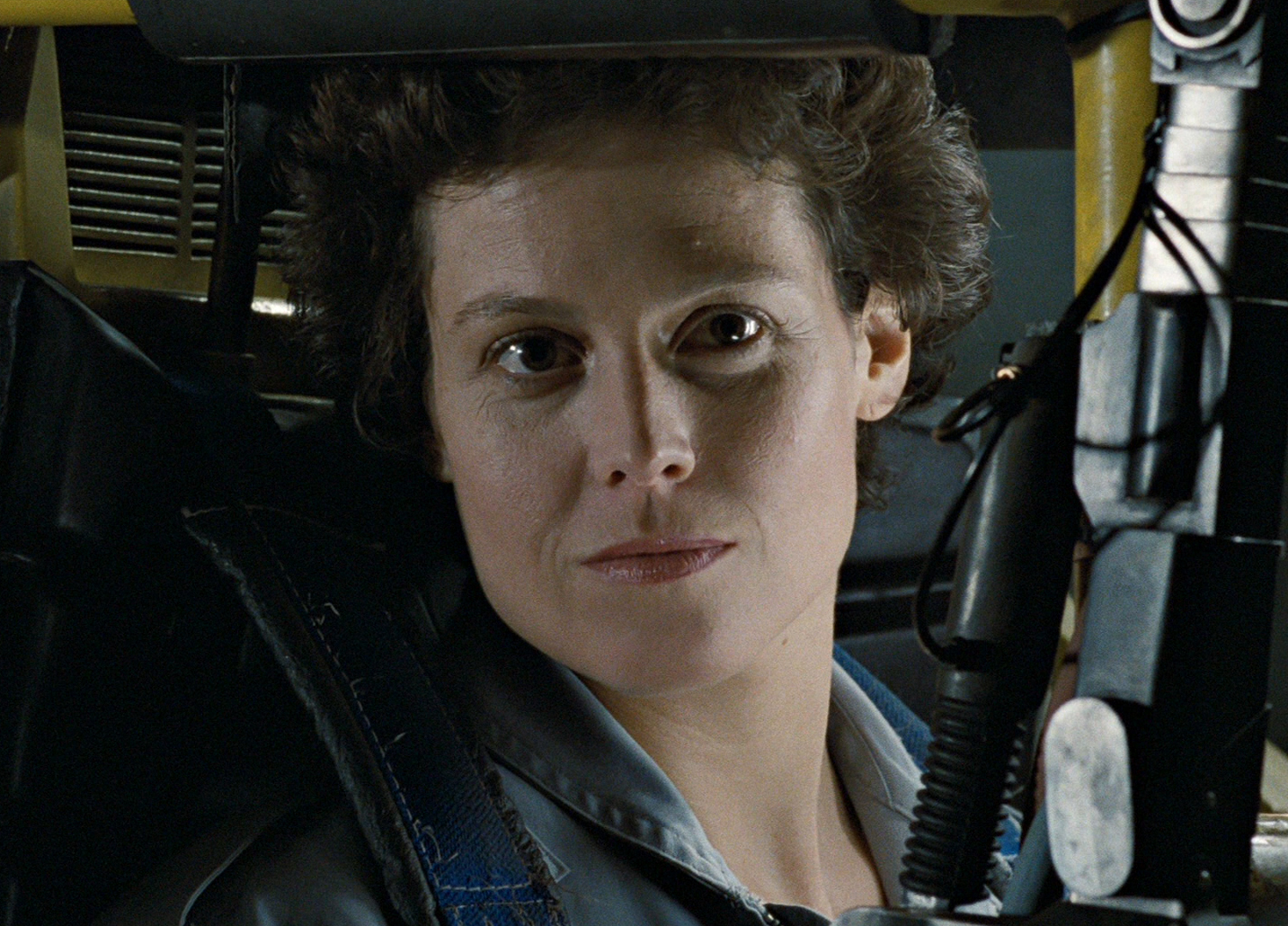 Ripley – Character flaw: Lack of trust
I remember when I first heard the term “three-dimensional character.” It sounded like one of those things clueless producers mutter when they don’t know why they don’t like something. Oh yeah, the characters weren’t, umm, “three-dimensional.” That’s why I didn’t like it. Occasionally, you’d run into one of the more affluent execs, who might throw this curve ball at you: “Your characters never popped off the page.” What the hell does that even mean? It’s a freaking piece of paper. If you want things popping off pages, head over to the children’s section at Barnes & Noble.
Ah, but as time went on and I came into contact with more intelligent and established entertainment folk (purely by accident of course), I noticed them using these same darn phrases. “Sorry, the characters have no depth.” “They were paper thin.” “The plot was okay but the characters never popped off the page.” Urgh. Wherever I went, this three-dimensional character thing was following. I needed to find out what was going on.
So I did a little research into this “3rd dimension” and repeatedly came across the term: “character flaw.” This seemed to be the all-elusive key to achieving character depth. A character flaw, I found out, was a negative trait holding your character back from becoming whole. Okay, I could get on board with that. I started watching my favorite movies and, lo and behold, it was true! There were character flaws everywhere I looked. Neato!
But then tragedy struck (well, subjectively speaking). I was on a screenplay message board one evening and found a thread discussing this exact topic. The head screenwriting message board guy in charge (HSMBGIC) was saying that not all characters had character flaws. Indiana Jones didn’t technically have a flaw. John McClane in Die Hard didn’t have a flaw. My whole screenwriting world came crumbling down. What next? Were there screenplays without words?? How could anything make sense anymore!!!
If only that were it. As if some phantom force was set on getting me to commit scripticide, I was introduced to yet another term: “Inner Conflict,” which writers were using interchangeably with “character flaw.” Yet another screenwriter cornered me and whispered, “Don’t listen to those bums. The key to a great character? A VICE.” Don’t even get me started on 70s Writer Guy, who kept telling me all I needed was a good “character fear.” Character fear?? What the hell was that??! It was at that moment I did what any slug-fearing screenwriter would do. I bought a case of Bud Ice at the corner liquor store and got drunk.
I won’t get into how that began a three year bout with alcoholism that ended with me on the top of a stoplight on Santa Monica and Wilshire screaming (the cops informed me), “Knick-Knack Paddywack, give E.T. a phone!” The good news is, I’m better now. And I have medication. Which allows me to drive by myself. Which led to a lot of library visits, where I actually learned what all these terms meant! And because I don’t want you to have to go through what I went through, I’m going to break all of them down and show you how you can use them to add depth to your characters. Get ready for your life to change. As one of the greatest philosophers in history once said…”I’m tan mom. Biyyyyyyaaaaattttcchhhh.”
Flaw – A character (or fatal) flaw is the dominant negative trait that’s held your character back from becoming the person he’s meant to be. Selfishness, lack of trust, won’t open up, won’t stand up for themselves, being irresponsible – these are all flaws you’ve seen hundreds of times in films. The most powerful character flaws tend to be the ones that have hindered your character their entire lives. So in Rocky, Rocky has never believed in himself. But flaws can occasionally be a more recent problem, typically the result of a recent traumatic experience. So if a character was recently dumped by someone they loved, maybe their flaw is that they don’t trust love anymore.
When done right, the character flaw is the most effective way to add depth to your character. This is because once a reader identifies a character’s flaw, there’s an intrinsic need to see that flaw overcome. Being able to change is one of the most universally relatable experiences there is. So seeing someone else do it makes us believe we can do it. It’s almost like we’re living THROUGH the character, and that’s what creates that deep emotional connection.
Inner Conflict – The term “Inner conflict” is often mixed up with “character flaw” because they both infer struggle within our character. But inner conflict is less about overcoming one’s big weakness and more about a battle being waged inside the character. To execute a great inner conflict, you want to give your character two opposing forces that are pulling at him. Luke Skywalker (as well as Darth Vader) is being pulled by both good and evil in Return of the Jedi. Travis Bickle in Taxi Driver is trying to decide between being good or bad. A newly announced Andrew Garfield film is about a real estate agent who starts illegally kicking people out of their homes. He becomes rich doing so, but his conscience starts to eat at him. He’s conflicted with whether earning a living this way is the right thing (inner conflict).
Again, the advantage of adding an inner conflict is that you’re tackling a universal experience. We’re constantly dealing with our own conscience, with what’s right and wrong, being pulled in opposite directions. The most unsettled we tend to be in our lives is when we’re fighting these inner battles. It’s a very intense experience, and therefore we relate to and engage when we see a character going through the same.
Vices – Vices are often used incorrectly in screenplays, as many beginning writers believe that simply adding a drinking or drug addiction will give their character that elusive “depth” all these producers and agents talk about. 99 times out of 100, however, the characters unfortunate enough to be created this way feel cliché. Why? Because unless you’re exploring the vice in all its depth and complexity, it feels sprayed on, a false veneer hiding the fact that you don’t know how to build depth. A vice is the physical manifestation of an inner conflict. It’s drugs, food, alcohol, sex, gambling – any physical addiction your character can’t control.
In my experience, the only time vices truly add depth to characters is when the writer commits to them 100% – when they explore all the complexities and faults and issues and pitfalls and devastations that come with them. We saw it in Flight, we saw it in Leaving Las Vegas, we saw it in Half-Nelson, we even see it in The Dark Knight (The Joker’s vice is chaos). The screenplay almost has to be ABOUT the vice for it to truly resonate. Otherwise, if you’re just slapping it in there to try and make your character feel “deep,” it’s probably not going to work.
Fears – Fears are the last and typically weakest way to add depth to your character. The reason being, they’re surface level. Unlike a flaw, an inner conflict, or a vice, there isn’t a whole lot going on under the hood with a fear. Take Indiana Jones. His fear is snakes. Good for a chuckle, not much else. Or Brody from Jaws. He’s afraid of water. Cool for later when he must go into the ocean to kill the shark, but it doesn’t really add much depth to his character. Or Richard Gere in Pretty Woman. His fear is heights. Sets up a nifty little finale where he must climb up the building to get to Julia Roberts, but there’s never a moment in the film where we feel the depth of Richard Gere being afraid of heights. It’s just a cute little setup and payoff, as are all these examples.
Now this doesn’t mean you don’t want characters who are afraid in your screenplays. Fear is a very powerful emotion. And as you can see from the examples above, it’s a nice little addition to a character who already has depth. You just don’t want fear to be the only element of depth in your character. Any fear should be in addition to, not in place of, these options. The one exception is if the fear is integral to the storyline. For example, if your character was raped, and now they’re afraid to leave the house in fear of getting raped again, obviously the fear is adding depth to your character.
Moving forward, my suggestion for adding depth to your character would be to start with the character flaw. If a character flaw doesn’t feel right for that particular story (Hey, Ferris Bueller didn’t have a character flaw), move to inner conflict. If your character doesn’t seem like the kind of guy with a lot of internal strife going on (aka Seth Rogan’s character in Knocked Up), go with a vice. Only use fear as a last option or if it’s integral to the kind of story you’re telling. There are a few other things you can do to add depth (backstory, mystery, your character’s relationships with others), but for the most part, if you’re not using one of the four elements featured in this article, your character will feel flat (leading to the dreaded, “Your characters never POPPED off the page.”).
Also, it’s okay to mix and match these elements. It’s okay to give a character a flaw and a vice. Or a vice and an inner conflict. If you really commit to one of these elements, one is all you need, but I’ve seen plenty of characters that are battling two or even three of these things. My only advice, if you take that route, is to connect the elements so they feel organic, as opposed to mechanically adding multiple things because a screenwriting blog told you to. For example, if your character’s flaw is that they don’t think they’re worthy of having a boyfriend, an addiction (vice) to food could keep them overweight and unattractive and therefore allow them to perpetuate that belief.
Remember that the main reason readers label characters as “thin” is that there isn’t a lot going on with them. I read so many scripts where I don’t remember the characters five minutes after I finish because there WASN’T ANYTHING GOING ON UNDERNEATH THE SURFACE. These four options are the things you place underneath the surface. Because the characters now have something underneath them, by definition, they have DEPTH. And just like that, you’ve created a three-dimensional character.
Genre: Drama
Premise: When an escaped convict infiltrates the home of a single mother and her son, the mother unexpectedly falls in love with the man.
About: This is Jason Reitman’s next movie, which will star Kate Winslet, Toby Maguire and comeback kid James Van Der Beek! It’s slated for an early 2014 release. Reitman’s outshone his legendary director father (Ivan Reitman) as of late, directing well-received films like Juno and Up In The Air. But he better watch out. Ivan is about to make a comeback, getting ramped up to direct the mega-hot script Draft Day, starring Kevin Costner as a general manager during the most important day of the year for NFL teams, draft day.
Writer: Jason Reitman (based on the novel by Joyce Maynard)
Details – 125 pages (2/4/11 draft)

Jason Reitman is an interesting writer/filmmaker. He’s not making films like anyone else out there. Here’s the issue I have with Reitman though. I’m not sure who HE is. I know every director out there wants to be Ang Lee or Steven Spielberg, the kind of director who can jump in and out of genres effortlessly, but what’s the reason we go to see a filmmaker’s film? Because we know what kind of movie they make. Thank You For Smoking. Juno. Up In The Air. Young Adult. Where’s the common thread in those? I’m not sure I can find one.
It’s not to say someone can’t break the mold and make whatever movie they want, but it’s a hell of a lot of harder to gain traction as a filmmaker if that’s the route you’ve chosen. I think early in your career you need to pick one genre and stick with it, THEN break out. Right now, the thing Reitman is probably best known for is being the director of a couple of Diablo Cody scripts, and I’m sure that isn’t what he’d like to be known for.
To make matters worse, the only consistent element he’s got going in his films (they’re 30-60 million dollar dramas that sometimes contain comedic elements) is the exact kind of film Hollywood is trying not to make anymore. There’s no real hook to draw audiences in other than the acting, directing and writing, and it’s hard to get those things right. And these films don’t have much of an upside even if they DO do well. With Young Adult never really breaking out, this is a huge moment for Reitman. He’s gotta prove that there is an audience for these movies. And that’s going to be tough. Cause if Labor Day isn’t executed perfectly, it’s in a lot of trouble.
Labor Day tells the story of Henry…. Wait a minute. That’s not actually true. It tells the story of Adele… Actually, that’s not true. It tells the story of Henry, who’s TELLING A STORY about Adele. Yeah, so let me start over. It’s 1987. Henry is a 13 year old kid living in a small town with a single mother who’s still bitter about her divorce. She’s given up on love, and in the process, given up on life. The only thing she’s got going for her is Henry.
That changes when the two go shopping one day and are approached by Frank, who seems like a good guy with the exception of a few suspicious cuts on his body. Now you and I would probably walk away from this. But Adele, for whatever reason, decides to take Frank home with her, a man whom she later finds out is an escaped convict.
All of this is being recalled via voice over from Adult Henry, who’s basically remembering the crazy 4 day Labor Day weekend that occurred when his mother fell in love with a convict. Yup, poor Henry gets his sex education via the shaking and moaning and screaming that occurs in the bedroom next to his. It’s something he isn’t really sure how to handle. He thinks it’s strange that they have, you know, an escaped convict not only living with them. But having sex with his mom! Most people would consider that weird.
Eventually, Henry befriends a new girl in town, Eleanor, who puts two and two together and realizes Henry’s housing the fugitive. She eventually convinces him that he’s going to be cut out of the picture and abandoned if he doesn’t do something. When his mom mentions moving to Canada to start a new life, that seems to confirm the prediction, and Henry begins to wonder if he should turn Frank in. It all comes to a head when the race to get out of town is interrupted by the cops finding out where Frank is, and trying to stop him before he gets away.
The other day I was saying (like I always do) to stay away from the drama genre. Hollywood doesn’t like to make dramas. They not only have really low profit margins, but they have to be executed perfectly to work. The script has to be flawless, the acting has to be genius, the directing and the cinematography have to be awe-inspiring. They don’t have any margin for error because people only come to see these movies if they hear they’re great. Honestly, when’s the last time you said to a friend, “Let’s go see that drama movie that’s supposed to be okay!”
Every story needs an engine. And like I often discuss, the engine is often your hero’s goal (beat the terrorists, get to the beauty pageant, get the Americans out of Iran using a fake movie as cover). Even Flight, a drama I loathe, had a goal – to win the court case against the airline for pilot neglect. Labor Day bases its engine on something a lot harder to drive an entire story with – suspense. Suspense is something you typically use in doses, to drive a scene or a sequence. Using it to drive an entire movie is hard.
The suspense engine here is: “Will Frank, Adele, and Henry get away with this?” This is achieved by making us wonder whether Frank and Adele and Henry are going to ride off into the sunset and start a new life, or get caught. As far as I can tell, that’s the only thing driving the story.
That’s fine. A really well-told story CAN work this way. Here’s my problem though. For suspense to work, especially suspense that’s supposed to last the entirety of the movie, we have to freaking love the characters. And that’s where I had problems. The script is told through the eyes of Henry (in older Henry’s voice over). For that reason, we’re not watching the movie through the eyes of the two people who have the most to gain and lose here (Frank and Adele) but rather the character with the least to lose, Henry.
In addition to that, because we’re seeing two people fall in love through a third party, I never really felt those characters’ feelings. I never got close enough to them since I wasn’t allowed to see them unless it was through Henry’s perspective. It was kind of like watching two people kiss across the street instead of BEING one of the people kissing across the street.
Don’t get me wrong. I didn’t dislike any of these characters. I thought Henry was pretty interesting, Frank was pretty interesting, and Adele was pretty interesting. But “pretty interesting” doesn’t cut it when you’re making a drama. It’s not like The Avengers where a “pretty interesting” character is fine because you have 200 million dollars worth of special effects to fall back on. In dramas, THE CHARACTERS are the special effects. And for that reason they must be infinitely interesting, infinitely fascinating, infinitely compelling. After finishing Labor Day, I was just kind of like, “Ehh, not bad.” It was a nice little story. But that’s not enough for a drama. A drama has to be great.
Where could the script have improved? I think Eleanor should have had a much bigger part. She’s the love interest for the character we care most about, the one we’re closest to, Henry. Why do we get more time between two people we don’t really know than the actual person who’s leading us through this story?
If that could’ve been introduced earlier, and Eleanor could’ve found out about Frank earlier (in this draft, she doesn’t find out until the end), she could’ve pressed Henry to give Frank up sooner, lest he lose his mom to him, and there would’ve been a lot more conflict in the house, which as it stood was pretty conflict-free.
That was probably the biggest issue for me in the script. Frank’s situation was never really challenged. Outside of a couple of late characters dropping by, Frank could prance around worry free. And I’m not sure a movie like this works unless his situation is always in danger, unless we’re constantly feeling the possibility that he could be caught.
All in all, this draft of Labor Day had a slow story that lacked the kind of characters and conflict a drama like this needs. Hopefully, Reitman has sped the story up and addressed these issues in subsequent drafts. I admire the man for pushing stories in Hollywood that don’t usually get made, but the catch is those stories have to be awesome, and I don’t think this one’s there yet.
[ ] what the hell did I just read?
[x] wasn’t for me
[ ] worth the read
[ ] impressive
[ ] genius
What I learned: Link up your story elements! I discussed this yesterday. Try and link up the elements of your story so they work together as opposed to separately. I thought Labor Day missed an easy one here. Henry was falling for Eleanor, who confesses sadly that she can no longer go to art school because her parents won’t pay for it (element 1). Later, Henry sees a “REWARD – $10,000” flyer for turning in Frank (element 2). Henry should be considering turning in Frank to get Eleanor the money so she can go to art school. That’s his main conflict. That’s what he’s battling every time he comes home. Should he call the police and run off with his own girl, or not call them and let Frank and Adele run off together?
