

Tis the day when the Americans and the Brits split up. A proud day for America, maybe not so much for our brothers to the East. Whatever the case, it’s a reason to celebrate. And I need a day of celebration. The downside of being an American is that the ideology of the country is built to make you feel terrible if you’re not working 16 hours a day. I often fall victim to this practice. But today, I’m going to grill a dead animal, light some cheap firecrackers, and feel good about doing nothing. I WILL repost my newsletter screenplay review of White House Down though, for those interested in discussing it. And with that, I’m out. See you Friday!
Note: This review was originally posted in my Newsletter a few months ago. When I originally read this script a long time back, I thought it was pretty darn good. Then I found out the casting and my excitement died immediately, which is reflected in this more recent review. Jaime Foxx as the president?? The ubiquitous Channing Tatum in the title role? That eliminated any chances that I’d go to the theater to see this. Anyway, I decided to re-post it today since it’s the Fourth of July and I’m not putting a new post up. Interested how the big spec sale translated to the scene so if you saw it, chime in. To get early reviews of screenplays, sign up for the Scriptshadow Newsletter, which is sent every Thursday.
Genre: Action
Premise: (from IMDB) A Secret Service agent is tasked with saving the life of the U.S. President after the White House is overtaken by a paramilitary group (which I assume means terrorists).
About: Pitched as “Die Hard in the White House,” James Vanderbilt sold his spec to Sony for the biggest sale of 2012, at 3 million bucks! You know when you can make even Dan Fogelman jealous, you’re doing a good job. A few things to note here. Vanderbilt has written some huge screenplays, including Spider-Man 3. Also, he writes for Sony (Spider-Man is a Sony film) which means he has a pre-established relationship with the studio, and likely had been informed of exactly the kind of movie(s) they were looking for. All of this plays into the paycheck. But even that combination doesn’t guarantee a 3 million dollar payday. There are plenty of other top-notch writers trying to pull off a sale like this and failing. So what was the secret to this one? It must be a pretty good script, right?
Writer: James Vanderbilt
Details: 142 pages – March 1, 2012 (This is an early draft of the script. The situations, characters, and plot may change significantly by the time the film is released. This is not a definitive statement about the project, but rather an analysis of this unique draft as it pertains to the craft of screenwriting).
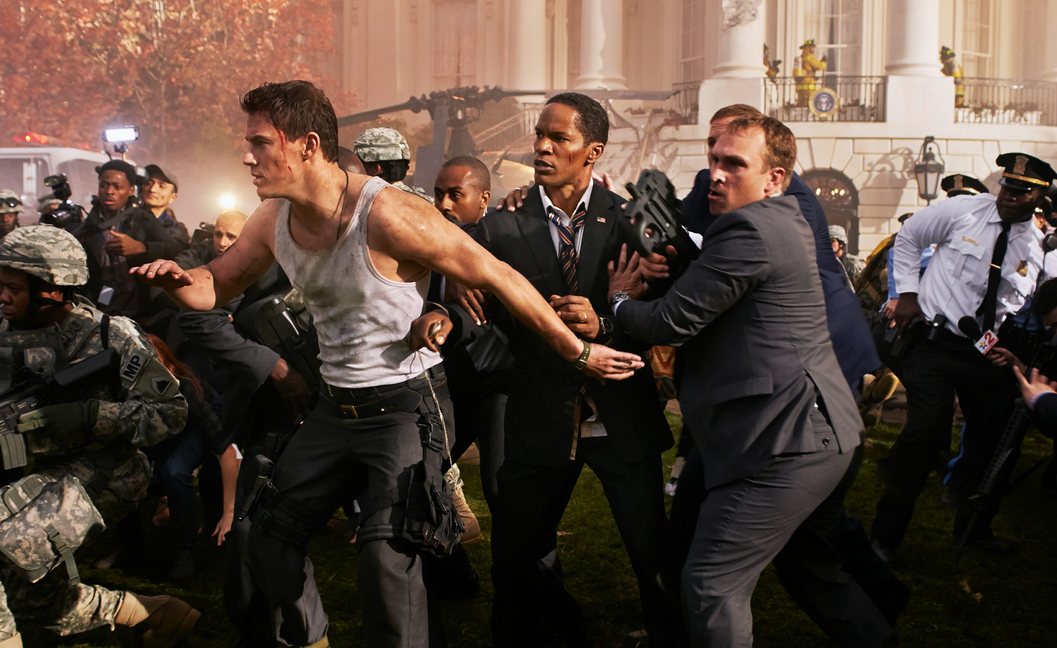
You might have recently seen the Olympus Has Fallen trailers. “Olympus” is a competing project to “White House” that sold at around the same time for 600k. They then raced that sucker into production as it’s on its way into theaters in a few weeks. While the early bird catches the worm, it doesn’t always catch the quality film. “Olympus” looks like a frat house bathroom at the end of a clean-cycle. There isn’t a single original shot in that trailer. The helicopter shots and explosions alone look like they were pulled from a stock video website.
Well, turns out White House Down caught the “rushed into production” bug as well, as it’s debuting this summer, landing Channing Tatum and Jaime Foxx in the lead roles. Not sure a few extra months will make a difference in quality control. But I can tell you this: “White House Down” is the better script.
Low-level security agent slash divorcee John Cale’s life isn’t going so well. He’s divorced. Doesn’t see his daughter very much. Doesn’t have a job. Yup, not good times. Luckily, he’s landed a rare day with his daughter, 10 year old Emily, whose claim to fame is being a CNN buff (it’s her favorite Ipad App). He’s decided to finally give her the gift of her dreams – a tour of the White House.
Cale’s also being a little sneaky, as he’s doubling up this tour with a job interview at the house. Hey, why not kill two birds with one stone? Although this two-for-one special pretty much encapsulates why Cale’s flying solo. Dude needs to start paying more attention to his family. Well, he’ll get his chance soon enough.
That’s because while taking a stroll through the White House, a series of explosions start rocking the wings. In another section, fun-loving president James Sawyer is rushed to the White House equivalent of a panic room. But before he can get inside, his head of security turns a gun on him. It turns out HE’S orchestrating this! Just as he’s about to put a bullet in the president, Cale comes screeching out of nowhere, providing just enough of a distraction to grab the prez and Harlem Shuffle it to another area.
In addition to protecting the president, Cale’s got to find his daughter, who was in the bathroom at the time of the attack. But the options are limited. With the head of security knowing just about everything there is to know about the White House, he’s able to bring backup mercenaries in, leaving all the major rooms occupied by gun-wielding trouble-makers!
Outside, everyone’s trying to figure out what the hell is going on. When they hear that the president is alive, being guarded by some secret service reject, their confidence is shaken. But they come up with a plan whereby the president and Cale will head to a little known escape hatch that leads to a series of secret tunnels Roosevelt built hundreds of years ago or something.
Naturally, things don’t go as planned, and in a spectacular firefight in the White House backyard (spoiler) the president is killed! Or at least, that’s how it LOOKS. It turns out the president actually escaped and is able to get back inside with Cale. Except now they don’t have any communication with the outside. And since the outside believes the president to be dead, they order a missile strike on the White House to take out the terrorists in 45 minutes. YIKES! Talk about a tight ticking time bomb. So will Cale get the president out alive? Will he save his daughter as well? Locate this 3 million dollar spec and find out for yourselves or get ready to line up in June.
White House Down was a cool spec. It’s got problems. Like that it’s way too long. And you don’t always know what’s going on. And the ending is a little confusing (“Ehhh, wait, what was the bad guy’s plan again??”). But it got the “fun” part right. And when you compare it to all the other Die Hard clones that have come out since the original film debuted 25 years ago, White House Down ranks up there with the best of them script-wise. I mean, it’s a thousand times better than “A Good Day To Die Hard,” that’s for sure.
There’s just some really good writing for a “blockbuster spec.” I noticed this early on in the scene that takes Cale into the White House for a job interview while ALSO setting up a tour with his daughter. Amateur writers probably would’ve separated these scenes, having Cale go somewhere else for a security detail interview, then after that, bring his daughter to the White House for the tour. The problem is, separating those scenes takes up more space. Which is why you want to combine scenes whenever possible – to keep your story moving swiftly. But what’s really cool about this scene is that Vanderbilt uses it to set up the distance between Cale and his daughter.
Most amateur writers, when writing huge action specs, avoid the emotional component. But these relationships are what anchor the story, what make it relatable and real, which is why you want to incorporate them. I particularly found the sentence from Cale’s ex, “She doesn’t even like you,” (in reference to their daughter) to be affecting. It sets up how far apart these two are, and it makes us want to stick around until they’ve made up.
I also liked some less-obvious touches, like the physical tour itself. The scene is designed as a way to establish the father-daughter relationship. Her bursting enthusiasm for the experience convinces us that maybe there’s hope for these two. But what the tour’s really doing is laying out the White House blueprints for the audience to set up what will happen down the line. There are certain details about the house we’ll need to know so we’re oriented when the shit hits the presidential fan.
There were some cool story choices as well. I liked how it was unclear if the president was dead half the time, leaving it unclear who had the authority to do what and how much authority they had. The Vice-President assumes the role of Commander-In-Chief if the prez bites it. But what happens when you’re not sure if the prez bit it or not? It’s the kind of uncertainty that I could see really happening in that situation, and I loved that attention to detail.
On the downside, there are way too many freaking characters here. Do we really need to see what happens to the Speaker Of The House? I mean we’re bouncing all over the place to a character list bigger than the entire Chinese population. Snippy snip snip all those characters away and you won’t have a 140 page spec (more important for you guys, of course, than guys like James Vanderbilt). There were one too many set-piece scenes as well, which could’ve lowered the page count. I was constantly confused about the geography of that backyard battle in particular, and didn’t see it as an ideal setting for the primary action scene. I would’ve K.O.’d it.
Still, this is really good stuff as far as blockbuster spec writing. I wouldn’t mark it as an “impressive,” but I’d tell you to read it if it showed up at your door.
[ ] Wait for the rewrite
[ ] wasn’t for me
[x] worth the read
[ ] impressive
[ ] genius
What I learned: You ever notice that main character’s lives aren’t going so well when we meet them? That’s because if their lives WERE going well, there’d be nothing to fix. Who wants to watch a character who already has everything figured out? Start your movie with a protagonist whose life is in the shitter then use your story to fix them.
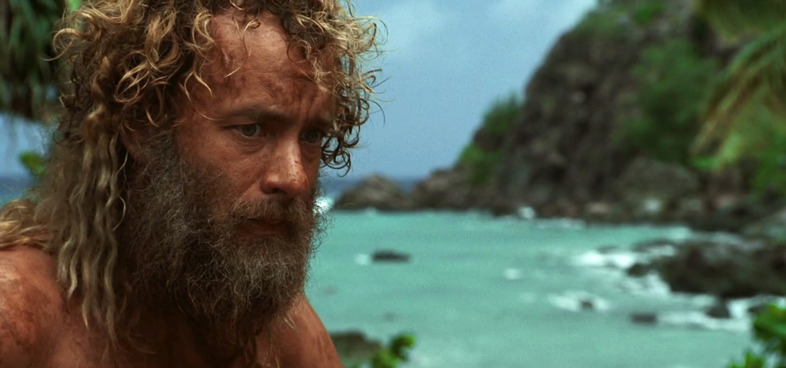
Now a lot of you are probably asking, “Carson, why the hell did you pick Cast Away for a script breakdown?” I’ll tell you. Because it’s different. Because it took chances. Because it’s something that shouldn’t have worked. And I love breaking down scripts that shouldn’t work. I love exploring the deviations and figuring out why they succeeded (when so often else, they fail). The film itself famously teamed up Robert Zemeckis and Tom Hanks and took a YEAR BREAK in the middle of production so that Hanks could lose weight and look like a real castaway for the second half of the film. That story overshadowed screenwriter William Broyles Jr.’s own escapades to get the script right. The Apollo 13 and Planet of the Apes scribe deliberately stranded himself on a beach in the Sea of Cortez for a week to force himself to search for food, water, and shelter. For today’s tips, I’ll be reading an earlier draft of the script in order to see some of the changes they made.
BUY WILSON HERE! – Wilson
1) If your protagonist cares about something enough, so will we – The success of Wilson The Volleyball defies just about all rationale. Many people actually cried when he was swept out to sea at the end of the film. Although rumors persist that I was one of those people, I steadfastly deny my involvement in any Wilson-related crying. The question is, why did this happen? Well, if your protagonist really really cares about something, whether it be a family member, a goldfish, or a volleyball, we will too. And you can use that tool to create moments like this one, where you rip that something away from the hero to provoke an emotional response from the audience.
2) The Set-Up World needs to be exciting – The “Set-Up World” is that 10-15 pages BEFORE the inciting incident. The inciting incident, of course, is when something happens to throw your character’s world into disarray (in Cast Away, this is when the plane crashes, obviously). Here’s the problem I see in a lot of scripts. Writers believe that because they’re just “setting things up” and the exciting inciting incident is right around the corner, that The Set-Up World can be boring. They can show their protagonist doing boring things and it’ll all be okay because the fun is coming soon. NO. It’s very important that during The Set-Up World, you set up your character in the most interesting way possible. So here, we show Chuck (Tom Hanks) running all over the world, desperately trying to ensure that Fed-Ex packages arrive on time. He’s yelling at people, busting his ass to get all the packages on the trucks. Things are HAPPENING. You can intersperse a few slower scenes in this section, but be careful. Too many and we’ll get bored before your inciting incident even arrives.
3) Know what you need to set up in the Set-Up World. Set up those things and nothing more – Make a list of the ESSENTIAL THINGS you need to set up about your main character. Come up with those scenes and don’t include ANYTHING MORE. This will keep your setup streamlined. In the early draft of Cast Away I read, there was all this extraneous stuff about the FEDEX headquarters and Chuck’s family that JUST WASN’T NECESSARY. Broyles Jr. and Zemeckis figured out they needed to set up Chuck’s job, his relationship with Kelly, and that was it. So those other scenes were excised.
4) If your protagonist’s life is boring and therefore uninteresting to document, get to your inciting incident sooner. – If your protagonist is someone who doesn’t have an interesting life to set up, such as The Dude in The Big Lebowski, try to get to your inciting incident even sooner. We establish The Dude in a robe at the grocery store. Then in the very next scene, when he gets home, two thugs attack him and piss on his rug, which is the inciting incident that starts the story. Exciting characters can have longer Set-Up Worlds. But do NOT give us 6-7 scenes of a stoner being stoned before the inciting incident arrives. We’ll give up on the script before it happens.
5) IRONY ALERT – Remember, always add irony to your script if possible. Double points if it’s a part of your premise! Chuck is the man who’s always on a tight schedule, who never has a second to spare. All of a sudden he’s on an island with all the time in the world.
6) Recognize when you have a good character and expand his role – Surprisingly enough, Wilson was barely in the draft of the script I read. But someone recognized how powerful he could be and so majorly expanded his role. If you have a show-stopping (or interesting or memorable) character, make sure to give him as much time as you can in your story. An example of a writer missing the boat on this was George Lucas in Episode 1. He had a badass villain in Darth Maul, but didn’t recognize it, didn’t expand his role, and therefore missed an opportunity to do one of the only things right in that script.
7) MID-POINT SHIFT ALERT – Remember, a good mid-point shift SHIFTS the second half of the movie in a slightly different direction so it’s not the same as the first. We have a pretty clean mid-point shift in Cast Away. We cut to 3 years later, with Chuck no longer being the green timid survivalist, but an aged vet of the island who’s figured out how to survive.
8) If you are going to jump forward in time, use an event to motivate it – Staying on that topic, I always see writers insert huge time-jumps into their scripts that come out of nowhere. We’ll be sitting with a family watching TV, and then the next line I read is… “8 months later.” If you’re going to make a big time jump in your screenplay, try to create a weighted moment to initiate it. Cast Away does this with Chuck’s tooth, which has been killing him for weeks it hurts so badly. He finally has no choice but to take it out. He does so with a rock, and the pain causes him to pass out, which leads perfectly into a FADE IN and a “3 years later.”
9) We need to be constantly reminded of the motivation if we’re to care about your hero succeeding – In this draft, Chuck did not have a picture of Kelly (his girlfriend) that he kept looking at to keep him going. I was shocked by the effect it had. In the movie, I so wanted him to get off the island. In this draft, I definitely didn’t care as much. The more I thought about it, the more I realized how big of an effect that picture of Kelly had. Because I was reminded of her, I constantly wanted Chuck to get back to her. Getting off the island to survive is selfish. Getting off the island to get back to Kelly is selfless.
10) The 10 Draft Rule – Every script should go through at least 10 drafts. The Sixth Sense had 20+ drafts. Good Will Hunting had over 50. And by ‘draft,’ I don’t mean going through a script and casually rewriting scenes you don’t like. An official ‘draft’ is where you read through your script and assess all problems (what is and isn’t working) in order to come up with solutions to apply to those problems. I read way too many scripts that feel like early drafts, such as this Cast Away draft which includes ten early pages of family scenes that are totally unnecessary to the story. That unfocused stuff drains its way out of the screenplay after ten drafts.
BONUS TIP – Good Chuck, Bad Chuck, Fuck Chuck – Here’s proof of the above. In this draft of the script, Chuck starts going crazy and is therefore split into two personalities, Good Chuck and Bad Chuck. Clearly, this was a method designed by Broyles Jr. so that Chuck could logically speak out loud and we could learn what was going on in his head. It was also a very cliché EARLY DRAFT choice. By going through many more drafts, he eventually realized that Wilson The Volleyball could take on the roll of someone for Chuck to talk to. I read too many scripts where writers don’t get past Good Chuck, Bad Chuck. And the script suffers for it.
These are 10 tips from Cast Away. To get 500 more screenwriting tips from movies as varied as “When Harry Met Sally,” “Pulp Fiction,” and “The Hangover,” check out my book, Scriptshadow Secrets, on Amazon!
Today’s script will hopefully answer the age-old question, how is he the “lone” ranger if he has a partner?
Genre: Action-Adventure/Western
Premise: When a corrupt sheriff takes over a hidden silver mine, a lone Texas Ranger and a local Indian named Tonto must team up to stop him.
About: Okay, this is not the draft that you’ll see in theaters. This is actually the draft that was written in 2009, when The Lone Ranger was set to be a really big movie. But then Disney got scared and canceled the movie, only allowing it back once the script was rewritten to drastically reduce the budget. So that’s what the writers did. And maybe this is why those trailers look so generic. They likely had to get rid of a couple of really big set pieces to get the price down. As a result, The Lone Ranger comes into 2013 as one of the summer’s more questionable entries. It just doesn’t feel like one of those “must see” films. Of course, as one astute Scriptshadow commenter mentioned, you can never count out “The Depp Factor.” We’ll see if Johnny Miracle can save this film from being one of summer’s big underachievers when it’s released tomorrow.
Writers: Ted Elliott & Terry Rossio (based on the radio series created by George W. Trendle and Fran Striker)
Details: March 29, 2009 draft – 125 pages
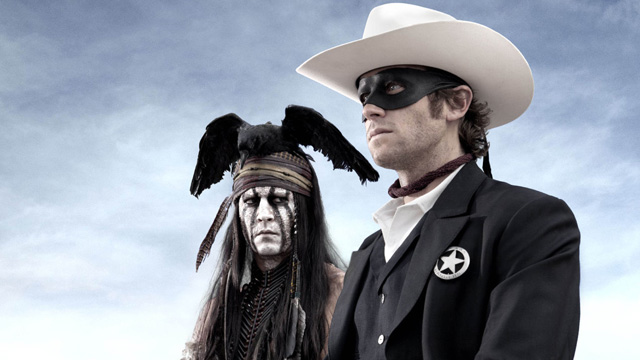
I’ve always looked up to Ted Elliot and Terry Rossio. They were a huge inspiration when it came to writing about screenwriting. Their Wordplayer Blog, at one point, was the only real place to find quality articles on screenwriting. They’re also incredibly wealthy and successful screenwriters who came to Hollywood with a 5 year plan, made their first sale way ahead of schedule, and have been kicking ass ever since (well, except for Treasure Planet, of course).
With that said, I’ve always been a little disappointed in them. They spend so much time working on these Disney movies that I’m not sure I know what a Ted Elliot and Teddy Rossio screenplay looks like. These guys have been such cogs in the Disney machine that they’ve never written anything for themselves. After reading John Favreau’s, “Chef” (which I reviewed in my newsletter), which was basically about Favreau realizing he needed to write for himself again, it seems insane that we’ve never seen a film from these guys that they created on their own.
Easy for me to say, right? It ain’t hard to call out safe screenwriting when you’re not the one making 5 million a film. I guess I have to remember that everyone successful in Hollywood is operating out of fear, fear that one day they’ll stop being asked to write or direct or act for millions of dollars. When those jobs dry up, THAT’S when you take your chances. Because that’s when you NEED to take chances. But until then? Why wouldn’t you take the money? Which leads us to The Lone Ranger, a script (or a draft of the script) that is every bit the prototype for safe screenwriting.
Texas Ranger John Reid has just stumbled onto one hell of a crime scene. An entire train full of people has been killed. So he takes a team of fellow rangers and heads to a nearby town, the only town that our murderer (or murderers) could’ve run off to. Once there, he finds a semi ghost town, with a few suspicious characters manning the local shops.
This leads him to the town’s half-crazy Sheriff, Latham Cole, a man so bizarre he’s placed a full-on locomotive in the middle of town (he figures by doing so, the tracks will have to come to him). We can’t tell if Latham Cole is good or bad but it doesn’t really matter because after their meeting, the murderer of all those train passengers, Butch Cavendish, pops out and kills all the Rangers except for Reid, leaving him to die.
But he doesn’t die! That’s because his mysterious soon-to-be-partner, Tonto, shows up and nurses him back to health. Tonto mostly spits out vague “wisdom,” which annoys Reid, but he can’t really get mad at the guy who saved his life. And actually, Tonto wants to help him get back at this Cavendish guy, but on one condition: Reid help him kill Latham Cole (who Tonto’s convinced is currently being possessed by an evil spirit). Reid agrees, in part because Cavendish has kidnapped his sister-in-law and nephew.
Soon After, Cavendish and Latham join forces and head to an old silver mine that Latham had been prepping, and begin readying it for operation again. Which means, of course, that Reid (now The Lone Ranger) and Tonto, must stop it! The End.
Man, what a disappointing script this was. Here’s the biggest lesson I’d take away from it. Don’t update something that can’t be updated – something that’s old news. I mean let’s be real. The Lone Ranger and Tonto are boring. They were created for a different time. Heck, they were born on radio! Neither of these two characters are relevant today and you feel it in every single page.
There’s a reason you didn’t see any classic Johnny Depp zingers in The Lone Ranger trailer. There are none. Tonto is a stereotypical Native American Indian that offers sage wisdom. That’s all he does. The whole movie. That’s the extent of his character is the sage-wisdom-offering guy. Naturally, with neither of the two lead characters being interesting, this movie was dead from the get-go.
But then you have the plot. And here’s my issue with Rossio and Elliot. These guys LOVE changing goals during their scripts. They’re never going to give you a clean narrative like Raiders Of The Lost Ark (i.e. “Get the Ark”). It’s going to start off as a murder mystery, then someone wants revenge, then someone’s sister-in-law is kidnapped, so they’re after her, and then there’s a spirit in one of the bad guys, so they’re after him, and then they get the sister-in-law back, and then there’s this mine they have to stop. And that’s the problem. When you keep changing the goals in your story, at some point, the audience stops remembering why the characters are doing what they’re doing. This was one of the big complaints leveled against Rossio and Elliott with the Pirates movies, the difference being that the characters in that film were actually interesting.
In addition to this, I couldn’t figure out why we needed two villains here (Cavendish and Latham). It was never clear which one was the “real” bad guy, leaving me constantly confused. And I never understood what their relationship was with one another. At one point, for example, Latham is going to have Cavendish executed. But a tribe of Indians interrupt the execution, forcing the two to work together to fight them off. After that, they start working together for good. Cavendish seemed to forget the fact that, oh yeah, earlier, two hours earlier you wanted to kill me! And I’m not saying the explanation wasn’t in there somewhere. But when you’re throwing so many plot changes at us, it becomes hard to keep up. This script would’ve been so much easier to follow with just one bad guy and a manageable amount of goal-changes.
I’m also unclear why this draft resulted in such a high budget. It looks to have even less action sequences than the movie I’m seeing in the trailer. There was a scene where Reid had to fight off a hundred coyotes, as well as a few sorta-big gunfights. But for the most part, there was a lot of talking here and not a lot of action.
Truth is, I’m afraid Rossio and Elliot took on an idea that was impossible to breathe life into. These characters feel ancient. Their interactions are dull. Tonto is stereotypical and boring (I can’t believe Johnny Depp was interested in this role when he has scripts like Desperate Hours at his production company). Reid is just…there. I don’t even know why he wears a mask. It’s not like it matters if anyone knows he’s John Reid or not. Even if the current draft is way different, I have a feeling this movie just won’t work. There’s something about this world that feels stale. A great film for 1956. Not for 2013.
[ ] what the hell did I just read?
[x] wasn’t for me
[ ] worth the read
[ ] impressive
[ ] genius
What I learned: Remember, motivation is what makes audiences CARE about whether the protagonists achieve their goal or not. A weak motivation could destroy an otherwise good script. So you HAVE to get it right. The character motivation here was weak. The Lone Ranger was trying to save his sister-in-law? A woman he didn’t even like?? We’re supposed to care about that??? Contrast that with the motivation in an almost identical film, Django Unchained. Django’s WIFE, who was taken from him, is being held by a slave owner. Now THAT’S motivation! It’s personal. It’s heartbreaking. It’s intense. An audience will care if Django gets his wife back. I don’t see a single person going to The Lone Ranger and caring whether Reid gets his sister-in-law back.
If you can’t take The Heat, get out of the southewestern portion of the United States.
Genre: Buddy Cop/Comedy
Premise: An uptight FBI agent must team up with an unruly nontraditional Boston cop to take down a mysterious drug lord.
About: Writer Katie Dippold was one of the lucky ones. She sold this script last March and was in pre-production by June with director Paul Feig, who was coming off the success of Bridesmaids. Before Dippold broke onto the feature scene, she wrote for cult hit Parks & Recreation, and before that, Mad TV. Dippold has done a lot of (and still does some) improvisational comedy, most notably with the Upright Citizens Brigade. This weekend, The Heat surprised a lot of people by destroying the more male-skewing White House Down, taking in 40 million to White House Down’s 25 mil.
Writer: Katie Dippold
Details: 117 minutes long
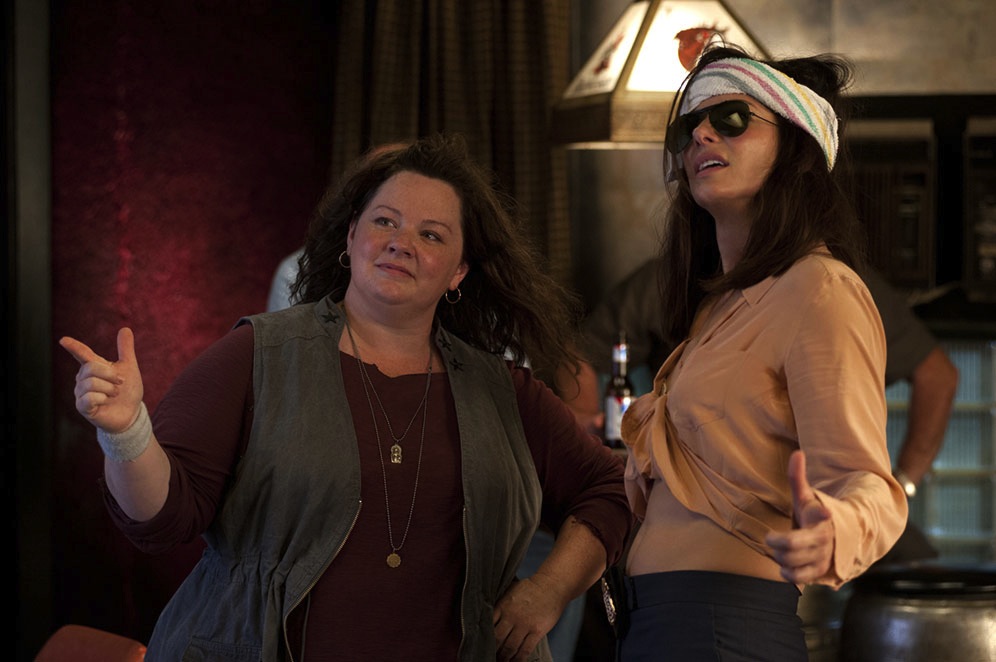
I suppose it’s appropriate that I went to see The Heat this weekend. We’re experiencing a heat wave in Los Angeles. My new favorite script Where Angels Die is getting a lot of heat. Heat seems to be a major theme in my life right now.
But you know what’s not a major theme in my life right now? Laughing. Laughing is not a major theme during the two hour running time of The Heat. Look, I love Melissa McCarthy. I like Sandra Bullock a lot. I thought the two of them were a genius pairing. I loved the trailers. They’re what made me want to see the movie.
Which is why I’m so confused. Why is this movie so boring? I mean, it wasn’t as bad as Identity Thief. But for all the things it had going for it, it never made it out of second gear. And believe me, I know all about not making it out of second gear. Yesterday I was in the In and Out drive-thru when my car died. I’d realized I’d run out of gas but the warning alarm had never gone off to warn me of that (okay fine, that’s not true. It did go off earlier in the day and I was too lazy to get gas).
Anyway, the prospect of pushing my car through a drive-thru line was becoming a reality. And I don’t think there’s anything more pathetic-looking than having to push your car through a drive-thru line. Think about it. We go to drive-thru lines for the distinct purpose of being lazy asses. It doesn’t make sense if you all of a sudden have to start working for your food. And you want to know what really threw everything off? Monkey Style. That’s right. I had heard of a secret In and Out burger called Monkey Style, but they were telling me that Monkey Style didn’t exist.
Eventually, I was able to convince the fumes in my gas tank to give me all they had and got out of the drive-thru line in one piece. But I’m still pissed off that I didn’t get a burger Monkey Style. Clearly in this video, someone’s gotten a Monkey Style burger. Which means I should’ve been able to get one too.
What does this have to do with anything? It doesn’t. The Heat was just so average that I’d rather discuss my own life than the film. But I guess since this is a review, I have to discuss the film at some point so here’s the plot n stuff…
Ashburn (Sandra Bullock) is an arrogant FBI agent who believes she’s God’s gift to crime-fighting, so much so that everyone else in her department despises her. Not to say Ashburn isn’t good at her job. She just can’t work with others. Which is fine by her. A director job just opened in her office, which means she’ll soon be the one in charge. And the one in charge doesn’t have to work with anyone.
Only hiccup is that her current boss wants to see a little more from her before he gives her the position. There’s a mysterious Boston drug dealer that no one can seem to find. If Ashburn finds him, the job’s hers. Here’s the issue though. There’s a batshit crazy local cop, Mullins (Melissa McCarthy), who considers the Boston drug beat to be hers. If Ashburn’s going to start playing on her turf, she wants in. Knowing she’s gotta prove to her boss that she can play well with others, Ashburn reluctantly accepts Mullins as a partner.
Normally I’d finish this with: “Hilarity ensues,” because why not end the most generic setup ever with the most generic comedy cliché ever? But for those who just HAVE to know the details, the investigation leads towards Mullins’ ex-con brother, who was a low-level drug dealer before Mullins threw him in jail! Her enormous opinionated Boston family (think 20 people all screaming out “cah!” at the same time) hates her for turning on her own brother, which has since caused a huge rift in the family. But it’s Mullins’ brother who eventually leads them to the real bad guy, who turns out to be someone who’s, yup, ACTUALLY one of the cops.
All right, so after writing out this synopsis, I know exactly why this script didn’t work. First of all, the story’s too generic. Dippold did a nice job injecting the buddy cop formula with some freshness via a double dose of estrogen. But I think she thought that would be enough. And it wasn’t. This storyline was as generic as a pack of Safeway q-tips, and for that reason, we never really cared if Ashburn and Mullins got their drug dealer or not.
Now you may be saying, “That doesn’t matter as long as McCarthy and Bullock get to be funny together. That’s the reason people are going to the movie.” But you’d be wrong. That works for the first 4-5 scenes we see our pair in. We’re so excited to see these two battling it out, we forget about the plot. But as soon as that excitement wears off, the audience wants a story that’s going to keep them interested. And since everything in this story was bland, we never get that. Once a reader or audience member doesn’t care about what happens, it doesn’t matter if you have two of the greatest comedians in history playing your characters. We’re bored.
The other big problem here was the lack of urgency. There was no deadline, no ticking time bomb to the investigation. They seemed to have years to solve the case if they wanted that. This approach can kill a story. If we don’t feel that catching the bad guys is imperative, then we relax. And you never want your audience to be relaxed. You want them on the edge of their seats!
This was most evident in the scene structure. Every single scene was 30% longer than it should’ve been. Dippold (or Feig) would stick around way longer than she needed to in order to get 5 or 6 more jokes in (or Melissa McCarthy zingers). I remember Feig did the same thing with Bridesmaids, which at the time I praised. That’s because Bridesmaids was a different kind of movie. Nobody was trying to capture anybody. The comedy in that script was based around a lot of the awkwardness that Kristin Wiig’s character created, which is why the long scenes worked. They exaggerated the awkwardness.
Here, we needed to feel like we were running out of time, that something terrible was going to happen if the bad guy wasn’t captured ASAP. But that was never introduced into the script. Feig probably felt like this worked in his favor. Since his characters never technically had to be anywhere, he could just play with them, let them insult each other. We have a bathroom club scene, in which Mullins dresses Ashburn, that goes on for way too long. We have a scene where they get drunk at a bar that goes on for way WAY too long. We have a scene where they visit Mullins family that goes on three minutes longer than it has to. Every scene just lingered and the combination between long scenes and a lack of a ticking time-bomb made this script feel slower than it should’ve.
So if you go see this movie and you’re wondering why it seems to be moving so slowly, this is the reason. And I’m not saying it’s a terrible movie. McCarthy and Bullock are funny enough and have enough chemistry that you remain mildly amused throughout the film. But the goal of writers and filmmakers should not be to “mildly amuse” their audience.
Now some of you might be saying, “Well hold up here, Carson. How the hell did this script sell then?” A couple of reasons. I’m always telling you guys that you want to find a fresh take on an old genre/concept. It’s one of the quickest ways to a sale. Dippold did this by creating a female buddy cop movie when we’ve only ever had male buddy cop movies. Kind of genius when you think about it. Second, Dippold’s already repped. She already has a way to get her script into directors like Feig’s hands. The unknown amateur writer doesn’t have that. For that reason, their scripts have to impress more people to get to a level where they’d be shown to Paul Feig. That script is only going to make it past those 7 or 8 people if the story in addition to the concept is there.
[ ] what the hell did I just watch?
[x] wasn’t for me
[ ] worth the price of admission
[ ] impressive
[ ] genius
What I learned: Genre and subject matter will dictate the average length of scene in your script. If you’re writing a straight-forward comedy that takes place inside a house, like say, “Meet The Parents,” you’ll have more freedom to create longer scenes that play off of the awkwardness and conflict between the characters. But if you’re writing a buddy-cop comedy, where there’s a more explicit and important goal, the scenes should be shorter and contain more urgency to them.
