

Over the next month and a half, Scriptshadow will relaunch its site. I have some great things in store for readers, but one of the things I’m most excited about is the time it will free up for me to start working on my next project – Developing a new system to find great screenplays from unknown screenwriters.
For 100 years, Hollywood has basically used the same system for finding screenplays. Each company, whether it be a studio or agency or whatever, has readers cover all incoming scripts, and anything the readers like gets passed up to their superiors, who if *they* like it, pass it on to their superiors, and so on and so forth.
Here’s the thing though. Over the past 5 years, the script-sending game has changed dramatically. The obvious difference is that scripts are now sent digitally as opposed to via a hard copy. This has led to a more instantaneous flow of scripts, and I feel like it should be ushering in a new filtering process. But it hasn’t. The model for weeding through screenplays has pretty much stayed the same.
Well, I want to change that. I feel we need some new ideas and some new voices. We need the younger generation – the generation not tethered to these outdated models – to look around and say, “How can we do this better?” I’ve already started looking for new ways to find great scripts, starting with my Twit-Pitch contest.
But I’d like to develop a large all-encompassing model for finding great screenplays that’s smarter, faster, and more efficient. I want to do what the studios and the agencies are too lazy to do. I want to change the system. And I thought, “Who better to ask for advice than the very people submitting these screenplays?”
So, I’m interested to hear what you guys would do if you were me. I’d like you to come up with a system for weeding out the bad screenplays and finding the good ones that takes into consideration today’s technologies and new avenues. There was no Scriptshadow 5 years ago. There wasn’t a huge community of people reading screenplays for enjoyment and education every day. There was no Twitter. PDF scripts were a luxury at the time.
Pretend that you’ve just been given the job at Scriptshadow Studios to build a better mousetrap. I have thousands of scripts coming into me from Amateur writers. How do we weed those down efficiently and find the good ones? The sooner we figure out how to do this, the quicker we revolutionize the business. So, I’m leaving it up to you guys. I’d love to hear your ideas in the comments section. Show me what you got!
NEW Amateur Friday Submission Process: To submit your script for an Amateur Review, send in a PDF of your script, a PDF of the first ten pages of your script, your title, genre, logline, and finally, why I should read your script. Use my submission address please: Carsonreeves3@gmail.com. Your script and “first ten” will be posted. If you’re nervous about the effect of a bad review, feel free to use an alias name and/or title. It’s a good idea to resubmit every couple of weeks so your submission stays near the top.
Genre: Thriller?
Premise: An illusionist’s next trick is to make the world disappear.
Writer: James Taylor
Details: 96 pages
Man, yesterday was quite the controversial post. I think I was denounced by half the screenwriting community as the devil for liking Prometheus. It was….awesome! I love debate. And even better, screenwriting debate. As long as we’re talking about these things, we’re learning. It’s when a screenplay has nothing to talk about that it’s in trouble.
Which is why today’s review should be just as fun. Let me give you some background. While procrastinating away on Twitter, someone sent me this tweet. It was just, “If you want to read it,” and then a link to this page (sorry it’s blurry).
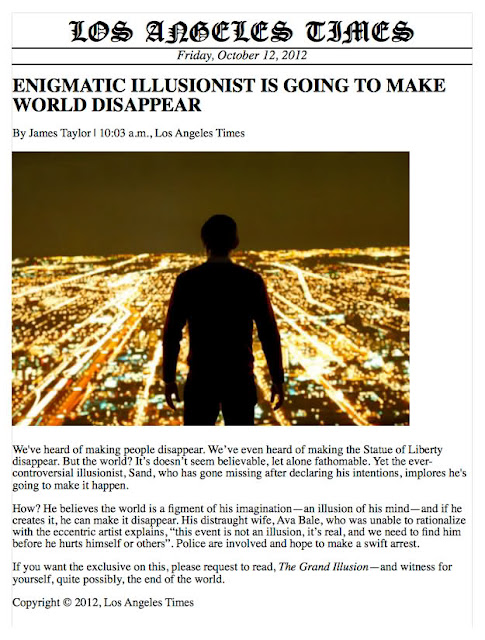
It was the perfect pitch! It was short. It was a great little marketing approach. And on top of that, the idea sounded cool. I was in!
After I sent the script out to the community, word began to come back on Twitter. “That script was amazing!” “That script was horrible!” “Just finished ‘The Grand Illusion.’ Wow!” “Just finished ‘The Grand Illusion.’ I want to punch myself in the face!”
Hmmm… How could a script get such divided opinions? And which side was right? Well, I’m here to put the definitive word on that. Read on…
Our hero is a man named “Sand.” Sand is an illusionist. David Copperfield without the creepy-factor. Sand is also realllllly moody. I mean, this guy is DEEP. You get the feeling he’s never smiled in his life. The reason for this is that Sand has been reading some philosophy books lately and come to the conclusion that the world is a figment of his imagination. In other words, if he wasn’t around, then the world would cease to exist.
That’s….about as much as I could understand in this script. Seriously. Everything was so weird, so out there, that I couldn’t find a story buried underneath all the psycho-babble. I mean we get scenes where Sand is talking to a woman who then…turns into Sand! So Sand is talking to Sand! Sand will all of a sudden find himself out in a desert (no idea how he got there) getting philosophical advice from an Apache Chief. And every five pages or so, we’d get dialogue like this: “Maybe. Because maybe I am your ego personified. Maybe your father is intuition incarnated. Maybe being an illusionist is a microcosm for interpreting the world. Maybe everything is a projection of your psyche — your wife, your daughter, the grass, the sky, the earth — everything is just a thought or a feeling.”
Ummm…huh?
I was able to glean a few more things about the plot. Sand has a brother named Vic who’s also an illusionist. The two don’t get along at all, and when Sand inadvertently ruins one of Vic’s big live illusions, Vic’s credibility goes down the tubes. It doesn’t really change anything, though, since Vic already hated Sand. But now he just hates him more.
But the real row between the two happened when they were children when their mother was driving them somewhere. The car broke down, they got stuck on the side of the road, and the mom went off to look for help, never to be heard from again. Sand has always blamed himself for this, and now wants to find out exactly what happened during that night.
To me, that’s the only thing in this script approaching somewhat of a narrative. And it’s a sporadic one at that. We don’t really get to it until later in the script. Also, Sand only seems to look for her when it’s convenient.
That was easily my biggest problem with the screenplay and I don’t mean to sound harsh because Jamie is a really cool guy. He’s been awesome on Twitter, excited about the review, and very thankful that I would take the time to read his script.
But the thing is, this is the kind of script that’s going to get people mad. When it feels like a bunch of psycho-babble, when it feels like armchair philosophy, when for most of the story the reader’s trying to dig through the mess to try and figure out what’s going on, you get frustrated. And I was frustrated. I just wanted SOME story to emerge, and one never did.
And I feel like this is a basic fix. I mean, revolve the whole thing around a show. This is an illusionist. He’s a showman. Why, then, are there next to zero shows in the script, replaced instead by a bunch of armchair philosophy scenes in small rooms? That’s what this script amounts to. People going into small rooms and opining about whether the world is real or not.
Sand needs to announce a huge show in Vegas in 3 weeks where he’s going to make the world disappear. It should catch the media attention. Everyone should want a ticket. He disappears in the interim. People have no idea if he’s going to show up to his show or not. I mean at least now your story has some FORM and PURPOSE.
Trying to connect a narrative via a couple of VERY LOOSE threads about where his mom disappeared and “is the world real or not,” is not enough for a movie. Your movie needs FORM. It needs a destination, a goal, a ticking time bomb. A show would provide that. And you know what? Maybe there even was a show set up. I don’t know. But if there was, I missed it because there were so many weird pointless scenes with people debating each other in rooms about reality.
And that’s another thing. We talked about this the other day. You don’t want repetition in your second act. Scenes shouldn’t repeat the same beats or the same information. Yet we have about a dozen scenes in the second act where people are debating the same things. Is the world real? Yes it is. No it isn’t.
On top of that, you can’t rest your climax on a bunch of unclear philosophical ramblings. You can’t say “quantum physics” four times during the script and expect that to explain (HUGE SPOILER) why the world disappears at the end. There needs to be a clearer connection there – a setup that logically leads to that payoff – preferably something VISUAL (show, don’t tell!). It would be like, in The Sixth Sense, if instead of Cole seeing and helping a bunch of ghosts throughout the movie, people just debated if ghosts were real for two hours and then Bruce Willis learned he was dead.
Again, I love Jamie the person. The guy rocks and has been so cool to me. And, at to his credit, he took some chances and wrote something different. I respect that. But this script is so vague and the narrative is so all over the place, that I just couldn’t engage. The good news is, this script does have some fans. So let’s see those Team Jamie posts in the comments section.
Script Link: The Grand Illusion
[ ] what the hell did I just read?
[x] wasn’t for me
[ ] worth the read
[ ] impressive
[ ] genius
What I learned: You are in a new age. You have to get creative when pitching in order to stand out. Taylor found a way to stand out amongst thousands of people to get me to read his script. I see posters and images becoming a bigger and bigger part of pitching and selling screenplays every day, which is why I’m lining up poster artists to offer the service on Scriptshadow (p.s. e-mail me if you want me to set you up with them in the meantime). It just seems so logical. Movies are a visual medium. If you have the resources, why not use visuals to sell your script to others? It’s the perfect way to stand out.
Genre: Sci-Fi
Premise: (from IMDB) A team of explorers discover a clue to the origins of mankind on Earth, leading them on a journey to the darkest corners of the universe. There, they must fight a terrifying battle to save the future of the human race.
About: This is a loosely connected “prequel” to Alien, directed by Ridley Scott. Hollywood’s new go-to sci-fi scribe, Jon Spaihts (Passengers) wrote the original draft. Lost alum Damon Lindelof came in to clean it up.
Writers: Jon Spaihts, Damon Lindelof

I’ve tried to avoid all online Prometheus discussion but it’s been difficult. It seems like everyone’s got an opinion on the movie. From what I’ve been exposed to, the criticism seems to be pointing towards the script. And that surprises me. Because I thought the script for Prometheus was pretty damn good!
I mean, let’s go back in time here for a second. Do you remember Alien 3? I don’t have any idea what that movie was about. I think it was about Ripley having an alien baby in a Brooklyn jail or something. And Alien 4? Wynona Rider played a robot in that movie. Nuff said.
Prometheus, even though it’s only loosely connected to the Alien mythology, is the best Alien film since Aliens BY A COUNTRY MILE. Now I know that’s not saying a whole lot. But even had those films never been made, I’d still look at this as a really good film, and EASILY one of the best films of the summer (it might even be the best – I’ll wait til fall to make that judgment).
So what’s it about? Well, I’ll try to stay as spoiler-free as possible but there’s a lot going on here so you probably want to avoid the rest of the review until you see the movie.
“Prometheus” is a “deep space” vessel that takes humans to faraway planets to explore them. But this particular expedition is special. Scientist Elizabeth Shaw and her husband have discovered a series of cave paintings that turn out to be a map to a planet in another solar system.
Trillionaire Peter Weyland is impressed enough with their research that he bankrolls an expedition there. The idea is to find aliens and ask the big questions. Where do we come from? What is the meaning of life? Weyland will actually be dead by the time Prometheus makes it to the planet but he wants to make sure that future generations don’t have to die, like him, not knowing these answers.
Besides Shaw and her husband, Prometheus carries a crew of about 15, headlined by heartless crew supervisor Meredith Vickers (Charlize Theron) and android David (Michael Fassbender). Meredith thinks this entire expedition is bullshit and just wants to get it over with and go home. David is a bit like a pissed off grown-up Pinocchio. He just wants to be real. And he’ll do anything in his power to have that.
Well, when they get to the planet, they immediately come upon a series of artificial domes. Once inside one of these domes, they find the remains of an ancient intelligent species who were trying to get away from something. This becomes the central mystery of the movie. What were these aliens trying to get away from? What is it that got them all riled up? And even more importantly, who killed them?
As the crew of Prometheus tries to figure this out, we learn that the key players on the ship have a few secrets they’ve been hiding. When those secrets come out, and are combined with a suspicious virus found on the planet, these guys aren’t going to be worried about the meaning of life. They’re going to be worried about saving their lives.
Okay, one of the first complaints I’ve heard about Prometheus is that it’s slooooow. From someone who attacks tons of amateur writers for taking forever to start their screenplays, you’d think I’d be all over this. But to me the opening of Prometheus wasn’t slow. As long as you’re building towards something, as long as we’ve set up a goal, then the story is progressing. The speed at which that story will progress is relative to how interesting that goal is to the individual audience member. If it’s a goal we want to see achieved, the story will move rather quickly. If not, it won’t.
In this case, the crew is going to check out a planet where our possible ancestors came from. That’s a pretty damn strong goal. And if you’re still not sold on the pace being quick enough, go watch Alien again. I mean if you want to see a movie where “nothing happens” for the first 30 minutes, watch that film. They spend like 15 minutes of screentime waking up and turning on the ship. I think there’s a 3 minute scene of JUST the ship landing.
But really, both movies have a similar setup. There’s a mystery that needs to be solved (in Alien, the ship has pulled them out of hyper-sleep because of an unknown signal on a planet they’re passing) and a crew has to go solve it. Where Prometheus splits off from both Alien and Aliens is that once that initial mystery is solved (spoiler: our crew finds out this species is, indeed, responsible for human life), a NEW mystery is introduced (what were they doing here?). Whereas in Alien and Aliens, after the initial mystery, they turned into straight horror movies, this movie is more about finding answers. It’s designed to be slow, to build, to make you wonder. And again, your enjoyment of that will depend on how interesting the mysteries were to you individually. I *did* want to find out what these aliens were up to, so I was totally into it!
The next big complaint about Prometheus was that it had tons of plot holes. Well here’s the thing about a good mystery. If you’re into it, you’re not scrutinizing the plot. Sure, there can be a plot hole so big, you can’t ignore it. But in my one run through the movie, I didn’t see any of these big plot holes (though I’m sure you guys will point them out!).
Was everything always clear to me? No. I felt there was some murkiness involved with the aliens. I wasn’t entirely sure what they were running from. But in the end, I got it. They came here to experiment with these weapons and shit went wrong. Was it the greatest explanation known to cinema? No, but it made sense to me. I was satisfied.
And yes, I saw the hilarious Red Letter Media video detailing a lot of these holes. But come on, any script enthusiast can do that with any movie. I mean I can do it with that guy’s favorite movie of all time, Star Wars. How come the most sophisticated battle station in the universe can’t track where our heroes are inside of it? How come Storm Troopers aren’t waiting outside the trash compactor in case our heroes escape? How come when Storm Troopers are looking for rebels on Mos Eisley, they give up because…a door is locked (“It’s locked. Let’s keep moving.”)?
All in all, the plot holes he mentioned were pretty small. Yeah, I too wondered why someone would run in a straight line when the ship above them was falling down in a straight line. But that wasn’t a script killer for me. There was FAR MORE good here than there was bad. And script-wise, for a big budget summer movie, I’d argue that outside of Pixar, this is as good as it’s going to get. I mean, it certainly made more sense than freaking Inception.
The moment for me when I gave myself over to this movie – when I said, “You know what? This is a legitimate flick,” was the surgery scene. (Major spoiler) In the middle of the movie, Shaw is impregnated with an alien fetus that is growing rapidly inside of her. The ship is equipped with a sort of robotic automated surgery tube. You go inside of it and it performs whatever surgery you need. Shaw realizes that the only way she’s going to get this fetus out of her is to perform surgery on herself.
Unfortunately, the machine doesn’t perform abortions. So she has to manually program a surgery into the machine that’s only SIMILAR to an abortion. She hops inside this thing, all the while feeling this entity inside of her trying to bust out, and watches as the machine rips her stomach apart and takes the foreign body out of her.
The alien organism is alive by this point, and trying to reach its tentacles down and kill Shaw. The only thing preventing it are the machines’ fragile clamping auto-tools. So Shaw is trapped inside a 2’ by 7’ coffin with a killer alien inches from her body, while getting sewn up from a machine performing an incorrect surgery on her. I mean THAT’S A FUCKING SCENE!
That’s what told me these writers had come to play ball. There are SO FEW SCENES you can write into a major Hollywood film these days that haven’t been done before. Yet I’d never seen that scene before. I was riveted.
[ ] what the hell did I just see?
[ ] wasn’t for me
[xx] worth the price of admission
[ ] impressive
[ ] genius
WHAT I LEARNED – If there’s anything to learn from this, it’s the gamble you take when you rest the majority of your story on a mystery as opposed to a threat. The first two Alien movies worked so well because of the established threat. If you don’t have that threat, your mystery better be uber-inspired, because you’re asking your audience to care only about that. Since audiences aren’t very patient these days, that’s a risky proposition. But I thought Prometheus’ gamble paid off and it worked. What did you guys think?
Genre: Thriller
Premise: A cop steals and publishes a serial killer’s unpublished manuscript while in the process of trying to take him down.
About: This script hasn’t sold. It hit the tracking boards recently and has been generating some buzz. I was told to check it out so here I am, checking it out. I’ve been informed that Corson has written a couple of novels and has a couple of small feature/TV credits.
Writer: Ian Corson
Details: 109 pages

Hmmmm…..
That’s usually not a good sign. When I start a review with a sound as opposed to a word. But I’m not going to mince adjectives here. This script was frustrating. And strange. And baffling. And kind of made me want to shoot myself.
I will say this – I encourage you guys to take chances, to do things that haven’t been done before. And I’ll give Corson this. He’s written a story I’ve never seen before and probably never will again. But here’s the thing about chances. They don’t always pan out. That’s why they’re chances. But I still admire Corson for trying something different.
I should point out that I knew nothing about The Falling Man going in, which was probably part of the problem. Cause you know what? It started out pretty cool.
Richard Einhorn, a slow-talking serial killer who doesn’t just kill his victims, but turns them into elaborate death art, has schlepped his latest victim out to the middle of the desert. The kind of place where no one can hear you scream. In fact, Einhorn proves this by screaming FOR the victim. Nope. No help. She’s fucked.
However, somehow, our victim escapes. And when she gets to the police (who’ve been looking for this guy for awhile) and tells them all about Richard, they’re able to locate him. It turns out he’s a well-known sculptor in the area. Well now he’s going to be a well-known sex toy for a guy named Bubba.
This is when we meet our hero, 46 year old LAPD detective Douglas Reese. Things aren’t going well for Reese. Outside of the basic issues that come with trying to raise a family on a detective’s salary, Reese is about to lose his house. The dude needs money.
Well he’s going to get it. In the oddest way imaginable. While roaming through Einhorn’s creepy artist-style loft, he finds a jump drive, and when he plugs it into his laptop later that night, he finds an entire manuscript, written by Einhorn, about being a serial killer. And it’s great!
So what does Reese do? He publishes it of course! As someone pointed out on my Twitter feed, about two hours later, his book is on the NY Times Best Seller List, a few spots above FABULICIOUS, Teresa Giudice’s cookbook.
In the meantime, our serial killer is now in jail, awaiting trial, which is surprisingly where he stays for most of the second act. Luckily, his lawyer’s able to get him out on a technicality just in time for Act 3, where Einhorn decides to take revenge on Reese, not for stealing his book, but for misplacing a sculpture of his?
Oh boy. Okay.
While there are little sections here and there in Falling Man that have potential, none of them ever come together in a cohesive way, and all of that begins with the confused premise. The second Reese decides to publish a book in what was, up until that point, a serial killer movie, I was like, “Uhhh, whaaat!!!???” It was just so….weird. I mean there were so many things wrong with it, I don’t know where to start.
Let’s start with the placement of the found manuscript and subsequent publishing. It happens at about the middle of the screenplay. Which means that midway through the movie, Falling Man turns into a completely different story. If you wanted this to be about a cop stealing and publishing a man’s manuscript, you need to make that plot point happen at the end of the first act. That’s your hook so that needs to be the central journey of the story. Put it on page 60 and you’re just going to get a lot of confused people going, “Wait, but…I thought this was about a serial killer.”
Next, the serial killer in the movie GETS LOCKED UP FOR THE MAJORITY OF THE MOVIE. Which means he’s harmless. Which means “where’s the tension and danger in the story?” The main source of all your conflict is rendered impotent. Yeah, Hannibal’s behind bars in Lambs, but Hannibal isn’t the serial killer they’re chasing in that movie. It’s just such a strange choice.
Next, Einhorn isn’t even bothered by the fact that Reese has stolen his book. In fact, the biggest hook in the story really has nothing to do with the story! What I mean by that is, there isn’t anything in the book that, say, helps them take down Einhorn, or helps them profile him or beat him. Reese is never in any danger from Einhorn regarding the book because Einhorn doesn’t care!
Let me give you another scenario where the book plot could’ve been more interesting. Reese and crew raid a guy’s loft who they think is the killer. They end up shooting him, putting him in a coma (or on life support). Afterwards, Reese finds an unpublished manuscript in the guy’s place. He sneaks it home and it turns out to be great. He gets a call later. The suspect isn’t going to make it. He’s brain dead.
So, of course, Reese decides to publish the manuscript. In the next few months, Reese becomes sort of a heroic figure for taking this killer down, and his book goes to the top of the charts as a result. He’s America’s hero. Then the unthinkable happens. The suspect is coming out of his coma. He’s going to make it. Even worse, they find out he’s NOT the killer. He’s the wrong guy and the real killer is still out there.
Now that’s off the top of my head but already you have some juicy conflict to play with. Maybe, in order to keep his fame and name, Reese plans to discreetly slip into the hospital and kill the author before he finds out what Reese has done. In this scenario, Reese has WAY MORE to lose. That was my big problem with the current scenario. It never seemed like Reese had anything to lose! Einhorn never threatened to tell anyone Reese had stolen his manuscript, and nobody would believe him anyway! So what was the point of the whole thing??
I don’t know. This script was just all over the place for me. It needed way more focus and a complete restructuring.
[ ] what the hell did I just read?
[x] wasn’t for me
[ ] worth the read
[ ] impressive
[ ] genius
WHAT I LEARNED: Whatever story-related problems your hero is going through, try to also give him some REAL-LIFE problems. Your hero should be facing adversity from every angle. So Reese isn’t JUST having to deal with this psycho serial killer turning people into art popsicles. He’s the victim of one of these adjustable rate mortgage scenarios and is therefore in danger of losing his home. There’s something relatable about these real-life issues that add authenticity and depth to a character, so use them where you can.
WHAT I LEARNED 2: Some ideas just don’t gel together. Unfortunately, there’s no cut and dry way to weigh this. It’s subjective. But if two ideas don’t sound right together, they probably aren’t. So here, we have a serial killer story about a detective who gets rich off the serial killer’s unpublished manuscript. I don’t know. Those two things just don’t organically fit together in my opinion. Something feels off about them. And that’s why I felt this script was constantly fighting against itself.
Genre: Dramedy (Romantic Dramedy)
Premise: On the brink of suicide, a washed up alcoholic A&R man hears an amazing song by an unknown singer and asks her to make an album with him.
About: John Carney is best known as the writer/director of Once. Before Once, Carney struggled mightily to get his scripts read in Hollywood. He said the most frustrating thing about hawking your scripts was that everyone would try to pigeonhole them into a genre. “There isn’t enough comedy in this to be a romantic comedy,” they’d say. Or “There aren’t enough thrills in this for it to be a true thriller.” He got so sick of everyone trying to label his scripts into one specific area, that he wrote Once – a movie he knew nobody could categorize or try to fit into something. I’d say the strategy worked out well. Right now, “Can A Song Save Your Life,” is in pre-production and appears to be starring Mark Ruffalo and Scarlett Johannsen.
Writer: John Carney
Details: 135 pages

It’s been awhile since we’ve seen John Carney. I don’t know what he’s been doing since the crowd-pleasing “Once” but it seems like he should’ve directed something by now. Maybe it’s because a movie like “Once” doesn’t scream out to anyone, “Great director!”
But the thing you have to remember about Once is that it was anchored by two non-actors. And someone had to get the performances out of those actors – one of the most important jobs a director has. So the fact that Carney was able to get those two to convey a believable love story, when we’re usually subject to the most non-believable love-stories imaginable (anybody catch Ashton and Portman in No Strings Attached?), says something.
Also, in case some of you don’t know, Carney is attached to direct my number one script – Dogs of Babel. So I have no choice but to get behind the guy and tell him to start making movies again. We’ve waited long enough, John!
And this looks like a logical step. I mean, when you hear that the director of Once is directing something called, “Can A Song Save Your Life,” you think, “Oh yeah, that makes sense.” If anyone knows music and movies, it’s Mr. Carney!
Our hero, Dan, is basically Jerry Maguire 10 years down the road had Jerry never written that “mission statement.” He was at the top of his game in his early 30s, signing brilliant artists to his record label left and right.
But times they have been a’changin. Dan’s 40 now (but looks 50), is divorced, has a teenage daughter (Violet) who dresses like a hooker, and hasn’t signed a good band in a decade. Oh, he’s also an alcoholic, with a problem so severe that he sold his share of his company basically for drinking money.
Things have gotten so bad, in fact, that Dan’s ready to end it. He heads down to the local subway station with plans to jump in front of a train, but right before the train shows, it’s announced that there will be a 20 minute delay. Dan can’t even commit suicide right!
Dan decides to have a drink in the meantime and hops up to a local bar. That’s when he hears Gretta. Gretta’s one of those artists so obsessed with not selling out, that she goes to the other extreme, trying to look as dumpy and “non sellout’ish” as possible. Despite that though, there’s something raw and real and magical about her. When she sings, you feel her pain. Dan especially.
Afterwards, he gives her his card, for which she’s rightfully skeptical. This man looks like he’s drunk and homeless (which he basically is). But after putting on the charm, he convinces Gretta to meet with him and talk about her music.
When the two can’t convince Dan’s partner that she’s anything special, they decide to get creative. Instead of finding a crap ton of money to rent a studio, they’ll record Gretta’s album OUTSIDE throughout New York, with real New York sounds in the background – real ambience.
The experience is nothing short of life-changing for both of them. Mark’s relationship with his ex-wife and daughter improves tremendously, and Gretta is finally able to tackle some big issues with her ex-boyfriend. But when they finally finish the album, Dan and Gretta will have to figure out one last thing – who they are to each other.
First of all, let’s call this what it is. It’s Once on steroids. There are a LOT of similarities between the two stories. Two struggling down on their luck people. Both hurt badly by previous relationships. Music steps in to soothe a lot of the pain. The relationship between those two people becomes caught somewhere between friendship and love.
The difference here is that Can A Song Save Your Life is a better screenplay. I would go so far as to say it’s a WAY better screenplay. Carney has a surprising penchant for repeatedly avoiding the obvious choice, which always keeps you guessing where the story’s going to go. For example, early on, when we meet Gretta, Carney does something I tell writers NEVER to do. He jumps into an extensive flashback, chronicling Gretta’s previous relationship and how she got to this point. At first I thought…NOOOOOOO. Why break into a flashback that has the potential to destroy all the momentum your story’s established?
But as the flashback went on, I found Gretta’s past storyline just as interesting as Dan’s present storyline. When it was all over and we rejoined Dan’s life, I was WAY more interested in what would happen between him and Gretta due to knowing so much about Gretta’s past.
I’d still advise against doing this (it’s a big reason why this script is 135 pages long) but Carney found a way to make it work. And it was weird unexpected choices like this that set “Song” apart.
I was surprised by Carney’s strong dialogue as well. I guess I thought that Once didn’t have a script. That the characters sort of improvised their lines. So I was skeptical of Carney being able to write good dialogue. But a lot of his dialogue was both funny and clever.
For example, in a scene where Dan is just finding out that his daughter, Violet, is seeing a psychiatrist, he angrily replies. “You’re fourteen. You don’t need a psychiatrist. Believe me. I know. I know you better than anyone.” Violet: “I’m fifteen.”
Or later, when Gretta is giving boy advice to Violet, who’s trying to get a boy to notice her. Gretta tells her to ignore him and he’ll come around. Violet responds: ““How can you get someone to notice you’re ignoring them, if they’re ignoring you?” Ahhhh! So true!
Or just the way he sees the world. There’s a sequence centering around a headphone “splitter” which allows two people to walk around town listening to the same ipod. Dan opines, “I hate listening to headphones on my own. I feel cut off. But you do it with someone else, and it’s a lot of fun. It’s like you’re plugged into the same, private vibe; but just the two of you, against the whole world. –I wanna try this with someone!
And it just goes to show HOW MUCH John Carney loves music. I mean you can feel his passion for it on every page. And that makes a HUGE difference, believe me. When a writer is passionate about something, they will go to the ends of the earth to make sure every single period is just right. And I got that sense here.
On the ‘not so good’ side, the script IS long. I mean, come on, this could easily be cut with a little discipline. There’s a character – Steve – for example, a friend Gretta stays with after her boyfriend leaves her, who seems to offer no inherent value to the story. I couldn’t figure out what he was doing there. Get rid of him and 7-8 pages are gone right there.
And maybe try to cut down those backstory flashbacks. You can still include them – but you don’t have to include every little detail. You can offload some of it into the present-day dialogue.
But in the end, this script really works, and I think what sets it apart most is the characters. You just like all these people. You want all these people to succeed. If you have that going for you, the story doesn’t even have to be that great. But the thing with “Song” is that the story kicks ass too. Can’t wait to see what Carney does with this.
[ ] what the hell did I just read?
[ ] wasn’t for me
[xx] worth the read
[ ] impressive
[ ] genius
What I learned: The “wait for the call” device is a nice little device to keep an audience turning the pages. Here, Gretta anxiously waits half the screenplay for her ex-boyfriend to come to his senses and call her. The device was aslo popularly used in Swingers (Mikey waiting for his ex to call) and recently in the Reese Witherspoon unproduced project, “Rule #1,” where she believes her ex will come around and call her. Because the stakes are so high (we establish how much the call means to the characters), we just HAVE to stick around to see if those people will call or not. A cheap device but very effective!
