
Search Results for: F word
Genre: Drama
Premise: (from Hit List) Set against the austere backdrop of pig-hunting in modern day Hawaii, an unlikely bond is formed when an orphaned wild piglet takes shelter in the back yard of a grieving couple, leading to a series of emotional journeys and consequences for man and pig alike
About: This script finished on last year’s Hit List with 29 votes. It comes from Ariel Heller, who graduated from USC. He directed James Franco in an experimental film called The Mad Whale, which for some reason isn’t listed on Rotten Tomatoes. But it appears to have been directed by 10 other people as well. No, don’t ask me what’s going on. I just work here.
Writer: Ariel Heller
Details: 112 pages

It’s funny how Hollywood works. One second your live action animation pig screenplay is just another bottom-of-the-hit-list nothing script. Then a live action animal movie that breaks a bunch of records comes out, and all of a sudden your live action animation pig movie is looking pretty darn tasty.
Recently injured Hawaiian pig, Red Salvador, talks to us in voice over as he bleeds to death. He lays down in the middle of the highway and waits to be hit by a car so he can die. Cut to black. Six years earlier. We meet Joshua, a priest of sorts who’s just planted a Caro Leaf in honor of someone who died. 40 year old Kulani and her husband, Hal, observe the ceremony in tears.
We jump two weeks earlier. It’s here where the pregnant Kulani is told by a doctor that the baby in her is not alive. Hence, we now know what that ceremony was for. Cut to DAYS LATER when the stillborn baby is born. It’s also during this time that we meet Red, the baby piglet version, as he watches his herd of pigs get slaughtered by hunters! Red then walks over to Kulani’s garden, who’s happy to have someone to talk to.
Cut to one year later! Kulani is still struggling to connect with her husband, who was able to move past the stillborn baby easily. Her husband’s sister, Sylvie, is married to one of the big hunters in the area, Brian. Brian and his hunting dogs are mad that the local pig population is getting out of control. Red now has a new gang he rolls with. They go out, eat off all the farms, then come back to Kulani’s backyard, where they know they’ll be safe.
You get the idea. Tensions begin growing. Brian doesn’t like that the piglets have shelter and he can’t kill them. Sooner or later, he’s going to find a way to take them out, which is probably going to have us cutting to that opening scene again, to find out Red’s fate.

One of the first screenwriting lessons I ever learned came from Blake Snyder’s book, Save The Cat. In it, he said that there’s zero reason to write a script until you’ve got your logline down. I remember reading that and getting very angry for some reason. In retrospect, it was probably because I’d written a number of screenplays and I hadn’t worked out the logline beforehand on any of them. Usually, that’s why we dismiss new ideas. Because we want to protect the way we’ve been doing it ourselves.
But the more I thought about it, the more I understood the logic behind the tip. Snyder’s logic was that you need a single defining line that tells you what your movie is about so if you ever get lost or stumble into the weeds during your screenplay, you can always look at that logline to know what you’re supposed to do. So, in Avengers: Infinity War, your logline might look something like… “A group of the most powerful superheroes in the universe must stop a galactic villain from obtaining all five stones in the Infinity Gauntlet, which, when obtained, will allow him to erase half the universe.”
Now let’s look at the logline listed on the Hit List for Red Salvador: “Set against the austere backdrop of pig-hunting in modern day Hawaii, an unlikely bond is formed when an orphaned wild piglet takes shelter in the back yard of a grieving couple, leading to a series of emotional journeys and consequences for man and pig alike.”
Notice the difference between the two loglines. In the first, there is a clear goal, a clear conflict, and clear stakes. A bunch of superheroes trying to stop a bad guy from killing half the people in the universe. Now look at Red Salvador. There are some specifics to latch onto. An orphaned piglet. A grieving couple. Pig-hunting. I can sort of imagine a movie in there. But note the last part of the logline, “…leading to a series of emotional journeys and consequences for man and pig alike.”
You know what that line says so me? It says, “I don’t know where this story is going. Stuff is going to happen. Emotions will be involved. Eventually there will be an ending.”
I want to be fair. This very well may not have been the writer’s logline. Sometimes the managers or agents write these up. But I bring it up because as I’m reading the script, I’m thinking, where is this going? It doesn’t seem to have a point. We’re with the nice family for a while, we’re with the hunters for awhile, we’re with the pigs for awhile. Five years ago. Two weeks ago. A week passes. A year passes. Five years pass. This script reads like the writer is making it up as he goes along.
It is therefore a prime candidate for Blake Snyder’s logline rule. Had the writer written out a logline ahead of time, they would be forced to come up with a clearer narrative and, probably, would’ve had a more focused screenplay.
Now do I think the Blake Snyder logline lesson is essential every time out? No, of course not. If you’re a seasoned writer who understands goals, stakes, urgency, clarity, and how to properly structure a story, you very well might be able to pull this off instinctually. But if you’re still in the “Under-6 Screenplays” category, it may be something you want to try.
Because, frankly, this screenplay is all the f&*% over the place. Between the random time jumps and sketchy world-building and wandering narrative, it was nearly impossible to stay focused on what was happening. Which is frustrating because the story has some nice elements. Kulani dealing with her stillborn child at 40 years old has the seeds for an interesting character study. The mythology of Hawaii and pig-hunting in the region and how it affects farming – that had some potential.
But here’s where the writer made their mistake. And it’s the same thing I see with thousands of writers. They tried to do too much. They’re covering too many sides. There’s no true main character, no true narrative guiding our story. And that’s fine if you’re Quentin freaking Tarantino and you can handle it. But if you’re Joe This is My Fourth Screenplay, you can’t. Trust me, you can’t. You gotta live in reality and come up with a narrative you can handle.
A woman has a stillbirth. It effectively destroys her marriage. She’s broken, trying to find meaning in her life. She befriends a stray pig who likes coming to her garden. And that pig is in danger of being killed as the pig-hunting in the area becomes more aggressive. That’s all you need. Don’t complicate it! I swear, I’m going to put that sentence on my grave. Those three words could’ve saved millions of screenplays.
I’m not going to say this script is a lost cause. But it would need at least half a dozen rewrites before it was in shape. Some writers need a producer to help them find their story. I think that’s the case here.
[ ] What the hell did I just read?
[x] wasn’t for me
[ ] worth the read
[ ] impressive
[ ] genius
What I learned: The main thing that writing out a logline ahead of time does, is it helps you understand what your main character is trying to accomplish, and what stands in his way of doing it. Those are two of the most important parts of the story and they happen to be the two crucial components to writing a good logline.
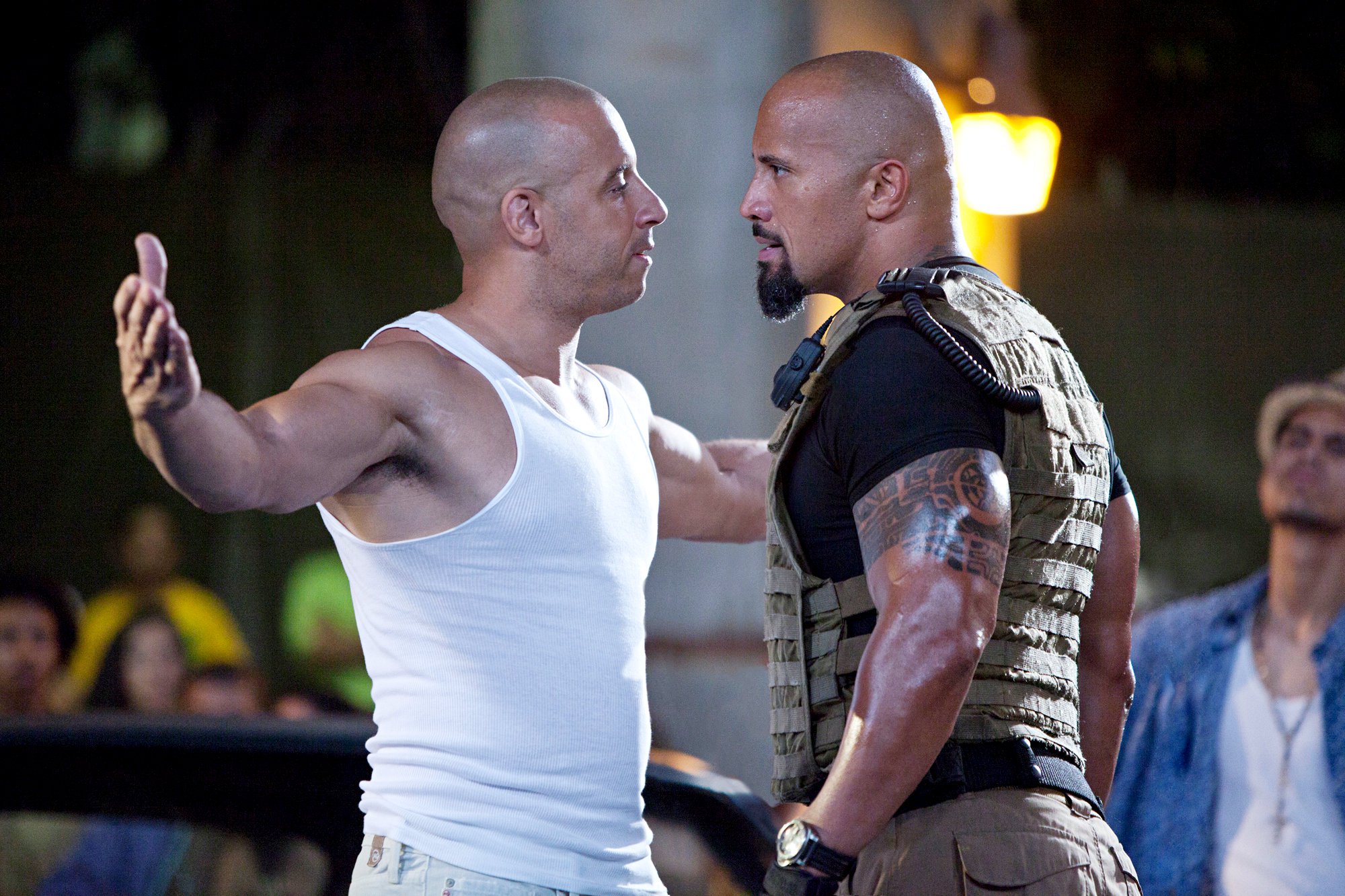
So far in our Dialogue Series, we’ve talked about how to set up a scene for good dialogue. We’ve talked about the importance of adding personality to your characters, as that’s a driving force behind good dialogue. Today I want to talk about the kind of dialogue that makes me want to kill myself. Because I read it all the time. And if I can just steer screenwriters away from these two things, I can ensure that all the screenplays I read from now on will have 50% better dialogue. So what are these script-killers?
ON-THE-NOSE DIALOGUE
and
GENERAL DIALOGUE
On-the-nose dialogue is dialogue where the characters are speaking only to service the plot and the scene. It’s as if they have a direct line into the writer’s head and are making sure that they’re saying exactly what the writer needs them to say for the reader to understand what they’re thinking and what’s going on. On-the-nose dialogue is obvious and straightforward. “I am so tired this morning.” “You should sleep in.” “But I have the big meeting today.” “Oh yeah. I’ll cook you breakfast.”
On-the-nose characters speak like cave men. Whatever they’re thinking, they share it. This gives the entire conversation a false reality. The audience isn’t even sure why they’re so bored. Characters are speaking on the screen. Usually they like this. But nothing the characters are saying is interesting. And that’s because there’s no human element to the conversation.
What’s the human element? Well, for starters, humans rarely say what they’re thinking. If Jane shows up at work with a disastrous new haircut and asks her friend, Sally, what she thinks, is Sally going to say what she thinks? Probably not. Conversation is a dance where you’re balancing what you’re thinking against what you’re saying. And I think that’s what a lot of newbies get wrong. They have the character say what they think as opposed to considering how that character might present that thought once it goes through their filter.
Here, in The Breakfast Club, Andrew (the Jock) is mad at Bender (the Burnout) and lets him know it….
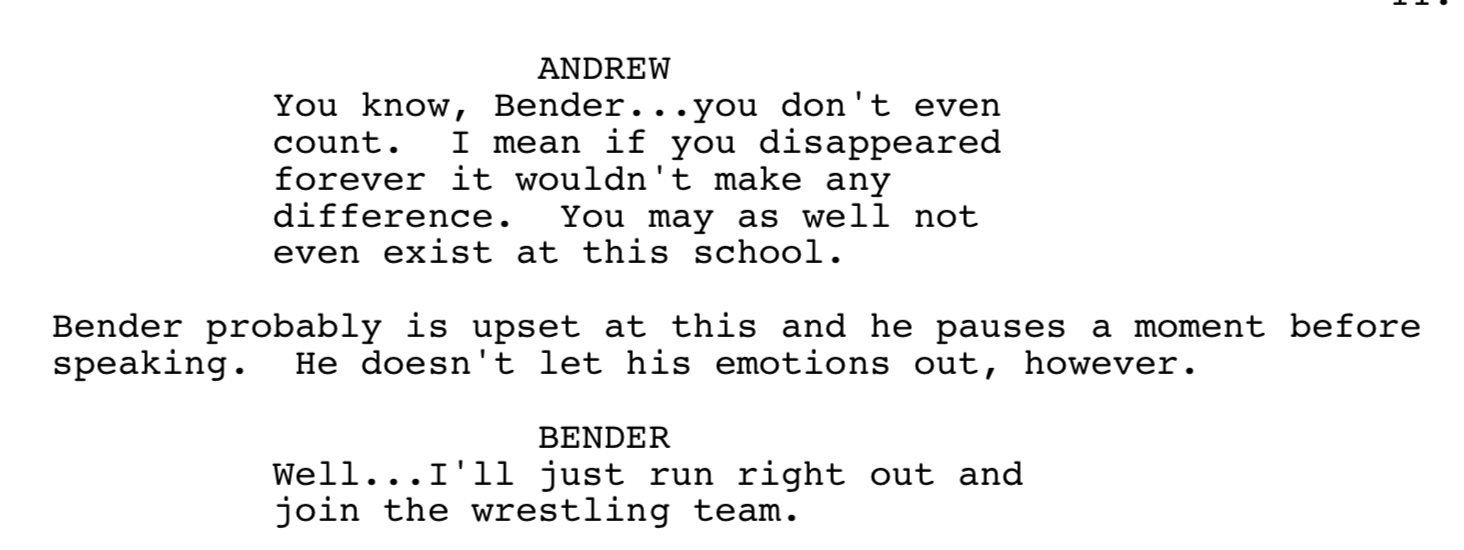
You can see that John Hughes even wrote it into the script. Bender wants to say something nasty. He’s angry. But instead of being a robot who conveys exactly what he thinks, he pretends that he’s unaffected and comes back with a jab. This is the human element. We think about what we’re going to say so that when we do say something, it frames us in the light that we want to be perceived in.
I can tell a writer is thinking “off-the-nose” (which is what you want!) when obvious questions are asked and non-obvious responses are given. Here’s a quick exchange in Erin Brokovich, where Erin is going to a woman’s house to get some information on the water scandal that’s hit the county.
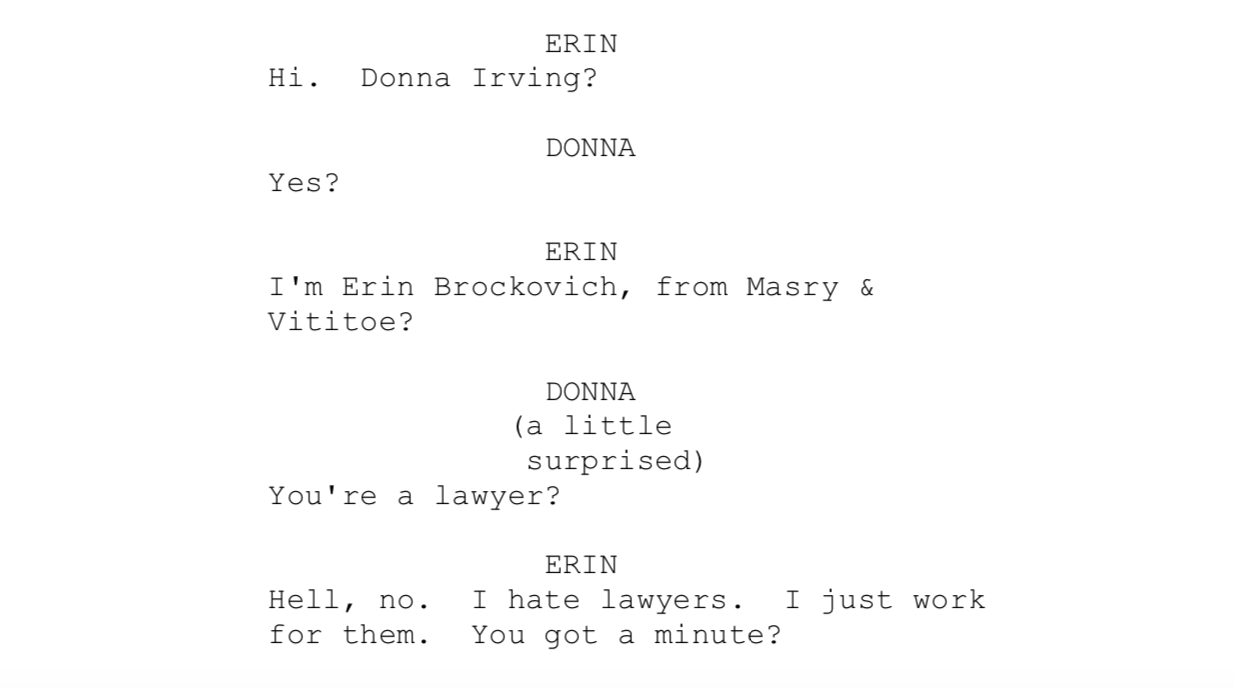
I’ve read a hundred scripts where a character asks a question just like this. “Are you a lawyer?” And the on-the-nose response from the lawyer is, “Yes, do you have a moment?”
It should be noted that on-the-nose dialogue becomes harder to avoid the more heavily plotted your script is. If you have a ton of plot, then your characters will become mouthpieces for the plot instead of real people having real discussions. This was a problem with yesterday’s script, Escher, which had a lot of plot going on, so all the characters needed to say exactly what needed to be said.
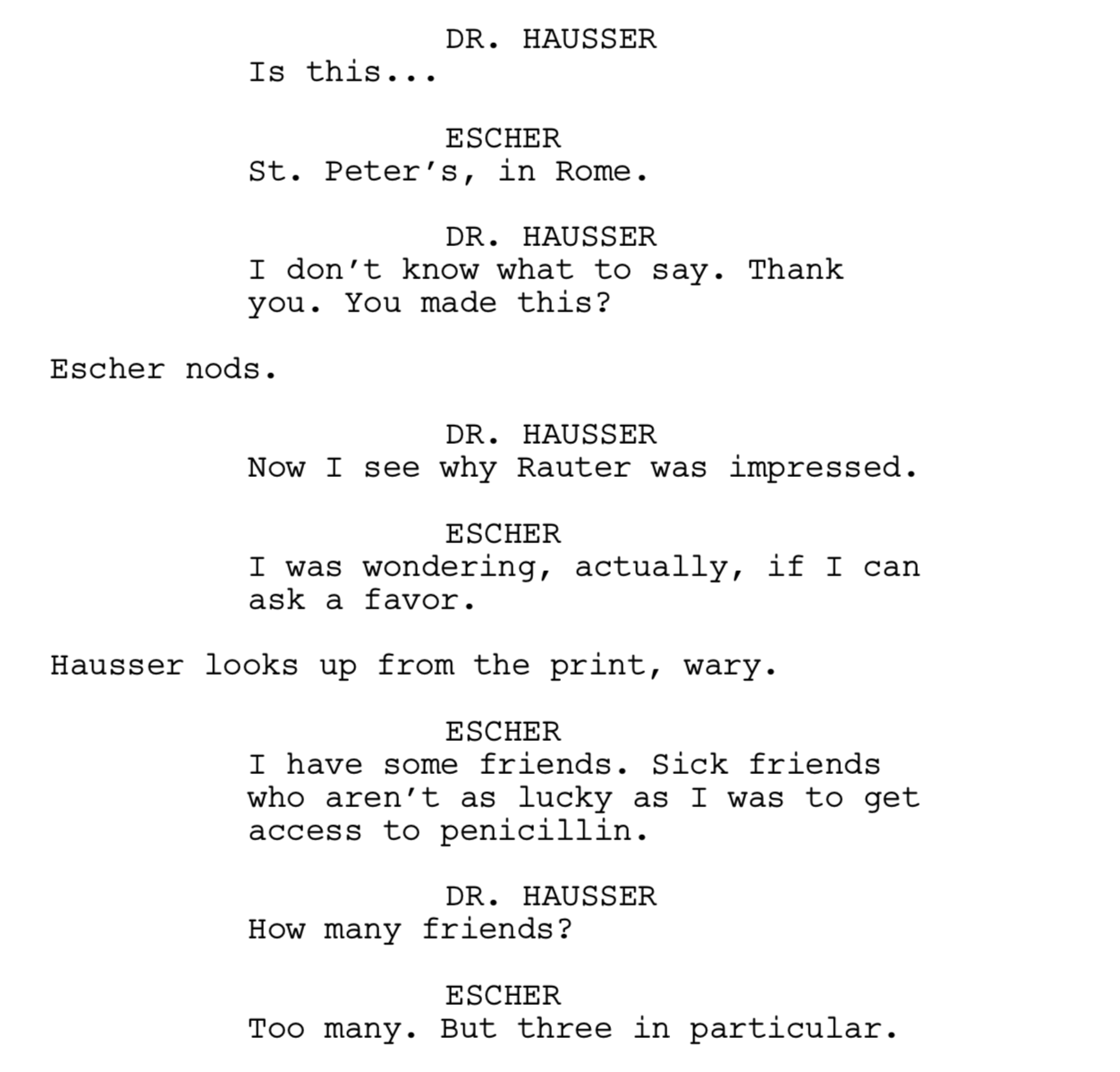
I bring this up because on-the-nose dialogue is often a result of circumstance. You’ve created stories or situations whereby the characters have to say exactly what they’re thinking. This is why you want to leave enough freedom in your story to let your characters talk without the constraints of needing to convey a plot point every three lines.
To avoid on-the-nose dialogue, avoid logic. Logic is your enemy in dialogue. Try to be playful. You want to have fun with your characters as opposed to just asking and answering questions. And try to incorporate scenes where one character isn’t being completely honest with the other. Or is holding back on some truth or their feelings. Once you have characters who aren’t being 100% honest, it’s hard to write on-the-nose dialogue.
Let’s move on to GENERAL DIALOGUE. General dialogue is dialogue that is the bare bones generic version of what a character can say. For example, if a character is at Thanksgiving dinner and wants more mashed potatoes, he might say, “Can someone please pass me the mashed potatoes?” This is a perfectly acceptable thing to say in real life. But in a movie, the line is so generic, it’s invisible.
The way you battle general dialogue is through specificity and playfullness. You add words and phrases and angles that add flavor to the line. Your hungry character might nudge his sister and whisper, “Hey, snag me the mashed potatoes before Uncle Rick engulfs them.” It’s not a crazy better line. But it’s more specific. The word “snag” is a little different. “Uncle Rick” makes the line unique to the story. “Engulfs” is a slightly dressed up way of saying “eats.” How specific you get will depend on the character, the story, the situation, and the genre. This line wouldn’t work in, say, Schindler’s List. Let’s take a look at an exchange from Deadpool.
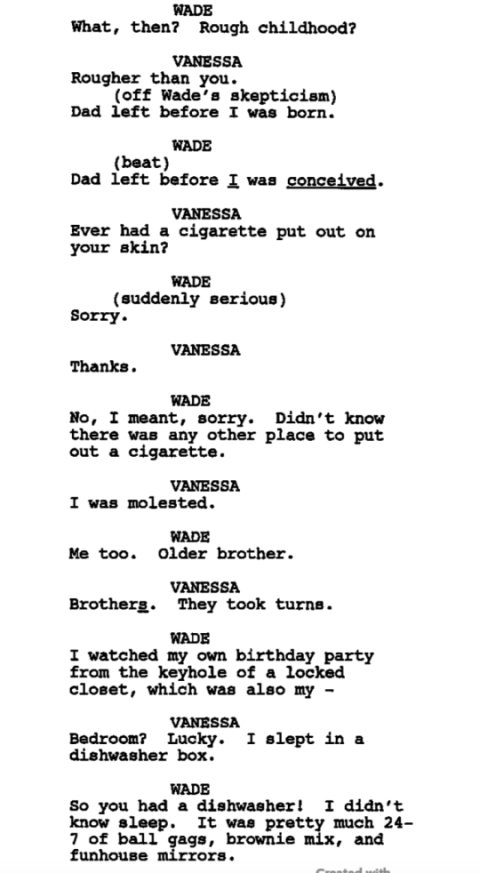
Notice how specific this dialogue gets, particularly towards the end with those last few lines. The two get into some pretty graphic experiences. Of course they’re not real, which makes the dialogue “off-the-nose,” and a solid example of everything I’m trying to teach in this post.
For the next exchange, we’re going to Fast and Furious 4. In the scene, Han is paying Dom for the job they just did…
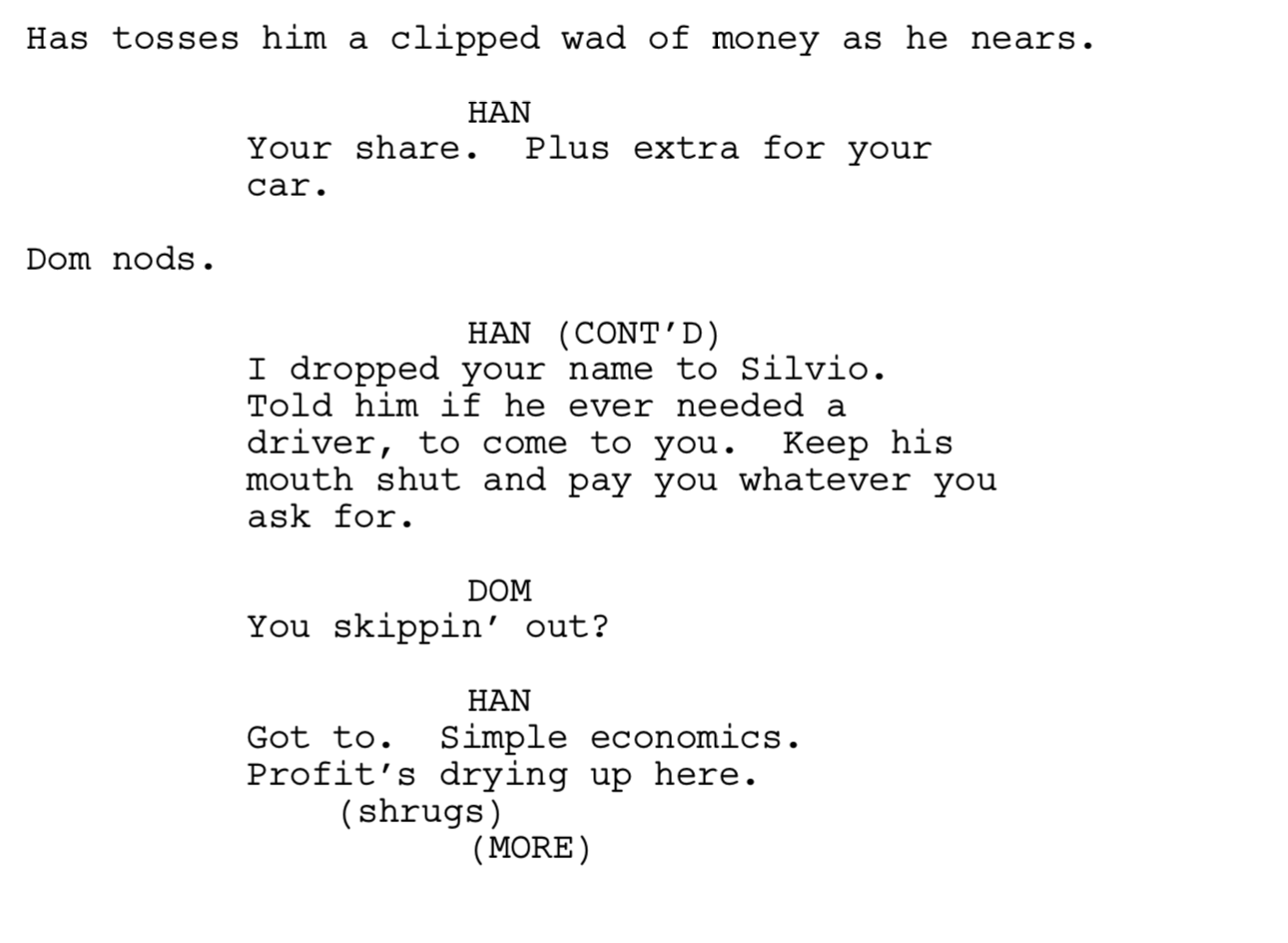
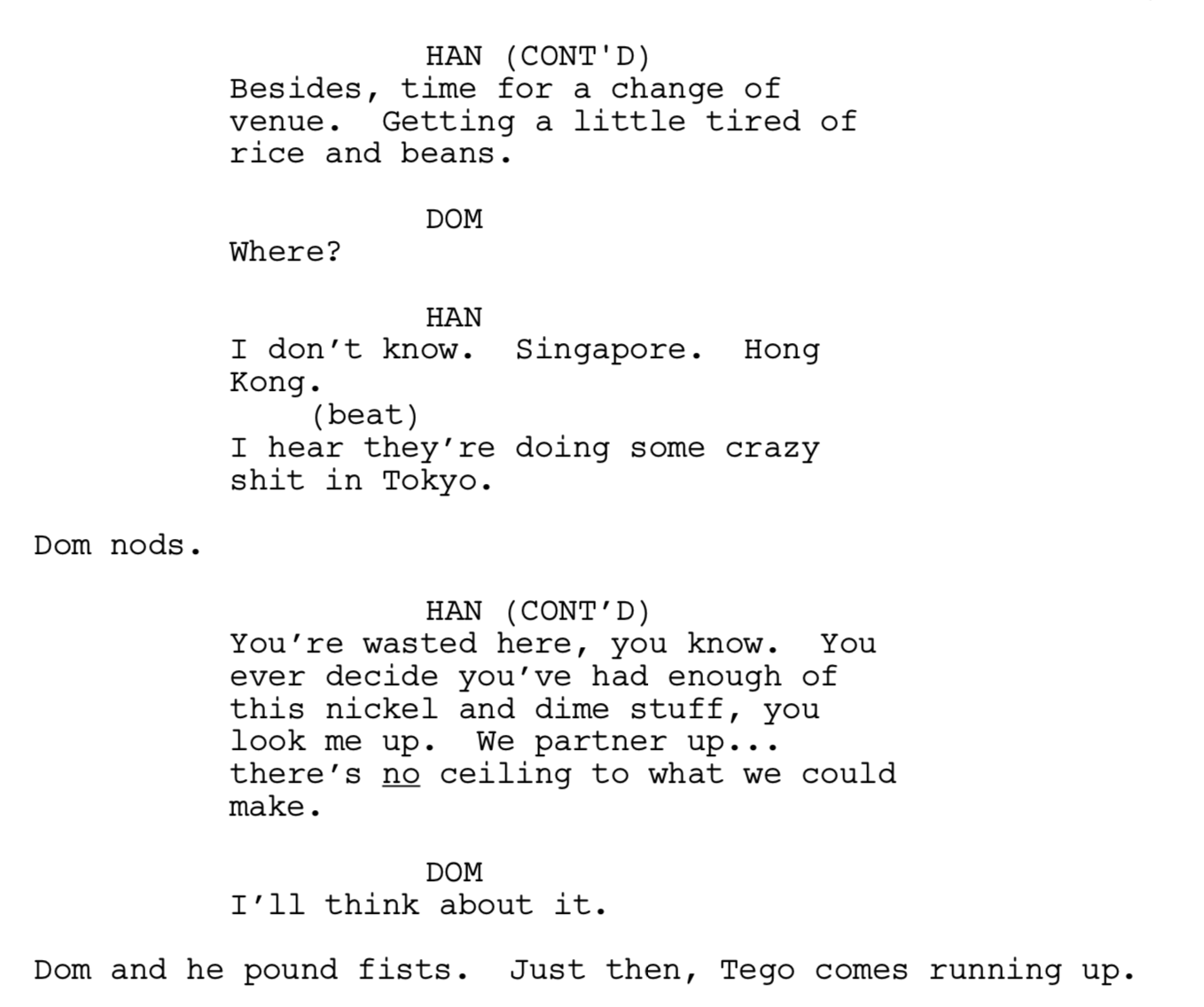
Look at the specificity in the words and phases. “Skippin’ out?” “Simple economics. Profit’s drying up here.” “Getting a little tired of rice and beans.” “I hear they’re doing some crazy shit in Tokyo.” “This nickel and dime stuff.”
All that’s really happening here is that the writer is willing to play with words. That’s the attitude you want to have whenever you’re writing dialogue. Obviously, the extent with which you’ll play will depend on the scenario and characters. But even if it’s two stiff accountants sharing plot information, you should still find ways to play with the words so it doesn’t come out like two robots talking.
That’s the worst thing that can happen to dialogue. On-the-nose generic “just the facts ma’am” conversation. Throw in some off the nose specific dialogue – be willing to play with words and phrasing – and your dialogue’s going to get a lot better.
Yo, do you have a logline that isn’t working? Are those queries going out unanswered? Try out my logline service. It’s 25 bucks for a 1-10 rating, 150 word analysis, and a logline rewrite. I also have a deluxe service for 40 dollars that allows for unlimited e-mails back and forth where we tweak the logline until you’re satisfied. I consult on everything screenwriting related (first page, first ten pages, first act, outlines, and of course, full scripts). So if you’re interested in getting some quality feedback, e-mail me at carsonreeves1@gmail.com and I’ll send you a quote!

We interrupt our regularly scheduled program (dialogue) to talk about character. Why character? Because yesterday some interesting conversations picked up AND I DISAGREED WITH EVERY SINGLE ONE OF THEM! Okay, that’s an exaggeration. My contention was that the script I reviewed, which sold back in 1994, never got made because the main character was so gosh-darn forgettable. He had ZERO going on. We knew NOTHING about him. Therefore, we had no emotional attachment to the story whatsoever.
One of you was quick to point out that Alien, one of the best movies of all time, tells us next to nothing about its characters and it didn’t seem to hurt the film at all. Others pointed out that action movies are often WORSE when the writer tries to jam a bunch of manufactured character development into them. Rose Tico has this deep tragic backstory in The Last Jedi. But she’s still one of the lamest characters ever.
So is character development overrated? Is it all just a matter of casting? I would answer that with a big fat NO. Not even close. In fact, character construction is still the most in demand writing skill in Hollywood. Put 10 guys in a room and ask them to come up with a cool plot or a killer set piece, and they’ll give you something that’s, at the very least, decent. Ask that same group of people to come up with a handful of great characters and nothing they give you will be useable.
There’s no question in my mind that if Man with the Football had a great main character, it would’ve been made. Why do I say that? Because good characters don’t come around often in Hollywood. So if an actor encounters one, they’re going to want to play them. That character was lame. I wouldn’t know a single actor in Hollywood who’d want to play him.
Now there’s a couple of things at play here that most writers aren’t aware of. When they hear “good character” or “make a character likable,” they think in terms of Adam Sandler movies or cheesy romantic comedies where the main character hands a homeless person a hundred dollar bill or, in the case of the most recent Sandler movie, Murder Mystery, Sandler busts a kid trying to steal something – BUT HE DOESN’T RAT HIM OUT! He lets him correct his mistake without arresting him. Gosh that Adam Sandler guy is nice, isn’t he?
That’s not real character development. It’s not real “character likability” development. It’s a hacky studio note that even the interns at CAA could give. And it’s not what we’re talking about today. The truth is, character development is varied. You will not use the same amount of it in every screenplay. Some stories require less character development. Some require more. Some GENRES require less character development. Some genres require more. A straight drama will always require the most character development of all the genres whereas an action movie might contain very little.
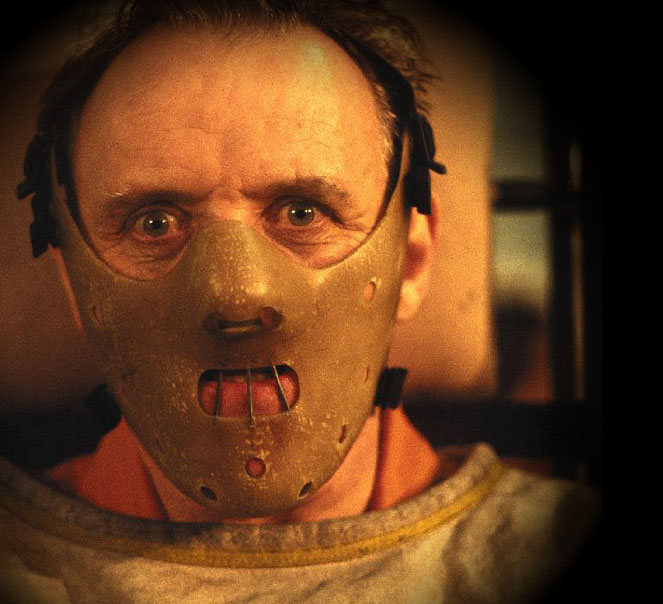
But hear me know, believe me later and understand me next week – YOU MUST ALWAYS add character development to your hero. And YOU MUST ALWAYS give us a hero that we want to root for. That doesn’t mean they have to be likable. But we have to want to root for them. Nobody liked that Hannibal Lecter ate a bunch of human beings to death. But, oddly, we still rooted for him to escape in the end. So today, I’m going to provide you with the eight most important things that affect how the reader perceives your character. I’m going to call this “care-achter” development. Because these are the things that make us CARE about your hero.
Backstory – Backstory is anything that’s happened to your character before the events of the movie took place. Backstory can be presented through flashbacks or alluded to through dialogue. Backstory is actually one of the least effective ways to influence a reader’s emotional response to a character. Movies are about what’s happening NOW, in the present, and therefore people don’t care all that much about what happened in the past. If I hear you lost your kid in a car crash – I’m sorry but big whoop. That’s every movie. We’re too desensitized to that stuff. Now if you start your movie with a flashback that SHOWS us the crash the kid died in, we’re definitely going to have a deeper emotional connection to that loss. But I would only rely on this sort of thing if that’s what the movie is really about. In other words, if the film is about a mother trying to recover from the loss of her child, that can be very powerful. But if you try to throw dead-child backstory into Independence Day 3, the audience is too smart to buy into that nonsense.
Actions – This is one of the single most important ways to influence how the audience thinks of a character – their actions. It’s also one of the primary character development tools in an action movie. Does your character step up to the plate and act when times are tough? If your character, Dan, is picking his 10 year old son up from school and sees Jake, 11, bullying him, does Dan walk up to Jake’s father and say something? That simple action can have a HUGE influence on how we perceive Dan. One of the easiest ways to get readers on your hero’s side is to write an early scene where your character acts in a strong manner. Or rights a wrong. That’s all I was asking from yesterday’s script. Not some big goofy backstory. But ANYTHING that gave me some insight into the hero and made me want to root for him.
Choice – Choice is action’s little cousin. It’s basically the same thing, but you add a little more weight to the action so that there’s not just a choice involved, but a difficult choice. Take the exact same scenario I mentioned above but change it so that Jake’s dad also happens to be Dan’s boss. So for Dan to go up and say something to Jake’s father is actually jeopardizing his relationship at work. If Dan’s already on shaky ground at his job, the choice becomes even harder. However, if Dan does the right thing (mentions Jake’s behavior to his boss), we’ll like him A LOT.
How They Treat People – This technically falls under the action umbrella as well, but I’m separating it because character interaction is such a major component of a screenplay. So if your character is treating everyone badly, you can guess how we’re going to perceive them. Conversely, if they treat people well, we’ll like them. These are the tiny slivers of character development that writers overlook. And yet in an action script where we want to convey as much about a character as possible in as little time as possible, paying attention to the way your hero treats others might be all you need to get him on the audience’s side.
Personality – A favorable personality can do a majority of the work for you. If we like a character because of their general disposition, we don’t need any save the cat moments or yell at bully’s dad moments. The magnetism of that personality is going to drive the majority of our support. Marvel has become a master at this. From Tony Stark to Peter Parker to Thor to Peter Quill, we like positive charismatic people. So if you’re writing a character like this, you don’t even have to worry about doing anything else. We like the character from the second they start talking.
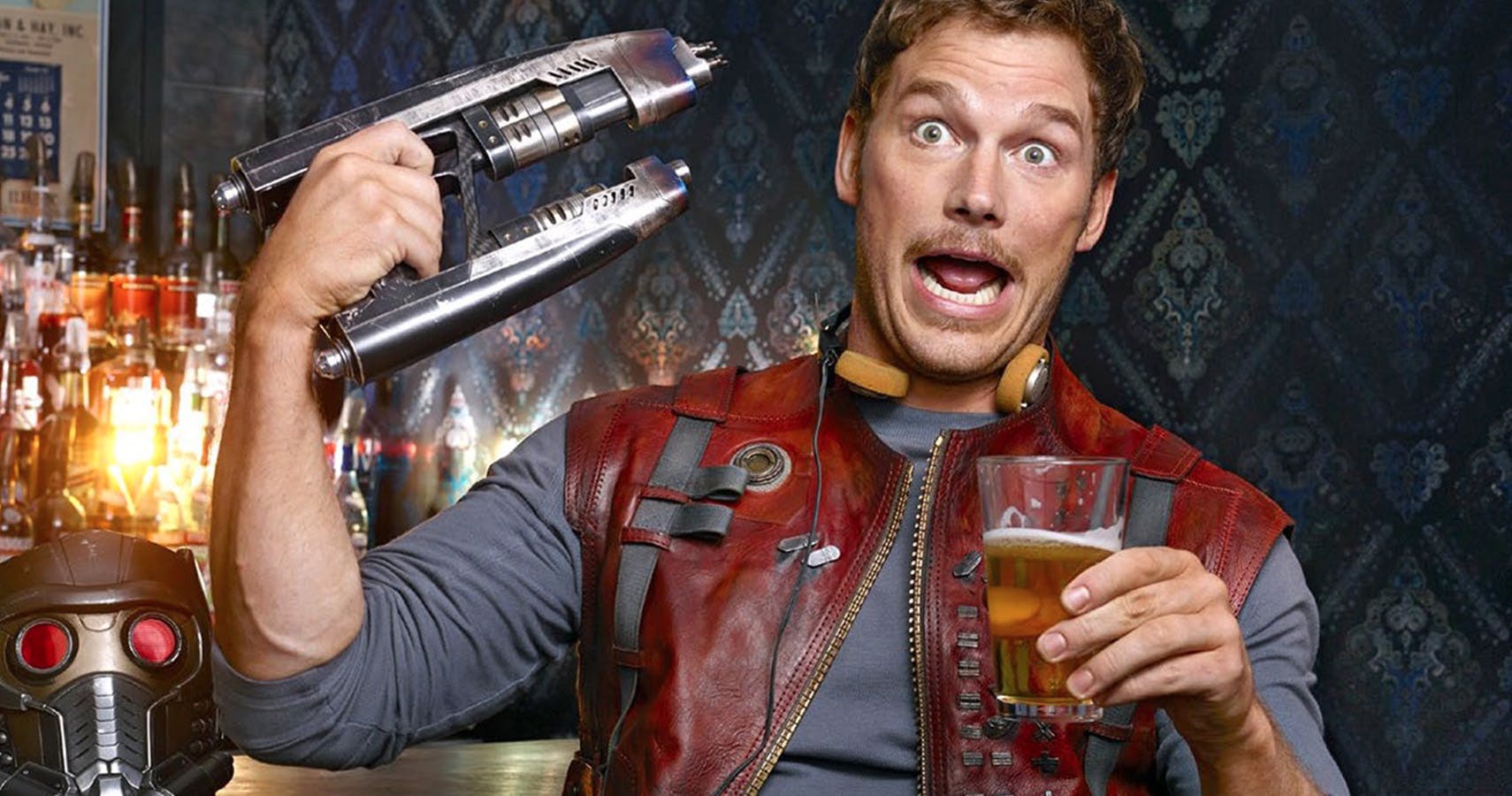
Their situation in life – A character’s current lot in life has a huge effect on the level of sympathy we have for them. A character who lives in a tiny place in a bad part of town and barely makes ends meet is higher on the sympathy scale than a billionaire who owns a penthouse on Fifth Avenue. — BUT if you give the billionaire an A+ personality, it can override our negative perception of their privilege (Tony Stark). There used to be a belief in Hollywood that rich people couldn’t be main characters for this reason. We’d reject them because their life was great. But I think you’re starting to see how this works. You assess who your character is, how they’re likely to be perceived, and you adjust accordingly. Some characters have so much working against them that you need to add a lot of these tools to make us like them.
How others treat them – A lot of writers trying to make their heroes likable assume they can only do so by looking inwards, at the character themselves. But actually, you can make characters likable through the way others treat them. Look no further than Cinderella. One of the reasons Cinderella is so insanely likable is that her stepmother and two step-sisters are so mean to her. When we see people being mean to others, our sympathy immediately goes out to them. I actually leaned this lesson by watching the reality show, Survivor. On that show was this guy named Russell. He was one of the worst human beings you could imagine. He was duplicitous, mean, vengeful, a liar, and just plain not a good person. He also holds the title of being one of the show’s all time favorites. He has tens of millions of fans. But how can that be? Well, the thing was, everybody hated Russell so much that they were constantly trying to get him off the show. They tried everything in their power. And they would say it right to his face. “We don’t like you. We will do anything to get you out of here.” They were so awful to him that audiences gradually found themselves rooting for Russell. So never underestimate the influence of how others treat your hero.

Whether or not they get back up – Movies are about knocking your hero down. It will happen over and over again. In fact, if your hero isn’t constantly being knocked down by obstacles and conflict, there probably isn’t enough happening in your movie. But the critical thing here is HOW YOUR CHARACTER DEALS WITH BEING KNOCKED DOWN. Do they give up? Or do they get back up? One of the most likable types of people on the planet are people who get knocked down but get back up with a positive attitude. They keep trying. Failure is an obstacle to them, not an end destination. So an early scene where your hero gets their butt handed to them badly but they still get back up and want to keep going – that will have a huge positive effect on how we see that character.
I’ll finish off by repeating what I said yesterday. If I’m not rooting for your hero, I don’t care what happens in your script. So make sure that when you’re writing that first act, you’re thinking about how the audience is perceiving your hero. Cause the flip side of what I just said is that if you can make us fall in love with your hero, you don’t need to write the best story in the world. We’re going to care so much about that person that we’ll be willing to follow them anywhere.
Hey, do you have a logline that isn’t working? Try out my logline service. It’s 25 bucks for a 1-10 rating, 150 word analysis, and a logline rewrite. I also have a deluxe service for 40 dollars that allows for unlimited e-mails back and forth where we tweak the logline until you’re satisfied. I consult on everything screenwriting related (first page, first ten pages, first act, outlines, and of course, full scripts). So if you’re interested in getting some quality feedback, e-mail me at carsonreeves1@gmail.com and I’ll send you a quote!
Genre: Biopic
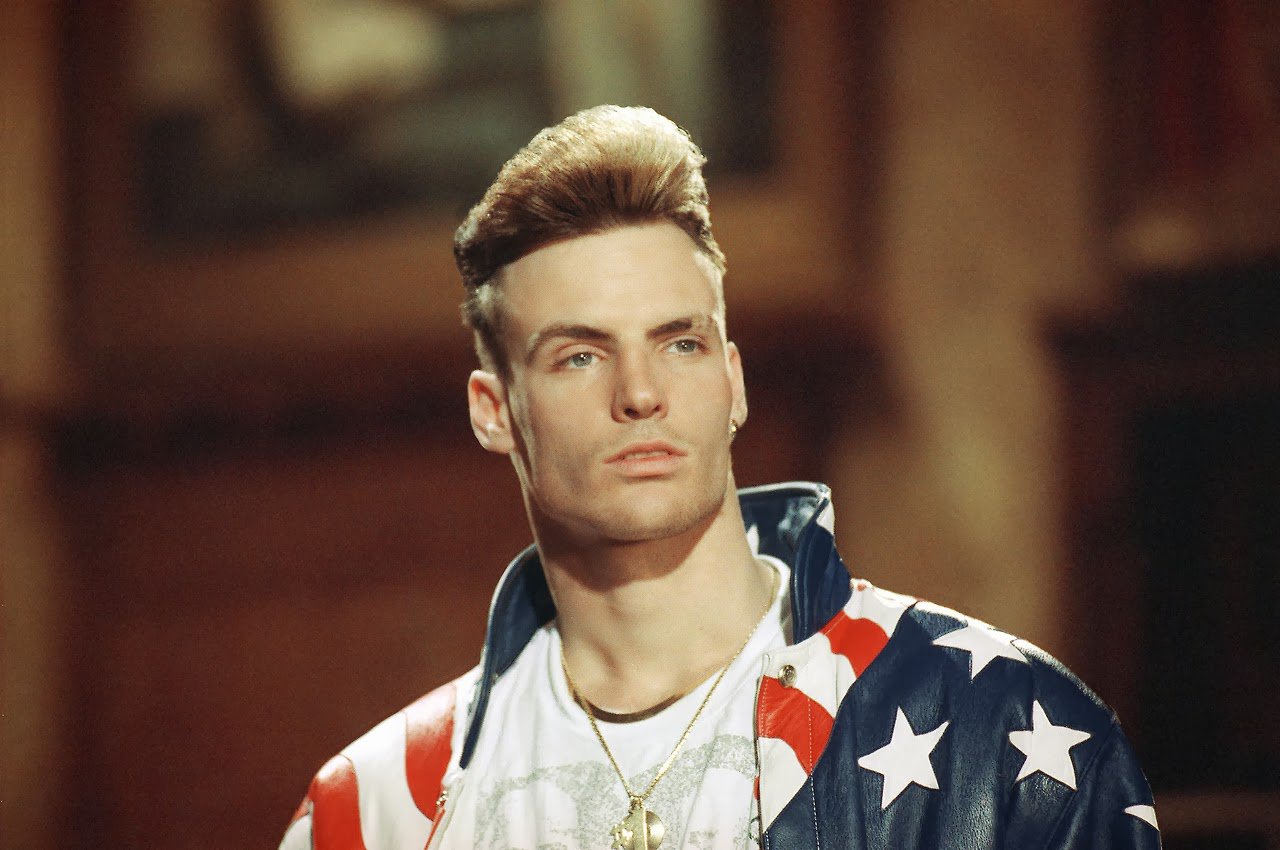
Premise: The rise and fall of the greatest one-hit wonder ever – Vanilla Ice.
About: “Something grabs a hold of me tightly. Flow like a harpoon daily and nightly.” Best lyric in the history of music? If this movie happens, one thing they won’t need is a make-up department. That’s because Vanilla Ice doppleganger Dave Franco is rumored to be playing the lead.
Writers: Chris Goodwin and Phillip Van
Details: 127 pages
You know the deal by now. When I read a biopic, I’m looking at whether I’m reading an author who did a quick wikipedia search and copy-pasted the story into Final Draft, or if I’m reading something where the writer actually thought about telling the story in a creative and moving way. If you do the latter, as very few people do, I’m thrilled. If you do the former, it’s one more bullet to the chest of the biopic. Which I’m okay with also because it means we’re one death closer to this genre never being relevant again.
For those new to biopics, here’s how we got here. Event movies destroyed the movie star. The movie star needed to find other options. The biopic became the go-to genre because it allowed the movie star to do what they do best, be the center of attention. The movie was about the historical figure, of course. But it was just as much about the actor. Even better, these movies became a primary vehicle for big studios to win Academy awards. So they were willing to spend big money on the production, the actor, and the director. Do you get to save the world anymore? No. But you get your close-up. And that’s all movie stars care about.
Anyway, I like the idea of a Vanilla Ice biopic because it opens up some avenues to not take the genre too seriously. Maybe play with the format a bit. Have some fun. Let’s see what route the writers took.
Robbie Van Winkle grew up in Miami Lakes, Florida. He was a little kid with a unique dream as a white boy – to be a rapper. Robbie worked as a used car salesman at 20 years old, and he and his crew would go over to the City Lights Night Club every weekend and watch the rap acts. One night, his friends tricked the booker into getting him up on stage, And Robbie killed it. Tommy Quon, the owner of the club, liked what he saw. To him, Robbie was a young Elvis, just doing it in a different style of music.
Tommy ended up selling his club and going out with Robbie on the road where they played in a bunch of dingy redneck bars that didn’t understand what Robbie was doing. But after a year of touring and Robbie piece-mailing together 10 songs, one of those songs, Ice Ice Baby, which was actually a B-track that Ice and his crew felt was weak, started playing on the radio. This led Tommy and Robbie to LA, where they signed with the record label, SBK, who gave Robbie, now “Vanilla Ice,” a half-million dollar advance.
Ice’s single would shoot to the top of the charts where he’d rub elbows with MC Hammer, an artist who many people felt Ice was copying. The single would then lead to an infamous cameo in Teenage Mutant Ninja Turtles 2, and then Ice’s own movie, Cool as Ice (“Drop the zero and get with the hero”). Quickly, however, the media turned on him, saying that he had stolen the hook from David Bowie’s song, “Under Pressure.” In a famous interview, Ice would explain the difference. “We sampled it from them but it’s not the same baseline. It goes DING DING DING DIGA DING DING. DING DING DING DIGA DING DING. That’s the way theirs goes. Ours goes DING DING DING TING AHH DING DING. DING DING DING TING AHH DING DING.”
But things would get a lot worse. Suge Knight, then an up and coming music producer, threatened Ice’s life if he didn’t give him a percentage of the profits from Ice Ice Baby. Ice was so shaken by the encounter that he hired eight body guards with machine guns to guard his house at all times. Ice then turned to drugs to ease the anxiety, and before he knew it, he was out of money with no prospects. Eventually he would come to the realization that it was time to leave Ice behind and reintroduce himself to Robbie.

The most amazing thing about this script is that the rise and fall of Vanilla Ice is structured so evenly. It’s literally the first half is all about the rise and the second half is all about the fall.
To me, the fall was more interesting. I didn’t know anything about the Suge Knight stuff. What do you do when a thug accompanied by four armed men holds you over a ledge and threatens to drop you unless you give him ten percent of the proceeds to your multi-million dollar hit? I guess you say ‘yes.’
As long as we’re talking about hit records, though, we might as well talk about broken ones. I say this every time I review a biopic. Unless you have the most fascinating person with the most fascinating life ever, to the point where you don’t have to change a thing – that’s how amazing it is. If you don’t have that, you need to make some story decisions that set your biopic apart from all the other ones.
This is your typical rise and fall music biopic. There’s nothing inventive about it at all. There’s even a “descends into the drugs and party life” montage. And while Vanilla Ice is amusing, he’s by no means fascinating. So it’s one of those typical reads where you get to the end and you think, “That wasn’t bad.” But it certainly wasn’t great.
A stronger theme probably could’ve helped. With these biopics, since they’re so furiously focused on one individual, you want to say something about the world through that individual. There were tiny moments that hinted at this theme of Vanilla Ice being the first example of cultural appropriation – a white man trying to act black. But they never went that far with it. I think they also could’ve pushed Ice’s desire to be accepted by the black community more. Let’s face it. In this day and age, the media loves race-bait. They eat it up. So if your movie plays into that, people are going to talk about it. And I truly felt like Ice was hurt that people in the hip-hop community weren’t more accepting of him.
And if you’re wondering how do you manage a theme like that in a screenplay – you start with your climax. Your climax should be the moment where your theme is colliding with your character in the most dramatic way. So, as an example (although there are many ways to do it), you might have Vanilla Ice break down about the fact that this community he so badly wants to be a part of has officially rejected him. And then you move backwards from there and make sure there are ample moments throughout the script that keep that topic at the forefront. If your theme is a huge part of your climax, it’s likely the audience will know that THAT’S what your film is about. If it isn’t, we’re probably going to be confused as to what the movie was about. And that was the case with To The Extreme. I’m not sure what it was about other than a singer’s rise and fall.
With that said, I was never bored by To the Extreme. But like all biopics, it’s sort of like reading a wikipedia page while on a Disneyland ride. It’s slightly more exciting than reading it from your couch. And I suppose if you knew nothing about Vanilla Ice, this might wax your candle. But if you don’t know who Vanilla Ice is, do you wanna know? I don’t know. Word to your mother. Peace in the Middle East.
[ ] What the hell did I just read?
[ ] wasn’t for me
[x] worth the read
[ ] impressive
[ ] genius
What I learned: Always try to find fun ways into scenes. If you have a meeting between characters, ask yourself if there’s a way into that meeting other than one man walking into a room, sitting down, and talking with another man. In To The Extreme, Tommy (the night club manager) says to Robbie to come meet him tomorrow at 10. This is Robbie’s big shot. Someone likes his music! Now we could’ve had Robbie just show up. But the writers cleverly have Robbie working at the car lot that day. And his boss, Bryon, won’t give him the time off. So Robbie has one of his friends, Chill, show up pretending to be looking for a car. This allows Robbie to give him a “test-drive,” which, in actuality, allows the two of them to get to the meeting.
Last week we talked about how to set up a scene in order to create the best dialogue. Today we’re going to go back even further than that and talk about how to create characters that lead to good dialogue. How important is character creation when it comes to dialogue? Well, you know that guy Quentin Tarantino? The screenwriter who many believe writes the best dialogue in town? All Tarantino does is he creates a series of larger-than-life characters and simply lets them talk. You could argue that unless you’re constructing some of your characters with the larger-than-life gene, you’re dooming your screenplay to bad dialogue. Think about it, how many average characters do you remember in all of the movies you’ve seen who spit out memorable dialogue? I’m guessing none.
So my first piece of advice to you when it comes to character and dialogue is to create a character who’s larger than life in some way. Now when I say, “larger than life,” I don’t mean Melissa McCarthy in Bridesmaids. I mean there’s something about your character’s personality that’s bigger than the average person. Juno is a good example. That character was talkative and opinionated, slightly larger than life. But she was still able to exist in reality. Steve Jobs in Aaron Sorkin’s “Jobs,” is another example. Big and opinionated and intelligent and thoughtful. He had that larger than life quality.
So the next question becomes, how do we vary these characters? Not everyone should be Juno. The good news is, it’s not as hard as you think. Personality comes in many different flavors. There’s the motormouth, the joker, the know-it-all, the b.s.’er, the opinionated, the walking thesaurus. Write out a list of all the people you know in your life and next to them write down what their most dominant trait is and you’ll get a sense of what types of people are fun to listen to and what types aren’t. You can also watch sit coms (Seinfeld is a good one) where characters, especially guest characters, are highlighted by a particular trait (the soup nazi is militant, for example), and get ideas that way. It’s important to note that every trait is scaleable to the tone of the movie you’re writing. There’s a version of the Soup Nazi for a move like “The Mule.” You’d just have to dial the goofiness back and make him one of the drug dealers, not a soup dealer.
One of the things that really gets in the way of good dialogue is, believe it or not, the main character. This is because your main character is often the most grounded variable in your story. Their goals and desires need a certain element of truth to them for us to care about their journey. Unfortunately, this often makes them an un-engaging conversationalist. And normal conversation isn’t as fun to read as larger-than-life conversation. This is why people remember Han Solo over Luke Skywalker, Jack Sparrow over Will Turner.
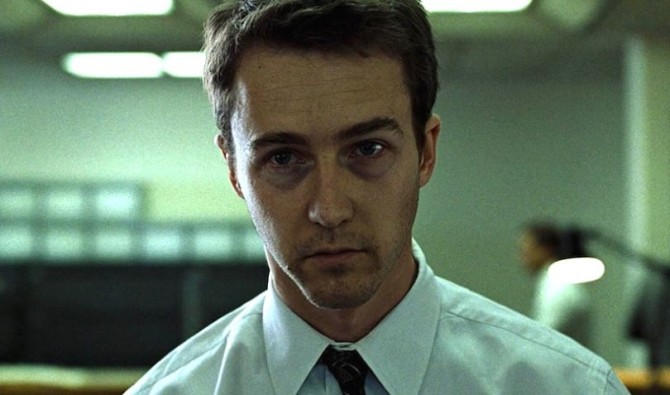
There are a couple of ways to deal with this. The first is to buck the trend of writing a grounded main character and center your story around someone larger than life. A good example of this is The Narrator (Edward Norton) in Fight Club. The guy is very thoughtful and has lots of opinions on work, love, and life, and he’s giving us a rundown of these thoughts throughout the story. He’s anything but your average grounded main character. Christy Hall’s angry man-hating heroine, Skylar, in her spec, “Get Home Safe,” is another anti-grounded character who says what’s on her mind and doesn’t care how you feel about it.
The second way to tackle this problem is to identify which character in your script shares the most screentime with your grounded lead and make sure they’re a larger-than-life character. A recent example of this is Hell or High Water. In that film, Toby Howard (Chris Pine) is our muted reserved down-to-earth lead and Tanner Howard (Ben Foster), his brother, is our alcoholic rambling joking threatening larger-than-life character. What this does is it creates contrast between the characters. Contrast results in a steady wave of conflict. And conflict is where you’re going to find all of your best dialogue. And the reason, of course, that you do this with the second biggest character is because you’ll have a ton of scenes with those characters throughout the screenplay, which guarantees you a lot of good dialogue exchanges.
One of the most dangerous things you can do in a script is create two down-to-earth grounded leads who aren’t big talkers. I’m sure a few cinephiles here can name a movie or two where that’s worked. But I’m guessing those examples are few and far between.
How many larger-than-life characters should you include in your script? That’s obviously going to depend on genre and what kind of script you’re writing. Every character will have a function in the screenplay that may or may not jive with being “larger than life.” However, one of the nice things about supporting characters is that their lives don’t have to be as fully-shaped and grounded as your leads. Therefore, you can have more fun with them. A movie with great dialogue is Good Will Hunting and pretty much every supporting character in that movie is larger than life. Chuckie (Ben Affleck) was a big goofball. Morgan (Casey Affleck) was the willing butt of the joke. Skylar was big and humorous and always ready to have fun. Lambeau (the math professor) was this fevered tortured soul desperate to see this young man reach his potential. And of course Sean the Therapist was the most animated character of them all. If there ever was a movie to prove the point of this article – that larger-than-life characters are the key to good dialogue – Good Will Hunting would be it. To summarize, there’s no limit to how many of these characters you can add. But there are situations where you have to be very judicious about adding multiple larger-than-life characters. I probably wouldn’t have a ton of them in Moonlight, for example.
I want to finish this off by saying that one of the consistent threads in the scripts I read that contain lifeless dialogue is the lack of interesting characters. It’s hard to make someone sound unique who isn’t. This is the reason for another big dialogue faux-pas, which is try-hard dialogue – characters saying big outlandish things that they would never say. This happens when writers construct uninteresting characters and then try to shove interesting words into their mouths. It doesn’t work because it never feels like the real character. It feels like the writer.
In the coming weeks, we’re going to learn how to apply these tools to actually write good dialogue. Should be fun!
Hey, do you have a logline that isn’t working? Are people not responding to it? Try out my logline service. It’s 25 bucks for a 1-10 rating, 150 word analysis, and a logline rewrite. I also have a deluxe service for 40 dollars that allows for unlimited e-mails back and forth where we tweak the logline until you’re satisfied. I consult on everything screenwriting related (first page, first ten pages, first act, outlines, and of course, full scripts). So if you’re interested in getting some quality feedback, e-mail me at carsonreeves1@gmail.com and I’ll send you a quote!