Search Results for: F word
Genre: Contained Thriller
Premise: A dedicated social worker enters the home of an adoptive father of six children to check on their well-being, only to learn that the family is keeping a deadly secret. Based on actual events.
About: This script made last year’s Hit List and Blood List. Skylar James has been writing for quite some time, penning the 2010 script for Mortal Kombat.
Writer: Skylar James
Details: 117 pages
If God said he was ending your life in six months unless you sold a screenplay, your best bet would be to write a contained thriller. Or, better yet, a contained horror. You probably won’t get a huge paycheck. But you’d sell your script and still be alive. Skylar James knows this formula. So much so that she’s turbo-boosted it with the old “based on actual events,” tag. If you can’t sell a contained horror that’s based on actual events, well then my friend, you are not a real screenwriter (I’m only joking, of course. Well, half-joking anyway).
Anthony Minchin, an obituary writer, is a weird middle-aged man who lives up on 29 Mole Street with his six adopted children, Christopher, Tallulah, William, Irena, Gideon, and Juniper. Anthony loves his kids more than anything and they love him back. Every day Anthony comes home with a new toy and plays games with them. Outside of not having a mother, the children are happy beyond their wildest dreams.
One day there’s an unexpected knock at the door. Hannah, from social services, is here to check on the adopted children to make sure they’re okay. A victim of abuse, Hannah is immediately concerned when she notices bruises on the children. She investigates each of them, but they only speak glowingly of their father. Still, something doesn’t add up.
Hannah’s spidey-sense spikes when she speaks with William. There’s something about him that’s familiar. Was he previously at another adopted home she was assigned to? Hannah shifts her focus from the children to the house, which she investigates with growing curiosity. Anthony has all these rules about what rooms you’re allowed to go in. And nobody, not even the children, is allowed in the basement.
As soon as Anthony is busy, that’s where Hannah goes. After snooping around, she finds a hollow floorboard, which contains an old laptop. She boots it up and finds obituaries for hundreds of children. But more concerning is the police file she finds on her abusive old boyfriend. Why would that be in here? When Hannah goes upstairs to confront Anthony, she realizes that neither this house nor these children are what they seem, and that she could be stuck here forever.
The problem with 29 Mole Street is that I predicted the twist a quarter of the way in (spoilers follow). There were too many red flags pointing to it. He writes obituaries. The kids are never allowed to go outside. The curtains must always stay closed so the neighbors can’t see in. It was pretty obvious they were dead. And if they were dead, she probably was too. So I spent the rest of the script waiting for the writer to catch up to me.
With that said, I had previous movies like The Others and The Orphanage to guide me towards that conclusion. If you haven’t seen those films, maybe the ending to 29 Mole Street is a surprise to you. But that’s not what I want to talk about today. I want to discuss bulk character descriptions, since this is something that keeps coming up.
Mole Street is a good example of why you don’t want to introduce a bunch of characters at the same time. When you introduce characters in bulk, it is HIGHLY LIKELY the reader will forget most of them. This problem usually comes up with writers who don’t read a lot of scripts. Because they don’t read, they’re unaware of how difficult it is to memorize a group of people.
Mole Street introduces us to six children in the worst way possible: “The children (CHRISTOPHER (4), TALLULAH (5), WILLIAM (5), IRENA (7), GIDEON (8), and JUNIPER (10)) sit side by side in a line on the sofa watching cartoons when Minchin walks in.”
How long do you think it will take before the reader forgets who’s who here? I can tell you how long it took me. A page. From that point on, I was guessing who was who. The good news is, there’s a simple set of rules you can follow to make sure that if you’re introducing a group of characters, the reader will remember them.
1) Don’t do it – It’s virtually impossible to introduce characters in bulk and not have the reader forget some of them. So only do it if you have no other option. If you must bulk intro, try to move some of the intros – hell, even if it’s just one intro – to another scene. The fewer characters you’re introducing in bulk, the better the chance we’ll remember them.
2) Introduce the most important characters first – Generally speaking, readers assume that whoever’s important will be introduced first. So if you’re introducing a group of characters, create a hierarchy of importance and introduce them in top-down order.
3) Write a killer description – Character descriptions become infinitely more important when introducing in bulk. Therefore, you should dedicate lots of time to writing highly memorable character descriptions for everyone. Here’s how Soderbergh described Erin Brokovich: “ERIN BROCKOVICH. How to describe her? A beauty queen would come to mind – which, in fact, she was. Tall in a mini skirt, legs crossed, tight top, beautiful – but clearly from a social class and geographic orientation whose standards for displaying beauty are not based on subtlety.” That’s a tad long, but you get the point.
4) Immediately have them do or say something that tells us more about them – When introducing in bulk, action becomes even more important than normal. The right action can be the difference between us remembering and not remembering someone. So if they’re a dummy, have them do something dumb. If they’re funny, have them say something funny.
5) Intersperse some nicknames – Anything you can do to help us remember who’s who should be used. A little trick is to give at least one character an on-the-nose nickname. I read a war script not long ago with a bulk character intro and one of the characters was named “Sideburns” cause of his insanely long sideburns. I never forgot that character. In general, names that sound like their characters can be helpful in these situations (if you have a character known for her virginity, naming her “Mary” might help).
6) Don’t dine and dash – Whatever you do, don’t abandon bulk intro’d characters right after introducing them. In other words, don’t introduce the characters then cut to some other scene or sequence that lasts ten pages, before coming back to them. I guarantee you we will forget almost all of them if you do this. Stay with the characters as long as you can so we can get to know them and define who’s who.
You follow these six rules, you should be fine.
As for the rest of the script, I don’t know if the reason I picked up on the twist early was because I read so many scripts or if it’s genuinely too obvious. Nor do I know how to judge the overall script in spite of this. It’s not a bad story. But just like anything that depends so heavily on the twist, it’s screwed once you figure that twist out. For that reason, I can’t recommend this.
[ ] What the hell did I just read?
[x] wasn’t for me
[ ] worth the read
[ ] impressive
[ ] genius
What I learned: When writing scripts that have a big final twist, err on the side of LESS setup for the twist rather than MORE. Audiences are always smarter than you think so you don’t want to make it too obvious. If readers later tell you that your twist “came out of nowhere,” you can add more setup. But I’d always start with less.
Genre: Dramedy
Logline: A blackballed entertainment lawyer puts her negotiation skills to the test when her beloved oldest daughter announces that she’s putting off college to become a feminist porn star.
Writer’s Pitch: This script examines just how messy and complicated modern feminism can be when ideals get translated to real life. The story is personal and timely and incredibly important to me. I think it will elicit strong reactions — both positive and negative — and it would be invaluable as I continue to develop this story to hear a variety of takes from readers male and female, young and old — not just Carson. (I’m saving my cash for a private consultation on my next script :) ) Bonus: At 89 pages with a lot of white space and humor, it’s a very fast read.
Writer: Angela Bourassa
Details: 89 pages

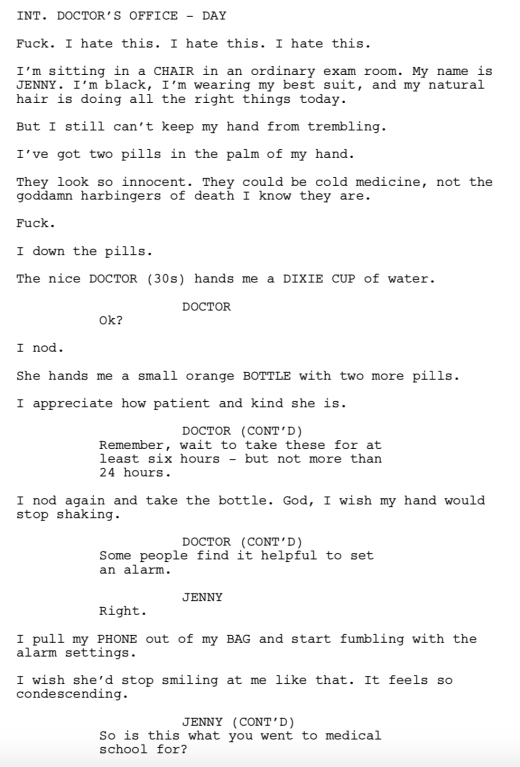
Last week’s Amateur Showdown comments section got a little messy, as it does whenever a writer attempts something different. Bourassa wrote her script in first-person, a huge no-no when it comes to screenwriting. Why is it a no-no? Because screenplays are supposed to act as instructional manuals for another group of people to go off and make the movie you’ve written. You’re writing to them. Under that logic, it doesn’t make sense to write in first person.
But as screenwriting has evolved into a more personal relationship between writer and reader, there’s been some flexibility in that rule. Screenplays have arguably become pseudo-noevellas, and, in the process, lost a lot of their strictness. While a first person screenplay is the most extreme version of this, it’s not the first time I’ve encountered it. However, if you’re going to use it, two things must be in order. One, you should have a good reason for doing it. And two, since the device will lead to more scrutinization, your script will have to be better than most.
Jenny, a proud 40-something black entertainment lawyer, is being handed a couple of pills in the doctor’s office when we meet her. We don’t know what those pills are for yet, only that Jenny looks stressed out about what the doctor’s just told her. From there, Jenny heads to middle school to pick up her 14 year old mixed-race daughter, Priya, who she spots making out with a 16 year old white boy.
Immediately, we sense that Jenny is fighting a daily battle – a battle to be progressive and supportive of her family, despite the permissive narrative in her head to be traditional and protective. So Jenny tries to smile about her daughter’s new boyfriend who, no doubt, will be pushing to have sex soon. Even if she’d do anything in this moment to make him disappear forever.
It turns out Priya is the least of her worries, though. When she gets home, her 19 year old super-cool beautiful perfect daughter, Indiga, informs her and Jenny’s husband, Amit, that she has something to tell them. She’s a) queer (they’re thrilled), b) wants to take a year off of college (sounds reasonable) and c) wants to make porn.
I’m sorry say what?
Indiga assures her mother that this isn’t “porn” porn, but rather porn for women. It will be feminine centric, body positive, instructional, and fill a market need. What Jenny isn’t yet aware of, is that she’s just been given the BAR exam for feminism. She should support her daughter if she wants to get into the sex industry. It’s what an empowering feminist would do. But she’s still this girl’s mother. And it’s porn!
Jenny huddles with Amit and the two discuss a plan to talk their daughter out of this. This problem is compounded by the fact that whatever Jenny was at the doctor for is eating at her, her professional career is floundering, her other daughter, Priya, wants to get an IUD, her husband’s artistic pursuits don’t bring in enough money, and her other child, Zack, is having trouble attracting girls. It will be up to Jenny to sort all this out in a way that makes both herself and Indiga happy, a task that will put her feminist ideals to the test.
Let’s begin with this first-person thing since I know it will be a hotly debated issue in the comments. While the first-person angle grabs our attention right away and makes the script different, I don’t see it as necessary for this story. Angela mentions the Pruss Passengers script, which also had a first-person perspective, but if I remember correctly, the first person there was relevant to the story. Aliens were “riding” human beings, and that allowed us, the first person narrator, to occasionally become an alien, which was crucial to the experience.
With The Dirty Work, I could see this being written in 3rd person and nothing changing. Maybe we don’t know Jenny as well, but there are tell-tale actions you can use to make up for us not being in her head. With that said, it does help the script stand out. So I’ll leave it up to Angela on whether she wants to keep it or not.
As for the script itself, it feels a bit thin to me. I liked the hook a lot. You set up the most progressive feminist mother ever and then give her the ultimate test – her daughter wants to become a porn actress – and see if she’ll stay true to her feminist ideals. But the script doesn’t really know where to go after the hook. There’s no narrative drive.
I know that yesterday’s film was as different from today’s as could be. But the narrative drive was always clear – climb the mountain. Here, the goal is to, I guess, stop her daughter from being in porn. But it’s dealt with in too casual a manner. One of the issues I had with the script was that I knew what the end result would be. I knew Jenny would support her daughter. So the goal is more symbolic than actual. She’s not REALLY trying to stop her. And we feel that in their scenes together. Jenny will make a point, but then immediately feel wrong about that point. This created an overall lack of suspense and the rest of the plot suffered as a result.
A good script problem has to have an uncertain answer in order to keep the reader engaged. Since this is Oscars weekend, we’ll use a famous Oscar winning script as an example. In Good Will Hunting, the question dictating the story is whether Will Hunting will remain a “nobody” working blue-collar jobs the rest of his life, or go off and use his talent to do something special with his life. The movie does an excellent job making you wonder which way he’ll go. The best stories ride that line the whole way through.
Part of the reason The Dirty Work is predictable is because of the type of porn Indiga is doing. She’s doing the nicest most pleasant most neutral form of porn possible. If your daughter did porn, this is literally the form of porn you’d choose for them. That was a major factor in me being able to predict what Jenny would do. This got me wondering, if you changed this to a more severe form of porn (regular male-female porn) would we be less certain what Jenny would do. I think we would. Then again, that alters the tone somewhat, so you’d have to weigh the advantages against the disadvantages.
As for the rest of the script, I felt the male characters were underwritten. Indiga and Priya have legitimate problems whereas Zack’s biggest issue is relegated to will he ask a girl out or not. And I definitely think we could do more with Amit. From my understanding, Indians have a very complex relationship with porn. The traditional culture out there looks down on it. That seems like the perfect opportunity to create more conflict between both Amit and Indiga and Amit and Jenny.
Finally, the script had a weak climax, no pun intended. The big final scene has Jenny negotiating Indiga’s porn contract. The idea behind this isn’t bad. Jenny’s entertainment law business has struggled. This is her “opportunity” to show that she’s still got it. But there are too many things hurting the scene, the biggest of which is that if she loses, she wins. If she loses this negotiation, it means her daughter doesn’t do porn. So why wouldn’t she lose on purpose? To be honest, it feels like this ending was rushed and that there’s a better ending out there.
Moving forward, I would dial everything up in this script. There’s not enough conflict. We never truly feel there are any problems between Jenny and Indiga. Even when they get mad at each other, it’s a polite mad. The more conflict you create in this relationship, the more doubt we’ll have that things are going to end well. And that’s what you want every story to feel like right up til the end – that things aren’t going to end well.
But I think this idea has potential. It has something to say in this day and age, and the hook is a strong one. A few more drafts and this feels like something that could make the Black List. It’s just not there yet.
Script link: The Dirty Work
[ ] What the hell did I just read?
[x] wasn’t for me
[ ] worth the read
[ ] impressive
[ ] genius
What I learned: Scene Agitator Deluxe – A scene agitator is an outside force that repeatedly bumps against your characters while they’re trying to do something else in a scene. Say your characters are having a fight. Well what if, during the fight, the fire alarm keeps going off, forcing them to pause the fight while one of the characters deals with it. They fix it, go back to the fight, then a few moments later, it goes off again. That’s a scene agitator. Today taught me that there’s a deluxe version of this. This is when you add a scene agitator during a pivotal scene, allowing that scene to level up even higher. During the pivotal moment when Indiga tells her parents that she wants to do porn, Priya has just come home and the car pool parent who drove her is outside waiting for gas money he’s owed. So Priya keeps asking her mom for the money (the agitation) while Indiga is dropping this bomb on her. Clever move! You can read more about scene agitators in my book.
Today’s script is a bizarre cross between Eternal Sunshine of the Spotless Mind, Groundhog Day, and 500 Days of Summer. You are not prepared!
Genre: Dark Romantic Comedy
Premise: When a woman finds a time machine in a downtown Manhattan nail salon, she uses it to keep traveling back in time 24 hours to make her previous night’s date perfect.
About: Today’s writer, Noga Pnueli, graduated from NYU. She had her script “My Teenage Daughter Is An Alien From Outer Space” make the 2016 Hit List. This script made last year’s Hit List with 52 votes, and was picked up by Akiva Goldman’s Weed Road production company, where it’s being developed in cooperation with Warner Brothers.
Writer: Noga Pnueli
Details: 118 pages

After Source Code and All You Need is Kill burst onto the scene in 2008, I never thought the 24 hour time loop movie would become its own sub-genre. Yet here we are, ten years later, and it seems like every other film/show has a time loop element to it. I suppose the reason it’s become so popular is because a) it’s high concept and b) it has an easy-to-follow structure built in. You just keep repeating the same day.
And therein lies the genre’s biggest challenge. It is, by definition, repetitive. And repetition is one of the fastest ways to illicit boredom. Which means you have to find creative ways around this. In Russian Doll (a Netflix 24 hour time loop show), they don’t spend much time on the repeated moments. They get you in and out of the repetition quickly, moving to the newer, unfamiliar, plot beats. Meet Cute obliterates this issue with one of the oldest tools in the screenwriting book: good storytelling. Let’s get into this near masterpiece, shall we?
(I suggest reading the script yourself before reading my plot summary. A big reason this script works is the surprising way in which it evolves. If you read the summary, all the surprises will be lost)
When we meet Sheila, she’s at a bar in the East Village, staring down the charming cynical Gary, who’s the only guy in the bar not watching the stupid sports game on TV. Sheila approaches him, nervous, and yet we feel something off about the moment. Like some of her movements are… rehearsed. After buying Gary a drink, she playfully informs him that she’s from the future via a time machine in the back of a nail salon that allows travelers to go back exactly 24 hours in time.
Gary finds this weird girl intriguing so the two grab a bite at a nearby Indian restaurant. Between the playful banter, Gary keeps asking Sheila about this “time travel.” She informs him that this is actually the 7th time they’ve been on a date. And after it’s over, she’ll go back in time and do it again. “Why not just continue hanging out like normal people do?” he asks. She informs him that, unfortunately, he dies in a horrific accident the next day, making this the only night she can spend with him. He smiles. Weird chick.
On the next Sheila-Gary first date, it’s been 30 days. Sheila’s getting a little bolder, a little less reserved, and this time informs Gary that time traveling is actually kind of complex. You see, the first thing you have to do when you go back in time is kill the former version of yourself. Gary lets this one sit for awhile. Is this girl saying she’s murdered herself 30 times? Is that even funny? He begins to wonder if this is really a joke.
Cut to the next Sheila-Gary first date and it’s been 90 days. Sheila is still in love with this man, but she’s getting annoyed by some things, such as the fact that he’s passive and doesn’t take charge. Gary senses her frustration, which is strange, since this is supposedly the first night they’ve met. She also busts this tidbit on him, “Remember when I told you the machine could only go back 24 hours? That’s not exactly true. I can go anywhere. And I have.” Gary’s really freaked out by this girl and leaves. But that’s okay because Sheila gets an idea. She can go back to all the moments in Gary’s life that defined his passive weak character and change them!
Cut to the next first date which is a year later. Gary is now a completely different person. He’s bold, active, even watches sports! Sheila thinks she’s created the perfect guy. But in the process of Gary becoming Super Gary, he’s lost a lot of his charm. Sheila believes she’s made a mistake, and that now she has to go back and unchange all the changes that she changed about Gary. I could go on about what happens next, but it’s best you find out yourself. Go grab this script as soon as possible because if you want to write a screenplay that gets people talking, this is one of the best examples I’ve seen in years.
When I encounter a familiar premise, one of the first things I say is, “Please don’t play out like I think you’re going to.” When I saw this premise, a specific formula rolled out in my head. I saw all the quirky ha-ha scenes where she corrected her previous mistakes. I saw the cutesy rom-com dialogue. I saw her lose the boy after it all then get him back in the end. This was going to be an extended version of the Groundhog Day sequence where Bill Murray tries to seduce Andie McDowell over a year of repeated dates.
But I’ll tell you the exact moment when the script let me know it was different. On the first date, Gary asks Sheila, “Well if you came back in time 24 hours, what did you do about your previous self?” Sheila dismisses the question flippantly as if to say, “That’s a nerdy unimportant sci-fi question” and continues with the date. However, on the second date, she says to him, “Remember how I said I wasn’t concerned about my former self? That’s not exactly true. The first thing I did when I got back to the past was kill her.”
Why was this moment so pivotal for drawing me in? Because it told me this wasn’t Groundhog Day. Bill Murray doesn’t purposefully kill anybody in Groundhog Day. This told me this was going to be much darker. And that’s exactly what it becomes. What we learn, as each new date progresses, is that we have an unreliable narrator. Sheila keeps revealing that the things Gary and us thought were truths were actually false. At one point she explains to him that she’s gone back to every pivotal moment in Gary’s life and changed it in order to turn him into the perfect man. That’s how creepy and weird things get.
I find it bold when writers embrace the crazy in their characters. We’re repeatedly told how important it is for our characters to be likable and good and heroic. So anytime you cross that line into making your hero a monster, in whatever capacity you choose to do so, you’re taking a big risk, but you’re also making your character more interesting. That’s one of the reasons Travis Bickle is one of the most memorable characters ever. They allowed him to go to dark places and be unlikable. Sheila is a monster here. But she’s a fascinating monster. Her pursuit is to shape the perfect man. And she’ll do anything to achieve it. And maybe we don’t like her. But we’re sure as hell curious where this pursuit is going to end up.
Perhaps that’s why it’s so incredible Pnueli manages to reel this monster of a character in by the third act and actually arc her in a satisfying way. When you have a script that’s dictated by pyrotechnics (gimmicky premises with lots of time jumping, for example), it can be hard to control your character arcs. The plotting is dictating everything. But the theme of this script, which is Sheila’s fear of embracing what happens next, is so perfectly executed by the end that I felt like standing up and clapping. That’s how rare someone nails the landing on one of these scripts.
This script also challenges the previous belief that when you’re writing a time-loop script, you have to start linearly. In other words, we have to be with the character when they go into the time loop and progress along with them. Meet Cute starts us inside the time loop, and it’s better for it. Why? Because the script’s biggest strength is its unreliable narrator. We keep learning, along the way, that Sheila isn’t telling the whole truth. Those revelations are what keep the story fresh. Had we gone into the time loop with her, the script would’ve played out in the predictable manner I expected it to.
But this is also a great lesson about how genres and story types evolve. If writers are pillaging a sub-genre, the rules of that sub-genre become staples. So the audience understands them going in. This allows you to play with the genre in ways you couldn’t do when it first began. We now know time-loop rules. So why can’t we jump in in the middle? Especially if that allows us to do new things we couldn’t do had we followed the original blueprint.
There’s so much to like here. Even at the end of the story, Pnueli is taking chances. At the conclusion of the final date, where every single time we’ve watched Gary walk away from Sheila’s point of view, this time we follow and stay with Gary, bringing the last few scenes to completely unexpected places. To somebody who doesn’t read a lot, this might not register. But when you’ve seen everything, writers unafraid to take chances and go in unexpected directions all the way up to the final credits is hard to find.
The only thing I see this script getting dinged for is the dialogue. It’s a bit try-hard at the beginning. But once we get to the second act, it’s more natural.
It’s true that dark and comedy are words of death at the box office. But this has the potential to be one of the few in the genre to break out due to how good the script is. They just need to cast it right. That’s the only way this movie will suck, is if they get the wrong individual actors or two actors who have no chemistry. Remember that Passengers was considered the best unmade spec in Hollywood at one time. Then they got two actors who had the worst onscreen chemistry of the year and the movie died a sad death. Please don’t let that happen here. What do you guys think? Who should play the leads? I’ll ‘thumbs up’ the best suggestions!
[ ] What the hell did I just read?
[ ] wasn’t for me
[ ] worth the read
[x] impressive (NEW TOP 25 SCRIPT!!!)
[ ] genius
What I learned: One of the great things about trends is that you can use the expectation they create to surprise the reader. We’ve had so many time loop scripts over the last couple of years. They all follow a similar formula. By coming into this time-loop script mid-loop, the writer was able to give us a version of the story we hadn’t seen before.
Genre: Horror
Premise: When the crew of an oil rig begins to drill on one of the deepest stretches of the ocean floor, they awake a dark and dangerous creature that has been hidden away for hundreds of years.
About: Today’s SPEC script (Yay, go spec scripts!!!) was snatched up by Michael Bay’s Platinum Dunes production company. But the more impressive feat, without question, was making the Black List as a non-biopic. The writer, Nelson Greaves, created the “Unfriended” franchise and was a staff writer on both Sleepy Hollow and 24.
Writer: Nelson Greaves
Details: 120 pages

I was going to do a whole Oscar Theme Week, reviewing big “important” screenplays that exhibited all the qualities of an Oscar contender. But then I thought, “Screw it. Let’s have some fun.” Today we get a classic monster-in-a-box screenplay. For those who don’t know what that means, “Monster-in-a-box” movies are any movie where your heroes are trapped in a contained area with a monster. It is seen as one of the most reliable and marketable movie setups that exist.
David Travis is the captain of an oil rig at the bottom of the sea. We’re told that down here, there is no light. And that, actually, 90% of living things on this planet live in this light-less existence. So it must be a shock to these critters when this crew comes down here and lights up an entire football field worth of sea floor to get their oil rig pumping.
Along with Davis there’s attitude-to-spare, Ox, alternative Chinese-American, Jen, parent of the group, Levan, lesbian, Rae, still acts like he’s in college, Craig, and cowgirl hottie, Anna. After the crew initiates their oil slurping, it’s time for a celebration. But just as corks start popping, the entire rig goes dark. It takes a second for the power to be restored, and once it is, they discover that the lighting system outside has been damaged.
Jen heads out to fix it, but when her toolbox falls outside the lit area and down a small hill, she must retrieve it. There’s only one problem. There’s no light down there. It’s DARK. And they’ve been told never to travel into the dark. Jen’s got beer muscles from the party earlier, however, and heads out. Should we be surprised that she doesn’t come back?
Control Man Craig notices on the radar that Jen is somehow half a mile away. That’s impossible. The rest of the crew throws their suits on and goes after her… into the dark. They get to where Jen’s supposed to be but there’s nothing. “But she has to be there,” Craig pleads. “The radar says so.” That’s when someone realizes, “She’s underground.” They all start digging, find Jen’s arm, pull her up, but her entire suit is filled with guts. Eww. But wait… this isn’t Jen’s suit. This suit is older. Then someone finds a second suit under Jen. These people are not a part of their crew. What’s going on?
Craig relocates Jen’s tracker, which is further away than previously thought. They keep walking and find a giant hole on the sea floor. It appears Jen is at the bottom of that hole. David volunteers to go down, and is slowly lowered via rope. He notices that in the walls of this hole are tons of little tunnels. Who made these? Where do they go? David gets to the bottom and finds a barely conscious Jen. He grabs her and starts back up the hole. And that’s when things get bad. A giant light-sucking beast starts chasing them. It’s able to snatch poor Jen, but David gets away.
Because this beast doesn’t reflect light, the crew realizes that walking back the traditional way is a death trap. There’s no way to see if it’s coming. So they take one of the tunnels and, once below their rig, dig upwards and get back to home base that way. Somehow, this inane plan works, but getting inside the rig doesn’t solve anything. This light-sucking beast is not going to stop until it kills them all.
Fun script desired.
Fun script achieved.
Dark is by no means perfect. The dialogue, in particular, was brutal (DAVID: “Two miles. Jesus. Can you scoot under the engine, check the converter belt?” RAE: “Not for what you’re paying me.” DAVID: “I’m paying you the GDP of Tonga.” RAE: “Which I can’t collect if I’m dead.”). What does that line even mean? What’s Tonga? And how much is their GDP? And since we don’t know either of these things, how can we understand this joke? A classic “camaraderie dialogue” fail, which I’ll cover more in the “What I Learned” section.
But luckily for Dark, the pacing is excellent.
The biggest issue with these monster-in-a-box screenplays is that there’s a lot of sitting around in rooms, gearing up for the next set piece. As that formula sets in (wait around, set piece, wait around, set piece, wait around, set piece), we get used to the pacing, and once the reader gets used to anything, they become bored. After getting out on the ocean floor in Dark, Greaves not only keeps our characters moving, but keeps throwing in unexpected developments as well.
I particularly liked the addition of these tunnels and thought Greaves could’ve done even more with them. If they had to maneuver in and around these things to escape the monster, that would’ve been cool. Making their trek a straight shot back to base was fine, but felt a little ‘first idea’ to me.
This is a great conversation topic for writers. Often what will happen is towards the end of your writing process – your last couple of drafts – you’ll come up with a great new idea. But because you’re basically finished, you don’t explore the idea. I can imagine a scenario where through six drafts in Dark, the hole was just a hole. It was only on the last two drafts that the writer came up with these tunnels. And, unfortunately, two drafts isn’t enough to fully explore how those tunnels could add to the story. Which is why we got this straight shot back to base. (I don’t know that this was the case. I’m only guessing)
If this happens to you, it’s your duty to explore it, even if it’s going to extend your writing out further than you planned. Cause good ideas are hard to come by. And you don’t really get everything out of an idea unless you’ve some spent some serious time with it. There’s a version of this that plays out more like The Descent, where these tunnels lead to a larger truth about what’s living down here. But the writer didn’t go there.
Greaves could’ve also made this much better if he’d taken 5 more pages to set up his characters. These characters are thinner than an electric eel. One character is literally described as “a lesbian.” Lol. As if that tells us everything we need to know about her. I see this a lot in these types of scripts, as writers know the characters are being written to die. “Why spend all this time on setting someone up if they’re just going to die” goes the logic. You should have the opposite mindset. The better we know your characters, the more we’ll care about them. And in cliche setups like this one, good characters are often what separate the winners from the losers.
In order to write memorable characters, start with the basics. Give us a thoughtful character description that lets us know exactly who the person is. Here’s a description of Matt Drudge from the number 4 script on last year’s Black List (“Drudge has a twitchy demeanor and horrific posture. He talks with a weird sense of confidence despite a nasally voice and the occasional stutter.”). Then, ideally, you want to provide an action for that character that further defines who they are. For example, to show that Drudge is annoying, you might have him send back his breakfast at the diner because the eggs are “10 percent too runny.” If you do those two things, your characters will stand out. You still want to give them flaws and vices and inner conflicts. But everything starts with the introduction.
Dark was a good script. It’s a little derivative but it moves quickly and never gets boring.
[ ] What the hell did I just read?
[ ] wasn’t for me
[x] worth the read
[ ] impressive
[ ] genius
What I learned: Try to inject TRUTH into your camaraderie dialogue. Camaraderie dialogue (dialogue between a tight knit group/crew in a movie) is some of the most cringe-worthy dialogue I read. It’s clear the writer has never been anywhere near a military unit, or, in this case, an oil rig crew. So they write some version of camaraderie they saw in a similar movie – in other words, a copy of a copy. Don’t do this. To write good camaraderie dialogue, work off your own life. Think about any time when you and a group of friends were joking around. It’s never perfect. Nobody ever nails that trailer-ready zinger. The conversation is more raw and messy. Start there and try to find the truth of the situation, as opposed to popping in that old Aliens DVD and rewriting the scene after they come out of hyper-sleep.
One of The strangest things I’ve encountered Lately is writers Capitalizing random words that Shouldn’t be Capitalized. This occurs, on average, once every eight submissions. Come on, guys. This is a writing website. If you don’t know how Basic capitalization works, why are you Sending in entire Screenplays? Learn the Basics. Such as How to write a sentence that doesn’t have any errors in it. Then we can talk about writing 110 page stories. When I go through these submissions, it’s an exercise in head-shaking. I’m rooting for everyone here but if you can’t even survive your pitch without making half a dozen grammar mistakes, there’s not much I can do for you. If you don’t know what should or shouldn’t be capitalized, ask for help in the comments section. There are plenty of people who will be happy to help you.
Despite this gripe, I’m excited about this week’s entries. We’ve got a couple of kick-ass writers whose work I’ve read before. We’ve got high concepts, on-trend material, and some solid thriller ideas. Who will win it all? That’s up to you to decide. Amateur Offerings is a mini screenplay tournament where you read as much of each script as you can, then vote for your favorite in the comments section. Whoever receives the most votes gets a review next Friday. If you’d like to submit your own script to compete in a future Amateur Offerings, send a PDF of your script to carsonreeves3@gmail.com with the title, genre, logline, and why you think your script should get a shot.
Good luck to all!
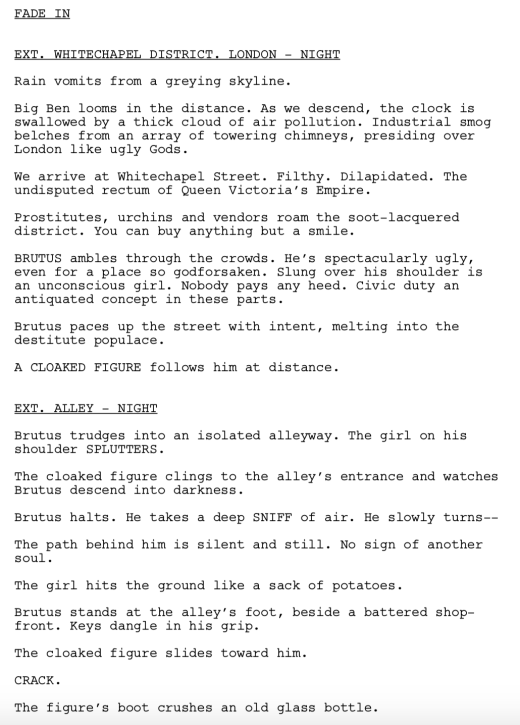
Title: 1888
Genre: Action/Fantasy
Logline: In 1888, an ex-cop seeking to unravel the mystery of his daughter’s death is recruited into an organization dedicated to protecting London from fantastical evils. As our hero hunts for answers, Jack the Ripper commences his reign of terror with an apocalyptic plan that transcends murder. Men in Black meets the Victorian macabre as the fate of the world hangs in the balance.
Why should you read: Big, fun and very R-rated, I’m the first to admit my chances of getting this thing made are bleak. Still, it’s a total passion project and I genuinely believe one that readers (especially those with a proclivity for action and the supernatural) will dig. Plus, London in the 1800s! That’s a pretty fun time, y’all (well, for readers of scripts, not the poor people who actually lived then. Seriously, my research indicates it fucking sucked).
Title: Cold Feet Wedding Insurance Project
Genre: Romantic comedy
Logline: After he insures an extravagant wedding against “cold feet” for a million dollars and the bride-to-be falls for him, a conniving insurance agent must get her to the altar, or the claim will bankrupt his ailing boss/father’s modest insurance company.
Why You Should Read: I came across the idea for this script when I was planning my wedding and researching all things wedding. I couldn’t believe it when I “ran” into a site that offered Change of Heart insurance. I thought that was a great kernel of an idea for a rom-com, and thus was “Cold Feet Wedding Insurance Project” born. If you like stories packed with irony, stakes and enough twists to make a Twizzler jealous, you should enjoy Cold Feet Wedding Insurance Project. — In advance, a big thank you to those of you who read any of the script, and a massive one if you vote for it!
Title: REDWOOD
Genre: Psychological Horror
Logline: After her child is killed, a woman becomes convinced that her husband and her neighbours were responsible. Is she being driven to paranoid madness by her grief or is the horror real?
Why You Should Read: I’ve always enjoyed a story that takes you inside a character’s mind and whips you along on a journey with them, where you don’t know what’s real and what isn’t and are kept guessing until the end. I wanted to see if I could write one of those. I also wanted to see if I could take a classic story – one of Carson’s favourite movies – and put a spin on it to make it mine. Maybe I have, maybe I haven’t. Only one way you’ll find out.
Title: The Dirty Work
Genre: Dramedy
Logline: A blackballed entertainment lawyer puts her negotiation skills to the test when her beloved oldest daughter announces that she’s putting off college to become a feminist porn star.
Why You Should Read: This script examines just how messy and complicated modern feminism can be when ideals get translated to real life. The story is personal and timely and incredibly important to me. I think it will elicit strong reactions — both positive and negative — and it would be invaluable as I continue to develop this story to hear a variety of takes from readers male and female, young and old — not just Carson. (I’m saving my cash for a private consultation on my next script :) ) Bonus: At 89 pages with a lot of white space and humor, it’s a very fast read.
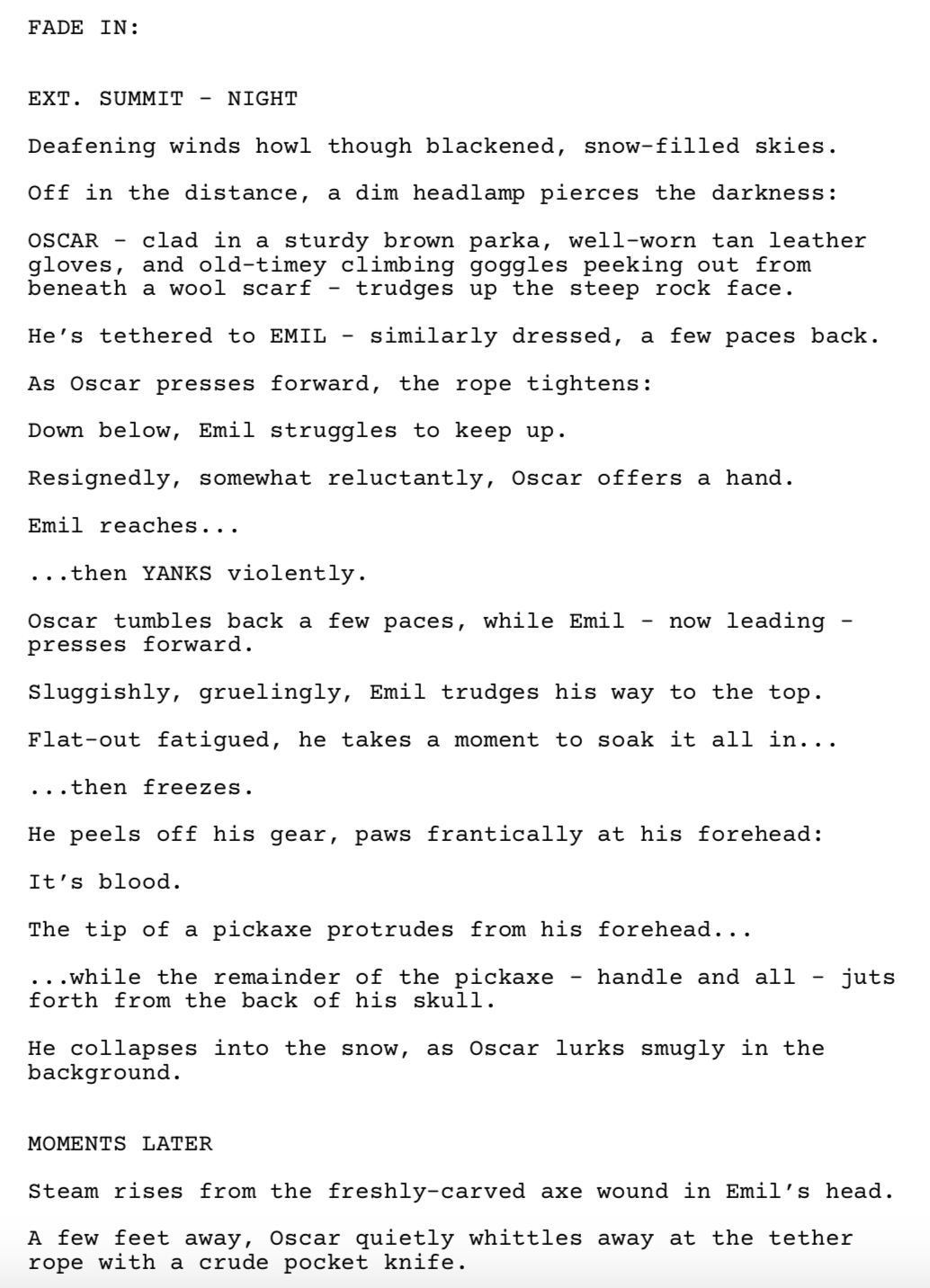
Title: DEATH ZONE
Genre: Psychological Horror-Thriller
Logline: When a novice mountain-climber embarks upon a treacherous, flurry-filled trek up one of the world’s tallest peaks, he soon realizes that the only thing more dangerous than the mountain he’s climbing is the deranged psychopath he’s climbing it with.
Why You Should Read: ‘Death Zone’ is a term used by mountain-climbers to describe high altitudes where there is not enough oxygen for humans to breathe (typically above 8,000 meters or 26,247 feet). Visitors to the death zone become weak, have an inability to think straight, and struggle making decisions – especially under stress. Most of the 200+ climbers who have died on Mount Everest have died in the death zone. My script, DEATH ZONE, is heavily inspired by movies like ‘The Shining’, where the real villain isn’t the supernatural spectres or scary things you see; but rather, the setting itself, and what it’s doing to those inhabiting it (and the subsequent risk posed to others sharing that space). Victor Miller (writer of Friday the 13th) called it a “helluva screenplay”, and a “wonderful hell on a mountain”. Hope you enjoy!