
Search Results for: F word
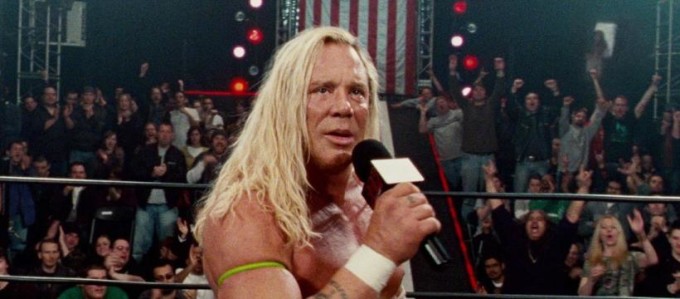
Ever since the beginning of the First 10 Pages Challenge, a segment of commenters have expressed doubts as to its purpose. They argued that capturing a reader from the very first word, then using each successive sentence to keep them invested is not only difficult, but unrealistic for every type of story (particularly non-genre stories). One of the more prominent arguments was that the first act is used to set up the characters and the plot so you can use the rest of the story to entertain the reader. Let us not forget, they point out, that the best action-thriller of all time, Die Hard, starts with a run-of-the-mill landing at LAX.
They further argue that the best scenes require an adequate amount of setup. You can’t place that rooftop scene in The Shawshank Redemption at the beginning of the movie, just as you can’t start Star Wars with the trash-compactor scene. It takes getting to know all the characters in that scene, learning about the Death Star, creating a scenario for us to get into the Death Star, saving the princess, trying to get out of the Death Star, before we can appreciate what’s going on and what’s at stake.
BUT if you’re using that as the reason why you don’t have to hook the reader right away, you’re sabotaging your screenplay gains. Let’s not forget that Star Wars begins with a pretty awesome scene – a giant ship overtaking a smaller ship, then invading it to capture the plans that the crew stole. The reality is, if you make it a priority, you can come up with a great first 10 pages for any type of story. You just have to adjust which tools you use. For an action script, it might be something action-y. If it’s a drama, you might use suspense, surprise, or dread. Hell or High Water is a relatively slow drama and it stats with a bank robbery. A Quiet Place has a great first scene where a family has to grab some things from town without making any noise. “But Carson, that’s a horror movie so it’s easier to write a scene with a hook.” I can’t tell you how many horror scripts I’ve read where the writer started with something mundane or boring. They could’ve easily taken this route in A Quiet Place and used their first 10 pages to set up the farm. You always have a choice. For every mundane scene you write, there is a suspenseful entertaining scene out there you could’ve written.
And while the focus for this challenge has been on the first 10 pages, I’m trying to teach you a bigger lesson here, which is that when push comes to shove and you need to write a great scene, you’re able to, regardless of where it is in the script. Most writers are unable to do that. They don’t understand what makes a scene work. They don’t understand basic storytelling principles like In media res, goals, obstacles, creating sympathetic characters, different types of conflict, dramatic irony, creating a problem that the audience wants to see the hero solve, suspense, mystery. Then taking those ingredients and giving us something either really well executed or unexpected (preferably both). If you want to watch a scene where the writer has all of these working, watch this short film.
But the most important reason you should aim to hook the reader right away is that you’re an unknown spec screenwriter. Nobody knows you. Nobody cares about you. The only thing you have to get peoples’ attention is the written word. So why risk boring these people with a slow or weak opening? Some of you will say, “Well if a reader is tasked with reading your script, they’ve got to read past the opening anyway. So what does it matter if you hook them on page 1 or page 15?” This is a common misnomer. A reader may be tasked with reading your script. But a lot of readers will decide early on whether a script is worth all of their attention or some of their attention. And most scripts fall into the latter category. So if you don’t hook them right away, there’s a change they’re reading your script half-heartedly. And that doesn’t even take into consideration what happens when the script gets passed up to the more important person (agent/producer/director). They owe you nothing. They can stop reading on page 2 if they want. And they do. Will Smith is notorious for giving a script five pages. If he likes those five pages, he gives the script five more. And as soon as the script gets boring, he stops reading. A lot of people in the industry are like that because they don’t have enough time to get through everything.
Where does that leave us today? Well, if there’s one thing I realized about this challenge, it’s that it’s hard to write a great scene. Especially the first scene of the movie, when we don’t know the characters yet. Sure, I can say, “Scream did it.” But Scream has one of the best openings ever. So it’s unrealistic to ask for that every time out. But there were two scripts (so far) that got me to read all ten pages (last entry here, and last entry here). And while neither of them were anywhere close to Scream-level, they both had something in common. And this is the big lesson I want you to take from today’s post: THEY DIDN’T GIVE ME A REASON TO STOP READING.
Let’s unpack that. The pages weren’t world-killers. The scenarios weren’t “oh my god” captivating. But they were interesting enough and the writing was easy enough to read that I kept reading. With all the other entries I bowed out of within 3 pages, it was torture reading them. Either I was confused, the scenes were overwritten, the setup was cliche, the setup was uninteresting, the writing was clunky. I was constantly given reasons TO STOP READING. So yes, I still want you to aim to hook the reader immediately. But, as a backup, you shouldn’t give us any reason to stop reading.
Assuming you’re dropping us into a situation that’s interesting (a scenario that has some level of drama and intrigue), here are three things you can do to make things as easy on the reader as possible. If you break any of these, you are giving the reader a reason to stop reading. That’s BAD.
1) Don’t be artsy and weird – You’re not trying to impress English professors. You’re trying to hook the reader. Too many writers think they have to be artsy and quirky with their opening. They must show the reader that they’re a “Writer” with a capital “W!” Just tell us what we’re looking at, dammit.
2) Keep your sentences (and your paragraphs) short and simple – No SAT words. No run-on sentences. Stay away from extraneous or unimportant information. Keep things short and to the point. In screenwriting, you’re trying to say as much as possible in as few words as possible. Nowhere is that more important than the first 10 pages.
3) Be clear – To bestow upon the abject redundancy of these rules, try retaining your core objective, the flaw that dictates where and how you resolve the early plot beats. If you read that sentence and said, “Um, what?” welcome to my biggest pet peeve – LACK OF CLARITY! The second I’m unclear about something, I’m out. After you write anything, put yourself in the eyes of the reader, read it back, and ask if what you’re trying to say is clear – as in, it can be understood by a 6th grader. If it isn’t, rewrite it until it is.
Carson does feature screenplay consultations, TV Pilot Consultations, and logline consultations. Logline consultations go for $25 a piece or 5 for $75. You get a 1-10 rating, a 200-word evaluation, and a rewrite of the logline. If you’re interested in any sort of consultation package, e-mail Carsonreeves1@gmail.com with the subject line: CONSULTATION. Don’t start writing a script or sending a script out blind. Let Scriptshadow help you get it in shape first!
We are almost at the end of the First 10 Pages Challenge! You have until Sunday, 11:59pm to submit your entry. Send a PDF of your pages to carsonreeves3@gmail.com with the subject line “FIRST 10 PAGES.” Head over to the original post to find out more about the challenge and what I’m looking for. I’ll let you know Monday (after I see how many entries I get) when – or IF – a winner will be announced. It’ll likely be no longer than a month.
Here are five of those entries. For those of you new to First 10 Pages breakdown posts, what I do is take five entries, show you how far I got, and explain why I stopped when I did. I’m hoping this information helps you craft your pages in such a way that they’ll be impossible to put down, which is the name of the game. Let’s get to it!
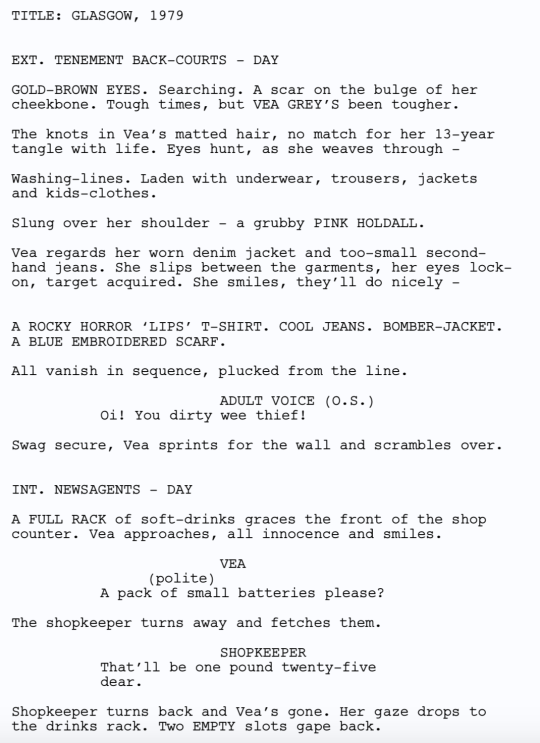
It’s never good when I’m confused by the very first slugline. I don’t know what “Tenement back-courts” are. Tennis courts? Basketball courts? As a writer, you never want to assume that the reader knows what you’re talking about if it’s in any way specific/unique. If I’m describing an area in Los Angeles and I say, “The Hollywood Sign,” you know what I’m talking about. If I say, “The Bird Streets,” you probably don’t. So I need to tell you what that is.
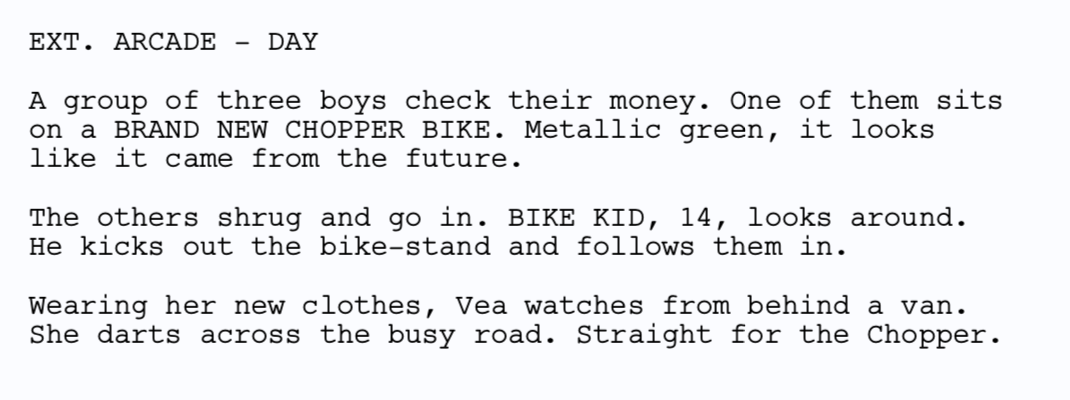
It’s important to talk about what the writer does next because it’s risky. And if it doesn’t work, you can lose the reader right away. The writer talks AROUND the setup instead of just setting the scene up. In other words, he doesn’t say, “VEA GREY searches through hanging laundry, looking for the perfect outfit.” He says, “GOLD-BROWN EYES. Searching. A scar on the bulge of her cheekbone. Tough times, but VEA GREY’S been tougher.” We’re talking AROUND the action, AROUND the introduction of the character, instead of just setting things up normally.
An argument can be made that this scene is set up like a movie. It’s almost like we’re a camera and we’re meeting this person, as well as what she’s doing, image by image. Unfortunately, a lot of readers don’t like this, myself included. We’d rather you just tell us what’s going on. I had a hard time understanding what I was looking at, so I was already on edge. And once we get to the arcade, my mind has drifted, and I’m out.
Let me remind you of the point of the exercise. It’s to hook the reader immediately. Not get all artsy-fartsy and try to impress the reader. That never works.
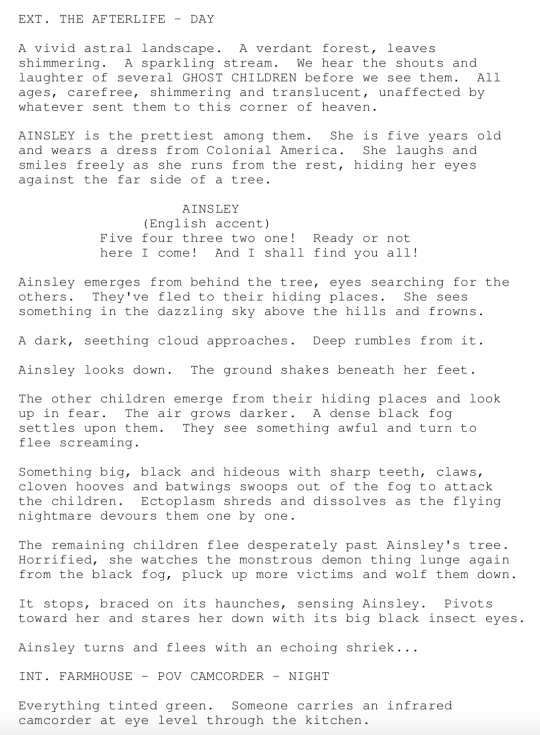
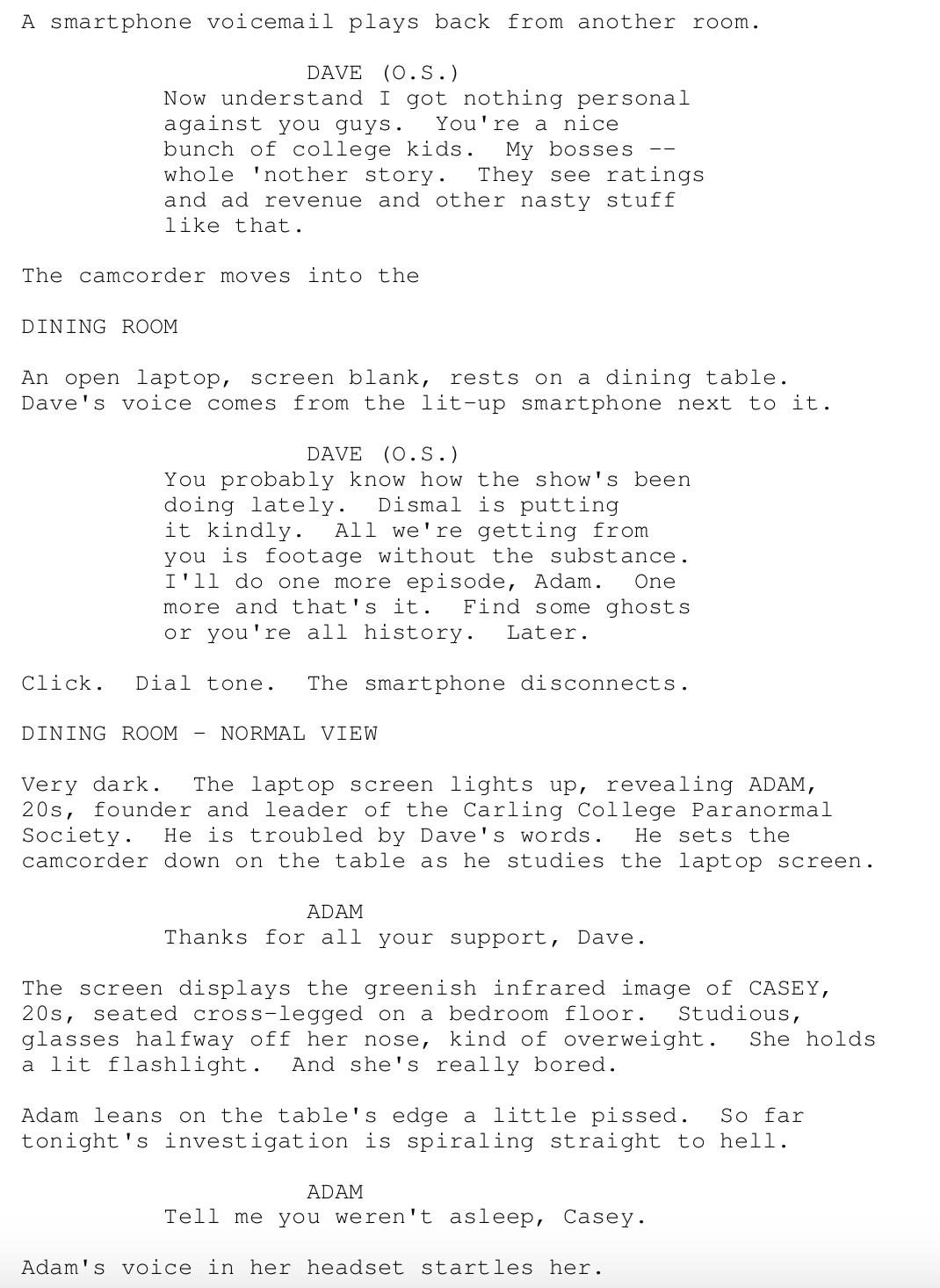
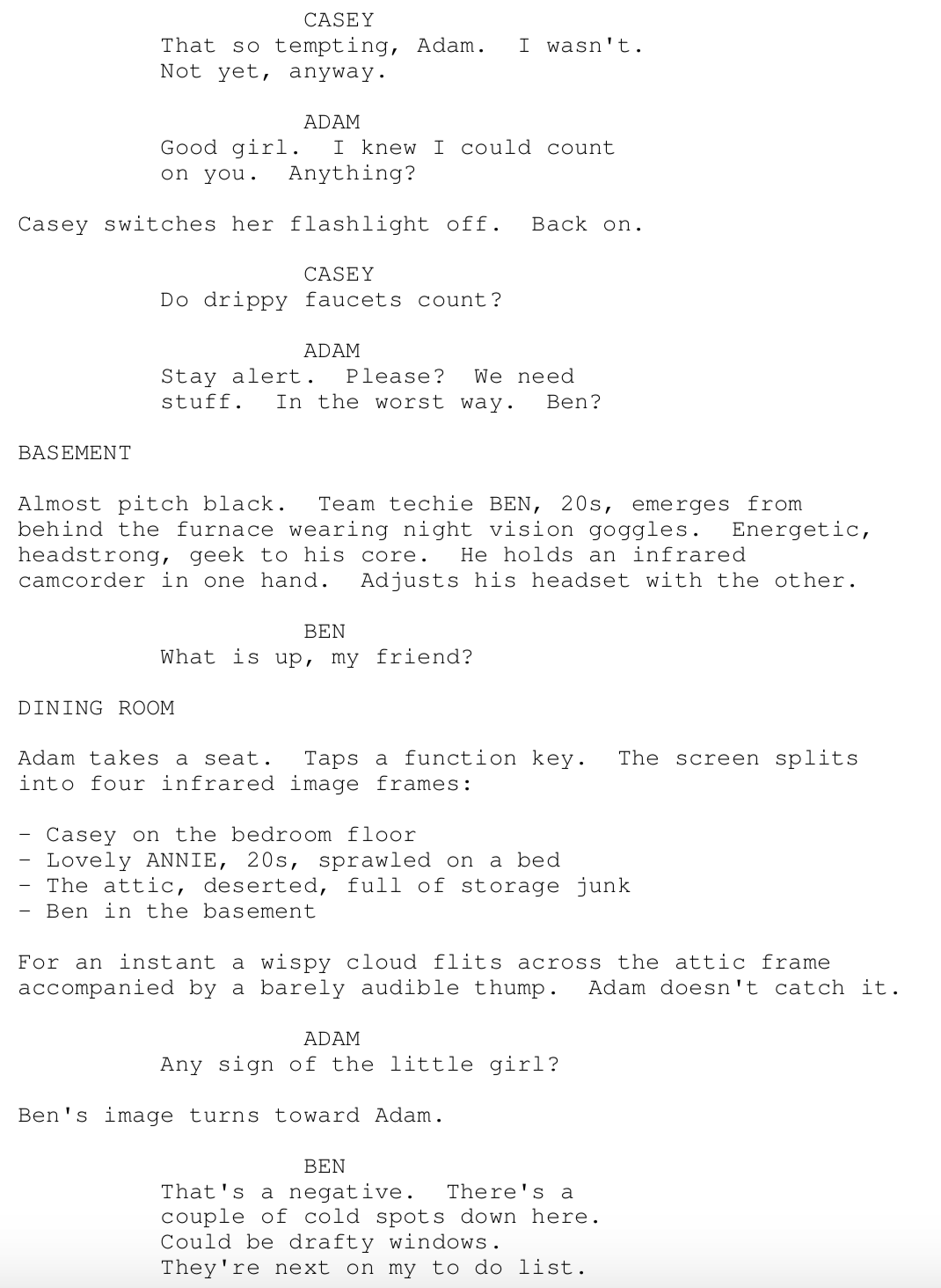
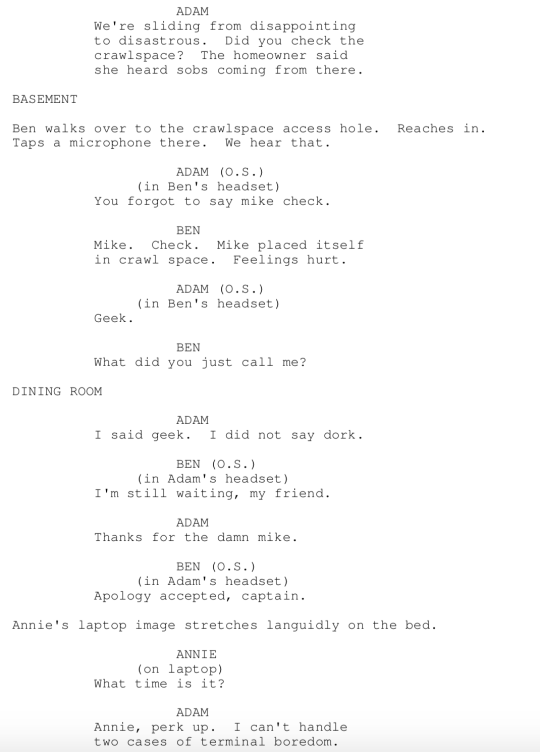
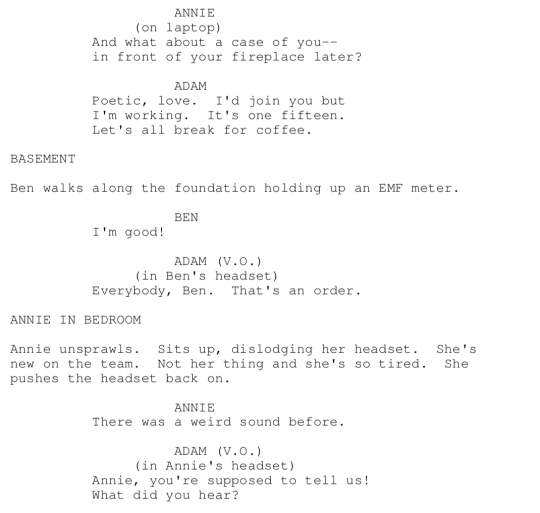
These pages were okay. I like the paranormal ghost hunter sub-genre, so I gave the pages a little longer than I normally would. That’s something you can’t control as a writer – if the reader likes your subject matter or not. The only thing you can do is send your script out to as many people as possible, increasing the odds that more people who enjoy the genre will read it.
There just wasn’t a big reason for me to keep reading here. The teaser was unique, which I liked. But once we got to the ghost hunting scene, it felt too familiar, and sloppy to boot. There wasn’t enough structure to the scene. What the writer should’ve done is set the scene up from the start. Build the scene like a mini-screenplay, with an Act 1, Act 2, and Act 3. Actually, that’s my best advice to pull a reader in right away, is open with a scene that’s a mini-story within itself. This is exactly what they did with Inglorious Basterds. It’s what they did with Scream. It won’t work for every script. But if there’s even a chance it will work for yours, consider it.
Oh yeah, and get a proper screenwriting program! Readers have been known to blacklist writers with text this light.
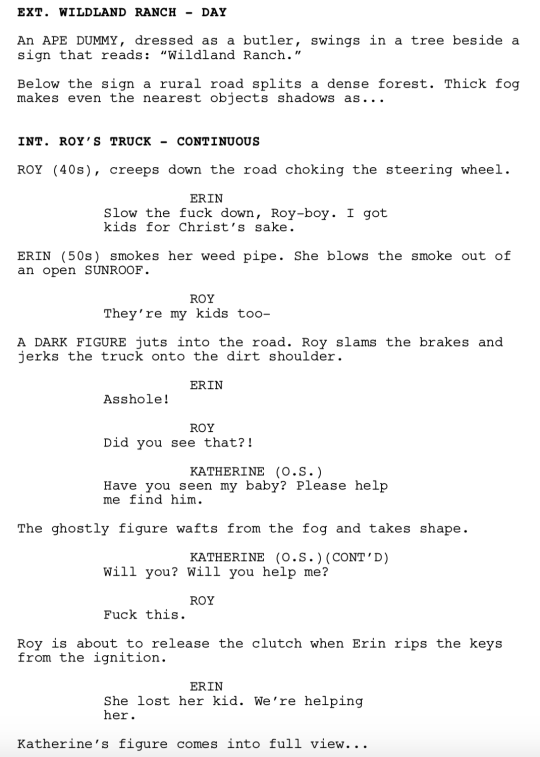
This scene moves too fast. Remember that hooking a reader doesn’t mean racing through a scene at breakneck speed. In fact, it can mean the complete opposite. In the case of this script, my first question is, why are they here? They’re driving through this place – Wildland Ranch – that appears to be special, like a backwoods Disney Land. Yet they don’t appear to be going here. The way they’re talking to each other, you’d think they were on their way home. It’s odd.
Then, when this woman pops out of nowhere, everything occurs way too fast. When something this jarring happens – a woman appears in front of your car out of nowhere – you need to take your time. It takes all of three lines from “My baby’s missing, will you help me,” to our heroine agreeing to. I mean come on. We’re in the middle of nowhere. This woman seems off. There would be questions. Erin and Roy would probably fight about it awhile. Bottom line: The writing feels rushed. It doesn’t seem like the writer has thought through the scenario. And for that reason, I’m out.
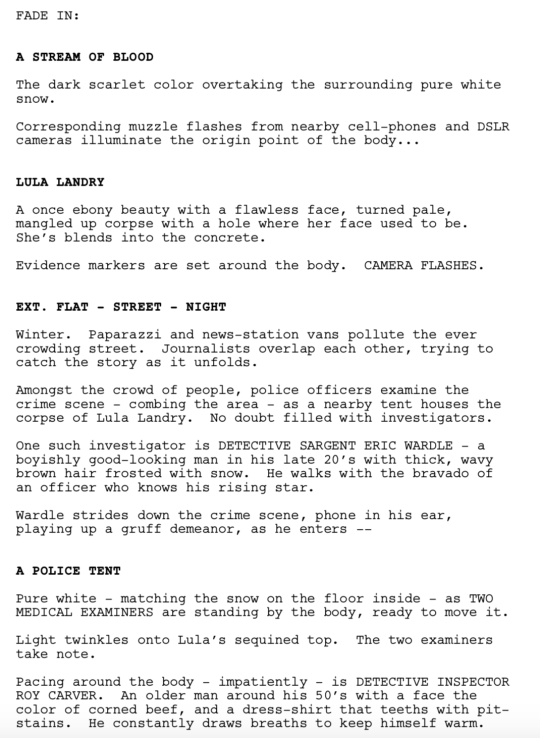
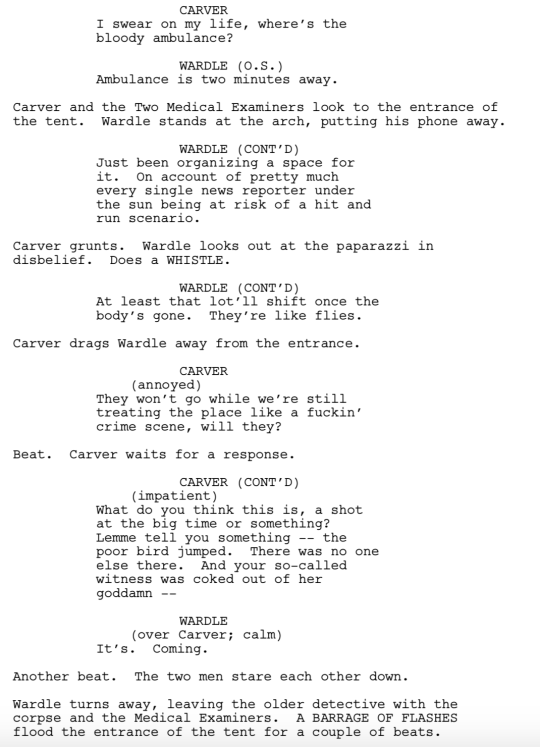
There is absolutely nothing wrong with these pages. Nothing. But there’s nothing exceptional about them either. Let me remind you what the exercise is again. It’s to hook the reader. It’s not to write something that’s “fine,” or even “ better than fine.” It’s to GRAB THE HELL out of the reader and make it impossible for them to stop reading
Starting your script with a murder is an above-average opening scene choice. A dead body gets the juices flowing. We’re curious who this is, what happened. A goal is set up right away – solve the murder. The problem is, I’ve read hundreds upon hundreds of scripts that have started with a murder. What makes this different? That she’s a celebrity? I’ve read tons of celebrity murders as well.
You have to find a way to make your scene unique. Here’s the opening of an early draft of Silence of the Lambs, which covers another familiar setup – an agent engaging in a dangerous hostage situation. Ignore the bold text. Someone did a bad digital PDF transfer from the original script.
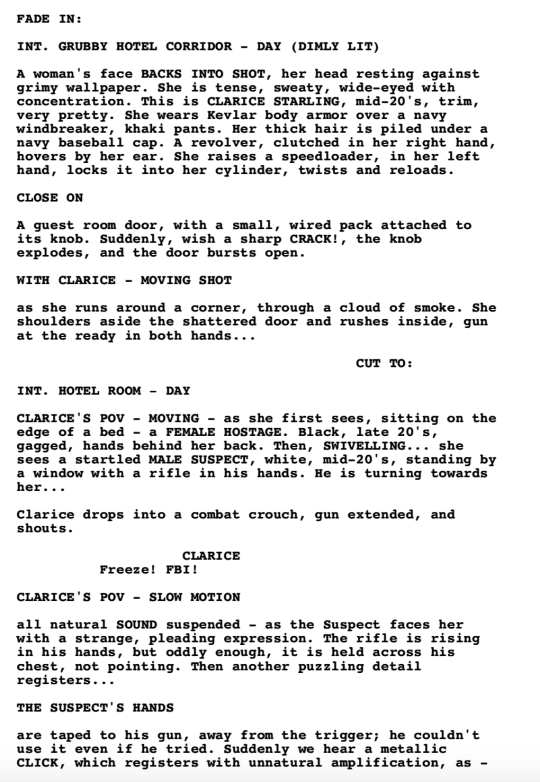
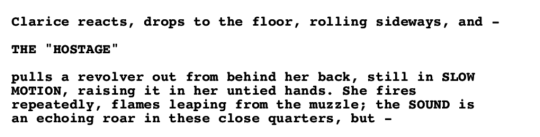
Would you keep reading? I would. Notice that by making a slight tweak – the unexpected reveal that the suspect’s finger is taped to the trigger in a manner where he’s unable to use it – gives the scene a fresh feel (not to mention puts our hero in serious danger). Remember, the audience has seen everything. You need to work your ass off to give them something they haven’t.
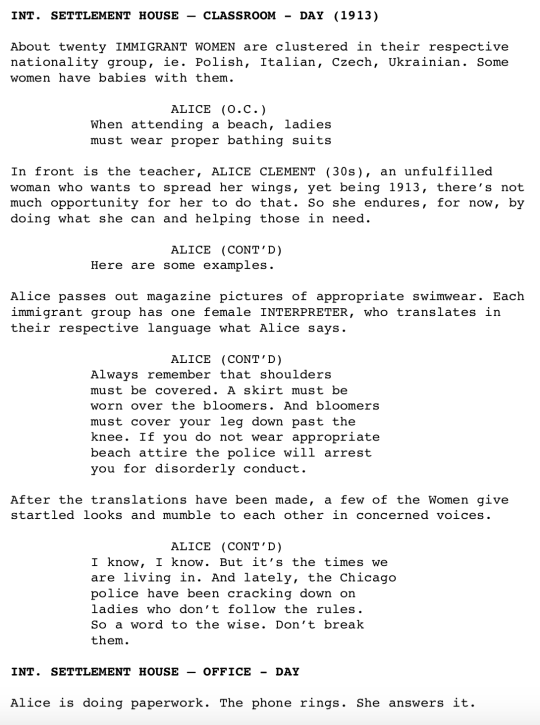
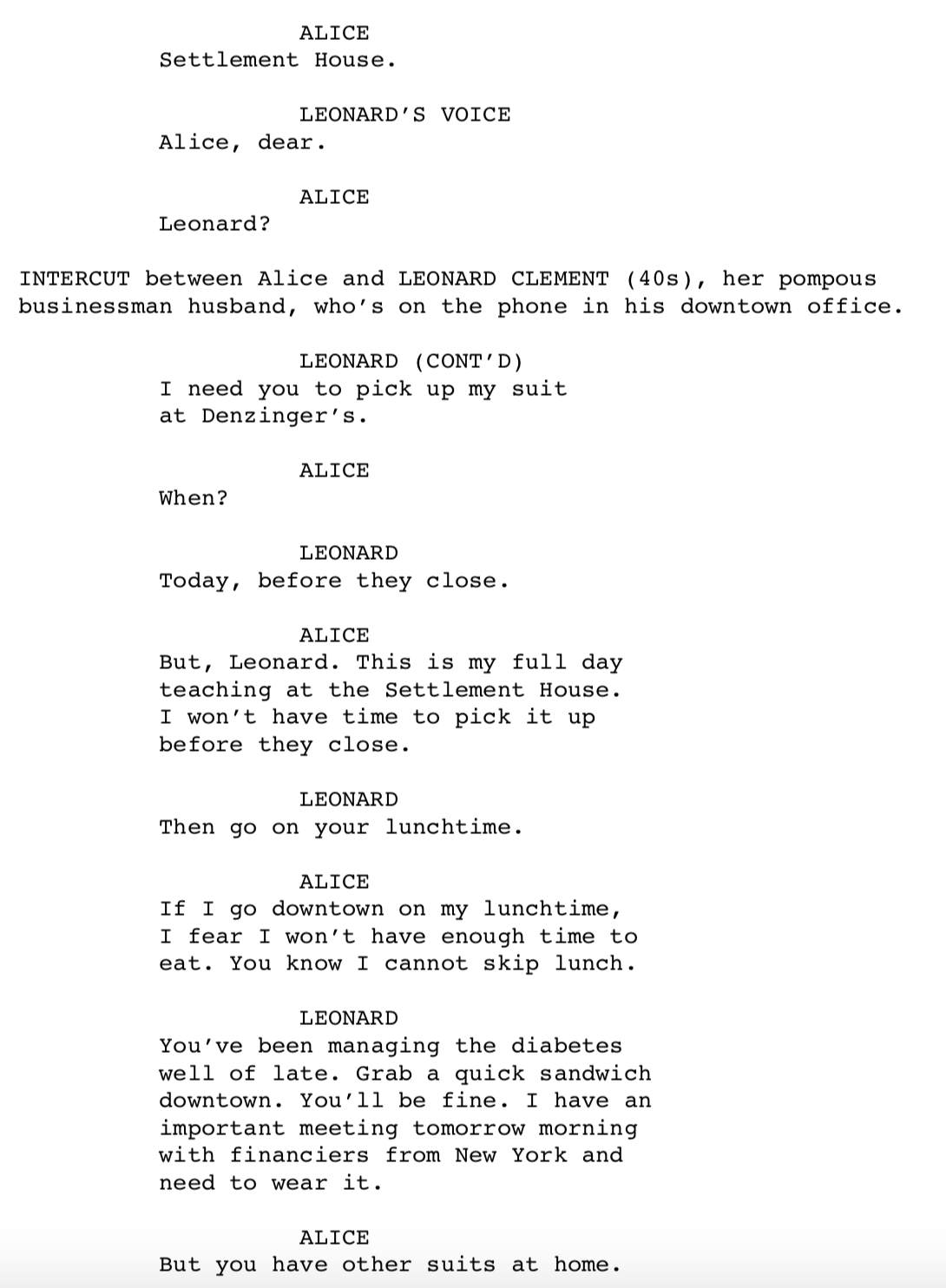
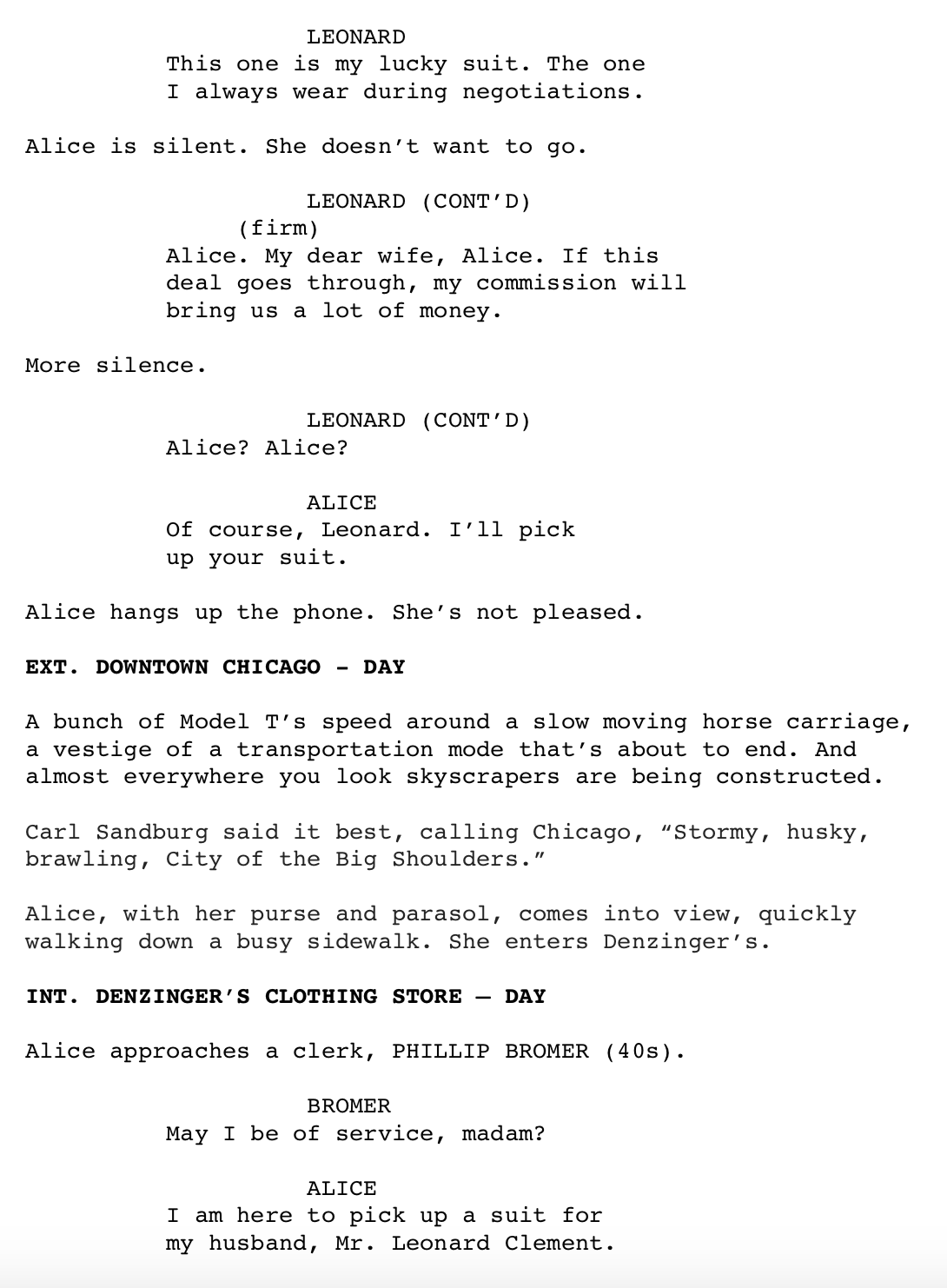
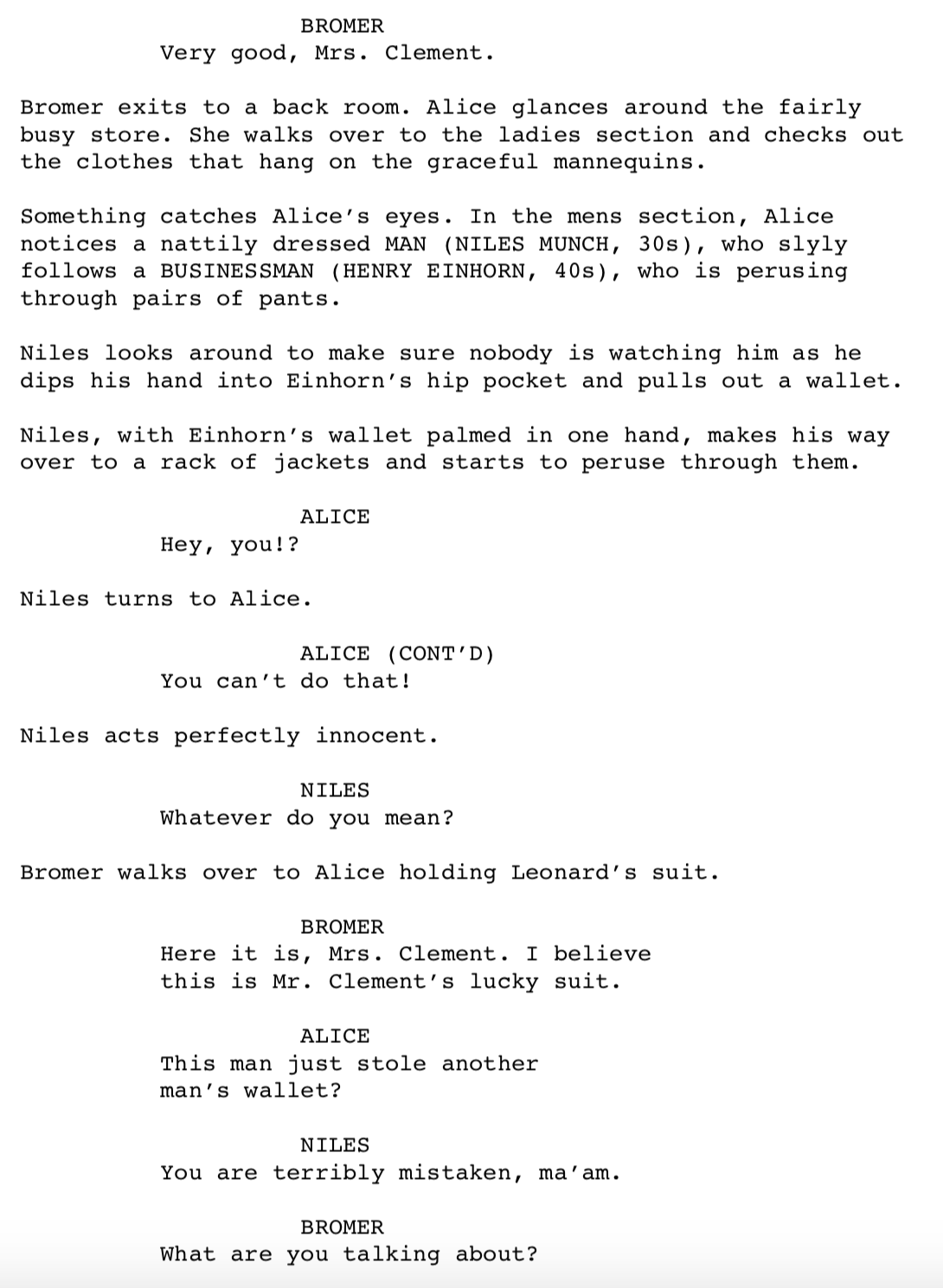
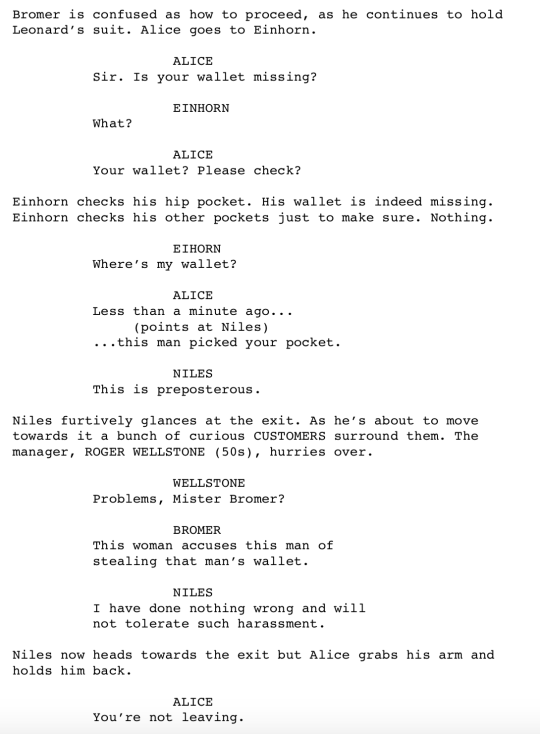
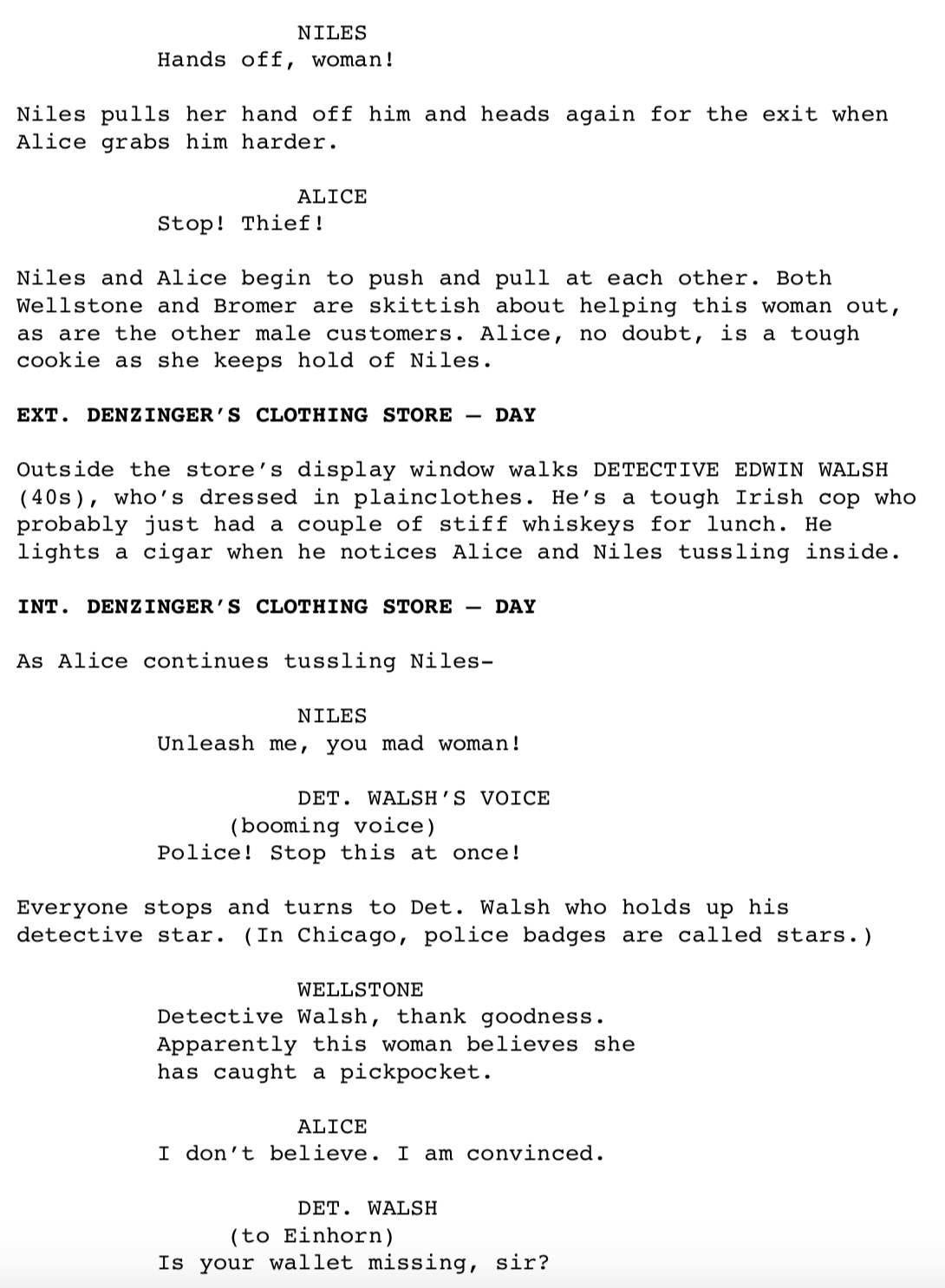
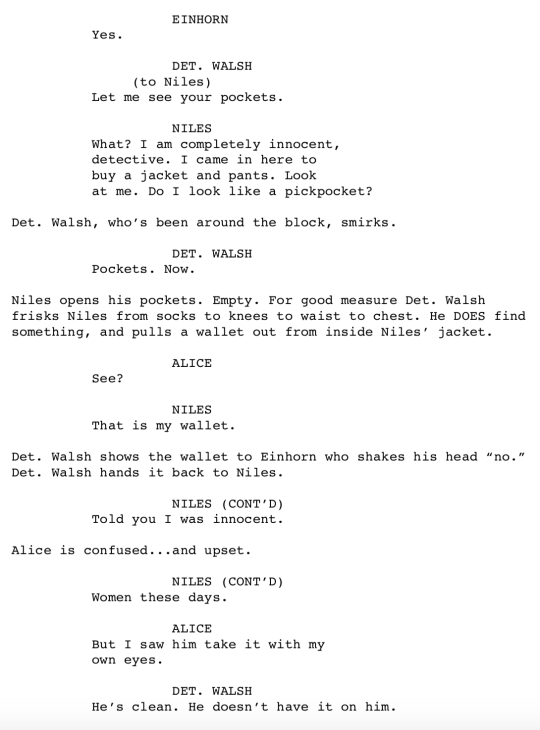
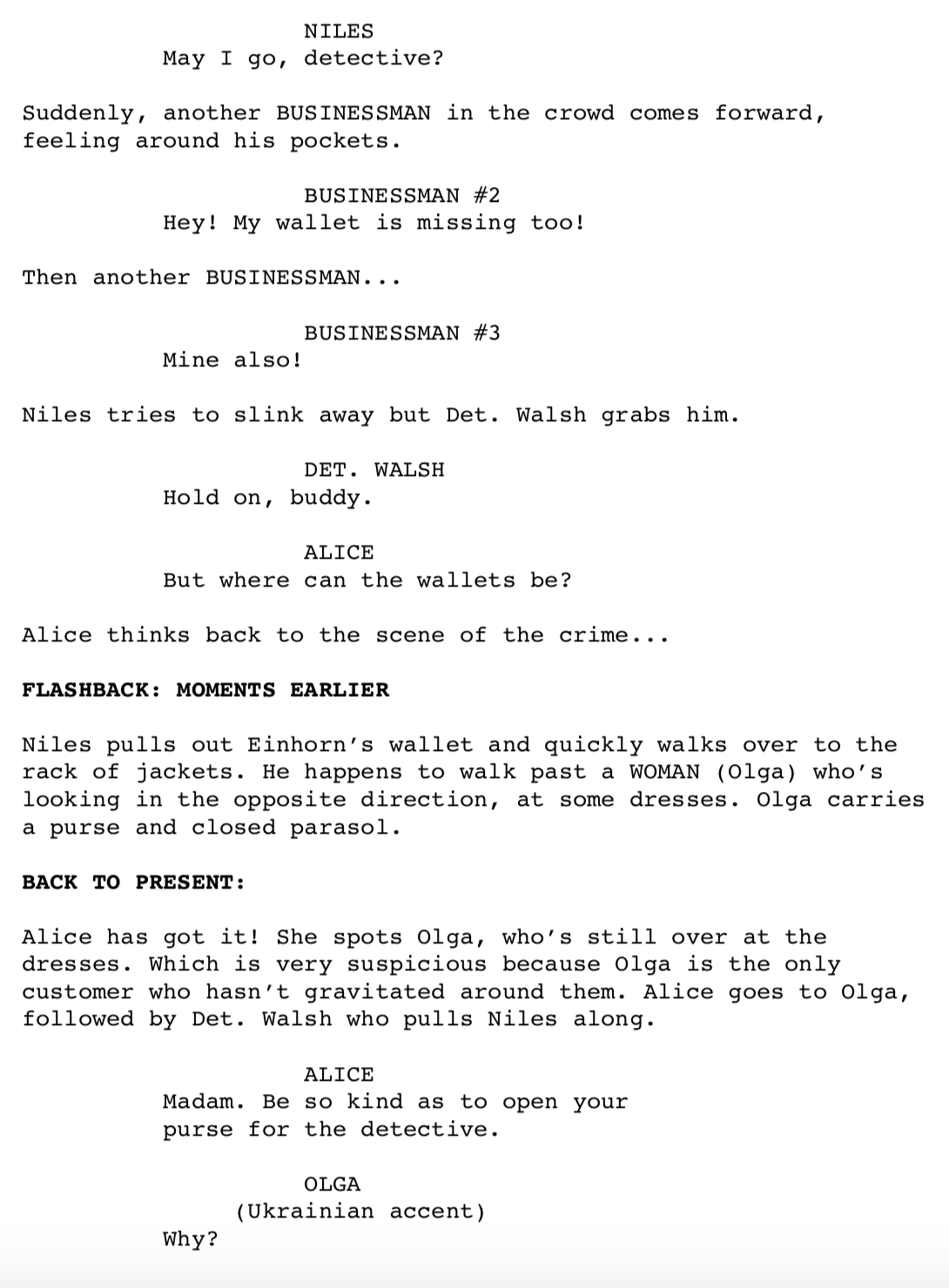
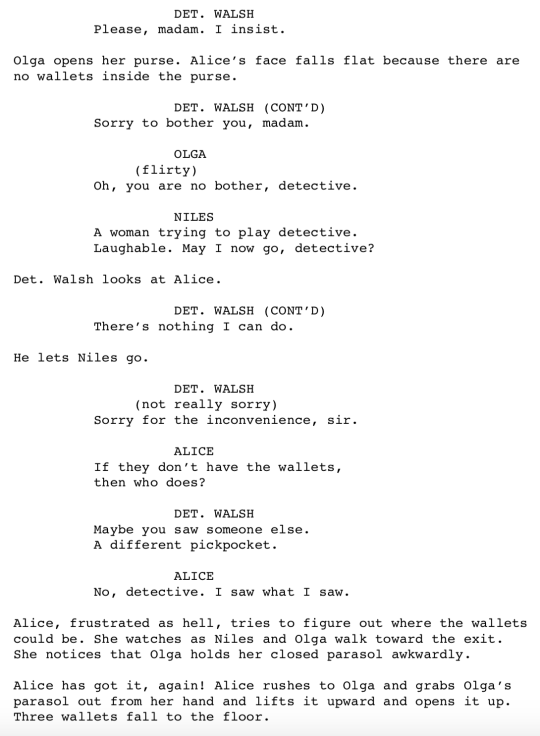
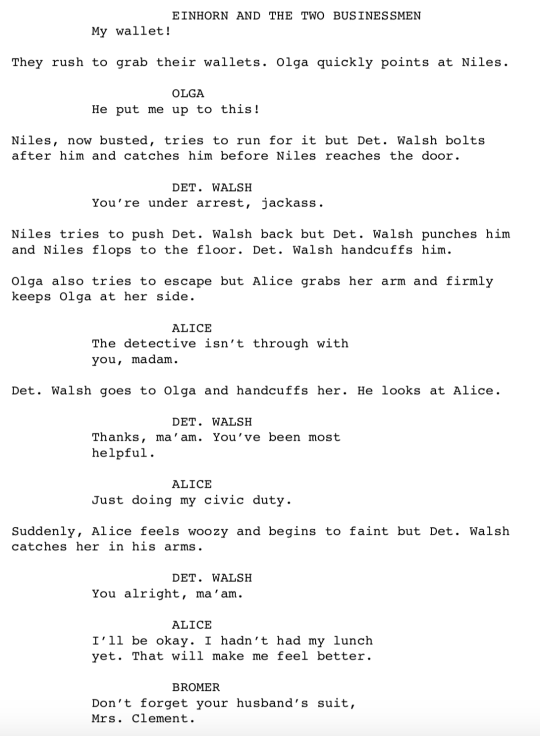
Wow! I made it to the end of another ten pages. Sweet! Okay, why did I read all ten of these pages? There’s nothing spectacular here. But much like Bill’s pages from last week, there wasn’t any reason to STOP READING. The writing is achingly simple. And that’s a good thing. Unlike the first entry, I’m not trying to piece together the simple actions of my main character. Everything is clear as day.
Another thing is that in all the scripts I’ve read, never has one started with a woman teaching immigrant women how to wear their bathing suits properly so they don’t get arrested. The value of originality in a world so saturated with content is high. That’s why I read past the first page.
The writer then shifts to a marriage ripe with conflict. It’s not over the top but we sense it in their phone call. Remember that when you establish conflict, there is a subconscious need for the reader to keep reading to see if that conflict gets resolved (if she smiles and says “okay,” there’s no mystery to this marriage). From there we get this fun little wallet-stealing fiasco where we’re wondering if Alice is going to come out victorious or not. What a great character, too. Who doesn’t like a woman who puts her reputation on the line to do what’s right?
I have to admit that I don’t know where this movie is going from here. But I like this feisty main character so I’m keen to find out. What did you think?
Genre: Thriller/Supernatural
Premise: (from IMDB) After a series of paintings by an unknown artist are discovered, a supernatural force enacts revenge on those who have allowed their greed to get in the way of art.
About: From longtime screenwriter Dan Gilroy comes Velvet Buzzsaw, his third directing effort. The film brings back the team of Gilroy, Gylenhaal and Russo (Nightcrawler) and debuted Friday on Netflix.
Writer: Dan Gilroy
Details:113 minutes

First of all, let me say that I love this practice of movies debuting at major film festivals then appearing on Netflix or Amazon days later. I’ve always hated hearing about Sundance movies then having no idea when or where I’d be able to see them. I might have to wait 8 months before I hear about the film again. More movies should do it like this where you hear the buzz (heh heh) then get the movie immediately. Call that a millennial mindset if you will, but I was so happy to see this up on Netflix Friday.
Now the way I see Dan Gilroy is that he’s 1 for 2. Nightcrawler was as close as we’re ever going to get to a modern day version of Taxi Driver. I loved that script from the opening page. Which makes it all the more perplexing that Gilroy followed it up with Roman J. Israel, Esq. That script was the opposite of Nightcrawler. It was verbose, unfocused, and lacked structure. Should’ve changed the “Esq” to “Ick.” I actually felt bad giving it a negative review because I thought maybe it was a super early draft. But nope. That’s the draft Gilroy went with. It’s hard to make Denzel Washington look bad. But that script achieved it.
This makes Velvet Buzzsaw the tiebreaker. If this is good, Roman was a misstep. If it’s bad, Nightcrawler was an anomaly. Time to place it up on the wall and see what this piece is about.
Josephina is a British art agent in the burgeoning LA art scene. She often rubs elbows with Morf, a bisexual art critic who she once had a fling with. The two are friendly with art gallery owner Rhodora, who has become so jaded by art that nothing impresses her anymore. Actually, that could be applied to everyone here.
After a long day, Josephina returns to her apartment where she sees that her neighbor, an old man named Vetril Dease (does anyone have a normal name in this movie?), has died in the stairway. In the coincidence of all coincidences, it turns out Vetril was an artist. But not just any artist. He was extremely talented, painting dozens of dark haunting paintings. Josephina immediately claims the paintings and starts selling them.
Morf is so taken by Dease’s work that his former feelings for Josephina are reignited. But as the two enter into a relationship, strange things begin happening around Dease’s paintings. A lowly intern crashes his car while transporting the paintings. A fellow gallery owner is found hung by his scarf near another.
It appears that these paintings are coming to life and killing the greedy art leeches who covet them. When Morf becomes the latest to see the paintings move, it’s only a matter of time before he ends up like everyone else. Unless he can figure out why Dease’s spirit is doing this and put it to rest first.
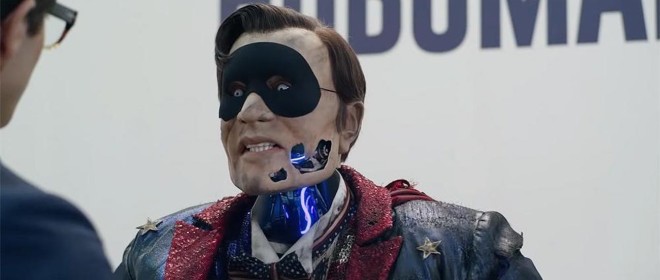
Ooh, a lot to get to with this one.
Let’s break down the first 10 pages since that’s been the theme this month.
The great thing about starting your story in a captivating manner isn’t just that it hooks the reader. It’s that it hooks an audience. It’s a good thing for the movie. Amateur screenwriters on the brink of breaking in understand this (as do struggling professionals who’ve been forgotten). They toil over those first ten pages because they know if they hook you off the bat, there’s a good change you’re going to like their script.
In Nightcrawler, Gilroy starts his screenplay with Louis Bloom stealing something. He’s immediately confronted by a cop and has to talk his way out of it. Not only is something interesting happening in this opening, but Gilroy does an excellent job establishing who Louis Bloom is through the interaction. There’s a moment where Louis says, “Excuse me, but that gate was open, sir. I was under the opinion that it was a detour. What kind of uniform is that?” Just the fact that Bloom is turning the questioning around on the cop gives us a great feel for who this person is.
But something funny happens when a screenwriter becomes an established professional, when they get to that stage where their projects are greenlit without anyone having to read their script. They get lazy with their openings. They rationalize that they can take their time, sometimes defiantly so. This can result in 20 pages going by before anything interesting happens.
Velvet Buzzsaw falls into this category. Some guy played by Jake Gylenhaal stumbles into an art showing, yet we have no idea who he is or what he does. He seems slightly arrogant and bored, but that’s all we have to go on. We watch as he ricochets between people and displays, never sure why he’s here or what he’s doing. It’s the complete opposite of Nightcrawler, which started with something happening that clearly established our hero.
We then ping pong over to the street where some British woman gets dumped on the phone. Who is this woman? What does she do? Why do we care that she just got dumped if we don’t know these things? As these questions linger, she joins us in the art showing as we continue to bounce around without purpose. Even if you make the argument that Gilroy is eschewing a compelling opening in order to introduce the cast of characters, it doesn’t work because none of these characters are well established. We only know that they work in the art world. I actually had to go to Wikipedia after the movie to find out what Josephina’s job title was. That’s bad writing.
If there’s anything I’ve learned, it’s that when the first ten pages are sloppy, you’re going to get a sloppy movie. And that’s exactly what happens. This movie is all over the place. First of all, who’s our protagonist? I thought it was Morf since we meet him first. But eventually I realize it’s Dumped Girl. And I only came to that conclusion because she’s the one who found the dead artist. But if you would’ve asked me if she was the hero before that, I would’ve said no. Morf was. Confusing confusing confusing.
On top of that, there’s no clear genre here. This starts off as a goofy satire about the art scene. Then it becomes a thriller. And then, out of nowhere, it becomes an out and out horror film, where paintings come to life. WTF??? I guess you can throw single protagonists and genre out the window if you want. There are no rules. But don’t be surprised when people leave your movie feeling like they watched some quickly thrown together experimental student film.
I mean everything was messy here. Louis Bloom was so carefully constructed, you understood him intricately. He’s a sociopathic capitalist who will try to talk his way out of anything. In contrast, Morf is vague and random. It seems like the only reason he’s bisexual is because Gilroy didn’t know how to make him interesting and threw the bisexual tag on him in the hopes that it would somehow make him more complex.
It’s becoming increasingly clear to me that filmmakers are using Netflix as a way to explore their weirder more experimental ideas that nobody else would let them make. In theory, that sounds good. In practice, it means we get movies like the pointless Mute, the jumbled Hold The Dark, the boring Roma, and now Velvet Buzzsaw, a sloppily constructed mish-mash of ideas in search of a protagonist, a genre, and a plot.
[ ] What the hell did I just watch?
[x] wasn’t for me
[ ] worth the stream
[ ] impressive
[ ] genius
What I learned: A lot of writers don’t realize how much effort screenwriters put into their dialogue. They assume the words just magically come out of the writer’s head. But how can a writer understand the way someone speaks in an industry they know nothing about? I wasn’t surprised at all, then, when I heard Gilroy’s answer to this question about how he wrote authentic “art world” dialogue. Here’s the question and answer, from a Vulture interview…
One of the elements of the film that I can imagine was fun, certainly in the writing process, was the “art-speak” — the very obtuse, heady way in which critics and gallerists and artists create meaning around their work. Did you work with anybody while writing those parts of the script, or did you just immerse yourself in that language and read a bunch of “Art in America?”
Yeah, I researched it for months, read articles, interviews; I brought in three technical advisers. And it is its own world, and it is its own sort of language. And I thought I had the language down at times, and then somebody who runs a gallery in L.A. would come in and say, “You should change that word to this, because that’s not a word we use.” And it is its own lexicon. There’s no question about it. But I like going into a world and learning the language of it.
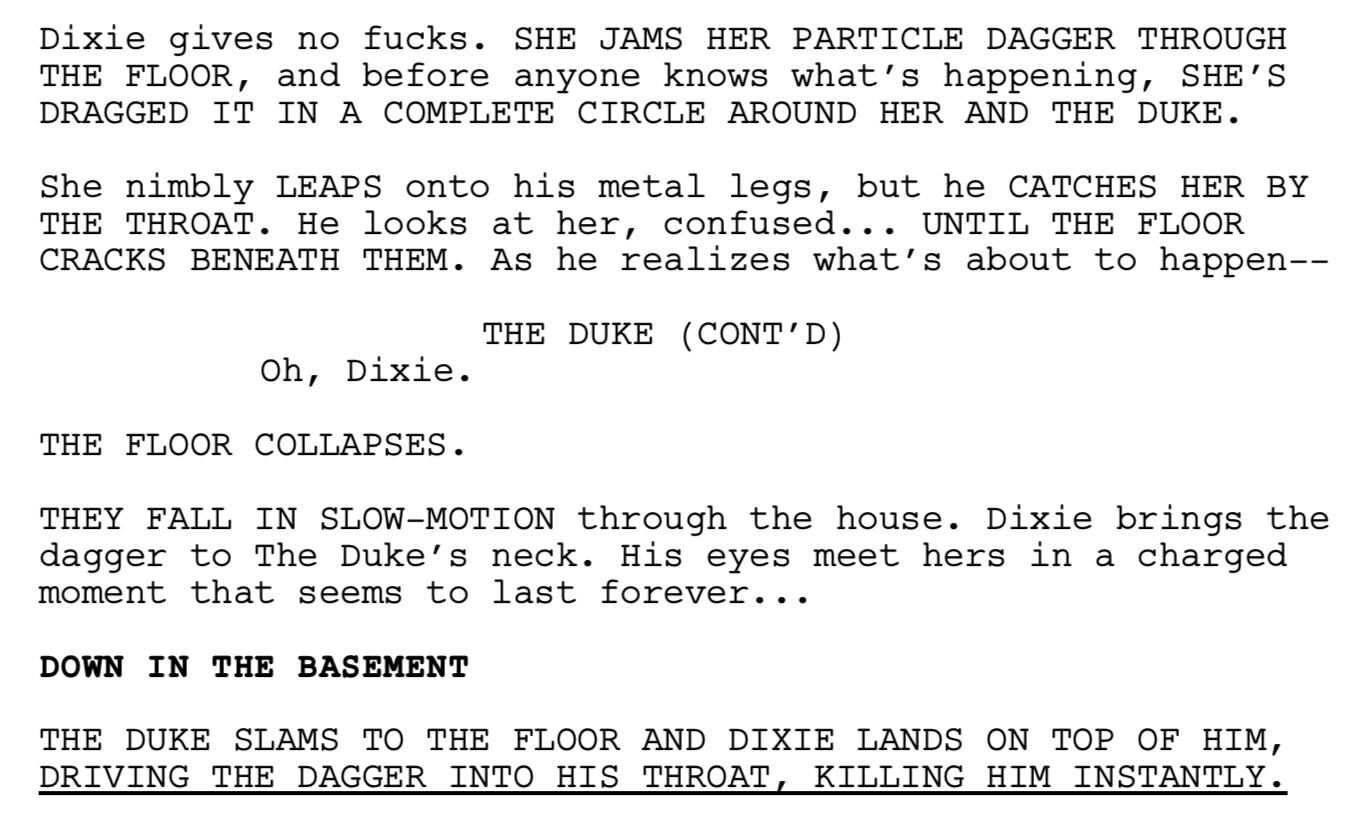
Genre: Action Thriller Sci-Fi Romantic Comedy
Premise: Barret is a social media influencer, the worst guy ever, and the eventual President of the United States. Dixie is a badass freedom fighter, sent back from 2076 to kill him before he takes over the world and ruins the future. They fucking hate each other. Then they accidentally fall in love.
About: This script finished Top 10 in last year’s Black List, a surprising showing considering the main character isn’t a real person (biopic joke). Michael Daldron seems to thrive in the absurd. He was a writer on the bonkers Dan Harmon TV show, Rick and Morty.
Writer: Michael Waldron
Details: 104 pages

We’re going to keep the absurdity alive this week! Yesterday, we covered a character who fell in love with a toe. Today, we explore traveling back in time to wipe out social media influencers.
What’s a social media influencer? I only found out the other day after watching Netflix’s Fyre Festival doc, a task I initially resisted because the media’s become a scourge of evil intent on destroying people’s lives regardless of whether they deserve it or not. I figured they did the same thing to this Fyre Festival dude. But ohhhh no. This guy deserved to be taken down. The crap he pulled would’ve caused a coma patient to stand up and demand action. I loved it so much I re-activated my dead Hulu account so I could watch their competing Fyre Festival documentary, which turned out to be even better than Netflix’s.
Anyway, all this is to say that social media influencers (the people who made Fyre Festival a “thing”) are vapid black holes of emptiness, the bottom rung of entertainment. And the current generation is growing up on them, which means they’re going to be the primary source of entertainment at some point. Get your Logan Paul merch while you can still afford it!
20-something Dixie lives in the year 2076, a post-apocalyptic future that is the result of a stupid douchebag of a social media influencer, The Duke, becoming president and ruining everything. After searching far and wide, Dixie locates a time-traveling backpack, and after killing the future version of Duke, goes back to the year 2018 to kill the young version of Duke so that he can never become president in the first place.
Dixie arrives in 2018 and immediately attacks the young Duke (who’s simply named “Barret” here). But within seconds of the attack, a 16 year old Duke disciple, Miller, also from the future, appears in a jet pack and attacks Dixie. Dixie and Miller battle while the confused Barret watches on, tweeting and instagram storying his fans about the attack.
Barret hops in a car and drives off, but Dixie easily catches up to him. When she finally has a clear shot to take him out, she waivers. This Barret may be a nimrod, but he’s far from the megalomaniacal super-douche that runs the country in 2076. After he pleads for his life, Dixie compromises and gives him a last dinner, which they share at Chuck E. Cheese. Unfortunately, the more Dixie talks to Barret, the more she kinda likes him. And by the end of the meal, she decides to postpone the assassination for a little longer.
The next day, Dixie comes up with another plan. If Barret walks back his earlier posts about running for president, he’ll never become president, and the future will be saved without Dixie having to kill him. But this comes with a new problem. If he does this, Dixie will disappear, since the future will completely change and she’ll have never been born. Since the two are starting to like each other, they postpone this ‘not running for president’ post a little longer.
The next thing you know, the two are living together, Dixie is pregnant, and Barret spends his downtime traveling back in time to World War 2 trolling Nazis. When Barret learns that Dixie already killed the future him before she jumped back in time, the two get in a fight and Dixie takes her time-travel backpack, jumps back 65 million years, and starts training velociraptors to talk. I could go on but does it really matter at this point? More time travel. More fighting. The two live happily ever after. The End.
I used to get mad at these scripts – when the comedy is so absurd it takes precedence over plot and character. But now I realize different people think different stuff is funny and while I may not have liked it, younger audiences who don’t put a premium on logic and plot progression will probably enjoy it for the same reasons I didn’t.
I do think a world where Logan Paul is president is a funny setup. My issue is that these types of setups are great for a 22 minute episode of Rick and Morty, but become tiring stretched out to two hours. And you can see that play out as you’re reading the script. Once Dixie and Barret enter into a relationship (about 50 pages in), it’s clear the writer doesn’t know where to go. So he goes everywhere. I mean at one point we’re 65 million years in the past listening to a deep conversation between Dixie and velociraptor.
At times, Waldron’s script almost becomes the thing he’s making fun of. Here we are blasting narcissistic millennials obsessed with Instagram stories yet half the script is written in CAPS while being self-referential and breaking the fourth wall (for example, when a fight occurs, we’re told that it will get nominated for an MTV Movie Award for Best Fight). If that isn’t the screenplay equivalent of a douchey influencer posting an Instagram story, I don’t know what is.
I also think there’s a bigger discussion here about writing a script that’s trying to be fun and writing a script that IS fun. When you’re having fun, it comes off on the page. But when you’re TRYING to write that viral fourth-wall breaking screenplay, it can come off as try-hard and your script quickly goes from cool to lame. Deadpool constantly walks this line and one can make the argument the sequel crossed it. You could feel it desperately trying to make you laugh, instead of trusting its story so that the laughs came naturally.
The one thing I’ll give this script is that, just like yesterday’s screenplay, I didn’t know where it was going. I was dreading a 105 page wall-to-wall comedy action flick where Dixie tried to kill Barret the whole time. That’s what most writers would’ve done. One of the most boring things you can do is to hit the same beat over and over again in a screenplay. You have to come up with clever ways to spin the story in different directions so the plot stays fresh. And Waldron achieved that. I was surprised when these two got together. And I didn’t know where their relationship was going to go from there. I think it says a lot about how much readers value unexpected plotlines that both this and The Toe finished highly on the two big End of the Year lists.
In the end, however, this isn’t my thing. I can throw all the screenwriting gobbledygook at you I want to explain why I didn’t like it. The truth is that when we don’t like something, we can come up with a million reasons why. This script was too juvenile for me. But it’s probably just the right flavor of juvenile for someone else.
[ ] What the hell did I just read?
[x] wasn’t for me
[ ] worth the read
[ ] impressive
[ ] genius
What I learned: Remember that the more words and sentences you cap in a screenplay, the less impact those words have. They become just as normal as uncapped words. Understanding, then, that the point of capping something is to bring to attention to it, use it sparingly, so that you can actually draw attention to the action you want to draw attention to.
Genre: Dramedy
Premise: After receiving the news that her show is being canceled, a prickly female talk show host goes back into the writer’s room for the first time in years, where she finds inspiration from a young female comic who’s just joined the staff.
About: Sundance! Which means lots of movie sales. This film just debuted at the festival, fetching one of the biggest sales ever – Amazon bought it for $13 million dollars. I confess that I’ve never understood what these sale prices mean. The movie itself probably costs $13 million to make. So does that mean they’ve simply broken even? Cause I’m assuming once Amazon buys it, they take all the profits. Who knows. Anyway, the movie stars Mindy Kaling and Emma Thompson. It will likely be marketed similarly to Amazon’s The Big Sick. The script originally appeared on the 2016 Black List.
Writer: Mindy Kaling
Details: 131 pages! Yikes!

The fact that I liked today’s script says a lot. Because I don’t like Mindy Kaling’s comedy. In fact, to demonstrate how little I like her comedy, I’ve been watching old Office reruns on Netflix and every time she comes on, I fast-forward, even though it takes more time to go through the process of fast-forwarding than had I just let her say her joke. It goes to show that if you write something good, you can overcome anyone’s bias. Cause my bias was strong on this one. Strong like bear.
Ice Queen British import Katherine Newbury is a staple of late night American talk shows. At one point, she was the best in the business. However, things have gone astray. Katherine is so on auto-pilot that she doesn’t even know the names of her writing staff. In fact, when she comes down to talk to the staff in one of the script’s early scenes, she asks where John is. “John died in 2012” someone informs her. Yeah, it’s that bad.
Meanwhile, 30-something Molly Chaterjee is attempting to move out of her boring chemical managerial job into comedy. It just so happens that Katherine is trying to spice up her all-male writing staff and so informs her producer to hire a woman. Molly lucks out in that she’s the first interview and gets hired basically because the producer is too lazy to interview anyone else.
As this is happening, Katherine gets word from corporate that this will be her last year on the show. Her ratings have been in decline for awhile now. But, more importantly, her heart hasn’t been in it. All of a sudden, Katherine realizes how much she needs this job and sets out on a course to win it back at all costs. She does this by doing unheard of things such as being present in the writer’s room. This is where she runs into Molly, who clearly has no business being here. She has no experience and no understanding of how even the most basic aspects of joke-writing work.
However, Katherine soon realizes that her all male staff is pitching the same jokes that they’ve always pitched, which are the same jokes that the all-male staffs from all the other late night shows pitch to their bosses. Molly, meanwhile, is encouraging Katherine to start talking about her personal life. When she talks about things she cares about, she shines. Katherine listens, gives the advice a shot, and, all of a sudden, her show becomes hot again.
Unfortunately, just when it seems like her career is saved, one of Katherine’s adversaries leaks something to the press that’s been rumored forever. Katherine has spent the last two decades sleeping around, cheating on her husband. Realizing she’s toast, Katherine prepares to hang it up. That is until Molly challenges Katherine to address the scandal in a monologue. If she’s open, honest, and finally lets her guard down, she just might be able to save her career, and the show.
I have a theory about this script. I think Katherine was originally a male character. It seems unlikely that you would conceive of an older female British talk show host in the U.S. We don’t have any precedent for that here. And this was obviously inspired by the David Letterman cheating scandal. So I believe the character was originally a man and, at some point, Kaling changed it to a woman.
I don’t know why she did this. But it was a critical change. It turned what would’ve been an okay story into something great. Just the scandal element alone is more complicated when the character is a woman as opposed to a man. It was such a successful choice, in fact, it should act as a reminder to writers to always challenge their original conceptions of a character. Not just whether they’re a man or a woman. It could be gay or straight. It could be aggressive or passive. It could be fun or serious. That one change could be the thing that ignites the character and turns them into something special. And there’s a reason for that. Our minds think logically. We set characters up the way they’ve always been set up. A late night male talk show host. Of course. That’s how they all are. It’s only when you go against the norm that the character becomes unique.
Moving on with the rest of the script, Kaling is attempting to do something tricky here, which is to craft a two-hander. There isn’t one protagonist in this movie. There are two. And despite how easy she makes it look, I warn writers to tread these waters carefully. Everything about the structure of your screenplay becomes more complicated when you go the two-headed protagonist route. For example, the inciting incident of this script happens on page 30. That’s when Katherine is told she’s losing the show. Why does it come on page 30 instead of page 15, where it traditionally shows up? Because Kaling has to set up two main characters instead of one. So it takes twice as long.
Now Kaling is a good enough writer where we don’t feel that extra time. But most amateur writers don’t yet have the skills to keep us invested for that long before a major plot point shows up. Kaling starts us with with a strong opening scene where an underdog female comic does standup for a tough crowd. The suspense and build-up to her routine was perfectly executed. We wanted to stick around to see how she was going to do. If you’re good at writing suspenseful scenes and setting up characters in compelling ways, then maybe you can pull this off. But I’d still recommend nailing a single-protagonist screenplay first. That’s hard enough.
This is a good one, guys. If you’re struggling with character, I would read this script pronto. It’s very character-driven. We’ve got characters with flaws (Katherine refuses to open up), with backstory (Molly comes from an unexpected background), and, most importantly, the characters are trying to figure themselves out. It’s not just about getting to the next plot point. It’s about battling inner obstacles that keep us from being what we want to be. When you explore humanity that honestly, your screenplay will rise above the typical fare that dominates this town. Very impressed with this.
[ ] What the hell did I just read?
[ ] wasn’t for me
[ ] worth the read
[x] impressive
[ ] genius
What I learned: Plot Points vs. Character Points. Screenwriters are often slaves to their plot. All they care about is getting to the next plot point. “I have to get to the part where they fire her! That’s what keeps the plot moving.” This is a good mentality to have. But don’t forget to add character points as well. A character point is something that happens to your character that isn’t necessarily tied to the plot, but it adds depth to both your character and the story. For example, after Katherine learns that she’s getting fired, she comes home to her elderly wheelchair-bound husband’s daughter, who demands that they get home care for him. It’s the last thing she wants to deal with right now but the fact that this “real life moment” is happening tricks us into believing this is a real person experiencing a real life. When you’re a slave to plot points and never introduce these character moments, your script feels thin and empty. I know this because I read those scripts all the time.