
Search Results for: F word

Don’t do it don’t do it don’t do it don’t do it. These are the words that have been assaulting my brain every hour for the last seven days. That would be when Red Dead Redemption 2 came out. Since then, I’ve gone to Amazon.com every hour on the hour and stared at a sleek picture of a brand new Playstation 4. Don’t do it don’t do it don’t do it don’t do it. I’ve wanted a Playstation 4 forever. But I’ve specifically not purchased one because I know I’ll waste hours of time with it. That plan has worked up until seven days ago. But every time I see a commercial for that rootin-tootin freakin video game, I want to buy it. I want to roll in its digital dirt. I want to swim in its plethora of pixels. So far I’ve held off. But I don’t know how much longer I can last.
Luckily, I found a Western for this week’s amateur offerings. That’s helped some. As for the rest of the scripts, we’ve got an electric variety. Pilots. Comedies. Thrillers. Oh, and one of these “Why You Should Reads” is quite inspirational. A lesson in assertiveness and exploring every contact you’ve got, no matter how small it seems. Check it out!
If you’ve never played Amateur Offerings before, you’ve been deducted 4 Scriptshadow points. A vote from you could mean the difference between a screenwriter starting his career and spending the rest of it in obscurity. Read as much of each screenplay as you can. Afterwards, cast your vote for your favorite script in the comments section. Voting closes on Sunday night, 11:59pm Pacific Time. Winner gets a review next Friday. — If you’d like to submit your own script to compete in Amateur Offerings, send a PDF of your script to carsonreeves3@gmail.com with the title, genre, logline, and why you think your script should get a shot.
Good luck to all!
Title: Bricks of Glory
Genre: Sports Comedy
Logline: In the fast-rising sport of Bricklaying, an anti-doping agent and disgraced former champion must take down the champion’s former nemesis, who they suspect is using a bricklaying-enhancement drug known as “Brick Dust.”
Why You Should Read: Bricks of Glory was inspired by a real life event called the Bricklayer 500 which takes place in Vegas every year. They take the top 20 bricklayers from around the world and compete to see who can build the highest (and most structurally sound) brick wall in 60 minutes. A friend of mine’s husband won the Regional Competition in my area so I went to Vegas to watch the show and attended the World of Concrete convention as research. Man, what a trip. I mean they seriously treat this like a major sporting event! I find it so hilarious! So in my script, I completely exaggerate this and make it a much bigger, funnier, spectacle of a sport. Bricklayers use flair, like lighting their walls on fire and juggling bricks, and the competition is so fierce, they resort to taking performance enhancing drugs. I’ve put a lot of work into this script, even doing table reads with stand up comedians to help me punch up the jokes. But if you want to see what inspired it, here’s a video recap of the Bricklayer 500 which should sell it better than I ever could: https://youtu.be/zR69ZFdldH0

Title: The Boom
Genre: TV – One Hour Drama
Series Logline: In the early 2000s, dreamers, misfits, prodigies, and hustlers swarm to Las Vegas in search of fame and fortune during the birth of the poker boom.
Pilot Logline: After becoming an online poker sensation, a gambling addict goes to Vegas to try his hand at the real thing, meanwhile a tortured ex-gangbanger kidnaps his cousin, a sports-betting prodigy, and drives him to the same casino hoping to capitalize on his skills.
Why You Should Read: In 2003, an amateur poker player named Chris Moneymaker won the World Series of Poker, sparking a massive increase in poker play all over the world. College students became millionaires playing online poker and moved to Las Vegas to live it up, while the existing live pros became celebrities. The Boom seeks to leverage the unique stories and characters from this time period to create the first ever series which chronicles the lives of professional gamblers in Las Vegas. It’s an ensemble similar to The Wire in that it follows a wide variety of characters and not all of them cross paths. The pilot starts with an 11 page prologue that culminates with the event that launches the series and from then on follows two separate storylines featuring four main characters, all struggling to survive in Las Vegas at the start of the poker boom. One of the things I’m most proud of with this pilot is that non-gamblers have found it accessible—so if you don’t know a thing about poker, please don’t let it prevent you from reading!

Title: Legal Pursuit
Genre: Comedy
Logline: A mocumentary following the legal exploits of the personal injury law firm Fraud, Trick & Brown and their pursuit of fortune, fame and sometimes justice.
Why You Should Read: In America today if you accidentally nail your hand to a wall because of a faulty nail gun, you’ll want to sue the nail gun manufacturer and there are plenty of lawyers that’ll nip at your heels for the case. However, if your teenager went to the hospital for eating a Tide Pod and you want to sue the detergent company for a lack of warning not to eat it, who are you going to call? You’re going to need a more ethically flexible attorney willing to blame someone else for you.
Legal dramas tackle social injustices, changing times, and debates about what real justice is and how the law should work. Legal Pursuit is a half-hour single camera comedy that shows how the legal system sadly works and follows the attorneys of Fraud(pronounced Freud), Trick and Brown. The lawyers that’ll lie, cheat and manipulate everyone they can to defend you in court and split the settlement 70/30… 60/40… Fine: 40/60!
Desperate for business in this bad economy, each client is a potential win that will keep the lights on for one more week, get them that fancy electric car, pay off their new boat or afford them a vacation to Hawaii. Oh! Legal fees, surprise witnesses and experts need to be covered too! Enjoy! And if you don’t, I’d love to hear thoughts from the SS community to help make this the best it can be.
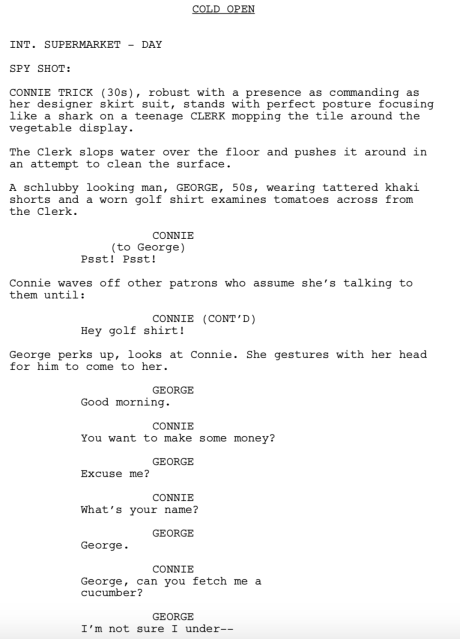
Title: THE SHADOWED
Genre: Horror-Western
Logline: An outlaw and his gang must team-up with a company of Texas Rangers to battle with the resurrected ghosts of vengeful Navajo braves besieging an isolated border town.
Why You Should Read: My script was shortlisted in The Tracking Board’s Launch Pad competition, allowing me to become a TB Alumni. I wrote the script after chatting with stuntman Ian Van Temperley, who hoped to be able to do the horse stunts for The Shadowed if it ever went into production. Whilst doing the stunts for the TV series Galavant, Ian Van Temperley shared my Shadowed script with the show’s creator Dan Fogleman. Dan read the script and wrote back saying this: “Dan Fogelman here from Galavant. I wanted to let you know that I read your script and was very impressed! The best thing about the script was the outlaw character Wakes, along with how well your action sequences were not only crafted, but written. It’s a very hard thing to do well, and you clearly know how to describe them. Most action sequences get hard to follow and hard to “read” – that’s not at all the case here. You have a great main character and a terrific action movie here. I enjoyed reading it.”

Title: Endangered 6
Genre: Thriller
Logline: After a widowed U.S. war vet and his estranged daughter check into a Manhattan hotel to reconnect, they soon find themselves alone and trapped in the building only to discover they’re at the center of a terrorist conspiracy that will kill hundreds on the streets of Manhattan, but they’re the only ones who know… or have the power to stop it.
Why You Should Read: I’ve been honing my craft for a while and have a few specs on the hard drive to show for it. This one was a finalist last year in a thriller screenplay contest and I’d like to see how it might do here with the Scriptshadow crowd. When I set out to write this my goal was to write a fast paced thriller with a broken relationship between a father and daughter at its emotional core. It’s Panic Room on steroids. Hope you feel the rush too!

Here are 10 lessons born out of the mistakes I’ve seen in the last 10 scripts I consulted on.

TAKE AT LEAST ONE BIG CHANCE – The most common script I read is the by-the-book script. It’s set in a familiar genre – horror, thriller, western – and it stays very comfortably within the rules of that genre. It never strives to do anything unique. There’s a fear of coloring outside the lines. These scripts can be decent. But they can never be great. Take one big chance. We know how I felt about Hereditary, but they definitely took a huge chance (spoiler) by killing off the daughter the way they did in that film. And people in The Matrix only fight via… Kung-Fu? I don’t think the average writer realizes how big of a risk that choice was.
PUT SOME BAD IN YOUR GOOD CHARACTERS AND SOME GOOD IN YOUR BAD CHARACTERS – When you hear the words, “on the nose,” in reference to one of your characters, you know you’ve failed. Here’s how to prevent that. For your heroes, give them shades of darkness. And for your villains, give them shades of goodness. “Good” character in The Looming Tower, Jeff Daniels, was determined to rip through red tape to take out terrorists and protect America. In the meantime, he was sleeping with several women besides his wife. That’s how you write a complex character.
FIGURE OUT A WAY TO MAKE YOUR HERO ACTIVE – One of the hardest things for a script to overcome is a passive hero. Audiences don’t like passive people. Active people drive stories. So whatever you can do to make your hero active, do it. I just read a military script where the main character was a soldier. And throughout the story, he was passively doing as told. Technically, this makes sense. Soldiers have to follow orders. But it doesn’t work for the story cause the hero is forced into the background. Chris Kyle was a soldier in American Sniper. But I’d never call him passive. Figure something out so that your hero is active. Cause it’s too hard to make a script work otherwise.
DON’T BE AFRAID TO CHANGE THE GOAL DURING THE SCRIPT – Movies can become boring if we know the goal from the first page to the last. There’s ways around this (namely, writing great characters). But if you want to hack the problem, change the hero’s goal at some point during the story. This keeps the reader on their toes, as it keeps the story fresh. For example, Star Wars starts out with the goal of delivering R2-D2 to Princess Leia’s home planet. But later, the goal switches to destroying the Death Star.
LAZY FIRST SCENES – This one drives me nuts because it’s one of the first things they teach you when you get into screenwriting. Write a killer first scene. Hook the reader immediately. And yet, in 9 out of the last 10 consulting scripts I’ve read, the writer didn’t follow this advice. I’m not saying all the scenes were bad. Some were pretty good, actually. But only one gave me the impression that the writer understood just how important the first scene is. He really went for it. I would implore you to think of your first scene as its own separate screenplay. Because it basically is. It’s the resume that lets the employer know that you’re worth knowing more about. You should be treating your first scene like it’s a life or death scenario. If you don’t hook the reader, you die.
DON’T OVERREACH – Be realistic about what you’re capable of. One of the problems writers make is they pick a really complex script or really complex subject matter, and they either don’t have the chops to nail it yet, or they don’t want to do the research required to make something like that work. For example, if I came up with an awesome idea about black market Russian nuclear warhead sales during the Cold War, I would never write it in a million years because I know I would have to do so much research to make that story feel even remotely authentic. I literally know three words in Russian. I couldn’t point out Moscow on a map of Russia if you gave me five guesses. And I’m going to write an intricate story about nuclear espionage in Russia 40 years ago? Part of being a good screenwriter is understanding your limitations. Yes, you want to be pushing yourself. But don’t be unrealistic. The best scripts are often scripts where the writer is insanely comfortable in the genre and story they’re telling.
CLARITY ISSUES – Clarity should be a given. I should never be confused about how two people know each other, where we are, what’s going on in a scene, what the basic geography is. I find that the writers who have the biggest problems with clarity are the ones who don’t read a lot of scripts. Make sure you’re reading scripts! And read AMATEUR SCRIPTS too. That’s where you’ll be confused yourself. You’ll then be less likely to make those mistakes in your own script.
HALF-BAKED MYTHOLOGY – There’s a huge difference between extensively built mythology and half-baked mythology. Watch The Matrix. Then go watch Tom Cruise’s The Mummy. Notice how carefully woven together the mythology of The Matrix is. You know that there are zero holes. It’s been broken down then built back up a hundred times (the first film, not the sequels). The Mummy, meanwhile, is all over the place. Nothing really makes sense. We’re not quite sure what the rules are. So if you’re writing a fantasy or sci-fi or horror script, do the work on the mythology. If you half-ass it, believe me, the reader will know.
NOT ENOUGH CONFLICT IN SCENES – The scripts that I have to fight to stay awake during are the ones where there’s little conflict going on. There’s no major conflict between the characters. There’s not a lot of conflict in the dialogue. There’s not a lot of conflict in the plot. Things tend to go easily for the characters. They don’t have to overcome major obstacles. Or, if they do, the obstacles are easy to defeat. Look to add conflict in every single scene. Remember that the reader feels a need to keep reading as long as there’s something unresolved. So if there’s conflict (an unresolved issue) in every scene, there’s always a need to keep reading.
EXPLOIT YOUR CONCEPT – Whatever your concept is, exploit the hell out of it. That’s what’s unique about your script. So you shouldn’t be focusing on other stuff. Every ten scripts or so, I’ll read a script with a really high-concept premise, but it reads like every other script I’ve read, namely because the writer’s inserting generic copy scenes from similar movies as opposed to exploiting the premise. Watch the trailer for the new film “Isn’t It Romantic.” The idea is that a woman wakes up in a romantic comedy world. You can see here that every scene of the trailer highlights that. Whether you like the idea or not, you can’t deny that the writer is mining it for everything its got. That’s what you need to be doing with your idea.
Genre: Horror
Premise: (from Blood List) Based on TRUE EVENTS. In response to this “astonishing” increase in demand for exorcisms, the Vatican opens a secret exorcism training academy where a young, gifted nun defies the church leadership to join her colleagues in the battle of good versus ultimate evil.
About: Today’s script finished numero TWO on this year’s Blood List. Robert Zappia has been writing for over 25 years, and actually wrote an episode of Home Improvement, which made him the youngest writer ever to write an episode for a number 1 rated show.
Writer: Robert Zappia (story by Earl Richey Jones & Todd Jones & Robert Zappia)
Details: 100 pages

It used to be that exorcism scripts were the best bang-for-your-buck sub-genre out there. Think about it. All you needed was a camera, a bedroom, and an actress willing to act crazy and you had a movie. These 500,000 dollar productions could fetch up to 30 million bucks at the box office. 600% return on your investment? Who doesn’t want that?
But either the public got sick of exorcisms or screenwriters ran out of ideas, because I can’t remember the last exorcism movie that was any good. Something-Something Emily Rose Exorcism? Is that what that one was called? It seems that audiences have gotten hip to the fact that someone writhing around in agony and screaming bad words isn’t must-see cinema. But with every dead genre, there’s an opportunity for a clever writer to reinvent it. Has today’s author done so? Let’s find out.
There has been an “unprecedented” rise in reported demonic possessions. This has resulted in the Pope setting up exorcism schools across the world. One of those operates in the United States. And this is where we meet Sister Ann, a nun in an affiliate church who doesn’t follow the rules. Ann, as is the case with all women, isn’t allowed to take any exorcism classes. But she does anyway!
One of the teachers, Father Quinn, takes exception to this, and warns Sister Ann that if she comes to another class, she will be expelled. Sister Ann ain’t no pushover, so she makes her case, but in the end agrees to leave it alone. That is until one of the priests runs into danger during an in-patient exorcism. Sister Ann runs into the room and bullies the demon back inside the patient, saving the priest’s life.
When Father Dante sees this, he asks Sister Ann to secretly come perform an exorcism on his pregnant sister. The school did not find sufficient evidence to label her sickness a possession, which is why he can’t go to anyone else. Sister Ann goes, only for things to go disastrously wrong. Ann gets kicked out of school. But only a few weeks later, they come back to her. It seems as if someone is possessed by a demon Ann has a special relationship with. Will this be her redemption? Does she want it to be?
What’s DIFFERENT about this script? That’s the first question a reader asks. And actually, it’s better if the reader doesn’t have to ask it. They should know immediately. They should feel this is different without having to ask why. There’s two things that are different here. A female exorcist and the movie takes place in an exorcism school. The next question the reader asks is, “Is that enough?” Is it enough to build a movie around a female exorcist in this setting?
I’ll say one thing. It’s smart. This is the market we’re in right now. Find the female angle. And it’s best if the angle exploits something that, traditionally, women haven’t been able to do. A female buddy-cop team-up isn’t that inventive because women have been able to be cops for a long time. But women have never been allowed to perform exorcisms. So it truly is giving us something fresh.
The final question a reader asks is, “Does it work?” And, ultimately, that’s the only question that matters. You can make all the arguments you want about why your idea is awesome. But if it doesn’t work on the page, it doesn’t work. To that I’d answer, Devil’s Flame sorta works? But not for the chances taken above. More so for the exorcism scenes, which are fun. There’s a scene, for example, where a possessed girl’s long matted hair has been slung around and shot deep into her throat. The priest is pulling on the hair, like a rope, grip-pull, grip-pull, trying to get it out, trying to prevent the girl from choking, until we finally see a demon’s hand emerge from the mouth, holding the other end of the hair, pulling as hard as it can back into the body.
Sweet.
The problem with Devil’s Flame is that the setting where the majority of the film takes place isn’t scary. We’re at an Exorcism School, and therefore all the possessed patients are kept in well-guarded, carefully insulated observation rooms. It’s a far cry from some of the exorcism scripts I’ve read where the priest has to travel to an isolated house in the middle of Romania or something. Out there, no one can hear you scream. Here, you have the entire school on call if something goes wrong.
And to Zappia’s credit, he knows he has to offset that. So he makes the exorcisms really intense. Almost to the point where I’d forgotten where we were. But still, it’s hard to make something scary when the setting is built specifically to make it not scary.
Zappia tries to remedy this by giving Sister Ann a backstory that has her seeing ghosts and demons around the halls. And to a certain extent, it works. But it doesn’t work as well as when we’re in the middle of nowhere, which is a staple of good horror. For example, Get Out doesn’t work if it’s set in the city. It only works cause it’s in this quiet isolated town where you get the feeling that all the neighbors are helping the bad guys.
I also think that further drafts could explore the theme of why priests don’t believe women can do this job. There’s a moment in the last possession where the demon possessing the person is saying these horrible awful things to Ann about her sexual past. And I felt like that should’ve been explored early and often – this belief that women can’t “handle” what the demons throw at them. Ann then being able to stand up to and conquer the demon in that way, would’ve placed emphasis on this theme of not underestimating women.
This is a tough call because the script has its strengths. But, in the end, it didn’t take enough advantage of its unique attractor, the female exorcism angle. Bump that up and there’s something here.
[ ] What the hell did I just read?
[x] wasn’t for me
[ ] worth the read
[ ] impressive
[ ] genius
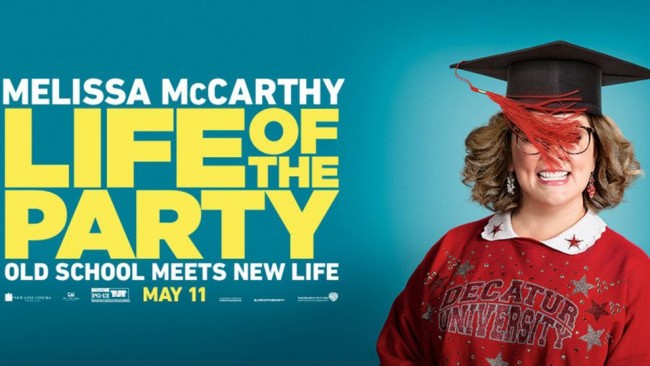
What I learned: Hollywood is looking for more female-driven movies. If you’re going to take advantage of that, do it like Devil’s Flame did. Find a job that women aren’t supposed to do, and make it about the first woman to do it. That’s better than finding a movie that had a famous male role and switching it to female. For example, you want to avoid Rodney Dangerfield in Back to School being changed to Melissa McCarthy in Life of the Party.
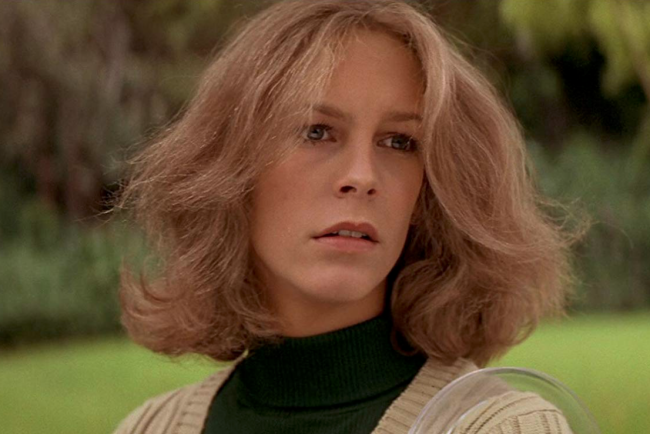
Great teasers are expected in horror scripts – When you write a horror film, you HAVE to write a great teaser scene. It’s expected. The teaser in 2018’s Halloween was the most memorable scene in the film. And the same can be said for this Halloween – a boy wearing a mask murders his naked sister in POV. If a horror script gives me a lame teaser, it’s a guarantee that the rest of the script is going to be lame as well.
Bodies in motion – I like when scripts start with something HAPPENING. The characters are IN MOTION, on their way to something. In contrast, bad scripts often begin with characters sitting around. Nobody wants anything. Nobody’s trying to do anything. This sets the tone for a slow dull movie. Get your characters moving after the teaser, preferably doing something that sets the story in motion. After the teaser in Halloween, we cut to Dr. Loomis and a nurse in a car driving to the mental institution to talk to Michael. We’re off to the races already!
Save the Cat still works! – If you’re ever in doubt about whether your hero is likable enough, give them a Save the Cat! scene. It doesn’t even have to be some big production. Like saving an old woman from getting hit by a car. With Laurie, it’s a simple scene where she runs into the boy she’s babysitting that night. The boy clearly loves Laurie, and she’s adorable with him, adhering to all of his demands (watch a movie, make jack-o-lanters, read to him, make popcorn). It’s a short scene, but just like that kid, we now love Laurie as well. The scene speaks to the power of simplicity in storytelling, as pretty much every choice in Halloween is a simple one.
Build build build – In a horror movie, you don’t want your killer to start killing people right away. You want to BUILD towards it. Tease it. Draw out the suspense. Someone’s broken into the local hardware store and stolen a bunch of stuff. Laurie sees a strange figure in a mask standing across from the school. Then a couple of additional times, behind a bush, and in her yard. We’re building building building before the terror is unleashed.
The scariest things don’t have to be complicated – The reason Michael Myers is still terrifying after 40 years is that he’s so simple. A killing machine in an expressionless mask who never says a word. I bring this up only because people think today’s characters have to have really elaborate backstories and motivations. And while that works when done well, sometimes all you need is a simple terrifying monster.
Horror works best under a tight time constraint – Halloween takes place in less than a day. The majority of it takes place in real time. That’s when horror cooks the hottest, when the threat is so immediate that your characters have to deal with it NOW.
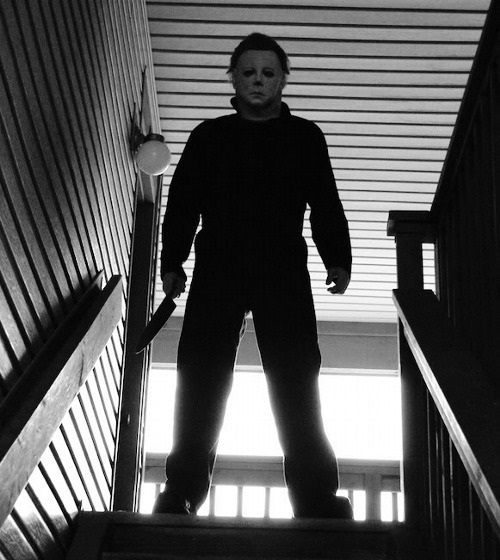
Integrate both active and passive storylines – One of the problems with these horror-slasher screenplays is that the victim is passive. Laurie doesn’t know that this man is after her. So she can’t go after anything herself. All she can do is live her life, and unfortunately, our lives are pretty boring. The solution to this is to add an active storyline. This is usually done by bringing in a policeman or detective who’s chasing the bad guy. Halloween does it with Dr. Loomis. He knows Michael will go back to Haddonfield, which is why he goes back there, to try and catch him. This allows you to cut back and forth between Laurie’s passive storyline and Dr. Loomis’s active one.
Dramatic Irony Alert – Remember that dramatic irony is when the audience knows something the character does not. It’s a device you should be using a lot as a horror writer. After Michael kills the guy who’s gone to grab a beer for his girlfriend, Michael puts on a sheet and walks upstairs to the girlfriend, who’s waiting in bed. She giggles when she sees her “boyfriend” in the sheet, and asks for her beer. WE know this isn’t her boyfriend. SHE does not. Hence the dramatic irony. This allows us to squirm and scream, desperately hoping she’ll find out before it’s too late.
The False Kill – Nearly every horror movie has a false kill of the monster/killer near the end of the film. Unfortunately, audiences have gotten hip to this and don’t believe it anymore. “Make sure he’s dead!” they’re screaming as the hero ignores this obvious advice. So if you’re going to do this these days, you want to use every trick in the book to convince the audience the monster is dead. That way, when they come back, we’re genuinely surprised. Unfortunately, Halloween is not one of these movies. Laurie weakly stabs Michael, who falls down behind a couch, and Laurie assumes he’s dead without even checking. Of course, only minutes later, he’s back on her trail.
We’ll forgive a basic plot if we like the hero – Yesterday I said that a cool plot cannot survive weak characters. The opposite is also true. A bad plot can be saved by strong characters. And when I say “characters,” I’m really talking about your hero. This might be the biggest screenwriting hack of all. If you give us a hero we really like, we’ll pretty much forgive everything else. Everything in Halloween is predictable. A killer escapes a mental institution. Some teenagers are baby-sitting that night. The killer finds them and kills them one-by-one. That’s basic horror movie 101. But we like Laurie so much that we don’t need a big fancy plot with lots of twists and turns. All we want is for her to survive. If that happens, we’ll have enjoyed the experience.
“Like it Didn’t Love It” refers to an old industry response to the glut of screenplays shoved into the system, and the many people who were required to read them. “What did you think of the script?” a co-worker or boss would ask the reader. “Liked it, didn’t love it.” It was a nice way of saying, “not bad.” Unfortunately, “not bad” doesn’t get a script anywhere. And if we’re being honest, it essentially labels the script dead in the eyes of the company that read it.
As someone who’s read north of 7500 screenplays, I know this experience all too well. The majority of the scripts I read are not good. A select few are very good. Between those extremes is a frustrating selection of screenplays (probably around 15%) that are pleasant reading experiences, but nothing more. I may even enjoy them while reading them. But if literally any distraction comes up, I choose that distraction over the script. These are “Like it Didn’t Love It” scripts. And it’s time to get into how to avoid writing one.
“Like It Didn’t Love It” scripts fall into five categories. The “Technically Perfect” script. The “Safe Concept.” The “Lacks Passion” script. The “Third Draft.” And the “Not Up To the Challenge” screenplay. Let’s take a look at each of these in detail.
The Technically Perfect Script – The technically perfect script is often written by screenplay-book junkies. They know everything about screenwriting, more than me even. They are slaves to the “rules” of screenwriting, often strangling the creativity from their story in favor of meeting plot beats on the right pages. If a writer’s been at this for a while, they can make a “Technically Perfect” script pretty good. But the ceiling for scripts this devoid of creativity is only so high, which is why even the best ones can only hope to achieve “Like it Didn’t Love it” status. When it comes to recent films, Skyscraper and Life of the Party are “Technically Perfect” scripts.
The Safe Concept – The safe concept has some crossover with The Technically Perfect Script because when you choose a safe generic concept, you will usually execute it in a safe generic way. But the main difference between these two is that the “safe concept” is so vanilla that, even under the best circumstances, the script can only be taken so far. With that said, the word “safe” is used for a reason. It’s “safe” because it works. And that means these scripts, if written well, are mildly enjoyable in the same way that orange chicken from Panda Express is mildly enjoyable. Unfortunately, the reaction to both afterwards is the same. “Why did I put myself through that?” Examples include “I Feel Pretty,” “Truth or Dare,” and “The Commuter.”
The I Clearly Am Not Passionate About This Script Script – These scripts often come about by writers who are sick of their low-concept dramas (or any non-traditional script) being ignored by the industry and finally give in to the notion that you need to write a marketable screenplay to get noticed. They hop on the latest trend (say, Girl With A Gun), writing their version of it, only to get rebuked by the industry once again, reinforcing their belief that their initial approach was the right way to go. — Look, you have to love what you write for it to be any good. Even great screenwriters struggle to make stories work that they’re uninterested in. It’s hard to find produced examples of this, since virtually any lifeless movie could be an example. But yeah, if you’re not getting paid, think long and hard about writing something you have no passion for.
Third Draft Scripts – Third draft scripts are scripts where you can see the promise of the story but the writer hasn’t done the hard work yet. Now, obviously, every writer defines drafts differently. For some, it’s an extensive process that requires tons of outlining and character work each time out. These writers can write a good script in 4-5 drafts. For others, they write quickly, and can belt out a draft in a week. For them, writing a good script takes 10-15 drafts. So “third draft” is more of a symbolic moniker that represents a writer who’s written a decent script that could’ve been a lot better had they written a few more drafts. The example I always give of this is The Sixth Sense. In the third draft of The Sixth Sense, M. Night’s story was about a kid who drew pictures of the future. By the 10th draft, it was about a kid who saw dead people.
Not Up to the Challenge Scripts – “Not Up to the Challenge Scripts” are actually scripts that have the potential to be “Love It” scripts, but the writer’s skill level isn’t yet high enough to stick the landing. Or another way to look at it is that their eyes are bigger than their mouths. These scripts often cover weightier material, a biopic with Oscar in its crosshairs (White Boy Rick) or a time-spanning period piece (Gangs of New York), or really ambitious rule-breaking type projects, a Pulp Fiction or an I, Tonya. You need to have been at this for awhile to pull one of these scripts off. In the meantime, you will be praised for your script’s “flashes of brilliance,” but condemned for its inability to “bring it all together.” While I think it’s important that every writer push their limits, it’s also important to know your limitations. You’re not going to write Pulp Fiction as a beginner. You’re just not.
Now that you know what scripts are most likely to turn into “Like it, Didn’t Love It” scripts, what can you do to write these elusive “Love It” screenplays? There’s no definitive answer to this question. But I will say this. The scripts most likely to make readers fall in love with them are scripts that contain a high level of emotional resonance. A heavy focus is placed on the interplay between character and theme. This is the best combination to emotionally affect the reader. And once you make a reader FEEL something, the chances of them falling in love with your script rise dramatically.
A perfect example of this is Eighth Grade, the film I reviewed on Monday. That was not the most amazing script. It didn’t have much of a plot. But Bo Burnham so effectively explored the theme of loneliness and the desire to connect through this imperfect but impossible not-to-like 13 year old girl, that it didn’t matter. We FELT something. And when you feel something, you don’t care about inciting incidents and first-act turns and whether the “fun and games” section was long enough. Emotion is the great-eraser of logical analysis. Which is why, if you’re trying to become a better screenwriter, the primary area you should be studying is character development. Understanding the psychology of people, then combining that with the technical know-how of establishing flaws in characters (in “Eighth Grade,” it’s that Kayla is too quiet) is the first step towards mastering this skill.
With that said, there are several additional things you can offer that increase the chances of writing a “Love It” script. Number one, take chances in your story. I always say that it isn’t the rules you follow that make your script great. It’s the rules you break. Anybody watch “Swiss Army Man” and think, “Way too many safe choices here?” Two, as I mentioned above, try to write something you’re passionate about. The more passionate you are about something, the more effort you’re going to put into it, and that’s going to come across on the page. Three, if you have a strong voice, like Zoe McCarthy from Tuesday’s review, write a script that takes advantage of that voice. And four, write a “tweener” script. The advantage of tweener scripts (scripts that combine two different genres) is that you’re more likely to write something original. But, of course, everything with a big upside has an equally steep downside. Get these wrong and people ask you, “I couldn’t tell if this was an [x] or [y] film!” A good tweener film is Get Out (horror and social commentary). A bad one is Tag (was it a comedy or a drama?).
I’m sure some of you are asking, “Well, Carson. If some of these Like it Didn’t Love It scripts are getting made, then how bad can it be to write one? Look, Hollywood has too many slots to fill not to make some Like it Didn’t Love It movies. The reality is, however, Hollywood doesn’t look to you, the unknown screenwriter, to provide them with this material. They can come up with average material on their own. As an unknown writer, you must STAND OUT in order to get your scripts through the system. Which is why you should be aiming to write “Love It” material.
I want to finish this off with one final piece of advice. I am not advocating that you write your passion project about the irrigation issues that the native peoples of 1781 New Zealand faced. Every script idea should be seen through the lens of “Will anybody pay to see this?” That’s the caveat to all of this – the one rule you have to follow. Nobody’s going to make your movie if there isn’t an audience for it. Conversely, the bigger the audience potential your idea has, the more lenient the analysis of your script will be.