
Search Results for: F word
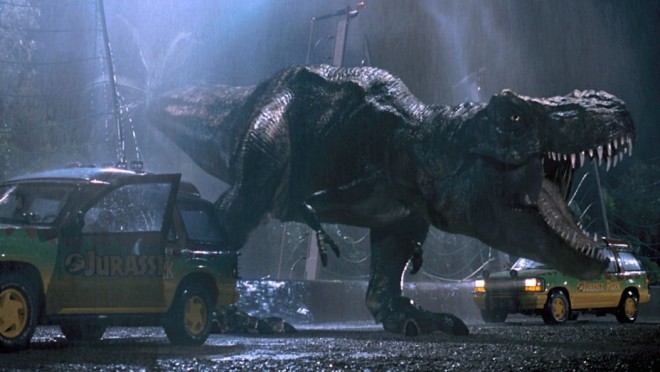
The main reason this movie works so well is that it has a big concept and a simple execution. I will trumpet this advice until the day I can no longer type – keep your stories simple. A group of people get stuck on an island full of monsters. They try and escape. That’s all this is! This is why so many of the Jurassic Park sequels are bad, because they don’t use this format. And it’s why the most successful sequel in the franchise was a reboot, where, once again, a group of people are stuck on an island and try to escape. Here are 10 more screenwriting lessons you can learn from Jurassic Park.
1) Big movies need big teasers – If you’re writing any sort of blockbuster type film (sci-fi, superhero, action-adventure), you need to open your script with a teaser scene worthy of that idea. Jurassic Park has one of the most memorable opening teasers of any film. A group of men are unloading a mysterious caged animal. When they’re nearly finished, the animal is able to grab one of the men, pull him in, and kill him.
2) Exposition needs to be conveyed while something is HAPPENING – I’ve been seeing this mistake too much lately. Writers put two characters in a room or in a boring setting and have them set up the story for the reader. Pro writers convey exposition WHILE STORY IS HAPPENING. The second scene in Jurassic Park has two men discussing the lawsuit that is going to stem from the death we saw in the teaser. But they’re talking about this as they’re called to a cave, where a group of men have found something valuable, a mosquito encased in amber. In other words, the story is moving forward while the exposition is being given.
3) One key word in your character’s description can sell the entire character – “Dr. Alan Grant, mid thirties, a ragged-looking guy with an intense concentration you wouldn’t want to get in the way of.” What’s the key word there? “INTENSE.” That ONE WORD dominates Grant’s entire personality throughout the film. When you’re writing a description, try to find that descriptor that personifies who your character is. It isn’t easy. Here’s another description of Koepp’s, which isn’t nearly as good: “Dennis Nedry is in his late thirties, a big guy with a constant smile that could either be laughing with you or at you, you can never tell.” No key word. A confusing sentence (a smile becomes a laugh out of nowhere?). Find that word, guys. The right adjective can help you nail a character description.
4) Use your suspense rope! – When you have something cool at the end of the rope, make us pull on it for awhile. When the island’s creator, Hammond, comes to Grant and Ellie, he doesn’t immediately say to them, “Hey, I’ve got this dinosaur island! Come and take a look.” He remains mysterious, baiting them with, “It’s right up your alley. Why don’t you come down?” This keeps the suspense going.
5) Make sure a character goal is present for everyone – Every character needs to have a purpose in the story. You can’t have Hammond bring our paleontologists there for compliments. It’s not a vacation. Grant and Ellie’s goal is to give their endorsement so that the investors can sign off on the park and Hammond can open it. I see this mistake A LOT. Writers put their characters in a situation simply because that’s the movie they want to write, never asking why they’d actually be there.
6) After getting to the end of a suspense rope, add another one – So the suspense rope we referred to above was finding out that this was a dinosaur park. That rope reached its end when Grant and Ellie see their first dinosaur, a Brachiosaurus. After this, Koepp immediately replaces the rope with a new one, when Hammond says they have a T-Rex. “You have a T-Rex?!” Grant says. “Let’s go look at it.” “Relax, there’ll be plenty of time this afternoon.” This forces the reader to pull on this new rope for awhile before getting what he wants.
7) Simple easy-to-understand set-pieces – One thing I can’t stand about new movies are these overly complicated confusing set-pieces where we barely understand what’s going on. Early Spielberg mastered the art of simple set-pieces. What’s the most memorable shot of Jurassic Park? A T-Rex chasing a jeep. That’s it! That’s the set piece. A T-Rex runs after a jeep in a straight line. And the other T-Rex set-piece is simple, too. Characters stuck in cars with a T-Rex just outside, nudging and trying to get them. Or being stuck in a kitchen with a group of raptors. They’re so easy to understand which is why they’re so effective.
8) Even Lebron needs a breather – Sometimes you want to give your A-story (people visiting a dinosaur park) a rest. You do this by creating a B-story to occassionally cut to. The B-story here is Nedry’s plight to steal the dinosaur embryos and sneak them off the island. Every 4-5 scenes, we cut back to him and his plan. You’re going to gas your A-story if you don’t substitute in your B-story every once in awhile.
9) Be awesome by having your B-Story intersect with your A-Story – Just having a B-Story isn’t enough. If you want to show off your writing chops, look for interesting ways to connect your B-Story with your A-Story. Koepp cleverly has Nedry turn off the safety mechanisms in the park in order to hide his crime. This, in turn, allows for our characters to get stuck during their ride and for dinosaurs to have access to them.
10) External flaws vs. Internal Flaws – A flaw is a character defect that’s holding them back. The movie’s journey is then used to have them overcome this flaw. There are two kinds of flaws. An external one, which deals with stuff we can see (example: fear of heights). And an internal one, which deals with stuff we can’t (example: selfishness). Jurassic Park gives Grant an external flaw – he doesn’t like kids. And if I’m being honest, it’s one of the weaker parts of the movie. I suggest going with internal flaws (arrogance, stubbornness, inability to connect) as they connect on a deeper level.
BONUS TIP: Use weather to add more conflict! Doesn’t matter how bad things are for your characters. A little weather insert can make it even more interesting. Here, they add a storm. But you can throw a heat wave into the mix. Hail. Below freezing temperatures. Humidity. Anything that’s going to agitate your characters more is a good thing.
Genre: Dark Comedy Thriller
Premise: (from Black List) A darkly comic crime thriller concerning three groups of people dealing with blackmail gone wrong.
About: Kill Shelter appeared on the bottom half of last year’s Black List. It’s written by newcomers Eric Beu and Greg Martin. The two won the 2015 Script Pipeline TV Writing Contest with a pilot called Beechwood. Martin was originally a composer and has gotten work on some major network shows. Eric Beu mainly wrote short fiction before moving to Los Angeles to team up with his friend Greg and start writing screenplays.
Writers: Eric Beu & Greg Martin
Details: 94 pages

Please be good Please be good Please be good Please be good.
Those are the words going through my mind whenever I open a script.
Why? Because MY JOB IS SO MUCH EASIER WHEN I LIKE SOMETHING. That’s why. Damn. You’re so pushy.
Here’s something you may not know. Screenplays? They’re time machines. No, I’m serious. They are. If you find your way into a bad screenplay? You will be reading for 5 hours and look up to see that you’re on page 12 and only 20 minutes has gone by. Conversely, if you read something good? You can be reading for 10 minutes and you’re already done with the script.
There have been times – times I’d like to forget – where I’ve actually gone backwards in time reading a script. I once read a script for 3 hours only to find out that I hadn’t made it past the title page. Those are the days I hate the world.
So color me Happy Henry when I time-traveled through Kill Shelter fast enough to finish in time for The Bachelorette. And can I just say something? Brett? You’re not there for the right reasons. You need to tell Becca.
Bennett, our shlubby un-hero, is a closed caption transcriber and a loser. But he’s going to be dead in a few minutes so it doesn’t matter. Bennett is visited at his home by an intimidating man named Gordon. Bennet gives Gordon a mysterious thumb drive and Gordon gives him 90 thousand dollars.
Except as soon as the trade is made, Gordon shoots Bennett dead. Gordon must now get this thumb drive, which clearly has some incriminating evidence on it, back to his employer. Except while he was shooting Bennett, he dropped the drive, and now there are four adorable Siberian Husky puppies standing side by side, as if in a picture, staring at him.
It takes Gordon a second to realize that one of these puppies ate his thumb drive. Shit. Now what? He grabs all four puppies and takes them with him.
Little does Gordon know, halfway down the block, pet vets slash scatterbrains Liz and Paola were coming to retrieve those puppies, as they had evidence Bennett was neglecting them (he was – stupid Bennett). Paola, a Game of Thrones enthusiast, brought a real-life Game of Thrones replica sword to intimidate Bennett into giving them the puppies. Except now the puppies aren’t with Bennett. They’re with this other guy. Who’s this other guy? They start following him.
We jump back a couple of days where we meet Bennett before all this happened, and learn that he was lucky enough to overhear a live-mic situation on a news show he was close-captioning where the head anchor, psychopath Grant, was banging an intern who’s not his wife. This, we realize, is how Bennett got himself into this mess. He tried to blackmail Grant with the audio.
We bounce back and forth between Bennett, Grant, Liz, Paola, and Gordon, as well as bouncing back and forth in time, gradually putting the puzzle pieces together just as all five parties (well, four, since poor Bennett’s dead) smash together in one final bloody battle. Of course, the only thing you care about is are those adorable puppies okay? They can’t let anything happen to those adorable puppies, can they? No way a writer would hurt even a fictional puppy, yes? Eh, you’ll have to read Kill Shelter and find out for yourself, sucker.
I really liked this.
For starters, I liked how the script was designed for us to play catch-up. We see Bennett. We see this mean dude. They make an exchange. We don’t know what for. He kills Bennett. We cut to three days earlier when Bennett is alive. Now we’re wondering, “What did this guy do to get into this mess?”
It’s simple but intriguing questions like this that buy you pages. And that’s all you’re trying to do as a writer. You’re buying pages of interest from your reader. If you can come up with one mystery here, another there, you can buy as many as 20-30 pages from the reader. So these guys had me right away.
I loved all the weird choices. I loved how Paola carried around a Game of Thrones sword that was so big and heavy she could barely lift it.
There’s this whole thread where Bennett has this bizarre Joseph and the Technicolor Dreamcoat 30,000 dollar bullshit vest that supposedly cures back pain. It’s got a Siri operating system and it lights up and whines at anyone who enters Bennett’s place to please “plug it in.” How do people come up with this stuff?
And what a GENIUS move it was to take a comedy staple – two stoner dudes who stumble around aimlessly in pursuit of the MacGuffin – and turn them into women. I didn’t realize until reading this script that I’ve never seen that before. These characters have ALWAYS BEEN DUDES. Not only did it freshen up the story. Liz and Paola KILLED. They stole the script.
Usually when I read zany scripts like this, the writers aren’t good with the peripheral stuff. They don’t care, for example, about anybody’s backstory. They’d rather come up with the next zany plot point. But these guys are different. EVERYBODY has a motivation, sometimes elaborately so.
For example, we find out that these puppies came from Liz’s dog. But not just any dog, a dog that was dying. A dog that was able to have these puppies right before death. I mean, how much more motivation does a character need to save puppies?
And Bennett too! He’s got this entire backstory where his mom got in a car accident. There were complications. He had to put her in a home. And that home is costing him a ton of money. Which means he can’t keep up with his student loan payments. Which is why, of course, he has to blackmail the news anchor.
And no – in case you were wondering – it wasn’t endless chunks of exposition that gave us this information. These guys are masters at saying a lot quickly.
I have to give them props. Despite a potentially messy setup (time jumping and multiple protags) I was never confused. A big reason for this is they give each character a strong memorable introduction (remember when we talked about that?). When you DON’T have strong character intros and try to write these “bounce around” scripts, we always forget who’s who. Even if a character was introduced 10 pages ago.
The only gripe I have about this script is that they don’t know what to do with these movies anymore – the zany dark ensemble comedies. They’ve never done well at the box office outside of the Coen Brothers. But these days it’s even worse. They get discarded onto Netflix with barely any marketing, and you never hear about them again. I just don’t know that I would recommend writing a script like this unless you’re using it as a writing sample. With that said, I hope this one bucks the trend because it’s a darn good script.
[ ] What the hell did I just read?
[ ] wasn’t for me
[xx] worth the read
[ ] impressive
[ ] genius
What I learned: Read this script STRICTLY for character introductions. Note how you know exactly who each character is after their first scene. I read too many scripts with boring, vague, or weak character intros and it’s always those scripts where I have to keep checking my notes. “Who’s this again?” “Wait, who is this person?” Once you learn how to write strong character introductions, you make the reading process a thousand times easier for the reader.
With financiers and mini-studios and Blumhouse and A24 and Focus and Amazon and Netflix’s industrialization of the production process, more movies are being made than ever before. Yet you still can’t get your script sold, or even noticed for that matter. What’s up? I’m going to address that right now. Here are 10 things you can focus on that will improve your chances of getting your script purchased.
1) Is your concept marketable? – If your concept isn’t a proven successful movie template (contained horror, guy with a gun, action-comedy, etc.) or a current trend (biopics, true stories, WW2, etc.), you’re not going to get a lot of interest. Less interest equals less reads equals less of a chance someone says yes.
2) Can your movie be made for under 5 million dollars? – Put simply, the less your script costs, the more production companies can afford to make the film. Which increases your selling options exponentially.
3) Negative attitude – Lots of writers believe that the journey is impossible. They’ve convinced themselves that the big evil conglomerate known as Hollywood is conspiring against you. This becomes a self-serving prophecy as everything you do is dictated by negativity. For example, if you query a producer, the e-mail is dripping with a bitter subtext, which puts the producer off, so they never bother getting to your script. I know this because I receive these e-mails. Writing is hard. But breaking in is harder. You have to stay on the path and continue to be positive. This is how most artists break into their respective industries. Positivity and persistence.
4) Keep pumping out material – Work hard on each script, but don’t be the writer who keeps hitting people up with a new revised version of a script they’ve already read several times. Everybody likes NEW. NEW is almost as important as MARKETABLE in Hollywood. There’s nothing more powerful than being able to say, “I’ve got this NEW script you have to read.” To be more specific, try and write 2 scripts a year, and promote those scripts for 6-9 months. While you’re promoting, you should be concurrently working on your next two scripts.
5) Do you know how to write a query letter? – I can suss out 95% of bad writers just by reading their query letters. They spell words wrong. They use weird fonts. Their grammar is off. They ramble aimlessly. If you can’t even say “Hi” correctly, I know there’s no point in opening your script. So get feedback on your queries before sending them out. And put more of a premium on presentation going forward.
6) Are you blanketing the world with your screenplays? – This is where I see most writers fail. They don’t get their scripts out to enough people. Get coverage. Get notes from me. Submit to Amateur Offerings. Submit to the Black List. Submit to Page. Submit to Sundance Labs. Submit to Nicholl. Get a writing group. Trade reads with them. Cold e-mail managers, agents, and producers. Hell, cold call them. A writer was just telling me that he cold-called a mid-major production company, asked for the head guy, and was shocked when they sent him through. It gave him the confidence to call other managers and agents, and while not all of them took his call, more of them took it than he expected. And he was able to send his script out to a handful of them. But the point is, this is a numbers game. If 2-3 people a year are reading a script, you’re never going to break in. The odds aren’t in your favor. Set a goal to get a script to 10 people a year at least (that could be contest readers, writing group friends, whoever).
7) Are you being realistic about where you are on your journey? – If you’re pissed off that nobody’s giving you the time of day on your third ever completed screenplay, or if this is your first year screenwriting, you may need to accept that you’re not ready yet. I mean in what business does someone shoot to the top .001% of the company in a year? You haven’t even figured out how to order coffee yet. You have to be realistic. Get a handful of scripts under your belt, get to at least 3000 hours (5000 would be better) of practice, and then start sending your stuff out there.
8) Are you getting into your story quickly? – Readers are quick to judge. Think about how many of you won’t even open a script after reading the FIRST PAGE on Amateur Offerings. Believe me when I say busy producers and agents are doing the same. There are caveats to this. If the script comes highly recommended, they’ll read it no matter what. But if you’re a newbie, chances are your script is coming with zero fanfare. Even a few seconds of boredom could get you the hook. So get into your story quickly, even if it’s an indie-drama. The Social Network starts with an intense breakup. Juno starts with a 16 year old getting a pregnancy test. Don’t make excuses. Hook the reader immediately and they’ll give you their attention.
9) Have you given us one great character? – One of the first things producers and agents ask when they’re reading a script is, “What actor can we send this to?” If you don’t have a compelling or fascinating or unique or complex or scene-stealing character (doesn’t have to be the hero – just one of the characters in your script), it seriously lowers everyone’s interest in the project. I always say, write a character that an actor would die to play. Recent examples include Harper from yesterday’s script, the mom in Hereditary, Jennifer Lawrence’s character in Red Sparrow, or JK Simmons’ dual-roles in Counterpart.
10) Is your script under 110 pages? – It better be. You can start writing 120 page scripts when you’re established. But right now you’re an unknown spec writer. Nobody knows you and therefore they don’t owe you anything. One of the first things a reader does is check the page count. If they see 120 pages from an unknown writer, I GUARANTEE YOU they’re rolling their eyes and going into your script with a chip on their shoulder. Keep your break-in script lean and mean. Trust me on this.
Genre: Dark Comedy/Satire
Premise: (from Black List) When a liberal white girl who knows exactly how to fix society accuses her equally liberal professor of hate speech, it throws the campus and both their lives into chaos as they wage war over the right way to stop discrimination.
About: Today’s script is a perfect example of workshopping something until it’s solid enough to make some noise in the industry. Writers Emma Fletcher and Brett Weiner first got their script accepted into the Sundance Screenwriters Lab, where they got some notes from professionals, and were able to then rewrite the script (presumably several drafts) and get it on last year’s Black list (with 7 votes). Let this serve as a reminder. Pursue every screenwriting avenue you can afford. And if you can’t afford any, there are plenty of free options (Ahem, Amateur Offerings). This is a “No thank you” business. So the only way to break in is by getting as many people to read your script as possible. Then, and only then, do you have a chance of landing that life-changing “yes.”
Writers: Emma Fletcher & Brett Weiner
Details: 115 pages

“I want to open it up to anyone who had an uncomfortable moment, a difficult feeling, or an experienced micro-aggression.”
One of the many great, and terrifyingly accurate, lines from today’s script.
Social Justice Warrior is so accurate at times, that you wonder if it’s a satire, or if this is the world we live in.
It was only a matter of time before somebody wrote a script on this topic. The question was whether it would be any good. Lucky for these two, they got it workshopped at one of the best places in the world to get a script workshopped – Sundance. Getting the tone right is so hard with satire and I’m sure the people at Sundance helped them nail it.
18 year old freshman Harper Penzig (female, white, cisgender) is so taken by classmate Deshaun Barnes’ story of discrimination that she immediately declares herself a fierce advocate for race and LGBT equality.
A few days later, in a European Intellectuals class, Harper takes exception with professor Susan Brodbeck’s (female, 40’s, white, cisgender) use of the word “ugly” in the sentence: “In your reading, Oppel claims that Nietzche is actually employing irony here to comment on societal attitudes that he finds ugly.”
Harper immediatley raises her hand and says she has a problem with the word ugly as it “alienates important segments of our community.” Specifically as it relates to her sort-of trans-friend Liz, who’s also in the class, and has been called ugly before. Liz, for the record, couldn’t give a shit about Harper’s argument.
When Susan refuses to apologize for her use of the word, Harper takes her fight to the school Dean, demanding a hearing for Susan violating the right that all classrooms must be safe spaces.
Within days, Susan has recruited a small army to picket in front of the history department, calling for Susan’s resignation. When Susan realizes this problem may affect her tenure, she apologizes to Harper. But Harper’s already on a roll, uploading her protest to social media.
Meanwhile, Harper starts “SAFES,” a group that will define every single word and action that constitutes hate. Beginning with a “Privilege Walk,” Harper shows everyone in the group just how privileged and, therefore, hateful they are. Which only reinforces how important the group is. Can a white man eat a burrito? Is this not cultural appropriation? SAFES says it indeed is.
Eventually, Harper’s fight goes viral, and she gets drunk on her social media power. Every injustice is instantly uploaded, where half the world can celebrate and the other half decry her. After awhile, the lines become blurred. Is she doing this because she believes in it? Or is she doing it for the attention?
In the end, Harper and Suzanne will battle it out, in a “safe space” room of all places. Whoever comes out in one piece may dictate the direction of social justice for us all.
This script was great.
What made it so great will surprise you, since I rarely talk about it on the site.
Social Justice Warrior built its entire plot around a thematic question: “Have we gone too far in our quest for social justice?” Every scene was built around that question. And what’s so great about the script is that it gives both sides an equal voice. Harper and Susan have several debate scenes together and in each one, they both make solid points. I bring this up because I read so many scripts where the writer has a clear agenda. So when he’s (she’s? they’s?) writing argument scenes, the point he agrees with always gets the best argument. This script proves that it’s way more interesting when you make the debate even because the writer has to keep reading to get to the conclusion.
For those of you who want to construct screenplays around a thematic question, here’s something to keep in mind. It doesn’t work unless the question is a) charged and b) difficult to answer. So if you built your script around the thematic question, “Is it okay to steal if you’re poor?” that’s not a question people are dying to know the answer to. SJW is built around a charged question that people have intense opinions on. And that means readers are going to keep turning the pages.
There are a few plot related things I want to bring up as well. The script starts off with Harper’s pursuit of getting Susan fired. I could see an early iteration of this script where that was the only plotline. If that were the case, the plot would’ve been too thin. So Fletcher and Weiner added the SAFES plot, where Harper’s goal is to define hate speech and implement it around the school.
As a screenwriter, you’re always feeling out if you have enough plot or if you need more. If you need more, this is an option – using dual-goals. Goal #1: Get Susan fired. Goal#2: Define hate speech for the school. This allows us to bounce back and forth between two storylines, keeping each of them fresh.
I also liked Fletcher and Weiner’s choice to make sure EVERYBODY in this story had something at stake. A common mistake is to only give stakes to your hero. But we had it for our “villain” as well. Susan is going to lose tenure if Harper wins this battle. And the Dean gets a call from the president that if this keeps blowing up, he’ll be fired.
What this does is it gives WEIGHT to these characters’ scenes where there otherwise wouldn’t be any. Because Susan has so much riding on this, we can feel her desperation in her scenes. If tenure was never mentioned, her scenes become infinitely less dramatic. Who cares if she loses this battle? As far as we’ve been told, her job will remain the same.
Finally, I liked the message of the script. That there are legitimate strides that need to be made in the area of social justice. At the same time, there are narcissists out there using the cause as a weapon to gain attention. And because they’re the loudest voices, they get propped up as the faces of the movement, which places said movement in a negative rather than a positive fight.
Where is all of this social justice headed? We’ll need a sequel about a year from now to find out.
[ ] What the hell did I just read?
[ ] wasn’t for me
[ ] worth the read
[x] impressive
[ ] genius
What I learned: Thematic questions result in dialogue-heavy scripts. If you want to write a lot of good dialogue, you might try building your script around a thematic question. That’s because you’ll spend many scenes having characters debate the question. And questions that don’t have easy answers are often fun to write and to read. Social Justice Warrior was 95% dialogue for that reason. It set up its question then it let its characters battle for the answer.
DIALOGUE WEEK IS HERE! – All this week, I’ve been breaking down dialogue scenes from the movies you love. Monday’s Dialogue Post is here. Tuesday’s post is here. And yesterday’s post is here.
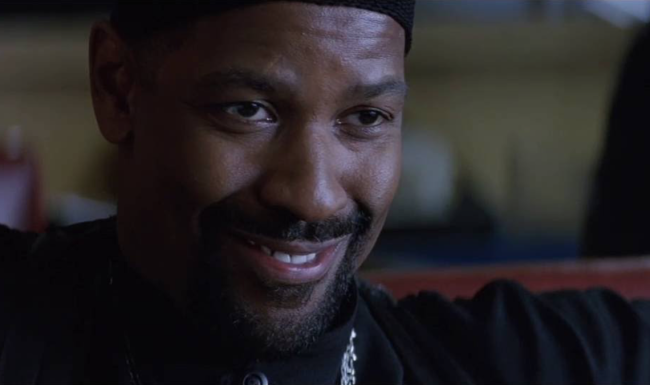
If you want to go to dialogue school, check out Training Day. It’s basically a 120 minute dialogue scene. Which brings us to our first lesson. Don’t focus on writing great individual dialogue scenes. Focus on creating great characters who can then write the dialogue for you. Alonzo is the ultimate dialogue-friendly character. And Jake is the ultimate straight man. Put those characters together and you have dozens of scenes where the dialogue writes itself. Let’s check out their famous first meeting together. For those who haven’t seen the movie, it’s about a young cop’s first training day with a veteran narcotics officer.
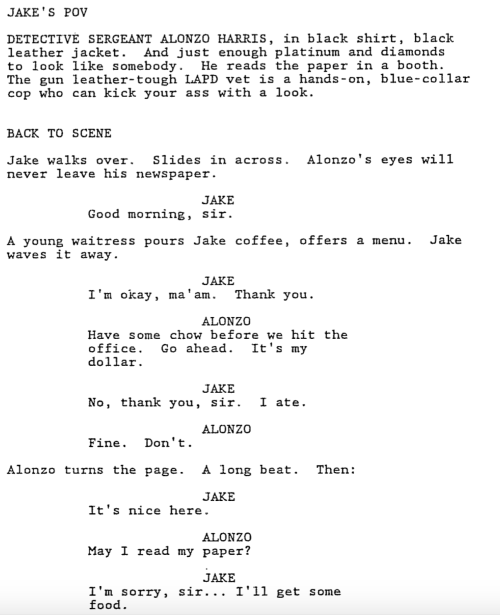
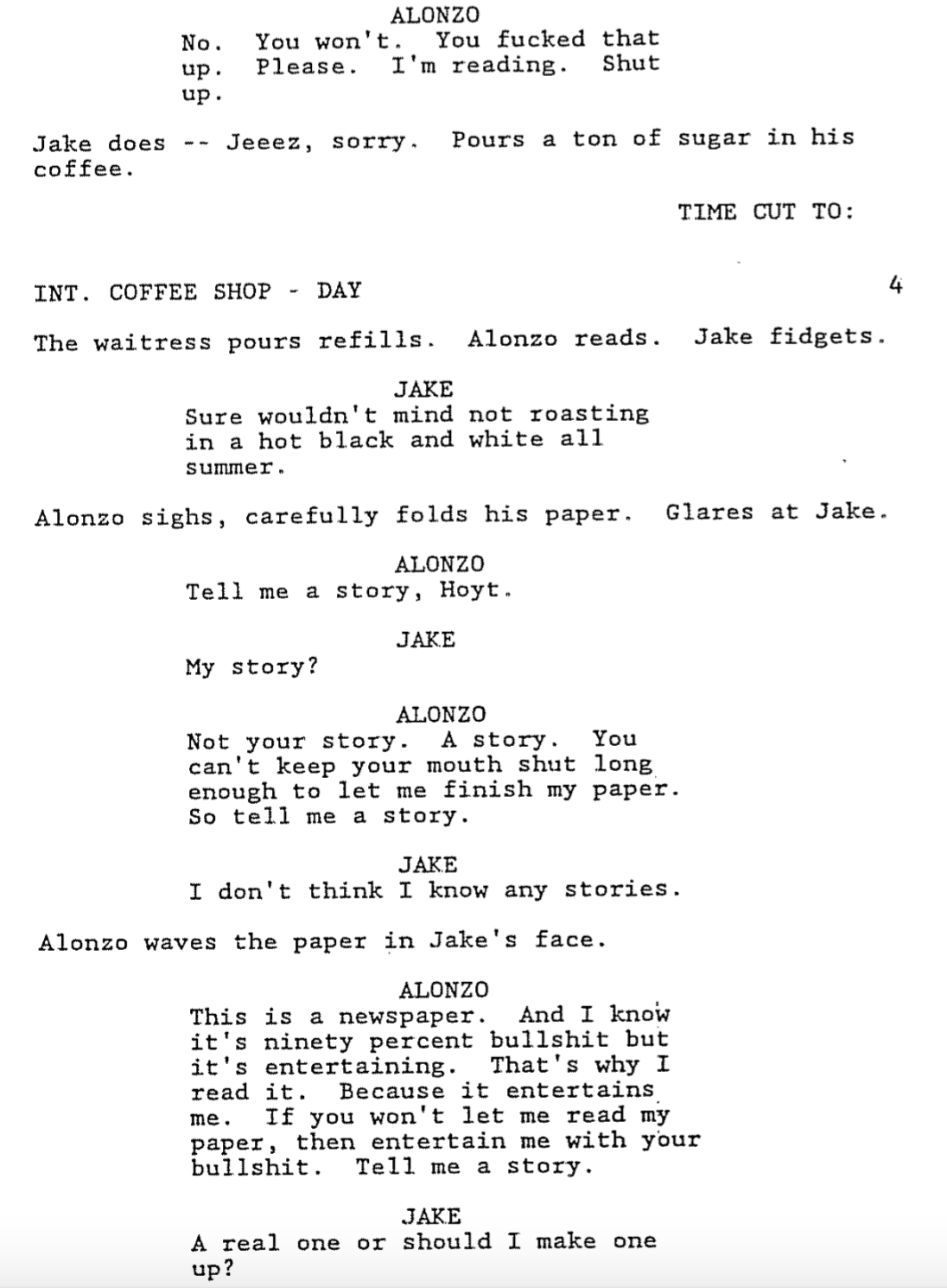
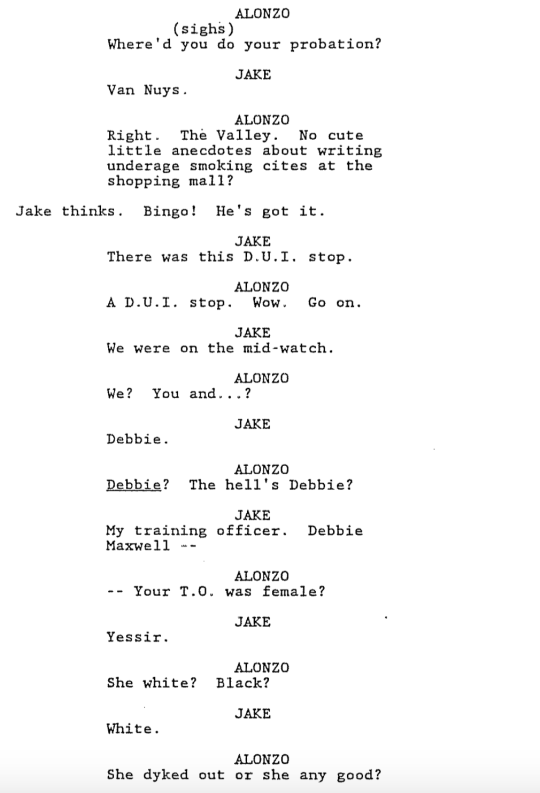
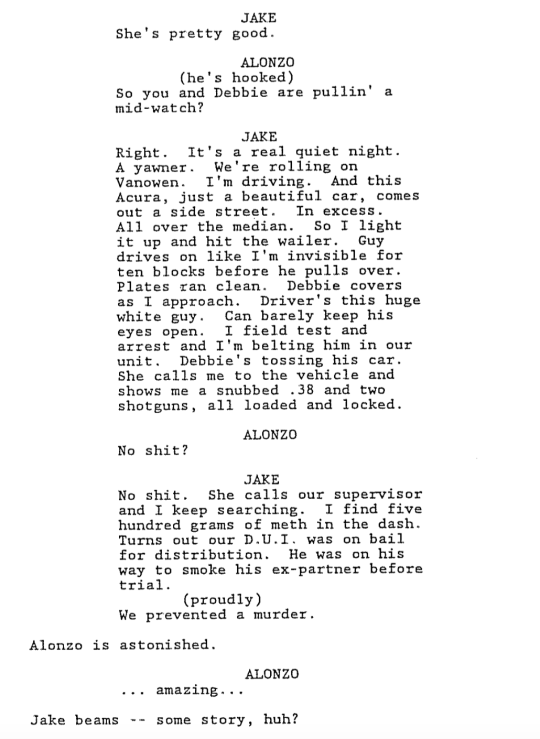
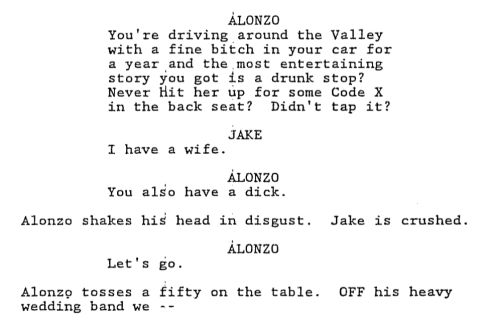
Okay, let’s jump into the easiest way to write a good dialogue scene. Are you ready? Give us one character who doesn’t want to talk and one character who does. That’s it! Boom! You do that, you will write good dialogue. I promise you. And that’s the whole premise of this scene. Jake wants to talk. Alonzo doesn’t.
I could stop there and you’d be halfway towards dialogue mastery. But I want to revisit this week’s theme. Which is that the best dialogue comes from what you’ve done BEOFRE the scene. Not during. We’ve built this entire movie around a dialogue-friendly character in Alonzo. He’s opinionated. He’s brash. He’s colorful. He’s un-p.c. He says the things you’re not supposed to say.
We then placed him across from a straight man. Dialogue-friendly characters work best with straight men. Two dialogue-friendly characters is like having two chefs in the kitchen. With that said, 2 DF characters can work. In Silver Linings Playbook, Pat and Tiffany were both dialogue-friendly and their scenes were great. But generally speaking, the rhythm of good dialogue follows a dominant and submissive pattern.
Which segues nicely into our next topic: power dynamic. Power dynamic is HUGE when it comes to dialogue. The very nature of somebody being “in charge” creates an imbalance. And that’s where the tension is. Tension is conflict. Conflict is drama. Drama is entertainment. In this scene, the power dynamic is obvious. It’s built into their job descriptions. But there’s a power dynamic to every conversation. Yesterday, the power dynamic was with the parents. They were in charge of the conversation. Chris was merely trying not to fuck up. In The Big Lebowski scene, Walter was on top of the power ladder, The Dude was in the middle, and Donny was on the bottom.
In this scene Alonzo’s power is SO MUCH HIGHER than Jake’s that Jake’s walking on eggshells the whole scene, which is what makes the conversation so fun. You can see Jake trying to say something – ANYTHING – to get Alonzo’s approval. If Jake and Alonzo are on the same power level, this scene doesn’t work.
It shouldn’t need to be said that dialogue reveals character. Which means you should be looking for opportunities to tell us about your character through the lines they deliver. Especially early in the screenplay, when we don’t know them yet. It just so happens there are a couple of prominent character revealing lines in this scene.
Alonzo is fed up that Jake won’t stop talking to him, so he demands that Jake tell him a story. Jake mumbles out that he does’t know any stories and Alonzo doubles down. Tell me a fucking story. “A real one or should I make one up?” Jake replies. I love this line because not only is it unexpected. But it reveals how indecisive and eager to please Jake is. I know everything I need to know about this character after this line.
Ditto Alonzo with his response to Jake’s story. Alonzo has no issues with telling Jake that his story sucked (he’s mean). And that getting laid is more important than preventing murder (seriously warped moral compass). In one sentence, we know just how screwed up and ruthless this man is. That’s good writing.
Let’s get into some minutiae. I love how Ayers says that Alonzo never stops looking at his paper during the conversation. It creates this literal barrier for Jake to bang up against for the first half of the scene. A lot of amateur writers assume you need to create the perfect circumstances for a conversation. It’s the opposite. You’re trying to find the angle that creates the most un-ideal circumstances for conversing. By forcing Jake to talk to a wall, it injects one more layer of conflict into a situation that’s already drowning in it.
Another example of this would be two people who meet at a loud club. They can’t hear each other. They have to keep saying, “What??” They misunderstand words, which leads to strange conversation tangents. That’s always going to be more fun than if they meet in a quiet room with no distractions.
I also love this exchange. “Have some chow before we hit the office. Go ahead. It’s my dollar.” “No, thank you, sir. I ate.” “Fine. Don’t.” Alonzo could’ve questioned what’s wrong with Jake here (“Who doesn’t eat at a diner?”). He could’ve challenged him (“You knew you were meeting me for breakfast and you already ate?”). Instead, he uses two words. “Fine. Don’t.” It’s savage. I actually shivered when I read those words. It’s a reminder that sometimes, the fewer words you use, the better. You don’t always have to craft a wonder-line.
Speaking of wonder-lines, there’s one flashy line in this scene. The newspaper line. And that’s appropriate. You shouldn’t be trying to win the lottery with every line. The very act of limiting yourself to one killer line ensures it will stand out. “This is a newspaper. And I know it’s ninety percent bullshit but it’s entertaining. That’s why I read it. Because it entertains me. If you won’t let me read my paper, then entertain me with your bullshit. Tell me a story.”
How do you write a line like this? Because I read a lot of amateur versions of this line. They come out more like, “Now you done fucked up. I can’t focus no more. All because you think you’re more entertaining than a newspaper. So if that’s what you think, then go ahead. Entertain me.” It’s clunky, not as clean. And doesn’t end with the same decisive POP that Ayers line does.
This is a case of a writer paying attention to his environment. You have this newspaper here. It’s already a major part of the scene. Let’s keep using it. But how can we use it to craft a great line? Start by asking questions. “What is a newspaper?” (It’s mostly bullshit) “Why is my character interested in this newspaper?” (it’s his calm before the storm) “What’s in here that he needs so badly?” (nothing really. But it’s one of the few things that entertains him. And since not many things entertain him, he values it).
You now have some PIECES you can use to form a line.
The answers to those questions pretty much form the basis of the first 75% of the line. Ayers then gives the line extra pop at the end by adding some wordplay. Entertainment and bullshit were featured words at the beginning of the line, so he brings them back at the end (“If you won’t let me read my paper, then entertain me with your bullshit”). There’s no science to this stuff but that’s one way of arriving at the line. Of course, for some writers, this stuff just comes naturally. Lucky bastards.
Finally, what I love so much about this scene is that while Denzel got a ton of credit for his performance, the truth is, it’s all there on the page. I don’t see that often. A lot of writers are wishy-washy and it opens the scene up for lots of interpretation. There’s no interpretation here. Any actor reads that beat of Alonzo keeping that newspaper up between him and Jake, and they know exactly who this character is and how to play him.
What I learned: Don’t over-describe pointless actions during heavy dialogue scenes. The less action you write, the more we can focus on what the characters are saying. Ayers writes barely any action here, and when he does, he keeps it to one line, except for a couple of times when it reaches one line and a quarter.
Now that you’ve read the scene, check out the finished product.