
Search Results for: F word
Guys, I’m too wrapped up in Thanksgiving duties to get anything up these next few days (fully expect to hear some jokes off of that unintentional phrasing). So I’ll leave you with some things to discuss, starting with Max Landis’s baffling decision to keep badmouthing his peers. Landis took to his favorite delivery device, Twitter, to tell the world that The Revenant (my old script review here) sucked, making fun of DiCaprio, Hardy, and Inarritu in the process. Is there anyone out there as confused by this as I am? I think Landis is operating on this belief that he’s “keeping it real.” And I suppose he is to a certain degree. But it’s a bad look when you’re attacking three of the most talented people in the industry while you’re putting out rotten turkeys like American Ultra and Victor Frankenstein. It’s kind of like the bat boy for the Seattle Mariners telling Derek Jeter his swing sucks. Wait til you get a jersey with your name on it before you start taking on the big boys.
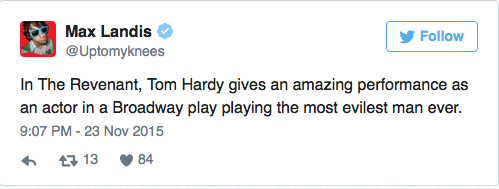
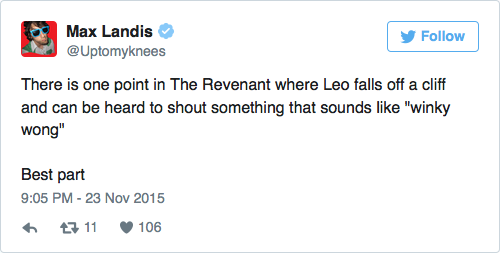
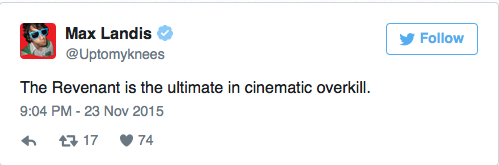
There’s a subplot to all this. After Landis’s American Ultra bombed, he went on a Twitter rant (man, this guy likes Twitter) about how his movie failed because the public only wants to see established properties and IP. They refuse to take a chance on something new. So the fact that he’s now writing about one of the most famous characters of the last 100 years, Frankenstein, should warrant an interesting reaction if the movie doesn’t do well, especially in the wake of the movie he’s blasting, which is about as original as a Hollywood film gets.
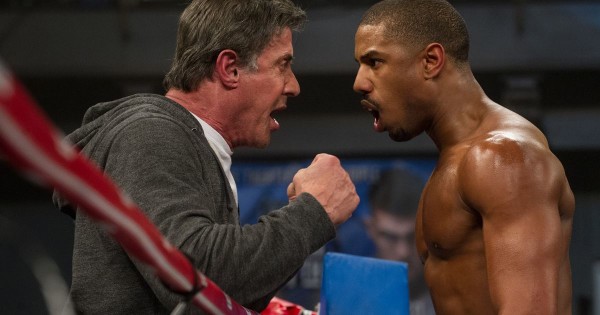
Moving on, Thanksgiving is usually one of the better moviegoing weeks, as studios try to capitalize on families being in that holiday group-activity spirit. But I can’t say I’m too excited about this week’s offerings. Pixar’s The Good Dinosaur looks to be aimed directly at the Kids Aged 2-4 demographic. And The Danish Girl seems to be less about telling a story and more about winning an Oscar for its lead. The wild card is Creed, with Fruitvale Station director, Ryan Coogler, coming back to direct his star, Michael B. Jordan, again in this Rocky 6.5 vehicle. Deadline had a nice interview about Coogler pitching Stallone on himself as director before he’d even made a film (he would direct Fruitvale later). One of the best things about the interview was Coogler realizing, while shooting, that a key punch in one of the fight scenes didn’t look real enough and the dilemma posed by getting Jordan to take a real punch despite not legally being able to tell him to do so. In today’s Concussion-obsessed world, that turned out to be a risky ass move.
I have a couple of issues with this one though, despite the trailers looking solid. First, Rocky Balboa (or “Rocky 6”) was way overrated. Stallone tried to make it out to be him “correcting his wrong” with Rocky 5, and making something grittier and more in tune with the original film. That’s great. But why the hell would your main fight be an exhibition match?????? One of the first things we’re taught in screenwriting is STAKES. The stakes need to be high for the audience to care. And the climax? The big fight? It has to have the biggest stakes of them all. So why should we care about a freaking exhibition bout? Huge screenwriting fuck-up there. They needed to figure that out before going in front of the camera.
The second issue is that, from the trailers at least, Creed is propped up on a shaky foundation. Jordan plays Adonis Johnson, the son of Apollo Creed, who famously fought Rocky Balboa in the first two films (and was killed by Drago in the fourth!). Somehow, Adonis has never met his father. And grew up in an orphanage or something. So let me get this straight. The son of one of the richest boxers in history didn’t inherit a single dime from him? I’m guessing he’s maybe an illegitimate child then? Hmmm, I’m smelling a fish. Clearly, they know this series works best with an underdog hero. And the entitled son of one of the best boxers in the world isn’t underdog in any sense of the word. This forced them to pull out all the stops to turn someone who would obviously be famous to someone who was unknown, hence the “foster child” angle. Whenever I feel those screenwriting gears straining underneath the page – especially when it’s to keep a franchise alive – I get skeptical.
But hey, I hope I’m wrong. Unlike Landis’s Victor Frankenstein, which is coming in at 13% on Rotten Tomatoes, Creed is trending at 93%, a full 80 points higher.
So, I send the question out to you now. What do you think of all this? And what are you going to watch this weekend (doesn’t have to be anything I’ve mentioned)? Just a warning: I will automatically delete anyone who answers, “Jessica Jones.” (that’s a joke btw – though I will be watching you – oh yes, I will)
Oh, and if all of that bores you, tell me what you think of the new Captain America trailer! Tony’s maaaaa-aaad…
Each week myself or one of the site’s readers will suggest an obscure, unknown, or under-appreciated film that you guys can then watch on a Lazy Sunday and discuss the screenwriting merits of. If you’re interested in submitting a suggestion, e-mail me at Carsonreeves1@gmail.com with the movie and a 300 word “pitch” on why you think people would enjoy the film. Together, I hope we can all find some hidden gems.
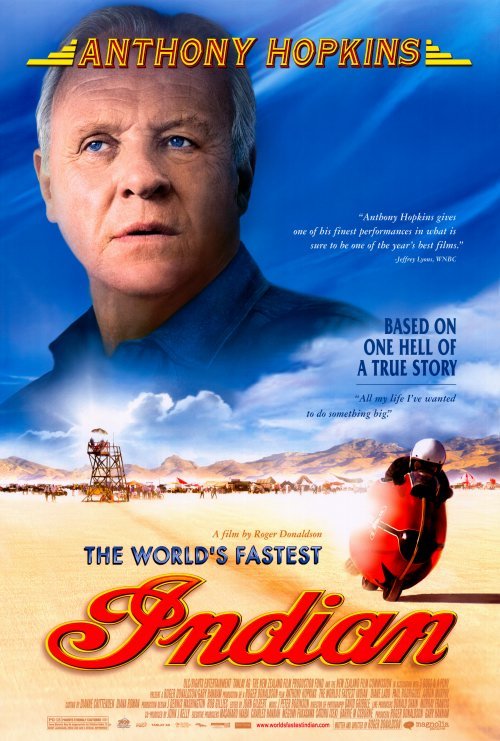
Today’s movie is The World’s Fastest Indian, a film that had the single worst title of any film, maybe ever. You put Anthony Hopkins on a poster next to the title, “The World’s Fastest Indian,” and everybody’s going to think that an old white man is playing an Indian who tries to run the 40 yard dash in the Special Olympics or something.
This movie is not that at all. It’s about an older simpleton from New Zealand who travels to America in the 1950s to try and set the motorcycle land speed record. His motorcycle is called “The Fastest Indian.” This is a movie that is guaranteed to make you feel good afterwards. If you are having a bad day, a bad week? Watch this film and all those yucky feelings will slip away. This has a character who is impossible not to root for. It’s basically a more grounded version of Forrest Gump. Enjoy!
Get Your Script Reviewed On Scriptshadow!: To submit your script for an Amateur Review, send in a PDF of your script, along with the title, genre, logline, and finally, something interesting about yourself and/or your script that you’d like us to post along with the script if reviewed. Use my submission address please: Carsonreeves3@gmail.com. Remember that your script will be posted. If you’re nervous about the effects of a bad review, feel free to use an alias name and/or title. It’s a good idea to resubmit every couple of weeks so your submission stays near the top.
Genre: Action Thriller
Premise (from writer): A troubled state police officer teams with his cantankerous war veteran father when he tries to rescue his younger brothers, two muscle car street-rodders who have gotten in over their heads transporting marijuana for a team of ex Special Forces assassins.
Why You Should Read (from writer): Because it’s a polished draft in a classic genre, with strong characters, crisp dialogue, and set in a unique world. This is by definition a low concept genre exercise, and yet these types of movies seem to get made all the time, albeit straight to VOD and DVD, so I’m hopeful that an AF spotlight might help get this script in front of the right eyes. It’s gotten a little bit of love on the contest circuit (Page Semi Finals and two rounds at Austin), and I’m optimistic that many of the great SS Faithful will enjoy it and that it will rise to the top if given a spot on AOW.
Writer: Scott Martin
Details: 105 pages
I pointed out in last week’s Amateur Offerings how much I liked this logline. A lot of you countered that it was too long. I agree that it’s long. But good writers can make long sentences work. And Scott’s a good writer who definitely made this work. I never had to reread the logline or stumble through any odd phrasing, something I do regularly with amateur loglines. I don’t know, something about this logline clicked.
And when Dead Drunk ended up winning the weekend, I felt vindicated. One of the truths screenwriters don’t want to admit is that a logline matters. If a reader reads a logline that’s unfocused, unsure of itself or badly written, they know that the script is going to be the same way. While the skill required to write a logline is different from the skill required to write a screenplay, good writers recognize that the logline is the bridge to a read and therefore practice until they get it right.
The only thing wrong with Dead Drunk’s pitch is that I’m going into it with high expectations. Good logline, runaway winner in the voting. I’m expecting a lot here. Let’s see if the screenplay delivers…
It’s Oregon circa 1974, right after the soldiers started returning from Vietnam. One of those soldiers is 25 year-old Jarret Westin, a ferry captain. Now since ferry captains don’t exactly rake in the dough, Jarret supplements his income by making marijuana runs into the big city with his older brother, resident troublemaker, Sylvan.
Ironically, these two have another brother, Wes, who’s a state cop. And when he gets word that his brothers are running drugs, he gives them a firm talking to and tells them it has to end. This leads to Jarret and Sylvan NOT ENDING anything, and picking up their latest shipment from the local pot farm.
While there, they don’t see a secret team of men stick the 1974 version of a car tracker (they had those?) on their car. Jarret and Sylvan don’t know it, but they’re about to be followed.
The two eventually catch whiff of the baddies following them and decide to make a run for it cross-country. The mysterious bad guys follow them, and then Wes and the brothers’ father, World War 2 hero, Delbert (does anybody in this family have a normal name?), follow the bad guys. As you’d expect, these three cliques all come crashing together, and not everybody survives the melee, with even the studs at risk of leaving the pile dead, drunk, or naked.

As I read through the first five pages of Dead Drunk and Naked, I started getting those stars in my eyes, those special Scriptshadow stars that lead me to call up industry folks and tell them that I think I found a winner.
We’ve got guys transporting drugs. We’ve got a brother who works for the state police trying to stop them. We’ve got some mystery dudes secretly throwing a tracker on their car. We’ve got a unique voice. A unique subject matter. This futhermucker was rolling in the right direction.
But I’ll tell you when the script slipped out of gear for me. It was in the first bar scene. Here we spend the first ten pages building up this exciting story, and then we pause all that to have our characters drink a beer for no other reason than to set up other characters, cover some exposition, and sling in some backstory. It was like going down that first drop on a roller coaster and then, right before you hit the loops, the coaster stops.
But while my harness may have loosened, I still wanted to complete the ride. There were so many promising signs. Like the way that Martin would take an extra beat every once in awhile to give us slightly more detail. Here’s what he writes in describing the main characters’ hometown:
Small-town Oregon in the heart of the Willamette River Valley — Willamette Falls, population 900 and shrinking.
Now that might not seem like much. But that last line is brilliant. Where most amateurs would’ve stopped at “Population 900,” Martin adds, “and shrinking.” With two simple words, he’s said so much about this town. It’s dying. An amateur would’ve spent a bunch of endless description detailing the abandoned town. Martin gives us, “and shrinking” and we know exactly what’s going on.
Also, I liked the mystery behind these killers. That’s the main thing that kept me turning the pages. I needed to find out who they were and what they wanted with Jarret and Sylvan. Because it wasn’t just about the drugs. They could’ve taken the drugs back at the farm. There was something more that they needed. And I needed to know that something.
But here’s where the script struggled. When you write a road trip film, and the people on that trip know each other, they need to be working through something. If there’s not some deep-set issue there, then there’s nowhere for the relationship to go. It’s just a bunch of dead dialogue. And we don’t get that only once (with Jarrett and Sylvan). We get it twice (with Wes and Dilbert).
Wes is probably the most interesting character of the bunch, as he’s the only one who has had anything of significance happen to him – his wife and kids have left him. But his wife is nowhere to be seen the entire movie. The person he’s with is his father. And his father appears to be supportive of him. Supportive fathers may be great for real life. But they’re horrible for movies. We need unsupportive. We need unresolved. And we weren’t getting that anywhere.
I read a script not long ago that had a similar setup, and the adult-son was still mad at his father for leaving his mom. So there was some actual conflict between the characters, something for them to work through over the course of the movie. I’ve said this before and I’ll say it again. You want your characters to agree on as little as possible. Disagreeing leads to conflict leads to relationship strife leads to relationship resolution, which is what movies are all about.
And look, I know you can go overboard with this stuff. The dreadful Free Fall proved that. But when I bring these things up, I’m not thinking about the cheesy on-the-nose version of events. I’m thinking about the “real world” version. I imagine authenticity dictating the plot – not “conflict for the sake of conflict.”
Now maybe the lack of relationship development would be acceptable if – IF – the characters were working through their own flaws. But out of our four main characters, I didn’t identify a single one that was battling something within himself. If you have a movie where the main characters aren’t trying to work through their own shit, I’m not sure you have a movie.
While I enjoyed the writing here, Dead Drunk & Naked suffers from a story that has too much stopping, too many meals, too many bar stops, and too much conversation about things that don’t matter. I’d love to see a story that’s more plot focused, that relies more on suspense (think the famous Cop across the street scene in Psycho), that has more urgency, and that has more character and relationship development.
Remember that character is not created through characters talking about one another. It’s created through action. Matt Damon doesn’t talk about how he wants to get off of Mars. He works on something every day to help him get off Mars. Dead Drunk & Naked needs more of that. Good luck, Scott!
Script link: Dead Drunk & Naked
[ ] what the hell did I just read?
[x] wasn’t for me
[ ] worth the read
[ ] impressive
[ ] genius
What I learned: Two characters talking about a third character in a non plot related way is almost always boring. Here’s some made-up dialogue to sell that point: “What do you think about Frank?” “I think he has issues, you know?” “Man doesn’t know right from wrong ever since he got fired from his job.” People don’t care. If you want to tell us who a character is, do it through an action FROM THAT CHARACTER. Which of these does a better job at conveying character? Luke: “Hey Obi-Wan, what do you think of that Han guy?” Obi-Wan: “Don’t like him. He’s entitled, you know? And he doesn’t even believe in the force.” Luke: “I haven’t seen him help anybody yet unless it benefits him.” Obi-Wan: “Selfish bastard.” VERSUS “Come help us save the Princess.” “No, go save her yourself.” “You’ll get a reward.” “Okay, what’s the plan?”
I am going to make a declaration at this moment that will change your life. I am going to guarantee (yes, I said GUARANTEE) that I improve the dialogue in your latest script. Guaranteed better dialogue, you say, Carson? How is that even possible? Are you a magician? Funny you should ask. I am. And today’s magic trick is going to make Harry Potter s&%# his pants.
You see, I’ve been reading your Scriptshadow 250 entries, and one of the things I haven’t been too impressed with is the dialogue. Much of it is, shall we say, uninspired. So I cooked up some eggs (I do this whenever I have deep-thinking sessions) sat down with myself, and I asked myself, “What can I tell these eager screenwriting mavens to help them better their dialogue??” About five eggs in, after getting a good egg-buzz going, it came to me like a rooster at sunrise.
Dialogue… is differlogue.
Do not avert your eyes. Because yes, it just happened. I made up a word, my friends. One that I will be submitting for entry into Webster’s Dictionary as soon as I finish this article. You see, the main issue with all the dialogue I’ve read… IS THAT IT WAS ALL THE SAME. The sentence structure was the same. Everybody said the same things. Everybody spoke in the same cadence. Everybody had the same personality. These writers were not aware of life’s three essential truths. The right to freedom. The right to happiness. And that dialogue is differelogue.
The concept behind differlogue is simple. Good dialogue is derived from two characters who speak differently. The contrasting styles bring a natural spark to the conversation. If a depressed DMV worker is speaking with another depressed DMV worker, the personality of the dialogue is going to be very one-note (read: boring). But if you pair a depressed DMV worker with an over-sharing optimistic 17 year-old cheerleader, now your dialogue comes to life via the power of contrast.
DIFFERLOGUE!
You achieve differlogue by figuring out what makes a character unique, and then giving them an IDENTIFIER that will subsequently inform the way they speak. Once you’ve assigned identifiers for each character, put them in a conversation together and watch your dialogue come alive. There are literally hundreds of identifiers you can use for characters, but to start you off, I’ll list 15 of the most common ones. Here we go!
1) The Chatterbox – You know this person. Everybody has one in their life. They talk and they talk and they talk and they WON’T SHUT THEIR TRAP. They’re usually super annoying, and therefore perfect for characters you want your reader to dislike. However, you can use the chatterbox in endearing ways as well, such as with Lloyd Dobler in Say Anything.
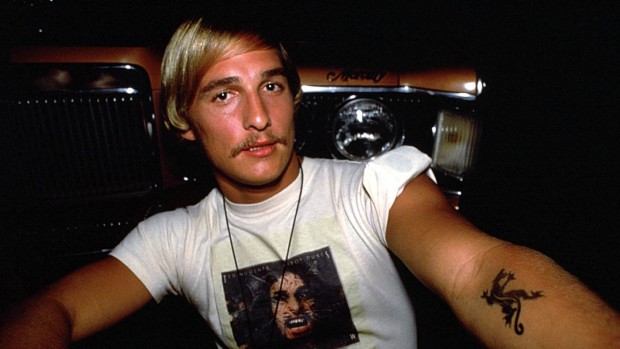
2) The Cool Cat – The cool cat tends to take their time when they speak. They’re in no hurry. And they don’t care if you are. Unlike the chatterbox, who says a lot, the cool cat usually chooses his words carefully and says little. Check out Matthew McConaughey’s famous character from Dazed and Confused to see the cool cat in action.
3) The Nervous Nellie – This character hates talking. Every sentence is an adventure for them and they’re 90% sure they’re going to fuck it up. They’ll often stop mid-sentence, think back, re-phrase things, before stumbling forward again. These people don’t like to talk. And you can hear it in their voice.
4) The Impatient – These people have a million things to do and they consider a conversation with you as a necessary obstacle to achieving these things. For this reason, they spit out their words quickly and expect quick answers. There’s an underlying tension when these characters speak as their impatience puts pressure on others to keep up. A lot of bosses will carry this tone, but there’s no reason why you can’t assign the impatient to your hero’s wife (or even 5 year old son!).
5) The Clown – Some people can’t go ten seconds without making a joke. Humor is their way of getting noticed and also their defense against a cruel cruel world, so they’ll use it when times are good and when times are bad. Don’t be afraid to play with these characters. For example, you can make them genuinely funny or embarrassingly unfunny. Each will have a different effect on the dialogue.
6) The Movie Star – No, I don’t mean a literal movie star, I mean the kind of character who oozes so much charm, so much confidence, so much swagger, that they come off as larger than life. The ultimate “Movie Star” character is Tony Stark, aka Iron Man.
7) The Internal – This character speaks even less than the cool cat. They don’t think talking is worth all the trouble. If they have something important to say, they’ll say it. Otherwise they either answer in 1-3 word sentences or not at all. A great example of The Internal is Mike from Breaking Bad and Better Call Saul.
8) Sarcastic Sam – A close cousin to the clown, think of Sarcastic Sam as an opportunist who’s always looking for the perfect moment to bust out his favorite sentence-toy, sarcasm. “You cold? You look cold.” “Oh no, my face is always the color of sea water.” Even when Sarcastic Sam isn’t being sarcastic, you get the sense that he’s waiting for the next opportunity.
9) The Military Man – These characters tend to speak very formally and get straight to the point. Like The Impatient, they create tension in a conversation, but the military man is more respectful and engaging. Still, these characters will rarely add flavor to anything they say. They keep it vanilla unlike Godzilla. The ultimate military man was Colonel Fitts from American Beauty. But there’s no reason why you can’t assign “Military Man” to a babysitter, a 7-11 checker, or a UPS delivery woman.
10) The Used Car Salesman – These characters always seem to be selling you something, even when there’s nothing to sell. They also always seem like they’re hiding something or know something about you that they’re keeping to themselves. These characters always keep you off-balance since you can never trust a word they say.
11) Debbie Downer – This person finds every opportunity to rain on your parade. Tell him it’s nice out? He’ll counter with, “Enjoy it. It’s supposed to rain tomorrow.” Compliment his tie? He’ll point out, “It’s my father’s. He died last month.” Take him out for his favorite ice cream. He’ll take one lick before proclaiming, “It was better last week.” Nobody likes a Debbie downer, but they can be a joy to write dialogue for.
12) The Know-it-All – The know-it-all doesn’t need much explanation. He knows it all. And he’s going to tell you every chance he gets.
13) The Queen Bee – The Queen Bee, like everyone here, is not gender specific. It can be a woman or a man. It signifies someone who’s in charge and uses that power to influence the world around them. These characters have a way of talking down to you like you’re five.
14) The Scatterbrain – The scatterbrain usually has 15% of his brain dedicated to the current conversation and 85% to all the other shit they have to do. The scatterbrain will ask for a lot of “Say that agains” and pepper his speech with plenty of “uh-huhs” even though he’s rarely listening.
15) The Guarded – The Guarded speaks very carefully since they don’t trust people. They believe everyone they talk to wants something or knows something about them, and therefore a conversation with The Guarded is sort of like a chess match. You have to make the right moves to get more out of them. Otherwise, their measured approach will stonewall your ass.
These are just 15 examples but there are plenty more out there. If you’re looking to add to the list, find your favorite movies and see if you can label the main characters with an identifier. Now some of these might seem a bit broad, but they’re just starting points. There are shades of gray to each. And you’ll find that some of your favorite characters ever fall into these categories. Robert DeNiro in Heat is a Guarded. Andy Dufresne in Shawshank Redemption is an Internal. George McFly in Back to the Future is a scatterbrain.
But the real power of these identifiers comes when you do two things: Use them against type and pit two opposite identifiers against each other. For example, to go against type, make a dorky 13 year-old the Queen Bee. Or make the CEO of the biggest company in the world a Nervous Nellie. The irony should add a little extra kick to the dialogue. Then, to really have fun with dialogue, pit the most contrasting identifiers against each other. A Negative Nancy with a Movie Star. A chatterbox with a Guarded. A know-it-all with a military man.
In fact, I want you to do that right now. In order to see the power of the differlogue, take a couple of the above identifiers, opposite ones preferably, assign them to two characters, then go write a scene. You’ll notice your dialogue getting better right in front of your eyes. From there, you’re only steps away from utilizing this tool in your current screenplay. I’d ask you to post your results but there isn’t any point. All of it will be genius. Have fun writing the best dialogue ever!
Can two of the hottest new names in film bring life to the overexposed city of Boston? Let’s find out!
Genre: Crime Thriller
Premise: A gun deal in Boston (1978) between the Irish and some local Bostonians goes horribly awry.
About: We’ve got a live one here folks. Everyone’s been telling me that this Ben Wheatley guy is the oak tree’s knees. I’ve been informed I HAVE to see his breakout movie, Kill List, a dark flick about a hitman. And that his upcoming High Rise, starring Tom Hiddleston (Avengers), is gaining a lot of heat as well. Free Fire stars Brie Larson, Armie Hammer, Cillian Murphy and Sharlto Copley. It finished production recently and is currently in post. Expect it in 2016.
Writer: Ben Wheatley
Details: 96 pages – unknown draft
I didn’t know who Ben Wheatley was until last week, when he started popping up on a bunch of web sites and people started e-mailing me that he was the best up-and-coming director since Tarantino. I knew Brie Larson of course. But after Room, she went into that upper stratosphere of actresses I will check out anything they’re in from now on. That girl’s going to win the Oscar.
So when I heard these two were doing a movie together, I just about flipped. Until I saw what movie it was: Free Fall. FREE FALL??? That vapid glorified beat sheet about a girl who climbs a mountain with her dad?? Nooooooooooo!!!
I was so depressed. Until I looked a little closer and saw that the project was actually titled Free FIRE. “Fire.” Not “Fall.” Oh, thank god. I can’t tell you how happy that made me. Time to find out if one of the buzziest projects in the industry is worthy all the hype…
It’s 1978. It’s Boston. Back in Ireland, the IRA is terrorizing the country. Frank and his underling, Chris, are a couple of Irishman who need guns to help fight that war. But this isn’t modern times where you can buy a snazzletooth L14 doppleslicer on Amazon and then 3-D print it four minutes later. They didn’t even have the internet back then. Which meant people had to buy weapons the old fashioned way – in sketchy warehouses in the bad parts of town.
Which is where Chris and Frank are. Accompanying them is Justine, a Swede who’s brokered this deal. Whereas everyone else is rough around the edges, Justine wears an expensive suit and looks as clean as a brand new 1978 Cadillac. Hell, she might even resemble the 1979 model.
On the flip side, they’ve got Steveo. No, not the half-retarded jackass from Jack-Ass, but he might as well be. Steveo’s already high on heroin when he shows up and sports a shiner from a mysterious run-in last night. Frank did NOT want Steveo on the team but he didn’t have a choice. They needed a man. Their usual guy pulled out. Call goes out to Reject #1.
The group heads into the warehouse. Leading the dealer side is a U.S. military man named Ord. He’s the kind of guy you want leading you down the trenches in Nam. His professionalism is downright intimidating, and he assures Frank that everything’s going to go smoothly and they’ll all be home with their children within the hour.
Wait a minute, Frank thinks. Since when were things NOT going to go smoothly? Why would they have thought otherwise? Oh yeah, we’re dealing with guns. LOTS OF GUNS. And when you deal with lots of guns, there’s always the possibility that something will go wrong. And something does go wrong. Frank was told that they’d be buying M-16s. But Ord has AR-18s, an inferior gun, instead. Frank’s pissed but they need these guns badly.
Meanwhile, one of Ord’s men, Harry, keeps eyeing a twitchy Steveo. There’s something familiar about this nitwit. The high-as-a-kite Steveo notices the attention and tries to play it cool, until Harry realizes where he knows him from. Steveo was part of a gang that bruised up his peeps last night, one of whom was Harry’s 17 year-old cousin. Harry starts chirping at Steveo, who swears he doesn’t know what Harry’s talking about, but the exchange gets louder and louder and, oh yeah, don’t forget there are over 200 guns sitting around…
I think you know which direction this safety switch is being flipped. Everyone scatters and a gunfight ensues. Like, the gunfight of all gunfights. To make matters worse, a third party starts firing AT BOTH SIDES from deeper inside the warehouse.
The. Fuck??? Who are they??? Nobody knows. But when everyone gets to cover and half of them are dead or dying, the sides will have to negotiate a way out of this mess, a task that no one seems up to. This gives us the distinct feeling that nobody’s getting out of here alive.
Let’s begin with Wheatley’s writing style, shall we? This might be the first professional screenplay I’ve read that was written on an iPhone. Contractions, capitalization, and punctuation (I’m talking essential punctuation, like periods) are scuttled in favor of text-like dialogue exchanges. Those of you who’ve gotten to know “Name” in the comments section and his infatuation with centering titles, would probably watch his head explode if he read this.
Now you may think I’d rip a script to shreds for this because that’s what I’d do if this were an amateur. So I’ve got to be fair, right? Well, I also know that this is a writer-director. And that means he’s not writing his script to get through the 15 levels of Hollywood “yeses” required before the script can be sent to a director. HE IS THE DIRECTOR. For that reason, fair or not, he doesn’t have to play by the rules. It’s the same reason Quentin Tarantino can make 800 spelling mistakes. His movie is already guaranteed 50 million for production the second he types the final period.
And hey, to be honest, I kind of dug this writing style. No, I don’t want you to adopt it. But dialogue is supposed to read quickly. And this text-approach without big letters and contractions and punctuation to muck up the words read super-fast. Since this was a dialogue-centric script, and since that style worked, I was liking what I was reading.
And in the end, all that matters is that the story works. And this story works. Not only that, but it’s unlike any script I’ve ever read. It’d be like if Martin Scorsese wrote a contained thriller. Ever fathom that? That’s exactly what you get here.
The script opens with a build. We’re building towards something important, and as each page goes by, the implication of just how dangerous this deal is grows. You know how I tell you guys to utilize an IMPENDING SENSE OF DOOM in your horror scripts? Imply that something bad is coming, then milk the suspense up until the point where you release the doom? Well, you can do that in any genre, and Wheatley does it to perfection here.
We get inside this warehouse and we can just tell something’s going to go wrong. Everybody’s so careful, but they’ve all got itchy trigger fingers. And itchy trigger fingers during a gun deal are liable to start scratching at some point. Bullet-scratching that is.
Remember back when I reviewed Jack Reacher? I told you that a scene that ALWAYS works, is to put two characters together who don’t quite know each other, and have one character cleaning or fixing or tending to a gun. The tension from that gun being in the middle of those characters brings the conversation alive. Because the audience knows that the potential for danger is just a flick of the wrist away. Well, Ben Wheatley has taken that concept and multiplied it by 1000. It isn’t just one small gun between our characters. It’s a couple hundred big guns.
With that said, when the giant gun fight finally begins (around page 40) and ends (around page 60), all of that built up tension is gone. We feel a bit like we’re laying around after sex. Sure, there’s the chance that the two of you could go again. But it’s not going to be as good as the first time, which was the release of an entire night of built-up sexual tension.
Indeed, these guys are talking back and forth with each other, trying to negotiate a solution, and we’re sort of like, “None of this is going to be as good as that earlier gun-fight.” What they needed to do was play up the mysterious third party A LOT MORE. Had they done that (and no, I don’t know why I’m referring to Wheatley as “they” now either), they might have had something to fill this new drama-free second-act void they’d created.
But the script excels in that it isn’t like anything else out there. Wheatley takes what’s typically a mid-script set-piece or a third-act climax and builds an entire movie around it. That’s forward-thinking and implies a storyteller who doesn’t see the world like the rest of us. If you can see the world differently from everyone else yet still see it in a marketable way, Hollywood won’t just let you through their doors, they’ll personally find you and drag you through them.
[ ] what the hell did I just read?
[ ] wasn’t for me
[x] worth the read
[ ] impressive
[ ] genius
What I learned: I have a plea for all future writers of crime screenplays. Please please PLEASE do not use Russians. Using Russians as bad guys is so beyond cliché at this point, it’s embarrassing. It was so refreshing to read a crime script without Russians for once. And yes, I get that it was set in 1978 where you wouldn’t see Russians, but still. Use anybody but Russians, or any Eastern European countries for that matter. You’re more imaginative than that!
What I learned 2: RELEASE THE DOOM! How do you build a story? Find a point in your screenplay where doom is unleashed (aka – a huge gunfight). Then retrofit your story to slowly build up until that moment occurs. As long as we feel like things are building, we’re going to stick around until you hit us with the doom.