
Search Results for: F word
Today I get a momentary respite from the Scriptshadow 250 to review a real-live spec sale. How does a 500 thousand dollar script hold up against your contest entries?
Genre: Fantasy
Premise: A cancer-stricken teenager gains cartoon powers when he finds a magical doorway that leads to a cartoon universe inside his missing father’s old office.
About: This script just sold a couple of weeks ago to Warner Brothers for half a million bucks! The writer, Mike Van Waes, used to be an assistant at the Jim Henson Co. and, not surprisingly, has his own web comic (called Vexed Wisecracker – write what you know!). The script sold without an attachment. Nice!
Writer: Mike Van Waes
Details: 118 pages – July 2015 draft
It’s happening quietly. But it is happening.
Specs are selling, my friend.
A sci-fi spec called Ascension just sold yesterday and Matthew Vaughn(!) is going to direct it. Matthew Vaughn tends to direct IP property that he finds himself. So him attaching himself to an original spec is a big deal. With the recent sale of The Virginian, and now Hammerspace, the spec market has quietly come alive.
I want to ask why but I also don’t want to ask why. This is one of those waves you just ride.
Mason Mulligan is 16 years old and doesn’t have a lot of time to live. He’s been diagnosed with an aggressive form of cancer, and sometimes simply getting out of the house is difficult for him. Not that Mason is feeling sorry for himself. He hates that his mom babies him. And that his younger brother, Wyatt, has been tasked by said mom to follow him around and make sure he’s okay.
One day, in a fit of rebellious angst, Mason heads over to the decrepit roller rink his father used to use as an office. Mason’s father, Henry, is the creator of Hammerspace, a popular “Spongebob Squarepants” like character who a comic book company bought off him early and turned into a smash hit on every platform imaginable. Unfortunately, because of a bad deal, Henry never saw any of that money. That might have contributed to Henry disappearing. That’s right, nobody’s seen Mason’s father in two years.
Anyway, while reminiscing at the old rink, Mason finds a magical key that allows him to open up a magical locker that takes him into a Narnia-esque animated universe where he meets Punchy, the 3 foot-tall squattish overly-happy main character his father created. Punchy is so excited to meet another human being besides Henry that he follows an annoyed Mason back into the real world.
Meanwhile, Mason starts to gain animated powers, like the ability to walk on air, get slammed by a frying pan with no repercussions, and defy human physics. As fun as that is, Mason learns through Punchy that his father might still be alive in the animated universe, which means he must find and confront him about why he left the family.
As most of you know, I’m reading through 250 amateur screenplays for the Scriptshadow 250 contest. It’s nice to mix in a professional script that just sold, as I can ask myself, What is it that this guy’s doing that the contest entrants aren’t doing? Why did his script sell?
Well, for starters, you gotta be professional. I know that’s a vague term so let me elaborate. I was reading a contest script yesterday. I was five pages in and I liked what I’d read so far. Then I saw a misspelled word. It was a minor mistake, but it was a mistake nonetheless. To the outside observer, this might seem like an overreaction. Who cares, right! But to someone who’s read thousands of amateur screenplays, this was a red flag. I’d seen it so many times. A red flag in the first five pages ALWAYS leads to more red flags.
Sure enough, on the very next page, the paragraphs started to get longer. They went from 3-4 lines to 5-6 lines. A writer who isn’t putting in the effort to keep his paragraphs short and to the point? Who’d rather be sloppy and redundant, making the read more of a chore? Red flag.
In the coming pages, more spelling mistakes. And now misused words were showing up. And the dialogue, which was crackling before, was becoming sloppy, as if the writer was no longer proofreading what he read. He was just flying by the seat of his pants and refusing to do any rewrites.
Naturally, the story continued to get sloppier, to the point where I didn’t even know what was going on. And it was only page 25. That’s why when I see that early red flag, I always cringe. It’s like seeing an ant in your apartment. THERE’S NEVER JUST ONE ANT. There are more lurking. It’s only a matter of time before you find them.
Hammerspace was tight and professional. No red flags. You could tell this script had been combed over, outlined, rewritten, double-checked, triple-checked, quadruple-checked. Doesn’t matter if you hated the script. You could tell that the writer made a professional effort. And while I shouldn’t be praising a script for that (professionalism should be a given), I see it so rarely on the amateur level, that I do appreciate it whenever I encounter it.
Now, what about the story? That I’m less sure of. Hammerspace takes a familiar concept and explores it through a new medium. We’ve seen the normal guy who gets super powers, of course. Hammerspace asks, “What would happen if you got cartoon powers?” My question is: Is that a compelling question?
Because while I liked the idea of a kid whose cartoonist father disappears and he goes looking for him only to end up in the cartoon space he created, this is less about that storyline than it is about Mason being able to walk on air and survive zany moments like being hit with a frying pan. The gimmick gets old quickly and never really gets used in an interesting way.
I actually thought Hammerspace was going to be darker. It starts off with this terminally ill kid dealing with the end of his life and his father who went missing two year ago. But as the script went on and it focused more on the aforementioned powers and the silly character of Punchy, it felt more like the cousin of the Goosebumps movie opening this weekend.
And that may be exactly why franchise-starved Warner Brothers bought it. But I guess with the script teasing something darker, I felt let down.
I also don’t think the script had a strong enough narrative engine. Once Punchy E.T.’s himself into Mason’s life, it isn’t clear where the script wants to go. The dad stuff is still always looming, but never quite thrust into the spotlight, leaving for a lot of characters wandering around and getting into random hijinx (here comes the bully!).
Contrast this with the similarly-conceived Ready Player One, about a kid going on a quest inside a popular video game universe, where the goal is clear. Solve the riddles that the creator placed in his game. If you solve them all, you get the creator’s entire trillion dollar fortune, as well as the game itself. Talk about clarity and high stakes. We never had that here. Or, to put it in Scriptshadow terms, the GSU was muddled at best.
I don’t want to sound like a bummer. I’m just not sure where they’re going with this. They could either Charlie Kaufman this motherfucker or turn it into the next Zathura. Right now it’s riding somewhere in between, and that’s probably why I didn’t respond to it as much as I wanted to.
[ ] what the hell did I just read?
[x] wasn’t for me
[ ] worth the read
[ ] impressive
[ ] genius
What I learned: Sophistication of Presentation. Sophistication of Presentation is the minimum level of skill you’re required to display on the page in order for the reader to judge you solely on your story (and not on your writing ability). Sophistication of Presentation isn’t just about avoiding spelling and grammar mistakes (although that’s part of it). It’s about having a strong understanding of sentence structure, of vocabulary, of how people speak to one another. Here’s an early line of dialogue from an uptight female friend of Mason’s in Hammerspace: “But maturity is more a state of mind. Don’t you think? Like, a search for greater meaning. Intellectual curiosity. Finding the poetry within what others find trivial.” This is a writer who clearly paid attention in their English and writing classes, someone who passes the “Sophistication of Presentation” bar. What I usually encounter is something more like this: “You’re not a mature person, Joe. You should stop being an a-hole and learn more to be a person of intelligence.” Do you see what I mean? There’s a lack of sophistication to that sentence. When I see that lack of sophistication displayed throughout the script, it’s a quick sign that the writer isn’t ready for the big leagues yet.
How could I have been so wrong about a screenplay?

Genre: Biopic
Premise: We follow Apple co-founder Steve Jobs through three of the most important presentations of his life.
About: This film’s history is almost as storied as Steve Jobs himself. The infamous Sony hack revealed that David Fincher never really connected to the script. When he declined, so did leading Steve Jobs candidate Christian Bale. Sony head Amy Pascal didn’t really like the script either, waffling every time she was encouraged by producer Scott Rudin to put it into production. Eventually, the project had to move to Universal, where B-team Danny Boyle and Michael Fassbender came to the rescue (give me that B-team any day of the week!). But would it be enough to make the film a must-see? It’s looking promising. The film opened in only four theaters this weekend, but grossed a staggering 500k per screen. For comparison, American Sniper, released via the same strategy, grossed 600k per screen.
Writer: Aaron Sorkin
Details: 2 hours and 2 minutes long (off of a 177 page screenplay)
I gave the Steve Jobs screenplay a “wasn’t for me.”
Can I have a redo?
Hello. (Again).
Steve Jobs: The Film, knocked me on my ass, held me down, and tickle-tortured me until I couldn’t breathe anymore. And yet I couldn’t shake that “love-hate” relationship a proper tickle-torture leaves you with.
This movie works. And it shouldn’t have. It’s too different. Too repetitive. Led by too big of an asshole.
But somehow, “Steve Jobs” avoids the spinning pinwheel of death and replaces it with a Spotlight engine that always finds the exact PDF script you’re looking for. And that’s thanks to two people. Danny Boyle and Michael Fassbender.
I’m always the first to say that no director or actor can overcome a bad script. But every once in awhile, this proclamation bites me in the ass. If you find a chunk of ass on Sunset Boulevard, please return it to me.
“Steve Jobs” follows Apple co-founder, Jobs, through three of the most important Apple announcements in history – when Jobs announces the original Mac, when he announces the NEXT system, and when he announces the original iMac. Each mini-story centers on the half-an-hour leading up to his presentation, leaving Jobs to spar with all his nemeses in the meantime. These include: his boss John Sculley, his programmer, Steve Wozniak, his marketing director, Joanna, his other head programmer, Andy Hertzfeld, and his daughter, Lisa.
If you remember, my problem with the script was two-fold. First, the 3-act structure was too repetitive, with every act taking place right before a big presentation.
This got tiring when it was just words on a page (in a 177 page tome, mind you), but Danny Boyle did an EXCELLENT job translating those pages to images. He constantly moved us through the buildings so that most conversations took place in new environments. And most of the time, he’d make sure those environments added something extra to the scene.
For example, in the script, it felt like every Jobs-Wozniak conversation was the same. But in, for example, Jobs and Wozniak’s third act confrontation, Boyle has the two barking at each other in the auditorium with Jobs on stage and Wozniak 20 seats deep. By forcing the two to hash things out in front of numerous Apple employees, it gave the conversation an energy you just couldn’t feel on the page.
The second problem with the script was our unlikable main character, Steve Jobs himself. The man was a total prick on the page. But Michael Fassbender gave the character life. And you know what? He didn’t exaggerate Steve’s positive traits in some desperate bid to make him likable. He played him like a real guy who understood his flaws and did his best to manage them.
His scenes with Joanna (Kate Winslet) were particularly persuasive for a couple of reasons. First, he respected her. And second, he had a LOT of scenes with her. So a lot of the movie is Steve talking to a woman that he respects the hell out of. This evened things out when Steve belittled other characters. We knew there was a good side to this man. He merely had a hard time finding him.
Also, he was so sweet to his daughter. In the script, it felt like he was merely tolerant of her. But here, he clearly connected with and loved this girl. That one-two punch (his connection with Joanna and also with his daughter) made me see that Steve Jobs could be good, and even wanted to be good.
Now let’s get to what the script did REALLY right. When you read an Aaron Sorkin script, the first thing you want to talk about is DIALOGUE. It’s what he’s known for. It’s what he does best. So you’re always seeing what you can learn from the master. I learned a lot.
First, almost every single conversation was laced with a ton of conflict. Jobs battling with Lisa’s mom over whether she deserves his money. Jobs battling with John Sculley about the reason he was fired from Apple. Jobs battling Andy Hertzfeld about making sure the Mac said “Hello” during the inagural presentation. Jobs battling with Joanna about whether he should pay for his daughter’s Harvard tuition. Jobs battling with Woz over acknowledging Woz’s Apple II team.
Remember, heavy conflict dialogue is some of the easiest dialogue to write because it’s clear what needs to happen in the scene (each character must try and “win” the argument). When your dialogue is conflict-less — when there’s nothing to “win” – that’s when you’ll find characters struggling to say interesting or meaningful things.
I’d say 75% of the scenes here involved heavy-conflict. That’s not by accident. Sorkin knows that’s where dialogue thrives.
Sorkin is also known for his obsession with the walk-and-talk. He uses it so frequently that it’s become a walking joke. And we see a lot of it here, where Jobs is moving throughout the buildings, taking on character battles every time he’s on the move.
Well, the walk and talk is not just a way to keep the scene moving. It’s also great for dialogue. When you have characters walking, you create a journey, and a journey isn’t over until the characters reach their destination. Until that happens, you have your audience on a line, which means you have their attention. Simply put, your audience is more focused on dialogue when your characters are moving since their attention will be heightened until the destination is reached.
That’s not to say you can’t make a conversation interesting when characters stand in one place. There’s plenty of that going on here as well. But the next time you watch a film, all else being equal, keep tabs on how attentive you are when characters are walking and talking as opposed to when they’re stationary. You’ll find that you’re a little more tuned in when they’re on the move.
It’s similar to putting time-constraints on dialogue, which, not surprisingly, Sorkin does as well. This whole movie is a time constraint. There isn’t a single conversation that takes place where Jobs isn’t in a hurry – where his presentation isn’t a few minutes away. And Sorkin always saves the most important conversations for right before the presentation.
THIS IS NOT BY ACCIDENT.
We naturally feel more anxious the closer we get to a deadline (in this case, Jobs’s presentation). So if you place a big conversation right before a deadline, we’re LOCKED IN. We’re worried about our character making the impending time constraint, so we’re secretly pushing for him to hurry his conversation up. The problem is, the conversation is important, so we’re tuned into that as well. This means we’re tuned in on all frequencies, creating a sense of extreme focus.
It’s no coincidence then that the biggest conversation of all (between Jobs and his daughter before the final presentation) occurs AFTER Jobs’s presentation is supposed to start. That’s right, for the first time in the film, Sorkin pushes us PAST his start deadline, heightening our awareness beyond any and all previous levels so we’re super-tuned in. The dialogue sizzles in part because there is so much weight placed on every word. I mean, Jesus, the whole world is impatiently waiting for our hero downstairs! Does it get any more intense than that?
For contrast, imagine Jobs trying to have the same conversation with his daughter on a lazy Sunday afternoon, at his house, with all the time in the world, each character perfectly relaxed. Sound like a conversation that’s going to knock your socks off? My guess is probably not.
These are all things I’ve talked about before, though. You’re probably looking for more in-depth tips this Sorkin go-around. What does Sorkin do that makes his dialogue crackle where so many others fizzle? I noticed a few things. Once Sorkin sets up the basics (heavy conflict, a time constraint, characters on the move), he weaves in a variety of conversational variables. Here are some of the big ones I noticed.
1) Asides – A character will all of a sudden take us on a tangent. They’ll say something like, “When I was eight, do you know what the most important thing in the world to me was?’
2) Jokes – Characters crack jokes, sometimes self-deprecating, sometimes at the other character’s expense. A good joke relieves tension, preventing the dialogue from getting too melodramatic.
3) Zingers – Sorkin loves Zingers. Have a character say something derogatory to another character, then have the other character come back with a clever burn.
4) Teachable moments – This is one of Sorkin’s favorite things to do. Have your characters teach the audience something. So a character will say something to the effect of, “Did you know the Romans refused to feed their soldiers after a battle?” The character will go on to explain why this is, before eventually bringing it back to how this relates to their problem.
5) Analogies – Characters will constantly say things like, “It’s like putting together a stereo. You want to choose the parts on your own.” Lots of analogies in a Sorkin script.
6) Set-ups and payoffs – Whereas a lot of writers like to set plot points up and pay them off later (Marty McFly plays guitar in high school. This pays off later when he’s asked to play guitar at his parents’ Fish Under the Sea Dance), Sorkin likes to set up DIALOGUE and pay it off later. So Jobs might call Woz a dickwad. Then 15 minutes later, Jobs will need Woz’s help for an unexpected problem, and Woz will say something like, “I didn’t know dickwads were capable of that.”
On their own, each of these things might seem obvious. But from a person who reads a lot of screenplays with a lot of bad dialogue, I can assure you that the biggest problem with amateur dialogue is how plain and uninspired it is. Characters say exactly what they’re thinking in a monotone matter. By mixing in all of these tools, Sorkin’s able to write a lot of vibrant dialogue. Of course, on top of these tools, you still need imagination, creativity, and talent. Just because you know to use analogies doesn’t mean you can think up an analogy as clever as Aaron Sorkin. But just knowing that you should bring that into the mix in the first place puts you well ahead of the majority of your competition.
Steve Jobs shocked me. I thought this was going to be just like the script. But Danny Boyle elevated it to something more. And he NAILED the Jobs-daughter relationship, which was the heart of the screenplay. Jesus, man. The ending? On that rooftop? These eyes don’t lie. I was tearing up. I want to go find my old iMac and give it a big fat iHug.
[ ] what the hell did I just watch?
[ ] wasn’t for me
[ ] worth the price of admission
[x] impressive
[ ] genius
What I learned: What I learned had nothing to do with the actual screenwriting side of this movie. What struck me is how much Steve Jobs failed in his career. The Mac was a failure, the Lisa (the computer before) was a failure, the NEXT was a failure, Jobs was fired from Apple. It wasn’t until the iMac hit that Jobs truly succeeded. The next time you’re worried about a bad writing day or a script that didn’t get received as well as you’d hoped, remember that a man who many consider to be a genius failed repeatedly in his first 12 years in the business. Failures didn’t stop Jobs. So they shouldn’t stop you.
A Mars Western in the vein of Chinatown? Watch out!
Get Your Script Reviewed On Scriptshadow!: To submit your script for an Amateur Review, send in a PDF of your script, along with the title, genre, logline, and finally, something interesting about yourself and/or your script that you’d like us to post along with the script if reviewed. Use my submission address please: Carsonreeves3@gmail.com. Remember that your script will be posted. If you’re nervous about the effects of a bad review, feel free to use an alias name and/or title. It’s a good idea to resubmit every couple of weeks so your submission stays near the top.
Genre: Sci-Fi
Premise (from writer): When recent, inter-global events threaten to disrupt the idyllic life on the first Mars Colony, a woman with a secret to hide must do all that she can to prevent neighbors in her small town from taking up arms against each other.
Why You Should Read (from writer): I believe that audiences want to be challenged. Why? Because I go to the movies a lot and I like to be challenged. So, it stands to reason that when writing I choose topics that are challenging with characters who are flawed but relatable. This is what led me to write “The Only Lemon Tree on Mars.” Like all good sci-fi there’s an allegory about today buried in there; specifically the modern political process. And although there are a few action beats, it’s really a drama about a woman struggling to make the world better despite the machinations of men. Most importantly, she does this by being a woman, and not acting like a man. In this day and age, that’s an important distinction.
Writer: Chad Rouch
Details: 108 pages
I’m really glad this one got in. Despite some readers believing I’m only in it for the straightforward “follow the rules” type screenplay (someone told me in my Steve Jobs review that I didn’t like the script because it didn’t adhere to traditional structure), I’m here to tell you that I embrace originality! I’m always looking for stuff that’s different. Different is where the genius lies.
What I’m NOT looking for, though, is BAD DIFFERENT. Or confused different. Or “film school experimental” different. In other words, I don’t like “different” that has to do with the writer’s lack of knowledge about storytelling. I like carefully cultivated different – the kind of different with a clear plan behind it. Unfortunately, I don’t see that much.
Hopefully we can get some “carefully cultivated different” today.
9 year-old James trudges down an old country road before meandering into a small town. For those who haven’t read the logline, you might assume you’re at the beginning of a Western. And in some ways, you are. But this Western doesn’t take place on Earth. It turns out James lives on Mars.
James’s mom, Ellie, is a NASA scientist who’s responsible for finding the best place on Mars to farm. And that’s where this American colony, the colony of Elzee, has settled. And it’s hard up here for a chimp. Crop-growth isn’t exactly breaking records. And Earth stopped communicating with Mars months ago.
We get the sense that Elzee is slowly dying. And if Earth doesn’t come to their rescue, everyone’s going to be in a lot of trouble. Luckily, Earth does call. Apparently, the reason they weren’t instagramming was because America was in a Civil War. Now that the war is over, American’s sending a ship up to say hi.
The Mars farmers (or, as I like to call them, the “Marmers”) aren’t so sure Earth’s visit is kosher. It’s quite the coincidence that a ship is showing up just days before the rare Mars rain season. Could Earth be coming to steal Mars’s crops? Might they grab the food, slaughter the colony, then hop on their ship all before The Voice starts?
Rabble-rousing farmer, Tom Dubray, doesn’t want any Earthlings threatening his livelihood. So he grabs a bunch of farmers and readies an army. It’ll be up to Ellie to keep the peace. But with her marriage falling apart and everybody seemingly strapped into their crazy cribs, the Martians very well might kill each other before the Earthlings ever show up.
The Only Lemon Tree on Mars is the best Amateur Friday script I’ve read in awhile. Not only does Chad engage us with one of the simplest easy-to-read writing styles you’ve read all year, he gives us a story unlike any we’ve seen before. As we’ve discussed – if you can offer the reader an experience they haven’t had before? You’re a hundred Mars miles ahead of your competition.
My big problem with Wednesday’s “Boy Scouts vs. Zombies” was that I didn’t know the characters. Even worse, I didn’t feel like the writers wanted to know their characters. Chad proves he’s not playing that game with Lemon Tree.
At the heart of his story is a complex love triangle between Ellie, her husband Reiner, and her lover Ansel. Reiner, a brilliant scientist, works for weeks at a time hundreds of miles away on Mars’s atmosphere machine. This has left Ellie to raise her family on her own. And quite frankly, she’s lonely! It’s only natural that she would fall in love with Ansel, who lives in town.
One of the most compelling character-storylines that plays out is Ellie trying to decide whether to divorce Reiner for Ansel, Reiner eventually realizing Ansel is his wife’s lover, and then later, when Reiner is forced to protect the very man who’s stolen his wife from him (from the militarized Martians).
With both those things said, there’s something missing from this script and I’m not sure what it is. As good as the writing is, the story feels a bit dry in places. And when Chad does try to inject drama, there’s something vague and misguided about it that leaves you wanting more.
How you infuse drama (the major plot points in your story) is the key to keeping your reader’s interest. Give them something small when they want something big, and that might be the moment when they decide to mentally check out.
Take Teddy for instance. Teddy is a Martian farmer who kills another farmer in a bar fight. But it was accident. Yet the event is turned into a major plot point where Reiner is asked to represent Teddy in a trial regarding the murder. Why a scientist is playing lawyer doesn’t make any immediate sense. And since this accidental murder’s not the main point of the story, we’re left to ask why we’d want to watch a trial about it.
The rain stuff is also confusing. The impending rain season is discussed dozens of times throughout the script. Yet it’s not clear why it’s so important. While farming seems to be slow on Mars, we’re never told HOW slow.
Farmers are also suspicious that the Earthlings are coming to steal their crops. But it’s not clear if Earth needs crops. It’s not clear if they’re short on food at all. Nor is it clear why Earth would send a ship to Mars to steal a bunch of subpar Mars vegetables. I mean what’s the crop yield in this small town? 30 acres? Is it really cost effective to fly 34 million miles for 30 acres of food?
Chad needed a scene to make clear what these rains meant. Tell us, for instance, that if this rain doesn’t happen, all of their crops will die before the next rain season comes. Which means everyone here on Mars will starve to death. Just because you’re writing an indie movie doesn’t mean you can’t add some good old fashioned STAKES. High stakes work in any story.
And you have a classic case of confused-protagonist here. Who’s your protagonist? Is it Ellie? If so, why are so many other people driving the story?
Remember, your main character should make the majority of the choices that drive the story. I hated that Ellie just did whatever the Mayor told her to do. I hated how when Reiner showed up (a guy we didn’t even like) he became the temporary protag.
Let’s stay with Ellie and MAKE HER MORE ACTIVE. That alone should infuse this script with some energy. Have her making a lot more decisions. Have her running around trying to get things right. The love triangle story is fine but Ellie trying to snag Ansel shouldn’t be the only thing that gets her out of bed.
Finally, I think you’re a draft or two away from your final plot.
You should simplify the story. In the first act, Mars learns Earth is coming and assumes it’s for good reasons. At the midpoint, they discover secret information (plot twist) that implies Earth is coming to steal their crops. From the midpoint (page 50-55) to the end of Act 2 (page 80-85) then, they prepare for war. And then Earth lands with a small marine-based crew of 200 soldiers, and the third act is the battle for the colony.
And I don’t mean trenches are dug and a traditional shoot-out occurs. You could stay true to the story’s low-budget roots and focus on skirmishes that occur in nooks and crannies of the town. Maybe a group of Marines comes to take down Ellie’s home. She and Reiner must defend themselves and that defense of their home sequence is the climax.
As for the inter-town conflict, I still think you can have that. I like the idea of nobody agreeing how to handle the approaching Earthlings. That’s perfect 2nd act stuff there. But instead of falling apart when the Earthlings arrive, what if they learn to come together? That might provide you with a nicer arc. That we are capable as a species of communicating and compromising and coming together for a common cause.
Or hell, if you wanted to make this super-indie, you could have the Earthlings land and the marines slaughter the entire town. The End. It wouldn’t be my choice but you’d get mad indie cred, that’s for sure.
The Only Lemon Tree on Mars is a messy script that’s not quite there yet. But boy does it show potential for both its screenplay and its writer. Chad Rouch can write. And if he hasn’t gotten attention from the industry yet, it’s about time that changes.
Script link: The Only Lemon Tree On Mars
[ ] what the hell did I just read?
[ ] wasn’t for me
[x] worth the read
[ ] impressive
[ ] genius
What I learned: Important characters, even if they’re not who they appear to be at first, need to be introduced WITH PRESENCE so we know that they’re going to be important later on. The reason for this is, if someone isn’t introduced with PRESENCE, we forget about them. So when you try to bring them back, we’re like, “Who’s that?”
There’s this character in “Lemon Tree” named Tom Dubray who becomes a really important part of the farmer’s resistance. But the guy is given the most forgettable entrance ever. Here’s his intro line, which occurs during a town meeting: “Once inside, Ellie spots TOM and ANGIE DUBRAY, both 40s with a worn look of people who have spent their lives on a farm, who wave her over to sit near them.”
The guy doesn’t even get his own introduction line! He’s doubled up with his wife. That right there tells the reader: UNIMPORTANT. Then, as the meeting goes on, Tom offers a couple of forgettable lines and that’s it. His scene is over. With this character becoming so important later on, give us an intro line to remember. “TOM DUBRAY doesn’t look like much at first glance. But there’s something deadly about this man’s stare. He doesn’t see you. He sees through you.” That’s kinda cheesy but you get the point. You want to point out that there’s something important about this guy.
Genre: Horror-Comedy
Premise: (from IMDB) Three scouts, on the eve of their last camp-out, discover the true meaning of friendship when they attempt to save their town from a zombie outbreak.
About: This script somehow made the 2010 Black List. It has steadily moved through the system, securing actor Tye Sheridan (Mud) and director Christopher Landon (Paranormal Activity: Marked Ones). It was written by comedy team Emi Mochizuki and Carrie Lee Wilson, whose only previous credit was the 2008 Martin Lawrence film, College Road Trip. The movie hits theaters later this fall.
Writers: Emi Mochizuki and Carrie Lee Wilson (the production draft you see in theaters was rewritten by Christopher Landon and Lona Williams).
Details: 114 pages (2010 draft that made the Black List)
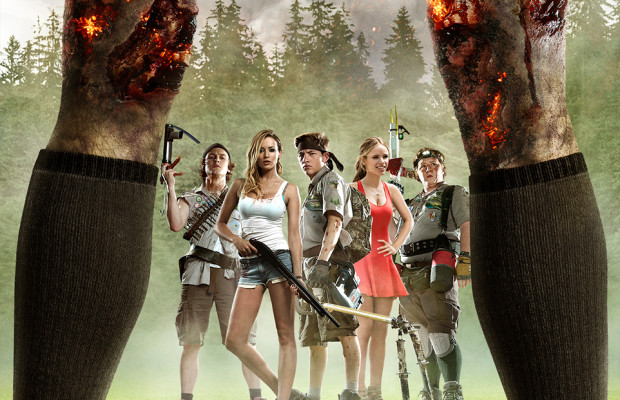
Boy Scouts Vs. Zombies was one of the last of the zombie wave of scripts to sell back in 2010. You have to remember that this was during a time where a script titled “Zombie Baby” sold. A 2010 zombie spec was the equivalent of a lottery ticket. It was the trend that wouldn’t stop trending, kind of like biopics today.
Still, this specific sale has always baffled me. There’s nothing inherently clever or ironic about the premise. It’s so arbitrary, it’s as if they picked a random group of people, said, “Let’s pit them against zombies,” and that was it.
It’s no different from “Clowns vs. Zombies,” or “Politicians vs. Zombies,” or “Skaters vs. Zombies.” There’s no clear connective tissue between this group and the undead.
“Grocery Store Employees vs. Zombies!”
Yet still they managed to get one of the hottest young actors in Hollywood to join the film. What’s up with that?? I mean this guy was in Mud and Tree of Life. Was his agent high when he read this? “Okay Tye, you’ve worked on some pretty impressive stuff so far. But I found something can’t-miss. Are you ready for this? Boy Scouts. Vs. Zombies. Waddaya say?”
All of this supports my belief that the way things get made in this town is passion. This is the furthest thing from a quality project, yet clearly, somebody believed in it and put all of their effort into pushing it through the system. If you want to know why bad movies get made, this is why. Bull-headed producers who stop at nothing to get that theatrical release.
The “plot” to Boy Scouts vs. Zombies has our core crew of boy scouts, each 14 (there are 14 year-old boy scouts??), heading to the island of Playa Del Amor to engage in some weekend boy scout tomfoolery.
There’s Dylan, the cool one, Matt, the proud one, Lloyd, the geeky one, and then a few other human versions of Swiss army knives. The group is led by asshole assistant scout leader, Scott, and “takes this way too seriously” scout leader, Gary.
Little does the group know that on Playa del Amor, there’s a hidden research facility, and that some guy who works there named Carlos just got infected with the zombie virus. Carlos is able to escape from the facility, where he then mauls a few campers.
“Lawyers vs. Zombies!”
As Dylan, Matt, and Lloyd finalize plans to invade a high school house party (I guess there’s a high school on this island??), their plans are interrupted when some local islanders try to, well, eat them.
Unlike most zombie movies where the main characters don’t know what zombies are, our group is well-versed in zombie lore and know that they must get the hell off of this island or embrace an afterlife of animated rotting flesh. Unfortunately, they have to rescue some girl scouts first, and that’s where everything falls apart.
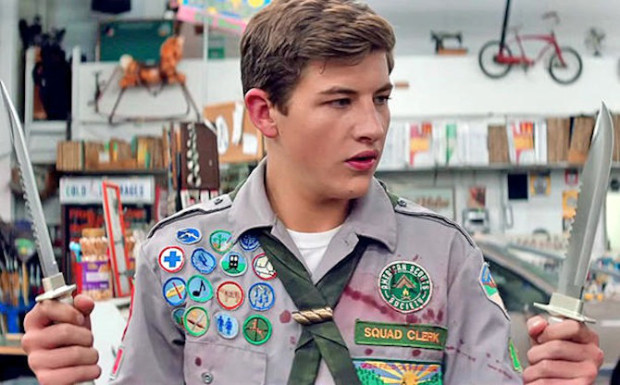
Boy Scouts vs. Zombies lies somewhere between Goonies and Piranha 3D. It wants that pure B-movie wackiness of Piranha, with a bit of the “kids in danger” heart that drove Goonies. And that’s its problem. Because it tries to be both, it does neither well, and what’s left is its surface-level infatuation with introducing zany zombies.
For example, someone gets bitten inside one of those blow-up sumo suits and becomes “sumo zombie.” And hey, that’s a fun idea, sure. But if all you’re doing with your zombie film is trying to come up with fun zombies, you’ve failed. I’m sorry, but you’ve failed big time.
Screenplays are supposed to be about characters. Connect us with the characters by making them relatable, by giving them flaws we can identify with, and then create problematic relationships (which are also relatable) that need to be resolved. Even if you only achieve the bare essence of this, you’ll probably make us care.
We don’t get that here. There’s a half-assed storyline where Matt is going to private school, leaving his best friend Lloyd all alone, but you get the feeling that the writers cared about that relationship 1/10th as much as they cared about sumo zombie.
And make no mistake. The audience feels that. They feel when you don’t give a shit about your characters.
“Pizza Workers vs. Zombies!”
Speaking of characters, there’s something that’ll happen when I read a script that’s a dead giveaway that I’m reading a bad writer.
As any script reader will tell you, sometimes you forget a character. Maybe their intro sucked. Maybe there were too many characters being introduced together and they got lost in the mix. Whatever the case, I can’t remember the character when his name is brought up again, which leaves me scrambling to figure out who they are.
Now if you’re a good writer, your character will speak and act in a way that’s so unique to them, that I’m able to pick up who the character is without having to go back and re-read the intro. This is ESPECIALLY true with comedy, where characters are exaggerated.
There’s a character named “Jim” here, who’s apparently a main character, whose introduction I missed. Every time he showed up in a scene, I’d try to remember who he was. But because his dialogue and his actions were so generic – because there wasn’t anything unique about what he did or said (or how he said it), I never knew who he was. He was a bland blob for all I knew.
This is important. Your character intro should not be the sole thing conveying who your character is. He/she must continue to act/speak in a unique enough manner that we’re able to identify them regardless of their introduction. In fact, we shouldn’t even have to see their name to know who they are.
“Truck Drivers vs. Zombies!”
Take a script like The Hangover. If you missed Stu or Alan or Phil’s intro, you still would’ve known who those characters were based on their words and their actions. Alan with his complete lack of social awareness, Stu because of how freaked out and OCD he was. Even the blandest of the three, Phil, was a narcissistic asshole who just wanted to have a good time, and that was evident every time he spoke.
You barely see any of that here.
And the script doesn’t even do a good job in the one area it cares about – the funny. There’s one memorable scene, when the group is attacked by a bunch of zombie bunnies. But other than that, it’s sumo zombies, bikini-girl zombies, and Chuck Norris jokes (yes, the second lowest joke on the joke totem pole, right above a fart).
In the end, I think this boils down to a flawed premise. Why a zombie movie about boy scouts? It’s too random – the kind of logline that wouldn’t have even made the Top 250 of my contest. Where’s the clever? Where’s the irony? I’ll be honest. I’m baffled this script was A) picked up and B) made. This freaking movie is getting a theatrical release! Can someone explain this to me??
[ ] what the hell did I just read?
[x] wasn’t for me
[ ] worth the read
[ ] impressive
[ ] genius
What I learned: Let’s say a law was passed that prevented you from writing traditional introductions to your characters (“JOE, 20, is a space-cadet with a penchant for pinball”). Would your characters still be identifiable based on their actions and their words? If not – if you NEED your character introduction to do all the work for you – it means you’re not focusing hard enough on expressing your character through action and dialogue.
“Dog Walkers vs. Zombies!”
Get Your Script Reviewed On Scriptshadow!: To submit your script for an Amateur Review, send in a PDF of your script, along with the title, genre, logline, and finally, something interesting about yourself and/or your script that you’d like us to post along with the script if reviewed. Use my submission address please: Carsonreeves3@gmail.com. Remember that your script will be posted. If you’re nervous about the effects of a bad review, feel free to use an alias name and/or title. It’s a good idea to resubmit every couple of weeks so your submission stays near the top.
Genre: Sci-fi
Premise (from writer): In a future where robots run grisly human-fighting rings for sport, any human who survives 72 matches is given 72 minutes to win their freedom–or die.
Why You Should Read (from writer): I moved to Los Angeles to specifically pursue a career in waiting tables. I was originally gonna write a biopic about Nikola Tesla’s chef, but figured this would be more interesting. This script has such a big fat concept, that when it took a selfie, Instagram crashed. Do not read it if you hate: space, hyper loops, nihilism, invisible architecture, and futuristic theories. FULL DISCLOSURE: I’m an alien that’s trying to blend in with everyone.
Writer: Robotic Super Cluster
Details: 85 pages

I suppose Game of 72 was the perfect script for today. As I struggle to decide on my last few slots for the Scriptshadow 250, my mind is on the verge of madness. And let me tell you, there isn’t a better script to read when you’re on the cusp of insanity than this one. I want you to imagine Steven Spielberg making A.I., but with Rob Zombie’s brain downloaded into his cerebral cortex. The word “trippy” doesn’t even begin to describe this bizarro eye-assault.
But before I get to that, I want to know which movie I should see and review for Monday. This is the best movie weekend of the year so far, with Sicario (great script), The Martian (great writer success story) and The Walk (amazing special effects) all coming out at the same time! I’m considering doing my first triple-feature in ten years, but I don’t think I’ll have the time. So which one do you want me to review? There’s no wrong answer!
Okay, on to Game of 72, which was my favorite logline of the bunch so I’m glad it won. Well, I should say I WAS glad that it won. Now? I’m not so sure.
The year is 2820. Earth is run by robots, aliens, and genetically modified monsters. The only thing these beings seem to care about is entertainment – specifically human-on-human fighting. They take the humans, chain them up like dogs, torture them, strip them of their names (replacing them with numbers), and force them to fight each other to the death.
Sounds fun, right?
The only way for humans to escape this misery is to win 72 fights (nearly impossible), after which they’re entered into something called “The Game.” In “The Game,” you have 72 minutes to catch a wandering orb. If you succeed, you gain your freedom, are upgraded into a human-robot hybrid, and get the choice to live forever.
So the stakes are high.
Our hero, 28 year old Finn, is one of the few fighters who’s managed to accumulate 72 wins. He joins two others who have managed this impossible feat – Nala and #9560 – and before the trio even knows what’s going on, they’re thrown onto an interplanetary train that shoots them off to Mars.
When they get to Mars, none of the monsters or aliens have ever heard of The Game. They don’t even know who these humans are. In fact, there’s no one to tell them how this game works. Complicating matters is that there’s a disembodied voice living inside of Finn who keeps telling him to do the opposite of what everyone tells him to do.
No more than five pages after we arrive on Mars, our players are told they’re going back to Earth, so they jump on another flight, and arrive into some kind of mind disco. Yes, a “mind disco.” As it’s explained to us, the music isn’t actually being played. It’s “transmitted through everyone’s bodies and souls, emanating from within.” Huh?
I could go on here, but I think you get the gist: THIS SCRIPT IS FUCKING NUTS.
Look, I’m all for imagination. Just yesterday I was complaining about writers who DIDN’T use imagination when writing their queries. But there’s adding jam to your sandwich and there’s dumping the entire jar on it. Game of 72 throws you into an information ocean, never letting you above water to catch your breath. Here’s a typical page from the script:
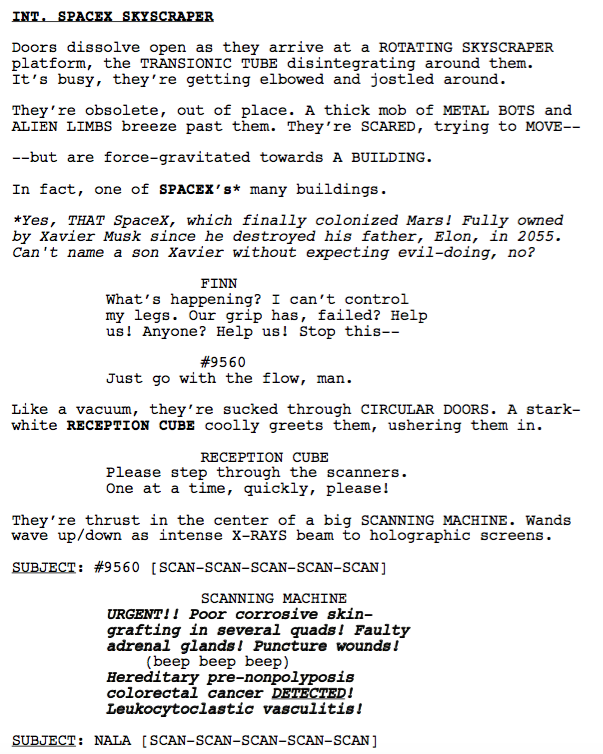
Let’s see what we’ve got here:
1) Italics-based writing.
2) Bolded writing.
3) Underlined writing.
4) TONS of information.
5) TONS of imagery.
6) Manic writing style.
7) Characters with number names.
The whole script reads like this. Here’s another line, picked at random: “He FALLS, an accordion of 100-copies of him are frozen mid- AIR. Thousands of MAGNOID thoughts enter his head. DEAFENING. The sensation of sinking into LAUGHING GAS, nitrous oxide.”
Huh?
I’m not even sure what to say. I mean, our writer is clearly talented. He had one of the best “Why You Should Reads” of the year. It showed that he’s clever, he’s imaginative, he can write. But it feels like for this script, he ingested an entire Starbucks store and wrote everything freehand, gripping the pencil like a knife, and stabbing 20,000 words onto the page without ever going back to see if he’d murdered anyone. Particularly the English language.
This is a cut and dry case of information overload. Too much style, too much imagination, too much action, too much information. As screenwriters, we do want our scenes packed with action and plot. But there’s a difference between drinking a beer and buying the brewery.
Truth be told there were a couple of red flags before my exhaustion kicked in. People use bitcoin in the year 2820? Space-X (created by Elon Musk) is the main form of transportation? I might buy into this if the year were 2075. The year, however is TWENTY-EIGHT HUNDRED! There wouldn’t be any recognizable brands still around, especially if the world had been taken over by robots and aliens.
The official moment I gave up on the story was when we went to Mars, and after five pages, came right back to Earth. To me, that indecision embodied the script’s biggest issue – its lack of focus. Our writer couldn’t find something interesting to do on an ENTIRELY SEPARATE PLANET, to the point where he had to bring our characters right back to the place they left just minutes ago.
And if you took the time to look deeper, it didn’t seem like anything had been thought out. Why didn’t anyone on Mars know about The Game? And if nobody knows about The Game, then aren’t you telling the reader that it’s not a big deal? And if it’s not a big deal, why should we care if these characters succeed or not?
In the flawed but fun Arnold Swarzenneger movie, The Running Man, the whole world watched that show. The writers made sure you knew everyone on the planet was obsessed with it. So the objective seemed important. With these characters, they’re not even sure if they want the prize (to live forever). Protagonists who aren’t even excited about achieving their goal? That’s a recipe for screenwriting disaster.
I like this writer here. I just think he tried to be too cute and stuff too much into every page. Dial the imagery back. Dial the world-building back. Get rid of the unnecessary details (the 9th version of the monster subset).
I say this over and over and over again, and nobody listens. The best screenplays are simple easy-to-understand stories with complex characters. Once you switch that emphasis around (to a complex story with simple characters), I won’t say you’ve hung yourself, but you’ve definitely tightened the noose.
This script was such an assault on my senses that I almost gave it a “What the hell did I just read?” Seriously, it got to the point where it hurt my head to keep reading. You’re a talented writer and better than this. Let’s nail the next one.
Script link: Game of 72
[ ] what the hell did I just read?
[x] wasn’t for me
[ ] worth the read
[ ] impressive
[ ] genius
What I learned: Information overload is a script-killer. Nobody wants to be inundated with description-porn on every single page. Dial it back. If it’s not easy to ingest what’s on the page, we’re going to give up on you fairly quickly.