
Search Results for: F word
ALERT ALERT!!! The SCRIPTSHADOW NEWSLETTER has been sent! Check your SPAM and PROMOTIONS folders if you did not receive the newsletter in your mailbox. You can add my e-mail to your ADDRESS LIST to make sure future newsletters go straight to your inbox. If you still can’t find the newsletter, e-mail me with the subject matter – NEWSLETTER. It’s a BIG one, with a review of what many consider to be one of the best scripts of the past five years. Sign up for the newsletter here.
So it happened again.
What’s that? You don’t know what I’m talking about?
Oh.
I had another meet-up with a writer.
Which resulted in another, “What the HELL are you thinking?????”
A sweet well-intentioned guy. Very nice.
But then it happened. He pitched me. Told me what he was working on.
I listened. I tried to be patient. But before I knew it, I was shaking my head. I asked him if he read my site. Because he said he was inspired by it. But if you’re inspired by my site, why are you doing the exact opposite of everything I talk about?
That may seem like a harsh reaction but I used to stay quiet in these situations. Nod my head and smile. But what good does that do anyone? Is it better for me to let this gentleman waste the next six months of his life or tell him right then and there that his ideas…well… suck.
What was the problem with this young gentleman’s ideas? None of them were movies! There wasn’t a single cinematic idea in the bunch. I’m not going to expose those ideas here for the world to laugh at. But let’s just say they were the equivalent of a man struggling through a job he didn’t like. Very basic, very “un movie like” premises.
Hearing him talk about these ideas, you could feel his passion. But passion without a good idea is about as useful as a slurpee without a cup. It’s going to spill all over your clothes, leave a stain, and result in a very angry Indian man yelling at you.
Okay, so it’s not exactly like a slurpee without a cup but the point is, this is amateur mistake numero uno. The thing that keeps 90% of aspiring screenwriters on the wrong side of the Hollywood wall. Their ideas are BORING! They don’t promise us anything exciting.
How does the saying go? A cat sitting on a blanket isn’t an idea. A cat sitting on a dog’s blanket is.
And there are a lot of things that go into it but basically you want to give the audience an idea that promises a lot of conflict. I mean look at the setup for Fury Road. A woman steals the most powerful man in the region’s five wives and tries to run away. We can see how that’s going to end up in a lot of conflict, a lot of problems, a lot of “shit going wrong.”
The reason I’m babbling on about this is because I’m tired of seeing writers waste their time on boring freaking ideas that will never go anywhere. I read them all the time in the Amateur Offerings’ submissions and I think, “What are you thinking??? How could you possibly think anyone would want to see this movie?”
For awhile I thought these were just hopeless writers who didn’t have the talent to come up with a good idea. But then I started thinking, maybe no one’s sat down and taught these people the difference between a good idea and a bad one.
So I came up with 7 questions to help these writers determine the value of their idea. If they can say yes to at least four of these questions, they probably have a story worth telling. Any less and they may want to go on to the next idea.
Now I’ve ranked these in order of importance. So the top questions are weighted higher than the bottom ones. In other words, it’s more important that you answer yes to the first few questions.
A couple of things to remember. The game changes if you’re going to direct your script yourself. That’s because when you direct, you give yourself another opportunity to differentiate your product. So if your script seems mundane on the page, but you plan on shooting it in a really unique or weird way, that still allows you to stand out. Like Gregory Go Boom. That script probably looked mundane on the page, but the director gave it a truly fresh feel on the screen.
Also, don’t try and defend your idea by putting it up against similar ideas that were a) book adaptations or b) director-driven projects. As a spec screenwriter, you will never get the benefit of the doubt a New York Times best seller does, nor will producers care when you plead with them, “I know not a lot happens but it’s going to be like a David Lynch film.” Since you’re the unknown spec writer, you have to be bigger and flashier to get noticed. So here are the seven questions you’ll hopefully answer “yes” to. Good luck!
1) Is your idea high concept?
I’d say that this is probably the most helpful thing you can do to get your script noticed. I read ARES, Michael Starbury’s script about a special division created to recover the extraordinary and supernatural. Truth be told, it wasn’t very good. But the idea was so big, so “you could totally see this as a movie,” that it sold for mid six figures. High concept is not synonymous with big budget either. A high concept could be a therapist who takes on a child patient who sees ghosts (The Sixth Sense). Or a couple who runs into their doppelgangers on their vacation (The One I Love).
2) Are you writing in one of the six marketable genres (horror, thriller, sci-fi, comedy, action, adventure)?
These are the genres that sell best on the spec market. Dramas don’t do well here. Westerns. Period pieces. Coming-of-age stories. If you’re not writing in one of these six, you should probably be worried about your spec’s chances.
3) Is your idea marketable?
This would appear to be the same question as number two, since the reason those genres are celebrated is because they’re marketable, but there are plenty of non-genre movies that can still be marketed. One of the ways you can figure this out is to find three movies (within the last decade) similar to yours that have done well at the box office (relative to their costs). The biopic is a good example of this right now. Studios have proven they can market these movies and people will show up.
4) Do you have a fascinating or extremely strong main character?
Actor bait can work as a sort of Hail Mary for smaller ideas. Think a meaty juicy role where an actor gets to do a lot of stuff. It could be anything from being a schizophrenic (A Beautiful Mind) to being bitter and having scars on your face (Cake, Vanilla Sky).
5) Does it have a unique angle?
We just talked about this the other day. Once you choose your idea, try to figure out what your unique angle is going to be. If you don’t have a unique angle, it’s likely your script is going to feel just like everything that came before it. Take one of the unexpected hits from a couple of years ago, “Now You See Me.” The writers decided to write a heist film. But everyone writes heist films. What was different about theirs? Well, they made the heisters magicians. That’s an angle we haven’t seen before.
6) Is your script thick with conflict?
A premise that promises a lot of head-butting between characters, a lot of tension, a lot of sides pulling at one another, a lot of uncomfortable interactions, is an idea that’ll likely make a good screenplay. A perfect example is Gone Girl. A woman disappears and we follow the husband, who everyone suspects killed her. Every situation this man steps into is going to result in some kind of conflict. Contrast that with, say, a movie about a man who’s grieving the loss of his life. I guess there’s some inner conflict in that idea, but it’s minimal, and we’ll grow tired of it quickly, meaning the idea is weak. A man who grieves the loss of his wife, only to find out she used to work for the CIA, and now people who were after her are now after him? Okay, you might have an idea there.
7) Does your idea contain irony?
If you’re writing what many would consider to be an “independent” movie, I consider an ironic premise almost essential. It’s really your last ditch effort to make your tiny movie stand out. A king who can’t speak must give the most important speech in history (The King’s Speech). When an older man meets a minor online, it turns out to be the minor who’s the predator (Hard Candy).
Don’t worry if you don’t get an affirmative on every one of these questions. That’s unlikely. But as long as you get more yes’s than no’s, you should be in good shape. Also, there’s a final component to all of this, and that’s your own creativity, your own voice. You have to add those creative flourishes and ideas that only you can bring to the table. For example, I could write a movie about a group of teenagers stuck in a town full of zombies that would get yes’s to most of these questions. But if I’m not bringing some creativity to the story, it’ll still be a dud. Nobody wants to be a dud. Be a stud. And never ever roll in mud.
Genre: Thriller
Premise: A home invasion crew targets the richest family in town, only to get a lot more than they bargained for.
About: This script was just purchased a couple of months ago. Eric Bress actually sold ANOTHER script, American Drifter, a couple of weeks later. Bress is best known as the co-writer and co-director of The Butterfly Effect, a film that he’s remaking as we speak. Let’s all pray that Ashton Kutcher isn’t in it.
Writer: Eric Bress
Details: 85 pages

They say that the definition of insanity is doing the same thing over and over again and expecting a different result.
On Monday, I officially changed the definition of insanity to just: George Miller, after seeing how fucked up Fury Road was.
Well, I’m about to change the definition again. I’m going to give half of that definition to Eric Bress. Holy SHIT is this guy dark. I mean…. Lol… I’m sitting here still shaking my head. And I finished this script 20 minutes ago.
This is, like, disturbed shit on a whole other level.
But the great thing about art? Is that you can be disturbed as well as admired. And I admire the hell out of this screenplay. I mean, this was supposed to be a home invasion movie. How crazy could it get?
Here’s an answer for you: VERY FUCKING CRAZY.
The Schottenfelds are rich as hell. We notice that by their 20 acre property and huge mansion. We have the wiry, maybe even wimpy, father, David. The trophy wife who’s secretly a badass in Barbara. 17 year-old emo, Meredith. And the jock of the family, 12 year-old Lance.
Oh, and there’s one more family member. 18 year-old loner, James. Now, the way this script is written, we start with a home invasion and then jump back in time at various points to get to know the characters before the event.
And what we learn about James is that he’d purchased a Contra-sized arsenal of weapons and was planning on pulling off the biggest school shooting in history. Luckily for those students, his parents found out about it, and were about to send him off to a special program to make him better.
But James hasn’t left yet. And thank God for that.
On a seemingly normal evening, the family is getting ready to do what families do, when eight men barge into the house and demand, well, just about every cent this family has, including every bank account they’ve stashed money in across the world.
The group is led by one nasty motherfucker in Burke. Burke isn’t afraid to feel up Meridith, hang Lance over a 30 foot balcony, light David on fire, and beat the shit out of Barbara. This is just not a good dude in any sense of the word.
The problem is, while Burke seems to know way more than he should about this home, he doesn’t know that James hasn’t left yet. And that James has a stockade of weapons that could take down ISIS. What follows is the reversal of all reversals. Burke and his crew go from the hunters… to the hunted.
There is so much good about this script, I don’t know where to start. First of all, it’s not for the squeamish. There is some hardcore violence in here so if that’s not your thing, the charms of this screenplay will likely not work on you.
But if you were delighted by scripts like Fatties, then read on!
Let’s start with ANGLES. Remember that there are about 75 movie types out there. By that I mean, sub-genres within the main genres. So we have the teenage romantic comedy, the alien invasion movie, the body switch movie, the serial killer procedural, the trapped in a box with monsters flick, the buddy comedy, the revenge flick, the coming-of-age movie, etc., etc.
These are all proven movie types so they’re used over and over again. What your job is when you write one of these films is to find an ANGLE that makes them different. So take teenage romantic comedies (Clueless, The Breakfast Club, Mean Girls). If you’re going to write a teenage romantic comedy, you need to find a new angle, because if you give us a generic teenage rom-com or one that doesn’t offer anything new (example: the Freddie Prinze Jr. masterpiece, “Down To You”), we won’t feel any need to see it.
A recent example of Hollywood finding a new angle for this type of movie is The Fault In Our Stars. A teenage romantic comedy about cancer patients. Hadn’t been done before. It was risky as shit, but usually the angle you pick will be risky. In order to find a new angle, you’ll need to do something that’s never been done before. Which is, by definition, risky.
So here we have the home invasion movie. We’ve seen this film before with Panic Room and Firewall and The Purge. So what’s the new angle you’re going to bring to it? In American Hostage, it’s that the teenage son is a psychopathic murderer who’s a thousand times worse than any of the invaders. And instead of them hunting him, he hunts them. That’s the angle that makes this script different.
Now if that was all there was, it wouldn’t be enough. You can’t JUST be different. You have to execute. And boy does Bress execute. I usually know I’m in good hands when I read something in a script that I’ve never read before. That tells me the writer is creative and that he’s TRYING. That last part sounds like it should be a given. But 90% of writers out there aren’t trying hard enough to make their scripts great. So it’s a big deal when I notice this.
What’s the moment I’d never seen before?
James drives the invaders’ van up to the house with the head of one of the men he’s killed planted on top of the swaying antennae. Before he killed this poor guy, he made him record a message in his iphone to the other invaders (telling them to leave). So when the invaders come outside, the head bobs back and forth, the message playing from the iphone, making it sound like the severed head is really talking. It’s the creepiest fucking image I’ve read all year.
But what about the story, Carson! I mean is this just a series of gross gimmicks? No! This script is really good. And it works because we know that James is out there. And that he’s killing these guys one by one. So we’re driven to keep reading to see where he’s going to strike next. And since Bress did such a great job making us hate these guys (beating up the mom, groping the daughter, lighting the dad on fire), we can’t wait for that next attack.
Also, I really liked the jump-back structure here, with the invasion occasionally interrupted to go back a week and meet the characters in their everyday environments. This allowed us to get to know the characters on a deeper level so that we gave a shit when they were stabbed or hit or… lit on fire.
Usually in a script that jumps into the action right away, you don’t get that, so we don’t really know the people we’re supposed to care for. Bress found a way around that problem. And he didn’t do it with super-long flashbacks or anything. Each jump-back was one scene. Very tight and easy to digest.
The script also made me feel something I’ve never felt before. We learn, early on, that James planned on shooting up a school, one of the most horrific acts you can imagine. So the fact that you’re rooting for this guy gives you this complicated uneasy feeling inside. You know you shouldn’t love him. And yet you do. You can’t wait for him to dole out more pain to these assholes.
It’s pretty rare that a script will make you feel multiple things at once. So when you find one that does, you raise your cap. And then put it on a car antennae.
The only downside to this script is that it’s so violent that it won’t be for everyone. And that sucks, because there are people who won’t be able to appreciate how well-written American Hostage is. And it’s really well-written. This is a great example of how to write a memorable contained thriller.
[ ] what the hell did I just read?
[ ] wasn’t for me
[ ] worth the read
[x] impressive
[ ] genius
What I learned: Do yourself a favor and consider an UNEXPECTED HERO for your screenplay. Everyone knows Vin Diesel’s going to beat ass, that The Rock is going to take names, that Jason Statham is going to kick your teeth in. These characters are all very on-the-nose. So what if, instead, you went with the most unexpected choice for the ass-kicker (or hero) in your movie? A mentally unstable 18 year-old who was planning to shoot up a school. That’s about as unexpected as it gets.
Genre: Action-Adventure
Premise: An alien civilization attacks planet earth… using 80s video game characters.
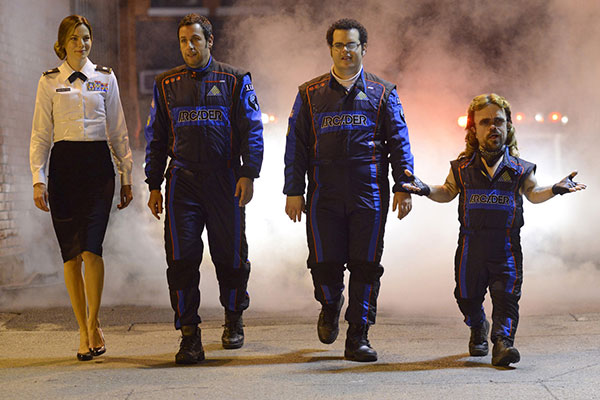
About: There seems to be a new stealth tactic suspect Hollywood projects are using to get geek cred. It’s called the “Thrones Tactic.” This is when you cast one of the actors from Game of Thrones in your movie to trick the potential audience into thinking your movie is cool. We saw this fail with Terminator: Genisys (Emilia Clarke) but hopefully it will work here (Peter Dinklage). Pixels comes out later this summer and stars Adam Sandler, Peter Dinklage, Josh Gad, and Michelle Monaghan.
Writer: Tim Herlihy (revisions by Timothy Dowling) Current Revisions by Tim Herlihy
Details: 100 pages – February 19, 2014 draft
I was hoping that Pixels was going to be the movie Adam Sandler used to finally get back to being funny. That hope was dashed when I saw the writer of Pixels was the same writer who gave us Grown Ups 2, Bedtime Stories, Mr. Deeds, and of course, Little Nicky.
Sony wised up and at least got Timothy Dowling (Role Models, George Lucas in Love) to add some funniness to the script, although it appears his contributions were short lived, as the original writer got to come back on and change everything back to the way he wanted.
I was actually excited about this movie due to the hilarious final gag in its trailer (here’s the trailer, make sure to watch til the end). It shouldn’t be surprising, then, that that gag was NOT in this draft and was probably thought up by someone else on the set who was actually, you know, funny.
In 1982, Julian Brenner was almost the video game champion of the world. At the last second, he lost out in Donkey Kong to gamer stud and all-around asshole, Eddie Plant. Julian never quite recovered from that loss, and now, 33 years later, he’s a member of Geek Squad, those guys who come to your house in sissy looking cars and install your TV or computer.
I don’t know if you want to say having your planet invaded by aliens is “lucky,” but when you’re the one guy who possesses the special skill to defeat said aliens, you have the potential to go from zero to hero.
You see, 30 years ago, the planet foolishly sent off a satellite that included everything about earth at the time, including its infatuation with 8-bit video games. Unfortunately, the alien species who recovered this satellite happen to think that this is a direct challenge by Earth for superiority of the universe (or something).
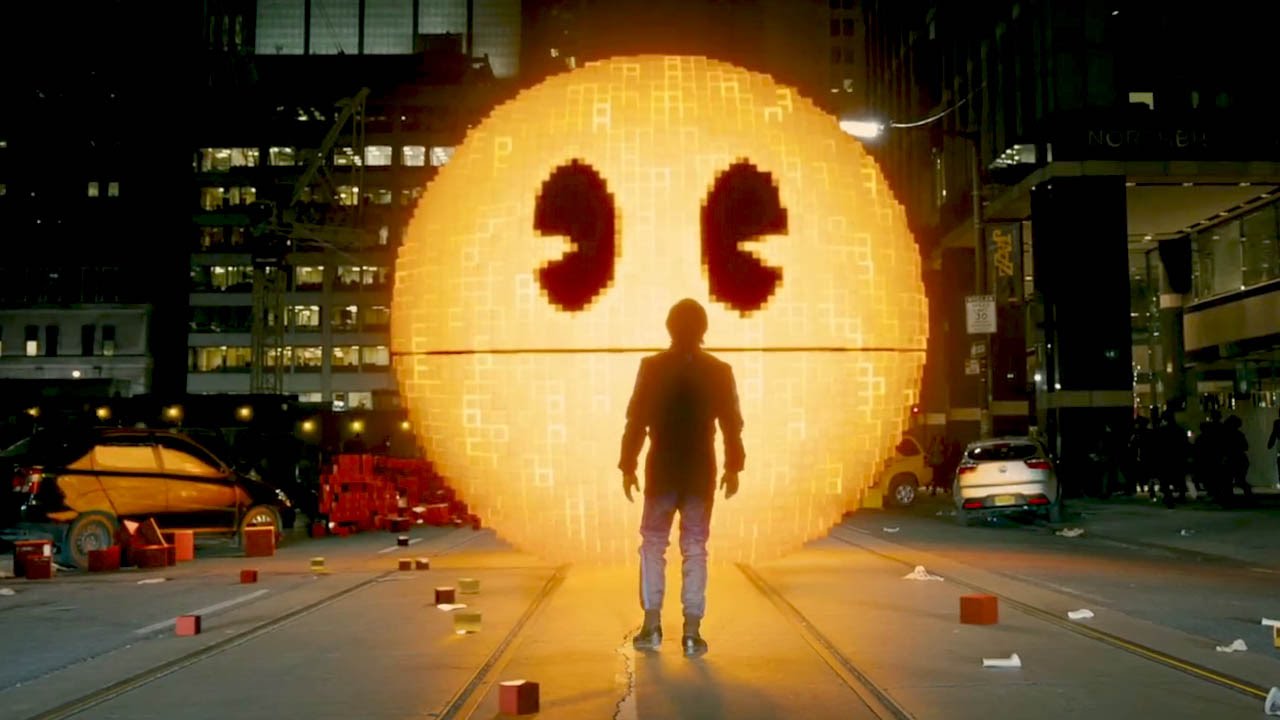
These creative aliens want to play fair though, so they attack earth with the very games mentioned in the message. So they battle us with Centipede at Central Park, Pac-Man in Tokyo, and finally throw a free-for-all at us (Dragon Lair, Frogger, etc.) in the final battle. Julian will have to team up with his old video game friends as well as his evil nemesis who defeated him in the world championships all those years ago, if he’s to both save the world… and his dignity.
You know what kills me about Pixels? It had the potential to be balls-to-the-wall crazy fun. But the script plays things so safe, it’s like playing Pac-Man with unlimited lives. There’s no freaking fun to it. After seeing Fury Road this weekend and realizing what happens when you REALLY go balls-to-the-wall, Pixels feels like the 7th grader who stands in the corner of the school dance all night, afraid to talk to a single girl.
Here’s the thing with formula. It’s awesome for structure. There IS a way to tell a story for maximum impact and the 3-Act structure is that way. Most writers never even get to the point of understanding the 3-Act structure so there’s something to be said for writers who master it.
However, if that’s ALL you’re doing and you’re just mailing in all the other components (characters, dialogue, plot beats), you’re never going to write anything good. Your script is going to look fine on the page. But it’s never going to stir up emotion in a reader. It’s never going to shock them or excite them. And if you’re not achieving those things, you haven’t written a good story.
One of the most important practices in screenwriting is anticipating what the audience expects, then giving them something different. If you’re not doing this, you’re not screenwriting properly.
So let’s compare a scene from Pixels to a scene from Fury Road, shall we? In Pixels, one of the big scenes is when Centipede attacks Central Park. So our main character and a bunch of soldiers go to Central Park with brand new “light guns” to stop the game. How does this scene play out? BY CENTIPEDES ATTACKING FROM THE SKY AND OUR SOLDIERS SHOOTING AT THEM. In other words, EXACTLY how any member of the audience would’ve written the scene themselves.
I mean seriously? You can’t do better than an audience member?
I’m not even going to use a BIG scene from Fury Road for this challenge. I’m going to use one of the few scenes without a car chase. Someone posted this in the comments yesterday so you can watch it yourself to see what I’m talking about.
In the scene, Max is chained to a door as well as a passed out War Boy and wants to be cut free. He approaches Furiosa and the five sirens, who are enemies at this point, to get help. Max is using a shotgun that we know doesn’t work, to force them to cut him free. We also see, in the distance, that the enemy caravan is driving towards them, leaving them little time to settle this issue.
In other words, there are like 18 FUCKING THINGS GOING ON AT ONCE. Max is bluffing with the gun. Max needs his chain cut. Max is chained to a dangerous enemy who could wake up at any second. A siren approaches him with a bolt cutter. Will she help or will she attack? Furiosa looks like she might attack at any second. Behind them, we see the caravan approaching. They need to get back in the truck and leave now!
Had the writers of Pixels written this scene it probably would’ve gone something like this:
Max sneaks up behind the truck. He sees a bolt cutter attached to the truck’s back bumper. He pulls it off and cuts himself free.
That was the kind of boring predictable writing that went on throughout Pixels. And don’t give me this shit that you’re catering to a younger audience who doesn’t expect as much. That doesn’t give you license to be lazy. And lazy is exactly what Pixels was.
Julian’s best friend as a kid, Cooper, grows up to be the president! How convenient is that when aliens invade. The first person the president calls now is our main character. Oh, and the woman Julian delivers a TV to for his job and falls for – she just happens to be the main weapons defense administrator at the White House. How perfectly convenient once again! Even the best character created – an asshole midget gamer villain – wasn’t even a midget in the screenplay! That was, of course, figured out by someone BESIDES the writer. Because going with a midget would have been way too risky.
The only sequence worth its salt is the Pac-Man set piece. It’s the only time where the writers actually felt like they were trying. For example, our heroes start off chasing Pac-Man through the streets (with their “ghost cars”) and everything’s looking easier than they thought it would be. Then, all of a sudden, Pac-Man turns a corner and there’s: A POWER PILL. Julian, of course, knows exactly what this means. They’re no-longer chasing Pac-Man. Pac-Man is chasing them. Everything reverses now and they’re on the run. It was a rare Pixels treat. An unexpected reversal.
Unfortunately one good sequence is not enough to save an otherwise generic screenplay. I’m still torn with this one as the trailer makes the film look genuinely fun. So I’m wondering if they got another writer on this to save the day or they have just cleverly covered up all the weaknesses. I shall hope for the former.
[ ] what the hell did I just read?
[x] wasn’t for me
[ ] worth the read
[ ] impressive
[ ] genius
What I learned: If Fury Road has taught us anything, it’s to go into every scene/sequence in your screenplay with this question: “What is the audience expecting here?” Once you have that answer, you simply go in a different direction. That one tip can improve your writing tenfold. Go ahead, I dare you to open your script right now and try it.
Genre: Action
Premise: In an apocalyptic future, a woman rescues the five wives of her insane leader, and tries to take them to her childhood home.
About: George C. Miller has been trying to make this movie FOREVER. With Miller getting older, it was looking like it wasn’t going to happen. He finally scraped together $150 million though to get his dream film finished. The movie debuted this weekend and took in 42 million dollars, a respectable sum, but not enough to defeat a group of crooning women. That’s right, Pitch Perfect 2 took in 65 million dollars.
Writer: George C. Miller (he was the only writer on the draft that I read)
Details: 120 minutes
They say the definition of insanity is doing the same thing over and over again expecting a different result.
That definition has now been retired.
The definition of insanity is George Miller.
And I mean that in the most glorious way.
I read this script almost three years ago and I remember thinking, “This is the best written chase in the history of cinema.” But even what I read on the page could not possibly prepare me for what I saw on the screen this weekend. Miller didn’t just run with his chase. He fucking stashed the thing into a nuke blender and created the second Big Bang.
Fury Road’s story is both simple and complex (remember, we’re talking about an insane person here. Many things you read in this review will contradict themselves). The simple part is that this woman, Furiosa, a dependable driver in a post-apocalypitc town run by a madman named Immortan Joe, decides to ditch her city and head back to the town she was kidnapped from as a child (the Green Place). Immortan Joe then sends his entire brigade of cars to stop her.
We have a clear goal (get to the Green Place), urgency (they’re being chased the whole time), and stakes (death). And this is where the complexity seeps in. Furiosa has kidnapped five drop-dead gorgeous women who breed babies for Immortan Joe. She doesn’t like that the five sirens are being enslaved and wants to bring them along. Almost all of these sirens are pregnant.
Now you may be saying, “Well wait a minute. Where the hell is Mad Max?” Ooh, we’re going to get all sorts of into that in a bit. But basically, Max has recently been kidnapped by Immortan’s clan, the War Boys, and is now being used as a “blood bag.” Lots of people in this town have janky blood and need to be constantly pumped with healthy blood to stay alive.
One of these pale-as-a-sheet boys is Nux, who really really really wants to join the chase for Furiosa. But he won’t survive without blood. Hence he comes up with a plan to chain Max to the front of his car and use him as a constant influx of blood during the chase.
As you can imagine, Max eventually gets free, teams up with a tepid Furiosa and the sirens, and the group tries to get to the Green Place together. It’s not without its share of challenges though. Out here in the nowhere lands, there are NUMEROUS tribes and clans, all with their own types of cars and styles, determined to take Furiosa’s team down.
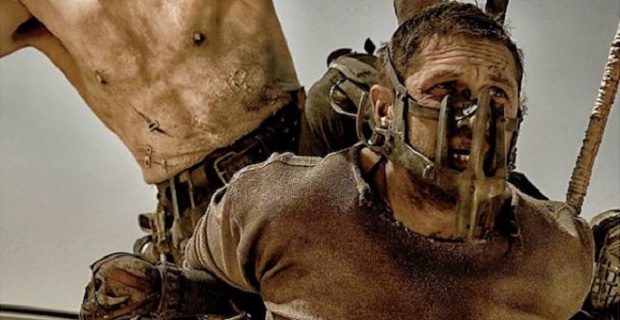
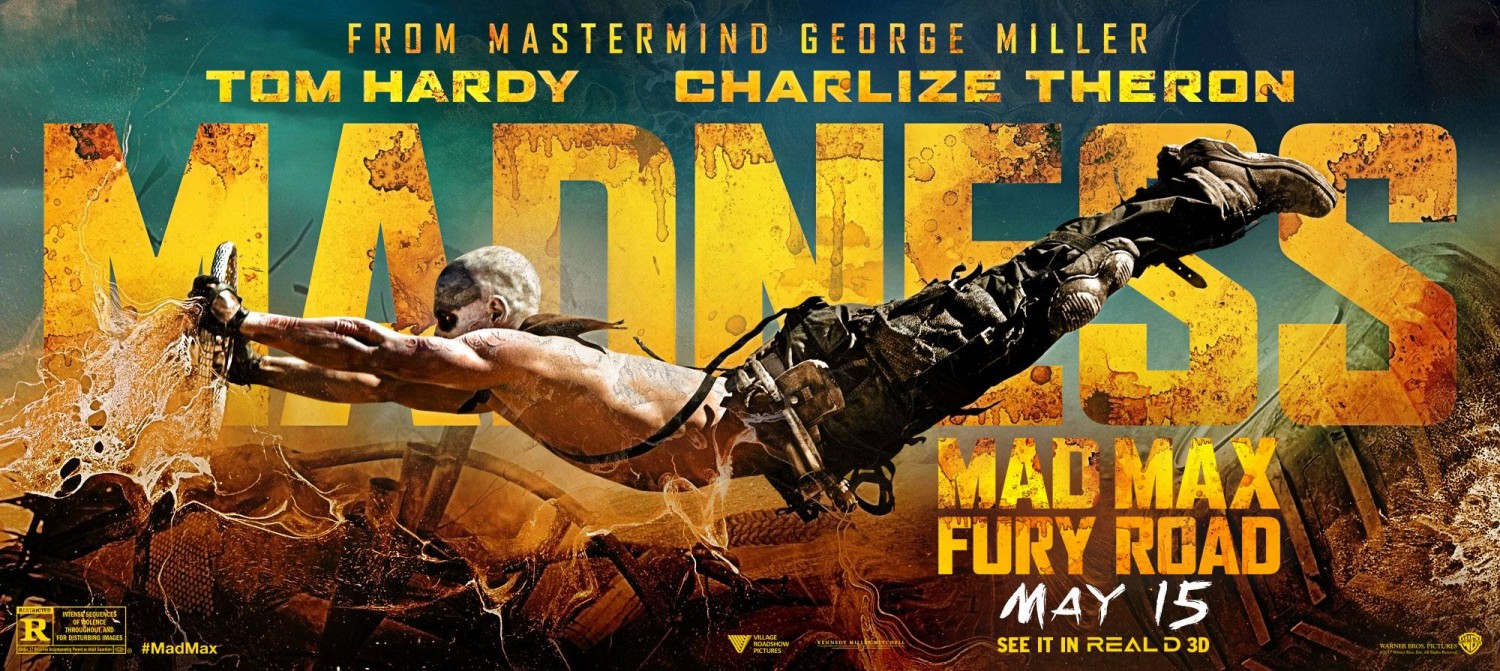
Let me just start by saying this is probably going to be my favorite movie of the year. This is unparalleled filmmaking here. You can tell that this is the movie George Miller originally envisioned in his head 30 years ago but only had 1/10th the budget to bring it to life. Well, he finally got 10/10ths of his budget and the result is magnificent. Almost everything is done practically. The style is unlike anything at the movies right now. It’s imaginative. It’s bold. It takes chances that lesser filmmakers wouldn’t even dream of.
But the film is not perfect because the screenplay is really strange. First of all, you have Furiosa. If it was just her and these sirens trying to get to this land of hers, everything would’ve been a lot smoother. Instead, we have this weird Max subplot where he’s literally silent for the first 50 minutes of the movie, strapped to the front of this car, watching everything happen around him. Mad Max, the character who’s name is in the title, HAS NOTHING TO DO WITH THE FIRST 50 MINUTES OF THIS MOVIE.
In fact, as crazy as it sounds, you could take Max out of this movie and barely anything would change. This isn’t Max’s movie. It’s Furiosa’s. So how the hell did that happen?
Well, here’s my theory. We all know that Miller’s been trying to make this movie forever. He’s had near-starts maybe a dozen times, many of them with Mel Gibson.
When Mel got too old to play the part, Miller started searching for younger actors to play Max, and that carousel went on for awhile without success. Finally, he decided to give up on Max and build a new character to center the movie around, Furiosa. That, for whatever reason, got him a green light, but then at some point somebody wised up and said, “We can’t have a Mad Max movie without Max,” and rising star Hardy was cast.
However, the script was already written and Charlize was cast. So how the hell did Miller infuse Max in the story? This is how. And this is why Max seems to always be on the outskirts of a plot that clearly favors Furiosa.
Now I happen to know a couple of people on the production of this film who confirmed exactly why this was a problem. According to them, both Charlize and Tom were pissed off at the fact that the other thought it was THEIR movie. And they were completely justified. Charlize’s character’s the one who’s driving the plot. Tom’s character has his name in the title of the movie. A series of carefully worded conversations needed to be had with each actor to convince them that THEY were in fact the star and not the other way around.
This speaks to a problem that I’ve been preaching to screenwriters forever. Unless it’s a team-up scenario (Safe House) stay far away from the dual-protagonist screenplay. It’s just too hard to pull off and you’re always going to be struggling to find that balance between each character.
So why does the movie still work despite this flaw? Because the chase scenes here were the single greatest chase scenes in the history of cinema. If you have something in your script/movie that is the single greatest in history, your script/movie can survive a lot of flaws.
This is the same thing I say to writers who point out that When Harry Met Sally had no plot, no goal, little structure, and basically followed two people sitting down and talking about nothing for 2 hours. That’s all true, but When Harry Met Sally also contained the best dialogue in the history of romantic comedies. Hence, it was able to overcome these issues.
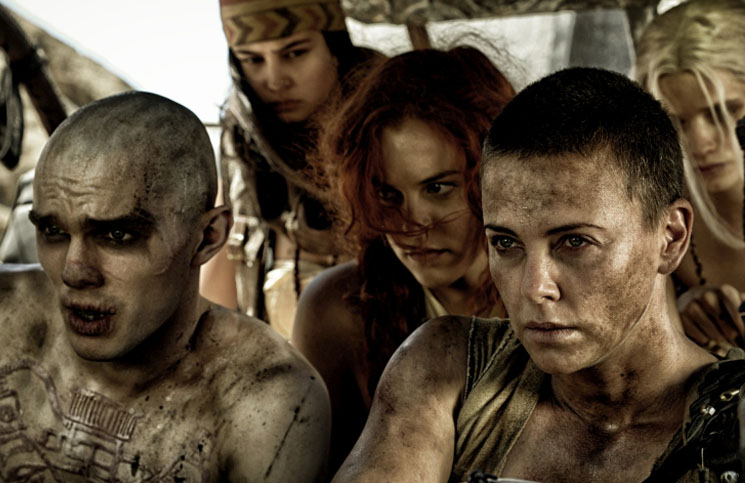
So what changed between the draft that I read of Fury Road and the final movie? Not much. They gave Furiosa an amputated arm for some reason, I imagine because it gave her a little more to play with as an actor. Plus she has a mechanical arm that looks cool now.
Nicholas Hoult’s character, Nux, got a more developed part. I barely remember him in the script but here he gets to come over to the good guys, strike up a relationship with one of the sirens, before redeeming himself in the end. My guess is that the studio was always unhappy with the fact that there’s no love story between Max and Furiosa (a super bold move on Miller’s part) and they wanted a love story somewhere. Hence, they created the Nux love story.
The last thing about the script that drove me crazy was the ending. And this keeps Fury Road from becoming a true classic. The entire movie is geared towards getting to the “Green Place.” However, once they get there, they find out that the place is dead. It’s no longer there.
So what do they do? Max decides that they should simply… go back!
I’m sorry but WHHHHAAAAA???? We spent the last 100 minutes getting to this place and now the last 20 minutes are going to be about going right back??? Um, no. No no no no no noononojoajono. NO GEORGE MILLER! You had something amazing on your hands here. Why couldn’t you have come up with a better ending!!!!???? Anything would’ve been better than going right back where you started.
So did that mean the ending sucked? No. The ending was saved by the same reason the whole movie was saved. Because the chases were so freaking spectacular that you forgot all about the story. I mean, there is a guy in one of the cars CHAINED TO A FUCKING GUITAR that he is playing for the ENTIRE MOVIE. There are gunners who SWING FROM 50 FEET TALL SWINGING STICKS, grabbing our heroes. There’s a buzzsaw truck. There is a tuck with a bulldozer mounted on it. I mean, how can you not forget about story when that’s happening?
I guess I’m just selfish. I wanted my Australian Desert Cake and to eat it too. Still, even with these weaknesses, Fury Road is a visual feast and the must-see blockbuster of the year. I even saw it in 3-D, which I never do, and the extra four bucks was worth it. I implore you to do the same.
Movie Rating
[ ] what the hell did I just watch?
[ ] wasn’t for me
[ ] worth the price of admission
[x] impressive
[ ] genius
Screenplay Rating
[ ] what the hell did I just read?
[ ] wasn’t for me
[x] worth the read
[ ] impressive
[ ] genius
What I learned: Stay away from the dual-protagonist story unless it’s a team-up movie. There are movies where it has worked, yes, but it usually doesn’t, as a story naturally wants to wrap itself around a single hero.
I hope you’re working hard on your Scriptshadow 250 entry. As of this moment, I’m allowing you to take a break to weigh in on yet another batch of…. AMATEUR OFFERINGS!
Title: Insatiable
Genre: Horror
Logline: When a law student’s girlfriend mysteriously vanishes from a truck stop diner, he suspects a shady trucker is to blame. But as he races to save her life, he discovers that the only thing more terrifying than her captors is the reason she was taken.
Why You Should Read: I need the help of the ScriptShadow community! I like scary things and enjoy a good horror film. I’ve been writing for quite some time and have advanced in some of the more well known contests including Nicholl. INSATIABLE was a semifinalist in Austin in 2011. A revised version was a finalist in ScreamCraft last summer and a semifinalist in Page. It has received some positive feedback, yet here it sits on my laptop. My question is this — is the story worthy of a movie? Can it get over the hump? Is the script worth revising or should I consider it a building block, leave it on my laptop, and move on? Please help!
Title: Hell Singers
Genre: Action/Horror
Logline: Victor Kalas and Chris Sheridan are Hell Singers, members of an elite secret service that uses scientific precision to quietly eliminate vampires in New York City. When Chris and his fiancee are attacked and turned, he sets out on a vengeful quest to find the vampires responsible, while Victor is hot on his tail with a direct order to kill him.
Why You Should Read: Assuming you’re still reading this after getting past the word “vampires” in the logline, Hell Singers is like a James Bond film set in the vampire subgenre, with a hint of noir. It’s pretty cool, why not give it a shot?
Title: Three or Out
Genre: Dark Comedy
Logline: In the final days of a yearlong deadline to either improve his life or end it, a sheltered mama’s boy, with nowhere else to turn, appoints a would-be criminal as his new life coach.
Why You Should Read: March 9, 2012, a day dubbed as “the Jai Brandon experiment,” Carson reviewed a script of mine titled, “The Telemarketer.” — When I originally wrote that screenplay, I thought “entertainment value” outweighed plot, structure, “rules,” or anything else you want to throw out there. I was a screenwriter with all of 18 months on the job and thought I had this craft figured out. I was confident in my ability to entertain, though I never made claims that The Telemarketer was “better than every script sale out there,” or “better than some of the classics that have graced our movie theaters for years.” I wasn’t ever that clueless. However, I did think the story could hold my readers’ interest throughout.
Boy was I wrong.
The most memorable feedback, to me, wasn’t even about the script. What stuck with me the most were comments along the lines of “I put this down at page XX.” Or “I bailed after page XX.” It sucked to fail at the very thing I thought I could accomplish.
Since that time, I’ve read tons of screenplays and penned another unconventional script that never went anywhere. Enough is enough. I wanted to prove to myself that I had the discipline to follow the rules. As a struggling actor, I also wanted to create a story that would be relatively easy to produce, with me as one of the leads. I decided to use the central idea behind The Telemarketer – as well as a couple of scenes from that script – and write a dark comedy called Three or Out. Hopefully this time I succeed in accomplishing what I failed to do earlier: hold my readers’ interest with a compelling and conventionally structured screenplay.
Title: The Shadow
Genre: Action/Crime
Logline: A medical student busts a hit man known as The Shadow out of the hospital to help her get revenge on the man responsible for her sister’s death.
Why You Should Read: I’m a Canadian author and screenwriter, and dedicated cinefile with a affection for horror, science fiction, action and crime dramas. I’m influenced by filmmakers such as Luc Besson, Tony Scott, David Lynch, Robert Rodriguez and David Cronenberg, and bow down to the screenwriting awesomeness of people like Quentin Tarantino, Diablo Cody, John Logan, the Coen Brothers and the one-and-only Shane Black.
The Shadow is one to read because it showcases a female lead that is both smart (she’s a doctor!) and bad-ass(she get trained by a stone-cold hit man!), and uses both to extract revenge for a transgression NOT motivated by a personal sexual assault (let’s face it this is overdone and in most cases simply exploitive) or lost love. There’s a lot of blurring between the “good” and “bad” guys, and an action-fuelled examination of the many layers of grey that people have to work through in terrible situations without betraying their personal morals or losing their humanity. Enjoy!
Title: Heart Storm
Genre: Action/Adventure
Logline: A tough nurse and a bumbling policeman have two hours to get a transplant heart across a chaotic city as a hurricane makes landfall around them.
Why You Should Read: This is my latest script and it’s a big budget blockbuster of the kind that we’ve been debating on Thursdays. I challenged myself to sum it up and ended up with, “Get a heart through a hurricane.” That sounds like fun to me. I believe this is original enough to have a chance at getting made, and if the people who say that’s impossible are correct, then I’m happy to stand by this script as a sample. Thanks.