
Search Results for: F word
Genre: Comedy (I think?)
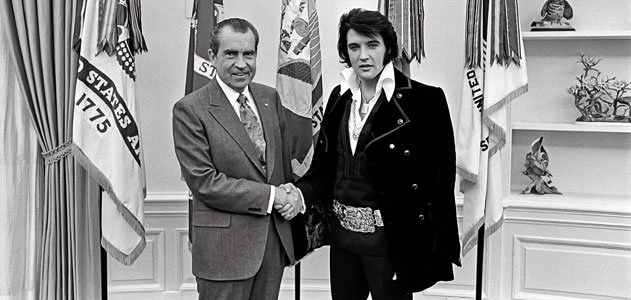
Premise: At 6.30am on December 21st 1970, the King of Rock’n Roll showed up on the lawn of the White House to request a meeting with the most powerful man in the world, President Richard Nixon. He had a very urgent request: to be sworn in as an undercover Federal Agent at large.
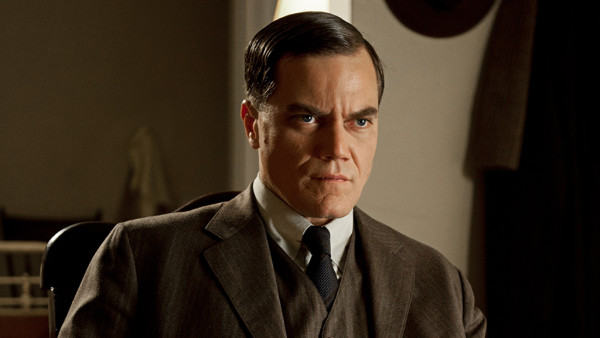
About: Elvis and Nixon was acquired by Amazon at the Cannes Film Festival and will star stellar actors Kevin Spacey and Michael Shannon as Nixon and Elvis respectively. The script was written by Joey Sagal, Hanala Sagal, and, in his first screenwriting gig, actor Cary Elwes (presumably off the buzz of his book, “As You Wish.”). This is, indeed, a strange writing team. Joey Sagal is best known for acting in a bunch of cheesy movies (Not Another Celebrity Movie, Anna Nicole, Redline). He’s also played Elvis Presley a number of times in his career, making you wonder if he originally wrote this for himself? Wife Hanala purportedly has over 90 million Youtube viewers and, according to her IMDB page, seven other films in development. I have to admit, this isn’t your typical “hot young writer” scenario we usually see with a buzzed about movie. But hey, why can’t that be a good thing?
Writers: Joey Sagal, Hanala Sagal & Cary Elwes.
Details: 123 pages
I’m telling you right now, the cables and networks and theater chains better watch out. Because the entertainment world is changing faster than you can say Blockbuster Video. Internet giants Netflix and Amazon are digging into their Lord Of The Rings-sized caves of gold to disrupt the whole paradigm.
And while Amazon is putting Elvis and Nixon in theaters first, you get the feeling that the next Elvis and Nixon will be made exclusively for Amazon’s site. And once that happens, coupled with Netflix doing the same, expect a tsunami effect to follow. We’ll never look back.
A note to Amazon though if they expect to compete with Netflix. Rebrand your TV and movie arm. Every time I go to your site to watch a show or a movie, I have to navigate a weird chain of links to do so. It’s so annoying that I’ve found myself avoiding going back because I know how much of a chore it will be. With Netflix I just go to: NETFLIX. It’s pretty damn simple. Make your entertainment arm simple as well and watch the money start rolling in. You’re welcome. I only want an associate producer credit.
Well, the plot of this one pretty much goes how it says in the logline. Elvis is watching TV one night. He sees all the drugs and the flag burning and the Black Panthers and he decides that America has gone to shit.
So he enlists his buddy Jerry Schiller, the only true friend he has in the world, to head to Washington with him so he can meet President Richard Nixon and request to become a “Federal Agent At Large,” even though there’s no such thing – the idea being that he can then help clean up America or something.
Jerry’s tired of being Elvis’s bitch. Every time this happens he upends his life to help the King. Yet against everything telling him to say no, he says yes, and off they go. As soon as the two land, they head straight to the White House. Elvis has written a letter to Nixon detailing his need to become a Federal Agent at Large right away.
Unfortunately, the White House guards tell him that even though they love blue suede shoes, there’s not much they can blue suede do.
Luckily, word of Elvis’s wish meets two young White House aides who happen to be Elvis fans. They ask Nixon if he’ll meet Elvis but Nixon says he thinks the guy’s an idiot. So hell no.
They break the sad news to Jerry, who’s pissed for about five minutes before remembering that Nixon’s daughter is a fan. So he gets word to her that Elvis wants to meet her father, and the next thing Nixon knows, he’s a slave to the demands of his spawn.
The movie ends with the 20-minute long meeting, where a pissy Nixon gradually warms up to Elvis, realizing he’s a great guy who shares a lot of the same political views as the V-fingered figurehead. Nixon surprisingly requests a photo of the pair which would go on to become the single most requested photo from the National Archives in history.
I don’t think I’ve encountered anything this light and fluffy since tripping over my neighbor’s Pomeranian. That’s not necessarily a bad thing. But you’re kind of encouraged, when writing screenplays, to write something with weight, with actual stakes. And the whole time I was reading Elvis and Nixon, I kept asking myself “What are the stakes here?”
I realize that’s a very “Screenwriting Professor” thing to say, and that art shouldn’t be boxed into such restrictive ideologies. So let me put it another way. What happens if Elvis doesn’t get his meeting with Nixon? I’m pretty sure nothing in his life changes. For that reason, this trip, this goal, doesn’t matter. So it was hard to get emotionally invested in the movie.
I mean, the trip obviously matters to Elvis, who’s obsessed with meeting the president and getting this secret badge thing, and that accounts for something. Sometimes you can distract the audience from the low stakes of your story by making the matter so important to the hero that we simply don’t pay attention to the bigger picture.
The problem is, Elvis is painted as such a one-dimensional character here, it’s hard to care about him caring. The King is pretty much played as a joke throughout. Most of the time, he acts like a 12 year-old who wants the hot new cowboy costume for Halloween in order to impress all his friends at school.
He truly honestly wants this secret agent badge so he can infiltrate bad groups of people. Elvis Presley. Infiltrating people UNDER COVER. Which I suppose is funny, and the joke they’re going for, but it comes at the expense of taking your hero seriously. And I personally can’t stand when writers make a joke at the expense of character.
Which leaves “Elvis and Nixon” feeling like one giant curiosity. I spent most of the read trying to understand why such top-level talent would want to make this. And then it hit me. Elvis and Nixon are two of the most iconic caricatures in pop culture history. To get to play one of them must be a dream for an actor. You really get to have fun.
I guess my next question would then be, does Michael Shannon have fun? I’m pretty sure the last time the guy smiled was when he was 8, after watching a school bus full of children drive over a bridge. And this only brings up more questions. Like what is the tone going to be here? I’m guessing they’re going for FULL WEIRD – Charlie Kaufman style – as that’s the only way I can see them justifying this lightweight concept. If you play this straight there’s simply not enough meat on the bone.
In fact, I think this script could’ve been a lot better had it taken its protagonist more seriously. There are these hinted-at moments of Elvis’s complex childhood, as well as repeated mentions of the handlers who control his life. I would’ve liked to have seen his character arc around those issues. See him stand up for himself or something. Instead, we get a pseudo-airhead who believes he’s a secret agent, which just wasn’t meaty enough to justify a feature film in my opinion.
Not saying it won’t work for others. But this was too thin for me. Elvis in his 20’s thin.
[ ] what the hell did I just read?
[x] wasn’t for me
[ ] worth the read
[ ] impressive
[ ] genius
What I learned: Just say NO to your hero. A lot! — Throughout this script, Elvis keeps getting a “No,” in response to his desire to meet the president. But he keeps fighting and fighting until he finally gets his “Yes.” And really, that’s how every story should work. You give your protagonist a goal, and then you spend the majority of the screenplay saying “No” to him. But he keeps fighting and fighting until he finally gets his “Yes.”

So a few months ago this writer wrote into me hyping up his TV pilot. Without getting too specific, it was about a future world in the mold of that new show “Humans” on AMC – the “A.I.” like show about robots being used as slaves. Hearing the writer discuss his script, I don’t think I’d ever been more excited to read something. Not only was it a cool idea, it tackled intense themes like mortality and survival and the power of family. It sounded really good.
And then I read it.
And the script was… not what I had been told it was. It was just so damn… cheesy. There’s no other way to put it. It was a freaking cheese-fest. Like it needed its own display in a Wisconsin supermarket.
But I’m not just an observer at the corner of Swiss and Gouda. I’m a client. I once wrote a tennis script that I thought was going to change tennis forever. It was this deep intense look at a troubled doubles team scraping by on the tour. I gave it to a producer and he didn’t really respond to it. When I pressed him for details on why, he said it reminded him of “that movie Side Out.” I’d never heard of that movie so I looked it up. Here’s the still that I found.
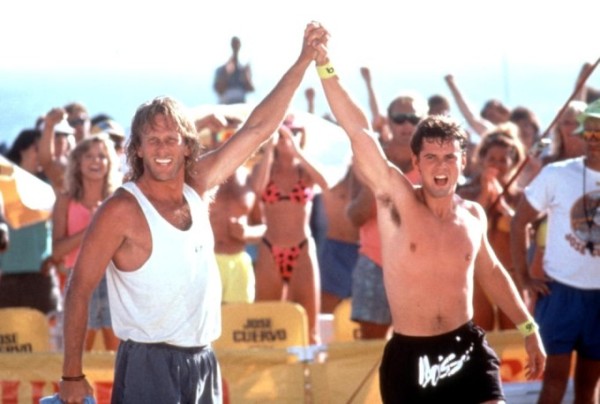
Ouch.
That was not what I was going for AT ALL. But it shows just how pervasive this problem is. And why everyone fears it. I mean, I think we’re all trying to avoid making the next Side Out. James Gunn, the writer-director of Guardians of the Galaxy, had a mini-breakdown in the middle of shooting that film when he became convinced he was making the next Pluto Nash.
Point being, I run into this problem a lot. Writers who go for these really intense dramatic stories that end up coming off super-cheesy. And they don’t know it. And the question becomes, how do you recognize this and fix it before you send your script out and embarrass yourself?
So I got to thinking about that question: What makes a show/movie cheesy? And I came up with a handful of observations. Now to understand what I mean by cheesy, we’re going to look at both extremes, intense drama and cheeseapocalypse. On the “non-cheesy” side, you have something like the Todd Field film, “In the Bedroom.” Here’s a clip from that movie.
As long as we’re talking about rooms, why don’t we hop into an adjacent room for what some consider to be the cheesiest movie of all time. Here’s a scene from, “The Room.”
Now here’s the scary part. Tommy Wiseau, the director of “The Room,” was trying to make a movie like In the Bedroom – something with that kind of power, with that kind of gravitas. What went wrong? That’s an article for another day. But the cheese-factor here can be attributed to a few things, as can most unintentionally cheesy efforts.
1) False Reality – “False Reality” is when you move away from how characters would act in real life and start substituting actions that work specifically for your movie. So if you look at this scene from The Room, Tommy Wiseau reasoned that he needed this scene for his plot. But a big reason why it feels so cheesy is because the scene would never happen in real life. A guy doesn’t sit down on a roof and immediately start talking to someone about girls cheating then leave. Nothing about it feels honest and therefore it screams, “False Reality.” Everything in In The Bedroom’s scene feels honest, like this is the way it would really go down. That authenticity is what wards off the cheesiness.
2) Bad dialogue – The words “cheesy” and “dialogue” go together like peanut butter and jelly. That’s how easy it is to write cheesy dialogue. To avoid this age-old trap, apply the same “false reality” logic to your dialogue as you would your scenes. Ask the question, “Would the characters really be saying this?” Because a lot of times as a writer, you make characters say things in order to move your plot forward or to slip in your observations about life. But you don’t stop to consider if that’s what they’d say in the real world. Now the conversations are never going to sound exactly the same, of course. You have to abbreviate movie-conversations to keep the story moving. But the essence of what they’re saying needs to be necessary. It needs to be truthful. And it needs to be believable. That’s what you need to nail. Also, avoid on-the-nose dialogue at all costs. People rarely say exactly what they’re thinking so when they do, it draws attention to itself, and cheesiness is a by-product of that. So Tommy Wiseau saying, “I’m so happy I have you as my best friend and I love Lisa so much.” Nobody says that kind of thing. That’s why the line is so cheesy.
3) Two-dimensional characters – This one isn’t as easy to spot because it’s less about what’s happening in the moment and more about how much time you put into constructing your characters. The less you know about a character, the more likely it is that they’ll respond to situations in a generic manner. And “generic” is cheese-fuel. Have you ever known someone who speaks in generalities and catch-phrases? “You working hard or hardly working, John?” “That’s my story and I’m sticking to it.” “Looks like somebody’s got a case of the Mondays.” They come off as cheesy right? It’s because they have no depth. Everything they say is surface-level. An act. The same thing goes for your characters. The better you know them, the more specifically you’ll have them act, which in turn makes them more authentic, which is the opposite of cheesy. So write out those extensive backstories, give your characters unique ways of speaking, create complicated relationships for them, give them goals in life, give them unique hobbies, weird stuff they’re infatuated with. Give them that flaw that holds them back. Make sure that flaw dictates everything they do. Make them specific!
4) Stay consistent with your tone – In military parlance, there’s an old saying: “Hold the line.” It’s when you’re shoulder to shoulder in the trenches with your army, shooting down the approaching enemy. Your job is to make sure those guys don’t get past your line. Tonal consistency is a similar idea. You choose a tone for your story and you try and stick to it. The problem is, you get all these goofy, funny, or weird ideas you want to add (the approaching enemy soldiers), and you’re so tempted to just duck down and let them through. You can’t. You’ve chosen this tone so you have you to stick with it. I can’t take your dark funeral drama seriously if one character’s farting all the time. I can’t take your blood diamond action film seriously if one character cracks wise every time he gets in a fight. I can’t take your Leaving Las Vegas type romantic drama seriously if you include the animal cracker scene from Armageddon. Whatever your tone is, hold the line until you get to “The End.”
Like a lot of things in screenwriting, avoiding the cheese tag comes down to truth. If you convey your story and characters and dialogue in a way that feels truthful, we’ll surrender to your world. But if characters are constantly doing things or saying things that they’d never say or do in that situation (or in real life), that’s when shit starts feeling like a big ball of Velveeta. And with that, I leave you with a challenge. Here’s a scene from the zombie show “Z Nation,” which I consider to be really cheesy. I want you to tell me WHY this scene is cheesy. In doing so, consider the show’s polar opposite – “The Walking Dead.” How would THEY have done this scene? Feel free to add your own reasons beyond the four I’ve brought up. The more cheesy rules we end up with by the end of the day, the better.

The schizophrenic 2015 Summer box office refuses to go away! Neither of this weekend’s contestants, Terminator: Genisys or Magic Mike XXL, finished in the top two. Those spots went to stellar holdovers Inside Out and Jurassic World. The studios responsible for the new entries, Paramount and Warner Brothers, are trying to blame a weird July 4th weekend layout (where July 4th didn’t fall on a weekday), but come on, let’s be honest here. Nobody wanted to see these films because of a simple reason: they didn’t look that good.
I mean Terminator: Genisys did so bad, it finished 20 million dollars below Terminator: Salvataion’s opening weekend box office, a movie that famously found a way to make a post-apocalyptic world dominated by killer robots boring. What’s strange is that every single person on the planet knew this movie was dead in the water EXCEPT for the Terminator producers and Arnold Schwarzenegger. How can a group of people be so out of touch?
Well, I have a counter-argument for that. I believe that if the script for Terminator: Genisys was good, and that script translated into a good film, word-of-mouth and slamming reviews could’ve saved this film. So why didn’t that happen?
Well, the writers of Terminator: Genysis made an age-old screenwriting mistake. They wrote a complicated time travel story. I’m going to say something here that I BEG all sci-fi writers heed for the remainder of their writing careers: COMPLICATED MAINSTREAM TIME-TRAVEL MOVIES DO NOT WORK.
Time travel is one of the trickiest sub-genres to get right. That’s because they intrinsically don’t make sense. If you travel back in time to stop something and it doesn’t work, you just travel back and try it again. The genre is a black hole for plot holes. And the more you keep travelling around in time, the more of these plot holes keep popping up.
Terminator: Genisys is all about characters travelling back in time to stop moments from previous Terminator timelines. Like an aging Arnold Terminator growing up with Sarah Connor and then fighting his younger Terminator self when he shows up in 1984.
This is a DEADLY but common mistake with young eager sci-fi writers. They say, “Ooh, that’d be so cool. The old Terminator fighting the young Terminator when he arrives in the past!” And it is kind of a cool idea. But if you manipulate a time-travel timeline that’s already iffy as it is solely to accommodate a cool scene, you’ve upset the entire foundation of your story.
When you write anything, whether it’s a complex time-travel plot or a simple coming-of-age film, you must avoid “But wait” moments. “But wait” moments are where your audience pulls out of the movie to ask, “But wait. If that happens, then the other thing doesn’t make sense.” Or, “But wait. If he did this then how come he couldn’t do it earlier?” Time travel movies are cess pools for “But wait” moments.
For that reason, when you write a time travel movie, you keep the time travel stuff as simple as possible. It’s why the original Terminator worked so well. A terminator came back from the future to kill a woman. The whole movie, then, was not about Sarah Conner jumping through time portholes to escape the Terminator. It was a chase movie. Plain and simple. No gimmicks. That’s why it worked.
James Cameron knew this going in for the sequel as well. He didn’t add some silly time-travel plot. The only thing he changed was adding a new Terminator. There was some stuff about trying to destroy Skynet before it could take over the world, but that was still easy to understand and buy into.
Another example of time travel screwing up a movie was Back to the Future 2. Now I can already hear some of you guys grumbling. “Back to the Future 2 was great, Carson!” No, it wasn’t. The plot was borderline ridiculous. What you liked about Back to the Future 2 (as did I) was that it still had 2 of the most lovable characters in cinematic history, Marty McFly and Doc Brown. Those two are what made Back to the Future 2 watchable.
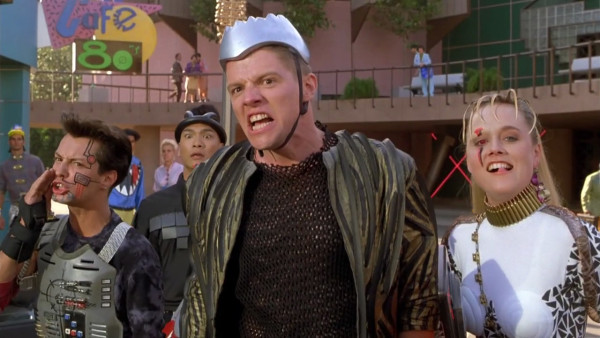
But the travelling to the future only to find out that they needed to travel to the past to save an alternate present. It was a mess. And I remember Roger Ebert pointing out that even the characters looked confused trying to explain it (needing a chalkboard to do so). And this is yet another reason to avoid complicated time travel movies. They require tons of exposition, which eats up valuable story time.
Now some of you might point out movies like Primer as examples of complicated time travel movies that work. But Primer isn’t a mainstream movie. It’s a $7000 indie movie that nobody outside of cinephiles saw and when you make a movie for that kind of money for that kind of audience, you can take risks and play around because you’re not necessarily required to make sense (and it’s debatable whether Primer does make sense).
My point is, time-travel is a plot device that you can get lost in. And I get it. It’s fun to play with. Who doesn’t want to solve a time travel problem by adding more time travel! But I’m warning you as someone who reads A LOT OF BAD TIME-TRAVEL SCRIPTS, if you’re writing a sci-fi movie, it’s best to keep the time-travel plot as simple as possible. You can be complex with character development and the plot itself. But don’t add layers upon layers of time travel unless you want to “But wait” yourself out of a movie.
Speaking of time travel, I bet the producers of Magic Mike XXL are wishing they could go back in time and not make their sequel.
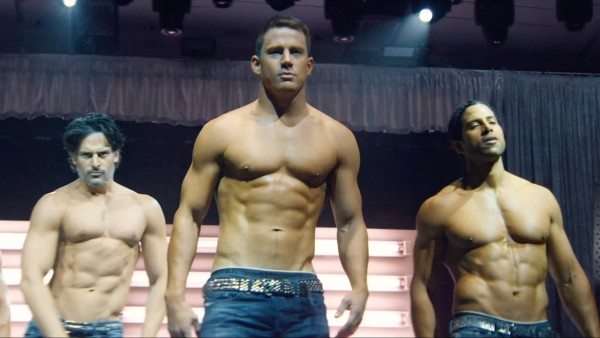
Granted, my understanding of why this movie didn’t work isn’t as complete as Terminator: Genisys, but I have some ideas. For starters, this isn’t a sequel-type movie. Sequel movies are action movies, adventure movies, sci-fi movies, and comedies. There’s nothing about this particular concept that screams “need more of these.” It feels very much like a “one-off.”
The producers didn’t seem to realize this and that cost them. Because even without that issue looming, sequels need to abide by one law. You need to give the audience MORE. Something bigger. And when you watched the Magic Mike XXL promos, it looked like we were getting the same.
This was the same mistake The Avengers 2 made, which isn’t coming anywhere near the domestic box office of the original. They went as big as they could in the original, leaving them no room to go bigger with the sequel. So people said, “That looks the same.” And it was. It was the same movie (probably even smaller). And that’s death for a sequel.
Using Terminator as an example here, Terminator 2 brought in a bigger badder Terminator. That’s why people showed up to that movie. Because we were getting something new. Magic Mike should’ve realized, “We aren’t a typical sequel film. So we definitely need to find something bigger to bring people in.” I don’t know what that would be. The promise of Channing Tatum full-frontal? Based on the audience for the film, maybe. But a carbon-copy stripper film isn’t going to be enough to lure people to theaters.
Unfortunately, next week doesn’t look much better. Minions is the only major film opening. But the following week we get Ant-Man AND Trainwreck, so that should be fun. And remember, screenwriters – following and dissecting box office is an essential part of your jobs. You need to know what’s doing well and what isn’t, and also WHY. Studios are fickle and terrified and reactionary and one major bomb in a genre can change the development tracks of all six studios. For example, you don’t want to go out wide with your complicated time-travel stripper script this week. Table that for awhile and work on something else. Like dinosaurs attacking Los Angeles or something. I’m only half-kidding. It’s not like Jurassic Park has IP on dinosaurs. Man, the more I think about it, the more I think a studio would actually buy that. Anyway, as always, good luck!
So a few weeks ago I was watching a short film (actually, it was the one I linked to in my newsletter) and I marveled at how easy it is to stand out in that medium. You have so many tools available to you. You can do something funky with the color grading (the green tint used in The Matrix). You can add a weird soundtrack (Gregory Go Boom). You can play with the camera angles, add creative camera movement, dress the set in a weird way (a la Wes anderson). The opportunities are endless.
Then you slide over to the screenplay side and… all of that is gone. You’re working with black and white. Not even images. Just words. There’s no musical cue to set the tone or sound effect to heighten the atmosphere. And that got me thinking. What can writers do to make their scripts stand out? I started thinking back to all the scripts I’ve read and specifically to the ones that left an impression. Was it only about the story? Or were there specific areas where you could make an impression? That’s the question I want to answer today. Here are six things you can do to make your script stand out from the pack.
Take pride in your presentation – Scripts riddled with weird presentation issues leave a bad taste in my mouth. Like the other day I was reading a script where a character name was at the bottom of the page, and the dialogue for that character was at the top of the next page. How am I supposed to see you as a professional after that? So start using professional screenwriting software, whether it be Final Draft, Fade In, even Celtx. This takes care of 90% of your presentation issues. From there, aim for a zero-mistake policy with your grammar and spelling. And avoid manic writing styles (lots of capitalization, underlining, italicizing). You may think you NEED TO WRITE WITH A BUNCH OF CAPITAL LETTERS AND BOLD AND ITALICS TO STAND OUT but all this does is make you look unsure of yourself – like you don’t think your story is good enough to be told without screaming. Whether I like a script or not, I always respect the writer who takes pride in their work. Those scripts always stand out to me.
Voice – Identifying something you want to write about is only half the battle. The other half is identifying how you’re going to present it – how your specific presentation is going to make it unique. This is the most effective way of standing out in screenwriting – writing in a unique voice. Take note, however, that “voice” has a volume dial. You can turn your voice up to “10” (tell your time travel story through the subconscious of a rabbit with Tourette’s Syndrome) but that might be too weird. On the flip side, if you don’t turn the “voice volume” up at all, nobody’s going to hear you. Take Tuesday’s two Narcos pilots. The first draft was slow, droll, painfully linear, and something we’ve seen a million times before. It lacked a single unique trait. The second draft shifted the perspective to a disembodied voice over and focused on a whirlwind retelling of Columbia’s exciting drug trade history. The exact same subject matter went from being boring to being fun – and it was all due to the voice it was told in – one that was more energetic and that changed up the perspectives of the main characters. So think hard about how you’re going to present your material. It has a huge impact on the read.
Start telling a story and never stop – Too many writers start their scripts in “set up” mode. They’re focused on setting up characters, relationships, backstory, jobs, plot exposition. As a result, we feel like we’re back in 6th grade reading comprehension class. Like, “Oh man, I better write down that John here lost his brother when he was 10 or I’m going to get an F.” Scripts should never feel like work, especially spec scripts. To that end, start telling a story from the very first line of your script and don’t stop until you type “The End.” The other day I rented this amazing foreign film called “Wild Tales.” It starts out on a plane, and an older man begins hitting on the woman next to him. Within 90 seconds, the two realize that they have a mutual friend. As they begin talking about this friend, someone in a nearby row pops up and says, “I’m sorry. I couldn’t help but overhear your conversation. I know that man as well.” And then another person pops up, and then another. We begin to realize that everyone on this plane knows this man. I’m not going to tell you what happens next to drive my point home. You’re already hooked. You want to know how all these people know the same person and you want to know what happens next. That’s what telling a story is about – it’s about hooking the reader immediately and not letting them go. Too many writers believe in some unwritten rule that it’s okay to bore the reader for awhile as long as you entertain them later. I’m sorry but it doesn’t work like that.
Thoughtful character introductions – It always leaves an impression on me when a writer writes thoughtful descriptive character introductions. Characters are really important. They’re the lifeblood of your story. And when you watch a movie, you get a sense of the character right away just by the way they look. Think about any of the characters in The Big Lebowski (or any Coen Brothers film for that matter). They really make an impression when they arrive onscreen, right? Well, you should try to replicate that on the page. And the only way you’re going to do that is with a thoughtful description that captures the character’s essence. To achieve this, identify a character’s defining characteristic and make that the focal point of their description. Here’s how The Dude is introduced in The Big Lebowski: “We are tracking in on a fortyish man in Bermuda shorts and sunglasses at the dairy case. He is the Dude. His rumpled look and relaxed manner suggest a man in whom casualness runs deep.” Isn’t that so much better than, “This is the Dude, a bored-looking man who walks through the supermarket isle?”
Paint a picture when you write – Lots of writers use the Dragnet approach to screenwriting (“Just the facts ma’am.”). So they’ll describe a bedroom this way: “The room is messy and has a single bed in the corner.” There’s nothing wrong with this. But come on. You’re a writer! Be creative. Paint us a picture. Maybe, “The room is populated with endless stacks of old Popular Science magazines. The bed in the corner is buried in various fast food bags.” You see how much more information the second description gives us? How much more you know about the person living in that room? And I know what you’re thinking: “But you tell us to keep our writing sparse, Carson.” That’s true. If a room isn’t relevant to the story, a quick and dirty description is fine. But if a location is relevant to the story or your characters, take a little extra time and paint a picture for us. Just do it in as few words but do it. If your entire script is told in a “just the facts ma’am” manner, it’ll register in the reader’s head as a big ball of genericness.
At least one larger-than-life character – When I read a script, I need at least one character who pops off the page. It doesn’t have to be the main character. But it’s gotta be someone. That way, I’m always looking forward to that character coming back (and that keeps me reading your script!). The most obvious example of this is Hannibal from Silence of the Lambs. Just a larger than life character who’s constantly surprising us. But your memorable character can be someone who’s crazy (The Joker), funny (George Clooney’s character in Gravity), a little bit dangerous (Quint from Jaws). If every character in your story is stuck firmly on the ground, you’ve probably got a pretty boring screenplay. You need that one character who’s at least 500 feet above sea level.
To sum up, I think the biggest way to stand out as a screenwriter is to be creative where others settle for being ordinary. Are you the writer who’s going to mail in one more generic car chase? Or are you going to put your character in a stationary bullet-proof super car with 20 cops firing AK-47s at it from less than 10 feet away and your hero has nowhere to go (Captain America 2). Are you going to give us one more generic boy-meets-girl rom-com? Or are you going to put that relationship in a blender like 500 Days of Summer? Are you going to demonstrate your main character’s detachment from life by making him yet another drunk? Or are you going to pull a Collateral Beauty and have him mindlessly building domino sculptures all day? Remember guys, it’s easy for readers to measure effort. We know when you’ve really put a lot into a scene and when you’ve mailed it in. You can never trick the reader. So put every ounce of your soul into every ounce of your screenplay and I promise you, you’ll stand out.
The Scriptshadow Newsletter is Out! If you didn’t receive it, check your SPAM and PROMOTIONS folders. It should be there. And it’s a good one. I review the hottest screenplay in town!
Genre: Thriller
Premise: When a newly minted partner at his firm goes to spend the weekend with his old friends, the three of whom own a successful hedge fund, he begins to suspect that they’re involved in some major illegal activity.
About: The 1983 film, The Osterman Weekend, is probably best known for being directed by the legendary Sam Peckinpah, as well as having a stellar cast (Rutger Hauer, John Hurt, Craig T. Nelson, Dennis Hoppper, and Burt Lancaster). It was around 2007 when people first got the idea to remake the film, and since then, it’s gone through a series of rewrites and restarts. The original book was written by Robert Ludlum, who’s best known for birthing the Bourne franchise. This is the most recent known draft and was written by Jesse Wigutow, who’s been doing well for himself lately. He wrote the latest Tron movie before it was cancelled by Disney. And he also wrote the latest Crow film, which we’re being told is coming soon.
Writer: Jesse Wigutow (based on the novel by Robert Ludlum)
Details: 121 pages- 6/12/12 draft

I think it was Steven Soderbergh who once said, “Why do we keep screwing up all these classic movies. If you’re going to remake a film, find one that had a good concept but bad execution.” In other words, find great ideas that they screwed up. And that appears to be the idea with an Osterman Weekend remake, a 1983 film that was loved by, well, nobody.
But I’m a big fan of these types of ideas. Seemingly small films with big concepts at their core – high stakes, the potential for lots of conflict and surprises. A guy stuck in the middle of nowhere with friends who may or may not be planning to kill him? That’s a movie there. In fact, this is the exact type of idea I’d like to see in a Scriptshadow 250 entry. Cheap to shoot but bursting with ideas inside.
Does The Osterman Weekend do its job and improve upon the original? Well, I can’t answer that question because, like the rest of America, I never saw the original. But now that I’ve read the script, I have a better idea of what may have held the film back.
The Osterman Weekend follows 35 year-old John Tanner, a tax attorney who’s just made partner. Tanner’s life is looking up, as in addition to his promotion, he and his wife are planning to have their first child.
Every year, Tanner heads up to an island off the coast of Maine, to join his three best friends – Loewy, Tremayne, and Osterman. The four of them descend back into their frat boy days, drinking, fishing, and generally being idiots. It’s a harmless weekend of rekindling their friendship.
Except this weekend isn’t going to be harmless. Loewy, Tremayne, and Osterman own one of the hottest hedge funds in the country. Their returns have been so incredible, they’ve left competing hedge funds in the dust.
On his way there, Tanner is confronted by a couple of men from Homeland Security, who inform Tanner that his buddies are bad news – they’re stealing money. And they want Tanner to help take them down.
Tanner’s not sure whether to believe this or not, but when the men tell him that Tanner could land in prison if he doesn’t help, he’s forced to wear a wire and collect intelligence on his buddies.
The weekend basically follows Tanner as he tries to extract information from his friends. As the weekend goes on, he learns that his buddies are involved in something far more complicated than simply building an elaborate money scam. And maybe their situation is more sympathetic than his pals at Homeland have made him believe.
Who does Tanner trust? Who does he help? In the end, he’ll have to decide whether to go with what’s best for him and his wife, or go with what’s best for the friends he’s known all his life.
When I heard about The Osterman Weekend, I thought I was going to get a really subtle thriller about a guy who ignorantly shows up at his buddies’ weekend party, only to slowly realize that they were criminals capable of doing something horrible – possibly even killing him. That’s the movie I wanted to see.
Instead, The Osterman Weekend comes at you like a giant hammer, banging its way into your skull. Gone is all hope of subtlety when before we even GET to the weekend spot, we’re already bombarded with two agents who are telling our hero that his friends are evil.
From that point on, I found myself completely distanced from the story. It was just so BIG and IN YOUR FACE. Even the writing screamed at you, with lots of CAPITALIZATION EVERYWEHRE YOU LOOKED.
Doesn’t this story work better if Tanner shows up on this island, thinking he’s in for a fun weekend, and then slowly discovers clues that his friends aren’t who they say they are? That they’re planning to do something horrible? And he has to quietly investigate what that is without them catching on? I think so.
Another frustrating thing about The Osterman Weekend was the lack of hand-holding. Whenever you’re covering a complicated job, or subject matter, or plan, it’s your duty as a writer to hold the hand of the reader and take them through the details so they know what’s going on.
The Osterman Weekend is about law firms and hedge funds, things I know next-to-nothing about. This left me playing “catch up” throughout most of the first act. In fact, since we were talking about hedge funds so much at the start, I thought Tanner worked at a hedge fund. It was only after a later throwaway line that I realized he was a tax attorney.
If the details aren’t important to the story, you can get away with less help. But the hedge fund here is the cornerstone of the plot. So to leave us on our own to interpret it was frustrating at best. Always be mindful of the fact that the reader knows less than you. If you have complicated subject matter, help the reader through it.
Maybe The Osterman Weekend’s biggest problem though – and the reason that despite a legendary director and stellar cast, it didn’t do well – is that it has a main character who doesn’t do anything. He’s just a pawn in the middle of two way more active parties.
It’s preferable you pick stories where your main character is DRIVING THE ACTION. He’s the most active party in the story. Here we have the Homeland Security guys (I’m still not sure why Homeland Security is trying to bust a hedge fund) targeting Osterman. We then have Osterman mounting a complicated escape plan. And Tanner is stuck in the middle, doing whatever people tell him to do. Someone needs him to wear a wire, he wears a wire. His buddies tell him the hedge fund issues aren’t their fault, he believes them.
This has been a debate since the beginning of screenwriting. Can your main character make it through an entire movie without being active? I suppose it’s possible but your audience is always going to respond better when your main character says, “Fuck this, if I’m going down, I’m going down my way.”
I mean look at Ludlum’s most famous series of novels. They revolve around one of the most active characters out there – Jason Bourne.
I think things are different in novels when you’re inside the hero’s head. We get a running commentary on what he’s going through. Therefore, it’s not as evident that he’s inactive. Because there’s all this activity going on in his brain. In movies, it’s different. All we have to go on are a character’s actions. So if they’re simply jumping when other characters tell them to jump, they look weak. And nobody likes a weak hero.
I’d love it if they went back and started from Square 1 here. Make this a slow-build story. Inject some curiosity and suspense into Tanner’s arrival. Make it so that everything seems great before everything falls apart. That was my biggest issue with Osterman. They introduced a problem before we had a chance to settle in and consider that there might be problems. There was no patience here.
[ ] what the hell did I just read?
[x] wasn’t for me
[ ] worth the read
[ ] impressive
[ ] genius
What I learned: Hold the reader’s hand when it comes to complicated subject matter. Tax attorneys? Hedge funds? The average person knows nothing about these things. So make sure you explain them to us, as well as how they fit into the story. If you leave us behind, we’ll mentally check out, and from that point on, we’re unable to enjoy your story.