
Search Results for: F word
Genre: Historical Epic
Premise: In 1804, before America has any cachet in the world, a rogue U.S. diplomat arrives in the savage city of Tripoli to demand the release of American prisoners.
About: Tripoli was famously about to begin production in 2003 (2004?) when at the last second the studio pulled out. Ridley Scott, the director of the project, immediately moved on to another Monahan scripted endeavor, “Kingdom Of Heaven

Writer: William Monahan
Details: 129 pages – 4/11/02 draft (This is an early draft of the script. The situations, characters, and plot may change significantly by the time the film is released. This is not a definitive statement about the project, but rather an analysis of this unique draft as it pertains to the craft of screenwriting).

Historical-related plots are so hard to pull off. They’re always walking that line between maintaining the historical accuracy of the times and keeping things entertaining enough for a modern audience. The problem is that the speed of life back then was so damn slow, and if you violate that pace, if you try to speed it up Michael Bay style, it feels false, necessitating that you move your story along at “Sunday afternoon” speeds. This requires the writer to dig deep into his bag of tricks to keep the story moving – conflict, mystery, suspense, tension, plotting – all of them must be used to “trick” the audience into thinking things are moving faster than they actually are. The problem is, there aren’t many writers who can do this. But since Monahan is about as skilled as they come, maybe Tripoli would be different.
Or…maybe not.
I didn’t like Tripoli. In fact, I had a harder time getting through this than I did a day at Sunday school. I don’t know if this movie was built for me because it is looooooong and drawwwwwwn out and not much happens and I don’t know if the subject matter is big enough for an entire movie. It’s basically about a guy walking around for a couple of hours. Let me lay out the plot for you.
The story starts off in the Barbary Coast of Africa in 1804. America isn’t a major player yet. To the point where places like Tripoli scoff when Americans show up in their city and demand the release of American prisoners. This is exactly what happens as our hero, Eaton, an easily frightened American diplomat on his way to another country entirely, but who gets roped into Tripoli after local pirates seize his ship, sees other Americans there and asks for their release.
This was the first sign of trouble for me, that our hero wasn’t even specifically headed to Tripoli in the first place. He was going somewhere else and only upon noticing a few of his other countryman being held did he decide to make a stand. When the situation was so meaningless that our hero wasn’t even going there to address it in the first place, it just felt like a second rate problem. And indeed, the Americans aren’t in any imminent danger. They’re just sequestered to their ship in the port. So right away, the stakes feel low.
To the script’s credit, there is one great sequence in this opening act, and that’s when Eaton demands to speak with the city’s ruler, a barbaric man who skins people alive, pokes their eyes out, and forces them to live in cages in his throne quarters. And we thought Charlie Sheen had issues. Just the anticipation of this meeting between Eaton and the ruler was great, and when they do finally have their showdown, and Eaton stands up to him, it was easily the best moment in the script. I still had high hopes for Tripoli at this point.
Unfortunately, Monahan takes the story in another direction entirely. After the ruler denies Eaton the release of his countrymen, Eaton finds out that the king has a brother who’s been exiled to Egypt, and that this brother is a way cooler cat who doesn’t skin people alive and put them in cages. So he gets this idea that he’ll go to Egypt and convince the brother to come back and rule Tripoli.
And thus begins an endless trip where Eaton finds the brother and the two walk back to Tripoli, debating how they’re going to take over the city with so few men. As you know, for any “road trip” scenario to work, the characters have to be interesting. And both Eaton and the brother are – I hate to say it – but really boring. They sound like two college professors debating 200 year old world affairs for two hours. I mean it’s really hard to get through.
I suppose the final battle to take the city back could be epic with Ridley Scott directing, but because I didn’t care about any of the characters involved, in particular the American soldiers who I barely knew, the battle didn’t matter. To make things worse, there’s a huge anti-climactic moment that interrupts the battle at the end that basically makes everything that came before it (aka the entire movie) meaningless.
Tripoli’s faults come down to that most basic pillar of storytelling – stakes. I just didn’t feel the stakes. I didn’t really know or care about the Americans being saved. I didn’t understand why replacing the leader of Tripoli was so important. It seemed like our main character was set on it only because of principle, because the ruler was bad and his brother was good. I get principle but I don’t know if I believe that someone takes a months-long trip to Egypt to find a replacement king then goes back and tries to take over the city simply on principle. In Braveheart
Also, I didn’t like the recruiting of the replacement brother. Mainly because the CITY IS WHERE ALL THE FUN IS! Tripoli, with this barbaric insane leader who kills people for sport….THAT’S WHERE I WANT MY MOVIE TO BE. That’s where all the conflict is. When we’re in this city, we feel like Eaton could be skinned alive at any moment. When he’s off wandering around Egypt, we feel no danger for him whatsoever. Why not have Eaton stay in the city and plan his takeover there? I suppose the answer to this has something to do with that’s not how it happened in real life. So then maybe you focus the story on one of the other characters, possibly one of the Americans stuck in the city?
To be honest, this is why I get worried whenever I open a period piece. Many of them seem to be geared towards historical nerds who love the details yet aren’t that interested in telling a rip-roaring story, which I guess brings us back to Monday’s script review, Repent Harlequin. The details are definitely necessary to making a script great. But a script’s laurels can’t rest solely on historical details. It has to be based on some kind of unique entertaining hook, and I’m still struggling to figure out what the hook of Tripoli was.
So if William Monahan, one of the best writers in Hollywood, is struggling to make an historical epic work, then let that be a word to the wise for all you amateur writers out there thinking you’re going to break into the spec market with an historical/period piece yourself. It’s really damn hard!
[ ] What the hell did I just read?
[x] wasn’t for me
[ ] worth the read
[ ] impressive
[ ] genius
What I learned: If you refuse to listen to me and still want to write your period piece, seriously consider starting your screenplay with an opening crawl that highlights the relevant details of the time. One of the reasons I had such a tough time getting into Tripoli was that I had no knowledge of this time period or this city. If there are some important details about why Tripoli is the way it is or what stage America is at right now, the reader needs to know (i.e. “In 1807, pirates out of Tripoli were wreaking havoc on the surrounding countries, severely crippling the most important trade routes in Western Europe, which in turn crippled America’s commerce…”). Set up for us why this story is relevant.
Genre: Comedy
Premise: (writers’ logline) A film producer known for remaking some of Hollywood’s biggest movies becomes the subject of a posthumous investigation by Entertainment Tonight.
About: Last week’s comments section for Amateur Friday was a disaster. I want to rebound here. Remember what Amateur Friday is about. It’s about identifying the problems in an amateur screenplay to help both yourself and the writer of the script get better. There’s a huge difference between constructive criticism and hurtful criticism. Let’s show some class and keep everything on the constructive side. —- Every Friday, I review a script from the readers of the site. If you’re interested in submitting your script for an Amateur Review, send it in PDF form, along with your title, genre, logline, and why I should read your script to Carsonreeves3@gmail.com. Keep in mind your script will be posted.
Writers: Josh Ames and Richard Karpala
Details: 102 pages

Ahhh Citizen Kane. A strange movie indeed. I’m one of those people who find the film fascinating, not so much because of the movie, but because of everything that happened around the movie. The egos involved. The history involved. The scandal. The David vs. Goliath aspect. With all those rich subplots, it really is the best story behind the making of a movie ever. And I can’t tell you how weird it was when I actually visited Hearst Castle and saw the real-life Xanadu for the first time. It made the whole thing even more real. Very trippy indeed.
So naturally, anything with Citizen Kane in the title and I’m going to be interested. And this one sounded good. The idea of trying to remake Citizen Kane is beyond ridiculous, and yet in this day and age, plausible. A comedy about that process could be gangbusters if done right.
Unfortunately, the movie I was expecting to read and the movie I actually read were not one and the same. Today’s writers take a more “meta” approach in their tackling of the subject matter. And the success of that decision will probably depend on the subjectivity of the reader. Let’s take a closer look.
The script starts off PERFECTLY. Charles Foster Kane – or a modern day version of him at least – stumbles into an expansive living room with bullet holes strewn everywhere, plants on fire, and a suffocating barrage of smoke. As sad opera music plays, and in ultra-slow motion, Kane pulls off a grenade pin. “Rosebud,” he says. And proceeds to blow his insides against the walls. Talk about updating a classic!
But whatever does “Rosebud” mean? I’ll tell you who wants to know. Entertainment Tonight. They assign our hero, Frank Tesh (yes, John Tesh’s brother) to find out as much as he can about Charles Foster Kane, so as to shed some light on why that word might have been his last.
He starts off by locating Kane’s infamous mistress, Susan Alexander, a MILFy cocaine-addict who still strips when they allow her to. Susan fills Tesh in on Kane’s early life, where he first discovered his love for movies. When he was old enough, he took a 25 grand loan from his uncle and proceeded to make “Heart Songs,” a touchy feely film that won the Grand Jury prize at Sundance (one of my favorite jokes in the script).

But Kane wasn’t satisfied with his success. What he really wanted to do was make remakes, regardless of how controversial they were. And his wish was granted. Producers everywhere allowed him to remake movies like Top Gun, Forrest Gump, and Back To The Future. Kane was on top of the world.
But that world came crashing down when his wife found out about his mistress, and pretty soon Kane was divorced, alone, and miserable. Even his most trusted confidant, Leland, sells him out by writing a scorching guest review of one of his movies on Ain’t It Cool News (another favorite moment). In the end, it all became too much for him, so he took his own life.
I’m not sure where to start here so I think I’ll begin with the degree of difficulty. This is something I bring up a lot and it’s definitely something every writer should be aware of. You need to know when you’re aiming too high. A lot of writers feel that the freedom of art should allow one to go anywhere they want and if it’s funny enough or clever enough, it will all simply work itself out. Unfortunately, that’s idealistic and unrealistic. The higher the degree of difficulty, the more likely it is that your story will fall on its ass.
Here, Josh and Richard are writing a highly broad comedic update of Citizen Kane while tackling a social commentary on the state of Hollywood remakes and sequels. Do you realize how pin-point accurate the tone has to be to pull that off? I don’t know if Aaron Sorkin could throw that together in his best year. I mean the humor here is really broad – almost Airplane 2: The Sequel 
Also, once the initial fun factor wears off, we realize that we’re basically following the exact same story format as Citizen Kane, but in broad comedy form. This puts us way ahead of the story and since there are no real stakes or consequences to anyone’s actions, we’re just hoping that each of the sequences is funny.
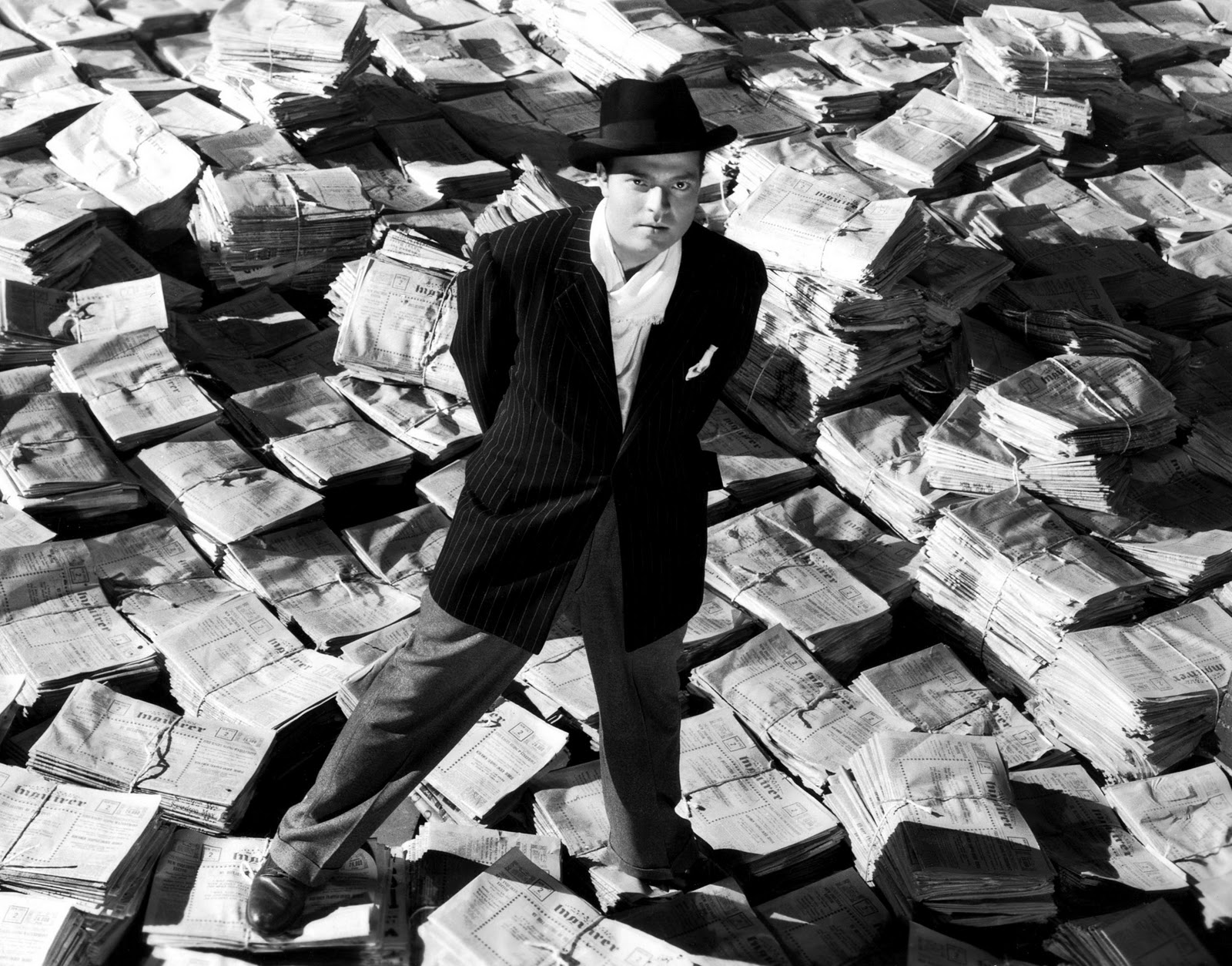
Strangely, this script brings to light some of the weaknesses in the original Citizen Kane, which are actually the same well-documented problems I have with all stories that exist in the bio-pic format. There’s nothing truly driving the story. The mystery behind “Rosebud” is a lazy attempt at creating a reason to look back into Charles Foster Kane’s life, made all the more clear when we find out the damn thing was in reference to a relatively insignificant sled. The thing with Citizen Kane though, was that it was such a rich and thorough examination of a man, that we didn’t care that such a thin objective was driving the story.
Citizen Kane: The Remake has replaced that richness with shenanigans – and many of them- which means, unfortunately, there isn’t a shred of story left to grab onto. In fact, the secret behind what Rosebud means (it’s a tube of lipstick Kane used to wear as a child) is given to us midway through the script, technically leaving no more reason for the story to continue. We know what it means. So why are we still following the guy who’s trying to find out what it means?
But the bigger issue here is the same problem I have with most of the comedies I read. Citizen Kane: The Remake is more about stringing together funny scenes than it is about telling a story. And when all you have to connect with your audience is laughs, they start tuning out on you around the half hour point (this was the exact moment, in fact, where I started pulling away from Citizen Kane: The Remake). This is why in the history of sitcoms, whenever they’ve tried to do an hour special, it’s never worked. Because after a half hour of jokes, the audience needs something more to keep them interested. They need characters to care about, relationships that need mending, a story to latch onto. There’s none of that on display here. It’s just cold hard comedy. And as a result, I became more and more distanced from the material as it went on.
There’s a part of me that wishes Ames and Karpala would’ve taken a more traditional route here and followed a director who was trying to remake Citizen Kane. It wouldn’t have been as inventive or daring, but it would’ve been much more manageable. Watching a Michael Bay like idiot suggest to a producer who held Citizen Kane close to his heart how he wanted to stage that opening scene (with Kane dropping the grenade during a slow operatic score) would’ve been priceless. But I’ll give it to Josh and Richard for taking a chance. They went for something a little left of center. They just may have underestimated how difficult it was to pull off.
Script Link: Citizen Kane: The Remake
[ ] What the hell did I just read?
[x] wasn’t for me
[ ] worth the read
[ ] impressive
[ ] genius
What I learned: Beware of the 3 a.m. idea! These are ideas that make you laugh your ass off at 3 in the morning. But that does not mean they should be included in your screenplay. In fact, most of the time, they definitely shouldn’t be included in your screenplay. I mean, apparitions of John Tesh (who’s not dead so why would there be an apparition of him?) playing a piano in the corner of the room during all of Frank’s interviews? Sometimes you need to police yourselves. You need to say, “You know what? That’s too much. We need to dial it back.” There is a limit, even in broad comedy.
Edit: Feeling like his best work was not on display here, Stephen has asked if I would post a more recent script of his that he feels more confident in. Since some of you were asking, this is his script that placed Top 100 in the Nicholl. I present to you….Dead Even.
Genre: Thriller (Horror?)
Premise: A recently widowed cop reclaims an old property in a small southern town, only to discover that key figures in the town have been hiding a horrifying secret.
About: Every Friday, I review a script from the readers of the site. If you’re interested in submitting your script for an Amateur Review, send it in PDF form, along with your title, genre, logline, and why I should read your script to Carsonreeves3@gmail.com. Keep in mind your script will be posted. Oh, and please, guys, this format only works if you present your criticism in a constructive way. Just be respectful to the writer when giving feedback. Thanks.
Writer: Stephen
Details: 99 pages – 11/15/10 draft

Okay, I admit it. Sometimes (not all the time!) but sometimes, I fall victim to a challenge. If a writer says to me “My script is way better than this,” in reference to some other script I’ve reviewed, there’s a part of me that wants him to prove it. Cause 9 times out of 10, they’re wrong. Their script isn’t better. And Stephen was making some noise last week about how bad the script choices have been for Amateur Friday lately, saying I could easily break that streak if I just read his script. So I decided to take him up on his challenge, and read his screenplay, “The House That Death Built.”
Now afterwards, I was surprised to find a couple of old e-mails from Stephen in my Inbox, and realized that I’d actually already read a script of Stephen’s two years ago – a great comedy premise about a guy who starts dating a girl only to find out she has multiple personalities. But when I read the script, it was a classic case of not exploiting the premise enough. It still needed a lot of work. Well, I’m happy to say, that Stephen’s writing has improved significantly since two years ago, but The House That Death Built still falls a few steps short of the front porch. Let’s find out why.
After opening with a spooky small-town carnival kidnapping, we jump forward eight years into another town where we meet Detective Trajent Future, a New York transplant working in the deep south. Things seem to be going well for Future, who’s happily married with a baby on the way. But unfortunately both his wife and the baby die during a difficult child birth, and just like that Trajent is a widower.
Three months later, Trajent heads off to the tiny town of Malatia, Louisiana to pick up the pieces of his life. Although it’s not clear how he’s affiliated with it, Trajent is reclaiming an old house there, where he plans to get a little R&R before heading back to the city.
Almost immediately, bad things start happening. Trajent can apparently see the past, and inside the house, he keeps seeing flashes of jarred up shrunken heads resting on shelves and lots of young girls being sliced and diced on an operating table. Also, the local sheriff and a few other tough guys send Trajent some not-so-subtle hints to get the hell out of town.
As Trajent begins to dig, he learns that a serial killer who preyed on young female runaways used to live in his house, and use it for many of his sick fantasies. But more importantly, he begins to suspect that key high profile figures in the town are aware of what happened here, and covered it up. But why? Why protect a serial killer? That’s what Trajent’s going to find out.
Okay, first, I want to point out some good things here. This is a great format for a story and almost always works. Guy comes into a small town, starts turning up rocks; the locals get pissed and want him out. Conflict naturally emerges from this situation. The people in the town are protecting their way of life (and possibly something bigger), so the closer our hero gets to uncovering the town’s secrets, the more motivated our locals are to fight back. This story always builds to a perfect climax, as sooner or later it’s either going to be him or them. So from a concept standpoint, “House” is in good standing.
Also, things do HAPPEN. One of Stephen’s complaints last week was that nothing HAPPENED in Vortex. It just kind of trickled along. I wouldn’t call the story developments in “House” anything new, but Stephen *does* keep the story moving. We have a death during childbirth. A move to a new town. Locals give our hero a warning. Hero starts discovering weird shit around his house. One of his only friends in the town dies. He looks into her death. He interviews some of the rich people. There’s a “go go go” mentality here that marches the story along at a pleasant pace.
But here’s the main problem with “House.” It’s sloppy. And I mean real sloppy. Especially the opening act. First we start with this kidnapping of 14 year old Kristy. She’s running through a carnival, trying to escape, then hides in a “white room” which I think is supposed to be some kind of carnival ride. The room begins spinning, and it reads like she’s being pelted with stuffed animals until she dies. I couldn’t believe that we’d have a “death” scene that was so silly, so I assumed I was reading it wrong. But the point is, I couldn’t understand what was happening from the description. And that’s on the writer. The writer has to be clear about the actions that occur on the page.
Next comes our main character’s name: “Trajent Future.” Does that sound like a character in a slow pot-boiling southern thriller? Or does it sound like the protagonist in your next sci-fi flick? It certainly doesn’t sound like the former to me.
Next we have a double time jump. We observe a kidnapping. Cut to 8 years later. Then meet our hero. His wife quickly dies. Then we jump 3 additional months forward. You can do a hard time jump forward once in your opening act, but you don’t want to do it twice (time montages are different). It’s confusing and gives the opening of the script an uncertain sloppy quality.
Then, Trajent arrives in town to reclaim this house, but I’m not sure what this house is. Is this his wife’s old house? Is it his parents’ old house? Or is it his? These are really important questions because it becomes a different story if his parents lived here, or his wife grew up here, or if he has no affiliation with the town whatsoever (although that brings up another question – why would he have property in a town he’s never been to?). I was never entirely clear why Trajent needed to come to this specific town because I didn’t understand his affiliation with this house.
Then, once in the house, Trajent starts having flashes where he can see back to the previous occupant of the house. My question is, how?? Does Trajent have superpowers that we haven’t been told about yet? Or are these flashbacks for the reader’s benefit, meaning Trajent can’t personally see them? This is never explained, leaving us to wonder if this is a supernatural script or not.
Worst of all, the first ten pages are littered with grammar mistakes, spelling mistakes, punctuation mistakes, missed words, and misused words. It’s a cornucopia of sloppy writing. Strangely, once we get past the first 15 pages, a lot of these problems clear up, leaving me to wonder why only the opening of the script was neglected in this manner.
To the script’s credit, the second act *does* get better. Once the procedural stuff starts, we do want to find out these town secrets. We do want to find out who this serial killer is and if he’s still alive. We do want to find out who’s involved in the conspiracy and we do want to see these bad guys go down.
But unfortunately, a lot of damage has already been done. The beginning of the script is so sloppy, and so much of the information given is unclear, that I lost trust in the writer. I didn’t feel like he was giving me his best. And once that happens, once the writer doesn’t have the benefit of the doubt in the reader’s mind, the script is dead. Because every unanswered question or bump in the road is assumed to be a mistake. I mean, how can I trust a writer with complicated plot points when I can’t even trust him to go back and clear up all the punctuation in the first 15 pages?
I do think the second and third acts of “House” were a lot better than what I read in “Three Times A Lady,” the first script of Stephen’s I read. So he’s definitely improving. But this script needed a few more passes.
Script link: The House That Death Built
[ ] What the hell did I just read?
[x] wasn’t for me
[ ] worth the read
[ ] impressive
[ ] genius
What I learned: Guys, make sure your script is ready for public consumption. Being 65% ready isn’t good enough. Fix the spelling, make sure action descriptions are clear, smooth out the bumps in the road (the double time jump). Part of this is simply giving your script to a friend or an analyst and saying, “Is all of this clear?” But if you jump the gun and throw it out there when it’s only partially ready, it looks bad on you. Cause people are going to assume that this is what you consider “finished” work.
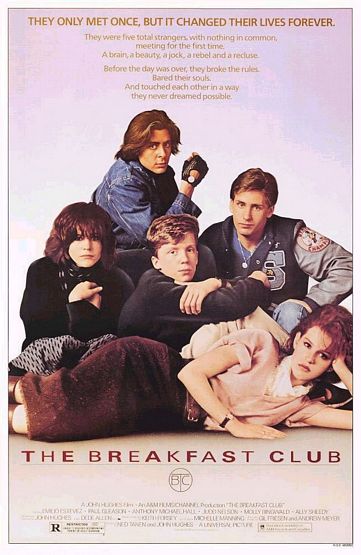

Although I’m a staunch supporter of classic screenplay structure and the core “rules” of screenwriting (three acts, a main character, clear goal, stakes, immediacy), that doesn’t mean I don’t like films that take chances and do things differently. In fact, I love breaking down films that ignore this classic approach (and still manage to be good) just to see how they do it. The other day I stumbled into an impromptu viewing of The Breakfast Club
CHARACTERS ARE CRYSTAL CLEAR TO US WITHIN MINUTES
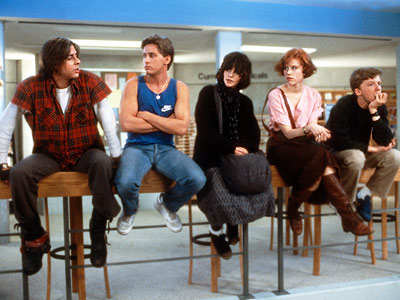
Good God is John Huges amazing at setting up characters. He knows exactly what they should be wearing, what they should be doing, and what they should be saying, when we first meet them. But the specific scene I want to highlight here is when the characters sit down in the library for the first time. Yes, John Hughes tells us exactly who our characters are ***by having them sit down***. It starts with Andrew, the wrestler. He can sit anywhere, but where does he sit? Next to the pretty girl. We know what’s on this guy’s mind. Then we have Brian, the nerd. He’s sitting a few tables back when Bender barrels up to him. He threatens a punch and Brian leaps out of his seat, cowering over to the next table. That simple interaction tells us Bender’s the dick who constantly craves attention and Brian’s a big fat wimp. Then Allison sneaks all the way around everybody, emerges at the back table, and immediately buries her head. The weirdo loner. Barely five words have been spoken, and yet we already know who all of these characters are. Brilliant.
FIND AN ANGLE THAT MAKES YOUR SCRIPT A LITTLE DIFFERENT FROM EVERYTHING ELSE
You can’t expect to stand out from the crowd if you’re a follower. You have to do something different with your script. I’m not talking about writing a story that’s never been told before. That’s impossible. Just having your script feel slightly different in some capacity. High school movies through the years have notoriously been chirpy and happy and silly and fun. Breakfast Club, however, goes against the grain and approaches the teen movie from a very dark place. This isn’t done very often, so when it showed up back in 1985, it felt different, new, fresh. What are you doing to make your script feel different and fresh?
CHALLENGE YOURSELF WITH DIALOGUE
There are very few movies as quotable as The Breakfast Club. Part of that is because Hughes was an insanely talented dialogue writer. But I’ve read some of Hughes’ unproduced scripts, and believe it or not, he doesn’t always come up with the goods. That tells me he worked extra hard on Club. One of the keys to coming up with great lines and sharp dialogue is to challenge yourself, to not go with the easy first choice, but to keep digging until you find something original. Your initial idea for a line may be “What an asshole.” But with a little work, you could come up with “That man…is a brownie hound.” Instead of “Nice outfit buddy,” how about exploring 20 more choices until you come up with, “Does Barry Manilow know that you raid his wardrobe?” Dialogue is about challenging yourself. It’s about not taking the easy way out. Clearly, Hughes practiced this philosophy in Club.

CONFLICT
There’s usually an inverse relationship between how simple your story is and how much conflict you need to add. Obviously, you want to pack conflict into all of your screenplays, but if you have a really simple story such as Breakfast Club, the only chance you have of keeping your audience interested is to splurge on the conflict. That’s why we have Bender, whose presence never allows anyone in this movie to be comfortable. That’s why we have Principal Vernon, who hates our high school kids with a passion. It’s why we have the sexual tension (conflict) between Bender and Clair. It’s why we have the alpha male showdown between Bender and Andrew. But probably the biggest element of unresolved conflict in the movie is the need for our five characters to find peace with one another, to “fit in,” if only for a day. The Breakfast Club would’ve been boring as hell if Hughes didn’t know to add layers of conflict.
MYSTERY
If you don’t have any plot in your screenplay, you better have a mystery or two. Here, we’re wondering how each one of these guys ended up here. It’s not a huge thing. We’re not dying to know. But it’s something that’s dangled in front of us and that we’re curious to find the answers to. Of course we can imagine how Bender ended up here. But how did a math dork get here? Why is Little Miss Perfect Claire in detention? Movies are about keeping the mind occupied and holding out a few mysteries for as long as you can is a great way to achieve this.
MEMORABLE MOMENTS
Your script needs memorable moments. How you come up with those moments is never easy, but your script isn’t finished until you have them. The Breakfast Club has several scenes that are impossible to forget. When Bender taunts Vernon until he gives him detention for the rest of his “natural born life.” When Bender reenacts what it’s like at his house every night. When the group is running down the halls together, bonding for the first time. If you want your script to be remembered by a reader, make sure those memorable moments are in there.

DIALOGUE SHOULD HAVE AN ANCHOR
While the dialogue is amazing and off the cuff and original and brilliant in The Breakfast Club, there’s more structure to it than you think. That’s because theme is driving most of what’s being said in the movie. And what is that theme? Differences. Or, more specifically, the struggle for all of us to fit in despite our differences. Discussions range from family lives to sexual adventures (or non-adventures) to high school cliques – nothing they talk about ever strays too far from that thematic core. And I think that’s part of the reason the dialogue is so good, because it has an anchor. Without that anchor, it would’ve been all over the place.
WE WANT RESOLUTION
I’m convinced that the producers of The Real World based their reality show on The Breakfast Club. The reason for this is that in every episode, there are at least two characters with an unresolved issue. By the end of the hour, those characters confront and resolve that issue. This same formula is the engine that drives The Breakfast Club. Ultimately, this is about five people who don’t get along. Our need to see them get along is why we keep watching. That essentially becomes the plot (the “goal” of the film). I always talk about how exploring unresolved issues between characters is a great way to add layers and complexity to your screenplay. Well here, Hughes uses the device to drive the entire plot.
“LOOSE CANNON” CHARACTERS ALWAYS WORK
Loose cannon characters always work. Let me repeat that. Loose Cannon Characters always work. I’m being a little facetious because I’m sure you can point to a few examples where they haven’t worked, but in most movies, the liberties that a loose cannon character affords you (the ability to say things and do things other characters wouldn’t be able to say or do), usually results in a lot of amusing situations. Bender is a perfect example of how a single loose cannon character can elevate a movie to a whole new level.
WHEN YOU DON’T HAVE HARD STRUCTURE, USE SOFT STRUCTURE
Couple final things here. While we don’t have a ticking time bomb in The Breakfast Club, we do have a ticking clock. Our characters are in this location until the end of the day. It may not seem like much –nothing blows up if our characters don’t save the day – but you comfort an audience when they know the schedule of your story, as silly as that sounds. Also, while we don’t have any really strong character goals (find Doug!), each of our characters does have a “soft” goal. They must write an essay by the end of the day describing who they think they are (not surprisingly, the essay stays close to our theme!). In both cases, Hughes added soft structural components to help keep the screenplay on track.
So, as you can see, structure can be found in the most structure-less of places. A soft ticking clock, subtle character goals, unresolved relationships, and a dominant theme all help hold The Breakfast Club together. But I admit, this one was kind of easy. Maybe next week I’ll challenge myself with something a little more complicated. Any suggestions on a structure-less screenplay to break down?
Genre: Action-Adventure
Premise: Indiana Jones goes in search of the famed “The Lost City Of The Gods,” which is supposed to hold inside it all the knowledge in the universe.
About: Before Spielberg’s go-to writer David Koepp wrote Crystal Skull, super screenwriter Frank Darabont worked on a draft of the script. Darabont, like many who took on this role (I think 7-8 writers in total worked on the project) expressed dissatisfaction with how unfocused Spielberg and Lucas were, and the impossibility of satisfying both. Word on the street is, Spielberg backed Darabont’s draft, but Lucas didn’t like it.
Writer: Frank Darabont
Details: 140 pages – 11/4/03 (This is an early draft of the script. The situations, characters, and plot may change significantly by the time the film is released. This is not a definitive statement about the project, but rather an analysis of this unique draft as it pertains to the craft of screenwriting).

It’s baaaaaaaaack. Yay! More Indiana Jones debate! You guys wanted me to review Frank Darabont’s Indy 4 draft so here it is. The plan here is to do the usual break down and analysis. But let’s be honest. The reason to review this script is to figure out which is better, City of Gods or Crystal Skull. Did our crime-fighting beard-donning duo drop the ball by spending another four years to come up with Crystal Skull when they had a great script right under their noses? Or was Darabont’s Indy interpretation as off-target as Lucas insisted?
What’s lost in all of this is an old interview M. Night gave at the peak of his powers, when he was recruited to write a draft of Indy 4. He said that Spielberg and Lucas had all these story elements they absolutely had to have in the script, and M. Night simply couldn’t work that way. In fact, the deciding factor may have been Darabont, who said to Night that the writing of the script was basically a “wasted year of my life.” Ouch. The irony, of course, is that Night would give up his youngest child to get an Indy writing assignment from Lucas and Spielberg these days. But I digress.
Hey, what do you know, Gods starts out with cars racing in the desert. Kind of like Crystal Skull. And just like Skull, none of our main characters are in those cars. Why would they be? That would be exciting. Instead, we have Indy hanging out at desert non-spot “The Atomic Café,” pawning off pottery barn level relics to his good friend Yuri, a jovial Russian who for some reason finds value in this garbage.
Someone pointed out in the Skull comments that the opening of Gods sucked because Indy was introduced in a café doing nothing. I agree that introducing Indiana Jones in any sort of passive or reactive manner is a risky proposition. But at least here there’s a character motivation for it. Indy is retired. He’s too old to go swashbuckling for ancient treasures anymore. I liked that. It made sense in the context of where Indy was in his life. However, like most elements that hold promise in Gods, it’s forgotten soonafter, and never heard from again.
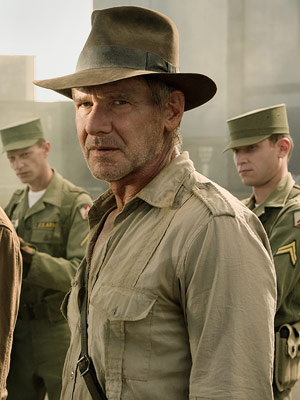
In a bafflingly clumsy segue, we cut to a few hours later where Indy is hanging out in the desert eating lunch and he spots a few military men right there in the open, lining their cars with artificial “American” insignias. And at the helm of this tomfoolery? Yuri!
Indiana decides to follow them, taking them (and him) into that AREA 51 warehouse that Skull starts with. Personally, I thought this was a better choice to open the film, since Indy DECIDES to go on this adventure instead of being roped into it. He *wants* go after Yuri, making him, and the whole warehouse sequence, more active.
We then, of course, get the whole atomic bomb sequence because Spielberg just had to have it in there. And afterwards, just like Skulls, Indy gets fired from his job. This is followed by a rather clumsy “Indy gets drunk in a museum scene,” which at first I hated, but then when I remembered he was basically responsible for getting half these relics on display, there was a poignant sadness to it that ALMOST worked.
After a fight to the death with the evil “Thin Man,” Indy gets a key to a locker at Grand Central station where he finds the Crystal Skull (yay! The Crystal Skull lives!), and is immediately mistaken for someone else who gives him a ticket to Peru to meet his “contact.” (uck. My guess is that Lucas is responsible for this choice, as he used the same painful plot device in Attack Of The Clones, when Obi-Wan was conveniently mistaken for an evil jedi at the Clone Farm).

Off we go to Peru and who’s Indy’s contact? Why Marion of course! Finally, around page 50, the plot to City Of Gods is revealed. They must find the Lost City Of The Gods, where this skull will reveal an unknown power. So Indy and Marion buddy up with an expedition team (no Mutt), head into the jungle, and try to find the mythical lost city, while two groups of baddies (I think it’s two – it’s not entirely clear) are hot on their tail.
So, let’s get to it, shall we? Which script for Indy was better? Gods or Crystal Skull? If my life was on the line and I had to choose one, I’d probably choose this one. But it wouldn’t be easy. Here’s the thing. City of Gods was more focused. Things made more sense. Once we actually get to our story (Find the Lost City Of The Gods), we actually know what’s going on. Whereas in Crystal Skull, I was constantly confused about where we were going and why we were going there.
However, Crystal Skull was just more…fun. I mean it’s hard for me to say that since that script is so damn all over the place, but the three-way dynamic between Indy, Marion, and Mutt, believe it or not, is more fun than any of the character dynamics in City Of Gods. And that’s surprising because Darabont actually comes up with a way more interesting dynamic than adding Mutt to the fold.
Here, Marion has a husband, Baron Peter Belasko, a wealthy archeologist who’s in it more for the fame than the hunt, and who has numerous best-selling books about archeology. In other words, a big fat fake. Really, the PERFECT foil for Indiana Jones, made even more perfect by the fact that he’s married to the woman Indy still loves. I mean, this was just ripe for comedic conflict-packed banter. And yet…it’s barely explored. Maybe it’s because Belasko comes into the story so late but he just never becomes a big enough character to care about (we never truly believe they’re married even). This leaves Indy and Marion treading the same dialogue waters they’ve always tread, giving their relationship a “been there done that” feel.
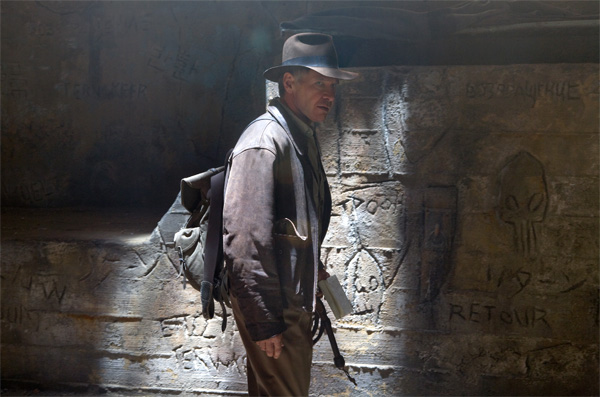
City of Gods also suffers from a lack of interesting bad guys. Some of you pointed out how Russian Pyschic Chick from Crystal Skull sucked as a villain because she wasn’t the least bit threatening. She never killed anyone. Never did anything that bad. In retrospect, I agree. If we’re not afraid of your villain, we’re not afraid of what happens to our heroes if they get caught. Here, we have the jovial Yuri, who I’m about as afraid of as a tickle me Elmo 
The thing is, the scariest character in both movies, a tall pale Harry Potter-like villain named The Thin Man, is killed off before we even start our adventure. I mean of the 260 pages (in both scripts) of searching for ANY memorable villain, they actually had one and they killed him off BEFORE the plot started!!
There is one aspect I really liked about Gods, and that’s an ambitious and well-crafted airplane chase sequence. It was the only scene in both Gods and Crystal Skull that brought something new to the Indiana Jones franchise, and yet felt like it was steeped in what made the original movie so fun. You have our characters walking along the wings of bi-planes, moving from one plane to the other, all while fighting off baddies. It was quite clever, and my favorite part of the script.
As for the silly stuff, there’s no vine-swinging in Gods. Oxley is WAAAAAAAAAAAAY less annoying in this one (although he is kept in a cage like an animal, lol). A giant snake eats Indy in this one (The power of the Lost City has affected the growth of animals in the area so all the animals are bigger – I seriously doubt Darabont had anything to do with this idea). And there’s still a spaceship in the end.
But what’s different is the entire final act has way more purpose in Gods. You actually feel like their exploration of the city is structured. That there’s a point and plan when they go inside (return the skull, which will result in the City showing them all the knowledge in the universe). In Crystal Skull, I had no idea why we were in that cave at any point.
All this brings about a question I can’t help but ask. There’s a lot of people on this board who would die for the opportunity to write an Indy film. So let me ask you, if you were to write Indiana Jones 5, what would your plot be? Let’s see if you can outdo Lucas and Spielberg at their own creation.
Script link: This script is out there in several places via a google search.
[ ] What the hell did I just read?
[x] wasn’t for me
[ ] worth the read
[ ] impressive
[ ] genius
What I learned: We all get attached to scenes/characters/and moments in our screenplays. But over time, screenplays change. They take on a new direction, and many of the elements in that original version you conceived no longer apply. If you try and hold onto those elements (even your favorite ones), they may prevent your story from reaching its potential. It’s clear that Spielberg and Lucas had a list of “must-haves” they included with every Indiana Jones 4 writing assignment, and that those elements weren’t working. I mean, if you give your script to 7-8 of the best screenwriters in the business and all the scripts come back sucking, chances are, it’s not their fault. I find that, sometimes, getting rid of that scene you love so much from the original draft can open the door to a million new story possibilities. In other words, don’t be afraid to get rid of something you love if it means improving the overall script.