
Search Results for: F word
One thing I never forget is that this site is for you guys. I created it to help you and I will continue to use it to help you whenever you can. That’s why I held the free logline contest. And that’s why I’m doing what I’m doing today. May is going to be Amateur Month. And the idea is to give a few of you a chance to get your scripts reviewed on the site. Now I know that this is going to suck for those who visit the site more as spectators than screenwriters, but I don’t care. I’ve wanted to do this for awhile.
The month will be divided into three sections. The first week is going to be Amateur Week. Anybody can send me a script to be reviewed. Anyone. The week will start off with Roger and I reviewing two completely random scripts from the sampling. We’re going to close our eyes, reach in, and review whatever we pluck out. These will definitely be the most interesting days of the month, as I’m expecting to review scripts in major need of realignment. I don’t want to jinx anybody, but a double “What the Hell did I just read” is not out of the question.
The rest of the week, I’ll pick three scripts based on loglines. So, at the very least, the concepts should be good.
Now let me warn you here. Neither Roger or I will be cruel in our reviews, but we will be HONEST. This goes for all of the reviews throughout the month. If you’ve only written a couple of screenplays, I’m warning you right now, there’s a very good chance your script will receive a low rating. If you’re not prepared for that criticism, don’t send your script in. So why am I doing this? Why subject someone to such a harsh critique? A couple of reasons. We’re doing this to learn. We feature PROFESSIONAL scripts on the site all the time, and a lot of times those scripts get bashed to pieces and called “amateur.” Which makes me laugh. Because if you think those scripts are amateur, you haven’t read any amateur scripts. We are going to review and post REAL amateur scripts, and you’re going see just how difficult crafting a story really is. But more importantly, it will give you the writer of these scripts, a chance to see where your screenplay is, where it needs to be improved, and how.
Now does that mean I’m not hoping to be proven wrong? Of course not. I am praying that somehow you, the guy or girl sitting on your couch right now reading these words, the one who has more talent in your middle toe than Aaron Sorkin has in his whole body, gets your script to me, I give it a genius rating, it sells for a million bucks, and it’s the happiest day in Scriptshadow history. So if you’re out there, please send your script in and make sure I pick it somehow. :)
WEEK 2 is going to be the return of Repped Week. If you remember, last year, I featured a week of writers who had representation from agencies and/or managers, but who hadn’t yet made the big spec sale. The idea was for you to see what it took to get an agent, which is obviously not as difficult as getting your script sold. So Repped Week is back baby. Send your scripts in (details below), and just like Amateur Week, only send your scripts in if it’s okay for me to post them.
But the big reason I’m doing this is for WEEK 3 and some of WEEK 4. Over the past couple of years, I’ve read a lot of amateur scripts, some through my notes service, some through contests, and some through referrals, and I’ve found a handful of unpurchased scripts that are really good. None of the scripts are perfect, but all of them are “worth the reads” or higher, and there are a couple I just know will be made into movies. If you’re a producer, a director, a financier, an agent, or a manager, you will want to be paying attention on that 3rd week of May. Because these scripts are going to be up for grabs.
Interested? Okay, here are the instructions. Follow them EXACTLY!
IMPORTANT: CHECK THE E-MAIL ADDRESSES BELOW – do not submit to Carsonreeves1@gmail.com
WEEK ONE – AMATEUR WEEK – ANYONE CAN SUBMIT
e-mail address: Carsonreeves3@gmail.com
Instructions: First off, write your logline INTO THE SUBJECT LINE. If it doesn’t fit, write as much as you can. The full logline will also be posted in the body of the message. Attach a PDF of your script with the e-mail. Here is a sample of how the body of the e-mail should look:
Name: Joe Screenwriter
Title: Blanket Man
Genre: Horror
Logline: When the people of Sleepville begin losing their blankets one by one, they realize that a horrifying entity known as “Blanket Man” has been stealing them, in hopes of making everyone really chilly at night.
WEEK TWO – REPPED WEEK – ONLY SUBMIT IF YOU’RE REPPED BY AN AGENT OR MANAGER
e-mail address: Carsonreeves2@gmail.com
Instructions: In order to qualify for Repped week, you must have an agent or a manager, and not yet have sold a screenplay. In regards to your e-mail, please write your logline INTO THE SUBJECT LINE. If it doesn’t fit, write as much as you can. The full logline will also be posted in the body of the message. Attach a PDF of your script with the e-mail. This is exactly how the body of the e-mail should look:
Name: Jane Screenwriter
Agency/Management: IDK
Agent/Manager: Temper Sent
Title: Tickle Dome
Genre: Drama/Sci-Fi
Logline: 700 years in the future, man has only one weakness: tickling. In a remote town off the Atlanta Wastelands, the best ticklers in the world battle each other til they’re really tired and can’t laugh anymore. It is known…as The Tickle Dome.
You can start submitting right now! GOOD LUCK EVERYONE!
LAST YEAR’S REPPED WEEK REVIEWS
http://scriptshadow.blogspot.com/2009/08/void-repped-week-5-of-5.html
http://scriptshadow.blogspot.com/2009/08/emergency-contact-repped-week-4-of-5.html
http://scriptshadow.blogspot.com/2009/08/fixer.html
http://scriptshadow.blogspot.com/2009/08/malcom-mccree-and-money-tree.html
http://scriptshadow.blogspot.com/2009/08/conquered-repped-week-1-of-5.html
Hmm, this week is going to be a little crazy. I’ll be contrasting today’s huge fanboy review with something tomorrow that’s so independent, I’m not even sure I know about it. And I read it! The good news is, the script was great. As for the rest of the week’s reviews, it’s still up in the air, so anything goes. But to ease the pressure of Uncle Sam’s ridiculous monetary demands this Thursday, I’ll be making a big announcement that should get all of you amateur screenwriters in a frenzy. So stay tuned because that opportunity will be coming before the end of the week. Right now, buckle yourselves up for another Roger review…
Genre: Crime, Prophetic Horror, Action
Premise: A former Pinkerton detective is resurrected as a Sifter, a bounty hunter tasked with going after people who have skipped out on destined meetings in Hades. When he’s ordered to hunt down a young artist, his past literally comes back to haunt him. He’s forced to team up with his deceased wife, now one of heaven’s operatives, to stop an impending apocalyptic event known as The Awakening.
About: “I Died a Thousand Times” is Aaron Drane’s sophomore screenplay. Drane went to film school at UCLA, where this script won the UCLA Samuel Goldwyn Award. In 1997, the script yielded a million dollar payday when it sold to Arnold Kopelson. He sold a couple more scripts to 20th Century Fox and most recently wrote and produced the FEARnet web series, “Fear Clinic”, which stars iconic horror movie actors, Robert Englund and Kane Hodder.
Writer: Aaron Drane
Ironically, I never heard of this script until my friend let me wander around in his mystical script vault, which turned out to be kind of like the warehouse from Raiders of the Lost Ark, except the relics on these shelves were unproduced and forgotten screenplays. I got lost among the shelves of scripts, overwhelmed and paralyzed by the paradox of choice. Four hours later, I finally escaped the labyrinth with brass brads in my hair and paper cuts on my fingers, armed with a copy of Aaron Drane’s “I Died a Thousand Times” (not to be confused with the 1955 remake of High Sierra), a spec that purportedly sold for a million bucks back in 1997.
[ ] What the hell did I just read?
[ ] wasn’t for me
[xx] worth the read
[ ] impressive
[ ] genius
Josh Baizer and Marshall Johnson made big waves last year with their script, “Dead Loss,” about a crew of crab fisherman who pick up a drifting castaway with a mysterious cargo. It was one of my favorite scripts of the year, as well as one of Hollywood’s. Dead Loss landed on the Black List with 7 votes. It also became one of your favorites when you voted it your 24th favorite unproduced script. I wanted to thank Josh and Marshall again for doing this interview because they’ve been working extremely long hours on an assignment and were nice enough to take some time and answer my questions. There’s a ton of good advice in here so I hope you enjoy the interview.
SS: I know a lot of people want to know where to meet writing partners. How did you two get started writing together?
J: It’s definitely tough to find someone who’s willing to put up with you over the course of many long/stressful workdays. We actually met as assistants in development at Paramount (long hours/stressful conditions). We worked right next door to each other. When I realized I wasn’t going the exec route, I started writing on the sly, between phone calls. Marshall would give me notes…and it all kind of went from there.
SS: What were you doing before Dead Loss? Where were you in your writing careers?
J: We were doing whatever job we could find. Small rewrites. Even a little bit of TV. We’d actually gotten some traction after doing a rewrite on a script for a studio – but then the strike hit and it kind of put us back to square one.
MJ: Before DEAD LOSS, we had written a couple feature rewrites. One was within the studio system, and the other was for an independent producer. But we also had worked on a short-lived TV show and wrote some webisodes for ESPN.
SS: What inspired you to write Dead Loss?
J: Contrary to popular belief, it actually wasn’t a spec. It was a pitch on an open writing assignment. We’d had a general meeting with Jesse Johnston at Thousand Words right before the strike and he’d been a fan of the first script we’d written. During the meeting we discussed our mutual love for a certain cable television show. Months later, he called and asked if we’d be interested in coming up with a take for a movie set in the world of Alaskan crab fishing. It was pretty wide open – they were open to see anything from sci-fi, to horror, etc etc. At the end of the day, our take won out and they hired us to write it.
MJ: A year before we started working on DEAD LOSS, we had met with Jesse Johnston, an executive at Thousand Words, so we already had a good relationship with him, and he was a fan of our writing. Like us, Jesse, Jonah (Smith), and Palmer (West) were all big fans of THE DEADLIEST CATCH and they wanted to do something in that world. We came up with our DEAD LOSS story, pitched them, and they bought it.
SS: I liked how you built in conflict and mystery between your characters (particularly between the brothers). What is your approach to writing characters? What’s the key to writing a good one?
MJ: Good characterization can vary based on a lot of factors – genre, tone, story, etc. Obviously, the ultimate goal is for the characters to resonate with the audience, whether that’s a larger than life buffoon in an absurd comedy, or capturing the nuances and mannerism of a real life person in a biopic.
For DEAD LOSS, it was important for us to ground the crew in realism, so we did a lot of research on crab fishermen and their lives on and off the boat. A lot of the inspiration for the characters followed organically from that research. For instance, a lot of these boats are family owned and operated, and the the business is passed down from generation to generation. So it made sense to have the brother dynamic at the center of things. And even apart from the brothers’ blood relation, the entire crew on these boats becomes like a surrogate family. It’s a very difficult and dangerous job, so they have to trust each other when they’re out on the water or someone is going to get hurt or killed. Understanding those dynamics, it became much easier to look at what kinds of circumstances and conflicts would push these tough guys who live life on the edge to their breaking point.
SS: What’s your writing method in general? How much do you outline? What do you emphasize? Do you write a lot of drafts? How long do you write each day?
J: We’ve always treated it like a job, even when we were just starting out. We meet everyday for at least eight or nine hours. When there’s a deadline, the days definitely get longer – but even when we’re not actively writing on anything, it’s good for the sanity to have a strict structure. Though, when actively writing, we don’t necessarily emphasize time, but page count. Outlines are probably the most important part of our process. We try to get as detailed as possible before starting the draft, otherwise, we could find ourselves in trouble if the plot is particularly complex.
We definitely try to emphasize the tone and the world. Tone can be tough on some projects, but that oftentimes takes many drafts of tweaks in dialogue and character choices…so we tend to tinker with that for as long as we can. The world comes out of the research phase. It’s probably the stuff we love most. Our second script took place on an aircraft carrier and the navy allowed us to fly onto the USS Reagan and explore everything we needed for two days. That research helped a lot and allowed us to make the world believable.
MJ: Most of our projects generally start with a lot of research. We really enjoy exploring new subcultures and environments. In fact, I think in many ways screenwriting can be like journalism. From there you find your characters and storylines, etc, and things usually start to crystallize in an organic way – like I was saying before about DEAD LOSS.
And yeah, when we’re getting ready to write or pitch, we usually do a lot of outlining. Josh and I both are very logic-oriented, so we try hard to make sure everyone’s motivations make sense and that there aren’t any plot holes ahead of time. It’s time-consuming to be so thorough up front, but it usually pays off in the long run. As far as schedule goes, we’re pretty diligent about writing and treat it like a day job, working regular hours together most every day.
SS: I’m assuming you guys are fielding offers in the assignment market now. Could you tell us a little bit about that world? How does a writer get into a room to pitch his/her take on, say, “Clash of the Titans?” Would you guys be able to get into a room for that? Or is that a whole nother level?
J: For those who don’t know how it works, most times your last good script becomes your resume for open writing assignments available in that genre. Your reps will know what assignments are around and put you up for those jobs. Of course, the timing isn’t always so perfect – jobs may not be in abundance. So you’ll end up going on a lot of ‘general’ meetings with production company execs around town who have read your work and hopefully liked it. A lot of jobs come out of these generals, directly and indirectly. Good relationships help so much. We got DEAD LOSS from a general meeting the year before. We were able to get another rewrite job when a pitch on another project didn’t sell…but the studio exec liked us and liked our writing (and we were the right price at the time). With something like CLASH, I’ve seen how it works from the studio side as well as from the writers’ – execs will try and go with big name writers, but there’s always room for a young up and comer with an amazing sample to blow them out of the water and get the job. Again, relationships are huge. You never know what big producer will read your sample and champion you. A big job like CLASH is in the realm of possibility for guys like us, but we’d still be up against heavy hitters…so we’d need plenty of luck.
MJ: The assignment market is pretty tough right now. It seems like there are fewer jobs each year at all levels. But there are still opportunities, from high-profile gigs like CLASH to smaller budgeted projects at companies who are independently financed. Still, in every case it starts with someone liking your writing.
From there, it’s hard to generalize. Studios obviously have conservative reputations, so unless you’ve sold something or had a movie go into production, it’s more difficult to get a job there but still not impossible. Starting as an unknown quantity, it generally just takes time to build your fan base and for everyone in town to get to know you and your writing. So hopefully, when a big project like CLASH comes along, you already have a relationship with either the producer or the studio exec supervising the project, and they will remember how much they liked your script, or maybe they had already met with you and recall how you had mentioned being obsessed with Greek mythology or whatever. Then they’ll consider you for the project and give you a shot at coming up with a take for the movie. That scenario has happened to us many times, even with DEAD LOSS. But once you’re in consideration, it’s up to you to make the most of the opportunity and come up with a fantastic take that is in line with their vision of the movie.
SS: Do you have any particular screenwriting books or scriptwriters who inspired/helped you? Who do you suggest Scriptshadow readers read to learn about the craft?
J: I’ve never read a screenwriting book. But I’ve read many, many scripts. We’ve actually got a loose writers’ circle made up of a bunch of friends at various stages in their writing careers and it’s very helpful.
MJ: I took screenwriting in college, so that’s where I learned the basics, like formatting and act structure. But there are lots of books that can teach you that stuff too (Syd Field, Robert McKee, etc). And ultimately it is very important you have that understanding – not only for writing and crafting a script, but also for pitching and discussing projects. It’s the jargon of the industry, so you have to be able to talk about act breaks, structure, etc. But honestly I found that the absolute best education came from reading scripts. While working at Paramount, I must’ve read thousands of scripts – and there’s just as much to learn from the bad ones as the good. And of course now there are so many online resources, so you can go watch a movie, then download the script and see how it read on the page. It can be very helpful to see how certain things are communicated and get a taste of different writing styles.
SS: Writers deal with a lot of rejection, and are oftentimes unsure of where they are in the journey. Are they close to that magical sale? Do they have a ways to go? When did you guys know you were legitimately able to compete with professional writers in one of the hardest markets in the world? Is there a way for a writer to know when he/she’s made that step?
J: Probably getting our first paycheck. It made it seem real for the first time.
MJ: I think there are probably certain milestones that are important to people for different reasons. Getting a key producer or talent to read your material, or landing an agent or manager is obviously important. But for me, it was getting my first paycheck. It wasn’t a big one, but that was the when I felt legitimized as a professional writer. And the idea of the “magical sale” is tantalizing, but honestly the odds of a first spec selling are very low. Obviously it happens, and when it does, it’s great and those Cinderella stories often make news, but speaking practically, it truly is a marathon and not a race. So I think as long as you’re continuing to progress in your career, enjoying it, and paying your bills (however that may be), then persistence is key. Just try to keep perspective on the bigger picture and ask yourself some basic questions about the big picture. Are your scripts getting better each time? Does your feeback get more positive? Are you getting more access with each script? And once you start getting paid, are your quotes getting higher? etc.
SS: What’s the best advice you’ve ever received in regards to screenwriting? If you could speak directly to that writer out there who’s just about to start his new spec – what would you tell him to give him the best chance to sell his/her screenplay?
J: Just finish it. You can always fix things in the next draft. Or the one after that. As for selling a spec, I have yet to do so, so I can’t speak from experience. But I would say to take a look at what’s recently sold to get a feel of the market. Passion projects rarely match what the town is buying. (I know from experience)
MJ: In regards to advice, there’s no single useful pearl of wisdom that comes to mind (omitting a few cynical ones, that is). Instead most of the wisdom I found useful came from working in the industry for several years before I started writing full time. It’s proven invaluable to have an overall understand of the process and how screenwriters fit into the bigger picture.
So maybe working in the industry is something to consider for yourself. But obviously, not everyone is able to do that. So let’s assume that you’re already writing something you like, and writing about settings, characters, and stories you feel competent portraying, then I would advise taking a step back and think about the commercial side of things.
Of course there’s artistry and craft involved with writing, but having worked in the studio system and seen that side of things, one thing becomes crystal clear: screenwriting is storytelling, but ultimately it really is just a for-profit business.
So keep in mind that the agent reading your script will be wondering how they can sell it, and the producer reading it will be thinking who will buy it. And if you’ve already got the access, then if a buyer reads and likes it, then they will also be thinking about the economics of saying yes, risk and recouping, etc.
So take some time and ask yourself some key questions like… is your movie meant for all audiences, just guys, just kids? There’s not a right and wrong answer here, but don’t forget that narrow demographics means lower box office which means lower budget, etc.
How much does your movie cost? It might be hard to estimate if you haven’t worked in Hollywood, but do some online research and find budgets of comparable movies.
Even if you write with an actor in mind, are there lots of other actors who could play the part? Because if your space epic costs $300M, there are only so many stars like Will Smith who will ultimately guarantee financing.
What does the marketing look like? Thinking about the poster and taglines is not only something that companies will have to do down the road anyway if your script gets produced, but it can also help you during the writing process to focus your story.
Obviously, in the end you still have to write a script that is going to resonate on the page and that people will like, just don’t lose sight of the business side of things so you aren’t wasting your time, or at least so that you have reasonable expectations about the response.
SS: Where is Dead Loss in the process, and what are you guys writing next?
J: Thousand Words has Chris Gorak attached to direct, and beyond that we don’t really know what their plans are. Right now, we’re in the middle of adapting a novel, LONG LOST by Harlan Coben for Gaumont, a French studio. Nick Wechsler and David Gerson are producing. Massy Tadjedin will direct and Hugh Jackman is attached to star.
Hello everyone. Welcome to another week of Scriptshadow! This week we’ll be tackling some sci-fi, one of the greatest comedic screenwriters of all time, and…pirates?? Oh yeah, you bet. But right now, Roger’s going to review another Black List script. So let’s get on with it!
Genre: Historical Adventure, Heist, War
Premise: A spy and twenty Union soldiers in disguise board a train in Georgia to execute a scheme that could bring a quick end to the U.S. Civil War.
About: In 2005, Chase Palmer was profiled in Filmmaker Magazine’s article, “25 New Faces of Independent Film”. Palmer has several projects set up around town. Among them are Evolution’s Captain, a film about Charles Darwin for Academy Award-winning producer Cathy Schulman (Crash) and Dune for director Pierre Morel.
This is a script off the 2009 Black List and is being produced by Kevin Misher (Public Enemies, The Interpretor, Dune) for Paramount.
Writer: Chase Palmer
[ ] wasn’t for me
[ ] worth the read
[x] impressive
[ ] genius
Come back for script on Saturday.
Genre: Fantasy/Adventure
Premise: (from IMDB) The mortal son of the god Zeus embarks on a perilous journey to stop the underworld and its minions from spreading their evil to Earth as well as the heavens.
About: After discussing the original Empire Strikes Back draft before Kasdan came along and turned it into a classic, I decided it would be nice to look at something Kasdan wrote today. And it turns out he wrote a couple of drafts of Clash Of The Titans, the long rumored remake which is finally making its debut in theaters this Friday. The writer who worked on Titans before Kasdan and who is said to have really taken it to the next level, is none other than Travis Beachem, who broke onto the scene with his much beloved “Killing on Carnival Row” (which you’ll be seeing on tomorrow’s Top 25 list).
Writer: John Glenn & Travis Wright – Revisions by Travis Beachem – Current Revisions by Lawrence Kasdan
Details: 120 pages (May 28, 2008 Draft) – This is not meant to be a review of the movie. We are critiquing an early draft of Clash Of Titans, and that is all we’re critiquing, just the script.

There are a lot of shitty ideas as far as remakes going around these days. They’re remaking “My Fair Lady,” for Christ’s sakes. I’ve never actually seen My Fair Lady. But even as someone who’s never seen it, I know it shouldn’t be remade! Clash Of The Titans is not one of those ideas. It’s actually the perfect film to remake. The effects in that 1981 film were so brutal as to be unwatchable. And what better film to remake than one whose hopes and ambitions were so much bigger than what the budget and special effects could afford at the time?
But man, I did not expect to actually be wowed by the trailer. And that’s what happened. My lips parted and went “wow.” No sound was actually emitted. It was a silent “wow.” A “wow” without sound. And as everyone knows, those are always the most powerful wows.
So good it was that I decided it should have been an official summer release instead of a wimpily served up pre-summer appetizer. But eight years ago when the studios staked their 2010 summer movie plots, the biggest thing Sam Worthington had done was a “Beware Of Dingos” PSA, and thus left the studios unaware that they’d be promoting a film with the hottest movie star on the planet. All this is not to say Clash is a slam dunk. There aren’t many things I remember about the original, but one scene that’s stuck with me over the years is the Medusa scene. Not sure how it would play today but that shit terrified me as a kid. The remake must not only top that scene, but tap into the charm and heart the original, even with all its deficiencies, somehow managed to muster. Does Kasdan’s draft of “Clash Of The Titans” succeed?
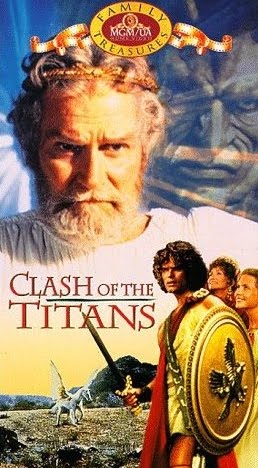
Rape. That’s how Clash of The Titans starts out. With the god Zeus raping a mortal Queen. There’s a plan to all of this, of course, but this is not the Zeus I know. If he isn’t careful, he’s going to end up in a bad bad place, or worse – Celebrity Rehab.
Flash to 25 years later and we’re hanging out with the Olympians, a.k.a. the gods, who are distraught over this endless war between them and the mortals. Too many people have died and Zeus wants to put an end to it, a truce. So he calls upon his half-son, the village fisherman, Perseus (who, if you’re keeping score, is the result of the aforementioned rape) to marry Princess Andromeda, thus ensuring a bond between the land dwellers and cloud surfers that will solidify peace.
Only problem is, the snotty Princess would rather go bungie jumping without the chords than marry this half-God stick-flinger. Perseus isn’t so high on the Princess either. He’s too busy trying to figure out when he became a half-God responsible for the biggest truce of all time. A few days ago his biggest duty was deciding between worms and bait.
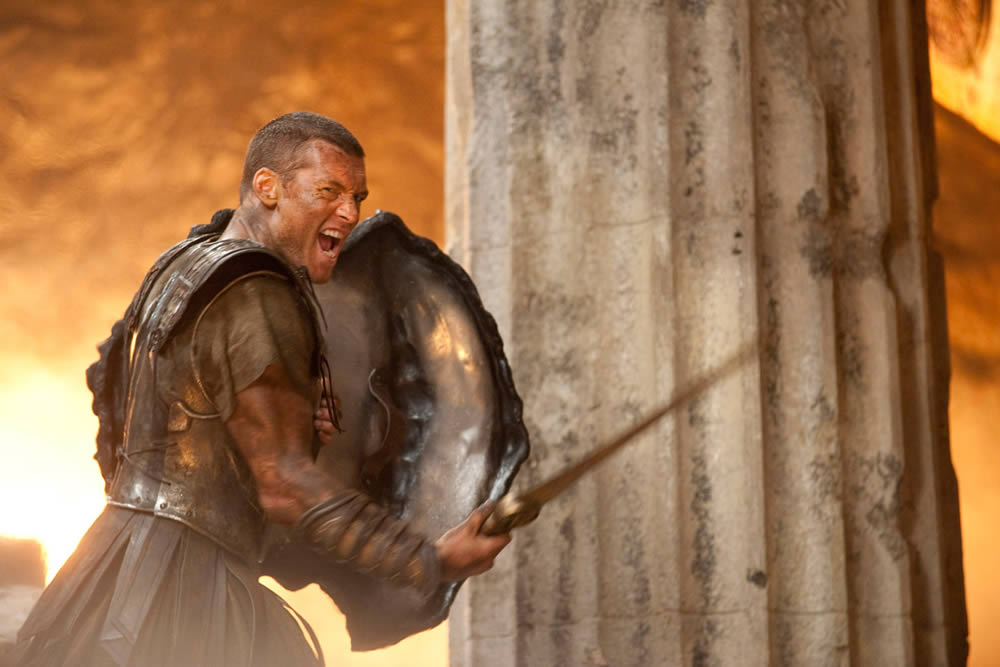
Complications ensue when the Bitch God Of The Ocean, Tiamut, hears the Queen tell her people that her daughter, the Princess, is hotter than Tiamut. In what may be the most jealous overreaction of all time, Tiamut charges through the gates and lets everyone in the kingdom know that unless they sacrifice the princess to the ocean, she will unleash the Kraken on the city in 30 days. Yikes. Talk about self-worth issues. Did they have shrinks in 805?
Naturally nobody wants to sacrifice the Princess, even though it’s been well-documented that she’s worthless, so they entrust Perseus to go off and find an elusive but “300-worthy” army to protect the city against the Kraken. Perseus and his Fellowship head off into the desert, navigating strange lands and strange creatures to find these modern-day marines and get them back to Jobba before the 30 days are up! Perseus isn’t keen on the journey and is way out of his league, but it’s not exactly like he has a choice.
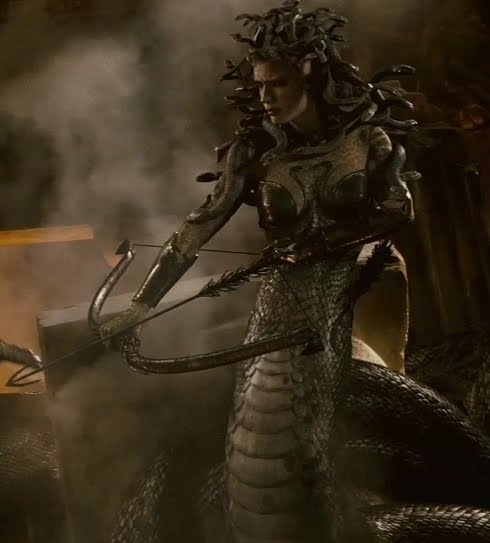
Along the way the crew encounters beasts, elephant-sized scorpions, eye-less witches, and of course, Medusa. And with each new obstacle, the reluctant Perseus is expected to more aggressively find the leader within himself. Will he? What will the team do when the army they came for can’t fight? Will the city, and more shockingly, the king himself, buckle before the Kracken shows, offering his daughter up to save the city? Aggghhhh! You’ll have to wait until Friday to find out.
Clash of The Titans takes its cues from…well from the very times its set in since that’s when the whole “Hero Journey” thing was born. This well-tread approach, which you might recognize from movies like “Star Wars” and “The Matrix” has a “chosen one” character plucked out of obscurity and thrust into a leadership role before he is ready. He must find the strength within himself before the final battle arrives or risk losing everything…for everyone!
What was strange about Clash Of The Titans, and something I bet they addressed in rewrites, was just how uninvolved Perseus was in the story. I mean full-out blocks of script would go by without him so much as saying a word. Everyone else is dictating the journey, occasionally looking back at Perseus and going, “This okay with you?” I understand he’s not ready yet, but for the first three-quarters of this script, the guy could’ve been a painting and exuded more presence. Of course once we get to Medusa and the finale, that changes. But is it too little too late? Not sure.
The script itself was fairly straightforward, but made two interesting choices. The first was the dilemma the writers put the king in. We routinely cut back to the city during the journey, and each day they get closer, the king has to make the impossible choice of whether to save his daughter or save the city. Remember what I always say. Your script is most interesting when your characters have to make tough choices. And when I say “tough choices,” I mean choices where the consequences are extreme. What’s more extreme than the death of a city vs. the death of a daughter? So that was a nice surprise.
The other interesting choice, and one I’m not as on board with, was telling us how Medusa became Medusa. She was a pretty girl who was also raped by a God (man, those Gods are not nice – I tell ya), and it led to her becoming this hideous cursed ugly thing. And when Peseus goes in to kill her, it puts a whole new spin on the battle, since we have some sympathy for how Medusa ended up in this predicament. It was just a strange unexpected touch that added some complexity to a situation I wasn’t thinking would be complex.
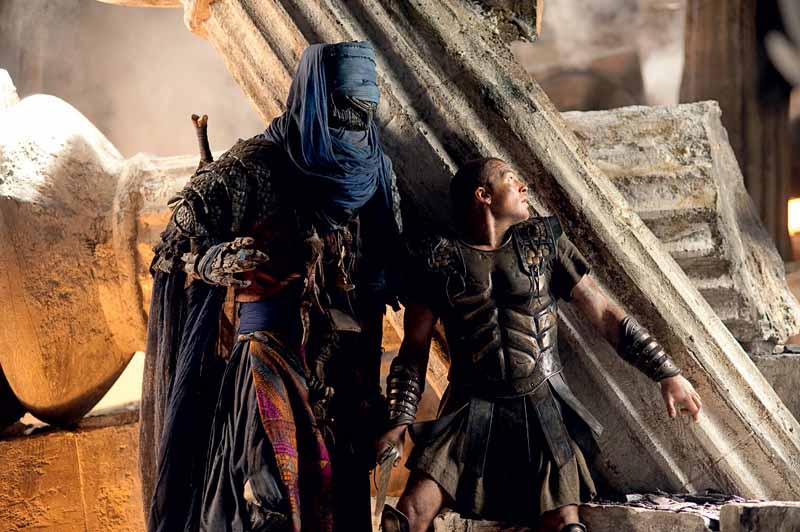
So there’s definitely some good stuff in here, enough to distract us from Perseus being a fairly passive protagonist at least. Nobody nailed the story, but the hammer and the wood are within arm’s length. And really their job was to just not fuck this up. Gods and warriors and beasts and krakens inside a vessel that actually makes sense is pretty hard to fuck up. And they didn’t.
What’s great about Clash, is that it feels different from everything else being released right now. And that’s such a big advantage in this superhero-obsessed market. This could be a massive hit, sneaking (if it’s lucky) into a coveted Top 3 spot for the summer. That’s a big prediction but outside of Iron Man 2, what’s coming out this year? “Cheech and Chong’s ‘Hey, Watch This.” ???
[ ] What the hell did I just read?
[ ] wasn’t for me
[x] worth the read
[ ] impressive
[ ] genius
What I learned: What do you want your audience to feel at a given moment? This is a question you have to ask yourself if you want to convey the right emotion at the right time. Leading up to the big Medusa fight, the writers had a choice. They could tell you Medusa’s horrific backstory, in which case you’d sympathize with her. Or they could tell you nothing, allowing Medusa to symbolize pure evil, in which case you wouldn’t sympathize with her at all. In the last decade, writers have been pushed to exercise the former choice. Give your villains a backstory. Make them real and complex. And in most cases, that’s good advice. But know that it is not a blanket rule, and sometimes you don’t want your audience feeling sympathy for the bad guy. Sometimes it’s okay for the bad guy to just…be bad. I bring this up because I’m not sure I would’ve wanted my audience feeling bad for Medusa in this scenario. I want her to be terrifying, cruel, evil, and mysterious. Giving up that backstory erases some of those intended reactions. Always consider the emotional ramifications of your choices, as it’s up to you to decide what you want your audience to feel.