
Search Results for: F word
Genre: Comedy/Action/Supernatural
Premise: A mother moves her family into the house of her recently deceased father, who was convinced that a portal to hell was opening up at a nearby mountain.
About: Ghostbusters Afterlife finally came out and pulled in 44 million dollars. For a little perspective, 2016’s all-female Ghostbusters had a 46 million dollar opening with bigger stars and no pandemic. So I think that’s a pretty good first weekend for the film. Then again, who knows anymore. A little side note about this film. It was directed by Jason Reitman, who is the son of Ivan Reitman, who, of course, directed the original Ghostbusters.
Writer: Gil Kenan & Jason Reitman (original characters by Harold Ramis and Dan Akroyd)
Details: 2 hours
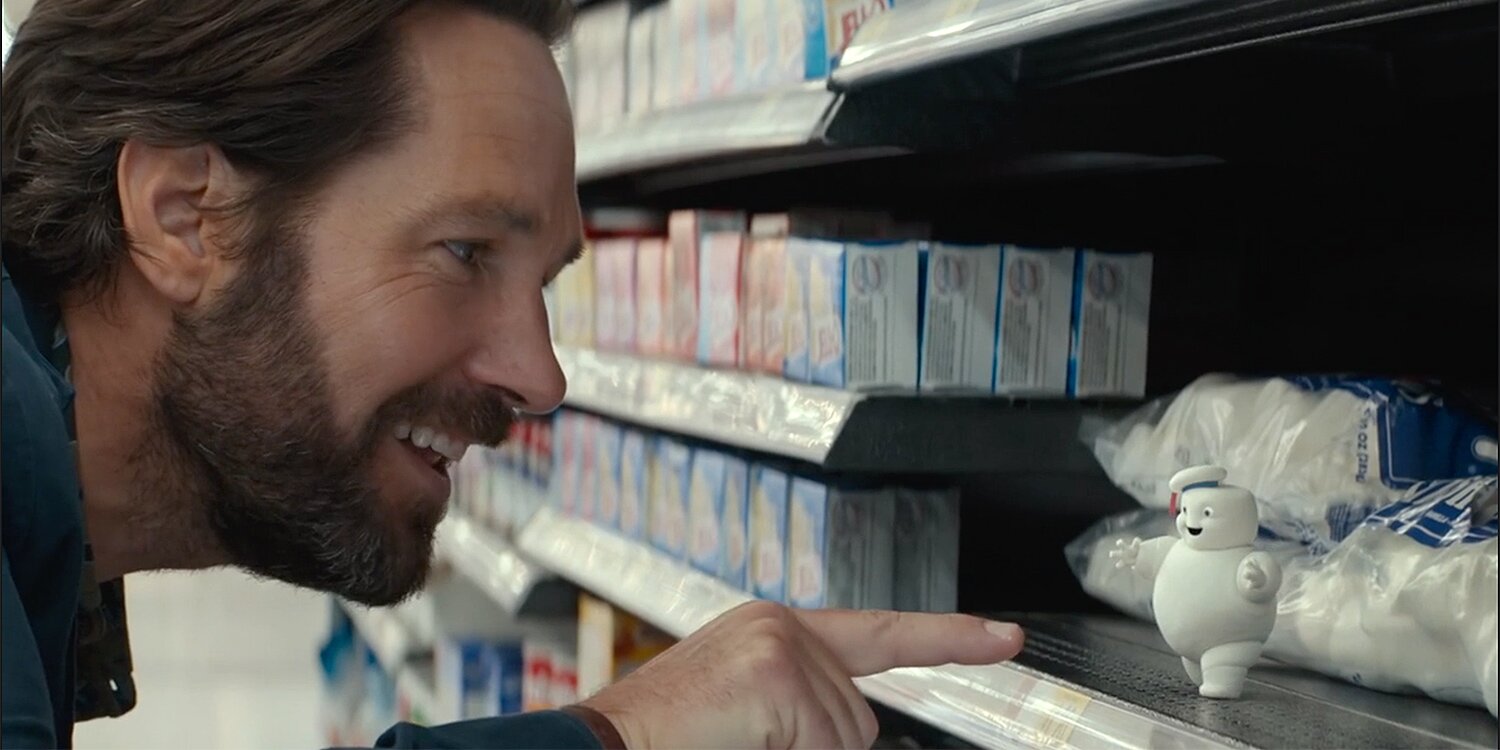
It’s hard to talk about Ghostbusters Afterlife without talking about the 2016 Ghostbusters reboot. Because, in most ways, Afterlife is a response to that film. And, actually, you can’t talk about Ghostbusters Afterlife and 2016 Ghostbusters without talking about The Last Jedi and Rise of Skywalker, since Rise of Skywalker was a correction movie in the exact same way that Afterlife was a correction movie. In both instances, the previous films alienated their core audience in search of new audiences, only to see that strategy fail. They didn’t bring new audiences in AND they lost legacy audiences in the process.
Ghostbusters 2016 was such a strange film in that the cast was great. Melissa McCarthy is great. Kristin Wiig is great. Kate McKinnon is great. The problem lay more with the Sony executives who greenlit the film. They decided to lean into the current trend at the time (female driven comedies) at the expense of what everybody loved about the original film, which was that great cast. It didn’t help that Paul Feig had no feel for the Ghostbusters universe whatsoever. He made so many bad creative choices that it, at times, felt like he was sabotaging the franchise. I mean why would you cast Bill Murray in a role that wasn’t his role in the original Ghostbusters? That would be like casting Arnold Schwarzenegger in the role of a concerned accountant in a Terminator sequel.
Now I’m not going to lie. I didn’t have high hopes for this latest Ghostbusters iteration. Reitman hasn’t had the best career after Juno. Even, arguably, his best movie since Juno, that Clooney flying movie thing, wasn’t very good. If you don’t believe me, I dare you to go back and watch that movie and have a more positive reaction than, “Eh, not bad.” Since then, he’s had Young Adult, Labor Day, Tully, and The Front Runner. Raise your hand if you saw any of these.
In that respect, Afterlife could easily have been seen as a metaphor for Reitman’s career, since it was pretty much dead. Yet he somehow convinced Sony to give him a shot at a Ghostbusters movie and here we are. As I sat down to watch this, I did a little prayer for this movie to be good. Being in California, they practically make you take a medical exam to get inside the theater so it was an exhausting ordeal. I needed the next two hours to be worth all the drama of getting in here. Let’s find out if they were.
Afterlife follows single mother Callie, who cares for her teenage son, Trevor, and pre-teen weirdo daughter, Phoebe. The three must move into her recently deceased father’s house (who she never knew) because she has no money and it’s her only living option. Phoebe immediately starts exploring the old house and realizes her grandfather was some sort of weird scientist.
Long story short, her grandfather was Egon Spangler, one of the famous Ghostbusters. By the way, kids in 2021 don’t really believe that the 1984 Ghostbuster event happened for some reason. I think because it was easier on the story if they didn’t. Anyway, Phoebe realizes that Spangler came here because a nearby mountain showed supernatural signs of opening up a portal to hell and wanted to stop it. And since he’s no longer around, that job will be up to Phoebe, Trevor, and their new friends from school.

Let me start off by saying my favorite new actor is the kid who played Podcast. I laughed at every single line of his, no exagerration. I understand why Sony needs to promote McKenna Grace as the breakout of this film but I mean, come on, if you’re being honest? It wasn’t even close. This kid was as good as Cory Feldman in his Goonies prime days.
I would say that Ghostbusters Afterlife is the breakout summer movie of the year (I think that’s when it was originally supposed to come out). Don’t believe me? Here is its competition: Black Widow, Shang-Chi, Venom 2, F9, A Quiet Place 2, No Time to Die, Eternals, Free Guy, Jungle Cruise, Dune, and Godzilla vs. Kong. I would say it’s better than all of those movies. Maybe Free Guy beats it in a death match but it would be close.
It certainly has all the ingredients for a great film. It’s got great characters, the comedy is genuinely funny, it’s got fun action sequences (I’d put the ghost car chase through downtown up against any set piece this year), it’s fun, it’s got heart, it has a few surprises along the way. And as much as I dog Reitman, there’s one thing he’s great at – getting good performances. He gets such great performances out of everyone. I mean I never understood why everyone loved Carrie Coon so much (the actress who plays the mother) until this film. She’s so great in this as a dumpster fire mother who uses her dark sense of humor to hold her family together.
I think detractors would point out the script is formulaic. But what you have to understand is that every studio movie that isn’t angling for an Oscar is going to use formula. It’s going to use the 3 act structure. It’s going to give its characters fatal flaws and inner demons that must be overcome by the end of the story. The challenge, then, is writing a great movie within that formula. You do that by being as creative as you can within those boundaries. The movie falls apart when you shrug your shoulders and say, “Well, it’s formulaic so I shouldn’t even try.” Embrace the formula then do as much as you can within it.
For example, they made this little ghost creature called “Muncher” that the kids had to hunt down early on. They called him that cause he was always munching on poles and metal. They eventually catch him in a ghost trap, but then that trap (and their proton backpack) get impounded by the police. They need that proton backpack for the final showdown so they break into the police station, only to find that the backpack is behind bars and, therefore, there’s no way to get it. Podcast then sees that the ghost trap is there as well and gets an idea. He reaches in, presses the release button, and Muncher pops out. What do you think Muncher then does? He eats his way out of the cage and flies off, giving the kids entry inside so they can grab the proton backpack.
That’s the kind of creative setup and payoff that a lot of writers won’t put the time and effort into. I know this because I read scripts ALL THE TIME where characters have to do stuff like this and the writers invariably use the old, “Do you have a hairpin” trope which they then pick the lock with. You can do it the creative way, in which case your movie will be cool. Or you can do it the lazy way, in which case your movie will be cliche.
(Spoilers) We do get into some heavy nostalgia at the end of the film. The original Ghostbusters do come back. I realize this will infuriate people who hate nostalgia. But not only did I think it was tastefully done (even Bill Murray had some classic Peter Venkmen lines that gave me goosebumps). I think it was necessary. You needed to course correct after the disaster that was 2016 and getting the Ghostbusters ghostbusting again was the only way to do it.
As you know, I’m a big proponent right now of movies that make you feel good. Movies that make you forget the pandemic for a couple of hours. This movie WILL make you feel good. And, honestly, I think the only reason it’s at 60% on Rotten Tomatoes is because there’s a certain subset of reviewers who don’t like that they’re trying to course correct from the previous movie. I honestly believe that 20-something percent was stripped from the score for that reason. In other words, don’t believe any negativity about GBA. It’s the most feel-good of feel-good movies you’re going to see all year.
[ ] What the hell did I just watch?
[ ] wasn’t for me
[xx] worth the price of admission
[ ] impressive
[ ] genius
What I learned: You can get around story problems with a little creativity. I noticed that Reitman wanted a teacher character in this script (to play the love interest for Callie). He wanted Phoebe to go to school so she could meet friends there. There was only one problem. The movie takes place during the summer. So what do you do? These sorts of logistical issues pop up in screenplays all the time. You want to do something but, for whatever reason, the story doesn’t allow it. Just remember, you’re God. You get to create the situation. So just be creative about it. Reitman got his school by introducing summer school into the story. And it actually helped the movie because it was a lot more laid back than normal school, which allowed Reitman to get a lot more comedy out of it. For example, Paul Rudd’s character is a teacher who throws on inappropriate 80s horror movies for the class to watch instead of actually teaching.
Normally, I say share your movie ideas with as many people as possible. But today I’ll reveal the one movie idea you should guard with your life.

When I spoke with Ravin, the director attached to yesterday’s script, I told him it would be a good idea to post the script so that people could read and learn from it. He and the writer were on the fence about it but ultimately agreed. I bring this up because posting material is big topic among the screenwriting community. Should you post your scripts online or keep them locked up in a virtual vault forever? I wanted to give you a history lesson on why people are so afraid to post their scripts and why they shouldn’t be. I also want to share with you one exception to this rule – the movie idea you should always hold close.
One of the original reasons to keep your script a big secret was because agents made a lot of money selling bad screenplays. Let me explain. The old agent strategy looked something like this: An agent would have a script that nobody had read, they would hype it up over the course of a few days or weeks, they would send the script out to all the studios at once, and then the studios, afraid that they were going to lose out to another studio, would start bidding on the screenplay, which drove the price up, and led to a big sale. Most times, after the excitement had died down, the studio would dive into the script, only to realize it wasn’t very good.
These sort of “trojan horse” sales were driven almost exclusively by buyers not having access to the script prior to the sale. And thus, it was critical, as an aspiring writer trying to get representation, that you be careful about sending your script out. Because if a bunch of people got their hands on your script, it would prevent the agent from being able to use this strategy. If people already knew your script wasn’t very good, you couldn’t trick them. It’s kind of messed up when you think about it. The whole system was designed to sell a bunch of bad screenplays. I still remember a famous agent once saying, “Any agent can sell a good script. Only a real agent can sell a bad one.”
This system was upended when Roy Lee came around and created the first internet tracking board. What happened at these big agencies was that the scripts would get covered by their in-house readers. The tracking board was a way for readers, across the industry, to secretly share with each other the best scripts they’d read. Because of this, bad scripts would get exposed a lot more frequently, which meant agents could no longer send out a script that nobody knew about. This was the first broken link in the chain that argued you should hold your screenplays close to the vest.
6-7 years later, the Black List rolled around. The thing about the Black List was that it provided a new avenue for writers to get noticed. Before, you had to make it through a ton of gatekeepers for your script to be propped up by the industry. With the Black List, you still needed an agent or manager, but you no longer needed one of the top agents or managers. If your script was good, it would be passed around and celebrated on the list. This was the second broken link in the chain because instead of only one person being in charge of whether you became known, it was now multiple people who determined your fate (the Black List voters).
From there, sites like this one, message boards, Reddit, started springing up giving screenwriters more chances than ever to get noticed. The trade-off was that they had to put their script up on the internet. But the pros of that choice were starting to massively outweigh the cons.
There’s no better example of this than Mayhem’s Headhunter script. That script was reviewed here on the site and would go on to be the number one script on The Black List. It used to be that writers would be terrified to have a review and script link up for their script. But what you have to realize is that the odds are so stacked against you getting noticed that one of the only ways to fight those odds is to get your script in front of as many eyeballs as possible and the internet is the only way to do that.
So, to summarize, the number one way to break into the industry in 2001 was to sell a spec script. The number one way to break into the industry in 2021 is to get on the Black List. And the best way to get on the Black List is to blanket the internet with your script to make people aware of it and you. If you don’t do that, how is anybody going to find you? Let’s say you instead have one agent friend you send your scripts to. What if that agent doesn’t like your voice and therefore won’t like anything you write? Are you really going to hinge your entire career on that?
Now, there is another contingent of writers who are terrified of posting their scripts for a different reason – THEFT. When it comes to stealing ideas, it’s a nuanced conversation because having done this for over a decade now, I can tell you that I rarely come across a “great idea” that I haven’t seen before. So most people who think they’ve stumbled upon the holy grail of ideas have stumbled onto an idea someone pitched me last month. In other words, the idea isn’t as “steal-worthy” as they think.
However, there is an argument to be made that if you have a killer idea and you post it on the internet, someone could steal that idea then write their version of it. This is actually the only time I would tell writers not to post their scripts online – if they have an “idea to end all ideas” idea. What kind of idea would that be? Jurassic Park – a modern day dinosaur park with cloned dinosaurs, one of the single greatest movie ideas of all time. Hancock – an alcoholic superhero who doesn’t want to be a superhero. Gemini Man – an old hit man finds himself targeted by a clone of his younger faster self. The Hunger Games – children competing in a to-the-death match with only one winner.
These are ideas that are so highly marketable, they are guaranteed to get made. Therefore, you have to be more careful with them. Because others might see them and think, “Ooh, I could tweak that a little and make it mine” and now you’re competing against others with the same concept. So I understand writers’ reluctance to make these concepts public. But here’s my counter to even that philosophy: Does any of that matter if you die holding onto the greatest movie idea ever conceived? At a certain point, you have to take a risk. You have to tell people about your idea or they’ll never know about it.
Let me quote one of my favorite shows, Survivor. “You can’t trust anyone in this game. They’re all out to get you. Unfortunately, it’s impossible to win without trusting someone.”
What most writers don’t realize is that the chances of someone stealing your idea online and breaking into the industry with it are microscopic compared to you breaking in yourself, pitching your idea around town, and one of *those* people stealing it. That’s because the people inside the industry actually have the power to make movies. Whereas the unknown amateur screenwriter who stole your idea is likely to be a bad writer (based on the fact that they need to steal ideas) and therefore will never make it anywhere. So what are you going to do? Not pitch your ideas to anyone once you become a professional? How are you going to sell anything?
I guess what I’m saying is, the benefits of pushing your ideas out there far outweigh the negatives. We live in a time where there’s so much noise to compete with. For that reason, we can’t afford to carefully and strategically choose three people a year to share our screenplays with. You won’t leave a big enough footprint to create any awareness of your screenwriting existence. My philosophy to become a successful screenwriter is to blanket the internet with your material. The more people who know about your script the better. That is currently THE best way to get noticed.
As we head into the weekend, I’m curious, what you would say are the five best “idea to end all ideas” movie ideas? Remember, we’re not talking about the best movies. Neither Gemini Man or Hancock were very good movies. I’m talking about the best concepts – ideas that, when you heard them, you knew immediately they were a movie.
Is this the best unknown screenplay in Hollywood?
Genre: Drama
Premise: In 1971 Alabama, a poor, gifted, teen living in a trailer with his abusive family is shocked when the prettiest girl in school pays him a visit and asks him if he’ll do her a giant favor.
About: This script was sent to me for a consultation by a director named Ravin Gandhi. The writer, Elyzabeth Gregory Wilder, originally wrote it as a play. She has since adapted it into a screenplay. Wilder has had her plays produced at the Royal Court in London, Alabama Shakespeare Festival, Denver Center, the Hartford Stage, amongst many others. She’s now looking to expand into a screenwriting career. You can learn more about her at her website. By the way, there are a lot of twists and turns in this script. So I encourage you to read it before the review so you’re not spoiled. The link to the script is at the bottom of the review. :)
Writer: Elyzabeth Gregory Wilder
Details: 111 pages

Okay, a little backstory here. Director Ravin Gandhi made his first film a couple of years ago and the biggest lesson he learned, during that process, was how important it was to have a great script. You have a great script, you get better actors. If you have better actors, you get a bigger budget. You have a bigger budget, you get a better team. You get a better team, you get better production value. And, of course, all of those things lead to a bigger and better distribution deal.
So, for his second movie, he made it his number one priority to find a great screenplay. After scouring every corner of the internet and as many agencies that would give him the time of day, the casting director who’d worked on his first film told him she knew a really great playwright who’d written this amazing play. Would he like to take a look?
Ravin said sure with zero expectations, read the play, and was blown away by it. That’s where I came in. He sent it to me, basically wanting to know from the guy who’s read everything, if the script was as good as he thought it was. I hate being put under that kind of pressure because 99 times out of a 100, I have to tell the person, ‘No, it isn’t as good as you think it is.’ But this time, it was.
Spirit of Ecstasy takes place in 1971 Alabama and follows 17 year-old Sammy, a poor shy boy who attends a local private school on scholarship. Unlike almost anyone else in Alabama, Sammy loves to draw, loves to create, loves to explore art. Unfortunately, because he’s poor and likes all these weird things, he doesn’t have any friends.
Sammy lives on a salvage yard in a trailer with his unabashedly “white trash” family. There’s 16 year-old troublemaker Luke, as cool and handsome as Sammy is shy and anxious. There is Lainie, Sammy’s mother, a once optimistic local beauty who’s been relegated to cutting coupons and staring at advertisements for nice neighborhoods she’s never going to live in. And then there’s Lowell, a local football star who’s become a beer-guzzling waste of space.
After Sammy comes home from school one day, we learn that he’s secretly fixing up one of the cars in the junkyard so that, when he’s old enough, he can leave this place. That opportunity may be coming sooner than he thinks. That night, there’s a knock on the door. Lainie goes to answer and is baffled at what she sees standing there – a beautiful girl.
This is Rachel, the most popular girl at Sammy’s school. Lainie isn’t sure what’s more surprising, that someone from the “right side of the tracks” is visiting them or that Sammy knows a girl. She immediately invites Rachel in and begins her southern hospitality routine. Later, once Rachel is able to get Sammy alone, she asks him if he’ll do her a favor and drive her to New Orleans. Sammy doesn’t know what to say.
As dinner rolls around, an increasingly pale-looking Rachel scurries off to the bathroom to throw up and that’s when we learn the true reason why she’s come. She’s pregnant. And she needs to get to New Orleans to get an abortion. She can’t have anybody in town knowing about this, which is why she’s come to the one family nobody cares about.
As Rachel carefully orchestrates the evening so that she can stay the night, she begins to see how abusive Sammy’s family really is. There are things going on behind closed doors that shouldn’t be happening, which only increases the urgency of her and Sammy having to leave.
After giving Sammy the first kiss of his life, she conspires with him to make a run for it before dawn, which Sammy agrees to. But we can’t help but wonder if Rachel’s adoration for Sammy is all just a ruse to get what she needs. Once she’s taken care of her problem, will she ditch him? We may never find out because Lainie discovers their secret plan and goes into nuclear preventative mode to stop her son from leaving her. Pulled between Rachel and his mother, Sammy will have to make the biggest decision of his life. What will he do?
There are soooo many things I liked about this script.
Let’s start with the plot. You guys have heard me go full hater-mode on drama scripts. Writers seem to think that the Drama genre gives them permission to be boring. Look no further than yesterday’s script, Rewired. The Spirit of Ecstasy shows you how to do it right. What’s the big difference? They use a time constraint.
This story doesn’t take place over a summer, a month, or even a week. It takes place in one night. That urgency covers up all of the problems that usually sink drama scripts because we know the issue is going to be resolved within the next 12 hours. That’s how you do drama. It’s the same idea behind 1917. A typical movie about World War 1 in 1917? Nobody cares. But make that story real-time and all of a sudden, “Wow, this is cool.”
That’s initially what pulled me in – just how fast a drama script was moving. I’m not used to that.
Next up, I loved the dramatic question at the center of the story. Dramatic questions are questions you can pose in your script that, if they’re compelling enough, make the reader want to stick around to find out the answer. The dramatic question in Spirit of Ecstasy that hooked me was, “Is Rachel conning Sammy?” Is she pretending to like him because she’s desperate to fix this problem she has? Or does she really like Sammy? Or does she go in planning to con him, but then actually starts to fall for him?
The fact that I was never entirely sure kept me flipping the pages. I had to know if Rachel was honest or not.
From there, the script exhibited an authenticity regarding the time and place that I rarely see. I’ve read scripts about the south in the 70s before. They all fall into the same stereotype traps. From everyone’s super religious to everyone’s a hick to they’re all walking around with guns. This feels different. Sammy is far from your typical southern stereotype. He’s smart and artistic and dances to the beat of his own drum. Even when the characters in Spirit do move towards “stereotype” territory, their actions and dialogue are so specific that it never feels fake or “written.”
By the way, that’s how you avoid cliche. You emphasize specificity. The more specific you can be about a time or place and how people act, that’s what makes your script feel real. The more vague you are, the more cliche you will be. It’s the difference between saying a tennis player “hits a forehand” and a tennis player “slides across the red clay, crushing a forehand down the line, past the outstretched racket of his opponent.”
Which leads us to the biggest star of the script – the dialogue. It’s been a while since I’ve read dialogue this good. The best way for me to identify good dialogue is when I never once am aware of the dialogue. Typically, when I read a script, I can feel the writer’s thought pattern as they’re writing the words of their characters. You sort of see them working out in their head what the characters need to say in the scene.
That never happened once in Spirit of Ecstasy. Every time people spoke, I became lost in their conversations. So much so that I would encourage anyone who wants to be a good dialogue writer to read this script. Because there are so many dialogue lessons you can learn from it.
Take this early conversation from page 9. We’ve just come into the trailer for the first time. We’ve been introduced to his parents, Lainie and Lowell. Lowell is watching the football game, making Sammy hold up an antennae to keep the picture clear. Meanwhile, Lainie is going through the newspaper, looking at houses and cars for sale. We pick up the conversation mid-scene…
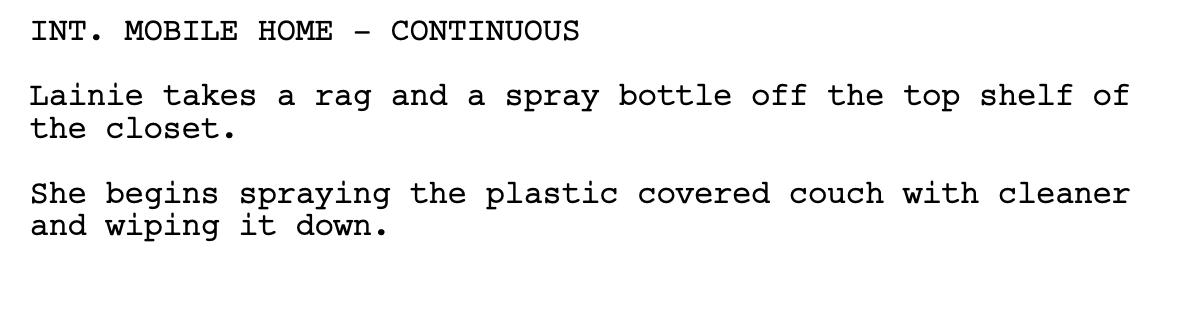
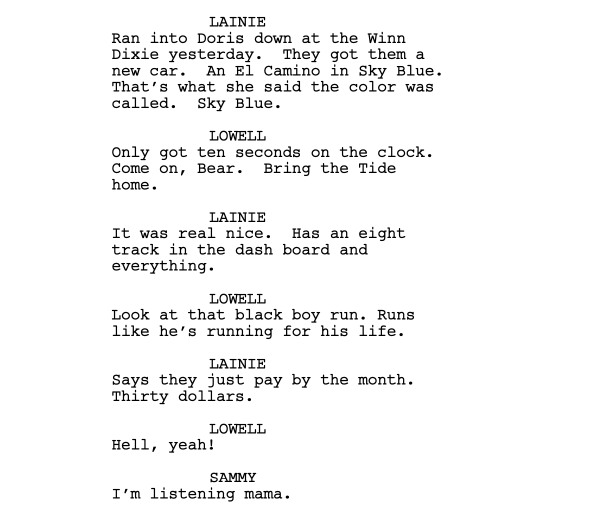
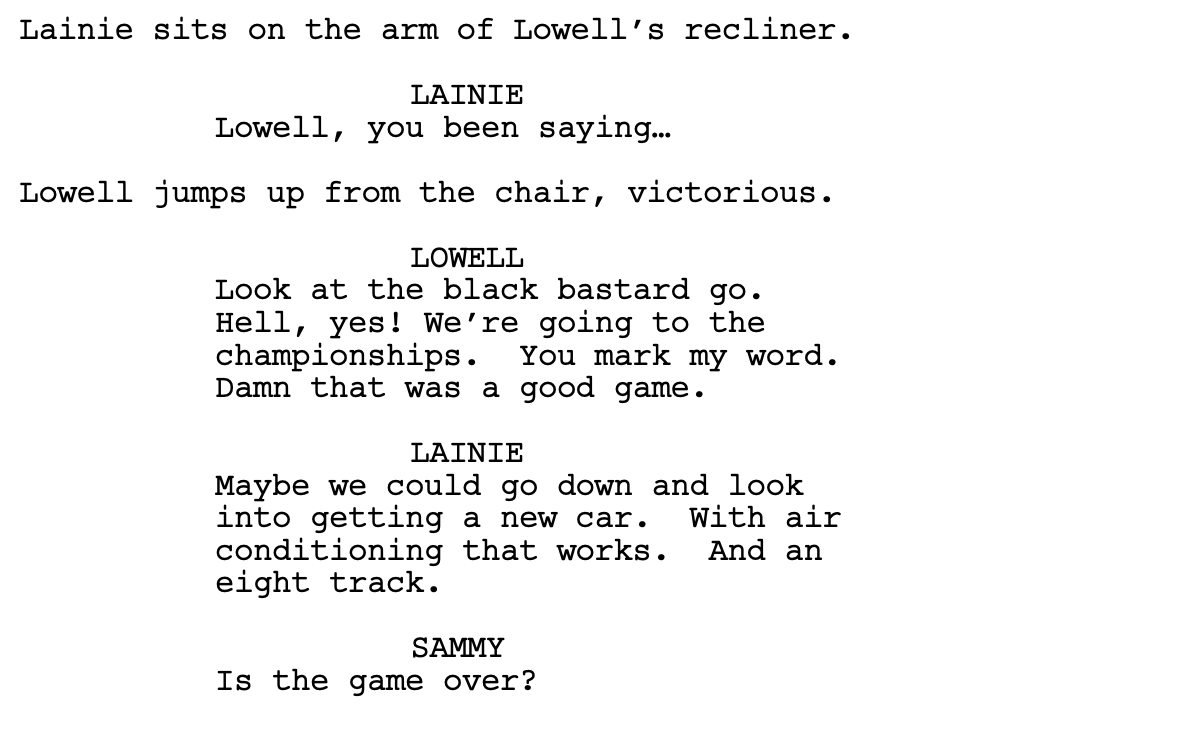
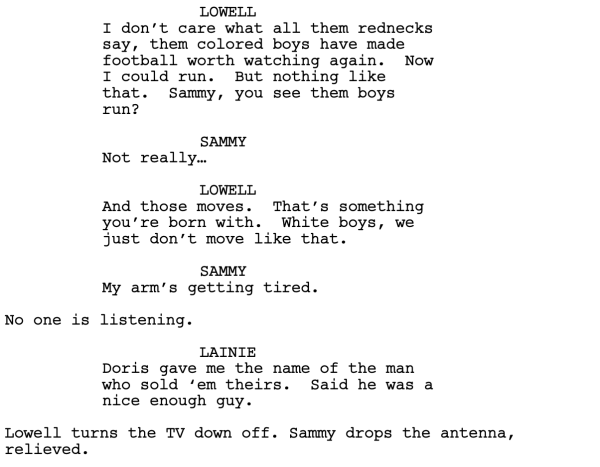
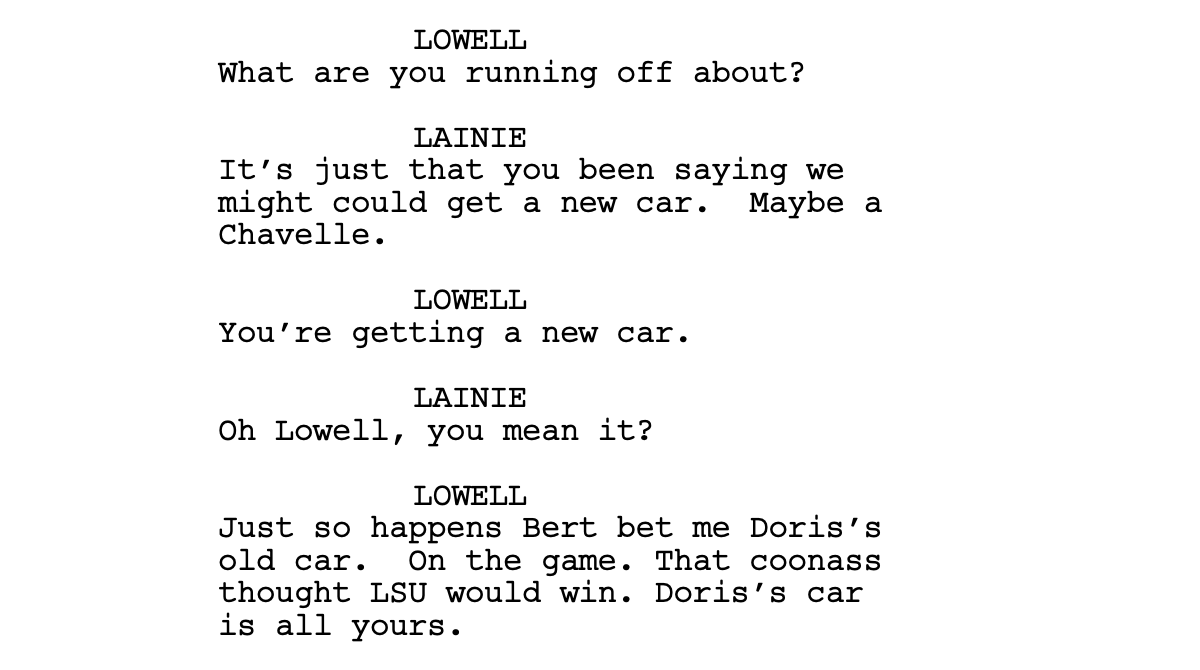
This is a dialogue tool that all of you should have in your arsenal. A lot of amateur writers get tripped up in assuming that dialogue must be logical. It must be a ‘your turn, my turn’ exchange of information where every question must be answered with a cohesive insightful response. No. Real life conversation is much messier than that. One of the cool ways you can take advantage of this is by writing conversations where the characters rarely, if ever, respond to the other character, which is what you see here.
But it’s not just a cool trick. Notice how this dialogue does three things. One, what Lainie’s talking about – wanting to get a nice new car so that she can look respectable – tells us EXACTLY who her character is. We know Lainie after this scene. Two, what Lowell talks about – his obsession with the game, his not so subtle racist remarks – tells us exactly who he is. This is a simple man with a simplistic view of the world. And three, it tells us exactly who these two are AS A COUPLE. Their (non) conversation tells us everything we need to know about this marriage within a minute.
That’s what great dialogue is. It’s entertaining in and of itself. But it’s also teaching us things about the people saying the words.
Another one of my favorite dialogue exchanges happens later in the script. **BIG SPOILER contained in the below example** We’ve hinted, at this point, that Lainie is sexually abusive towards Luke. But this is something that’s never spoken about in the house. In this scene, Luke has gotten ready for bed and is passing by Sammy and Rachel, who are on the couch.
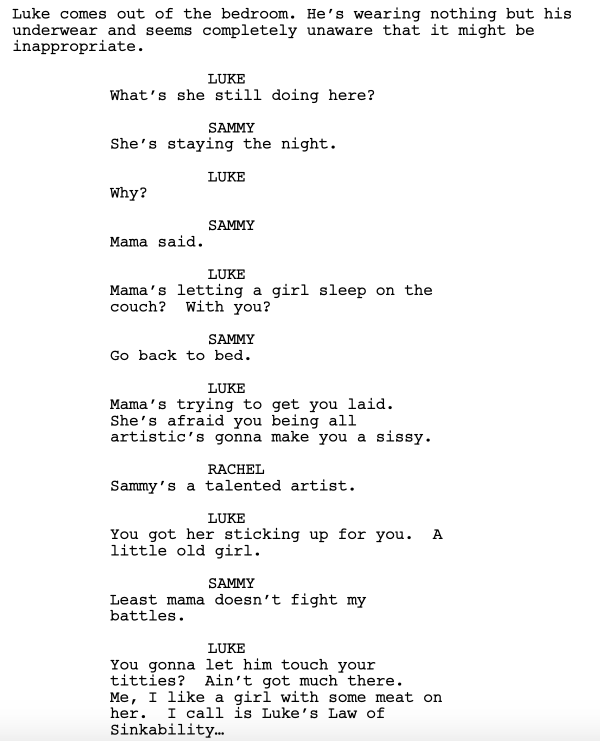
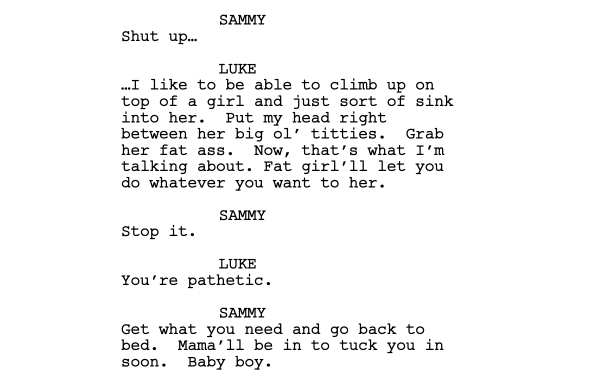
Good dialogue does more than one thing at a time. At first glance, this scene is about Luke making fun of his brother regarding his lack of sexual experience. The dialogue is funny, albeit in an uncomfortable way. But take a closer look and pay attention to what Luke is saying. Luke’s sexual experience is limited as well, exclusively to his mother. So even though he’s offending Sammy here, what he’s really talking about is his own sexual abuse.
This is highly advanced stuff that I rarely see in screenwriting these days. Nobody understands subtext. Or, the ones who do, are too busy rushing through the script to come up with any clever ways to explore what’s happening beneath the surface. The writer is telling us, without having to ever tell us, that Luke is being abused by his mother. In bad scripts, writers will have their Luke character walk straight up to their mom and say: “You need to stop sexually abusing me mom!” “I’m not sexually abusing you.” That’s an uninteresting way to explore the issue. Instead, you want to talk around it, talk under it, talk about it abstractly, hint at it in conversations with other characters. Not only is that more true to life, it leads to much more interesting conversations.
I could go on about this script for a long time. I think the characters are, honestly, the kinds of roles that win actors Oscars. The structure is so tight that it makes what’s, essentially, a bunch of characters speaking for 90 minutes, go by faster than you can snap your fingers. And the dialogue is consistently awesome. It’s kind of reignited my belief that there are really good screenplays out there waiting to be discovered. Check it out for yourself and let me know what you think in the comments!
Script link: Spirit of Ecstasy
[ ] What the hell did I just read?
[ ] wasn’t for me
[ ] worth the read
[x] impressive
[ ] genius
What I learned: This reinforces my belief that dramas can almost become de facto “thrillers” if you add a really tight time frame. For that reason, I encourage anyone writing a drama to consider tightening the time frame of your story. You may be shocked at how much it improves the script. As I told Ravin, “This doesn’t work if it takes place over one week. Or even two days. It works specifically because it takes place over 12 hours.
Genre: Biopic
Premise: Harvard. 1959. A young Ted Kaczynski is experimented on by Dr. Henry Murray during a secret CIA psychological study that may have led to the creation of the Unabomber.
About: This script finished on last year’s Black List with 10 votes. Both of these writers have done a little TV work as well as written some indie features.
Writers: Adam Gaines & Ryan Parrott
Details: 91 pages

One of the most common things you’ll be tasked with as a working screenwriter is finding angles on topics that have no business becoming movies. Hollywood is so focused on snatching up life rights, biographies, and IP that they don’t actually ask if the ideas are something worth turning into a movie.
The Empty Man, which I spoke about yesterday, is a perfect example of this. It was some dumb comic book that nobody read. Yet someone decided to buy it. And then they pitched it to director David Prior, who went off to read it, came back, and said, there is no way I will make this movie because this comic is stupid as hell (paraphrasing). But I will keep the title and make my own movie. They wisely said, ‘fine.’
The problem with making a movie about Ted Kaczynski is that he’s an unpleasant wacko who possesses zero qualities that would make him a good movie character. He’s a disturbed weasel who sends bombs to people with crazy-person messages attached. That character can never ever be a protagonist.
And yet, here is the sickness that permeates the industry. Everyone is so desperate to get movies through the system, they’re willing to pluck these unpleasant, but popular, topics, off the idea tree, thinking that a sad bleak boring name is better than no name at all. And so we get a screenplay about Ted Kaczynski.
One of the weirdest things about this screenplay is that we’re never told, until the very last line of the script, what Ted Kaczynski did to deserve the treatment of a movie. If I’m 25 years old reading this, all I’m thinking is, “Who is this guy and why are we following him?”
I suppose this could’ve been an artistic choice. But something tells me the writers assumed that everyone would know who Ted Kaczynski was. Which is something you should never do as a writer. I didn’t know even know who Ted Kaczynski was. I thought he was the Oklahoma City bombing guy. While you may spend 200 hours researching someone and therefore know them intimately, a majority of readers will have no idea who they are when they first lay eyes on your script.
“Rewired” focuses on Ted’s life when he was 17 years old attending Harvard in 1959. He was a math prodigy who got recruited by a pretty teacher’s assistant named Barbara Martin into a psychological experiment at the university being run by a psychology professor named Dr. Henry Murray.
Murray asks Ted, along with the 50 other students in the program, to give him a thesis on how to live life and Ted comes back with a paper that basically states too many people in Harvard don’t need Harvard because they’re already set for life. Meanwhile, poor people like him have to scratch and claw just to keep up with their scholarship requirements and then, when they graduate, they’ll have to start all over again, since they don’t have a network of rich people to help them.
Murray then recruits a lawyer from the legal department and tells him to debate everyone in the group, breaking down their life theses, and making them feel as bad as possible about their ideas. His plan seems to be to destroy their beliefs to see if he can then build an entirely new belief system within them.
Halfway through the experiment, Barbara visits Murray’s home, only to discover that he’s babbling incoherently and randomly painting his walls with a long black stripe. Needless to say, this man should not have been conducting any experiments. But it was the 50s so there weren’t a lot of checks and balances.
Barbara tries to warn Ted that Murray’s experiment is evil so Ted goes to Murray’s office to quit. But Murray takes advantage of Ted’s youth and naiveté to convince him to keep going, which basically amounts to a lot more psychological abuse. Ted heads home for the holiday and is violent for the first time to his brother. His parents are concerned that something sinister is going on at the university and encourage Ted to drop out.
I’m not clear on if he did drop out or not because the last few pages of the script are vague. But I think he may have? And then we get a closing title screen that tells us Ted killed three people with mail bombs and injured 23 others. The End.
I mean… (my head drops to the desk)…
I don’t understand why people write these scripts.
This script is so f$%#%ing depressing and sad and rote and boring and nothing happens! It’s two people sitting across from each other for 90% of the movie.
Even the script’s intention doesn’t work – to build sympathy for Ted Kaczynski – because Ted is such a bummer himself. He lugs himself around campus, staring at the ground, talking to no one, when he does talk to someone he’s scolding them or getting upset. Why would we care about this person? They’re extremely unlikable. I don’t mean that in a screenwriting sense. I mean in a person sense. Like, I hate these kinds of people. So why would I care about a movie that follows one of them?
And this goes back to the point I made at the beginning: Not every well-known person in history is meant to have a movie made about them. Just because somebody did something spectacularly good or spectacularly bad does not mean that a film must be made about them. And yet Hollywood can’t help themselves. No soul left behind. No matter how boring or rote or unlikable or annoying or eye-rolling a famous individual is, we must make a movie about their life!
What I’d be curious about here is if any of what I read is documented – if these interactions between Ted and Murray came from a transcription – or if the writers just made them up. Because the conversations certainly felt made up, with the bad guys sounding like mustache-twirling villains from the 70s.
At one point the lawyer says to Ted, “Your father. Average sausage maker. Master bowler.” Ted replies, “How did — how did you know that?” The lawyer says, “Grinding it together as it grounds him down. You must know those casings are made from intestines. Tell me… do you help your father clean the intestines? So he feels like less of a failure?”
I apologize if these words are on record but I sincerely doubt it. They feel made up. If you’re going to tell a story this serious, you can’t just have a bunch of made up gibberish as it undercuts everything you’re trying to accomplish – which is to write a convincing portrayal of how this kid was manipulated. That’s the only thing the movie has going for it, is that authenticity.
Another issue I had with this script is that they’re squaring a Harvard professor off with a kid to challenge his ideas. However, Ted is psychologically weak from the get-go. He’s lonely. He doesn’t have confidence in himself. He doesn’t even really belief in his thesis. For that reason, the conversations are all one-sided.
Psychological battles are entertaining when the two parties are an equal match. Without that, it’s basically like watching a bully come into a room and beat up someone smaller than him again. And again. And again. And again. And again. And again. It’s masochistic. It’s unpleasant. I just… I’m so baffled about why anyone would think this would be entertaining.
Which brings us back to… yes, you guessed it: the fault of basing your movie on a weak idea. There’s honestly a more entertaining movie in two people trying to figure out how to spell Ted’s last name. We have to stop blindly putting scripts like this on the Black List because it means we will only get more of them.
[x] What the hell did I just read?
[ ] wasn’t for me
[ ] worth the read
[ ] impressive
[ ] genius
What I learned: This is one more example that you cannot fix a bad idea. Whether it’s a bad fictional idea or a bad subject you’ve chosen. Writers lose years of their lives trying to make scripts work that will never work because the subject matter doesn’t work. This is one of those scripts. Nobody should ever make a movie about Ted Kaczynski. You can’t make him sympathetic. You can’t make the story entertaining. Anything you come up with will be bleak and sad. Nothing about this script works.
These horror submissions were shut out of Horror Showdown. Why?? Also, stay til the end because I announce the next SHOWDOWN!
I always say that running a contest is one of the worst things a person can do. You make one friend and 999 enemies.
And I get it. You see the entries that made Horror Showdown last month and you think, “My concept is better than those.” First off, you’re probably wrong. However, a few of you might, indeed, be right.
Therein lies the immeasurable conundrum of subjectivity. You might have a cool idea that I’m just not into. I’m not a fan of movies about magic, for example, like Harry Potter. I find them abracadumb. But, obviously, there are people who love Harry Potter and whom might anoint your magic concept the best idea they’ve ever seen.
Also, whoever’s running the contest is looking for a specific type of script. Nicholl celebrates high-minded fare where theme takes precedence over everything. The Black List is turning into a site that celebrates social commentary. For me, right now, I’m looking at concepts and asking, “Is this a movie I’d want to make?” If the answer is no, I don’t need to deliberate any further.
Both of those things – subjectivity and could this be a movie – are driving 95% of my choices. Just because your script didn’t win those two battles doesn’t mean it’s a bad idea. So don’t get down on yourself if you didn’t get picked.
With that said, there are concepts that are just straight up weak. And the purpose of today’s exercise is to help writers identify why a concept or logline doesn’t work and what you can do to improve your concepts moving forward. Let’s get to it!
Title: One Night in the White Mountains Under a Black Sun
Genre: Drama/Horror
Logline: In 1936 the lives of seven strangers violently collide when they become snowbound in an Italian hotel while one of them must stop a Nazi plot that would destroy the world.
Analysis: I wanted to get Felip’s entry in here because I could sense his audible frustration at not making the showdown (I love you, Felip!). This script actually finished in the top 15 because I thought the logline was intriguing. But the reason I passed on it had more to do with the Why You Should Read – “I just wanted to spin a decent yarn with Nazis and underground cults and black magic and werewolves and aliens.” Once I saw all that, I knew it was too much for me. There have been a few times in Scriptshadow history where I’ve liked “everything and the kitchen sink” scripts. But usually, I’m not into them. And once you have werewolves, Nazis, aliens, cults, and black magic? I just knew that wasn’t going to be for me. I tend to like simpler more direct concepts.
Title: THE PROJECTIONIST
Genre: Horror
Logline: A group of teens discover an old movie theater projector abandoned in a barn and inadvertently unleash a wave of horror after they switch it on.
Analysis: At first glance, this sounds like it could be a movie. But there’s one issue holding the logline back. We go from A to C instead of from A to B to C. We start with an old movie theater projector. Okay. There’s something a bit mysterious about that. However, how does switching it on unleash “a wave of horror?” Was the projector owned by someone dangerous? Maybe if there was a bit more information about WHY the projector unleashed this horror, I might’ve given this one a shot.
Title: Blood
Genre: Horror / action
Logline: A former combat medic, now providing rapid-response medical assistance for LA’s criminal underworld, takes on a trafficking gang harvesting teenagers’ organs for sale on the black market.
Analysis: I get the feeling that Ben tried to sneak an action script into the horror showdown here. So that’s the main reason I didn’t pick it. But I’m highlighting this concept to warn people off “organ trafficking” storylines. This is a 20 year old idea at this point. I know specifically how the town feels about organ trafficking because a couple of years ago I found a really good script about organ trafficking and I tried to pitch it to a bunch of people. Nobody would read the script the second they heard “organ trafficking.” it’s just a dead subject matter. If you’re going to do it, do it like they did it in Squid Game, where it’s a Z-story.
Title: Slaughterhouse
Genre: Horror
Logline: A documentary crew goes undercover to expose the horrors of factory farming, but things turn grisly when their project is discovered by a group of brutal farmers.
Analysis: This is a perfect example of how subjectivity plays into choosing scripts. I can’t stomach anything where animals get hurt. It just gets me thinking about all the animal harm going on in the world and I get really depressed. So this was a ‘no’ for me immediately. But from the writer’s e-mail, he pointed out that this script has gotten him a lot of meetings. So, obviously, other, less-sensitive people, have no issue with the subject matter. I just want you guys to see this so you don’t get too down about a rejection. There could be something in your idea that someone is simply sensitive to. I know people who won’t read anything about rape. Or abortion. There’s nothing you can do about that so there’s no reason to get down about it.
Title: The Malignant Shift
Genre: Psychological Thriller / Horror
Logline: One year ago, a fringe religious sect vanished into the wilderness of an undisclosed location. Today, a group of idealistic documentarians set out in search of them for the story of their lives. Tomorrow, they discover that some things are better left undisturbed.
Analysis: I wanted to highlight this entry for a specific reason. It contains a classic logline mistake that I see writers make over and over again. The logline starts off strong then dissolves into nothing. It amounts to, “Some documentarians set out to find a fringe religious sect who vanished into the wilderness a year ago… and then scary stuff probably happens.” The end of of a logline shouldn’t be a teaser. You want to tell us what happens. If the sect turned into cannibals, tell us that. If they were eaten by giant wolves that are now hunting our documentarians, tell us that. If the woods trap them until they starve to death, tell us that. The “exciting first half logline” that then becomes the “vague ending logline” is one of the biggest logline mistakes you can make. You gotta be specific about what happens.
Title: The Doppelgänger Suite
Genre: Horror
Logline: A paranormal team — headed by a grieving estranged married couple who’ve suffered a family tragedy — shoots their season finale at an accursed New Mexico hotel plagued by a century-long string of physically impossible suicides. Unless the married couple can reconcile and solve the mystery, they and their team will become the hotel’s next victims as their blackest secrets, desires and agonies take human form in a murderous game that must conclude by dawn.
Analysis: I passed on this one for one simple reason. Too long of a logline. I know everyone hates writing loglines. I used to hate them too. But being able to write a cohesive logline that quickly conveys the concept indicates to readers that this writer has been at the craft for a while, understands that writing loglines is a necessary evil, and knows what they’re doing. When I see a logline this long, 99.9999% of the time, the script is messy. Here’s the thing. Once you learn how to write a strong concise logline, you also learn how to be a concise storyteller. You’re more focused, both with your overall screenplay, as well as the scenes within your screenplay. Someone recently asked me how long a logline should be. There’s no universal number, but somewhere around 30 words is ideal.
Title: THE FUMIGATOR
Genre: Horror
Logline: A highly ritualized serial killer uses his fumigation services to isolate and torment a troubled family in their own home.
Analysis: Shout out to Brett for this entry. Always love to see Brett enter. Here’s my issue with this one. The concept borders on comedic. If you explain to me that someone would use those big house coverings to hide their killings, that does make sense. But those tents all look like something you’d see at a carnival. The title “The Fumigator” comes close to sounding like a horror parody. And, also, I couldn’t figure out how the killer’s plan worked. The families all have to leave the house while it’s being fumigated. So how could the killer trap them if they’re already gone? It was just one of those ideas that didn’t quite work for me.
Title: Monster Bait!
Genre: Horror Comedy
Logline: While on a family ski trip, a teen’s efforts to win over his girlfriend’s dad go horribly wrong when a curse makes it so that every time he masturbates – a monster kills the object of his lust.
Analysis: Okay, “Monster Bait” is a funny title. But when it comes to horror comedy, my bar is higher than the elevation your last flight flew at. A horror comedy idea has to be absolutely amazing for me to bite. And this one didn’t make a lot of sense to me. I thought a curse just makes things happen. I wasn’t clear why a monster needed to appear (for example, when I think of a curse, I think of Tom Hanks in “Big.” He becomes an adult. That’s the curse. There aren’t also demons flying around trying to kill Tom Hanks). There’s a logic-chain to these concepts that needs to be clean and this one was too messy for me.
Title: The Slaying at Rustic River
Genre: Slasher Flick
Logline: Five college friends vacation at a remote cabin in the woods, however, they soon find themselves hunted by a killer whose motives are fueled by an unspeakable event linked to the group’s past.
Analysis: Another classic example of a logline not giving us enough information. It’s being vague. Loglines must be SPECIFIC. It is the SPECIFIC that intrigues the reader, not the GENERIC. Here’s the key problem phrase of the logline – “are fueled by an unspeakable event linked to the group’s past.” TELL US THE EVENT. Don’t talk around it. The event from the past is the hook. Without it, what’s unique about this concept?
I wish I could’ve gone through all of the entires but I only have so many hours in the day! So what do you think?! Should any of these have made the Horror Showdown? Who should’ve gotten in? Who should’ve been pushed out?
***ANNOUNCEMENT***
Finally, the official announcement of the next showdown will be in the newsletter. But here’s the unofficial announcement. The next Showdown is titled ANYTHING GOES SHOWDOWN. That means any script, any genre, any concept – it’ll be open to every script. We’re going to fold “WEIRD SCRIPT SHOWDOWN” into ANYTHING GOES SHOWDOWN. And I am going to be paying special attention to those weirder ideas. One or two of those will definitely make the showdown. So you did not write those scripts in vain. The deadline is FEBRUARY 3RD. So you have exactly three months to get your scripts in shape. GOOD LUCK!