
Search Results for: F word
High-profile television IP is a fairly new space so I suspect we’re going to be scratching and clawing our way into a workable structure for these shows for the foreseeable future. What I do know is this. Marvel shows have been average. And the Star Wars shows have been below average. Boba Fett’s latest episode confirmed to me that they don’t know what to do with that character or the story, for that matter. The show has little bursts of fun moments. But, for the most part, it’s a show in search of a coherent story.
The Marvel shows have fared a little better. Hawkeye and Falcon & Winter Soldier were no-frills empty calorie entertainment. And Wandavision and Loki, while better, never quite lived up to their ambitious objectives.
One of the things I’ve realized is that superhero characters are built for big flashy moments. The caravan chase in The Dark Knight. The train sequence in Spider-Man 2. The airport sequence in Captain America: Civil War. TV doesn’t allow for this to happen. The budget just isn’t anywhere near what it is for those films. That’s where superhero shows have struggled. With their identity stolen away, they’ve tried to reinvent the genre. And what we’re learning is that there isn’t anything low-budget that can replace those big crazy set-pieces.
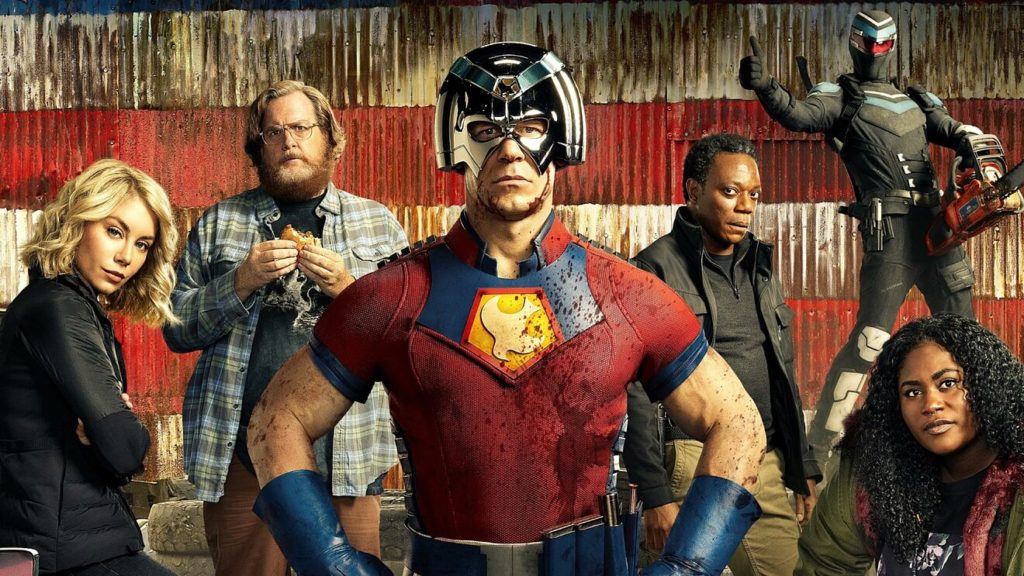
Which brings me to Peacemaker, easily the best high profile television IP that’s hit streaming so far. I went into the series skeptical only because I didn’t think Gunn’s Suicide Squad was very good. I did that thing where you put a show on in the background while mindlessly looking up new coffee tables online. Despite only casually following along, I found myself consistently giggling at the dialogue.
The next thing I knew my laptop was on my current ugly coffee table, completely closed (a rarity) and with each passing minute, I was more pulled into Peacemaker’s charming irreverent slice of superhero fiction. You know what it reminds me of? If Community was an R-rated superhero show. It’s got that balls-to-the-wall “who cares” attitude to it.
Hell, I was singing along to the opening dance number by the second episode!
There are a lot of things to like here but I’ll point out a couple that stood out. The first was the bridge between episodes 1 and 2. At the end of episode 1, Peacemaker is being chased by a scary powerful alien woman. That’s the end of the episode. The second episode 2 begins, we cut to the continuation of Peacemaker being chased by the alien woman!
You might be asking, “Why is that a big deal, Carson?”
Well, whenever I watch an episode of Boba Fett, they draw EVERRRRYYYYTHING OUUUUUUT FOR AS LOOOONNNNNNNNG AS POSSSSSSSIBLE. If we’re in the middle of a chase at the end of an episode, you can bet your bottom dollar that the next episode is going to start with a 20 minute flashback. And maybe – MAYBE – they’ll show us the continuation of the chase after that.
Don’t get me wrong, I know this is a narrative technique. You give us the beginning of a big moment then you cut to other characters or other storylines so we have to suspensefully wait to see what happens. However, it’s clear with episodes of Boba Fett, and most of these Marvel episodes, that that’s not the reason they’re making us wait.
They’re making us wait because they don’t have enough story. And when you don’t have enough story, you lean on trickery. You lean on false story engines. You’re basically finding things that fill up time so you can make the episode’s minimum time requirement.
This has become so predominant in high profile IP shows that I was legitimately shocked – in a good way – when we continued right where we left off in episode 2 of Peacemaker. Gunn understands that the lure of flashbacks – they help flesh out characters – can also act as story roadblocks, sending you off on some long not-well-thought-out detour that always takes too long to get you back to your original route.
Good writers develop characters in real-time. They don’t need that flashback crutch.
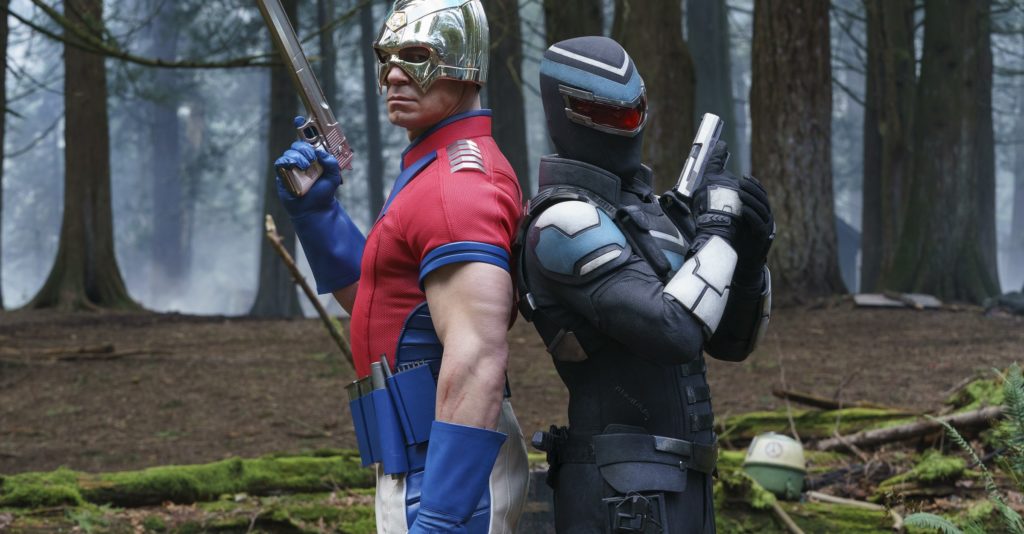
The other thing I like about Peacemaker is that Gunn didn’t say, “What’s the best Peacemaker show?” He said, “What’s the Peacemaker show that would best highlight my strengths as a writer?” Gunn’s biggest strength is putting characters in a room talking about nothing. As many of you know, I’ve railed against doing this. But IF YOU’RE GREAT AT SOMETHING then it doesn’t matter if you’re not supposed to do it. Your strength should always take precedence over what you’re “supposed” to do. And Gunn is a master at funny observational dialogue.
I’m beginning to realize why I didn’t like his last two movies (Suicide Squad and Guardians 2). It’s because, in features, you can’t sit characters in rooms and have them babble on for three minutes. Every scene in a feature has to push a ten-ton movie forward. Without that constraint, Gunn can now let loose. And he’s really good at letting loose. The way his mind works is so funny and he’s finally found a medium that allows him to go to town in this area.
By the way, one of the reasons he’s able to do this is because he’s created eight full-on dialogue-friendly characters. If you’re new to my site, there are dialogue-friendly characters and dialogue-unfriendly characters. If you’re trying to write great dialogue with two dialogue-unfriendly characters, it’s never going to sound right. I mean, can you imagine Boba Fett and Fennec having even a single entertaining conversation together? Of course not. Because neither of them is dialogue-friendly.
Gunn made sure that every single character here had their own entertaining personality type. Peacemaker is a blabbermouth who says a lot of ignorant things. His hilarious best-friend, Vigilante, is like Deadpool-lite. Co-team leader Emilia is always angry and always ready to take that anger out on you. Tech Specialist John, probably the most introverted of the bunch, is still willing to engage in awkward opinionated debates about what they should be doing. New Girl Leota isn’t afraid to throw quippy insults Peacemaker’s way.
I know it seems obvious. But if everyone is designed to be entertaining when they speak, you’re going to have a lot of good dialogue.
But I’ll tell you my favorite moment in Peacemaker – the moment that confirmed to me the show was special. And, believe it or not, it’s a moment that doesn’t have any dialogue. It occurs when Peacemaker is hiding outside the house of a man they need to assassinate with Emilia, his hot-headed boss who hates him but who Peacemaker has a major crush on.
They’re far off, in the bushes, waiting for the target to arrive so they can take him out with a sniper rifle. As they sit in silence, waiting, Emilia is eating a bag of trail mix. Peacemaker keeps looking over at it, hungrily. Finally, reluctantly, she holds the bag out so he can have some. He eagerly reaches in and takes a handful. Then, just as we think he’s going to start eating it, he begins to pick out the little pretzels and, one by one, place them back in the bag that she’s holding while she stares at him like he’s a crazy person.
I like this moment for two reasons. I love scenes that tell us who characters are by showing and not telling. This twenty-second moment tells us so much about these characters without saying a word. She hates this guy so much that the act of giving him her food must be coupled with an animated production of how much she hates doing so. Through that simple action, we know how much she detests Peacemaker. Meanwhile, the fact that Peacemaker starts placing trail mix pieces he doesn’t want back in her bag tells us that he is so ignorant to others’ perceptions of him that he doesn’t even know when someone hates him. That is Peacemaker in a nutshell: oblivious.
And two, most writers wouldn’t think to come up with this moment. It’s too subtle. To know your characters well enough to create a subtle moment as specific as this one is rare. Or, at least, in the scripts I read, it’s rare. It’s a great reminder to think about what your characters could do while they’re not speaking to each other. Moments do not always have to start with words.
This show came at just the right time for me. I’ve been looking for a good show. And this one is so fun. I would go so far as to say it’s the best thing James Gunn has ever done. And I dare anyone to challenge me on that because I’m obviously right. What about you? Have you seen Peacemaker? What did you think?
Is “Grizz” as good of a bear movie as “Jaws” was a shark movie?
Genre: Thriller
Premise: A car accident strands a young paramedic in the rugged Pacific Northwest where she is hunted by a ravenous grizzly bear.
About: This was one of the loglines that stood out to me on the Black List. Connor Barry has produced some indie movies but this is his first screenplay recognized by the industry.
Writer: Connor Barry
Details: 101 pages

I’ve used this logline in several recent logline consultations to demonstrate what an effective logline looks like. Let’s take a look at why it works so well.
“A car accident strands a young paramedic in the rugged Pacific Northwest where she is hunted by a ravenous grizzly bear.”
The logline starts with the inciting incident (a car accident). It then introduces us to the main character. Constructing a main character in a logline is difficult because you only get 1-3 words to do so. It basically comes down to a choice between an adjective, a job, or both. Here, we get both. A ‘young paramedic.’ It’s enough to get a sense of who our hero is.
Next we get the setting. The key with setting is to paint a picture in the reader’s mind of what the movie world they’ll be entering looks like. The choice they use here is perfect. We don’t just get “the forest,” or “nature.” We get “the rugged Pacific Northwest.” I know immediately what that looks like so I can imagine the setting. It’s a beautiful but dense endless sea of giant trees that are impossible to navigate.
Finally, we get our antagonist, or the central conflict of the movie – the bear. But if you just put “bear,” that’s boring. A logline is the written version of a billboard. It has to create an image in the reader’s head. So you have to be a little more exciting with your word choices. Hence, we get a “ravenous grizzly bear.” It’s almost a perfect logline.
Now let’s see if the script lives up to it.
Cari is a 30-something paramedic who’s been suspended from her job after assaulting someone. So Cari decides to go on vacation. While driving on the mountainous roads of the Pacific Northwest, her van goes shooting off the road and tumbling into some trees. Cari only barely survives the ordeal and quickly realizes the cliff is too steep to climb back up. She’ll need to find another way out of here.
Her barely functioning phone tells her there’s a highway 8 miles north so that’s where she heads. She doesn’t get very far before she encounters the world’s meanest (and hungriest) grizzly bear. The bear doesn’t even hesitate. It attacks, digging its jaws into her midsection. Cari somehow gets away and hurries back to her van. In one of the best scenes in the script, Cari tries to fend off the bear which squeezes through the windshield and inches its oversized body further and further into the van, pushing Cari further and further back until she has nowhere left to hide.
After stabbing the annoyed bear several times, it retreats. But this is just the beginning for these two. It’s only page 25! After another attack, Cari makes a run for it but doesn’t get far. This thing is FAST. Cari shoots into a tiny cave opening the grizzly can’t penetrate. Or can it!? The bear repeatedly slams the cave opening until it crumbles.
Around this time, two hunters find Cari, thank God. But even though Cari explains to them that this is no ordinary bear, they seem unfazed. They follow Cari back to her van where they subsequently rob her and leave. Less than an hour later, she hears them being attacked by the grizzly, sending one of them right back to her, inspiring the world’s most reluctant team-up.
As their supplies dwindle, Cari realizes that there is no way out of this forest without going through that grizzly bear. It will require all the strength and intelligence she has left to do so. Will she make it? The answer may surprise you.
Many years ago, in one of the most infamous stories to ever come out of Hollywood, producer Art Linson paid famous screenwriter David Mamet a couple million bucks to write a movie for him. He didn’t have a concept. He didn’t even have an idea. He simply wanted one thing – that there be a bear in the movie. That’s how we got the movie, The Edge.
Boy would Linson have loved to have had this script instead of that one. Cause this could be the bear movie that beats all bear movies.
The thing with “Grizz” is that it’s such a simple and clear idea. And simple clear ideas tend to be the scripts that become good movies. The only downside of simple and clear is that they don’t pack a lot of plot into them. So you end up running out of story by page 45. Maybe sooner.
The way to defeat this is to figure out what your major plot beats are ahead of time and space them out accordingly. A major plot beat in Grizz would be that scene I mentioned above of the bear invading the van. Or the bear collapsing the cave. Or the hunters showing up. You would take each of these and chart them out in an outline. This scene will happen on page 20. This scene will happen on page 40. This moment will happen on page 50. When you do that, you’ll always have something to write towards instead of looking at 70 blank pages ahead of you and thinking, “What in the world do I do now??”
Pro Tip: Writer’s block is usually a result of bad planning.
But Grizz goes one step further here in that it does a great job creating this, almost, intimate connection between Cari and the bear. They’re going through this together, even if they’re trying to kill each other. So even without the cool plot beats and set pieces, we’re attracted to this unique relationship and what’s going to come of it.
There are numerous moments in Grizz where Cari and the bear just stare at each other, almost like they’re trying to read each others’ minds. I’m not going to lie – it made me emotional. Barry, the writer, even makes us feel sympathy for the bear. He explains that the bear is starving. That it’s one of the last bears in the lower 48 states because the others all starved to death. So we understand why the bear is doing this. He’s not just doing it because he’s a big old meanie.
That propensity to lean into emotion is what separates Grizz from scripts like this that just want to show a woman running from a badass bear.
From a technical standpoint, if you’re going to write a script with so few characters and so little dialogue, you need to keep the paragraphs to 1-2 lines. Because readers do not like reading non-dialogue scripts with thick paragraphs. They actually become enraged if you do this. Do what Barry did. 1-2 line paragraphs all the way through so that the reader’s eyes move down the page quickly.
Grizz nearly got that ‘impressive.’ It was so close. I think I wanted one more big plot surprise. There’s a minor twist late in the script that was fairly predictable. That twist needed to be better to push the script over the top. With that said, the ending is strong. We get our money’s worth with a few unexpected final bear encounters. Definitely check this out. It’s the best script I’ve read from the 2021 Black List so far.
[ ] What the hell did I just read?
[ ] wasn’t for me
[xx] worth the read
[ ] impressive
[ ] genius
What I learned: When things are good, make them bad. When things are bad, make them good. In any script where there’s a pattern, you need to occasionally reverse the polarity of that pattern. This is why, in a script where things are going well for your heroes, you introduce obstacles. Conversely, for scripts like Grizz, where your hero is constantly experiencing bad things, you need to introduce the occasional good. One of the better moments in Grizz occurs when the two hunters find Cari. When they arrive, we’re like, “Thank god. She’s okay now.” It’s not like a bear is going to be able to take down two armed men. Sure, it amounts to a false victory. But before we learn these dudes are bad, we get that ‘thank god she’s safe’ screenwriting dopamine hit that interrupts the pattern. If a pattern is never interrupted, the reader will get bored

(SPOILERS!)
For the past several months, you’ve been hearing me talk about how the Boba Fett show better have themselves a Hutt in the series or I’m out. Yesterday, the show answered my call. And they didn’t just give me one Hutt. They gave me two. Twins, in fact.
I loved this choice. It’s what every screenwriter should be trying to do. The audience wants something. It’s your job to give it to them. But, ironically, if you give them exactly what they want, they’re not satisfied. Don’t ask me how that works. It involves some deep psychological introspection about human behavior that only Freud and Pavlov would be able to explain. Needless to say, I was thrilled. The twin aspect offers a unique obstacle for our beloved bounty hunter to overcome.
The moment when the Hutt twins arrive is one of the best moments in Star Wars’ TV history. And yes, that includes two seasons of The Mandalorian. It’s a tremendous entrance. We hear the distant sounds of a pounding drum beat. There’s a small but noticeable rumble to the ground. We hear the Hutts long before we see them.
If you were like me, you were charged up in this moment. The Boba Fett show had officially arrived. This is what we’d been waiting for. So what did they do after this explosive scene? They did the unthinkable. They played out the rest of the episode in a flashback.
Sigh.
I could go on a 1500 word rant about how worthless flashbacks are but I’ve already done that so I’ll just say this: I guarantee 99% of your audience would rather watch this present day storyline than the past one. So how are you the one person who thinks people would rather watch a flashback storyline?
Yes, Star Wars flashbacks are better than most due to the fact that you have so much mythology to play with. But a flashback is still a flashback. It is stopping the present storyline – the one that actually matters – to show us something that is over and done. It is an inherently flawed approach to telling a story, especially when you’ve just set up a way more compelling story minutes prior.
Let me put it to you another way. Have you ever been telling someone a story about your day and then said, “Oh, and I forgot to tell you. Earlier in the day, when I first woke up, I put on my tennis shoes instead of my boots and…” When has anyone’s eyes ever lit up when you’ve stopped your story to set up something from earlier? It’s never happened. Flashbacks are nuclear story missiles, destined to blow up the story city you have built. They’re pointless save for the industry’s most sophisticated storytellers.
Anyway, after taking the night to think the episode over, I realized the mistake the writers had made. They were prioritizing the wrong genre. They were making a Western instead of making a crime family show when, clearly, the crime family angle is more intriguing. The Sopranos meets Star Wars. The Godfather meets Star Wars. Breaking Bad meets Star Wars. Goodfellas meets Star Wars. That’s the hook here. That’s the Star Wars we’ve never seen.
You know the Star Wars we have seen? Star Wars as a Western. We’ve seen it to death. We just saw two freaking seasons of it with The Mandalorian. If you want to remake The Mandalorian, just make a third season of The Mandalorian. If you want to justify the existence of a new bounty hunter show, make it different. Make it The Godfather meets Star Wars.
What’s the difference between the two genres? Westerns are sloooooooooowwww. They revel in long drawn out storylines. They’re not afraid to spend 30 seconds showing a character walk through a desert. It’s a strange man entering a foreign territory and not being trusted.
The crime family genre is about TENSION. It’s about placing powerful morally questionable people in the same room wanting different things and sitting there while the tension builds. Why do you think the “Am I clown, do I make you laugh” scene from Goodfellas is so powerful? It’s tension that builds and builds and builds until it finally explodes.
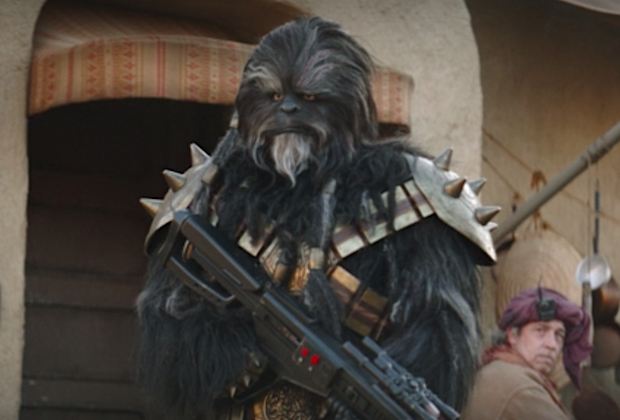
That’s why the Boba vs. the Twins moment is one of the best in Star Wars lore. It’s two (actually three) powerful people standing their ground as the tension builds between them. And the crazy thing about this scene is that the writers know it. They know it so well that they amp it up by introducing yet ANOTHER bad ass character stepping into the fray in Black K (the wookie). He takes things up yet another notch. For them to recognize that this scene is so good only to go into flashbacks is unforgivable.
Cause the flashbacks are the Western. They’re the man with no name being helped by the natives becoming a better man or something. It’s all drawn out insignificant nonsense and it’s coming to us specifically because the writers are thinking that Boba Fett is a Western. It is not. It’s a crime family drama. That’s the Star Wars avenue you haven’t explored yet so give us that! Even if you don’t agree with that, you’re still prioritizing backstory over present story which you should not be doing!
Is there an argument to be made that, by showing us these flashbacks, you’re fleshing out the main character so that, when he does reach those pivotal moments in the present day storyline, we’ll care more? Sure. That’s a legit argument. But here’s the problem with that. Anybody can make a character more fleshed out by showing us 20 minutes of his past, or 40, or 60, or 1000. Yeah, the more we know about a person’s past, the more we’ll care about them.
But there are diminishing returns here. We learn more about this character at the expense of being given an entertaining story that’s happening right here, right now. Good screenwriters know how to make you care for a character without having to resort to 30 minutes of flashbacks. They do it through the character’s actions. They do it through the character’s choices. They do it through carefully positioned lines that hint at what has happened in their past.
Ironically, Boba Fett is the perfect embodiment of this. He had like five minutes of screen time in Empire Strikes Back yet we loved him. You don’t have to bathe a character in backstory to make us care. You just have to be smart about what he does in the little bit of screen time he has.
For example, one of my favorite moments in Star Wars happens in Empire Strikes Back when Han and crew trick an Imperial Star Cruiser by floating out with the space junk then, after the cruiser leaves, escaping off to another planet. Mere seconds later, we see Boba’s ship ignite its engines and follow the Falcon. That tiny moment told us how clever Boba was. As ahead of the Empire that Han was, this bounty hunter had thought one move ahead of him.
Getting back to my point, the writers seem to think that the backstory, with its Western roots, is the more appealing storyline here. It isn’t. The crime family stuff is not just a little bit more interesting. It’s a LOT more interesting. I would argue that the second best scene in the Boba Fett series so far is the scene that happens right before the Hutt sequence, when Boba Fett goes to tell off the mayor. It’s another crime family moment – the local crime boss threatening the mayor of the city to let him do his thing.
That’s two scenes IN A ROW that prove the crime family genre is where your focus should be. Yet you go back to this silly rehashed Western backstory nonsense??? I’m angry. I’m baffled. I’m frustrated. Because this is the series that could save Star Wars. I know people think Mandalorian did that but let’s be honest. Mandalorian was a gimmick. It was Baby Yoda and a guy who couldn’t take off his mask. This series has some actual potential. If they’d focus on the crime boss stuff, they’d be golden. Because they’ve got one of the coolest characters in Star Wars lore and they’ve done something *really* cool in making him this underdog gangster king in a world he’s not ready to take on yet. It’s badass. And they’re ruining it right in front of our eyes.
I would implore all writers to seriously consider what they’re doing if they build a narrative around what’s already happened as opposed to what’s happening now. What’s happening now will always be more significant because the effects are immediate.
I do think I know what they’re doing with the flashbacks. Speculative spoilers ahead. The goal is to make us fall in love with the tusken raiders and then, in the final episode, kill all of them off. And it’ll probably be a genuinely sad moment. But my counter-argument to that is, was it worth ditching two hours of cool crime family drama in the present day for that? My answer would be a hard no. Whenever there is a choice between focusing on the past or the present, you should choose the present. It’s where the real story is and, therefore, where you should be.
The Hutt twins have upped the ante of this series. It is so clear to all Star Wars fans what should now happen. The final five episodes should focus on the turf war between Boba Fett and them. If they continue to prioritize these flashbacks, though, I don’t know what I’m going to do. I’ll be so angry. The path to greatness is right there in front of you, plain as day. Please take it. I’m begging you, Boba.
Today’s script is Joker meets The Social Network meets The Wolf of Wall Street
Genre: Biopic
Premise: The completely outrageous and completely true story of “pharma bro” Martin Shkreli — from his meteoric rise as wunderkind hedge fund manager and pharmaceutical executive to his devastating fall involving crime, corruption and the Wu-Tang Clan — which exposed the rotten core of the American healthcare system.
About: This script finished in the top 5 of the recently released Black List, a list that tabulates development execs’ favorite scripts of the year. The script was written by Andrew Ferguson. Andrew had one script he put up on the Black List amateur site a couple of years ago that readers of that site enjoyed called Boost. The logline for that was: “Two safecracking sisters are recruited for a heist by the Corsican Mafia in order to establish a modern-day French Connection.”
Writer: Andrew Ferguson.
Details: 120 pages
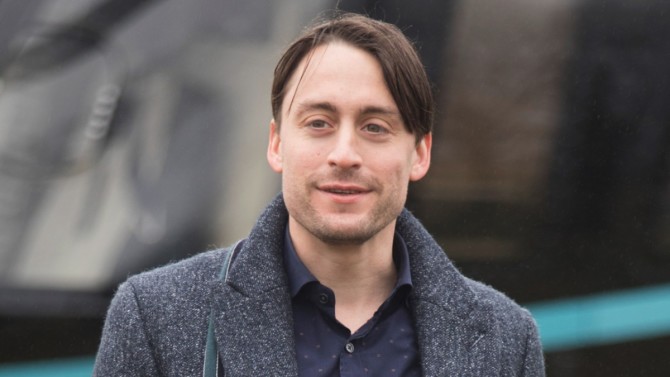
You may be wondering why, of all the scripts on the new Black List, I’m reviewing a biopic. The answer to that question is the same answer to the question of, “What makes a good biopic?” A lot of writers get this wrong so I want you to pay attention. Biopic writers believe that what makes a good biopic subject is a famous person they like. That’s the only criteria they use. But today’s writer knows the correct answer to this question, which is, “Write about the most interesting person you can find.”
Because remember – biopics are inherently boring. They just are. They’re meat and potatoes bland narratives that take us through years and years of a person’s life, making it hard to jumpstart any sort of compelling story. Out of the gate, the plots’s a dud. The only chance you have of keeping readers invested is if the character is one of those “can’t look away from” characters. And today’s character is that.
Our narrator for this story is RZA, one of the members of The Wu-Tang Clan. RZA is coming to meet Martin in prison. But, before we can learn what he needs from Martin, he tells us all about Martin’s story.
We meet Martin Shkreli as a 12 year old kid whose Albanian father is a janitor. Martin is embarrassed by his father’s job. But he’s even more embarrassed by the fact that his father has no desire to improve his life. In Martin’s eyes, that’s the ultimate sin.
Martin wants to be rich so, straight out of high school, he cons his way into an interview with Jim Cramer – yes, the wacky financial host – back when he was running a billion dollar hedge fund. After convincing Cramer to hire him, Martin learns the value of “shorting,” which is when you invest money in the hopes of a company failing. This teaches Martin that there is heaps of money to be made by taking a morally irresponsible approach to investment.
Martin eventually quits Cramer’s fund and starts his own fund in his mid-20s. Naturally, it fails, so he starts another one, and that fails too. Despite losing tens of millions of dollars of his clients’ money, Martin identifies a market that nobody is capitalizing on: You can buy the rights to a pill then raise the price of that pill to whatever you want.
So that’s what Martin does. He buys a pill called Thiola and ups the price from 15 dollars to 350 dollars. It is of no consequence to Martin that the pill saves lives and that, by raising the price, many people will die. Journalists ask him if he cares about this and he literally says no, he does not. All he cares about is profit.
What Martin doesn’t plan for is for his story to go viral. It even hits the late night talk show circuit, with Stephen Colbert and Seth Myers going after him. Martin, who operates under the m.o. of any publicity is good publicity, eats the attention up, even doubling down on social media.
But it ends up getting so much publicity that the SEC starts looking into him. What they find is someone with such an atrocious moral compass that they’re positive he has skeletons in his closet. They turn out to be right, identifying numerous laws he’s broken in his decade in the financial industry. So they arrest him and send him off to prison, where Martin is residing until next year, when he will be released and surely begin another sketchy company.
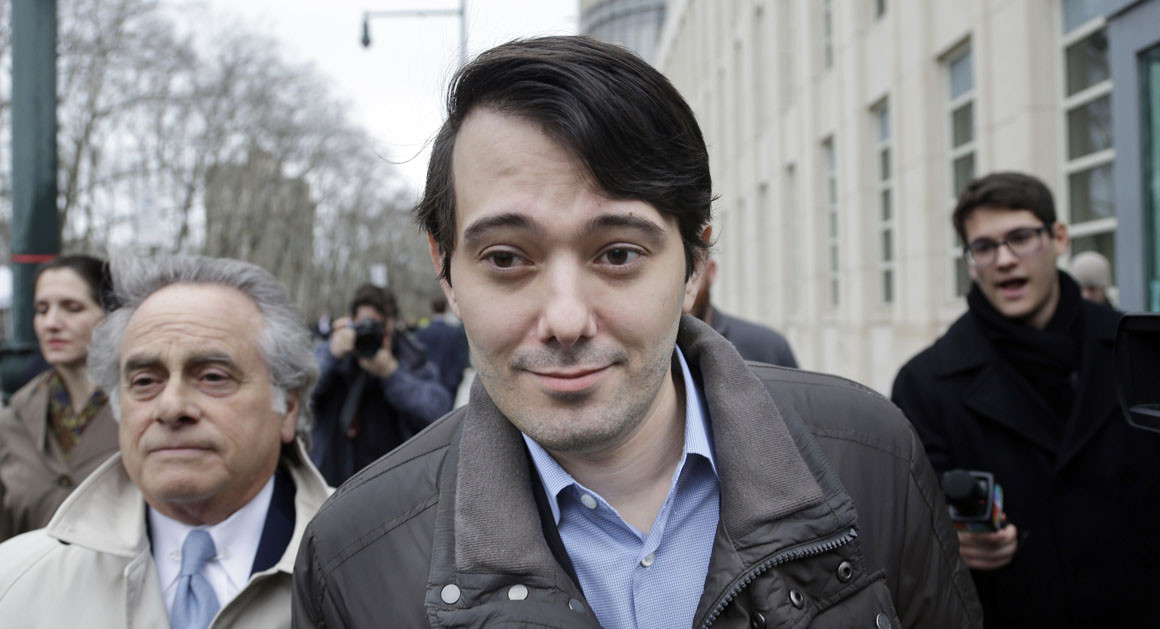
The Villain is an inherently challenging script to write in that the hero is the worst human being ever. Ferguson seems to know this and attacks it immediately. Martin’s father is a poor immigrant. Martin has no friends. Nobody gives Martin a chance. Martin gets accepted into multiple Ivy League schools but can’t go because he can’t afford it.
I think Ferguson realized that this guy was going to do such despicable things later on that he had to drum up as much sympathy for him as possible. Keep us around long enough to where we realize how weird and interesting this guy is. And then, by that point, even though he’s become a grade-A dickoholic, we’re so fascinated by the guy that we have to keep reading.
The script is also good by general biopic terms. I grade on a negative curve when it comes to biopics since I hate them but this is definitely one of the better ones I’ve read. I loved the choice of using RZA as a narrator. You’re always looking for ways to contrast and clash elements in a screenplay. That’s where you create excitement – combining things that don’t typically combine.
RZA’s streetwise no-B.S. narration (“But we first gotta run it back to the beginning. ‘Cause in the beginning was the word. I’m talking about the one place every rags to riches story in America begins — motherfuckin’ Brooklyn!”) was the perfect accomplice for a story about white collar Wall Street.
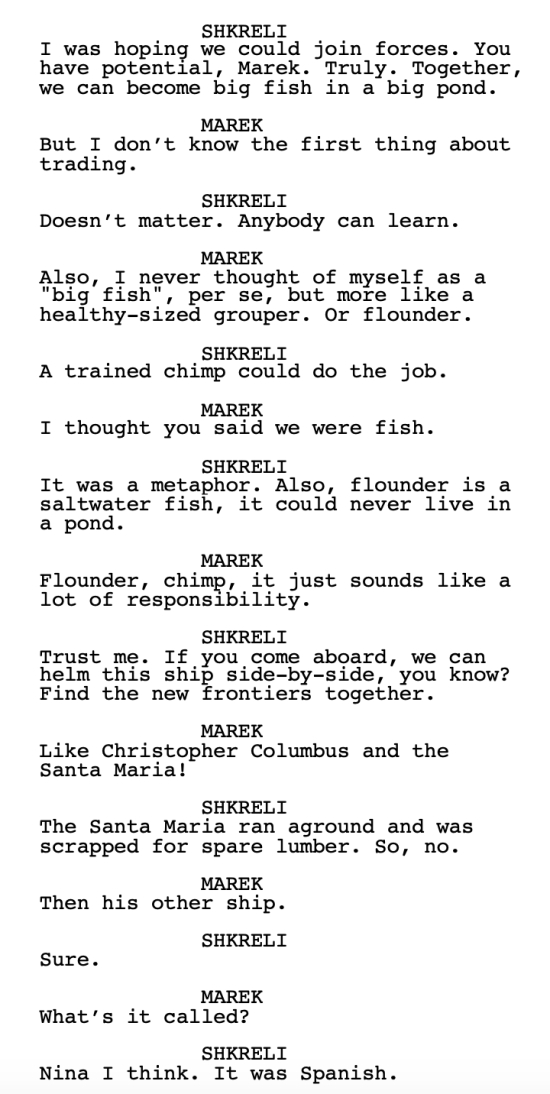
The dialogue is also good. It’s not quite Sorkin. But you get gems like this one where Cramer responds to Martin’s handshake (“Jesus, kid. You got the handshake of a teenage girl with polio.”) as well the below exchange, which I chuckled at.
But I think that the main reason the script works is that it gets your emotions going. That’s all you’re really trying to do with a script – connect with the audience on an emotional level. If you don’t achieve that, the audience will forget your movie within a week. If you do achieve it, they’ll remember your movie for a lifetime. Those are the stakes you’re playing with when it comes to emotional connection.
You can do this through love, like Titanic. You can do it through fear, like The Exorcist. You can do it through sadness, like Million Dollar Baby. Or you can do it through anger. And while anger is the least effective version of creating an emotional connection (since it’s a negative emotion) it still works.
We get so enraged when Martin price-gouges these people who will die if they can’t afford his pill that we’re now emotionally invested in the story. We want a resolution. We need to find out that someone’s going to come in and save these people from this insane man.
On top of that, there was something refreshing about a character who has zero interest in redeeming himself. Martin not only accepts his villain label, he goes out of his way to flaunt it. This guy is the embodiment of evil and I think that’s why the internet became so fascinated by him. Most people back down when they’re called out. He doubled-down. So we were kind of thrown into uncharted waters. If this guy has no desire to change, where does the story go? I wanted to know.
The one issue I had with the script was that it was a bit try-hard. It wants to be the next Social Network. It wants to be the next Wolf of Wall Street or The Big Short. But you can feel the writer pushing for that cool-factor (“Shkreli inhales breadsticks as he sits opposite Adele and SEC Officer inside the tourist-infested Olive Garden, surrounded at every turn by MAMMOTH MIDWESTERN MOUTHBREATHERS with their OVOID OFFSPRING devouring discount Italian by the dinnerplate”) and I’m not a fan of when I can feel the author’s presence. I want to be lost in the story. I don’t want the writer to remind me that he’s there.
With that said, this was pretty good. Definitely worth checking out if you’re also a biopic writer.
[ ] What the hell did I just read?
[ ] wasn’t for me
[x] worth the read
[ ] impressive
[ ] genius
What I learned: When it comes to narrators, writers tend to use the most obvious choice. Instead, consider the least obvious choice, like RZA here. I guarantee it will be more interesting.

Here’s the way I see it. 2020 and 2021 don’t count. They were weird years. A lot of weird stuff happened. How can one focus on his screenwriting career when he can’t even sit down at a coffee shop for six hours and complete one page of his script, for goodness sakes! Or can’t go to a movie theater where he can properly procrastinate? Here’s the good news. Those days are over. Covid is disappearing in 2022. Who said that, the CDC? No. Try the CRC. The Carson Reeves Consortium.
Myself, along with my esteemed board of trustees, have put in a word with the leaders of the free world, minus the president of Finland, of course, and have decided that enough is enough. Once these presidents and prime ministers learned of the reason I demanded an end to Covid – that screenwriting everywhere was suffering – they were immediately on board.
But the CRC didn’t stop there. They demanded that I – yes, yours truly – personally give screenwriters two opportunities to break out. And so I created the ANYTHING GOES AMATEUR SHOWDOWN along with the FABULOUS FIRST ACT CONTEST. Both of these competitions are going to revolutionize screenwriting. Well, maybe not revolutionize. But they’re going to give you two deadlines so that you actually get some writing done ya lazy asses.
ANYTHING GOES AMATEUR SHOWDOWN
What: An amateur showdown where any genre is accepted. I will choose the five best-sounding concepts to compete against each other at the end of February. You will then vote on the best one. I’ll review the winner.
When: Entries are due by 10pm, Pacific Time, Thursday, February 24th.
How: You need to send me your title, genre, logline, why you think the script deserves a shot on the big stage, and, of course, a PDF of your script.
Where: E-mail your entries to carsonreeves3@gmail.com and put “Anything Goes” in the subject line.
How Much: Free
THE FABULOUS FIRST ACT CONTEST
What: Starting March 1, I will spend a month guiding you, scene by scene, through writing your first act, the most important act of a screenplay.
And?: Whoever has the best first act, I will develop the rest of the script with you, guiding you through several rewrites. Once we’ve got the script in shape, we’ll go out there and try and get it made.
When: Entries will be due on May 1. You can start sending your first acts to me on April 1. I’ll give you details on where to send them as we get closer to the deadline.
How: Anybody who is thinking of entering this contest, I want you to begin a two-month Battle Royale of all your script ideas. I want you sending these ideas out to friends and asking them which one is the best. You will need a strong concept to win this contest.
How Much: Free
I wanted to start the screenwriting year off with some motivation for you guys and, unfortunately, found out that hiring several thousand Benihana chefs to go to your personal places of residence and do that really scary sword attack thing they do until you write three pages of a screenplay was going to cost me a couple million dollars, so I came up with an alternative. Some screenwriting resolutions. I’m going to give you ten resolutions but you only have to pick and adopt three. Choose wisely.
Resolution #1 – Write for at least two hours a day.
One of the fastest ways to get better is to write more. If you want to get good at anything, you have to prioritize it. So if you can’t carve out two hours a day to write, I would ask you, how much do you really want to be a screenwriter? Cause it doesn’t sound like you want it that much. Think about it. When has anyone ever become great at anything that they didn’t dedicate at least two hours a day to? Open up that laptop and don’t leave until those two hours are up.
Resolution #2 – You will find out if a concept is good BEFORE you spend six months writing it.
This has to be one of the most common mistakes I run into. People send me loglines for consultations all the time ($25 – carsonreeves1@gmail.com) that are so problematic, there is no version of a screenplay that can save them. The issue? They’ve already written the screenplay. Look, I understand that when we get an idea we love, we just want to write it. We have such tunnel vision that we don’t care what anybody else thinks. But screenwriting is an emotionally taxing endeavor. You can only write so many scripts that don’t go anywhere before you give up. For that reason, you don’t want to waste any of those slots on a lousy idea. Send your logline out to some friends and ask them for brutal honesty. Is this any good? And don’t get defensive. If five people aren’t that excited about your biopic into the origins of banana bread, consider another idea.
Resolution #3 – You will read at least 25 unproduced screenplays.
I thought that I knew everything about screenwriting before I’d read a single unproduced screenplay. I then read 1000 screenplays and learned 50-100 times as much about screenwriting as I knew up til that point. I read 1000 more. Same thing. 1000 more. Same thing. The biggest thing that reading screenplays did was shine a light on all the blind spots I had. When I read a beginner screenplay, I’d see them doing the same things I did in my scripts. “Oh,” I realized, “I can never do that again.” Or when I read a really good screenplay, I’d notice how much clearer and visceral the prose was than all my screenplays. It helped me identify where the bar was. Before reading scripts, I thought the bar was so much lower than it actually was. 25 screenplays is 1 screenplay every 2 weeks. You can do that.
Resolution #4 – Improve your biggest weakness as a writer.
What’s your biggest weakness? Is it plot? Structure? Character? Dialogue? Concept? Theme? Do your scripts lack conflict? Do they not build? Do your second acts get progressively more boring? Whatever you’re bad at, set aside some time every week and work on it. You can do that by googling, “How to write good second acts” and read 50 articles on how to get better. You can write a practice script that specifically focuses on the thing you’re weak at. For example, if it’s dialogue, you can write a practice script that has two characters in a house that’s almost all talk. So many writers ignore the things they suck at. But if you want to get good at this, you have to strengthen your weak links.
Resolution #5 – Write out a plan for the year.
I know we all make fun of Vin Diesel now (and believe me, I’m right with you). But there was a time when that dude was the biggest movie star in the world. And I remember him saying in an interview that, when he was a nobody, he sat down and wrote out this very specific three year plan. He’d write and shoot a short film. He’d submit it to Sundance. He’d use it a promotional tool. He’d get an agent off the buzz. He planned the types of roles he wanted his agent to send him out for. He had it all mapped out. That’s what you need to do. Divide the year into four quarters and have a goal for each quarter. If you want to get even dirtier, set clear goals for every month. Too many writers operate under this lie whereby they wait for inspiration to strike. Unless you want to snap your fingers and see a decade go by, that’s not how you become successful. Come up with a plan and execute it to the best of your ability.
Resolution #6 – Add one new writing weapon to your arsenal.
I’ll never forget the day I learned about dramatic irony. It was like I’d seen all of these great movies and shows with these scenes that always worked and yet I could never quantify what they were doing to make them so awesome. Then I learned they were using dramatic irony – the act of telling the audience something that a key character in the scene was unaware of. John McClane meeting Hans Gruber up on the roof and thinking he was a hostage. There are a bunch of little screenwriting weapons like this that can improve your writing. Suspense. Scene agitators. GSU. Using conflict in every scene. Adding a ticking clock to a scene. Identify one of these, read up on it, then become an expert at it. Your writing will take off.
Resolution #7 – Shift your mindset to a positive place.
In any artistic pursuit, everybody who’s on the outside has a level of disdain for those on the inside. A lot of it comes from a belief that you’re better than a lot of them. And you don’t understand why they’ve made it and you haven’t. I’ll be honest. In some cases, you are better than someone who’s making millions of dollars screenwriting. I can think of two names right now – one who’s about to have a major movie release – where everybody who’s ever won an Amateur Showdown is hands down a better writer than those two. But here’s the thing. It doesn’t help you to expend all that energy being frustrated by that. In fact, it hurts you. It’s much better to focus your energy on writing a great script. I know some people won’t agree with me on this. But I’ve found that, in my life, when I focus on just coming up with good content and not worrying about other peoples’ success who are less talented than I am, I write much better and I’m much happier overall.
Resolution #8 – Come up with one great character.
Most of the scripts we write are born out of an idea we have for a movie. And that’s fine. I’m all for coming up with good movie ideas and writing them. However, this often leads to us retrofitting characters into that idea. Idea first. Character second. Yet when I look at all of the greatest movies throughout time, the one constant I see is great characters. Neo, Jack Sparrow, Travis Bickle, James Bond, The Terminator, Hans Landa. So I’m imploring you to try something new. When you come up with your movie idea, I want you to ask the question, “Can I create a great character within this idea?” So you’re attacking the script on two sides, both conceptually, and as a show-stopping character vehicle. A great character is going to turn a good script into a great one.
Resolution #9 – Speed up your plot.
I have read, maybe, 10 scripts out of 10,000 that I could argue moved too fast. However, I could point to several thousand screenplays I’ve read that moved too slow. The reality is that most scripts move slower than they should. This is because we assume we need to include more than we do. But as I was telling someone the other day, one of the things pros are really good at that amateurs are not, is that they can do in one scene what amateurs take three scenes to do. So their scripts move along a lot faster. I’m not saying you need to redefine the way you write. But any little opportunity you have to move the story along, take it. You don’t want to sit inside any section for too long in a screenplay. Save that for when you write your novel.
Resolution #10 – Finish 2 Screenplays, no less, no more.
You should be shooting for two scripts a year. That’s one script every six months. Which is totally doable if you’re writing 2-3 hours a day. The problem I’ve found with writers who only write one script a year or one script every two years is that they’re not developing their overall screenwriting skills because they’re only improving the skills that help them write that one story. Every script challenges you in different ways. So if you want to get better as a writer, you need to write more than one script. On the flip side, I don’t think you should write more than two screenplays a year. The writers I’ve run into who write 3, 4, even 5 scripts a year – their scripts are sloppy. They’re not developed properly. It’s more of an ego thing for them. And look, I’ve been there. I was once writing scripts every two weeks. I bragged to everyone I knew about it. But, looking back at those scripts? They were terrible. Two screenplays is the perfect amount. That’s what you should be shooting for.
I’m really excited for what this year is going to bring the screenwriting world. Especially here at Scriptshadow. I can’t wait to see which of you break out in 2022. Happy New Year!!!