
Other Mommy Unfriends The Social Reckoning! Plus, The Most Baffling Movie I’ve Seen All Year!
First of all, thanks for all of you who took the time to vote this weekend in Amateur Showdown in what turned out to be a very close competition. I took away five first time votes from Deer Day as they seemed suspicious and yet, still, the unique high concept premise edged its way to a victory.
So, congratulations to DEER PEOPLE. But I do not yet know if I’m going to review that script. I may review one of the other leaders and allow Kool-Aid Man to rewrite it, as he says he’s aware that it’s very rough. So, tune in Friday to see what I review. It was a close race so it could be anyone. And oh, in case anyone forgot, a little script called The Ballad of the Ember Knight once finished second-to-last in an Amateur Showdown. So we may be striking gold this weekend.
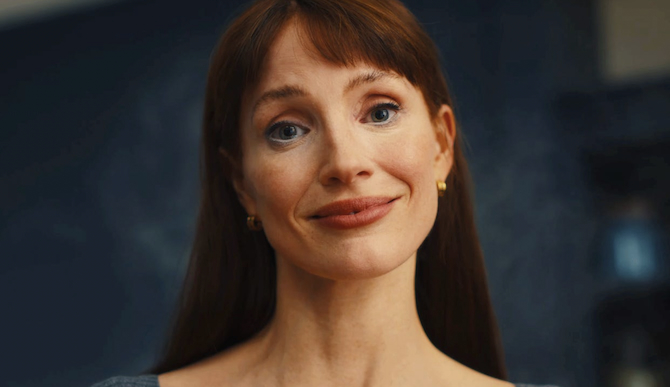
Okay, let’s talk about the box office. Other Mommy got dogged hard after getting abysmal reviews. And hey, I get it. I read the book (written by the Bird Box author) and it wasn’t great. But Other Mommy pulled in 30 million bucks this weekend because it aced the key screenwriting skill that matters: If you deliver on what you promise, audiences will forgive you for almost everything else.
This script was about a creepy antagonist and scary scenes. That’s the promise. That’s what people are showing up in hopes to see. So, if you deliver on those two things, the audience will leave happy! Those trailers were fucking scary, yo. I was watching through my fingers.
This is why I always tell writers to prioritize the thing their movie is selling. If you’re writing an action movie, you shouldn’t obsess over whether the exposition in your dialogue on page 74 is perfect. That’s not what people are coming to see. They’re coming to see action scenes that they can excitedly tell their friends about later.
The other big release this weekend was The Social Reckoning, which, let’s be honest, should never have been made. They probably could’ve doubled their box office if they’d gotten Jesse Eisenberg back, who Sorkin desperately attempted to lure to the sequel. But Eisenberg seems to be on some kind of spiritual journey these days. Every time I hear him talk, I feel like I need to swaddle him in a blanket. He’s dealing with his own shit and clearly has no interest in returning to the Zuckerberg universe.
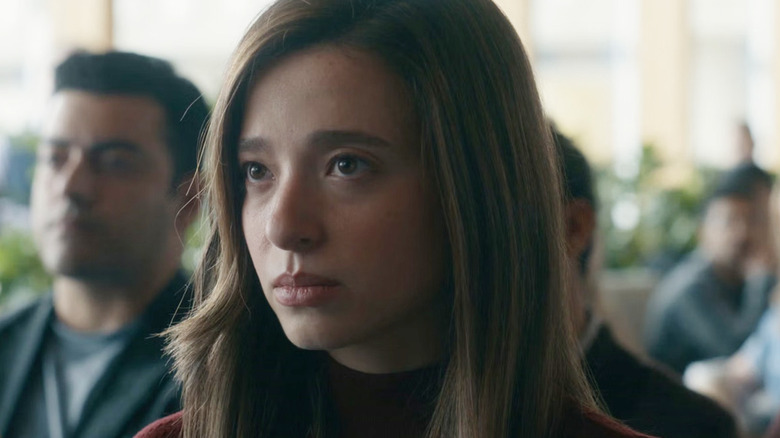
Despite that, you’ve got Jeremy Strong, Jeremy Allen White, and Mikey Madison. If you told me three years ago that these three were headlining a movie, I would’ve told you it was the hottest project in Hollywood.
But in 2026? It feels like the most dated cast around. Which is CRAZY to say because they’re all really good actors. I love Mikey Madison. I thought she was amazing in Anora. Jeremy Allen White is always good. Jeremy Strong and his method-loving ass gets shit done even if Brian Cox hates him more than week old bagels.
But it’s Mikey Madison who’s going to wear this failure the hardest. This was her big chosen film after Anora. The one that was supposed to shoot her into the stratosphere. And she blew it by choosing this project over all the others that were offered to her. There’s no other way to frame it. She blew it.
It reminds me how careful you have to be when you become hot in Hollywood. I’m not just talking about actors here. I’m talking about screenwriters. Those moments when everybody wants to work with you? They don’t come around often. And you’ve got to make the most of them.
Of course, nobody knows what’s going to hit and what isn’t. But the big thing you have to watch out for is feeling yourself too much. And Mikey Madison was feeling herself. She’d just won an Oscar. She was a serious actress now. She wanted serious roles that reflected that.
The Social Reckoning is exactly the kind of movie you take when you’re in that mindset. It’s important. It’s prestigious. It’s got a big message. It’s the kind of thing that screams OSCAR CONSIDERATION.
The problem is that nobody cared. And I don’t think anybody was ever going to care about this movie. Even if David Fincher had directed it. Because the movie is the embodiment of the self-important, I-have-a-message, please-give-me-an-Oscar film that audiences don’t just dislike. They hate. They hate when you slam that message into their face like a raspberry pie.
It’s the movie equivalent of a pick-me girl. You look at this film, shake your head, and say, “Have some respect for yourself, Social Reckoning.”
Okay, now let’s talk about one of the most baffling movie-watching experiences I’ve had in a while. I finally watched The End of Oak Street this weekend.
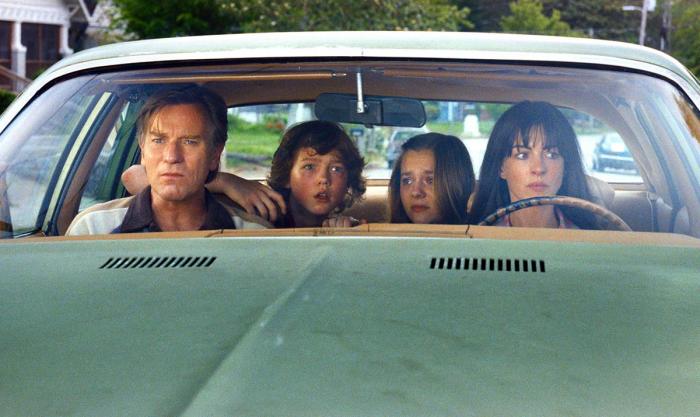
I’ve wanted to see this movie forever. It finally went down in price on streaming, so I dusted off my 1960s popcorn maker, switched on the “mega-butter” setting, and settled in for a movie I genuinely had no idea what to expect from.
And, man.
I don’t even know where to begin with this thing.
First of all, this is my jam as far as concepts go. If you’re wondering what kind of concept Carson loves, THIS IS IT. An entire neighborhood gets transported back to the prehistoric era, where they have to survive dinosaurs? SIGN. ME. UP. That’s an amazing premise.
But what I witnessed was such a bizarre execution of that premise that I currently look like that spinning pinwheel you see on your computer screen when it’s frozen. My brain is unable to comprehend how odd this movie was.
Just to be clear, there were parts of this movie that I LOVED. And then there were parts that were so awful I genuinely thought I was watching one of the worst movies I’d ever seen.
Let’s go back to what I said about Other Mommy: Give audiences what they came for.
In The End of Oak Street, we’re coming for dinosaurs attacking people in a suburban neighborhood. And we get that! There’s a scene where a giant eel dinosaur slides into a house that I thought was brilliant. It was tense. It was unique. We weren’t really sure how the family was supposed to stop this thing. It didn’t feel like another recycled Jurassic Park scene.
Even some of the more traditional dinosaur stuff, like the T-Rex chasing people, was fun.
But then you’ve got Ewan McGregor. If this were the first movie I’d ever seen Ewan McGregor in, I might’ve concluded that he was the worst actor in the entire universe.
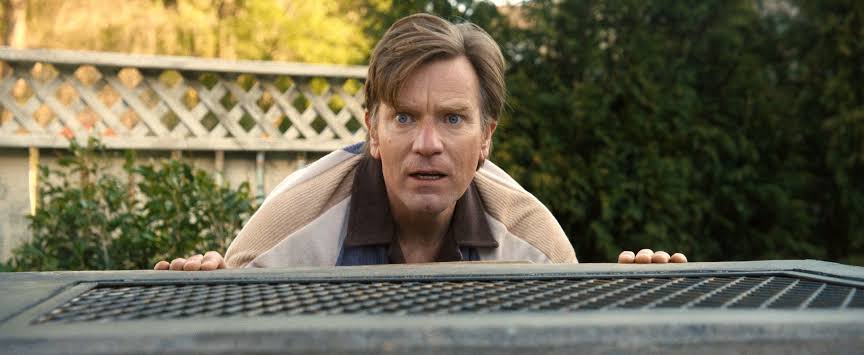
It was like somebody was standing off-camera reading him his lines and he was just repeating them back. It’s honestly made me reevaluate him as an actor. He was amazing in Trainspotting. But I don’t know if I can point to a single other stand-out Ewan McGregor performance. Go take a look at his IMDB. And don’t try to sell me Obi-Wan Kenobi. He was okay in the role.
Anne Hathaway, meanwhile, was trying her hardest. Maybe a little TOO hard at times, like she always does. But at least she was trying.
And then you’ve got these completely baffling creative choices. There’s a LONG SCENE in this movie where two giant dinosaurs are having sex. You read that right. There is a dinosaur sex scene in this. And it’s a major scene! It’s not something we see in passing. I’m sitting there going, “What am I watching right now?? Is this really happening??”
Who thought this was a good idea??
It reminded me of Rian Johnson inserting his weird sense of humor into The Last Jedi. You’d be watching this serious Star Wars movie and then some out-of-left-field joke would show up and suddenly we were in some 2 million dollar Rian Johnson indie flick.
Same thing here.
We’re watching this intense survival movie about a family trying not to get eaten by dinosaurs and suddenly we stop everything for a dinosaur fucking scene. I froze. There’s another scene where dinosaurs are eating and shitting at the same time. It’s this bizarre humor that completely takes you out of the movie. David Robert Mitchell. Time to retire that comedy pen. I hate to be the bearer of bad news but it’s not your forte.
But here’s the biggest issue I had with the film, and it’s something I think every screenwriter can learn from. Whenever you write a big concept movie, the first thing screenwriting teachers tell you is that you need compelling characters. You need relationships. You need character arcs. Otherwise you’re just watching a Michael Bay movie where things explode for two hours.
And that’s good advice!
The problem is that writers often take that advice and create the SCREENWRITING VERSION of compelling characters. They start checking boxes. Okay, this character needs a flaw. This relationship needs conflict. These two characters need to be estranged. This person needs to learn a lesson. And by the end, everybody needs to resolve their issues.
In The End of Oak Street, the parents, Denise and Greg, are on the verge of divorce, and they’re keeping it from their kids. That’s our family conflict. That’s our broken relationship. We’ve got our emotional storyline.
Except none of it feels real.
And THIS IS THE BIGGEST LESSON I WANT YOU TO TAKE FROM TODAY’S POST. If you’re only creating character storylines because that’s what a screenplay is supposed to have, IT WILL FEEL FAKE. You need something real to latch onto.
Let’s say you’re writing about a marriage that’s falling apart. If your own parents went through a horrible divorce, you’ve got a direct connection to that experience. You remember the little things. The weird arguments. The awkward silences. The stuff people said that they probably shouldn’t have said. You can bring all that into your screenplay!
Maybe your parents didn’t get divorced, but your best friend’s parents did. You spent a lot of time at their house. You saw what was happening. You absorbed some of that reality. Okay, you’re a little further removed, but you’ve still got something genuine to draw from.
But what if you’ve never been anywhere near a broken marriage? What if everything you know about divorce comes from movies and television? And now you’re writing this big divorce storyline because screenplay books say you need a moving character storyline.
I GUARANTEE YOU IT WILL FEEL FAKE.
The arguments will feel manufactured. The emotional beats will feel forced. The characters will say things because the screenplay needs them to say things, not because real people would actually say them.
That’s exactly what happens in The End of Oak Street. Every scene involving this marriage felt written. You could practically see David Robert Mitchell sitting behind his computer deciding which emotional beat needed to happen next.
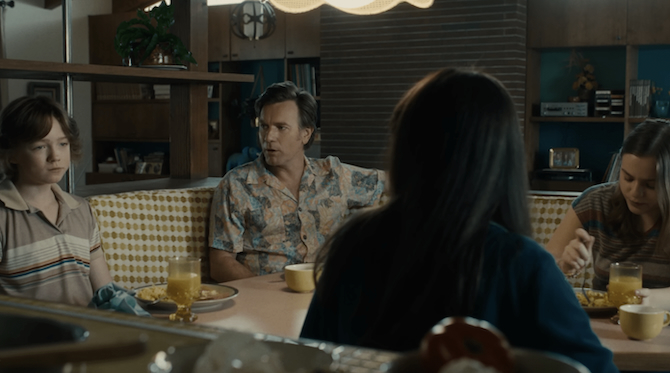
Which is crazy because his first movie, It Follows, was the exact opposite. Everything in that movie felt natural. The characters felt like real people. Nothing felt pushed. Here, everything feels pushed. And sometimes the results were downright ridiculous.
There’s a scene where the family has just been transported millions of years into the past. They’ve already been attacked by dinosaurs. They’re boarding up their windows, trying to keep these prehistoric monsters from eating them. And Denise suddenly smells alcohol on Greg’s breath. So she starts browbeating him about drinking.
LADY!
YOU’VE JUST BEEN TRANSPORTED MILLIONS OF YEARS INTO THE PAST AND THERE ARE DINOSAURS TRYING TO EAT YOU!
Why the fuck are you worried about your husband having a sip of whiskey???????
That’s what happens when you’re forcing a character storyline instead of letting it develop naturally. You end up creating moments that make absolutely no sense because you’re so determined to hit your screenplay beats.
And this applies to every kind of character. If you’re writing about a drug addict and you’ve never been an addict, never known an addict, never been close to anyone dealing with addiction, you’re going to fail at making them feel authentic. You just will. I promise you.
The only time you won’t is if you do an insane amount of research. I’m talking meeting with multiple addicts and having hours upon hours of conversations with them where you try and understand their lives. But writers these days will never do that. And you won’t either. You’ll go to AI cause it’s easier. It won’t work.
So, what am I saying? You need to personally experience everything you write about? To some degree, yes! Not directly. Like I said, you can have second-hand experiences. But if you try to write about an Only Fans model and you’ve never experienced that life or know one of these models closely, good luck. Seriously, good luck trying to make that character feel authentic.
That’s what made The End of Oak Street such a frustrating experience for me. One minute I’m watching a really cool dinosaur sequence. The next I’m watching some of the fakest family drama I’ve ever seen. Then I’m watching dinosaurs have sex. Then I’m watching another cool action scene. The I’m watching a dinosaur shit. I’ve never been yanked back and forth so violently before in a movie.
And it’s too bad because the premise is absolutely KILLER.
I suspect that’s a big reason the movie didn’t break out into a bigger hit. People saw it, kind of liked the dinosaur stuff. But they thought the character work was abysmal. So it didn’t hit them on that gut level. And when a movie doesn’t hit you on a gut level, you don’t recommend it to other people. That and Ewan McGregor recently received an acting lobotomy.
Anyway, I’m curious what you guys thought of the film. Did you like it? And what else have you been watching lately?
Let me know in the comments!
Time to vote!
Man, when I told you guys to send me those weird script ideas you’ve had trouble getting anyone to read, you really took that to heart. I’ve gotten so many bizarre concepts. They’ve been fun to read through but some of them had me thinking, “I have absolutely no idea how this could be a movie.”
Also, I received a TON of Christmas submissions. You guys must have heard of my contact at Sony who loves Christmas flicks (he produced the new Arnold Schwarzenegger Christmas movie coming out later this year). Only one of them made the cut. Believe it or not, there was a better Christmas idea but the writer botched the logline. I’d say 90% of the writers who submitted need logline help. If you’re sending those loglines out to other people I am BEGGING you to get a logline eval from me before you send it out again. They’re just 25 bucks. E-mail me at carsonreeves1@gmail.com if you want one.
I already know some of you are going to say, “Why did that stupid concept get in when my clearly superior concept didn’t?” and you can rest easy. I’ll explain why I picked each entry on Monday. I’m holding off until then because I don’t want to influence the voting.
If this is your first Amateur Showdown, here’s how it works:
Below are the five entries that caught my interest (and one that caught Scripty’s), along with first pages and links to their scripts. You only need to judge the loglines to vote. The scripts are there if you want more context or need help deciding between two entries.
Unlike the High Concept Contest, you get ONE vote. And no splitting your vote between two scripts. You’ve got to commit. Consider it practice for real life.
To vote, leave a comment naming your pick.
Ideally, tell me a little about why you chose that entry, especially if you’re a new voter. Occasionally, people try to game the system by creating fake accounts to vote for their own scripts. If I find evidence of that, you can be disqualified. A reason for the pick helps verify that the voter is real.
An explanation isn’t required, though. If you just want to name your pick, that’s fine. And for our longtime voters, you already know the drill.
Voting closes Sunday at 11:59 p.m. Pacific time. I’ll tally the votes, and the winning script will get reviewed on the site next week.
Here are your five contenders. Scripty wouldn’t shut up about letting Made Men in, so that’s number 6. Save the Cat wanted E.C. Henry’s script included but I had to draw the line somewhere. If you are a writer of one of these scripts and want to share a poster for your entry, you can do so in the comments.
Let’s see which script you guys want me to read.
Good luck to everyone!
Title: Deer Day
Genre: Horror/Thriller
Logline: When a group of hunting buddies take their pampered teens into the woods for the first day of buck season, they are hunted by killer deer who have a taste for human meat.
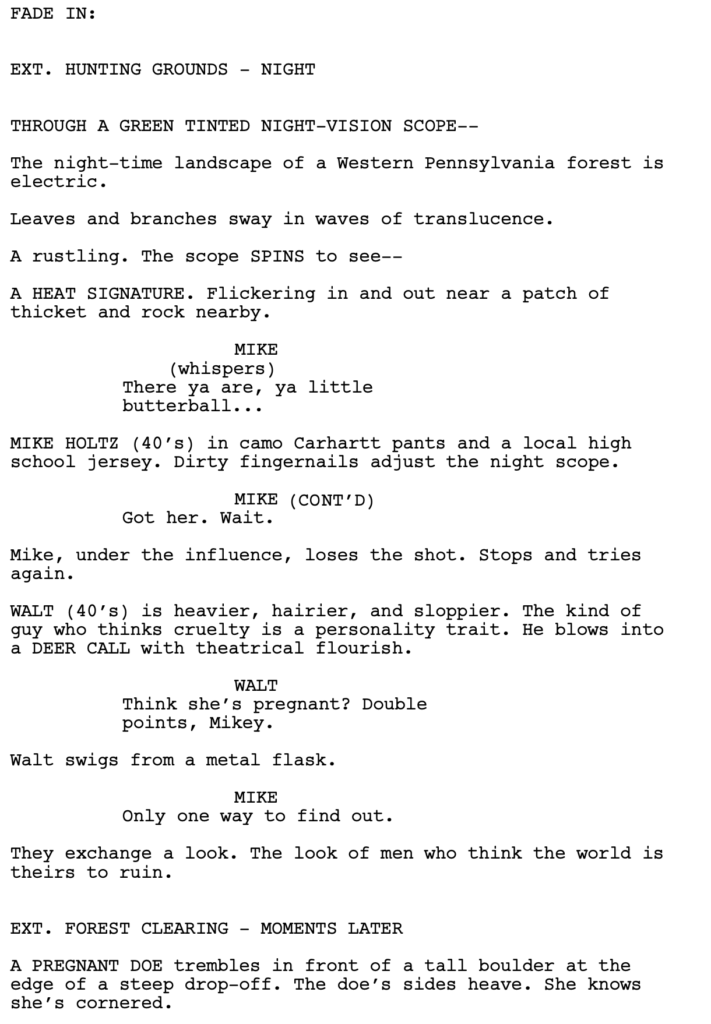
Title: Cornelius
Genre: Dark-Comedy
Logline: When his criminal mother returns after a decade, a timid teenage dishwasher who competes as an underground mascot fighter must choose between the biological mother who abandoned him and the controlling, delusional bar owner who raised him.
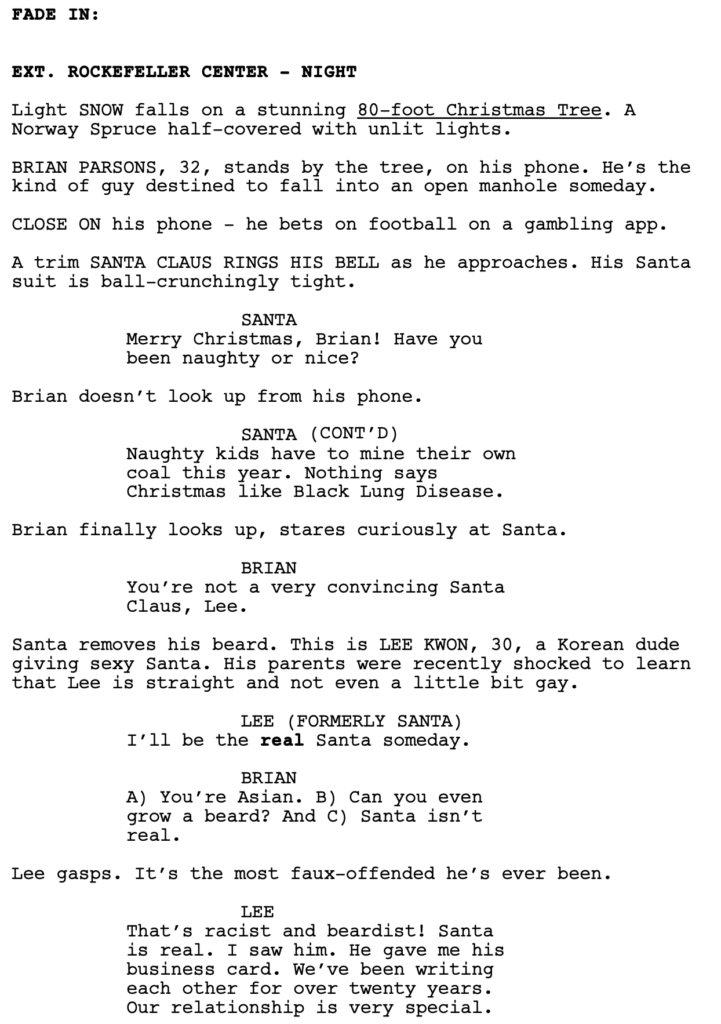
Title: Rockefeller Center Christmas Tree
Genre: Christmas Comedy
Logline: When the Rockefeller Center Christmas Tree burns to a crisp, a ragtag group of misfit landscapers band together to find a replacement before the official tree lighting ceremony. It goes badly.
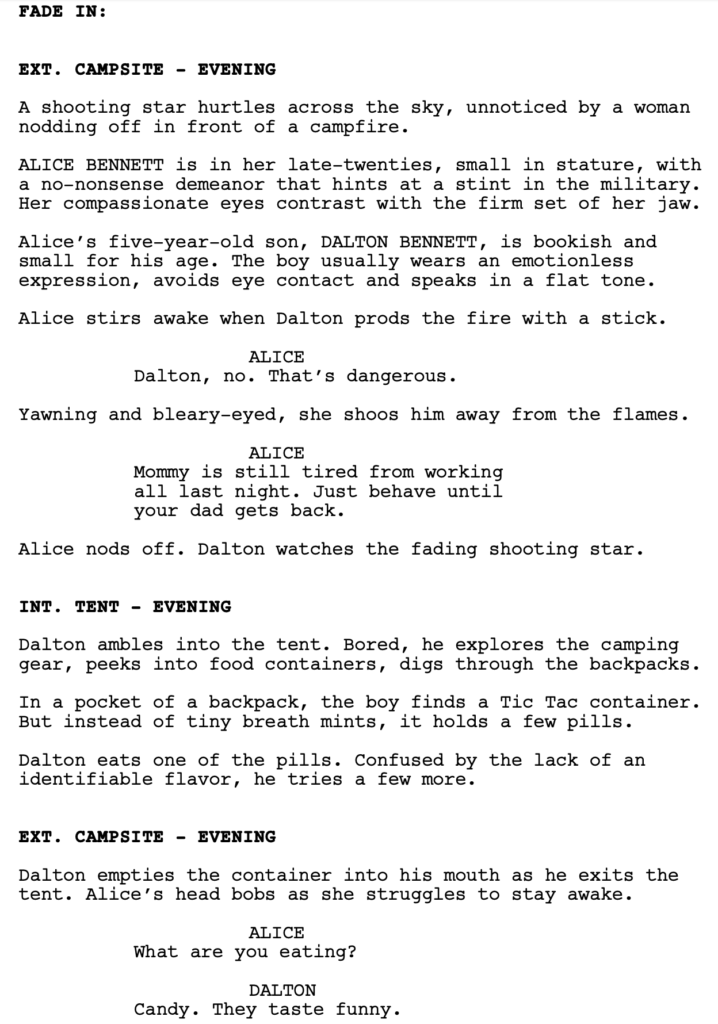
Title: Invasive
Genre: Horror
Logline: Held hostage in a garage, a traumatized medic must perform an improvised autopsy on a dead soldier to learn how to defeat an alien invasion.
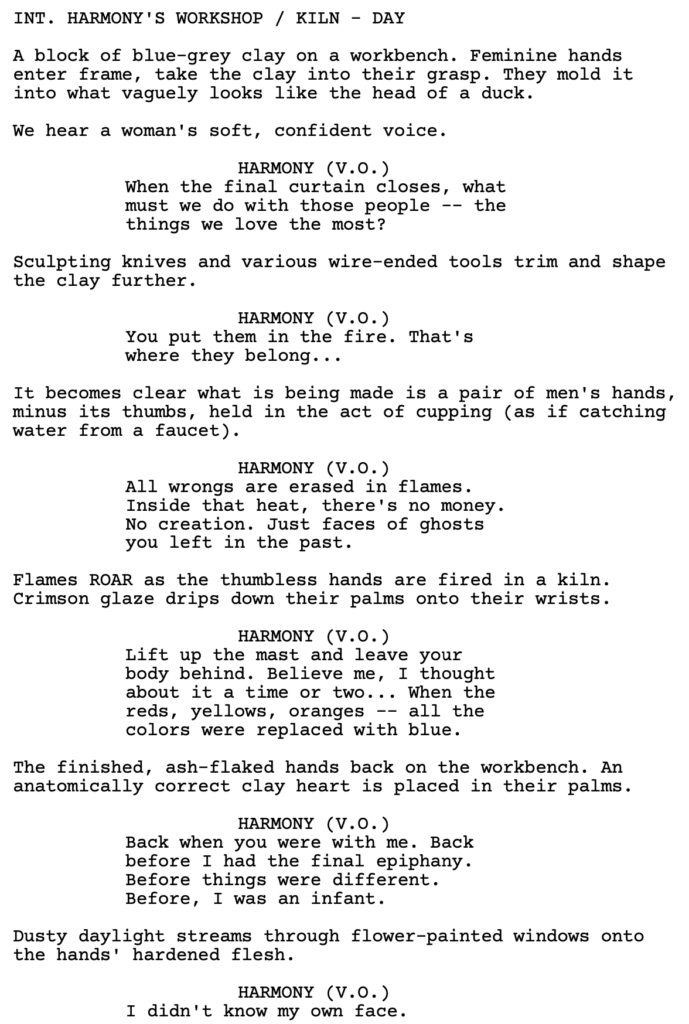
Title: Gratuity
Genre: Drama/Thriller
Logline: The tranquility of autumn in small-town North Carolina is broken when a sculptor’s hardheaded husband fails to tip a handy waiter, leading to dire consequences.
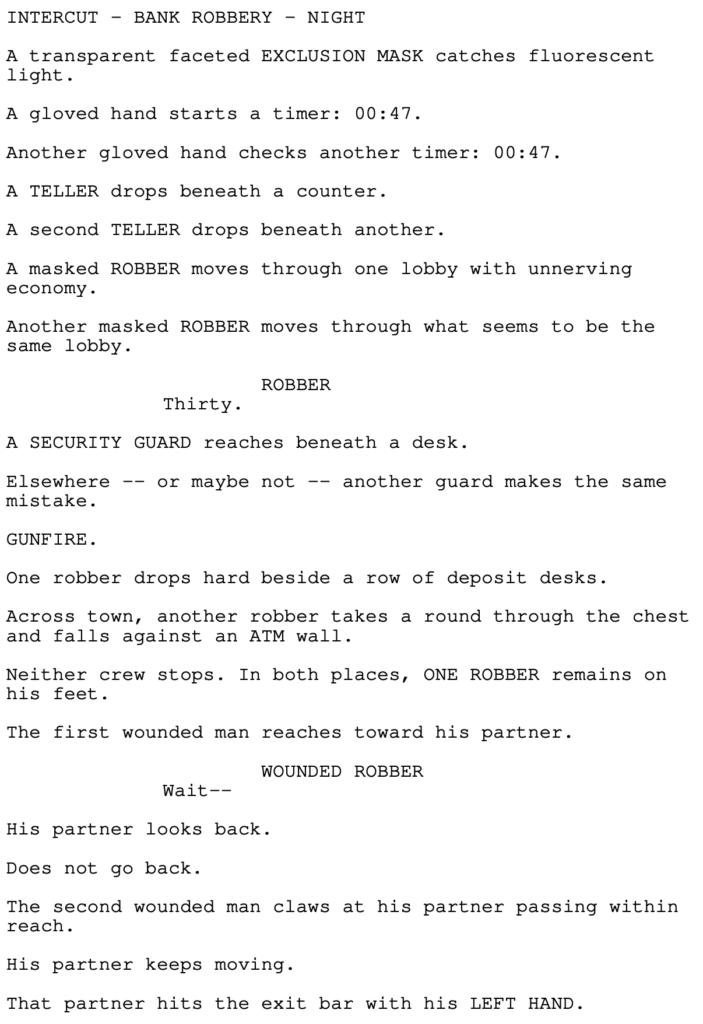
Title: Made Men
Genre: Crime / Heist Thriller
Logline: Four professional thieves with the same face discover they are disposable human reconstructions created to bankroll the original man. To escape his cycle, they must outthink the one criminal who knows every move they were built to make.
Today’s script SCREAMS “movie.” Will its delicious setup deliver??
Genre: Horror
Premise: When an Arctic research vessel becomes stranded after retrieving a mysterious egg, a timid deckhand must overcome her fear and lead the crew against the ancient creature, tracking their every move through the ship itself as it hunts.
About: Last year I did a pitch contest called Blood & Ink where anyone could pitch me horror movie ideas. I accepted the best 100 of those ideas. The writers then wrote those scripts. Ever since, I’ve been reviewing them on the site, looking for the best one. Already, one script, Wildman, written by Jacob Rainer, sold!
Writer: Erica Benedikty
Details: 114 page
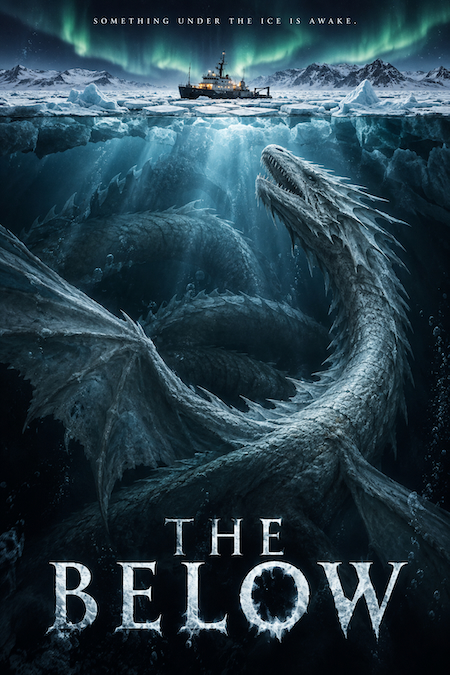
Okay, this is the FINAL Blood & Ink entry I’m reviewing on the site. Combined with the ones I’ve been reading privately, I’ve read almost all of them. If I have not reviewed your Blood & Ink script on the site and you’re curious what I thought, feel free to e-mail me at carsonreeves1@gmail.com.
The reason this one makes the site for a review is because it’s a really solid movie idea. Anything out in the middle of nowhere where getting help is impossible combined with a supernatural element is a great starting point for a screenplay because the poster shows up in your head immediately.
The question I always have going into these scripts is, “Yeah but are you going to give me the generic version that I could’ve written myself or are you going to give me something that I wasn’t expecting, that feels fresh, that surprises me in some way?” Well, we’re going to find out!
Somewhere in the ninth-century arctic, a bunch of vikings discover that stealing an ice dragon’s egg comes with a strict return policy. A winged creature lands on their longship and sends the whole operation to the bottom of the ocean.
Cut to the present, where research vessel, Northwind, discovers an abandoned trawler. Captain Jessup wants to check for survivors. But Lieutenant Chen, the resident military a-hole, would prefer that everyone recognize an obvious horror-movie setup when they see it.
Jessup wins, and the boarding party finds a nearly dead man clutching a mysterious chest. He warns them not to open it. Naturally, this leads to them bringing it onboard. Scientist Erin Gordan becomes fascinated with the chest, which contains an ice dragon egg. The trawler survivor dies but briefly revives long enough to shoot the chest, before collapsing again. Meanwhile, something enormous damages the Northwind’s thruster, trapping the ship in ice.
An underwater investigation reveals that sunken Viking longship we saw in the cold open. Their diver is killed, their underwater robot is destroyed, and a hungry hatchling starts making its way through the ship’s personnel.
Erin, meanwhile, keeps getting colder, stranger, and more protective of whatever they’ve brought aboard. Our intuitive deckhand, Rowan, begins figuring out that whatever they’ve found responds to heat and energy. Unfortunately, getting Chen to listen to her is harder than finding free parking in Beverly Hills. Sorry, bringing in a bit of my personal life here.
After Jessup is dragged overboard, Chen tries trapping the creature with liquid nitrogen. But fighting an ancient ice dragon with anything goes about as well as you’d expect. Rowan proposes an electrical attack using a Tesla coil, a harpoon, and the storm’s lightning. The resulting showdown kills more crew members and helps finish off the ship.
Erin’s transformation suggests that she has become, or merged with, the mother dragon. Rowan and a crewmate escape in a raft. The mother approaches but spares them after detecting that Rowan is with child (get pregnant kids! It pays off!). The end.
I really like the setup here. A research ship is trapped in the arctic with an ice dragon lurking beneath it. That’s a movie. The Viking opening gives us an immediate sense of dread, and bringing the egg aboard births some delicious dramatic irony into the mix where we know the characters have made a terrible decision before they do.
But the question that kept bothering me throughout The Below was, who the heck is our main character??
We meet so many people that I never knew who I was supposed to latch onto. Erin gets the mysterious scientist treatment. Jessup makes the big decisions. Chen dominates the arguments. Rowan gradually becomes more important. But there’s no clear handoff telling me, “This is your person. Experience the movie through them.”
You can write an ensemble without an obvious protagonist. The original Alien lets Ripley emerge from its ensemble, which I’m guessing was Erica’s inspiration. But that approach demands unusually strong control over character differentiation. If you don’t have that, an anchor is pivotal.
We do get some early information on Rowan. She’s throwing up a lot. She likes to doodle tesla coils. But the opportunity to make her a character that stood out was lost. On page 80, we learn she has a PhD in electrical engineering and all I was thinking was, this info needs to be set up a lot earlier, along with everything else about Rowan.
Look at Ripley in Aliens. Before we meet the larger ensemble, we know she’s traumatized, disbelieved, and fighting to make people understand what happened. Her experience makes her the person we trust when the danger arrives. We’re attached before the movie starts spreading our attention around.
The only real character who stood out early in this bunch was Chen. And the reason is, we continue to broadcast who he is through what he says and does beyond his introduction. When somebody wants to board the derelict ship, he objects. When something strange happens, he wants containment. When Rowan offers an explanation, he challenges her. Even when his decisions are wrong, they’re recognizably his decisions.
That’s how you establish a character. You don’t put “nervous but brilliant” in their character intro and assume the reader will carry that information around for you for the next hundred pages. You dramatize those qualities repeatedly.
There are some attempts to do this elsewhere. Matt talks about his fiance. Lukas steals and wants to sell things. Alexei has his old music. But too often this stuff feels like accessorizing rather than building real people from the ground up who keep reminding us who they are every time they enter a room.
I’ve found that writers resist obvious archetypes because they think it’s hacky. But with a large ensemble, those clear archetypes are exactly what help us tell everyone apart. Star Wars was built on The Hero’s Journey. The farm boy, the princess, the cocky smuggler, the wise mentor. You immediately have somewhere to file each person. And by the way, that doesn’t mean you can’t deepen these people as the story goes on. But it’s important in ensemble screenplays to give the reader that official filing cabinet. Here, too many people occupied the same category (crew member concerned about the weird thing).
Often, I’ll realize what’s wrong about a script when the writer does something right. Erin and Rowan have a thoughtful talk on page 55. Rowan admits she worries about saying the wrong thing and making everyone wonder why she’s there. Erin recognizes that feeling. We finally get something beyond the current ship problem. There’s vulnerability, a connection, and a reason to understand Rowan’s hesitation when she has something to say.
But why is this conversation happening well after my concentration has been divided by a dozen different characters and I’ve half-given-up attempting to understand who everyone is? If a conversation like this happened much earlier, it would’ve helped me understand these two a lot better.
Which brings me to something I want every writer in the High Concept Club to know. A big concept does not mean your screenplay should become plot, plot, plot, plot, plot. You need early scenes that build strong characters we care about. Otherwise, all of the danger you unleash on us is happening to strangers.
And no, that doesn’t mean stopping the movie so two characters can explain their childhood over strawberry matcha.
Ideally, the scene is entertaining and dramatic while establishing the character (or characters).
The Social Network’s opening is a great example of how to do this half-well. In that opening breakup scene, Mark Zuckerberg’s intelligence comes through, as does his status obsession, his condescension, his insecurity, and his inability to recognize what his girlfriend is actually saying. He can process information at an amazing speed and still be completely lost in basic human matters. The breakup also triggers his angry blogging and Facemash idea.
We know who Mark Zuckerberg is after that scene. So we can go into the movie with a full understanding of who we’re dealing with. With that said, the scene was 90% character setup and 10% entertainment. A good writer can give you a scene with 50% character setup and 50% entertainment.
Enter Aliens.
Ripley faces an inquiry about the destruction of the ship she was on in the first movie. Her credibility and livelihood are on the line. She’s trying to defend her actions while convincing people that the creature she encountered was real. They suspend her flight license and place her under psychiatric monitoring. We learn she’s a fighter because we watch her fight in a scene with an immediate objective and consequences.
50% character setup (we know exactly who Ripley is after that scene). And 50% entertainment (we’re emotionally charged as we see these assholes trying to destroy this woman’s life who we know is being truthful).
That’s what I wanted for Rowan. Give her an early situation where her technical ability matters, but her fear of being dismissed makes asserting herself difficult. Now you’re establishing the woman and the problem she needs to overcome while something is actually happening. And the more entertaining the “happening” is, the better.
The other major issue was the second act. There’s plenty of activity but too much of it feels like variations of the same beat. Someone notices frost. Someone hears a noise. Someone studies a reading. Erin touches the glass.
People do die. The underwater sequence is one of the better scenes in the script. But because of what I laid out above – that I’m not attached to these people since I don’t know them that well and I can’t even identify their archetype – the deaths don’t hit as hard as they should.
Aliens takes time setting up its story as well. But we get to the insanity pretty quickly once we’re into that second act and in the moon base.
Here, I kept feeling like I was being told, “Hang on. The dragon is coming.” With a premise this cool, I want the dragon to shape the middle of the movie more aggressively. I just felt like we were dealing with the “65” version of this story rather than the “Jurassic Park” version.
The final act does deliver the fireworks. But a big finish rarely retroactively saves a limp second act. That’s not to say Erica didn’t take some swings. Erin has a weird storyline that some readers might be into. But when I hear “dragon movie,” I don’t personally want characters psychically connecting with dragons. I felt like this movie needed to deliver more on the promise of its big juicy premise.
Script link: The Below
[ ] What the hell did I just read?
[x] wasn’t for me
[ ] worth the read
[ ] impressive
[ ] genius
What I learned: I know I say it all the time but I’m going to say it again anyway. Do the work to figure out “what is at the core of my character that I want people to know.” And then set that up AS SOON AS POSSIBLE in your script. That’s why Ripley rocked. Cause James Cameron used that exact equation to build her. Not nearly enough time was put into that equation in The Below for, not just a main character, but for the main five.
Also, is the wokest movie of the year also its best??
A question I get asked a lot, especially by people who aren’t in the movie business, is “Why did they make that movie?” Something completely awful was financed, produced, and ended up in theaters and people rightly have no clue how it happened.
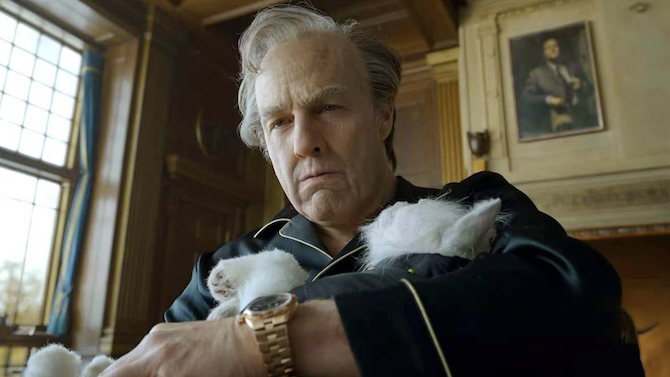
I don’t think there’s a better example of that in the past five years than Digger. Digger cost 180 million dollars to make. And it’s a satire. Why do I point out the genre? Because .000000000001% of America will pay to see satires. Whatever the opposite of making money is, producing a satire is that.
So, I’m going to tell you how Hollywood works. Because once you understand what’s really going on here, you’ll realize why this was made.
So, Warner Brothers wanted Tom Cruise in the WB fold. They want to start making movies with him. Pull him into their orbit. The number one way to get a movie star into your studio is to fund a big Oscar bait vanity project. In other words, they knew they were going to lose money on this. But if Cruise is now going to make half-a-dozen four quadrant movies with them, losing money on Digger was worth it.
And that’s why we have Digger. Which is ironic because Paramount, where Cruise currently resides, just bought Warner Brothers. So, they would’ve had him anyway.
I don’t know if Digger is any good. I know I’ll never watch it. I know it’s inspired by Dr. Strangelove, the most overhyped movie ever. I know this director made this movie more for himself than for audiences. And I know Cruise made it more to win an award than to entertain people. And guess what? Audiences can smell that shit a mile away. They know you didn’t make the movie for them. So they don’t show up.
I don’t think audiences were wrong to avoid this movie.
But there’s a different movie I think they’re deadly wrong to have avoided. Although I understand why they did.
This movie is woke-coded. I know that word triggers people but there really isn’t a better way of saying it. You see the trailer and it’s playing to a very specific audience, likely because they started putting this film together before the woke backlash began.
And while I’m usually the first on the eye-rolling list when a woke message film arrives in cinemas, you guys told me this movie was awesome and I listened. I went into it knowing absolutely nothing.
I’m talking about Forgotten Island. Which, unfortunately, seems to have already been forgotten. Hey, maybe we can work that into the advertising campaign!
So, why did this woke film work while so many others didn’t? The answer is so simple, it’s almost embarrassing that all these other films overlooked it. Forgotten Island ALWAYS PUTS THE STORY FIRST.
It really is as simple as that. You can put whatever messaging you want in your film. Liberal. Conservative. But if it’s the priority over the story, audiences will ALWAYS reject it. Because audiences aren’t dumb. They can tell what you’re trying to do.
Forgotten Island is awesome because it ALWAYS puts the movie first.
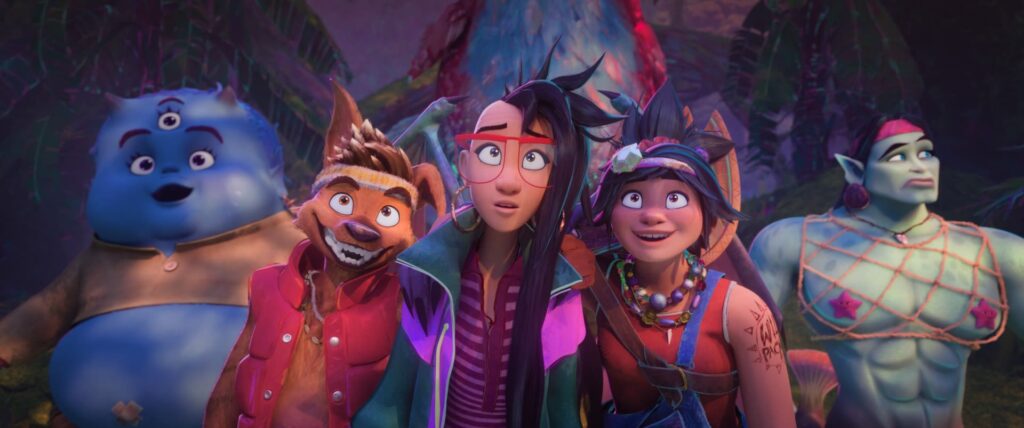
The story takes place in the Philippines and follows Jo and Raissa, two girls who become best friends in grade school. Jo is the wild one. Give her a bag of flaming hot Cheetos, a case of illegal energy drinks, and a bag of fireworks, and she’ll give you the best night of your life. She lives with her grandmother while waiting for her father to bring her to America.
That day never comes.
Raissa is the smart one. She’s got the academic future. Meanwhile, Jo’s more interested in whatever adventure they can get into that afternoon. We watch them grow up together, creating memories, which they commemorate with little charms on matching bracelets. Every new experience gets its own little item. Eventually, they’re carrying their entire friendship around on their wrists.
But after high school, Raissa announces that she’s going to Caltech in America. For her, it’s the necessary next step. Flaming Hot Fireworks Nights only get you so far in life. For Jo, it’s the end of her life as she knows it. This is her other half. And she’s about to lose her forever.
On their final night together, they find a magical sand dollar that opens a portal to Nakali, the mysterious island Jo’s grandmother used to tell them about in stories. They go through it, and this is where the movie makes a choice I was not expecting.
It turns into The Hangover. They wake up after what appears to have been the craziest night of their lives, and neither of them remembers what happened (hence: Forgotten Island). They’ve lost the sand dollar, aka their ticket home. So now they have to retrace their steps across the insane island, figure out what happened, and find the thing before Raissa misses her flight to America the next morning.
Along the way, they collect this assortment of bizarre companions while dealing with a terrifying witch-type creature called the Manananggal. And when I say bizarre, I mean BIZARRE. There’s a devil baby. There’s a self-obsessed merman. There’s a giant parrot-looking creature. There are beings in this movie that I don’t even know how to describe.
This isn’t your standard animated adventure where you meet a talking rabbit, a talking reindeer, then a slightly larger talking rabbit. The creatures draw from Filipino folklore, which gives the movie a whole collection of things that make you feel like you took acid, ketamine, and ayahuasca all at once. That results in a both wonderful and maddening experience.
But the reason why I wanted to talk about this movie today is because it has a killer screenwriting lesson embedded in it. Which is: If you get your audience on board with your characters early, it will pay insane dividends for the rest of the screenplay.
Forgotten Island does this in its opening stretch and should be studied by all screenwriters for how to execute the process of making the reader fall in love with your heroes.
It shows Jo and Raissa meet and then we watch their friendship develop over the years. It was clearly inspired by the first ten minutes of Up. You see the fun. You see the adventures. You see all the shared experiences. But you also see the pain. Which is important. If you’re writing one of these montages, you can’t just give us the peaks. You need the valleys as well. We see Jo lose her grandmother. We see what it means to have someone beside you when the person who raised you is gone.
By the time this opening is over, you feel like you’ve grown up with these girls. Which means you’re ready to go anywhere with them. That includes an insane island full of crazy creatures, many of which make you feel like you’re losing your mind.
When you establish your main characters like this, it allows you to make tons of mistakes throughout the script and the reader will keep forgiving you. You can make an occasional cliché choice. You can get a little clumsy with your plot. You can introduce a few annoying secondary characters, which this movie definitely does.
But we’re already invested in the people taking us through it so none of this hurts the story. That’s why Forgotten Island can throw a devil baby into the mix and I’m still going with it. Jo and Raissa are the core. I’m following THEM because I grew up with and fell in love with them.
Now, I know somebody’s going to read this and say, “Great advice, Carson. Just write amazing characters. Why didn’t I think of that?”
I’m not saying it’s easy. I’m just saying that the writers who sit down before writing a script and think, “How do I want my characters, my main characters, to be seen by the audience? What do I want them to think of my main character? And then what can I do to get them to think that? What kind of scenes can I write? What kind of situations can I put them into that will create that feeling that I want the reader to have?”
If you are having those discussions with yourself, you are on your way to doing what today’s writers achieved. Because they clearly had those discussions then went out and executed. It all starts with a plan. Creating characters and how you introduce those characters and what you show us in the first few scenes that those characters have has an insane influence on the reader and their interest in the screenplay.
And like I said, it helps you when you make those inevitable bad creative choices. Nobody’s going to write a perfect screenplay. We’re all going to do something that doesn’t work at some point in our script. My favorite screenplay ever is Back to the Future and I absolutely HATE the scene when Marty dresses up like Darth Vader to convince his father to execute his plan. It’s cheap. It’s lazy. It’s the only scene that feels like nobody put any thought into it.
But it doesn’t matter because we love Marty and his dad so much so we overlook it.
Here, the plot is pretty wonky if you think about it. They get to this island and the second they get there, they’re trying to get off of it. An island they’ve been hoping to find their entire lives. So that plot point doesn’t work. And I’m not convinced that the Hangover plotline was the best choice either. It provides plenty of GSU. But it feels weird that instead of experiencing the island along with them when they get there, we’re told that experience is already over.
I will say that all of this is paid off in a really strong way later on. But that doesn’t take away the feeling you have in the moment of arriving on this island and learning that we weren’t even with our characters for the first ten hours they were there.
But the point is, the character setups were so strong that I went with it. And I guarantee you, if those setups had been weak, I would’ve been out the second the two woke up on the island. That’s the power of prioritizing your character setups.
And I love how they pay it all off. Underneath all the weird creatures and crazy imagery is a very simple fear: What happens when the person who’s been your whole world moves on?
Jo wants to hang out and party forever. Raissa wants to take the next step in life. And neither of them knows exactly how to do that without losing what they have. That’s a movie. You can put as many insane creatures around it as you want because the thing at the center is something we understand and care about.
So, of the two big movies that bombed these past two weekends, stay the hell away from the pretentious satire and fully embrace the woke animated film. It may just be a Top 5 film of the year.
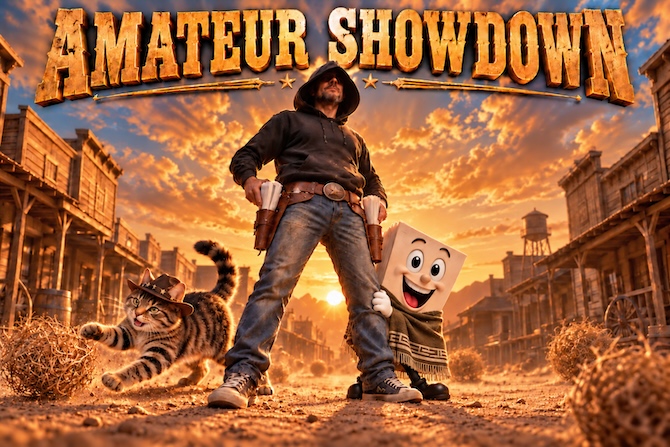
Got a screenplay nobody wants to read? This is your chance! Send me that script NOW and you may find yourself competing in the coolest rootin-tootin screenplay challenge on the internet!
Yo! What do you say we spice things up around here?
Things have been a little slow lately but it’s nothing that a little dancing can’t solve. Let’s get crazy. Let’s get naked. Let’s bring back a fan favorite.
YES! IT’S TIME FOR ANOTHER SCRIPTSHADOW AMATEUR SHOWDOWN!
It’s been a while since we’ve done one of these and I’m curious what you guys have been working on. Especially all the new blood! I’ve been getting a lot of emails from people who’ve discovered the site over the last couple of months. Well, now’s your chance to show us what you’ve got.
For those of you who are new, here’s how it works.
You send me your title, genre, logline, and a PDF of your screenplay. I’ll look through the submissions and pick the five that sound the best. Those five scripts will go up on the site next Friday morning.
Then, all weekend long, Friday, Saturday, and Sunday, the readers will check out the contenders and vote for their favorite. Whichever script gets the most votes gets a review on Scriptshadow the very next week.
That’s right. No waiting six months to find out whether you’ve advanced to the semifinals of the preliminary quarterfinals. Win the weekend, get your review the next week. And as we’ve seen, a Scriptshadow review can quickly turn into a screenplay sale.
You can start sending your entries in RIGHT NOW. Here’s what to send:
To: carsonreeves3@gmail.com
Subject line: Amateur Showdown
In the body of the email:
Title
Genre
Logline
Attach a PDF of your screenplay
(I don’t know if I’m going to allow posters yet but feel free to send one just in case)
And one little suggestion. I wouldn’t send a script you’ve already submitted to me that never got featured. There’s probably a reason I didn’t pick it. Give me something new. Give me that fresh screenplay blood so I can suck on it.
Okay, that sounded a little weird. Hey, cut me some slack. I just read a script about AI vampires.
The great thing about Amateur Showdown is that there are no restrictions. Got a weird script nobody will give the time of day? Send it. Got a big fancy blockbuster? Send it. Got a coming-of-age script that everyone keeps telling you isn’t marketable? Send it!
Just remember that the readers are voting, and they usually gravitate toward the idea that sounds like the most interesting movie. The one they’d actually want to see. So keep that in mind when choosing your script. And make sure that logline is doing its job!
Let’s find a great script, guys.
Get to it!
