
Seven meets Weapons meets Pluribus?
Genre: Serial Killer/Sci-Fi
Premise: An LA detective begins to suspect that a series of murders and suicides is tied to a group that’s figured out how to jump into another person’s body.
About: This spec sold to BoulderLight Pictures, the coolest hippest production company in town. They’re the Zach Cregger adjacent outfit. They produced both Barbarian and one of my favorite movies from last year, Companion. The buzzy sci-fi tale comes from someone who worked with the buzzy sci-fi guru himself, J.J. Abrams.
Writer: Isaac Louis García
Details: 110 pages
 Chris Pine for Detective Harry?
I come across these “switching through a lot of bodies” concepts a couple of times a year. And, in every third script or so, the idea is mixed in with a serial killer premise. So I’m not unfamiliar with this setup. However, today’s writer reminds us that if no one has cracked a cool idea yet, why not take another shot at it and crack it yourself?
LA detective Harry Roth is barely keeping his head above water. A young girl has vanished without a trace. Her last known contact was an LA sleazeball named Melvin Ray, who soon after disappears himself. Digging deeper, Harry uncovers a chain of unsettling connections: Melvin was involved with a woman named Claire Kim, who later takes her own life. Claire, in turn, had ties to a UCLA scientist, Jonathan Laib. He also ends up dead by apparent suicide.
Now Harry’s attention has turned to Laib’s colleague, Genevieve Black. And with every new link in the chain, the pattern becomes harder to ignore.
Harry begins to suspect something impossible. He believes someone is transferring their consciousness from body to body. The real challenge isn’t just solving the case, but convincing his no-nonsense boss, Captain James Rhee, that any of this is real. Rhee is deeply skeptical, but even he can’t deny that the evidence points to something abnormal. Reluctantly, he gives Harry room to keep digging.
All of this unfolds against the backdrop of Harry’s strained home life. He’s married to Celine, whose adult daughter Lucy still lives with them. Lucy makes money through strange internet side hustles, including selling abstract audio recordings to an OnlyFans-like audience. She resents Harry for inserting himself into her family and makes sure he feels unwelcome at every turn.
Eventually, Harry traces the mystery to a man named Dreux, who once worked for a reclusive scientist named Isaac Gamin Astor. Astor developed a technology based on an auditory trigger that allows a person’s consciousness to jump into another body. At first, the two exploit the invention in simple ways. They hop bodies, empty bank accounts, then move on.
But Astor’s ambitions have grown far more extreme. He envisions a world where identity itself dissolves. Where everyone becomes everyone else.
Harry has no idea how close he is to the truth until his pursuit goes disastrously wrong. His own body is hijacked, and he wakes up trapped inside a little girl’s body. With time running out, Harry must find a way back and stop Astor before the technology is unleashed on the world. Whether he can pull it off… remains to be seen.
I’ve been on the lookout for a supernatural “Seven” for a long time. This script is it.
How did that movie separate itself?
What made Seven stand out wasn’t the plot mechanics. It was the detail. The lived-in quality of the world. The way the rain felt like it had a personality of its own. The script lingered in places most screenwriters would rush past without a second thought.
There were moments that seemed insignificant on paper but carried real weight because of how specifically they were rendered. A cop alone in his office. Sitting. Thinking. Not advancing the plot. Just existing. Those pauses gave the story texture. They made the world feel inhabited rather than assembled.
It felt like the kind of script that could only come from someone with time. A writer who wasn’t under contract, wasn’t racing a deadline, and didn’t feel pressure to be efficient on every page. Someone willing to let scenes breathe, to follow their curiosity, to stay with a moment a little longer than necessary.
That’s one of the underrated advantages of being a nobody screenwriter with zero deadlines. You can let your mind wander and put it on the page. And when you do, the script starts to feel less like a delivery system for plot and more like a place you can actually live in. That’s what separates something like Seven from the average script.
The character of Lucy is a good example of that same approach in Cut Outs. She’s an adult still living in her mother’s house, burrowed away in a dark, cluttered bedroom, perpetually online. Her world is narrow but deep. She’s gone far into the strange, specific corners of internet life, the kind of depths you only reach when you spend an enormous amount of time doing nothing else.
That level of specificity feels observed. It’s the sort of detail that comes from lingering on a character long enough to understand how they actually live, not just what role they serve in the story. Those small, slightly uncomfortable details help a script stand out.
Or, to put it in plain speak: This writer actually put in real effort.
Most writers put in 60-70% effort. The good ones will get to 80%. The great ones are between 90 and 100. Just like great athletes who leave it all on the field, great writers leave it all on the page. If you asked them to improve anything, they’d say, “I can’t. This is the best I can do.” That’s the feeling I got when I read this script.
I want to draw attention to a very brief moment early on where, once I read it, I knew this would be the first “worth the read” or better script on the site in a long time. Harry’s talking to Captain Rhee. He’s describing the habits of Claire who, according to her boyfriend, began acting strange all of a sudden. He says he noticed a change in her habits. She had been a bubbly, young, creative type. A late riser. Medicated. A little slovenly. But open, always open with him. Then suddenly she starts getting up at the crack of dawn and leaving the apartment before he’s awake.
This is the exchange that follows. Rhee asks, “What kind of meds she on?” Harry replies, “It’s in the dossier. Nothing relevant.” Rhee asks, “She change her medication at all?” Harry says, “I don’t know.” Rhee responds, “Go on.”
99.9% of readers will breeze right past this. But to me, it signals a writer who’s stronger than most. Here’s why. Most writers treat a screenplay as a stack of pages they need to fill in order to get their story down. When you think that way, you only focus on your objective as the writer. You aren’t thinking about the characters as living people.
The scene becomes: what do I need to accomplish here to move the story forward? And once you start thinking like that, the scene loses life. You cannot write real life if you are only trying to achieve your own objectives. Real life is full of friction. Of interruptions. Of resistance. Of people pushing back when you least expect it.
A good screenwriter understands that Rhee is in this scene too. And if you put another character in a scene, they are not there to be decorative. They have their own goals. Their own pressures. Their own motivations. Rhee’s job is to evaluate whether this theory deserves police resources in a city that barely has enough to go around. Letting Harry run with a hunch means pulling him away from some other problem that also needs attention.
Most writers would have had Rhee go silent after Harry lays out the theory. To them, the exposition about Claire is the whole point. Letting Rhee talk gets in the way of that. So they might have instead had him say, “Go on,” or “I see.” When Rhee asks what kind of medication she was on, and then follows it with, did she change it at all, that tiny moment reveals a writer who is paying attention to how people actually think and respond. As someone who reads a ton of scripts, I can promise you, that’s rare.
And that commitment to detail is present throughout the entire screenplay. And it takes what’s already a fun twisty journey into that “Seven”-type universe where LA becomes its own character. I think that’s when you know a writer is really cooking. He understands that the very environment itself is its own character.
So, does it get an “impressive?” Almost! A movie that’s this twisty and weird needs to land the plane. And we do land (and to the writer’s credit, it doesn’t go exactly how you think it will). But it’s a bumpy enough landing that I can’t give it a top grade. I think it’s a really good script though and definitely one of the best scripts I’ve reviewed on the site in a while!
[ ] What the hell did I just read?
[ ] wasn’t for me
[xx] worth the read
[ ] impressive
[ ] genius
What I Learned: One of the simplest ways to add real energy to a dialogue scene is to let another character push back. That tiny bit of resistance creates imbalance, and imbalance is what makes a scene feel alive. If one character is talking about a trip to the store, put someone else in the room who says, “You never go to that store.” The first character fires back, “Okay, well, I went there yesterday.” Nothing major changes. No new plot information is revealed. But the scene suddenly has texture. Any time you let a character talk uninterrupted, the dialogue starts to feel fake. Because, in real life, people don’t just rant on for ages. There’s a give and take. There’s pushback. There’s messiness.
I’M GIVING OUT TWO SETS OF SCREENPLAY NOTES FOR 40% OFF!!! E-MAIL ME AT CARSONREEVES1@GMAIL.COM TO CLAIM ONE – YOUR SCRIPT DOESN’T HAVE TO BE READY YET TO CLAIM THE DEAL!
So, the other day, I was listening to a sports podcast (Pardon My Take for those interested) and they were talking about how an external mouse instantly makes you look more professional. Not better at your job. Just more serious. Put a mouse next to your laptop and people assume you’re working 20 percent harder than you are, even if you’re doing the exact same thing as the trackpad person. It was actually a funny five minute bit.
Afterwards, something hit me. This is the sort of thing that only used to be available in movies. If I wanted a thoughtful funny bit about the minutia of life, I would’ve had to go to the theatre to watch When Marry Met Sally. Or, more recently, The 40 Year Old Virgin. But now, even daily podcasts are giving me the equivalent of what I only used to get in the theater.
I think about stuff like this all the time because I see cinema as being in a war. And, every day, we’re losing ground to the enemy. Unlike other people, though, I’m not Mr. Doom & Gloom. The reason I want to know what we’re up against is because I want to figure out how we fight back. How we regain ground in this war.
And that question boils down to: What can we give people that no other medium can? Or, specific to this site, what can we write about that creates a movie experience that can’t be experienced anywhere else? To be honest, that was one of the big reasons I went all-in on Osculum Infame. And it’s been echoed back to me by everyone who’s come onto the film. This is an experience you will not be able to get ANYWHERE ELSE but in film. Period. End of story. Not even close.
With that said, it’s a shocker of a film. And I don’t want to think that’s the only way to write a script that becomes a movie in the future. I want there to still be versions of movies in the romantic comedy genre, the thriller genre, the supernatural genre, the sci-fi genre, and yes, even the drama genre, that people go and see.
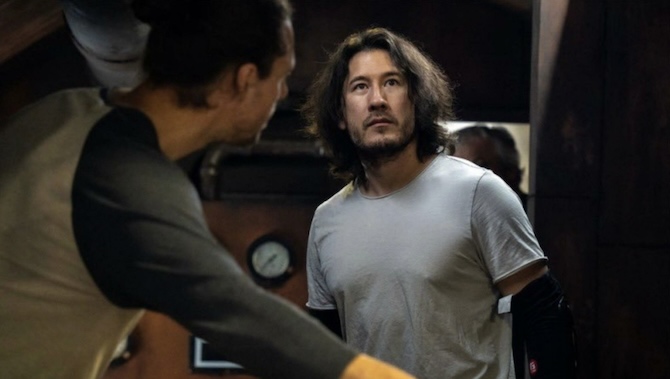
One movie that got people to the theater that no one was expecting was this weekend’s Iron Lung. Iron Lung was written, directed, starred in, and produced by a video game streamer, Markiplier.
The story behind the movie is interesting. Markiplier played this little-known video game years ago about steering a submarine through a sea of blood and thought it would be interesting to turn it into a movie. In the spirit of every smart aspiring filmmaker, he kept costs low by starring in it himself and setting it in one location (the sub).
After finishing the film, no distributor would give him the time of day. He could only get into 60 theaters. So he called on his followers to call every theater they know and demand the movie. The campaign worked. He was eventually able to get a wide release (3000 theaters) and finish with the highest per-theater average of the weekend, finishing number 2 overall, with 18 million dollars.
It’s a true do-it-yourself triumph.
But what does it say about screenwriting?
A couple of things actually. One thing I’ve always said is that there are TONS – we are talking TONS – of overlooked IP in the book, comic book, and video game space. If you had a cool take on one of these IP, the rights would cost you NOTHING. And now you’re working with something that’s already been proven and that provides a little more cachet whenever you’re pitching up the Hollywood ladder.
Clearly, the weird moodiness of this unique video game made Markiplier believe it would strike a chord with audiences. And he was right! It did.
Also, this is another reminder that when you film your own script, you skip the line. I mean, if we’re being one-hundred here, this movie looks awful. It looks like your typical “stuck in a room and goes crazy” narrative, which are essentially impossible to do well past the 20 minute mark. Even when Hollywood puts its biggest stars and highest production value into them (Solaris 2002), they’re horrible. So, I’m guessing this is a much worse version of that.
But that’s actually more inspiring than you think. Cause you guys actually know how to write! I would be shocked if Markiplier has spent more than 30 hours on screenwriting in his entire life. And that’s including writing this script!
If you could write a GOOD version of a contained thriller that’s cheap to produce, and then somehow found a way to make it? Then you’ve just made an actual good movie while all the other writers who used to be on the same level as you are still holding their hands out waiting to be given permission to step forward.
But if you’d rather stab yourself a thousand times in the eyes with an ink-tip pen than direct a feature film, I got good news for you. Send Help, about a boss who crash lands on a deserted island with his psycho assistant, won the weekend box office! It took in 20 million dollars. Not only that. It was basically a spec script! And that means, if you had written a script like it, you could’ve sold it.

This script is part of a new subgenre I want to officially title now. I’m calling it an “Expanded Contained Thriller.” What I mean by that is, we’re not constrained to a single room (Iron Lung) or a single indoor space (10 Cloverfield Lane). We’re still contained (in this case, we’re on an island) but the area is larger and gives us more to play with.
The downside to a Send Help is that it’s definitely going to cost more to make than an Iron Lung or an Osculum Infame. So that’s the risk. You’re going from a 3-5 million dollar movie to a 15-25 million dollar movie. And less production houses can afford that kind of cap hit. But, it’s still a better strategic option than writing a 100 million dollar sci-fi script.
Want more good news? Between Send Help, Mercy, The Housemaid, and Shelter (Jason Statham pic), you’ve got four movies that either were, or which could’ve easily been, spec screenplays. Throw Primate in there as well. In other words, there are opportunities for writers to sell their scripts and get them turned into films. I just gave you proof!
BUT! Notice how sexy all of those pitches are. Each one of them is a clear “this could be a movie” pitch. You’re not getting to this place with your thematic mood piece about a dying middle-aged couple who try and sell their farm before they kick the bucket.
Back to my original question. What can we give people, as writers, that they can only experience in the world of film? I don’t know the answer to that yet. But I do know this. The margin for error has gotten exponentially slimmer. And Hollywood hasn’t accepted that yet.
They’ve gotten into this state of denial where they’ve cozied up with Rotten Tomatoes and still believe that a 90% Rotten Tomatoes score means you’ve made a good movie. And it’s just not true. I don’t know if it was ever true but it certainly used to be more true.
Audiences are clearly demanding something closer to a transformational experience, and not just something that passes the time. Because there are a million things out there that allow you to pass the time now. Movies are no longer the only game in town.
Which benefits writers who are dedicated to the craft and determined to keep learning and keep getting better.
I will say that, from what I can tell, writing doesn’t seem to be under threat from AI. I’m actually starting to think that the filmmaking space is way more under attack than the writing space. But AI doesn’t seem to know how to elicit emotion or create compelling drama or create affecting characters. So I suspect that as the AI filmmaking world continues to improve, screenwriters will be more and more in demand.
But that’s an article for another time. :)
What did you guys watch this weekend? Anything good?
Writing a slow script that’s actually good is hard. So thank God Scriptshadow is going to show you how to do it, once and for all!

A few weeks ago I reviewed a movie (or was it a script?) that moved at the pace of a continental drift. At the end of the review, I asked if anyone wanted me to write an article explaining how to write a slow-moving story without putting the audience into a coma.
Seven of you responded with some version of, “Yes. Please do that.”
Now, if we apply the universally accepted Equation of Exponentious™, which takes actual online engagement, multiplies it by real-world silent agreement, and divides the result by The Denominator of Audience Inertia (because people never quite say what they mean), we arrive at a very conservative estimate that 18,000 people wanted this article written.
Which means I had no choice.
So here we go.
To accurately diagnose the problem, we need several slow films as reference points. Let’s start with Sentimental Value, which follows a washed-up director attempting to cast his estranged, deeply resentful daughter as the lead in his latest project. Then there’s The Ballad of Wallis Island, about a wealthy man who owns a private island and hires his favorite pop-folk duo, now long since broken up, to perform a concert just for him. Bugonia centers on two unhinged cousins who kidnap the CEO of a local company because they believe she’s an alien. And finally, After the Hunt follows a university professor forced to carefully navigate her relationship with her star student after the student accuses one of the professor’s friends of rape.
I would call all of these films slow.
I think they all work, even if each of them has issues. Still, they are exponentially better than a movie like Train Dreams, which follows a couple where the husband builds train tracks over an endless series of decades.
Now, what I’m about to describe are the tools for getting a slow story right. But not every one of these tools is present in every film I mentioned. So if you’re looking for one of them in After the Hunt and it’s not there, that doesn’t mean the idea is wrong. It means these tools give you the best chance of writing a slow movie that stays engaging. You don’t need to use all of them. But you should use as many as you can.
The real danger with slow moving screenplays is that the margin for error is thinner. Readers are far more likely to give up. You are already asking them for more patience than they are used to giving. Because of that, choosing not to use one of these tools might mean removing the very thing that would have kept your script afloat during a long stretch of quiet.
TOOL 1 – AT LEAST ONE CAPTIVATING CHARACTER
With a slow screenplay, it’s imperative that you have at least one truly captivating character. Faster paced scripts can rely on constant plot turns to keep a reader engaged. A slow story can’t. So you have to make up for that somewhere else.
The upside is that if you absolutely nail the character, you don’t need any other tools. This is where my instruction basically ends. Readers will follow interesting characters anywhere. They’ll follow them straight into the middle of the most boring plots imaginable.
That’s why Joker, with its almost nonexistent narrative, became a breakout hit. Arthur was endlessly interesting. He desperately wanted to be liked. He had a bizarre condition that made him laugh uncontrollably. He was unpredictable. He was the world’s biggest underdog. He was a stand-up comedian. Characters like this become a plot unto themselves, to the point where the narrative almost doesn’t matter.

You see something similar in The Ballad of Wallis Island. Charles, the owner of the island, is a two time lottery winner who lost his wife, lives alone, and is unfailingly kind to everyone he meets. He has an offbeat, often awkward sense of humor, and we’re never quite sure what he’s going to say next. Readers are willing to sit through slow storylines when they get to spend time with characters like this, because hanging out with them feels no different than hanging out with a genuinely unique person in real life.
TOOL 2 – A GOAL
One of the riskiest things you can do as a writer is not tell the reader where your story is going. You send the script off on a road trip with no destination. While there are audiences willing to go on that type of aimless adventure, they are a tiny portion of the movie-watching populace. Generally speaking, readers want to know where they’re headed.
This is where you see some of the examples I used break down. Wallis Island has the clearest goal – play the concert – and, therefore, the most direction. Sentimental Value has a goal (director dad needs to get daughter to play the lead role in his film) but it’s one of the more casually explored goals you’ll see. And it’s eventually abandoned. After the cousins kidnap the CEO in Bugonia, it becomes less and less clear what the goal is (have her admit she’s an alien?). And then with After the Hunt, there is no goal. The movie is literally titled, “After The Hunt.” It’s about the fallout that happens after a sexual assault.
Therefore, if you didn’t like any of these movies, this may have been why. Because you may have been watching them and, somewhere along the way, thought, “What is this about again? What are they trying to do?” But I’ll tell you this. All of them have clearer goals than Train Dreams, which has no goal. And you can see that in its randomness. If anybody had tried to sell Train Dreams as a spec, they would’ve been laughed out of every office in Hollywood.
TOOL 3 – CARROT DANGLING
Because the plot is rarely propelling the story forward in a slow script, you need other tools to keep the reader turning the page. For that reason, the act of carrot-dangling is crucial in slower-moving screenplays. And it’s simple to use, too. You essentially say, “Hey, if you read another 5 pages (or 10 pages, or 20 pages), I’m going to let you have this carrot.” It’s a reward.
Carrot-dangling is a mix of smaller short-term carrot enticing and bigger long-term carrot enticing. One of the most common carrots you can dangle in a script is, “Will they get together?” That’s one of the primary carrots being used in Ballad of Wallis Island. We keep watching, in part, because we’re curious whether former band members Herb and Nell are going to get back together.

But this tool is versatile. You can dangle all sorts of carrots. In After The Hunt, when Maggie tells Alma that Hank raped her, it manifests as an “anticipation carrot” for Maggie’s talk with Hank. We want to hear Hank’s side of it. From the moment the cousins in Bugonia reveal that their plan is to kidnap the CEO, that’s a big fat juicy carrot that will effortlessly take us to the point where they try and do it.
TOOL 4 – SUSPENSE
This is arguably the most powerful tool you have available in your shed. Because suspense has an amazing ability to condense the reader’s perception of time. If we write a meeting scene in a boardroom and tell the reader there’s a bomb under the table and that it’s going to go off at some point, you can literally extend that scene out to 20 pages and it would feel like 3 pages to us. Because we’re anticipating the bomb going off.
Where so many slow scripts go wrong is they never look to add a bomb under the table. And yet they’re perfectly fine with writing that same 20 page boardroom scene. But that’s, ironically, where time distorts in the opposite direction. 20 pages now feels like 40 pages. You should be looking for elements to introduce into the script that signal something destabilizing is coming, and then force the reader to live inside that anticipation. That’s the power of suspense.

In Bugonia, we introduce this electrosis machine that Teddy has built for Michelle to get answers out of her. It sends excessive electricity into the body. The whole sequence leading up to the use of the machine is pure suspense. Once we see the machine, we know what she’s in for. And once he starts using it on her, the suspense continues because we know he has the “max power” option, which could potentially kill her.
TOOL 5 – SCENES WITH GOALS
In most slow-moving screenplays, the narrative is weak. Like Train Dreams. What is that narrative really about? Existing? That’s not a plot. Once you take the fun of a plot away from the reader, you have to make up for it in other places. You do that by making sure the reader’s moment-to-moment experience is engaging.
Therefore, create clear scene goals. Once a character is trying to achieve something, you can put another character in their way, and suddenly the scene has tension. We want to see whether the character overcomes the obstacle and gets what they want. And because someone is actively blocking them, we know they’ll have to rely on cleverness, intelligence, or persistence to succeed. That uncertainty is what keeps us reading.
These goals don’t all have to be gigantic. They can be as simple as a high school kid asking a girl to the school dance. As long as a character has a goal in the scene, you’re creating scenes with more purpose than 75% of the screenwriters out there. Even if you only used this one tool in your slow script, and you executed each scene well, it may be all you need. Because if we’re always entertained in the moment, we’re not as demanding in regards to the overall story.
TOOL 6 – UNRESOLVED
In slow movies, you want to build a series of unresolved elements that pull the audience forward.
Start with your hero’s flaw. If your protagonist is insanely stubborn and lives by the creed, “my way or the highway,” and that trait is actively ruining their life, we want to see how that gets resolved. Now compare that to a protagonist with no real flaws. Why would we keep watching them? They’ve already figured everything out.
Unresolved relationships work in the same way. Two sisters who can’t get along no matter how hard they try, like in the Netflix show Sirens, create an ongoing question that keeps us engaged. We keep watching to find out whether that relationship ever heals.
Unresolved actions matter too. If we know the hero’s dream is to move to Hawaii and he’s been saving toward it for years, we’ll stay with the story to see whether he follows through.
What all this comes down to is that you’re making a series of promises. You’re saying: this character is broken, and if you keep watching, I’ll show you whether he gets fixed or not. You’re saying: these characters are trying to build a time machine (in Safety Not Guaranteed) and if you stick around, I’ll show you whether they succeed or not.
Most writers don’t use enough of these tools. And when that happens, the reader drifts away. That’s why I strongly recommend erring on the side of using too many rather than too few. Rarely will a script feel too engaging. More often, it’s the opposite: too flat, too slow, too putdownable.
These tools aren’t just for slow scripts either. They can be applied to any screenplay. But in a slow-moving story, the stakes are higher. You’re asking your audience for patience, for attention, for a willingness to linger. Using these tools is how you repay that patience.
So think of them as a toolkit. Captivating characters, clear goals, dangling carrots, suspense, scene-level objectives, unresolved threads. Each one is a lever you can pull to keep your audience invested. Use as many as you can, mix them creatively, and be deliberate about where you deploy them.
A slow-moving screenplay shouldn’t be a shot in the dark. It should be a choice. You’re keeping things slow because you like the way a slower pace bakes in the reader’s head. But this choice requires some serious know-how. You can’t stumble into a slow-moving story as an amateur and expect it to work. You need to master these tools if you have a shot. But the good news is, when you *do* master those tools? Your storytelling is literally unstoppable.
Spec sale alert!
Genre: Thriller
Premise: A young teacher gets kidnapped and tossed into a car trunk but when the car finally stops and she gets out, there is nobody around. This begins a year long investigation into what happened to her.
About: This script was part of a heated bidding war won by Searchlight. The writer, William Gillies, has another recent film on his resume: Hollow Road, about parents trying to help their daughter after she hits someone with her car.
Writer: William Gillies
Details: 118 pages
 Nicola Peltz for Val?
I have a lot of confidence in this one. For starters, it’s my kind of concept. I like these character-driven mysteries. It also had 11 production houses bidding on it before selling to Fox Searchlight. And it’s repped by Kaplan Perrone, who has some of the highest standards in the business. I know because whenever I send Aaron one of the scripts I find here, he’s tough!
Val is a school teacher who wakes up in the trunk of a moving car one day. Naturally, she’s terrified. And when the car finally stops, she braces for the worst. But when all she hears is silence, she eventually opens the trunk herself, only to find herself in a Boise, Idaho field. And THERE’S NO ONE IN THE CAR. She was simply… left here.
Val hurries to the nearest road, finds help, gets home, and temporarily moves back in with her Christian Fundamentalist mother. The local cops, lead by female detective, Delgado, can’t find any evidence that this kidnapping actually happened. Frustrated, Val goes back to her life, only to wake up with a man in her room two months later, who drugs her and puts her in the same trunk again. Except this time when she wakes up (again with no one in the car), it’s in a forest in Montana!
Val heads back home and, after talking to Delgado and her partner, decides to go into witness protection and heads to the West Coast. Val starts a life there, however, three months later… she gets kindnapped again! And this time she’s left out in the desert! Hey, at least each kindnapping has a little theme to it!
Val is done playing the victim and moves back home, determined to figure out who’s doing this. Her prime suspect is Elliot Luthe, the twin brother of an old friend of Val’s, who later committed suicide, which Luthe blamed her for. Val thinks he’s on some sort of revenge trip and is fucking with her.
But Delgado isn’t so sure, and starts looking into some traveling salesman dude and his partner. The two were in Boise and Montana at the same times Val was dumped in those states. Val finally gets sick of the nonsense and kidnaps Luthe! She takes him into the middle of nowhere, just like he did to her, and demands answers. Except Luthe swears he doesn’t know what she’s talking about. What happens next puts Val in a position she won’t be able to come back from. So let’s hope she got rid of the right guy.
Noooooooooo!
Why do you destroy my dreams Script Gods!!??
I thought we had a good one here.
I’ll say this about Incidents: It’s different.
And I’m guessing that’s what got it attention.
But this script is very wonky and weird. It starts. It stops. It starts again. It stops again. It builds up its mystery every time it resets, which is a lot. But around the midpoint of the script, I started to get the feeling that the writer didn’t know where he was headed. I didn’t feel like he knew who was doing this. And the ending confirmed that. We get a muddy explanation with no real closure.
Here’s the thing about ambiguous endings. They can work. Even though I don’t like them, I admit there are times where they can work. But this is not one of those times. And it’s explicitly because the mystery at the center of the story is so unique. When you hook us with such a strange mystery, we’re going to want a legit explanation. You absolutely must give us an answer.
Especially with a script THIS LONG that has SO MANY TIME JUMPS. That’s a bigger investment than normal (you’re asking us to start investing in a brand new story every time she moves after a kindnapping). And when the reader really invests, they want a payoff worthy of that investment.
But there’s a bigger issue here and it’s something I haven’t seen for a while. But it used to be quite common in scripts I read. Which is that you can feel the writer trying to figure out the mystery while they’re writing. They’re just as clueless about who did it as you. And that creates a narrative that feels like it’s on roller skates. There’s never a moment where the direction feels solid, like the writer has a plan.
This script also taught me that suspense, as a writing tool, has its limits. I was 100% engaged initially. The use of suspense after that first kidnapping was excellent. Because the circumstances behind the kidnapping were so strange. And we knew that the guy was still out there. That’s what created the suspense. So I’m reading to both figure out the answer to this mystery but also because I know it’s only a matter of time before they come for Val again.
But once we hit the second kidnapping, some sort of “interest switch” turned off. In mysteries, you want your story to evolve. If it doesn’t evolve, then we feel like we’re reading the same beats over and over again. Taking us to a forest as opposed to a field just wasn’t different enough. And now, the suspense that was working so well after the first kindnapping, had its power cut in half. Because not only is the kindnapping identical but now we’re emphasizing that Val isn’t in danger. She’s just being messed with.
And, finally, there’s so much waiting in this script. Val’s endlessly waiting around for the next kidnapping to happen. You guys know how I feel about “waiting around” narratives. They’re the opposite of what movies do well. Movies kick ass when the hero is active and going after things. Val eventually does that. But it takes forever. More than half this movie is Val waiting.
I’m trying to figure out why this got so much attention. I suppose that having such a unique take on the “kidnapping-murder” genre was enough to get studios excited. But I’m surprised they read the whole thing and felt like it was worthy of a big sale. I will say this. It has a very similar vibe to Prisoners, which was also a big spec sale. So, if you liked that script, you may enjoy this one. Especially because both scripts have underwhelming climaxes.
We’re deep in the screenwriting darkness, guys. I have to find a good script soon or I’ll go insane!
[ ] What the hell did I just read?
[x] wasn’t for me
[ ] worth the read
[ ] impressive
[ ] genius
What I learned: If you can come up with a twist on a missing woman story, that’s the equivalent of finding a goldmine in Hollywood. And even though the execution proved problematic here, this was a legitimately unique take on the girl-kidnapped subgenre.
 “Am I, like, getting executed or a root canal?”
You may have glanced at the weekend’s box office, saw that some low-budget Chris Pratt movie miraculously climbed its way to the top of the heap, a la Alex Honnold in Taipei, before going back to your TikTok scrolling.
But if you’re a screenwriter, you should be paying more attention. Because this is great news! A spec screenplay just finished number 1 at the box office. That NEVER happens. So let’s take a closer look at why it did.
It starts by asking a crucial question. What kind of spec screenplay can attract an actor with enough star power to not only get a movie made, but to help push it all the way to number one at the box office?
You need a concept where the main character is featured prominently. And I mean VERY PROMINENTLY. The more prominent, the better. Sure, actors want challenging roles. But you know what they really want? They want to be propped up on a pedestal as THE GUY in a film. You can’t spell “actor” without “ego.”
“Mercy” featured its actor more than any other spec I read in 2024. And when actors see that, they want to be a part of it.
Next, the script had a high concept. There’s a lot of discussion about what exactly “high concept” means. It can be quite unclear. So, let me give you a fun way to measure it. When someone asks you what your script is about, are you unapologetically excited to pitch it to them? If so, you’ve probably got a high concept.
What I’ve realized over the years is that any script grounded in real life, whether it’s a coming-of-age story, a period drama, or a dark comedy, almost always has to be sold with qualifiers.
“It’s about a marriage that slowly dissolves. The husband takes it so hard he ends up losing his job. The wife retreats into this book club because it’s the only real connection she has left.” (pause, noticing the light leave the other person’s eyes) “But it’s really sharp. Like, the scenes are great. And the husband is actually a super interesting character. There’s a lot of tension. It’s not depressing or anything.”
That’s the typical pitch of a non-high-concept idea. You feel like you have to apologize for it when you pitch it.
Contrast that with a pitch like Mercy. “It’s set in the future where accused murderers are put on trial immediately. They have 90 minutes to prove their innocence or they’re executed on the spot.”
That’s the kind of pitch you would not be apologetic in giving.
And finally, you’ve got GSU in spades, baby! You’ve got your goal – PROVE YOUR INNOCENCE. You’ve got your stakes – IF YOU DON’T, YOU DIE. You’ve got your urgency – YOU’VE ONLY GOT 90 MINUTES!
If you have these three things – a giant featured role for an actor, a high concept, and GSU – then you can definitely do what they did here. This formula worked in the 90s and this proves it still works today.
So then wait a minute, Carson. Why is it that the movie got a 20% on Rotten Tomatoes?
Now hold on there, cowboys. I never said anything about the quality of the story. That’s a different skillset entirely. This is a point too many screenwriters miss. If you check all the boxes I just laid out, the bar for execution drops dramatically. Why? Because a studio’s first priority is simple: can we market it? If you hand them something that markets itself, they’ll overlook A TON, mostly because they’re convinced they can fix the script later (even though they never do).
So, yeah, Mercy is a pretty awful screenplay. I read it. It’s bad. But if anything, this should make you thrilled as a screenwriter. It means you don’t have to be perfect to get something made. Just don’t show up with some busted ass boring concept and expect great things.
Moving on.
I saw something quite good this weekend – the new Game of Thrones show, A Knight of the Seven Kingdoms. I wasn’t just wowed by the writing here – which was good. I was wowed by the choice to take a giant property and go small with it. So much so that I realized how valuable the choice was.

In discussing the fall of Star Wars the other day, I was fascinated by the fact that no matter which way they went with their shows/movies, it always seemed to be the wrong direction. And when I watched Knight, it occurred to me that they may have finally found the formula for expanding a giant franchise.
Don’t go bigger. Go smaller.
Now, “go smaller” always sounds great. Especially in cinema nerd circles. A bunch of film dorks get to proudly say they’re doing the opposite of what Hollywood wants. But it’s important to understand what “go smaller” actually means. It means build the story around the characters.
What this does is it forces writers to put everything possible into their characters. Because they know the story isn’t big enough to keep people hooked, especially under the weight of a franchise that’s gone big before.
And when you put all your focus on creating great characters, guess what happens? You suddenly have a much better shot at creating great characters! Funny how that works.
Knight is smart in exactly this way. It knows everything is going to live or die on the characters, so it reaches for the most battle-tested character type in storytelling history: the underdog. But this is Game of Thrones. One underdog isn’t going to cut it. Not with those expectations. So it gives us two.
Dunk, a giant, lumbering, slightly clumsy wannabe knight. And Egg, a strange little orphan kid with way more going on than he lets on.

Honestly, that alone would probably be enough to keep most people watching past the first episode. We love underdogs. We root for them. We want to see them beat the odds.
But the writers of Knight didn’t stop there. They actually built a plot into the pilot, which happens far less often than you’d think (at least in the pilots I read). Dunk has come to this town to compete in the Knight Tournament. It’s not a massive plot. But it has something incredibly important.
It has purpose.
A goal provides your hero, and by association, your story, with purpose.
And because we’ve already established Dunk as a lovable underdog who wants nothing more than to be a knight, the mere announcement of a Knight Tournament is enough. We’re in. Of course we’re going to keep watching. We have to see how he does!
The writers then do all the right things to hold our attention. Other knights openly taunt Dunk, daring him to bring it on. And what does Dunk do? He backs down. Every time. This isn’t John Wick, where the moment someone steps up, they get flattened in a blur of violence. Knight plays it smarter. It withholds. It builds suspense. It makes us lean forward, begging for the moment Dunk finally stops backing down.
So today’s two screenwriting takeaways are, ironically, complete opposites.
Number one: if you come up with a giant, high-concept idea, you don’t have to nail the execution. The concept is doing a lot of the heavy lifting for you.
Number two: if you want to write truly great characters, strip the big concept away entirely. Force yourself to hold the reader’s attention with nothing but character.
That kind of pressure is a gift. It’s what pushes you to write the strongest characters you’re capable of.
Here’s my old Mercy screenplay review, which had previously only been available in the newsletter.
SCREENPLAY REVIEW – MERCY
Genre: Sci-Fi Thriller
Premise: In the future, Capital Punishment has been expedited with those being accused of murder having 90 minutes to prove their innocence.
About: We’ve got a big one. This is the package Amazon just picked up starring Chris Pratt. It is a spec sale from an unknown writer, which is rare these days. Nobody knows anything about Marco van Belle other than he wrote and directed a version of King Arthur a decade ago that nobody saw.
Writer: Marco van Belle
Details: 108 pages
In the future, this is where the spec sales are going to happen. They’re going to happen on streamers. Which is fine. Cause streamers have just as much money as studios. Probably more. Which means the paycheck will still be hefty. And, if enough of these spec scripts go on to become hits for the streamers, the studios will get back into the original spec screenplay market. Which means we want movies like Mercy to do well.
Will Mercy do well?
It’s some time in the near future. Chris Raven is a homicide detective in a different world than the one we live in now. Capital punishment, which cost Americans an untold amount of money for every prisoner placed on Death Row, has been thrown out for a much cheeper version. The “Mercy” Program.
Ironically, Chris wakes up in the Mercy chair. The Mercy system locks you down in a chair, gives you one AI robot judge, in this case, Maddox, and you have 90 minutes to prove your innocence. To do so, you must bring your percentage of likelihood that you are innocent down below 92%. If you are unable to do that within 90 minutes, your brain is injected with some electrical wave that immediately kills you.
Chris’s wife, Nicole, is murdered. She was found in her home. And the only person anywhere near her, according to street cameras and phone signal locations, and a bunch of other evidence, is Chris. It is virtually impossible that anybody else killed Nicole. Judge Maddox is so sure of this, she tells Chris that he may as well wait the 90 minutes out and say goodbye.
Obviously, Chris isn’t going to go down that easy. He knows he didn’t kill his wife but has no leads as to who else would kill her. However, the Mercy program allows you to use your judge to access any phone records or video records or databases you want to help prove your innocence. So Chris goes to work.
What Chris quickly realizes is that his wife may have had an affair. That’s the first lead he follows. He’s also interested in a party that happened the night before at his home. Could one of the party members be the killer? Nicole also worked for a shipping company that has some dicey employees, guys who may be shipping suspicious cargo.
As Chris’s frantic investigation continues, there is a secondary battle going on between him and Maddox. Maddox is an AI judge deemed perfect for this Mercy system because she cannot feel anything. She only goes on facts. But as the investigation continues, Maddox learns that not every aspect of a case can be explained with facts. There are times when you have to make judgments based on your gut. Maddox grapples with this as well as with the duty of a job where she’s forced to kill. In the end, the two will have to team up to take down a bigger enemy.
“Mercy” is what I call a “bulletproof concept.”
Let me explain what this means.
When you send a script like Nyad or Maestro out to the town, you’ll hear the phrase, “execution dependent.” In other words, the idea is so unmarketable that the execution of the idea has to be amazing for the movie to succeed.
Bulletproof concepts are the opposite of this. The concept and story setup are so marketable and ideal for an audience experience that you don’t need to nail the execution to sell the script. The movie will work regardless of how well you write it.
Which sounds insane but it’s true. There are certain ideas that write themselves. Mercy is one of those ideas.
We’ve got a flashy genre, in sci-fi. We’ve got timely subject matter, in AI. We’ve got a gigantic goal – prove innocence. We’ve got gigantic stakes – if you fail, you’re executed. We’ve got insane urgency – you’ve only got 90 minutes to prove your innocence. You’ve got a movie star. You’ve got a robot. You’ve got a mystery.
Let’s be honest. This script has it all. This script is everything I tell you to do when you write a spec. Cause when you nail all these things, this is what happens. Big movie stars want to star in your movie. Big producers want to produce your movie.
Oh, and on top of all that, it’s going to be a fun ride.
But here’s why the bulletproof concept really matters…
Mercy isn’t a very well-written script.
It’s okay in places. But every ten pages, I would notice something that didn’t make sense. For example, at a certain point, a SWAT team is working for Maddox and Chris on the outside. But this team seems to have been brought onto the case by pure happenstance. They weren’t doing anything so they happened to have some extra time. And now Maddox and Chris are able to direct them around the city wherever they want.
It would seem to me that a system based on proving your innocence or dying in 90 minutes would have a clearer rule-set than hoping a SWAT had some free time to help save your life.
Or there were times when Chris would call people he knew and the people would be annoyed, insisting that they had to get back to work. Is that how people really act when someone they know is 60 minutes away from electrocution? There were a lot of clunky moments like that.
But.
BUT.
When the major pillars of your movie idea are in place like this one, a script can withstand these miscues. I was still curious who killed Chris’s wife! I still wanted to see if Maddox had any humanity. I was still under the spell of the story’s intense GSU.
Just to be clear – these things do not mean the finished movie is going to be good. I don’t care about that nor should you. You should care about getting your script to the finish line. That’s it. Yes, if you want a great movie, you need to fix a lot of these problems in the script. But if you want to get something made, the bulletproof concept is your biggest asset.
I will never hold Mercy up as an example of good writing. It’s way too uneven for that. But the strength of the concept as well as the setup of the story, make this a surprisingly compelling read. I hope they bring in a good screenwriter to clean it up.
Because if they can fix all the weak world-building and max out the character interplay between Chris and Maddox, which has the potential to be moving, this goes from a decent script to a really good movie.
We’ll see!
[ ] What the hell did I just read?
[ ] wasn’t for me
[x] worth the read
[ ] impressive
[ ] genius
What I learned: Two underrated things that screenwriters overlook are vanity roles and budget, two things that this script nails. This script is a total vanity project. The camera is on our trapped hero the entire movie. It’s hard not to find an actor who will be excited by that idea. And, also, the entire movie takes place in a room with two characters (cheap to make!). Sure, we get some outside stuff via the video feeds and those will need to be shot. But it’s easier to create those on a small screen than go out and shoot them like Christopher McQuarrie does with Mission Impossible. This makes a big idea cheap to produce.
