
And in circumventing this mistake, does the film accidentally expose the most powerful screenwriting tip in all of history?

I want to talk about one of the most baffling screenwriting paradoxes of all time. I’m sure you’ve come across this analysis before. You may have found it amusing before hurrying on to the next doom-scroll app of your day. But it’s arguably the most confusing thing in all of blockbuster film history.
Raiders of the Lost Ark, a Top 5 movie franchise of all time, contains a screenplay in which its main character has no influence over the story whatsoever. You’re hearing that correctly. If Indiana Jones never got involved in the search for the Ark of the Covenant, everything the Nazis did would have been exactly the same.
OMG, she’s right!
I will never be able to watch Indian Jones again! 😂 pic.twitter.com/QI9bmlOKYx
— Vince Langman (@LangmanVince) February 25, 2026
At first, it’s kind of a funny revelation. You don’t really believe it. But then the more you look into it, you realize, “You know what? That’s actually true.” Then, if you’re a screenwriter, you have a bit of an existential crisis. If one of the best movies ever features a protagonist who has zero influence on the events of the story… what even is screenwriting, lol?
Make no mistake, this is a big deal. This is the kind of criticism that top-grade critics will drop on movies they hate: “The main character doesn’t even have any influence on the story!” And I’ve made similar criticisms about dozens of scripts I’ve reviewed over the years.
So how can this film not only overcome that critical error? But become one of the greatest movies ever? Before I answer that question, let me chat with you for a sec about why this topic caught my eye today.
I’ve been reading a lot of consultation scripts lately where main characters haven’t been active. Instead, they run the gamut from inactive to passive to neutral to mildly active.
Every one of these scripts feel lacking. Now, is the lack of an active protagonist the only reason? No. But it’s the main reason. And that’s because an active protagonist is like a starship shuttling thousands of people to a new planet. If it stops pushing forward, everyone in the ship dies.
One of the biggest hacks in all of screenwriting is a super-active protagonist. If you have a protagonist who is DESPERATE to achieve their goal and will do anything to achieve it, it is VERY DIFFICULT TO WRITE A BAD SCRIPT. Because the act of relentlessly pursuing a goal ensures that every single scene will have forward momentum. And not just a little forward momentum. A lot!
You see, where scripts tend to die is when forward momentum stops. I bet you’ve experienced it several times this month while watching something. You’ll be watching a movie or a show, and four scenes have gone by and you’re bored. You think, “What’s going on right now? Nobody’s doing anything.” Exactly. The second your main characters aren’t pursuing something aggressively, your script moves into a stasis state.
That doesn’t mean you’re dead in the water. But it means you’re treading water. And the longer you force the reader to tread with you, the closer they get to abandoning you and letting you die. Just like all those losers who trusted that stupid starship.
So, how does this relate to Raiders of the Lost Ark? Well, ironically, despite what I’ve just told you about the lack of impact Indiana Jones has on the plot of his film, Indiana Jones is one of the most active movie characters ever. The man is always moving forward. He is always attempting to achieve his next objective. And he’s always doing it obsessively.
Indiana may not actually have any influence on his own plot. But he’s sure as hell trying to! And that’s everything. This is exactly why having an active hero matters so much. We love active heroes so deeply, so instinctively, that our critical thinking just… shuts off. We’re too locked in to what they’re doing to stop and ask whether any of it actually matters.
You can see the power of active heroes in one of this year’s Oscar hopefuls, Marty Supreme. Marty Supreme has a very wonky plot. It ventures down a lot of weird alleys. But the glue that holds it all together is Marty’s relentless pursuit of his goal. He’s always pushing forward. He has to find a way to compete in the ping-pong championships so he can become champion. That’s all he cares about.

And because he cares about it so much and because he’s always pushing forward to achieve that goal, it smooths over a lot of the film’s less interesting subplots, such as getting a dog back. But even the whole thing with getting the dog back – THAT TOO RESULTS IN MARTY BEING SUPER ACTIVE.
Super active protagonists are the reason, by the way, that the Safdies are one of only a handful of exciting new directors in film. All of their movies contain extremely active protagonists. Look at Good Time. Look at Uncut Gems. Majorly active characters. I haven’t seen The Smashing Machine so I don’t know what’s going on with that character. But I know from the trailers that the movie looks slow and a little boring. So, I wouldn’t be surprised if the lack of an active protagonist is the main reason.
One of the more interesting examples of an active main character is The Big Lebowski. The Dude wants money for his rug that was ruined. This guy lives the most passive life ever. He just wants to be left alone or to hang out and chill. But the Coen Brothers knew that if they made The Dude passive IN THEIR PLOT, the movie would be cooked. So Jeffrey Lebowski becomes the most active passive character ever.
Something to keep in mind is that there are movies that don’t have that “adventure” blueprint. The characters are confined to one area. But that doesn’t mean you get left off the “active protagonist” hook. You still need an active character. And all that means is that, even if they’re stuck in a single spot, they STILL MUST WANT SOMETHING WITH ALL OF THEIR BEING. That’s what makes them active. It’s what’s going on INSIDE OF THEM. Not outside.

Look at The Housemaid. In that movie, Sydney Sweeney’s housemaid character’s only job is to clean the house and take care of the house duties. That is an inherently passive-to-neutral character type. However, the writer makes sure that Sweeney needs to keep this job more than anything. She will literally go back to prison if she is fired. This requires Sweeney to charge around with a fire under her ass and make sure that her employers are always happy. There is rarely a moment in that film where Sweeney is just relaxing.
Another example of this would be Bugonia. Bugonia is pretty much a contained thriller. A couple of guys kidnap the head of a company, are convinced she’s an alien princess, and try to get her to call off her alien species from taking over earth.
80% of the movie takes place in the house, a lot of it downstairs in the basement where the company head (Emma Stone) is being held. So, on the surface, it feels like a passive situation. But Jesse Plemons is DETERMINED to prove this woman is an alien and get her to call off her invasion. This keeps him very active. He’s always trying to move her situation forward.
I’m going to say it again. A super-active character is one of the biggest cheat codes in all of storytelling. And it pains me that I’ve now trained this into some AI writing program somewhere that’s scraping my site for this information. But now you know it too. So, start using it!
Oh, and the lesson to that whole “Indiana Jones doesn’t have any influence on the plot of Raiders of the Lost Ark” issue? It’s that an extremely active character has such a positive influence on an audience that you can actually write a plot that isn’t impacted by that character at all and the audience will still fall in love with your movie. Talk about a screenwriting tip for the ages.
If you’re interested in me consulting on your script and making it amazing, e-mail me at carsonreeves1@gmail.com!
Genre: Horror/Thriller
Premise: A mild-mannered American analyst climbs the ranks of a ruthless London investment firm, only to discover a horror more frightening than the industry itself: the insatiable monster awakening within him.
About: This was a big sale that had 8 bidders. Netflix won it. It will star their new male lead darling, Taron Egerton (Carry-On). The movie will be produced by Safehouse, which made one of my favorite movies last year, Novocaine! Writer-director Halil Ozsan was the lead singer of a band called Poetry for Pornstars, who once opened for Guns and Roses.
Writer: Halil Ozsan
Details: 117 pages

If you want to outsmart the market right now, a tiny little lane that may prove fruitful is writing anything that leans into an exploration of masculinity. The media has spent the last decade doing everything in their power to destroy masculinity. And, finally, the pendulum is swinging back in the other direction.
I’m personally working with a writer who’s writing a show for a major cable network and the show explores masculinity on a deep level. And the network is obsessed with that. It feels like they care more about that theme than the plot and the characters!
In fact, I would go one step further. I would say that if you’re a horror writer, come up with a clever concept built around toxic femininity. I have ZERO DOUBT that a clever horror premise built around that subject matter would sell in seconds. Not something that’s hateful, though. It’s got to be clever.
That whole approach is exactly what’s landed this project a deal. It’s all about masculinity. So let’s get into it!
We’re in modern-day London. American, Petey, is married to his sweetheart of an English wife, Charlie. She loves him more than anything. But she can’t seem to see him for who he really is. Charlie is a weak feminized version of a man. He cowers away when bad guys attack his wife on the train. He allows men at work to bully him around. His testosterone is so low, he can’t even get his wife pregnant.
Petey has just started a new job at Sterling-Wolfe Investment Bank, one of the biggest banking firms in the world. He’s an assistant to a trader and his job amounts to getting coffee for his boss, Jackson, a real alpha male.
Petey ends up getting so frustrated with his lack of aggression that one night, he gets out of bed and just goes running. He ends up naked and passed out in the middle of nowhere. But when he gets home, he feels something… different within him.
The first thing he does is ravish his wife (for the first time in months). He then flirts with the hottest scariest female trader in the company, Alexis. He then embarrasses Jackson in a board meeting, going over his head and suggesting a risky trade that a client ends up loving. All of a sudden, Petey is on everyone’s radar.
But Petey also has a growing appetite… for flesh. First it’s his own wife. As well as Alexis, who he starts having sex with. But it isn’t long before he’s taking night jogs and eating fellow joggers. And here I thought I was flexing by getting a double-double animal style 10 minutes before In & Out closed.
After Petey executes an illegal game-changing trade at his company that makes them tens of millions of dollars, Jackson realizes that Petey is officially coming for his job. So Jackson announces that it’s war. Well, Petey’s new persona takes that declaration very seriously and ends up eating Jackson! I guess that’s one way to get a promotion!
(Spoilers) Eventually, Petey’s now-pregnant wife takes the blinders off and realizes that Petey’s gone absolutely insane. After having the baby, she straight-up leaves him. That’s okay. Petey still has his game-changing trade that’s going to turn him into a generational super-employee at Sterling-Wolfe. That is until Alexis runs off with the money. Leaving poor Petey alone, broke… and hungry.
I want to talk about STORY DESIGN today.
Story Design is: How your story is put together.
And I bring this up because in our recent discussions about AI, I’m realizing that AI is really bad at this. What AI seems to be built on, in the storytelling department, is that classic 1980s 3-Act structure popularized by Syd Field.
The problem with the Syd Field approach is that, when you follow it exactly, it gives you a “correct” movie. But also a very predictable and forgettable one. That’s not to say you shouldn’t use the 3-Act structure. I’m a huge advocate of the 3-Act structure.
But the genius of impressive screenwriting is the little ways in which you make your screenplay messy. That messiness is what makes it human. And Alpha is a great example of that.
Alpha’s first act is its own story. It literally has its own three acts. We meet this guy who’s trying to start a new life. He’s weak and lacks any masculinity. He goes through his daily routine. And we see him get kicked around by life. Then we seem him engage with some animals. And then he turns into this Alpha Male version of himself by the end of the first act.
Normally, you’d do this as you’re telling the entire story. So, you’d have him at work a lot longer before this alpha side of him took over. But the first act is literally its own contained story about a man turning into an animal. And it’s a little bit weird. And some screenwriting professors would probably call it wrong. But that’s exactly why it works. Because it’s a little messy.
And you may say, “Well, how do I make a script that’s messy but not so messy that the whole screenplay falls apart?” I’ll explain how to do that in a second.
But first, another good example of this is The Housemaid. I just watched it the other day. It’s a fun movie! It’s campy and silly. But it knows exactly what it is and executes it perfectly.
Spoilers if you haven’t seen it yet. But The Housemaid has this late Act 2 twist whereby we learn that the wife has been setting up the maid the whole movie so that she’d get stuck in her place with her abusive husband. And it creates this really messy narrative that forces the last 30% of the movie to turn into something completely different from the first 70%.
But that messiness works for the movie. It makes it a little bit weird. And this is something that AI just isn’t ever going to understand. Us humans are human because of our imperfections. Same goes for our screenplays. Our screenplays become living breathing things because of their imperfections.
Now, how do you make something messy that doesn’t fall apart because of its messiness?
The answer, actually, is simple. CONSISTENCY IN YOUR MAIN CHARACTER. As long as you have a main character with some sort of flaw or inner conflict that they’re battling with over the course of the movie, then they’re going to be the CONSTANT that smooths over any messy VARIABLE that pops up in the narrative.
Petey and his battle with his masculinity help smooth over any quirky script problems because he’s interesting enough that we want to see what happens next with him. And that’s it! It’s as simple as that.
If Petey all of a sudden started struggling with his stubbornness in Act 2, the reader’s going to get confused. They’re going to say, “Wait, who is this character again? What are they about? They were about masculinity a second ago. Now they’re focused on being less stubborn?” That’s how character inconsistency rears its head.
I thought this script was pretty good. It made some respectfully risky creative choices. Petey has this pregnant wife. Yet he’s having sex with Alexis. Hollywood doesn’t usually do that sort of thing in a mainstream movie.
I do think Alpha wants to be American Psycho but with a werewolf. But I don’t think it’s smart enough to accomplish that. It’s still an entertaining script, though!
Screenplay Link: Alpha
[ ] What the hell did I just read?
[ ] wasn’t for me
[x] worth the read
[ ] impressive
[ ] genius
What I learned: Please, all writers, spend one day of your life to figure out the difference between “its” and “it’s,” as well as “there,” “their,” and “they’re.” Your writing will look SO MUCH MORE PROFESSIONAL.

This is a big big BIG newsletter, guys. We have a giant conversation about AI and the unavoidable reality of how it’s going to affect our love of screenwriting. It’s a conversation that probably doesn’t go the way you think it will. Also, we got an Osculum Infame producing update. We’ve got a review for the hot new short story that sold. And the good news is, you’ll be able to read it yourself! You know I gotta give you my thoughts on that latest Mandalorian trailer. Did Dave Filoni save Lucasfilm after the disastrous Super Bowl spot? We’ve also got several other trailer thoughts, all with great screenplay tip reminders within them!
If you didn’t receive the newsletter or you’re not yet on the Scriptshadow Newsletter list, e-mail me at carsonreeves1@gmail.com. I’ll send it to you!

Last week, I challenged everyone to send me a query e-mail for their screenplay. The best query got a script review on the site. Monday, I posted the winning query. Tuesday, I reviewed the script from that query. Wednesday, I showed you how to write the perfect query. And today, I’m going to go over several queries that didn’t make the cut and explain WHY.
Let’s jump into it, shall we? Here’s the first one.
Hi Carson,
I hope you’re well. I’ve been following the site since it was scriptshadown.com. Thought it would finally be a good time to reach out and submit a script.
I’d like to share Claus: Rise of the Northman, a large-scale action epic that reimagines the novel The Life and Adventures of Santa Claus, written by L. Frank Baum (The Wonderful Wizard of Oz), as a violent, mythic, emotionally charged war epic. It aims for the scope and savagery of Braveheart, Gladiator, The Northman, and The Outlaw King.
“In the brutal snows of the far North, a young warrior named Claus rises from loss and bloodshed to lead an impossible rebellion, battling a monstrous army and their evil warlord and forging a legend that will echo for centuries – the origin story of Santa Claus.”
This is not a holiday film. It’s a grounded, R-rated action epic rooted in sacrifice, love, revenge, and legacy – a mythic origin story in the spirit of Robert Eggers and Ridley Scott, but with the emotional payoff of a timeless legend. The red coat doesn’t begin as a symbol of joy – it’s earned in blood.
At its core, this is a four-quadrant epic origin story built for global audiences. It has franchise potential and strong merchandising/IP expansion upside, while still standing alone as a prestige action film. Work has already begun on the graphic novel.
I’ve written and/or directed 15 feature films that have played across every major streaming platform. My work has landed in Netflix’s Top Ten, and I’ve had films hit #1 on both Hulu and Paramount+, that have starred the likes of Malin Akerman, Luke Wilson, Simon Rex, Amy Smart, Val Kilmer, and Kelsey Grammer, among many others.
Attached please find the script and an image from the graphic novel.
Thanks for your time Carson, and whether or not it’s chosen, keep up the great work as I’ll continue to follow your site daily.
Best,
Shane (personal information edited out by me)
*******************
This is a great example of what happens when you send a WALL OF WORDS out. I open the e-mail and I see this long thing that I have to get through. I’m going to read it but I’m already kinda annoyed. Because whenever somebody sends me a long e-mail, it always rambles. It rambles on and on and on. It sucks for the writers who actually know how to write a long e-mail because the ramblers ruin it for you.
Then I read the first line. I have no idea what “scriptshadown” is. I’ve never run a site called scriptshadown. So, at that point, I’m thinking the writer doesn’t really know the site. I talked about this in my “perfect query” post yesterday. You want to relate to the person in that opening couple of sentences. But make sure your research is accurate! Because as soon as I read that, combined with the Wall of Words, I went into skim mode.
I continued to read the logline and then I ran into “Santa Claus.” For whatever reason, I get pitched a billion Santa Claus scripts. I don’t know if that’s true for the entire industry but it’s true for me. This has made me resistant to Santa Claus material. This query has now hit the 3 red flags mark so I skimmed the rest and moved on.
The irony is when I went back to this e-mail today, and I read through it fully, I saw that the writer was super-legit! This guy’s written and directed number one films on streaming services before! But I never got to that part of the query because of the Wall of Words submission and the bad research.
There are a couple of things here worth talking about. I think this line is fine: “I’d like to share Claus: Rise of the Northman, a large-scale action epic that reimagines the novel The Life and Adventures of Santa Claus, written by L. Frank Baum (The Wonderful Wizard of Oz), as a violent, mythic, emotionally charged war epic.” It’s fine because it conveys the tone of this unique story. But I don’t think you then need to list other movies it’s similar to. You have to cut words somewhere in a query. Again, we’re dealing with busy people here.
All this other stuff about “this is not a holiday film” and “this is a four-quadrant” movie is just noise. And it’s wasting the reader’s time. You’ve given us the tone. You’ve given us the logline. If you have to then explain to the recipient that it’s not a holiday film and that it’s a four-quadrant movie, then you haven’t done your job with the logline. They should be able to determine that on their own. And, really, it’s up to them to decide anyway.
Now, in regards to personal accomplishments, this is something I didn’t address in yesterday’s post because I’m assuming that the people sending these queries out haven’t had any accomplishments yet. But if you’re like Shane, then you should definitely include your accomplishments. The issue I typically see is writers including accomplishments that hurt rather than help them.
They’ll say that they finished in the 3rd round of the Beach Street Screenplay Contest. Or that their short film won the audience award at the Rhode Island Digital Sunrise Invitational. I’m not even sure I would mention a produced movie you wrote if nobody’s heard of it. I’m okay with mentioning “finalist” or “winner” of major screenwriting contests in the last several years, maybe a top 20 showing on the Black List. But that’s it.
*******************
On to the second query…
*******************
Since it’s impossible to recapture some of the styling in html, the only way to properly make my point here is to take a picture of this e-mail query. Here it is:
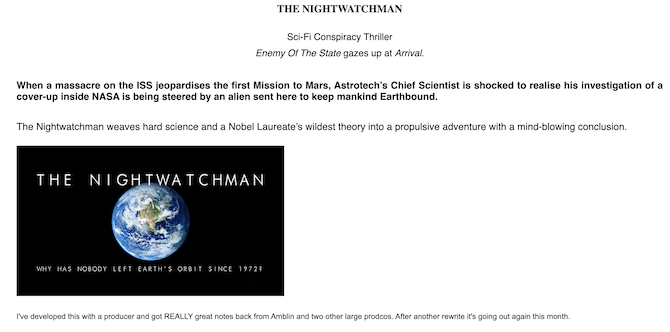
In the history of my receiving screenplay queries, one of the more reliable ways for me to know if the script is weak is a query that has multiple fonts, multiple text sizes, lots of styling, lots of misaligned text.
I think I understand what the writer is thinking with this approach. They want to stand out. And they feel that if they add some pizazz to the presentation, it’s going to separate them from the pack. It does separate them from the pack. But in a bad way.
E-mail isn’t designed for a controlled layout. So, once you start messing with formatting inside of an e-mail document, it’s going to look “off.” And what’s worse is, once it ends up on a different e-mail program (you made it in Mac Mail and sent it to someone’s gmail), the text always gets screwed up somehow. So all that extra work resulted in your e-mail actually looking worse.
It’s just not worth it. Whenever I see it, my first thought is, “Amateur writer who doesn’t know what he’s doing.” And I can promise you that that’s how 99% of the working people in the industry will see that e-mail as well. Look at how much cleaner this query looks…
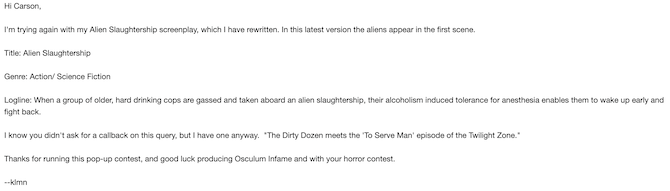
Just use regular fonts. Regular formatting. Keep it uniform (don’t use 12 point font in one section and 14 point font in another). Anything else ends up looking sloppy and unprofessional. It’s hurting your chances of accomplishing a very simple goal, which is to tell someone that you have a cool screenplay they should read. If they’re put off by the zaniness of the formatting, they won’t be able to see that.
*******************
On to the last query…
*******************
Sit down, shut up, and listen. “The Facetakers” is science fiction horror with teeth, because the monster is not in the woods, it is in your head. An omniscient AI called The Sum already won the world decades ago, and it runs the planet through an electronically induced hypnotic narcosis called the Experiential Grid, a global augmented reality streamed straight into human brains. It can make you see day at midnight, hear voices in the static, and walk smiling into your own execution. When someone is marked for replacement, the system hits them with a Kill Tone, then sends a Facetaker, a hollow android full of circumducting gold and plasti-bone, wrapped in polymorphic endoplasm that can become skin, hair, clothes, even your loved one’s face. These things do not just kill you, they become you, and the older they get the more their minds fracture into a blood-lust religion where they bathe in victims and feed on fear.
After a blistering cold open on a moon base that announces the scale and the rules, the movie clamps shut into a single location siege: one isolated 1980s time-capsule lake property in 2027, one house with forty windows, a covered bridge, a generator-lined basement, and a perimeter that turns into a kill box.
The script is a mix of Videodrome, Black Mirror, and The Matrix. 1980s Body Horror modernized and perfected.

I included this last query as a catch-all for the writers who want to buck tradition and query with something unorthodox. The reality is that this can work. In a world where everyone sounds the same, it can help if you sound different. But there’s no question that it’s a risk. It’s no different from approaching a girl walking down the street. You can adhere to social norms and say, “Hi, I wanted to meet you.” Or you could come up and say, in a Yoda voice, “Want to have sex with you, I do.”
You’re going to get in a lot more conversations if you use the first option. But the rare girl who likes the second option is REALLY going to like you.
That’s what’s going on here. Starting your query by telling the reader to sit down, shut up, and listen is risky. But there will be the occasional reader who loves it. Cause it’s different. So, just know that if you’re going to be unorthodox, your hit rate is going to be a lot lower. But, hopefully, the people who do respond to it, will respond very positively.
Now, if that was the only talking point with this query, I’d say that the writer is okay. They have a strategy. They’re accepting the risk of that strategy. All good.
But there’s another problem. The visual of this query is off-putting. It starts with this giant paragraph. When I see a really long paragraph, it almost always means ‘rambling.’ That’s what I’m expecting. And that’s pretty much what we get here. We’re dropped into Neil’s mind and he’s vomiting his movie idea out at us.
And because the mythology is so specific and unique, it exacerbates the rambling. Wild terms are thrown at us (experiential grid, kill tone, facetaker) that mean nothing to us. And so they risk sounding like a homeless guy on the train blabbering at us mindlessly.
Finally, we get a poster. This is something I’m seeing more and more of with pitches – an AI Poster or AI images. I think we’re at the point where they’ve become ubiquitous. And that means that they may hurt you more than they help you.
David Spade once said, “A limo is just a taxi that says you have a hundred dollars.” An AI image in a query e-mail is the same thing. It doesn’t say you’re a visionary. It says you opened Midjourney.
The exception would be if you’re a power user. You have a graphic design background and are entrenched in the AI revolution. You’re genuinely creating images that the average person cannot. But even then, I wouldn’t include it unless it looked extremely professional and perfectly encapsulated your movie. Not does so in a “close enough” way. It’s gotta be perfect. (And yes, I’m aware of the irony of using AI images in my posts, so feel free to factor that into your final decision).
So, if I were Neil, I would break this e-mail up into smaller paragraphs. Don’t talk about extremely specific mythology. Save that for the script read. Try to be more purposeful with the e-mail itself (Here’s why I’m writing you. Here’s my idea. Let me know if you want to read the script). And then I’d probably ditch the image.
And that concludes QUERY WEEK! If you have any other questions about queries, ask them in the comments. Hope you guys all learned something. I always enjoy brushing up on this stuff cause some of it is easy to forget.
Enjoy your weekend and, oh yeah, the first person to e-mail me gets 40% off a screenplay consultation! E-mail me at: carsonreeves1@gmail.com now!

Last week, I invited all of you to query me with your scripts. Whoever had the best query got a script review. I reviewed that winner yesterday. And the script was pretty good!
Today, I want to give you a template for writing all of your future queries. This template is built on the thousands upon thousands of queries that have been sent to me over the years.
But before we get into the actual query, let’s talk mindset. Unless you have the right mindset, your queries will always be a mess. The proper mindset to have is: This person I’m sending this e-mail to is busy. They’re not interested in anything anybody has to send them that they don’t know. Therefore, I have to capture their interest quickly and efficiently, and then get out.
If you have that mindset, the response rate to your queries is going to go up radically.
In addition to that, remember that the person you’re sending the query to only cares about one thing: “Does this script sound like something I’d want to make into a movie?” That’s it. Which is why you want to keep things sparse. So that, if they want to, they can jump straight to the logline to determine if they like it or not.
By the way, this is why picking the best concept possible 12 months ago was so important. For THIS MOMENT RIGHT NOW. Because the producer/agent/manager you’re sending this to doesn’t care about your query. They care about the script. If you field-tested your concept a year ago, and you know people liked it, and you know it’s marketable, that’s going to pay off BIG TIME right now when you start querying people.
A lot of people ask me, when it comes to querying, should you include your personality? I used to think this was THE ONLY THING that mattered in querying. That queries were about entertaining the recipient. Making them laugh enough so that they’d remember you. But it’s not about that at all. I can count how many times ON ONE HAND that I was wowed by the query itself (not the logline).
Some light personality for genre-relevant queries (if you’ve written a comedy, for example, and want to display your humor) is fine. But the reader didn’t sign up for your stand-up routine. They’re trying to get through their day as efficiently as possible. They’re whipping through their e-mails. They see yours. They don’t know who you are. They’re opening it with about 20% of their concentration.
All they care about is: IS THIS A MOVIE IDEA THAT’S RIGHT FOR THEM?
Okay, now that we know the mindset behind writing the query, how do we actually write it? Let’s begin with the subject line. You have some flexibility here. But I’m going to keep going back to this mantra of: Keep it simple. My go-to is, give us the genre and give us a popular movie it’s in the vein of. You get extra points if the “in the vein of” movie is something that the recipient is connected to. Here are some examples.
Subject: Horror script in the vein of Weapons
Subject: Period thriller in the vein of One Battle After Another
Subject: Romantic Thriller in the vein of The Housemaid
You, of course, have some flexibility here. You can use crossovers as well: “Horror script. Housemaid meets Sinners.” But I’d limit it to those two options.
By the way, don’t use movie comps that didn’t make money. Don’t even use movie comps that made average money. Only use hits. And don’t use any old movies as single comps. It’ll make you look out of touch. But you can use one classic movie if you’re doing a crossover (“Rear Window meets Weapons”).
Okay, the next couple of steps are going to benefit heavily from you doing your research (which can be done through your favorite AI and IMDB Pro). Your queries will get ignored by 95% of the people you send them to if you address the recipient as a collective. “Dear sirs” equals trashed e-mail. “Dear to whom it may concern” equals recipient stops reading. You need to do your homework and address the person specifically.
“Dear James,” or “Hi Jennifer,” Use a real name!
Next, you’re going to introduce yourself. “Hi, my name is Carson.” Again, you’re keeping it simple. This should actually be the easiest part of your query.
Now, you’re going to butter them up. Buttering these people up is a lot more important than you think. If they believe you genuinely know who they are and what they’re responsible for, they’re going to like you. And if they like you, they’re going to read your query through a positive mindset.
If someone tells me that they love Scriptshadow and that they read it every morning. Or, even better, that they’ve been reading ever since [some very specific popular script review that only true Scriptshadow readers know about] then I’m now rooting for them. I’m literally rooting for them to win me over with their logline. Whereas, when someone clearly heard of my site through some third party and doesn’t know who I am and they’re just taking a shot in the dark at sending me something, I feel zero remorse for skimming through their query.
Here’s an ideal “buttering them up” line for an agent: “I’m a huge fan of your client Ryan Olsen’s Black List screenplay, Time Force. It was my favorite screenplay of the year.”
Should you lie during the “buttering them up” segment? Absolutely. It’s no different from actors putting all those bullshit skills on their resumes. All that matters is that you develop some sense of rapport in that moment. Because, here’s the truth: If you give them a script that makes them money, they’re not going to give a shit whether you lied to them or not. Nor will they likely find out anyway. I doubt the moment is going to come where they’re on the verge of repping you, but only if you can tell them what Kage Jackson’s fatal flaw was in Time Force. (spoiler alert: Kage Jackson has two fatal flaws, one for his Future Self and one for his Past Self)
After you butter them up, you’re going to use a very short and simple line: “I have a script that I think you’ll love.” Don’t say “like.” Use the word “love.”
Then you’re going to use a quick sentence to sell the logline. You’ll say something like, “It’s a movie that harkens back to those great action films they used to make in the 90s.” Or, “It’s what an Ari Aster movie would look like if it were a romance.”
Then, you give the classic, title, genre, and logline, vertically. You do this for a specific reason. You want to create visual isolation for your pitch’s key info so that if the recipient is busy, they can easily jump to it. I see too many writers burying their logline inside long paragraphs. Producers hate that. They want to be able to see it separate from everything else.
Title: For Your Heart Only
Genre: Romance/Horror
Logline: When a young demented man falls deeply in love with a woman, he cuts her heart out and places it inside of himself, so he can be as close to her as possible.
After that, you want to write a simple line whose only purpose is to say you’ll send the script over if they’re interested. Something like: “Let me know if you’d like to read it and I’ll send it right over!”
Close the message out: “Sincerely, Carson”
And that’s it. That’s your query. You don’t want to mess around here. You don’t want to overthink it. You’re just here to pitch a logline. That’s it. So don’t get in your own way by clogging up your logline with your biography or an additional summary of the script. The visual that presents is: WALL OF WORDS. And there’s no faster way to get someone to delete an anonymous person’s e-mail than a WALL OF WORDS.
Okay, without further ado, here is how the uninterrupted query should look…
Subject line: Romantic Thriller in the vein of Hereditary
Hi Nick,
My name is Carson Reeves. I’m a huge fan of the movies you’ve produced. I’ve watched Bloody Martyr a dozen times at least. I have a script that I think you’ll love. It’s what an Ari Aster movie would look like if it were a romance.
Title: For Your Heart Only
Genre: Romance/Horror
Logline: When a young demented man falls deeply in love with a woman, he cuts her heart out and places it inside of himself, so he can be as close to her as possible.
Let me know if you’d like to read it and I’ll send it right over!
Sincerely,
Carson
If you want to clean up your own query, I do query consultations for 60 bucks. That includes three follow-up e-mails where we make adjustments to your query until it’s perfect. E-mail me at carsonreeves1@gmail.com if you’re interested. Or, if you need a consultation on your entire screenplay, we can do that too!
