
Search Results for: F word
Genre: TV pilot (comedy)
Premise: A low-level hitman heads to LA for his latest job, only to inadvertently befriend his target, an aspiring actor.
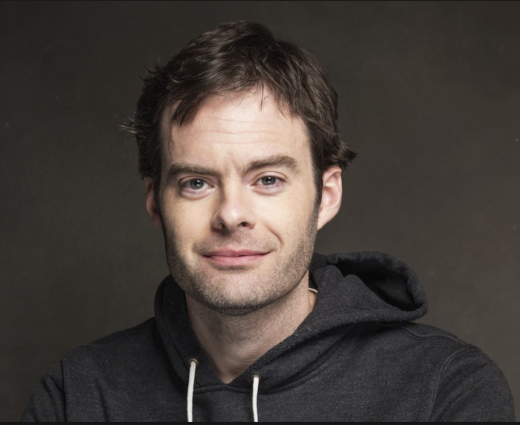
About: Today’s script was written by SNL vet, Bill Hader, and Silicon Valley producer, Alec Berg. Whereas Netflix has embraced the “throw a bunch of shit at the wall and see what sticks” strategy, HBO still has to slot shows into a proper schedule, and is therefore more discerning about what they air. It’s for this reason that they still have the edge over Netflix. It’s also why, when something gets an official commitment from the network, you know it’s beaten out a ton of other quality material (last I heard, HBO had something like 100 projects in active development).
Writers: Alec Berg & Bill Hader
Details: 36 pages (Third Draft)
Since yesterday’s script was the antithesis of funny, I spent the last 24 hours on a comedy script hunt, a laugh-quest, if you will. After traversing many of Los Angeles’ landmarks – Randy’s Donuts, Rodeo Drive, the Capital Records building, I met a sinewy little fellow who called himself “Maurice Bubblestilskin the III.” “Psst,” he said to me, while I tried to hail a Lyft. “Psssssst!” he said again. And from under his cape, he passed me this, “Barry.” ‘Best project HBO’s got going for it,” he assured me, before slipping back into his tent and screaming at himself for 5 minutes. And that’s how I came across Barry.
Hitman-Comedy is a sub-genre with a lot of history behind it, and that’s because, like all good comedy, it’s built on top of some heavy irony – A comedy… about killing people. I’m surprised we don’t yet have the definitive hitman comedy. Could there be some flaw in the concept that keeps these scripts from being great? I’m sure we’ll find out. Grab my hand and hop in my Scriptshadow canoe while I paddle you through Barry’s plot.
Barry is lonely. But WAY worse than that, he lives in Cleveland. If there is a more hideous fate than being lonely in Cleveland, I don’t know what it is. The only time Barry has anything to do is when he’s on the job. Barry is a hitman, you see. He’s paid to kill people.
Barry has a Charlie’s Angel’s disembodied boss named Fuches who calls Barry whenever he’s got a job for him. And Fuches has a new target in Los Angeles. If Cleveland is our idea of hell, Los Angeles is Barry’s. Barry begrudgingly flies to LA, where he’s introduced to a medium-grade Chechen crime boss named Goran Pazer. Pazer is pissed because some trainer named Ryan Madison is fucking his wife.
Pazer has hired Barry because he can’t have his fingerprints on the murder. And it’s a fairly simple job. Ryan is a nobody trainer. So, theoretically, all Barry has to do is wait until he gets home and put a bullet in his head. But Barry makes the mistake of following Ryan to an acting class (yup, it’s LA, so Ryan is also an actor!). And after being lured into the class by a beautiful young actress, Barry bumps into Ryan, who assumes he’s a fellow actor, and asks Barry to do a scene with him.
Barry does the scene with Ryan, likes it, and is then pulled out for drinks with the acting class. Being such a lonely guy, this is an exhilarating experience for Barry. But now he has a dilemma. He has to decide if he’s going to kill his new buddy, Ryan, or wiggle out of his contract and pursue his new dream – ACTING! Unfortunately, Barry’s hand is forced when the Chechens step in and take care of Ryan on their own. The plan is to kill Barry next, but Barry kills them first. And that’s how Barry finds himself an aspiring actor in LA… with the Chechen mob after him.
I want to take this opportunity to reiterate a great screenwriting device that works every time you do it. It’s mostly a comedy thing but you can use it in any genre. It’s called the “Mid-Scene Twist,” and the structure behind it is quite simple. You make the audience believe the scene is one way. Then, at the midpoint, you reveal that it’s something completely different.
We open on Barry, washing up in his bathroom, getting ready for the day. He looks at himself in one of those, “What the hell am I doing with my life?” ways. He plucks a gray hair, frowns, straightens up, then walks out. As he walks through his apartment, we notice… GUN HOLES IN THE WINDOW? Oh, and then there’s a murdered dude on the floor. This isn’t Barry’s apartment. No, Barry is a hitman, and he’s just finished a job.
In this case, the mid-scene twist was subtle. But it’s a lot more interesting than say, showing the hit. We’ve seen hits before. Hell, I think every single movie in history has a hit. So to start with a mid-scene twist was a much stronger choice.
A more aggressive form of the Mid-Scene Twist came at the beginning of an, unfortunately, terrible movie – Snatched (that Amy Schumer Goldie Hawn jungle flick). But it was a good scene!
In it, Amy’s character is at a clothing store, picking up dresses to try on, excitedly telling the employee helping her about the amazing vacation she’s about to go on with her fiancee. The employee seems a bit overwhelmed as Amy continues to grab new articles of clothing and gab away.
Finally, when the employee can get a word in edgewise, she says, “So are you going to set me up with a fitting room?” And we realize that it’s actually AMY who is the employee, and the other girl the customer. Amy then becomes defensive, frustrated that this woman isn’t appreciating her upcoming vacation, and the two eventually go their separate ways. It’s a simple premise, the mid-scene twist, but very effective when done well.
Start us off one way. Twist it into something else. Usually the opposite of what we assumed.
As for the rest of Barry, it was good. It was a little different. More importantly, it was unexpected. And this is where all the amateur writers screw it up. Because I know the amateur version of this script. I’ve read it a million times. Barry has to kill a guy. He goes over to the house. But, oh no, ZOINKS, the guy shows up with the wife he’s fucking! And the only place for Barry to hide is… ZOINKS!… UNDER THE BED! So he has to hide under the bed while the two have sex! Oh the shenanigans! Oh how the hilarity is ensuing!
No.
NO NO NONO ONONONOONNOONONOON
If you write that version of the script, you are a failure as a writer. I’m not kidding. Your job as a screenwriter IS TO GIVE US THE UNEXPECTED. If you give us what we expect, why would anyone pay you? If they want the version everyone expects, they write it themselves. They pay you to come up with unexpected complications and obstacles that keep the story fresh.
And that’s exactly what happens here. I never thought in a million years that Barry would get drawn into an acting class, and start to like acting, and start to like a girl in class, and wonder if he wants to move to LA, and kill the guys who hired him instead of the guy he was supposed to kill. I didn’t expect any of that. And so, even if I don’t like what the writer did with the story, I acknowledge that he gave me something unique.
Now, as it so happens, I did like what the writers did here. My only issue is with “Barry” is Barry himself. He’s such a quiet character. Quiet characters are hard to make interesting. And to build an entire show around a quiet character is more challenging than they may be anticipating. But I was still intrigued by what Barry would do next. That’s a sign that I’m connecting with the character.
We’ll see what happens once this hits the air. Im predicting, at the very least, a multiple-season pick-up.
[ ] What the hell did I just read?
[ ] wasn’t for me
[x] worth the read
[ ] impressive
[ ] genius
What I learned: When writing TV shows, think about character advancement. Where are they in their career now and is there opportunity for them to move up over time? Because that’s where you’re going to find your Season 2, Season 3, Season 4, is in the character advancing in their career. Breaking Bad is the most obvious example of this. He’s a small time drug dealer at the beginning. Then, by the end, he becomes a major force in the meth business. Here, Barry is a low-level hitman. So there’s lots of room for him to move up the ladder.
There are no movies coming out this weekend. You know it to be true. Which means one thing. IT’S TIME TO READ SOME SCRIPTS! Will we find the next Das Chimp out of this weekend’s entries? Or the next Orbital (that’s an old-school Scriptshadow joke there)?
How to play: Read as much of each script as you can and submit your winning vote in the comments section. Winner gets a script review next Friday!
If you’d like to submit your own script to compete on Amateur Offerings, send a PDF of your script to carsonreeves3@gmail.com with the title, genre, logline, and why you think your script should get a shot. Good luck!
Title: Radiant City
Genre: Sci-fi
Logline: In a post-apocalyptic city where people have gained the ability to cast ‘echoes’ – temporary copies of themselves – an Echo Crime Detective hunts a killer with the unprecedented ability to echo other people.
Why You Should Read: Radiant City is a noir-tinged sci-fi thriller with inventive set pieces, a racing plot, and a super strong protagonist that will have A-listers clamouring to get their agents on the phone. Well, that’s the dream anyway! Read a word, a page, or the whole thing – all candid feedback is welcome, you lovely people.
Title: THE COMEBACK
Genre: Drama
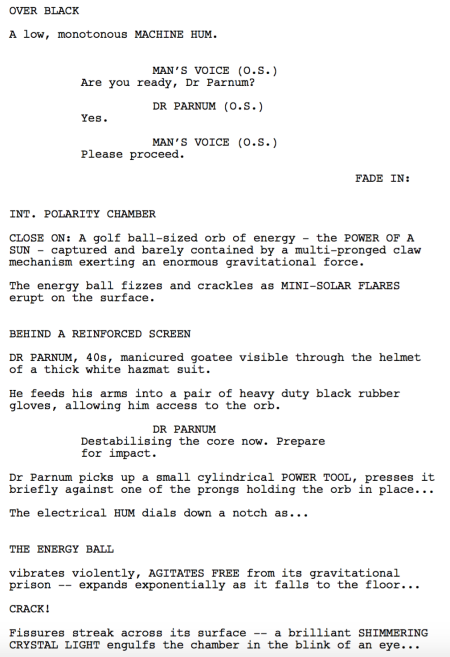
Logline: An inspiring story based on true events about an all-star high school quarterback that loses his throwing arm, but is determined to return to the game he loves with the help of a retired NFL physical trainer.
Why You Should Read: The script’s inspired by the true story of a one-armed high school quarterback from Seattle. I was so blown away by the kid’s determination, I wrote this tale that’s told in the vein of Soul Surfer and Rudy. Per Carson’s lesson, I said No to my protag as much as I could on his difficult quest of rehabilitation and redemption.
Title: Ridgeville
Genre: Crime Drama
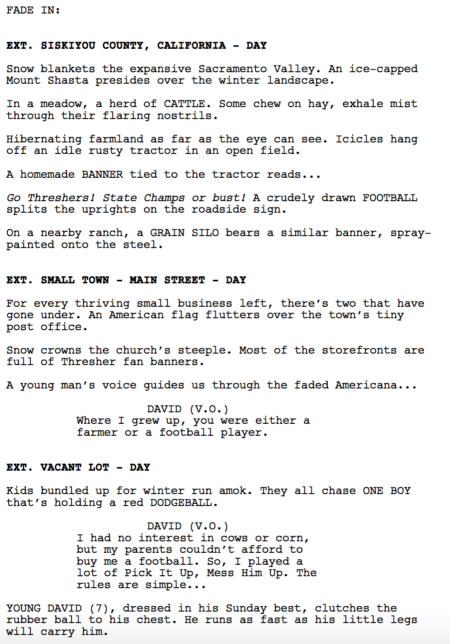
Logline: After the elusive serial killer known as “The Exterminator” is apprehended under mysterious circumstances, an FBI Agent and a local journalist team up to find the real killer.
Why You Should Read: My name is David Fershtadt, and I am going to be a freshman in college this year. When I was in eighth grade, I sprained my ankle during basketball practice. At the time, I wasn’t that big of a movie fan. However, since I couldn’t walk for a few days, I decided to watch some movies. I went to the IMDb top 250 and picked some that I liked. Ever since, I have been a huge movie fan. Since I also love to write, I figured I should try to write a screenplay. I started writing Ridgeville two years ago, but gave up soon after. Recently, since it was the second semester of senior year, I had time to look at what I wrote, see what I could fix, and power through. Now, I have a finished feature length screenplay. I think you should read my script because I believe that it is compelling enough to keep your attention throughout. It will have you asking questions from the start and make you want to find the answers. I also want to be able to get feedback that will help me become a better writer, and I believe you can provide me with that. Thank you so much for your consideration!
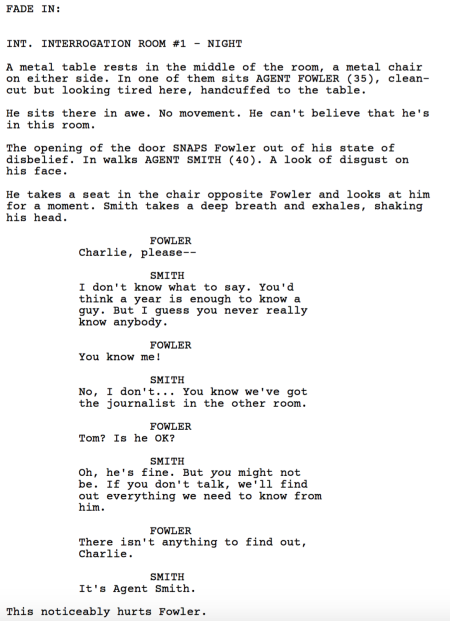
Title: The King’s Fool
Genre: Historical/Drama
Logline: During World War 2, a famous Jewish director was coerced by the Nazis to produce a propaganda film showing the concentration camps as a spa for Jews, all while being a prisoner in one. Based on the true story of Kurt Gerron.
Why You Should Read: For the past seven years, I’ve been writing, directing and producing my own short films. Since my love for making movies is bigger than my wallet, I almost went bankrupt because of it. With that said, a year ago I wrote this screenplay after a FULL YEAR of research. The story is full of irony, and I never understood why no one had made a movie about Kurt yet.
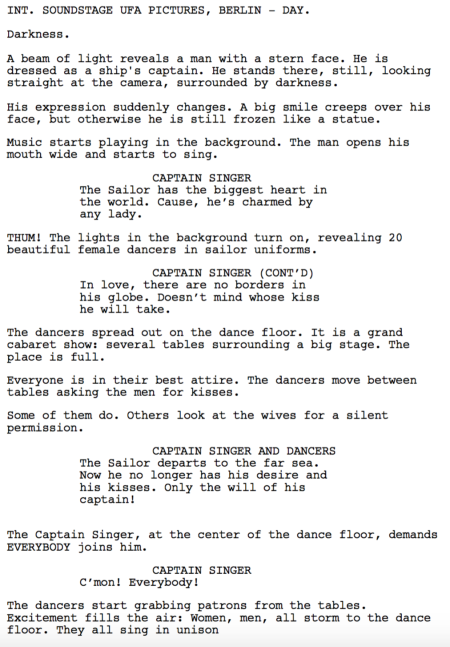
Title: Genesis Protocol
Genre: Sci-fi / disaster
Logline: The year 2035. With Earth facing imminent destruction, a government space station — with capacity for only 150 people — becomes the last refuge for what will remain of the human race.
Why You Should Read: I’ve now written over a dozen screenplays but nothing prepared me for a story of this magnitude and complexity. For the first time ever I took on a writing partner — an engineer / scientist specialising in the design of space habitats — to make the script as accurate and authentic as possible. It has been a fantastic experience (for me at least, I can’t speak for him!) and we now have various other ideas brewing including a graphic novel. I hope you guys enjoy the script and thank you in advance for any feedback.
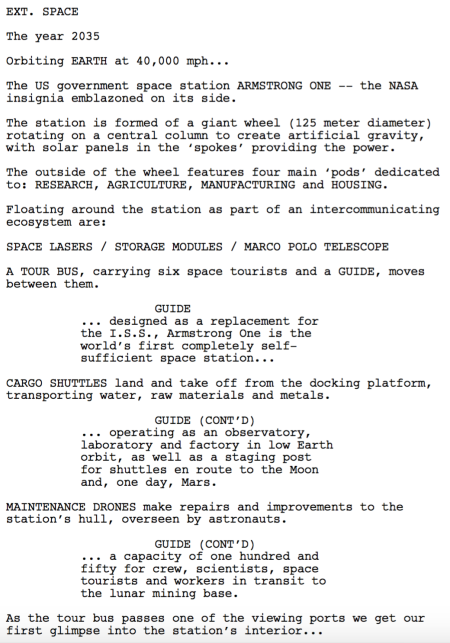
The winner of last week’s heated Amateur Offerings showdown finally gets its moment in the sun. But as every great tennis playing chimp knows, the sun gets awful hot without sunscreen.
Genre: Monkey Tennis
Premise: After a tragic tennis accident, a failed tennis pro seeks redemption by coaching a talented chimp and entering him in to Wimbledon disguised in a man-suit.
Why You Should Read: This is the greatest monkey tennis story ever told. It’s an ironic homage, a pastiche if you will – a spoof if you must – of the great animal-based comedies of the 90s like Beethoven, Flipper, and Dunston Checks In, each one of them an iconic work which has stood the test of time.
Writers: Chris Grezo & Rupert Knowles
Details: 110 pages
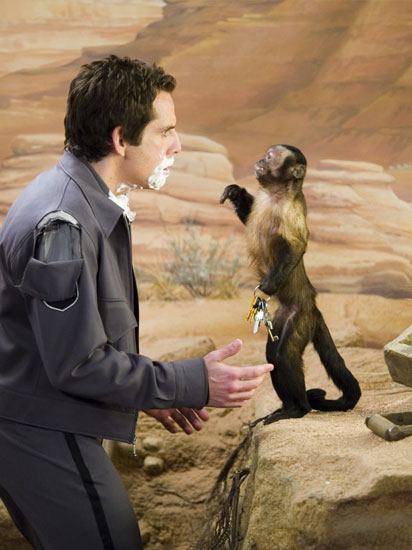
Das.
Chimp.
Chimp.
Das.
By themselves, the above words mean nothing. Invisible food-coloring, if you will.
But together? They represent one of the most powerful phrases in the English language.
Das Chimp.
Don’t believe me? Have you ever had a single passionate thought about the word “Das” before last Friday?
Me neither.
But look at how much controversy that same word created once combined with “chimp.” We had a fellow competitor questioning the sanity of each and every member of the Scriptshadow community when his script was defeated by Das Chimp.
Let us call a spade a spade. “Das Chimp” is the single greatest title to ever grace the pixelbytes of Scriptshadow. It is both simple, yet oh so complex.
And therein lies Das Chimp’s biggest hurdle. Could a title promise something so great, that it was impossible for the story to live up to it?
My friends, I’m ready to find out if you are.
So please, grab a beer, grab a racket, grab your favorite stuffed animal, and join me… for Das Chimp.
It’s never a good day when you kill your doubles partner. That’s what happened to John Protagonist, who lost his nerve when his tennis match got tight, accidentally hitting the chair umpire with a serve, causing a chain reaction of Center Court implosion, leading to a giant light landing on poor Hamish.
Adds a whole new meaning to the term, drop shot.
Fast forward 10 years and John faces each day with the regret of what he did to a man who didn’t deserve his demise. John heads to the zoo to share a beer with his custodian best friend, Duncan, when he sees a chimp effortlessly hitting a tennis ball against the wall.
John approaches the chimp’s handler, the excessively weird but beautiful zookeeper, Lily, and asks if he can teach the chimp (Pierre) tennis. Lily is game, but to do this, they’ll need to make sure no one realizes Pierre is gone. John comes up with an idea and puts Duncan in a monkey suit where he’ll stand in for Pierre.
Once John gets Pierre out on the court, he’s even better than he thought, so he starts entering Pierre in tournaments. The scrappy Pierre keeps winning, and actually earns a birth into Wimbledon! There’s only one problem. Monkeys aren’t allowed to play Wimbledon! Who would’ve thought?
So John gets another one of his genius ideas. He’ll dress Pierre up in a human suit. No one will know the difference. Meanwhile, John is dealing with some unexpected issues. Pierre is in love with Lily. And the reason Lily is so weird is because she was raised my meerkats. She has no clue how human interaction works.
But John’s biggest challenge comes when Britain’s #1 Doubles team is mauled by a wild boar. Britain comes to John and asks if he’ll team up with upstart Pierre to represent the country again. John is reluctant, but dons the headband once more, this time to play with a chimp… a chimp wearing a human suit.
Elephant shit.
Oh, I’m sorry. That’s not my assessment of the script.
I’m just noting that when you can include an elephant shit joke in your movie? And it’s FUNNY? By gosh you’ve already succeeded my friend.
But Das Chimp is no flash in the pan one-elephant-shit-joke wonder. Believe it or not, the majority of this script is funny. And not just funny, but well structured!
There’s an easy way to distinguish between “I don’t know how to write a screenplay” broad comedy and “I actually know what I’m doing here” broad comedy. Setups and payoffs. When I see lots of setups and payoffs in a broad comedy script, I know the writer has thought the script through, and, at the very least, completed a few rewrites. You can’t include too many payoffs without going through the script and figuring out where to set up them up.
For example, the crazed always angry Zoo owner lets out one of his wild boars at night to take care of people sneaking into the zoo after closing. 50 pages later, that same boar is responsible for sending John back into competition, after it mauls the other British doubles team.
And Lily is an entire compilation of setups. She acts beyond bizarre, to the point where you wonder if she’s retarded. Then we learn why she acts that way. She was abandoned by her parents as a kid and raised by meerkats. She would then get a job at the zoo because animals were the only world she understood.
But the best thing about Das Chimp is that Grezo and Knowles rarely make a lazy choice. Everything that happens here is either bizarre or the result of something bizarre.
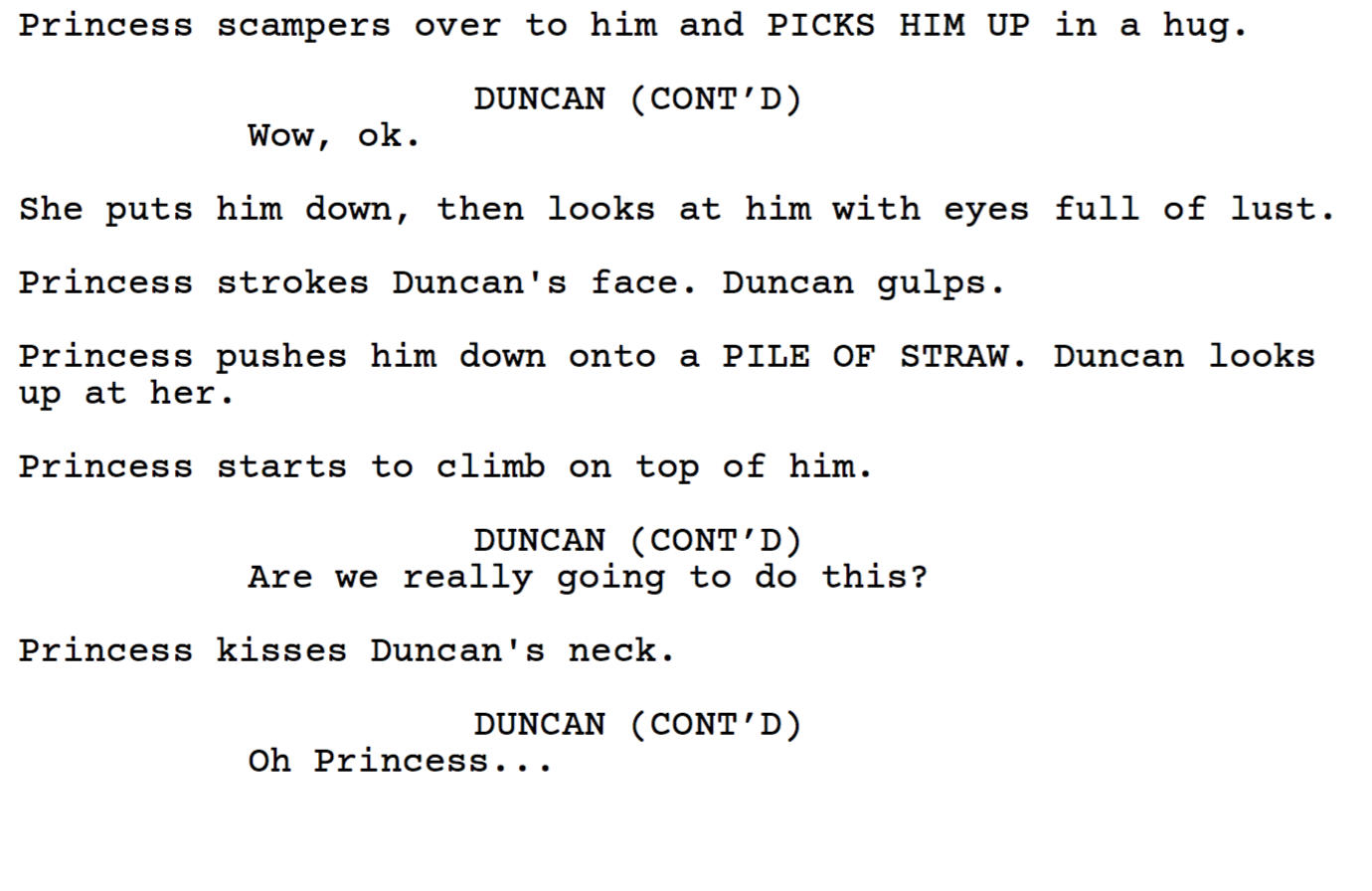
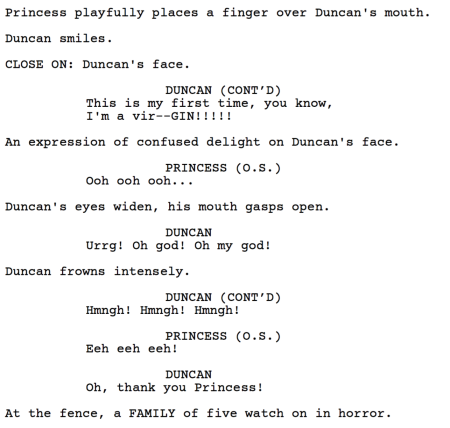
I have no doubt that a less talented writer would’ve made Duncan (John’s friend) some corporate type, so as to properly contrast the friends’ lives (like the screenwriting books tell you to do). Instead, they make Duncan an animal shit-shoveler over at the zoo. And thank God they did. Duncan’s storyline – while in chimp costume, he falls in love with a real chimp, Princess – was my favorite of the script, and led to the biggest laugh.
In this scene, Duncan comes to talk to Princess. I dare you to read what happens next.
If I have a beef with the script, it’s that the setup could be sharper. Pierre’s ascent from chimp who likes to hit against the wall to rising tennis star is way too fast. I understand that we have to get to the story, but I never understand why it was so important that Pierre start playing tournaments. John’s motivation seems more tied to using Pierre as an excuse to be around Lily. He didn’t need to enter Pierre in tournaments to do that.
This may seem like nitpicking. But the script ends up taking its plot surprisingly seriously later on, retroactively sending me back to this first act, where the only reason things seem to be happening is because they need to for the script to exist.
Another area that could’ve been better is the Pierre tennis matches, which were too repetitive. A lot of Pierre running around for balls it doesn’t look like he’s going to get to… and then he gets to them! I speak from experience as I’ve written several tennis scripts myself. I’ve learned you need to limit the repetitive actions of the sport and focus instead on individualized non-playing situations.
For example, instead of writing an entire page of, “… and then Pierre runs over to get the ball, barely reaching it – BAM! – he hits it back…” you might focus on the fact that a ballboy suspects that Pierre isn’t human, and write in a series of moments where the ballboy is trying to figure it out.
Obviously, you have to include SOME points to build the drama in the match. But the strange thing about screenwriting and sports is you want to include as little actual playing of the sport as you can get away with. The exception would be if you’re focusing on something unique within the game. For example, if John’s racket cracks during a point and he doesn’t have a backup, so John needs to play a point WITHOUT A RACKET. We’re going to be more interested in that point because it’s unique. It’s not another, “…he reaches for the ball with all his might…”
Das Chimp isn’t perfect. But these two writers are DEFINITELY funny. I believe it’s a script worth perfecting. So I’d encourage anyone here that if they can think of more funny scenes for Das Chimp, to share them with the writers. The more laughs we can pack into this script, the better shot it has.
Script link: Das Chimp
[ ] What the hell did I just read?
[ ] wasn’t for me
[x] worth the read
[ ] impressive
[ ] genius
What I learned: Give friends and family jobs that keep them closer to the story as opposed to further away. So you don’t want to make Duncan an architect or a stock trader. You give him a position at the zoo, where we can keep him close to the story without having to force it.
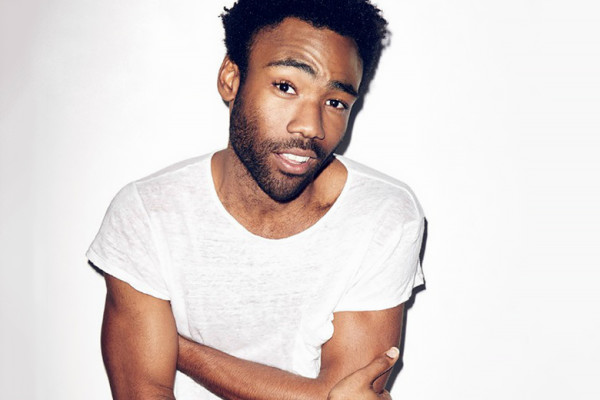
So the other day I FINALLY decided to watch “Atlanta,” the show from Community alum Donald Glover that had gone on to win a Golden Globe for Best Television Show, a Writers Guild Award for best Comedy Series, and was nominated for an Emmy in writing. Personally, I thought it looked pretentious and unfocused, so I never got around to watching it. Until now.
Before I get into my thoughts on the series, I have to share something with you. I hate Donald Glover. There’s something about the guy that rubs me like a bad batch of poison ivy. Discounting the fact that he’s an egomaniac who must prove he can act, direct, write, produce, rap, and do stand-up comedy, all under the guise of an “aw-shucks-I’m-just-trying-to-work” persona. Discounting the fact that there are articles being written about him that tell everyone to “underestimate Donald Glover at your own peril” (Gag me with an Instagram like). There are things even beyond those issues that I despise.
Mainly, that his writing is just okay. His dialogue is decent at times. But his storytelling leaves a lot to be desired. And his acting vacillates between mini mumbling monologues and looking like he’s so stoned that he might fall asleep at any moment.
Worst of all, it’s impossible not to know you’re watching Donald Glover whenever he’s onscreen. The Martian basically stopped for 5 minutes mid-film so that they could include a random “Donald Glover Short Film” Scene. I thought an actor’s job was to disappear into a role. Glover goes in the opposite direction, always wearing the same hipster clothes, always sporting the same trendy haircut, always giving the camera the same Donald Glover hangdog expression.
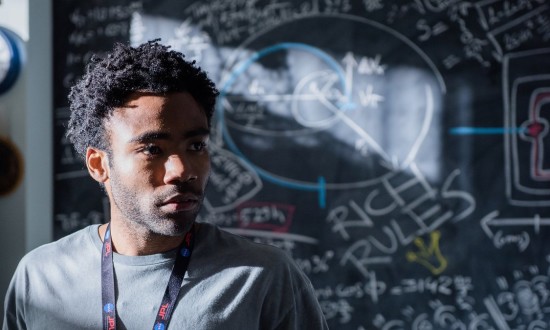
Which makes it all the more perplexing that the man is one of Hollywood’s fastest rising stars. And it really bothers me. Not because I don’t get the love for the dude. But because every time a writer or an actor or a director (or in Donald’s case, an actor/writer/director/producer/rapper/caterer/surgeon) rises up, Hollywood is telling you something: THIS IS WHAT WE WANT. Which means you, the aspiring multi-hyphenate, must understand why this person is ascending so that you can take some lessons from it and use them to further your own career.
Yet here I stood with Glover, unable to figure out how he’d separated himself from the pack.
I’m sure Glover’s old fellow staff writers on 30 Rock (where he started) are asking the same thing. Why is this guy blowing up while we’re still trying to get staff writing jobs on The Goldbergs?
Powering down my television after that decidedly average pilot episode of Atlanta, I finally figured it out.
Do you want to know what it is?
Voice.
What Donald Glover has that all those other staff writers and bottom feeder feature assignment writers and aspiring amateur screenwriters don’t have is a VOICE. It’s undeniable. Glover is bringing something unique to the table that nobody else out there is doing. I don’t know what it is, exactly. But I do know that when I watch his shows or listen to the dialogue he’s written? It’s different. And the reason this is so important is that VOICE is the equivalent of GOLD in the artistic community – the most valuable commodity there is – to the point where it can propel someone like Glover to stardom.
Think about it. How many people in this business truly have a unique voice? Very few. The majority of Hollywood’s army are cogs in a machine, regurgitating or helping to regurgitate the same old movies and TV shows over and over and over again.
When someone emerges from that glut of sameness to give us something unique, they stand out like a punch at a cuddle party. In fact, the very reason I hate this guy is tied to his voice. That’s what voice does. Its unique point-of-view incites passion one way or another. In my case, it’s “or another” but for a ton of people, it’s “one way.” He’s got something unique.
As artists, there is no bigger fear than being bland. Wondering whether we’re one of those also-rans who doesn’t have anything original to say keeps us up at night. Don’t get me wrong. You can still work in Hollywood without a voice. If you can perfect form and technique and craft and understand how the storytelling and character creation mechanisms work, you can work in this town. But you’ll never be special. You’ll never stand out like Donald Glover.
So today, I’m going to help you find your inner voice. The bad news is, voice isn’t something you can construct through pure force of will. Your voice is who you are at your core and therefore emerges naturally. When you look at someone like Bill Murray, his unique persona isn’t calculated. It’s just him. On the flip side, there are clearly celebrities who enhance their voice in a calculated manner. Lady Gaga, for example, does a lot of calculated things in order to enhance her “voice.”
With that in mind, here are seven things you can do to find your voice so you can be more like Donald Glover and less like those journeyman staff writers on The Goldbergs.
1) Identify what your world view is – What is the operating thesis by which you see the world? Is it John Lennon-esque, that everyone should put aside their differences, hold hands, and find peace with one another? Or is it Machiavellian, where everyone’s backstabbing each other and looking out for number 1? Is it idealistic, like Spielberg? Or is it fatalistic, like Kubrick? One of the key reasons for a writer lacking voice is that they don’t explore underlying themes in their work. Without a point-of-view, a lot of what we write is empty.
2) Write stories that exploit that world view – A big mistake writers make is not writing the scripts that explore the world view they’re so passionate about! For example, if you have a Kubrickian world view, but you’re writing Das Chimp, you’re not taking advantage of your voice. Every script you write where you’re not exploring your world view is going to feel lacking in some way.
3) Break rules – Following the rules allows you to write something good. But breaking the rules is how you write something great. Writers with voice don’t make sure their inciting incident happens on page 12. They’re too busy telling a unique and unexpected story. There’s a balancing act here. You can’t ignore rules completely. They’re what keep your story focused. But if you come across a rule in regards to your script that, by breaking, makes the story come alive in some way? That’s a sign that the rule is worth breaking. In “Room,” the Screenwriting Rule Nazi would’ve encouraged the writer to either get them out of the room at the end of the first act, giving them enough time to build a storyline post-Room, or in the third act, crafting the escape as the climax (like you’d see in a traditional thriller). Instead they placed the escape at the midpoint, allowing them to explore a devastating question: Where was life better? In the room? Or out?
4) Be raw and honest – To have a voice, you have to let us into your soul. It’s the only way we’re going to get to know the true you. And the deeper down you take us, the more ‘you’ we’re getting. The majority of writers write as fanboys. They re-write their favorite horror movies, reshape their favorite action set-pieces, mimic their favorite dialogue writers. They think that’s writing. That’s not writing. Writing is baring your soul through your characters. Be truthful. Be honest. Get into the nitty gritty of how you endure the human experience. This is why everybody 30 years later is STILL trying to write John Hughes movies and failing. They don’t realize that those movies don’t work because of the fun parts. They work because of the darkness, because of the way Hughes explored human psychology during one of the most confusing times in a person’s life – adolescence.
5) Be brave – Tarantino, one of the most voice-y writers ever, once said (paraphrasing) “You should always be a little nervous to let someone read your stuff because of how fucked up some of it is.” That’s not to say everyone should include a Gimp-Rape scene in their script, especially if you’ve been hired to write The Nut-Job 3 (on second thought…..). But a good writer explores those messy areas in life and in human interaction that aren’t usually talked about openly. Embracing those awkward moments brings truth and originality to your work.
6) Evolve The Genre – We all have our favorite genres to write in. So I’m going to give you advice that’ll place you ahead of 90% of aspiring screenwriters out there. Before you write your script, ask yourself, “How do I plan to update this genre?” If you’re writing a horror film, maybe you’re infusing race into it (Get Out). If you’re writing a heist film, maybe you’re infusing time manipulation into it (Inception). If you’re writing a Western, maybe you’re bringing a level of violence to the proceedings that has never been seen before (Bone Tomahawk). I consider this tip, more than any other, a ‘cheat code’ in the game of voice, because without much work up front, you can make a script feel totally unique.
7) Make sure there’s at least one character in your script who’s unlike anything we’ve ever seen before – Audiences rarely remember the plot to a movie years later. But they always remember the characters. I’ve found that voice-y scripts always have at least one character who’s totally and completely different. Travis Bickle in Taxi Driver. Miles in Sideways. Wade in Deadpool. Juno in Juno. Unique characters go hand in hand with voice. So don’t write your script without one.
8) BONUS! – A non-traditional narrative – I went back and forth on whether to include this tip because there’s nothing more that I hate than a rambling narrative, a vague plot, or unclean structure. But the proof is in the pudding. The artists with the strongest voices tend to sacrifice plot and structure for character and situation. Woody Allen, Quentin Tarantino, Sophia Coppola, Aaron Sorkin, Christopher Nolan. I’m not a fan of this tip. But I can’t deny its presence when it comes to writers with voice.
Carson does feature screenplay consultations, TV Pilot Consultations, and logline consultations. Logline consultations go for $25 a piece or 5 for $75. You get a 1-10 rating, a 200-word evaluation, and a rewrite of the logline. All logline consultations come with an 8 hour turnaround. If you’re interested in any sort of consultation package, e-mail Carsonreeves1@gmail.com with the subject line: CONSULTATION. Don’t start writing a script or sending a script out blind. Let Scriptshadow help you get it in shape first!
Genre: Thriller
Premise: (from Black List) After a shooting at a police funeral by a suspected militia member, a recluse ex-cop and fellow militia man must interrogate the suspected gunmen in his own militia before copycat attacks start a nationwide war between cops and militia.
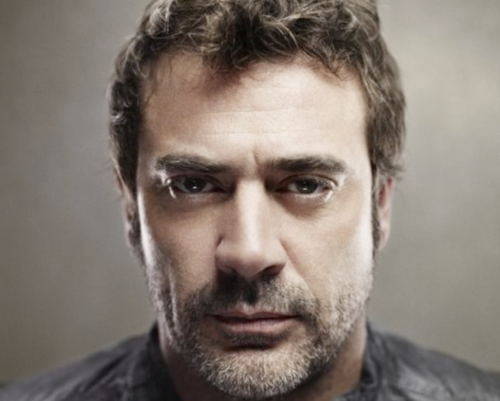
About: This script finished on the 2015 Black List. The film will star current Walking Dead villain, Jeffrey Dean Morgan. The writer, Henry Dunham, will also be directing. Dunham first made waves with his short, The Awareness, which you can watch here.
Writer: Henry Dunham
Details: 105 pages
Just want to give everybody a heads up. Yet ANOTHER female John Wick project is going into production, this one starring Alias vet, Jennifer Garner. The script is being written by Chad St. John, whose Scriptshadow interview you can check out here. Not going to mince words, guys. If you’ve got a female John Wick script, ya better finish fast. I sense that the end of this trend is coming, especially with the so-so box office of Atomic Blonde.
On to today’s script, which actually contains an ORIGINAL premise. Imagine that. A concept that isn’t following any trends but is rather blazing its own trail. I’ve always been fascinated by the militia. We basically allow people in our country to come together and form their own personal armies. How is that okay?? It was for that reason that I picked Militia up. Let’s find out if it rewarded my curiosity.
40 year-old Gannon lives out in the wilderness. He’s in the midst of smoking a deer for dinner when he hears automatic gunshots in the distance. These gunshots are followed by three explosions. Gannon immediately gets on the phone with a dude named Olsen and the two agree to meet at “The Safe House.”
That safe house is a reclusive lumber warehouse where Olsen and Gannon are soon accompanied by a trickling-in of militia members. There’s Beckman, the techy of the group, Morris, the giant Alpha Male with a chip on his shoulder, Hubbel, a slovenly mountain man, Keating, a deaf-mute, and Noah, the only guy here who looks reasonably presentable.
As the group listens in on the radio, they learn that someone has attacked a cop’s funeral and shot up a good 20 cops in the process. This is bad news because the first people they’re going to suspect in this shooting is the militia. And that’s where the meeting begins – how to make it clear they weren’t involved.
However, when they check their supplies and learn an automatic rifle and several grenades are missing, they realize they WERE the ones involved, and now it’s a matter of smoking out the guy who did it. Gannon takes the lead with the interrogations, convinced that the antagonistic Morris is their culprit.
But it quickly becomes clear that not everything is as at seems. And when word comes in that there have been TWO MORE major militia attacks in neighboring states, they realize that this is way bigger than just one guy. In the end, it’ll be up to Gannon to figure out who’s lying and who’s telling the truth before the police find them, raid the warehouse, and kill them all.
UGH!
I so wanted this to be great! I loved this setup.
So here’s a great tip for screenwriters looking for a big concept that can be made on the cheap. As we’ve discussed before, when your script is cheap to make, you increase the number of potential buyers exponentially.
To do this, start with a really big idea. It can be anything. A giant monster. A mega-quake. A nuclear war. Whatever. But don’t build the story around the actual subject. That’d be expensive. Build it around characters who are affected by the subject.
What this does is it makes your movie feel big even though it’s small.
That’s what Dunham does here. There’s a big attack on this cop funeral, but we don’t see a frame of it. We hear it. But we don’t see it. Then, the entire movie takes place in a warehouse with these characters trying to figure out which one of them perpetrated the attack.
Do you know how cheap it would be to make this movie? You could shoot it in 2 weeks. And it still FEELS BIG. That’s really smart writing there.
Another thing I liked about this script was that it was a SITUATION. What I mean by that is, we don’t see the attack, watch someone run away, show the cops prepare to catch them, show our attacker hide out, meet a love interest, try to move to the next safe area, get into a chase scene, etc., etc.
That’s not a situation. That’s a series of events.
Militia is a situation. A bunch of dudes in one place. One of them killed some cops. The leader has to figure out which one of them did it. Every person who walks into this theater is going to immediately understand what this movie is about. What the setup is. What the rules are. It’s a clear situation.
Not that non-situations can’t work. Yesterday’s film, Good Time, wasn’t a situation and it was a great flick. But situations tend to work really well for feature films. So if you can think of a good one, write it. Other situation-films include The Shallows, 10 Cloverfield Lane, Saw, The Hateful Eight, The Thing, The Wall, Birdman and The Martian.
Yet another great tip to take away from Militia is the mid-point RAISING OF THE STAKES. Remember that when you go into the second half of your story, you need to make things feel bigger somehow. If they stay the same, people are going to get bored. Especially in a movie like this, where you only have one location to work with.
So the midpoint news that it wasn’t just this one funeral attack that happened, but that there was a coordinated attack against cops across three separate states? That’s when I was like, ooooh, this is good. The movie was growing beyond its original setup. That’s always a good thing.
But all was not perfect with Militia.
My big issue with it was that the character-to-character interactions felt a little… phony. I didn’t get the sense that the writer really understood what militia men were like. And this is a common issue in screenwriting. You pick an idea because you like it, but you don’t know anything about the actual subject matter.
So you have a choice. You can do some research and combine it with what you’ve learned through similar movies that you’ve seen, or you can really do the hard work. That means doing a fuck-ton of research. That means finding and locating an actual militia member and talking to them. Learning what their day-to-day life is like.
Nobody likes to do this. So the more common route is the former. And, unfortunately, when you do the former, there’s a lack of authenticity to the proceedings. And I’m not saying it was insufferable here. Some of the interactions felt real. But there were enough moments where I wondered, “Would this really be happening this way?” that it affected my enjoyment of the story.
With that said, I love this setup and I have a feeling that with some rewrites, these authenticity problems can be fixed. So I’m going to recommend Militia. It’s a fun script.
[ ] What the hell did I just read?
[ ] wasn’t for me
[x] worth the read
[ ] impressive
[ ] genius
What I learned: If you really want to make your descriptions pop, use analogies. When you have a guy with a deep voice, you don’t want to say, “His voice is deep and throaty.” That’s boring. Do what Dunham does. Here, he describes mountain man Hubbel’s voice with an analogy: “Every word from Hubbel sounds like gravel being raked.”