
Search Results for: F word
Welcome to the newest trend in screenwriting, the “micro-screenplay!”
Genre: Horror/Post-Apocalypse
Premise: A farming family must communicate without speech in order to avoid a violent creature which seeks out its prey via sound.
About: For those of you who think the only way to break into Hollywood is to have an Oscar-winning producer as an uncle, look no further than Scott Beck and Bryan Woods, graduates of University of Iowa, a state with plenty of uncles, but no Hollywoods! Beck and Woods are filmmakers who have been slowly moving their way up the ladder, finally selling this script to Paramount for John Krasinski and wife, Emily Blunt, to star in. While Krasinski would later do a pass on the script (he’s also directing), this is the spec that sold before his involvement.
Writers: Scott Beck & Bryan Woods
Details: 67 pages
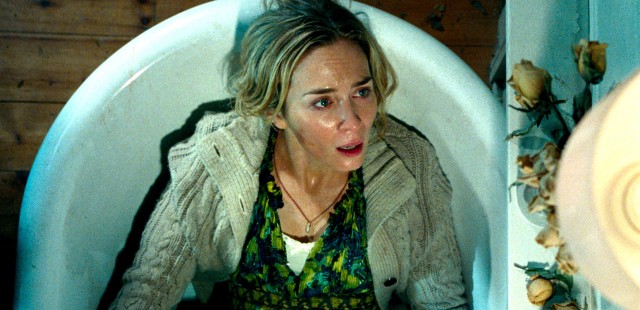
Say it with me now. Miiiiiiiii-cro screenplay.
It’s the new trend, brother. Haven’t heard of it? Where have you been? Off writing your behemoth 100 and 110 page screenplays I suspect. How dare you. Between A Quiet Place (67 pages) and Meat (73 pages), thin is in! With everyone’s attention span being stretched to the bone – as the 24 hour news cycle turns into the 28 hour news cycle, people have less time to read. So you better make your scripts as tiny as possible.
The proof is in the pudding, guys. Justice League? 120 PAGES! And what happened to that movie? Only the lowest opening weekend for a DC film. If that doesn’t prove it, I don’t know what does. No more pages for ages. Recede word greed. 75 is the new 110.
Just in case you were wondering, I’m joking. Today’s slim shady screenplay is due to the fact that there’s barely any dialogue in it. Which turns out to be the reason it’s so awesome. Tell your cubicle neighbor to turn down his radio. I’m going to need some quiet for this review.
After sweeping into a beautiful farmland utopia, we meet two children, April, 8, and her brother Will, 10. The two are moseying about, each doing their daily chores. We then meet the very pregnant Mia, their mother, and the patriarch of the family, John.
They seem to be your typical family of farmers. But it doesn’t take long to notice that something is off. That something is the fact that nobody speaks to one another. In fact, everyone goes out of their way not to speak.
It turns out the reason for this is that the world has been wiped out by creatures that prey on sound. If you so much as whisper, it’s the equivalent of screaming as loud as you can in these creatures’ ear. And since they now know where you are, they come and kill you. As long as you don’t say anything, though, you’ll be fine.
This is something that, up until this point, has been controllable. The family has a system down. They don’t need words to communicate. But remember that Mia pregnancy? Yeah, that baby’s due soon. And the last time I checked, babies don’t know how to shut up.
Which is why the family has been meticulously sound-proofing their shed. They hope to have it silent as a church by the time Mia goes into labor. Oh, one problem with that. Mia goes into labor early. This causes pandemonium, as the family is forced to improvise, all with the creature now aware of their location.
Somehow, John’s able to get everyone into the bunker. Everyone, that is, except for April, who, in all of the chaos, got lost in the field. John will now have to go out and save his daughter, with a highly alert sound-hunting creature nearby. But how do two people find each other without the ability to speak? Without the ability to yell? I guess we’ll have to find out.
This was a really clever idea.
It’s funny how that works. We’re all looking for that singular idea that’s so great, so complex, so unlike anything anybody’s seen before. When, usually, the cool hip idea that comes out of nowhere is the one that’s painfully simple.
A world where if you speak, you die.
I always say that the key to avoiding cliche is to come up with a unique concept, as it will, in turn, lead to unique scenarios. And that’s exactly what happened here. Every scene felt different from the stuff I usually read.
Take, for example, when Mia goes into labor early. She’s in the house, by herself, while the rest of the family is working on the shed. Here’s this woman, who’s going through the most physically painful experience of her life, and she not only can’t make a sound, but meanwhile, her family is across the field, casually working on other stuff, having no idea that she’s in labor.
I haven’t read that scene before. As was the case with virtually all of these scenes. Everything felt new because of this “can’t talk” rule.
I also like how Beck and Woods crafted this setup. They didn’t just stop at the gimmick part (nobody can speak or the monster gets you). They asked, “What’s the WORST thing you can do to a family who, if they make a noise, they’re dead?” It’s a question, as storytellers, you should always be asking yourself. “How can I make things even WORSE for my hero?” The answer was the genius: a baby is coming. A baby can’t keep quiet. A baby is a bomb in this situation. Which leads you to wonder, how the hell is the family going to get out of that??
Beck and Woods also explore the emotional side of this question, which is another thing you guys should be focused on. They extrapolated the concept of not talking and made it the family’s flaw from before the creatures arrived. Through a series of flashbacks, we learned that the family wasn’t talking to each other EVEN WHEN THEY COULD. Specifically John, who had a hard time expressing his feelings to the family.
This is easily the cleverest concept I’ve read all year. And the writers did so much right that I’m reluctant to even point out the bad. But there were a few things that bothered me.
For starters, the baby is conveniently quiet for the majority of the time after it’s born. I mean, I don’t know a lot about babies. But I know they aren’t little angels for the first 24 hours after they’re born. They’re crying a lot. And I would’ve liked to have seen the family have to deal with more crying.
At least on the page, the geography was hard to figure out. And when April is lost and John has to find her, I thought, April has lived here her whole life. She knows every landmark like the back of her hand. How could she not find her way back to the house/shed? I’m curious how that’ll be dealt with in the movie.
Finally, the emotional stuff was okay, but not great. There was another family member who died, a dead sister, and we find out through a flashback she died in a car accident. Just a heads up for those wondering. As a reader, I read SO MANY PEOPLE DYING IN FLASHBACKS THROUGH CAR ACCIDENTS. It’s the most cliche choice you can make. And I didn’t understand why they did that when it would’ve made so much more sense to have the other sister die by the hands of the creature.
I’m also VERY CURIOUS to see how the final line of the movie plays. It’s a HUGE GAMBLE. Like, major. It’s either going to crush or fall flat. Have people crying in the aisles or rolling their eyes. I’m so curious to see this movie not just for its clever concept, but for that moment.
I’ll finish off by saying these frustrations are mainly due to the fact that I think this idea is so awesome and so clever, and so even when the writers made the smallest misstep I was like, “No!” Cause I wanted this movie to be perfect. And it has a chance to be that. It’s that film everyone is looking for – something unlike anything else out there that’s still commercial.
I will DEFINITELY be seeing A Quite Place when it comes out. This is what spec screenwriting is all about. The bar has been raised.
[ ] What the hell did I just read?
[ ] wasn’t for me
[ ] worth the read
[x] impressive
[ ] genius
What I learned: Take advantage of your unique upbringing to write a great scene! There’s an awesome scene here where April falls into a silo full of grain and begins to drown in it. It’s a scene written in startling detail and with facts that I suspect only someone who grew up in the farmlands of Iowa would know. So keep writing what you know, people! Chances are it’s what will separate you from everyone else.
What I learned 2: NOTHING should go according to plan in a movie. If Mia’s pregnancy goes according to plan? BORRRRR-ING. It’s the very fact that she goes into labor early (NOT PART OF THE PLAN) that makes the movie so exciting.
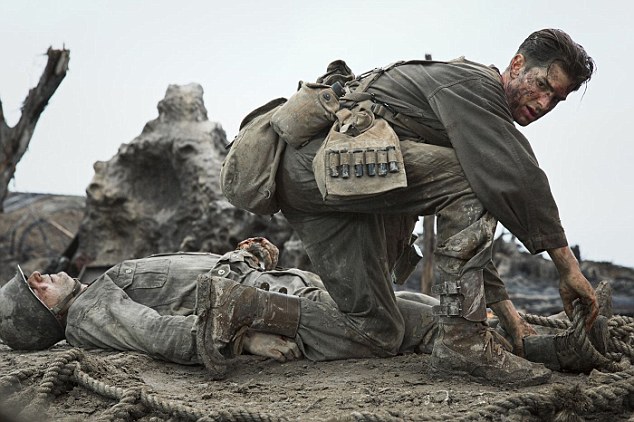
A common theme kept popping up in the last three consultation scripts I’ve read. A theme so prominent in the screenwriting trade, its primary descriptor sends chills down screenwriters spines. I’m talking, of course, about THE CLICHE.
We’ve spoken generally about cliches in the past, and how to avoid them. If there’s a line or a scene or an idea that you’ve heard before, it’s in your best to interest to go with another choice.
But all that does is put the onus on you to think something up. And thinking stuff up is hard! The reason we come to Scriptshadow is so we don’t have to think! So that Carson can give us the answers that make screenwriting easy.
Okay, okay. My apologies. I’ve been slacking.
So here’s a more active way to solve the cliche problem. It came to me while reading a classic movie scenario. Two soldiers on a battlefield. One gets shot and he’s not going to make it. This is the final conversation they have before the injured soldier’s death.
In the scene, the writer wrote a beautiful interaction between the two characters, whereby they were each able to say the things they’d always wanted to say to one another. Time stopped so that this idealized exchange could continue unimpeded until the very last breath.
Which is the reason it didn’t work and felt so cliche.
It was at that moment I had an epiphany about what exactly “cliche” was. Cliche… is the absence of truth. Cliche is the idealized “movie logic” version of a moment. The lighting is perfect. The characters speak in poetic prose. It’s a romanticizing of what a real world moment might be.
To avoid cliche, you must turn to truth. And truth is messy. The lighting is never perfect in truth. People never say the perfect thing at the perfect moment in truth. Whatever you pursue in life never happens the way you plan for it to. To avoid cliche, look for the mess. Look for the things you DON’T want to happen. Not the things you do. Look for the things that will make the scene MORE difficult to write, not less. The more you mess things up, the further away from cliche you’ll be.
So let’s get back to that scene. We’re on the battlefield. One of two soldiers has been shot and they’re dying quickly. You could make the argument that this scene is doomed from the get-go. You’ve already created an idealized cliche situation. So it’s destined to be bad.
But that’s not true. In real life, we do have war. In real life, we do have soldiers who get shot and die in front of other soldiers. So there’s truth to mine from this situation. What you want to avoid is playing those last moments out in an idealized fashion. Instead, look for the mess.
And that’s not easy. Because unless your name is Ernest Hemingway, chances are you’ve never been on a battlefield. But that’s okay. You’re still a writer who’s capable of imagining a realistic scenario. So again, I’d ask you, look for the mess.
For example, let’s say these two characters do need to say some last words to each other. Let’s start by making that difficult. Maybe the Captain is off to the side, screaming to our hero, “LET’S GO LIEUTENANT! WE’RE GETTING PICKED UP IN 20! WE NEED TO LEAVE NOW!” And he doesn’t just say this once. He KEEPS yelling it over and over again. This erases any chance for a well-lit smooth uninterrupted final conversation. Already, the dialogue is getting messy. And as we’ve established, messy is good.
Maybe the hero wants to go for that big heroic moment and carry his friend back to safety. So he gets him under his shoulders, waits for the gunfire to stop, lifts him up and starts to run back for cover, takes two steps, collapses, and crashes back down. He’s not strong enough to carry his friend. THAT kind of shit is real life – when you realize just how heavy a man is when you’re exhausted and in the middle of a firefight.
Maybe, instead of our dying soldier begging our hero to tell his wife and kids that he loves them more than anything, he tells our hero that he knows of a secret massage parlor down by Lower Wacker and to ask for this woman named Cara, because she’ll do anything you want for a hundred bucks. That’s the kind of weird messy shit people really say when these once-in-a-lifetime moments happen. They don’t speak to each other in pre-rehearsed loving lines that make total sense.
Are you starting to get the picture here? Whenever you find yourself inside a moment that has the potential to be cliche, seek out the truth of the moment. And never forget that truth is messy.
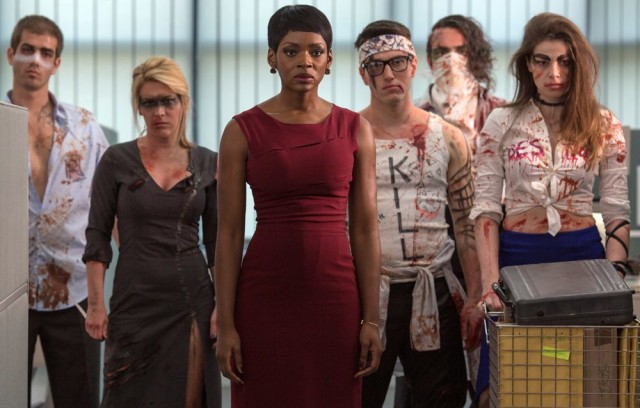
I originally planned on reviewing Mayhem today. But then I watched it. And the movie is a borderline disaster. It’s one of the most overwritten over-directed movies I’ve ever seen in my life. I then rented the movie Columbus. That movie is like a delicate slice of cinematic sweetbread. It’s also one of the most underwritten under-directed movies I’ve seen in my life. So I thought it’d be fun to review these two contrasting pieces of entertainment together.
And here’s the funny part.
I’d tell each and every one of you to write the abysmal Mayhem over the brilliant Columbus.
For those who don’t know, Mayhem is about a company attacked by a virus that makes its victims succumb to their worst impulses. If you’re an angry person, it makes you extremely violent. If you’re slightly manipulative, you become a sociopath. If you’ve got sex on the brain, it turns you into a walking sex machine.
When their building is placed on an 8 hour quarantine, a recently fired employee, Derek, enacts revenge on everyone who screwed him over, teaming up with a former female client the company also screwed over, to do so.
I expected to LOVE this movie. I thought the premise was fun. It was a way to make a zombie film without making a zombie film. It had that “familiar but different” thing Hollywood’s so keen on.
But the execution was too over-the-top, as subtle as your loud inappropriate drunk uncle. On the screenplay side, half the script is dedicated to explaining the virus. Even though the opening montage is specifically built to explain every nuance of the virus, we’re still being given virus rules 40 minutes later.
Here’s something to keep in mind for new screenwriters. Exposition (the process of explaining things so that your story makes sense) is fought on two fronts. The front everyone focuses on is the “How to Limit My Exposition” front. You’re trying to minimize how much you explain everything. Which is good. You should be doing this.
But the other front, the one nobody talks about, is to simplify your plot and rules in the first place! If you build your story on top of a simple premise and simple rules, you won’t need to explain as much! By making this virus, this company, the people within this company, and the laws governing this virus, so complicated, they had no choice but to use up half the movie on exposition.

On the other end of the spectrum was Columbus.
Columbus takes place in the titular town of Columbus, Indiana, a hidden goldmine for some of the most beautiful architecture in the country. When a visiting professor of architecture falls gravely ill, his son, Jin, must fly in and wait for the doctors to figure out what to do with him. In the meantime, he meets a townie, Casey, with the potential to do something great in the world, but who’s sacrificed that opportunity to take care of her addict mother.
Talk about completely opposing plots, right? Whereas every second of Mayhem is dedicated to explaining something or killing someone, you might go 3-4 minutes at a time in Columbus without a character saying a word.
The movie is one of the most beautifully shot I’ve ever seen, so much so I tracked down interviews with the elusive director, a 50-something Korean man named Kogonada (who up until this point had only done video essays and never been on an actual movie set). Listening to him discuss his film was fascinating. His entire approach to filmmaking is to prioritize form over plot. To him, the perfect shot (of a building, a character, a lone room in a house) was far more important than two characters conversing. It’s pretty much the antithesis of what I preach. And yet it worked brilliantly for the film.
What Is Neorealism? from kogonada on Vimeo.
Granted, Kogonada has a filmmaking eye like no other. Every frame of his is a painting. Therefore, had a less talented director tried to do the same thing, I’m sure I’d have been chastising him for not focusing more on story.
With that said, Kogonada still finds a story that resonates. Remember, you can get away with simple plots as long as the themes are universal, as long as the issues are relatable. Both Jin – working a soulless corporate job that’s desensitized him to the world – and Casey – being stuck in a small town instead of going out and following her dreams – are universal conflicts that many people can identify with.
And unlike Mayhem, where the plot had to be jammed in our faces every five seconds, Kogonada used the most minimal plot device possible – a sick father who was keeping our main character stuck in town. It was a big reason why the story worked so well. The plot point that placed our characters together was borderline invisible.
With all that said, if you’re choosing between writing a Mayhem or a Columbus? I’ll tell you to write Mayhem every time. It’s got a fun hook. It’s marketable. You can imagine the movie when someone pitches it to you. It’s going to get priority over a “Columbus” like idea in every production room in town.
Not to mention, the prestige Straight-To-Digital release is an emerging avenue for spec screenwriters. I say “prestige” so it’s separated from the abysmal D-Movie efforts that Nic Cage and John Cusack star in. These prestige digital offerings are cooler, hipper, the kind of stuff that’s going to get play on movie web sites. But that means your idea needs to be cool and hip. It cannot, sadly, be Columbus.
With that said, Columbus is the perfect vehicle for a writer-director. If you have something that isn’t sexy on the page but you KNOW is going to look great on film, directing the movie yourself is the way to go. Realistically, nobody’s going to be interested in your small personal movie but you. And that’s okay. Cause plenty of these personal writing-directing efforts turn out to be great.
But if you have no interest in directing? Come on. Be smart. Write something with a hook like Mayhem.
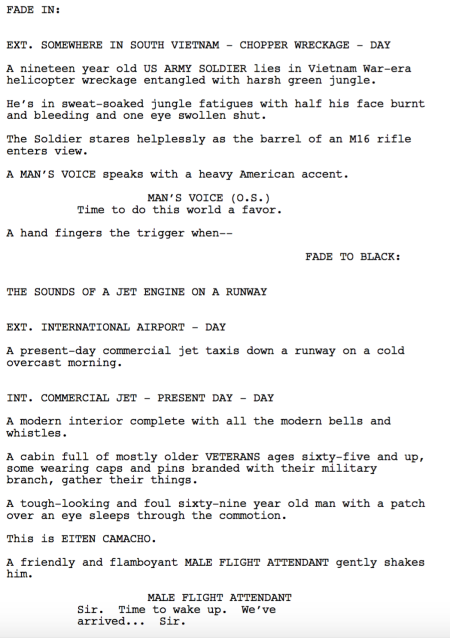
Genre: Thriller/Drama
Premise: A Vietnam POW struggles to survive captivity to seek revenge on the group of soldiers who betrayed him and left him for dead.
Why You Should Read: Been at this incredibly rewarding and gut-punching craft for seven years now. I’ve had my share of contest placements and even turned one of my ten scripts into a multi award-winning book, however, I’m still on the hunt for that big breakthrough. For this script I stepped way out of my comfort zone and broke some of the so-called “rules.” This is a past/present script that is part The Revenant, part Apocalypse Now, and part Saw. Would love the invaluable feedback from the Scriptshadow community to make it the best it can be.
Writer: John Avrai
Details: 95 pages

We had a tie in last weekend’s Amateur Offerings.
And that meant the onus was on ME to pick a winner. This is a good time to take you into the mind of a script-reading madman, because I think the way I approach which script to read is similar to how most people in the industry would choose between two scripts, all else being equal.
The primary determining factor is, which concept do I like better? In this case, I felt both concepts sounded interesting. And that led me to determining factor number 2. You guys are going to hate me for this but I promise you it’s something most producers and agents use in their decision-making process as well. That’s right. Page count. One script was 105 pages. The other was 96. The latter would save me 7-10 minutes of time in my evening. Game, set, match. My Sojourn in Hell.
That’s not to say Dark Horde will never get the call. It could come up in a Rematch Week somewhere down the line. But right now. It’s all about the sojourn, baby. Even if I don’t yet know what sojourn means.
Might need to change that title.
Okay.
Plot summary.
69 year-old Eiten Comacho has just flown into town for a Veterans Benefit. Camacho, a badass soldier in the Vietnam War, isn’t off the plane more than five minutes when he’s approached by a woman who claims to be associated with the proceedings. She guides him towards a parking lot where he’s quickly drugged and thrown in the back of a van.
When he wakes up, he’s with three members of his old infantry unit back in Vietnam. There’s Whybrow, a chickenshit wannabe weatherman, Ox, a former tough guy who’s since found the lord, and Emmit, Ox’s dumbass little brother. All the men have been cuffed and restrained.
They’re soon met with the sight of the woman who drugged and kidnapped them.
Before we can work out what’s happening, we flash back to Nam, where we meet Fort, the weakest member of their outfit – a man so incompetent (he can’t even do one pushup) that the others are routinely forced to pick up his slack. It gets so bad that Comacho beats the hell out of Fort in the hopes that he gets stuck in medical and they never have to see him again.
From there, we cut back and forth between the past and the present, learning more about how the guys bully Fort, and more about this mysterious woman who’s torturing them. Eventually we find out that Camacho killed a local Vietcong woman, and to make sure the word never gets out, he attempts to kill Fort as well. But Fort survives and is later captured by the Vietcong.
Back in the present, the mysterious woman drops a bombshell on all of them. Their shitty lives since Nam (they’ve all been victims of a string of bad luck) have been meticulously orchestrated by her. She made sure Camacho went to prison for 30 years. She made Ox’s business fail. She sabotaged Whybrow’s weatherman job. She’s the sole source of their miserable lives.
Who is this woman? Why is she such a monster? Will she kneel for the anthem on Sunday? And what ever did happen to poor Fort, who barely escaped Camacho’s murder attempt that day? Inquiring minds should check the comments section for answers.
On Wednesday, I complained about a script that was too predictable.
So before I do anything, I have to give props to John for writing a script that, for 60 pages, I had NO IDEA where it was going. When he says he broke rules, he wasn’t lying. This was a wild one.
For starters, there’s no protagonist! Going the no-protagonist route is extremely risky because audiences want somebody to latch on to. They want to feel connected to someone. We didn’t feel connected to anybody here. I mean, Camacho was introduced first so I thought he was our hero. Yet he’s the most despicable character of the bunch. After I found that out, I was left stranded. Who am I rooting for now? Crazy Torture Lady? Kind of hard to get on board with mysterious torturers. Was Fort our hero? No. For the first 60 pages, we only see him through the eyes of others. Talk about keeping me on my toes!
Despite its unpredictable nature, the script still had an ENGINE. What I mean by an ENGINE is that there was still something DRIVING our interest, our need to keep turning the pages. It’s important I make this distinction because it’s easy to write something unpredictable if you just ramble on aimlessly. But we’re going to lose interest if it’s clear the story isn’t going anywhere. Here, the script still had this mystery of: Who is this woman and why is she doing this? So despite us jumping all over the place and going back to Nam for these crazy flashbacks, I was still driven by the desire to find out what this woman’s end game was.
Another thing I picked on the other day was the writer not doing anything unexpected with the plot. You have to take chances with your plot beats or else the story becomes boring. Here, midway through the script, the crazy woman simply unlocks everybody and gives them access to a machine gun! Our characters could’ve hopped up and killed this psycho right then. It was moments like this where I said, “Wow, I did not expect that!”
So what’s the deal then? Did I like this script?
Here’s the problem with My Sojourn In Hell despite its mysterious setup and consistent risk-taking: It was seeped in anger. Reading the script made me feel sad, depressed, angry. Watching the worst in human beings exploit the worst in other human beings – That’s not my cup of tea. And I get that this isn’t an issue for some readers, which I respect. But, for me, a script has to have a sense of hope SOMEWHERE. I can’t leave feeling like humanity is hopeless. It’s just too depressing.
Even in the torture-porn era, you had the torturer, and you had the person getting tortured. And the person getting tortured was usually good. So you were hoping they were going to somehow get out of this and maybe kill the villain. Remind us that good conquers all. My Sojourn In Hell gave us bad people going after bad people. And so even if I was intrigued by what was going to happen next, I never had someone to root for.
In addition, the final act falls apart. The stuff about one brother secretly fathering the other brother’s son felt kooky. And to add this entirely new character of Lee (who accompanies Fort in a POW camp) with 30 pages to go… it felt like the narrative was unraveling rather than coming together. In a way, Fort becomes our hero. But like I said above, we barely knew the guy. We only saw him through the eyes of others, and usually simplistically. He wouldn’t do a push-up right and people would kick his ass. That’s not how you get an audience to root for a character. We have to get to know him on some level.
Also, I figured out what the twist was with a good 40 pages to go, only because there was literally NO other way it could’ve gone.
With that said, John is a good writer. I’d encourage him to enter Amateur Offerings again with something that’s less of a downer. But that’s just my opinion. What did you guys think?
Script link: My Sojourn In Hell
[ ] What the hell did I just read?
[x] wasn’t for me
[ ] worth the read
[ ] impressive
[ ] genius
What I learned: If you’re a writer who wants to take some big chances with your narrative, really be unpredictable, this is a good way to do it. Have a giant unanswered question/mystery at the center of your story, and the reader will let you bounce around and do a lot more avant-guarde stuff than usual.
I got two words for you, baby. Thor. Ragnarok. This weekend. Review on Monday. But while you’re waiting, why don’t you dive into some amateur offerings and find the next great screenplay.
How to play Amateur Offerings: Read as much of each script as you can and submit your winning vote in the comments section. Votes will be counted through Sunday, 11:59pm Pacific Time. Winner gets a script review next Friday!
For those who want to play in the next Amateur Offerings, send me a PDF of your script, along with the title, genre, logline, and why you think people should read it (your chance to really pitch your story). All submissions should be sent to Carsonreeves3@gmail.com.
Title: KILLING THE REAPERS
Genre: Sci-fi/fantasy
Logline: After a young paramedic’s soul is prematurely taken by a grim reaper, he must navigate a confusing and dangerous afterlife to find the way back to his destined life.
Why You Should Read: Originally, I was interested in the idea of a young man who has his whole life ahead of him and gets cheated out of it on what should be his happiest day. I wanted to create an afterlife that exists in the real world, where life and death are under the purview of a decaying bureaucracy filled with undead civil servants who act as grim reapers. I was intrigued by the concept of a hero whose job was to save lives and must now save those whose job is to end lives. — I sincerely appreciate anyone who checks out even a few pages of my script. I look forward to anxiously reading insightful comments from Carson and the learned SS community.

Title: Native Blood
Genre: Thriller
Logline: A Native American woman is forced to seek vengeance against the Bollard Gang, an infamous group of scalp hunters responsible for the extinction of her people.
Why You Should Read: Hey Carson, longtime fan and lurker here. I just relocated from Philadelphia to Los Angeles to pursue the dream. Native Blood is a brutal revenge thriller that transcends the genre by bringing to light the horrors of America’s westward expansion. The story takes an unflinching look our nation’s history in the hopes of creating an authentic Native American folk hero. After the first ten pages I guarantee you’ll be hooked.

Title: SNAPPING TURTLE
Genre: THRILLER
Logline: Legendary drinker, brawler, and keelboat captain Mike Fink travels down the Ohio River, unaware that one of his passengers is plotting kidnapping and murder – and has accomplices waiting downstream to attack the boat.
Why You Should Read: Some background. After the American Revolution, the frontier was the Northwest Territory (Ohio, Indiana, Illinois, Michigan, Wisconsin and eastern Minnesota. Americans called it, “Indian Country.” The British called it “The Indian Reserve” and tried to preserve it as a buffer between the US and the British colony of Canada. The Ohio and the Mississippi Rivers were the residents only means of moving freight. Big, slow moving rivers – average current velocity about 2 mph. You could walk faster. But if you walked you couldn’t carry freight or passengers. For that, you needed a boat. Practically anything would go downstream – rafts, barges, flatboats. But if you wanted to travel upstream as well, you needed a keel-boat – a long narrow boat, with cleated running-boards on each side of the cabin, for the crew to walk on and pole the boat. They were up to 120 feet long, and able to carry up to fifty tons of freight as well as passengers. Mike Fink was the Chuck Norris of his time, but where Chuck’s record was in point karate, Mike’s was in the no rules combat called rough-and-tumble, eye-gouging, or simply gouging. I was surprised to learn that Fink was only portrayed once on film, in two episodes of Disney’s Davey Crockett series (during the fifties). I think this script contains everything Carson has blogged about in the context of thrillers: Dramatic irony throughout the script, ticking time-bombs (figuratively, not literally), and a MacGuffin. Did I miss anything?
I had some great source material for this one: antebellum folklore, history, and pulp – everything long out of copyright. Thanks to everyone who checks out the script.

Title: My Sojourn In Hell
Genre: Thriller, Drama
Logline: A Vietnam POW struggles to survive captivity to seek revenge on the group of soldiers who betrayed him and left him for dead.
Why You Should Read: Been at this incredibly rewarding and gut-punching craft for seven years now. I’ve had my share of contest placements and even turned one of my ten scripts into a multi award-winning book, however, I’m still on the hunt for that big breakthrough. For this script I stepped way out of my comfort zone and broke some of the so-called “rules.” This is a past/present script that is part The Revenant, part Apocalypse Now, and part Saw. Would love the invaluable feedback from the Scriptshadow community to make it the best it can be.
Title: DARK HORDE
Genre: Sci-fi
Logline: In the Middle Ages, two warring military commanders, one Christian and one Muslim, must team up to stop an alien force from weaponizing the Bubonic plague to annihilate humanity.
Why You Should Read: Dark Horde combines the structure of films like PREDATOR and PITCH BLACK with the historical heft of films like GLADIATOR. I think you should review DARK HORDE because it is not only exciting, suspenseful, and a hell of a good read, but it also brings something brand new to the Sci-Fi genre.
