
Search Results for: F word
Today I use this wild thriller to teach you how to write better action sequences.
Genre: Thriller
Premise: When a crossword puzzle maker finds out his dead father hid a code inside of him, he must figure out what it means before a pissed off CIA finds him first.
About: I keep seeing this name in the trades wherever I turn. “Joby Harold.” He wrote the King Arthur remake. He wrote the new upcoming Robin Hood movie. He just signed on to rewrite DC’s new Flash movie. “Who is this writer??” I’ve been saying every time I see him. A little research shows he wrote and directed the Hayden Christensen movie, “Awake,” back in 2007. But he hasn’t done much since. I traced his re-rise back to this script, which he wrote in 2011. Let’s find out why this got him back on Hollywood’s radar, and led to him being one of the hottest screenwriters in town.
Writer: Joby Harold
Details: 114 pages – 2011 draft
This week’s going to be fun. Tuesday through Friday I’m going to review the Top 4 scripts from the Scriptshadow Tournament, with the winning script, The Savage, getting the final, Friday, review.
But that leaves an open slot for today. And while I’d love to use that time to discuss the box office battle that was Split versus A Dog’s Purpose, I’ve opted instead to figure out where Joby Harold came from.
Whenever you’ve got a guy tearing up the assignment circuit, you want to know what their secret is. I’ll save you the suspense though, since I already know the answer. You get big assignments in a genre because you wrote something good in that genre. This is an actiony thriller script. He’s writing actiony blockbuster scripts.
But what about the content? What’s inside this script’s walls? Is it good? Will it help me forget my unhealthy obsession with the Split versus A Dog’s Purpose box office battle? I hope so.
Jake Richmond lives a quiet existence in San Fransisco writing crossword puzzles for The San Fransisco Post. He’s divorced with a young daughter, Emma, who’s the apple of his eye. Unfortunately for Jake, his past is a rotten apple. He was found on a boat when he was a toddler and has no idea who his parents are.
Then one day, while riding on the subway, an old man notices the unique cross Jake has around his neck, the cross that was found on him as a child. He lets Jake know how rare the cross is and encourages him to come to his museum to learn more about it.
Jake does, reluctantly, and it’s there that the man finds a little trap door within the cross, where a teensy-tiny scroll comes out. On that scroll? A phone number! They call it, where a 35 year old message tells him who his parents were and that Jake’s carrying something valuable inside his body.
The lousy news is, the CIA stole the device designed to receive that call, and they want to kill Jake just like they killed Jake’s dad! Why? We don’t know yet. But we get the feeling Jake knows something big. Or, at least, he will once he pieces together the puzzle his dad left for him.
That puzzle leads him all across the United States solving all sorts of weird puzzles. For example, at one point, Jake has to cut himself open to receive another clue, which is a long string with tiny knots in it. Those knots? They’re morse code, motherfucker!
On another occasion, Jake is given a series of directions that takes his car in every which way, making dozens of turns that make no sense. That is until after he gets to the destination – a storage facility – and needs to know what number locker to open. Zoom out. The number was traced via the path he just took with his car!
All the while, Jake is being followed by a mysterious CIA operative named Mr. Poe, who has a creepy Marathon Man-y vibe to him. Jake’s only hope of surviving this chaos is to find out what his dad was hiding from the CIA and use that knowledge to bargain for his life.
The Key Man is an old-fashioned mystery-on-the-run thriller. And mystery-on-the-run-thrillers are tough to write because there are only so many ways to write the “on-the-run” stuff, and the “mystery” stuff requires a hell of a lot of intelligence and creativity to come up with anything fresh.
Typically the way these scripts work is they start off with one good puzzle component, then each subsequent component gets cheesier and/or dumber. And that’s because we, as writers, are inherently lazy. So with each subsequent mystery, we’re less motivated to write something as good as the last one.
The initial component in The Key Man is that the first clue’s been surgically implanted inside Jake’s body. This leads to the best set-piece of the script, which is Jake holding a nurse hostage and making her perform surgery on him to retrieve the clue.
Unfortunately, this is where the mysteries go downhill. A string with knots acting as morse code felt a little… I don’t know, far-fetched? And then we’re deciphering that code to come up with a long string of numbers and letters, which we eventually learn are directions (the letters are direction and the numbers the number of blocks to go).
Look, I’m not going to rail on Harold here. I’ve tried to write these things myself and they’re really fucking hard. If you can come up with a COUPLE of good clues/mysteries, you’re doing a good job. But these scripts have 7 or 8. And unless you have the endurance to stick those out and be creative with each one, you’re not going to write anything good.
And really, this is a lesson for every genre. One of the biggest reasons that bad screenplays happen is lack of effort. The writer knows their choice for this next scene or this next sequence isn’t great, but they tell themselves, “It’s good enough.” Once you start using that phrase (good enough), you’ve lost the battle.
Another thing I want to bring up here is the difference between simple action and structured action. Simple action is straight forward, no brains necessary, action. This is how The Key Man starts. We’re following this couple and their child as they run from the CIA. However, THAT’S ALL THAT’S HAPPENING. It’s linear, it’s straightforward, it doesn’t require anything from the viewer.
Structured action is when a story is built into the action. There are multiple threads going on or a complex problem involved or a character conflict that’s agitating the scene, or all of the above. Audiences like structured action because it ENGAGES them on more than just a “look at all the flying colors” basis.
A good structured action scene is the plane crash in the movie, Flight. Before there’s even a problem, you have a drunk pilot. That adds complexity to the issue. Next you have a set of broken hydraulics, which make it impossible to control the plane. Then you have a young co-pilot who’s freaking the fuck out. So we gotta calm him down. Then we realize that the only way to save everyone is to pull off an impossible flight maneuver that’s never been attempted before (turn the plane upside-down). There’s no guarantee that will work. So it’s an all-or-nothing proposition.
You can tell that this crash sequence has been THOUGHT THROUGH. There are things going on on multiple levels, giving the scene a three-dimensional structure. The simple action version of this scene would’ve been, one pilot, an engine problem, and an attempt to make an emergency landing. And that would’ve been it. I suppose it could’ve worked. But how exciting would that have been?
Anyway, getting back to The Key Man. This script had some fun moments but it never rose to a level that allowed it to overcome this conceit: a father leaves his son a dozen impossible-to-solve puzzles to find what he left him. Why not just put the answer in the initial necklace note and call it a day?
Of course, you could make a similar argument for movies like National Treasure. So maybe the problem’s me. I crave a more sophisticated and believable puzzle to get me going these days.
[ ] what the hell did I just read?
[x] wasn’t for me
[ ] worth the read
[ ] impressive
[ ] genius
What I learned: Almost all of your action scenes should be STRUCTURED. What I often find is that the writer will structure THEIR MOST IMPORTANT action scene (so the featured plane crash in “Flight”) and then go with simple action scenes the rest of the way. Take the extra time and structure ALL your action scenes. I promise you your script will be better for it.
Today we look at an old Blade Runner 2 script and get an idea of what the sequel to the cult classic might look like.
Genre: Science-Fiction
Premise: When an old blade runner flies into Los Angeles to find someone who can save his dying soul mate, he’s targeted by a young breed of blade runner who’s tasked with taking him out.
About: If there is a project that more exemplifies “Development Hell” than Blade Runner 2, I’d like to know what it is. Over the past 25 years, the project was happening, then it wasn’t, then it was, then it wasn’t. Harrison Ford was involved, then he wasn’t. Ridley Scott was involved, then he wasn’t. Well the project has finally come together with one of the flashiest packages Hollywood can offer. You’ve got Harrison Ford reprising his role. You’ve got Ryan Gosling playing the young blade runner. And you’ve got Denis Villeneuve (Arrival) directing. It should be noted that this is a 1997 draft of the script so I have no idea if they’re using the same plot or not. A novel for Blade Runner 2 was written, which is what this draft is based on. The writer, Stuart Hazeldine, has been pretty absent in Hollywood since he wrote this draft, until recently when he just got a huge directing gig with The Shack.
Writer: Stuart Hazeldine (based on the novel BLADE RUNNER 2 by K.W. Jeter)
Details: 126 pages (November 1, 1997 draft)
Okay, real talk.
Blade Runner is a visual and aural masterpiece and one of the greatest science-fiction films ever made. There’s no disputing that. The iconic shot of a car flying towards the giant exterior television with the Vangelis soundtrack playing in the background? Magical.
HOWEVER.
From a screenwriting standpoint, the film leaves something to be desired. Narratively, it starts out strong, then wonks around through a casual second act, before sort of coming together at the end. The reason given for why Blade Runner was never popular with audiences was that it was too “edgy” or too “dark.”
B.S.
In reality, the screenplay wasn’t very good. A stronger story would’ve meant stronger word of mouth which would’ve meant more people seeing the film.
Look at Arrival (ironically directed by the same person who will be directing Blade Runner 2). Offbeat sci-fi film that’s been a box office bonanza built entirely on word-of-mouth.
I guess that’s what makes the movie unique though, and like an obscure band, it’s always more fun to prop up what others don’t like. Will Blade Runner 2 change the narrative, or keep the offbeat sensibilities of the first film?
It’s been a decade since we last saw Deckard, our former LAPD blade runner who’s now hiding in the countryside with Rachael, the replicant he fell in love with. Replicants are only supposed to be able to live four years. But Deckard has built a cryo-chamber that’s extended Rachael’s life.
Unfortunately, even with life extension, Rachael’s going to die soon. That is, unless, Deckard can find someone who knows how to hack the “life limitation” code inside replicants. So he heads back into dangerous Los Angeles to visit an old friend who may be able to point him in the right direction.
Meanwhile, Deckard’s old boss learns that he’s back in town. Since aiding a replicant is illegal, he tasks a snazzy new blade runner, Andersson, to find and kill Deckard. In case you were wondering, the extra ’s’ in Andersson stands for “slick.”
Deckard’s journey leads him back to the Tyrell corporation, the place that makes the replicants, where a new woman named Sarah is now running the company. Sarah tells Deckard she wants him to finish the job he started a decade ago – find and kill the sixth replicant. If he does that, she’ll give him the key to extending Rachael’s lifespan.
And so the race is on. Deckard has no idea who this replicant is or what he looks like. But he must find and kill him before a determined Andersson finds and kills him first.
Blade Runner 2 has a traditional story setup. Deckard’s “wife” is dying. So he agrees to “one last job” in order to save her. What’s unique about Blade Runner, though, is the replicant twist. The person our hero is trying to take down could be anyone. Hell, he could be the guy staring back at you in the mirror.
Also, as with every good story, you want to add urgency if possible. Deckard running off and trying to find a replicant unimpeded is fine. But not as exciting as if Deckard is being chased by a cop who’s trying to kill him as well. Every moment is heightened when there’s someone on your heels.
A lot has been made of Blade Runner’s unapologetic darkness. As we all know, the word “dark” gets geeks more revved up than an IMAX preview of a new Christopher Nolan film. It is the operative word for cinephiles getting hot and giggly. It doesn’t matter if a sci-fi film is TERRIBLE. If it’s dark, there will be geeks who stand by it til the end.
One of the distinguishing characteristic between a dark and a “light” movie is the goal of the protagonist. If the protagonist is attempting to KILL someone, the overall tone of the movie will be dark. If the protagonist is trying to SAVE someone, the overall tone will be light.
What’s the goal of the original Blade Runner? – Go and kill some dudes. What’s the goal of this new one? – Go kill the final replicant. We even have a SECOND blade runner being tasked with trying to kill our hero.
Hollywood knows that darkness equals less box office, so they’re always fighting back against these narratives to give them some light. For example, Deckard is doing all of this to SAVE SOMEONE’S LIFE. This offsets the darkness a little, improving the chances that more butts show up in seats.
I think that’s why one of the darker movies in history, Silence of the Lambs, also made a ton of money. Yes, Clarice was tasked with (essentially) killing a man. But she’s also trying to save someone as well. They found the perfect balance in that story.
In comparison, did any of you see that 2010 movie, Edge of Darkness, starring Mel Gibson? You probably barely remember it if you did. That’s because the movie is about a dude who wants to kill the people responsible for killing his daughter. It’s dark and sad because it’s solely about killing. There is no light.
And therein lies the quandary. You get “street cred” as a writer for going dark. But you get money and jobs for going light. It’s why writers are obsessed with straddling that line to find the perfect balance – writing the next Silence of the Lambs.
Getting back to Blade Runner 2, this script, from a storytelling perspective, is actually stronger than the first film. It has more going on. But that doesn’t mean the film itself will be better. Blade Runner is one of the top 5 directed sci-fi films of all time, maybe top 20 directed films of all time period. From a DIRECTING perspective, it’s amazing.
So if Denis is able to capture that same magic, and he rides this more active plot (assuming they’re doing something similar) he may achieve what Scott could not – a dark movie that also breaks through to the popular masses.
[ ] What the hell did I just read?
[ ] wasn’t for me
[x] worth the read
[ ] impressive
[ ] genius
What I learned: If you’re struggling with a tone that’s too dark, add more saving!
Today’s writer makes one of the snazziest minor innovations to the screenwriting format I’ve seen since I started reading. This needs to become a mainstay in all scripts going forward!
Genre: Western/Thriller
Premise: When a poor but ambitious family man finds a barrel of gold, he attempts to follow his dreams without allowing his greed to drive him insane.
About: This script finished in the middle of the pack on last year’s Black List. These days, many Black List scripts come already optioned or purchased, or, at the very least, campaigned for. Let the Evil Go West is one of the few scripts that made the list bare naked. That implies that it was passed around due to the quality of the script alone – a rarity. Screenwriter Carlos Rios is an alumni of Universal’s Emerging Writer’s Fellowship, which is becoming a hotbed for finding strong emerging talent.
Writer: Carlos Rios
Details: 117 pages
One of the things you become keen on when you read a lot of scripts is knowing when you’re reading a writer and when you’re reading a pretender. The pretender is like the annoying guy at the party. He’s got nothing of substance going on so the only way to get your attention is to yell and scream and jump in the pool several times.
On the flip side, good writers are like Andy Warhol. They’re so confident in themselves that they’ll stand in one place, barely say a word, and let the party come to them.
Let The Evil Go West is one of the coolest written scripts of 2016. I LOVE this guy’s style. First off, he grounds that style in the format’s most dependable approach – SIMPLICITY. His writing is descriptive, but always stays on point, rarely eclipsing 3 lines.
On top of that, he uses a “continuous style.” A continuous style continues sentences and paragraphs even after a line break, sometimes bypassing capitalization in order to keep your eyes moving.
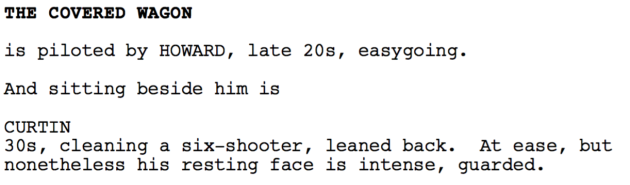
It’s a best of both worlds scenario. The only benefit of “wall of text” writing is that the sentences visually connect one after another so it feels like one continuous thought. The problem with walls of text is that they’re daunting and readers feel overwhelmed by them.
With a continuous writing style, we jump down to a new paragraph, and yet we’re still within the same thought, action, or description. However, we don’t have to deal with the cumbersome mass of text that usually accompanies that kind of connective writing.
Rios is a such a snazzy writer, he even innovated the format. More on that in a second. But first, let’s learn what this script is about.
30-something Abner Ellis is a lot like Daniel Plainview from There Will Be Blood. He’s an ambitious man who wants to take advantage of a country that’s still in its infancy. He’s got a beautiful wife, Elspeth, and a handsome little boy, Benjamin, who he plans to bring along on this journey.
The problem is, Abner is poor as shit. And back then, the only way to make money was to have money (actually, that hasn’t changed). Unfortunately, Abner’s been stuck in a string of low-paying jobs that eventually brings him to the Trans-Continental railroad.
While working for 2 dollars a day clearing land, Abner lucks out when he finds a barrel of gold in the nearby forest. Sure, there are four dead men laying by it, all of whom killed each other over the stash. But that’s the last thing on Abner’s mind. He’s finally in the game.
Abner moves his family up to Wyoming where he puts his grand plan into motion. Abner will build an entire town that the brand new railroad will run through. Elsbeth isn’t so sure, but Abner’s dogged determination to make something of his life eventually convinces her.
There’s one problem. Abner’s losing it. He’s so obsessed with his barrel of gold and so convinced that the next guy is around the corner, plotting to steal it, that he becomes more protective of it than he does his own family. And when real threats do surface, he’ll do anything to keep his gold. Even if it means killing those closest to him.
You’re dying to know what that innovation is, right? Okay, let’s do it.
One of the annoying things about reading is the inefficient syntax that delineates DAY from NIGHT at the end of a slugline. Most of the time, readers shoot past slugs to get to the important stuff, and often become confused as a result, needing to back up and check what the slug said to gain context. DAY and NIGHT are just one casualty of this glitch.
So Rios REVERSE BLOCKS his nighttime slugs. This way, we get an instantaneous VISUAL CUE that it’s night time. It’s genius! This was the first script I’ve read where I instantly knew whether it was night or day without having to read anything.
Daytime slug example —> 
Nighttime slug example —> 
Now if someone could invent a visual slug that also delineated EXTERIOR and INTERIOR we could streamline screenwriting forever and push these janky math-like documents one step closer to a natural storytelling medium.
Well that’s great, Script Nerd Carson. But what about the script?
The script was great. There were so many hallmarks of good storytelling here.
Start with Abner. Scripts work better when the main character has a strong drive. Not only do we like people who are driven more than those who aren’t, but driven characters create a natural reason for us to keep reading. We want to see if the character is going to achieve what they’re driven to do.
Abner wants nothing more than to become great. So we want to see if he can do it.
Contrast that with a character who’s fine with where he is in life. Maybe something terrible happens to him and that’s what begins his story. You can still write a good script this way, but the story’s always going to be more powerful and the main character more likable when it’s HIM WANTING SOMETHING that drives the story as opposed to the story driving him.
But what really placed this script above so many others was the VARIETY IN STORYTELLING. What this means is that when you write a movie like Taken or Bourne, there’s only one beat being repeated throughout the movie – CHARGE THROUGH OBSTACLES TO CONQUER THE GOAL (“take down the CIA” in Bourne, “find my daughter” in Taken).
That can get tiring if every section is like that. Sometimes what intermediate writers will do to alleviate this is write a slow “sit-down-and-talk” scene. But all that does is momentarily alter the pacing. It doesn’t add VARIETY to the way the story is being told.
Variety in storytelling means creating entire sections that have a different purpose and feel than other sections. When you do this right it’s like magic because it keeps the reader off-balance and unable to tell where the story is going.
For example, early on we have a section where Abner goes off to make money on the railroad. It’s a goal-oriented sequence – get a job to support my family. However, when Abner brings the gold home, that section is entirely different. It has no goal. Instead, Rios builds a sense of fear surrounding the gold – that someone may have followed Abner and is planning to kill the family and take the gold.
So even though we’re sitting in one location for 15 pages, we have something that’s driving our interest – a potential threat from outside. And that fear permeates every scene. More importantly to my point, IT FEELS COMPLETELY DIFFERENT FROM THE RAILROAD SECTION.
So that’s something to keep in mind – that you’re not hitting the same story beat over and over again every sequence. Granted, it’s easier to do this when the timeline is extended, like it is here, but crafty writers can achieve this in time-crunched narratives as well.
The only reservation I have about the script is that the ending gets really dark. The whole movie was such a rush and then we’re hit with this hard-to-take finale. I guess it was inevitable but still tough to swallow. However, if you liked There Will Be Blood and The Shining, you’re going to go fucking go apeshit over this.
What a script!
[ ] What the hell did I just read?
[ ] wasn’t for me
[ ] worth the read
[x] impressive
[ ] genius
What I learned: There’s no need to draw attention to jumps in time (writing down: “6 months later”). Remember that time jumps can kill plot momentum. We’re zipping along and then we see: “1 Year Later.” We feel the wind sucked out of the plot. We’ve got to start building momentum all over again. For that reason, only notate time jumps if it’s necessary for clarity. Otherwise, do what Rios does here and use visual cues to show we’ve jumped forward. For example, we’re on an empty strip of land that Abner’s just purchased for his town, than we cut to an almost completed train station and we just seamlessly keep moving through the story.
It’s 2017. You’re wondering what you should write. I’ve got good news. I’M GOING TO TELL YOU! There isn’t a person on this planet who knows what screenplays Hollywood’s buying better than me (it’s the new year, let me hyperbolize). But seriously, we know that Hollywood currently hates spec scripts. And who can blame them. The last three major spec sales (Collateral Beauty, Allied, Passengers), all underperformed this winter. If they had it their way, everything would be IP from this point forward.
But fear not! There are still plenty of script options a screenwriter can write and still sell. That’s what today’s article is about. I’m going to give you ten PROVEN genres that Hollywood will eagerly snatch up as long as you deliver the goods. Are you ready? Start taking notes. Cause this article is going to change your life!
Biopic – The biopic is still chugging along. Why? Simple. A-list actors are no longer needed to drive major tentpoles. Those A-list actors had to go somewhere to stay relevant. Enter the biopic, where they get to play famous historical figures and earn Oscar nominations. Who wouldn’t sign up for that? However, keep in mind that this genre is getting crowded. Everyone’s writing in it. So make sure you’re not phoning it in (i.e. don’t research your subject on Wikipedia). Find a unique and interesting way to tell the story so your biopic stands out from the rest!
True Story – This is the fastest growing spec genre out there and, in a way, the biopic’s little brother. But unlike a biopic, the subject doesn’t have to be super-famous. They need only have been involved in a fascinating true-life story. I’ve always wanted to write the real life story of Roswell (not the tin-foil hat version, but one based on facts and real interviews from those involved). Find that true story that you find fascinating, like yesterday’s David Steeves survival tale. Or the infamous “Astronaut Diaper” story chronicled in Pale Blue Dot. Or even the freaky tale about the woman who went crazy at that Los Angeles hotel and ended up in the water supply. So many great real life stories to choose from.
Female-Driven Anything – Ghostbusters didn’t deter Hollywood from their infatuation with female-driven fare. They want more female led films, both fiction and non-fiction alike. Action and comedy are the sweet spots because audiences pay the most for ass-kicking and laughs. But as long as you’ve got a great idea with a female in the lead, you should be good.
Budget-Conscious Action Spec with Franchise Potential – Action will never die. It’s the only genre that will play well in every single country it’s shown. The tough thing about action is finding an idea that hasn’t already been done before. John Wick’s secret society hitman world was cool. And while I didn’t like The Accountant, its non-traditional main character made for a unique take on the action genre. Also, you want to think franchise. So don’t make the film too self-contained. It should hint at bigger things to come. Also, don’t blow the roof off the doors with your budget. In order for something non-IP to get made, the first film will need to come in at a price, probably between 60-70 million. If the movie does well, the franchise begins, baby.
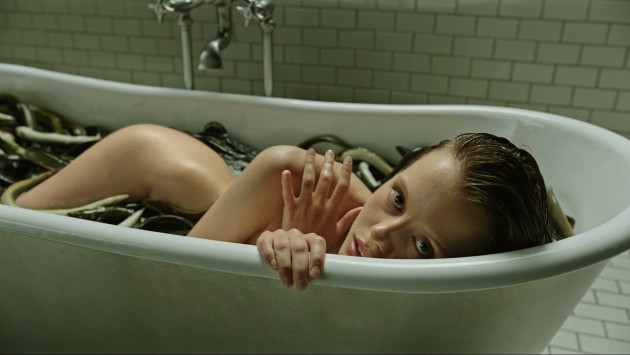
Horror Spec – The horror space is THE most competitive genre of them all. Horror has the biggest cost-to-potential-profit margin of any genre out there. A 2 million dollar film can pull in 100 million at the box office. No other genre even comes close to that kind of upside. For that reason, don’t give me another movie about zombies in the forest. You have to be unique. You have to find another way in. A good comp is A Cure for Wellness, the new horror film coming out from Gore Verbinski. It doesn’t quite feel like something we’ve seen in the horror genre before.
A spec in the superhero universe that isn’t about traditional superheroes – Newsflash. Hollywood is obsessed with superheroes. However, you don’t have access to the millions of dollars required to purchase famous superhero characters and write about them. Therefore, get creative. Find a superhero idea that’s not quite about superheroes. For example, a team of famous superheroes suddenly lose their powers and must integrate into society as normal people for the first time in their lives (think a famous boy band after the glitz and glamour is all gone). Something like that, where you’re coming at the genre from a different angle. Hmm, that’s actually a good idea. Maybe I’ll write that.
A “Voice” Spec – If people always tell you that you have a unique perspective of the world, or you see things in a different way, consider writing a script that highlights your voice. The great thing about writing a “voice” script is that you don’t have to write about anything exceptional. Your VOICE is the exceptional part. You can write about a guy with a shitty job, as long as you give us a perspective on guys with shitty jobs that we haven’t seen before. One note: Vocie-y writers go off the reservation too often. Voice is good, but you still need a story that goes somewhere, or explores something universal. Eternal Sunshine of the Spotless Mind was a very voice-y script, but it was exploring something universal – our fear of getting hurt, our struggles to overcome our past. It wasn’t the dreaded “rambling voice,” which is where bad voice scripts go badder.
Swords and Sandals Spec – I’m always looking for that genre that’s traditionally done well at the box office but hasn’t had a hit in awhile. The last swords and sandals hit was the Pirates movies. But the Pirates movies have become stale. I think a good swords and sandals script has the potential to explode onto the market. One note: HUMOR. I believe the reason Pirates did well while the recent Gods of Egypt did not was how well-done the humor was in Pirates. In fact, I was watching The Princess Bride the other day and thinking, “Someone needs to write the next Princess Bride!” A self-referential comedic swords and sandals movie? Start counting your money now.
A Forward-Thinking Spec – Our world is changing faster than it ever has before. Instagram, Uber, Fake News, Fake lives on Facebook, self-driving cars, our every movement being tracked, phone addiction, life disconnection — All of these things are dramatic elements that could be integrated into your next screenplay. Because if you’re writing a movie that could’ve been written in 1996, or even 2006, it’s probably not going to feel fresh. A comedy about what would happen to millennials if the internet went down for a week. I’d go see that. Shit, that’s another good idea. Why am I giving these away?
That Weird Idea You Have – This is actually the best time to write something weird, since the entire spec market has become so homogenized. There’s never been a time in history where more of the same hasn’t been peddled to film audiences. Your weird idea is going to stand out so much more than it did in the past. The weird idea spec may not sell, but like a good voice spec, it can catapult you into the industry and get you tons of work.
Sorry about the lack of posts. I was at LAX all night yesterday trying to get back to the Midwest. I didn’t make it but it looks like a Christmas miracle might get me out tonight. Before we move on to today’s article, I want to beg every traveler out there to please never fly American Airlines for the rest of your lives. Not only is it a terrible airline as far as comfort and customer service, but they have to be the most clueless airline company on the planet.
After being bumped 3 times last night to later and later flights, my last flight changed gates ELEVEN TIMES. That is not a printing error nor is it an exaggeration. In addition to this, I saw three women break down, fall to the floor, and start crying, due to how much they’d been dicked around all night, and one man lead a 30 person revolt against the gate attendant. It was insane.
After we’d changed gates for the 10th time, American Airlines kept saying we couldn’t board because the plane outside was broken, and they needed to tow it out before they could bring in “our plane.” We waited an hour for this towing to happen. Finally, when they moved us to our 11th and final gate, which did not have a plane in it, many astute passengers pointed out that since they no longer needed to tow a plane away, they could bring “our plane” up and start boarding. American Airlines, clearly caught in a lie, quickly moved to a new excuse about air traffic being broken or something.
I know the holidays are crazy for air travel but I’m not basing my critique here on just this experience. Every time I have flown American Airlines, it has been terrible. I only flew them this time because I had to. But I will never fly them again after this. It was the last straw.
Now, on to funner topics!
Because I don’t have time to write an in-depth article or review, I thought I’d share with you some brief thoughts on a screenwriting concept that’s always frustrated me: THEME
Theme has always been a tricky concept. To this day, I’m yet to meet someone who’s given me a definition for theme that doesn’t sound bullshitty (this is why theme posts get debated so vigorously – since there is no definition, everyone’s interpretation is different). But the other day I stumbled upon a Youtube video covering academia and had a mini-revelation. As I retroactively tested that revelation, I realized how much sense it made.
The idea is this. “Theme” comes in two flavors – simple and complex. BOTH can work effectively. You can use the simple version of theme and still write a good movie. In fact, I’d argue that the simple version gives you a better chance at writing a good movie. However, the complex version gives you a chance at writing a GREAT movie.
But before we get into that, let’s remind ourselves why we’d want a theme in the first place. A theme is there to keep your story focused. Whenever you lose your way, like a lighthouse, the theme is there to steer you back on course. Without a theme, your script seems scattered, confused, and unsure of what it’s trying to say.
If you were to grade this article on theme, for example, it would fail. I started out talking about how shitty American Airlines was before moving onto a screenwriting article. That’s thematically inconsistent, which is why this article feels messy. You could argue that because I just referenced my opening to prove a point about theme, that the theme for this article is intact, but that’s a debate for another time.
On to “simple theme.” The simple version of theme is the act of wrapping everything around a single idea. That idea can be anything! Take the Star Wars movies. A common theme I’ve heard thrown around for them is “Good vs. Evil.” As long as you play out the struggle of good vs. evil, the movie’s going to feel consistent and whole. However, if a storyline popped up in Star Wars about a character who was obsessed with money and needed to have all the money in the universe, you’d be like, “Uh, what the hell does this have to do with Star Wars?”
Or take Zootopia. The theme there is that we can be anything we want if we put our minds to it. It’s a simple easy to follow formula that gives your movie a point. And since Star Wars and Zootopia are both awesome movies, we know this type of theme works.
Now let’s move to the complex version of theme. To achieve this, we’ll be transforming the word itself. “Theme” will now become “Thesis.” The idea with a thesis is to create a question or theory that has to be proven or debated over the course of the story. Whereas bigger budget Hollywood fare will lean on theme to power its core, character pieces rely more on a thesis. And the best way to understand the power of a thesis is to compare two similar character pieces, one that used a theme, the other that used a thesis.
The first is Sully. Sully was boring as shit. Why was it boring as shit? Because the theme was boring as shit. What was that theme: Heroism. That’s it! A man being a hero. Now yes, that kept the story consistent throughout its running time. We were never confused about what Sully was about. But because this was a character piece, it needed a thesis, something that forced us to think a little more.
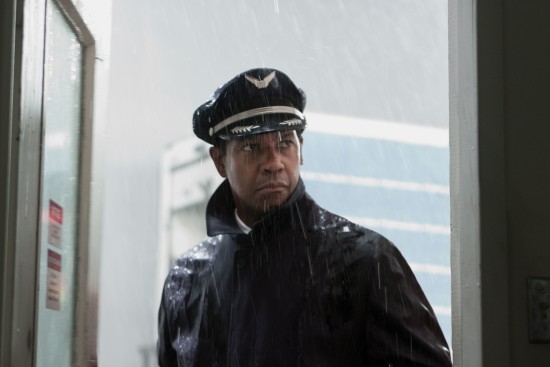
Bring in Flight. Flight based its screenplay on a thesis, that thesis being: “Can a bad person still be a hero?” Denzel Washington’s captain character put 250 peoples’ lives at risk by drinking all night and snorting up coke before he piloted that flight. But he still ended up pulling off a radical maneuver that saved most of the passengers’ lives. Notice how, by using a thesis, the story becomes a lot more complex. We’re not sure what we think of Whip. Yeah, he saved all those people, but he shouldn’t have gotten on that plane fucked up in the first place.
In both cases, we have something to center the story on. But in one, that something merely represents what’s going on, whereas in the other, it forces us to continually ask a question. Can bad people be heroes?
Hey wait a minute. My last two examples were about airplanes. Maybe this article is more theme-centric than I gave it credit for.
I’ll finish by saying this. If you’re just starting out in screenwriting, whether you’re writing a Hollywood movie or a character piece, go with a theme. Even if you’re experienced and you’re writing a Hollywood movie, go with a theme. The only people for whom I’d encourage using a thesis are seasoned screenwriters who are writing character pieces. I say this because I’ve seen beginner screenwriters try and use theses and they always make it too complicated on themselves. By trying to make their stories so intelligent and thematically resonant, they forget to actually make them entertaining. Don’t be one of those guys.
HAPPY HOLIDAYS!!!