
Search Results for: F word
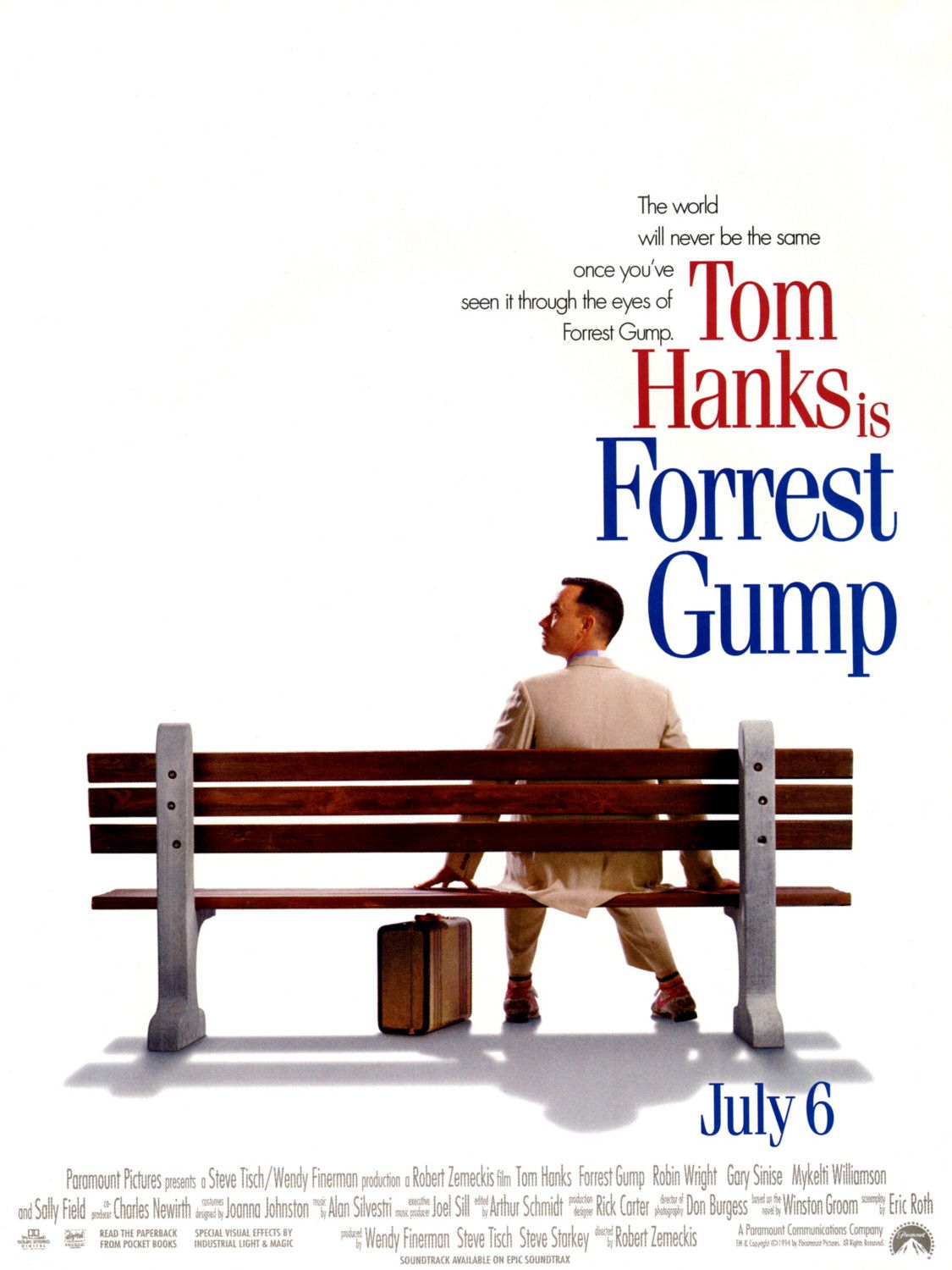
Forrest Gump may be one of the biggest anomalies in the history of moviemaking. There’s nothing here to indicate it should’ve worked besides, maybe, Tom Hanks. As a story, it goes against pretty much every rule out there. There is no goal. There are no obstacles. There’s no urgency. No real stakes to speak of. Yet it was the highest grossing movie the year it came out. It won the Oscar for best picture, best director, best screenplay. It was widely successful on just about every level. Eric Roth (who adapted the novel) is a fascinating writer. In his 30 year career, he’s never once written a spec script (until last year, ironically, when he penned a mysterious sci-fi project). He doesn’t seem to have read or studied screenwriting on any level. His approach is very much intuitive. If you look at his body of work (Benjamin Button, Extremely Loud and Incredibly Close, The Insider) he appears to eschew structure. His style is more flowy, almost like he’s following the story wherever it takes him, as long as that avenue is interesting. It’s an approach that many screenwriters attempt and fail at, but for some reason it works for him. Of course, some may argue it doesn’t. Forrest Gump is one of the most polarizing movies out there. I think it’s great, but many people absolutely despise it. Either way, it’s such a unique movie that I thought I’d break it down and see if I couldn’t find some cool screenwriting tips from it. Let’s give it a shot…
1) Say it with me: UN-DER-DOG – Forrest Gump reminds us how damn likable the underdog character is. Think about it. Who doesn’t like an underdog? And Forrest is the king of the underdogs. He’s a simpleton. He’s got leg braces. Everyone makes fun of him. He wants a girl he can never have. It’s impossible not to root for this guy. And if you have an audience rooting for your character, you’ve done the majority of your work. Rootforability accounts for probably 80% of Forrest Gump’s success. We just love this character.
2) Take some risks in your screenplay – One of the constants in Forrest Gump is that it takes tons of chances, and risky ones at that. Forrest’s great grandfather started the Ku Klux Klan. His mother prostitutes herself to the principal to keep Forrest in school. These aren’t things you’d typically associate with a “feel good” movie. Therefore it’s one of the reasons Forrest Gump feels different from every other movie out there.
3) But only if you have a great character – I’m all for taking chances. Forrest Gump proves how good a movie can be when you take risks. But if you’re going to take risks, make sure you have one hell of a main character, as he’ll act as a safety net for risks gone wrong. Forrest Gump, love him or hate him, is an unforgettable character. He alone is the reason this script can buck traditional structure and still get away with it. Taking huge story risks with average characters (or even “good” characters) is probably a death wish.
4) CONFLICT ALERT – Remember that if your script lacks structure, there better be some major forms of conflict to drive the drama. Preferably, you’d like one big EXTERIOR conflict and one big INTERIOR conflict. The exterior conflict here is that Forrest loves Jenny, but she doesn’t love him back. The interior conflict is Forrest’s desire to be smart when he’s dumb. These two conflicts drive the majority of the story’s emotional component.
5) If you don’t have a goal driving your movie, make use of “The Dramatic Question” – You all know how much I like character goals. Yet there aren’t any in Forrest Gump. We’re just experiencing Forrest’s crazy life along with him. So, if you find yourself writing that kind of movie, make sure you AT LEAST have a “Dramatic Question.” That’s a question whose answer has large ramifications for your central characters. In other words, it must be DRAMATIC. Here, the question is, “Will Forrest get Jenny?” That’s the only consistent dramatic aspect driving Forrest Gump, and because we care so much about Forrest and Jenny as characters, it’s a powerful one.
6) Look to add a visual element that symbolizes your story – Forrest starts with a feather floating along in the breeze. This feather symbolizes Forrest’s journey, which floats along unpredictably as well, Ferris never knowing where he’s going to end up next. That feather became one of the bigger talking points after the film was released.
7) We despise people who complain about their shitty lot in life and do nothing to change it – We already talked about how likable the underdog character is. Yet another reason why Forrest is so likable is that he has all these disadvantages, yet never uses them as an excuse. He always pushes forward and tries to make the best out of his situation. I can’t stress how likable these people are in both real life and in the movies. If you can write this type of character into your movie, do it. We’ll instantly fall in love with them. (note – while this is true for main characters, it isn’t for secondary characters, like Lt. Dan. Just make sure those characters change by the end of the movie)
8) The “Relationship Save The Cat” Moment – Lots of us focus on the ‘save the cat’ moment for our main character. But in a love story, I think you need a ‘save the cat’ moment for your couple as well. We need that moment that’s going to make us love them together, that’s going to make us want them to be together. To me, that moment comes when Jenny and Forrest hide from her drunken abusive father in the fields. It’s a “them against the world” moment that makes us sympathize and care for them.
9) IRONY ALERT – Irony is one of the most powerful tools in writing. Audiences LOVE IT. And it’s one of the reasons Forrest Gump is so popular. Forrest is the dumbest character in the movie, yet he’s the most successful character by far. This movie doesn’t work without that irony. For example, if Forrest was smart and he achieved all this, we’d be bored because, duh, why wouldn’t he be successful? He’s super-smart.
10) Comedy is your main weapon to combat melodrama – Forrest Gump could’ve been SUPER melodramatic. It has Forrest’s best friend dying on the battlefield, his mother dying of cancer, and the love of his life dying of AIDS. But the film places comedy at such a high premium, that it balances those moments out. Without all the comedy here, those melodramatic moments would’ve sunk this script.
Every day writers give up on their dreams. What can The Imperfectionist teach us about minimizing that possibility?
Genre: Comedy/Drama
Premise: (my best interpretation of it) A loser husband lies to his adoring mother, telling her he sold a manuscript. When the lie spreads beyond the family, he plays along, not realizing the devastating effects it will have on himself and his daughter.
About: This script finished with 5 votes on the 2006 Black List. The writer, Craig Hoetger, was never able to parlay the achievement into anything bigger, and has since moved on to another profession.
Writer: Craig Hoetger
Details: 120 pages
 Seth Rogen for Dan?
So there I was, trying to do a good thing – trying to dig into these spec scripts of the past and find another forgotten gem. I didn’t know anything about this one other than that it was on the 2006 Black List, ranked fairly low (implying not many people had read it), and so it sounded like the perfect script to take a chance on.
And then I started reading it. And 30 pages in, I started regretting my decision. Why? Well, for starters, nothing was happening! And the things that WERE happening weren’t making a lot of sense. But I dutifully read on. Where others would’ve given up, I kept going, determined to make it to the end. And the script actually did start to develop a plot, but it was too late. By that point, I’d already given up.
However, it wasn’t until I started doing research on the writer that I perked up and realized there was a lesson to be learned in all of this. It turned out that our scribe, Craig Hoetger, had given up on his screenwriting career, moved back east, and become a lawyer. He’d spent 10 years pursuing his dream before quitting. And all I could think was, if he’d had the right education, he could’ve made it. And how there are thousands of writers just like him. Talented, but for one reason or another, not getting the proper instruction on how to write a screenplay. These writers were quitting every day. Believing they didn’t have the goods and moving on. I want to talk about that in a moment, but first a quick breakdown on the imperfect Imperfectionist…
Daniel Merton was a childhood genius. He could spell his name with alphabet soup letters when he was two. His older brother, Kyle, was the opposite. A baboon in human skin, he’d be lucky to spell his name after graduating high school. As a result, Dan was tabbed the golden child by their mom, Cookie, who saw to it that he always got the best education, the best opportunities in life. He eventually graduated law school, living up to his promise.
Except that was ten years ago. Dan is now married to the monstrous nagging wicked bitch of the west, Cat. His only achievement in life is his adorable little eight year old daughter, Sophie. These days, Dan is anything but a prodigy. He loses every job he gets within a year. He doesn’t have any drive. He can’t even succeed at the simplest of tasks – like re-organizing his books (books he never finished reading, by the way). In short, Dan has turned into a loser.
And when he gets canned from his latest job, his wife has had enough. She leaves him and Sophie. Dan is so broke that he can’t pay the bills anymore, so having no other options, he takes his daughter and heads back to his mother’s house in Michigan. Cookie is more than happy to see the prodigal son return, but Kyle, his brother, isn’t. Kyle, of course, is still living at home.
Fearful that his mother will find out he’s a failure, Dan comes up with a story that he’s sold a manuscript for a cool $100,000. His mother is so psyched, she starts telling all her friends, who in turn tell their friends. While at a local town rally the next day, Dan’s achievement is announced to the entire crowd, and Dan finds himself being shuttled up to the microphone. He sees so many expectant eyes that he expands on his lie, telling everyone that not only did he sell the novel, but it’s going to be the next book on Oprah’s Book Club!
While this helps him achieve momentary celebrity status, Dan must explain to his confused daughter why it is he’s lying to everyone. She knows the truth, that Dan has written a total of 2 chapters of his “novel” in 4 years. Whatever the case, it doesn’t take long for the town to catch up with him and his lie to be exposed. Which leaves Dan at his lowest point of all. Will he find a way out? Will he resolve his issues with his wife, brother, and daughter? He’ll have to if he has any chance of salvaging what’s become one pitiful life.
The Imperfectionist has a lot of problems. Starting with the most obvious. It takes WAY TOO FREAKING LONG TO GET TO THE PLOT. A common beginner mistake. Now I’m assuming this script is about a guy who tells his town that he sold a book and then dealing with the aftermath of the lie. Here’s the thing though – we don’t get to that lie until AFTER PAGE 60! That means the plot of this movie isn’t introduced until half-way through the script!
Before that, I had no idea what The Imperfectionist was about (I didn’t have the benefit of a logline). The first act contained another common beginner error – the constant repeating of information we already knew. Dan gets fired. Dan’s wife tells him he’s a loser. We’re told Dan’s lost other jobs. Dan doesn’t pay his bills. Dan chooses porn over paying his bills. In other words, Dan is a LOSER. But we didn’t need 12 scenes to tell us that. We understood it after the first scene. No wonder we don’t get to the plot until the midpoint – we’ve spent the entire first act telling us over and over again that Dan is a loser!
There are a lot of other problems here (How Dan went from a super-genius to a super-loser is never clearly explained, leaving us baffled and confused for most of the story) but that’s not the point. The point is, Hoetger is like a lot of screenwriters. Guys come to Hollywood every day hoping to become screenwriters. Some spend a year or two here while others spend an entire decade (or more!). A lot of them don’t make it. And a huge reason for that is that they’re never told how to write a fucking screenplay!
I mean, these are basic problems in this script. You don’t need 12 scenes to tell us who your freaking protagonist is. A good writer needs 1. You don’t introduce your plot on page 60. You do it as soon as possible. Dan should’ve been fired by his boss by page 5, headed back to his hometown by page 10, and lied to his mom about the book by page 25. This is basic screenwriting 101 here. Get to your story as soon as possible! For whatever reason, tons of wannabe screenwriters don’t seek out the widely available number of books (or websites, or professional screenplays, or teachers) that explain how to do this stuff.
And in Craig’s situation, it was even worse! The Imperfectionist made the Black List (for what I’m assuming were a few clever moments sprinkled throughout) which told Craig that that was the proper way to write a script. You don’t need to move your story along quickly. You don’t need to get to the point quickly. So he continued writing screenplays for another five years believing that that was the correct way to write. No wonder he never found success. Had he gotten professional feedback or read a hundred scripts or a half-dozen screenwriting books, he would’ve realized that these were major mistakes that needed to be corrected, regardless of what his cheerleading agents were telling him.
I say this because I can tell, under the right guidance, Craig could have forged a career in this business. The writing here is pretty good. It’s just that there are some giant structural issues and inconsistencies in the way the characters were portrayed. Those things could’ve been fixed with the right feedback. It just terrifies me that there are all these aspiring writers out there like Craig who don’t know to study the craft and who are subsequently making basic correctable mistakes over and over again in all their screenplays, and who will therefore have to abort their dreams at some point. Study, people. Learn. Get feedback. Read scripts. Take classes. Know how to tell a story. By doing so, you give yourself the best chance at success in this business.
[ ] what the hell did I just read?
[x] wasn’t for me
[ ] worth the read
[ ] impressive
[ ] genius
What I learned: This is the third script I read this week where the writer kept repeating the same information over and over again about his main character in the first act. If you do it right, all you need is one scene to establish your hero, then you get on with your story.
We don’t get to talk about the action spec much, which means today’s review is going to be an education on the matter…
Genre: Action
Premise: (from IMDB) Disgraced former Presidential guard Mike Banning finds himself trapped inside the White House in the wake of a terrorist attack; using his inside knowledge, Banning works with national security to rescue the President from his kidnappers.
About: Writers (and married couple) Creighton Rothenberger and Katrin Benedikt had been writing together for over a decade before they sold their first script, Olympus Has Fallen. Rothenberger had actually won the Nicholl competition all the way back in 2002 (with a Korean war epic – total Nicholl-bait!). They struggled with numerous near misses over the next decade before signing with Gersh and Kaplan-Perrone off a script they wrote called “Cali.” The reps read through their entire body of work – 20 scripts – and said that Olympus Has Fallen was the one they wanted to go out with. However, they first spent a year revising the script, mainly updating it from its original incarnation, which was dated. The movie was then purchased by Millineum and got Aaron Eckhart and Gerard Butler and Morgan Freeman attached. Antoine Fuqua directed the film. It just came out this weekend and finished second at the box office with a 30 million dollar take.
Writers: Creighton Rothenberger and Katrin Benedikt
Details: 115 pages

The reason I wanted to review Olympus Has Fallen was simple: Action. Producers want action scripts. Why? Action films have the potential to make more money than any other genre because action sells everywhere. The guy who lives in the middle of the desert in Nigeria isn’t going to turn on an action movie and go, “Wait, what’s going on? I don’t understand. Why are things blowing up?” Blowing-up is a universal language.
Artistically, I have a problem with this. It hurts to admit that the writing of a movie doesn’t matter to the guy in Spain who doesn’t understand English. As long as his action appetite is satiated with enough car chases and explosions, he’s happy. To that end, it’s appropriate to point out that the most important aspect of an action spec is the concept. If you’ve got something a little unique that we haven’t seen before that has the potential for a lot of great action scenes, your spec has a chance of getting picked up.
But here’s why that’s not all you need, despite most writers believing that’s the case. The guy in Nigeria may not be discerning of what your love interest’s backstory is. But the guy at a studio desk in Hollywood is. You see, he gets hundreds of action scripts to read. So he’s going to be weighing all of them against each other. Concept will be the biggest determinant. But he’s also looking at execution, originality, castablity, character, etc. Therefore, contrary to popular belief, quality does matter.
Mike Banning is your typical secret service agent. The guy is big. Looks former athlete’ish. Flashes that alpha male smile. Or at least, he USED TO flash a smile. Not after tonight though. While hanging with the prez at Camp David, Banning is unable to save Mrs. President from falling through the ice pond and dying a cold airless death! Banning never mentally recovers from the ordeal, and when we cut to two years later, we see that he’s now a Secret Service GROUP agent. That’s, like, the level BELOW the lead agents! Olympus has fallen? More like Banning has fallen! Right after the First Lady has fallen. Through the ice!
President Benjamin Asher doesn’t have time to dwell on dead wives though. Tensions are heating up between North and South Korea, and decisions have to be made on how the U.S. will respond. South Korea’s new president decides to come to the U.S. to personally ask the president for help, but soon finds out he’s got his own secret service issues. Once in the White House, the head of his security, a nasty little bugger named Kang, snaps his fingers and his entire team enacts a plan to take over the White House! Looks like Kang is secretly North Korean! And he’s come here to re-unite his country with his Southern brothers!
In the meantime, Banning is off on the outskirts of the city doing some menial task when he sees a bunch of explosions and stuff in the distance. So he hops in a sewer and starts the long underground trek to the White House. At some point during his smelly stroll, Kang reveals that he wants the codes to a secret defense project called “Cerberus.” Everyone in the U.S. cabinet looks at each other with bulged eyes. How does he know about Cerberus???? But that should be the least of their worries. Because it turns out Kang isn’t here to re-unite the Koreas like originally assumed. His plan is MUCH more terrifying!
Beep beep boooop.
Scriptshadow verdict computing……….
Analysis…….
Well, I’ll say this. Olympus Has Fallen is better than most amateur action scripts I’ve read. Which may sound like good news. The problem is, I rarely come across a good amateur action script. That’s because most action writers just focus on the explosions. They don’t realize that the totality of explosions equals in a movie is maybe 2 minutes long and that there needs to be this thing called a, um, STORY in between.
Olympus has a story. But besides a few nice flashes (literally) in the first half, it’s a little too standard. I’m thinking the studio must have really REALLY loved this concept (concept is BIG in action scripts! Don’t bother writing an action spec without one!), because they allowed for a bit too much in the cliché department. In my opinion, if you’re going to write an action film, you gotta give us something different here and there. And there WERE some cool moments. For example, I liked when the North Korean plane came in and set off that blinding light weapon so that nobody could shoot them down. I’ve never seen that before. And the Cerberus storyline (which amounted to taking all American nuclear missiles off-line) was slightly…..er…different-ish than many of the plans I’ve seen in these movies.
And there were a few other things that told me I was reading a professional script here. Early on, as Banning is getting ready for work, he gets a phone call from a friend, and the resulting conversation tells us some things about his character. At the same time this is happening, Banning is watching the news, where reporters are telling us about the current North/South Korean situation. In other words, the scene is achieving TWO THINGS at once – exposition about Banning and exposition about the Koreas. Amateur writers would’ve typically separated these scenes. Pros are always looking to combine scenes so that they’re doing two/three things at once.
It’s also important to make the central plan in your action movie believable. You have to ask yourself, “How would this really happen?” and go from there. The more convincing you can be, the more you’re going to pull your audience in. I see too many amateur scripts where the writers don’t even consider this and as a result the reader is taken out of the story immediately. Within the context of the movie, the plan here was pretty believable. I had some reservations about the U.S. letting a C-130 cargo plane fly up to the White House (they do stop it but not before it’s able to help enact the plan), but the stuff on the ground was sound.
The big problem with Olympus Has Fallen – and I’m kinda shocked writers with ten years of experience made this mistake – is that its main character is sooooooo boring. Or maybe “boring” isn’t the word. “Standard” may be better. I’m actually not surprised that Gerard Butler plays the role of Banning because he’s the real-world equivalent of “standard” and “boring.” Despite Banning being the hero here, he doesn’t say or do much! I mean, he’s running around in the underground tunnels and running around in the White House, but I never really felt like I knew the guy because he didn’t say anything, ever!
It’s interesting, the White House Down spec (the competing White House hijack project that’s coming out this summer) took another approach. It paired its hero with the president, allowing for conversation between the two so we could get to know him. Then, of course, Die Hard has McClane talking to the cop (via radio) down below so we could get to know him. Banning doesn’t say much because he’s got nobody to talk to, poor guy. And in a movie market where we’ve seen a million agent-types before, you’re going to need any opportunity possible to get us into the head of your agent so you can differentiate him from everyone else. Of course, this was the sale draft I read. They may have changed it in the film. But it was a real issue in the script.
So the lead-up to the White House takeover was fun. But Olympus falters due to its bland hero and cliché second half. Which leaves a lot of you asking, “Well wait, I thought this was supposed to be an example of how to do it right.” That’s the scary thing – it’s actually better than most action specs. While it may not have been original, it was very competent, and 99% of the action specs I read aren’t even that. Those professional touches like having double-duty scenes, combined with a perfect execution of the three-act structure are things I don’t see in amateur screenplays. I’m still waiting for that kick ass modern-day Die Hard spec to give today’s audiences their first action classic, but scripts like Olympus Has Fallen will have to do in the meantime.
[ ] what the hell did I just read?
[x] wasn’t for me
[ ] worth the read
[ ] impressive
[ ] genius
What I learned: This is a great reminder that these are the people you’re competing against as a screenwriter – people who have been honing their craft for over a decade, people who have won the Nicholl competition 10 years ago, people who have seen and experienced every kind of writing obstacle one can encounter and figuring out how to overcome it. Chances are, if you’re not throwing everything you can into your own writing, you won’t be able to compete with these guys.

I remember sitting in front of my computer six years ago and thinking, “What now?” I felt helpless. I felt lost. I felt blind. I’d been trying to break into this business known as “screenwriting” for years and I didn’t feel any closer now than I did when I started.
I’m sure all of you know what I’m talking about. That elusive job title known as “professional screenwriter” can seem so far away. Especially if you’re trying to break in from places like Ohio or Florida or Germany or Canada. Maybe you have a family or a job that takes up all of your time. You can only manage to write an hour a day, if you’re lucky. Heck, I remember a few weeks ago an amateur writer telling us that the only time he had to write was on his way to work on the train. So he was writing his script on his iPhone!
And yet, even though you put all that work in, even though you care so much, even though the only thing you can see yourself doing in life is writing movies that the public goes to see every weekend, the business always feels a million miles away. You’re one of hundreds of thousands of wannabe writers trying to get through the door. How do you differentiate yourself? How do you get this industry to notice you?
What’s even more frustrating is seeing these scripts that DO get writers through the door, especially some of these Black List scripts – supposedly the best scripts in town. The stories are thin. The characters are cheesy. If this is what’s needed to break through, then why haven’t YOU broken through? You begin to think the game is rigged. That the only way in is to “know someone.” And how can you know anyone? You’re in freaking Ohio! The closest thing you have to a Hollywood contact is your old gym teacher, who once was an alternate contestant on The Price Is Right.
So here’s the big question. How do you break into this exclusive club? What’s the secret? Well, I have good news for you. It’s not as impossible as it looks. The game isn’t rigged. Every producer, manager, and agent I know is DYING to find the next great script. Great scripts are what make their careers. Yeah, there are some top dogs who have their network of writers and directors who help them put together 100 million dollar movies whenever they want but those are the exceptions to the rule. Everyone else out there is desperate for an awesome script.
The first thing you gotta do is be honest with yourself. Are you in this for the long haul? If you’re not, screenwriting probably isn’t for you. Except for a handful of lucky souls, every successful writer I know has paid his dues. He’s written screenplays for at least five years. And there’s a reason it’s taken so long. Five years is the minimum amount of time it takes for writers to learn how to write a good screenplay. This craft is a lot harder than it looks. It’s a very specific type of writing that takes time to master. This is actually a good thing. That process weeds out the posers, the hucksters, the lazy wannabes, the writers who aren’t serious. It allows these guys to write a couple of bad action flicks and disappear forever. The only people who succeed here are the ones who are serious about it. Who keep writing, who keep learning, who keep reading scripts. Think about it. You’re competing against hundreds of thousands, maybe even millions of people. Half-ass is never going to cut it.
Assuming you’re serious, one of the most important elements to your success is: GET YOUR SCRIPTS OUT THERE TO AS MANY PEOPLE AS POSSIBLE. There was a time, back in the 90s, where script secrecy was an important aspect to getting your script sold. Agents liked to tease a script, build up buzz, blanket the town with it all at once, and start fielding offers within a few hours. It just doesn’t work like that anymore. We’re too connected. Information and reaction via tracking boards and private backchannel communication helps sniff out the fact that most of these scripts aren’t very good. You can’t dupe the decision-makers anymore.
This is both bad and good. Bad because less writers sell scripts, but good because scripts now sell on their merits alone. In other words, the way to sell something is to write something truly good. Now as I’ve said before, there are still ways to game the system, to get bad stuff sold. But most of those ways are only available to working screenwriters. You’re not in the system yet. You’re an unknown. And for an unknown, the only way in is if your script kicks ass. Which brings me back to my point. If you write a good script, there’s no need for secrecy. A good script WILL sell. Look at The Disciple Program. That went out and everyone in town read it. The agency then pulled it back, packaged it, went out with it two full months later, and it sold. The fact that everyone already saw it didn’t prevent its success.
But even if you’re not as lucky as Disciple Program, the truth is that 95% of writers these days break in because they write something that gets around town and that a lot of people like. That’s their way into the business. So in my opinion, you should stop focusing on that elusive spec sale and just get your script to as many people as possible! The more people who read your script and like it, the more likely it is that someone’s going to offer you a rewrite job. And as soon as that happens, you’re in the business. It may be the fringe of the business, but you’ve gotten your foot in the door, which means the next script you send out there, more people will be eager to read it, and you’ll have a better chance of selling it (or it leading to an even bigger job). Almost every one of your favorite writers had a 2-3 year period where they were writing SyFy channel movies or uncredited rewrites for movies like Halloween 12. The writing business is just like any business. You have to work your way up. So after making sure your script is good (from honest friends to writing group feedback to getting a consultant to give you their honest opinion), I’m telling you: GET IT TO AS MANY PEOPLE AS POSSIBLE. I’ve never met a writer yet who’s found success by not letting anyone read his stuff.
Now that you’re in the right mindset, you need to come up with a plan. If you’re mindlessly writing scripts without any direction, unsure of what you’ll do once those scripts are finished, you’re not going to get anywhere. In a sense, you have to think like a producer. Not a producer of movies, but a producer of your own career. You have to gameplan, think about what you can write that will generate the most interest, think of how you’re going to market that material, how you’re going to get it in front of as many eyeballs as possible. The great thing about writing a screenplay now is that there are more avenues than ever to get your script read.
What’s the ideal plan? Well, everyone has to come up with their own approach, but if you’re asking for the plan that’s going to get you the most bang for your buck, this is what I’d suggest. Write at least two scripts in the SAME GENRE, and make sure that genre is marketable. That’s action, thriller, comedy, horror, or sci-fi. The reason you write two is because everyone wants to know what else you’ve got. If you’re lucky enough to garner someone’s interest, you don’t want to have to say to them, “Well I’m working on something that will be done in five months.” The buzz you created with that person will die and they might not even remember you after all that time. By having another script in the same genre ready to go, you’ve made yourself both professional and marketable. It’s always easier for these agents to sell a new writer if they have multiple scripts from them. Even more so if those scripts are in the same genre.
From there, blanket the industry on as many fronts as you can afford. Enter all the contests. Get your script set up on the amateur Black List website. Hire consultants who will send your material to industry contacts if they like it. Make friends in all the online screenwriting forums. Create a writer’s group (as the members of the group improve, more of them will have access to industry contacts). Cold e-mail query every mid-level manager, agent, and producer in Hollywood. I’ll say this again: NOBODY CAN BUY YOUR SCRIPT IF THEY DON’T KNOW ABOUT IT. So you have to ask yourself, what are you going to do to make sure everybody knows about your script?
Now of course, success is always dependent on the script you’re hawking. It has to actually be GOOD. There are a lot of writers out there who have created plans like this and not found success. But when I ask those writers how many scripts they’ve written, they respond with, “This is my first script.” Or, “I’m on number 2.” I’m not saying you’re not one of those lucky geniuses who can master the craft on your second try. I’m just saying it’s sure as hell not likely. That’s why I said before: MAKE SURE YOU’RE DEDICATED TO THE CRAFT. You gotta get to that point where you can gauge the level of your own material – know what’s good and what’s bad so you don’t put anything out there that sucks. And getting to that point takes awhile.
So in summary, make sure you’re dedicated to the craft. Put your head down and write a handful of screenplays. Once you hit your stride and start understanding screenwriting and what kind of screenwriter you are (what you do best), come up with a solid plan that includes two marketable genre scripts. Then get those scripts in front of as many eyeballs as possible. The better the writer you become + the more marketable your material + the more people who see your screenplay = your best chance at success. I’m rooting for you. Now get back to writing! ☺

Ghostbusters has one of the best comedy movie hooks ever. Dudes. Busting ghosts. It makes me nostalgic for the days of the high concept comedy. Nowadays, we’re inundated with all these low-concept comedies. A guy and a girl having relationship troubles? Welcome to the next big comedy starring Paul Rudd and Reese Witherspoon: THE RELATIONSHIP! I figure it’s only a matter of time before the high concept comedy makes a comeback. So I’ll just deal with it for now. Originally written by Dan Akroyd (eventually Ivan Reitman came on), the original concept for Ghostbusters was much bigger, with the Ghostbusters travelling through time and battling much more ambitious ghosts. But when Akroyd brought the script to Reitman, Reitman noted that it would be way too expensive to make, so Akroyd dialed the story back. Reitman also (wisely) encouraged Akroyd to ground the story in reality. Akroyd originally conceived of a dream cast that included Eddie Murphy, John Candy, and John Belushi. Belushi then died during the writing of the script, and Candy and Murphy weren’t interested. I’d say it turned out okay though, with Bill Murray coming in, and Akroyd and Harold Ramis filling out the roles of the other Ghostbusters. Now, as much as this script thrived due to its special effects and great performances, there are still a few things we can learn from the script itself. Let’s take a look…
1) Introduce MULTIPLE FACETS of your character in their intro scene – The more you can tell us about your character right away, the better. So with Venkman (Bill Murray) performing bogus telepathy tests on a couple of college coeds, we’re not just learning he’s a selfish womanizing jerk, we’re also establishing that he’s involved in the supernatural (telepathy), which is obviously a key element in our story. A lesser writer would’ve established Venkman at a fast food restaurant or in his car. By placing him in his element when we first meet him, we learn a lot more about the guy.
2) It’s okay to state the relationship of your characters in the descriptive text – Oftentimes in scripts, I struggle to understand one character’s relationship to another. The writer knows, but since it’s never been clearly stated, I don’t. Even though it’s technically a cheat, go ahead and DIRECTLY TELL US the relationship in the descriptive text. So here, when Stantz (Dan Akroyd) is introduced, we get this text: He is Venkman’s colleague and best friend. It’s blunt but it saves me a lot of confusion and possible assumption. You want to use this trick sparingly and only for your important relationships. But know that it’s there for you if you need it.
3) Science-Fiction Comedies are one of the most undervalued genres out there – Men In Black, Back To The Future, Ghostbusters, Hancock, Night At The Museum. These movies make tons of money and yet it’s still a genre I don’t see a lot of writers writing in. Take advantage of this niche market if possible.
4) If you don’t have an immediate goal, at least make sure things are moving forward – I’m all about the story goal. But I admit not every story fits perfectly into that model at all times. Like here, the initial goal for the Ghostbusters is vague: “Become paranormal investigators and start earning a living at it.” If that’s the case, just make sure your characters continue to WORK TOWARDS SOMETHING. As long as they’re moving forward, we’ll feel like the story is moving forward. Here, the Ghostbusters get office space, they get a car, they create a commercial. They’re not going after anything specific yet, but they’re still ACTIVE.
5) Comedies are one of the last remaining genres purely for spec writers – All the big fantasy stuff is adapted these days. Period pieces are often derived from books. Dramas as well. The occasional sci-fi spec will get through, but that too, studios prefer to be adapted. The only genres studios are always looking for in the spec market these days are basically comedies and thrillers. Another reason to dust off that comedy spec.
6) As soon as you hit your characters with a huge up, hit them with a huge down – This is a tried and true story device and seems to always work. After the Ghostbusters hit their first breakthrough – seeing a ghost for the first time, they get back to the University to find out they’ve been fired. Audiences love having their emotions ripped from one extreme to another. It’s the theme park equivalent of a roller coaster ride.
7) MID-POINT TWIST ALERT – Ghostbusters has a great mid-point twist. Remember, a mid-point twist should slightly twist the story in a new direction so it doesn’t get stale. Here, it’s when Dana (Sigourney Weaver) and Louis (her neighbor) become possessed. This sets the movie off in a much bigger and more dangerous direction (and as any good mid-point twist should do, it severely ups the stakes!).
8) Don’t tell us in the descriptive text that something is going to happen, then repeat that same information in the dialogue that follows – Ugh, this is such a distracting amateur move! So I was surprised to see it in the Ghostbusters screenplay. Akroyd writes in the description: Stantz is immediately intrigued by the idea but voices his reservations. Then STANTZ says: “I don’t know. That costs money. And the ecto-containment system we have in mind will require a load of bread to capitalize.” Why did you tell us he was voicing his reservations when we just saw him voice his reservations?? Try something like this description instead: Stantz is immediately intrigued by the idea but then— Then cut to the dialogue.
9) To spice up a scene, add an ulterior motive – Rarely are scenes any good when they’re ONLY about what’s going on. Typically, there needs to be something going on underneath the surface as well. An “ulterior motive” is a tried and true tool that automatically ups the entertainment level of a scene. For example, early on, Venkman goes to Dana’s apartment to check out the ghost activity she says she experienced. Alone this scene would’ve been pretty straight-forward. But Akroyd adds Venkman’s ulterior motive of trying to snag Dana, and all of a sudden this scene becomes fun. Take note that the “ulterior motive scene” doesn’t just work for comedy. It works in any genre.
10) Build quirks into your character for better dialogue – Venkman’s a sarcastic smart-ass. So he has fun little smartass comments. “May I see this storage facility?” our villain asks, in reference to the facility holding the captured ghosts. “No, you may not.” “And why not, Mr. Venkman?” “Because you didn’t say the magic word.” That dialogue derives directly from Venkman being a smartass. Spengler (Harold Ramis), on the other hand, is socially inept, unable to process sarcasm. When he’s looking for a ghost in the hotel and encounters a woman in her room wearing a towel, he asks, “Were you recently in the bathroom?” “What on earth gave you that idea?” she retorts sarcastically. “The wet towels, residual moisture on your lower limbs and hair, the redness in your cheeks.” Build those little quirks into your character from the get go and they’ll feed you good dialogue without you having to work for it.
BONUS TIP: Ellipses indicate a pause. Dashes indicate a character being cut off. – Elipses at the end of dialogue (…) are meant to indicate a pause. Dashes (–) at the end of dialogue are meant to show someone being cut off. I see these getting mixed up all the time and since they basically mean the opposite of each other, getting it wrong can really hurt your screenplay.
These are 10 tips from the movie “Ghostbusters.” To get 500 more screenwriting tips from movies as varied as “Eternal Sunshine Of The Spotless Mind,” “Pulp Fiction,” and “The Hangover,” check out my book, Scriptshadow Secrets, on Amazon!