
Search Results for: F word
Genre: Sci-Fi
Premise: The United States is in a race with China to become the first country to time travel. When an older pilot cheats his way onto the program, he positions himself to be the first ever time traveler.
About: Being pitched as “Interstellar meets Top Gun,” short story “The Barrier” became a hot package when rising star Austin Butler became attached. Winner of the package? 20th Century Fox, who knows themselves some sci-fi. Writer MacMillan Hedges has been reviewed on the site before with another time-travel script. This man loves himself some time-jumping!
Writer: MacMillan Hedges
Details: About 4000 words

There was some reluctance to check this one out because I’d read the writer’s previous time travel story, a screenplay, and let’s just say I thought there was too much going on.
But Carson, don’t you ALWAYS think there’s too much going on in screenplays? You know what? That very well may be the case. But it’s a valid argument because most of the time, THERE IS TOO MUCH GOING ON.
Screenplays, and short stories, need to have focused stories to truly take advantage of their mediums. And writers just jam too much shit into them. Or, even if they don’t have a lot of shit, they twist and turn the simple stuff they do have in ways that are unnecessarily confusing.
When you combine that issue with the nuclear shitshow that a lazily written time travel story can create, you’re asking for trouble, brother. Time travel movies are HARD TO WRITE.
I’m not saying don’t write them. Deep down in my heart I love time travel as a story device. But it’s hard to get right. So if you’re going to write a time travel story, you have to give 100%. Not 95%. Not 97%. Not even 99%. Cause that extra 1% is the difference between time travel plot holes and no time travel plot holes.
As for today’s story… I’ll say this. For 75% of the story, I had no idea where it was going. Then, out of nowhere, the main character’s purpose arrives and I said, “Oh, okay, that’s actually a story. Why didn’t we make that clear earlier?”
Confused? Let me break down the plot for you.
The Chinese have accidentally discovered time travel during a drone test. This freaks the U.S. military out. If China can develop a reliable Time Machine and send people back in time, they could erase the U.S.
So the U.S. puts all of its resources into making it to the time travel finish line first. The rules are this: Since it requires so much energy, they’re only going to be able to send one person. Pilot Karl Herseht is determined to be that guy. So he goes up against all these other dudes.
A key stage in the hiring process is the psychological evaluation. They put you through a lie detector test specifically to see if you have any past traumatic experiences. We don’t really understand why yet, but they really want to know if someone in your past died.
Here’s where things get a little complicated so stay with me. Karl is pretending to be someone else. How he’s able to trick the U.S. military into thinking he’s another person isn’t convincingly explained. But we realize later on why it needs to happen for the plot.
Karl does the old trick of jamming a nail in your foot to defeat the lie detector. He pretends he’s someone else so they don’t know about his secret past trauma – that Karl’s son drowned in their pool. When it happened, his wife was so devastated, she simply ran away.
When Karl wins the job, he goes through the training and then preps to be placed in some supersonic jet thing that will be dropped from the edge of space and then speed towards the earth fast enough that it will eventually create a time portal. And then he’ll eject and parachute to the ocean.
(Spoilers) Right before launch, the military discovers who Karl is and tries to stop him but he goes anyway. Once back in time, he runs over to his home from 20 years ago and rigs up his son to have a secret breathable mask underwater because Past Karl has to believe that his son dies so that Future Karl will come back to this time and save his son. After he and Past Wife “save” the son, they run away together.
I mean… there’s a lot to get into here if we want to.
We could start with the fact that the U.S. spent every single resource they had to create a Time Machine yet was unable to properly ID a member of their own military. There are some plot holes audiences will overlook. I’d be surprised if they’d look the other way on that one.
But let’s say we can get past that. Does the story work?
The problem I have with The Barrier is that it doesn’t show its hand until too late in the game. This means we’re stuck trying to figure out what’s going on the whole story. This can be a purposeful storytelling device, where you, the writer, are dangling the carrot for the reader way off in the distance. But you have to be careful. If the carrot is too far away, to the point where we can’t make out what it is, we can become disinterested or frustrated.
I began to get frustrated. The short story had these fun little moments where we’d see transcripts from news shows and podcasts, with famous people talking about the event. But while all of that was fun, I kept saying, “What is this about??” I kept waiting for a story to emerge.
Sure, I knew we were trying to win the time travel race, but I wasn’t sure why. There was this vague threat that if China beat us to the punch, they could erase us. But not long after that threat was mentioned, it evaporated, and then, out of nowhere, we were in a time travel race with India??
Why the messiness? You want your story to be cohesive. You want all the parts to come together harmoniously. It felt like new parts of the story were being added all the time without thought.
Such as: where we were even going when we traveled in time? It was determined by the U.S. military that they wanted to go back and stop the Iraq War. So they were sending Karl back to the year 2002.
Why was this even in the story?? It’s a setup that’s never paid off. Clearly, it was just put there because that was the approximate time the author needed to send the main character to to save his son. If you’re the U.S. military creating time travel, your first goal wouldn’t be to stop a war. It would be to – you know – TIME TRAVEL! Let’s figure that out first and we’ll move on to the war stuff later. It’d be like trying to win the race to the moon and, hey, while we’re up there, let’s build a lunar skyscraper.
It was weird choices like that that gave the story an unsophisticated polish. And time travel needs to be as polished as it gets. There can’t be any rough edges as those edges always feel 10x as sloppy as they do in normal stories.
Much like the last sci-fi short story that sold, I sense that this sold because of the concept/pitch. That one was about the first human alien hostage exchange. This one was about the time-travel race, an update to the space race. That’s a good pitch. Good pitches/concepts put blinders on producers which is why I constantly drill it into your head how important they are. Good concepts don’t require great writing to sell sometimes.
With that said, once you come up with the concept, you have to execute it. And with these short stories, they’re limiting in the way you can explore big ideas. We’re talking about one of the biggest ideas ever here – a time-travel race. Can you really explore that in 20 pages? That’s where this story gets derailed. It’s the biggest story ever for 15 pages and then it’s the smallest story ever (save son from drowning) for 5 pages.
I don’t know, guys. I don’t think any screenwriters have a handle on this short story thing. They’re all just winging it. The one excellent short story sale that I’ve read so far, Big Bad, is a small story that takes place in a small town with a condensed time frame. It’s a perfect setup for a short story. And it still had marketable content as it was about werewolves. But I have to concede that writers like MacMillan have a better feel for how to exploit this market, since they’re the ones selling these things.
[ ] What the hell did I just read?
[x] wasn’t for me
[ ] worth the read
[ ] impressive
[ ] genius
What I learned: The short story revolution has come upon us for a very specific reason. Back in the day, spec scripts with giant concepts were the biggest currency in town. However, 99% of those scripts had a concept and nothing else. So after a bunch of them bombed, Hollywood stopped buying them, which was a big reason for the fall of the spec sale. Nobody thought we’d ever be able to con Hollywood with our big concepts and weak execution again. Enter the short story. The short story is actually BETTER at the shoddy execution delivery than the spec script because the stories are so short, you have a built in excuse as to why you can’t pull them off. The buyers all understand this limitation so they don’t penalize you for it. What does this mean for you, the aspiring screenwriter? It means write short stories with giant concepts. They are your best shot at selling something for a lot of money right now. Now, if you can write one of these big concepts AND ALSO MAKE IT GOOD you will literally control Hollywood for an entire week as the town desperately attempts to buy your script. It hasn’t happened yet. Which means one of you could be the first. Short Story Showdown is happening later this year. :)
But Mega-Showdown is Ready to Rise!

It was not a good weekend to be any writer who liked ballet. Etoile, on Amazon, didn’t even make it to its second season. And now we’ve got Ballerina, toe-scuffing its way to a 25 million dollar opening.
I don’t think you need to look far to figure out what happened here. The issue is two-fold. You can’t just create a brand new character in a universe and hope we’re going to love them. It doesn’t work that way. The way it works is you prove yourself as a secondary character in a bigger franchise. The audience falls in love with you. Then you go make your own movie (or TV show).
This formula has worked for decades. I don’t know why you think you can change it. It speaks to the value of great character writing. Creating a strong character that audiences resonate with remains the hardest thing to do in screenwriting. Which we’ll talk about more in a second.
The other problem was that Ana De Armas is not a movie star. It’s not even that audiences don’t like her. It’s that they don’t REMEMBER her. She doesn’t have that “must see” quality that only a dozen people in this profession have. The combination of those two things doomed this movie.
It’s too bad because Ballerina, as some of you remember, started out as a spec sale. This was one of those dream scenarios for a screenwriter. Most spec sales get stuck in forever-development. For your script to be pulled into a billion dollar franchise is the stuff dreams are made of. The fact that the movie has now flopped means less of that will happen in the future.
But I’m not here to dwell on the negative. I want to focus on the positive: What can we learn from this? Especially considering that the greatest screenplay competition is coming back to Scriptshadow. How can you use the lessons from Ballerina to create better characters and win the Mega-Showdown?
One of the tougher lessons I’ve learned over the years is that you come into every script with a handicap. With studio scripts, your hero must be grounded in reality. They can’t be wacky or wild or untethered. Why is this problematic? Because grounded people are boring. How’s that for a challenge: With every studio script, you must figure out a way to make your boring hero compelling.
The default solution to this is to make them likable. There’s only one problem with this. Likable people are still boring. We want to find a way to make these characters COMPELLING.
Lucky for you, I know how to pull this off.
You have to lean into real life and create a flaw for your hero that’s relatable and that resonates with others. You have to see grounded characters as an advantage. It allows you to explore the “real shit” and the “real shit” is what everyday people relate to.
Let’s say you want to write about someone who’s stubborn, someone who only sees the world the way they want to see it. It is their way or the highway. They are such a prisoner to their world-view that they cannot accept the views of anyone else around them, even their closest friends and family.
That may seem like a relatively boring flaw on the surface. But if you truly commit to it and explore it like you were researching a real person in real life, that character is going to feel REAL to the audience.
Once you achieve that reality in their eyes, they can now compare that person to people THEY KNOW. This is the trick to getting audiences to become obsessed with a character – when the character becomes a stand-in for real people.
This means that reading your script, or watching your film, offers the viewer the chance to CHANGE THEIR LIVES by reading your script to the end. You see, to them, if your hero can change, it means their friend or family member can change too! So they have no choice but to read to the end.
If you want to see this play out in a movie, check out Hoosiers. When Gene Hackman died last month, I watched a few of his old movies, including this one. Sure, it’s a formulaic sports movie about a tiny basketball team trying to win the state championship.

But what elevates it beyond the traditional sports flick is this stubborn coach at the center of the story – this guy who only does things his way. The writer and Hackman committed to that flaw so thoroughly that the character became real to the audience. I knew people like that Coach. Seeing him gradually bend and listen to others gave me hope that the people I knew could change as well.
Do you see what’s happening here? Your script is connecting the imaginary world (yours) with the real one (theirs). Now you’re playing in 4-D space and this is when movies become magical.
Absent a flaw, the other thing you can do to make us care about your main character is to create a genuine relationship in their life that contains an issue that is unresolved in some way.
I use the word “genuine” aggressively. If it’s not genuine, it won’t work. You have to dig into your own life and find these unresolved relationships that you can draw from and transplant onto the hero of your script. Only then will this work.
If you have never had your heart broken and try to write about a relationship where one character breaks another character’s heart, I guarantee you it’s not going to work. We won’t care. It will feel disingenuous. You have to draw from real life to pull this off.
The trick is to pinpoint WHAT, in the relationship, is unresolved (in a marriage one person does all the work, in a friendship there’s zero communication). If you don’t know, you won’t know what to build their scenes around. But once you know, it becomes extremely powerful because to explore any unresolved issue, your characters must push through conflict, and conflict is where all the drama is.
More importantly, the audience again gets to compare what they’re seeing onscreen to their life. And if it’s genuine enough, they will be able to mentally work through those same issues with the person they share that problem with. Whenever the character onscreen does something, they will be able to think, “I could do that. And maybe that will fix the issue we have.” Or, “Ugh, that’s what my person always does! I hate that.”
When they are thinking these things, they are EMOTIONALLY INVOLVED in your movie as opposed to casually involved. And once you’ve got them emotionally, they are captivated.
But it’s not easy! You have to draw from real life and you have to make sure the characters’ actions reflect how things would genuinely go down in the real world. The second you start cheating and making up reactions or lines based on what you want to happen rather than what would happen, you will lose them. Which is why so few writers are able to pull great characters off.
But the point is, when you’re writing these bigger movies, and you’re forced to ground that main character, you don’t have many avenues to make that character interesting. Is that why Ballerina didn’t work? I don’t know. I didn’t see it and it’s been forever since I read the script. But if I had to guess, I’d say that nobody’s coming out of that movie feeling like they’ve connected to the Ballerina character for the reasons I just brought up.
So, to summarize. If you like to write wacky heroes, write an indie movie that costs less than 5 million bucks to produce. Or use the secondary characters in your studio scripts to have fun with. But if your script depends on a hero that must be grounded, the main ways you’re going to make those characters compelling to an audience are to explore a genuine flaw or explore a genuine broken relationship.
Remember this when writing your Mega-Showdown screenplay.
VIVA LA MEGA SHOWDOWN!!!
Genre: Dark Comedy
Premise: When a lonely and socially-stunted young woman mistakenly receives a severed thumb in the mail, she makes it her life’s obsession to return it to the hand it once belonged to–putting her on a collision course that will upend her world forever.
About: This script got on last year’s Black List, with 10 votes. Screenwriter Cesar Vitale has one TV credit, a show starring Peyton List (Cobra Kai).
Writer: Cesar Vitale
Details: 104 pages
 Jessica Gunning for Addie?
The other day I said you either need to give us a strong concept or a strong character. Your script cannot survive without either. Today’s script shows that you can actually include BOTH if you want. We’ve got a flashy plotline as well as a flashy character. Let’s see how it worked out.
Addie has a serious case of antisocial personality disorder. In other words, she’s a psychopath. It’s not her fault. Her parents were drug addicts who both overdosed, which means Addie got tossed around the foster care system for years.
These days, she lives alone and works as a bagger at a local grocery store. Every day is a battle with Addie because she doesn’t feel empathy. If someone spills their groceries in front of her, she will not help. She just watches them pick their own groceries up right in front of her.
One day, Addie receives a thumb in the mail. The thumb is from a rich guy named Tyler. Tyler’s been kidnapped by his drug dealers, Dakota, Shawn, and Bug. They want a million bucks from his father to return him. Which is why they sent the father the thumb. Except they’re so stupid, they messed up the address and the thumb went to Addie’s address instead.
Excited about figuring out the thumb’s origins, Addie heads to the money drop-off point where Bug is waiting. She tasers him and brings him back to her apartment and starts questioning him. Unfortunately, Bug hit his head hard when he fell and soon dies. Addie then cuts him up and puts him in her fridge.
After some more investigating, she locates the business where Tyler is being held and heads there. She kills both Dakota and Shawn to save Tyler. But there’s a caveat to releasing Tyler. She wants to be his friend. She’s tried to make friends her whole life and she figured, if you save someone’s life, they HAVE to be your friend.
Tyler realizes that this girl is batshit insane and that he still has to escape, just like he had to before. But before he does, the cops show up, confused about who’s good and who’s bad. They start shooting and not everyone survives.
A quick side story regarding this review. The logline created a different expectation from what the story ended up being. The logline made it sound like us and the main character were on this journey together, trying to solve the mystery of where this thumb came from and why.
But that’s not the script. The script starts off in the villains’ lair, so to speak. We’re there when they cut off the thumb. As the story evolves, we’re with the bad guys just as much as we’re with Addie. In that sense, we’re waiting for Addie to catch up with what we know.
It’s a slight difference but an important one. Because you want your logline to convey what the accurate experience is going to be when the reader reads the script or else you risk disappointing them. I was disappointed for a while because I liked the logline version of the story better. Eventually, the new way won me over. But just be careful about that as screenwriters. And, by the way, I do logline consults. They’re just 25 bucks (carsonreeves1@gmail.com). So I can help you with this.
Moving on to the script itself – the other day I was talking to a producer because a writer had sent me a good dark comedy. I asked the producer if he’d want to read it and he said, “Too hard to get off the ground. They never make any money.” I bristled at the response but after reading this script today, I understand where he’s coming from.
When I finished “Thumb,” I wasn’t sure if I was supposed to be crying, laughing, or satisfied that the goal had been achieved. In other words, these scripts can be hard to track. They’re riding a finer line than a straight comedy or a straight drama. Sure, when you ace the test, they’re great. But when you don’t, you always leave the reader a little confused about what they were supposed to feel.
I will say this, though – dark comedies are great canvases to create memorable characters. Whether you like Addie or hate her, you will remember her. Some of the strongest characters you can write in movies are characters who react the opposite to how normal people react.
There’s this funny yet heartbreaking scene where Addie goes on a date for the first time and has no idea what she’s doing. All she knows is that she hates sushi and that’s where the guy invited her. So, in her world, if you don’t like something, you simply bring your own food, which is what she does.


Addie’s every move is counterintuitive to normal human beings, which makes her fun to watch. You may not like what she does at times, but you’re always on the edge of your seat anticipating what she’ll do next. For all the fireworks behind The Hider’s recent sale, Robert Downey Jr. probably would’ve done better securing this role and playing Addie. She’s a more interesting character than The Hider for sure. :)
But I think this script breaks down as we move into the third act. I was not convinced I was viewing the authentic actions of a psychopath. It felt like sometimes we chose laughs (Addie’s obsession with Jack in the Box) or buzzy imagery (Addie watching TV with the decapitated head of Bug on her lap) as opposed to more genuine actions.
That’s one of the tricks when you write about mental disorders. You have to do a ton of research to make sure that the character stays consistent with their mental disease. Cause once you start guessing what they’d do or have them do something for a laugh instead, we lose faith in the character. The suspension of disbelief cracks.
Once we make it into the third act, Addie becomes obsessed with finding a friend. Every third sentence is some variation of, “I want friends.” And I don’t think psychopaths want friends, right? Or they don’t care? Maybe I’m wrong but it didn’t feel honest. Which contributed to an already shaky tone that had been bee-bopping its way around throughout the second act.
WITH THAT SAID, I still thought the script was fun. I liked not knowing what was going to happen next. The plotting was pretty tight – it evolved in a pleasant way. And Addie was such a weirdo that anytime she was in a scene, you were at least entertained. For those of you who want a story with a better version of this character, check out the book, Eleanor Oliphant is Completely Fine. But, otherwise, this is still pretty good.
[ ] What the hell did I just read?
[ ] wasn’t for me
[x] worth the read
[ ] impressive
[ ] genius
What I learned: When relevant to the story, we need to know whether your character is attractive or unattractive. Addie works as a bagger at a grocery store. A handsome man named Nathan asks her out. Which was confusing. Addie is clearly strange. She doesn’t seem to wear nice clothes. She doesn’t work out. Her daily diet consists of coke, ice cream, burgers from Jack in the Box, chicken nuggets, and potato chips – which means she’s probably severely overweight. Why in the world would this handsome shopper ask her out? UNLESS she’s just a genetic beauty. In which case WE NEED TO KNOW THAT. In almost every story where there’s romance or dating involved, it’s important that we know how attractive the characters are.
Genre: Drama
Premise: Four of the richest people in the world, all of whom work in the tech sector, meet up for a weekend getaway, while the tech tools they’ve created incinerate the world.
About: Succession creator Jesse Armstrong wanted to make a movie about the tech bro world, specifically the “lack of self-awareness” prevalent with most tech billionaires. Word on the street is that he wrote and directed the film all within a six months period. The movie is now available to stream on HBO Max.
Writer: Jesse Armstrong
Details: 110 minutes
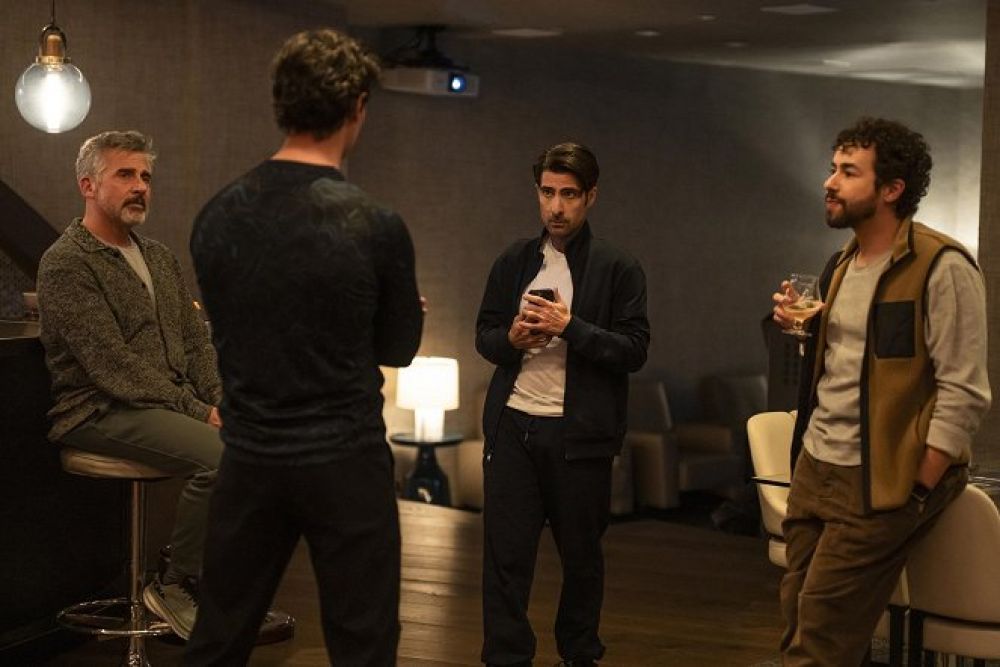
This was one of the movies I was looking forward to the most this year. Jesse Armstrong, of Succession fame, getting his first big shot at a feature, staying squarely inside of his wheelhouse by tackling another bunch of richy-riches. Felt like a home run.
We’ll get into whether it lived up to the hype in a second but first, I have to mention the strange Rotten Tomatoes scores for this film. As of today, it has an 80% critic score and a 25% audience score.
This is the oddest scoring pair I’ve seen on the reviewing aggregate site. Whenever there’s this much disparity between critics and audiences, it’s ALWAYS for some political reason. Yet, while politics are mentioned in the movie, it is blatantly apolitical. Which makes the low audience score even harder to reconcile.
Maybe this will make sense once we delve into the plot.
Mountainhead follows four tech bros: Randall (Steve Carell, aka Jeff Bezos), Jeff (Ramy Youseff, aka Mark Zuckerberg), Venis (newcomer Corey Michael Smith, aka Elon Musk), and Souper (Jason Swartzman).
Although the movie doesn’t do the greatest job explaining how these four know each other, they’re apparently best friends who come together every year to celebrate how many billions of dollars they have. This year, they’re meeting at Souper’s new mansion up in the mountains.
We know exactly how much money each of them has thanks to one of the most forced scenes that’s ever been written. In it, the group goes to the top of a mountain, takes off their jackets so they’re bare-chested and, in some sort of ritual, Souper writes their net worth on each of their chests. Venis has the most money. Randall is second. Jeff is third. And poor Souper isn’t even in the billion dollar club. He only has 600 million.

The crux of the plot is that Venis has just released new AI software that allows people to make realistic videos of whatever they want. Everybody starts making videos of charged subject matter and, because these videos are indistinguishable from reality, others believe they’re real, charging up the opposition, who then start attacking these people in real life.
But the real story emerges later in the script when Randall, who has just learned his cancer has returned, starts manipulating the group so that all of their resources can be put towards digitizing the human brain as soon as possible, allowing humans to upload their consciousness to a computer. Randall has been assured by Venis that, if Venis has the help of everyone here, he could digitize the human brain within five years.
The only problem is that Jeff doesn’t want to help Venis in this area. Keep in mind, nobody knows that Randall is terminal. That’s a secret. So, when Randall learns that Jeff isn’t on board, he soft-launches the idea of killing Jeff to the other two. At first, they don’t love it but Randall is convincing and soon, they plan the murder for that night. Unfortunately, none of these guys has the capacity or know-how to murder someone, which results in all sorts of attempted-murder hijinks.
Okay, so here’s the thing.
I have complicated feelings about this movie, lol.
At first, I hated it. But then it grew on me. And while I’m not convinced that it ever made its way into “good” territory, it definitely stayed within “interesting” territory throughout. It’s not like any other movie you’ve seen and, whether you liked Mountainhead or not, there’s value to that.
The main problem with the movie is the forced camaraderie.
Matt Damon notoriously called this out after Good Will Hunting. He said that the worst thing in movies was characters pretending to be friends despite it being clear that the actors had never spent a day with each other in their entire lives.
That’s why Good Will Hunting felt so genuine. All the actors in it really were friends. At the same time this was going on, Swingers came out. That movie also had a bunch of real-life friends in it. And you could see that on screen. The chemistry was genuine throughout.
When you watch Mountainhead, you’re very aware of what Matt Damon is talking about. These guys just showed up on set and had to act like they’d known each other their whole lives. So when the lack of chemistry bumped up against the writing, that inauthenticity became apparent.
Which is why I believe the movie grew on me. This was all shot on one set, this house. That means they shot it linearly. And you can feel that. Once we get to that second half of the movie, the chemistry got better, the timing got better, the line-reading got better. That’s because the actors had been hanging out for 15-20 days.
This brings us to the murder plot and that’s when the script almost salvaged itself. I know that portion of the movie was working because when Randall, Venis, and Souper sneak into Jeff’s bedroom to smother him with a pillow, I was insanely anxious. I was so nervous that Jeff was going to wake up and say, “What the fuck are you guys doing??” If the viewer is that anxious, your script is working.
From there, Armstrong makes a bold choice (spoilers). Normally, in a movie like this, they’d kill Jeff. And then they would have to figure out how to explain it away afterwards. But Armstrong doesn’t go in that direction. He makes all three of these tech bros the Pink Panther. They’re bumbling morons who have never had to do anything physical or real in their lives. They exist only on their computers. So they don’t know how to kill someone.
Which felt genuine to me. I know that Armstrong is being satirical here. But it actually makes sense that these people would be clueless about how to murder someone. There’s this sequence where they have Jeff locked in the sauna and they’re so clueless about how to kill him that they come up with this idea to pour gasoline in the room and then light it on fire.
But once they get the gasoline, they don’t know how to get it in there. So they pour it on the floor, then get a squeegee, and start pushing the gasoline in with the squeegee. It’s so ridiculous but it’s also kind of hilarious.
I think back to American Beauty and how it was critical for Sam Mendes to get two weeks of rehearsal time with the actors. Remember, he came from a stage background so practice was a huge part of his process. Kevin Spacey repeatedly mentions the importance of that rehearsal time as it allowed them to really figure out the characters.
That’s what Mountainhead needed. I would go so far as to say that if Armstrong had two weeks with these actors ahead of time, this is a vastly better movie. Cause you can see it on the screen as the actors get more comfortable with each other. In that end scene where they’re all at the table, after having forced Jeff into a deal that gave Venis a major part of his company, the timing and chemistry with all the little side remarks between everyone, was worlds apart from where they were in that awful mountain top scene.
I started this review thinking I was going to give this a “wasn’t for me.” But it’s too interesting of a failure for me to do that. I value movies that are different, that are not like other movies out there. And although Mountainhead has its faults, I still think it’s worth checking out.
[ ] What the hell did I just watch?
[ ] wasn’t for me
[x] worth the stream
[ ] impressive
[ ] genius
What I learned: Armstrong is not a believer in meeting people in real life for research. He says he’s too anxious to meet people in the real world. He likes to do his research the old-fashioned way, through reading. He read a ton of stuff about real life tech bros and used little bits and pieces of them to fill in his characters.
The writers scored 2 million dollars for the sale of their Sci-Fi Story

Last week, I reviewed the 2-million dollar short story sale, “Drift,” by Ben Queen and Jason Shuman. The story follows a hostage trade between humans and aliens. Ben e-mailed me the next day and asked if I could take the review down as he was afraid it might affect the very precarious process of getting the movie made. I said sure and Ben was nice enough to offer an interview. So, here is the interview with him and his writing partner, Jason! Maybe we can finally get some insight into how to sell one of these short stories for ourselves!
Scriptshadow: Congratulations on selling your short story! A lot of screenwriters out there are desperate for information on how to sell a short story of their own. So I’d like to go through this in detail. How and when did you find representation?
Ben Queen: Years ago I wrote a black comedy script called One Track Mind as a writing sample which got me a manager and agent. I was at ICM back then I’ve been repped by other agencies over the years but more recently I’ve been at Verve – everyone there has been terrific.
Jason Shuman: I had been at CAA for over 12 years. Both my agents left the agency during the strike. So, I decided to see what else was out there agent-wise. Ben was already at Verve when we decided to team up for Cola Wars and was advocating for them as an agency. I trusted him and I’m so glad I did. Over this first year and a half with Verve, they have been nothing short of amazing.
Editor’s note: “Cola Wars” is another project that Queen and Shuman sold before Drift, which will be directed by Judd Apatow.
Scriptshadow: Before you wrote this short story, what were you hearing as writers (from reps, from producers you may have pitched) about short stories? Were you hearing “Write them?” Were you hearing nothing? What’s the feeling out there in Hollywood about short stories right now?
JS: I think short stories are having a real moment for sure. And I get it. Writing the full screenplay on spec can feel so final, like “this is the movie.” And a pitch can sometimes not be enough. These short stories are a great way to allow producers, executives, and filmmakers a detailed insight into what the film’s potential can truly be. And with the short story in hand, the collaboration process between the director and writer can hopefully be a lot easier.
BQ: We heard from one studio executive that they’re being submitted a lot of short stories right now. I know they’ve been a good way to get original ideas set up for the last few years. A lot of these have the feeling of mini-novels, or flashy movie treatments rather than slice-of-life short stories – less literary and more propulsive, you know?
Scriptshadow: When you decided to write a short story, why did you choose this one? Was it because your agents said people want high concept sci-fi right now? Or did you just go with your gut?
BQ: This was an idea I’d wanted to do for a long time. I first came up with it a few years ago and started doing research, talking to people in the world of the story. I have literally hundreds of pages of notes on this idea. When Jason and I started working together, he gravitated to the idea and we started working it out together. Last year we sat down with our agents at Verve and ran through some features we wanted to do. They pointed at this one (Drift) and told us that was something to focus on.
Scriptshadow: Have you written short stories before?
BQ: We’ve never tried this before!
JS: First time.
Scriptshadow: Have you received any advice from industry people about how to write a short story that sells? For example, has a producer said to you, “The key to writing a saleable short story is…”
BQ: I don’t know if there’s one key but it certainly helps to have a good idea and a character you can get behind. It really helps to feel like you know the world better than anyone. And it’s not a shortcut – short stories can take just as much time to write as a screenplay. So I’d say be prepared to put in a lot of time and effort to get it right. Scott Glassgold, one of our producers, and a true expert with these short stories, had a lot of great input throughout the writing process. But among all the advice he gave the most important was to stick the landing.
Scriptshadow: In general, if someone does want to write a short story, what would you suggest they write about?
BQ: I’d say it probably just needs to be a great idea for a movie. If you’re looking to write a piece of fiction for publication, that’s different obviously. But then make sure you really execute it as best you can.
JS: As with anything having to do with writing, it should always come from the heart. This being said, it does feel like the short story format plays best in certain genres like thriller, horror, sci-fi, or a combination thereof. But I bet a comedy could work if someone wanted to try it.
Scriptshadow: Can you take me through the process of how Drift sold? Was this months of planning? Or did it happen quickly? What went on between typing “The End,” to becoming the biggest bidding war sale of the year?
JS: It actually happened pretty fast. The final draft of the story (after months of re-writing of course) was sent into our reps on a Tuesday night. On Wednesday, it was sent out to a select group of directors. By Thursday, a number of those directors wanted to be a part of it. It was then sent into various studios, each with different director attachments. By Friday evening it had sold to Skydance.
Scriptshadow: Another thing people always ask me regarding short stories is word count. How long should the short story be? Is this something you thought about or no? Any advice on short story length?
BQ: I don’t know! I didn’t even check the word count on Drift. However many it took to write it and no more. If I had to guess I’d say it was about ten thousand words – which is a lot.
Scriptshadow: What is the biggest adjustment between writing a screenplay and a short story in your opinion?
BQ: For this type of story we broke it the same way structurally, mapped it out like we would a script. At the end of the day there was less dialogue and we intentionally held back a lot of the secondary character development to help streamline the read.
Scriptshadow: Now that you’ve sold the story, what’s the next leg look like? Do you write three drafts and then try to get the studio to greenlight it? What’s the plan look like going forward?
JS: Our plan is to put our heart and soul into the screenplay as soon as possible. This type of big-scale science fiction story is a real dream for us to write. And we want to convey everything that’s in the short story and more into a script everyone can be excited about.
Scriptshadow: Any final advice to screenwriters who are trying to sell a script or a short story. What would you tell them?
BQ: If you have an idea you care deeply about, think about the best way to communicate that feeling to others. Now decide what the best delivery system is: a short story? A screenplay? A short film? So much of this business is believing in something and trying to get others to see it the way you see it. So just always be thinking about your audience and how to connect. Rinse, repeat. :)
JS: Write what you are passionate about. It will come across on the page.