
Search Results for: F word
And screenwriters are going to take over

Every time I go out and meet new people these days, one of the first questions I ask them is, “Do you go to the movies?” And the inevitable answer I get is, “No.” The explanations I receive break down into two demographic categories. If the person is younger than 30, they almost always complain about the price being too high. If the person is older than 30, they usually say that life got more complicated (marriage, kids) and they don’t have as much free time as they used to.
With Marvel, the current leader in box office receipts, making half as much as they used to with each release, it is safe to assume that the industry is about to go through a major change. I believe that we’re 3-5 years away from a cratering in the theatrical movie business. But unlike a lot of people in the industry, I don’t see that as a bad thing. I see it as a good thing, especially if you’re a screenwriter. Let me explain.
The thing that is most at risk of dying here is the giant blockbuster. These movies don’t have the box office juice that they used to and it’s causing studios to lose a lot of money. You don’t get to keep spending money forever if you’re losing it so, inevitably, they’re going to have to pull back on these budgets.
This is great news for screenwriters because the less a movie can depend on spectacle, the more it must depend on good storytelling. Movies will go back to the “word of mouth” days of the 70s where, if someone writes a great movie, it will play on and on in the theaters. And even if it doesn’t, it will do well on streaming, because in a world where you don’t need to make 500 million at the box office to break even, it’s perfectly okay to send your movie to streaming early.
What does this mean for screenwriters? What it means is, everybody here is going to have to become a better character writer. The less a movie costs, the more dialogue scenes you’ll be writing into your script. So you need to get good with character in order to write those scenes. Also, the movies themselves will be more character-driven because they have to be. Without spectacle, you have to explore characters internally, explore them in conflict with other characters, and explore them in conflict with the world.
By the way, this does not mean every script now has to be Manchester By The Sea. Far from it. You can still write genre films (horror, thriller, low-budget action). Sinners is actually a good example of what one might write in this new era. It’s character-driven but it still has a genre element to draw audiences in.
Other movies that will do well in this new era (assuming some of them were written better) are: It Ends With Us, A Quiet Place, Longlegs, Heretic, The Beekeeper, Get Out, Air, Bullet Train, and The Menu.
What does this mean for IP? IP will still be valued, of course, but this is also going to benefit screenwriters because the costs of these movies are going to plummet. So they’ll be looking for writers who actually know how to write, since they’ll need you to come up with a fresh cheap take and be able to execute it. A good example would be “Prey,” on Hulu. Big franchise – contained low-budget take.
Again, with less action, you’re going to have more character moments. So screenwriters have to be able to handle those. Thunderbolts is a good example of this. That movie had a lot more character development than your average superhero movie. This tells me that Hollywood may already be moving over to this model.
The next thing that’s going to be important in this new era is separating yourself from AI. AI will get better at writing but it’s only going to get better at the most populist version of writing. It’s going to be able to write a generic sequel to The Rock. But it’s not going to be able to write Everything Everywhere All At Once.
So, in addition to learning how to write strong characters and strong character-driven stories, you need to infuse your own voice as much as possible into those stories so you stand out.
Now, what I’ve learned over the course of reading 10,000 scripts, is that there’s “forced voice” and “natural voice.” “Forced voice” is when you try to ape somebody else’s voice. You’re trying to write all this wall-breaking commentary directly to the reader even though you’ve never done that before in your life. There’s a clear inauthenticity to it.
“Natural voice” is when you take the elements that make you unique as a person and accentuate them. So, if you like dry humor, you up the dry humor in your script. If you love long scenes, like Quentin Tarantino, write long scenes. If you like non-sequiturs, add them. If you’re weird as hell and think about bizarre stuff, include it! If you like telling stories out-of-order, do that. If you naturally love talking to the reader, you can do that as well. Just as long as that’s truly your thing.
Scripts like Civil War, Challengers, Leave The World Behind, Anora, and Missing, will do well in this new era.
This change will not be all-compassing. I think animated movies, like Inside-Out, are still going to do well because parents will want to get their kids out of the house. There will still be outliers, like Barbie and Minecraft, every couple of years. But even those films will take a hit at the box office. They’re not going to become phenomenons anymore, as more and more stuff moves to streaming, keeping even more people home.
But that’s good news for screenwriters as well. The nice thing about streaming is that the admission price is zero. It’s basically: point a device at your TV and press a button. For that reason, the audience doesn’t have nearly the same standards as they do when they go to the theater. I mean I just watched the first 20 minutes of this movie called iHostage on Netflix, about a guy who holds up an Apple Store. It was easily one of the worst movies ever made AND IT WAS #3 ON NETFLIX’S MOST WATCHED MOVIES LIST!
In other words, you don’t have to be the greatest writer to write streaming movies. As long as you’ve got a strong flashy concept, you’ve got a shot. And they need ENDLESS content over there. So there are opportunities to be had.
People have been saying that screenwriting is going to fall to AI over the next few years. I think the opposite. Hollywood is going to need writers more than ever when the mega-franchise collapse happens. So buckle up. It’s about to get fun. :)
40% off Script Notes from me! I’m only giving out two of these deals. Be the first or tenth person to e-mail me at carsonreeves1@gmail.com with the subject line “May Deal” and you get one!

I’ve noticed that people are talking about AI a lot in the comments section. I do think AI is going to make some big leaps in the world of writing in the next couple of years, but not in the ways many assume. It’s not going to be able to write a good script for you, unfortunately.
But I’ve been privy to some behind-the-scenes chats about word processors incorporating AI in a way where they’re constantly evaluating your story and giving you real-time options on where to take it. For example, after you write a scene on page, say, 15, it will have a little prompt you can click on that brings up three potential directions you can take your story next. Or it may give you options for how you can make your hero’s flaw more consistent with the theme of your story.
It’s gonna be your virtual writing partner, in a sense. And it will probably take a while to get good at it. That’s the thing about AI and writing right now, is that when you truly put it to the test of writing something, it’s still not very good.
I constantly test it with dialogue prompts. I give it a scenario or provide an already written scene and ask it for dialogue suggestions. It has never given me a line that I would use. It *does* prompt new ideas on your end for certain lines. But it never gives you an actual line you’re satisfied with. I think because it still doesn’t understand humanity and how we think. Because how we think is a big part of what we say. It doesn’t get that.
However, there is one area where AI has made writing 1000% better, which is that you can now literally write about ANYTHING.
Through reading thousands of scripts, what I’ve learned is that if the writer doesn’t know the world they’re writing about, the script is always bad. Like 99.9% of the time the script is bad. But when someone really truly knows their subject matter, the quality of the script goes up dramatically. Cause the story is specific and authentic and, most importantly, feels like it’s really happening.
It makes a difference when a cop writes a screenplay about a cop. It makes a difference when a club promoter writes a story about a hot club in downtown Miami. They can get to places that nobody else can, and it makes a huge difference. Which is why we’ve always had the advice: WRITE WHAT YOU KNOW. Because when you write what you know, you can write the most authentic story possible.
Well, you no longer have to write what you know. AI has made that advice obsolete.
I realized this because, for the longest time, I had this movie idea about a murder that occurs inside Area 51. I thought it would be fun to explore an investigation where the setting makes it impossible to do your job. And, also, inside a place that has so many secrets!
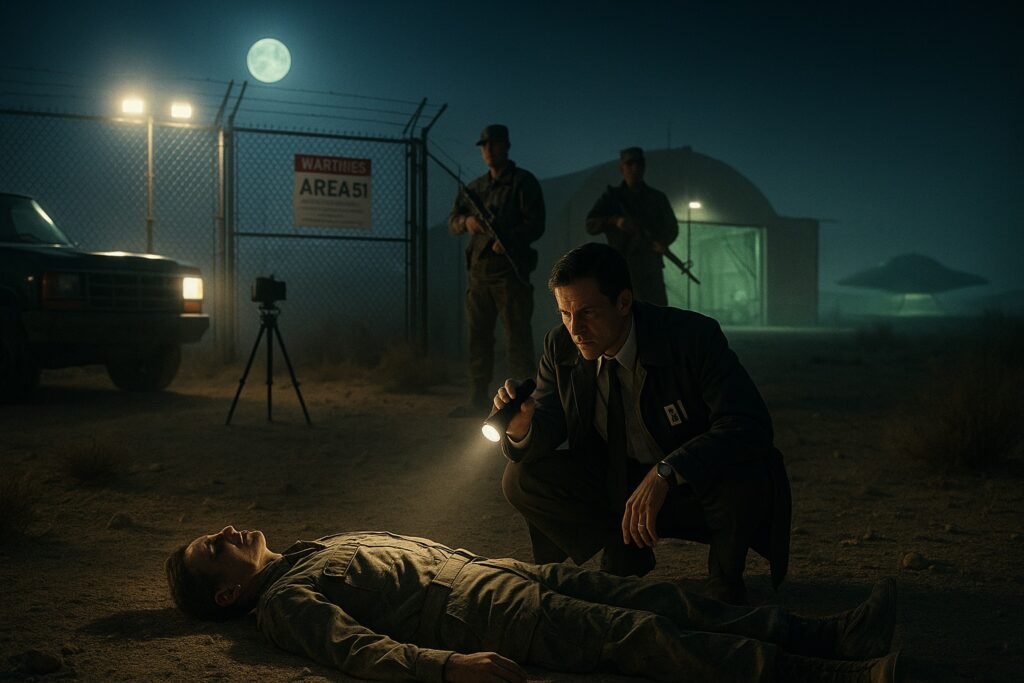
But I never wrote it because I knew NOTHING about that world. I don’t even know the difference between a general and a sergeant. I truly don’t! I don’t understand military hierarchy. And I definitely don’t understand what the day-to-day operations on Area 51 would be like. I would just be making things up and, trust me, when the writer is making shit up, the reader knows.
But a couple of months ago, for shits and giggles, I popped open Final Draft, opened up a tab in Firefox for Grok, and I started writing the script. Every time I had a question about how it would really be, I’d ask Grok. How do workers get into Area 51? It told me they fly over on a covert flight from Las Vegas airport every day. The movie is set in 1996, so I would ask it, “What kind of plane would they have flown into Area 51 at that time?” It told me the exact plane and what it looked like.
I asked it, “Who would greet my investigator when he arrived in Area 51?” It told me it didn’t know but based on common military protocol, it gave me its best guess. And I quickly realized how realistic I could make this all feel just by having this AI helper by my side.
And that’s when I realized, the world is wide open for writers now. You can never have engaged with an FBI agent in your life yet write a realistic FBI espionage thriller. You may have always wanted to write about The War of Scottish Independence in 1296 but were terrified that you wouldn’t be able to get the cadence or dialogue right for the time. Well, now you can just ask AI and it will tell you.
Or even something simple, like a legal show. We all know the notorious story about how the writer’s room of She-Hulk, which was a legal show, realized that none of them knew anything about the law or legal proceedings in a courtroom. If they would’ve written the series now, it would’ve been a million times easier. You can literally ask AI exactly how each step of a courtroom case would go down and it will tell you.
This is the most exciting thing to me about AI in the writing space by far. There have been so many fun ideas I’ve had over the years that I wouldn’t touch with a ten-foot pole because I knew I didn’t have the knowledge to pull them off. And now it’s like… the floodgates have opened. Anything is possible. It’s exciting.
I’m curious if anyone here has taken advantage of this. Or if you’re using AI for other writing tasks. Let me know!
This is a big recent spec sale to Lionsgate. It is being pitched as a “negotiator” version of Source Code
Genre: Sci-Fi
Premise: Unable to prevent a bomber from blowing up a hotel, a hostage negotiator finds himself stuck in a time loop, using the extra time to figure out who the determined bomber is and what he wants.
About: This script sold to Lionsgate last week. Here’s Deadline’s account of how it went down – “Townend’s deal is remarkable, we’re told, for a writer with no produced credits, particularly given that the script was taken out without any talent attachments. Sources described the outcome as a three-way bidding war that resulted in a mid-six-figure guaranteed fee against a low-seven-figure purchase/bonus. The script was taken out on the first Monday of April, and by Friday of that week, 20 premium production companies were chasing aggressively.” And for those long-time screenwriters who want a little bit of motivation, I have an e-mail from Mark dating all the way back to 2014! 11 years of writing to get to the sale. So, always keep writing!
Writer: Mark Townend
Details: 108 pages

Hot spec alert hot spec alert hot spec alert hot spec alert.
And a very “Carson” hot spec it is. Sci-fi? Loop? Was this written just for me?
Let’s find out!
40-something Billy Aubrey is a negotiator. He’s also a terrible family man, which is why he’s on the outs with his wife and son. One day, he gets a call from his lawyer wife, who says she wants to have a big conversation with him.
First he goes to work, then he attends a conference, then he shows up at the hotel to talk to his wife. Only to spot a man in a parka with a detonator in his hand. Billy tries to approach him, ready to use his negotiating skills, but the man presses the button and everyone in the lobby, including Billy, is blown to bits.
But then Billy wakes up at the beginning of the same day. At first he assumes he had a nightmare. But when everything in the day happens exactly as before, he comes to the shocking conclusion that he’s stuck inside a loop. He’s a little more ready for the bomber (Chris) this time. But Chris still detonates the bomb.
Billy wakes up again, this time with new information. On day 1, he woke up at 6:47 am. Day 2, 7:47 am. Today, he’s woken up at 8:47am. He’s losing an hour with each reset. And the bomb? The bomb always goes off at 12:47. Which means he only has a few more shots to figure out what’s going on here.
He ropes in his disbelieving partner, Josie, and learns that there’s a major tech titan at the hotel that day. That must be Chris’s target. But with each reset, Billy finds out more about Chris, eventually getting his address. So he visits Chris’s house in the morning, where he finds that there are men there, men who are making Chris do this.
(Spoilers follow) That’s when things get really crazy. The men are talking to someone on the phone. They’re telling the mystery phone man, “He’s here. The target is here.” Which means that Billy…. IS THE TARGET. Which means now Billy has to figure out why he’s the target. He eventually realizes that a man from his past, his old partner John Rosen, who’s about to become mayor, is trying to dispose of him. With only one loop left, Billy will have to confront him and take him down.
We all know I love myself a time loop script.
But – and this is a continuation of yesterday’s theme – what are you adding to the time loop genre that’s new?
Here, the fresh addition is that, after every loop, we start the day 1 hour later. This adds a ticking time bomb (literally) to the proceedings since, sooner or later, we’re going to start too late into the day to prevent the bomb from blowing up.
The obvious question, then, is, “Is that different enough?”
My gut instinct answer is no. Like we talked about yesterday, the objective, when creating the “different” part of the “same but different” formula Hollywood likes, isn’t to win the logic debate. The “different” aspect that you add must *feel* genuinely different. And this doesn’t feel that different to me. It feels like a lot of other time loop scripts I read.
That doesn’t mean the script doesn’t work. From a structural standpoint, I like the idea that one hour disappears each day. It creates urgency inside a genre that is all about anti-urgency (a loop is endless – that’s the obstacle the hero faces). And the writer explains a potentially complicated rule-set (the loop moves forward 1 hour every reset) effortlessly, which I can tell you does NOT always happen. Many amateur scripts I read fall apart because their writers don’t explain their rules clearly enough.
I can tell you exactly when I knew this script would be ‘worth the read.’ It happens halfway into the script when Billy is at Chris’s house, trying to figure out why he’s determined to bomb the hotel, and he overhears the men in the other room – the ones making Chris do this – on the phone with someone saying, “We don’t know why but he’s here.” In other words, the tech guy isn’t the target. Billy is the target.
Why is this such an important plot development? Because I read scripts like this a lot – not loop scripts per se, but mystery thrillers – and nine out of ten writers would’ve gone with the tech guy as the target. The tech guy as the target is an *okay* plot choice. But it’s not sexy. It’s not that interesting. What’s interesting is your hero being the target because now the mystery deepens and the story becomes more personal.
So, why then, doesn’t the script score higher than “worth the read?” Because nothing surprising happens after that. The writer ties up the story threads he’s set up. But that’s all that is – tying up plot threads.
This is a dangerous trap that’s easy for screenwriters to fall into. They set up the pieces of their mystery and, at a certain point in the story, once we know what’s going on, the writer just goes through the motions of wrapping up every plot beat. (Spoilers) We know Rosen is the bad guy now so it’s just a matter of getting to him and taking him down. There are no new developments.
As screenwriters, we should always be looking to stay ahead of the reader. The reader should never get too comfortable, especially in the final act. But here, everything that I expected to happen in the final act happened. We could’ve still pushed in a few areas – had one last surprise or two.
White Lotus did a great job of this in its season finale. I don’t know anybody who predicted what was going to happen in that final episode. Because Mike White knows that you have to stay ahead of the reader. You can’t just use your final episode (or act) to tie everything up. You still have to titilate and excite and throw some curveballs at us.
With all that said, this is another good example of how sexy concepts capture the attention of readers. It doesn’t always mean they’re going to sell, like Renegotiate, but it gives you a much better chance in the marketplace.
[ ] What the hell did I just read?
[ ] wasn’t for me
[x] worth the read
[ ] impressive
[ ] genius
What I learned: Beware of this word – INEVITABLE. If anything is inevitable in your story, we’ve lost interest. I’ll give you an example. Return of the Jedi. Everybody already knew that Luke and Leia were brother and sister. But Luke and Leia had not had that conversation yet. So it was INEVITABLE that Lucas had to write that scene. Which is why the scene is one of the most boring in all of Star Wars. Well, maybe not as boring as episodes 1-15 of Andor, but boring in the OG Star Wars universe. My point is, you should always try to give a little more than what’s expected when you’re wrapping storylines up. Cause it’s always going to be more interesting than that inevitable scene we’re all waiting for. Here, once we knew about John Rosen and we’re just waiting for the inevitable showdown, I thought more could’ve been done.
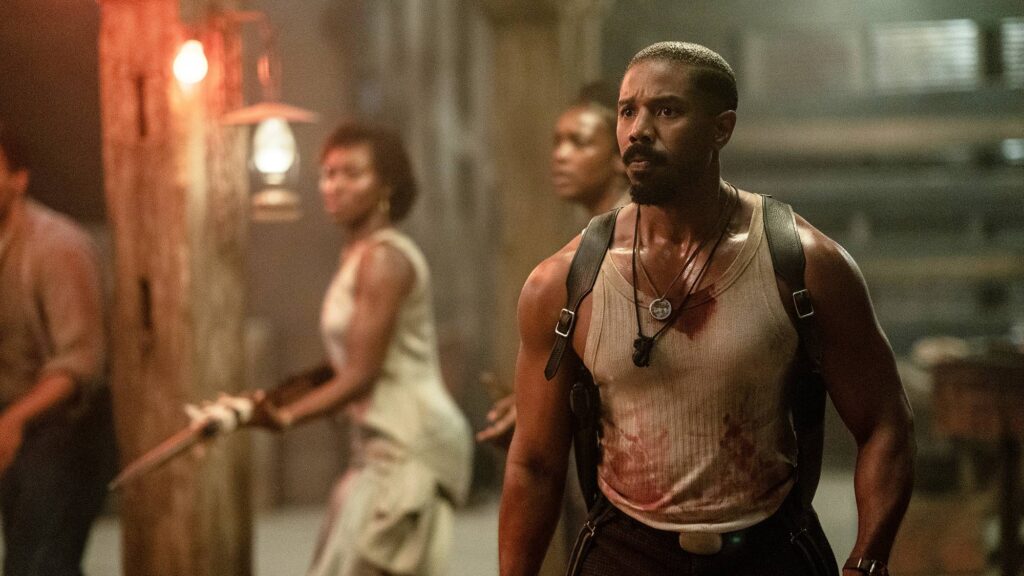
I couldn’t ignore all the buzz that Sinners was getting. It’s not easy to achieve both 90+ percent in critics and audience scores on Rotten Tomatoes. So, over to the local movie theater I went and strapped in for two hours of… well, I didn’t know what. I’d seen the fist trailer, which was vague, and nothing else. This is how I prefer to see movies if possible. I want to know as little as I can.
The story takes place in a 1932 Mississippi town – and yes, I was, as always, excited to be able to type out “Mississippi.” Identical twins Smoke and Stack, who used to work for Al Capone in Chicago, have returned home to start a new business venture. They’re going to open a dance hall.
For whatever reason, they’re adamant about starting their dance hall TONIGHT. You’d think maybe they’d spend a month putting the place together. But no, it must be tonight. By the way, it’s never explained why the urgency but maybe Ryan Coogler reads Scriptshadow and knows that the tighter the timeframe, the better.
Smoke and Stack put together their team throughout the day – getting their guitar man, their harmonica man, their door man, their food people, their liquor guys. And, as the sun sets, people start showing up.
Little do they know, just down the road, a vampire has crashed a couple’s home and immediately turns them into vampires as well. The three of them, who now are, also, an Irish folk band, show up at Smoke-Stack’s party and want to join. A little issue, though. They’re white and everyone here is black. So Smoke and Stack tell them to get lost.
Eventually, Smoke’s (or Stack’s) side piece girlfriend ventures out to ask the folk band why they’re still hanging around and she gets bitten. Therefore, when she comes back inside, she lures Stack into a back room and, during hanky-panky time, she bites him. Smoke catches wind of what’s going on and orders everyone but the staff to leave. And now, the games begin.
The folk band vampires immediately turn all of the leaving partygoers into vampires, which means there are a good 200 vampires outside eager to devour the staff. So they wait, and they taunt, and they tempt, and they trick, all in an attempt to lure the rest of the crew out and turn them into vampires. Eventually, it becomes an all-out war and nearly everyone dies.
So, how was it??
Was it as good as everyone’s saying?
Well, you know how I see things at this point. The first thing I’m looking at is not the acting, not the directing, not the visuals or the music. I’m looking at the script. And the script has problems.
I’ve seen these types of scripts before and they have a very significant issue that’s hard to overcome. That issue is that the main event – in this case, the party – is too small to get to right away but too big to get to too late. In other words, you can’t start the party at the beginning of the second act (pages 26-31). You’ll run out of steam before the climax.
However, the later the party starts, the more script you have to cover in the meantime. And what do you do with that time? The first act (pages 1-30) sets everything up. In this case, it sets up the brothers’ return. It sets up the purchase of the party building. It sets up all the characters who are going to be involved.
But, traditionally, when the second act begins, that’s when your characters need to go out on their journey. For example, that’s when Deadpool and Wolverine begin their journey to escape the world they’ve been banished to. In Sinners, the “journey” is the party.
But like I said, you can’t start the party too early. So this leaves this “No Man’s Land” between the end of the first act and the beginning of the party, where Sinners is clearly lost. Coogler’s solution is to extend his setup from 30 pages, to a full 45 pages, and so we get lost in this ENDLESS setup where, quite frankly, we’re bored out of our minds.
Now, in fairness, the reason I don’t think it bothered critics as much, is because they know what’s coming. They know Insane Vampire Party is coming. And when you know something big and flashy and sexy is coming, you’re more willing to suffer through an elongated setup. But there’s no question that this setup section is a disaster. It’s way too long.
Still in need to cover time before the real movie begins, Coogler then gets us to the party, but gives us this sort of “half party” where people are lingering about and chilling and not really into it yet. Again, we’re stuck in Screenplay No Man’s Land here. And it’s giving this movie all sorts of pacing issues.
In fact, the inciting incident, when the vampire folk band shows up at the party, doesn’t happen until 60-70 pages into the script! Which is insane. But, at least now the movie has begun.
So, once the movie truly begins, was it worth the wait? I would say…. Almost. Things get so crazy that there’s definitely entertainment value to be had here. And the music stuff is really good. There’s sort of like this music battle going on between the people inside the building and outside the building. It’s funky, a little bit different. And that was cool to watch.
Also, Coogler was a genius to cast Michael B. Jordan in the brother roles. Because, traditionally, if you had cast a movie star and a character actor in those roles, you wouldn’t make your movie star a brain dead vampire halfway through the film. The movie star wouldn’t go for it. They’d want to be the star, the guy who leads the charge til the very end. But because Jordan is playing two roles, it allowed Coogler to do that, which was cool.
And I was into the final battle. I was curious what was going to happen. Unlike traditional Hollywood movies, you got the sense that nobody was safe and that’s when endings are most exciting. I’m not sure I understood why we continued the movie after the night was over. But, otherwise, I thought the climax was good.
So, it’s a mixed bag, this film. It’s messy. In addition to the early script issues, I don’t really understand what the movie was about. I’m guessing some sort of social commentary was being made here but I didn’t pick up on what that was. I’m sure people will get on their high horses and confidently claim it was about “this” or “that,” but I’m betting every one of them got those theories from a quick post-movie internet search.
In the end, I have to ask the question, “Would I be confident in telling someone it was worth 30 bucks (ticket plus parking) to go out and see this movie?” And the answer is, “No.” I think whoever I told to go see this movie would be upset with me afterwards. But is it worth checking out when it hits streaming? Sure. There’s enough good here to, at the very least, have a nice passive viewing experience.
[ ] What the hell did I just watch?
[x] wasn’t for me
[ ] worth the price of admission
[ ] impressive
[ ] genius
What I learned: Beware story setups that have a “Screenplay No Man’s Land.” This is where there’s a gulf in between the end of the first act and the beginning of the official “adventure.” You’ll be pulling your hair out trying to figure out how to make pages 30-60 entertaining.

I’ve watched four of the six episodes of the recently released seventh season of Black Mirror and, like all Black Mirror seasons, it’s a love-hate relationship. I don’t think I’ve watched something I’ve hated more than the first episode. In that one, a wife, Amanda, gets a traumatic brain injury and they digitally replace her brain under the condition that it be hooked up to a server that cost 300 dollars a month.
Everything’s great at first but then this service starts inserting ads (Amanda will randomly recite a commercial ad out of nowhere) and the only way to stop hearing them is to upgrade to the higher tier, at $800 a month. And then it keeps going up from there.
It’s not the worst idea in the world but the contrast between the marriage, which is played completely straight, and the service, which is played like it takes place in the Monty Python universe, is so jarring that nothing ever feels right. And the actors, Rashida Jones and Chris O’Dowd, who play the husband and wife, are beyond nauseating. If you had told me that the over-under for how many times two people could proclaim their love for one another going into this show was 500, I never would’ve thought it would hit the over. But they did! They’re trying sooooooooo hard to make you love them and all it does is push us further away. And Rashida Jones may be the single most boring actress who’s ever graced the screen. I absolutely hated this episode.
The next episode had zero pretense, zero satire. It was trashy. It was dramatic. And I loved it! This girl who works at a Bon Appetite like food company is thrown into disarray when a weird girl from her former high school starts working there. Soon, our heroine starts making mistakes that she’s never made before and suspects that her new coworker is responsible. But she can’t prove it. So she goes to extreme measures to take her down.
What I liked about this episode was that it proves you don’t need a ton to write a strong story. You really only need a good starting point (a solid premise) and some conflict. The heavier you can make that conflict, the juicier the story tends to be. And the writers here do such a good job creating the conflict between these two women. In the end, that’s all that was needed – two people going at each other and let’s see how this ends.
The third episode, Plaything, is the darkest of the four episodes I watched. It follows this strange older man who’s arrested by police under the suspicion that he’s responsible for a recently discovered suitcase that contains body parts in it.
The episode takes place mostly in an interrogation room at the police station and the two cops interrogating the man are baffled and frustrated when he tells them that all of this goes back to a video game he used to play 30 years ago – “The Throng.” The game consisted of the first digitally sentient beings in a game. These things understood their own existence. And they started replicating over the years, becoming a bigger and bigger civilization. As a result, he’d been tasked with growing the hardware over the decades so they could keep expanding.
But, finally, they’ve gotten too big for the hardware, which means there’s only one place left to expand – the internet. This, it turns out, was our older man’s plan all along. Get captured, come in here, and use a sleight-of-hand QR code trick to send the Throng into the UK’s governmental computer, via a nearby security cam. Soon, the Throng will be everywhere. And humanity will never be the same again.
If you know me, you know that I like when writers use common scenarios to build their scenes and stories around. I talk about this in my dialogue book. Common situations are your friend in writing. Interrogations, in particular, are fertile grounds to create interesting scenarios because the audience already understands the rules and these situations themselves are often high stakes, since murder is usually involved.
And you can see, with this episode, that as long as you inject that scenario with a fresh angle, you can still tell a fresh story. Interrogations very well may be 500 years old. But none of them have involved somebody talking about a video game that eventually becomes a threat to all of humanity. You take something old and you combine it with something new. That’s what makes it fresh (and that’s what’s made Black Mirror such a success).
The final episode I watched was the sequel to U.S.S. Callister. The U.S.S. Callister is considered by many to be the best episode of Black Mirror ever. It follows an evil coder, Robert Daly, at a game company, who digitally replicates his coworkers via a DNA-to-digital machine, which allows him to put their digital clones into his own version of the game, where he can then lord over them like a God.
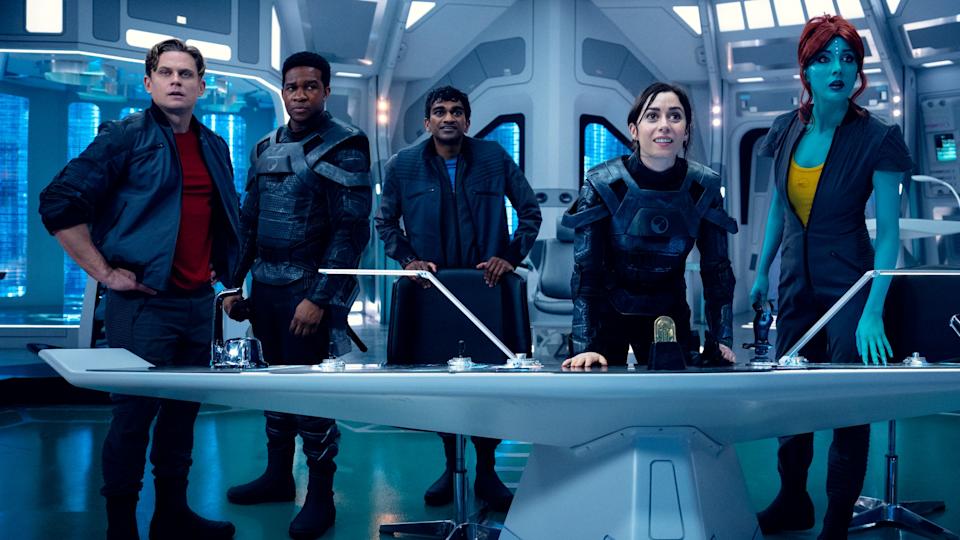
In this sequel to the original, the New York Times has gotten wind of a rumor about the digital clones. If true, it would sink the company. So the president tasks one of his coders, a young woman named Nannette, to figure out what’s going on. When Nannette learns that her own digital clone, as well as five others, are in the game, she must figure out a way to save them. Meanwhile, the digital clones are in the game fighting off real players. The difference between them is, if the players die, they can just respawn. If a digital clone dies, they die for good.
For the most part, I enjoyed this sequel. However, it’s a reminder that the more complex the rules are, the harder it is for the average reader/viewer to keep up. I’d forgotten the rules from the original movie, and it took a good 45 minutes to remember how it all worked. Basically, it was hard to track the exact connection between the real world people and their digital clones. How much did they know about each other? How did they communicate?
I always tell writers to keep your sci-fi rule-set as simple as possible. Most writers enjoy getting into the weeds of their rules and, in the process, we, the reader, get left behind. This just happened recently. I read a sci-fi script with way too many rules and it, ultimately, took the screenplay down.
At the very least, if you have a lot of rules, you have to be awesome at explaining them to the reader in an understandable way. That’s where you see the biggest difference between pros and amateurs. Despite some of my issues with the excessive rule set here, I ended up understanding them by the end and, in most amateur scripts that tackle rules this extensive, that wouldn’t have happened.
Ultimately, I think the movie suffers from Cristin Miloti carrying the load. She’s great to look at but she is nowhere close to being able to carry a movie all on her own. She’s just not interesting enough as an actress. The reason that first movie was so good was 50% due to the writing and 50% due to Jesse Plemons. Without Plemons playing a major role here, the sequel doesn’t compare to the original.
But it’s still solid. What did you guys think?