
Search Results for: F word
Watch Scriptshadow on Sundays for book reviews by contributors Michael Stark and Matt Bird. We try to find books that haven’t been purchased or developed yet that producers might be interested in. We won’t be able to get one up every Sunday, but hopefully most Sundays. Here’s Michael Stark with his review of “King of The Sunset Strip.”
Genre: True Crime / Memoir
About: Young Hollywood actor leaves the Mickey Mouse Club for Mickey Cohen’s gang. Think Public Enemies meets What Makes Sammy Run with a dab of The Freshman thrown in.
Writer: Steve Stevens (who has constantly worked in Hollywood for over 50 years) and journalist, Craig Lockwood
Staus: According to the book, Steve’s son, Mark, had written a screenplay, but I can’t find the development stats anywhere. Trust me, this one would make a great flick.
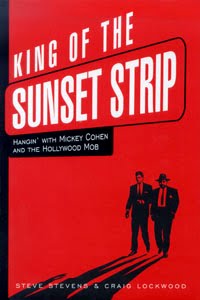 “Someone’s gonna die cause some broad is banging a bullfighter? It ain’t gonna be me.” — Mickey Cohen on both Sinatra’s and Bugsy Siegal’s women troubles.
Hey there, Hi there, Ho there!!! Welcome to another sporadic Scriptshadow Sunday Book Review, where we brave paper cuts and funky, old paperback stench to bring you the books we wanna see turned into movies. It’s our way of helping our nation’s starving writers, the dying logging industry and all those underdeveloped development gals.
With my own bookshelves bare and not enough scratch for a coffee to beard my word thieving ways at Barnes and Noble, the search for my next column brought me back to a place I vowed never to return to — the damn library. I asked the bookish blonde behind the counter what was good. She dutifully told me to go take a hike in the biography section…
…Where I got jumped by the stunning, Saul Bass reds and blacks of this little honey’s spine. Hypnotized, I read the blurbs and knew I had found the one! King of the Sunset Strip instantly intrigued me cause it’s about two of my favorite subjects: Old Hollywood and true crime noir.
It’s the late 50s in the city of angels, mere moments before the Raging Bulls and Easy Riders would seize power. The mighty studio system still ran the town and it was all so deceptively glamorous and magical like Cuba before Batista fell.
19-year-old, Steve Stevens, a graduate of the Hollywood Professional School and the Mickey Mouse Club, is getting a little too long in the Ultra-Brite-white tooth for the kid roles he’s been playing. He knows damn well that not every child star makes the transition to the adult’s table. For every Mickey Rooney and Elizabeth Taylor, there’s the cautionary tale of a Bobby Driscoll (Treasure Island and the voice of Peter Pan) who ended up dead at 31, just another junkie on skid row.
(Actually, Driscoll’s story would make a great movie too if Disney would allow the slight besmirch of their hallowed name.)
Waiting around his pad for his agent to call (No 4G or answering machines back then), Stevens was way closer to going broke then breaking in. But, then, a mysterious piece of fan mail arrives under the slot that will change the spin of his axis forever. An admirer named Mr. Michael invites him to his ice cream shop, saying “You play tuff guys real good.”
That Mr. Michael, for those gangland challenged, turned out to be the colorful, celebrity criminal, Mickey Cohen, the East Coast, Jewish mob boss who was sent out West to keep an eye on Bugsy Siegal. Ax ex-boxer and Chicago enforcer, Cohen pretty much organized all of the organized crime in the great state of California.
Cohen, a skilled blackmailer, had so much dirt on the denizen of Tinseltown, that the media had to protect themselves, painting him as a modern day Robin Hood. Newspaper magnate, William Randolph Hearst, was a close friend. Or perhaps Cohen knew who Rosebud was? Even the FBI stayed away – supposedly the mob had the cross-dressing goods on J. Edgar too.
He was a bulletproof survivor, who lived through gang wars, feuds, assorted attempted hits and all forms of federal prosecution. The man was definitely charismatic but also totally ruthless.
Does it seem a little contrived that a notorious mobster would send a young actor a fan letter? Well, put that in the truth is stranger than fiction department, cause it happened. When adapting the screenplay, this may have to be finessed a bit. Stevens played a lot of juvenile delinquent roles and Cohen must have seen a little bit of his younger, scrappy self in those portrayals. Childless, perhaps he was looking for someone to groom.
Stevens starts hanging with the mobster and the mentoring begins. A natural charmer, the kid soon wins over Mickey’s gang of tough thugs with his heartthrob smile and autographed pictures of Annette Funicello.
Against the warnings of his friends, Stevens is soon a junior member of their little crime family. The flash, the cash and the hot women were just too enticing. Now, Stevens wasn’t exactly an innocent. He had an ulterior motive too. Cohen knew everyone from the Rat Pack to studio chieftains to then Senator Richard Nixon. Being seen with the smooth criminal might just kick-start his career – if he doesn’t get kicked in the head first.
With all the sexy star treatment came some real, fucking serious danger too. Cohen was Public Enemy Number One for good reason. His hair trigger temper was infamous.
Not only did he have the cops in his pocket, but most of L.A.’s best maitre d’s as well. At the exclusive Villa Capri, while Stevens is starstruck by his fellow diners, Cohen overhears a rude comment, extracts a champagne bottle from the bucket and proceeds to wail on the loose-lipped fella with it. After the lug is knocked unconscious and dragged outside, Cohen nonchalantly returns the bottle to the shocked patrons, sits down and puts the napkin around his neck.
The gentleman mobster was sometimes something of a sociopath.
My favorite scene is when Stevens accompanies Mickey and his goons to a comedy club and the brave (or perhaps suicidal) Don Rickles unleashes his trademarked “Mr. Warmth” tirade on the gangster. The kid and the gunmen are shocked silent, waiting for a reaction from their boss. Is he gonna a grab a baseball bat and show the disrespectful comedian just how it’s done in Brooklyn? Finally, after what seems like an eternity of deliberating, Cohen doubles over in laughter. The usual mercurial mobster can take a joke tonight. It’s one of the many moments that will kill on the screen.
When Steven’s parents get into a little scrape with some hooligans in the apartment upstairs, he calls in his first favor from his “Uncle Mickey”. Goons are quickly dispatched to take care of business. It’s another good, comic scene, cause we only hear the ruckus of broken furniture and ass stomping from his parent’s living room below.
Now, favors in the mob have to one day be returned. Stevens is soon dragged into some rather unsavory and increasingly dangerous errands for his uncle.
When he botches one of them up, Cohen explodes. To make sure it doesn’t happen again, he uses a little negative reinforcement, unmercifully kicking the living shitlights out of the kid. Good thing there weren’t any auditions that week.
In a parallel plotline, Stevens lands a juicy role in the B-movie, High School Caesar, as a sycophant patsy to the vicious JD running the school – a part he’s been basically preparing for the past two years. Shooting on location in a small Missouri town, he thinks he’s finally escaped from Cohen’s grasp till two goons from Kansas City come down to watch over him and show him a good time.
Returning home, the errands Mickey has him running get more and more dangerous, one landing him a savage beatdown from the LAPD. Another has him witnessing a near gangland slaying of a skimming nightclub owner.
With friends avoiding him and his acting career faltering, Stevens realizes that hitching his star to Cohen’s wagon might not have been the brightest idea. Hey, did you do anything stupid when you were 19? With more hit attempts on the gangster’s life and the FBI closing in, the kid may not even get out of there alive.
King of the Sunset Strip is a quick zip gun of a read, but it ain’t James Elroy. It’s more the chatty memoir of a very talented schmoozer. Thus, If it’s gonna get made into a movie, I suggest taking a few liberties and have it merely “based on a true story.” Also, we need to focus more on the famous gangster. After doing some research, I’m shocked that Hollywood has never made a movie solely about Mickey Cohen before. Both Bugsy and L.A. Confidential feature him in smaller roles.
As the book is told through Steven’s POV, we need to have more scenes cementing Cohen’s reputation – His scandalous Hollywood shakedowns, his escalating war with Jack Dragna, the Senate Select Committee on organized Crime and, of course, his involvement with Johnny Stompanato.
Stompanato was Cohen’s bodyguard and something of a legendary chick magnet. The sex tape Cohen recorded of Stomp and Lana Turner made the mobster a load of dough. He pressed copies of the starlet’s ecstatic squeals and sold them at fifty bucks a pop. When Turner’s daughter murdered Stompanato, the ruthless businessman pressed up a few thousand more. I have yet to see one of these platters turn up on Ebay.
There’s plenty of material to flesh this film out, including Cohen’s own autobiography and Brad Lewis’ Hollywood’s Celebrity Gangster. As biopics need clear arcs to keep them from meandering, Mickey’s friendship with the Mouseketeer is the perfect frame, keeping the crux of the tale in this two or three year period.
While clearly the comedic elements make it reminiscent of the charming Brando & Broderick team-up, The Freshman, (Man, why isn’t the great Andrew Bergman making movies anymore???) it could also aim towards a more sweeping crime epic like L.A. Confidential.
Either way, I’d love Brian DePalma to take a crack at it. He can atone for The Black Dahlia and prove he can make yet another Untouchables. Step up to the plate, sir. Step right up!
For Discussion: What Biopics would you like to see? And, please tell my fucking tightwad editor to give me a damn book allowance. GA rural libraries aren’t the finest funded these days.
Stark’s further rants and ramblings can be followed in his blog: www.michaelbstark.blogspot.com
Genre: Horror/Supernatural
Premise: A strange event results in nearly everyone in the world vanishing into thin air. A small group of survivors find each other and try to figure out what happened.
About: Brad Anderson, the director of “Vanishing,” has always been an interesting filmmaker to me, but truth be told his films have left me wanting more. Session 9 was cool, but I still couldn’t tell you exactly what it was. Was it a horror movie? A serial killer movie? It seemed like an excuse to shoot at a creepy location more than anything. The Machinist was okay, but confused me more than it entertained me. It too lacked conviction. I wanted that movie to slug me in the face and it seemed more intent on tickling me to death. So I think the jury’s still out on him. Anderson’s found a solid cast in his latest though, with Hayden Christensen, John Leguizamo, and Thandie Newton onboard. Anthony Jaswinski, the writer, has written a couple of movies for TV, has another couple in development, but is best known around these parts as the writer of the spec script “Kristy,” which has poked up on the Scriptshadow Reader Top 25 before. The script is about a girl who’s terrorized on a deserted college campus.
Writer: Anthony Jaswinski
Details: Blue Rev. 9/22/09 draft (This is an early draft of the script. The situations, characters, and plot may change significantly by the time the film is released. This is not a definitive statement about the project, but rather an analysis of this unique draft as it pertains to the craft of screenwriting).
The Vanishing on 7th Street is a script that starts off strong but, like a lot of these scripts, gets swallowed up in its own ambition. The ultra high-concept premise lures us in like fresh garbage to a family of raccoons. The question is, is the premise *too* high concept? Wha? Huh? Buh? ‘How can that even be possible’ you ask?? A premise is too high concept when no matter what you do with the story, it will never be as interesting as the concept itself. In other words, you bite off more than you can chew. And unfortunately, I think that’s the case with Vanishing.
Paul is a quiet keeps-to-himself projectionist in his 40s who lives a very similar existence to his job – isolated, alone, doesn’t want to be bothered. He spends his free time like all of us do, gobbling up quantum physics in textbook form (Come on, you know you dig the quantum). When the projector stops, Paul gets up to check out what’s going on in the theater, only to see that everyone is gone. Did Paul accidentally screen The Switch? No, the audience simply…vanished.
Paul wanders into the adjacent mall, hearing the occasional scream, but notices that he’s the only one there. Instead of raiding Cinnabon though, Paul stumbles out into the streets where he realizes that all the cars have stopped, all the phones are out, and poor dogs are walking around without owners. The Vanishing has apparently spared canines.

72 hours later we catch up with Luke, our brooding hero played by Hayden Christensen. Luke split up with his wife to work here and he’s never quite found peace with the decision. As is always the case, you don’t start missing someone until the damn world’s about to blow up.
Eventually Luke runs into a group of people. The first is Paul, our projectionist friend. The second is James, a teenager who’s waiting for his mom to come back (it ain’t happening kid), and then there’s Maya, a nurse who’s a few bad meals from going off the deeeeeep end.
The group holes up in a tavern and tries to figure out why the hell people are, you know, disappearing. Some believe it’s a pissed off God. Some think the universe is systematically closing down. Others think that there’s no reason at all. It just simply…happened.
But while theories are flying fast and free, a far more pressing problem arises. The group starts to hear voices in the shadows, and become aware that the light is the only thing keeping them alive. Slip out of it and into the darkness, and the beasts/monsters behind those eerie voices pull you away. The group must formulate a plan to escape before the light runs out.
The Vanishing on 7th Street has a lot of scenes and visuals and sounds that would get any director excited. There’s a baby stroller lit under a lone streetlight. A character opens a door to another room only to find a concrete wall. Characters in hoods slide through a city bathed in pockets of light. Voices spookily taunt characters from behind the shadows. Visually and aurally, there is definitely a movie here. I just don’t know if there’s a story.

The big hook – the actual vanishing – wears off quickly and we’re stuck with these characters who technically all have solid goals (to survive) but aren’t all that interesting. They seem only a quarter or a half realized. For example, Paul, who’s a science geek, comes up with this cool theory that whoever created the universe is shutting it down piece by piece, and the people of this planet are the first to be turned off. Yet that’s all I can remember about Paul, was his theory. I couldn’t tell you about any character flaws or what happened in his life that pushed him into such an isolated existence. He’s like the hand and the leg of a person instead of the entire body.
Luke is more thought out and has the backstory with his wife, but this information doesn’t inform the story or the character at all. Besides a quick throwaway conversation, Luke doesn’t seem that interested in finding or getting back to his wife. He spoke of it being an issue, but we didn’t FEEL it was an issue. Which leads me to a bigger problem. Nobody here really had a plan. There’s this vague notion that they should find a working car (all the cars are dead) and drive somewhere. But where? I always say that once your character’s motivations are unclear, your movie is dead, because the audience isn’t interested in watching characters without a point, without a plan. And that’s how I felt once the second half of Vanishing rolled around.

Instead, the script focuses on middle-of-the-road conversations the characters have which contain little to no conflict beneath them. “Who are you?” “What do you think it is?” “I want to find my mom.” One of the reasons Aliens is so awesome is because those characters had so much going on underneath the surface. Ripley is trying to save this little girl. Burke is planning to sacrifice Ripley for money and glory. Bishop is an android, who our hero hates but must trust to survive. There was a real dynamic between the characters ripe for conflict. Here, it’s like each character is on their own island, inflicting no cause or effect on any of the other characters. It was frustrating.
Admittedly, Anderson and Jawinski seem to be tackling some really deep issues and thoughts in this movie, and I’m not sure if I’m smart enough to understand them. I definitely felt like something bigger was happening here, that symbolism and metaphors and a multi-layered narrative were all present. But because I wasn’t engaged in the storyline, I didn’t care to figure out any of that stuff.
Vanishing is a strange cross between Flashforward, The Darkest Hour, The Langoliers, and The Happening. It’s very Steven Kingish, and I anticipate King fans will dig the vibe. But the script is never better than in its opening act, and that can’t happen in a script.
[ ] What the hell did I just read?
[x] wasn’t for me
[ ] worth the read
[ ] impressive
[ ] genius
What I learned: Think long and hard about whether you can deliver on your huge premise before you write it. If the concept that sends your story into motion is the best thing about your script, then you only have one-fourth of a script. What if aliens invaded our planet tomorrow? Okay, great concept. But then what? How do you keep that interesting for the 100 minutes after they invade? If you want to see how bad someone can screw this up, go rent Independence Day. Just make sure to also rent a gun, as you’ll want to shoot yourself by the midpoint. I think the key to these high concept ideas is making sure you have a story ready on the personal level after you hit your audience with the hook. So in District 9, the hook was, “What if aliens got stuck here and we enslaved them in a ghetto?” But the personal story was, “What if a human started turning into one of these aliens and had to find a way to turn back before it was too late?” That’s a story that can sustain itself the whole way through. The story within the story baby…the story within the story. :)
Doing something a little different today. Roger is reviewing a script from a professional reader. Does he have what it takes to write a great script? While reading a ton of scripts helps your own screenwriting, I’ll be the first to admit it doesn’t ensure success. Each script has its own unique challenges and there’s no guarantee, regardless of whether you’re an amateur, professional or semi-professional, that you’ll be able to overcome them. I look back at shitty scripts of mine all the time and think “This sucks. There’s no way it can be salvaged.” What I love is that Dan was like, “Have at it. Grade it just as hard as you grade everything else. Grade it harder.” One thing I love about readers – they know the value of straightforward criticism cause nobody tells you the truth in this town. I know Dan offers notes, as do I (feel free to e-mail me for prices: carsonreeves1@gmail.com) so if you’re interested, drop me an e-mail.
The rest of the week is Odd Fever. I tackle a straight action script, a moody spooky period piece that a certain star has been trying to get made forever, and at the end of the week, for Amateur Friday, I review…a zombie script?? What the hell is going on?? Anyway, it promises to be a different week at Scriptshadow. Hope you enjoy it!
Genre: Supernatural Thriller, Horror, Drama
Premise: An orphaned teen returns un-aged from a mysterious 10-year journey to battle a powerful minister for control over a gateway to hell.
About: Dan Calvisi was a Senior Story Analyst for Miramax Films for over five years and now runs the script consultation service, Act Four Screenplays. As a professional reader, he worked for Fox 2000, New Line Cinema and Jonathan Demme’s former production company, Clinica Estetico.
Writer: Daniel P. Calvisi

“Donnington” has the type of logline I eat up.
Not only does it mention a gateway to hell, but it has the phrase, “un-aged from a mysterious 10-year journey”. It’s such a bizarre detail (Why is the character un-aged? Where did he go? What happened to him? Again, why didn’t he age?) that captured my imagination and made me want to read the script.
Weaned on horror movies, Ghostbusters and Buffy: The Vampire Slayer, I am always very interested in gateways to hell. All of my favorite myths involve characters like Orpheus or Hercules entering such gateways to rescue or retrieve loved ones or creatures from the shadowy, fiery underworld.
And, I’m here to report, this script is about a boy who disappears into such a doorway to claim a mythic mantle and returns to the ordinary world (yep, un-aged and ten years later) with a supernatural boon that may bring death to every other person he encounters in the natural world.
Cool. Who’s the boy?
Seventeen year-old Ben Danvers officially becomes an orphan when his father dies in jail. We meet our protagonist at his father’s funeral, where we also learn that the townspeople hate his father. Donnington is a town devastated by a horrible mine explosion that killed thirty-three people in the early 80s (in fact, the script begins with a creepy cool prologue that captures events in the mine just before the cave-in, which involves a miner fleeing into a red light with a baby in his arms).
Ben’s caseworker has enrolled the pagan teenager (during the funeral, he spouts his knowledge of Greek and Roman mythology to the minister) at a top-notch school, a prestigious private institution called the “Donnington Lamb of God Evangelical School for Christian Leadership and Development”. So, not only do the townspeople express resentment for Ben because of his paternal pedigree, but he’s being placed in an educational environment that violently clashes with his own personal beliefs.
It’s at the evangelical school that we meet Cassie Harken, a goth-y gal who is immediately attracted to Ben, especially when he announces that his topic for his senior term paper will be disproving the existence of Hell. Her own topic for Senior Themes? Vampirism in the bible. This is a match made in the bowels of a heavily religious and right-wing environment, the common denominator being that both characters have a mutual disdain for authority figures.
They bond when they visit the cemetery and start to make myths, or make-up stories about the people behind the names on the headstones of the graves.
At this school, not only do we get to meet Ben’s reluctant teacher, Mr. Grabash, we also witness the school’s painful version of required chapel, which is the daily assembly led by the school’s figurehead, Brother Gabriel.
What’s the story behind Brother Gabriel?
Brother Gabriel is known for dressing all in black and delivering not so much a fire and brimstone sermon to the young sheep at his school, but for pontificating about a place he calls “Outer Darkness”. I suppose the place is related to the Cormac McCarthy novel in that both are about the concept of Hell, although Brother Gabriel also refers to it as a physical, geographical place while McCarthy seems to only be concerned with the moral and emotional metaphor.
Basically, Gabriel makes kids weep by talking about the complete solitude of Hell and paints word scenarios where they must imagine being trapped there, and that it’s too late to call on Jesus for help. It’s important to know that Gabriel and his school rose to power because he’s the only known survivor of the Golgoth mine cave-in of 82. He reminds the kids and the townspeople that not only is survival a miracle, but that his purpose on earth is to save the youth from Hell.
Ben gets in dire straits with Brother Gabriel while trying to interview him for his term paper. Not only does Gabriel dislike Ben, but he doesn’t appreciate him challenging his authority. To complicate the situation, Ben also learns that Gabriel is also possibly molesting Cassie.
Does supernatural stuff start to happen?
Yeah. One day, at the Jesuit house Ben lives in (where his caseworker finds him lodging) he receives a mysterious letter that has strange symbols and glyphs on it. There’s a phrase that says, “Return back. Mine.” So, accordingly, Ben is drawn to the Golgoth mine, but the townspeople warn him that it’s condemned because of mercury poisoning. Undeterred, he explores the hillside and encounters the Charon-like Duey, the old punch-in clerk from the prologue who now wanders the hills as a sort of guardian. In their first encounter, he demands to inspect Ben’s tongue.
The first act turn approaches when Ben learns about Cassie and Gabriel and when the strange birthmark he has on his body starts morphing into a map on his body. He lines it up with another map and it all leads to a particular entrance of the mine called Raven Hill. Under the cover of night, Ben goes to the mine and encounters three men (perhaps the mysterious authority trio Gabriel answers to at the school) in hazmat suits are inspecting creek water. He’s chased into the mine…
…where he disappears for, apparently, a really long time. Now, for me, this was the most intriguing part of the script. We’re treated to a time-lapse of the outside of the mine, and although we’re not sure how much time is passing, we suspect that whatever is happening must be supernatural. Sure enough, Ben emerges from the mine with a beard and his face is weathered by the elements.
And, he’s holding a lacquered wooden strongbox with iron latches.
It reminds us of the circular, mossy door he fled into in the mine.
What’s in the box?
That’s part of the mystery. No matter what Ben does, he can’t seem to open it. And no matter where he leaves it, it seems to magically reappear wherever he’s at. Yep, it’s an inanimate object that follows him around. There’s also a scene where the villains are searching for the box, and although it’s in plain view, they’re unable to see it. Ben spends the rest of the script carrying the box around with him.
So, ten years passed while Ben was in the mine?
Yep. Ben returns to Donnington to find that the town is eclipsed by the gigantic new mini-mega church that spires up into the sky. He meets Mr. Grabash, who is now a drunken hobo that wanders the streets, and Cassie, who is ten years older while Ben isn’t. She’s super confused, and tells a tale where she thought he disappeared for good.
We discover that Brother Gabriel is now calling himself Prophet Gabriel, and that he’s built an institution that seats fifteen thousand people. Parents from all over the state enroll their kids at the school. Gabriel seems to employ most of the town. Gabriel isn’t too happy to discover that Ben has returned, and the mysterious three men are on alert to snatch him and interrogate him about his experience in the mine.
Which he has no memory of.
He gets mysterious flashes of what happened to him down there, and well, they’re not always pretty.
And, now, Ben is plagued with more strange events. While he tries to discover who Gabriel really is and what he’s up to, he becomes aware of phenomena with the box. Disconcertingly, everyone in contact with him seems to die soon after. There’s a cool detail when he interrogates a photographer and we learn that, in the photos of himself, he seems to have a dark smudge-like tail following him around.
Does Ben learn about the mysterious men that employ Gabriel?
Yep. We learn that they’re part of a consortium called The Alchemy Group, and that they’ve been interested in the mine for a very long time. And they’re very intrigued by Ben and his bloodline.
It all culminates into a bloody finale (one that actually made me sick to my stomach) where Ben may or may not become a popular mythical figure. Pay attention to the clues: references to the Valkyrie, gargoyles, Tartarus and a certain scythe-wielding icon.
Does it work?
It’s a very intriguing mystery. In a good way, it reminded me of “Donnie Darko”. The tone and the element of mystery is both its strength and weakness.
There’s some character and plot stuff that can get confusing at times. Just lots of goals that seem to get lost in the 2nd act shuffle: Ben is trying to clear his father’s name, but he’s also trying to expose Gabriel, and he’s also trying to solve the mystery of not only the mine, but the Alchemy Group, and his true nature. It can feel convoluted.
I also felt that, at times, the author was grinding an axe rather than simply telling a story.
All in all, it’s a cool puzzle narrative that reminded me of “Carnivale” and stuff by Stephen King. It also has a really cool concept at its heart: It’s about a boy whose inheritance is related to the Grim Reaper. And for that, it’s definitely worth reading.
Please contact Dan at dan@actfourscreenplays.com for the script.
[ ] What the hell did I just read?
[ ] wasn’t for me
[x] worth the read
[ ] impressive
[ ] genius
What I learned: There’s a quote by Richard Kelly that I’m pretty fond of, “For me, for fantasy to truly work, there has to be an undercurrent of absolute realism.” When you have birth marks morphing into maps, a character disappearing into the underworld for ten years and returning with no memory of the experience, an ornate box that you can’t open but follows you around no matter where you leave it, and encounters with a supernatural realm that culminates into a boy becoming a scythe-wielding mythical figure, it’s important to ground everything in a realistic setting with characters that feel like real people. I think Donnington could benefit by not only making its setting, the town, more realistic, but by depicting the town in such a way that makes it feel like an actual character. From “It’s a Wonderful Life” to Faulkner’s “A Rose for Emily” to the more modern “Lars and the Real Girl”, there’s something to be said for giving a community, a collective of people, a character arc. Donnington is a town that has suffered a great tragedy and has turned belly-up, but the setting never quite felt realistic. I think it could benefit from being fleshed out more. How do you do this? You depict more characters from the community who have different backgrounds. For example, I’ll point to Karl Gajdusek’s “Pandora”, which portrayed multiple characters who inhabited a town. They were all different ages and from different social stratas with different jobs. All together, the varying perspectives felt like a tapestry of characters that gave weight and soul to the setting. I’m not advocating turning this script into an ensemble piece, but if “Donnie Darko” can make a town feel like a character, so can “Donnington”. At one point, a character says, “God left this town long ago.” It’s a literal Ichabod (the departure of God’s glory). For the audience to believe that a setting is truly cursed, first they have to truly believe the setting.
note: Okay, comments seem fixed.
Genre: Crime/Mystery
Premise: The murder of an old man opens up a bleak trail of long buried secrets and small town corruption for a worn out police detective and his squad.
About: Overture Films has purchased the remake rights to Jar City, a popular Icelandic mystery film that was good enough to nab a 94% on Rotten Tomatoes. Michael Ross, who penned the remake, is also writing “Near Dark,” the remake of Kathryn Bigelow’s vampire film. His first writing credit was the horror film Turistas. Before that Ross was an editor on such films as Wrong Turn and 2001 Maniacs. Going back further, he assistant edited Meet Joe Black and Jerry Maguire, and was an assistant for Wes Anderson on Bottle Rocket. Jar City landed on the 2008 Black List with 4 votes.
Writer: Michael Ross
Details: 127 pages – October 29, 2008 draft (This is an early draft of the script. The situations, characters, and plot may change significantly by the time the film is released. This is not a definitive statement about the project, but rather an analysis of this unique draft as it pertains to the craft of screenwriting).

With all the hoopla over “The Girl With The Dragon Tattoo,” I was totally down for another mystery in the same vein. Someone suggested I read a script that made some noise a couple of years back called Jar City, which contained a lot of that dark moodiness present in other films from that part of the world, such as the Millineum trilogy and “Let The Right One In.”
The American adaptation plucks us out of Iceland and puts us in the deep south Louisiana town of “Bayou Cane.” 30-something Daniel Thibodeaux is living every parent’s nightmare. His six year old daughter, after a long illness, has died of a rare blood disease. Daniel is devastated but to make things worse, he feels that he is somehow responsible, that his blood is the blood that gave her the disease. Work, love, and his day-to-day life are no longer important to him. All Daniel cares about is finding out how this disease made its way into his daughter so that maybe he and his wife can have another child someday.
Across town, in a seemingly unrelated event, an old man is found dead in his basement, bludgeoned to death with some kind of instrument. 50 year old Martin Ford, a veteran detective, assumes it at first to be some squabble over owed money, probably drug-related. But after going through the man’s things, Ford finds an old polaroid picture of a girl’s gravesite from 30 years ago. It’s the first in a set of clues which indicate that this murder goes much deeper than an old dead man in a basement.
Ford is dealing with his own personal demons as well. His daughter, 19 year old Eva, is a junkie who will do anything to support her habit. Ford must make the difficult decision every day to either give her more money for her habit, which he knows will someday kill her, or allow her to get that money on her own, which he knows means prostituting herself. In some cases, the very perps he’s taking down are the same ones paying his daughter for sex.
The script jumps back and forth between Daniel’s search into his daughter’s blood disease and Ford’s search for the old man’s killer. The emphasis, however, is put on Ford’s thread, as that’s where the main investigation is.
Ford eventually locates the sister of the child whose gravesite was in the polaroid. She implies that the old man, along with the sheriff and a couple of other men were running around town raping any girl they could find. She believes that the dead girl is the illegitimate daughter of one of these men. So Martin begins a process of elimination to figure out which one of the three men was the rapist. On top of that, their involvement still doesn’t explain why the girl died in the first place, which is a mystery in itself.
Concurrently, we learn that there is a long running blood disease that has been killing off the people of New Orleans which dates back to the first settlers of the area. Daniel begins to believe that his daughter’s death is somehow related to this disease. But that doesn’t make sense, as his bloodline has nothing to do with those initial settlers.
Eventually, these two storylines clash, and we get our sort-of big twist ending. Now it took me a couple of times through to understand what had happened but if this is indeed the twist, I must say it feels like a cheat. (MAJOR SPOILER) What we learn is that the two storylines were not, actually, running concurrently, but that the Daniel storyline had already happened, so that when the flashback “reveal scene” comes to see who killed the old man, it turns out, in fact, to be Daniel, at the end of his investigation into who was responsible for his daughter dying of the disease.
It all makes sense, but the deliberate manipulation of time at the audience’s expense feels more like a writer manufactured twist than the more satisfying story-related kind. So I felt a bit cheated.
Overall though, I think the script has some good things going for it, especially the tone. I don’t know what those Icelanders eat over there, but they sure know how to write “creepy.” There’s a pervading sense of hopelessness simmering underneath the story, and it’s done in such a way where the story doesn’t drown underneath that depression, but rather it accentuates that creepy vibe.
You combine that with a heavily layered narrative, and this isn’t just another run-of-the-mill procedural. This thing runs deeper than a desert well. I mean the writer is clearly trying to say something about birth and parents and children and death and how things aren’t always how they seem. Now I’m not going to pretend like I understood all these layers, but I knew they were there. :)
Despite all this, I’m still asking myself, “Why didn’t I enjoy this as much as I feel I should’ve?” And I guess the big problem for me was that the investigation itself was pretty average, hampered in part by the confusing dual-storyline. Everything works here. But the lack of any exceptional twists and turns makes it almost too “real world,” like you’re watching this thing unfold over a few days via articles on the news . I was expecting to be shocked at some point. But that never happened.
The biggest issue with the script, however, is that Ross (or, I should say, his source material) depends too heavily on the twist, and doesn’t put in the necessary legwork to make it resonate. Daniel has nothing to do here. His investigation chugs along at the speed of a Louisiana afternoon and after awhile you start to wonder why we’re even cutting back to him at all. It became clear to me after the reveal that the only reason we were spending time with Daniel was so that we didn’t forget him once the ending came. There is virtually nothing for him to look into during his scenes and that left an entire 25% of the movie feeling empty and pointless.
This was a hard one to get a handle on. Jar City had just enough juice, just enough mystery, to keep me reading til the end, so for that reason it’s worth checking out. But it only barely gets a passing grade as I wanted more back from my investment.
[ ] What the hell did I just read?
[ ] wasn’t for me
[x] worth the read
[ ] impressive
[ ] genius
What I learned: Whenever you’re writing a script with multiple storylines, like Jar City, you have to make sure each storyline warrants its existence. This is easier said than done, because it’s the nature of these multi-storyline beasts that some story threads are better than others. But the reason these movies don’t usually work is because 2 of the storylines are great and the other 3 suck. To avoid this, treat each storyline as if it were its own individual movie. In other words, Daniel’s investigation into his daughter’s blood disease doesn’t have enough going on to support its own movie. Your job is to make that storyline deep enough and compelling enough that you COULD base a movie solely on that. Never leave one of your story threads out to dry. The audience can sense it and they’ll turn on you.
I’m taking a break today and bringing in Aaron Coffman to review a script that you couldn’t get me to read with an AK-47 pointed directly at my nose. 244 pages?? That means at page 120 you’re not even halfway finished! When James Cameron says your script is too long, that’s when you know your script is too long. But that’s why I’m bringing in AC, a Primer fan who wrote one of my favorite scripts of Amateur Week, The Translation. He’s read this thing not once, but twice, sacrificing his entire 2009 to do so. So I thought the least I could do is give him a platform to tell us about it. Here’s Aaron with his review of Shane Carruth’s “A Topiary.”
Genre: Sci-fi?
Premise: This may be the first script in Scriptshadow history that can’t be described in premise form.
About: Shane Carruth burst onto the scene with his low-budget sci-fi brain teaser “Primer,” which won the grand prize at Sundance in 2003. Strangely, Carruth doesn’t have a single credit to his name since that film (although he may have done some uncredited writing work). If I had to guess why this is, I’d say it’s because this film (which he’s trying to make himself) sounds like it would cost 150 million dollars, which may be a tad ambitious when the only other budget you’ve worked with is 10,000 bucks. As a side note (this is Carson here), I went to a question and answer session after a screening of Primer in 2004, and I remember Carruth being very nice and quite overwhelmed by the Hollywood Machine. He told us that he had no idea you were supposed to go into meetings with ideas for future movies ready to pitch. His thinking was, “I just spent the last 3 years making this movie and it’s finished. Why do you want me to talk about something I haven’t even written yet?” I always remember that and thinking afterwards, “You know what, he’s got a good point.”
Writer: Shane Carruth
Details: 244 pages

Let’s just get this out of the way, right here and now, and then we can get on with things… A Topiary is 244 pages long and there is a very good chance I’m not smart enough to understand what it’s really about. I’ve read it twice now, and I’m still not sure exactly what’s going on.
The script begins with a 68 page first act in which Acre Stowe, a city employee, has been tasked with finding the perfect spot for a first response facility. The idea is that they want to build this building close to where all the accidents happen to cut down on response time. By taking data from the past seven years he’s come up with a weighted average that pin-points the spot where the contractor should build.
Lobbyists aren’t happy with the location and give Acre data that they suspect will get a location more to their liking. And yet, when he breaks it down and plugs their data into his equation, he comes up with the same location.
An intersection.
This leads him out to this specific location, and it’s here where he sees a starburst glistening off a skyscraper. And it’s within this starburst that he sees a pattern. A pattern that he starts to see everywhere. He begins following the pattern to different locations around the city, marking each location on a map. And eventually, realizing that the locations on the map create a design that looks like the starburst.
The journey blossoms as the first act spans around eight years or so and Acre meets and joins a cult-like group of scientists who are investigating the same phenomenon. To go into more detail would be counter-productive as it’s not entirely clear what they’re looking for or what they find. In fact, the first act ends with Acre resigned to the fact that they’ve hit a dead end.
Acre’s story ends here, and we pick up with ten boys, aged 7-12, who discover something called a ‘Maker’ which ejects strange discs. Without much explanation the boys discover that the discs have strange abilities and eventually the boys can build rocket-like toys out of them and control their flight with small ‘controller’ discs. By holding or wearing these controller discs they merely have to yell, “launch” and the rockets take flight.
Then slowly, as they toil with their rockets they discover that they can in fact create creatures with these discs and control their actions. The controller disc now acts like a Wii remote…

…I think I’m going to stop here, because I don’t think I can clearly describe what comes next. Let’s just say that over the next 176 pages the boys learn to make more sophisticated creatures, they discover the discarded pieces from the creatures they created have bloomed into a fort, and then a war breaks out between them and what I think are the scientists from the opening act. And it’s during this war that the boys use their creatures like that giant war elephants in that last Lord of the Ring movie. Beyond that, I’m still confused as to what exactly happened.
Oh, except I do know that the boys eventually make a full-scale flying dragon. That part was pretty clear.
Now despite my confusion, and inability to properly describe what happens with much detail, I can say that I really hope Carruth gets to make this film. As a fan of Primer, there were a lot of things that I loved about that film that he brings back here.
First, Carruth has talked in the past about how All the President’s Men was a big influence on Primer. More specifically the idea that you don’t have to explain everything to the audience as long as the two characters who are talking onscreen seem to know exactly what they’re talking about. In A Topiary Carruth does the same thing both with Acre in the opening act and again with the boys. They clearly know what they’re after, but it’s not made entirely clear to the reader just what that is. While some might find this annoying, in this case I found it interesting and it helped keep the story moving at a clip and kept my confusion at bay.
While reading this script I couldn’t help but think of the pacing of Magnolia and how the sequences almost had an operatic quality to them. Each sequence would start out slow and then build and build and build and then move suddenly into the next sequence. I think this helps keep a long script feeling energized as it moves towards its conclusion. It really helped in this instance as the script was, well, long.
Something else Carruth does here that he did very well in Primer is to sound like he knows what he’s writing about. In Primer it felt like everything the characters were doing was based in real-world research and that is the case here as well. In the opening act I felt that Carruth had taken his time to do his research, not just in the fantastical details, but even the smallest details. For instance, when Acre interacted with the other municipal workers it sounded real. There was a short hand to the way the characters spoke to each other.
“Look, we’ve gotta get the –”
“Yeah, it’s on its way, has he called light and power –”
“This morning. Paperwork is on my desk. Just need your signature on the I-9 –”
Now, I personally felt there were some issues with the script, specifically there were a lot of names given to the strange objects the boys come in contact with and I had a difficult time keeping them all sorted out, especially as the story went along. Each time something was given a name, and then became a big part of the story I had to step back for a moment to take inventory of everything that had been introduced to make sure I still remembered what it all did. The ‘Maker’ did this, the ‘funnel’ did this, the ‘governor’ did this’ the ‘petals’ did this, the ‘flowers’ did this, etc, etc…
Lastly, I could probably discuss the formatting that Carruth used, since it did feel as if it had been written in MS Word, but ultimately because Carruth is directing this, the format isn’t really a major concern.
Let me just end this mess with restating that I hope Carruth finds the money to make this film. The script can be frustrating and it can feel long at times and it can lose you at others, but it also feels like it was written by someone who knows exactly what they want to do with it and have a clear vision on what it should look like in the end. It’s an original work and boy do we need more of those right now.
[ ] What the Hell Did I Just Read?
[ ] Wasn’t for Me
[x] Worth the Read
[ ] Impressive
[ ] Genius
What I Learned: If you’re writing a script that you plan on directing yourself, then you can pretty much do whatever you want. Sure, eventually someone will need to understand what you want to do so they can give you some money, but until then, write the script however you want. If you’re writing a spec, I don’t think this should be your blueprint. If you are trying to secure an agent or make a sale there are ways to write this story in a more traditional way. That’s not to say you can’t be original when writing a spec and it’s not to say you can’t try and do something different, but if you want that agent, handing them a 244 page script probably isn’t the best idea. I imagine if this script found its way onto the desk of a reader, that person would get maybe halfway down the first page before tossing it into the recycling bin — and I’m not even talking about the shred-only box that contains Amy Pascal’s receipts from her last trip to Vegas — I’m talking about the blue bin for bottles and plastic cups that sit next to the dumpster out back.