
Search Results for: F word
Genre: Period/Biopic
Premise: On the precipice of World War 2, the son of King George V, who has an embarrassing speech impediment, is tasked with giving one of the most important speeches of the 20th century.
About: The King’s Speech just won the Audience Award at the Toronto Film Festival. The film stars Colin Firth, Geoffrey Rush, and Helena Botham Carter. For those of you writers getting long in the tooth and afraid that Hollywood ageism is conspiring against you, David Seidler, the writer of The King’s Speech, is 73 years old and just signed with UTA! Talk about paying your dues, huh? This script should prove to many that your best work is usually your most personal. Seidler had a terrible stuttering problem when he was growing up and was inspired by Bertie’s (King George VI) story. He’s been trying to get the film made for over 20 years. The script was finally made because it got into the hands of Tom Hooper’s parents (the director). They gave it to their son, who was shooting John Adams for HBO. He showed up at Seidler’s door, waving the script, calling it the best script he’d ever read in his life. In classic Hollywood fashion, they then proceeded to write 50 more drafts!
Writer: David Seidler
Details: 115 pages – Sept. 17, 2008 draft (This is an early draft of the script. The situations, characters, and plot may change significantly by the time the film is released. This is not a definitive statement about the project, but rather an analysis of this unique draft as it pertains to the craft of screenwriting).

I remember last year around this time when An Education debuted and people were talking about it as an Oscar contender. I didn’t personally see anything Oscar-contention-worthy about the script, so while I know a lot of people liked it, I wasn’t surprised to see it disappear off the radar. I still don’t know why you’d make a movie about an inappropriate relationship where nobody in the movie cares that the relationship is inappropriate! But alas, I’m not here to complain about An Education.
I’m here to look for some weightier scripts. Last week’s half-hearted attempts at screenwriting left me cold so when I heard that, once again, companies were marching out their Oscar contenders, I perked up. You figure, at the very least, the scripts have to be decent, and this is what led me to The King’s Speech, the movie that came out of Toronto with the most attention.
I’m by no means an expert on British royalty so you’ll have to excuse me if I get some facts wrong. The King’s Speech is about Albert, or “Bertie” as he’s known, The Duke of York and second son of King George V. It’s the 1930s and some lunatic named Hitler is wreaking havoc up and down Europe. With King George on his last legs, a new king will have to reign soon, and that king’s voice will be one of the most important voices in the world, as it will convey to every country what Britain’s stance is on the dictator.
Enter Bertie, who has a colossal stuttering problem, so much so that his own wife, Elizabeth, is embarrassed by him. Lucky for Bertie, his older brother David, the Prince of Wales, will be taking over the throne, not him. David is a media darling and extremely popular, however he falls in love with a common woman, and is therefore scandeled out of the throne, forcing Bertie into the role he thought he was free and clear of, that of The King.

During this time, radio was becoming huge. For you youngsters, think 3-D times a thousand. Actually, 3-D’s not a good example, since it will be gone in a year. Let’s see. Like the internet! Yes, like the internet. Radio was like the internet back in the 1930s. Except there was no e-mail in radio. Or web. Or Twitter or Facebook. This reminds me, did you guys hear about that college that experimented for one week with no cell phones, texting, or internet? I guess the whole college grinded to a halt because nobody knew how to operate.
Anyway, the point I was making was that radio was huge, and more leaders were required to give public addresses. In particular, the world was awaiting the most important country in the world’s response to Hitler. Enter Bertie, a man who stuttered so bad he couldn’t find his way out of a sentence with a map.
So terrible is his problem that his wife actually seeks a speech therapist outside the royal circle. She finds a man with a great reputation, an Aussie named Lionel Logue. Lionel is of course brash, unconventional, and inappropriate, sort of like a 1930s Mr. Miagi with more attitude. Bertie hates him immediately. But after a clever first session in which he proves to Bertie that he can speak without stuttering, Bertie has no choice but to continue the therapy.
This is where the script really takes off, when these two are clashing against each other. The pitch-perfect conflict, one steeped in convention, the other dripping with disrespect, makes for some fun back and forth. Characters who buck convention and live by their own set of rules are always good, and when I heard that they got Geoffrey Rush to play this part, I knew they’d hit the jackpot.
Unfortunately, for some reason, the script deviates from the Lionel-Bertie storyline in the later half of the second act, focusing instead on in-family political issues and some nonsense with the prime minister that we don’t really care about. While I understand why so many writers get lost in this part of the script (I think it’s the hardest part of a screenplay to get right), this seemed like a pretty obvious mistake. Why go away from the best part of your story?

While it could be characterized as a hoighty-toity period piece, The King’s Speech uses the simplest most classic story structure there is. Man has problem. Man tries to fix problem. Believe it or not, it’s not that different from a script like Bad Teacher, the Cameron Diaz comedy I reviewed earlier this year. In that script, woman has problem (she needs bigger boobs so she can find a sugar daddy) and woman tries to fix problem (Steals money from the school she’s employed at).
What makes The King’s Speech so successful at this format, however, is first, irony is built straight into the concept. A man who can’t speak is tasked with making the biggest speech ever! What a great premise. Next, the stakes are extremely high (possibly the freedom of the world). There’s a natural ticking time bomb (the speech), and our character is super sympathetic. He’s an underdog! As I’ve pointed out before, there’s no character we root more for than an underdog. Put all these things together and you have a winning formula.
Now that doesn’t mean the structure is foolproof. One of the problems you run into with such simple stories is deciding how complex to make them, namely how many subplots to add and what to do with those subplots. This is a critical decision. If your subplots are too few or too thin, the story feels empty. If they’re too many or too complex, they create deep chasms of screenplay real estate that bore the audience to death. This is what I was referring to above. When we move away from Lionel and start concerning ourselves with Bertie’s brother, he’s just not tied into Bertie’s issue enough to make him interesting. Or, at least, not in the way they chose to include him.
Finally, I have to mention the dialogue in this script, specifically between Bertie and Lionel. Once again, it proves that the SITUATION is the most important factor in creating great dialogue. The dialogue here comes because you have an uptight man who demands respect working with a selfish man who respects no one. Before you’ve even written a word, the conflict you’ve created by placing these two characters in the same room is going to lead to great dialogue no matter how inexperienced you are.
It’s really too bad that the dreaded late second act blues hit this script because it was shaping up to be an impressive. Still, this was an enjoyable read and I’m not surprised it’s playing so well to audiences.
[ ] What the hell did I just read?
[ ] wasn’t for me
[x] worth the read
[ ] impressive
[ ] genius
What I learned: Failed period pieces often try to cover too much territory. It’s as if the writer feels he/she must live up to the weightiness of the time and the material by exploring as many different aspects of the subject matter as possible. Instead, the next time you write a period piece, consider telling a simple yet powerful story that audiences can understand and relate to, like The King’s Speech.
First thing’s first. If you want to complain about the new look of the site, I’ve created a forum for you! A lot of people have said to just go back to the old look but unfortunately that’s one thing I can assure you isn’t happening. I’ve always despised the look of the site and while I’m clearly not an esteemed member of the design club, I’ll keep tweaking it until it’s acceptable. If you’re a graphic design master and want to shoot me some tips, feel free to!
You’ll also notice there are now ads on the site. People have called me a moron for not monetizing the blog earlier and I guess you can say I finally came to my senses. My adsenses. Heh heh. If you’ve spent countless hours here and always wished you could help out somehow, support the site when you see something that interests you. :) It will definitely be appreciated.
This week Roger starts us off with a Western. I then review scripts for two movies that played over at Toronto, both of which are getting some early Oscar buzz (Oscar buzz? In September??). I’ll also review an enormous super-thriller that’s been kicking around development for awhile. And for those freaking out because I didn’t do Amateur Friday last week, fear not as I am doing one this Friday. In my world, Friday is September 31st. Now, here’s Roger with a review of a Richard Donner project. Enjoy!

Genre: Biopic
Premise: A look at the years leading up to John Wilkes’ Booth assassination of President Lincoln.
About: Booth is one of those scripts that’s been bouncing around Hollywood for a long time. Although all we have to go on is rumor here, it’s said that many who have read it loved it, and that the only reason it hasn’t been made is because it’s a hard sell. Christopher McQuarrie, who wrote the script with Dylan Kussman, has talked openly about his screenwriting career and about how winning an Oscar on only his second movie with “The Usual Suspects” put an enormous amount of pressure on him. He’s spoken about how freeing it was to write the script when he knew nothing about “the rules of screenwriting,” and how that allowed him to make choices he never would have made today. He talks about the subsequent decade long process of being stuck in development rewrite hell on numerous projects, which is why he seemed to disappear after Suspects, and he’s talked about wanting to quit the screenwriting business because of how difficult it is to get movies made (even for an Oscar winner!). Lucky for McQuarrie and us, Tom Cruise called him up one day and wanted to do a movie about Hitler, which has given his career a resurgence. McQuarrie’s favorite movies include, “Deliverance”, “The Verdict”, “The Treasure of the Sierra Madre”, “The Taking of Pelham 123”, “Die Hard”, “Electraglide in Blue”, “Lone Star”, “The Big Country” and “The Lives of Others.” Kussman is primarily an actor, appearing in such films as Leatherheads and X-Men 2.
Writers: Christopher McQuarrie & Dylan Kussman
Details: March 18, 2004 draft – 121 pages (This is an early draft of the script. The situations, characters, and plot may change significantly by the time the film is released. This is not a definitive statement about the project, but rather an analysis of this unique draft as it pertains to the craft of screenwriting).

I don’t know if Booth has hit “cult” status in the screenplay world yet but it is one of those screenplays that people say you have to read. I’ve been meaning to read it myself until hearing McQuarrie talk about it. I don’t know what it was but there was just this sense of…frustration when he discussed it. Maybe it was not being able to get it made but it sounded more like he knew the script had problems. I lost interest after that but finally decided to give it a read.
One of the things that drew McQuarrie to Booth was that he wasn’t your average mentally unstable weirdo stalker who thought killing a famous person would bring him closer to a higher power. He was actually a pretty levelheaded guy. In fact, he was quite popular, one of the more famous stage actors of the time. Booth toured from city to city, directing and acting in his own hit plays, charming any man or woman who stepped in his path. He was also frighteningly handsome, although if this picture below is anything to go by, there probably weren’t too many good looking people back in the 1800s.
We meet Booth on that infamous day, as he’s shooting Lincoln and jumping off the rafters, shouting those immortalized words, “Sic Semper Tyrannis,” which is probably why we’ve always assumed he was a nut. Killing people and shouting out phrases in an ancient language usually means “crazy town.”
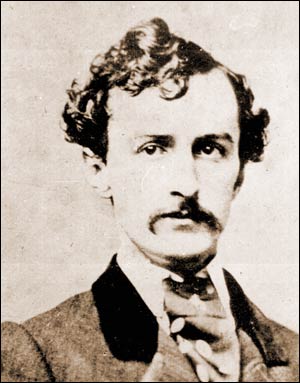
We then jump back five years to Richmond, Virginia before it all started. This portion of the story is somewhat Wikipediaish. Booth has a big family. He doesn’t have the best relationship with them. In particular he and his brother Edwin, also an actor, don’t see eye to eye. This conflict stems from their father’s passing, who apparently drank himself to death, which (I think) Booth believes Edwin is responsible for.
Around this time, the Civil War is gearing up, and after seeing a Union soldier hanged for freeing slaves, Booth has an epiphany and rededicates himself to becoming a great actor (I’m not sure what seeing someone’s death has to do with acting either. Though Tom Cruise has taught us inspiration comes from the strangest of places).
Eventually Booth meets up with his childhood friends Sam and Michael, who are off to the war. Booth promises to join them but then makes a second promise to his mother that he’ll never become a soldier. This leaves Sam and Michael pissed and is a critical turning point in Booth’s life, as he will never get over the guilt of abandoning his friends.
However, Booth gets another chance to help out the cause when the Confederacy comes to him and asks if he’ll secretly deliver medicine to the Confederate army on his tour stops. Delighted to be of use, he accepts, and this is probably the most dramatically compelling portion of the screenplay. There’s a great scene where some officers stop him and ask to check his suitcase for weapons, the very suitcase the medication is in. Watching him try and squirm out of it is fun stuff.
As Booth’s star rises, his side falls. It’s looking more and more like the Union is going to win the war, and for that reason, people are coming up with desperate ideas. Booth is no exception. He starts concocting a plan whereby he kidnaps the president in order to bargain for many of the captured Confederate soldiers.

This is actually what was supposed to happen all along until a few days before the kidnapping, when Booth’s conspirators changed the plan to killing Lincoln instead, something Booth was never totally on board with. And while he went through with the killing, his conspirators left him out in the cold. They were supposed to kill the entire presidential body, including the vice president and secretary of state, but they all choked and didn’t go through with it. Which kinda sucked for them, since they ended up getting hanged anyway. And that, my friends, is the story of Booth.
Whoa.
This was a tough read. There’s so much information packed into this novel-esque screenplay that every page you read feels like you’re reading four. Indeed, the student inside me wanted to highlight all the necessary passages for the test I would surely have to take tomorrow. When I do my whining on this site, it’s usually for biopics that make me feel like I’m back in school in the middle of a boring history course, and unfortunately, that’s how I felt here.
My big problem with Booth was that there wasn’t enough drama. There wasn’t enough conflict. In Valkyrie, Quarrie’s last film, there were so many scenes where people were clashing up against each other. You could feel the tension in each of the scenes. Here, it was just a person’s life unfolding before us, and that wasn’t enough for me. That’s why I loved the medicine-luggage scene so much. It was the only time where Booth’s journey was difficult – where his world was challenged and where something bad had the potential to happen.
The central conflict in Booth is internal – specifically his troubled relationship with his dead father. The problem is that the source of that conflict and the reasoning behind it are all very confusing. It’s somehow related to his brother and he’s mad at his brother for not stopping his father from drinking himself to death, so he blames his brother for killing his father but his brother also blames him for it I think and then he’s also trying to live up to his father’s name (who was also an actor) and I think somehow we’re supposed to make the connection between his unresolved relationship with his father and him killing Lincoln but I just didn’t see it. It was way too complicated.
I also found it a strange choice to put the assassination at the beginning. On the one hand, it makes sense. We all know what happens anyway. Why not start the movie off with a bang? The problem with this is, the rest of the story is so slow (and I think deliberately so), that we need something to look forward to. We need that exciting finale to pay off the huge investment we’re putting into this. But since we’ve already experienced the finale, we’re not sure what it is we’re driving towards, why we want to get to the end.
My question is, is Booth’s story worth telling in the first place? As far as I can tell, the bullet points of his motivation are, “He sympathized with the south, felt bad for not joining his buddies in the war, and eventually that guilt caught up with him which resulted in him killing Lincoln.” It’s almost as if what’s interesting about Booth as an assassin, the fact that he was pretty normal, is what makes his story so uninteresting. There’s no deep-set shocking reasoning for his actions. He was a normal guy and decided to do something stupid. I don’t know if that’s enough for a movie.
I think McQuarrie’s a great writer but this subject matter didn’t interest me.
[ ] What the hell did I just read?
[x] wasn’t for me
[ ] worth the read
[ ] impressive
[ ] genius
What I learned: Now I know that some of you disagree with me on this but I believe, and will continue to believe, that telling a story where the audience already knows what’s going to happen severely handicaps one of your biggest advantages as a writer – the element of surprise. To me, when your audience is 30-40 pages ahead of you (or in this case, 100 pages), you have to work twice as hard to keep them entertained. Sure, if you have super-compelling characters, unlimited obstacles, and every scene is dripping with conflict, you can keep our focus so in the now that we don’t care that we already know what will happen (For example, we loved Apollo 13 even though we knew how it ended) but why make it so hard on yourself? I remember watching Toy Story 3 this year, probably my favorite film of 2010, when the toys are heading towards that incinerator (spoiler), and for the briefest of moments thought, “Oh my God. They’re really going to do this. They’re going to end these toys’ lives.” I was riveted in that moment, on the edge of my seat. Imagine if the opening scene of that movie was a flashforward showing us that those toys had made it out okay. How that would’ve eliminated every drop of mystery from the movie. How it would’ve stolen one of the best scenes of the year. Writing a good story is hard enough. Why handicap yourself?
Genre: Heist/Action
Premise: A group of famous magicians combine their talents to perform a trio of heists.
About: This is a spec sale picked up by Roberto Orci and Alex Kurtzman. See Me is written by Edward Ricourt and Boaz Yakin. Yakin wrote the 1989 version of The Punisher, The Rookie, and directed Remember the Titans. Ricourt’s career has been a little shorter. He was a member of Marvel Studios’ writing program and wrote last year’s Black List script, Year 12, about earth 12 years after of an alien invasion.
Writer: Boaz Yakin & Edwart Ricourt
Details: 117 pages – May 2009 Draft (This is an early draft of the script. The situations, characters, and plot may change significantly by the time the film is released. This is not a definitive statement about the project, but rather an analysis of this unique draft as it pertains to the craft of screenwriting).

In the world of screenwriting, it’s becoming harder and harder to come up with a truly original high concept. “Aliens invade earth” can only be used so many times. Now You See Me is the most original high concept I’ve heard in awhile. I know this because I’m far from a “bank heist” guy, but boy did I get excited when I heard about this bank heist. Unfortunately the problem with these great-sounding premises is the writers usually screw it up within the first 20 pages by giving us the most obvious version of the story. Well I’m happy to announce that that’s not the case with Now You See Me. They don’t just come up with the concept – they execute it.
See Me opens up with a great scene. Our four protagonists are up on a Vegas stage performing their first of three limited engagements. There’s Michael Atlas, our illustrious leader, Roderigo, a master craftsman of magical devices, London Osborne, a testy hypnotist, and young Alex Hero, a sleight-of-hand master. They name themselves the “Four Horsemen” and because each has become the most popular magician in their field, the fact that they’re teaming up has the world buzzing.
After Atlas works the crowd with his disappointment over the fading economy, he invites a random audience member up on stage. Wouldn’t it be nice, he ponders, if they could get back some of that money that’s been taken from them? Behind them are a series of video screens displaying security camera feeds of a bank. But not just any bank, a bank in Paris, the very bank this audience member belongs to. Atlas’ cohorts perform some vanishing trickery, and the audience watches in shock as Atlas and the audience member APPEAR in the video feeds. In the bank. IN PARIS!

They march their way into the vault, take all the money inside, and the next thing you know, money is RAINING FROM THE CEILINGS of the auditorium. REAL MONEY. The audience scrambles about, grabbing as much as they can, and our magicians walk off stage amidst an air of mystery.
But it gets better. The authorities call up the bank in Paris. Indeed, their vault has been robbed of the same amount of money stolen in those security videos. The cops are flabbergasted. How can that have possibly happened?
Dylan Hobbes, an FBI agent who’s overworked his way right out of a marriage, is tasked with figuring that out. He’s dead set on booking these guys but that’s not going to be easy when our heroes have a couple of thousand alibis. I mean you can’t keep people in custody for teleporting to Paris, robbing a bank, and teleporting back, can you? So after a lot of strong-arming, he’s forced to let them go.
That’s when we meet Thaddeus Bradley, a broken down old curmudgeon who’s seen more magic than Harry Potter’s underwear. Thaddeus is a magician’s mortal enemy – one of those “exposer” types who peels back the curtain on magicians’ secrets to make a quick buck. It turns out he taught Atlas everything he knows. And he knows how he pulled off his robbery. The trick is catching him in the act of the other two. He offers his services and even though Hobbes hates him, he has no choice but to let him join the team.
We then follow the Four Horseman to Atlantic City, where they expose a greedy insurance scammer, and finally Los Angeles, where they try and pull off the biggest robbery ever.
Now You See Me has the kind of spirit summer movies used to have. There’s no sex-starved vampires, rushed sequels, or superheroes here. It’s big, it’s fun, and – gasp – even attempts to make you think a little. That’s not to say the script doesn’t have problems (it’s noticeably top-heavy) but the fun-factor helps it overcome them.
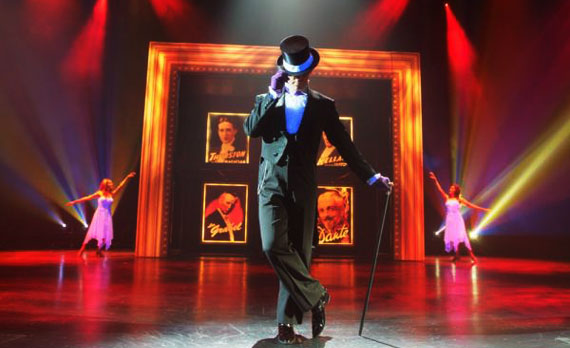
The strongest aspect to me is how they approached the story. If I told you I had a script about magicians who were bank robbers, the first thing you’d probably imagine is a group of magicians, some caped, some with masks, breaking into banks, throwing down smoke bombs, disappearing and reappearing inside vaults – in other words the most straightforward interpretation of the idea. The fact that the writers approach this in a completely different way – where the characters create a spectacle of their heists, performing them in front of hundreds, makes this way more interesting than anything I could’ve imagined. It’s a good reminder that whenever you have an idea, you want to sit down and look at all the ways you could execute it. The most obvious way is not always the best way, and that little extra effort you put into figuring that out, is going to pay huge dividends in the months (and maybe years) you spend on the script.
I also thought all the magicians were great. They’re not particularly deep but the mastery each has over their respective crafts gives them this heroic quality that really makes you want to root for them. Audiences like characters who are really good at what they do. I don’t know why but that’s always been the case. And to solidify the love-fest, it was a clever coup to not only have them steal the money, but give it back to the public. I mean who doesn’t like Robin Hood (unless, of course, Russell Crowe is playing him)?
Now You See Me does most of its character exploration with Dylan Hobbes, the workaholic FBI agent who never received the memo about ‘family time.’ This is probably the only character that fell flat. Dylan’s problems are generic and uninteresting and there don’t seem to be any stakes attached to them. There are all these scenes with him and his wife/ex-wife (I’m still not sure what she is), talking about how he works too much, but there’s never that ultimatum. He never gets that “It’s either your family or your work.” If you’re not going to challenge your protagonist’s flaw, then why have it in the first place?
I suppose the only concerning issue here is the progression (or I should say “degression”) of the performances themselves. The opening performance in Vegas is awesome. So much so that the other two can’t possibly live up to it. And they don’t. The second performance, in particular, which exposes a shady insurance magnate, doesn’t even set up the magnate ahead of time. So when he’s exposed, a mere 1 minute after we meet him, we don’t care. Had they set him up earlier as a true bad guy, that would’ve helped. I like that the third robbery takes place at a unique location, but that location is so cold and grey and dead, it doesn’t feel right. These guys are putting on a show. The final performance needs to be visual and cinematic and exciting. Not some ugly brick warehouse out in the middle of nowhere. Also, the order of the cities seems off. Vegas is the crown jewel. Shouldn’t it be saved for last?
But these problems are the equivalent of having bad food at a wedding reception. Who the hell cares about the food? You just wanna get drunk and have a blast. And “See Me” gets you wasted.
[ ] What the hell did I just read?
[ ] wasn’t for me
[xx] worth the read
[ ] impressive
[ ] genius
What I learned: Be careful starting your script out too big. True, you want to rope in the reader right away. But if your opening scene is the best scene in the script that means it’s all downhill from there. Spielberg has said that his only problem with Hereafter is that it starts with a bang and ends with a whimper. I couldn’t agree more. The movie starts with this awesome tsunami sequence and then doesn’t have a single scene that comes close afterwards. Now You See Me is not in that category, but I think it’ll have to raise the level of its second and final performances if it truly wants to be a great movie.
Genre: Drama
Premise: (from IMDB) A master forger falls for a mysterious woman.
About: I can’t say I’ve ever read The Contortionist’s Handbook, the Craig Clevenger novel, but that’s okay because now it’s being turned into a movie starring Hollywood’s new bad boy, Channing Tatum. Robin Shushan, the writer who adapted the book, is probably best known for working on Taylor Hackford’s upcoming project, a biopic about the life of Tennessee Williams. Contortionist’s Handbook is apparently being shot on the cheap, as the producers are responsible for such films as Lars And The Real Girl, Charlie Bartlett, United 93, Adventureland, etc. Knock Channing Tatum all you want, but the man is putting movies into production left and right.
Writer: Robin Shushan
Details: 121 pages – May 23, 2008 Draft (This is an early draft of the script. The situations, characters, and plot may change significantly by the time the film is released. This is not a definitive statement about the project, but rather an analysis of this unique draft as it pertains to the craft of screenwriting).
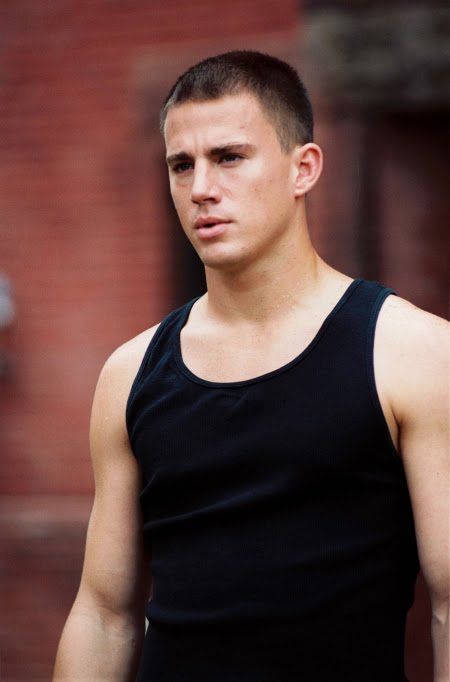
If Channing Tatum is trying to be the next James Dean, he’s certainly picked the right project. The Contortionist’s Handbook isn’t so much a movie as it is a commercial for Tatum’s bad boy appeal. He gets to play dangerous, rebellious, unpredictable, all those things young actors gravitate towards. The only problem is there’s no show surrounding this commercial. Tatum might be “tearing you apart” but he’s doing it without a story.
Handbook (which is what I’ll call it now because “Contortionist’s” is a weird word to write) starts out with our hero, John Dolan Vincent, being rolled out of a cheap motel by paramedics with a 40 year old hooker watching on. We’re guided by Vincent’s thick weathered voice over, as he tells us, “Rule number one, blend in. Rule number two, don’t stand out. Rule number three. See rules one and two.”
Vincent is a rules type of guy and he has many more observations about how to live that he’ll be filling us in on. But that’s not the only thing going on with Vincent. You see Vincent, right out of a page from Ellen Pompeo’s book, has a sixth finger. It’s not a freaky stub or anything but an actual moving operable finger. Imagine the possibilities.
Now experience tells me that wherever there’s a voice over, a flashback isn’t far behind, and indeed we jump back to Vincent’s childhood where we meet his no-nonsense dick of a father. As soon as daddy sees his freak son born, he gives up on him right there and then. 16 years of contentious childhood follow, and Vincent’s desperate bid to nab his father’s approval never pans out.
For reasons that still aren’t completely clear to me, Vincent sets off in a desperate bid to be anyone but himself. As a teenager, he learns how to make fake IDs, fake backgrounds. It’s intoxicating stuff for a young man who’s known nothing but disappointment. And so instead of just making these fake personas, he starts *becoming* these fake personas. This allows him to play a role other than himself, and that becomes addictive.
Strangely, these identities don’t seem to benefit Vincent in any way. True he’s always getting into trouble and being sent off to jail, and I suppose the changing identities clear his rap sheet, but he never uses any identity to, say, infiltrate the city’s upper crust or get a job he wouldn’t have otherwise been able to get. He just does it cause he doesn’t like being anyone for too long, which is kinda boring, don’t you think?
The good news is that Vincenet meets Keara, a stripper who doesn’t quite have a heart of gold, but she’s nice enough. Vincent saves her from a stripper breakdown and the two immediately fall in love. After some QT together, Vincent finally admits to Keara his true identity, something he hasn’t admitted to anyone since he was a teenager, which, in a way, forces him to come to terms with who he really is.

Along the way there are some nasty criminals who force Vincent into making identities for them. Vincent gets himself committed to a mental hospital in order to find the missing Keara, who’s also at that hospital (hence why he overdoses in the opening scene), but the changing of identities and the Vincent-Keara love story are the main thread.
Probably the most difficult thing about this read is that when I read it, I didn’t know what the premise was. I only checked afterwards, where the summary stated it was a story “about a forger who changed his identity to cover up his past.” I went, “Oh, *that’s* what this was about the whole time?” I thought the forger aspect was his *character*. I didn’t know it was the entire story! And that’s where Handbook failed for me. Yeah it did a good job detailing the fake identity world, but sixty pages in I was still going, “Uhhh, what is this supposed to be about again?”
I guess you could say the hospital storyline, where Vincent is desperately trying to find and be with Keara is the central story question. “Will he find her or not?” But the reason it didn’t hold my interest was because there were no stakes attached to it. At no time did I think, “This is his only chance to be with her! This is it!” It was more like, “Well if he doesn’t find her here he can just wait outside the hospital until she’s released.”
This left the heavy lifting to the cool-factor of the screenplay. The deep philosophizing voice overs (“Maybe you were slow to walk because you had nowhere to go”). The bravado male posturing. The angsty looks we’re sure to see from Tatum’s character. The stylistic flourishes (such as a flashback into a fetus! Yes, we get one of those). I think that can work with a young edgy male demo who likes to think they’re Channing Tatum, and the girlies content with staring at Tatum’s muscles for two hours, but I’m telling you, whenever you completely abandon story, you’re severely lowering the chances that we’re going to stay tuned for the whole show.
One other minor thing that bothered me was the sixth finger. I didn’t really understand why it was there in the first place other than as an odd character quirk. And just from a story perspective, it didn’t make any sense. We’re repeatedly told how often Vincent’s gone to jail and how many times he’s gotten in trouble with the law. When you book someone with six fingers, isn’t that something you remember? Don’t you mark down in a book, “six fingered man.” I mean everyone’s seen Princess Bride, right? So doesn’t that make it impossible to be an identity-changer? It’s not like they’re going to say, “Oh hey look, it’s *another* six-fingered man. That’s the fifth one this month! What are the odds??” I don’t know. It seemed like a strange choice.
No surprises here. I prefer a good story and this is more of a vanity project. Nothing wrong with that though. Clooney just had The American. Why can’t Tatum have The Contortionist?
[ ] What the hell did I just read?
[x] wasn’t for me
[ ] worth the read
[ ] impressive
[ ] genius
What I learned: While it’s probably best to avoid voice over, the device does allow you to do some things you can’t do without it. The biggest thing is that we can get inside a character’s head and know EXACTLY what he’s thinking. This creates an intimate connection between the audience and the character that isn’t possible otherwise. I don’t know if the device was successful in Handbook though because Vincent speaks more in sound bites than actual thoughts (“Rule number one, blend in.”) but I’ve seen it work in other places, most notably Morgan Freeman’s voice over in The Shawshank Redemption.
Why a star chose to play this role: This is a simple one. Again, the actor gets to play multiple characters (the different identities he takes on). He also gets to play by his own rules, which is something we discussed with Damon and Green Zone. Actors love characters who shun authority and live by their own code of conduct.