
Search Results for: F word
Genre: War
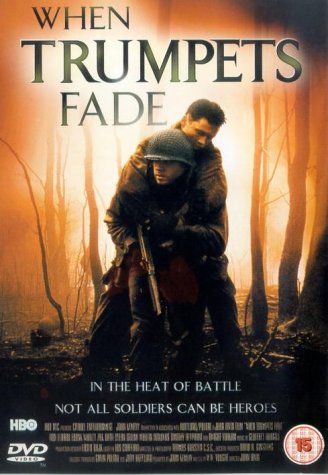
Premise: A private bent on saving his own ass in the forgotten Battle of Hurtgen Forest in World War 2, finds himself repeatedly promoted as those around him continue to die.
About: When Trumpets Fade 

Writer: W. W. Vought
Details: 116 pages – original 1996 draft (This is an early draft of the script. The situations, characters, and plot may change significantly by the time the film is released. This is not a definitive statement about the project, but rather an analysis of this unique draft as it pertains to the craft of screenwriting).
One of the cool things about Steven Spielberg and what’s allowed him to be on top of the movie business for so long, while so many others have faded into obscurity, is how much emphasis he puts on finding new writing talent. Spielberg realized a long time ago that writers are the lifeblood of the industry. Without their ideas, without their unique voices, without their stories, you have nothing.
And to you or I, who know what it’s like to stare at a screen for 10 hours a day, that may seem obvious. But there are so many other producers in this business who believe in shortcuts, who believe that all you need is an idea, the latest writer gun-for-hire, and a really good D.P., and you can slap together a 200 million dollar hit in six months. If you want to know why none of these guys have Spielberg staying power, look no further than that mentality.
I’m not sure how Spielberg’s operation works, but from what I can tell, he puts the same amount of effort into finding new writers as Apple puts into R&D. In other words, a whole lot. I can only imagine how much rough they have to trudge through to find those diamonds, but they eventually find them. And as long as they keep finding them, Spielberg will continue to stay on top.
So what was this script that got Spielberg and Nina so excited? Was it really that good?
Let’s find out.
Private Manning cares about one guy and one guy only. Numero Uno. Even in the heartpounding opening scene, as he carries a dying soldier to safety, the implication is that the only reason he’s alive and everyone else in his platoon except for this guy is dead is because he stayed back, hid out, stayed out of the fray in order to keep his own heart pounding. When he gets back, his superiors tell him as much. They call him a coward. A survivor only through fear.
Not that he doesn’t deserve to be scared. The Americans are located in an area known as the “Death Factory,” a forest so thick with Germans they might as well grow there. And they are massacring the Americans group by bloody group. With all the leaders dying, drastic measures must be taken. So Manning, who was hoping to go home, is instead promoted. The king of the chickens is now in charge of his own batch of chickens.
His platoon shows up a day later, a group of fresh-faced scared kids who have no idea what’s in store for them. The noobs are thrown into battle right away by Manning. And within minutes they’re getting shot at with real bullets, they’re being hunted by real Germans, they realize they could really die. And there’s nothing they can do about it.
After a few minor missions, Manning gets the news he’s been waiting for. If they can take out a few huge artillery guns that the Germans have perched up on the hills, Manning will get his wish to be sent home. So the normally passive Manning puts his game face on, and sets out to do what thousands of other men have been slaughtered trying to do.
When Trumpets Fade has some genius in it. Right off the bat you’re pulled in by Manning’s desperate attempt to keep this other soldier alive. We know the man’s going to die. He knows he’s going to die. But Manning tries his best to keep him calm, to keep him going. It’s not only an exciting way to open a script (make those first ten pages great!), but it makes us immediately like our hero – whose selfishness would otherwise make him hard to warm up to. I mean this is a really intense scene and even though we’ve seen it a hundred times before, there’s something real and authentic about their exchange. We don’t even know these people and yet we’re hoping against all hope that this guy makes it. After this scene, I was willing to go anywhere Manning took me.
Also, just like any good movie setup, you want there to be some irony in your story. In this case we have a guy who doesn’t want to lead who’s forced to lead. That right there is a compelling character whose very existence for the rest of the film is steeped in conflict. Conflict = drama. And drama is what keeps your audience’s interest.
The strange thing about When Trumpets Fade is that no real story emerges until after the midpoint (when Manning is given orders to take out the artillery guns). Up until that point, our characters are repeatedly sent out on minor missions that don’t really have anything at stake. This would normally result in a bunch of boring scenes. But there’s something honest and authentic about these missions that keeps us reading.
Even though we get all the cliché war moments where you look to your right and the guy you bunked with last night now has half his face blown off, the dialogue feels real, the missions intense, and our desire to see how Manning reacts to it all, if he’ll learn, keeps us engaged. To simplify it, even though I’ve seen dozens of war movies, this script made me feel like I was in the war.
But there are still a lot of mistakes that are made , and raw ones at that. I guess we’ll start with Manning, whose flaw, while interesting, was at times unclear. Manning is selfish AND a coward. Last time I checked those are two completely different things, and while that may work fine in real life, it’s confusing when a main character has two separate fatal flaws he’s battling. We’re not sure which one to identify him with, which alters our interpretation of the story. In other words, the script reads much differently if we’re assuming Manning is a coward as opposed to if we’re assuming Manning is selfish.
I thought the supporting characters could’ve been better constructed as well. Warren, who plays the second lead in the movie, is someone I know absolutely nothing about other than that he’s fresh-faced and wears glasses. There were 5-6 other guys whose backstories were even thinner. This was a big deal since whenever the group faced a dangerous encounter, the only character I cared about surviving was Manning. I cared more about that opening dying character than I did any of these guys.
The ending also needed work. Not only is there a manufactured plot twist where the other soldiers want to murder Manning (which doesn’t work at all) but the main story goal comes in so late, it’s hard to get into (I’m referring to the mission to take out the guns on the hill). Late-arriving story goals never have the same stakes attached to them as something that’s been set up throughout the story. I had the same problem with Saving Private Ryan. Once they found Private Ryan, they tried to tack on this supposedly big bridge finale. But the goal of securing the bridge came so late that we never really bought into its importance, and therefore didn’t care if they succeeded or not.
Despite these problems, the Manning character and the feeling of really being in this war won me over. I know that just a couple of weeks ago I harped on the staleness of World War 2 movies, but I have to remind myself that when something is written well, it doesn’t matter what the subject matter is. It’s going to work.
[ ] What the hell did I just read?
[ ] wasn’t for me
[x] worth the read
[ ] impressive
[ ] genius
What I learned: Stakes stakes stakes people. I know we can’t shut up about them here but writers are still making the same mi-stakes so we’re going to keep bringing them up. The success of your climax is directly related to how big the stakes are. The later you set those stakes up, the smaller they’re going to seem. Imagine Rocky 
Genre: Action-Adventure/Romance/Comedy
Premise: When the infamous womanizer Don Juan starts to fall for a woman for the first time in his life, he must decide if that love is worth giving up his woman-chasing ways.
About: Don Juan won the Scriptapalooza contest back in 2004. Not the actual Don Juan, but the writer who wrote Don Juan, Patrick Andrew O’Connor. Believe it or not, this is the second script O’Connor ever wrote, which is a rare feat, winning a major screenwriting competition off your second script. O’Connor got his first produced credit last year with the indie flick “The Break-Up Artist” which he sold at the Cannes Film Festival. O’Connor recently optioned another script (whose title I can’t find) which is why people are going back and giving this script another look.
Writer: Patrick Andrew O’Connor
Details: 105 pages – undated (This is an early draft of the script. The situations, characters, and plot may change significantly by the time the film is released. This is not a definitive statement about the project, but rather an analysis of this unique draft as it pertains to the craft of screenwriting).

I’m not the swashbuckling type.
I always thought The Three Musketeers 

But you guys have demanded more contest winners and since I work for you, the people, then dammit if I wasn’t going to review more contest winners.
Don Juan starts with, well, Don Juan standing at the foot of his dying mother’s bed. Before she kicks it, she tells Don Juan to make sure he finds love. Being only 12 at the time, Don Juan interpreted this to mean “find as much love as humanly possible.” And when we flash forward 15 years, that’s exactly what Don Juan’s doing, finding love, sometimes with three or four women a day.
In fact, Don Juan has a bet going with his biggest Lothario competition, Don Luis, on who can bed the most women in a single year. Since Don Juan is the ultimate lover, he wins handily, but not without some questionable record-keeping (he was supposedly with two women on the same day in two different countries – not an easy feat in 1830).
In order to clear his name, he proposes another bet. This bedding competition has left Don Luis yearning for the true love of a woman. As such he has asked the beautiful Ana for her hand in marriage. Don Juan proposes that he can bed Ana before Don Luis marries her in a couple of days. Under the tight scrutiny of an eager crowd, Don Luis accepts the challenge in order to secure his dignity (why this is considered “dignified” is something I can only assume people 180 years ago understood).
As soon as the challenge is accepted, Don Luis races home to his fiance to prepare her for the ensuing onslaught of Don Juan.
In the meantime, Don Juan runs into Ana’s best friend, the heartbreakingly beautiful Ines, who is a few days away from taking her oath as a nun. Don Juan is struck by the unbridled beauty of this woman and experiences something he’s never felt before while around a woman – feelings. The only problem is that Ana is the one woman on the planet not affected by Don Juan’s charms. Even his most time-tested methods fall flat with her.
And thus begins a most impossible conquest. Sleep with Ana before Luis marries her and get Ines to fall in love with him before she takes her vows as a nun. This isn’t going to be easy!
Along the way Don Juan is chased by Ines’ father, who happens to be the captain of the Sevilla Royal Guard, gets thrown into jail, helps his affable and hilarious servant hook up with Ines’ servant, breaks out of jail, and struggles to achieve these two impossible goals before the sun rises.
As you can probably tell from my exuberant review, I enjoyed this a lot more than I thought I would. One thing I worried about right away was that this was yet another standard treatment of a character we’ve seen dozens of times before. In fact, Heath Ledger just played the kindred spirit to this character, Casanova, a few years ago. The forgettable generic treatment of that character is exactly what I was expecting with Don Juan.
Usually, the writers who rise up out of that giant amateur screenwriting stew are writers who take characters like this and find a fresh take on them. That’s why Baz Luhrman’s Romeo & Juliet worked, as he transported it to modern day Los Angeles. That’s why Steve Martin’s “Roxanne” worked, as they took Cyrano de Bergerac and found a present-day angle. Here, we stay with the same character in the same setting in the same time period as we’ve always seen Don Juan. So how interesting could it be?
Very.
And there’s a reason for that. O’Connor nails the execution. It’s the hardest thing to do – take a story that we’ve seen before, tell it the same old fashioned way that everyone else has told it, and still make it exciting. The reason it’s so hard is because you have to do everything perfectly. And this is made even more amazing by the fact that this is only O’Connor’s second screenplay. I would like to know the rewrite situation on this script (is this the draft that won the contest or a newer draft?) because there are so many things he does right here.
First, the goals are very strong. And I love how Don Juan bucks the traditional single-goal protagonist structure and instead gives Don Juan TWO goals, making his job twice as difficult. I love the dual ticking time bombs, ensuring that our story moves at a breakneck pace. I love that Don Juan’s being chased by Ines’ father, which adds even more momentum (and ups the stakes – if he gets caught, he could end up in jail for the rest of his life…or worse!). And I love the exploration of Don Juan’s character flaw, his confusion and rejection of the emotion he’s so terrified of feeling – love. These are all very basic story-telling devices, but O’Connor puts them to use with amazing results.
I also loved Ciutti, Don Juan’s noble servant, who’s stuck doing everything Don Juan does, even though he’s one-fourth as capable. I thought the dialogue was witty and funny, not an easy feat when this genre practically expects it. And I really grew to love and understand the advantage of writing a story around this character. Don Juan is that impossible to resist rogue lead – he’s a liar and a cheater, which gives him a dark side, but he’s eternally optimistic and funny, making it hard to dislike the guy.
All in all I’d say this was a rousing success. And yes, I’m using “rousing” because it’s a word they’d use in the 19th Century. I’m that inspired by this script. I kind of stumbled onto it after attempting to read two Brit List scripts (both of which were littered with misspellings and sloppy writing – what the hell man??), and boy am I glad I did. The only reason this doesn’t get an “impressive” is because the subject matter isn’t my cup of tea, so there were parts I couldn’t get into no matter how well-written they were. But for a script that started at a “Wasn’t For Me” before I opened the first page, I’d say a double “worth the read” is impressive in itself.
[ ] What the hell did I just read?
[ ] wasn’t for me
[xx] worth the read
[ ] impressive
[ ] genius
What I learned: It’s important to always make it hard for your hero to achieve his goal. Anything that comes easy for him will feel like a cheat. However, I realized that sometimes, in a comedy, if you set it up properly, you can make a key plot point easy for your hero as long as it gets a big laugh. In Don Juan, there’s a guard guarding Ana’s house who’s both deaf and blind. We get some early exchanges with a worried Don Luis that the guard won’t be able to keep Don Juan out. The guard assures him that he can handle the job, and later when Don Juan sneaks past him easily in a funny scene, we accept it. Since it was properly set up and funny, we don’t feel cheated. Contrast this with a comedy script I reviewed the other week, We’re the Millers. I was really upset that in a movie about smuggling drugs into America, that our criminals don’t encounter any problems at the U.S./Mexico border. It’s not funny and the reason it’s easy was never set up, so we feel cheated.
Genre: Action
Premise: A terrorist has planted a series of bombs inside several malls in Los Angeles. Although they capture the man before the bombs go off, a bout of amnesia prevents him from remembering where he put the bombs, or if he’s the terrorist at all.
About: Mondry and Bagarozzi met as teen-age video store clerks back in 1987. In 2000, they sold this script for 1 million dollars. “Every night we worked, we took home videos and we would find a director whose work we loved,” said Mondry. “We’d just basically go through the whole catalog and watch one film after another. It was sort of a self-taught film history course.” Bagarozzi sold one screenplay on his own before this called “The Tin Man,” a revisionist noir L.A. detective story, to the Walt Disney Co. for $250,000. Unfortunately, this is not the spec draft that sold, but rather a draft from a few years later.
Writers: Anthony Bagarozzi & Charles Mondry
Details: 128 pages – 12/21/04 draft (This is an early draft of the script. The situations, characters, and plot may change significantly by the time the film is released. This is not a definitive statement about the project, but rather an analysis of this unique draft as it pertains to the craft of screenwriting).

I remember first posting my views of this script on a screenwriting forum a few years ago. I’d only read 30 pages, but what I’d read, I didn’t like. I thought it felt like a wannabe Die Hard 
Imagine my shock, however, when everyone else who read the screenplay absolutely loved it. In fact, I can’t remember a single person having a bad thing to say about it. Everyone kept talking about the “confidence” of the writing, how assured the writers were in carving out their words. I’d never really thought of writing in those terms before – “confidence” – so it took me awhile to figure out how that might affect someone’s reading experience.
To me, writing had always been about the story. Style and confidence are great, but they don’t address character arcs or sustain second acts. Could it be that style and confidence alone could carry a screenplay? I’m inclined to say no, but Tick Tock has a few other things going for it, namely that it’s never slow. This script moves at the breakneck speed of a Ferrari, and it should, since it’s being told in real time. I’m curious as to what the Scriptshadow readers will think of it. Does this spec-friendly real time confident action romp satisfy? Or is it pure sizzle?
Los Angeles.
Red-headed FBI Agent and tough-girl beauty, Claire, is racing to the Federal Building. She’s been informed of a terrorist threat. A man has threated to blow up some bombs in malls scattered throughout Los Angeles today, which just happens to be the biggest shopping day of the year.
The good news is they already have the bomber in custody. The bad news?
He doesn’t remember anything.
He doesn’t even know his own name. In fact, the FBI isn’t 100% sure this is even the guy. They just have some evidence to indicate he is.
The man, who we’ll refer to as Crosby, is a nice affable guy who’s convinced that he’s been misidentified. He doesn’t think he’s capable of doing something this terrible. But the doctors say that amongst other things, Crosby’s also lost his personality, which means if he were a true baddie, he wouldn’t even know it. The “good” news is they believe his amnesia will disappear within a few hours and the real “Crosby” will emerge.
But they don’t have a few hours! The bad guy’s taped threat says these bombs are going to blow up soon!
So Claire grabs Crosby along with a small crack FBI team and heads to Fox Hills Mall, where the first of the bombs is said to be planted. Her hope is that with a little visual stimulation, Crosby will remember where he put the bombs so they can deactivate them in time.
But wait! Crosby points out that even if he was the bad guy and all of a sudden remembered it, the last thing he’d do is expose his bomb locations. He’d just keep pretending he’d forgotten. I’m still not sure why Claire doesn’t see this as a problem, but she says something to indicate she’s not worried about it.
Basically, we jump from mall to mall as the threats get bigger and the bombs get explosioneyer. Claire and Crosby begin developing a friendship, even though they know that when Crosby finally realizes who he is and becomes Evil Crosby, that that friendship will dissolve faster than a lit bomb wick. Eventually they end up at The Beverly Center, a huge indoor upscale mall in Beverly Hills, where it appears this cat and mouse game will end with a big explosion.
Okay so first the good. Real-time. The real-time angle makes this movie a little different from the now two-decade long string of Die Hard copycats. It also keeps the script moving at a breakneck pace, which is always advantageous when writing a spec (faster more immediate stories tend to do better in the spec market).
Making the bad guy essentially a good guy was also a unique twist. Normally in these films the bad guy is obvious. Here, he’s actually helping our hero. When you combine this with the mystery of whether this really is the bad guy or not, I have to admit you have an interesting dynamic you’re not used to seeing in an action film.
However here’s the problem I had with Tick Tock. There’s a lot to buy into here, and the story almost feels like two movies trapped inside one. First you have a film about malls being blown up by some terrorist mastermind, and then you have a movie about a terrorist who doesn’t remember being a terrorist. They kind of go together but it all seemed a little too convenient that this was happening at the same time.
And that’s not the only thing you have to buy into. Tick Tock tests the limits of suspended disbelief. Let’s start with what I mentioned above. If this is the terrorist, once he remembers who he is, there’s a strong chance he’s not going to admit it. Also, our FBI team is running directly into malls that they know are going to blow up. Does that make sense to you? Cause I’m not sure it makes sense to me. Also, since they know all the bombs are placed in Los Angeles malls, why not just evacuate all the malls? There are attempts to explain this throughout the story, but for reasons I’m still not clear about, none of the malls are ever entirely evacuated. Also, it’s never clear how they know which mall to go to (they just sorta guess) or when the bombs are going to blow (they just sorta estimate).
All in all, there are a ton of rules you have to buy into to accept Tick Tock, a few too many for me, and that really prevented me from enjoying it. It helps that the script is not trying to be anything more than a fun action flick, but even that didn’t prevent a good handful of “Oh come ons!” during the read.
The funny thing is, Tick Tock incorporates a lot of things that I preach on this site. The writing is lean. The structure is sound. The script is the very definition of a ticking time bomb (it’s titled “Tick Tock!”). So I’m not going to go out of my way to say it has nothing to offer. It’s just that while I could buy into all these things on an individual basis, together they were too much. Not to mention that the reveal of the bad guy was lame.
I have a feeling some of you will find this fun, especially action buffs. But it wasn’t for me.
[ ] What the hell did I just read?
[x] wasn’t for me
[ ] worth the read
[ ] impressive
[ ] genius
What I learned: There is something to be said for confidence in one’s writing. If you charge ahead, are in control of your words, if you show conviction in your choices, you can almost fool the reader into believing anything you write. If you’re timid and unsure of yourself when you write, the reader will sense it. If we don’t believe that *you* don’t believe in your story, then we’re not going to believe in it. Just remember, confidence doesn’t mean aggressiveness. The aggressive in-your-face writing works here because it’s a testosterone filled action flick. “Confidence” might be written much differently in, say, a horror script.
Genre: Crime/Drama/Thriller
Premise: (from IMDB) When a debt puts a young man’s life in danger, he turns to putting a hit out on his evil mother in order to collect the insurance.
About: William Friedkin, the famed director of The Exorcist


Writer: Tracy Letts
Details: 123 pages – not sure when this draft was written (This is an early draft of the script. The situations, characters, and plot may change significantly by the time the film is released. This is not a definitive statement about the project, but rather an analysis of this unique draft as it pertains to the craft of screenwriting).
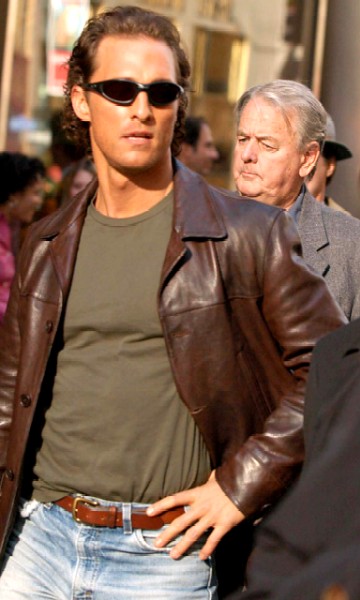
This movie’s going to be good. I can’t promise you that but sometimes you read a script and you just know. There are extenuating circumstances. The wild card is Matthew McConaughey in the Killer Joe role, but even though Matthew’s on the verge of becoming a caricature of himself (“Becoming?” Who am I kidding? He already is), I believe he’ll nail this role. There’s a low-key dangerous sensibility to the character that fits right into McConaughey’s darker range, a range we saw glimpses of all the way back in Dazed and Confused
Chris, the kind of guy who gets in trouble just by leaving the house, is manically banging on the door to his parent’s trailer when we meet him. We’re in the middle of WhiteTrashville, so it’s no surprise the family’s got issues. Chris’ father, Ansel, recently divorced his crazy wife and married Sharla, who’s so trashy she walks around the house half-naked no matter who’s around. Chris also has a sister, 20 year old Dottie, who’s pretty enough to make you stare, but slower than a lobotomized turtle.
Chris has a problem. He owes some bad people a lot of money. 6,000 bucks to be exact. In trailer park money that’s like a million dollars. And he’s begging for his dad to loan him the dough. Ansel thinks that’s pretty funny. When the hell has he ever had 6000 dollars?

So Chris has an alternative plan. What if they get someone to kill Ansel’s ex-wife, his mom? Chris has it on authority that Dottie (his sister) is the sole benefactor of his mom’s 50,000 dollar life insurance policy. Chris has heard of a man, appropriately named Killer Joe, who will do the job for 20k. With the rest they can pay off his debt and split up the money. Ansel doesn’t have to think about it too long. He’s in.
Killer Joe is smooth, logical, a calming presence – the kind of guy you might discuss the rainforests with while warming up some hot chocolate. But you get the sense that he is a volcano waiting to erupt. Cross this man and you will endure torture that would make the Taliban blush.
After introductions have been made, Killer Joe gives them his terms. At the top of the list? Payment in advance. Hmm, that’s going to be tough, Chris says, explaining the plan behind the insurance. They have to kill the person to *get* the money. Then this discussion is over, Killer Joe says, and walks out.
Except…Killer Joe spots Dottie and changes his mind. He could be persuaded if they gave him some kind of…retainer. The indication is clear and Chris and Ansel make a deal with the devil, handing Dottie over to Killer Joe while the transaction goes down.
As you might imagine, every possible thing that could go wrong with this plan goes wrong. And it’s all brilliant.

What can I say? This was just a really good script. It starts with the dialogue, which, as you know, I don’t talk about a whole lot unless it truly impresses me. This impressed me. It’s thin (not too wordy), it’s crisp, it moves the story forward, it’s never obvious, it’s humorous, it never gets bogged down in exposition, it’s imaginative…I feel like in most of the scripts I read, I know what the characters are going to say before they do. I was never quite sure what was going to come out of these characters’ mouths, and that’s what made it so fun.
Where Letts really separates himself though is in the humor. He really captures the social dynamic of this world. The characters think, act, and talk exactly like you’d imagine they would. You get gems like this when Chris realizes they can’t pay Killer Joe, “We could do it ourselves,” he says. Ansel replies, “You gonna kill somebody? You can’t even tell time.”
Overall, a great script to study for dialogue.
In a lot of ways, Killer Joe reminds me of an under-the-radar movie that came out a couple of years ago, “Before The Devil Knows You’re Dead
When you title your script after your villain, it’s a safe bet that he’s a strong character, and Killer Joe doesn’t disappoint. Usually, the scariest villains are the ones where you only see their good side. The reason for this is, you know that sooner or later that good side is going to break, and that there’s something horrifying underneath. That was the genius behind Christoph Waltz’ character in Inglorious Basterds
And again, this is how you get your script made. You create a character that a big actor can’t say no to. That’s why McConaughey signed on to this. That’s how they got the funding. That’s why this movie is going into production. I dare you to read this script and not be fascinated by this character. He says and does the kind of shit that actors kill to say and do.

Another thing that sets this apart is that you never know what’s coming next. Obstacles keep getting thrown at our hero. The plan keeps having to be reevaluated. If you give your character a straight path to his goal, it’ll always be boring. You give them a goal and then continue to alter the playing field? Now you have an interesting story, which is exactly what happens here.
I don’t have many complaints. I think the script could’ve been a little shorter. There’s some weird stuff in the middle where Chris is going to porno movies and starts imagining Dottie in the role of the porn stars. I’m thinking that stuff wasn’t in the play and someone told Letts to make the movie more “cinematic” so it was thrown in.
While the ending is wonderful and batshit fucking crazy, it does have a very “play-like” final moment. It’s hard to explain without spoiling it but when you read it, you’ll know what I mean.
But man, this is how you do it. This is how you write a script. The page count is long but the writing is so sparse you don’t realize it. He’s only telling us the bare essentials of what we need to know in order to keep the story moving and boy do I wish more writers would take that cue. Killer Joe was a very pleasant surprise.
[ ] What the hell did I just read?
[ ] wasn’t for me
[ ] worth the read
[x] impressive
[ ] genius
What I learned: I’ve found that if your script is more dialogue based, you can make your page count longer, because dialogue reads faster (and by association is easier to get through).
Genre: Horror
Premise: A young priest who does not believe in the Devil travels to Rome to study at an Exorcism School.
About: Oh yeah baby. It’s Halloween Week! Why the hell was I thinking of reviewing Wanderlust on Halloween Week? Instead I’ve decided to review a more appropriate script, The Rite. The Rite will star Anthony Hopkins, Alice Braga, and an unknown actor in the starring role (at least he’s unknown to me). It’s directed by Michael Hafstrom, who directed 2007’s fun Steven King adaptation, 1408


Writer: Michael Petroni (based on the book by Matt Baglio)
Details: 123 pages – April 2008 draft (This is an early draft of the script. The situations, characters, and plot may change significantly by the time the film is released. This is not a definitive statement about the project, but rather an analysis of this unique draft as it pertains to the craft of screenwriting).

No offense to some of the recent writers whose scripts I’ve reviewed, but man can you tell when someone knows how to write. Writing isn’t about dictating real life events word for word. It’s about constructing those events in a dramatically entertaining way for an audience. It’s about knowing when to step on the gas and when to ease up. It’s about ratcheting up the conflict when the audience wants it, and keeping it subtle in the meantime. Yesterday my reading experience was pure frustration. I kept thinking, “Is this good and I’m just not getting it?” Today reminded me what real writing reads like.
These days, all you need to do is look around to see to see how many people are acting out their most sinful thoughts. We’re devolving as a species, and the devil is using it as a means to get inside of us. Over 500,000 possessions were reported last year. Priests are our last line of defense against this growing problem. For that reason, in 2007, Pope Benedict XVI instructed all bishops of the Catholic Church to appoint an exorcist in every diocese world wide. But before these exorcists can operate, someone has to teach them.
Thomas is an intelligent 24 year old embalmer for his father’s lifelong business, a funeral home. Close to retirement, he wants Thomas to take over when he leaves. But Thomas has other plans. He wants to get an education. He wants to live a normal life.
But a normal life requires schooling, and his father has made it clear that you don’t need an education to run a funeral home. If Thomas is going to go to school, he’ll need to find the money himself. That’s when he comes up with a plan. If you pledge your life to God, the church will pay for your education. In a move that would surely guarantee his spot in Hell if Thomas believed in such a place, Thomas plans to get his four years of education, then, before taking his vows, say “thanks but no thanks.”
As the climax for his plan approaches, one of the priests sees Thomas perform an amazing act of God without a shred of fear. He believes Thomas is destined for bigger things and suggests he consider becoming an exorcist. Thomas is reluctant, but the priest convinces him to go to Exorcism School in Rome for two months. If he doesn’t like it, he’s lost nothing.

Once at this school, Thomas is thrust into lectures about exorcism protocol, exorcism subjects, and the spookiest of the teachings, documentation of past exorcisms. But even the most spectacular of cases – and some are truly horrifying – are yawn-inducing as far as Thomas is concerned. He knows there’s a rational explanation behind everything and all this nonsense about God and the Devil are clouding these priests’ ability to judge.
The head priest senses Thomas’ skepticism and decides to send him off to one of their more “unorthodox” priests who does his work off-campus.
Indeed Father Carmine lives by his own code. There’s a protocol to go through before performing exorcisms. You have to see if a patient is mentally unstable. You have to rule out multiple personalities or trauma or psychological issues. Carmine couldn’t care less about that shit. If he thinks someone’s possessed, it’s time to slam a cross onto their forehead and batter them with the word of God.
It just so happens Thomas walks in during one of Father Carmine’s exorcisms, a young 17 year old pregnant woman named Rosaria. The event is horrifying, this young girl doing and saying the most unimaginable things. But even after what he’s seen, Thomas still believes that her problems can be explained away through abuse and trauma.
The rest of the story centers on Thomas and Carmine’s relationship as Carmine takes him through the daily treatment of his clientele. Even when these subjects bring up personal issues about Thomas’ life, he is convinced they’ve either done research or heard information about him from other parties. He knows that it is impossible for a person to be possessed by the devil. Of course, at some point, this conviction will be tested, as he will have to perform the exorcism to end all exorcisms, a task so impossible he will need to believe if he has any chance in succeeding.
I really really liked this screenplay. First of all, this is exactly what I was talking about when I reviewed our last exorcism script. In that review, I talked about how every exorcism movie is about some priest coming into a town to perform an exorcism on some woman. EVERY ONE! Borrr-ing. So taking the exorcism idea and coming at it from the angle of a school was, in many ways, genius. It’s a great reminder that finding a new angle to a tired subject matter just requires a little thought.
Also, as dumbed down as this sounds, this script proves how effective the “crazy mentor character” is. I was talking about this in my review of The King’s Speech the other day (with the part that Geoffrey Rush plays). There’s something about a mentor who does things “his own way” that’s simply fun to watch. It works here with Father Carmine, it worked in The King’s Speech, it’s one of the reasons Karate Kid 

The construction of Thomas’ character here is also well done. We have a built in fatal flaw – he doesn’t believe. He has a complicated unresolved relationship with his father that we keep going back to. He’s resistant to the job, which infuses most of the scenes with conflict. We understand where the character’s been. We understand where the character wants to go. So many times I don’t know who a character is in a screenplay so it’s refreshing when the writer takes the time to map him out like he does Thomas here.
I think the one challenge for the script was the tricky notion of putting a priest in Exorcism School who didn’t believe in God. This was an essential component to the script working, yet not a logical situation. Petroni (or Baglio) decided to use this desire for education as the reasoning behind why someone who didn’t believe in God would join the priesthood, and it’s admittedly the one conceit you have to make in order to buy into the premise, but I think he gets away with it. And I have to admit, it was a lot more interesting than the tired choice we’re used to seeing , which is to have someone close to the priest die right as he’s starting his journey

Another dramatic mainstay the screenwriting gurus will tell you is that your main character should have a goal and that that goal should drive the plot. So in The Exorcism, the goal is to exorcise the demon from the girl. In Borrelli’s script, it’s the same thing. This approach keeps the point of the story crystal clear to the audience. But The Rite doesn’t do this. There is no single goal for our protagonist, which gives the story an uncertain quality. We’re not quite sure where it’s going. Which is good if it works, but usually if this goes on for too long, an audience will check out. So how does The Rite make it work?
Well Petroni shifts the focus of the movie from a physical goal to an internal question. Will Thomas believe or not? The answer to that question becomes the driving force of the story. It’s a risky move that I see fail way more than I see succeed because it just doesn’t give the story the same driving force a goal does. But because the characters are so compelling here, because the situations are so interesting, and because we want to find out what happens with Thomas, Petroni makes it work.
If I had a beef with the script, it’s that the ending gets a little crazy. One of the effects of focusing on several exorcisms instead of one is that you have to resolve them all, and with Thomas running around at the end to see all these threads to their conclusion, the finale feels a little scattershot.
But overall, I enjoyed this way too much to let that bother me. A highly recommended read.
[ ] What the hell did I just read?
[ ] wasn’t for me
[ ] worth the read
[x] impressive
[ ] genius
What I learned: A big reason why this script works is that it’s steeped in conflict. Thomas and his father don’t agree on his direction in life. Thomas doesn’t believe in God. Thomas doesn’t believe in Exorcism School. Thomas doesn’t agree with Carmine’s methods or practice. Everywhere you look in this script, two diametrically opposed ideas are colliding, and it’s the resulting conflict that brings so much entertainment to the ride. Remember, as a story teller, conflict is always your best friend!