
Search Results for: F word
Genre: Thriller
Premise: A man wakes up on his wedding day with a text that simply says, “Run,” and what follows is 8 straight hours of people trying to kill him.
About: Another HUGE short story sale. This one sold to Universal. Sam Hargrave (Extraction) will be directing. This is writer Aaron Jayh’s second sale of the year. The other went to Amazon for a project called The Dwelling about a man who discovers that a house is buried in his backyard.
Writer: Aaron Jayh
Details: 45 pages

I know you want me to start right in on these Black List scripts but I want to introduce a revolutionary new practice the rest of the world is aware of you but you, apparently, are not. It’s called PATIENCE. We’ll get to the Black List scripts in the new year. We have a ton going on in these last couple of weeks so I gotta squeeze it all in. Starting with the newest form of spec scripts in Hollywood – short stories!
Our nameless hero, a good guy who runs a non-profit, wakes up on his wedding day with a text that says, “Run.” Our hero ignores it but then gets another text. If you don’t run, you die. The next thing he sees is a giant man breaking into his house. Yeah, our hero thinks, maybe running is a good idea.
He evades the man and grabs an Uber, getting a call from his future wife, Sara, in the meantime. He’s told by the mystery texter to not let on that anything is wrong to Sara. Which would be fine if a car didn’t come out of nowhere and sideswipe his Uber! And now people with guns are getting out and trying to kill him.
Somehow, our hero gets away. He’s guided to a store by the texter where he’ll be able to buy a gun. He’ll need to shoot the man who plans to kill him in five minutes. Huh?? This is not how he planned to spend his wedding day.
Despite numerous attempts by our hero to get the texter to tell him who he is, the texter will not oblige. Just get through the day and get married, the texter says, and we’re all good. That’s the important thing.
Along the way, we learn that the wife-to-be has a father who absolutely HATES our hero. He runs this giant tech corporation and works on top secret projects and needs his daughter to run the company when he retires. But she’s instead wasting her time at our hero’s non-profit, marrying the loser who works there (our hero).
If you’re a savvy reader, you’re starting to put the dots together. This father must have something to do with the attempts on our hero’s life, right? However, when our hero confronts him, the father is convincingly confused. He has no idea what the hero is talking about. Our hero then spends the last three hours trying to figure out what’s going and, more importantly, getting to his wedding alive. Does he get there? And if he does get to the finish line, will he finally find out who was trying to stop him?
 Will Poulter for our runner?
The most shocking thing about this sale is that IT ISN’T A SCRIPT EVEN THOUGH IT COULD’VE BEEN. This is, roughly, the same amount of words as a screenplay. This is written in a high-octane, eyes-flying-down-the-page fashion, just like a screenplay. Why, then, did the writer choose to write it as a short story?
Isn’t it obvious? Cause short stories are selling bigger than specs right now. Which doesn’t even make sense if you think about it. It used to be that the short story sold because it was a shorter time investment on the reader’s end. But today’s short story is going to take you just as long to read as a screenplay. So now I think it’s just in the marketplace consciousness that this is where they’re finding material. If you don’t have a buzzy short story as part of your portfolio, now is the time to consider one.
Okay, I’m going to upset some Die Hard fans here but I need to bring this up in order to explain why I struggled with Run For Your Life. Remember Die Hard 3? The one with Bruce Willis and Samuel Jackson? I remember going to that movie and being let down. Not in “this was a bad movie” way. More in a, “I wanted a better Die Hard movie” way.
I wouldn’t realize until many years later, when I got into screenwriting, why that movie underwhelmed so much. I learned it was because it made its protagonists passive. Even worse, it made the coolest action hero in the world, John McClane, passive. McClane just went where he was told. That’s not John McClane and that’s not the setup you want for an action movie.
An action movie needs an ACTIVE protagonist. I mean, the words – action, active – are practically the same, right? It wouldn’t be for another several years before the entire puzzle came together. I learned that that Die Hard 3 script wasn’t originally a Die Hard script! It was some other random script called “Simon Says” the studio had already purchased and they just changed all the names to make it a Die Hard movie in order to move into production quicker. It proved to be an early nail in the franchise’s coffin, as the franchise never recovered after that.
Lesson? Don’t make your action hero passive.

Yet that’s exactly what they do here in Run for Your Life. The hero is not making any decisions on his own. Like John McClane, he’s going wherever people tell him to. The story is still entertaining because it’s action packed and it has this mystery component and ticking time bomb. But those things only provide so much cover for the passive protagonist.
This is a long-winded way of me saying I’m not a huge fan of these “follow-my-orders” narratives. They turn your hero into an errand-runner, which, of course, can be overcome with clever writing but, as I always say, writing is hard. Theoretically, any large script issue can be overcome. But it probably won’t be because it’s really freaking hard to write a good story without having to overcome large script issues, much less with them.
That’s not to say Jayh doesn’t give it his best shot. The best thing the script has going for it is its central mystery and I did want to find out who the heck it was who was calling (spoilers follow). I figured it had to be the hero, probably from the future. As soon as we started talking about the father-in-law being this giant CEO tech guy, I figured that made the most sense.
(Major spoiler followed). So there was something really sweet about it being Sara instead. It wasn’t what I was expecting and it wrapped up this backseat theme the story had been promoting all along of: “love conquers all.” This was a woman who was doing everything in her power to save the love of her life and her marriage. It worked!
Maybe too light and airy to become a movie. Echoes of “Ghosted” were ringing in my ears. But it’s still a fun read.
[ ] What the hell did I just read?
[ ] wasn’t for me
[x] worth the read
[ ] impressive
[ ] genius
What I learned: The nice thing about writing a short story over a script is that you can get directly inside the hero’s head. This gives us a much better idea of how the hero is feeling and coping during the story, which makes for a different experience. The hardest thing about screenwriting is you can’t do this unless you do voice over, which many find clunky. Your job, as a screenwriter, is to show how your hero is feeling THROUGH ACTION. For example, in a novel, if you wanted to convey that the hero was angry after getting duped by a work friend, you might have him say to himself, “I can’t believe Joe betrayed me.” In a script, you’d show him hurling his phone across the room. In other words, you’d use ACTION to convey what the hero was feeling.
Genre: Romantic Comedy
Premise: Maggie finds herself the target of her sister’s wedding-thirsty bridesmaids after unintentionally catching the bouquet, messing up the bride-to-be queue.
About: This script finished in second place in this month’s Logline Showdown. We have a new Logline Showdown every month. The deadline for the next one is Thursday, June 22nd, 10pm Pacific Time. If you want to participate, send me your title, genre, and logline. The script *does* have to be written as the winner will get a review. You can send all entries to carsonreeves3@gmail.com
Writer: Kevin Revie
Details: 88 pages
 The Hailster for Maggie?
Okay, so we had a snafu behind the scenes this week. Adam, who won with his script, The Dinosaur War, had been submitting the script to Logline Showdown for a while. At one point, he was submitting it as a feature. And this time, he was submitting it as a pilot.
Except I didn’t list it as a pilot. I listed it as a feature. Since everybody voted on it as a feature, both Adam and I decided that it shouldn’t be featured this week, which means the second place script, Petal to the Metal, is stepping up to the plate for this week’s review.
I’m actually excited about this script. I’m in the mood for something light and fun. And we don’t review a lot of romantic comedies around here. So I’m curious what Kevin has in store for us.
27 year-old Maggie isn’t the wedding type. So she’s far from thrilled that she has to go to her sister, Sierra’s, wedding. And she’s even less thrilled when she inadvertently catches the flower bouquet, anointing her as the next single lady to put a ring on it.
Not long after this happens, Sierra’s wolf-like bridesmaids, Evie, Zara, and Kira, get dumped by their long-term boyfriends. They immediately believe that some sort of curse has occurred because Maggie caught that bouquet.
So they conspire with Sierra to find a man for Maggie. The sooner they can marry her off, the quicker they can get back in line for their own marriages. They go to dating sites, find some dudes, and send the dudes off to pretend-bump-into Maggie and work their charms on her.
There’s only one problem. Maggie’s gay! She doesn’t want any sausage with her eggs. And when she finds out that the men are only coming on to her because of the evil bridesmaids, she does a reverse prank where she pretends to get engaged to one of the men, only to then throw it in the girls’ faces with a big fat “PUNK’D!”
After the fallout from the punking, Zara confronts Maggie, wondering why she can’t just get married so the rest of them can get married… BUT THEN KISSES MAGGIE!!! Maggie’s down with it and she and Zara engage in some extracurricular activities. But afterwards, Zara is unsure if she wants to make their new love public. The uncertainty of their relationship pushes us towards the big climax where Zara will either go public with her feelings or take the more traditional route in life.
Man, this was a wild one.
I don’t know what I was expecting, exactly. But it is definitely not what I got. I’m still trying to figure out if that’s a good thing or a bad thing.
I guess we should start with the main character, since that was the topic of yesterday’s article. I liked Maggie. She’s the one getting pushed around in this story. So there’s a natural inclination to root for her.
But I wasn’t sure if Maggie was the main character after the first act. I don’t know if she’s the main character after reading the whole script!
Let’s start with that first act, though.
We don’t meet Maggie right away. We only hear her voice as she narrates her sister’s life. We never see Maggie’s own everyday life, the section of the script that best shows the reader who your hero is. And then, even after the big “catching of the bouquet” moment, we shift our focus to these other girls – Evie, Zara, and Kira.
They then control the second act. They are the active characters. It is their goal – to find a man for Maggie and accelerate the courting – that drives the story.
If the first act barely focuses on Maggie and the beginning of the second act is driven by three characters besides Maggie… then who’s the main character here? Does this movie have a main character? Or is it meant to be an ensemble?
I still don’t know the answer to these questions.
Then, when you throw this sidewinder of a twist at us – that Maggie is gay – we’re really unsure what’s going on. After that reveal, the original concept disappears. We are in a completely different movie than the one we started with.
Then you have Zara revealing that she’s gay too! And that she likes Maggie! Which was an interesting way to go but it wasn’t set up at all. There was no official setup that Zara was gay or interested in Maggie. So when Zara plants a smackaroo on Maggie, it feels random.
Not to mention, Maggie comes out of that kiss looking bad. All we’ve seen so far is Zara be horrible to Maggie. And the second she kisses Maggie, Maggie’s down with it??? How bout showing a spine? Telling her to f-off for being such a terrible person to her. Rewarding awfulness does not endear us to your hero. Assuming Maggie is the hero!!
I was trying to think of a comparable movie that had this structure. It started off as one thing and became something else. The 40 Year Old Virgin comes to mind. That started off as a straight comedy with this guy trying to get laid for the first time. Then it shifted into a rom-com with him in a relationship.
But I’m not convinced this plot was as smoothly executed as that one. That plot felt planned. This plot felt like things were being thought up on the fly. That’s usually the case when a script deviates heavily from the original concept because the writer runs out of plot for that storyline and has to come up with something else to keep the keys depressing.
Then we’ve got this logline issue. The logline to Petal to the Metal is misleading. I think I would’ve enjoyed it more if I knew what was coming. So something like: “When a closeted 20-something unintentionally catches the bouquet at her sister’s wedding, she screws up the bride-to-be queue, resulting in the furious wedding-thirsty bridesmaids taking control of her dating life in an attempt to get her married ASAP. “
I know, it’s long. I would revise it a few times before sending it anywhere. But at least it represents what the script is. Readers can get pretty upset when the script is different from the logline.
Overall, I thought this script was okay. It’s too messy to get a ‘worth the read’ though. And I would’ve preferred to read the script I was promised. But it has its moments. It had a few lines I genuinely laughed out loud at, like this one: “I talked to an AI chatbot yesterday while drinking a sangria alone. That’s not okay.”
Now that you know the actual story, you can go in better prepared than I did, which will probably mean you’ll enjoy the script more.
Script link: Petal to the Metal
[ ] What the hell did I just read?
[x] wasn’t for me
[ ] worth the read
[ ] impressive
[ ] genius
What I learned: Economy of words. Economy of words is SO IMPORTANT in comedy because comedy scripts must be easy to read. There were occasional lines in Petal to the Metal that violated the ‘economy of words’ law, like this one: “The bouquet, notably rose-less and stem-wrapped with ample precaution, comes HURDLING toward Maggie.” Why not just, “The bouquet comes hurdling toward Maggie?”
Or, on the dialogue end, we get lines like this:“Well, this is confusingly unnerving.” Why not just, “Well, this is unnerving?”
There will always be times when you’re more verbose. But, for the most part, screenwriting is about economy of words, saying as much as possible in the smallest package possible.
Genre: Drama
Premise: (from Black List) Peter, a seventeen-year-old painter, lives with his controlling mother in a lonely house in the wilderness. When he meets a mysterious stranger, he begins to question the reality he was raised to believe, gathers the courage to leave his mother, and unveils the sinister truth behind his upbringing.
About: This script finished with 8 votes on last year’s Black List. The writer has written several short films, which makes this script their big breakthrough.
Writer: Yumiko Fuiwara
Details: 85 pages
 Millie Bobby Brown for our gender neutral mystery forest figure?
We’re going from one of the biggest blockbusters of all time to a script you might see Kogonada direct for A24. That’s why I love Scriptshadow, baby. You never know what you’re going to get!
17 year old painter Peter Mori has lived his entire life with his mother, Felicia, out in the middle of the forest. All Peter does every day is paint. And he’s really good at it, even if his paintings are excessively disturbing. Peter focuses on death and fear and evil in his paintings, with a particular love for fire.
Every few weeks, a 70 year old man named Mark shows up to the cabin and collects Peter’s paintings. Mark appears to be some rich dignified aristocrat of sorts. Which is impressive when you consider that society is no more. At least that’s what we’re told.
Things are starting to change for Peter, though. He’s going to be 18 soon, and the implication is that he will make his way into society once he’s a man. This has injected a healthy dose of curiosity in Peter, most of which is aimed towards a big metal door in their home that Peter is not allowed into. Talk about a mystery box.
In addition to this, Peter meets a strange character out in the forest one day. This is the description of the character in the script: “A TEENAGER – about Peter’s age. Gender-neutral. Skinny, a few inches taller than Peter. They wear an oversized hoodie, black jeans and leather boots. They have wild, curly hair that ends just below their ears, and falls over their large, searching eyes.”
Our gender-neutral “teen person” tells Peter that the real world isn’t nearly as bad as his mother has told him. And that Peter should come with “them” and find out for himself. Peter hems and haws over the course of a few meetings with this mystery figure, but finally agrees to run off with them.
A day before Peter plans on sneaking off, he can’t help but be drawn to the steel door that has stood between him and the mystery room his whole life. So he goes inside when his mom is out and finds out the shocking truth about his mother, and by association, him. (Major spoiler) It turns out Peter’s mom was a famous artist in the real world and that Peter’s entire life has been an art exhibit of hers, which she plans to show the world on his 18th birthday. Naturally, Peter decides to get the f$#k out of there. But will the real world be any better than his mother’s fake world?
It’s important to remember that not everything can be ideal screenplay or movie subject matter.
There are certain genres that fit perfectly into each. An action movie, like James Bond, is perfect for film. It celebrates everything the medium is good at. A lean thriller, a la Taken, is perfect for spec screenwriting. The narrative moves quickly and the writing is always sparse and, therefore, easy to read.
But we still need other stories or else the audience gets bored. And today’s script is definitely “other.” I’ve read plenty of scripts about people living in isolated areas. Even scripts about parents lying to their kids’ in these scenarios, keeping the truth of the real world from them.
But I’ve never seen one that evolves like this. And I’m still trying to wrap my head around the big reveal. Cause in scripts like this, where the entire story is screaming, “JUST WAIT UNTIL THE END! EVERYTHING WILL BE REVEALED AT THE END! THE BIG END IS COMING AND IT’S GOING TO BE A DOOZY! JUST YOU WAIT AND SEE WHAT THAT ENDING REVEAL IS!” – the reader will not accept anything other than a perfect reveal.
An argument can be made that everything that needs to be set up in this story could’ve been done so in the first 10 pages. Then the next 60 pages are the story spinning its wheels, getting you all charged for the final reveal, and we get that reveal with 15 pages to go.
While I give the writer credit for a reveal I’ve never seen before, I’m not convinced its worth a 70 page tease. The script is a prime example of a “waiting around” narrative. For those who don’t know what this is, it’s when the characters don’t have a clear goal and are therefore passive. We’re essentially “waiting around” for things to happen *to* our hero as opposed to the hero going out and *making* things happen for himself.
These scripts are not impossible to make work. But they are definitely challenging. And if you’re someone who doesn’t understand the unique challenges of a waiting around narrative, it’s unlikely you’ll pull them off. Because even writers who understand the unique challenges of this template have a hard time making them work.
With that said, mystery is a primary interest-driver in these stories. And the writer does a good job setting up several mysteries. Who is our gender-neutral forest dweller? What’s behind the magical steel door? What is Mark doing with these paintings Peter paints? And just what’s going on in the outside world in general?
Those were just enough mysteries to keep me interested in finding out what happened. I wouldn’t say I was invested, though. And this is one of the issues you run into whenever you write a story with so many mysteries. It’s hard to delve into any character development because every character is a lie. You can’t tell us what’s really going on with them.
We do know, however, that they’re taking advantage of Peter. And that makes him sympathetic enough for you to care what happens to him (readers will always root for characters who are being taken advantage of).
The problem was that you just never had enough gears pushing the narrative along. And so the story felt like a car with only a couple of gears. That led to characters sitting around and being forced to say things that didn’t do much for the story. “Thing is, when I paint I can exist somewhere else… Like, outside of space, and maybe outside of time, even. I’m not here… I’m in a different realm.” This is essentially gobbledy-gook. You don’t want artist characters giving detailed thoughts about their process. It’s never as interesting as the art itself. Just show it through the art. And you don’t want characters offering up unprompted thoughts as a rule of thumb. It comes off as pretentious 99% of the time.
The Fire Outside reminded me of many of the Black List scripts you read today. You can see some talent on the page. But it’s too raw. There’s not enough technique to keep the story compelling from beginning to end.
[ ] What the hell did I just read?
[x] wasn’t for me
[ ] worth the read
[ ] impressive
[ ] genius
What I learned: I’ve pointed this out before. But never have somebody physically push another character down, then have the fallen character bump their head, and either pass out or die. That doesn’t happen in real life. So it shouldn’t happen in the movies.
What I learned 2:
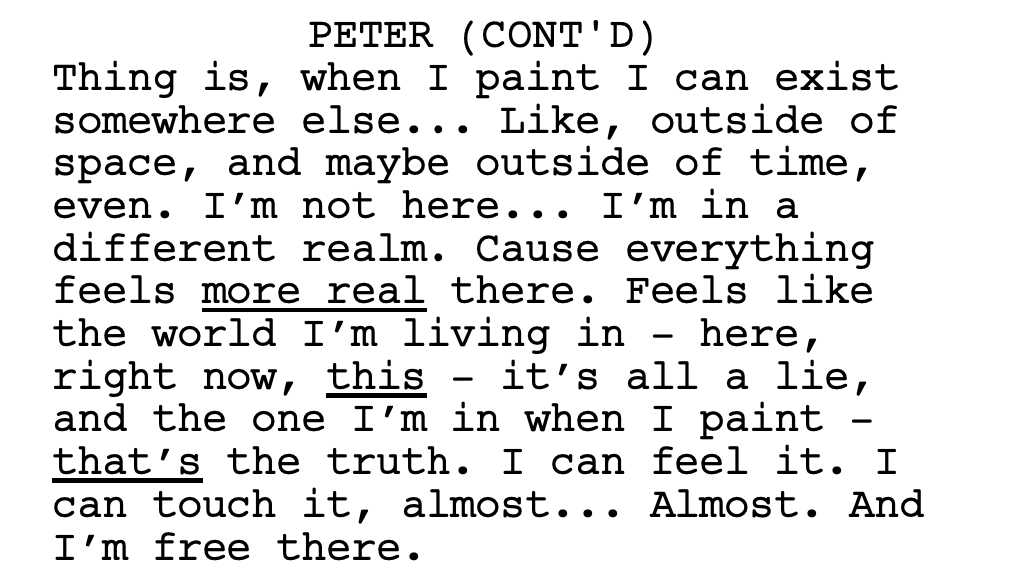
When writing monologues, or any dialogue really, don’t underline a bunch of words for emphasis. First off, it looks like you’re trying to direct the actor’s performances, which actors hate. But it also conveys that you don’t have confidence in what your character is saying. If you have to underline a bunch of words to REALLY EMPHASIZE those moments, it means the dialogue isn’t doing the job on its own. I don’t mind emphasizing a word once every 25 pages or so. Assuming you really need that emphasis to make your point. But don’t don’t do it multiple times in a monologue. Your monologue should speak for itself. And the truth is, it’s highly unlikely those words needed to be emphasized.
Today we look at the script that got Mattson Tomlin the most coveted screenwriting job in Hollywood, writing Matt Reeves’ “The Batman.”
Genre: Action
Premise: A bad man takes a group of people hostage at the top of a building and informs the media that he will start killing one of them every hour until the masked vigilante known as The Leopard surrenders to him.
About: Mattson Tomlin is a spec-writing machine. He writes fast and doesn’t like rewriting, which allows him to deliver product after product at a breakneck pace. His biggest credit to date is the Netflix film, Project Power. He’s written a ton of scripts that have appeared on The Black List. This script, Kill The Leopard, appeared on the 2018 Black List and is what got him “The Batman” job.
Writer: Mattson Tomlin
Details: 90 pages
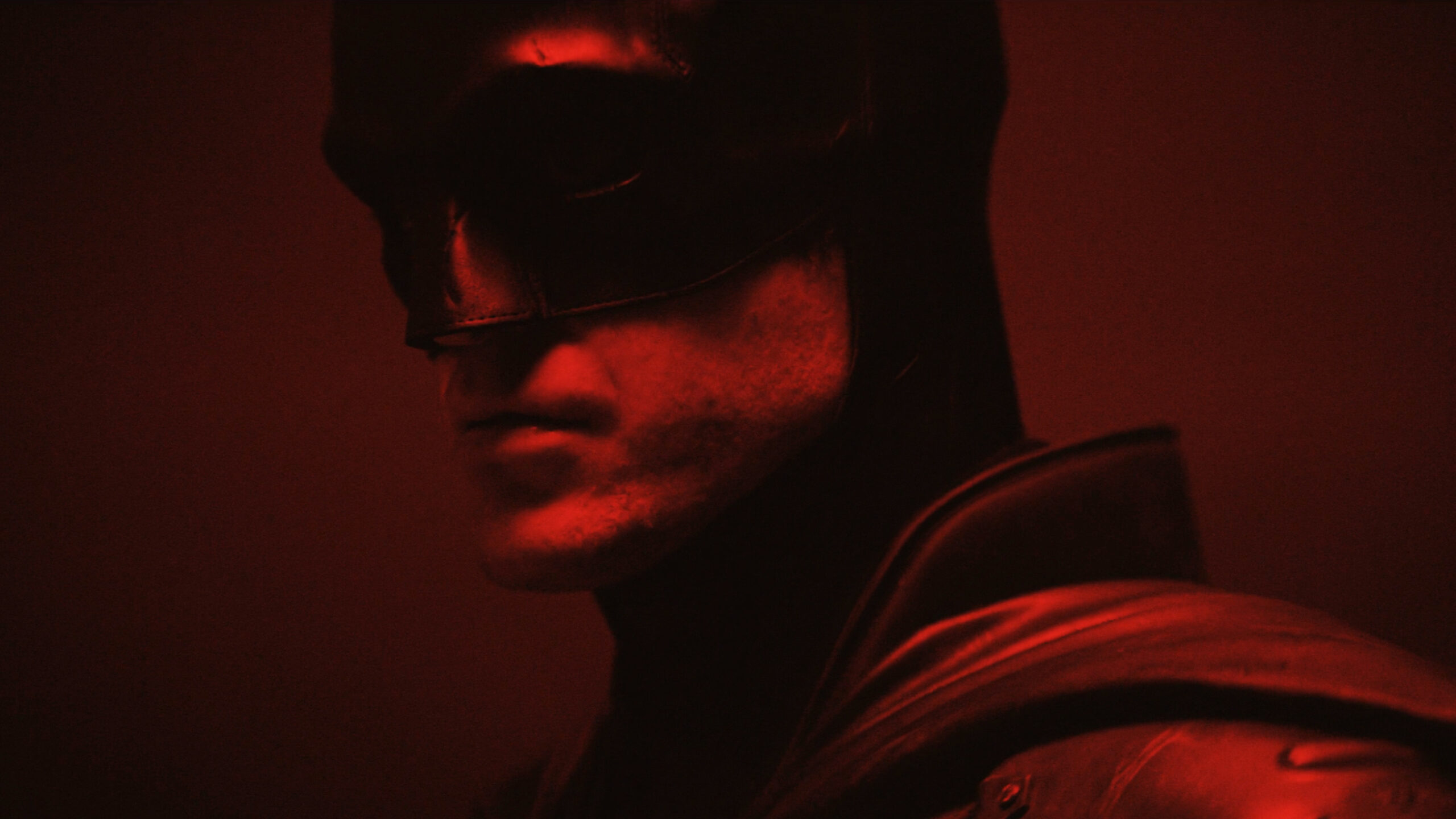
Is there a more spec-y screenwriter than Mattson Tomlin? Methinks not.
What do I mean by “spec-y?”
The purest form of screenwriting is a “spec script,” an original story you’re writing without getting paid, SPEC-ULATING, that it’s going to be so good that someone will buy it and turn it into a movie. Over time, writers realized that writing a spec script required a completely amped up skillset compared to writing on assignment.
Every rule you’d normally follow in screenwriting would need to be amped up ten-fold. Take the rule, “Come into a scene as late as possible and leave as early as possible.” For spec screenwriters, you’d come into a scene even LATER than as late as possible and leave even EARLIER than as early as possible. If you’re supposed to keep a regular script to under 110 pages, a spec script should be kept under 100, or 90 pages!
Preference shifts from writing a great movie to writing the easiest-to-read script. Keeping the story moving takes precedence over everything, even character development.
Of course, the best spec screenwriters find a balance. They try to write a great movie within this amped-up format. Mattson Tomlin, however, doesn’t do balance. He fully leans into his spec roots and doesn’t apologize for it.
An evil looking bald guy named Simon Savero grabs his team, who he’s nicknamed the Seven Dwarves, throws them in a truck, and heads into the city to the Enso Building. The Enso Building, we learn, was the site of a tragic situation last year. 30+ people were forced up to the top of the building as it burned by a dude known as the Red Rabbit.
As the flames caught up with them, instead of burning, they chose to jump to their death, one by one. At the last second, a masked-vigilante named The Leopard swooped in and recovered the Red Rabbit, sending him to prison for the rest of his life. Since that day, the Enso Building has struggled to shake its image as a giant death trap.
So today, they’re commemorating those who died and moving forward. It’s a day of rebirth. That is until Simon and the Seven Dwarves storm the building as the press conference is being held, herd everyone in the lobby up to the top of the building – AGAIN – to repeat last year!
Simon then goes on TV and says he’s got the building rigged with explosives. If anyone tries to come in, they go off. He has a simple directive. Leopard? Wherever you are? You must come here and turn yourself in. For every hour that you don’t, Simon will throw a hostage off the building.
One of the hostages, Mike (who Tomlin literally describes as ‘like Bruce Willis from Die Hard’) has no plans on dying here. Any chance he gets to fight back, he’s going to do it, he tells the other hostages. Luckily, he doesn’t have to. That’s because the masked vigilante known as The Leopard shows up and surrenders.
Simon tells The Leopard to take off his mask. He does. And he’s… just a guy. Simon shoots him. While Simon is distracted, Mike charges him and takes him down, gets his gun, then shoots him. With both The Leopard and Simon incapacitated, Mike finds himself in charge.
He then gets a call from the Seven Dwarves, who are a floor below him. They say if he sends down the bodies of Simon and The Leopard, they’ll let all their hostages go. Mike says fine, only to realize that none of the other hostages agree with him.
This leads to a series of arguments between the hostages as to what to do, and a number of revelations about how they’ve all had previous encounters with The Leopard. What will Mike do? What will anyone do? Who the hell knows. I certainly never figured it out.
The further into this script I read, the more I remembered how much I struggle with Tomlin’s screenplays. It’s honestly like somebody wrote a script in six hours. There’s zero thought put into any of the choices. Nothing comes together organically. The twists that occur make zero sense.
I mean… there’s a twist here – I’ll just give it to you. One of the hostages, a woman, refuses to let Mike send the incapacitated Leopard down to the bad guys. For thirty pages, we don’t know why. Finally, the woman tells this story about how the Leopard saved her from a bad marriage and she’s fallen in love with him. The Leopard looks at her like she’s crazy and says, “You’re not in love with me. You want to know why? Because I’m a woman!” The woman looks a little closer at The Leopard and realizes, oh yeah, although she has somewhat masculine features, she is a woman.
I mean… am I going insane right now? In what screenwriting universe does this make sense???
By the way, how does the Leopard know everyone?? We keep getting these hostage flashbacks, a la “Lost,” where we learn that they’ve each had individual encounters with The Leopard at one point in their lives. The problem is, this is completely coincidental! These are all just random people yet somehow they’ve each had this intimate and life-changing moment with The Leopard. Or Leopardess.
The one thing Tomlin does well is he subverts expectations. The Leopard comes to save the day but, nope, he/she gets shot and is incapacitated. Ditto the main bad guy, Simon. So we really are in uncharted plot waters, which can be exciting. In most cases, the audience knows what’s coming next. Here, you have no idea.
But subverting expectations is an art. You don’t just do it to do it. Because, a lot of times, subverting leads to a less interesting plot. Which is what happened here. Batman comes to save the day. He’s shot. Hans Gruber is going to kill the hostages, he’s shot. Major expectation subverting on every level. But what do we have left? We have a group of people squabbling with each other about whether to send two bodies down an elevator.
Is that an exciting plot?
Was subverting expectations worth it?
At least I finally understand how Tomlin got the Batman job. It’s 100% the setup of this script. You’ve got the “seven dwarves” thing. Comic book producers love shit like that. Red Rabbit. Love names like that. Love’em. Gangsters herding a bunch of hostages to the top of a building. They love that shit. And I’m guessing they’re going to use this basic setup for one of the major set pieces in the film.
But, man, virtually nothing else in this script works. It’s just a bunch of make-it-up-as-you-go-along-gobbledy-gook, the kind of thing aspiring screenwriters look at and say, “Wait, I’m not good enough to write in Hollywood yet this guy gets to write Batman??”
Hey, I respect the hustle. But, wowzers. This script was all over the place.
[x] What the hell did I just read?
[ ] wasn’t for me
[ ] worth the read
[ ] impressive
[ ] genius
What I learned: Don’t use adverbs just to use adverbs. Use them with a purpose. “Metal and glass angrily glimmer in the last moments of sunlight.” How do you angrily glimmer at anything? This is a weird choice of words and something I see all the time in amateur writing. Throwing in a ‘spin-of-the-wheel’ adverb regardless of what image it might evoke is not good writing. Seek out your adverbs with a purpose or don’t use them at all. “Metal and glass glimmer in the last moments of sunlight” isn’t going to win a pulitzer prize but it’s a much better sentence.
You know how it works. Lots of people fought to be included in High Concept Showdown. Hundreds didn’t make it. Shall those writers go on for the rest of their lives never knowing why they weren’t chosen? NOT HERE ON SCRIPTSHADOW! We’re taking five submissions that didn’t make it and explaining why. Hopefully, you can use this information to improve your next submission. Let’s begin!
Title: Call of Judy
Genre: An eye-popping Action Adventure with real heart
Logline: When a kid wins First Play of a Next-Gen VR-Experience but gets lost in its digital limbo, his technophobe Mom must complete four bespoke games they were due to play together to find him.
Why You Should Read: This idea came to me fully formed. My son plays Xbox for hours (and hours), especially since lockdown, and he’s monosyllabic while online.
I’ve been known to play Call of Duty or GTA but my wife hates it ALL so I wrote it through her eyes.
Judy experiences the jolts her son gets from playing Xbox – but amplified massively. These two player games were created for Judy and her son, from a psych quiz but her son filled hers in so everything is askew.
Being it fully immersive VR, Judy’s inside each game, so those jolts are super visceral. And by playing 4 games, it opens up contrasting worlds of eye candy.
There’s endless fun riffing of several game genres but the search for her son packs an emotional punch that hits hardest.
Analysis: I occasionally see people play with the genre label, like David’s entry does. While this can be fun for the writer, in my experience, it indicates a bad script is coming. This goes back to the age-old notion that good writers don’t need bells and whistles. They don’t need a big crazy font for the title of their script. They don’t need to write a bunch of asides to the reader. They don’t need to invent their own genre. All they care about is telling a good story. To that end, one genre is preferable. You can get away with two (Comedy/Horror). But you should probably stop there.
As for the logline itself, I’m not up to date on video game lingo. So when I see “First Play,” capitalized, I’m not sure what it’s supposed to mean. Is that a game? Or is it a known term in the gaming world. “He got First Play of Red Redemption 2.” Capitalized words that aren’t typically capitalized tend to confuse me.
I’m into VR stuff so I liked that. I’m not sure I like the phrase “digital limbo.” It’s a murky way of saying what you’re trying to say, which is that he gets lost in the game. You don’t want any haze hovering over your logline. You want to make it as easy to understand as possible. I like that his mom is a technophobe. Some nice irony there. “Bespoke” is an odd word in this context and took me a minute to figure out. Anything that slows down a logline is a bad thing. And, finally, the central task itself isn’t very interesting. Based on what you’ve told us, the mom is going to be sitting in front of a TV playing video games for the 2 hour running time. Is that the movie?
This logline is a good example of how important each word and phrase in a logline is. The wrong word can send the reader off in a completely different direction than what you intended. I would encourage David to focus on clarity in the next go-around.
Title: Viewers
Genre: Sci-fi thriller.
Logline: After the CIA remote-viewer(psychic) program is dissolved due to a mission gone awry, an ex-member of the force comes across information about a Russian spy recruiting retirees. With nothing to lose, he puts together a rag-tag team to help hunt down the spy and prove to his previous employers that his best days are still ahead of him.
Why You Should Read: None
Analysis: The first thing I notice about this logline is that it’s long. A long logline does not mean the logline will be bad. But the more seasoned a writer gets, the better they get at writing loglines, and one of the things they learn to do is to keep the logline tight. Again, this isn’t a logline killer. It’s just a little red flag. “After the CIA remote-viewer (psychic) program is dissolved…” Okay, this is a red flag. Putting something in parenthesis is a major no-no in loglines. Also, the word ‘psychic’ seems to be an important detail. So why you’d relegate it to parenthesis, I’m not sure. From there, we get a lot of common logline words and phrasing. “Ex-member of the force,” “Russian spy,” “rag-tag team,” “hunt down,” “that his best days are still ahead of him.” I know this is hard, guys. You’ve got this very tiny amount of space to convey all this important information and the majority of those words are going to be common ones. But that’s why you need to make the key moments in the logline stand out. You need key specific phrases (“dream heist” from Inception, for example) that differentiate your idea from everything else. Without any differentiating elements, it’s just a bunch of words we’ve already seen before.
Title: The Bone Butcher’s Cosmic Slaughterhouse
Genre: Sci-fi/Horror
Logline: A couple of ex-addict, rock star has-beens discover an extraterrestrial portal allowing them to relive past moments and change their greatest regrets, but the new choices they make and a nasty creature threatens to make them pay for it with their blood.
Why You Should Read: This is not a wacky idea by an undisciplined writer! I have to say that right off the bat. The script started off as trying to be a very disciplined, marketable “It Follows” meets “Alien” with a kick-ass, high-concept engine. Well… that engine took over and renamed the script. Upon finishing an early draft, I was sure the story was too ambitious. Ex-addict, deeply flawed protags, fantastical, outer space set pieces, awesome creature designs, too much blood, cosmic music concepts (Don’t worry it’s not a musical!), and people willingly getting gruesomely torn apart by a black hole.
Yet then somehow, this script became a finalist in a couple sci-fi and horror contests as well as taking 2nd place in one. And my cynical writing group actually liked it. So I kept tinkering and polishing and getting feedback. Growing this thing like a cosmic chia pet for this very moment. I truly appreciate this opportunity and would relish in even the smallest amount of that amazing Scriptshadow feedback I’ve read over the years. Fingers crossed.
Analysis: While I wouldn’t call this an “everything and the kitchen sink” logline, I might call it an “everything and the slightly smaller bathroom sink” logline. Let’s go through it piece by piece. “A couple of ex-addict, rock star has-beens…”. So far, so good. I have a good feel for these characters. The ‘ex-addict’ feels organic to their old job, so it’s not just thrown in there to make the characters sound more interesting (something I encounter a lot in loglines). “… discover an extraterrestrial portal…”. Okay, we’ve just taken a huge leap. Whenever I see “portals,” I know there’s potential for the story to go sideways. I’ve read all the portal scripts, guys. It seems to be permission for a lot of writers to go to Wackyville. So, now, I’m on guard.
“…allowing them to relive past moments and change their greatest regrets…”. Okay, you’ve officially lost me. I distinctly remember having to read this part of the logline three times. It’s not written as elegantly as it could be. Also, it never works in loglines (or in scripts, for that matter) when there’s more than one objective. “They need to do this AND this.” You want a clean narrative. That means ONE thing. In Jaws, they’re not trying to kill a shark AND fix a broken dam. They’re just trying to kill the shark. “…but the new choices they make and a nasty creature…” At this point, there’s nothing that the logline could’ve done to reel me back in. But adding a creature to the mix definitely made things worse. It just feels like there’s too much going on at this point.
The good news is, people helped with this logline in the comments. And this is the new one they came up with: “A downtrodden couple, drowning in regrets, discover an extraterrestrial portal that allows them to change their past sins, but unwittingly unleash the portal’s blood-thirsty gatekeeper.” This logline is WAY better and shows you what a difference a well-written logline can make over a badly written logline. Which is why you should get a logline consultation from me! (E-mail carsonreeves1@gmail.com with subject line: “Logline Consult.”). Would this new logline have gotten the script into the High Concept Showdown? Probably not. But while I’d say the first logline put the script in the top 60 percentile, this new logline put it in the top 10 percentile. That’s a huge jump.
Title: High School Samurai
Genre: Martial Arts/Action
Logline: When a bullied, high school delinquent discovers that his local kendo dojo is a secret base for teenage samurai, he must fight with them to protect his family and the city of LA from an invading army of yōkai.
Why You Should Read: Yōkai are demons, ghosts and monsters of Japanese folklore. There are many tales of these creatures terrorizing the people of Japan during the feudal era, and even more tales of the brave samurai who faced them in battle. This script is one such tale, set in modern time where the yōkai have expanded their terror to the American west coast, and it’s up to the worst possible samurai to stop them; a troubled youth who lacks honor, loyalty and discipline. He must learn these values if he’s to protect those he loves, all while navigating the other great terror that is high school.
With splashes of Buffy, Kill Bill and Ninja Turtles, as well as the writing essentials like GSU and great characters, this is the kind of popcorn movie you’d enjoy with your best friends on a Saturday night at the local cinema. So kick back, play some koto music, and forget the worries of the world. This is “High School Samurai,” and I hope you enjoy it. Arigato!
Analysis: This one got some love in the comments. I love the title, “High School Samurai.” It rolls off the tongue. But when I got to his dojo being “a secret base for teenage samurai,” that’s a moment where you either buy in or step back. And I stepped back. I’m not sure why. It might be a preference thing – that pesky “personal taste” that gets in the way of so many great loglines. But I tried to imagine a bunch of teenaged samurai in my head and my head wasn’t cooperating with that image.
With that said, it was a big enough idea to still be in the running, which leads us to the second half of the logline, which ends with the words, “an invading army of yōkai.” I don’t know what yokai are. And that’s the thing with loglines. If the reader is on the fence, one wrong step can be the finishing blow. Now, astute readers of the site will point out that, in the very first sentence of the “Why You Should Read” section, the writer explains what yōkai are. But here’s the thing. Cause I remember this exact moment. I had a few hundred of these things to get through so I had to move fast. As soon as the nail was placed in the coffin, I was on to the next one. And this situation is not unique to me by any means. Nobody has time. Everyone’s moving on as quickly as possible. Now, do I think this logline is something the writer shouldn’t pursue? I wouldn’t go that far. People in the comments liked this so there’s obviously something to it. For my own taste, however, it wasn’t for me.
Title: KINGDOM COME
Genre: Sci-Fi Action
Logline: When a determined fleet admiral plans to ambush insurgent forces at a deep-space military base-planet, the base’s mechanic steps up to lead ground operations on the planet’s surface, and must step in when her admiral mother decides to take out the insurgency by any means necessary.
Why You Should Read: As a sci-fi fan, I’ve often thought about how galactic empires could manage to oversee bases and colonies spread across entire star systems. How likely is it that soldiers and other staff stationed at a base will be ready to fight, or even want to fight, a war they’ve been waiting years, maybe even decades to participate in? When they call, who responds? KINGDOM COME follows one individual who steps up when nobody else will, and she doesn’t stop until the job gets done, no matter where it takes her. You might know me in the Scriptshadow comments as CCM30. I’ve read and critiqued many scripts in this community over the years, and now it is my pleasure to offer up a work of my own.
Analysis: There were a couple of things working against this entry. For starters, this is a big science-fiction movie. Big science-fiction movies cost lots of money to produce. So, already, you’re at a disadvantage. When studios do make these movies, they hedge their bets on pre-existing intellectual property. If Warner Brothers is given the choice to spend 200 million dollars on a Dune movie or 200 million dollars on an original movie called, “The Divinity of Zal’Nahr” which one do you think is the more financially responsible choice. The reason it’s so important to internalize this is because it’s a question that filters all the way down the pyramid to the tiniest movies that the industry makes. If you’re a production company with a million dollars to spend, do you spend it making a horror movie or a drama? If you want to stay in business, it’s a horror movie. So you need to be thinking about your potential buyers when you’re coming up with an idea.
With that said, there is a caveat. And that caveat works like this. The more expensive a movie is, the better the idea has to be. Now, of course, “better” is subjective in a lot of ways. But one metric you can tap into is the ‘originality quotient.’ If the logline consists of a lot of generic words or things we’ve seen in other movies, it’s easier for the reader to say ‘no.’ Look at all the key words in this logline. “Fleet,” “admiral,” “ambush,” “insurgent,” “deep-space,” “military base,” “mechanic,” “ground operations,” “admiral mother,” “insurgency.” There isn’t a single unique word in the bunch. It’s all basic stuff. This results in a logline that doesn’t have the “flash factor.” Because the words are so generic, we imagine a generic movie. That’s why I didn’t pick this logline.