
Search Results for: F word

Last week, I challenged everyone to send me a query e-mail for their screenplay. The best query got a script review on the site. Monday, I posted the winning query. Tuesday, I reviewed the script from that query. Wednesday, I showed you how to write the perfect query. And today, I’m going to go over several queries that didn’t make the cut and explain WHY.
Let’s jump into it, shall we? Here’s the first one.
Hi Carson,
I hope you’re well. I’ve been following the site since it was scriptshadown.com. Thought it would finally be a good time to reach out and submit a script.
I’d like to share Claus: Rise of the Northman, a large-scale action epic that reimagines the novel The Life and Adventures of Santa Claus, written by L. Frank Baum (The Wonderful Wizard of Oz), as a violent, mythic, emotionally charged war epic. It aims for the scope and savagery of Braveheart, Gladiator, The Northman, and The Outlaw King.
“In the brutal snows of the far North, a young warrior named Claus rises from loss and bloodshed to lead an impossible rebellion, battling a monstrous army and their evil warlord and forging a legend that will echo for centuries – the origin story of Santa Claus.”
This is not a holiday film. It’s a grounded, R-rated action epic rooted in sacrifice, love, revenge, and legacy – a mythic origin story in the spirit of Robert Eggers and Ridley Scott, but with the emotional payoff of a timeless legend. The red coat doesn’t begin as a symbol of joy – it’s earned in blood.
At its core, this is a four-quadrant epic origin story built for global audiences. It has franchise potential and strong merchandising/IP expansion upside, while still standing alone as a prestige action film. Work has already begun on the graphic novel.
I’ve written and/or directed 15 feature films that have played across every major streaming platform. My work has landed in Netflix’s Top Ten, and I’ve had films hit #1 on both Hulu and Paramount+, that have starred the likes of Malin Akerman, Luke Wilson, Simon Rex, Amy Smart, Val Kilmer, and Kelsey Grammer, among many others.
Attached please find the script and an image from the graphic novel.
Thanks for your time Carson, and whether or not it’s chosen, keep up the great work as I’ll continue to follow your site daily.
Best,
Shane (personal information edited out by me)
*******************
This is a great example of what happens when you send a WALL OF WORDS out. I open the e-mail and I see this long thing that I have to get through. I’m going to read it but I’m already kinda annoyed. Because whenever somebody sends me a long e-mail, it always rambles. It rambles on and on and on. It sucks for the writers who actually know how to write a long e-mail because the ramblers ruin it for you.
Then I read the first line. I have no idea what “scriptshadown” is. I’ve never run a site called scriptshadown. So, at that point, I’m thinking the writer doesn’t really know the site. I talked about this in my “perfect query” post yesterday. You want to relate to the person in that opening couple of sentences. But make sure your research is accurate! Because as soon as I read that, combined with the Wall of Words, I went into skim mode.
I continued to read the logline and then I ran into “Santa Claus.” For whatever reason, I get pitched a billion Santa Claus scripts. I don’t know if that’s true for the entire industry but it’s true for me. This has made me resistant to Santa Claus material. This query has now hit the 3 red flags mark so I skimmed the rest and moved on.
The irony is when I went back to this e-mail today, and I read through it fully, I saw that the writer was super-legit! This guy’s written and directed number one films on streaming services before! But I never got to that part of the query because of the Wall of Words submission and the bad research.
There are a couple of things here worth talking about. I think this line is fine: “I’d like to share Claus: Rise of the Northman, a large-scale action epic that reimagines the novel The Life and Adventures of Santa Claus, written by L. Frank Baum (The Wonderful Wizard of Oz), as a violent, mythic, emotionally charged war epic.” It’s fine because it conveys the tone of this unique story. But I don’t think you then need to list other movies it’s similar to. You have to cut words somewhere in a query. Again, we’re dealing with busy people here.
All this other stuff about “this is not a holiday film” and “this is a four-quadrant” movie is just noise. And it’s wasting the reader’s time. You’ve given us the tone. You’ve given us the logline. If you have to then explain to the recipient that it’s not a holiday film and that it’s a four-quadrant movie, then you haven’t done your job with the logline. They should be able to determine that on their own. And, really, it’s up to them to decide anyway.
Now, in regards to personal accomplishments, this is something I didn’t address in yesterday’s post because I’m assuming that the people sending these queries out haven’t had any accomplishments yet. But if you’re like Shane, then you should definitely include your accomplishments. The issue I typically see is writers including accomplishments that hurt rather than help them.
They’ll say that they finished in the 3rd round of the Beach Street Screenplay Contest. Or that their short film won the audience award at the Rhode Island Digital Sunrise Invitational. I’m not even sure I would mention a produced movie you wrote if nobody’s heard of it. I’m okay with mentioning “finalist” or “winner” of major screenwriting contests in the last several years, maybe a top 20 showing on the Black List. But that’s it.
*******************
On to the second query…
*******************
Since it’s impossible to recapture some of the styling in html, the only way to properly make my point here is to take a picture of this e-mail query. Here it is:
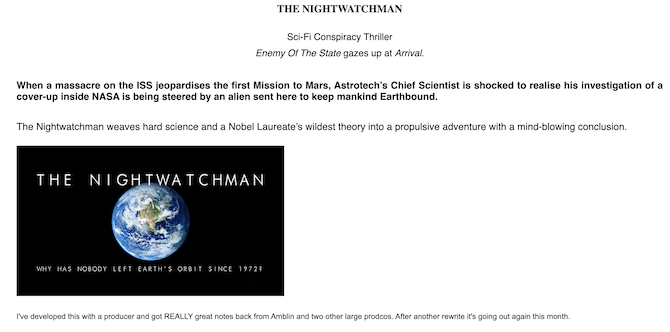
In the history of my receiving screenplay queries, one of the more reliable ways for me to know if the script is weak is a query that has multiple fonts, multiple text sizes, lots of styling, lots of misaligned text.
I think I understand what the writer is thinking with this approach. They want to stand out. And they feel that if they add some pizazz to the presentation, it’s going to separate them from the pack. It does separate them from the pack. But in a bad way.
E-mail isn’t designed for a controlled layout. So, once you start messing with formatting inside of an e-mail document, it’s going to look “off.” And what’s worse is, once it ends up on a different e-mail program (you made it in Mac Mail and sent it to someone’s gmail), the text always gets screwed up somehow. So all that extra work resulted in your e-mail actually looking worse.
It’s just not worth it. Whenever I see it, my first thought is, “Amateur writer who doesn’t know what he’s doing.” And I can promise you that that’s how 99% of the working people in the industry will see that e-mail as well. Look at how much cleaner this query looks…
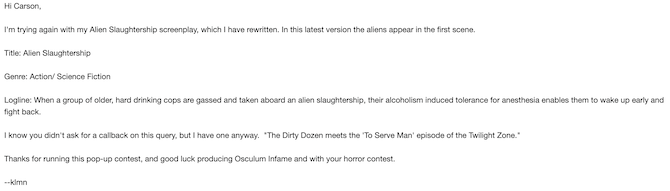
Just use regular fonts. Regular formatting. Keep it uniform (don’t use 12 point font in one section and 14 point font in another). Anything else ends up looking sloppy and unprofessional. It’s hurting your chances of accomplishing a very simple goal, which is to tell someone that you have a cool screenplay they should read. If they’re put off by the zaniness of the formatting, they won’t be able to see that.
*******************
On to the last query…
*******************
Sit down, shut up, and listen. “The Facetakers” is science fiction horror with teeth, because the monster is not in the woods, it is in your head. An omniscient AI called The Sum already won the world decades ago, and it runs the planet through an electronically induced hypnotic narcosis called the Experiential Grid, a global augmented reality streamed straight into human brains. It can make you see day at midnight, hear voices in the static, and walk smiling into your own execution. When someone is marked for replacement, the system hits them with a Kill Tone, then sends a Facetaker, a hollow android full of circumducting gold and plasti-bone, wrapped in polymorphic endoplasm that can become skin, hair, clothes, even your loved one’s face. These things do not just kill you, they become you, and the older they get the more their minds fracture into a blood-lust religion where they bathe in victims and feed on fear.
After a blistering cold open on a moon base that announces the scale and the rules, the movie clamps shut into a single location siege: one isolated 1980s time-capsule lake property in 2027, one house with forty windows, a covered bridge, a generator-lined basement, and a perimeter that turns into a kill box.
The script is a mix of Videodrome, Black Mirror, and The Matrix. 1980s Body Horror modernized and perfected.
I included this last query as a catch-all for the writers who want to buck tradition and query with something unorthodox. The reality is that this can work. In a world where everyone sounds the same, it can help if you sound different. But there’s no question that it’s a risk. It’s no different from approaching a girl walking down the street. You can adhere to social norms and say, “Hi, I wanted to meet you.” Or you could come up and say, in a Yoda voice, “Want to have sex with you, I do.”
You’re going to get in a lot more conversations if you use the first option. But the rare girl who likes the second option is REALLY going to like you.
That’s what’s going on here. Starting your query by telling the reader to sit down, shut up, and listen is risky. But there will be the occasional reader who loves it. Cause it’s different. So, just know that if you’re going to be unorthodox, your hit rate is going to be a lot lower. But, hopefully, the people who do respond to it, will respond very positively.
Now, if that was the only talking point with this query, I’d say that the writer is okay. They have a strategy. They’re accepting the risk of that strategy. All good.
But there’s another problem. The visual of this query is off-putting. It starts with this giant paragraph. When I see a really long paragraph, it almost always means ‘rambling.’ That’s what I’m expecting. And that’s pretty much what we get here. We’re dropped into Neil’s mind and he’s vomiting his movie idea out at us.
And because the mythology is so specific and unique, it exacerbates the rambling. Wild terms are thrown at us (experiential grid, kill tone, facetaker) that mean nothing to us. And so they risk sounding like a homeless guy on the train blabbering at us mindlessly.
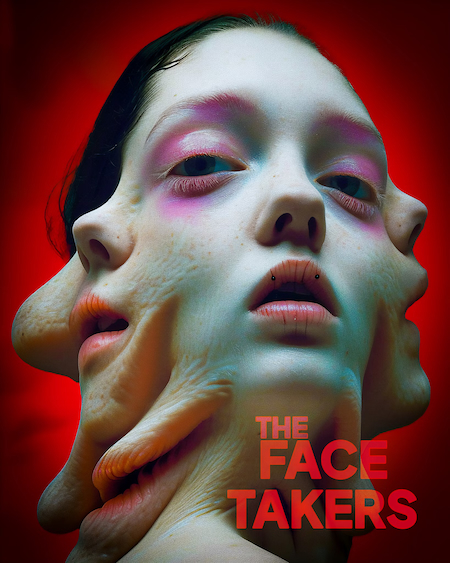
Finally, we get a poster. This is something I’m seeing more and more of with pitches – an AI Poster or AI images. I think we’re at the point where they’ve become ubiquitous. And that means that they may hurt you more than they help you.
David Spade once said, “A limo is just a taxi that says you have a hundred dollars.” An AI image in a query e-mail is the same thing. It doesn’t say you’re a visionary. It says you opened Midjourney.
The exception would be if you’re a power user. You have a graphic design background and are entrenched in the AI revolution. You’re genuinely creating images that the average person cannot. But even then, I wouldn’t include it unless it looked extremely professional and perfectly encapsulated your movie. Not does so in a “close enough” way. It’s gotta be perfect. (And yes, I’m aware of the irony of using AI images in my posts, so feel free to factor that into your final decision).
So, if I were Neil, I would break this e-mail up into smaller paragraphs. Don’t talk about extremely specific mythology. Save that for the script read. Try to be more purposeful with the e-mail itself (Here’s why I’m writing you. Here’s my idea. Let me know if you want to read the script). And then I’d probably ditch the image.
And that concludes QUERY WEEK! If you have any other questions about queries, ask them in the comments. Hope you guys all learned something. I always enjoy brushing up on this stuff cause some of it is easy to forget.
Enjoy your weekend and, oh yeah, the first person to e-mail me gets 40% off a screenplay consultation! E-mail me at: carsonreeves1@gmail.com now!

Last week, I invited all of you to query me with your scripts. Whoever had the best query got a script review. I reviewed that winner yesterday. And the script was pretty good!
Today, I want to give you a template for writing all of your future queries. This template is built on the thousands upon thousands of queries that have been sent to me over the years.
But before we get into the actual query, let’s talk mindset. Unless you have the right mindset, your queries will always be a mess. The proper mindset to have is: This person I’m sending this e-mail to is busy. They’re not interested in anything anybody has to send them that they don’t know. Therefore, I have to capture their interest quickly and efficiently, and then get out.
If you have that mindset, the response rate to your queries is going to go up radically.
In addition to that, remember that the person you’re sending the query to only cares about one thing: “Does this script sound like something I’d want to make into a movie?” That’s it. Which is why you want to keep things sparse. So that, if they want to, they can jump straight to the logline to determine if they like it or not.
By the way, this is why picking the best concept possible 12 months ago was so important. For THIS MOMENT RIGHT NOW. Because the producer/agent/manager you’re sending this to doesn’t care about your query. They care about the script. If you field-tested your concept a year ago, and you know people liked it, and you know it’s marketable, that’s going to pay off BIG TIME right now when you start querying people.
A lot of people ask me, when it comes to querying, should you include your personality? I used to think this was THE ONLY THING that mattered in querying. That queries were about entertaining the recipient. Making them laugh enough so that they’d remember you. But it’s not about that at all. I can count how many times ON ONE HAND that I was wowed by the query itself (not the logline).
Some light personality for genre-relevant queries (if you’ve written a comedy, for example, and want to display your humor) is fine. But the reader didn’t sign up for your stand-up routine. They’re trying to get through their day as efficiently as possible. They’re whipping through their e-mails. They see yours. They don’t know who you are. They’re opening it with about 20% of their concentration.
All they care about is: IS THIS A MOVIE IDEA THAT’S RIGHT FOR THEM?
Okay, now that we know the mindset behind writing the query, how do we actually write it? Let’s begin with the subject line. You have some flexibility here. But I’m going to keep going back to this mantra of: Keep it simple. My go-to is, give us the genre and give us a popular movie it’s in the vein of. You get extra points if the “in the vein of” movie is something that the recipient is connected to. Here are some examples.
Subject: Horror script in the vein of Weapons
Subject: Period thriller in the vein of One Battle After Another
Subject: Romantic Thriller in the vein of The Housemaid
You, of course, have some flexibility here. You can use crossovers as well: “Horror script. Housemaid meets Sinners.” But I’d limit it to those two options.
By the way, don’t use movie comps that didn’t make money. Don’t even use movie comps that made average money. Only use hits. And don’t use any old movies as single comps. It’ll make you look out of touch. But you can use one classic movie if you’re doing a crossover (“Rear Window meets Weapons”).
Okay, the next couple of steps are going to benefit heavily from you doing your research (which can be done through your favorite AI and IMDB Pro). Your queries will get ignored by 95% of the people you send them to if you address the recipient as a collective. “Dear sirs” equals trashed e-mail. “Dear to whom it may concern” equals recipient stops reading. You need to do your homework and address the person specifically.
“Dear James,” or “Hi Jennifer,” Use a real name!
Next, you’re going to introduce yourself. “Hi, my name is Carson.” Again, you’re keeping it simple. This should actually be the easiest part of your query.
Now, you’re going to butter them up. Buttering these people up is a lot more important than you think. If they believe you genuinely know who they are and what they’re responsible for, they’re going to like you. And if they like you, they’re going to read your query through a positive mindset.
If someone tells me that they love Scriptshadow and that they read it every morning. Or, even better, that they’ve been reading ever since [some very specific popular script review that only true Scriptshadow readers know about] then I’m now rooting for them. I’m literally rooting for them to win me over with their logline. Whereas, when someone clearly heard of my site through some third party and doesn’t know who I am and they’re just taking a shot in the dark at sending me something, I feel zero remorse for skimming through their query.
Here’s an ideal “buttering them up” line for an agent: “I’m a huge fan of your client Ryan Olsen’s Black List screenplay, Time Force. It was my favorite screenplay of the year.”
Should you lie during the “buttering them up” segment? Absolutely. It’s no different from actors putting all those bullshit skills on their resumes. All that matters is that you develop some sense of rapport in that moment. Because, here’s the truth: If you give them a script that makes them money, they’re not going to give a shit whether you lied to them or not. Nor will they likely find out anyway. I doubt the moment is going to come where they’re on the verge of repping you, but only if you can tell them what Kage Jackson’s fatal flaw was in Time Force. (spoiler alert: Kage Jackson has two fatal flaws, one for his Future Self and one for his Past Self)
After you butter them up, you’re going to use a very short and simple line: “I have a script that I think you’ll love.” Don’t say “like.” Use the word “love.”
Then you’re going to use a quick sentence to sell the logline. You’ll say something like, “It’s a movie that harkens back to those great action films they used to make in the 90s.” Or, “It’s what an Ari Aster movie would look like if it were a romance.”
Then, you give the classic, title, genre, and logline, vertically. You do this for a specific reason. You want to create visual isolation for your pitch’s key info so that if the recipient is busy, they can easily jump to it. I see too many writers burying their logline inside long paragraphs. Producers hate that. They want to be able to see it separate from everything else.
Title: For Your Heart Only
Genre: Romance/Horror
Logline: When a young demented man falls deeply in love with a woman, he cuts her heart out and places it inside of himself, so he can be as close to her as possible.
After that, you want to write a simple line whose only purpose is to say you’ll send the script over if they’re interested. Something like: “Let me know if you’d like to read it and I’ll send it right over!”
Close the message out: “Sincerely, Carson”
And that’s it. That’s your query. You don’t want to mess around here. You don’t want to overthink it. You’re just here to pitch a logline. That’s it. So don’t get in your own way by clogging up your logline with your biography or an additional summary of the script. The visual that presents is: WALL OF WORDS. And there’s no faster way to get someone to delete an anonymous person’s e-mail than a WALL OF WORDS.
Okay, without further ado, here is how the uninterrupted query should look…
Subject line: Romantic Thriller in the vein of Hereditary
Hi Nick,
My name is Carson Reeves. I’m a huge fan of the movies you’ve produced. I’ve watched Bloody Martyr a dozen times at least. I have a script that I think you’ll love. It’s what an Ari Aster movie would look like if it were a romance.
Title: For Your Heart Only
Genre: Romance/Horror
Logline: When a young demented man falls deeply in love with a woman, he cuts her heart out and places it inside of himself, so he can be as close to her as possible.
Let me know if you’d like to read it and I’ll send it right over!
Sincerely,
Carson
If you want to clean up your own query, I do query consultations for 60 bucks. That includes three follow-up e-mails where we make adjustments to your query until it’s perfect. E-mail me at carsonreeves1@gmail.com if you’re interested. Or, if you need a consultation on your entire screenplay, we can do that too!

It’s time to learn WHY certain loglines didn’t have the power to push past my discerning eye and make it into the Logline Showdown.
Remember that I’m one person and, just because I didn’t like a logline doesn’t mean someone else won’t.
Which is the main reason I like posting these articles. It gives you some insight into why I choose (and don’t choose) certain loglines.
Let’s get into it!
Title: The Big Return
Genre: Action Comedy
Logline: Determined to right his father’s wrongs, the son of a legendary master thief embarks on an impossible mission: returning everything his father ever stole — without anyone noticing.
Analysis: I’ve come across ideas similar to this before. There may have even been a Black List script with an adjacent idea. My issue with these ideas is this: What are the stakes? Who cares if he succeeds or not? Let me give you a similar idea that uses stakes to make the concept a lot more exciting. You may recognize it. A history professor recaptures ancient artifacts and puts them back in the museums where they belong. He is then hired to find one of the most famous artifacts of all time, the Ark of the Covenant, before the Nazis get it first and use its powers to win the Second World War. Similar idea. But one adds an incredibly high amount of stakes, which improves the concept considerably.
Title: Help
Genre: Thriller
Logline: When a reclusive billionaire dies, the staff of his secluded estate makes an uneasy pact—hide his death and live in opulence, for once. But as greed, suspicion, and uninvited guests close in, their scheme quickly spirals into chaos.
Analysis: I wanted to include this one because I worked on it with the writer. This is a good example of how a logline and a concept must work in tandem. If they’re working against each other, you’ll always feel like something isn’t clicking. My issue here was not with the logline, but with the concept. My argument to the writer was, why would you risk everything to live in opulence for a week tops? Sooner rather than later, people are going to show up asking what happened to the billionaire. They’re then going to learn he’s been dead for a while and that you didn’t report it. You probably won’t get in a lot of trouble. But you’ll get in some. And for what? To waltz around the same grounds you’ve always waltzed around but this time without having to do any work? Where’s the upside? I told the writer we need a different angle for this to work. For example, add a murder-mystery to the plot. That gives the concept a lot more flexibility.
Title: Trust
Genre: Allegorical Thriller / Crime Drama
Logline: A farming couple on the brink of collapse is further divided when one secretly agrees to smuggle cocaine inside pineapples for a deceptive drifter. As tensions rise, a venomous snake slithers through their farmhouse—an ominous force that threatens to destroy them both in this modern allegory of Adam and Eve.
Analysis: You don’t want to send out loglines that put the burden on the reader to figure out the movie. The logline is supposed to do that for them. This idea starts off being about a struggling couple who decides to engage in criminal activity to pay the bills. Okay, it’s a small idea but it hints at a conflict that could drive a narrative. But then, out of nowhere, a snake arrives. Instead of explaining how this snake will engage in the plot, we’re thrown the very vague explanation of “an allegory of Adam and Eve.” Now it’s my job, as the reader, to guess what’s going on. My first thought is, “Well, if there are three people, then it’s not an allegory of Adam and Eve, is it?” This is what happens when you ask the reader to do the work for you. They will come up with things that I guarantee were not part of your plan.
Title: Override
Genre: SciFi/Action
Logline: When a suicidal but indestructible robot hitman botches his latest assassination, he teams up with the young girl he was supposed to kill when she agrees to give him the code that can rewrite his program and allow him to die, but only if he can help her escape to safety. -Leon the Professional, Logan in a cyberpunk world
Analysis: In my experience, when a logline starts to feel like a run-on sentence, it’s failing. NOT EVERY TIME. But, like, 95% of the time. That’s how this feels. Override is actually a pretty good idea when you break it down. I like the team-up between the hitman and the person he was supposed to kill. And their exchange of duties at the end makes sense based on everything that’s been set up. But there’s something about the abundance of wording that makes it hard to comprehend the logline on a single read. Case in point, I didn’t pick up the word “suicidal” until the third time I read it, which is probably because “suicidal but indestructible robot hitman” is a mouthful. Likewise, when you’re trying to work out the exchange of duties at the end, it doesn’t enter the brain smoothly. You really have to focus hard to get what’s happening. Reading a logline should be effortless. As proof, think of all the loglines that have worked for you. You understood and enjoyed everything after one read, right? You didn’t need an abacus.
Title: The Hunt for the White House
Genre: Action / Sci-Fi
Logline: A defeated Presidential Nominee must convince and unite his former military associates and incoming legislative friends that the opposition party and its nefarious worldwide allies are collaborating when they commit the most traitorous and audacious act in history – utilize radical technology to teleport the White House to an unknown location and exploit the President for their covert demands.
Analysis: This is an example of a cool idea – the White House gets teleported somewhere. It’s a concept I haven’t come across before that contains several different cool story directions it can go. But then you have to wade through a bunch of word salad to get to that part. When I read a logline like that, I think, “If the writer can’t come up with a cohesive presentation of their idea in the logline, why would I expect them to be able to tell a cohesive story through 110 pages?” Either that or they haven’t thought deeply enough about their idea yet to present it. You see, sometimes we come up with pieces of a cool idea rather than a full idea. It’s your job, then, to mold that crumb into a cake. And don’t show anybody that cake until it’s out of the oven!
Title: Omega Critical
Genre: Sci-Fi
Logline: When Miranda finally gets the chance to run her dream D&D campaign before graduation, she creates an epic, mind-bending adventure where her friends play as different heroes every session. But as the game nears its final showdown, the game begins to mirror her real-life battle for respect and validation from her long-time crush, the group’s former leader.
Analysis: This is the kind of logline you are forced to write once you’ve written a low-concept script. With any movie concept, you’re looking to generate a “special attractor,” that thing that makes the movie stand out from every other movie. Omega Critical has Dungeons and Dragons, which is slightly original. But it’s not big enough to drive people to the theater. That leaves us with the rest of the logline, which is essentially a woman who has a crush on a guy. That’s certainly not big enough to generate box office since anything that can be a subplot in another movie will struggle to be a main plot in its own movie. I bring this up because a lot of people come to me for logline help with these small ideas and they want me to juice them up, make them sound amazing. I can help make loglines sound as good as they can possibly sound. But I can’t make small ideas sound big. To be clear, I think this could be a good script! I’m not knocking its potential at all. But I’m judging it from the perspective of a producer. They read this and think, “Okay, that sounds like… maybe it could be okay.” The only chance you have of someone requesting this script is if they’re really really really into Dungeons and Dragons.
Title: Seeking Relationship Advice
Genre: Romantic comedy
Logline: A formerly anonymous sex and relationship columnist who based her advice on smutty fanfiction must pretend to be in a relationship with her best friend once her column goes viral and she is forced into the public’s eye.
Analysis: This is a pretty good idea. So, why didn’t I choose it? Because it wasn’t different enough. It feels like a movie seen already. It doesn’t have that unique differentiating factor that makes me want to pull the trigger. Some of you may say, “But Carson, you chose some ideas for the showdown that I felt like *I’d* seen already.” Fair enough. This is the subjective nature of picking ideas and it’s why if you gave 10 people these loglines, they would not all choose the same winners. I will say that with an idea like this, a great way to differentiate it is to modernize it. Can we use apps or programs or web sites or modern pop culture in a way to update the concept? Because a relationship columnist may have been common in the 90s. But not so much in 2025.
Title: Dead Stop
Genre: Horror
Logline: During their morning commute, passengers on a city bus are tested when the bus turns out to be a trap set up by a madman who demands one passenger be chosen to be sacrificed before every stop. (SAW meets SPEED)
Analysis: It’s hard for me to articulate exactly why I’m not a fan of this idea. But it comes down to not being a fan of overly forced concepts. This is what I mean: “A woman has 6 hours to run from the bottom of Manhattan to the top and a series of bombs are positioned across the city that will go off every time her heartbeat goes above 110.” For an idea to work with me, it has to meet a certain organic threshold, where it feels natural and believable (at least by movie-idea standards). I know that’s a vague target. I can’t tell you exactly where the line is. I just know that when I read this logline, it felt forced to me. I could feel the writer’s hand. When that happens, I tend not to connect with the idea.
Title: Hell Hole
Genre: Action/Horror
Logline: When a U.S.-Chinese drilling operation in the Arctic breaches the Gates of Hell, the crew must put aside their differences to seal it before its horrors emerge and destroy the world.
Analysis: This concept finished pretty high up in the contest. Which says a lot. Because, often, when the words “gates of hell” are in a logline, I’m out. Mainly because there’s something generic about it all. I just imagine a bunch of generic demons emerging from the ground and now it’s just a video game. Which is the whole reason I stopped playing video games. Every single game was mutated monsters/demons running at you. It didn’t seem like anyone cared about story anymore. So, I think if I had a better idea of what emerged from these Gates of Hell and what kind of plot resulted from their arrival – that would be the deciding factor of me either going in with this or staying out.
Title: How To Train Your Assassin
Genre: Action/Comedy
Logline: When a financial analyst rescues an amnesiac stranger from a crash, he soon discovers she’s a hitman sent to kill him by his corrupt boss. As they grow closer, he must fight to survive, dodging the crypto crime syndicate hunting them while keeping her from remembering why she was sent.
Analysis: I’ll tell you why I wrote off this idea. The word “crypto.” “Crypto” is a word that has become so ubiquitous that it no longer means anything. To me it’s synonymous with “generic.” Therefore, its inclusion had me imagining a generic movie. In retrospect, I wish I wouldn’t have dismissed it so quickly. Cause I do like the idea of someone rescuing an amnesiac who, it turns out, was sent to kill them. And there is some connective tissue with the main character, since he’s a financial analyst. It feels a teensy bit similar to “Unknown.” But if you could create a unique and expansive mythology around this “crypto crime syndicate,” that solves the main problem I had with the idea – that crypto makes it sound generic. It’s not the most original idea but if I did the showdown all over again, I could imagine this logline making the top 10.
Title: Flooded Cage
Genre: Thriller/Drama
Logline: After a tsunami devastates a prison on a remote island, the warden must lead the survivors to higher ground, but when they discover a second, more devastating wave is approaching and rescue becomes increasingly unlikely, order begins to crumble forcing her to face unimaginable decisions.
Analysis: This was definitely one of the top loglines in the competition. I remember earmarking it early on, bringing it into my “maybe” document. But once I had to cut everything down, it was one of the last ideas to go. What’s clever about this idea is the second tsunami. Cause I think most writers wouldn’t have come up with that. And, by doing so, you add this extra element of urgency and tension within a group that historically doesn’t do well with tension. Looking back at this logline with fresh eyes, I’m thinking maybe I should’ve included it.

Talk about a title that grabs your attention!
Whenever I mention titles, I see a little dance going on in the comments section. It’s an exciting topic these titles, probably because they’re the most elusive element in screenwriting.
Ruminating about what makes a good title gets my anxiety pumping. Do I even know the answer to what makes a good title?
Or are good titles the thing you only know when you see them?
“Jaws.”
That’s a good title. I don’t know why. But I saw it and I felt something and I liked the way it looked on the page so, yeah, boom, I like that title.
Is this method scientific? Most certainly not. But therein lies the complexity of titling.
I also wondered if titles only work when they’re placed next to the logline or poster. Can they work by themselves?
Are loglines worthless unless we know the genre? So many questions.
But I got news. I have all sorts of titles from all the showdowns I’ve run. So let’s lay out 30 random titles from those submissions and use them as the starting point for a conversation about what makes a good title.
Here we go…
Noah’s Choice
The Best and Brightest
Quiet Storm
Triggered
Bloodlet
Sweepers
Demon Motel
Go Find Her
Hit Squad
Proselytes
A Theory of Wolves
Pariah
An Old Friend
Witness Protection
Oh, Hi Mark
Live Fire
20,000 Leagues Into the Sky
Violence Is the Way
Here Comes Santa Claus
Trephination Falls
Sugar Green
The Glen Meadows Reclamation Project
Our Dead Lives
Youngbloods
Things That Glitter
All American Boy
The Stationary Department
The Pot Washer
Avulsion
Devil In A World of Hurt
Variant
Slide to Survival
The Fourth Husband
The Last Fairy Tale
10 Things I Hate About Demons
I’ll be honest. Quite a few of these, if I’m just looking at the title, make me curious. Some more than others but it’s interesting when you strip everything else away what you find. There’s so little information that your mind is forced to fill in a lot of blanks. For that reason, titles without context will work as Rorschach tests to most. You see what you want to see.
“Avulsion” has a strong intensity to it. “Variant” has a mysterious quality that makes me want to know more. “Pariah” is not only mysterious but also hints at a compelling main character. I think you’re seeing a trend here. One-word titles create mystery. And for certain types of genres, mystery is good. You just have to make sure that word is powerful and memorable. It can’t be something like, “iPhone” or “Sheets.”
Some titles that clearly *didn’t* work for me begin with, “The Pot Washer.” Think of the image that puts in the reader’s head. Someone washing pots. Is there any way someone could interpret that as a compelling story? I don’t think so. So find another title.
“Slide to Survival.” The words don’t gel. A slide is something fun. Survival means “save yourself or you die.” Combining them feels like combining peanut butter and mustard.
“Live Fire” is straight-up generic. It doesn’t put any image in my head that even remotely resembles a movie. Which is what you need these titles to do. They can’t just be a combo of words that you like. They must have purpose. That purpose is to convey an image of a movie people would want to see. This does not do that.
“Here Comes Santa Claus” doesn’t have any creativity to it. You’re just taking part of the chorus of a well-known song and repeating it. Good writers find a spin on the title to make it its own.
At first glance, “10 Things I Hate About Demons” is kind of fun. But something’s missing. It took me a second to realize what it was. The ending of a “10 Things I Hate” title works best when the things hated are the opposite of what you’d expect. So if my title was, “10 Things I Hate About Killers,” you’d scratch your head and say, “I already know killers are bad. Why am I coming to you to remind me of that?” But if I titled my script, “10 Things I Hate About Puppy Dogs,” now you’re a little bit curious, as puppy dogs aren’t hated.
Are there any titles here that, if I saw them and nothing else, I would open the script and check out the first page? Maybe, “Violence Is the Way.” The title is a contradiction. So I have to read the script to figure out why we’re doing the opposite of what is right. Irony in a title is one of the few ways you can make a title work all on its own. Comps include True Lies, The Neverending Story, Dead Man Walking, and Wargames.
There’s something about Sugar Green that I like but I can’t put my finger on it. That’s the thing with titles. They can be personal in the way they affect each individual. Sugar isn’t green. So, that right there has me curious. But also it feels like the title of some indie movie I’d want to know more about.
What are some other lessons we can glean from this exercise?
In order to answer that, let’s take a look at 30 more titles. The difference is, these are titles from movies that have actually been made. Now, just because a movie got made does not make a title “better.” In fact, studios are notorious for getting cold feet on risky titles and replacing them with something boilerplate. Still, I expect these movie titles to be better than what we saw with the amateurs.
It Ends With Us
If
The Wild Robot
Longlegs
Migration
Civil War
The Beekeeper
Anyone But You
Challengers
Argylle
Madame Webb
Trap
Speak No Evil
Night Swim
The Boys In The Boat
The Forge
Imaginary
Abigail
Monkey Man
Arthur The King
Poor Things
Blink Twice
The Bikeriders
The Ministry of Ungentlemanly Warfare
Fly Me To The Moon
Unsung Hero
American Fiction
The Iron Claw
The Watchers
Tarot
Of these, several caught my eye right away. “Blink Twice” was at the top of my list. Which is funny because I have no interest in seeing the movie. But the phrase indicates that someone is in trouble (“Blink twice if you’re in danger”) and that can be all you need to get someone to open your script.
“The Ministry of Ungentlemanly Warfare” is an eye-catcher. Typically, the longer the title, the more dangerous. That’s because long titles can start to feel like run-on sentences. Also, the word choice has to be just right. For example, if I wrote a script titled, “The Dogwalker Sleeping In Albuquerque Has Designs On Running The World,” is that a good title? No. It’s a mish-mash of words that have no meaning.
Meanwhile, look at how many short titles we have here in the produced list. 21 of the 30 titles are 2 words or less. That’s the one title tip I’m sure you should take away from today. Go short with your title. UNLESS you have the greatest idea for a long title in history.
“The Iron Claw” is a strong title simply because it’s a strong image. “Civil War” is probably the only title where I would definitely request the script, even if I didn’t know anything else about it. Others agree. A lot of people who never go to indie movies went to this one SPECIFICALLY because of its title. It’s a title that promises conflict at the highest level.
That’s a good lesson: If you can imply conflict in your title, you are likely to get some interest. We see this with one of the earlier titles on the list, “Anyone But You.”
As for bad titles? “Argylle” is the worst title on the list. It tells us nothing. Is it a surprise, then, that nobody saw it? “If” is weak. I guess sometimes a title can be too short. The Forge is weak. The Bikeriders may be the most bland title on the planet. What does that title tell you about the movie? That people are going to ride motorcycles? That lack of specificity is exactly why myself and millions of other potential moviegoers never saw this thing.
Outside of that, most of the titles are solid.
What have we learned today? Not much! Well, a few things. 1) Make your title short. 2) Create irony if possible. 3) Imply conflict if possible.
You guys are always so vocal about titles. I can’t wait to hear your opinions on this.
There is still time left to grab an October Script Consultation Deal! $100 off the full price + another $50 off if you have a horror or thriller script. Also, while I don’t yet have a title consultation option (maybe I should – 99 cents per title consult?), I still have a great logline consultation. Just $25 for me to evaluate your logline. If you’re interested in the feature deal or any of my consults, e-mail me at carsonreeves1@gmail.com!
The deadline for January Logline Showdown is THIS THURSDAY at 10pm! So if you have a logline you want to enter, follow this link and it will give you instructions on how to submit. This is the first Logline Showdown of the year so it’s a big one. Best five loglines will be posted Friday for the weekend competition.
Genre: Horror
Premise: A dysfunctional family’s weekend is interrupted when a strange man shows up at their door claiming to know the wife from many years ago.
About: Christopher Landon is one of the biggest horror directors in town. He was unfortunately part of that Scream 7 disaster where the entire movie imploded within seven days (lead actress getting canceled, the industry’s hottest young actress, Jenna Ortega, not counting Sydney Sweeney, also dropping out). Maybe there’s a movie idea there. A horror movie is a week away from shooting and the actors start getting killed one by one. Somebody write it. Anyway, Landon quickly moved onto this project which is none other than a… SHORT STORY! So, once again, we’ve got a big short story sale. If you’ve got Amazon Prime, you can read “Big Bad” for free over on their site.
Writer: Chandler Baker
Details: 62 pages

Yes, I know this is a site about screenplays thank you very much. But how can you expect me to ignore the hottest trend in story sales: SHORT STORIES. I just go where the money is, baby. And, as I’ve mentioned before, short stories aren’t that different than screenplays. In fact, today’s story is probably the same number of words as a 90 page screenplay. You’re just telling the story in a more descriptive medium.
Also, it’s been a long time since we’ve had a great werewolf movie. There was that one awesome werewolf script from last year. But I’m still looking for a werewolf movie that gave me the same feels as when I first saw The Lost Boys. Can Big Bad give me that oh-so-good feeling I’ve been waiting for? Time to bust out the dog treats and find out!
Sam and Rachel are the unhappy parents of girls Odie and June. The family lives in Eugene, Oregon and, right from the start, we sense this is a majorly dysfunctional crew. Rachel is a renowned academic with a good professorial job but her job is the only thing good in her life.
Sam was also once a renowned academic – that’s how they met – but these days he’s more of a recluse who writes in spits and spurts. We’re not sure why yet. But after switching POVs from Rachel to Sam, we learn that Sam despises something deep within his wife, something that, it appears, has infected their marriage since the beginning.
The town is dealing with a recent problem – landslides from the nearby mountains have taken down some of the town’s infrastructure. This has brought more animals into the area. And the predators have followed. The main predators that everyone is worried about are wolves.
A sick Rachel comes home from work and immediately starts arguing with Sam. The daughters watch. Sam sends them to bed. Then Sam takes Rachel downstairs into the basement. He comes back up without her. But before Sam can go to bed, there’s a knock on the door. It’s some guy claiming to be an old friend of Rachel’s. He wants to see her. Sam tells the guy to beat it but it takes a while to send him away.
Sam senses something is off, heads downstairs, and that’s when we realize Rachel is a werewolf. This is where she’s chained down when she turns. But the chains have been shed and there’s no sign of Rachel. This is VERY BAD NEWS. Sam hurries upstairs, ushers the girls into the attic, and goes down to find Rachel.
Instead, he finds the man from earlier, who reveals his true purpose for being here. He’s a werewolf hunter. And he’s not leaving until Rachel is dead. Heck, Sam can even help him if he wants. A scuffle ensues and Sam is able to kill the man. But that still leaves one x-factor floating around: Werewolf Rachel. Will he have to kill his wife? And is that something he’s wanted to do all along?
I don’t know what I was expecting here. But I definitely wasn’t expecting something this dark. This story is f&%$ing dark dude. DARK. Right from the start, these two don’t like each other. It’s not a casual dislike. It’s a deep dislike. So you’re trying to figure out why that is.
Baker, who’s a really good writer, baits you with a few misdirects, making you think Sam is the werewolf. So when it turns out to be Rachel, we’re surprised. As he’s gradually revealing all the toys in the story, he’s keeping you primed with this mysterious stranger who keeps showing up wanting to know where Rachel is.
Even the scenes that have the potential to be boring, like when the girls are stuck up in the attic, contain entertainment value. They start looking through old pictures kept in boxes and find out they had a brother. Where is that brother now? It doesn’t take long to add 2 + 2. I told you. This story is DARK.
I must reiterate how valuable it is when the writer can stay ahead of the reader. It’s even better when the reader THINKS he’s ahead of the writer only to be proven wrong. Which is what happens here. I thought I knew how this was going to end. I was wrong. And it really solidified the writer’s commitment to writing a TRUTHFUL DARK tale. He was never going to “Hollywood” this up. Maybe Landon and the studio change that in the movie but they shouldn’t. The ending is perfect.
Strangely, you know what this story reminded me of? Anatomy of a Fall. For those who haven’t seen it, the story is built around this marriage that completely fell apart. Crumbled on every level because the husband and wife hated each other. This is the werewolf version of that movie.
I wouldn’t be surprised if Landon saw Anatomy of the Fall, was then pitched this book by coincidence, and he realized that he could capture that same dysfunction and collapse of a family, in the form of a werewolf movie.
For those still struggling to come up with their own short story, one of the ways to write these is the way Big Bad was written, which is create ONE BIG SCENE. The family is at the house. The wife is turning into a werewolf so she needs to be tied up. A mysterious dude shows up at their door. There’s your scene. Have fun. And that’s exactly what Baker does. She milks every crevice out of that scenario. I would go so far as to say nobody could’ve written it better.
Also, a big reason why this worked – and this is something you can do a lot more in short stories than you can in scripts – is it gave the reader more detail about the world and more detail about the past. You can go into how Rachel and Sam met. How they were once happy. The specifics by which they were happy (meeting at school – were both hotshot academics). And really detail how they got to this point.
But it’s not just providing the facts. It’s providing the facts in the most dramatically advantageous way possible. Give us a little bit here, but not enough to form the entire picture. Just enough to make us curious and to get us to start forming that picture in our head. Then wait until 4 pages later to give us a little more information.
For example, we show the kids looking through the pictures. Then we see some little boy with dad. Who’s this boy? Don’t give us the answer yet. Cut back to Sam looking for Rachel. Four pages later, show the girls discussing this boy, trying to figure who he is. Only then do we start realizing – this was their brother and Rachel killed him. THAT’S why their marriage is so bad. It’s pretty hard to be happy when mommy murdered your son.
Another thing that stood out in the writing was that everybody was DOING SOMETHING when the story began. Bad writers start their characters’ lives as soon as they write “FADE IN.” Good writers know exactly what those characters have been doing for the past year, for the past month, for the past week, yesterday. (This is why I had you guys doing all that pre-script character work this week!!!)
That may not seem important. But when you read this story, you learn exactly why it *is* important. Since Baker knew exactly what was going on in Rachel and Sam’s lives, she could place them in situations where they’re DOING THINGS when we meet them. Things that matter. It makes SUCH A DIFFERENCE.
Someone needs to change the cover of this book. Cause this cover makes this look like it’s going to be a YA book. But this is one of the darkest stories I’ve read in a year. Wow.
[ ] What the hell did I just read?
[ ] wasn’t for me
[ ] worth the read
[x] impressive
[ ] genius
What I learned: Usually when I write these “What I Learneds,” I’m regurgitating things I already know. They’re important things – things that help screenwriters. But I’m no longer always learning something new from a script. This story was different. I genuinely learned something. Create a disturbance at the beginning of your story. A town that is going about its daily business is boring. A town that is cleaning up after a devastating landslide – that’s more interesting. It gives your location and your story an immediate energy cause everybody’s reacting to what just happened. I’m definitely filing this one away. Create a recent disturbance to your story’s location to start your story off with an extra spark of energy.