
Search Results for: F word
Psycho meets Alice in Wonderland meets American Psycho. Could there be a stranger more appealing movie combination??
Genre: Murder-Mystery
Premise: Set in 1953, when a young woman is murdered in a small town, everyone suspects the mysterious gardener who lives with his sick mother.
About: We’ve been tackling so many adult scripts lately, it was time to get back to genre. This script finished #2 on last year’s Blood List (Best Horror and Thriller Scripts of the Year).
Writer: Alyssa Jefferson
Details: 98 pages

I often say not to go over 3 lines a paragraph when you’re writing a screenplay. So you may think that when I read a script like The Gardener, which regularly hits up to 8 lines per paragraph, that I’m predisposed to hating it.
But that’s not the case. I’ve always been of the belief that you can break rules. In fact, the rules you break are what help define your voice as a writer. Quentin Tarantino likes to write 10 minute scenes. I wouldn’t advise the average screenwriter go anywhere near that number. But Tarantino knows how to write these scenes and he’s good at it. So it works for him.
Likewise, I don’t mind paragraphs that go over 3 lines as long as your writing’s good, you’re setting a tone, and you’re taking us places we couldn’t normally go inside a pithy 3 line-paragraph. In other words, there’s got to be a method to your madness.
And the best example of this style of writing working is in horror and mystery scripts where the writer is trying to set a dark uncomfortable tone. Less than two pages into Alyssa Jefferson’s screenplay, you know that’s what she’s going for.
She even goes so far as to explain what kind of socks our hero, 30-something Charles Dempsey, is wearing.
Charles, it turns out, is a weird guy. And that’s BEFORE we find out he’s suspected of murder. He lives in the house at the end of town with his sick mother, the two having run a successful gardening/florist business for years now. Except since his mother’s gotten sick, Charles has had to do all the work himself, and it’s starting to stress him out.
One day, on the way to work, he stops in the park to take a rest, only to notice that the body of a dead woman is lying on the grass beside him, a woman with beautiful fresh flowers placed in her hair. Before he can react, Alice Calloway, a local journalist, snaps a photograph of him. Charles runs off to work, disturbed by the whole incident.
It isn’t long before a couple of detectives come by and ask Charles what he was doing at the site of a murder, but he’s adamant he had nothing to do with it. As Charles gets back to his schedule, Alice starts dropping by his shop, and the two develop a friendship.
As more young women start turning up dead around town (all with flowers in their hair), the detectives put more and more heat on Charles. But with Alice continuing to vouch for him, they’re able to keep the detectives at bay. That is, until, the murderer strikes close to home, attacking Alice before disappearing into the night.
Will Charles and Alice be able to figure out and stop the murderer in time? Or will Alice end up, inevitably, like all the other women?

So let’s first discuss this “huge paragraphs” issue. Jefferson is clearly someone who comes from a novel or short-story background. I wouldn’t be surprised if this was her first script. Everything is extremely descriptive, as I pointed out in the opening. And Jefferson does a nice job taking advantage of those descriptions and setting the tone.
But The Gardener’s biggest fault is that the plot doesn’t move fast enough. And the main reason for that is that so much time is dedicated to describing rooms and the way people are standing and what people are doing, that there simply isn’t any time left to add more story beats.
When you come off of a slugline, you’d preferably like to move past the description and into the main action or dialogue exchange by the third paragraph. Good writers can get everything taken care of with one paragraph, meaning they’re into the meat of the scene by paragraph two.
There were a lot of times here where we’d go 5-6 paragraphs of description after the slugline. And even when that was cut down, it was usually because the paragraphs were longer. So we still had to read through the same amount of words to get to the point of why we were here.
So let’s say you have a male character at a fast food restaurant who’s going to hit on a female character. That’s the scene you want to write. You’d set up the restaurant and each character (assuming both characters have already been introduced in previous scenes) in one paragraph, two tops. Then you’d have the male character talk to (or attempt to talk to) the female character (the key action that starts the scene).
Now there are always going to be exceptions to this. And setting the mood for a particularly spooky scene could be one of those exceptions. The problem was, Jefferson did this almost everywhere, and it starts to take a toll on the reader. It’s hard to read through that many words and get so little action that actually plays into the plot. You start to distrust the writing, assuming it won’t provide you with the calories necessary to satiate your appetite.
If you can get past that though, and judge The Gardener as a story, it’s pretty good. It’s one of those scripts where you’re not sure if the main character is crazy or not. So you don’t know if he’s killing these people or if he’s being set up. You’re constantly being ping-ponged between “Of course he’s the killer” and “Oh, there’s no way he’s the killer.” So you’re mainly turning pages to figure that out and, as a writer, it doesn’t matter how you’re getting your reader to turn the pages, as long as they’re turning the pages.
And I think the straw that saved the “worth the read’s” back was the character of Charles himself. The dude was straight up creepy. The way he’d stand in front of the mirror and meticulously comb his hair until every strand was in place. The way a singular altered millisecond of his day could send him into a mental tailspin.
But probably the scariest thing was how calm he stayed in the face of intense pressure. The casual manner in which he’d answer the detective’s questions about the murdered women would make your skin crawl.
A good mystery and a good main character will get you a long way in a screenplay.
And finally, this script has one of the most chilling final images I’ve read in awhile. We’ll just say it’s the kind of image you won’t forget anytime soon, and likely one of the reasons this script has been passed around enough to get voted onto The Blood List.
[ ] what the hell did I just read?
[ ] wasn’t for me
[x] worth the read
[ ] impressive
[ ] genius
What I learned: There’s an old saying in screenwriting. Come into a scene as late as possible. This doesn’t just mean story wise, but writing-wise as well. In other words, try to get all of your description down in 1-2 paragraphs and then get into the main action of your scene. You will find exceptions to this in your first act though, particularly if you’re introducing a lot of characters. Since most new characters get their own paragraph of description, we could go 3-4 lines deep before the action starts simply because we have new characters to introduce.
Scriptshadow 250 Contest Deadline – 80 days left!
Genre: TV Pilot – Drama
Premise: A group of Appalachian rednecks declare war on the local government when they’re told they must leave their mountain.
About: WGN continues their slow move into scripted television. They’ve been happy with Salem and Manhattan (liked the Salem pilot, Manhattan, not so much) and now want to add another player to that list, with Titans getting a 13-episode order. Titans comes from Rescue Me’s Peter Tolan and Paul Giamatti, as well as playwright Peter Mattei, who wrote this first episode.
Writer: Peter Mattei
Details: 70 pages (6-3-14 draft)

One of the nice things I’ve noticed about television’s reinvention is the 13-episode order. As you know, networks have always ordered 22 shows, which is an insane amount of television to write in such a short period of time when you think about it. This is why old-time television was so boring. You had to have a procedural or recurring format (cops, detectives, medical, law) in order to keep the episodes easy to write (it’s easy to have a new murder every week, a new emergency, a new court case).
10 and 13 episode orders are way more serial friendly. Since you don’t have to come up with so much product, you can move away from the pre-formatted dynamic and start telling more long-form stories. This is why TV has gotten so good. It’s basically become a bunch of long movies.
Today’s show is no different. It’s about Appalachian rednecks. Would you have been able to make that show in 2002? No way. Every network exec with a beamer would have said, “Where’s the show past episode 5?” And the thing is, there may not BE an episode past 5 but at least these same execs now know that it’s possible with all these past successes. I mean when you think about how long Breaking Bad ran without a single set-structure episode, it’s kind of amazing.
So does Titans have that kind of longevity?
Not sure how many redneck clans you know but these Appalachian gypsies run a different kind of operation than you and me. While we might, say, go to a movie with our dads, fathers and sons in the Kentucky Mountains like to beat each others’ brains in for entertainment. And that’s how we meet Big and Lil Foster, members of an extended backwoods clan known as the Farrel’s.
The group is both infamous and above-the-law in these parts (we get to know them doing a Walmart run where the workers watch them steal a thousand dollars worth of items, their mouths agape like they’ve just seen Justin Bieber) but their dominance is coming to an end.
The state of Kentucky sees dollar signs under the mountain they’re squatting on in the form of coal. The Farrel Clan has faced threats like this before. But this one is official. It’s coming straight from the government.
The Farrels turn to their group elder, 75 year-old wheezing wheelchairing cancer sufferer Lady Ray Farrell. Lady Ray is not one to claim that violence solves all, but this appears to be a declaration of war, and so, she announces, that’s what they must prepare for.
Speaking of Lady Ray, it’s no secret her time on earth is as limited as toothpaste in a redneck supermarket. So a mix of power-hungry hillbillies are squaring up to take her place. Big Foster is the leading contender, but he’s no favorite of Lady Ray and getting her endorsement seems to be the key to winning the election.
Instead, it’s Asa Farrel, a dark horse, who has the inside track. The only Farrel to have gotten an education, it was just a week ago that Asa tried to kill himself. But having seen the light, he’s back with something the Farrel clan has never had on its side before – knowledge. Big Foster is quick to sense Asa as a threat and puts him on his shit list. The question is, how far will Big Foster go to become the new leader? For a community that basically prides itself on being inbred, I’m sure the answer is: far enough.
Titans is a pilot with a lot of potential that’s about as messy as the redneck clan it follows. With that said, it’s so different from everything else out there that you can’t look away.
The script’s strong-point is the set-up of an impending redneck-versus-our-necks war. You sense that these gypsies will do anything to keep this mountain, and that’s the kind of suspense that’ll keep an audience coming back week after week.
Strangely, as soon as that war is mentioned, which is around the midpoint of the pilot, the script switches gears to a set of new storylines and gets totally lost in the process. It gives us a scene where the Farrel’s rob a random old man in town, followed by the beginning of a Farrel moonshine business followed by a kid killing his father after getting drunk on said moonshine.
On the one hand, it makes sense to start setting up story threads for future episodes. But it seems weird that we’d set up this giant war in the first half of the script only to move on to more mundane stuff in the second half. Every script should build to its finale, whether is be a feature or a TV episode, with the biggest event coming at the end. We needed the announcement of war to come at the episode’s conclusion. Sure, we get a murder, but since it’s born out of a moonshine storyline that only commenced 10 pages ago, it felt tacked on and anti-climactic.
Another frustrating thing about this episode is that there are all these hints that things are going to turn supernatural, yet they never do! Half the time I’m waiting for the group to turn into werewolves (wolves are a big thing on their mountain) and the other half for someone to perform a magic spell. In the very end of the episode (spoiler) we see the ground rumbling above a grave. Does this mean we’re now going to get a zombie show???
I think you owe it to the audience to tell them what your show is about in the pilot. I don’t see how it works if you keep your main hook a secret. At the very least, have the ending shot tell us, and let that be the cliffhanger. A rumbling ground isn’t enough. Audiences don’t have the patience these days to be dicked around. They have too many options.
It’s also interesting to note that we’re seeing yet ANOTHER sitting king who must choose his/her successor storyline. We saw this with Game of Thrones, Empire, Badlands, Tyrant, and now Titans. Some of you may be wondering WHY everybody’s picking this storyline. Are they all just copycats who can’t come up with their own ideas?
The answer is CONFLICT. This concept sets up a group of people fighting for the crown, and when you have that, you have conflict, deception, betrayal, and DRAMA built into the premise. You always want to come up with an idea that does the work for you. If you set up a story where a bunch people are all fighting for the same thing, the story is going to write itself. If you set up a story where a group of people are all trying to be better people, you’ll have to work a lot harder to find the drama since it isn’t naturally there. That’s why this setup is so popular.
Titans is a little like the moonshine its characters produce. It’s not the most pleasant way to drink, but in the end, it still gets you drunk. There’s a messiness here, for sure. But the subject matter is so unique, I can’t help but see the potential in the show.
[ ] what the hell did I just read?
[ ] wasn’t for me
[x] worth the read
[ ] impressive
[ ] genius
What I learned: Titans only did this for a page, but it was enough to frustrate me. The end of your script should be the FASTEST PART OF THE SCRIPT TO READ. Everything’s coming together so our eyes should be racing down the page. I don’t understand, then, why writers write some of their thickest paragraphs in the final 10 pages (4 and 5 line paragraphs when the rest of their script is 2-3 line paragraphs). Minimalize your action lines in the final act. If there’s a lot that needs to be explained, rethink the act until there isn’t a lot to be explained. And if you absolutely need a lot of words to tell the reader what’s going on, break your paragraphs up into smaller pieces.

Last week, we discussed the five pillars of complexity. Some of you had fun with my attempt to break it down into mathematical terms, which is fine. I will hate you forever. But I think I got the point across. As long as you’re aware aware of the things that complicate a script, you’ll be more likely to find a solution.
Well, I had so much fun writing that article that I’m going to write a similar one. Except instead of focusing on negative subject matter (what not to do), I’m going to focus on the positive (what TO do). Today, I’m going to write about screenwriting MASTERY.
Now here’s something you might not know. It takes the average screenwriter seven years to break into the professional ranks (to get paid for their work). How do I know this? It’s a combination of talking to hundreds of screenwriters and reading hundreds of screenwriter interviews. That number seems to be the one that keeps coming up the most.
It’s probably no coincidence then, that there are seven pillars to screenwriting mastery. Now for those freaking out about waiting seven years for success, I have good news for you. Just the fact that you KNOW these seven pillars exist will help you speed up the process. How quickly? That depends on how talented you are and how hard you work.
So what are the seven pillars? They are, in no particular order, concept, plot, dialogue, character, message, story, and writing. Some more good news. You don’t have to master all of these to sell a script or get paid as a writer. But you do need to be proficient in almost all of them. Let’s take a look at each pillar individually and see what they consist of.
CONCEPT – We were just talking about this yesterday. Concept seems like it shouldn’t be a pillar, because a concept literally takes 5 seconds to come up with. But it is a pillar. In fact, it might be the most important pillar of all. That’s because a lousy idea negates everything that’s written after it. And when I say that you need to come up with a good concept, I don’t mean you need to come up with some huge monsters vs. aliens premise. There’s nothing wrong with a small story. But just like any idea, the concept must have specificity, it must have elements that intrigue, there must be conflict inherent, the stakes must feel high, and if you can add irony, all the better. Let’s say, for instance, that I wanted to write a movie about high school. Here are two potential concepts for the subject matter. “A bullied teenager who struggles to make friends tries to make it through his first year of high school.” “A bullied teenager with a speech impediment finds success when he becomes the unexpected hero of the debate team.” Look at how much more specific the second idea is. A random teenager is now a teenager with a speech impediment. Instead of dealing with just “school,” we’re dealing with the world of the debate team. Because it’s the debate team, stakes are implied (competition). There’s even some juicy irony there (someone who can’t speak joins the debate team). Coming up with a good concept is tough. Some of us are better at it than others. The best thing to do is ask others about your ideas. If they don’t like your ideas, ask them to be candid as to why. Sometimes you need to hear out loud what’s not working about your ideas in order to change your approach (I offer this service by the way – but be ready, I will be honest).
PLOT – Plot is the sequencing of events that tell your story. If you have your main character, Joe, buy apples and then, in the next scene, break up with his girlfriend, you’re plotting. You’re taking one sequence and following it up with another. The reason plotting is so difficult is because you have to do it over 110 pages. And, unfortunately, just showing Joe go from one task to the next for an entire movie isn’t going to keep our interest. You need to show him pursuing something important. You need to show him run into unexpected obstacles. You need to decide when the bad guys catch up to him. This is why the 3 Act structure was created, to give you a sense of where to put these things. But as you’ve all figured out by now, the 3-Act structure only guides you. In the end, it’s your creativity that’s going to dictate how you plot your story.
STORYTELLING – Contrary to popular belief, storytelling and plotting are not the same thing. There is some overlap, but whereas plotting is the art of sequencing events, storytelling is the art of coming up with events (or ideas, or characters). So when you say, “Ooh, what if my main character is actually a ghost and he doesn’t know it!!??” you’re coming up with your “story.” Still confused? Let me try and clarify. There’s a scene in Psycho where Norman Bates pushes the car of the woman his “mother” has killed into a lake. “Storytelling” is coming up with that idea in the first place. “Plotting” is deciding where to place that scene in the screenplay. Let’s try another one. Storytelling is the idea that people in the Matrix can bend space-time, allowing them to have special “powers,” and the subsequent distribution of those powers to all the relevant characters in the movie. Plotting is figuring out where in the movie to best introduce these powers. To that end, storytelling is the art of creation, of coming up with a series of ideas to buff up your story. The mastery of storytelling comes from understanding when an idea is cliché or subpar, and pushing on until you come up with something better. Most new screenwriters have a low bar for their ideas, and go with whatever comes to mind. Veteran screenwriters have a high bar and therefore keep searching until they find an idea good enough for their story.
DIALOGUE – Here’s the thing with dialogue. On the one hand, it’s not as important as the story itself. What do I mean by that? Let’s say you met someone who witnessed and told you the story of Pearl Harbor. The guy may not be the best talker, but the story would be so fascinating that you wouldn’t care. With that said, the most obvious sign of a rookie writer is bad dialogue. Unfortunately, dialogue is one of the hardest things to teach because it’s based more on feel than any other screenwriting component. I can give you a head start though. Here’s a recent post I made on improving dialogue.
CHARACTER – In my opinion, character is the single hardest component of screenwriting. Hands down. I say that because 95% of the characters I read in a script don’t feel like real people. And the reason they don’t feel like real people is because the writer hasn’t created any depth to them. And the reason the writer hasn’t created any depth to them is because they didn’t do the work. Creating characters that feel real requires tons of work on the front end (character biographies) and the back end (rewriting). I rarely read a character that feels honest and fully formed in a first draft. It’s only through the writer getting to know their character over drafts and drafts that they finally become a real person to them, and by extension, us. Character is where the true pros make their money. You can get lucky with a good premise. You can fake your way through a plot. You can have some natural talent when it comes to dialogue. But it takes hard work and dedication to the get the characters right. And only the best writers are willing to do that work.
MESSAGE/THEME – Do you subscribe to the theory of, “If you want to send a message, try Western Union.” I feel you. I was once like you. Until I realized that theme UNIFIES a screenplay. It brings it all together. Don’t believe me? Go read a bad amateur screenplay (we’ve posted a few here on the site). The commonality you’ll find in all of them is that they’re lost and unfocused. Why? Because they have nothing to unify them. They have no theme! When you have a message you’re trying to convey in your script, you have a story with purpose. Theme can easily be overlooked in screenwriting, but it shouldn’t be.
WRITING – Last but not least, let’s not forget the actual WRITING. I wasn’t going to include this one but as I looked back at all the amateur scripts I’ve read, I found a major trend: sloppy writing. Overly complicated sentences, sentences that were too long, sentences that were too short, misuse of words, trying to be too cute, dependence on SAT words, bad grammar, purple prose, clunky sentence structure, endless description, you name it. A reader can’t appreciate your story if they can’t get through one of your sentences without wanting to gouge their eyes out with a rusty spork. Each genre will have its own tone, each screenwriter his/her own style, but for the most part, you should write simple clean easy-to-read sentences. If you need help, find a screenwriter you love and read all their scripts over and over again. Pay close attention to how they write and use their style as blueprint for your own.
And that’s it my little screenwriting rapscallions. It’s a good idea to rate yourself in all these categories and, wherever you’re weak, do something about it. For example, if you’re weak in plot, watch a bunch of movies and ONLY focus on plot. If you suck at dialogue, read a bunch of scripts by great dialogue writers and figure out why their dialogue works. For most of you, your screenwriting education is self-taught. Blindly writing screenplays over and over probably isn’t going to help. You need to identify your weaknesses and specifically work on them. These seven pillars are a great place to start. Good luck!
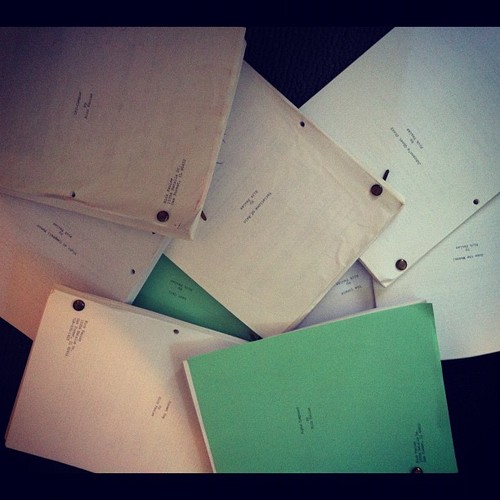
Read as far as you can and vote for your favorite script in the comments. Feel free to help the writers out with constructive criticism. And please make your vote clear at the top of the comment. Enjoy!
Title: The Baltimore Plot
Genre: Thriller
Logline: Based on true events. When Allan Pinkerton discovers a plot to assassinate Abraham Lincoln before his inauguration, the legendary detective and his most trusted operatives must race against the clock to prevent the murder of the president-elect.
Why You Should Read: When we came across this story, we were amazed it hadn’t been made into a film yet. Starring the most famous American president in history, the most renowned of real-life sleuths, and the first female detective in the United States.
Title: The Dead and the Drawn
Genre: Western/Horror
Logline: In Texas, 1887, a lone gunslinger reluctantly escorts survivors to sanctuary during the aftermath of a zombie epidemic.
Why You Should Read: It’s the tried-and-true, harrowing, horrifying tale of random people working together to survive the zombie apocalypse. Only this time, it just so happens to take place during the era of six-shooters, lawless individuals and colonization of the American Frontier. I’ve always been fascinated by Westerns, particularly because they involve adventurous characters actively moving from one location to the next. Those are the kinds of movies I love, and that’s the kind of movie I envisioned this script to be. Hope you enjoy.
Title: Rough Head
Genre: Crime/Drama/Sport
Logline: Irish Fighter Rory Wilson has absorbed so much punishment in the ring he is now more monster than man. On the run from the IRA his estranged brother follows him to America where they crash head on into Boston’s underworld.
Why you should read: Battle of the Fight Films! When I saw the review for Southpaw posted i just had to have a shot at it. As a writer I’m at the top of my developmental curve. As the years pass I’m no longer improving at any great rate – so if I can’t get this going I am pretty well stuck in amateur armageddon. Probably it’s a bit like a sprinter than does the 100 meters in 11 seconds – it’s fast but not fast enough to make it. It’s not like you can get new legs – or in writing terms a new brain… Carson I give you the privilege of putting me in the game – or knocking me out!
Title: Once Upon a Time in the North
Genre: Family/Adventure
Logline: A gritty origin story of Santa Claus, in which Old Nick, a grumpy, reclusive miner, goes up against Krampus, an evil goat demon and ruler of a fantastical North, who steals a child every year on December 24th. Frozen meets Raiders of the Lost Ark.
Who We Are and Why You Should Read Our Script: We’re both playwrights and performers. We’ve been co-writing comedies for the stage since 1998. Our most notable credit is Toothpaste and Cigars, which was adapted into the feature film The F Word/What If – which featured on your site before it was produced. — Once Upon a Time in the North has some similar comedic sensibilities, but belongs to a radically different genre, which makes it harder to get people to read the thing. It’s adapted from a stage version we wrote of the same story, which enjoyed great success. Our goal was to capture the excitement of the adventure movies we loved growing up – Star Wars, The Goonies – with jokes both adults and kids would enjoy, all grounded in a solid story, a la Pixar.
Title: The Devil’s Footprints
Genre: Thriller/Horror
Logline: In 1850s England, a condemned criminal joins an expedition to defeat the supernatural force behind a string of grisly murders — a killer suspected to be the Devil himself.
Why You Should Read: This screenplay recently won the grand prize in the 2014 ScreamCraft Horror Script Contest and has also earned a score high enough to be featured on the SpecScout website. Despite these accomplishments, The Devil’s Footprints has had some polarizing reviews and I would love YOUR take on it. I honor and respect your opinion and believe a review would be immensely helpful.
Genre: Period
Premise: Moses takes revenge on his cousin Ramses after being cast off from the city he was supposed to help rule.
About: The biblical epic trend continues! We had Noah. Now we’ve got Moses. It’s a good bet that J-swizzle is getting his own movie soon. If you’re like me, you have no idea what any of this means. The Bible is one giant collection of words like “overfloweth.” Consider my cup confused. Exodus comes out in three weeks, stars Christian Bale as Moses and Joel Edgerton as Ramses. The film was directed by Ridley Scott.
Writer: Steve Zallian draft (previous drafts were written by Adam Cooper & Bill Collage)
Details: 7/6/13 draft – 132 pages
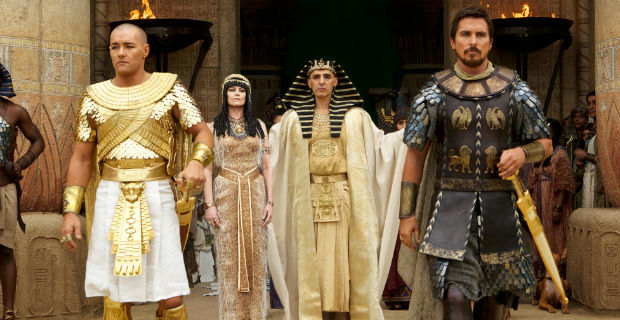
This wouldn’t be on my radar if it wasn’t for Steve Zallian writing this draft, one of the few screenwriters who’s worth the dough you pay him. The question is, can his writing overcome a film that has the special effects team that pixel-poked Dracula Year-Zero? I mean we know the guy’s a good writer. But you can’t write, “Don’t use bad green screen” in a slug line, can you?
Hey, here’s an idea for Hollywood. You’ve got this whole “Universe” approach going now. First it was Marvel superheroes. Then it was DC superheroes. Then it was Star Wars. Universal’s monsters are setting up their own universe.
Why not get some Bible Universe up in hurr!? You don’t even need the rights. I’m pretty sure the Old Testament is public domain by now (although I’m sure Disney’s trying to change that). Jesus was basically a superhero anyway, right? Came back from the dead if I’m not mistaken. Eat your heart out, Wolverine. Actually, I think I know why no one’s hopped on this chariot yet. The Bible’s stories don’t exactly lend themselves to Hollywood structure. As you’re about to find out with Exodus.
Exodus starts out strong. It’s 1300 B.C. The current Egyptian Pharaoh, Seti, is trying to decide who’s going to succeed him. On the one side he’s got his son Ramses, the hands on favorite. On the other, his nephew, Moses, who’s clearly the better leader.
One day during battle, Moses saves Ramses’ life, and because a prince is never supposed to need saving, Ramses doctors the history scroll to omit Moses’s act. This pisses Seti off, and has him seriously considering making Moses the next Pharaoh.
But then Ramses learns that Moses is the offspring of slaves! His whole life has been a lie. So Ramses casts him out of the city, and Moses goes on a spiritual journey where he becomes, of all things, a sheepherder.
One day while herding, non-believer Moses bumps his head and sees God, who tells him to go back and save all of Ramses’ slaves! Ramses threatens Moses once he arrives, so Moses uses his new God-like powers to turn the sea red, send disease at Ramses, rain down hail, and kill all of Ramses’ crops.
But it isn’t until Ramses actually gives Moses his slaves that Moses will face his most difficult test – getting all 400,000 of them home alive.
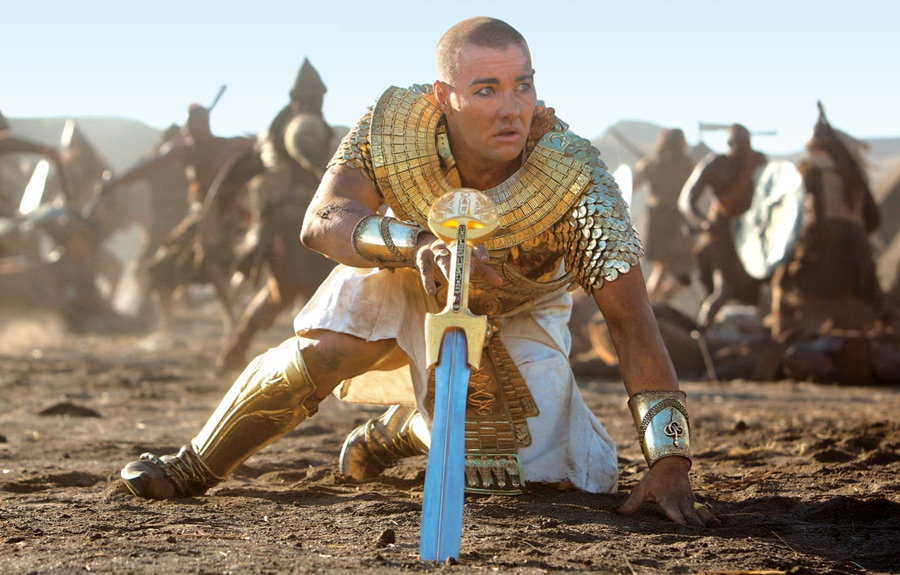
Whenever you write a swords and sandals pic, the danger is in getting lost in the grandiosity of it all. It can be scary stuff, trying to juggle so many characters and locations and subplots and passages of time. So your first order of business is to FIND YOUR CORE. You need to find what your story is REALLY ABOUT and place that front and center so the reader has something to grab onto.
With Exodus, that’s the relationship between Ramses and Moses. And Zallian (along with the earlier writers) does a really good job with this. All the cousins’ early interactions are laced with tension, a sub-textual jockeying for the throne. Remember that you want all your scenes to contain some element of conflict, tension, or suspense. We see that here.
And Moses was a really strong character overall. There’s this early sequence where he’s sent off to check on the slaves where he comes in contact with the slave king, Hegep. Hegep is a greedy car salesman type who has no respect for Moses and treats him like dirt the whole time he’s there. This is a writing trick we’ve talked about before on Scriptshadow. If you want to make us like your hero, put him around an asshole, someone who takes advantage of or disrespects him. We’ll immediately gain sympathy for your protag.
So things seemed to be going well. Strangely, however, this is the last moment in the script that contained any structure. We had this clear goal where we knew what Moses had to do and why he was doing it. But once he got back from the slave trip, the script turned into one of those slip and slides you see in the heat of summer, the screenplay equivalent of a runny nose.
Moses is cast out of the city and then sort of wanders around for awhile. He eventually finds a small farm and hangs out there for ten years. Then there’s a storm where he sees a burning bush (why is a burning bush such a big deal by the way? Isn’t it easy for a bush to burn?), and now, instead of clearly defined plot points guiding the story, we’re being pushed forward by symbols and ideas.
This is why clear goals and clear mysteries are SO IMPORTANT in screenwriting. When you tell us what our character needs to do and why, we feel a part of the story, like we know what’s going on. Seti says go find out why the slave owners are complaining. So we know that Moses needs to find out why the slave owners are complaining!
Where’s the goal in stumbling around on a farm and seeing a burning bush? It just felt… random. And I don’t know if that’s because Zallian was following the bible story or made the choice himself. But we needed structure here.
My guess is that Zallian was limited by the bible. 2000 years ago, they didn’t have 3rd acts with heroes overcoming their flaws right at the climactic moment of the story. Nor did everything end in an elevated battle. And that’s where Exodus really falters.
Ramses gives Moses his slaves and tells him to leave. And so the whole climax of the film is to… run away? Try to sell that on a modern-day project. I get that the climax here had to be the parting of the Red Sea, but even that was anti-climactic, as the parting was the slaves waiting for 12 hours until the tide made the sea shallow enough to walk across.
Satisfying character development also had to be sacrificed due to the Bible text. One of the storylines here was that Moses had no faith. He didn’t believe in God. Ideally, then, you want to play that out during the big Red Sea moment, where he had to believe in God to part those waters. The ultimate test of his faith and his flaw.
But we’d already spent the last 45 pages watching Moses use God to tear apart Ramses’ empire. So his battle with his faith was never in question by the time the Red Sea arrived, leading to a heck of an anti-climax. This is why Bible stories are so tricky. You can’t change the Bible to make the story better. You’re stuck with what they give you. And often that’s at odds with what mainstream audiences expect.
But the truth is, this script lost me all the way back in the second act. You have to recognize that period pieces are the genre most susceptible to becoming boring. It’s not like a comedy where a good joke can bring the reader back in, or horror where a good scare can do the same. If you get complacent and let the story slip away from you – meaning NOT MUCH HAPPENS for too long a period of time – the reader’s eyes will glaze over and they’ll stop caring.
Once Moses got to that outpost and became a sheepherder and just hung around all day, that was it for me. There wasn’t enough happening in the story to keep me invested. It’s true that period pieces need their “downtime” scenes, but that never means the scenes shouldn’t entertain. It’s your job to know when things are getting slow, and to look for ways to keep those scenes entertaining, as tough as it might be.
I still remember the scene in Braveheart where the two new Generals were brought in. The story was between big battles and could’ve easily gotten bogged down in a boring sequence. Instead, the next scene showed William Wallace hunting, and we find out one of the generals is an assassin here to kill him. The rest of the scene plays out with the second general saving Wallace’s life. That scene energized a potentially boring section.
Exodus started off strong, but ended like a day at church, with you discreetly checking your watch as the pastor prattled on.
[ ] what the hell did I just read?
[x] wasn’t for me
[ ] worth the read
[ ] impressive
[ ] genius
What I learned: Find your CORE for your period piece, which is almost always a key relationship between two characters. Here, it’s the relationship between cousins Ramses and Moses. Whenever you’re lost in your script then – things have gotten too big or too out of control – go back to that core. That’s your real story. Everything else is secondary.
P.S. If anyone wants to share their keys to making swords and sandals scripts (or period pieces in general) work, please do. The difficulty level on these scripts is so high. Any help will do.