
Search Results for: F word
 I just like putting up Matrix pictures. This has nothing to do with the article.
Just like when I review a script on the site, I have “what I learn” moments when I do script consultations as well. Of course, most of these things, I’ve already learned. But if there’s one thing I’ve come to realize about screenwriting, it’s that you occasionally need to be reminded of things.
Which was the motivation for today’s article. I thought it would be fun to share the big lesson I learned (or, was reminded of) in each of the last ten script consultations I did. It’s going to be a little tricky because I can’t share the details of the scripts. But if I need to get detailed, I’ll just adjust the concept and specifics to keep everything private.
Afterwards, I’ll provide you with a ranking of how often I come across this particular issue in screenplays. 1/10 means I barely come across it. 10/10 means it’s one of the biggest issues in all of screenwriting. Okay let’s get into it!
1) Fear of being on-the-nose – For an airplane pilot, the scariest thing that can happen is that all of your engines go out mid-flight. For a surgeon, the scariest thing that can happen is that the patient goes into cardiac arrest during the surgery. For a screenwriter, the scariest thing that can happen is someone telling you that your script is on-the-nose. We actively avoid “on-the-nose” to such a degree that we actually create the opposite problem for ourselves, which is that the specifics of our plot, characters, and theme are so vague that the reader has no idea they’re even there. For example, if you wanted to build the flaw of “selfishness” into your main character, but were so terrified of being on-the-nose you only mentioned the selfishness a couple of times in the script, then when that character transforms in the end and becomes selfless, we’re utterly confused. Cause we never knew the character was selfish in the first place. — In my experience, the writers who are obsessive about avoiding on-the-nose moments are being too vague in general. It’s okay to draw attention to things that are important in your script.
How often I run across this issue: 5 out of 10
2) Picking the wrong point-of-view – Sometimes when you write a script, the hero is obvious. If you’re writing “John Wick,” for example, you know whose eyes the movie should be seen through. But sometimes you run into scenarios that have more characters, a less linear storyline, and, therefore, it isn’t as clear whose point-of-view should take precedence. For example, if you have a movie like Knives Out, where there are all sorts of characters to choose from, you have to think harder about which character the spotlight should be on. The answer is typically the person who’s the most active. So, in a movie like that, the detective is the most active. But you also have to take into account which character has the most interesting storyline. That will play into whose POV to follow as well. In this particular consultation script, I was posed with one character – let’s call her “the killer” – whose kills made her somewhat interesting to watch and another character – let’s call him “the detective” – who had the more active storyline, since he was investigating these murders. An argument could be made to go with either character. But I felt that the benefits from the discoveries that would come from the detective’s investigation outweighed watching the killer, whose killings wasn’t interesting enough to be the sole focus of the story. The killer wasn’t Patrick Bateman from American Psycho, for example. POV can be a difficult decision to make in some scripts. But when it’s all said and done, go with the person whose POV leads to a more entertaining story.
How often I run across this issue: 5 out of 10
3) Execution is too familiar – No matter how many scripts we write, a pitfall we’re never safe from is being too formulaic with our execution. And there’s a specific reason for this. When we fell in love with a particular genre growing up, we fell in love with everything about it. We fell in love with the characters, the scenarios, the dialogue, the plot twists. And so when the time came to write these scripts ourselves, we wanted to do what we saw growing up!! We wanted to write those same characters. We wanted to write those same scenes. And some weird cognitive dissonance didn’t allow us to realize this was a bad thing – that readers were going to tell us that our scripts were formulaic and cliche. To combat this, you need to deconstruct the genre on some level and actively avoid writing the characters and scenarios and dialogue you were so fond of. You’re still going to write those things to a degree. But you’re actively looking to write your version of it and not just straight up copy and paste.
How often I run across this issue: 8 out of 10
4) Way too much going on – There are two primary reasons why someone might label your script this way. One, you have too many characters. Or two, you have too much plot. But, by far, the worst violations of this rule are when you do both. You have way too much plot – you’re jumping around to a million different locations and trying to cram in too many storylines. And, by proxy, because you have all this extra plot, you populate it with more charters than your story can handle. Reading these scripts is like reading college textbooks. They’re big and cumbersome and feel like you’re taking notes as opposed to enjoying yourself. I think the reason writers make this mistake is because they have the wrong mindset. Their mindset is, “I have all this stuff to get into my story. How can I best position my story to squeeze it all in?” And since that’s the objective, they feel really good when they’ve done it. It’s like, “Wow! I was able to get every single thing I wanted into the script.” The objective should instead be, “How can I write the most entertaining story?” If you start from there, you probably won’t ever get this criticism thrown at you.
How often I run across this issue: 9 out of 10
5) Rules of your world are too complicated – This is an issue I run into almost exclusively in the sci-fi and fantasy genres. This is your mythology. This is your world-building. And what’s great about that is, when you get it right, it’s awesome. The Matrix is awesome. The rules are cool and fun to learn. But there’s a version of The Matrix where there are 20 more rules about how things work. Where there is three times as much backstory. Where there is so much exposition, it starts to contradict itself. Time travel scripts, in particular, can become incomprehensible if you don’t simplify your rule-set. I remember I wrote a time travel script once and I must’ve had a dozen time travel rules that I thought were expertly crafted. I felt that if anyone had me in a room and challenged me on these rules, that in just under an hour, I would be able to convince them that it all worked and made sense. It probably took me another five years before I realized how stupid that was. That the goal is not to be able to prove your point. Your goal is always (always always always) to entertain the reader. Period. This is a reminder to everyone writing sci-fi and fantasy to err on the side of LESS IS MORE. I know you want to show us how intricate your multiple universe time-travel rule-set is. But movies don’t have the capacity to keep track of all of that. You need to distill it down to the essentials.
How often I run across this issue: 5 out of 10 (but would be 8 out of 10 if this was just an assessment of sci-fi and fantasy scripts)
6)An unimportant subplot – Whenever we sit down to construct our latest screenplay, we tend to have a number of things we want to put in the script. Because these become the “OG” elements of your screenplay, you become attached to them. You think they are unchangeable. It’s sort of like laundry on your bedroom floor. The longer it sits there without you picking it up, the more it starts to feel like a permanent part of the room. This can lead to subplots that aren’t necessary for your story sticking around, draft after draft. In this particular script there was a subplot with a character that was only peripherally connected to the main plot. So, whenever we visited this character, we felt like we were a million miles away from the main story. It can be hard to ditch these subplots. But if a subplot isn’t helping push the story forward, it’s probably not important. Even if that subplot is helping develop your main character, it probably needs to go. 95% of screenplays move too slowly. Unnecessary subplots are a big reason for that.
How often I run across this issue: 4 out of 10
7)Over-setting up the first act – This is an adjacent tip to number 4. First acts are tough because they’re the setup act. They set up the main character, the supporting characters, and the plot. When your stories are simple, like Taken, this is easy-peasy. But when your stories are complex, like Avengers Infinity War, it can be a lot tougher. Because you just have a lot of stuff you’ve gotta cram into that opening act. But, in the case of this consultation, the story was relatively simple, yet the writer tried to include way too much in the first act. For example, instead of just telling you what the main character was up to in their life, they tried to include another 40 years of their backstory. And then, as soon as that happened, we had a death to deal with, and then a funeral to deal with, and then a will reading to deal with. Why not just open with the will reading? As I like to remind screenwriters any chance I get, the most common mistake I see is writers making things overly complex. The solution to most problems in screenwriting is keep it simple.
How often I run across this issue: 5 out of 10
8) Concept isn’t big enough – A concept must be special. As in, this is something we don’t typically get to see and therefore is worthy of making a movie about. And the stakes need to be high. The story must feel like it matters. My primary issue with this consultation script was that the story felt too small. I needed the stakes to be bigger. If you ever want to see what it looks like when concepts aren’t big enough, check out the tail end of the 1990s – early 2000s indie era. This is when writers were getting super experimental, and, in the process, writing a bunch stories that had low stakes and no compelling central idea. A couple of films that come to mind are Gerry, a movie that has Matt Damon and Casey Affleck roaming around a desert for 90 minutes. And Bubble, from Steven Soderbergh, which was about a doll machine plant. You can still make these movies if you direct them yourself and keep the budget low. But it’s hard to compete on the spec script market with a low-stakes or medium concept script.
How often I run across this issue: 7 out of 10
9)Starts off fast, loses momentum – We seem to be aware of three important checkpoints once we get into screenwriting. The first 5 pages, the first 10 pages, and the first act. We know we need to make these segments of the script sing. Cause we need to get people into our script if we expect them to finish our script. Unfortunately, this leads to an oft-overlooked side effect, which in that we don’t write with the same level of immediacy after the first act. Granted, you can’t make every single moment in your script thrilling. But you should still have that mindset of, “The writer could be getting bored. The writer could be getting bored.” So that you continue to write an entertaining script the whole way through. This particular script started out like gangbusters. But the writer took his foot off the gas about 15 pages into the second act. And it took what was, up until that point, an ‘impressive’ script, and turned into just barely ‘worth the read.’ So don’t take your foot off the gas, people!
How often I run across this issue: 8 out of 10
10)Being too clever for your own good – Sometimes I come across really smart writers who are so driven to write something great that they forget to write something good. In other words, they unnecessarily overwrite their script. This particular script was a mystery and it was just so insanely detailed and had so many little clues and key moments along the way, along with voice overs and flashbacks and voice over from past characters playing over present storylines. It was so intricate that by the time we got to the ending, I was trying to see the story through thirteen layers of intricate plotting and therefore struggled to understand what happened. In the Sixth Sense, we get it right away that Bruce Willis is dead. If you try to overcomplicate that setup and the reveal, it doesn’t work. I’m not going to give you the advice to “dumb it down.” But writers who try to outthink everyone… you don’t need to outthink us as much as you think you do. Which brings me right back to my most common screenwriting advice: Keep it simple!
How often I run across this issue: 2 out of 10
LABOR DAY DEAL! – I’m taking $200 off my screenplay consultations if you order them this weekend! If you want to get super cheap notes now or on a future script, e-mail me at Carsonreeves1@gmail.com. Use subject line “Labor Day” and let’s rock n’ roll!!
Genre: Comedy
Premise: When a misogynist explorer meets his sudden (and violent) end, his long-overlooked understudy seizes the moment and embarks on an adventure that will earn her a place in the annals of history.
About: Matt Roller is a seasoned TV writer who comes from the Dan Harmon tree, writing on both Rick and Morty and Community. This script landed him on last year’s Black List. Also, Tristar purchased the script last year.
Writer: Matt Roller
Details: 108 pages
 Annie Murphy for Abbi?
Abbi and The Eighth Wonder hooked me almost instantly with this line, which happens after studly explorer and proud misogynist, Channing Smith, bumps into our heroine in the jungle while they’re being chased by cannibalistic locals: “I thought they got you when I pushed you in front of me and ran.”
“Nope. Still alive,” our hero, Abbi, replies.
“That’s good news for both of us. I may need a decoy. I don’t understand how that damn Goldblum found us.”
“I did mention we weren’t covering our tracks. Also you left our map in that bar. Bragged to a lot of people about where we were going…”
“Yeah, he’s cunning.”
But Abbi and the Eighth Wonder makes a critical mistake not long after we meet our heroes that reverberates throughout the script. It’s a common choice a screenwriter will face whenever writing a two-hander. And, therefore, learning from it could help save your script in the future.
It’s 1936 and Abbi Rhodes is the assistant to world-traveling explorer, Channing Smith. As we’ve established, Channing is kind of a sexist d#*%head. A woman, in his mind, is someone who will always be an assistant, never an explorer.
He’s been able to string Abbi along precisely because he’s promised to one day make her an explorer. So during a big celebration party after Channing’s latest successful adventure (where Abbi did all the work), Abbi presses Channing on when he’s going to introduce her to the Council of Explorers when – KABOOM! – Channing is blown up by an exploding cannonball he was playing with.
At Channing’s funeral, Abbi meets Jo, a gossip journalist who wants to be a real journalist. Her only problem is that she hates everyone and drinks too much. But much like Abi, she’s tired of men getting all the cool jobs. And when Abbi gets a hold of a rare medallion that is said to be the key to finding the eighth wonder of the world, Jo wants in.
So the two head down to South America to look for a suitcase that is said to have the famed map leading to Firebeard’s treasure (aka ‘the eighth wonder of the world’). There they run into Adam Blaze, the evil male explorer who has dutifully filled in in the absence of Channing. Oh, but Abbi and Jo are about to get the surprise of a lifetime. That’s because Channing is still alive! He faked his exploding death and is now teamed up with Adam to find the Eighth Wonder!
The two teams fight on trains, bi-planes, and inside lavish parties, before making their way to an island that has Firebeard’s treasure. All parties will have to navigate a pirate ship graveyard to locate the single most lavish treasure known to history. Will Abbi prove that she’s worthy of being a true explorer? Or will she fail, confirming that once an assistant, always an assistant?
First off, this is a funny script.
However, it could’ve been an awesome funny script.
And I think that the writer made a key mistake early on.
Abbi and Channing were hilarious together. Every exchange of theirs was funny. Him with his over-the-top sexist comments and her exasperatedly pointing out how wrong he was with every single decision he made. They were perfect together.
Then they killed Channing off. And in comes Jo. Jo, meanwhile, isn’t nearly as funny as Channing. Channing was a very clear archetype, which is important in comedy. We need to know the type of person someone is to laugh at them. Jo, meanwhile, was a mix of conflicting ideas and was hard to pin down. She’s a feminist. But she’s also kind of a clueless ditz. So her actions didn’t quite line up with her label.
More importantly, when you put Abbi and Jo together, they weren’t funny. I wasn’t even sure what the dynamic was. For example, in the Marvel films, Captain America is the super serious “everything by the book” guy and Iron Man is the loosen-up sometimes you gotta improvise guy.
Establishing dynamic is critical to a two-hander working and the writer HAD TWO CHARACTERS WITH THE PEFECT DYNAMIC. Yet he destroyed it by killing off Channing in favor of Jo, who was, quite frankly, lame.
Why did he do this? I suspect the angle was to focus on women working together as sort of “feminism is awesome” creed. But the irony is that you’re able to get that message across much better if Abbi is teamed up with the world’s biggest chauvinist.
I realize that there’s a creative choice here. And there are pros and cons to each decision. But the rule that trumps everything is that the best dynamic in your movie should be the dynamic that’s on the screen the most. Abbi and Jo do not have the best dynamic. Not even close. Abbi and Channing do. So that’s the movie right there. Full stop. End of discussion.
Now, you may think this killed the script for me but it didn’t. The writer wrote a lot of funny scenes and a lot of funny characters. He’s so funny, in fact, that he makes up for this mistake. One of my favorite characters is Abbi’s love interest, Michael, who’s this openly beta magician-on-the-weekends map-maker who is perennially dealing with bouts of diarrhea. He’s so opposite of Channing and Adam, you can’t help but laugh.
This is both the curse and the benefit of writing comedy. If you’re funny, you can make up for major creative mistakes. But if you’re not funny, you can write the most technically perfect script ever and it won’t matter. In other words, even if Roller had paired Abbi up with Channing, it wouldn’t have mattered if he wasn’t naturally funny.
What is “funny?” What does that mean?
Well, obviously, “funny” is personal for every individual. But there just seems to be a little more imagination in people who are funny. For example, fellow misogynist explorer, Adam Blaze, is such a douchebag that, during big parties, he loves showing off his backflip, despite the fact that it’s the clumsiest backflip ever and he should not be proud of it at all.
Then, later on in the script, Abbi is about to steal the gold medallion from the museum, but a masked man is able to grab it before she can get her hands on it and he runs off. She chases him towards a busy street, effectively cornering him. “Who are you?” Abbi asks. “You’ll never know,” he says, deadly serious.
The “mysterious” masked man then proceeds to do the clumsiest backflip ever onto a passing truck bed.
It was just fun stuff like that that had me giggling the whole way through.
Whenever I post about a script I laughed at, I get a million comments declaring, “That’s not funny, Carson!!! You’re wrong!!!….. and DUMB!” All I have to say to that is, step into my shoes for a week. Read seven comedies that are truly TRULY not funny, and you might change your definition of funny. Because this writer is definitely funnier than the majority of comedy writers out there.
[ ] What the hell did I just read?
[ ] wasn’t for me
[x] worth the read
[ ] impressive
[ ] genius
What I learned: CRITICAL mistake. The writer did not give his two leads ages when they were introduced. I know that sometimes writers will do this at the request of the producers in order to cast a wider net of which actors they can send the script to. But you need to tell us Abbi’s age here. As any woman will tell you, their life at 25 is a lot different than their life at 35. And I didn’t know where, in that spectrum, Abbi’s age was. And it prevented me from truly understanding who she was as a person.
Eighth Grade meets Little Miss Sunshine meets Euphoria in today’s screenplay!
Genre: Comedy
Premise: After witnessing a drug deal gone wrong, thirteen-year-old (and exceptionally awkward) Beatrice accidentally finds herself in the middle of an underground drug ring…and on the perfect route to having a proper hot girl summer.
About: Michelle Askew was born in Staten Island and graduated from USC’s screenwriting program. She’s currently repped at UTA. This is her first big script, which landed on last year’s Black List.
Writer: Michelle Askew
Details: 105 pages
 This is the first image that popped up when I googled, “Hot Girl Summer.”
I don’t know what a hot girl summer is.
I’ve heard of it before. But I have never gone so far as to ask someone what it means. I know what the Summer of George is. Lana Del Ray taught me what summertime sadness was. My buddy, Shakey, introduced me to midsummer nights.
But I do not know what a hot girl summer is.
I assumed it meant something sexual, which is why I’ve always been confused by this logline. The main character’s age didn’t seem to fit the title.
I finally decided to read the script and figure out, once and for all, what a “hot girl summer” was, so that I could, in turn, teach all of you what it was. I never want a Scriptshadow reader to be caught in a position of ignorance should someone mention they’re in the midst of a hot girl summer. I want them to be able to respond, “God speed to you and your hot girl summer activities, of which I am familiar with.”
Our main character is a 13 year old girl named Beatrice. Beatrice has a little extra weight on her. Which is ruining the game she’s running on the boys. To put it nicely, no dudes are interested in Beatrice.
Beatrice, however, is very interested in Ben, the hot high school life guard. Ben is the Chris Hemsworth of Staten Island and yet, for some reason, call it blind ignorance, Beatrice thinks she has a shot with him. Since she’s not going to be able to depend on her looks, she comes up with another plan.
DRUGS.
Beatrice knows this slimy 28 year old guy, Ray. If she can score some weed from him, it might just give her that “cool” glow she needs to make Ben notice her. When she makes her proposition to Ray, he laughs at her. But then he gets an idea. Cops would never suspect that a 13 year old girl would deal drugs, so what if he uses her as a mule?
Soon, Beatrice is transporting “pixie” (a cool new drug) around New York. And, wouldn’t you know it, Ben finds out. He approaches Beatrice and asks her if he can score some of that pixie. Ecstatic, she says sure. Come to my party this weekend, he says. And just like that, Beatrice’s dreams are about to come true.
Except that when you’re only 13 years old and dealing drugs and trying to date guys 5 years older than you and you’re not exactly a looker… well, let’s just say those stories don’t end well. And this one doesn’t either. When the fallout arrives, it will be up to Beatrice to mitigate the damage as much as possible – damage that could follow her for the rest of her life.
To answer the question I posed at the beginning of this review, it appears that a hot girl summer is any summer where a girl decides to do whatever she wants. Although anecdotal evidence was weak, it appears that you don’t have to actually be hot to experience a hot girl summer. I think that the summer itself is the hot part. So, in retrospect, it probably should’ve been called Hot Summer… Girl… Adventure?
Anyway…
Like any good comedy, Hot Girl Summer injects a healthy dose of irony into the concept.
A 13 year old should not be worried about partying and scoring drugs and having sex. That’s where all the laughs come from. This protagonist is way too young to be in all of the scenarios she finds herself in. And that ‘fish out of water’ element is what makes it so funny.
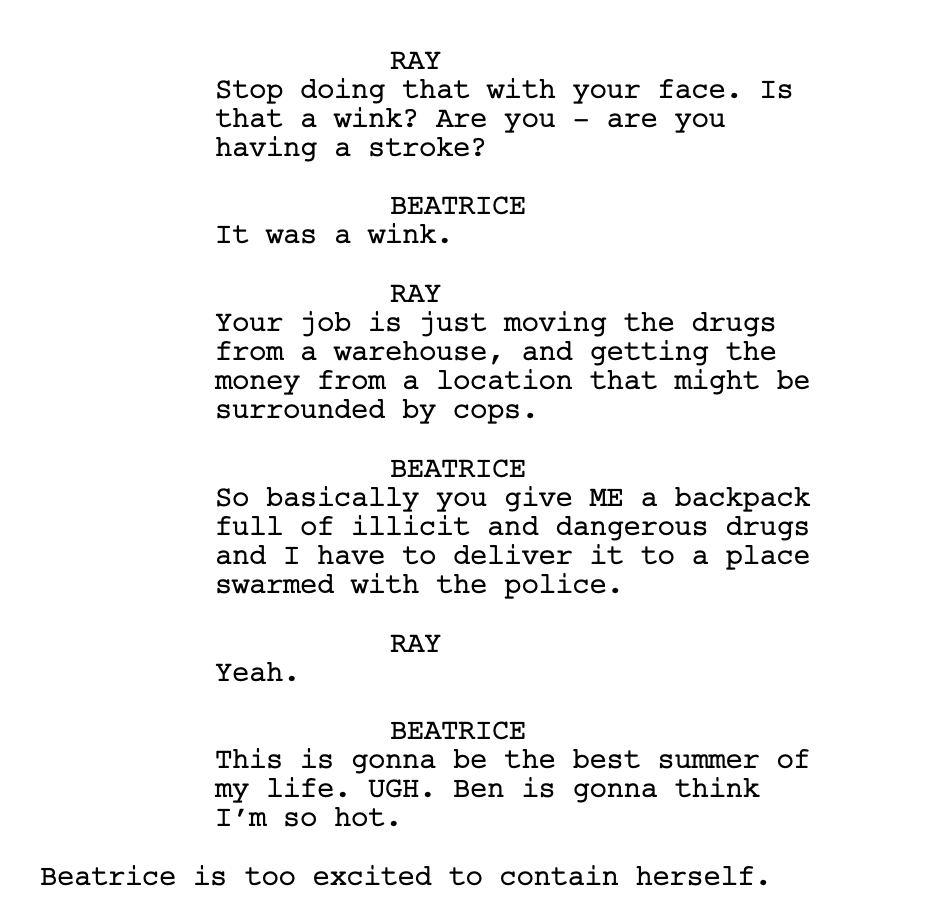
I think I learned a new screenwriting lesson today. Which is that there’s something extra-likable about a character who has no reason to be big and bold and open and active, but yet who is all of those things. It’s the exact same thing that made Little Miss Sunshine work. That girl was not a looker. She had no business thinking she should be winning beauty contests. Yet she was unfazed and charged forward optimistically.
We like this because most people are the opposite. If they have even the slightest reason to doubt themselves, they curl up in a ball and stay hidden from the world. It’s inspiring when someone doesn’t follow that path.
I also enjoy non-traditional role model relationships in movies. Ray, the 28 year old drug dealer, acts as a surrogate father to Beatrice in the movie. 100% we should not be rooting for any drug dealer who’s sending a girl into the heart of New York City by herself to deal drugs. And yet we do.
Part of the reason we do is because the writer isn’t writing what they’re supposed to write. They’re not writing Ray as this big bad terrible villain. They’re writing him with more subtlety and it creates a much more complex and interesting relationship. It reminded me a lot of the screenplay, “Bad Words,” which also leaned into the negative role model.
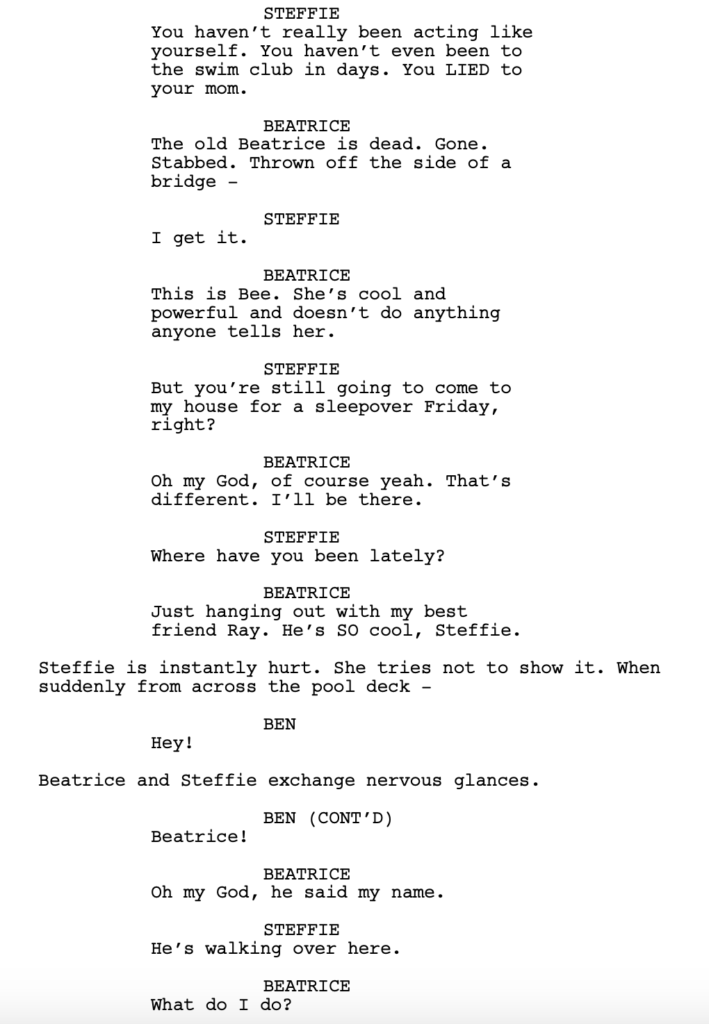
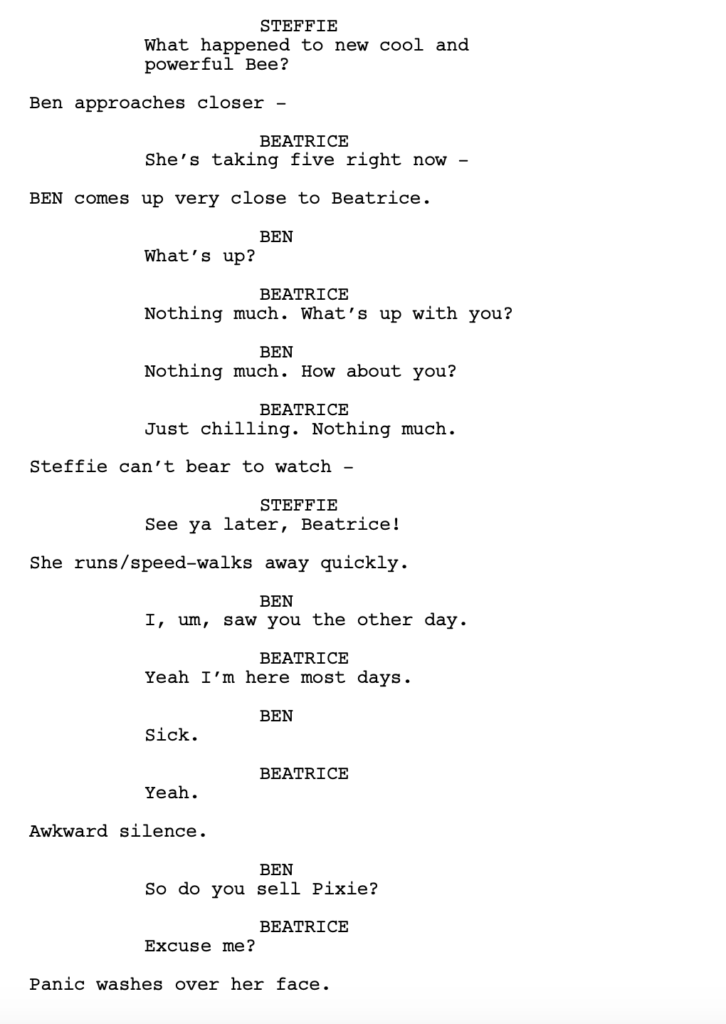
This is probably the funniest comedy I’ve read all year. And that comes down to the writer being naturally funny. I always tell writers who are thinking of writing a comedy – MAKE SURE YOU’RE FUNNY. People who are not your friends or family need to have told you you’re funny. Whenever you write something comedic, people need to be telling you it was hilarious. Because comedy is the one thing in all of writing you can’t learn. As much as I love Leonardo DiCaprio, he’s never going to star in a comedy cause he doesn’t have the comedy gene in him.
Michelle Askew definitely has that gene:

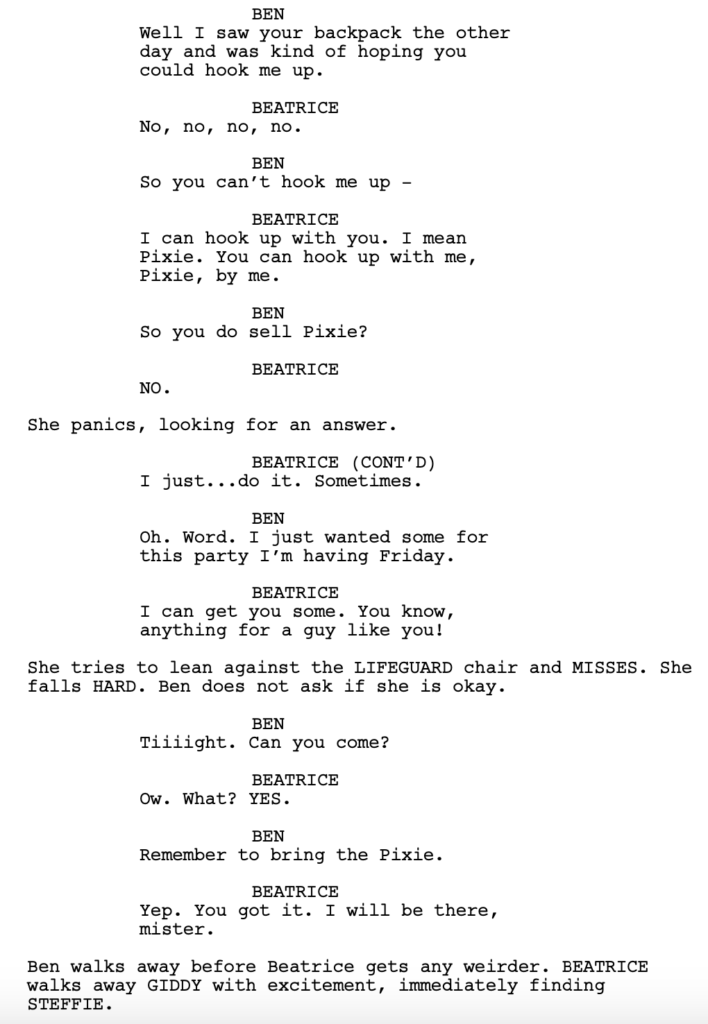
This is a really fun script. Fun main character. Well-executed plot. Never slowed down. If you want to be a professional screenwriter, this is how you do it!
[ ] What the hell did I just read?
[ ] wasn’t for me
[xx] worth the read
[ ] impressive
[ ] genius
What I learned: When describing a scene, lean heavily into sights and sounds. Play to the senses. The more specific you can be, the better. Here’s a description of the pool club early in the script: “The pool club oozes with screaming children and mothers with wine coolers in their hands, wearing oversized FDNY t-shirts and slides.” “Screaming children” – sound. “Mothers with wine coolers in their hands” – sight. “Oversized FDNY t-shirts” – sight.
House of the Dragon comes out swinging, putting the pressure on its swords and sandals fantasy rival, Lord of the Rings, to come correct!
Genre: TV – One Hour (Fantasy)
Premise: Tensions are high in the House of the Dragon, where the king awaits the birth of a new heir. But a series of unfortunate events force him into a contingency plan.
About: Does this show need any introduction? The Targaryen’s are back! Long live Westeros! Okay, I don’t know what either of those things mean but I’m trying to be a Game of Thrones fan here so give me a break!
Showrunners: Ryan Condal and Miguel Sapochnik
Writer of this episode: Ryan Condal
Details: 66 minutes

I remember all the way back to the Done Deal Screenwriting Message Board days when Ryan Condal (the showrunner for House of the Dragon) used to post on the site.
I didn’t know, at the time, that he was considered one of the more knowledgeable posters. I just remember coming across a response he made to another poster’s screenwriting question and thinking, “Whoa. This guy is on another level.”
I don’t even remember what the question was. I just remember how detailed and knowledgeable and assured his reply was. It was clear that he understood screenwriting at a level far beyond anyone else on the site.
So I’m not surprised that he’s made it this far, leading one of the biggest TV shows in history.
A show I wasn’t sure I was going to watch, by the way! I made it through about three seasons of Game of Thrones before there were more storylines I wasn’t interested in than there were storylines I was. It wasn’t like I quit via some declarative feet-stomping tirade. I just was never motivated enough to go back and watch again.
The fresh start that is House of the Dragon allowed me to come back to Westeros without having to worry about if I’d remember everything.
If you didn’t see it, the pilot follows a king named Viserys Targaryen. Viserys is under a lot of pressure to deliver a heir to his throne. Right now, all the family’s got are his young daughter, Rhaenyra, and his brother, Daemon. Due to her being a woman and him being crazy, neither are fit to take over the throne.
Luckily, Viserys’ wife, the Queen, is pregnant. And Viserys is convinced, due to a vivid dream, that his child will be a boy. While we wait for the birth, we engage in a jousting tournament that has Daemon cutting off horse’s legs to ensure he wins. And we have the troublemaking Rhaenyra riding around on her pet dragon.
Eventually, the Queen goes into labor (spoilers) and it’s a barn-burner of a delivery. She’s in immense pain. The baby won’t come out. It’s getting to point where a decision needs to be made. They cut the baby out manually, saving it and killing the Queen. Or they see what happens, in which case they might lose both. Viserys makes his choice, (bigger spoiler) which let’s just say doesn’t go well. This places Viserys in a precarious position. He must choose either Daemon or Rhenyra to succeed him.
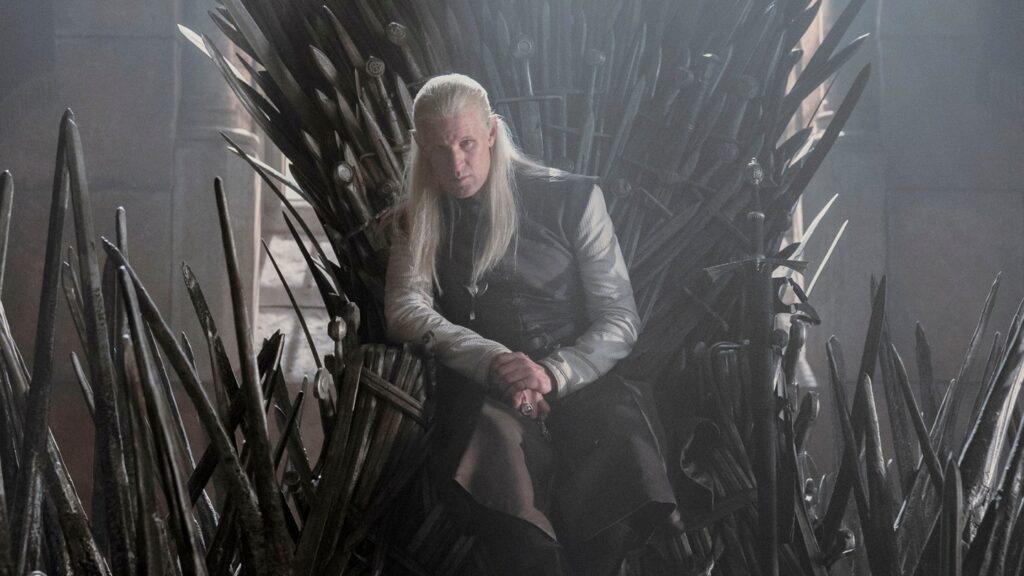 Crazy bro, Daemon
Yesterday, I talked about how sloppy the writing was in She-Hulk.
Today, you see how big of a difference good screenwriting makes.
With She-Hulk, they were basically running a scam on the audience. They’re throwing a bunch of randomness on the page and hoping that the reader does the work for them, putting all the pieces together.
Here you can tell this pilot was meticulously crafted. There was purpose to every scene. The characters were all carefully introduced. The order of things was perfectly convceived and executed. Whether you liked the finished product or not, you can’t say there was a lick of laziness in the pilot. It’s that well executed.
One of the ways I identify good writing is through the big scenes. If your big scenes are great, the smaller stuff tends to be strong as well.
House of the Dragon builds its pilot around the Queen’s labor scene. What’s important to note here is how carefully the scene was set up ahead of time. This isn’t just a, “I can’t wait to have a new kid” scene. Pillars have been propped up ahead of time to give this scene as much weight as possible.
Pillar 1: We’ve been told several times how important having a heir to the throne is.
Pillar 2: We’ve seen how important it is to Viserys that he have a son.
Pillar 3 We meet the crazy brother, Daemon, who wants to be king himself. We know Viserys having a son would take Daemon out of the picture.
In other words, the writer sets up high stakes for the labor scene so that when it arrives, we’re invested.
There was very little foresight in She-Hulk which is why it was incapable of creating a scene like this. You could see the writers hurriedly solving problems on the fly. Oh, we need to get Bruce’s blood inside Jennifer so she can become a Hulk. How do we do that? Uhhh, we could put them in a car crash. Okay, why are they in a car together? Uh, I don’t know. They’ve decided to hang out for the weekend? Okay, how does the crash happen? Ehhhh, maybe a spaceship causes it? What spaceship? Not important. We’ll just have it show up and distract her.
I mean, seriously??? This passes for professional screenwriting in 2022?? I’m embarrassed.
Meanwhile, because the labor scene was so well set up, we’re on the edge of our seats waiting to see what will happen. And the writers use one of the best bang-for-your-buck tricks in the business to climax the scene: A Sophie’s Choice. You can save your kid and lose your wife. Or you can do nothing and possibly lose both.
One of the best things you can do as a writer is place your character in a situation with high stakes and an impossible choice. Not a choice that’s weighed 55-45 in one side’s favor. A choice that’s truly 50/50. And that’s what House of the Dragon did.
That scene right there got me on for at least another three episodes. Knowing that that’s the writing bar they’re asking of themselves, I know I’m in good hands.
[Major Spoiler] Unfortunately for Viserys, things didn’t go as planned. He chose to save his baby instead of his wife. And his baby ended up dying too.
This set us up for the succession decision. Who does Viserys name as his successor? Daemon or Rhaenyra?
This was the only thing about the pilot I think they could’ve done a better job with. Unlike the labor decision, which was a true Sophie’s Choice, the succession choice was more of a 65/35 ordeal. It was clear that he was going to choose Rhaenyra. She’s smart. She’s behaved. She’s respected. What is the downside of her being chosen?
They try to float this idea that, because she’s a woman, the people will resist it. It’s unconvincing, though. Especially because we’ve been conditioned in movies and TV over the last decade to assume all female characters will kick butt. It’s a very popular choice among writers right now. So there isn’t the requisite doubt needed for us to assume anything other than Rhaenyra being chosen over Daemon.
What they probably should’ve done was make Rhaenyra more of a trouble-child. She does her own thing. She doesn’t always listen. That way, the choice would’ve been more difficult. But if you gave her those characteristics, her character starts to overlap with Daemon. He’s the troublemaker. Now you have two troublemakers? It’s lazy.
This is why screenwriting is so hard. Cause sometimes you have the solution to a problem but due to the particular makeup of your screenplay, you can’t use that solution.
What I also admire about Game of Thrones, in general, is that they’re unafraid to push storylines that make you feel uncomfortable. I think it’s important to make the reader uncomfortable at times because you want to keep them on edge! You don’t want them to feel too safe, especially in a show about fire-breathing dragons.
There’s a scene late in the pilot where the king’s weasle-y right-hand man, Otto, sees an opportunity to move up in the royal hierarchy after Viserys loses his wife. So the VERY SAME DAY AS THE WIFE’S FUNERAL, Otto sends his 15 year old daughter to Viserys and says to her, “Go make him feel comfortable. Be a shoulder for him to cry on.” The fact that this man would pimp out his own daughter to gain power is Game of Thrones in a nutshell. And I’m here for it.
House of the Dragon is another win for HBO, which continues to have the best TV writing in town. And it isn’t close.
[ ] What the hell did I just stream?
[ ] wasn’t for me
[xx] worth the stream
[ ] impressive
[ ] genius
What I learned: When you don’t have a lot of action in your story. When a lot of the entertainment comes from the drama between the characters, you should look to create a “Sophie’s Choice” every once in a while. An impossible choice attached to a high-stakes problem is one of the most compelling things an audience can watch. Just make sure that the choice is truly impossible. Don’t weight it so it’s clearly better to pick one option over the other. Then it’s just Sally’s Choice, Sophie’s weaker lamer choice-sister.
Is Kevin Feige losing a handle on the quality of the MCU?
Genre: TV Show/Superhero
Premise: (from IMDB) Jennifer Walters navigates the complicated life of a single, 30-something attorney who also happens to be a green 6-foot-7-inch superpowered Hulk.
About: This series was created by Jessica Gao, which continues a recent Marvel trend of going with riskier and riskier showrunners. Up until this point, Gao’s biggest accomplishment was writing an episode of Rick and Morty. The show has had a strange press tour, with co-stars such as Jamella Jamil openly wondering, on social media, why her costume was so ugly. The show stars Orphan Black star Tatiana Maslany as the She-Hulk. The pilot was directed by Kat Coiro, who recently directed J. Lo in Marry Me.
Writer: Jessica Gao
Details: 35 minutes
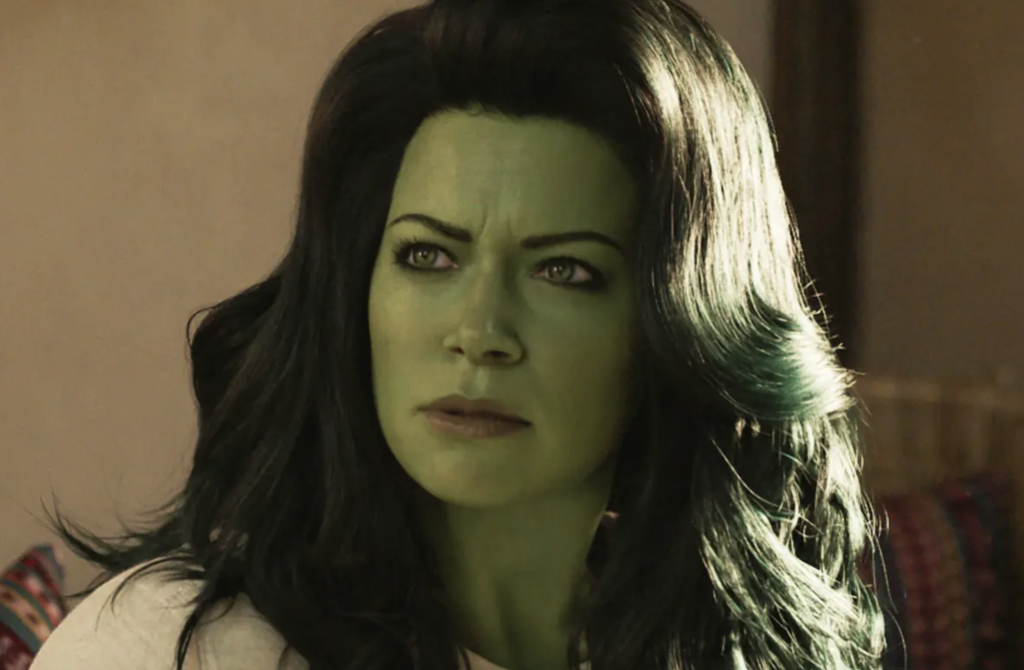
Marvel is implementing the same genius strategy Lucasfilm implemented in the 90s whereby they took their IP and laid it directly on top of already proven video game genres.
Side-scroller? Add Star Wars characters. RPG? Add Star Wars characters. First-Person Shooter? Add Star Wars characters.
Marvel realizes they can utilize this same strategy with their television shows. They have an endless number of TV genres they can lay their brand on top of. Sitcoms? Wandavision. High-school comedy? Ms. Marvel. Legal One-Hour Drama? She-Hulk.
It’s a clever strategy and I hope that, as they tighten the screws and perfect the formula, it will work for them.
Unfortunately, She-Hulk is going to be seen as one of the early test-cases that didn’t work. The reason for that is simple. It prioritizes message over story. And the thing about message-pushing TV is, even if you agree with the message, you still feel the manipulation, which breaks the suspension of disbelief, and prevents you from enjoying the experience.
We’ll get to that in a second. But first, here’s a quick breakdown of Episode 1. A young attorney named Jennifer Walters tells us (as she talks straight to the camera) that she’s an attorney but she wants to catch you up on how she got here.
This jumps us into a flashback where Jennifer is hanging out with her cousin, Bruce Banner (as in The Hulk), when they get in a car crash. During this crash, Bruce’s blood leaks onto an open wound of Jennifer’s, which means Jennifer can now turn into a Hulk too!
So Bruce whisks her away to his own private island where he spends the rest of the episode training her in the ways of Hulkness. When he explains that she’ll need to train for 10+ years before rejoining society, she freaks out and says she only needs one week. Hey, it worked for Luke Skywalker. Why not her? (note: I came up with this analogy, not the writer. The writer isn’t nearly that clever).
Her reason for *why* she only needs a week may have been the single most miscalculated line in the history of television. Which I’ll get to in a bit. But, anyway, we jump back to the present, where Jennifer is finishing up a case in the courtroom when a female villain bursts into the room, cliffhanging us until the next episode.
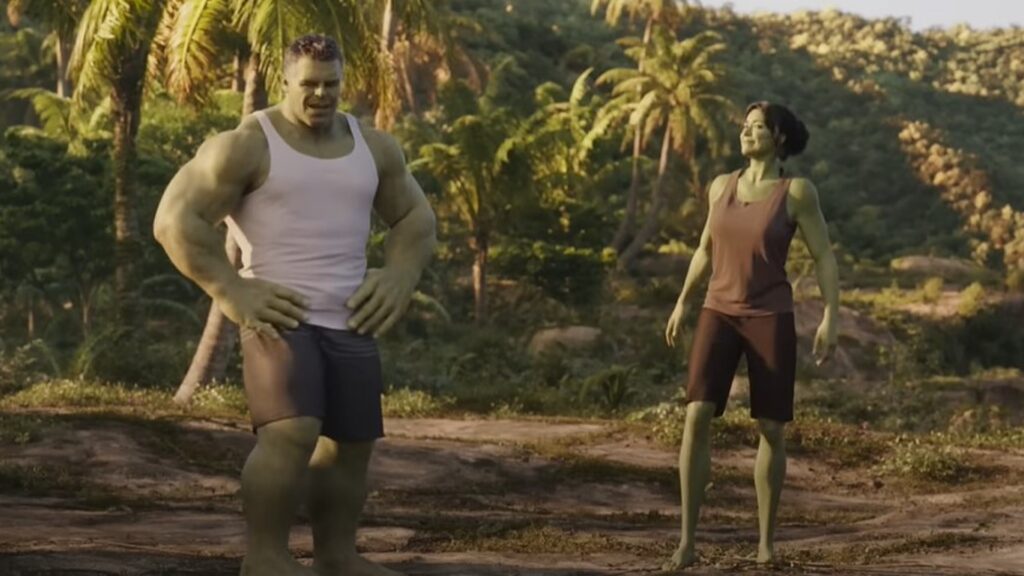
So I went and watched some interviews about this show and what I learned was that they originally wrote the season so the origin stuff – Jennifer becoming She-Hulk – wasn’t revealed until the final two episodes. When they test-screened it, everybody was confused. You had this big green woman walking into courtrooms without any explanation as to why.
So they hurriedly rewrote the first episode as the “origin story,” where we learn how Jennifer turned into She-Hulk.
It’s for this reason that the first episode is so problematic. It feels rushed from the start. For example, Jennifer and Bruce are driving their car in the mountains and, out of nowhere, a spaceship arrives, which distracts Jennifer enough that she crashes. This spaceship is never mentioned again. We have no idea who it was or why it was there.
The writers then make one of the classic “I’m a newbie screenwriter” mistakes where Jennifer keeps passing out as a cheap way to move her from location to location. She passes out after the crash, which allows us to jump to Bruce’s lab. She passes out again during one of Bruce’s tests, which allows us to jump to Bruce’s secret island.
People don’t routinely black out. So, when you’re doing that, the reader reels from your laziness. It feels like the writer isn’t even trying.
From there, we get the “fun and games” section where the Hulks play around with each other, tossing boulders into the atmosphere. It gets kind of fun, except that there’s this growing “men just don’t understand” subtext permeating the story. If Bruce is explaining something about being a Hulk, Jennifer sees it as “mansplaining.”
It’s mostly in a jokey way. But that’s when the show hits us with the line that’s now gone viral and which will be the nail in She-Hulk’s coffin. Because what the line says is, “This is a message show. We’re going to be propping up one gender over another. And if you don’t like that, buh-bye.” Which is their prerogative but it’s a fast way to lose half your audience. And why in the world would you want to do that?
*Ahem* 🗣 Say it louder for the people in the back 🗣 #SheHulk #TatianaMaslany pic.twitter.com/EWd57xbehr
— IMDb (@IMDb) August 18, 2022
Being this on-the-nose about ANYTHING isn’t going to work. There’s also such a generalization here from the character – painting gender with such a broad brush – that it makes her look ignorant. Which, in turn, makes us not like her.
One of my favorite movies from a couple of years ago was The Invisible Man. That movie was about the dangers of some men being toxic. And it never had a scene like this. Where the heroine spouts out on-the-nose dialogue about the state of the male gender. If ever there was an attacking line, it attacked the individual, her ex-husband. Not every person on the planet with a penis. Yet the movie gets its message across 1000x better than She-Hulk.
It’s frustrating because I like the actress here. And I like the idea of a superhero version of Ally McBeal (which is getting a sequel btw, BECAUSE of this show). But the second the show decided it wanted to be exclusive instead of inclusive, it was done. They may double-down with a series renewel out of spite for the blowback they’re getting. But mark my words, this series is toast.
Kevin Feige has to be careful because he’s starting to lose touch.
We just saw Top Gun pass Avengers Infinity War at the domestic box office. What is Top Gun known for other than being a really great movie?
ZERO MESSAGE!
All it cared about was entertaining. And audiences were like, “FINALLY! We don’t have to be preached to. For once!”
“Nope,” the biggest major release message film of the year, made 100 million less than the studio was hoping for.
They/Them is getting destroyed by the very critics who are so desperate to prop it up.
People are sick of the preaching. Yet She-Hulk is ready and willing to not only die on that hill, but become a martyr on it.
The thing is, there are ways to push messages and get the audience on your side. One way is to take the piss out of the preaching. When Jennifer says, “Men are toxic and the patriarchy is in charge and blah blah blah,” have Bruce say something like, “Okay, calm down there, Don Lemon.” Have more fun with it instead of slamming us over the head with a hammer, implying that if we don’t weep for Jennifer, we’re bad.
Unfortunately, even if this wasn’t an issue with She-Hulk, the writing isn’t strong enough to have saved it. We can see that right from the start. Jennifer turns to the camera and starts explaining things to the audience. This is fine. Breaking the 4th Wall has been done forever and is a legitimate creative option.
But then she refers to what she’s in as a “legal show.” In others, she goes beyond the fourth wall to the fifth wall. She’s not just talking directly to the audience. She’s telling you that this thing she’s a part of? She’s just an actor in it. They might as well have turned the camera to show the crew shooting the shot. That’s how little they care about creating an illusion.
It’s sloppy. It’s a cop-out. It gives them an excuse to be lazy cause now their hero can say stuff like, “Sorry for that lame scene! We didn’t have a lot of time to write it! Zoinks!”
Between that and the random spaceship and the blackouts and the over-the-top messaging – this is just a poorly written show. The only reason it seems halfway professional is because of all the money they spent on it. But from a writing perspective, it’s hackneyed and should be used as an argument to reestablish some quality control at the Marvel headquarters.
[x] What the hell did I just watch?
[ ] wasn’t for me
[ ] worth the stream
[ ] impressive
[ ] genius
What I learned: What a lot of writers don’t realize is that when you preach, you literally achieve the OPPOSITE of what you were trying to do. We see you’re trying to insert a message into our head, which makes us resist the message. Instead, sell your message through SHOWING as opposed to telling. By showing us just how psychotic and obsessed the ex-husband was in The Invisible Man, we received the deeper message about male toxicity invisibly.