
Genre: Horror/Possession
Premise: When the president’s increasingly erratic behavior brings the United States to the brink of nuclear war, a young White House reporter becomes convinced the most powerful man in the world must be forced into an exorcism.
About: The Blood & Ink Horror Screenplay Contest is a unique screenwriting contest whereby, six months ago, you had to pitch your way into the contest. Scripts either got in with a “yes” by me or they got at least 15 upvotes when pitched in the comments section. The 90+ writers that were chosen then had six months to write their script. I am currently reading all the scripts and will put together an official two weeks of reviews for the Top 10. But, in the meantime, I will occasionally review one of the scripts here. Which is what I’m doing today. Black House was one of only five scripts that got a definitive “yes” to be in the contest. If you want to see the previous Blood & Ink reviews, you can do so here, here, and here.
Writer: Jake Barnes
Details: 98 pages
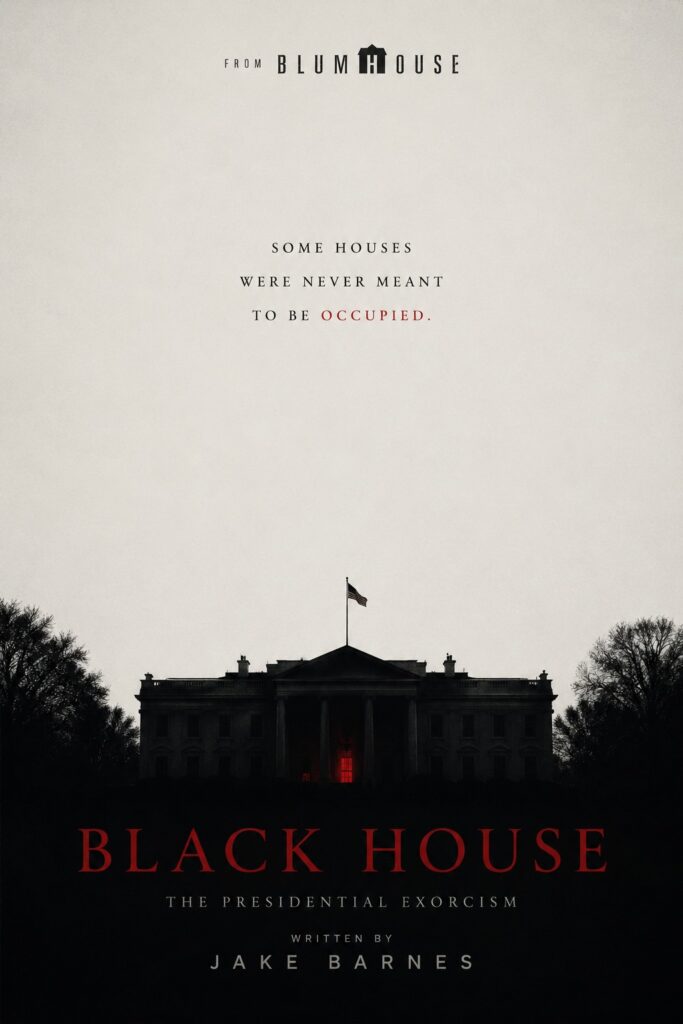
This is not a high concept. This is a huge concept.
When I came up with the idea for this contest, it was for pitches like this one. Where you immediately say, “That’s a movie.” Cause it really is the whole ballgame – the concept. When you have one that’s awesome, you don’t have to fire on all cylinders. The script can withstand a lot of weaknesses. But that doesn’t mean you can go on autopilot. You still have to write something that’s above average. Let’s see if Jake did that.
Black House follows 26 year old D.C. journalist, Emily Morgan. She works as part of the press corps at the White House, where she pals around with fellow journalists Edmund Douglas-Hamilton and Madison Wells. They make up the young hip journalist crowd who speak to Gen-Z.
There’s a lot going on in the White House these days. The president, 43 year old James Sloan, is dealing with a growing war in the fictional Eastern European countries of Molgova and Krasnia. Everyone wants the USA to stay out of the mess but because rogue nuclear missiles are on the line, the conflict can’t be ignored.
Then, one night, a goat is mysteriously sacrificed on the White House lawn. Afterwards, the president’s wife meets with Emily at a restaurant and confides in her that she doesn’t think the president is her husband anymore. She believes a new man has taken over his body. Emily’s a little weirded out by this but then a car speeds directly into the restaurant, killing the wife instantly.
When Emily next sees the president, she too feels that something is off about him. He acts like an asshole. And he’s starting to seriously consider going to war with the Krasnians. So he mobilizes his military machine, setting up the possibility of initiating World War 3.
By this point, Emily is beyond convinced that the president is possessed by the devil. So she locks in a meeting with the White House priest, and says they have to get it out of him. If they don’t, he for sure is starting World War 3. At first, the priest thinks she’s nuts. But the longer this guy is in office, the more bad stuff seems to happen.
As Emily’s journalist friends find themselves in danger by this evil monster, she realizes that if she doesn’t exorcise the demon from the president before a key date coming up regarding the war, that the president is going to start World Wars 3. So she teams up with the local priest and sets up a plan for the first ever presidential exorcism.
This is going to be a unique breakdown because I’m going to try and figure out my thoughts in real time. So, instead of going back and making all this make sense, I’m going to give you the unique experience of what goes on in my head as I read a screenplay.
Expect the unexpected.
I realized, while reading this, that Jake had a tricky decision to make because it was going to affect the entire reading experience. Should it be obvious that the president is possessed? Or should we not be sure?
Let’s look at both scenarios.
Scenario number 1 is what Jake goes with. We know for sure the president is possessed. The advantage of this scenario is that it invokes dramatic irony. We know something the rest of the world does not — which is that the president is definitely possessed and, because of that, he’s going to destroy the world. This creates a desperate feeling inside of us because we want everyone else to realize what we know before it’s too late.
Scenario number 2 creates a different engine. In this scenario, we would only see the president through Emily’s eyes and he would do nothing to definitively prove that he was possessed. As a result, our focus is more on whether Emily is mentally okay. Is she imagining this? Is she putting together pieces that aren’t there? The story becomes more about her.
There’s definitely a version of the second scenario that works. But I don’t think Emily can be a reporter in that version. She’d have to be a staff member, someone who was around the president a lot. Because it would need to be little things here and there that she picks up on that lead to her theory. And you would need to give your main character constant access to the president to notice those things. As a reporter, you only get to see the president in certain situations.
Which one is better? I honestly don’t know. I was thinking about this throughout the read. I know this: there’s something missing from the current draft. So my solution-oriented brain kept wondering whether the dramatic irony version of the story was the problem. Because I do know this. Something felt too obvious in the script’s execution. It felt like I knew what was going to happen way before it happened. So I thought, maybe that would be cured IF I WASN’T SURE that the president was possessed. But since I *do* know he’s possessed, it’s easy to predict what happens next.
By far, one of the most important decisions you make when you sit down to write a script is what POV you tell the story through. This story can be told through dozens of different points of view. It could be told through the wife’s POV. It could be told through the Department of Defense’s POV. An intern’s POV. The White House janitor’s POV. It could be told through multiple POVs as the demon transfers its way up the hierarchy once it gets inside the White House.
It could be told through the Vice President’s POV. Think about how interesting that one would be. The only person in the world who believes the president is possessed just, coincidentally, happens to be the person who benefits the most from his death.
So, you always want to ask: is this really the best POV to tell the story from? I understand why Jake went with Emily. A reporter is one of the most active jobs there is. Their job is to literally take action at every step. So, we know that she’s going to be on this story like a dog on a bone and, carry the plot with her along the way. Which is good.
But for that to work, another question must be answered: Is your main character compelling? Is Emily compelling? Do we like her? Do we want to follow her? I’ll answer that by saying this: I didn’t *not* want to follow her. But there was nothing about her that made me desperate to hop on her back and root for her either.
The thing I least liked about her was that she was part of this “journalist cool kids club” that were kind of cynical and cutthroat. There wasn’t a whole lot about them to like. So, right away, I wasn’t pulled in by Emily. I’d say when it comes to the most important things about screenwriting, you giving us a reason RIGHT AWAY to root for your hero, is up there near the top. And that didn’t happen with Emily. She kinda came off as a bratty journalist.
“Industry” would be a good comp here. A lot of assholes in that show. But the hero was this tiny new girl who was a super underdog. That’s what made us immediately root for her. She was the ultimate underdog. Maybe creating underdog status for Emily would do wonders for her likability.
Here’s a suggestion I would make to Jake. Every journalist in America in 2026 has become the most cynical person in the world. And they’re all about themselves and their own individual agendas. What about making Emily the last good optimistic journalist in America? She’s the last one who believes in the truth. Make her naive in that sense, sort of like Clarice from Silence of the Lambs. Not only would we like her more but you get a much better ‘good versus evil’ showdown with Emily and the Devil that way.
But I think the biggest problem of all is that not enough happens in the story. Emily comes up with with her theory early on and, from there, it’s a lot running around town, a lot of small victories, until she finally comes up with a plan to confront him and exorcise the demon.
It’s funny because it kind of has that same inherent flaw that moviegoers say Disclosure Day had. They all know the guy is going to disclose the data he took. Here, we all know that Emily is going to help exorcise this demon. And in both cases, we’re just waiting around for that to happen. The movies feel like they’re spinning their wheels in the meantime.
On this next draft, we gotta play around with the plot more. We have to throw some unexpected developments into the story. We have to do something to not make this script feel so… Screenwriting 101’ish.
To me, the moment where I became the most excited in the story, was when the priest said that in order to approve an exorcism of this magnitude, you had to get permission from the Pope himself. I was excited because, for the first time, I felt like there was a system in place. A mythology. And these very specific steps had to be taken before you could do the job.
That’s a good starting point for the next draft. You set up a specific mythology behind high profile possessions (they need to be different than regular possessions) and now Emily has a list of things to do. And these things should be cool, like making your case to the pope.
What we have here is the EXPECTED draft of Black House. For draft number 2, I want Jake to explore his ass off and go in a bunch of different directions. I want the unexpected weird draft. And I guarantee he’s going to find some cool new ideas in that draft. And then we can steer the rig back onto the road for draft 3, where we bring in the best stuff from both worlds. This one still has a lot of potential.
Script link: Black House
[ ] What the hell did I just read?
[x] wasn’t for me
[ ] worth the read
[ ] impressive
[ ] genius
What I learned: Being correct but still wrong. Screenwriting has a lot of things that you are technically correct to do but could still end up being a net negative for your script. Here, Emily has a former boyfriend who killed himself. And then, later, the demon inside the president uses the dead boyfriend to antagonize her. Both of these creative choices are things that I would support in a vacuum. But, because the dead boyfriend thing feels familiar in a possession movie and because we know the demon is going to use that against her at some point, and because we get the exact scene we’re expecting to get from him, the choice actually ends up hurting the script because it doesn’t add any value other than, “It made sense to do this.” Coming up with these creative choices is no different from coming up with a movie idea. You have to find a fresh way in. You can’t just do the same old song and dance. The second I heard she had a dead boyfriend, I knew the demon was going to bring it up. If I’m that far ahead of you, your script is in trouble. I think one reason why Obsession has taken on a life of its own is that you never know what Nikki is going to do next. One of the standout scenes in the movie is when Nikki starts walking around the bedroom nonsensically with a vase of flowers in front of her face. So I’m not saying to ditch this subplot. But play with it more. Figure out a way to make it more interesting. Maybe her dead boyfriend was keeping secrets and the demon starts revealing them to her. That’s probably not enough but it’s a starting point.
Close Encounters of the Haterz Gonna Hate Kind
Genre: Sci-Fi Thriller
Premise: A man steals proof of alien life and goes on the run in an attempt to disclose the material before an evil government operative stops him.
About: One of the more surprising things about this movie to me is that Steven Spielberg has a ‘story by’ credit on it. That means he came up with the idea. Spielberg hasn’t done that in decades! Everything he does now is IP or adapted from a book. So, that’s crazy. The movie did better than anticipated this weekend. It was projected to make 35 million. It instead brought in 43 million. Alien nerds unite! Spielberg brought in longtime collaborator David Koepp to write the script.
Writer: David Koepp (story by Spielberg)
Details: 2 hours 25 min
Some key questions pop into my head when I sit down for a Spielberg movie these days, the most common of which is, “Is Spielberg a good director anymore?” I mean when was the last truly good movie he made? Look at his output over the last 20 years…
The Fabelman’s
West Side Story
Ready Player One
The Post
BFG
Bridge of Spies
Lincoln
War Horse
The Adventures of Tintin
Indiana Jones: Crystal Skull
That is one giant blob of forgettable movies.
The next question I ask myself is, is David Koepp even a decent screenwriter? Not good. We all know he’s not good. Is he even decent? And it’s hard to make an argument for that as well!
Black Bag – couldn’t even make it through the first act
Presence – I’ve never even heard of it
Cold Storage – Apparently this is a movie?
Indiana Jones: Dial of Destiny – barely watchable
Kimi – Literally just learning about this movie now by looking at IMDB
You Should Have Left – Huh???
The Mummy – The worst Tom Cruise movie of the past 30 years
Inferno
Jack Ryan Shadow Recruit
Premium Rush
The Little Engine That Could
Ghost Town
Indiana Jones: Crystal Skull
Zathura
Secret Window
That is an objectively terrible slate of movies. Which is why I went into Disclosure Day with the lowest of expectations. You’re talking about a director who hasn’t made a good movie in 20 years and a hacky writer who only works in Hollywood because Steven Spielberg likes him.
So, it’s probably going to surprise the hell out of you when you hear that I liked this movie.
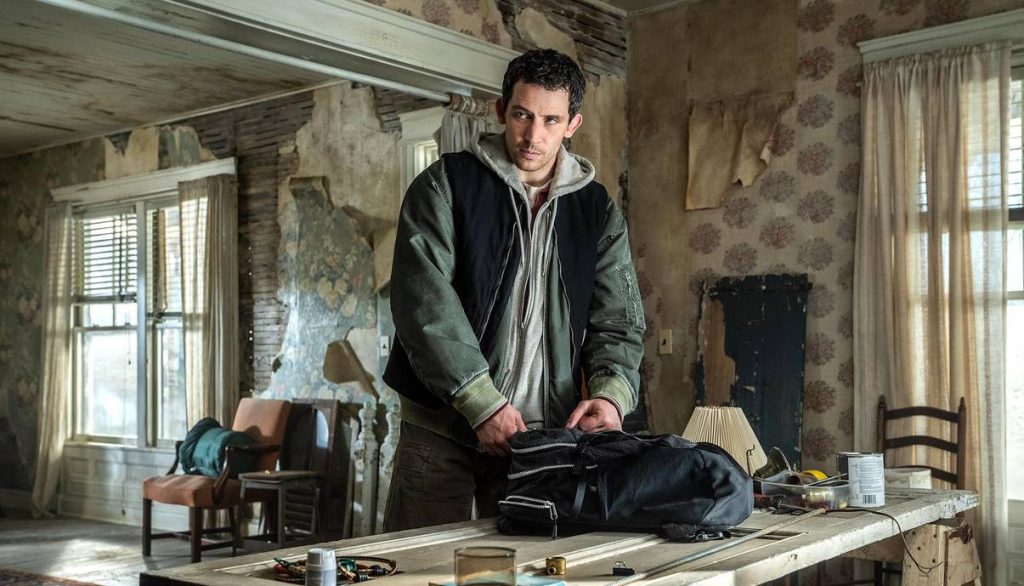
If you haven’t seen it, it’s about this tech nerd, Daniel Kellner, who steals a bunch of proof of aliens from the terribly named secretive company, “Wardex,” with his former-nun girlfriend, Jane. Wardex, run by the evil Noah Scanlon, is determined to get those files back before Daniel does anything with them.
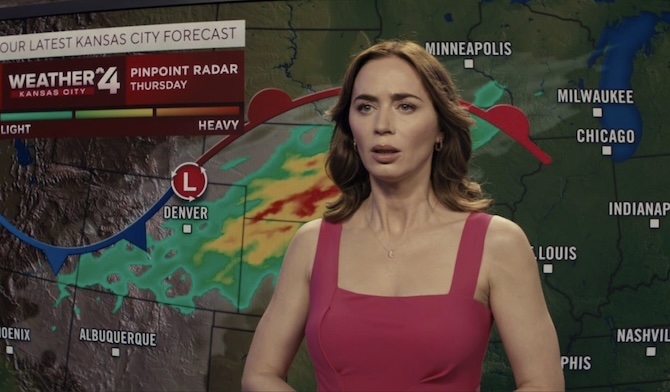
Meanwhile, we meet weather girl Margaret Fairchild (Emily Blunt) who, right before she goes to work, sees a cardinal. And after she sees this cardinal, she all of a sudden can speak Russian, Korean, and many other languages. She can also read minds. But she can’t control any of this. It just happens to her. Then, when she goes on air that day, she unknowingly speaks an alien language, which makes her target # 2 for Wardex.
The next phase of the movie is following both Daniel (and his gf) and Margaret (and her husband) separately as they seem to be trying to come together, despite the fact that they’ve never met before. There are a LOT of car chases in these two plotlines. Wardex must have its own car-chase school. Because it participates in a lot of them.
We also have this guy named Hugo Wakefield, who keeps hopping on the phone with Daniel and Margaret, coaxing them towards the warehouse he’s in, where for reasons we’re not clear on yet, he’s building a house.
A big plot item in this story is a handheld alien device that seems to have all sorts of powers, many of which we learn along the way. Noah Scanlon has one of these devices, which allows him to infiltrate the bodies of other people. So, for example, he can take over the body of Daniel Kellner’s girlfriend and try to kill Daniel, which he does several times.
What we eventually learn is that Daniel and Margaret were both part of a profound alien abduction that they shared when they were children. During that time, they were given certain powers. And the recent events have merely opened up those dormant powers for use. So, now, they just have to get Daniel’s data to the local news station where Margaret works and tell the world the truth.
You’re probably looking at that summary thinking, “I don’t know Carson. That sounds pretty silly.”
Look, before I get into why I liked this movie, I am not going to turn a blind eye to all of its problems, of which there are a lot. I would go so far as to say I hated this movie initially. I’ll tell you why. There are certain writing “tells” that indicate a writer who’s winging it.
Using animals in that vague faux-profound way where they stare at humans and humans stare back at them and we’re all supposed to conclude that something incredibly important just happened? That’s usually a bad sign.
The reason it’s a bad sign is because writers often reach for those moments when they don’t fully understand their own story. They don’t quite know what they’re trying to say. They don’t quite know what the mythology means. They don’t quite know what the theme is. So instead of clarifying those things, they create a mysterious image and hope the audience does the heavy lifting for them.
You’ll see this all the time. A character is running from danger. He stumbles into an alley. Suddenly there’s a wolf standing there. The wolf stares at him. He stares at the wolf. Dramatic music plays. The scene ends. And the filmmaker is essentially saying, “You figure out what that means.”
The problem is that symbolism only works when the writer already knows what the symbol means. If you’re using symbolism to avoid figuring out your story, the audience can feel it. They’re not experiencing depth. They’re experiencing vagueness masquerading as depth.
There is a lot of that in this movie. So I knew we were in trouble early.
Another huge issue was the dongle that Noah Scanlon had that allowed him to possess people. It was a really dumb idea. Mythology never works when the rules become too expansive. It’s one thing to say that if you hold the alien dongle, you can see faraway places and what’s going on with them. If you set up that rule, we’ll probably buy it.
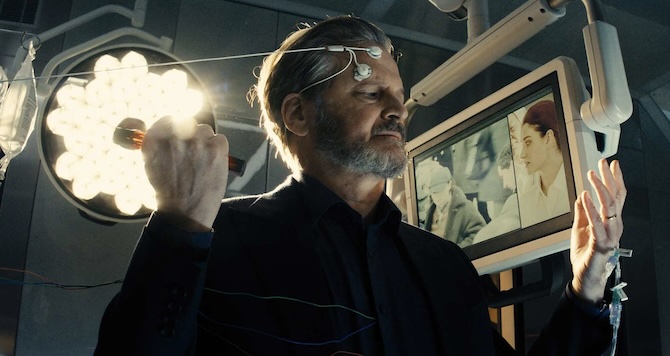
But then if you also said that the dongle can make you invisible, now you’re going to get some pushback from the audience. Some will still go along with it. But others are starting to check out. Cause those are two different things that don’t organically connect.
And then if you also said that the dongle allows you to possess remote people, you’re going to lose almost everyone in the audience. Because now you’ve added a third power to a single item. That’s when the audience starts to see the screenwriting. And that’s when you’re toast.
If they would’ve gotten rid of that alien dongle thing, I think this movie is at least 10 percentage points higher on Rotten Tomatoes.
But now let me tell you why I ended up liking this movie.
For starters, this is the first time in a while that I felt like I was watching something that was real and tangible and that someone put a camera in front of and filmed. People are taking cracks at Spielberg for this film feeling dated but I LOVE that about this film.
Every room I was in, I felt like it was a real room! If there was a chase, I felt like these were real cars racing down a real road. And it made a difference inside of me. I can’t even explain it without giving the opposing example. One reason why I detest Mandalorian and Grogu the more that I think about it is because I don’t think a single thing in that movie was real. It was all created in a computer. And that completely takes me out of the reality of the story.
Then you had Emily Blunt. This is probably Emily Blunt’s best performance ever. I don’t mean in an Oscar sense. I mean in how challenging of a performance it was. I mean, for starters, she’s speaking with an American accent the whole movie (she’s British). She speaks Korean flawlessly. She speaks Russian flawlessly. She comes up with an alien language.
And there are these crazy moments that only people who have worked on sets would understand how difficult they are, where she’s hitting like 20 marks on this giant set with five dozen people behind her and going through five different mini-scenes within that sequence. Her performance was so good in this film that even if you hated it, you can’t deny what she brought to the movie. I thought she was nails.
But there were two moments in the movie that transitioned me from “Not a fan of this flick” to “I now care what happens.” The first is the train set piece. The train set piece is the best set piece I’ve seen all year. It’s probably the best set piece I’ve seen in several years.
What happens is that Daniel and Margaret are in this car that stops because a train is shooting by. And then this bad guy from Wardex comes up behind them and rams their car, and starts pushing it closer and closer to this moving train. And finally, the front of the car gets caught on the moving train, and gets pulled along with it, with both Daniel and Margaret still inside.

The two then have to get out of this car and try to grab onto this ladder on the train that’s just out of reach, while the insanely bumpy ride of the train makes it impossible. Meanwhile, ANOTHER train is shooting towards their car on a parallel track while ALSO the bad guy is driving on a frontage road shooting at them.
It’s a harrowing scene but the reason I’m so giddy about it is that this is an age-old set piece setup. A car by a railroad crossing was probably first done 100 years ago. One of the things I give screenwriters immense credit for is taking an age-old setup and finding a fresh new way into it. And the fact that Spielberg and Koepp were able to find a new exciting scene out of this ancient setup is a reminder to all of us screenwriters that fresh ideas are out there for the taking if you push yourselves hard enough.
That sequence was number 1 getting me on board. The second was Hugo Wakefield’s monologue to Noah Scanlon about why people deserve to know the truth. Full disclosure (no pun intended), I’ve been personally hoping for disclosure for decades now. And Hugo’s speech seemed to be directed more at people like me than casual audience members. And he said exactly what I feel – which is that it’s not their right to decide what we citizens can or cannot handle. We deserve the truth and we’ll decide what we do with that truth.
From that point on, I kinda felt like I was in the real world (dating back to my point about how this was all filmed in real locations). And I wanted these people to succeed in sharing that information with everybody. So I was into that last news station sequence. I know some people have issues with them trying to get to the news and not just put it online. But you gotta understand, if it just went online, the government could’ve said it was nonsense. It needed to be an event. So I understand why they went to the news.
When I look back at this movie, I think that Spielberg went for it. We’ve got dual protagonist narratives. You’re trying to maneuver the story to bring those narratives together. We’re cutting to bad guys and also a third pseudo protagonist narrative (Hugo). The story is basically told in real-time. We’ve got animals connecting with humans and all-powerful alien devices and remote possession and invisibility set pieces.
People say Spielberg phoned this in. He did not phone this in. It was his movie idea, something he never does, so obviously he cares more about it than his average movie. And if the rumors are true, he had Koepp write 47 drafts. You may have thought the movie sucked but those are not the actions of someone phoning it in.
This is a very flawed movie. But it’s a movie I’m happy I saw. My love for aliens and disclosure likely played into me overlooking some things that others couldn’t. But I’m not going to apologize for that. I think it’s worth checking out if you in any way think the truth is out there.
[ ] What the hell did I just watch?
[ ] wasn’t for me
[x] worth the price of admission
[ ] impressive
[ ] genius
What I learned: Always “What if” your set pieces. I’ve seen maybe 700 scenes where a car is on the tracks with a train coming. So, if that’s the setup for your set piece, you’re probably doing it wrong. Instead, start asking “what if” questions. “What if the car is stopped BEFORE the tracks, the train comes, and then another car tries to push it into the moving train?” Notice how the scene immediately becomes more interesting. Do we even know what happens when a car is pushed into a moving train? No, we don’t. So that’s a great place to start a scene. Any time you’re placing your characters in situations where we know what’s going to happen, you’re likely boring the audience. “What if” your way into a better set piece instead.
It’s pretty rare that I have screenwriting revelations these days. I’ve crawled through every little nook and cranny of the craft and discovered almost everything there is to discover.
But the other day, I had a pretty big wowza moment.
Unfortunately, it only applies to a very specific genre. But my rule here on Scriptshadow is that if something excites me about the craft, I’m going to talk about it.
So, here’s what happened. Over the past few weeks, I’ve had several script consultations that were serial killer scripts. Serial killer scripts are one of the most reliable genres in Hollywood. You sickos who go to these things love serial killers. And, therefore, Hollywood loves serial killers.
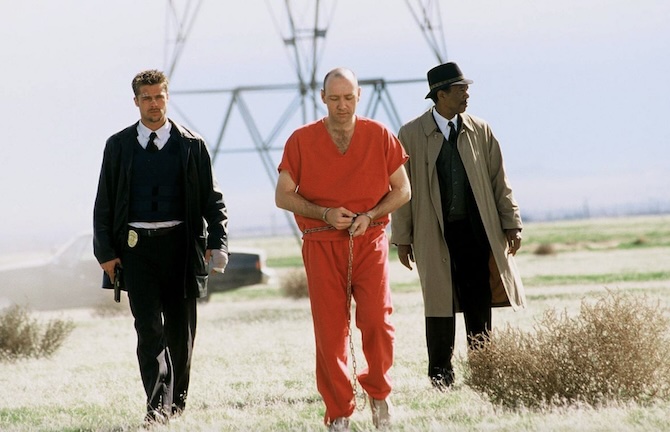
But I feel I can make a legitimate argument that there hasn’t been a great serial killer movie in 30 years. That’s when Seven came out (1995).
Now, before everybody starts firing at me, yes, there have been decent serial killer movies. Zodiac. American Psycho. Prisoners. Longlegs. But none of them became the defining serial killer movie of their generation the way Silence of the Lambs and Seven did. For a genre this popular, that’s weird. How can you not create another classic serial killer movie in thirty years???
And it was through reading these consultation scripts that I finally figured out what the problem was.
One thing I always try to do in consultations is provide examples from other movies. If a writer is struggling with a specific script problem, I’ll point to another movie that solved that problem well. But whenever I read serial killer scripts, I run into the same issue. I go searching for recent examples and come up empty. It’s Lambs. It’s Seven. And then it’s everything else.
But as I started comparing these scripts, I noticed something interesting. The writers weren’t obsessed with the investigation. They were obsessed with the killer.
Every script had pages and pages dedicated to the killer’s psychology, philosophy, rituals, childhood trauma, worldview, elaborate murder methods. Meanwhile, the investigation itself was always undercooked or meandering. The clues were generic. The detective work was repetitive. The second act limped along. And after seeing this over and over again, I started asking myself the question: Where did writers learn this?
I’ll tell you exactly where.
Silence of the Lambs broke the serial killer genre.
Hear me out.
The actual serial killer in Silence of the Lambs is Buffalo Bill. He’s the killer Clarice is trying to find. The movie is fundamentally an investigation. Clarice is racing against time to locate Buffalo Bill before he kills his latest victim. That’s what traditional serial killer stories are built around. The investigation. The search. The clues. The race to stop the next murder.
But Lambs introduced something entirely new in Hannibal Lecter. What made serial killer Lecter so brilliant is that he wasn’t the villain of the story. He was a helper. That setup allowed Thomas Harris to create one of the most memorable characters ever put on screen without taking attention away from the investigation itself. Clarice is still pursuing Buffalo Bill. The story is still moving forward. The investigation remains the engine.
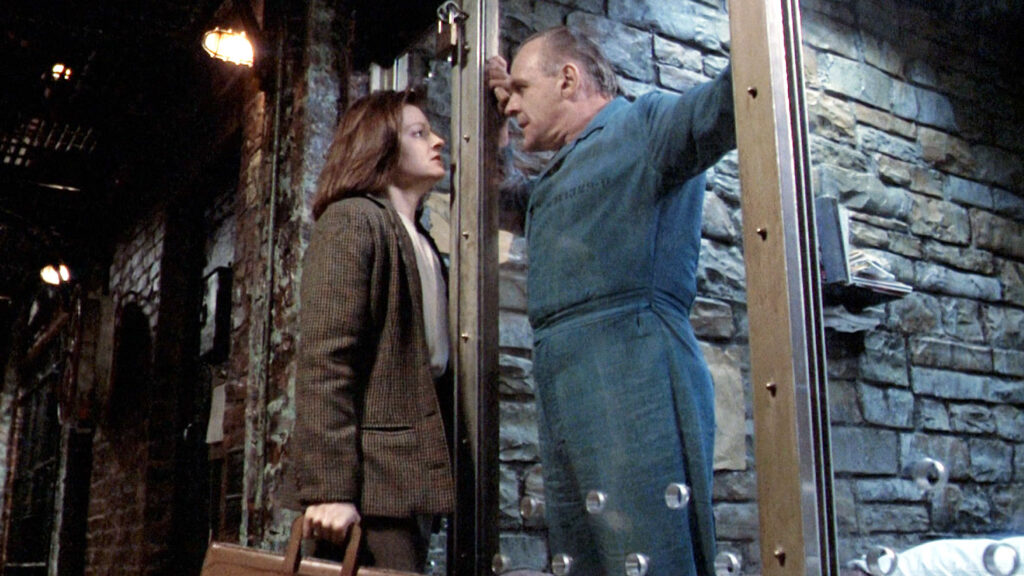
The problem is that everyone who came after learned the wrong lesson. They looked at Silence of the Lambs and concluded that the reason it worked was Hannibal Lecter. So they started creating their own Hannibal Lecters. The goal was no longer to write a great investigation. It was to create a killer so eccentric, so memorable, and so actor-friendly, that some movie star would want to play him and chase an Oscar.
As a result, the investigation became secondary. The detective became secondary. The story became secondary. Everything revolved around the killer.
Once I noticed this, I couldn’t unsee it. Every serial killer script started looking the same. The writer had spent months constructing this elaborate killer. But when I got to page 50 and had to use crazy glue to keep my eyelids open, I would later ask the writer, “Okay but where’s the cool mysterious unpredictable constantly-evolving-in-interesting-ways investigation?” The response was always some form of, “Uhhhhhhhhh…”
Which is why so many serial killer scripts die in the second act.
Because the second act is the investigation.
That’s the movie.
So, if it’s not working, nothing’s working.
Which is why Seven is so fascinating.
Andrew Kevin Walker and David Fincher somehow avoided this trap. Seven isn’t interested in creating a flashy serial killer showcase. John Doe barely exists for most of the movie. The focus is on Somerset and Mills. The focus is on the investigation. The focus is on uncovering the next horrifying piece of the puzzle. The investigation becomes addictive.
Then, when John Doe finally arrives, he lands with maximum impact because the movie hasn’t spent two hours trying to convince us how interesting he is.
I truly believe this is why the serial killer genre has struggled for the last three decades. Writers think they’re writing killer movies. They’re actually writing investigation movies.
If your investigation is weak, it doesn’t matter how many weird quirks your killer has. It doesn’t matter how disturbing his philosophy is. It doesn’t matter how many hours you spent coming up with a cool nickname for him. The movie is still going to stall because we don’t spend two hours watching a serial killer movie to admire the killer. We spend two hours watching because we want to know what happens next.
And “what happens next” comes from the investigation.
So if I were writing a serial killer script today, I wouldn’t spend six months creating a killer. I’d spend six months creating the greatest investigation I could imagine. That’s the lesson Seven understood. And it’s the lesson the overwhelming majority of serial killer writers since then have forgotten.
And a Blood & Ink success story update!
Genre: Psychological Horror
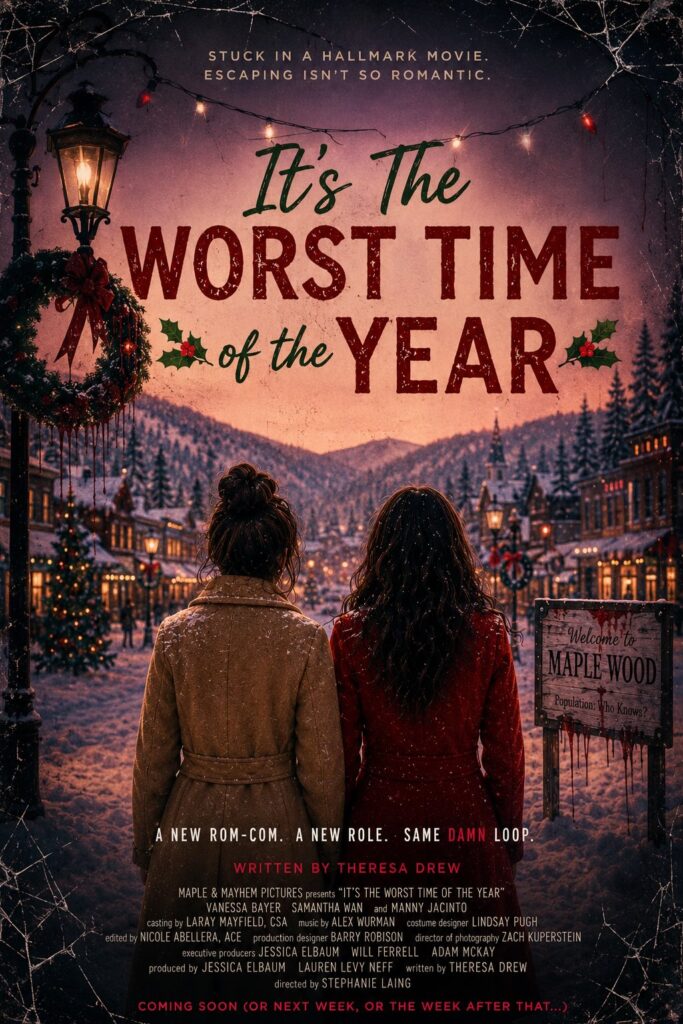
Premise: When two successful big-city best friends are trapped in a never-ending Hallmark movie loop that resets and recasts them each week in a new rom-com, they must escape before they’re permanently rewritten as their dead-eyed Hallmark alter egos.
About: The Blood & Ink Horror Screenplay Contest is a unique screenwriting contest whereby, six months ago, you had to pitch your way into the contest. Scripts either got in with a “yes” by me or they got at least 15 upvotes when pitched in the comments section. The 90+ writers that were chosen then had six months to write their script. I am currently reading all the scripts and will put together an official two weeks of reviews for the Top 10. But, in the meantime, I will occasionally review one of the scripts here. Which is what I’m doing today. If you want to see the previous Blood & Ink reviews, you can do so here and here.
Writer: Theresa Drew
Details: 120 pages
A couple of things before we get started.
One, a writer already got management from his Blood & Ink horror script! That would’ve been for Wildman. Separately, I met with a producer over on the Paramount lot last week and when I pitched them the scene where the Bigfoot takes down an entire bar full of rednecks with a chainsaw he immediately said, “Now that’s a movie scene.” So, Blood and Ink is already starting careers!
Now, all is not good in the hood.
Since it’s been so long since the original pitches, I’ll often open up a Blood and Ink e-mail, read the logline, and have absolutely no memory of it. And some of these loglines are rough. I mean really rough. Inevitably, when I look up how they got into the contest, they came through the reader-vote process.
This is a problem. One of the worst things you can do for a writer is give them a false signal. When a weak concept gets voted into a contest, it suggests that the concept is working when it isn’t. That writer may spend the next several years pushing an idea that was dead on arrival, all because nobody was willing to tell them the truth.
Which brings me to the conclusion that allowing reader voting was a mistake. I don’t know why some of these concepts got voted in. Maybe they were voting for friends. Maybe they simply liked the premise more than I did. Whatever the reason, the outcome was the same. Concepts that never should’ve made the field made the field.
So that’s on me. I created the rule and I let it happen. But I won’t be making that mistake again. The next contest will have a stricter admissions process because I’d rather disappoint a few writers upfront than accidentally encourage them to spend years pursuing concepts that were never viable in the first place.
The good news is, today’s concept was one of only five “yes’s” that got voted in. It’s one of the scripts I was most looking forward to. And now, I finally get to review it!
Best friends (and quasi frenemies) Lillian and Sarai, both of whom live big city lives, find themselves driving on a strange road after attending their friend’s baby shower. They eventually end up in a snowstorm, and are forced to stop in the nearby cozy town of Maple Wood.
Everyone in Maple Wood is so nice, so when the local bed and breakfast owner encourages them to stay the night until the storm clears, they reluctantly agree. The next day, the two prepare to leave, but everyone keeps talking about the big festival tonight that they have to stay for. And when flannel god giga-chad Will tells Lillian he’d love it if she attends, that’s enough to move the needle.
That night at the festival, a crazed woman named Priya explains to Lilian and Sarai that they’re all trapped here, and the longer they stay, the more they become the brainless characters in this Hallmark Hell story. They’re cut off from Priya before they can get more information, though.
The next morning, they see that everything has stayed the same, yet changed. The sheriff is now the baker. The detective is now the waiter. It appears that at the end of each day, the story resets. So now they’re existing in a brand new story where everyone, including them, is playing different characters.
Sarai, who has children in this iteration, is determined to get out of this town by any means necessary. But when Lillian is made the town’s new event planner, she leans into her new duties, and encourages Sarai to play it by ear. They’ll get out eventually, is Lillian’s mantra. But Sarai’s not so sure. She might be losing her friend. And the longer she stays here, the more likely she’ll get lost to Maple Wood as well.
It’s always interesting to get pitched something and then to read the script itself. Cause you often have a specific idea of what movie you’re going to get. And it always throws you when that’s not the movie you get. It’s nobody’s fault, of course. We’re all different and, therefore, have different visions of what a story will look like.
I think that a key mistake in It’s The Worst Time of the Year was creating two protagonists. As I was reading the early part of the script, I met this Sarai woman and then I met this Lillian woman, and then we’re back to Sarai, and then we’re back to Lillian, and I was thinking, “Wait, who’s the main character here??” I was getting confused.
When I finally realized they were co-main characters, I thought, “Uh-oh.” Because, in my experience of reading a lot of screenplays, that almost always ends up being worse than if it were a single protagonist. To be clear: I’M NOT SAYING IT CAN’T WORK. I’m just saying it’s harder.
I’ll give you one obvious example. Two main characters always beefs up the page count because you’re developing two main characters instead of one. And how many pages is this script? 120 pages. How many pages should it be? Not a page over 105. A concept like this, in spec script form, needs to move quickly.
Another problem is that the characters are surprisingly unlikable. I understand what Theresa was doing in theory. You’re sending your characters into the nicest place in the world. You want contrast. You want conflict. So, you can’t send in nice people. But, you have to be very delicate in how you craft these unlikable people because if we don’t root for the main characters, your script is cooked.
I didn’t like Sarai at all. Lillian was more on the neutral side but the sum of the two characters was negative. And that proved to be the biggest hurdle for the script. Because I distinctly remember where I mentally checked out on the screenplay. It was page 67. Cause I was getting bored and town events were feeling repetitive, and I looked up to check where I was, and I was on page 67.
When you have characters that the audience likes, they’re more willing to overlook receptive story beats, as well as other story issues. But because I was never totally on board with these two, it was only a matter of time before the plot ran out of gas for me.
Another issue with the two protagonists instead of one, particularly in how it pertained to this story, was that it made me feel safer. If I get lost by myself in a crazy town, I’m terrified. But if I get stuck there with a friend, at least I have someone by my side who can help me. So, I noticed that I was never that scared here since my leads had backup.
I think the easiest fix you can make to this script is to get rid of Sarai. And then retool Lillian with that adjustment in mind. You can kind of make her a hybrid of Lillian and Sarai, with a little more likability sprinkled in.
Another area I was looking forward to here was set pieces. When I first heard this concept, I thought, “There are so many fun set pieces you could do with this.” And yet very long stretches of the script had no set pieces. And when there were set pieces, they weren’t big enough. I always wanted bigger. And more imaginative. And just more.
I think the mistake Theresa may have made was to dig into to this mystery of what’s going on and how to escape. But none of it was that interesting. And it was taking time away from being able to write fun memorable set pieces.
Curry Barker said, of Obsession, that he had no interest in having the characters go to the local library and look and micro-film to see how to break the curse. He was way more interested in exploring what was fun about his premise. And I think Theresa would do well to take that lesson and run with it. Keep it simple and have fun with your premise.
But listen: This is a first draft. This is exactly what first drafts are for. You’re exploring your idea. You’re seeing what works and what doesn’t. And now, assuming you agree with these notes, let’s make some changes. Because this remains one of the concepts with the best chance of selling. Hands down. I could see multiple studios bidding for this idea once the script is in shape.
So, I’m going to include a link to the script. Go ahead and read it. Share your thoughts with Theresa. Feel free to disagree. And agree. And if you have any killer ideas for the screenplay, make sure to send them Theresa’s way. Because that’s one of the advantages of being a part of this community. We can all help each other. And I think with some help, this script could be awesome.
Script Link: It’s The Worst Time of The Year
[ ] What the hell did I just read?
[x] wasn’t for me
[ ] worth the read
[ ] impressive
[ ] genius
What I learned: Adding characters adds pages. So the fastest way to cut down pages from your script is to ask who you don’t absolutely need in your story, cut them out and, boom, your page count goes down considerably.
A couple of weeks ago, I was talking to someone about the word “hate.”
The conversation started because we were discussing music and I casually mentioned that I hated this band. She immediately stopped me.
“Hate is a terrible word,” she said.
Naturally, I asked why.
And she actually had a pretty interesting argument. Her point was that “hate” has become one of those words people throw around without thinking. You don’t merely dislike a movie anymore. You hate it. You don’t disagree with someone. You hate them. Everything gets pushed to the most extreme setting.
The more she talked about it, the more I started to come around. “Hate” is a conversation-ending word. It doesn’t invite discussion. It declares war on discussion. The moment you say you hate something, you’ve essentially informed everyone that you’ve moved beyond reason and entered into the realm of pure emotion.
By the end of the conversation, I found myself nodding along. Maybe she was right. Maybe we’d all be a little better off if we retired the word entirely.
I thanked her for the perspective.
Anyway.
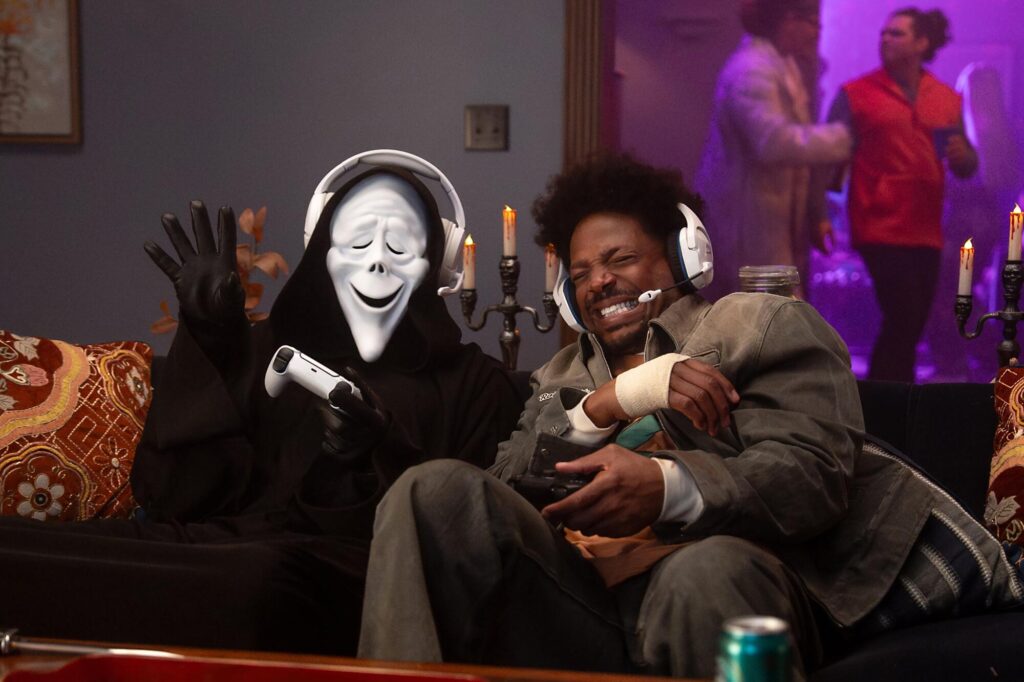
I hate the Scary Movie franchise.
If there is a lazier, less funny comedy franchise out there, please tell me what it is. Because I don’t think it exists. The Wayans Brothers and their idea of humor have to have some of the worst attempts at joke construction that I’ve ever seen put to screen.
And by the way, the success of Scary Movie’s box office this weekend completely destroys all the good will that the box office has built up over the past couple of weeks. We thought we were seeing a revolution. That audiences had finally become smart. They refused corporate trash like Mandalorian and Grogu and embraced smart thoughtful horror in Obsession and Backrooms.
NOPE.
This weekend proves they’ll continue to pay for any piece of garbage that Hollywood lobotomizes onto the screen.
Some people will say, “No. This is good! People are coming to theaters!”
No! It is the opposite of good. People show up to this movie, are reminded of just how bad Hollywood movies can be, then don’t come back for another six months. These are the movies that destroyed the business. Not saved it.
It’s just sad that people go and see this trash. I feel like I’m watching the dodo birds, with the screenplay pages of this monstrosity of a script strapped to their backs, plunge off a cliff and I’m helpless to stop them. But what are you going to do?
The move that was supposed to have the big box office weekend was He-Man (30 mil). But it turned out the roided-out 80s icon did not “have the power.” I don’t think there was anything they could do to make this movie work because I honestly believe this was the best version of the movie they could make. Big-budget, harmless, cheesy. And people still didn’t like it. And sometimes that’s just the reality of your IP. It’s not meant to be a blockbuster no matter how hard you try and make it one. And they tried! They spent 17 years developing this. It’s just not a movie IP.
Backrooms took a pretty big tumble this weekend, losing 70% of its audience. That’s a hard to defend drop. The old excuse used to be, “Horror always has giant drops on the second weekend.” The only problem is that the film’s main competition, Obsession, GAINED audience in its second weekend. And this weekend, it’s fourth, it only dropped 7%. So they can’t use that excuse.
It confirms what I’ve been saying, which is that the backrooms don’t really make sense. The mythology is wonky. And so there isn’t nearly as much depth in the film as its missionaries want you to believe it has.
I still think it’s an okay movie. It’s just not a good movie.
But don’t worry, Backrooms. At least you’re not Mandalorian and Grogu. A lot of people have said that Backrooms and Obsession were the worst things to happen to Star Wars. Because they highlighted how tiny movies with tiny budgets can take down 300 million dollar (Mando and Grogu’s real budget) behemoths with 200 million dollar advertising campaigns.
But I would argue the opposite is true. The Backrooms/Obsession takeover is such a great story that nobody’s paying attention to the fact that Mandalorian will barely limp past 300 million dollars.
WORLDWIDE. Oh, but Disney tells us, the film is “guaranteed” to make money no matter how poorly it does. Yeah, okay Disney. I’ll expect that Mandalorian sequel announcement any day now.
I’m just pumped for Obsession. I obsessively push to you guys how important a simple premise is. It focuses the movie so much and creates this clean runway for you to just play with that premise and have fun. When you have to spend 30% of your screenplay explaining things, that’s time that you’re not entertaining your reader. That’s the power of a premise like Obsession.
Now, the premise itself has to have a good hook. You can’t be simple just to be simple. I could write a movie about a haunted lightbulb and that’s simple. But a lightbulb is not a hook people care about. A girl becoming insanely obsessed with a guy is a hook. And it’s proving to be the most powerful hook of the year.
On the TV side, I’ve been checking out this show, The Audacity, on AMC. Yes, AMC still makes shows. A couple of people had recommended it to me and the best way I can describe it is Succession in Silicon Valley.
It’s about this tech company CEO, Duncan, whose company has a really high valuation but, in actuality, it’s a worthless company. So he’s running around town trying to get people to invest money so that he and the company don’t implode once the media realizes the truth.

The show has a couple of mini-hooks. The first is that Duncan has access to a program that can access every single thing in the world. So he basically knows everything. And also, he blackmails his therapist (who’s a “therapist to the tech CEOs”) and forces her to give him information about his competition.
The show is a maddening watch. If you thought Succession was risky by making all of its characters unlikable, this writer, Jonathan Glatzer, seems to be conducting an experiment of just how unlikable an entire cast of characters can be and an audience will still watch them. I mean, Duncan alone is the most unlikable person on the planet. And the show cannot overcome that. It’s impossible. It’s one thing to be damaged and an asshole, which creates a small level of sympathy. It’s another to be a crazy asshole. And it doesn’t help that Duncan is played by Billy Magnussen, who’s probably the most unlikable character actor in his age range.
But what intrigued me about the show was that Glatzer seems to have read Scriptshadow and is using a lot of the screenwriting tools I espouse. But he’s using them like nuclear weapons as opposed to hand tools.
EVERY SINGLE SCENE has urgency behind it. We can never just sit in a scene between two characters. There’s always a ticking clock. There’s always somewhere someone has to be. If there’s a party scene, the countdown begins to when the guest of honor arrives and everyone is desperately rushing around to make sure the party is ready for their arrival.
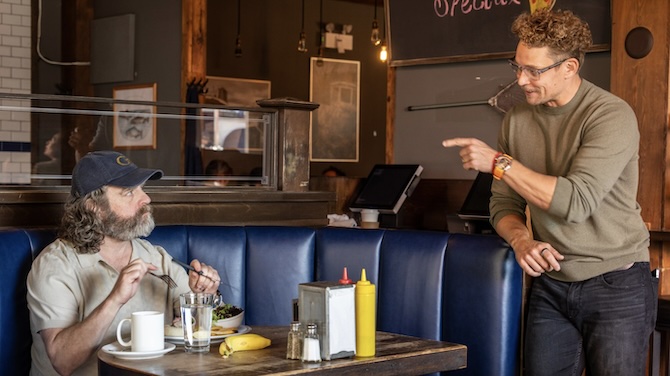
It’s strange because whenever I see the opposite — a lazy party scene where everyone is half-asleep and there’s no clear goal and we’re limping along through several character conversations, I say, “This scene needs urgency!” But Glatzer shows me that there is definitely a limit to how much urgency a scene can handle.
I also talk about “scene agitators” as a means to spice up a scene. Don’t just have two characters in a car talking. Have there be some third agitating variable to create conflict, like a cop car trailing them that may, at any moment, light up its lights and pull them over.
In the third episode, a looming brush fire is introduced. And I’m thinking, “Of course there’s a looming brush fire.” Cause it’s something that can provide this constant series of scene agitators wherever the characters go. We have to worry about that fire getting closer and destroying everything.
In the first three episodes, I’m guessing there are about 100 scenes. 80 of them have scene agitators. There is always something agitating the characters and it’s INSANELY ANXIETY-INDUCING. It’s not fun. That’s the thing you have to realize about these screenwriting tips. You don’t just use them to check a box. You use them specifically to make a scene more entertaining. If all you’re doing is creating more anxiety in the reader and making the scene needlessly messier, than don’t use the tool. The tool is hurting more than it’s helping.
I don’t know if I can finish this show. It creates too much anxiety in me and I hate everyone in it. But what I’ll give it is that it’s never boring. And since nearly every show I watch is boring, I’m inclined to see it to the end. I will say this. Most shows that start off with low episode IMDB ratings contain episodes that get lower and lower rated as the season goes on. But this is the rare show where the rating keeps getting higher and higher. So I’m wondering if Glatzer is just using these first four episodes for setup that he will pay off in an amazing way in the second half of the season.
What did you see (and not see) this weekend?
Give me your reviews!
