
Is Beef officially Netflix’s White Lotus?
There isn’t a whole lot going on in the movie box office world at the moment. The kind of people who go to Super Mario Galaxy aren’t the types who run to movie websites and excitedly taunt how much money their favorite video game turned movie is making. Which has made box office talk pretty boring the last couple of weeks.
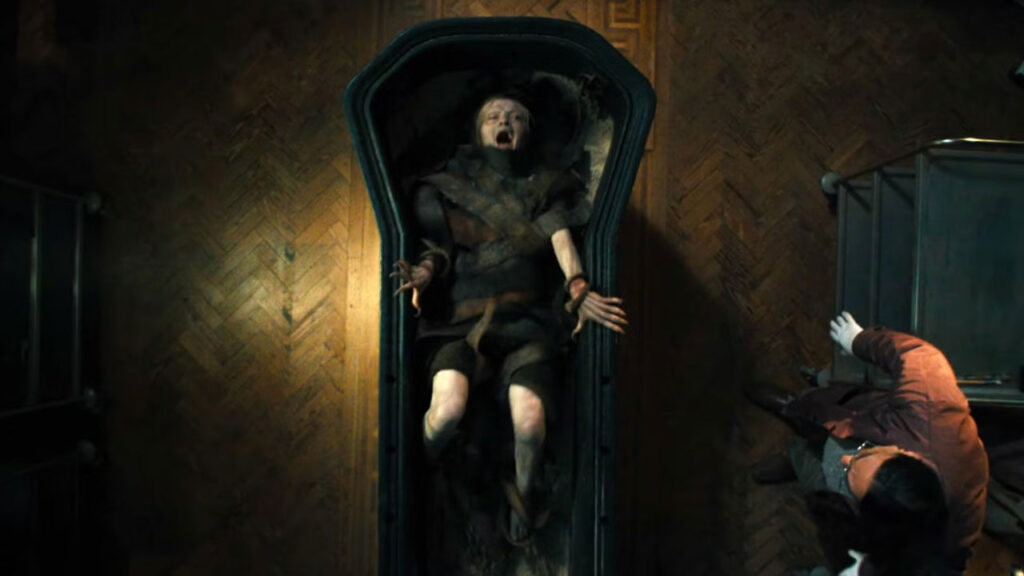
A couple of small notes are that horror is not bulletproof, despite being the only genre Hollywood has been able to bank on as of late. Lee Cronin’s The Mummy only took in 13 million bucks.
I liked the angle on Cronin’s script. I wrote about how, when you pitch major IP, or anything that’s been in Hollywood for a while, you need an angle to your pitch that’s going to stand out from everyone else who’s pitching. Shifting the mummy lore over to a little girl felt different and fresh and, no doubt, is the angle that got the movie greenlit.
But here’s the funny thing about this town. The thing that gets you greenlit isn’t always the thing the audience wants. Sometimes, audiences want a good old fashioned mummy movie. But, as a Hollywood producer, when you get pitched that, you think, “Been there, done that.” You’d feel like you failed at your job if you greenlit that take.
“Nobody knows anything,” right? The famous William Goldman quote.
Which is bullshit by the way.
The mantra is a useful myth. But it’s not literally true. Hollywood, as a system, understands a great deal, arguably 90% of what drives outcomes. There is deep institutional knowledge around story construction, star value, release strategy, and audience segmentation. These variables aren’t random.
What remains unpredictable is the final 10%, the intangible convergence of taste, timing, tone, cultural mood, and audience reception. That margin resists modeling. It is where otherwise well-calculated projects fail to connect, and where outliers like Iron Lung emerge and outperform their tracking.
In other words, the industry isn’t blind. It’s operating with high clarity right up to the point where clarity stops being possible.
I’m sad to see Normal do so terribly (3 million bucks). It probably signals the end of Bob Odenkirk’s unique leading man career. They should’ve limited that film to streaming and it probably wouldn’t have hurt him so much. But those are risks you take when you go theatrical! Somebody’s got to take the fall.
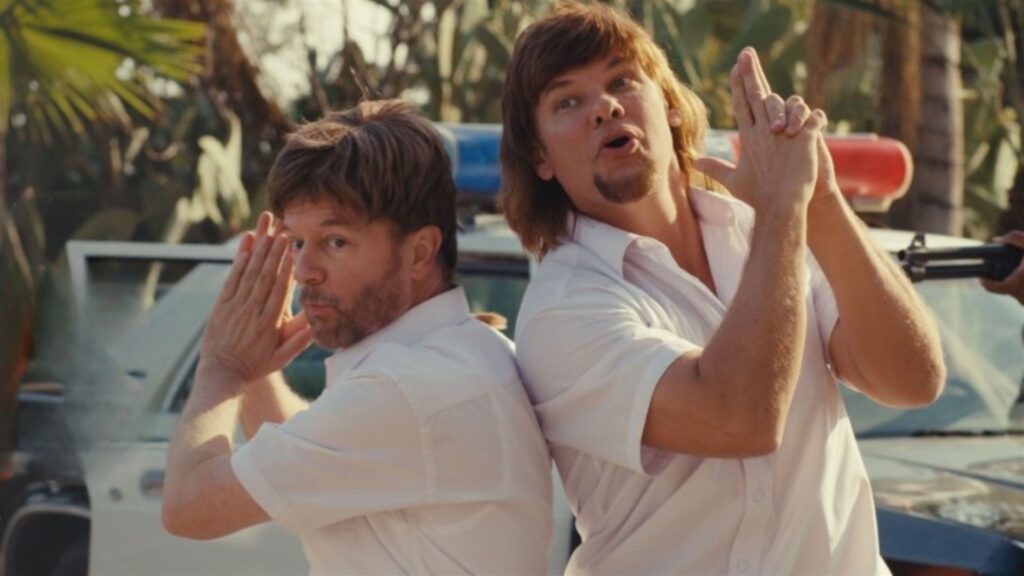
I was keeping an eye on the comedy, “Busboys,” starring Theo Vonn and David Spade. I was asking the question, could comedy podcasters usher in a new theatrical comedy renaissance? But the flick barely made a million bucks. The error with this one is pretty obvious. Why are you casting a third tier aging comic in a role that doesn’t even make sense (why is a 55 year old trying to become a busboy). For any comedic 2-hander, the audience has to look at the pairing and laugh even before they’ve seen a single second of footage. When you looked at this pairing, you thought, “Huh?”
Since there was nothing dragging me to the theater this weekend, I checked out the pilot for the second season of Beef. This is a powerhouse cast here, a creator with a lot of buzz, and a show with a lot more money. What has that resulted in?
A mixed bag.
The first thing I noticed is that Netflix is trying to make “Beef” its “White Lotus.” It’s a very specific voice that’s aggressively character-driven, built around strong filmmaking, an incredible cast, and an affecting score. And I don’t think it’s a coincidence that the main character, Joshua, runs a ritzy country club. The shades of Murray Bartlett’s “Armond” from season 1 of White Lotus are strong.
The writing here is quite awesome at times.
Early on, we see country club manager Joshua (Oscar Isaac) and his wife, Lindsay (Carey Mulligan) get home after working a long day at the club, and get into this big fight. Meanwhile, two young workers at the club, Ashley and Austin, are head over heels for each other. Every single moment for them is bliss. Just being around each other and getting to kiss makes their day.
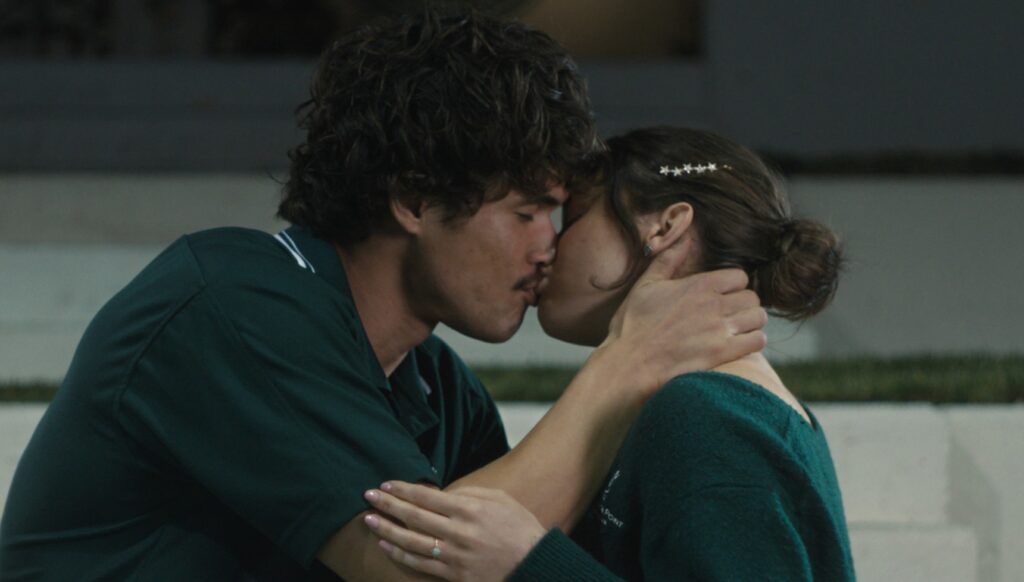
So, creator Lee Sung Jin does this really clever thing where he cuts back and forth between these two couples, one trying to rip each others’ heads off, the other trying to love each other as much as humanly possible. And the reason why this works, besides the fact that it creates a jarring juxtaposition, is that one of the strongest ways to reveal character is through comparison.
If you want to make it clear that one of your characters is a bad person, you can just show them doing bad things of course. But if you want to turbo-charge that message, put them in a scene with the nicest person possible. That way, their meanness will truly pop.
Why is this important? Because easily one of the biggest mistakes I see in screenwriting is writers not clearly conveying who their characters are right away. So you want to look for any tools you can that help you set up exactly who your character is. And comparison is one of those tools.
We leave this montage knowing, very overtly, that one of these couples has deep deep set problems and the other loves each other more than anything.
Despite this, there are a couple of things that keep this from becoming the prestige event that is White Lotus. The first is that the stakes here are low. The pilot is built around this moment where Joshua left his wallet at the club. Austin is asked to return it by the president, and Ashley comes with him.
The two go to their house at night just as Joshua and Lindsay are in that huge fight. Ashley starts recording it on her phone through the window (unbeknownst to Joshua and Lindsay) and even though Lindsay is the aggressor, Ashley starts recording at a moment where it looks like Joshua is the aggressor. Right then, Joshua and Lindsay spot the two outside, and Ashley and Austin run away.
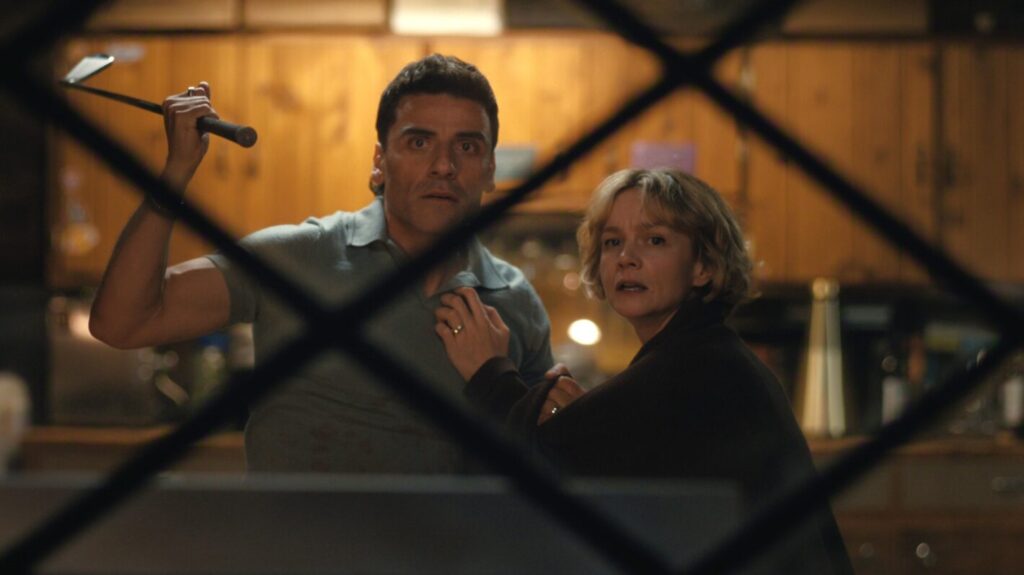
So, looming in the background of this story is Ashley’s possession of this video. And, presumably, she’s going to choose to show that to someone at the club, or post it online. And that will probably start the season’s “beef.”
Those stakes are pretty low. In real life, the insanity we’ve seen through peoples’ worst behaviors being published via video are way way worse than anything that happens here. So it doesn’t really feel like Ashley has that much on Joshua. I suppose it’s enough to get him fired. And it probably will get him fired. But just as the inciting incident of a show, it’s pretty tame.
Compare it to White Lotus, where the inciting incident is always a murder. Those are real stakes. A video of an aggressive fight where nobody’s technically done anything illegal is not a high stakes situation. It’s a medium stakes situation. And you don’t want to build 8 episodes on top of a medium stakes situation.

I suppose the stakes could grow. We’ll see. But, for your sakes, as screenwriters who’re writing pilot scripts, you want to set up your stakes in that very first episode. Cause that’s the one you send out to everyone. You don’t send episode 2 out to anybody.
That’s another thing I find kind of weird about Beef. Nobody dies in Beef. There’s all this threat but the threat is all bark and no bite. At least in the first season and I’m guessing this season as well. So, despite the darkness it touts as its calling card, it doesn’t actually go to the furthest depths it can (death). I find that strange.
One thing that separates White Lotus from Beef is how they manage the audience’s emotional experience: whether the show pays you back for what it puts you through.
Every movie or show asks something of you. Your time, your attention, your emotional energy. If it’s going to lean into discomfort, tension, or ugliness, it has to return something on the other side. That can be humor, insight, release, momentum, even just the pleasure of watching it all unfold.
White Lotus understands that. It gets dark (sometimes very dark), but it constantly offsets that with sharp humor, absurdity, and a kind of voyeuristic fun. You’re never stuck in the discomfort. You’re riding it like a wave.
Beef, on the other hand, often sits in the discomfort longer without giving you the same kind of release. The tension accumulates, the situations tighten, and the emotional experience starts to feel heavier than what you’re getting back.
And that’s where you start to lose people. Not because it’s too negative but because the exchange stops feeling balanced.
The difference isn’t that one show is darker than the other. It’s that one understands how to make the darkness enjoyable, and the other sometimes forgets to.
With that said, it’s by no means severe. I’d say White Lotus is 60% positive and 40% negative whereas Beef is 55% negative and 45% positive. Which is why it remains watchable. And why I will continue to watch this season. Because I like all the actors here and the acting between Isaac and Mulligan, in particular, is next level. And creator Lee Sung Jin is good with plotting. He knows how to weave things around in unexpected ways. So, we’ll see what happens.
What did you think of Beef or any of the movies that came out this weekend?
This may low-key be one of the best dialogue tips on the planet
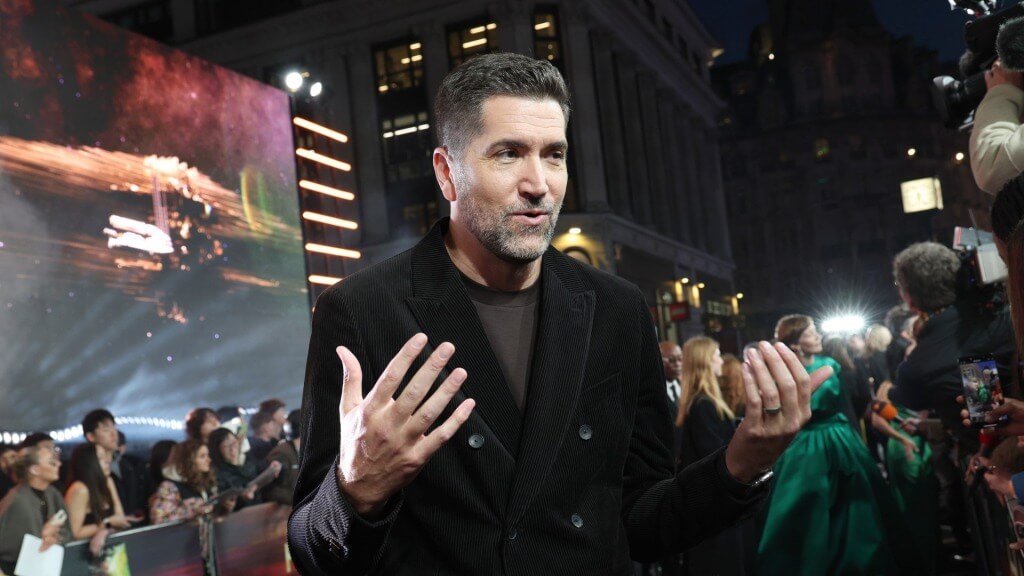
So, the other day, I was watching an interview with Drew Goddard for Project Hail Mary. I’ll be honest, I don’t read or watch a lot of screenwriter interviews these days. Mainly because I don’t learn anything new from them anymore. But this is one I wanted to check out because I think this guy is one of the best writers in Hollywood. He took two very hard books to adapt and made great movies out of them. And, if I’m being honest, after reading the book, I didn’t think this one was going to be very good. I thought the alien stuff had the potential to be a movie killer. Which is something I’m going to talk more about in this month’s newsletter. Stay tuned.
But getting back to Drew, he said something that struck me. He was asked how difficult writing dialogue was for this film and he immediately replied, “Dialogue is easy if you get the outline right.” Now, if I were a beginner screenwriter, I would hate that advice. Because outlining and dialogue don’t connect in any obvious way. But, having the benefit of hindsight of reading a million scripts and writing an entire book on dialogue, I can now tell you that this is one of the best pieces of advice for writing dialogue that you’ll find. And I want to break down why.
The first thing you need to understand is why we write an outline in the first place. Most people will tell you it’s a way to plan your story out. That’s obviously part of it. But the sneaky important reason you write an outline is to set up a story that always has FORWARD MOMENTUM. You’re making sure there is always an ENGINE underneath every sequence of your story. Because if you resolve a major thread early on in your script and you don’t replace it with a new engine, there’s nothing pushing your story forward. Which means your story will sit there, languishing, unclear where to go or what to do.
That’s what an outline should be doing. Making sure that each act has momentum. Making sure that you’re threading in plots and subplots that are always pushing things forward. How do you do this? The easiest way is to create characters with goals. A goal that spans the entire story, like Liam Neeson’s goal to save his daughter in Taken, is the easiest way to accomplish this. But not all stories are like this.
So if goals fade, you need to replace them with new goals. Or you need to switch the focus onto another character who has a goal. At first, in Star Wars, Luke Skywalker has no goal other than to get off his farm one day. So what’s the engine driving that section of the story? It’s Darth Vader trying to find those droids to retrieve the Death Star plans. Only once Luke’s parents are killed does he now have a goal – to help Obi-Wan deliver the Death Star plans to the Rebels.
You can, of course, have multiple characters pursuing multiple goals, which is the best case scenario, because it supercharges your story engine. But as long as at least one major character has a goal, and that goal has some level of importance behind it, it will be enough to keep the engine revving and keep the story moving along.
So, how does this relate to dialogue? Well, if you have a strong outline, and you’ve used that outline to make sure that there’s a strong engine underneath each part of your story, then we get to the real nitty-gritty of how this all works. Creating engines for pieces of your story ensures that each individual scene is moving the story forward. More specifically, the characters in the scenes want something (their “goal”). That want, that desire to get something (often from the other person) is what creates good dialogue.
Why is this? Well, one of the elements of strong dialogue is that, when a character speaks, he’s speaking because he wants something. That want is what gives his speech direction. Now the scene has a point. Main Character wants something. Will he get it or not? In that scene, because the character is speaking to achieve something, every line of dialogue will have purpose. And then, when he either succeeds or fails at achieving the goal, the scene is over.
When Goddard says that poor outlines result in poor dialogue, what he’s saying is that the opposite chain of command occurs. The outline is thin. There are parts of it where you don’t yet know what’s going to happen. This creates large gaps in the story where no clear engine is pushing the story forward. When you try to write a scene inside one of those gaps, characters often don’t have clear goals. Or if they do have goals, they’re weak. When you try to write dialogue inside a scene like that, it becomes infinitely harder.
Think about it. What does a character say if they don’t want anything?
In fact, if you’ve ever had that scene in your script where you’re constantly trying to rewrite the dialogue because it never quite feels right, there’s a good chance that that section of the script is weak, which is creating a lack of a story engine, which is weakening the goals inside the individual scenes, and if you try and place two characters speaking inside one of those scenes, you’re basically guiding lambs to the slaughter. Why are these characters speaking if they don’t have anything to say?
What then often happens, is you start trying to jestermaxx your dialogue. You try to make the jokes funnier. You try to liven up the observations and hot takes, pushing with everything you’ve got to make the conversation entertaining. Sometimes you even come up with some really clever stuff. But deep down you know the truth, which is that your characters are just babbling at each other. And when people read that scene, they’re not praising your dialogue for being clever. They’re bored out of their mind because nothing’s actually being said. That’s the dirty secret of dialogue. Nobody cares unless you’ve written an entertaining story where people need to say things to move storylines forward. And if your outline isn’t in place to make sure that that’s always happening, no amount of clever dialogue is going to save your script.
How does this look in practice? Let’s say you’re writing a scene about a young man meeting up with his father. The two don’t have the best relationship. They haven’t seen in each other in a while. The young man is struggling in life. He and his girlfriend are close to getting kicked out of their apartment. So he’s called this meeting with the intention of asking his dad for money.
It’s easy to write good dialogue for this scene. Why? Because the young man has a clear goal and the goal is important.
How would you write this scene? Well, the son knows he can’t come right out with, “I need money.” He’s got to at least pretend he cares about his father’s life a little. So he might ask his father what’s going on right now. Maybe ask about mom. Ask about work. The ultimate goal of getting money from the dad is buying time in the scene. The subtext is strong since we know he’s only saying all this other stuff to make the money ask feel more organic. That’s the ideal situation for a scene. Clear directive. Resistance from somewhere that creates doubt. You can write a million different variations of that scene and most of them will work.
Now let’s change the setup a bit. Let’s just say it’s a 22 year old young man meeting up with his father after they haven’t seen each other in a while. The son doesn’t want anything. The dad doesn’t either. It’s just them reconnecting after a long time.
I want you to imagine writing that scene. Notice how much more difficult the plan for the scene becomes. Where do you even start? You can start with, “Hi,” then awkward silence. Yeah, there’s something here because of the scarred relationship. But without establishing what each character wants, chances are you’re going to have these two mumbling at each other for two and a half pages and call it a scene. You’ll justify it by saying it’s “true to real life” but readers don’t care about that shit. They care about being entertained. And a vague meeting scene between father and son without any real direction is not entertaining.
I want to make something really clear here. Because when most screenwriters think of dialogue, they think of flash. They think of trying to make the dialogue as interesting as possible. In reality, though, what the reader really cares about is being pulled into the emotion of the scene. They want to wonder what’s going to happen next. And so “great lines of dialogue” are not what’s going to win them over. What’s going to win them over is: This character wants something important and, therefore, I want to see if they get it.
As long as you have that, your dialogue can be pretty barebones and readers will still be pulled into your scene.
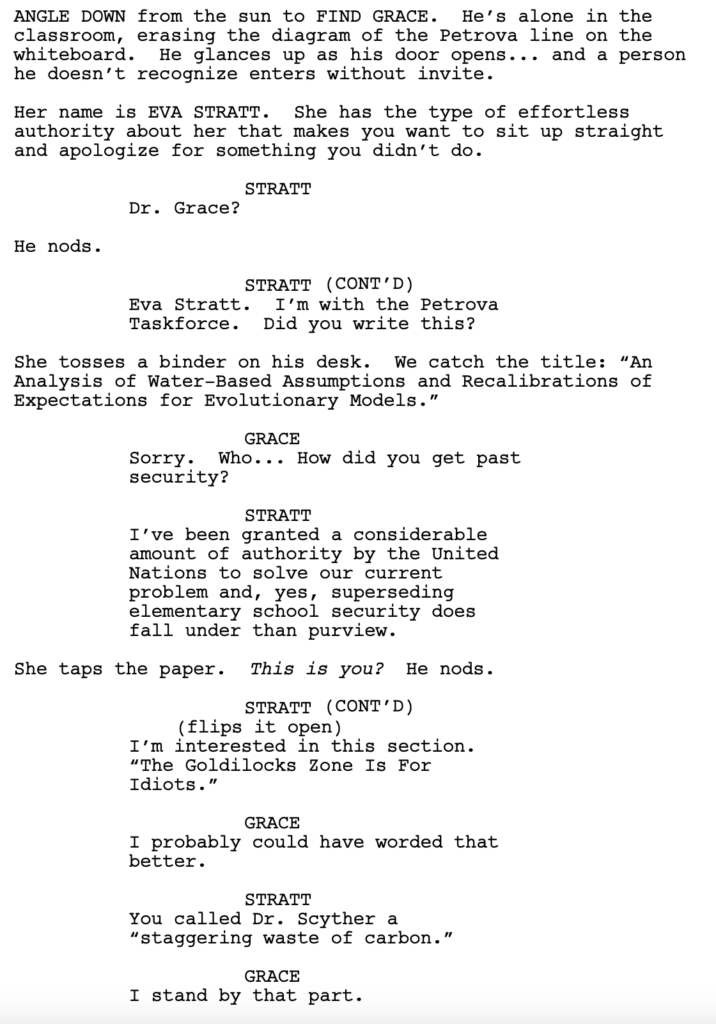
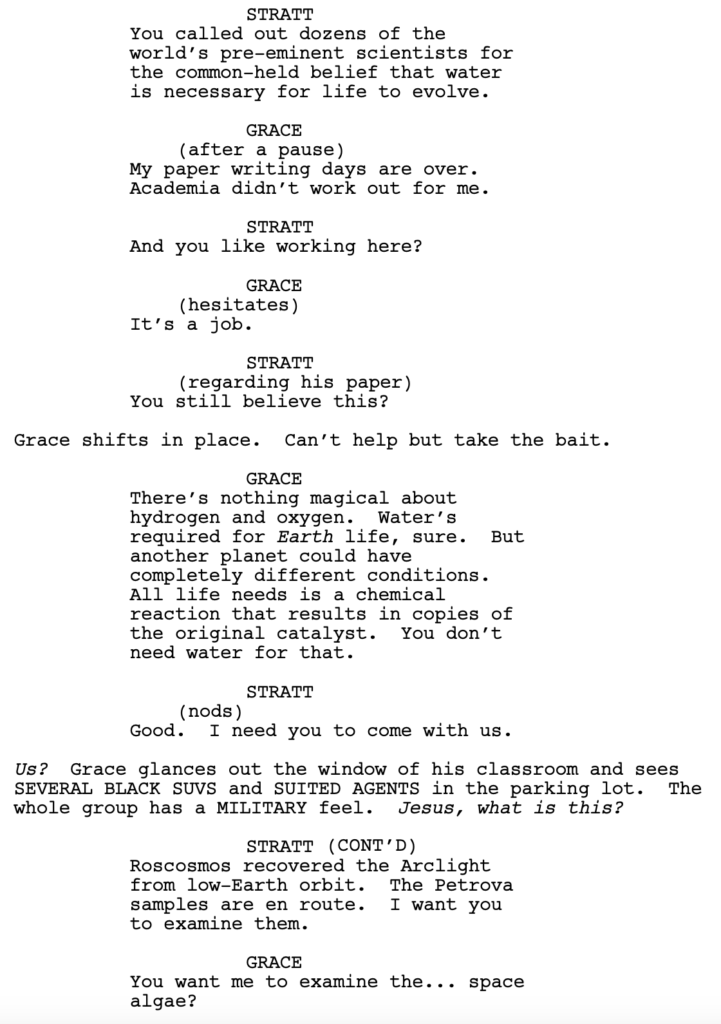
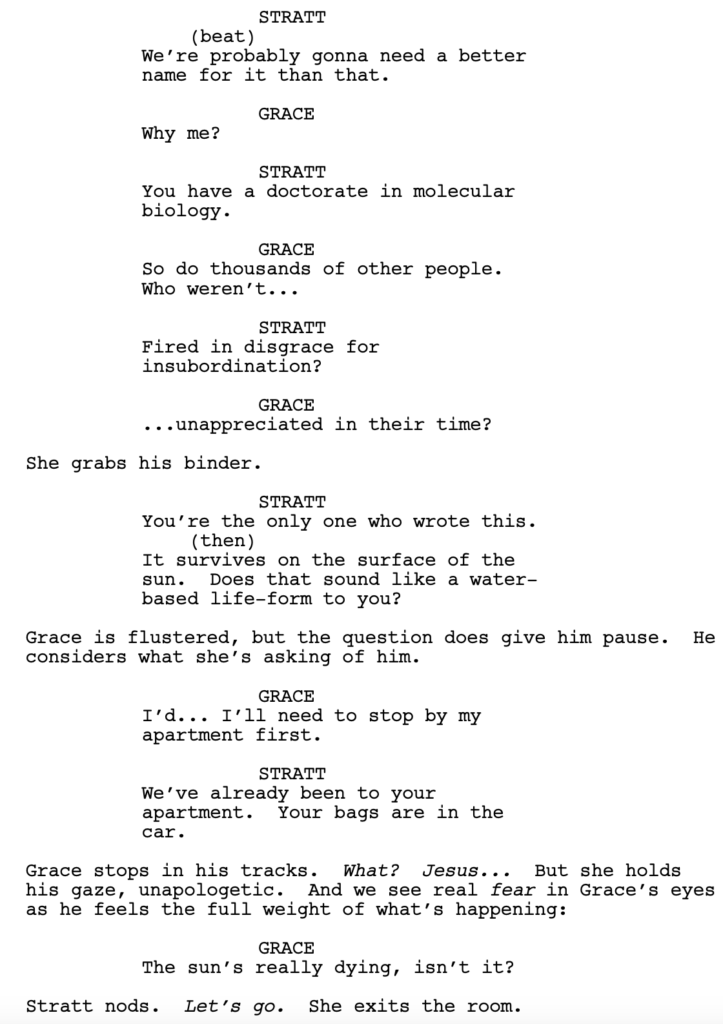
Again, this all goes back to the outline. Make sure that every section in that outline, that takes you from page 1 to page 100, from Act 1 to Act 3, from Sequence 1 to Sequence 8, all of it needs at least one primary character with a strong goal. That will ensure that each section has a powerful engine running beneath it. And every scene you write within that section will have a character with a goal in it, which’ll make your dialogue write itself. I’ll leave you with a very simple example of this from Project Hail Mary. This is where government worker Eva first shows up to Grace’s work to recruit him. She has the goal. The goal drives the dialogue. Happy weekend!
Genre: Comedy
Premise: Delaney Pitts is a nerdy, teenage virgin who has a secret online life as an erotic fan fiction author. But when a publisher tasks her with writing a book about her (non-existent) high school love life, she’s forced to team up with a top expert in the field: the slutty quarterback of the football team.
About: This script sold after a big bidding war. Emma Stone’s production company, Fruit Tree, is attached and A24 is the buyer. Maya Erskine, who played Mrs. Smith opposite Donald Glover in the Mr. & Mrs. Smith Prime video adaptation of the film, will make her directing debut. The script comes from Morgan Lehmann. This was Lehmann’s second spec sale of 2025. She also sold a female-driven sports comedy project in the vein of Miss Congeniality. Lehmann has also sold a couple of TV pilots. The Harvard grad’s best known credit is writing on numerous episodes for the TV show, Bless This Mess, which ran for two seasons.
Writer: Morgan Lehmann
Details: 99 pages
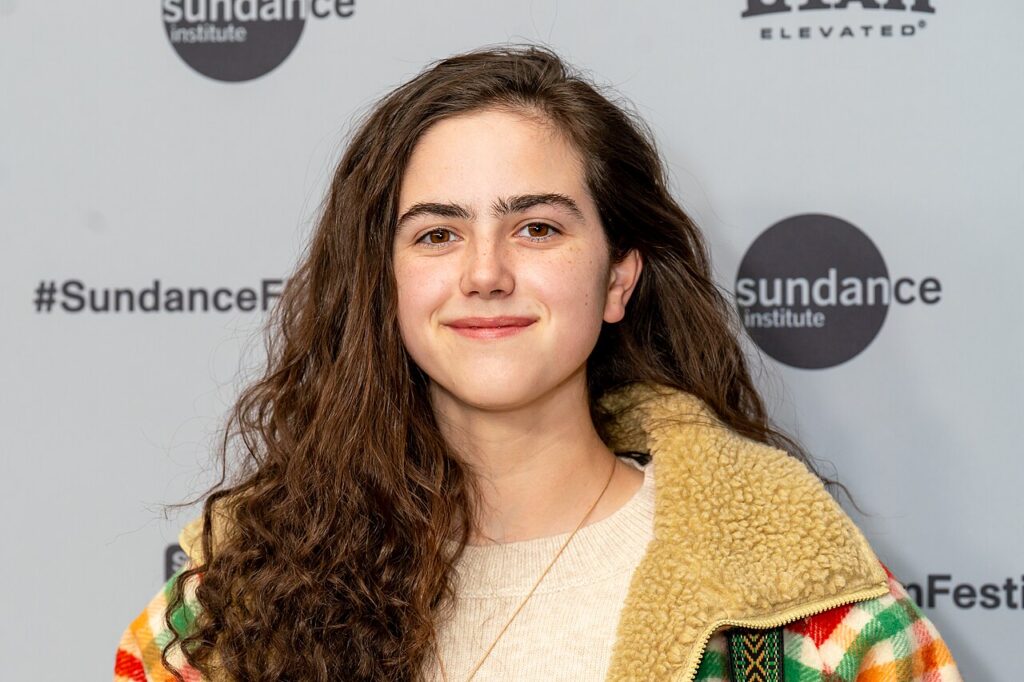 Abby Ryder-Forsten (Ant-Man & The Wasp) for Delaney?
Not long ago, I was at the Hollywood Farmer’s Market when I got into a conversation with a couple visiting from Ohio. It was one of those easy, drifting exchanges that starts in an ordinary place and expands into something unexpected. The woman was a writer, and they had come to Los Angeles for a book fair where she was appearing as a featured author and doing signings.
Curious, I asked what she wrote, expecting a standard answer, and she immediately said erotica. But not just general erotica. A very specific subgenre of erotica that’s suuuuuper dirty. She was describing this to me with complete ease, giving lurid examples of her work as casually as someone might describe how they cooked their chicken last night. Her boyfriend stood a few feet away, looking a little uncomfortable, as she laid out the details.
What struck me wasn’t the shock value, but how matter-of-fact it all was. Like there was a whole ecosystem of erotic subgenres I had never been aware existed. I knew about Fifty Shades of Grey, of course, but I’d always assumed that that was more of a cultural outlier than anything.
That’s why I chose to read today’s script. It takes that same idea (the existence of a much more specific, niche world of erotic writing) and filters it through a fun lens: a high school girl who has no real life sexual experience. Let’s take a look!
17 year old nerd author Delaney Pitts has a decent sized audience who reads her writing online. Which might surprise you considering that her current story follows Timothee Chalament as Willy Wonka dominating a young tied-up housewife. Yes, Delaney writes about graphic sexual experiences with nerdy pop culture characters.
The irony is that Delaney has zero real-life sexual experience. She hasn’t even kissed a guy! Her only friend is Kira, a super-horny Filipina girl whose parents are insanely religious and don’t let her do anything. As Kira likes to point out, they’re not even cool enough to get bullied. Literally nobody knows they exist.
On the flip side of this you have Ty Reynolds, the high school quarterback and every girl in school’s wet dream (including the teachers). But Ty isn’t even on Delaney’s radar. It’s like the Stapler guy from Office Space wanting to date Margot Robbie. At some point, you gotta be realistic about your options.
But then something interesting happens. Delaney gets a call from a publisher who saw her work online. He says if you can write a whole book of this stuff and it’s good, we’ll give you $50k. There’s only one stipulation. It has to be about the REAL LIFE of a high school girl. It can’t be about Thanos banging Blackpink.
Uh oh.
Delaney doesn’t have any original ideas! Nor would she know where to start. She has zero real life social high school experience. She’s never kissed a guy. Never been to a party. Don’t even get started on how far away she is from sex. But Delaney finds out that Ty got busted for submitting several English essays written by AI. If he doesn’t rewrite those essays and get a good grade on them, he won’t go to college.
So Delaney makes a deal with him. I’ll help you write those essays. You help me learn what high school and socializing and hooking up is really like. Ty agrees and they’re off to the races, with Delaney going to her first party that weekend.
But when the backup QB starts hitting on Delany, Ty gets unexpectedly jealous. And when Ty’s girlfriend, Sabrina, learns of this nerd-chick trying to lure her boyfriend into her weirdo nerd lair, she goes on the offensive, determined to get Delany out of the picture. Which may mean exposing her dirty sex-lit musings to the entire school.
Untitled Erotic Fan Fiction is a solid script. I think my big question, while reading it, was, why did A24 want this? Because this is about as formulaic as a script gets. It’s the same slightly raunchy teen comedy that they’ve been making since Pretty in Pink. I guess I was expecting something a little more avant-garde.
You guys know my feelings about comedies. You have to lean into what’s unique about your premise. Cause that’s the only area where you’re going to find jokes that haven’t been used in other comedies. And, in this case, those are exactly the funniest moments in the script, when we flash to one of Delaney’s weird erotic scenes she’s writing.
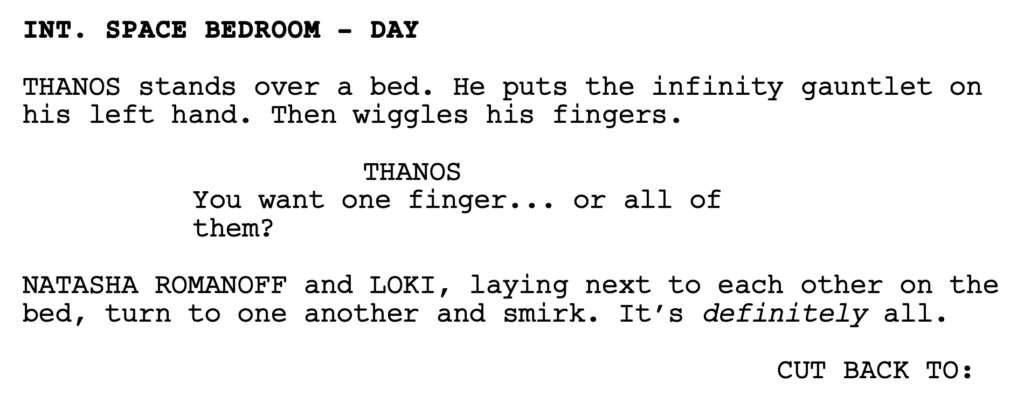
The problem was, there wasn’t enough of this! And because of that, Lehmann was instead depending on making teens in a high school setting funny, an arena with millions of other writers competing against you. I mean, how many different ways can you write the scene where your main characters are in a bedroom, talking about homework, with the sexual chemistry boiling underneath?
Again, it’s not that you can’t make that scene good. If the characters are strong and we want them to be together, it’ll work. But it’s still a scene we’ve read a million times before. So, in a way, we’ve already read the scene. We’re just waiting for you to finish it.
My writing strategy is: Look for the avenues that give you an advantage over other scripts. And mining the uniqueness of your concept at every turn is one of the easiest ways to do this. Especially with this premise. The moments I laughed the loudest were always the ridiculous yet alarmingly dirty sexual escapades Delaney would dream up.
I will say this, though. This script is perfectly structured. I’m talking absolutely perfect. It’s 100 pages long. The acts are divided perfectly (Act 1 = Pages 1-25, Act 2 = Pages 26-75, Act 3 = 76 – 100). The inciting incident happens between pages 12-15. We’ve got the midpoint (Delaney’s first party). And the majority of it is invisible. It doesn’t feel like you’re noticing those key script moments when they’re happening.
That’s the moment I’d say that a solid intermediate screenwriter becomes an advanced intermediate screenwriter – when they can structure out their story in a way that’s invisible to the reader.
And just to be clear on why that’s important – because a lot of people think that the 3-act structure and all the sub-beats of that structure are only done to make screenwriting teachers happy. They don’t believe they’re actually useful for telling a story. Not true. This is something I’ll get into Friday, with my new article – the point of good structure is to move the story along. When you nail your structure, your script is always pushing forward. When you don’t, that’s when it feels to the reader like not enough is happening.
Another thing I want to bring up here is the party scene. Cause a very quick way for me to know if I’m dealing with a real writer is to see how they handle a party scene. Not just a high school party scene but any “gathering” scene.
The secret to writing a good party scene is to give the key characters one of two labels. Either they are active or reactive. If they’re active, give them a goal they’re after. If they’re reactive, then you need to have something interesting happen to them (which they can then react to). If a key character doesn’t have one of these two things going on, your party scene will be in trouble.
In the party scene in Untitled Erotic Fan Fiction, Kira loses her phone. Kira has snuck out of her house. Has to sneak back in by 11pm. And we establish that if she goes back to her parents without a phone, her life will be over. So her goal is to find that phone. That’s her directive during the party scene.
Then we have Sabrina, Ty’s girlfriend. Sabrina has noticed Ty becoming distant lately. So she created this party (it’s taking place at her house) with the specific intent of getting her boyfriend obsessed with her again. So that’s Sabrina’s active goal: GET MY MAN BACK.
Then we have Delaney. Delaney doesn’t have a goal really at this party. She’s been forced to come here by Ty so she can experience what a real high school party is like so she can accurately write about it. But that’s not an active goal really. It’s too vague. So, we need to have something happen TO Delaney. In this case, we have Vaughn (the backup QB) notice her and start hitting on her. So Delaney spends the party reacting to that. Does she want to get involved? Does she not want to get involved? That’s her journey at the party.
Finally we have Ty. As we already established, Ty is the target of Sabrina. But Ty is starting to lose interest in his girlfriend. He’s starting to have more fun hanging out with Delaney. So Ty’s journey at this party is to deal with the incessant pressure that is Sabrina trying to get him back. She’s pulling every trick in the book to win him over, which is keeping him from where he really wants to be, which is with Delaney.
Now, all of this might seem obvious to the casual screenwriting eye. “Duh, Carson. You just have them each do something.” Trust me, it’s not that simple, lol. And I can give you about 1000 examples from the 10,000 scripts I’ve read where writers don’t give their party characters a clear directive or a clear action to react to. Actually, I just saw a terrible example of a party scene last night. I had on this awful movie called Palo Alto for 30 minutes (don’t ask why). And there was a party scene where none of the characters had any clear directive or action to react to. They just wandered. And the scene was boring as hell as a result.
All in all, Lehmann has a good understanding of the craft here, which has resulted in a solid script. But when it comes to comedy, you need to step on the gas. And it felt like we were mostly on cruise-control throughout this. More fun scenes surrounding Delaney’s sexual scribblings could’ve easily doubled the laugh count. But I’d still say this is worth the read.
[ ] What the hell did I just read?
[ ] wasn’t for me
[x] worth the read
[ ] impressive
[ ] genius
What I learned: A good joke option is to connect two things that don’t go together at all. The juxtaposition of those things is what makes the joke funny. Of course, there’s an art to this. You can’t just say “bears and popsicles” and expect people to laugh cause the two things are different. You have to play with some combinations to find out which ones sound the funniest against each other. But when you land on a good one, it’s gold. In this scene, Ty has read Delaney’s most recent pages and has feedback.
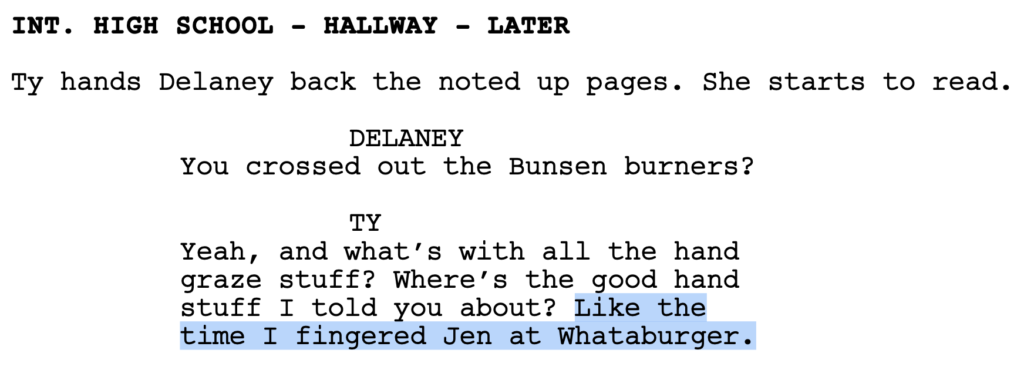
“Fingered Jen” all by itself would not have been funny. The juxtoposition of placing it at a cheap fast food joint is what makes the joke pop.
What is the gangbusters screenwriting lesson within Project Hail Mary that nobody’s talking about?
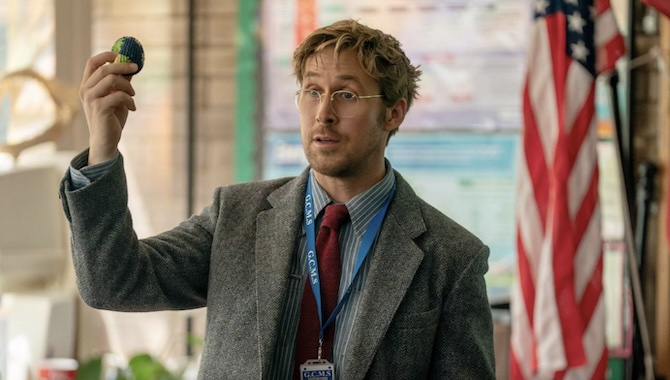
Project Hail Mary dropped just 23% in its third weekend. Is this amazing hold because of Ryan Gosling? Yes. Is it because of a stellar marketing campaign? Yes. But when a movie holds this well, there’s one reason that rises above all others – THE SCRIPT.
Only awesome stories have 23% drops. Because awesome stories hit audiences more powerfully. Which means audiences come back from this film and tell other people about it, who then go see it themselves. It is the oldest and most effective form of marketing there is.
Now, there are many reasons why this screenplay is great. I’ve gone over some of them on the site. But I want to tell you a secret screenwriting reason this movie is killing at the box office that nobody’s talking about. It’s a reason that Hollywood keeps forgetting. But it’s been around forever and a day.
Here are some of the movies that should cue you in on the tip…
Step-Brothers
Bridesmaids
Swingers
Back to the Future
Good Will Hunting
Midnight Cowboy
Know what it is?
Okay, let’s put up the final movie that represents this tip, what some say is the greatest movie of all time.
The Shawshank Redemption.
Now do you know what the tip is?
It’s FRIENDSHIP.
Actually, it’s more specific than that. It’s a love story told through the lens of friendship. A platonic love story. Audiences absolutely love this simple formula. Two people fighting against the world to achieve what they need to achieve.
And Project Hail Mary falls into that category perfectly. It’s a love story told through the lens of friendship between Grace and Rocky.
Here’s how to make this formula work. You imply that the friendship has to end at some point. Just like a love story. You have to tell us that the lovers may not get together at the end.
I was just watching Back to the Future the other day again. Doc and Marty’s future is threatened by the fact that Doc is dead in the future. So, the very act of succeeding results in a friendship dying. That’s what makes these narratives so special.
And it’s the same thing here in Project Hail Mary. Grace and Rocky are trying to save the galaxy together but by doing so, they will never see each other again. That creates this looming feeling of worry and sadness in the audience, that makes things all the more amazing when the two end up together at the end.
So, why aren’t there more movies about friendship? We’ve established it’s a powerful blueprint to create an exceptional film. Well, until recently, Hollywood always thought you needed the female love interest to make a movie work. So, that was the relationship that always took precedence.
That’s why, when you saw The Shawshank Redemption back when it came out, it felt so different. There was no love interest.
But anyway, building a story around friendship can be dramatically powerful. And if you can couple it with a high concept like Project Hail Mary did, well then watch out, because you can take that movie to the box office stars.
Not all the entertainment news out there is as peachy as Ryan Gosling’s hair, unfortunately. There’s a really bad show that just debuted this week. It’s called The Miniature Wife. Now, you may say, “Uhhhh, Carson? Why would you think that show would be anything other than terrible?”
I assumed it was probably bad, yes. But I love Matthew McFaddyen! And I like Elizabeth Banks. Also, I really want someone to make the movie, “Kitten,” (scroll down in link for review) from a script I reviewed a few months ago. And I was wondering if this show would, in any way, negate that project.
That answer came pretty quickly: DEFINITELY NOT.
Cause this show is terrible.
I mean ACHINGLY terrible.
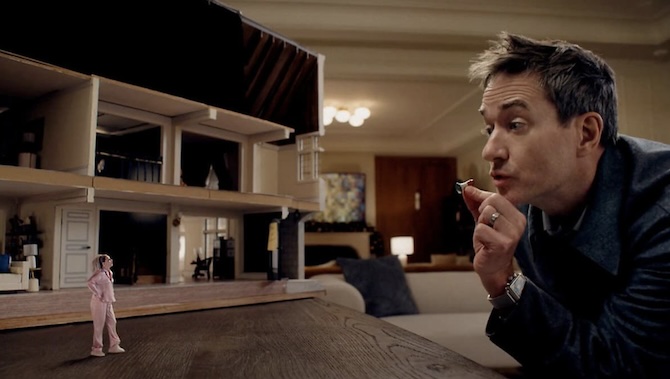
But here’s the good news. Failures like this can teach writers something and this show actually has a powerful lesson you can learn from the poor writing on display.
It’s something I call “SETUP BLOAT.”
I’m highly aware of Setup Bloat at the moment because I’ve consulted on several scripts recently, all of which had setup bloat in them. And setup bloat is a uniquely evil issue in that it kills your script immediately. Because it’s happening during the setup. And the setup is where readers decide, quickly, whether they’re in or out. If you have Setup Bloat, the reader will not make it through your first act.
So, what is Setup Bloat?
It consists of two things.
One: THERE’S WAY TOO MUCH GOING IN YOUR STORY
Two: THE EXPOSITION REQUIRED TO INTRODUCE ALL OF THOSE PLOT ELEMENTS
Exposition will always be required in your first act. You need to set up your story. Which means you need to write exposition. But here’s the thing about exposition in your setup: The reader only allows for you to provide so much exposition before they tap out. (if you want to learn how to effortlessly add exposition, my dialogue book has an entire chapter dedicated to it)
I think you know where this is going. If you don’t have a ton of plot to set up, then you won’t have to write that much exposition.
However, if you have a super complex plot with a ton of moving parts, then the majority of your first act is going to be exposition. Every moment is going to be you introducing information that the reader needs in order to understand the story. That’s Setup Bloat: When your first act is so over-stuffed with exposition that very little entertainment is allowed to breathe through.
Which is exactly what happens in The Miniature Wife. First we set up the unnecessarily complex situation that two people who are already married are deciding to stay married. Then we set up the husband’s miniaturization invention. Then we set up the complex funding requirements for this invention. Then we set up the wife breaking up with her secret boyfriend. But not a boyfriend she physically cheated on her husband with. This was just an emotional affair. We also set up that she used to be a famous author but hasn’t had a best seller in 15 years. Then we set up that her emotional affair boyfriend secretly pretended to be her agent and submitted a short story she wrote without her knowledge to the New Yorker. But what he didn’t know was that she stole that short story from one of her university students. Stole it to secretly keep on her hard drive in order to pretend to herself that it was hers. So now she has to go to that student and convince her to leave the country for six months, isolate, all so that she’ll have no idea that she, the wife, stole her short story when it gets published in the New Yorker.
And that’s just some of the setup!!!!!!
Do you see, now, how Setup Bloat can destroy a script before it even gets going? I don’t think William Goldman in his prime would’ve been able to manage that level of setup in a first act.
To be clear, part of what makes a good screenwriter a good screenwriter is making exposition invisible. It’s finding ways to make scenes entertaining on their own, before covertly slipping the necessary exposition into them. But if you don’t know how to do that, you end up with setups like The Miniature Wife, where it’s not only all exposition, but it’s clunky obvious exposition. It’s clunky setup scene after clunky setup scene.
How do we avoid this? Don’t write a billion threads into your plot. Or, if you do have a lot of plot, space it out. Especially if you’re writing a TV show. You have so much more time to delve into your plotlines in TV writing. You don’t have to stuff all of them into the world’s biggest trash bag and dump it on your reader in the first act of the first episode.
I’m kinda disappointed. I wanted a cool Matthew McFaddyen TV show to watch. But if there’s a silver lining to this, it’s that he’ll be able to look for another job right away after this one gets canceled next week.
As we get closer to the Blood & Ink deadline (that would be Cinqo De Mayo), we’re going to have to, you know, finish our scripts. I could write a book on finishing scripts. There’s actually a lot to it. But for the purposes of today’s article, I want to focus on the final act. Because, chances are, as you approach finishing, the area of your script that’s going to be the least complete is that ending.
It’s an issue I’ve always had with the screenwriting process. We get so caught up in writing that first act (we keep going back to it to improve the opening scene and set up our heroes better and make sure the inciting incident is perfect) that the other two acts don’t get nearly as much of our time. Which equates to an uneven “percentage of time spent on each act in a screenplay” ratio.
Time Spent on First Act: 60%
Time Spent on Second Act: 25%
Time Spent on Third Act: 15%
If you want to know why so many movies fall apart, this is the reason. And it’s why almost every Hollywood movie freaks out about the third act during production and brings in a writer to rewrite it AS THEY’RE SHOOTING THE FIRST TWO ACTS OF THE MOVIE.
It’s because they didn’t put in the time when originally writing the script to make the ending good enough that people wouldn’t question it. Cause people only question bad or average third acts. They don’t question anything when that third act is awesome.
Look at Back to the Future. Arguably the best third act in the history of cinema. They weren’t rewriting that during production, I can promise you that. They notoriously rewrote that script until they got it right and THEN went into production with it.
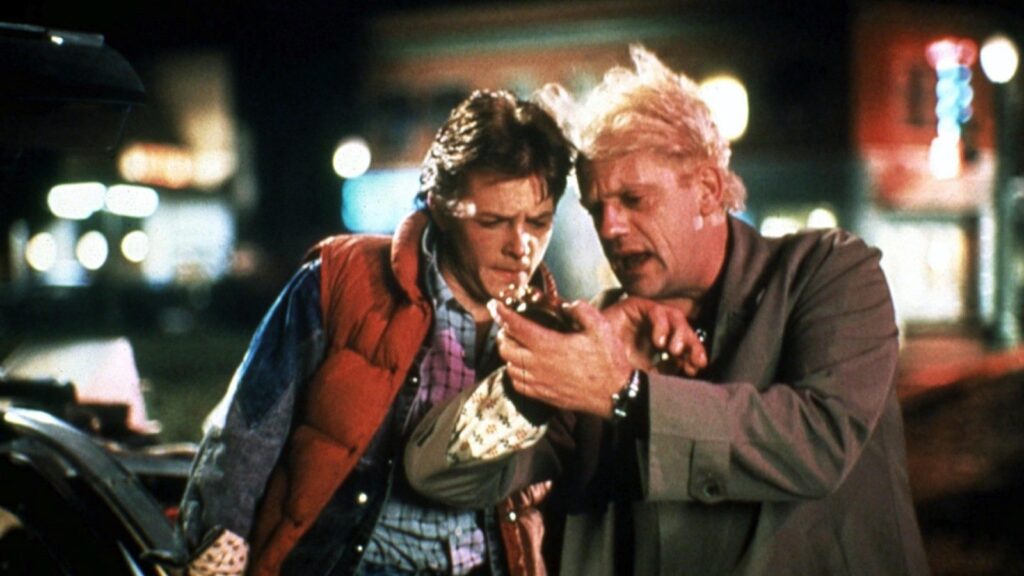
But how is my saying, “You need to spend way more time on your third act” going to help you now? Well, lucky for you, I’m going to give you a little hack on how to massively improve your third act without having to spend another one thousand hours on it. And Back to the Future is actually the perfect movie to use as inspiration for this screenwriting hack.
The key to massively upgrading your third act is this: PAYOFFS.
Payoffs are your secret weapon for turning a bad third act into an awesome one. Because the mistake that so many writers make is they just write a logical conclusion to their story. It’s enough to get the job done but it doesn’t contain any of those moments that emotionally invigorate the reader.
You can create those moments by simply setting up things throughout the first and second acts, and then paying them off in the third act. And the great thing is? There’s no limit to how many payoffs you can use. Readers and audiences absolutely love payoffs. The setup and payoff formula always feels clever. The reader feels like they’ve earned something because they’re rewarded for paying attention earlier. It makes readers feel smart cause they had to add a couple things up. It’s very rare that a setup and payoff doesn’t work.
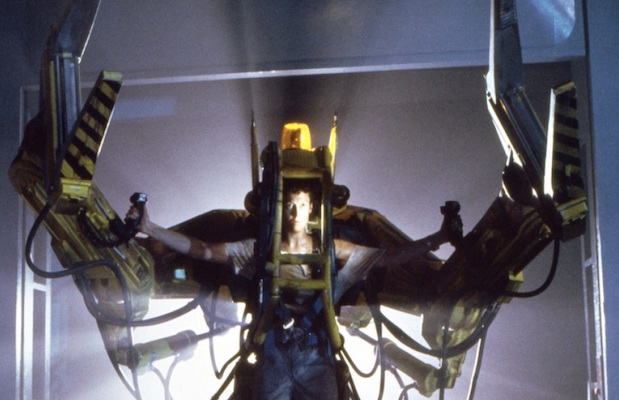
And here’s why this is relevant to the position you’re in now. Because you can retroactively add setups. For example, if you’re writing a movie about marines going to a planet to take down aliens and you’re at the end of your story and you don’t know how to end it but you think, “You know what? It would be really cool if I could put my hero inside a big mechanized suit and have her battle the mother alien that way.”
Perfect! All you have to do is write that scene then GO BACK TO THE FIRST ACT and set it up. Write in your hero, in this case Ripley, telling one of the marines that she can operate one of those mechanized loader suits, show her doing it, and now you’ve just set up that ending.
Would Aliens have still worked had there never been a setup scene for that construction loader suit? Sure. But when you create the setup scene, it operates as this line connecting the earlier part of the screenplay to this part of the screenplay, and, therefore, it makes the story feel unified. Or, to put it more bluntly, it doesn’t feel like the writer was just making up the ending as he went along.
I brought up Back to the Future earlier because I don’t think it’s a coincidence that the best third act in history also has the most third act payoffs in history. If there’s ever an argument to be made about how important payoffs are to making a third act great, look no further. It’s one payoff after another here.
- The Photograph Restoring
- George overcoming his cowardice to knock out Biff
- The entire Enchantment Under the Sea Dance Set Piece
- Marty’s guitar skills required to make his parents kiss again
- Doc refusing to read the warning in Marty’s letter (then changing his mind)
- Marty’s mom acting like a slut despite earlier painting herself as a nun
- The lightning striking the clock tower
And these are just some of the big ones. There are a million smaller payoffs that come into play in that film as well.
So, how do you apply this to your own script and your own ending?
Well, as you’re trying to figure out how to make your third act work, don’t think two-dimensionally. Think three-dimensionally. For example, if you’ve written a slasher film and you’re looking for a final location to create the big showdown between your hero and the killer, don’t just ask, “What’s the best location to have this showdown?” Ask, “Is there a location that’s either already set up, or that I can set up retroactively, that would make the location more powerful?”
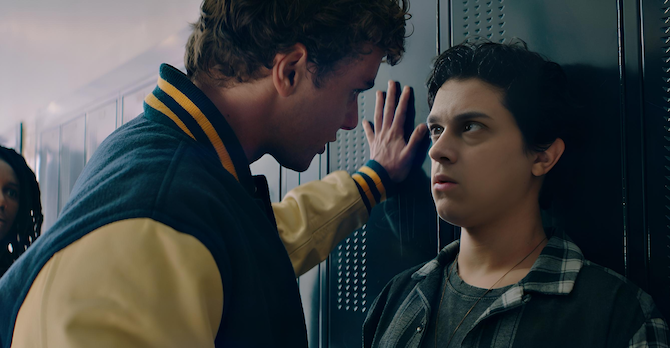
I remember a couple of years ago, I was consulting on a slasher screenplay that was dealing with this exact issue. A lot of the backstory revolved around the killer’s years at high school and him getting bullied. Twenty years later, he was taking out his bullies one by one. And the writer placed his big climactic ending in this random place. I think it was a loading dock or something. And I told him, “Are you crazy?? The climax needs to happen at the high school!”
That’s where you want your head for all of your creative choices as you’re writing that third act. You’re trying to connect back to as many moments in the story as you can. When you first add these to your script, many of the connections will be clunky. But you can rewrite them quickly, smoothing them out more and more each time. And the next thing you know, you’ve got a third act with 5-10 payoffs and your script feels way more interconnected and planned than your competition. And the ending’s just better. We enjoy it more.
And even if you aren’t struggling with your ending, I can promise you that it would benefit from a couple more payoffs. Again, you can’t add enough setups and payoffs in a movie. Audiences absolutely love them.
So what are you waiting for? Get to it.
