
Search Results for: F word
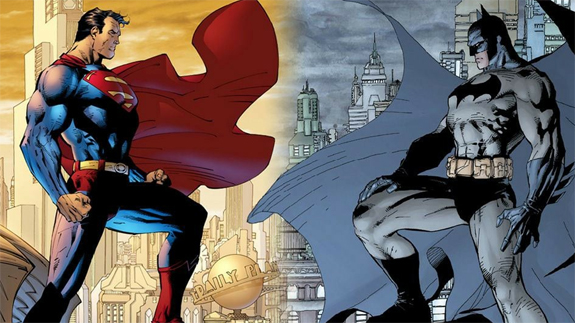
I think Warner Brothers is crazy. I do. Because despite their best intentions and all of their efforts to do this Batman vs. Superman thing, there is no way it’s going to work. Just no way. That’s not to say it isn’t going to make money. Zack Snyder’s style results in some of the best trailers in the business. So it’s going to look cool. And of course we’re going to get that 150 million dollar marketing campaign that will subliminally convince us that we will die of Bird Flu if we don’t go see it. But the movie is going to be terrible. Why? Because there’s no way to make the Batman Vs. Superman script work. There isn’t a single variable in the make-up of this pairing that lends itself to a good story. Which leads to a much bigger problem for the franchises than just this film. If it’s as ridiculous as I’m assuming it will be, you end up killing the Golden Goose, just like Joel Schumacher did with the last Batman franchise. Both franchises, then, could be catastrophically injured.
I bring this up not from a place of hate. I’d love to see a great Batman vs. Superman movie. I bring it up from a place of knowing what makes a good story. In an imaginary world where Warner Brothers came to me with this idea and asked me to write it, I would say, “It can’t be done. There are too many things working against it.” I want to get to those things, but first, let’s recap how we got here.
Warner Brothers, who has much of the DC Universe under contract, has been watching the way Disney/Marvel’s been methodically parading out solo movies for their characters (Iron Man, Thor, Hulk) and making a lot of money off them. They said, “Hey, why can’t we do that? We have other superheroes besides Batman and Superman.” So they kept developing the Wonder Woman project. They gave us Ryan Reynolds as The Green Lantern. And the results of these experiments were… not good to say the least. It was then that Marvel took over the movie world with its orgasmic super-hero fest, The Avengers. Warners had had enough. They wanted to do their version of The Avengers, Justice League, but, as we already established, didn’t have the characters. But gosh. That Avengers made so much money. We have to have an answer to it. Batman vs. Superman has been kicking around Hollywood forever, and this seemed like the perfect time to bust it out, so they pulled the trigger. Their argument was, “We got the two best superheroes around. We don’t need anybody else.” And hence we got Batman vs. Superman. With Ben Affleck to play Batman to boot (that casting choice is a whole other discussion).
Here’s the problem though. Famous Character X vs. Famous Character Y movies never work. In fact, they actually work against the franchises because all of them carry a whiff of desperation. As a studio, you bring these out when the characters are stale or dying. Freddy vs. Jason? Oh yeah, that was a good one. Alien vs. Predator. Does anyone even remember what that was about?? Why are we bringing together two franchises that are just fine? Here are a few more thoughts I’d like to add.
It’s a gimmick, not a movie.
“Versus” movies are always gimmicks. Instead of being able to create a journey for the main character that will end up being our main plot (i.e. Lex Luthor holds America hostage and Superman must stop him), the whole script must be geared towards figuring out a way to get these two to fight. So you’re already starting from an artificial place. You’re trying to push something on the audience that isn’t natural and therefore will never feel natural, no matter how many writing tricks you use. I’m sure Goyer and Snyder will do their best, but I’m willing to bet my right hip that while you’re watching this film, you’re going to notice a ton of really ridiculous exposition that sets up why Superman and Batman will have to fight.
Tone mixing
The tone between the two universes is too different. Batman’s darker, more realistic. Superman has super powers and aliens. Superman’s also set in a more idealistic world, despite Zac Snyder’s best efforts to eliminate that idealism. In Superman, you still get cheesy lines you’d NEVER see in Batman like, “The world’s too big mom.” Or an overly-melodramatic death where someone’s father perishes in a Level 5 tornado. Combining super human heroes with mortal human heroes and keeping the tone universal is going to be a bitch to do right. I guess The Avengers somehow mixed a Norse God into their story, but I’m guessing Batman and Superman are always going to feel like they’re in different movies. The tonal bubble that surrounds each is too different.
Neither character can win –
This is probably the biggest challenge they have in the script. Neither character can defeat the other. Both are too big and too important to the studio to lose at the end of the movie and the fanbase for each is too passionate to take on when said favorite loses. That means we’re going to get the mother of all cop-outs where both characters battle each other with all their hearts, then come to a truce at the end. It will be monumentally unsatisfying. You know that great feeling you get when the hero defeats the bad guy at the end of the movie. Batman vs. Superman can’t have that, which is going to leave you feeling confused. “Wait, a tie? Well then what was the whole point of the movie?”
False Character Motivation
How do you motivate this fight? Like motivate an all-out “to-the-death” battle between Superman and Batman? There’s nothing you can do. Superman won’t want to kill Batman. And Batman doesn’t kill good guys who have made their mark by doing good and saving thousands of lives. Any motivation you give these two to fight each other is going to feel entirely fabricated.
It’s not a fair fight, so anything they do to make it fair will feel like cheating.
As a writer, the actual battle between these two is impossible to write. This comes down to geek obviousness. There’s no way for a mortal man to defeat a superhuman. True, we have the whole kryptonite thing, but what’s Batman going to do? Lace himself with kryptonite? Would Nolan’s Batman ever do something like that? Of course not. It’s too silly, too bizarre, bringing us back to the tone issue. These two don’t work in the same universe. They operate in completely separate worlds. The writers (I’m assuming someone will come in to help after Goyer) will have to design all these artificial elements to even the fight out, and it’s going to make everything feel fake and manufactured. I could see this working in the broad universe of a cartoon. But live in a dark supposedly “realistic” world? It’s going to feel silly.
This leaves us with one obvious question: What WILL they end up doing? Well, I’m not in their heads, but the best way to approach this is to probably create some nasty villain that Batman and Superman are both going after. They may even have to team up since you want these characters around each other as much as possible. But they don’t see eye to eye and something goes wrong. Batman splits off and decides to do it his own way, and much like The Dark Knight, he goes too far. In fact, Batman’s been going too far in his street-cleaning crusade for awhile now. But local law enforcement can’t stop him, so they have to bring in Superman. There would also have to be some secondary plot where Bruce and Clark are interacting as normal people, possibly in a reporter-interview capacity so you can get a lot of dramatic irony in there via their interactions. But I contend it’s just going to be stupid and cheesy and forced when they fight. Why would these two fight each other than nerds wanting them too???
Whenever you stoop to a “fan-fiction” level with your story, you run the risk of killing it. Because you’re making the movie for the wrong reasons. You’re not trying to tell a good story. You’re trying to answer a geeky question. Who wins if Superman and Batman fight (we already answered this, of course: neither). Which is why these things need to be kept to dorm rooms at 2 a.m. after the final strand of weed has been toked. The idea “Batman Vs. Superman” sounds rad for two seconds, but when you really think about it, how they would actually make it happen, it falls apart immediately. The trailer for this will be great, but mark my words, there’s no way for this script to survive. Which is exactly why, despite them developing the idea for 20 years, no one’s cracked it yet. With that said, I leave it up to you guys to prove me wrong. How would you write Batman vs. Superman? Is it, indeed, impossible?

Carson, here– I’m currently stuck in someone’s basement. Say no to strangers, kids. Especially if they don’t know the secret word. But not to worry. Last week some of you were asking to hear from a genuine script reader. Today I’m making those dreams come true. Here’s Matt, who read for a couple of production companies. He’ll tell you what kind of people you’re trying to get past, and has even offered to answer questions in the comments. So shoot them out there after you read his article, which is damn good!
{Note: These are my experiences having worked as a reader for two production companies. As I learned by working with two different companies, every process is slightly different. But I also learned that for the most part, they’re incredibly similar. Also note, I will not, for what should be obvious reason, be publicly naming any names.}
Okay, so what I’m going to do is a bit of a faux-interview in that nobody is actually interviewing me, but I’ll present some questions and answer them, and go into the details of my experience as a script reader, advice, etc. Some of this is probably blatantly obvious to many of you, some of it may not be. I’m just putting it all out there.
My Background
In short, I started writing when I was 17 after I watched (for the first time), Pulp Fiction, Taxi Driver, and The Departed (the latter had just come out the year prior). Before that I had maybe seen fifty films in my entire life, and none of them were like those movies. Long story short, I found this amazing website called TriggerStreet, became a member (which was against the rules since I wasn’t 18 yet), and read and reviewed at least four hundred scripts on that site over the years, and wrote many myself. I met some incredible people, and eventually moved to Los Angeles and remain good friends with many of them. I mention this because it is a wonderful site to get feedback on your scripts, as well as read others’ work (which is an invaluable learning experience unto itself). I encourage you to check it out.
How’d I get a job as a reader?
I don’t know how most people do it. I never asked them. Mine was sheer blind luck. I was 19, living in Ohio, and I ended up working on a documentary for some people that flew in from Los Angeles. The director happened to have worked for this company in the past, and he said he’d set me up with an interview. I did a phone interview and sample coverage and there you go. I was getting paid to read scripts.
The Process – What did I do?
I would get a script emailed to me. I knew nothing about the script other than the title. No logline. (this applies to both companies) They’d give me a deadline, though usually I’d do it much faster so I could get another script to read. I’d read the script, and fill out a coverage sheet. The coverage sheets vary from company to company, but all of them are essentially: a one page synopsis and then rating (scale one to ten usually) and describing the concept, story, dialogue, character, and marketability. I would also assess (obviously a guesstimate) the budget (low, medium, high). Then I’d tell them whether I recommended the script or whether it was a pass. If I recommended it, it would be kicked further up the ladder for someone else to read. If I passed, that was the end of it. And that last part is why lowly readers like myself (well, okay, there is someone even lower – the unpaid intern) are so important. If you submit an unsolicited script, you can bet that it’s going to be read by someone like me. Or, as I mentioned, an unpaid intern.
About Unpaid Interns
Unpaid interns are people who pimp themselves and their knowledge out for free in the hopes of one day securing a job. Go to Los Angeles Craigslist TV/Film jobs, and you’ll see how many unpaid internships are floating around out there. I’m generally against this type of work, for a variety of reasons. One of which is that unpaid interns write HORRIBLE coverage (no this is not universally true, but almost). When I say horrible, I mean that their coverage often lacks attention to detail and at least fifty percent of them I read indicated a significant lack in ability to form a coherent sentence. And I largely think this is because they’re unpaid! As The Joker said, “If you’re good at something, never do it for free.” But like I said, this isn’t universally true. I’ve read plenty of coverage from unpaid interns who took it very seriously and were incredibly diligent.
Know Who You’re Sending Your Script To
One company I worked for would get all types of scripts, all different genres. The other company worked primarily in comedy. Don’t send your sci-fi adventure script to a company who only makes low budget dramas! Do some research about who you’re sending it to first. This will maximize your potential, waste less time, and if you’re querying a company (yes it does work sometimes), you can personalize the query.
What Kind of Scripts Did I Read?
Everything. And I mean everything. Like I said, one company dealt specifically in comedy, so I didn’t read everything there. The other company… I read low budget dramas, I read comedy, I read high-octane action scripts. The longest script I ever read was 138 pages, and the shortest was 57 pages. Yes, 57 pages, and no it was not a TV pilot. I’m not sure how or why that script was selected, but I suspect it was as a favor.
Did I Ever Recommend a Script?
Yes. For every hundred scripts, I probably recommended five of them to go up the chain. Does this mean I’m a hard-ass? Maybe, but probably not. It simply means that a majority of scripts aren’t ready for the big time. And there were times when I did not recommend a script, but I’d recommend the writer. Maybe the script would be too expensive. Maybe it wasn’t quite right for them. But the writing was excellent. So I’d recommend the writer, but not the script.
What Happened if I Recommended a Script?
Well, I’m not 100% in the know on this in terms of every single step that would happen. I never followed up on scripts, I just did my job and read them and provided feedback. But what I can say is that if I recommended it, it would get kicked up to my boss, who wasn’t the top of the ladder, but certainly had some strings they could pull and stuff might happen. From what I understood, it would get kicked up to this person, and they would read it, and if they liked it, then they would have other people read it for more feedback. This was the case not only where I worked, but many other agencies, production companies, etc. One person who has a lot of sway may like a script, but they will almost always have other people that they work with read it to get their opinions too. So once you get past the lowly reader, you (usually) have to not only impress whoever they kick it up to, but probably two or three other people as well before you’ll even hear back from them.
Essentially, you have to make quite a few people fall in love with your script before anything will happen. On the bright side, it’s incredibly rare that every single person who reads it loves it. But if six people at the company read it, and only one doesn’t like it, you have some good odds.
I do believe that I once recommended a script, and while the script was not purchased or made into a film, the company hired the writer to do some other work for them. That kind of ties into the “recommending the writer” thing, except I also recommended the script in this case.
What Did I Look for in a Script?
Great writing, of course! But more so than that, I wanted originality. I wanted scenes and characters I hadn’t seen before. And I wanted to be MOVED in some way. It doesn’t have to be to tears. A horror script might creep me out. A thriller might… thrill me. If you can make the reader feel something, you have just improved your odds of a recommendation ten fold.
What to Avoid in Your Script
None of this stuff is guaranteed to screw you if you have it in your script. It’s simply a matter of increasing your odds, and these types of things will most likely lower them.
Big budgets
If you’re writing the next Pacific Rim, it may not matter how amazingly well written it is, if the company can’t make that kind of film, they can’t make it. The chips are a bit stacked there. Sure, these films tend to be more marketable and make more money, but bang for your buck? Horror and comedy. Thrillers are also a much easier sell. But, if your heart is set on that big-budget action film, go for it. You have to write what you love, or your script will suffer. And there ARE companies looking for that stuff. Same goes for sci-fi.
Being Too Subtle
This is incredibly tricky. All good films have their subtleties. Their subtext. All good scripts have them. But when it comes to readers, some of whom don’t put much effort in at all, there is such as a thing as being too subtle. Problem is, of course, there’s such a thing as hitting the reader over the head. It’s such a tricky, fine line to balance that I can’t possibly explain how to walk it. But simply keep in mind, you can be too on-the-nose, but you can also be too subtle, and it will completely go over the inattentive reader’s head.
Directing from the Page
Sometimes this is perfectly fine. But a lot of amateur writers completely overdo it, and it’s ANNOYING. Not only does it make for a tedious read, but if it ended up being produced, the director will do whatever the hell he wants. Use these only when ABSOLUTELY necessary, and I would say no more than three times in a script.
Music Cues
Unless the music is playing in the scene itself, don’t include it. You’re not writing a friggin’ soundtrack. Not only will they totally ignore your ideas if it was produced, but it’s really damn annoying to read. It pulls the reader out of the script, and that’s the last thing you want.
There are of course many other things to avoid, but those four in particular are important when it comes to the lowly script reader. The rest (like less black more white on the page, too many characters, etc.) are just universally good to avoid.
Myths About Readers
In my time spent on Triggerstreet and in the screenwriting world in general, I heard a lot of these (and probably more). After working as a reader, I realized how many of them were just utter bullshit. Note: this applies to readers only, not to people like development executives. It applies to the lowest people on the totem pole (which are the first people who will read your script in most cases, unless you know someone higher up and can bypass these people).
If you don’t hook them in the first ten, they’ll throw your script in the trash
No, they won’t. Not only is this the age of the Internet, where it would be the recycle bin instead, but none of that will happen. Why? These people are PAID (or sometimes not paid, but it’s still their job) to read the ENTIRE script. As I mentioned above regarding the coverage sheets I would fill out, I had to write a synopsis! You can’t do that unless you read the entire script.
Now, this is one reason I specified this applies to readers only. A development executive, for example, who isn’t paid per script and has no obligation to read an entire script, will most certainly toss your script if he doesn’t like it after ten, fifteen, twenty pages. I’ll never forget one script I got into the hands of someone who could make shit happen and their response: “gave it twenty pages, good writing, liked it, didn’t love it, thanks for sending.” But the little guy that works for someone like him who’s paid to read scripts and send the good ones up the ladder? THEY READ THE ENTIRE THING.
Grammar/Spelling/Formatting
Your script will not be discarded if you make a few grammatical, spelling, or formatting guffaws. This goes back to the “they are paid to read the entire thing.” However, if your script is rife with errors, it will give the (potentially incorrect) feeling of amateurism. So it’s not entirely a myth that this stuff can sink a script, but it is a myth that it’s guaranteed to screw you over if you have a few mistakes here and there. Nobody. Cares.
Directing From the Page
Yes, I said to avoid this. And you should. But like the grammar/spelling thing, if you do this a few times in your script, no one will care. I promise.
Dramas Won’t Get Read
Wrong. They just might not get sold. But as a reader, if I got a script and I liked it, I would recommend it. I didn’t care about the genre (and I wasn’t supposed to). But there’s a bright side: there are niche markets for low budget indie dramas. There are companies who specifically cater to this and WANT these kinds of scripts. This goes back to my “know who you’re sending your script to.” IMDb Pro is a great place to get information like this. Also, you can do as Carson suggested, and throw in a hook.
Query Letters are Pointless
Nope. They may be pointless if you’re trying to get The Weinstein Company to read your script. But there are plenty of companies out there who accept unsolicited submissions (one I worked for had a link on their page to submit to). Once again, IMDb Pro can be very helpful here. (note: don’t ever pay for those mass query services)
Only Scripts that Are 90-120 Pages Long Will Get Read
Wrong! As I mentioned above, the longest script I read was over 135 pages. The shortest was 57! Now, there is a bit of truth in this, though I would adjust it to 80-120 pages. That’s the range in which 98% of the scripts I read fell. How that 57-pager got in is beyond me. And too long can definitely be a turn off, but by and large, it’s all about your pitch and the concept. The company doesn’t care if their reader has to read an extra long script. They get paid the same amount. But like I said, it’s definitely extremely preferable to stay between 80 and 120 pages.
They Want True Originality!
Kind of. Here’s the thing, and this isn’t coming from the way I would personally assess scripts, it’s coming from the bajillions of other coverages I read. Sometimes true originality can baffle readers. They don’t know what to make of it. This is where the old adage “same but different” comes into play. And it’s a fine line. Not too much the same that they say “we’ve seen this before”, but not too different that they don’t know what to make of it. Though I also firmly believe that a great script, with a solid grasp on storytelling principles, original characters, and an original story WILL find a home.
Okay, Carson said to write about 2000 words and I’ve already exceeded that, so I’m going to wrap this up with some closing thoughts.
The single best piece of advice I can give is to love what you’re writing. Don’t write something because you think it’s more likely to sell or whatever. I’ve tried it, and I didn’t even finish the script. If you’re not 100% devoted and excited about your story, it WILL show. Believe me.
And, in true ScriptShadow fashion….
What I Learned (by being a reader): Obviously, all of the above. But beyond that, know what you’re writing about. I could tell when someone was writing about a subject that they had never researched or experienced. To write a war film, you don’t have to have been in a war, but you damn well better research that shit. Otherwise you’re just gleaning information from other films and TV and it comes off as derivative. Also, I highly suggest, unless there’s some sort of deadline, to wait two weeks after you finish your draft before sending it to anyone. Why? That kind of time gives you distance and allows you to be a bit more objective about your work. I would read some scripts that had a draft date that was a week before I received the script (which means they probably submitted it to the company the day they finished it). Don’t do this.
I hope you guys found at least something in here a bit helpful. I am more than happy to answer any further questions in the comments section (I post as “Matty” with the little George Clooney head). Those two thousand words went quickly!
Have an A-1 day!
Genre: 1 hour TV Drama/Sci-fi
Premise: A Secret Service agent goes to Wayward Pines, Idaho in search of two federal agents who have gone missing in the bucolic town. He soon learns that he may never get out of Wayward Pines alive.
About: The show was bought on a spec by Chad Hodge, which was based on a book. Hodge has been working in TV for awhile, getting on-air with the shows “Runaway” and “The Playboy Club,” but hasn’t been able to cross that mighty threshold known as the “2+ season show.” Ahh, don’t we all wish we could be there. He’ll have a little help this time, however, from M. Night Shyalaman, who’s executive producing the series at Fox. The show has some serious actors to help as well. Matt Dillon, Carla Gugino, Terrance Howard, Melissa Leo, and Juliette Lewis will all partake in this maze of a story. I thought the show was coming out this year, but apparently it’s not premiering until 2014. It’s either a Fox or FX show (it’s not totally clear which).
Creator: Chad Hodge (based on the ebook by Blake Crouch)
Details: 63 pages (October 23, 2012 draft)
There was a time when anything M. Night Shyalaman did was shrouded in secrecy. He was the master of the mystery (before JJ Abrams came along). Nowadays things are a little different. However, there’s a part of me (and I assume, us) that’s still curious whenever M. Night introduces a new project. Will he bring us back to that Sixth Sense magic? And when you hear that they’re going for a “Twin Peaks” feel with this – well, the mind is definitely curious. All on top of a show based on an e-book (keep writing those e-books people – Hollywood is snatching them up!). Might this unique equation result in the next big thing on TV??
37 year-old special agent Ethan Burke is driving along in the middle of Idaho with his partner, Pete Stallings, discussing how the heck two other secret agents could’ve disappeared. That’s why they’re here in Idaho, heading to “Wayward Pines.” Two special agents were sent there on a mission last week and never reported back. Now these guys have to find out what’s up.
Turns out only one of them will figure that out. A MACK truck appears out of nowhere, slamming into the car and instantly killing Stallings (ironically in a very un-stall’ish maneuver). That’s our teaser. When the cops finally find the car, it’s all but annihilated. But there’s a curious difference from the last time we were inside of it. Ethan’s no longer in it!
Turns out Ethan flew a hundred feet out of the car into the forest, and no one saw him. Which is where we pick him up. Bruised and bloodied, he stumbles along the road where he finally reaches a small town. And wouldn’t you know it – that town is Wayward Pines!
That much is good. But what isn’t good is that everyone treats poor Ethan like he’s a moron from outer space. Nobody seems helpful, and even after he ends up at the hospital, no one seems to know where his burned up car is, where his stuff is, or why he keeps babbling on about being a secret service agent. Eventually Ethan gets so fed up that he sneaks out of the hospital and into town, where he meets a waitress, Beverly, who, after a little chat, tells him to stop by her place if he needs help.
He does, only to find one of the agents he was looking for brutally tortured and burned to a crisp. Not cool! Ethan goes running back into town, telling the sheriff that his co-worker has been tortured and killed, but just like everyone in this getup, Large N’In Charge doesn’t seem to be that interested. What the hell does a guy need to do to get a drink around here!
Later, Ethan meets up with Beverly again, who tells him that she’s just like him. She got stuck in this town and has been here for an entire year. “What year is it?” Ethan asks. It’s 1986! Holy debut of the Oprah Winfery Show! If that isn’t weird enough, Ethan eventually DOES run into that other female agent he was looking for. There’s only one problem, she’s 13 YEARS OLDER than the last time he saw her. What in the Challenger crash is going on here?
And that’s only a fraction of the questions asked in the debut of Wayward Pines. You get the feeling that this show is going to have Lost-level story threads to resolve. But is it a good enough show to warrant all those threads? Or is this just gobbledy-gook covering up the fact that there’s no story?
Well that’s a good question. I don’t know! You see, with feature screenplays, the answer’s always there for you. If you read to the end, you find out if the writer knew what he was doing or not. With a TV pilot, there’s no way for you to tell. Because many of these questions don’t have to be answered for weeks, sometimes even years!
That’s why it’s so hard to write these types of shows for TV. If you don’t have a set amount of seasons, you have no way of knowing whether to speed up your storyline or hang back. And a show’s lifespan is often hanging in the balance unless you’re Gray’s Anatomy or Modern Family.
But getting back to Wayward Pines, I thought this was pretty damn good. We may only have questions to judge this on, but the questions were definitely entertaining. I want to know how we went 20 years back in time and yet one person has aged 13 years while another has only aged one.
And the writers were smart. One of the agents our hero is looking for is a former flame who almost broke up his marriage. In other words, there’s a CONNECTION there, and you need those relationship connections in a movie to balance out the relationships that are new to the character. And plus I just like the idea of this unresolved love affair that’s complicated by a strange nefarious town, the aging of one of them 13 years, and the fact that she’s now married to one of the Wayward Pinians! These are not your average issues you have to deal with. And that’s what you want when you write any type of script. You want relatable, but the ‘on-steroids’ heightened version of relatable.
And then it’s got that “Lost” goal going for it as well – that goal that’s always going to be there for every episode: GET OUT. They had to find a way to get off that island. This guy’s gotta find a way to get out of this town. As long as you have that pull dominating every episode, it gives your show a little more juice. It’s not as exciting, obviously, if this show was framed as a man going to a strange town, looking for missing people, who could leave whenever he wanted.
As for the script’s faults, there were a few here and there. Our character’s partner is killed but he pretty much forgets about that after five seconds. True he’s frustrated and wants to get out of this town. But we probably need more than a “You’re kidding me,” when he finds out his partner’s dead. And it was frustrating that every single person was so unhelpful. I couldn’t figure out if this was being done because people were purposefully trying to mislead him or because it made the script cooler. I guess it makes sense if everyone’s in on it, but I find that hard to believe. And even if they were in on it, you’d think they’d at least PRETEND like they weren’t. So when he says to the Sheriff, “an agent’s been tortured and burned to death,” why isn’t the Sheriff pretend-acting like a real person would. “Oh shit! Where!?” The fact that he’s more interested in getting a drink is basically proof that he’s a bad guy. And if that’s the case, why not just tell Ethan. “Yo, I’m a bad guy and you’re now stuck in this town. Get used to it.”
Then again, that’s the dance you’re always doing with these kinds of scripts. How long can you keep the secrets and reveals before it gets ridiculous?
This kind of thing has been done before (most recently in the underrated The Prisoner). I thought that was pretty good but it got cancelled. So I’m not sure what’s the formula for success here. But from this pilot alone, I think they have something pretty cool. With that talent pool they’re working with, I find it difficult to believe that people won’t at least check out the first few episodes. Where it goes from there is up to the TV gods.
[ ] what the hell did I just read?
[ ] wasn’t for me
[xx] worth the read
[ ] impressive
[ ] genius
What I learned: A technical tip today. There are times where you have to change a character’s name in a script. For example, if a character has a secret identity, then later reveals himself to be someone else, you have to start using that new name. Problem is, the reader’s used to the old name. So cold-turkey changing the name can be jarring. In these cases, for the first few times you use the character’s changed name, include both names – the previous and the new, divided by a slash.
So in this pretend scene in a back alley, a mysterious man named Anderson hands a character we’ve seen before (Frank) a bag of money.
ANDERSON
How’s it going, Ray? It’s all in there.
It’s Frank, the doctor who chatted Ethan up back at the bar. But Anderson just called him “Ray.”
FRANK/RAY
Thanks.
ANDERSON
Welcome. We all good?
FRANK/RAY
We’re all good.
Frank/Ray struts over to his car, gets in, and drives away.
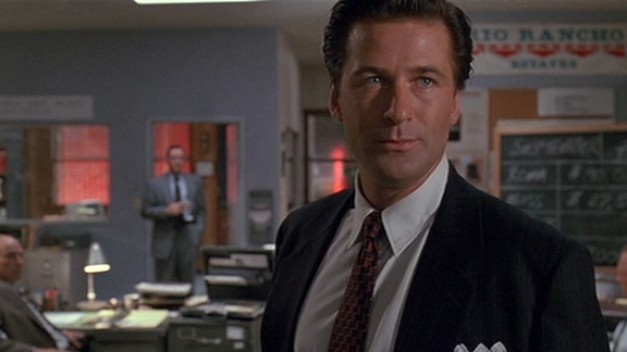
Glengarry Glen Ross is one of those films that flew under the radar because of its ultra low-budget look and feel. As moviegoers, when we don’t see our movie stars perfectly lit in front of A-level sets, we get suspicious. “Is this one of those vanity projects?” we ask? The kind where the acting is great but the story sucks? We’ve been burned by too many of those before so no thanks. But Glengarry is one of the few “vanity” projects that was also a great story (and a great film!). I mean superstar screenwriter David Mamet (who was paid 1 million to turn his hit play into a script) wrote the thing. And to many, this is his best work. There are, of course, three things that one remembers from Glengarry – Jack Lemon’s amazing performance, The Alec Baldwin scene (which was written exclusively for the film – it was not in the play) and the razor-sharp dialogue. In honor of that dialogue, I’ve decided to make today’s “10 Tips” all dialogue-related! Enjoy!
1) Your characters should only speak when they have something to say – Without question, one of the biggest mistakes I see from amateurs is characters who are only talking because they’re in a scene. If characters are only talking because a writer’s making them, the scene will be maddeningly boring. What’s so great about Glengarry Glenn Ross is that the characters never say anything unless they want something. They may want to close a deal, they may want to beg for leads, they may want to let their boss know how pissed they are, they may want to vent their frustrations to their co-workers, they may want to convince someone to steal the leads with them. But they’re always speaking for a reason. If your character doesn’t want anything, they probably shouldn’t be saying anything.
2) Use dialogue to reveal character whenever possible – When characters speak, try to occasionally tell us something about their character via dialogue. For example, Blake (Alec Baldwin) is gearing up for his classic monologue early in the script. He turns to Williamson (Kevin Spacey). “Are they all here?” “All but one.” “(checks watch) Well, I’m going anyway.” In other words, this is the kind of man who doesn’t have time to wait for others. That’s what we learn about Blake through this line of dialogue. You should try to reveal character through dialogue wherever you can.
3) Ask and you shall receive… a better response – When a character asks another character a question, the simplest answer is usually the most boring. “How are you?” “Good. How bout you?” If this is how your characters speak, God help you. You can do better. In the famous Blake (Alec Baldwin) monologue, one of the salesmen asks, “What’s your name?” “Fuck you, that’s my name. You know why, Mister? ‘Cause you drove a Honda to get here tonight, I drove a sixty-thousand dollar B.M.W. That’s my name (original dialogue).” What would you have written had someone asked Blake “What’s your name?” Hopefully something just as unique.
4) Specificity in monologues – Monologues, like Alec Baldwin’s, work best when the speaker is being SPECIFIC. This monologue would’ve sucked had the character unleashed something general like: “You guys are all lazy bums! We give you leads and what do you do with them? Jack shit! You need to stop fucking around and work harder to secure these guys!” There’s no specificity there. Anyone could’ve written that! In Mamet’s version, we learn about ABC (Always be closing), A.I.D.A (Attention, Interest, Decision, Action), we learn Blake drives a 60 thousand dollar BMW, we learn his watch costs more than what these guys make in a year, we learn he’s from Mitch and Murray, we learn about the coveted sparkling wonderful Glengarry leads. The monologue is convincing because it’s not just a bunch of general bullshit. It covers a lot of details. Make sure to do the same with your monologues.
5) Delay an answer to a question! – Just because a character asks a question during a conversation doesn’t mean the other character has to answer it right away. We see this during another great moment in the Blake monologue. Moss (Ed Harris) challenges Blake with, “You’re such a hero, you’re so rich, how come you’re coming down here, waste your time with such a bunch of bums?” Blake looks at him for a moment then keeps on yelling at everyone. A few minutes later, out of nowhere, he turns back to Moss: “And to answer your question pal. Why am I here? I came here because Mitch and Murray asked me to, they asked for a favor, I said the real favor, follow my advice, and fire your fuckin ass, because a loser is a loser.” A conversation is never a straightforward thing. It jumps around a lot. Never forget that.
.
6) CONFLICT CONFLICT CONFLICT – I’ve said it before and I’ll say it again. One of the easiest ways to create good dialogue is through conflict. In almost every single scene in Glengarry Glen Ross, one character wants something while the other character wants something else. Take the famous scene where Shelley Levene (Jack Lemmon) begs Williamson (Kevin Spacey) for the Glengarry leads. The entire scene is built on the principle that Levene desperately wants those leads while Williamson is determined not to give them to him.
7) Phrase exercise – To find out your character’s unique way of speaking, take a simple phrase, then have your characters each say it in their own unique way. This is not to happen in the script. Do this in a separate document. The goal is to get a feel for how each of your characters speak. Take the phrase, “Good luck.” Let’s see how each of the characters in Glengarry would say this. Blake actually says in the script, ““I’d wish you good luck but you wouldn’t know what to do with it.” Bitter Shelley might say, “Good luck you miserable cocksucker.” Pathetic Williamson might say, “Good luck” laced with heavy sarcasm. Earnest Aaronow (Alan Arkin) might say, “Best of luck, Frank. You deserve it. You really do.” If each of your characters wouldn’t have their own way of saying a phrase, you either don’t know your characters well enough or you’re not doing enough with your dialogue.
8) A negative temperament for at least one character in a scene typically results in interesting dialogue – Some of the best scenes in Glengarry are when Shelley (Jack Lemon), wreaking of desperation, tries to get others to do what he wants (getting those Glengarry leads, trying to get the husband of the woman he talked to on the phone to come around). Whether it be frustration, desperation, fear, anger – Negative dispositions are your friends when writing dialogue.
9) Liar Liar, dialogue on fire – Dialogue is always interesting when someone’s lying. Why? There’s a natural inclination for us readers to find out if the other party’s going to figure it out or not. Glengarry is one big lying fest. Shelley’s lying to all the leads about how they “won” a contest. Roma (Pacino) spends the entire movie lying to his mark. Ross (Ed Harris) and Aaronow (Alan Arkin) are lying about robbing the place. When a character has something to hide, the dialogue always has an extra spark to it.
10) Give your character an interesting angle going into a scene – Instead of just placing two characters in a scene and letting them talk, try to find an interesting angle for your key character. So in the Glengarry restaurant scene, where Roma (Al Pacino) is trying to con a customer into a sale, there’s a million ways Mamet could’ve approached it. He could’ve had Roma be straight forward, he could’ve used the hard sell, he could’ve had him focus exclusively on the numbers, he could’ve made it seem like a great deal then played hard to get. Instead, he has Roma SEDUCE the man. He treats him like a date, someone he’s wooing. He slowly cuddles up to him, makes the man believe in him, and that’s when he goes in for the kill. Seduction, I believe, was the best option for interesting dialogue in this case. It allowed for all this fun philosophizing on life that you wouldn’t have gotten otherwise. If you want good dialogue, make sure your character is approaching what he wants from an interesting angle.
Genre: Sci-fi
Premise: In a future where the world’s been frozen over, a young man on a train that never stops leads a revolution to topple the train’s tyrannical leader.
About: Snowpiercer was co-written by Korean director Joon-ho Bong, who’s making his first American film. He’s best known for his films The Host and Mother. Kelly Masterson, who made revisions to the script, wrote the excellent “Before The Devil Knows You’re Dead,” yet strangely hasn’t written anything since (that was an excellent screenplay – so I’m kinda shocked he didn’t blow up after it). Snowpiercer stars Captain America himself, Chris Evans. It’s already been shot and will be released later this year, although curiously, no release date has been set.
Writers: Joon-ho Bong and Kelly Masterson, based on the French comic book series created by Jacques Lob, Benjamin Legrand, and Jean-Marc Rochette
Details: 110 pages (final draft – 11/11/11).
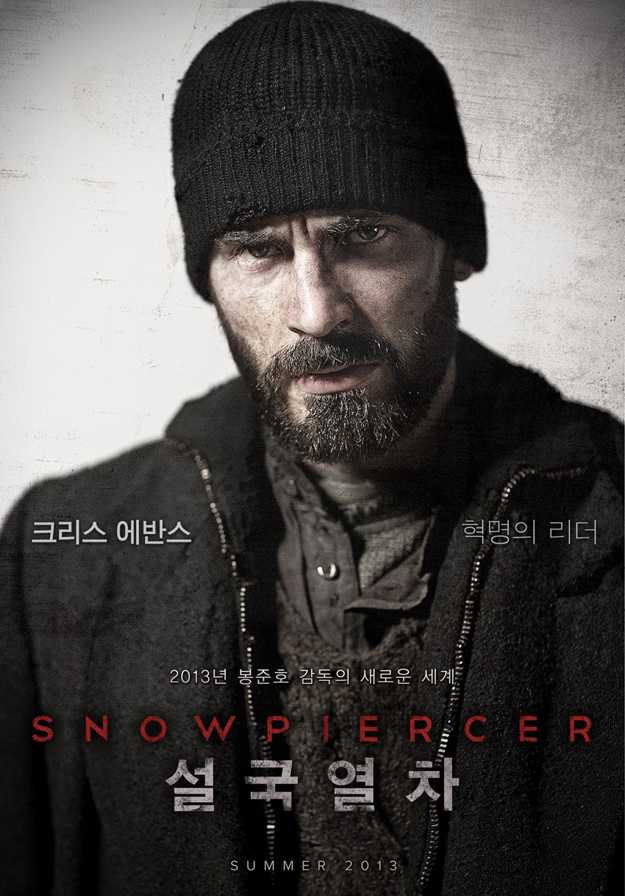
Along with its cool title, hip director and shiny lead actor, Snowpiercer has itself some pretty slick visuals if you’re to go by its trailer. Ever since I saw The Host way back when, I’ve been intrigued by Bong as a director. The guy was one of the first to prove that big effects didn’t have to come from a Hollywood budget. I guess it was only natural, then, that he’d work his way over to the states.
However, the U.S. is a little different, and something I’ve noticed over time is that the Asian point of view doesn’t always translate well in the U.S. And it probably shouldn’t. Cultures are different. They like a lot of different things. I saw that earlier this year with the Chan-wook Park film, Stoker. And I saw it with The Host, too.
I bring this up because my opinion on Snowpiercer is not a good one. And I don’t know how much of that is because of bad storytelling or because of a cultural divide. But this script did not work for me. I guess because I wanted it to succeed so bad, I’m looking for excuses why it didn’t.
It’s 2031, 17 years after the world’s nations sent a chemical called “CW-7” into the air to stop global warming. Looks like their chemical worked a little too well. It’s now freezing out. Worse than a morning-Chicago-commute-in-February freezing. Almost everyone died in this global freeze-a-thon. Except for a few lucky ones, like Wilfred. Wilfred was one of the few who foresaw the chemical agent apocalypse, and so he built a train.
A train, you say? But how is a train the best option for taking on global freezing? That’s one of the many baffling questions Snowpiercer will pose. But yeah, so this eccentric billionaire built a train that travels around the world and never stops. It’s powered by a super-engine that never dies. How? Oh, you wouldn’t believe me if I told you. It’s one of the big reveals of Snowpiercer and it’s so ludicrous, I can’t repeat it. But, moving on…
So this guy, Curtis, is one of the poor souls at the back of the train. These are the nobodies, the slop, the trash. They live in deplorable conditions while the rich eat their caviar and drink their champagne in the front cars. Too bad for them, Curtis is tired of being left out. So he puts together an army to march through all the cars and to kill Wilfred.
But first he’s going to need the gate opener, Namgoong. Namgoong designed the gates between each car before becoming a Chronole addict. He’s since been sent to prison with his 17 year old daughter, who’s ALSO a Chronole addict. Curtis makes a deal with the both of them. For every gate they open, he’ll give them a bag of Chronole. They’re in.
There are others who join the charge as well. They’re Tanya, whose child was stolen by the rich. She wants him back. There’s Curtis’s best friend and second-in-command, Edgar. There’s the old man of the club, 70 year-old Gilliam. Each wants to get to the front of the train for their own reasons. Not all will make it. And the ones who do (spoiler) will be shocked to find out their revolt may not have been their decision in the first place.
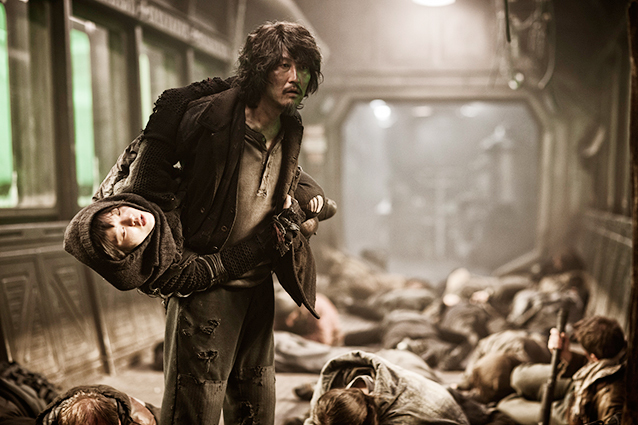
Oh boy.
I mean. Okay. Wow. Snowpiercer is one of the more bizarre pieces of material I’ve read all year.
One of the first things you want to make sure of when you write a script is that your concept passes the logic test. It needs to make sense and be understandable. Because if your concept’s weak, anything you place on top of it is going to make it weaker. Things are going to start creaking. They will start buckling. And pretty soon they will all fall down.
The concept in Snowpiercer? It’s the future. We’re in a self-imposed ice age. So in order to battle this a man builds… a train?? I’m sorry but how does this make sense? There is no connective logic there whatsoever. How does a train stave off cold? Wouldn’t it be a billion times easier to build a bunker? I mean then you wouldn’t have to worry about maintaining 30,000 miles of track over the course of 20 years, right?
To me, this was the script-killer of all script-killers. The mythology here was just too poorly thought-through. Nobody sat down and thought past the cool-factor of each idea. I mean, when you watched The Matrix, you got the sense that the Wachowskis knew their world inside-out. Even if you thought some of it was weird, you knew they knew it. That isn’t the case here. Most of the stuff feels like a sixth-grader thought it up and everyone just went with it without a second thought.
There were also some really goofy choices here. For example, one of the train cars they have to go through is a club. Like, “boom boom boom” – a dance club. In a world where these are the last remaining humans and every square inch of living space is vital, why are they wasting an entire train car on a club???
We also get weird lines of dialogue, like when one of the rebels throws a shoe at a guard, the resulting tantrum results in this line: “This is disorder. This is size ten chaos.” Or when it’s revealed that Curtis had to resort to cannibalism before he was on the train, he offers this line, “Do you know what I hate the most about myself? I fucking hate that I know what part of a human tastes good. I know that young babies taste the best.” I don’t’ even know what to say about that line!
I wish the faults stopped there but even the main character was confusing. I never really knew what made Curtis tick – why he wanted to do this. There’s this vague reference to him being afraid to lead, but it was never explored or explained in a way that we could get behind. I mean at least Tanya had a clear motivation – she was trying to find her kid. Why does a secondary character have a clearer and stronger motivation than your hero?
To the writers’ credit, there were a few fun characters. Namgoong, our drug addict, was kind of fun in a slightly-more-dangerous Han Solo way. There were these badass twin villains that I liked. There was this huge beast guy who makes an appearance in an early battle. There were definitely moments where I could visualize a cool scene in the theater.
But see, there’s the trap that so many writer-directors fall into. They’re so focused on the visuals that they don’t make sure it works on the page first. And it’s gotta work on the page. Bong has an amazing visual sense. The Host showed that. But you gotta give us a story or none of the visuals will matter. That’s Storytelling 101.
If I were writing this, I’d make everything about the train a mystery. The guys in the back have no idea why they’ve been on this train since they were born. And one day they decide they want to know more. And they start fighting their way from car to car. With each car, they learn a new clue as to what this train is and what they’re doing on it. In other words, instead of knowing the whole backstory before we meet our characters, we’re learning what’s going on as our characters do. I think that mystery would make this story a lot more fun. At the end, they’d probably find out that they were food for the rich (cannibalism is already a part of the script – this would allow them to incorporate it more fully).
You’d then have to redo the entire mythology. Get rid of the weird global warming “so let’s build a train” stuff. I still don’t know why a never-stopping train would need to be built for any reason, but I’m sure if a dozen Scriptshadow folks brainstormed the idea for twenty minutes they could come up with 10 better reasons than this one.
Of course, it’s all too late for that. The script has been shot. The movie is wrapped. I just hope Bong fixed some of these issues in the meantime.
[ ] what the hell did I just read?
[x] wasn’t for me
[ ] worth the read
[ ] impressive
[ ] genius
What I learned: Play devil’s advocate with every idea you come up with, especially when you’re creating new worlds in sci-fi or fantasy scripts. Snowpiercer could’ve avoided so many plot holes if someone would’ve simply challenged its goofy ideas. “Why would someone build a train to keep people warm?” “If someone has an undying energy source in a freezing world, why are they using it on a train instead of as a heat source?” “If nobody can live outside, who’s maintaining the 30,000 miles of track the train is on?” “Do you really think that 20 years could pass without a single track maintenance problem?” Playing devil’s advocate ensures the script doesn’t cheat.