
Search Results for: F word
Amateur Friday Submission Process: To submit your script for an Amateur Review, send in a PDF of your script, along with the title, genre, logline, and finally, something interesting about yourself and/or your script that you’d like us to post along with the script if it gets reviewed. Use my submission address please: Carsonreeves3@gmail.com. Remember that your script will be posted. If you’re nervous about the effects of a bad review, feel free to use an alias name and/or title. It’s a good idea to resubmit every couple of weeks so your submission stays near the top.
Genre: Comedy
Premise: (from writers) In a last ditch effort to sell his screenplay, a self-absorbed writer kidnaps actor Kevin Bacon.
About: (from writers) Carson, according to our mothers, we’re a couple of sexy, cool screenwriters with a fun little screenplay. According to us, we think you’re going to enjoy reading TAKING BACON. Why? Well, for starters, we’re already getting attention from some of Hollywood’s biggest movers and shakers. Who you might ask? Do Steven Spielberg and J.J. Abrams ring a bell? (this was sarcasm by the way).
Writers: Michael Fitzgerald and Matt Carrier
Details: 104 pages

Whoa, Taking Bacon was hit with the controversial stamp in Amateur Offerings last week. There were a few comments praising the script in the comments section that sounded less like a critique and more like mom and dad giving approval.
Truth be told, I wasn’t bothered by any of it. I loved this idea and since there was no clear winner in that Amateur Offerings bunch, I figured why not go with the concept that had the highest upside. Granted, this kind of script depends on getting Kevin Bacon, but it’s not like he’s having to fight off fans these days.
I figured even if I didn’t like Taking Bacon, maybe I could offer the writers some ideas on how to get it into shape. Comedy is rarely executed well on the amateur level. The story’s almost always a mess. As I do before every comedy, I say a little prayer to the script gods that that won’t be the case this time. Please, I said, let Taking Bacon be different. Did the Gods listen??
Like most movie characters, 33 year old screenwriter Morgan Wright isn’t where he wants to be in life. As in he’s an assistant at a production company. Sure he’s got access to one of the top producers in town. But being that close to someone who can change your life is almost as worse as being light years away. I mean every day you’re staring at the man who, with the flick of his wrist, could have you writing the next Jurassic Park. Yet whenever you mention your script to him, he quickly changes the subject and disappears.
The sorta good news is that Morgan gets fired from that nightmare. The bad news is he walks in on his girlfriend playing naked sex-organ tickle with another man. And that’s the point where his life officially falls apart. Recent breakups and unemployment are never the condiments you want to spread on your life sandwich. The only thing that makes waking up bearable anymore is that his new friend, Darrel, a security guard wanna-be actor, is even more pathetic than he is.
But Darrel’s got a pretty sweet idea. He’s got this business associate down in Mexico with a lot of money. Why don’t they just go straight to him for some financing and make their own movie!? Problem with that is, this Breaking Bad extra lookalike wants a star. So Darrel offers up a white lie. He happens to say that his favorite actor, Kevin Bacon, (who he’s seen like 50 times in Wild Things, freeze-framing every time the Bacon full-frontal shot happens for reasons unbeknownst to anyone in the script) is attached. Going off this information, the shady Mexican businessman says, sure, bring him down here and let’s make a movie!
So the guys head down to Comic-Con where the Baconator is heavily promoting his next film – Hang Glider! It’s about a guy who hang-glides. They approach him about starring in Morgan’s current script (an alien musical) but he blows them off. Knowing this is their only shot at stardom, Darrel waits until Kevin Bacon goes to the bathroom and tasers him. Morgan’s freaked out about this turn of events, but Darrel convinces him that they can either get on the Success Train or stay at Failure Station forever. Morgan chooses train.
Together, the three head down to Mexico, where they encounter a major detour at a Native American reservation. In the meantime, Kevin Bacon’s agent desperately needs Kevin to sign the franchise papers for Hang Glider 2 and 3. So he goes after them. But not before they finally make it to Darrel’s money buddy, who promptly changes the rules as soon as they get there, a la Darth Vader in Cloud City. What’s going to happen to Kevin Bacon? What’s going to happen to poor little Morgan? And what about Doofus Darrel? You gotta read to find out folks!
Taking Bacon has that required professional polish that a comedy spec needs – it shines enough to say to others in the business, “I’m not a drive-by screenwriter. I know what I’m doing.” But as the story evolves, a lot of those frustrating craft/story holes you see in amateur scripts start popping up.
Let’s start with the premise. Regardless of how wacky your comedy premise is, when you set it up in your story, it needs to make sense. Taking Bacon is predicated on this notion that Kevin Bacon is a bankable movie star. He isn’t. He’s a fun topic of conversation. But nobody’s rushing out to see his movies. So right from the start, as they’re trying to get Kevin Bacon to be in this movie so they can get money, I’m thinking to myself, “Um, that doesn’t make sense.”
And if it doesn’t make sense to me, history tells me it isn’t going to make sense to a lot of other readers either. Not that I’d go this route, but if our main character was in love with Footloose and had written Footloose 2 – now it makes more sense why he has to kidnap Kevin Bacon. Again, I wouldn’t take that route. I’d sit down and brainstorm something with more depth. But the point is, it makes more sense for the setup. And the setup is the one part of your script you can’t have any holes in.
This brings me to Kevin Bacon himself. I’m not sure the writers have figured out what’s funny about Kevin Bacon. Because really, you could’ve inserted any faded movie star into this role and it would’ve been the exact same movie. That cannot be the case. If you’re going to pick a well-known person to make fun of, you better have a ton of specific jokes and situations that will make fun of him. If you’re doing a roast of Donald Trump, you don’t start making jokes about Simon Cowell. For example, say we exchanged Kevin Bacon for another faded star, like Hayden Christensen. You’d then stack your script with Star Wars prequel jokes and situations that would force Hayden to re-enact dumb Star Wars scenes.
There was just nothing specific to Kevin Bacon here. I know, for instance, that Kevin Bacon lost a fortune, almost his entire life savings, to Bernie Madoff. We could’ve exploited that for some jokes. But really, the most frustrating thing about Taking Bacon is it meandered around with no real purpose. I mean it did have a goal (get to Mexico to talk to the guy) but why, for instance, are we spending 30 pages at an Indian reservation? What do Indian Reservations have to do with Kevin Bacon?
When you come up with a premise, every scene should exploit that premise. In The Hangover, we don’t have a scene where they go have a trampoline showdown with a bunch of prostitutes. Not that a great comedy writer couldn’t make that scene funny, but it’s NOT RELEVANT to their situation. Their situation is that they don’t remember the previous night, and therefore must follow the trail of receipts they have to find Doug. Every time they do something, it’s an extension of that specific problem. I didn’t see that here. The Indian and Comic-Con stuff felt completely random.
Again, this comes back to, “What is it that’s funny about Kevin Bacon?” The one thing everyone always talks about is the six degrees stuff. Is there a story you could build around that? In order to get Kevin Bacon, they have to go through the six degrees of people they know between him? I don’t know, I’m just riffing here. But, without question, we need the comedy in this script to be less random and more relevant.
Now was the script funny? Comedy is so subjective, I’m not even sure if my answer matters. I’m thinking for any good comedy script, you gotta be laughing out loud at least 30-40 times. I laughed out loud maybe five times? Again, that’s just me. Doesn’t mean someone else wouldn’t die laughing. For me, Kevin Bacon getting bitten by a snake on his dick and then Morgan having to suck the venom out? Even though I was cringing the whole time, I have to admit I laughed.
I think for this script to work, the set-up has to make a lot more sense (you can’t just invent rules like “Kevin Bacon is a mega-movie star in my world”). On top of that, all the situations have to be more Kevin Bacon specific. Instead of thinking, “What kind of wacky situation can I put my characters in? Ooh, an Indian Reservation could be hilarious,” think “what situation would be the worst to put Kevin Bacon in right now?” Maybe they stumble upon the town where Footloose was filmed, and everyone there hates him for it because the entire world now associates their town with a bunch of dancing pansies. So they all want to kill Kevin Bacon. That kind of thing. If it’s not relevant and specific to the setup, it probably won’t be funny.
This is something every writer has to learn, usually the hard way, so hopefully Michael and Matt will take that to heart. ☺
Script link: Taking Bacon
[ ] what the hell did I just read?
[x] wasn’t for me
[ ] worth the read
[ ] impressive
[ ] genius
What I learned: Remember that dick, poop, and ‘constant swearing’ humor is typically considered the cheapest humor out there. In other words, it doesn’t take a lot of thought to put it together. Therefore, most readers hate these kinds of scripts. They like their humor with a little more thought put into it. I’m not saying dick and poop aren’t funny when done right, but you definitely run a huge risk if that’s the majority of the humor in your script.
Many of you may remember that a couple of months ago, I fell in love with an amateur script called “Where Angels Die.” I liked it so much, I put it in my top 10. Since that time, the writer, Alex Felix, has moved to Los Angeles, garnered co-management from Energy and Station Three, and secured representation at CAA. The agency is currently packaging the material to go out to studios with. I sat down with Alex in Culver City last week to interview him about how he got here. The interview went a lot longer than expected so I’m going to split it into two parts. Part 1 is today and Part 2 will be posted tomorrow. Enjoy!

SS: When did you start writing?
AF: I’ve been doing it for 8 years now, so since 2005.
SS: I think you said you originally started writing short stories, right?
AF: No, well, the first thing I wrote was actually a novel.
SS: Exactly. I totally knew that.
AF: Yeah. And so I sent it to some friends and they were like, “Oh, that’s cool.” I’m sure it was terrible. But I had always been fascinated by movies, so I thought, “Lemme check out screenplays,” and I started buying screenwriting books — I read Save the Cat a bunch of times. When you’re a beginner, it’s probably the best book you could read. People will argue that. But yeah, I read every screenwriting book I could get my hands on, and then I adapted that first novel into a screenplay, then wrote a bunch more.
SS: A bunch more screenplays?
AF: Yeah. And some of them were, y’know, eighty percent done or so and I’d be like, “Wait…”– I didn’t quite know what I was doing yet. Second act, black-hole type phenomenon. But eventually you push through and you push through and you keep doing it and, I guess what helped out, too, was working for Sniper Twins as a director’s assistant. I helped a lot with their pitch decks and longer form treatments. Working with Dax and Barry allowed me see scripted material from a director’s POV, which is something a lot of screenwriters don’t think about.
SS: Wait, who are these people?
AF: Sniper Twins? They’re commercial directors based in NYC, repped by Smuggler. You should check their stuff out, they’re really talented guys.
SS: This is just so not fair. I work with guys named “Daisy” and “Wheelchair Al.” You work with the “Sniper Twins.”
AF: What can I say? I’ve been lucky here and there.
SS: And what’s a ‘pitch deck?’ I want one for Christmas.
AF: Let’s say Nike has a concept for a commercial — they’ll basically take submissions from different repped directors, and it’s basically their version of how they would shoot the commercial. It’s kind of like a show bible but for a commercial, so it’s more visual. So, I helped [the Sniper twins] with that.
SS: So do they include storyboards?
AF: No, not really. For instance, you might include actor references, but it’s really about the look, the feel, the tone, and the world. That actually helped me with the world-building aspect of screenwriting, too, and seeing things visually. I learned a lot. And that’s when I went to film school.
SS: Where’d you go to film school?
AF: Digital Film Academy. It’s in New York. It’s not one of the expensive 4 year programs or anything, but they have a solid curriculum and everything is very hands-on. I’d been writing for a while by then, and what was cool about that was I got to write a bunch of shorts—for your thesis you had to direct your own short. I had never really messed with shorts before and so that was cool, too.
SS: Was your education just focused on the filmmaking side or did you write any screenplays there?
AF: I did, actually. I wrote three shorts while I was there and ended up picking the one I liked best and using that as the one to direct, but I was still working on my own feature-length screenplays on the side.
SS: So you finished there. Did you keep trying to direct or did you focus on writing?
AF: I focused on writing. I wanted to do the film school thing because I’d been writing a while, but wanted to explore all aspects of filmmaking. I did really like the process of directing, though. I think I had a 7D at the time and enjoyed DP’ing as well. I was doing the whole DSLR, run-n-gun, do-it-yourself filmmaking thing, but my passion throughout had always been the writing (that’s not to say I wouldn’t be interested in directing some of my own work in the future).
SS: It’s one of the best ways to get in the business, really, getting established as a writer, then when you write something everybody likes, hold them hostage: “If you want this made, I’m gonna be the director.” You can’t really do that at first.
AF: Yeah, I actually just spoke to Chris Sparling recently, great guy. He originally tried directing Buried after he wrote it.
SS: Yeah, that’s right, he wanted to direct that.
AF: That’s what he’s doing right now, directing his own first feature. I couldn’t be happier for him.
SS: Oh, he’s officially doing it?
AF: Yeah. You see that happening a lot more – writers who have written 3, 4, 5 screenplays, garner a lot of acclaim as far as their voice and their writing and saying, “I want to direct this.” Whether it’s using the contacts they’ve built up or “holding the material hostage”, as you put it.
SS: Yeah, that’s how I like to do it.
AF: [laughs] Well, those were your words!
SS: So, how did we get from there to Where Angels Die? How many scripts did you write in between? And how many years would that have been?
AF: I was in New York for six and a half years and I was writing that whole time. Where Angels Die was written afterwards, in Michigan. The plan was to move from New York to LA, but there was an extended pit stop in Detroit, which actually served the screenplay really well because I was in Detroit to write it. I think I had written about 6 features total before Where Angels Die.
SS: From the beginning?
AF: Yeah, not including the shorts and the novel.
SS: You told me you didn’t feel as confident in those previous scripts. Can you elaborate on that?
AF: Practice really does make perfect. Each time I look back at one of them, I see that I learned something, even just from script to script. And I would tell this to a lot of writers, when you write something you think is really great and you’re in your “cooling off period”, always put it aside for a few weeks. Don’t look at it. Instead, look at the last one you wrote, or even the one before that, and so many things will pop out at you, just from the experience of writing this new one. You might see characters in a completely different light, or that your dialogue is flat in places… and when you go back to the newer one, you see noticeable improvement. For me, the bar has been set at Where Angels Die—it’s not that I’m not proud of those previous efforts. Without them, I wouldn’t have gotten to where I am now. But would I send those to producers around town? I think they’re more interested in what comes next. And there’s already two, three things in the works.
SS: What was it about Angels that put it above your previous screenplays in your opinion?
AF: I knew this one was unique from the start. I had never written a screenplay in the city I was living in at the current time so I got to go location scout. As I was planning to write certain scenes I had the ability to visit those locations. With the Ambassador Bridge, for instance, I got to drive by that. When you have a picture in your mind– and this is also why, going back, directing and film school helps because when you’ve done that and you can visualize what the end product needs to look like, you know whether the scene works or whether there’s a good chance the director is just going to cut it. Those factors added depth, as far as the world building went. I think it was also just building on previous experience… something clicked for me. The phase of my own life I was going through, that probably influenced it as well — I was in, honestly, a little bit of a darker, moodier, depressing place. My plan was to drive from NY to LA and I had bought a POS early model Honda Prelude and so it ended up breaking down in the best place possible, in Detroit, because I have a lot of friends and family there. As I was there, I was writing and it was a setback, I didn’t have money to just go buy another car right away, also I was kind of, “Okay well, maybe it’s not meant to work out.” I still was going to keep writing, I never stopped, but you know how it is when you’re back home. My folks were really pushing me to…
SS: … to do stuff that actually paid money?
AF: Exactly. [laughs] So while I was in MI, I was just trying to keep everybody happy. Then winter came. It was a brutal winter and part of me was obviously depressed, although I don’t think I’d admit it back then– a part of me really wanted to go out to LA and follow my dreams. So I think that that unique mindset, it kind of lit a fire in me and there were at least 3 days in a row where I was banging out 10-15 pages a day and it was almost like this act of rebellion. So it was very personal and real to me and it was almost like I had something to prove to the world. I was angry inside and I dunno, writing was my therapy.
SS: I felt some of that anger in the script!
AF: Yeah! So, it was probably a combination of lots of factors.
SS: Something I really liked about Angels were the characters. I was curious how you approached creating characters.
AF: Well the first thing I always do – before I even approach the characters – is I’ll get the concept down. I’ll do some abstract brainstorming, a page or two of jotting down whatever ideas I have for this film, and then I’ll whip up a quick Blake Snyder, I’ll get those 15 beats down.
SS: So you actually use the Blake Snyder beat-sheet?
AF: Absolutely. Every time. I get my 15 beats down and then I’ll go and do my 40 scenes. So I’ll go in and for me it’s easier and I’m gonna get to character in a second – but this is just my process– before I even get into the characters I need to know what happens.
SS: So you’re more plot-centric when you start?
AF: Yeah, and that’s not to say there’s a right way or a wrong way. It’s just the approach that works for me. And sometimes I actually try and get my writing buddies involved early on, even in the outline phase, to get some feedback.
SS: So you’re actually sending out–
AF: It’s like when Blake Snyder says bounce your loglines off friends. I have a couple of close friends who’ve also been writing a long time and I trust their feedback so before I put TOO much effort into something I’ll ask what they think about the concept. So when I’m confident I have a great premise, I’ll write my 15 Blake Snyder beats, then flesh it out and get my 40 scenes down. Once I’ve got a good handle on plot, then I’ll go in and work on my characters. There was actually a Scriptshadow article that really helped me as I was developing my process. The one about the X-factor?
SS: I think the one about the 13 most important things every script should have?
AF: Yeah, that one and also the GSU one. Goals, stakes and urgency lend themselves to all the genres I write. So I make sure those are there. But once I know where the story’s going, I get to the characters. And I really start by making sure the characters aren’t stock, aren’t stereotypes.
SS: Well how do you do that? How do you make sure they’re not stock?
AF: I’m not sure if part of it is because I’ve always been more of a sociable person, and part of it is noticing little quirks about people in my real life. Someone I meet or know might have this really cool quality about him or her that’s intriguing and different. I kind of just keep those things in mind and if you base your characters in a bit of reality, then you know that A) they’re not gonna be way over-the-top or unbelievable, but B) they’re gonna have some qualities you’d find exceptional and different. It’s not the whole “give every character a limp and an eye-patch” thing, you could do that, you could make a list of ten things that sets this person apart. But for me, when it’s personal and it’s based off someone in real life, even just taking my own good friends and family, everybody’s got flaws, including myself.
SS: Which friend was placed into the cross-dressing killer role in your script?
AF: [laughs] It’s not only real life, it’s also movies you’ve seen. You just draw from all experiences, let’s see, Horatio was– I know a couple people who have really short tempers, actually, but keep in mind villains have to serve the protagonist, so you know Parker, being strapped all the time, I wanted someone who’s gonna make you really worry about Parker’s safety. Someone really unpredictable. I also have people in my life who’ve died of AIDS and so that was an influence in that decision. People kind of avoid that topic, which I get, but at the same time it’s a fact that a lot of inner-city prisoners are HIV positive, so that goes back to basing your character in reality in certain aspects. Even the medications he takes, I was working at a pharmacy at the time, so even that little part, write what you know. And then there were a few of the more standard villain tropes. There was also definitely a little bit of Heath Ledger’s Joker in there. I kind of built a Frankenstein villain that works for the story. I know one of the things you said was he was a little too over-the-top at times but you just don’t care because he’s unpredictable, which was what I was going for.
SS: So, obviously when you talk about character, you move naturally into dialogue, and one of the dialogue scenes I liked best was the scene where Parker yells at his co-worker. If felt so real. How do you approach dialogue so it feels natural?
AF: This is one of those things where going back to the older scripts you’ll notice huge improvements. When I go back to my earlier efforts, a lot of the dialogue is very on-the-nose. So that is probably, for me, that took the longest to lock in. How do I approach it? They always say to have actors read your stuff if possible. I’ve never had that opportunity, and writers who have are definitely lucky. I’m not hanging out with the cast of Breaking Bad on the weekends. For me, the dialogue has to serve the character first and foremost and also, I really at this point make a conscious effort (and this doesn’t come until 2-3 drafts in) to make dialogue NOT on-the-nose, to use subtext. Real people talk in short clipped sentences, they’ll cut each other off, they’ll be sarcastic. The better you know your characters, the better their dialogue is going to sound. Even just when you sit at a bar and people watch, you’ll notice there’s definitely a rhythm to the way people talk, and some people talk with their whole body while others are very conscious of how they come across. The main thing I would say is really do everything you can to make sure your characters are not just conveying information that you want your audience to know. No one wants to sit around and read that. If you’re giving notes on an amateur script, bad dialogue will be one of the first things you probably notice.
SS: Right.
AF: It’s the quickest way to sink a script. I’ve seen people who can write great action scenes, great description, and then you get to the dialogue and it’s like, “God, none of these people sound like real people.” So yeah, that’s what, I think for me, took the longest to nail down. Other writers are naturals at dialogue. For them other aspects of the craft are harder to pick up (like structure). But this is how the world works for me.
Part 2 of the interview is here!
Genre: Sci-fi
Premise: (from IMDB) Set in the year 2154, where the very wealthy live on a man-made space station while the rest of the population resides on a ruined Earth, a man takes on a mission that could bring equality to the polarized worlds.
About: This is Neill Blomkamp’s second feature film. Blomkamp came to prominence when Peter Jackson surprisingly picked him for the gigantic task of directing the Halo movie, at the time the biggest project in Hollywood. That film fell through, but not to worry. Blomkamp would go on to direct the sleeper hit, District 9. He’s since been courted by just about everyone, all of them wanting him to direct their films. But Blomkamp has said he’s only interested in making his own stuff, which is why he went off and made this movie. However, Blomkamp is definitely playing with more money here (and a bigger star) so the pressure is much bigger this time around. The film finished #1 at the box office this weekend with 30 million, which is good. But it is 8 million less than District 9 opened with three years ago. Whereas with D9, Blomkamp co-wrote the film with writer Terri Tatchell, he went it alone on Elysium. Blomkamp is already hard at work on his next project, Chappie, which is said to be a sci-fi comedy.
Writer: Neill Blomkamp
Details: 109 minutes (119 pages)
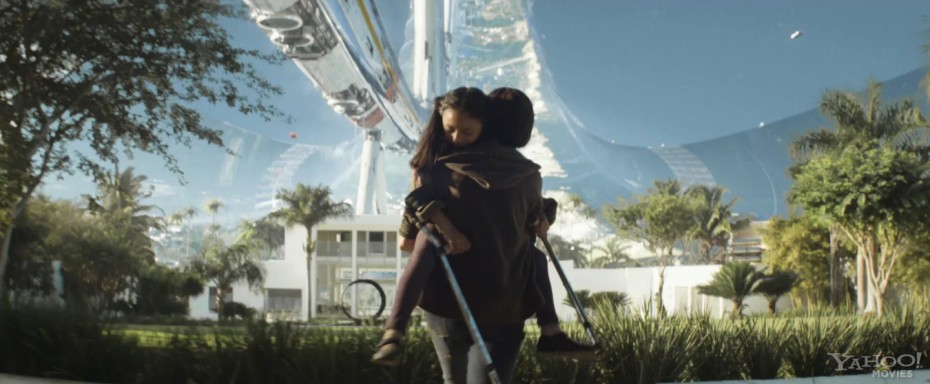
I love Neill Blomkamp. I want to swap cameras with him. I want to hang out all day on set with him and share a laugh when something goes wrong. I want him to say, “Hey Carson, where are you sitting,” when it’s lunchtime, then follow me to my table. He’ll then ask me, “What did you think about that shot, Carz?” “It was good, Neill,” I’d say, “But you probably could’ve gone a little lower with the angle.” “Jiminy Wax, Carz, that’s exactly what I was thinking. You should be directing these movies. Not me.” “Aww, stop it, Neill. You’re just saying that.” Yeah, I’m a little bit creepy when it comes to Neill Blomkamp, I admit it.
Which is why my Elysium experience was so confusing. It started out great. Matt Damon’s walking through a gritty, ugly futuristic Los Angeles. Robot police are roughing him up. Mood-stabilizing pills are spat out at you if you look even mildly depressed. It’s exactly what I see 2152 looking like. For a good 15 minutes, I was thinking: “This is it. This is his masterpiece. As of this moment, I’m marking this as genius.” There is nobody, right now, who creates a more honest and interesting futuristic world than Neill Blomkamp.
But then little choices here and there began to bother me. Before I get into those though, here’s a quick summary of the story: So there’s this guy, Max (played by Matt Damon) who lives in the slums of LA in the 22nd century. Everybody is poor here. Everyone is struggling. We’ve ripped our planet apart and turned it into one giant trash-bin (without the lavender-scented trash bags).
One of the only ways to make it in a world like this is crime. Which is exactly what Max did for awhile. But now he wants to leave that world. He wants to earn an honest living (likability alert – We like characters who are trying to turn their life around!). But one day at his factory job, a mishap leads to him getting severe radiation poisoning. Which means Max will be dead within five days.
There’s only one way to survive a disease of this magnitude. Get to Elysium. Elysium is a giant space station that houses only the rich people. Realizing the earth was fucked a long time ago, the richies built this utopia for themselves so they could play polo whenever they wanted and build castles for their pets. Oh, and because all these people are so damn rich and it’s the future, they have these MRI like machines that instantly cure them of any disease.
Unfortunately, getting to Elysium requires knowing a person or two, and to hitch a ride, Max will have to do one last job (a data heist). What he doesn’t know is that the heist gives him super sensitive information about an impending coup up on Elysium. Which means that just about everyone with a gun wants a piece of him. This leads to the inevitable question: Can Matt Damon save the world!?
Elysium was over-themed. The theme of this movie was brought up every two minutes, I swear. The poor are fucked. The rich are set. And it’s not fair. This is explored mainly through the fact that if poor people get sick, they die. If rich people get sick, they cure themselves.
Which is fine. It’s important to explore a theme in your script. But we’re just bombarded with this theme throughout the screenplay. A woman escapes onto Elysium, runs her daughter to a medic-machine. It cures her. Matt Damon gets sick. He’s told he’s dead in 5 days. We meet the romantic interest, a nurse, who has a daughter who’s dying of cancer. We have shots inside the hospital of hundreds of minorities dying. Then we have shots of the city, where everyone looks sick and diseased. (spoiler) Then we get the ending, with all the smiling, happy, running kids laughing as their feet splash through the water on their way to the newly distributed medical machines. It’s laid on REALLY thick.
One of the most important things about writing is to be invisible. Whatever you’re pushing, whether it be a setup to a later payoff, a plot twist, a theme, an act break – The audience (or reader) must never know that that’s what you’re doing. They should never think of the writer writing his plot twist or his theme. All of that stuff must feel invisible. Therefore, if you’re sloppy with any of these things or push them too hard, it becomes obvious to the audience what you’re doing and they check out.
What complicates this is that each person is different. Person A might need you to mention your theme four times before they get it while Person B might only need you to mention it twice. It’s why you can’t please all the people all the time. No matter what you do, someone’s always going to say there was “not enough” while someone else will say there was “too much.” So figuring out that balance is always one of the hardest things about writing.
But I just felt Blomkamp got out of hand here. By the end, it was like, “We get it! This is like the Mexico border! Rich Americans have health care. Poor people don’t.” I wish he would’ve played around with the plot more and gone with something a little less on-the-nose.
In addition to this, the script gears had to work way too hard to keep the plot moving. There seemed to be four storylines. Max getting radiation poisoning. The Nurse and her dying daughter. Jodie Foster’s secret coup. And bad guy Agent Kruger. Getting to a point where Matt Damon ALONG with the bad guy would be going up to Elysium WITH this little girl so Max could save her felt like every plot gear on the planet was grinding to make it happen. I could see fingers typing: “Okay, we need to get Max to the nurse’s apartment so Kruger can track them there, take them, use them as bait to draw Max in, then also have Spider set up the reboot process on Elysium since the girl doesn’t have citizenship on Elysium and therefore won’t be accepted by the machines…”
It felt more like a writer trying to find his way to his destination than a smooth, natural story. That clunkiness is something you can only solve with tons of rewrites.
I also had a couple more issues. Agent Kruger, our villain, felt very… cliché. He was just this angry dude. There was no subtlety to him. There was no motivation behind his actions. He was just your garden-variety, crazy, loud, angry villain. Those kinds of characters are fun to play, I’m sure. But I couldn’t even begin to tell you why Kruger was the way he was. Why he had weird metal things in his skin. Why he randomly carried around a samurai sword in the year 2152. Why he gets mad when his face regeneration makes him more handsome. Villains need to be original and make sense. I didn’t get either of those from this character.
And finally, I was so confused by Max’s suit! I thought it was going to turn him into superman. That thing was splashed all over the posters and trailers and for good reason. It looked awesome! So imagine my disappointment when it only made him… a teensy-tiny bit stronger. In fact, there were times where I didn’t even know if it made him stronger. There was this whole unclear, complicated thing with his medication that made him weak. So he was weak from the radiation and medication. But the suit made him strong. So did those two things cancel each other out and just make him regular strength?? The rules of the universe weren’t clear. And that’s one of the first things you gotta get right in sci-fi. The rules of your universe MUST BE CLEAR (that’s one of the reasons Matrix was so good. They worked hard to make sure you understood the rules).
Now it may sound like I hated Elysium. But I didn’t! No amount of writing quibbles could undermine the awesomeness of this world Blomkamp created. It just looked so damn real. I mean, I see those fucking robots policing our streets someday for sure. I see future Los Angeles looking EXACTLY like that.
The story also had a really strong pull to it – Elysium itself! Despite the clunky plot elements, I WANTED them to get to Elysium badly. I wanted to see that awesome spinning wheel and the outrageous mansions and the outright beauty of this artificial world. Also, because the CHARACTERS wanted to get there so badly, I wanted to get there badly. I’m a sucker for a big goal with high stakes and Elysium’s got that (the main character’s dying and must get somewhere to save his life!). It kept us interested until the end. Still, this was a much better movie than script. Neill’s cinematic vision saved a screenplay that probably needed 4-5 more drafts.
Script rating:
[ ] what the hell did I just read?
[x] wasn’t for me
[ ] worth the read
[ ] impressive
[ ] genius
Movie rating:
[ ] what the hell did I just see?
[ ] wasn’t for me
[x] worth the price of admission
[ ] impressive
[ ] genius
What I learned: The early drafts are where you figure out the logistics of your plot. The rewrites are where you smooth those logistics out. If you stop 4-5 rewrites short, your plot’s going to feel that way. It’s going to feel mechanical and “written.” Keep rewriting until your entire story feels effortless.
Amateur Friday Submission Process (read – slightly new!): To submit your script for an Amateur Review, send in a PDF of your script, along with the title, genre, logline, and finally, something interesting about yourself and/or your script that you’d like us to post along with the script if it gets reviewed. Use my submission address please: Carsonreeves3@gmail.com. Remember that your script will be posted. If you’re nervous about the effects of a bad review, feel free to use an alias name and/or title. It’s a good idea to resubmit every couple of weeks so your submission stays near the top.
Genre: Drama
Premise: When a man involved in a fatal hit-and-run accident learns the victim is his brother’s wife, he must decide whether coming clean and appeasing his conscience is worth the risk of shattering his family.
About: Since the last time Recovery was up for AF consideration, back in November 2012, it’s undergone a page-one rewrite. The resulting draft garnered a quarterfinal placement in this year’s still active Page Awards, and I feel it’s ready for another shot at AF glory.
Writer: Harj Bains
Details: 90 pages
 I don’t know why, but I see Joel Edgerton in this for some reason.
So what is a “page-one rewrite” (mentioned above in the About section) anyway? A page-one rewrite is when you scrap everything in your story and start anew. There are times where we write scripts that have inherent problems, and no matter how many times we rewrite them and rewrite them and rewrite them, it’s like adding a new shade of lipstick to a pig. It cleans’em up a little, makes them prettier. But the rewrites never seem to fix the underlying problem in the script.
Now most of the time when this happens, you eventually move on to the next script. At a certain point it just becomes so tiring trying to fix something you can’t figure out, that the best thing to do is to move on. But occasionally you have an idea that’s so good, or that you love so much, moving on isn’t an option. In these cases, where you refuse to give up, the best thing might be a page one rewrite. You see, one of the reasons it may be so hard to fix things is because you’re obsessed with some character or plotline or sequence that’s actually crippling your story. It made sense in that first draft. But as the script evolved and become something else, it doesn’t anymore. However, you’re so close to the material you can’t see what that troubling element is and therefore don’t know to eliminate it.
By starting over, by accepting that nothing in the previous script is necessary and you can take the idea anywhere you want again, you open up the potential of where the script can go NOW. Since today’s script is called “Recovery,” the proper analogy might be to see your script as a drug addict. And one day he wants to change. He wants to get off drugs. The problem is, all his friends are drug addicts too. It’s impossible for him to stop because he’s surrounded by drugs ALL THE TIME. It’s only when he eliminates those friends from his life that he can actually move forward and change.
Okay, enough with analogies. I’m not even sure Recovery is a true page-one rewrite. I just saw the author mention it and felt it was a good topic to bring up since we haven’t discussed it before. Now on to the script!
Recovery follows two 30-something brothers, Tommy and Daniel. Tommy is a functioning heroin addict. He’s got a job and everything, but he lives solely for his next high. Daniel is the brother who’s got his shit together. He’s got a nice job and a nice wife, Anna, who he loves with all his heart.
Well one morning, Anna wakes Daniel up because the treadmill isn’t working. He promised to fix it yesterday and she wants to get a run in before work. She asks him to please fix it but he’s too tired. He tells her to take a jog and he’ll fix it later today. He promises. She’s pissed but heads out for a jog.
In the meantime, Tommy, who’s exhausted coming off the high of one of his many shoot-ups, is forced to drive across town dead tired to sign a stupid form for work. On the way back, he’s falling asleep at the wheel, and wouldn’t you know it, there’s Anna running, and there’s Tommy not seeing her and BAM, he gruesomely slams into her.
Tommy’s awake now. At this point, he doesn’t know it’s Anna (we don’t know Tommy and Daniel are brothers yet, either). So he shoots off, freaking out and wondering how the hell he’s going to get his car fixed without someone reporting it. It’s a small town. If he’s not careful, the wrong people are going to know that the front of his car has a person-indent in the front, and then it’s only a matter of time before he goes to jail.
Not long after, Tommy is called over by his and Daniel’s parents. They’re all mourning the loss of Anna by a hit-and-run driver. Of course, they don’t know that their own blood, Tommy, was the hitter-and-runner. And it doesn’t help that Daniel is beating himself up over it. If he just would’ve taken the time to fix that damn treadmill, none of this would’ve happened. His wife would still be alive. Not to mention the fact that exercise is supposed to extend your life. What a lie that was.
After an elongated game of Tommy feeling awful as everyone around him curses this “anonymous” hit and run driver, Tommy decides to come clean. He tells Daniel that he did it. Daniel’s outraged at first, but realizes it was an accident. The event actually becomes the impetus for Tommy getting clean. He goes to rehab, even meets a girl he falls in love with, and a few months later he’s drug-free and ready to start a new life with this woman.
Uhhh, Daniel is NOT cool with that. His brother kills his wife, then gets a wife of his own out of it!!?? No, that’s not cool at all. Daniel’s rage takes him to the darkest of dark places, and we get the feeling he’s going to take care of this problem his own way. All of this is happening while detectives get closer and closer to finding out who hit Anna. But will they find out before Daniel decides to get revenge for his wife’s death?
I can see why you guys wanted me to read Recovery. Its first ten pages are kind of awesome, culminating in a brutal and memorable hit-and-run. But the rest of the script is kind of hit-or-miss. It’s actually quite the unorthodox story. It starts off as this thriller of Tommy trying to hide this dark secret, which is the section that had the most potential.
But then he actually tells his brother he did it. And when that happened, the story lost something. I mean, it was a brave choice. It was totally unexpected. And I love when writers take stories in an unexpected direction. But every choice must be the best choice for the story dramatically. It’s good to surprise the audience, but not if that surprise results in a loss of tension or conflict, which is what this choice did (in my opinion).
Harj tries to keep that tension up by cutting back to the detectives, who are trying to find the person who hit Anna. But there was something that didn’t quite work with that. We’re constantly reminded that if Tommy gets caught, he’s only going to jail for a year. In other words, the stakes aren’t very high.
The script ramps up a little towards the end when Daniel becomes enraged after finding out that Tommy’s getting married. We know that’s going to come to an explosive head. But that still left this big chunk in the middle of the script where the tension is non-existent.
Speaking of that middle, part of the problem is that Tommy’s girlfriend never felt real. Even now, 12 hours after reading the script, I can’t remember her name. She’s barely in a few scenes, and when it became clear to me what was going to happen (Tommy was going to fall for her and Daniel was going to get mad), I was disappointed. The girlfriend was a tool, a plot point. She was there to get Daniel mad. But she was never a REAL PERSON.
I see writers do this a lot. They need to create a plot element to advance the story, but they don’t make that element real. For this to work, we have to see Tommy FALL IN LOVE with this girl. We need long scenes showing these two losing themselves to one another. We need to give her her own hopes and dreams and problems and backstory so she feels like an actual person. Not just a plot point. Because the ending is based on this idea that (spoiler) Daniel’s going to kill Tommy for the love that he has and we don’t believe in this love. This moment needs to be TRAGIC. We have to die at the idea of this love being destroyed. But since we never get to know the girl, we don’t really care.
I think Recovery is an interesting script but it needs a little more meat. It’s only 90 pages long and it’s a drama. I always push for shorter scripts but dramas are typically the longest scripts out there because the genre DOES allow you to get into your characters more. And that requires more space and time. So this script should be at least 110 pages and those 20 extra pages should probably be dedicated to building the relationship between Tommy and his girlfriend into something more real. And making HER more real! I don’t think that’s going to fix everything. But it’s definitely going to give the script more weight. I wish Harj luck with it. ☺
Script link: Recovery
[ ] what the hell did I just read?
[x] wasn’t for me
[ ] worth the read
[ ] impressive
[ ] genius
What I learned: Don’t just lay down an empty plot element. Every element in your story must feel real and authentic. If it doesn’t, we’ll see through the façade and know it’s only there for some plot reason. So with Tommy’s girlfriend, since she was never really explored as a character, we became keen to the fact that she was going to be used for something. And she was – Daniel’s motivation for revenge.
Carson here. Okay, a little background. I have this friend who recently broke into that oh-so exclusive “Hollywood Screenwriting Club.” In other words, people actually started paying him for his work. It was exciting to watch him finally get that recognition, go to meetings, officially tell people that he had representation. But as the months rolled by, I saw that he’d gotten a little down. So I asked, “Yo, Good Friend. What’s wrong?” And he assured me that while there wasn’t a day he didn’t wake up pinching himself for the opportunity to write for a living, he was a little crushed by some of the realities that go into the profession. As he started explaining them, I said, “You know what? Why don’t you write this all out and I’ll post it on the site? It’ll be like, a way for you to exorcise your demons.” He agreed that’d be a wonderful idea. So why am I posting this? To remind everyone that getting to the “spec sale” finish line is really just the start of a new race, a much longer and tougher race. Because now, instead of trying to be the king of the amateurs, you’re competing shoulder to shoulder with the heavyweights, writers who can all tell a good story (something you didn’t have to worry about in the amateur camp). You gotta work your way up. You gotta take jobs you may not necessarily like to pay the bills. It’s not easy. This is what he wrote…
 Necessary dance for when you sell your first script.
When you sell your first script, you will cry.
I know that seems dramatic. It might be. But you’ve worked for this moment. Whether it’s for two years or twenty, writing is hard work—it’s impossible work. Squeezing your brain till it’s dry like brittle, staring at a glowing screen for hours until your eyes sting red, forgetting what it’s like to shower (or interact with other human beings). Writing is hard. Which is exactly what makes opening that email from your agent or manager and reading the words, ‘We got an offer’ so much sweeter.
So when you sell your first script, you will cry.
Because it feels amazing. This thing that you’ve been slaving over—outlining, emailing to trusted friends, fixing the outline, sending out again, fixing it one more time, scene-writing, banging your head against the keyboard, character work, act one is done (hurray!) oh wait it’s shit (boo!), rewriting, sending out, head-banging, writing, writing, writing, napping, read a professional script that makes yours look like a Hallmark Channel D-movie, writing, writing, almost there, final scene, DONE, sending out, rewrite rewrite rewrite, ignore these notes, apply those notes, rewrite rewrite, send to manager or agent and wait a million years until—someone actually LIKES it.
Liked it enough to, um, pay you for it.
And not just pay you. They want to make it. Into a movie. That people will watch. You IMDb the interested party immediately. Good resume, a few films under their belt, a couple you’ve heard of but have never seen. Netflix them—not too shabby, your script is better so you’re not worried because the movie’s getting made. The dream is here. In a year’s time you’ll be on a red carpet, smiling awkwardly for the cameras, right? Friends come out of the woodwork to ask about free screening passes, can you read their work, who is your manager—the uphill battle is over. You’ve made it, you’ve sold a script. Your bank account will go from $1.17 (checking AND savings combined) to some number that allows you to shop for actual groceries instead of driving thru Taco Bell for the 9th time this week. You’re gonna be sitting pretty in a dark theater with strangers laughing (or screaming, or crying, or ooh-ing and ahh-ing) at words YOU WROTE, watching actors saying things YOU MADE UP. Life. Is. Grand.
Except that doesn’t really happen.
Or maybe it does. Maybe for some people that’s really how it goes. But as far as I know, that’s like Supermoon Rare, an anomaly akin to Ahab’s white whale. That doesn’t mean selling your script isn’t awesome—it is, it’s just not the perfect, smooth sailing, seven-figure life changing event people make it out to be. But here’s what it does change:
It makes you hirable. Or, more hirable than you used to be. So you’ll get meetings. Sometimes generals, where people with a lot of power offer you a free water bottle (always take the free water bottle) and ask questions about the script you sold that they may or may not have skimmed over last week. Sometimes generals with baby producers who talk a big talk and name-drop every other sentence and try to get their talons into you early before a studio notices you. Let me just get this out now: BEWARE OF BABY PRODUCERS.
What’s a baby producer? That rando with one short film IMDb credit who blows up your inbox with questions about the script you sold, where’d it find a home, what are you working on now—that’s a baby producer. And they’re slick because the high of selling your script is just that—a very cool, ego-inflating high, and people will not hesitate to exploit it. You’ll think, Great! People want to hire me and read more of my stuff and having two produced scripts is CLEARLY better than selling one so why not?! I’m gone ride this wave of attention to the Academy and never eat Taco Bell again!! It’s easy to think this. It’s easy to assume that these people just want to make a good film and they read your work and loved it and trust your voice. It’s so, so easy.
It’s also incredibly stupid.
Baby producers are the worst. They’re dangerous. Because they’re inexperienced and because they’re inexperienced they’ve had to learn how to talk to get into rooms they have no business being in. So they’ll talk to you. But you’ll be naïve (well, you won’t because you read this article but anyways). So you’ll work. On insane timetables, too, because you’re riding that momentum from your script sale and don’t plan on losing steam anytime soon. You’ll work on their terms, with their ideas, and always with the understanding that you should be grateful for this opportunity to be writing for pay. You will write the first draft in less than a week. And the pay will be shit.
Meanwhile, you’re in rewriting hell from your own spec. There’s that saying, “Writing is rewriting.” That’s never truer than when you sell your script—because the studio or producer or independent prodco owns you. And they want a quality product. Oh, they liked your script, your ideas. But they like theirs better. So you’ll rewrite your precious baby into Kingdom Come to get their stamp of approval. After all, they are the gatekeepers here—they don’t like what you do, you get paid out and a shared credit with whomever they bring in. Which, as a new writer with an original spec, is not good news.
And you’ll learn that the feature world is harsh. That the writer is not the revered king but the lowly fool. That staying afloat in this pool requires some serious stamina—this is a marathon, not a sprint (and how many metaphors was that? yeesh!). You’ll learn that the producers are really the writers and most of the time they really aren’t writers but just think they are and they’ll tell you what darlings to kill. You’ll kill your darlings. You’ll do it reluctantly but you’ll do it.
You will question your own sanity. Notes will start to look circular—isn’t that how I had it in the original draft? why are we circling back??—and this script that you’ve lived with for months, years, will begin to haunt you. And you will despise it. It’s important, though, to realize exactly why this happens, why you might hate your own work so much at this point in the process: This is your baby. It’s been your baby since its conception. You know it inside and out, forwards and backwards and upside down. You saw it take its first steps, lose its first tooth. Then you sell it and someone else joins the family. Except they haven’t been living with the script for months or years—it’s new to them. This is both a blessing and a curse. Their perspective is fresher than your own, but it’s also not your own. Some ideas these new eyes have will be great, like Why didn’t I think of that?! ideas. Others will be awful, like, There’s a reason I didn’t think of that. Whatever the case, you’ll spend hours slogging through producer notes and draft after draft after draft until your eyes bleed from reading notes that tear your precious script apart piece by piece, slugline by slugline. And maybe, if you’re lucky, if you’re working with a producer who maybe kinda sorta knows that they’re doing, it won’t be so bad.
Maybe it’ll be good. Great, even. Awesome.
Because you sold your first script—the key word being “first.” I cannot stress this enough: This is a snapshot, not the whole picture. The trailer, not the movie. Somewhere along the way, this becomes clearer. You might complain about how hard the work is, how harsh and pointless the notes seem, how ridiculous and unprofessional the baby producers are, but you’ll realize that many people have this dream, and for you it’s now a reality. So you will shut up with the negativity and start to tell people when all that gratitude and excitement finally sinks in. And their reactions will be priceless. You’ll spend a lot of time answering questions from friends and family about when your movie is coming out (this will never stop until, I’m guessing, your movie actually comes out). And then you’ll smile—because that’s actually a very likely outcome to all of this. Your movie will come out.
Unless it doesn’t. In which case, it’s time to sell your second script.