
Search Results for: F word
Genre: Comedy
Premise: Four best friends in their 70 head to Vegas for a bachelor party.
About: Dan Fogelman, screenwriter of Scriptshadow favorite Crazy Stuipid Love and recent Black List entry, Imagine, sold Last Vegas earlier in the year. In related news, Fogelman also sold his Wednesday Jack In The Box receipt for high six figures to Warner Brothers. Speculation is rampant about what was on the receipt. My sources tell me it was 2 tacos, a Jack’s Crispy Chicken with cheese, and an Oreo Milkshake. Receipt review to come. The producers of Last Vegas seemed to have moved on from Fogelman and handed the script over to Rom-Com scribe Adam Brooks. Brooks has penned such films as Definitely Maybe 

Writer: Dan Fogelman (rewrites by Adam Brooks)
Details: 111 pages (Oct. 5, 2010 draft) (This is an early draft of the script. The situations, characters, and plot may change significantly by the time the film is released. This is not a definitive statement about the project, but rather an analysis of this unique draft as it pertains to the craft of screenwriting).

In my endless pursuit of everything Dan Fogelman, I finally got my hands on Last Vegas. However of all Fogelman’s projects, this was the one I was the most wary about. Seeing as I don’t yet depend on adult diapers, a movie about a bunch of old fogies reliving the golden days at a Vegas bachelor party sounded like it could be kind of good, but also kinda of bad. But with Fogelman (and now Brooks) at the helm, I was pretty confident they’d make it work.
Those not familiar with Brooks’ work should go rent Definitely, Maybe when you get the chance. It’s easily the most mature romantic comedy I’ve seen in the last decade. The problem with the movie is it has that big goofy Ryan Reynolds smirk on the cover coupled with Little Miss Sunshine 
Now when you write comedies with old people in the leads (Space Cowboys


This is why I was so pleasantly surprised with 2008 Black List script, Winter’s Discontent, easily the best “old folks” movie not yet made. The whole film is about one thing: getting laid. It’s told with a zest for life that most teenage flicks would envy. I had the same high hopes for Last Vegas. Personally, I think Bucket List meets The Hangover 

The biggest surprise about Last Vegas is that it goes almost exactly how you think it’s going to go, except a lot slower. It’s like our characters are stripped of their tap shoes and dropped into a vat of quick sand. The character introductions are too long. The story takes forever to set up. The initial Vegas scenes have nothing going on. The character conflict is too basic. It’s like the script has been raped of fun.
And that’s when I sat back and realized, “Oh boy, this is like the worst writing assignment ever.” Old folks going crazy in Vegas *could* be good. But after writing in all two minutes and thirty seconds of trailer moments (Getting wasted at a club, partying like Entourage at the pool, old guys macking on chicks, and Jack Nicholson involved in some Viagra joke) what the hell do you do with the other 108 pages? I think Fogelman and Brooks were asking the same question.
Oh yeah, what’s this movie about? Well, we have have eternal ladies man Bill, stick up his ass Paddy, wisecracker Sam, and voice of reason Archibald (who will be played by Morgan Freeman of course). The four have been friends forever and at the ripe old age of 70, Bill is getting married for the first time (to a 30 year old). So they go to Vegas for a bachelor party.
The main source of conflict is between Bill and Paddy, which began because Bill didn’t show up for Paddy’s wife’s funeral a couple of years ago. So Paddy spends the entire trip bitching at Bill, and this may be the script’s biggest problem. Paddy is so effing annoying. It’s bitch bitch bitch bitch bitch bitch bitch bitch bitch. He just will not stop whining. He’s like that friend at work who can’t shut up about how much he hates the job, yet he never quits.

Anyway, the two meet an older female singer named Diana (who I’m willing to bet a thousand dollars on will be played by Susan Sarandon) and they both fall for her, which of course only adds to their existing conflict.
Sam, in the meantime, has received a “hall pass” from his wife for the weekend, and I’m sorry but I’m putting a moratorium down right now for all writers. If a girlfriend or wife gives your main character a hall pass, THEY HAVE TO USE IT. They can’t meet someone at the last second, sparks fly, get two seconds away from sex, then decide that they love their wife too much and no longer want to use the hall pass. I’ve read that ending in about ten different scripts.
There is one winning moment in the script, and that’s in the first act when Billy interrupts a eulogy he’s giving to propose to his girlfriend – a true Jack Nicholson moment – but it’s unfortunately the only memorable sequence in the screenplay. Everything else is very basic Las Vegas staples.
I am not giving up on Last Vegas, but someone needs to slap the electric paddles on this corpse and jolt the fucker to life. Everything here needs to be bigger. That’s what Winter’s Discontent figured out. In movies like American Pie 
You know me. I’m Mr. Character Development. But the character development here just felt like a bunch of old guys complaining with each other. Maybe if those moments were more compelling than Paddy bitching the whole time, they would’ve worked, but my feeling is that if this thing is going to sing, it needs its characters to want to have fun.

The script also got me thinking of a mistake a lot of intermediate and even pro writers make. Sometimes a premise is so obvious that you give it an obvious treatment. And even though everything’s right where it needs to be and the structure would give Robert McKee 
That’s why The Hangover was so popular. You have tigers in bathrooms and naked Chinese men flying out of trunks and chickens and babies and Mike Tyson. You got everything you wanted out of the premise, but not exactly how you thought you were going to get it. I’m just not seeing any imagination in Last Vegas, and that’s contributing to why it reads so slow.
This project has a lot going for it. You put Jack Nicholson, Morgan Freeman, Chirstopher Walken and Dustin Hoffman in an old man’s Hangover, people are going to show up to see it. But if all it is is a bunch of old guys complaining with each other, the box office might be looking at an early funeral.
[ ] What the hell did I just read?
[x] wasn’t for me
[ ] worth the read
[ ] impressive
[ ] genius
What I learned: Is the treatment of your idea too obvious? Stories are a bit like train rides. You take a bunch of people from point A to point B. However sometimes you gotta stop the train and let the people explore a little bit. Have’em get stuck in a town overnight or lose their luggage or get robbed. The most memorable thing about a trip is never the stuff you planned ahead of time. It’s the unexpected things that are always the most exciting.
Genre: Horror-Thriller
Premise: (from writers) After a member of their expedition sustains an open flesh wound, a group of mountaineers find themselves being stalked by a vicious high-altitude Snow Beast.
About: Every Friday, I review a script from the readers of the site. If you’re interested in submitting your script for an Amateur Review, send it in PDF form, along with your title, genre, logline, and why I should read your script to Carsonreeves3@gmail.com. Keep in mind your script will be posted.
Writers: Art McLendon & Beau McLendon
Details: 93 pages (This is an early draft of the script. The situations, characters, and plot may change significantly by the time the film is released. This is not a definitive statement about the project, but rather an analysis of this unique draft as it pertains to the craft of screenwriting).

First thing’s first. We need to address this logline. You don’t want to be too specific in your logline with a detail that’s ultimately unimportant in the grand scheme of your story. In other words, you don’t want to say, “sustains an open flesh would.” If you’re going to get specific, it needs to be about the character or a really important piece of the plot that’s part of the hook. Otherwise, leave it out.
But as far as the idea goes, this is a good one. Being trapped up on a mountain with a giant snow monster hunting you, is not only an idea I can see selling but one of the rare scripts that goes on to get made as well. Who can’t imagine a dozen great moments where a group of climbers is getting hunted by a Yeti?
Now that doesn’t mean you can just throw anything on the page. You still gotta execute. So do Art and Beau execute?
Simon Trudeau is a British Journalist who mysteriously wears a black ski mask when he does his news stories, the latest of which is about a hiking team that disappeared up in the remote Himalayan Mountains a couple of years ago. His cameraman is constantly annoyed by Simon’s insistence on wearing the mask, and its integration into his presentation is a regular point of contention.
Cut to 2 years ago where we meet the team that disappeared. We have Paul Brody, the leader, barrel-chested Gus Osborne, the tomboyish heart and soul of the group Anabell Cross, and her handsome sun-beaten boyfriend Mitch Russell.
The thrill-seekers are trying to hike their way to the peak of the 6th highest mountain in the world, but are upset to find out they’re not getting the Michael Jordan of guides like they expected. Instead, they’re getting new kid on the block, Nima, a 19 year old Tibetan who’s more nervous about screwing up than his group is about making it to the top.
But they’re all big tough guys (and girls) so they shrug it off and start up the mountain. Unfortunately things go wrong quickly. Mitch gets injured, and even though his wound isn’t that bad, it seems to coincide with a series of roars that follows the group up the mountain. Not your typical mountain lion roars either. These roars are decidedly more…angry.
Lima looks skittish, and when the roars get closer he admits that this may be a monster that hangs around on the mountain. His people call it a “Dzu-teh” which is pronounced “Psycho Snow Monster.” Naturally our team is pissed and wants to know why the hell they weren’t told about this BEFORE they went up the mountain. Uh, well duh, because it’s bad for business! (my assessment, not Lima’s)
Eventually, they run into this snow beast, and without hesitation it grabs Mitch and runs off. The group wonders what they should do now and after some heavy discussion, they decide to go after Mitch (I’m sorry but I would’ve been running down that mountain faster than Usain Bolt). Since snow beasts get plucky when you stroll into their lair, this turns out to be a bad idea.
During this time we keep cutting back to our British journalist Simon, who updates us on what they know about the disappearance through hindsight, all the while refusing to take off his ski-mask. Dzu-teh ends up picking off our doomed hikers one by one until there’s only one left – and it becomes a battle to the death.
“Ascent: Day 3” has some intense and really fun action sequences, taking the simplistic “Descent
However the Descent approach only works if you have a group of compelling characters and those characters are legitimately stuck, and I’m not sure the characters in “Ascent” are either. In Descent, once they were down there being stalked by these “whatever-they-were,” they had nowhere to go. There only choice was to fight for their survival. In “Ascent,” there seemed to be a lot more choices, since they are out on this huge mountain.
I liked the idea of Mitch getting taken, and the team having to make that decision of whether to save him or head down the mountain and save themselves, but I didn’t know anything about Mitch other than that he was Ana’s boyfriend. So sure, in the story world it makes sense that you’re going after your boyfriend, but to me, the audience, I don’t care about this guy because I know nothing about him.
Contrast that with a movie like Aliens
There just needed to be more going on with these characters. The action genre does not give you license to ignore flaws and backstory and personality and secrets and family situation and ideology and motive and everything else that adds to a character’s weight. I brought up Pitch Black 
And even though there *was* something going on with Ana, it didn’t seem to stem from her character. We had this whole backstory about how she always wears a whistle because her sister didn’t have a whistle or something and her sister died because she didn’t have a whistle. It’s there to give the character depth, yet it doesn’t have anything to do with the character. It’s backstory for backstory’s sake.
Good backstory is born from who a character is – and that’s usually identified through her flaw. The character of Lana in Risky Business 
The other big problem I had was with Simon. This whole idea of him having to wear this mask felt kinda gimmicky and didn’t make a lot of sense. Had he really spent the last couple of years as the masked news reporter? Or was this more recent? If it was recent, and his (spoiler) burn injuries had just happened, why would his cameraman be clueless about them? When a newsperson gets into a horrifying burn accident, people usually find out about it, especially people you work with.
Also, when he takes off the mask at the end, it’s supposed to be this cathartic character transformation but Simon is the least important character in the movie, so it makes no sense that he’s getting the most attention when it comes to a character arc.
In addition, Simon poses problems for the fear-factor of the screenplay. Instead of being stuck up on this mountain with our characters scared out of our wits, we get these nice cushy time outs with Simon that allow us to catch our breath and feel safe. Imagine The Descent or Paranormal Activity 
I’m being pretty harsh on Ascent but that’s only because I see a lot of potential in the script. I could totally see this as a movie if a few things were changed around and more effort was put into the characters. Yeah this is one of those fun movies you simply sit back and enjoy, but you can’t enjoy a film, no matter how relaxed it is, unless you have that connection with the characters.
So good luck to Art and Beau on the next draft. Hopefully I’ve given them some ideas on how to make Ascent better. :)
Script link: Ascent: Day 3
[ ] What the hell did I just read?
[x] wasn’t for me
[ ] worth the read
[ ] impressive
[ ] genius
What I learned: It’s so important to have conflict between your characters in these kinds of films. If everyone likes each other (which seems to be the case in Ascent), you’re going to put the audience to sleep. Remember, it’s not so much the monster that should cause the fear. It’s how the adversity caused by the monster brings out the conflict within the group. Read The Grey to see what I mean.
Genre: Indie Dramedy
Premise: After sabotaging another family vacation, a travel agent who’s afraid to fly battles his irrational phobias in order to win back his wife and daughter.
About: Paper Airplane landed in the middle of the pack of the 2010 Black List. Karger has written and directed a few shorts over the last five years, but this is his breakthrough script.
Writer: Sid Karger
Details: 104 pages (This is an early draft of the script. The situations, characters, and plot may change significantly by the time the film is released. This is not a definitive statement about the project, but rather an analysis of this unique draft as it pertains to the craft of screenwriting).

If there’s a lesson to be learned from Paper Airplane, it’s in the logline, specifically the easy to identify ironic component: “After sabotaging another family vacation, a travel agent who’s afraid to fly battles his irrational phobias in order to win back his wife and daughter.” Not every story has an ironic hook or character, but I’ve found ones that do get a lot of reads. There’s no guesswork involved because the meat of the conflict is right there for an exec to see.
However as a screenplay, I had some problems with Paper Airplane, and part of that has to do with high expectations. See The Black List is renowned for finding and championing quirky material. You might even call it the preeminent source for doing so. The Beaver finished atop the Black List two years ago. Muppet Man last year. We have The Voices and Butter and Juno 
Henry Tripp is Mr. Risk Averse. He’s settled into that middle-aged safety-net phase where you’re aware of every possible thing that has the potential to end your life. And for that reason, he avoids it all. There is nothing he avoids more vehemently however, than flying. Getting on one of those long metal tubes and barreling through the air six miles above the earth for hours on end is the equivalent of repeatedly stabbing yourself with a rusty fork as far as Henry is concerned.
And it’s killing him. Or more specifically, it’s killing his family.
His selfish powder-keg of a wife, Joyce, is sick of all the fear. She’s sick of Henry being such a fucking wuss. And his cute but dark 17 year old daughter, Carolyn, has been around this for so long that she’s in danger of actually thinking it’s normal.
So one day, Joyce says she’s had enough and reads a letter to the family explaining that she’s decided to leave. So she takes her things and moves out. Henry and Carolyn are jaws-to-the-floor shocked. Didn’t see that coming. If only that were all they had to worry about.
In one of the more original choices of the screenplay, it turns out that Joyce, the wife, is the one who has the mid-life crisis. In a desperate bid to find that freedom and that happiness she had before her marriage, Joyce makes a play for Ethan, Carolyn’s overly pretentious artsy boyfriend. Ethan, who believes he’s an adult anyway, is all too eager to take Joyce up on the opportunity, and so starts banging his girlfriend’s mom.
In the meantime, Henry believes that if he can just overcome his fears and find the courage to fly, that Joyce will fall back in love with him and he can save the family before it’s too late. So he joins an “afraid to fly” Support Group and makes one last desperate bid to destroy all his phobias.
Paper Airplane plays out as an amalgam of a lot of quirky scripts and movies that you’ve seen before. In fact, it almost feels like it’s competing against them. The problem is, it’s really hard to compete against what came before you. The Monkees 


Part of my problem with the screenplay is that it’s so….cruel. A mom who steals her daughter’s boyfriend?? I mean how unlikable can you make a character? Even if the point was to make her unlikable, the problem is that the driving force behind the story is Henry trying to get Joyce back. So if we don’t want Henry to achieve that goal because his wife is so despicable, then what’s our incentive to keep reading?
I think I might’ve been able to stomach this if Ethan came on to Joyce first. But she clearly is the hunter in this scenario. And the only word I can think of to describe it is…disgusting. This is your own daughter we’re talking about! And Carolyn isn’t even the person you have the problem with. It’s Henry.Why would you hurt her?
But that’s only part of the problem. The biggest pitfall you can fall into when writing one of these scripts is focusing too much on the quirkiness and dysfunction-ality of the universe and not enough on the reality of the characters. In essence, you say, “Okay, what fucked up thing can I add next?” instead of building your characters from the inside out so that their actions stem from reality as opposed to a need to shock the audience. And I saw too much of that going on in Paper Airplane.
A perfect example (spoiler) was later in the script when Carolyn was spending a lot of time with her girlfriend. And I kept saying to myself, “Please don’t realize you’re a lesbian. Please don’t realize you’re a lesbian.” And sure enough, a few scenes later, a goof-around session results in them making out and Carolyn realizing she’s a lesbian. The problem was, there was nothing previously set up in Carolyn’s character to indicate she had any interest in girls whatsoever. But it was shocking and dysfunctional, so it was used.
Contrast that with a film like “The Kids Are All Right
Anyway, there were some things here to admire. While I didn’t enjoy the wife storyline, I totally admired Karger for creating such a daring female lead. I’ve definitely never read a character like this in a script before so that was different. And there was something quietly likable about Henry. His dogged determination to get his family back together, no matter how misguided it was, was fun, and slightly inspiring, to watch.
In the end though, this just didn’t do it for me.
[ ] What the hell did I just read?
[x] wasn’t for me
[ ] worth the read
[ ] impressive
[ ] genius
What I learned: In the eternal struggle to “show” and not “tell” in your screenplays, pictures can be your best friend. Instead of building a whole scene where your characters argue about how good things “used to be,” just show your hero catch a glance of a picture on the fridge showing the family in happier times. In fact, look to use photographs in every aspect of your script to convey quick easy backstory about your characters (i.e. need to convey that one character is adventurous? Show a picture of them rock climbing).
Genre: Horror/Sci-Fi
Premise: Jurassic Park meets Michael Bay via Jerry Bruckheimer. A team of scientists study what could be Noah’s Ark, trapped underneath a mountain of ice. But this is not the same ark we’ve been told about in stories.
About: The 2005 sci-fi script “The Ark” is what got Holly Brix her agent. This later led to her selling her first spec, “Mile Zero,” about a young woman who takes a job on an Alaskan oil rig so she can prove her father’s innocence in a series of murders (to star Milla Jovavich). Finally, last year, Brix got her first produced credit with “The Butterfly Effect 3: Revelations
Writer: Holly Brix
Details: 125 pages – undated (This is an early draft of the script. The situations, characters, and plot may change significantly by the time the film is released. This is not a definitive statement about the project, but rather an analysis of this unique draft as it pertains to the craft of screenwriting).
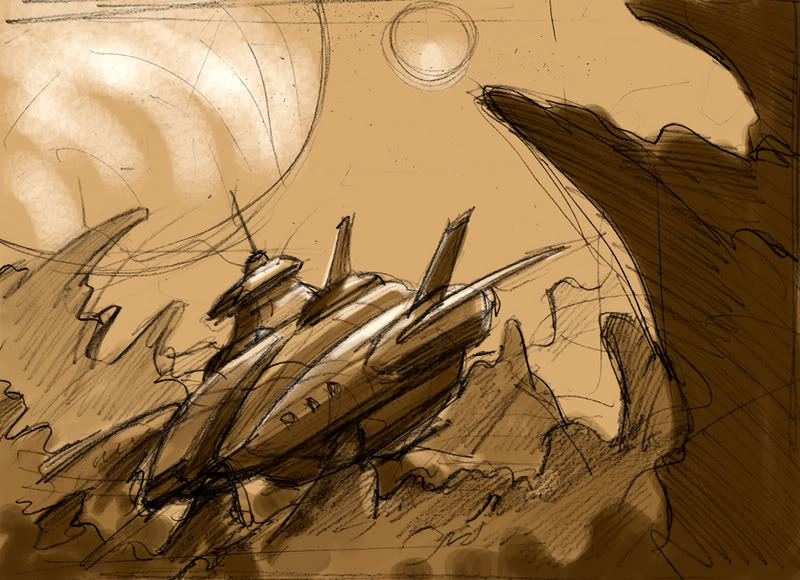
Hooray! A script all of you can participate in. We haven’t had much action oriented sci-fi stuff on the site lately, so I decided to change that. The Ark is one of those big idea scripts, the kind that Roland Emmerich and Dean Devlin get all hot and bothered over. Something a younger Spielberg might have made. And make no mistake, The Ark has its influences steeped in Jurassic Park
Abby Archer, that rare breed of knockout archeologist you only find in movies, is approached by a man explaining to her that they’ve “found it.” Whatever “it” is, Abby seems to understand what he’s talking about, but doubts that it’s true. “It” is obviously something very rare.
Complicating matters is that Jeff, her ex-husband, is also being summoned to the “it” party. That’s good news for us readers (conflict!) but bad news for Abby. While it all seems like a lot of hassle for what will likely be nothing, in the end Abby agrees to participate because the scientific ramifications are just too large.
So it’s off to Iceland where Abby and an entire team are greeted by Allister Eckmann, a 56 year old Richard Branson times 20. Eckmann believes he’s found the Ark. Yes, the Ark as in that boat with all the animals on it. Well great, Abby says, let’s get the hell down there and check it out.

So they head down under stories and stories of ice and are shocked to see what doesn’t look like a boat at all. This looks more like a…giant space ship. Abby takes the group inside and they immediately come upon some frozen animals, but not like any animals you and I know. More like animal hybrids. Dog-bears and Emu-vultures. That kind of thing.
What this means, they beleive, is that Noah’s Ark is a ship that originated from another planet, and came here to populate the earth. Nobody’s quite sure why the ship then would be down here, with all the animals seemingly still entombed, but since they’re all scientists, they’re eager as hell to find out.
Unfortunately, while taking a stroll through the stadium sized ship, it TURNS ON, and all these animals start thawing out. These animals weren’t frozen after all. They were in cryogenic sleep! And since half of them seem to be the really nasty hunting type, our characters realize they’re playing the part of eggs and bacon in these animals’ breakfast.
As is the norm in these movies, people start splitting up, and each group is hunted down by a set of nasty monsters. One group takes on a rhino…thing. Another takes on a room full of cougars, and no, not that kind of cougar (though I’m not sure which would be worse). And others still take on some kind of Yeti beast.
There’s a big storm that prevents them from getting up to the surface. There’s a bad guy who’s got his own motives for the Ark. And there’s plenty of hypotheses about what planet the ship is from and why it came to earth. But in the end, it’s just about getting the fuck off this thing alive.
So, does The Ark work? I’m afraid to say “not really.” It’s certainly a fun idea but the treatment of that idea is too simple and too obvious. If you’re a fan of these kinds of movies, you’re not going to find anything new here, and while that certainly isn’t required for these films to work, the lack of surprises leads to us being way ahead of the story, which is never a good thing.
One of the overlooked things in these genre, believe it or not, is character development. Outside of Abby’s past relationship with Jeff, there’s nothing linking any of these people together – no history, no secrets, no conflict, no problems. In other words, there’s no drama to get wrapped up in, and as a result, we lose interest in the characters.

Look at a movie like Pitch Black
The stuff that happened topside with Eckmann and our bad guy, Joe, was kind of interesting. But it felt completely detached from the rest of the story, since the two plots had little to do with each other, so it was tough getting into it. Plus, if you’re going to have a bad guy, you want him to be a part of the party, right in the mix of everything, not safely upstairs in another subplot. Imagine if Burke was still up on the main ship in Aliens
To be honest, I would’ve preferred they got rid of the topside plot altogether. Some of the stuff there was hard to buy anyway (Eckmann went down and set up cameras all over the ship ahead of time so he could watch the scientists expressions when they looked around). I think one of the reasons The Thing 

This script actually feels more like a first draft, where the writer is getting the basic ideas down, with plans to flesh everything out later. If that’s the case, I think it has potential. Mutated animals hunting down humans is definitely movie material. But right now, too many aspects are only half-realized.
Script link: http://www.wga.org/uploadedFiles/theark.pdf (This link is for the WGA’s server, where you can download the screenplay)
[ ] What the hell did I just read?
[x] wasn’t for me
[ ] worth the read
[ ] impressive
[ ] genius
What I learned: Use a lingering mystery in your first act to take us through boring character introductions. In some scripts, you have to set up a lot of characters. This can be really boring for a reader to trudge through, but here’s a trick to make it more bearable. Set up a mystery ahead of time. In The Ark, we’ve been told that he’s found “it.” What’s “It?” We’re not sure but from everyone’s excitement, we sure as hell want to find out. For that reason, while we meet 8 characters in a row, the pages fly by, because we’re excited to find out what it is they’re all talking about. If you ONLY introduce 8 characters in a row, you’re probably going to put us to sleep.

When you read a ton of scripts, patterns start emerging. Little things occur here and there – red flags if you will – that indicate you’re dealing with an amateur. This article is not meant to attack these mistakes, but rather highlight them so that anyone writing a script can try and avoid them. I never give up on a script if I encounter a couple of these red flags, but when they start piling up, especially early on, I know I’m in for a long read. Here are ten common things that tell me I’m dealing with an amateur, and therefore ten things you should avoid!
MISSPELLINGS/MIS-USED WORDS (ESPECIALLY IN THE FIRST 10 PAGES) – Of the hundreds of scripts I’ve read with rampant misspellings, there have been maybe two that turned out to be good. The thing is, misspellings and misused words speak to a larger issue — that the writer isn’t putting enough effort into his/her script. All it takes is sending your script off to a friend for a spell check, or combing through the script religiously yourself, to fix the problem. People who don’t put a lot of effort into spelling most likely aren’t putting a lot of effort into bigger issues like plot construction, character development and rewriting. Keep in mind, professionals take a lot of pride in their work. When they finish a script, they want to present it to you in the best light possible, so they make sure everything is perfect. Therefore when everything *isn’t* perfect, it’s natural for a reader to assume they’re not dealing with a pro.
BLOCKY CHUNKS OF TEXT – I get that some scripts are going to require more description than others, but when I’m repeatedly seeing blocks of text 5-6 lines long (or longer) I know I’m dealing with an amateur. Blocks of text need to be lean in order for your script to be easy to read. Pros know this. They know that taxing the reader’s eyes is going to result in a less enjoyable reading experience. So they keep descriptions lean, and when they do have to go into detail, they break those chunks up into multiple paragraphs so they’re easier to digest. Some genres get a little more leeway in this department. For example, I’m okay with paragraphs *occasionally* getting 5-6 lines deep in a period piece. But if I’m reading a comedy, you better have a damn good reason to go over 3 lines consistently.
NO CHARACTER DESCRIPTION – This one kills me, however I acknowledge that some pros are guilty of this as well, so it’s not always a guarantee that you’re dealing with an amateur. Here’s how I look at it. Your characters are your everything. They’re the lifeblood of your movie. If we don’t know what they look like, how are we supposed to connect with them? Here’s a description for you: “Gene, 40, takes in the world behind a pair of steely gray eyes. He always looks at you for a little too long, as if he’s sizing you up for some later experiment.” Here’s another: “Gene, 40, short and stocky.” Try and convince me that the reader doesn’t get more out of the first description. Obviously, you’re going to give shorter descriptions for less important players, but an attempt should always be made to bring characters to life when they’re first described.
TOO MANY CHARACTERS – Amateur writers love introducing new characters. 20-30 characters counts are normal to them. Pro writers not only understand that too many characters become hard for a reader to remember, but that by combining characters and/or focusing on less characters, it allows them to develop those characters more, therefore making them more interesting. Keep your character count down. Only introduce characters if they’re absolutely necessary to the story.
TOO MUCH “MOVIE LOGIC” – When I’m reading a script, one of the things that separates the pros from the amateurs is how they treat logic. In professional scripts, whether it be fantasy or drama or comedy, things always happen for a reason, and that reason makes sense. In amateur scripts, choices are made more because the writer *wants* them to happen. They don’t really care if they make sense or not, as long as they solve the immediate story problem. For example, is your female lead agreeing to go out with your male lead because he’s done something to impress her, or is she simply going out with him because you need them to get together? Is your babysitter going to check out that noise in the dark dangerous basement because it makes sense or because you need to kill her off? Why is your hero, who you’ve established as afraid to fly, flying his date off to Vegas for the weekend? This may seem obvious, but I read so many scripts where characters do illogical things because the writer isn’t putting themselves in the character’s position and asking if they’d really do those things or not.
SHIFTING TONE/GENRES – One second your script is a crime caper. The next it’s a romantic comedy. Once we hit the second act, it’s a thriller! I’ve actually spoken to writers about this. Sometimes, they’re not aware of it. But other times they try and tell me that they don’t want to make a “Hollywood movie,” and are instead trying to create something original, different, and cutting edge. Well, okay, you can do that. But unless you understand intricately the genres that you’re working in and have a logical and original plan as to how to jump back and forth between genres, your script is not going to come off as profound. It’s going to come off as hackneyed. There’s only one Quentin Tarantino.
PREDICTABLE – I excavated this out of some notes that I gave because I think it’s the perfect way to describe this issue. You don’t want your plot to be too predictable! Readers being able to predict every plot turn is death for a writer. It means you’re not doing your job, which is to tell a story that we’ve never quite seen told this way before. You want to use our assumptions against us. You want to think, “Okay, they think we’re going to do *this*, so instead we’re going to do *this*.” This is a great way to think while writing in general, because it challenges you to go against the obvious choice, a surefire way to make your screenplay more original.
MELODRAMATIC – New writers aren’t yet aware how much is enough when it comes to evoking emotion, and usually way overdo it as a result. Someone dies. A couple of scenes later someone gets cancer. A couple of scenes later there’s a car crash and someone goes to the hospital. It feels to the writer like they’re creating captivating drama, but the overindulgence of it all actually creates the opposite effect, making it feel ridiculous and unrealistic. Pick and choose your spots where your script gets heavy. And don’t cram too many intense dramatic moments together.
BORING ON-THE-NOSE DIALOGUE – This is probably the biggest clue that you’re dealing with an amateur. The dialogue is really straightforward and boring. Characters say exactly what they mean: “You make me so angry!’ Characters get way more specific than people in real life would: “I’m going to head over to get a cheeseburger at Portillo’s and then call my mom.” (instead of “I need a chili dog before my stomach starts eating itself.”) There’s no nuance or slang. People talk like robots. There’s no subtext or conflict. Characters aren’t hiding anything from one another (which always makes for interesting dialogue). You need to understand all of these things in order to get that dialogue to pro level.
And there you go. Those are the things that scream “amateur” to me, but if you’re a fan of this site, then you’ve read your share of screenplays as well. What are the things that clue *you* in that you’re reading an amateur as opposed to a pro?