
Search Results for: F word
Did I just read… a good comedy script???
Genre: Comedy
Premise: An unemployed doofus who lives with his mother is asked to pose as a couples therapist for a sports agent to covertly manage the agent’s wife, only to stumble into a new career as a shrink.
About: This was a big spec sale that came together earlier this month. Miramax beat out a bunch of other suitors. The production company is Boulderlight, who just produced the awesome, “Companion,” so let’s keep an eye out for them in the future, since someone over there seems to have an eye for good writing. Writer Brandon Cohen has actually been writing in Hollywood for over ten years. Most of his work has been on kid’s shows.
Writer: Brandon Cohen
Details: 110 pages
 My choice for RJ is Ben Schwartz
I met with a producer recently and we were talking about how bad comedy scripts have gotten. We racked our brains to try and remember even one good one from the last five years.
Well, I got news for you. TODAY I FOUND ONE.
I don’t know how it happened. I don’t know where this writer came from. I’m just happy to have been able to laugh out loud for two hours.
RJ is one of those 30-something lovable losers who’s so self-involved that he doesn’t even realize that his relationship is crumbling around him. His girlfriend forces him to take couples therapy sessions which confirms what she already knows – this guy sucks – so she leaves him.
RJ Doordashes and lives with his mother, giving him few prospects for a next romantic adventure, but gets lucky when an old friend invites him to a UFC event. It’s there where he meets Jordan, a manager for a UFC superstar named Sean (think Connor McGregor). While in his friend’s suite, he meets Izzy, a beautiful perfect girl he instantly falls for. But she leaves before he can shoot his shot.
Later, RJ and Jordan get to talking about his recent therapy sessions and, jokingly, how he believes that his girlfriend was giving the therapist extra money under the table to side with her. This is a lightbulb moment for Jordan, who’s been having problems with his wife. He comes up with this idea where RJ can pretend to be a couples therapist and side with him during their sessions so his wife gets off his back.
RJ is reluctant at first until Jordan offers him 500 bucks a session. Therapist it is! RJ has no idea what he’s doing but, of course, does any therapist know what they’re doing? RJ fakes his way through a bunch of mumbo-jumbo advice, always siding with Jordan, and soon he’s getting referrals from other guys in the UFC agent/manager space.
All of this is going great until Sean comes to him for a session. And who is Sean’s girlfriend? IZZY! RJ must now make Sean believe that he’s supporting him in the sessions while, at the same time, not piss off Izzy, who he’s secretly in love with. There is literally no way this can end well. Which is exactly why we keep reading until the end! :)
I’ve been reading a lot of comedies lately.
And I’ve learned that comedy, in screenplay form, boils down to getting five things right. Those are….
SET PIECES
FUNNY CHARACTERS
CONFLICT
MINING THE UNIQUENESS OF YOUR PREMISE
and
VOICE
If you can nail three of these five things, you’ll write a funny script. Nail four of them, you’ll write a really funny script. Nail all five and you’ll write a hilarious script.
Set pieces are the showcases of your comedy so that’s where you need to focus most of your efforts. Sure, you can spend time trying to come up with funny lines spread throughout your screenplay. But it’s the set pieces that audiences will remember so that’s what you want to spend most of your time on.
And a set piece doesn’t need to be some big elaborate thing. It just needs to be concept-relevant and funny. My favorite set piece in this script was RJ’s first therapy session. He has no idea what he’s doing. He’s making things up as he goes along. We’re waiting for him to screw up and get caught. It’s hilarious.

Next requirement – the characters who have the most screen time in your story need to be as funny. That sounds obvious but a lot of writers screw this up. They create sort of funny characters then try and force funny lines into their mouths. This makes sense when you consider that writers are also trying to create fully fleshed-out characters who arc over the course of the story. So they end up prioritizing that over making them funny. In the process, they’re fighting that character the whole script trying to make them act funnier than they are.
This is a comedy. You have to focus on laughs. Prioritize a hilarious character over a deep character. Cause when you do that, you don’t even have to try to be funny when you write scenes for that character. They just naturally say funny things. RJ naturally says funny things because he’s a lovable doofus who’s pretending to be an expert in something he’s a moron in. So every single thing that comes out of his mouth is funny.
Next we have conflict. When it comes to conflict, your bread and butter comedy comes from two-handers where the characters constantly bicker, like Deadpool and Wolverine. But conflict can also come in the form of anything that is out-of-balance. In this case, RJ is lying about who he is. So, in every scene, there’s potential for him to get caught. He’s always having to talk around things, which creates conflict.
But also we have some traditional conflict in that Sean is an a-hole and is constantly putting pressure on RJ to do what he wants, which, of course, hurts Izzy.
Next up we have mining the uniqueness of your premise. Too many comedy writers write a movie with a premise – say, two geeky teens build a robot version of a popular kid to make them popular at school too – then write up a bunch of jokes that have nothing to do with that premise. There will be jokes about aliens, about weddings, about prison, about sexual preference, none of which focus on the core concept’s conceit – that two guys have built a fake popular guy in robot form and are trying to use him to ascend the social hierarchy at school.
Cohen did it right. A good 75% of the comedy in I Can See You’re Angry is built around RJ pretending to be a therapist.
Finally, you have VOICE, which boils down to “a funny way to see the world and talk about it.” To understand comedic voice, watch comedians. Note, specifically, the STUFF THEY TALK ABOUT and HOW THEY DELIVER IT. Nate Berghatze likes talking about really basic everyday stuff, such as ordering DoorDash and hiding it from his wife. Meanwhile, Ryan Long has built his entire routine around political hypocrisy. Two very different subject matters.
Then you have delivery. Aziz Ansari is known for his energetic almost manic delivery style. Whereas Anthony Jeselnik speaks verrrrryyy slooooooow. He’s not afraid to pause for an eternity before he delivers a punchline.
Conveying voice in comedy scripts is similar. What do you like to talk about and how do you like to talk about it. The style in which you combine those two things should feel different from the way others do it. Cause if you sound like everyone else, telling the same jokes in the same manner, you won’t make readers laugh and everyone will forget your script quickly.
The only thing I didn’t like about I Can See You’re Angry was the last third of the script. There was something forced about going to Sean’s lake house. When you start to exert too much of your agenda on the plot, you lose that organic feel that made things so originally effortless. Organicness is especially important in comedy because the best comedy comes from natural situations.
But even with that, this was still a good script and it’s given me hope that, as long as a good writer is writing it, good comedy is possible.
[ ] What the hell did I just read?
[ ] wasn’t for me
[xx] worth the read
[ ] impressive
[ ] genius
What I learned: A great comedy tool is exaggeration. And it’s simple to use. You just dial things up to a 1000. A trick on how to get the most out of it is to give an exaggerated line to someone who’s, otherwise, even-keel. It will then come out of nowhere, which is what makes it funny. When RJ is starting to make a lot of money as a therapist, he comes home to tell his mom that he’s finally going to change their lives for the better.
RJ:
Listen, Ma, things are about to
change around here.
LORRAINE:
If you take away my internet, I’ll
burn the house down with me inside.
I talk about exaggeration and other comedy tools in my dialogue book. If your dialogue is weak, DEFINITELY spend 10 bucks on my book. It will change how you write dialogue forever. That, by the way, is not an exaggeration. :)
It uses an age-old tool to keep you invested in every scene, one that not many screenwriters depend on.

Outside of the Mega-Showdown, which is happening at the end of June – so everybody make sure you’re keeping up with your writing cause you’re going to want to have a script for that contest – I consider this month, Scene Showdown, to be the most important showdown of the year.
What: Scene Showdown
Rules: Scene must be 5 pages or less
When: Friday, March 28
Deadline: Thursday, March 27, 10pm Pacific Time
Submit: Script title, Genre, 50 words setting up the scene (optional), pdf of the scene
Where: carsonreeves3@gmail.com
Why?
Because if you can’t write a good scene, you can’t write a good script. All a scene is is a mini-feature screenplay. It’s got its setup, its conflict, its resolution. So you have to be able to master the small-form version of telling a story if you expect to be able to master the long-form version of it (aka a screenplay).
I chose Companion for a scene to feature because I knew it came from the same people who made Barbarian, and Barbarian had some good ass scene-writing in it. So I knew we’d learn something about scene-writing today. And we did!
First of all, this is a really good movie. It will easily make my 2025 Best Movies of the Year list. Unfortunately, it’s a very difficult movie to talk about without spoiling its many surprises. So I would encourage you to watch this movie first then come back to this post. Cause I’m going to spoil a lot.
The movie follows a regular dude named Josh who takes his new girlfriend, Iris, to meet his best friends at a secluded mansion in the wilderness. The friends are Eli, a proudly pudgy dude who’s in a relationship with the gorgeous Patrick. And there’s catwalk modelesque Kat, who’s in a situationship with the owner of the house, 40-something Russian “businessman,” Sergey. A weird group for sure!
Once everyone is situated, Iris goes down to get some sun by the lake and Sergey follows. Sergey starts getting handsy. Then he starts to force himself on her, telling her things like, “This is what you are. Just go with it.” And Iris flips out and cuts Sergey up with a knife, killing him.
When she walks inside, dazed and drenched in blood, everyone flips out. But then Josh says, “Iris go to sleep,” and she shuts down. That’s when we learn that Iris is a companion robot. She’s not real. We also learn that Josh and Kat planned all this. It was a setup so they could steal Sergey’s money.
What’s interesting about this script is that it doesn’t have a lot of traditional dramatic scenes, such as the scene I highlighted Tuesday in “Vanished.” There are a few in the late second act and third act. But many of its better scenes are exposition scenes, which is rare. The reason why is because there are so many reveals in the script. And in order to get to those reveals, we must go through a considerable amount of exposition to understand what’s happened.
For example, when Josh wakes Iris back up, he tells her that she’s a robot, something she didn’t know. She responds by saying that’s not possible because she has all these memories. She even has the memory of when they met. Josh explains why all that is not true, telling her about her programming, even explaining that their introduction was just a “meet cute” option on a computer (she bumped into him at the supermarket produce section and he accidentally sent all the oranges tumbling to the floor).
“Reveal” scenes depend on both the exposition and the reveal itself to be interesting. Nobody wants to sit through information that isn’t fun to listen to. Drew Hanock is a master at making sure everything he’s revealing is fun to listen to.
The closest we get to a traditionally dramatic scene in the first half of the script is when Sergey tries to sexually assault Iris. But I actually thought Hancock sped through that scene too fast. That was a moment where you could really play with the suspense. It wasn’t a bad scene but Albert Hitchcock would not have been impressed.
Instead, many scenes in Companion hinge on the “reveal,” a template where new information emerges—either enlightening and fun to uncover, impactful to the plot, or both.
To be honest, this is more “gimmicky” than writing traditional dramatic scenes because it doesn’t require you to understand dramatic writing. Revealing information can be done in a basic linear manner and, therefore, is easy to pull off.
However, the art of the reveal is in how and when the reveals are layered into the story. Because you can reveal something in a boring way or you can reveal something in a clever way. And if you’re weaving all these reveals in in a way that tells me you’ve thought endlessly about your plot, that’s just as difficult as writing a traditionally dramatic scene.
I’ll give you an example (spoilers).
The original plan to use Iris to kill Sergey was thought up by Josh and Kat. Eli and Patrick knew nothing about it. That way, Josh and Kat get all of Sergey’s money. But since the killing, Iris has escaped from the house, forcing Josh and Kat to bring Eli and Patrick in on what they did.
It’s, again, an exposition scene. Because we’re going over what Kat and Josh planned, why they planned it, etc. Also, there’s plot-related exposition. We get the plot advancement of Josh offering Eli a third of the cut if he helps them capture Iris.
Eli looks at him and says, “You mean a fourth of the cut,” motioning to Patrick. “Are you crazy, no way. A third of the cut,” Josh says. Eli argues back that if he’s coming in, it will be a four way split. As that argument heats up, Eli turns to Patrick and says, “Patrick, go to sleep,” and Patrick goes into sleep mode.
That’s our reveal. It turns out Patrick is a companion robot as well.
Do you see how writer Drew Hancock did that? Most writers would’ve brought that reveal out in a less dramatic way. Maybe late at night when Eli and Patrick are in bed and Patrick is annoying him, wanting to talk, Eli then says, “Patrick go to sleep,” and we get our reveal there.
But it’s a way less dramatic version of the reveal. And that’s how you know you’re a good “reveal” scene writer. You’re dishing out these reveals during intense plot moments – in this case, when discussing the percentage split of 12 million dollars. The whole reason Eli fought Josh on the split was not because he wanted it split four ways, but because he was terrified that his robot would find out that he was a robot (since Josh was treating him as one, not bringing him in on the cut).
So the lesson here is that I’d rather you become great at traditionally dramatic scene-writing. It’s a way more valuable skill. But if you’re writing a script where you’re keeping a lot of information from the reader, you can definitely write a strong screenplay with “reveal” scene-writing.
Companion also reminded me that screenplays are very context-heavy. Scenes don’t live off on their own islands. If you can write a scene that requires zero story context, it probably isn’t the best scene for your movie. A good scene should always be pulling in earlier setups from your script, which is why, in Scene Showdown, I give you the option to set your scene up (the only time you shouldn’t need this is if you enter the first scene of your script).
Still, Companion is one of those rare screenplays where literally no scene works without the knowledge of all the other scenes. That’s something we’re SUPPOSED to do in every script we write. But we never completely do it. And this script did. Impressive!
Ironically, it’s the reason why it bombed at the box office. There’s just no way to sell this movie without massively spoiling its awesomeness. However, I have no doubt that Companion will make a killing in digital rentals and when it’s later released on Netflix. It will for sure become a cult classic and it deserves it!
Mickey 17 for the win!
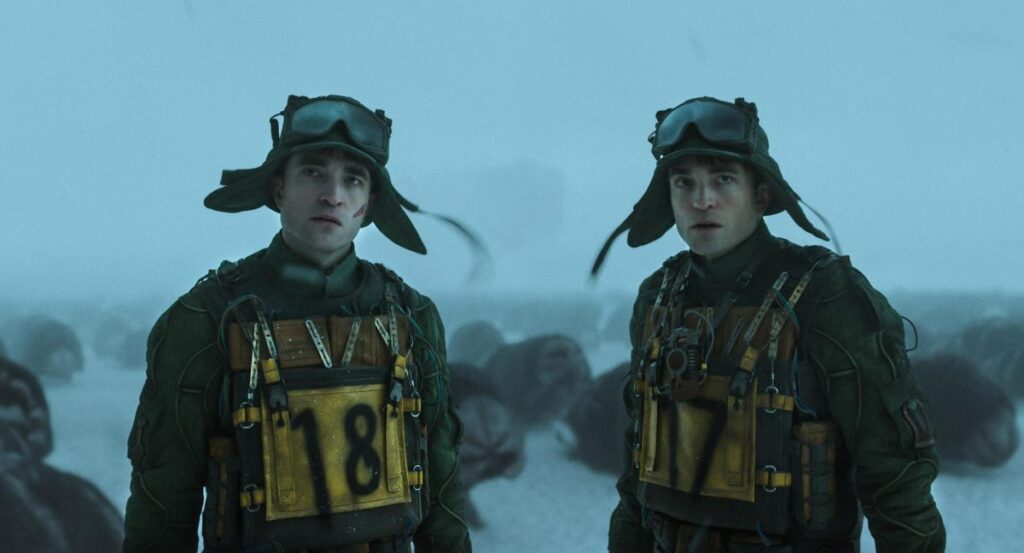
Unfortunately, I’ve got too much work on my plate and, therefore, cannot write up a script review today. But I wanted to leave you with a brief reminder about the most important thing in screenwriting.
Have any idea what it is?
It’s CONCEPT.
And Mickey 17 is proof of that.
Hold up, many of you are saying, Mickey 17 just bombed at the box office. Why would this movie be proof of anything positive?
Are you ready for this?
I’m about to blow your mind.
The fact that it bombed is exactly why concept is so important in screenwriting (I know this was originally a novel but it was essentially written as a vehicle to get a movie adaptation, aka a screenplay).
You see, the most important component to making a studio movie (and even most indie movies) is POTENTIAL. Does the film have a shot at grabbing a huge paying audience? If the answer is yes, a script/novel/treatment/pitch will move up the ladder.
What’s the most proven way to create something with potential? A big concept. And Mickey 17 is a big concept. Nobody can argue that. Studio execs are willing to fall on these swords if they’re big ideas. Because it means they were gunning for the right thing – a movie that makes money.
When they get in trouble is when they push movies without clear concepts (or low concepts) and they bomb. Stuff like Megalopolis, Babylon, and Beau is Afraid. Greenlighting those movies will get you fired.
But people WILL READ SOMETHING LIKE MICKEY 17 because when they hear that concept, they know it has potential. They also know that high concept material doesn’t need to be perfectly executed to perform well. Say hello to M3GAN or Us.
Always come up with the best and biggest concept you can. If you do that, you have a fighting chance as a screenwriter. If you don’t, breaking into this profession is nearly impossible.
Genre: Mystery/Thriller
Premise: Ten years after she disappeared as a teen, Violet, now 25, turns up with no
memory of what happened to her, but as her family welcomes her home, it quickly
becomes apparent that the past cannot be forgiven or forgotten.
About: These two writers first hit the trades ten years ago with a script called Mayday 109. The logline was, “The story of how a young World War 2 Navy commander saved a group of men after their ship was destroyed by the Japanese. That man? John F. Kennedy.” They then went on to write Keeper of the Diary, about the attempt by Anne Frank’s father to sell her diary. This is their first high profile script I know about that is completely fictional.
Writers: Samuel Franco & Evan Kilgore
Details: 104 pages
 Casey Affleck for Michael?
For the rest of this month, we’re going to be on a hunt. We’re going to be looking for scenes we can feature here on the site to work as inspiration for Scene Showdown. If you’re late to the party on Scene Showdown, here are the submission details.
What: Scene Showdown
Rules: Scene must be 5 pages or less
When: Friday, March 28
Deadline: Thursday, March 27, 10pm Pacific Time
Submit: Script title, Genre, 50 words setting up the scene (optional), pdf of the scene
Where: carsonreeves3@gmail.com
The fact that I couldn’t find a single scene from Sunday night’s episode of White Lotus, a show that hails from the best writer in television, is a reminder of just how difficult writing scenes is. I don’t think screenwriters think about it nearly enough. They think about their overall story then piece together a series of 1-2 page moments that, eventually, lead them to the conclusion of that story. But they don’t construct individual scenes unto themselves, scenes that have clear beginnings, middles, and ends.
It’s an epidemic and has become so common that I don’t think most writers even know how to write a scene anymore. I really don’t.
But I still go into every script hoping they do because I know that I’m going to have a much more enjoyable experience if they’re great scene-writers. So, let’s check it out!
Recently separated 36 year-old Michael Miller is going camping with his 14 year-old daughter, Violet. It’s going to be the last time they spend together for a while, as Violent will be going to live with her mom, Joanne.
Late at night, on the drive back from camping, Michael is stopped by a cop for speeding. The cop checks both Michael’s and Violet’s IDs, then request Violet get out of the car. Michael freaks out and tries to stop him but the cop threatens him with a gun. The cop then arrests Violet for distributing drugs, detains her in his car, and drives away. Michael tries to follow the cop but loses him.
When he finally makes it to the local police station, they say they don’t know this cop. After a few calls to other departments, they realize that the cop who picked Violet up was a fraud. Violet has been kidnapped.
Cut to 10 years later and Michael gets a shocking call. His daughter has been picked up in Mexico. Michael and Joanne head down there and retrieve their daughter, who has amnesia brought on by PTSD. The cops say to give her time. Her memory will come back.
(Things start getting spoilery from here on out)
When they get back to the U.S., a female detective named Manuela Garcia is assigned to cross the t’s and dot the i’s on the case. But she’s immediately suspicious that something is off regarding Violet. She’s particularly skeptical of the Mexcian cops, who refuse to send over the DNA test.
So Manuela goes down to Mexico to ask some questions. She immediately confirms that her suspicions were correct. This chick is definitely not Violet. But then who is she? And, more importantly, what happened to the real Violet? Manuela heads back to the U.S. to answer that question once and for all. But neither she, nor we, are prepared for what she discovers.
Okay, I got good news for you. WE’VE GOT SCENE WRITERS!
We get a fairly good one right away and then a really good one afterwards. That is the scene I’m pasting here. The setup is that this car has been riding Michael’s ass at night for a long time. Finally, Michael gets pissed and speeds away from it. As soon as he does, cop lights appear on the car, indicating it’s a cop, and he pulls them over.


This scene is an example of how classical situations can result in great scenes. Cops pulling you over create an immediate baseline of conflict that you can take in a lot of different directions in the scene. The trick with familiar scenarios is to build in your own unique details.
For example, this wasn’t a normal “cop pullover” scene. The cop baited them into breaking the law. It tricked them. So, already, we’re (the reader) more heated than we would usually be in this scenario because we know this cop is a snake.
From there, we have our clear beginning, middle, and end. To find your beginning, middle, and end, find the goal. That’s where you build your scene from. The goal doesn’t need to come from you hero. It can come from the villain. That’s the case here. The villain, the cop, wants the girl. That’s his goal. Now he just needs to execute his plan.
The middle of every story is your conflict section. It’s no fun if the person with the goal achieves that goal easily. There’s got to be pushback. We get that here in Michael and Violet resisting (and freaking out).
The highlight of this scene is something we don’t often talk about in scenes which is REVELATIONS. Revelations are great ways to pump up a scene, especially one that’s already cooking, like this one. The cop makes Violet get out of the car instead of Michael and then arrests her for drug-dealing (something that was vaguely set up in an earlier scene). We don’t know WHAT’S HAPPENING here. This was not expected. Which is why we’re so charged up.
That leads to the final act of the scene – the ending. This is the climax, where Michael tries to fight back, demanding answers. But the cop is able to hurry out of there and Michael isn’t able to get back on the road fast enough to follow him.
Really good scene.
As for the rest of the script, it’s good! The problem this particular story poses for writers is that, usually, all the best stuff happens in the first act. The girl goes missing. We cut to 10 years later where she reappears.
But then where is the story engine from that point on? Why would we keep reading? To see Michael, Joanne, and Violet have a series of awkward conversations for 90 minutes? You need something to drive the story. Kilgore and Franco achieve that by shifting the goal over to Detective Manuela.
She takes the reins and becomes the story engine – first looking to confirm that this is Violet and then trying to figure out what happened to Violent. In that sense, it’s a very well-written screenplay.
[major hints at spoiler below]
The climax of Vanished is the biggest whopper on this year’s Black List. I haven’t read 80% of the scripts yet but I know that’s the case. Cause this ending is a big swing. Does it work? It does! But is it perfect? No. It’s ALMOST there but not quite. If it got there, I would give this an impressive. But it was still darn close. And I appreciate the creative swing with the ultra twist ending. :)
[ ] What the hell did I just read?
[ ] wasn’t for me
[xx] worth the read
[ ] impressive
[ ] genius
What I learned: A simple way to improve your scene-writing is to set up stuff BEFORE THE SCENE. Then pay it off in the scene. One of the things you see happen in this scene is that Michael’s car won’t start. That ends up being the reason the cop gets away from him. This was set up a couple of times in earlier scenes. That this car was not top quality and was definitely on the unpredictable end. That setup allowed for the climax of the scene to be even more exciting.
REMEMBER THAT SCENE SHOWDOWN IS AT THE END OF THE MONTH. SUBMISSION DETAILS BELOW!

What: Scene Showdown
Rules: Scene must be 5 pages or less
When: Friday, March 28
Deadline: Thursday, March 27, 10pm Pacific Time
Submit: Script title, Genre, 50 words setting up the scene (optional), pdf of the scene
Where: carsonreeves3@gmail.com
A big reason I’m tracking White Lotus on the site every Monday is to see if Mike White can pull it off. Three straight seasons of a great show. It’s hard to do. And last week was the first time I spotted a loose piece of thread on the shirt.
One of the ways you can tell when writing is going bad is when it loses purpose. Things are happening on screen but you’re not entirely sure why they were included. With good writing, every scene, every moment, adds something to the story, whether it be the plot or something important about the character we didn’t know before. And it all falls under the umbrella of a story that’s building towards a conclusion.
I didn’t get a sense of that last week. That whole “get high and go watch a snake show” sequence (two characters leave the hotel to watch a local snake show), felt like a bad outtake from a rejected Hangover sequel. It was the opposite of purposeful. I had no idea why it was in the story and that usually indicates that the writer is trying to fill up time. That’s when you know you’re in trouble – when you’re just filling up pages so that the episode or movie can be long enough.
I’m sure Mike White has a different interpretation of why he included that sequence but there’s no question the last episode was the worst of the first three. So I went into this one hoping it was a one-off issue.
Was it?
Well, guys…
I’m getting worried. My White Lotus BVDs need a cleanin’.
Something I wanted to do with this episode was identify a great scene so I could share it with you here as inspiration for Scene Showdown. Mike White is a great scene-writer. So color me WTF’d when I got to the end of the episode without seeing a single good scene.
Almost every single moment in the script is a scene snippet as part of a larger sequence. One of the plotlines of this episode was that the loopy Ratliff family goes on a giant yacht courtesy of a girl Saxson met at the hotel. The whole yacht plotline was random and unfocused. We’d see the dad, Timothy, drinking and mumbling to himself. We’d see Saxson encouraging his little brother, Lochlan, to talk to girls. We’d see mom, Victoria, complain about her social anxiety.
But WHERE WERE THE SCENES!???
Scenes require structure. They require a beginning, a middle, and an end. They require someone who wants something, then that goal is complicated by conflict, then they either get what they want or they don’t.
The closest thing we got to that was Chelsea sitting her perpetually antagonistic older boyfriend, Rick, down and asking why he’s acted so weird the whole trip and why he’s demanding to take a side trip to Bangkok tomorrow (that’s the goal for the scene. She wants to know what’s up with him). He hems and haws, not wanting to tell her (that’s our conflict). But she pushes and, finally, he relents, telling her (spoiler) that the owner of this hotel killed his father. And he wants revenge.
While it’s the most “scene-y” scene in the episode, it isn’t a very good scene. The last three episodes have so heavily hinted at why Rick is here that the reveal isn’t surprising. Which means that *we* don’t benefit from the scene. Only Chelsea does. She’s now caught up with us. But how is that entertaining to the viewer? It isn’t.
Mike White is playing a dangerous game of what I call “swimming in sequences.” Sequences are, basically, long scenes. The argument for them is this: instead of coming up with a perfect beginning, middle, and end for a scene every two minutes, why not create a larger sequence – one with a bunch of scene snippets – and use that to create your beginning, middle, and end.
And when you’re on top of your sequence writing – when you deftly outline their beginning, middle, and end – they can work. Just like scenes work. But because sequences are so much longer, it’s easier to get lost in them. And the next thing you know, you’ve got 6-7 scene snippets, but because they’re not tightly constructed enough, the sequence feels loose and unconfident.
Which is exactly how this boat sequence felt. Where was the goal of the sequence? Without that, you’re screwed. Cause now nobody in the audience knows what we need from this boat ride! If you gave us SOME KIND of entry point, I would’ve been okay with that. For example, Saxson likes this French prostitute woman who invited them on the boat – the one who’s currently the girlfriend of the man who owns the boat. Okay, so give Saxon the goal of trying to have sex with her.
That’s actually a pretty strong entry point into the sequence – to try to have sex with the woman who’s beholden to the boat’s owner. Lot of potential conflict there. Lots of potential danger in the fallout. But we don’t get anything close to that.
I think back to the original season of The White Lotus, and they had these great scenes, like when Shane (the entitled rich newlywed) would challenge Armond (the hotel manager) about him screwing up their room booking. Armond, who would privately realize Shane was right but refuse to admit it, would have these marathon scenes with Shane where he would dance around saying sorry and look for ways to fix the problem that Shane was never satisfied with.
I liked those scenes so much, I highlighted one in my dialogue book.
We’re not getting enough of that this season and that’s usually an indication that the writer has lost the plot. They’re not really sure what the show/season is about. They’re not really sure what each individual character’s storyline is. They’re not really sure where they are in the season. When that happens, you throw in these big chunks of story that can eat up time in an episode (sequences) and you just, sort of, have stuff happen in them, like Saxson and Lochlan hitting on some Thai wives for 3 minutes.
It’s lacking definition and I’m legitimately worried. Cause I love this show so much. But I also know how hard it is to write an extended story well. Sometimes I believe that all writing is just a house of cards and that if a writer is forced to write for long enough, the story will fall apart. Which is why the first movie in a franchise is awesome. Second movie, not so much. Third movie, getting worse.
Same thing with TV. Each season seems to get a little sloppier. Until we reach that final season, where the show starts to get back on track. The reason for that is, the show has purpose again. It’s going to end at the end of the season. So the writer can now write towards a goal, instead of being stuck out in the ocean clinging to any piece of conflict or unresolved relationship issue he can find.
But the good news is, you can manage this problem if you understand its pitfalls, which I’ve just laid out for you. Structure is everything. The more you move away from it, the more trouble you’ll find yourself in. Create strong beginnings, middles, and ends to scenes. Definitely create strong beginnings, middles, and ends to sequences. As long as you’re doing that, you’re giving yourself a chance. :)