
Search Results for: F word
Mandalorian and Grogu built a movie on a main character whose face we couldn’t see. Minions & Monsters built its movie on main characters who speak a language we don’t understand. Will it suffer a similar fate?
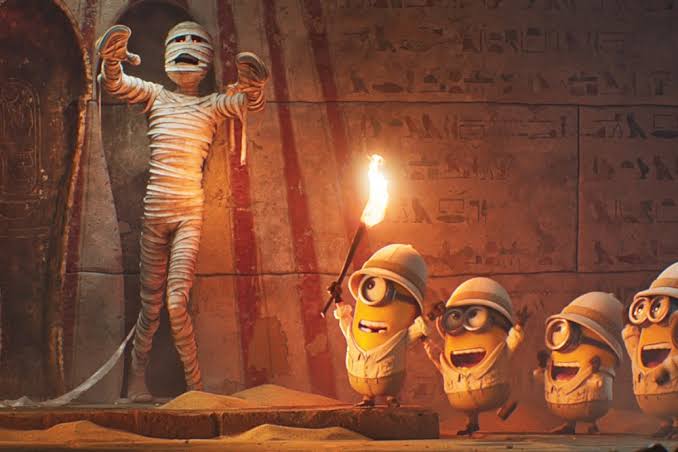
I find it funny when the trades try to cover for a movie bombing. According to them, the reason Minions made 60 million dollars compared to 120 million for the last sequel is that July 4th landed on a Saturday. Which meant the weekend played traditionally, versus when it lands on, say, a Thursday, and then it gets more people in on the non-weekend days.
Oh, and then there’s the World Cup excuse. You know, cause the World Cup fans are entire families. So they’re more focused on that than movies. Hmm, strange how the World Cup excuse didn’t apply to Toy Story 5’s record-breaking opening.
Uh, here’s an alternative explanation. Just throwing it out there. DON’T RELEASE YOUR ANIMATION MOVIE TWO WEEKENDS AFTER THE PREMIER ANIMATED FRANCHISE IN TOWN!
You know. Maybe that’s a reason also?
Now that the Obsession obsession has finally cooled down, the second biggest box office story of the year has come to the forefront. And that’s the quick merciless death of Supergirl. The movie dropped 80% in its second weekend, which is almost impossible, just based on the fact that, when you have that many theaters, sometimes people accidentally buy tickets to the wrong movie.
One of the things that’s always thrown me about Hollywood is how the town will decide early on that a movie is toast and every single person gets on that narrative train, making it very hard for the movie to overcome that negative buzz.
That’s how I would frame the failure of this movie. Right from the beginning, people were against it. And it strangely started when Millie Alcock signed on to play the lead, hot off the buzz she was getting from Game of Thrones.
I’m starting to think that all you need to build buzz about yourself in this business is a really bright blond wig. Maybe I should get a bright blond wig. Wear it around the farmer’s market at the Grove a few hours a day. Speak in Old English. Use a lot of “ye’s” and “thou’s.” Who knows what might come of it.
A lot of people point to Millie Alcock’s interviews as a problem. That’s when a lot of people turned on her. Her most famous quote was this response: “It definitely made me aware that simply existing as a woman in that space is something that people comment on. We have become very comfortable having this weird ownership of women’s bodies. I can’t really stop them. I can only be myself.”
When she was asked about that comment a year later, she doubled down. “I didn’t even say ‘men’ — I said ‘people!’ And they got so angry. I was like, ‘You’re proving my point. You’re proving my point!’”
There were also some woke criticisms that came from comments claiming Supergirl doesn’t live “inside the binary of what a woman should be.”
And it’s definitely Millie Alcock’s fault for saying these things. But not for the reasons you’d think.
Reporters asked her questions that they hoped would get these very responses because reporters know that these responses go viral. So they asked her in that first response what she thought about toxic fandom in regards to House of the Dragon. And they asked her, in that second response, if Supergirl is a good role model for queer people.
In other words, they were baiting her. And she took the bait. And she only took it twice but that’s all that was needed. People turned on her hard after that.
This is part of being an actor. You have to know that the media is not on your side. They are only there to get things from you that help them. And so you sometimes have to swallow what you want to say and instead say what’s best for your project and your career.
There’s a reason that nobody can quote a single thing that Leonardo DiCaprio has ever said in an interview. Because he knows the game the media is playing so he’s deliberately boring. He gives them nothing to print.
The other option is to be like Inde Navarette (Nikki in Obsession). She is the most beloved actress in town right now and she would never ever make a mistake like Millie Alcock made. She was recently cornered by the press asking her about the rumors she might play the lead in Michael B. Jordan’s movie adaptation of the popular book franchise, The Fourth Wing.

This was her response: “I have seen this because I said that I’m a really big fan of Fourth Wing and I would love to play Violet. But I mean, at the end of the day, I really want the studio to find who they want to find and what everybody thinks is like the perfect actress. But if that happens to me, that would be phenomenal.”
You don’t get the sense that Millie Alcock could respond like that. And she’s paying the price for it.
Look. Supergirl was a miscalculation on a giant level. The biggest miscalculation was betting on a third-tier superhero at the tail end of the movie superhero era. People aren’t seeing superhero movies at nearly the same clip anymore. The only ones that do well now are the big dogs. So, if you want to identify the core issue that caused this movie’s failure, that was it.
Millie Alcock’s attitude only exacerbated that problem. And it’s something I believe Gunn was aware of. So he made sure that Supergirl was going to have a big “save the cat” moment early on in the movie so that we fell in love with her. The save the cat scene we got? Supergirl is drinking in a bar when a giant alien steals a little girl’s dead father’s sword. Supergirl then goes after the alien to get the sword back for the girl.
What struck me most about that scene was how little I felt afterwards. I did not think, “Wow, I really like this person.” Which is the primary thing that the save the cat scene is designed to do. But I didn’t feel that way and I suspect it was because Supergirl was pissed off the whole time that she had to help this little girl. So it negated the action.
On top of that, reluctant heroes are notoriously difficult to write, since characters who don’t want to do the very thing the story requires them to do create a tricky puzzle for screenwriters. In storytelling, it always works best when the person pushing the story forward wants to achieve the goal.
The best I’ve ever seen the reluctant hero work in a screenplay was Braveheart. William Wallace hated every second of his quest. But he also loved his country more than anything and wanted freedom for his people. So, that helps a lot. When your hero is doing things for others rather than himself. And even though Supergirl is technically doing this to save her dog, she feels like she’s only in this for herself.
I think one of the more interesting subplots of the downfall of superhero movies is the bizarre choice by both Marvel, with Thunderbolts, and DC, with Supergirl, to center their stories around depression.
I’m not saying depression shouldn’t be discussed. I just think it’s a tough fit for a genre built on wish fulfillment and escapism. People go to superhero movies to feel uplifted, not to spend two hours watching superheroes wrestle with the same problems they brought into the theater.
I don’t know. Maybe they thought with Joker’s success that they could bring in a new “depression era” in superhero movies. That everyone was now going to get all jazzed to see depression trilogies. I got news for you, Hollywood. AIN’T GONNA HAPPEN. You want to explore depression, do it with a 15 million dollar film. Not 200 million dollars. Cause these are the results you get.
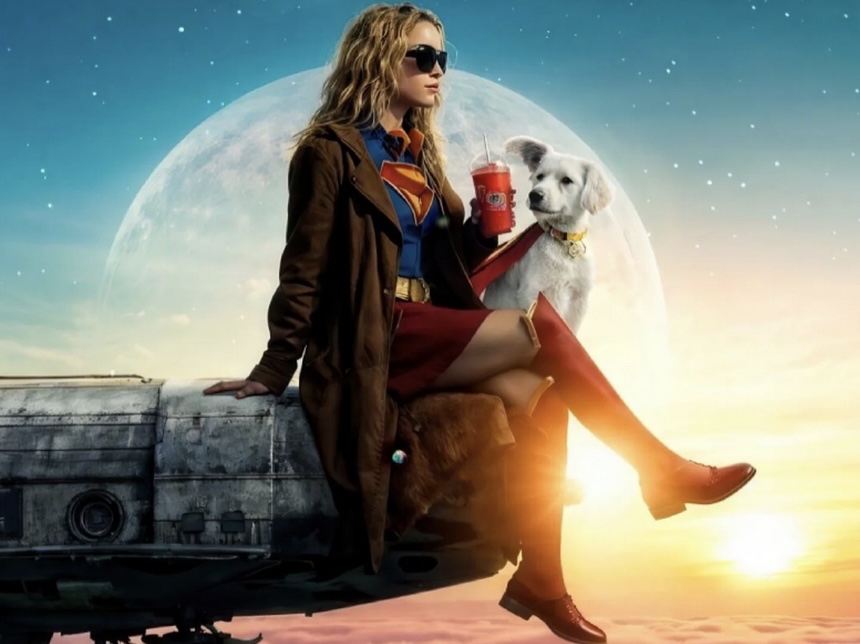
But the funniest story to come out of Supergirls’s failure is the battle between the “needle drops.” For those who don’t know, I guess because of his Guardians movies, James Gunn has anointed himself the king at being able to drop just the right song at just the right moment into the climactic sequence of the movie, delivering an epic finale.
Because Supergirl had been testing in the 60s (that’s really low) for months before its release, they were looking for every way possible to bring that score up.
Their big solution? The needle-drop moment!
Apparently, there was then a battle between Gunn and Supergirl director Craig Gillespie about what the needle drop song should be. And they went back and forth on it and they had all these meetings and they even tested different needle drops with different audiences.
Dude.
If you’re depending on a needle drop to save your movie, your movie’s dead. It is six feet under. Maybe that’s your needle drop. Billie Eilish’s Six Feet Under.
I think Supergirl just had too many things working against it. It’s too bad because everybody says the comic book the movie is based on is amazing. But not all comic books are meant to be turned into movies. And I think that having an unlikable protagonist combined with a not very likable actress was the nail in the coffin.
Genre: Horror/Action
Premise: After her family is murdered by the mob, a religious woman lets herself become possessed by a demon in order to get revenge.
About: The Blood & Ink Horror Screenplay Contest is a unique screenwriting contest whereby, six months ago, you had to pitch your way into the contest. Scripts either got in with a “yes” by me or they got at least 15 upvotes when pitched in the comments section. The 90+ writers that were chosen then had six months to write their script. I will occasionally review one of the scripts here. If you want to see the previous Blood & Ink reviews, you can do so here, here, here, and here. For those who missed Blood & Ink, I am doing a brand new pitch contest starting Friday July 10th. Get those high concept script pitches ready!
Writer: Nicholas Cocco
Details: 96 pages
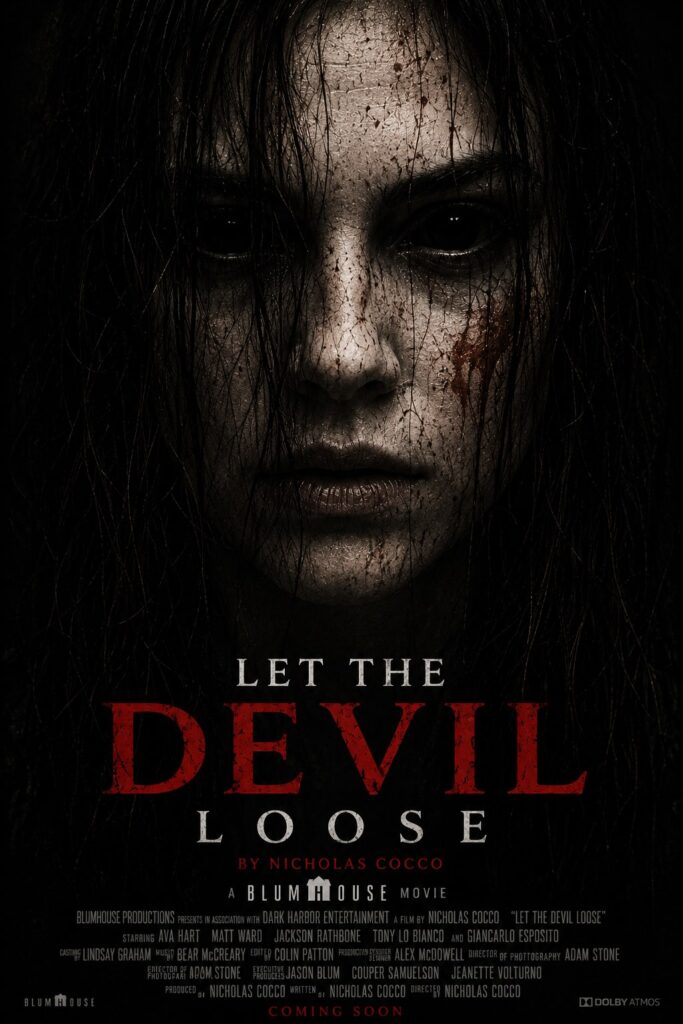
I LOVE this idea.
Love it love it love it. I think I picked this as one of the top 5 loglines, right?
Yeah. So I was really looking forward to this one.
Let’s check it out!
It follows Grace Rache, a deeply religious woman in her 30s. She’s married to Max, a war veteran who has no interest in religion, and together they have a teenage son, Wolfgang, who doesn’t believe in God either. So when it comes to faith, Grace is pretty much on an island by herself.
Max and Wolfgang run a breakfast shop in the city. Right next door is a Wiccan shop run by an elderly woman. One day, two mobsters, Cesare (20s) and Nico (40s), show up and inform the old woman that she’ll be paying them for protection. She tells them to fuck off. Wolfgang happens to be nearby, steps in, and knocks Cesare to the ground. That quickly escalates into a standoff between Cesare and Nico on one side and Max and Wolfgang on the other. The gathering crowd eventually convinces the mobsters to back down and leave.
Unfortunately, they come back later to send a message. But things get out of hand, and Max and Wolfgang end up dead. A few days later, we see Grace mourning. She struggles to move forward until the old witch pays her a visit. She presents Grace with an ancient jar containing a demon and explains that if she allows it inside her, it will help her get revenge. Grace doesn’t need much convincing. She’s in.
Next we meet a terrifying wraith, which we eventually learn is Grace in demon form. The wraith begins hunting down members of the mob one by one. One is taken down in a butcher shop freezer. Others are attacked inside a moving car. The creature is fast, powerful, and seemingly able to appear and disappear at will. After Grace kills Nico, his brother Frank, the head of the family, gathers everyone together to figure out how to stop this thing.
Meanwhile, Grace, or more accurately the demon living inside Grace, catches the attention of Father Vincent, who becomes determined to destroy it. So while Grace continues her bloody war against the Family, Father Vincent launches one of his own against her. Eventually, only Frank and his son Cesare remain. Grace tracks them to an abandoned live munitions island, where the story builds to a long, brutal fight to the death.
Okay, so I’m learning a valuable lesson from this experiment.
It would’ve helped if I’d given guidance on the outlines for these scripts before they were written. Because this doesn’t represent the idea that I imagined. And, if I would’ve seen this in outline form, I could’ve helped Nick nip some of these choices in the bud, and set him on a path to a more powerful screenplay.
So, I think what I’m going to do for the upcoming high-concept pitch contest is offer the top 10 finishers just that – An outline evaluation. Cause I would’ve strongly encouraged Theresa to go with one main character instead of two in Worst Time of the Year. I would’ve encouraged Jake to build a more all-encompassing mythology in Black House. And I could’ve helped avoid the structural issues with Eric Levin’s The Mold.
That’s why I always encourage writers to get consultations BEFORE they write the script. An outline consultation can eliminate problems that might otherwise take three or four drafts to discover. It’s one of the most efficient investments you can make. If you’d like an outline consultation or a screenplay consultation, e-mail me at Carsonreeves1@gmail.com.
Okay, so what are the issues in Devil?
I’d start with the wraith. The whole point of this movie was to see this woman take down these bad guys. But, instead, we start her off as this shadow-like wraith who’s basically Venom.
To me, that defeats the purpose of the screenplay. I don’t want to see a 1000 year old monster get revenge on people who never did anything to him. I want to see the woman whose situation I’m devastated by, someone I empathize with, I want to see HER get that revenge.
So, as soon as that wraith showed up, a big part of me gave up on the script.
To Nick’s credit, he seems to catch a second wind in the second half of the screenplay and give me something closer to the movie he originally pitched. The showdown at the church, the family going for outside help from other crime families, the climax on the island, Grace in human form — that was more what I was originally envisioning. But a lot of it came after I’d mentally given up on the movie.
That’s the thing with screenplays. You can be one of the screenwriters whose script doesn’t hit its stride until the middle of Act 2. But if the reader mentally decommitted on page 17, it’s pretty much impossible to get them back.
And there are other problems here as well – things that, had they not happened, maybe I would’ve stayed with the script longer. For example, we never see Grace react to her husband and kid being killed!!!!!!
The first time we see her reaction is at the funeral standing in front of the caskets. And she doesn’t even seem that upset. She’s just numb. This whole movie is about revenge. It’s about making this extremely difficult choice to bring a demon into your body so you can achieve something that you are diametrically opposed to — revenge and killing. If a character like Grace is going to make that choice, we have to see her devastation. That’s the only way that the choice makes sense to the audience. And for some strange reason, we never see that.
There were other basic mistakes early on. A key scene occurs when Nico and Cesare are trying to choose which shops on the block are good for hitting up. We’re not told what they want from these shops. That information is kept secret for some reason. Then, out of nowhere, we cut to inside the Wiccan shop, and Cesare is standing in front of a “crone” (note: I don’t know what a crone is), and we hear this line from the crone – “Don’t need protection, boychik.”
That’s the first line we hear after being thrown into this context-less situation. My best guess, at the moment, was that “boychick” implied some sort of sexual connotation. Like a ladyboy maybe? And so the word “protection” following indicated ‘sexual protection’ to me. Condoms maybe. I have no idea why that’s being talked about here but that’s the best I can do with what little information has been handed to me.
This then leads to Wolfgang coming out of nowhere, knocking Cesare down. Then running away, which leads to Cesare and Nico confronting Wolfgang and Max. Which leads to Cesare and Nico later killing them.
Only in retrospect do I realize that the Italians were going down this block, forcing shops to accept “protection” for money. And that’s what the scene was about. With this scene being so incredibly important to set up the story, why are we coming into it so late? Why open the scene mid-conversation with a line that can be so easily misinterpreted??
This scene sets up your whole movie!!!
Make it clear as hell!
And make it an actual scene!!! With a beginning, middle, and an end.
That shop scene is half-a-page long. It should’ve been 4 pages long. You build it up. You give us all the information we need so we understand what’s going on. Then, and only then, do you introduce a disruption.
I knew after that scene that the script was in trouble. Because those scenes should be easy to write. It’s the later scenes where you try and get deeper into the characters and create interesting plot developments — that’s the hard stuff. This setup stuff should be a piece of cake.
Maybe Nick thought, “I know I’m not supposed to be on the nose. So I’m not going to have the mobsters explain exactly what they’re doing.” And “Screenwriting books tell me I need to move the story along quickly, so I’ll jump into this scene really late.”
I mean, we come into the scene so late and with so little information that I didn’t even know why Wolfgang was there. I know Max told him to go in there for some reason. But I was not told why.
Sometimes I think screenwriters tie themselves in knots trying to do things the “right” way. This scene needed to convey important information. So convey the information. Don’t convince yourself that making the scene cryptic somehow makes it better.
Just to reiterate why I fell in love with this concept. I imagine this woman who couldn’t physically beat up a teenager, much less mobsters with guns. Her husband and son have been killed by the most powerful crime family in the city. The police won’t help her because they’re in with the family. No one else can help her because the family is so powerful.
Then she gets this opportunity to be possessed by a demon that will give her the strength to be able to take the family down all by herself. But it’s a demon. So, there will be problems containing it.
But she’s instructed on how to bring it forth when she needs to and put it away when she doesn’t. Of course, it doesn’t go that smoothly. When she doesn’t need it, it still wants to come out. And so even in her normal life, she’s struggling to keep it contained until the revenge is over. Then, at the end, she has to get it exorcised. Which is no given. And that’s your movie.
And just to be clear, I know writing scripts is a lot harder than criticizing the final effort. I sense that Nick struggled with how much horror he could stuff into this premise and made some creative choices that I didn’t agree with because of that. But I would tell Nick to always follow the path that gives you the best movie, not the path that fits you the most squarely into the correct genre.
Script Link: Let the Devil Loose
[ ] What the hell did I just read?
[x] wasn’t for me
[ ] worth the read
[ ] impressive
[ ] genius
What I learned: Your bad guys have to be formidable. At least the ones at the top of the food chain. Because if there’s no doubt at all that Grace can eliminate these guys, then there’s no suspense. There’s no uncertainty about what’s coming on the next page. Make Frank and one more guy super formidable. Maybe they even get their hands on some anti-demon weapons. I want to feel like Grace is overmatched in this final battle.
A couple of weeks ago, I was talking to someone about the word “hate.”
The conversation started because we were discussing music and I casually mentioned that I hated this band. She immediately stopped me.
“Hate is a terrible word,” she said.
Naturally, I asked why.
And she actually had a pretty interesting argument. Her point was that “hate” has become one of those words people throw around without thinking. You don’t merely dislike a movie anymore. You hate it. You don’t disagree with someone. You hate them. Everything gets pushed to the most extreme setting.
The more she talked about it, the more I started to come around. “Hate” is a conversation-ending word. It doesn’t invite discussion. It declares war on discussion. The moment you say you hate something, you’ve essentially informed everyone that you’ve moved beyond reason and entered into the realm of pure emotion.
By the end of the conversation, I found myself nodding along. Maybe she was right. Maybe we’d all be a little better off if we retired the word entirely.
I thanked her for the perspective.
Anyway.
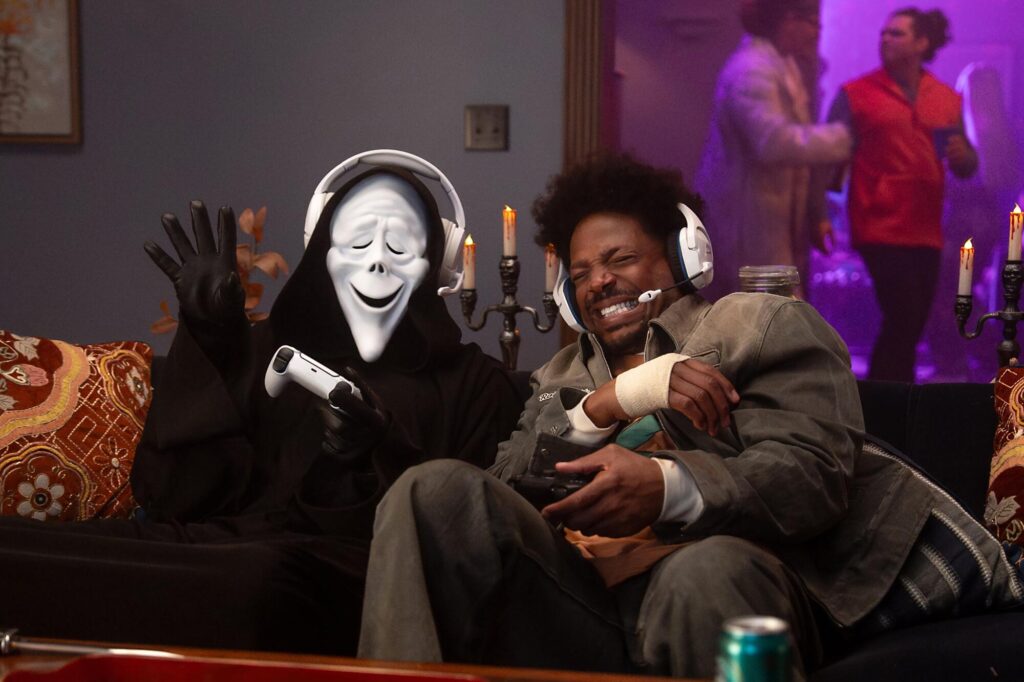
I hate the Scary Movie franchise.
If there is a lazier, less funny comedy franchise out there, please tell me what it is. Because I don’t think it exists. The Wayans Brothers and their idea of humor have to have some of the worst attempts at joke construction that I’ve ever seen put to screen.
And by the way, the success of Scary Movie’s box office this weekend completely destroys all the good will that the box office has built up over the past couple of weeks. We thought we were seeing a revolution. That audiences had finally become smart. They refused corporate trash like Mandalorian and Grogu and embraced smart thoughtful horror in Obsession and Backrooms.
NOPE.
This weekend proves they’ll continue to pay for any piece of garbage that Hollywood lobotomizes onto the screen.
Some people will say, “No. This is good! People are coming to theaters!”
No! It is the opposite of good. People show up to this movie, are reminded of just how bad Hollywood movies can be, then don’t come back for another six months. These are the movies that destroyed the business. Not saved it.
It’s just sad that people go and see this trash. I feel like I’m watching the dodo birds, with the screenplay pages of this monstrosity of a script strapped to their backs, plunge off a cliff and I’m helpless to stop them. But what are you going to do?
The move that was supposed to have the big box office weekend was He-Man (30 mil). But it turned out the roided-out 80s icon did not “have the power.” I don’t think there was anything they could do to make this movie work because I honestly believe this was the best version of the movie they could make. Big-budget, harmless, cheesy. And people still didn’t like it. And sometimes that’s just the reality of your IP. It’s not meant to be a blockbuster no matter how hard you try and make it one. And they tried! They spent 17 years developing this. It’s just not a movie IP.
Backrooms took a pretty big tumble this weekend, losing 70% of its audience. That’s a hard to defend drop. The old excuse used to be, “Horror always has giant drops on the second weekend.” The only problem is that the film’s main competition, Obsession, GAINED audience in its second weekend. And this weekend, it’s fourth, it only dropped 7%. So they can’t use that excuse.
It confirms what I’ve been saying, which is that the backrooms don’t really make sense. The mythology is wonky. And so there isn’t nearly as much depth in the film as its missionaries want you to believe it has.
I still think it’s an okay movie. It’s just not a good movie.
But don’t worry, Backrooms. At least you’re not Mandalorian and Grogu. A lot of people have said that Backrooms and Obsession were the worst things to happen to Star Wars. Because they highlighted how tiny movies with tiny budgets can take down 300 million dollar (Mando and Grogu’s real budget) behemoths with 200 million dollar advertising campaigns.
But I would argue the opposite is true. The Backrooms/Obsession takeover is such a great story that nobody’s paying attention to the fact that Mandalorian will barely limp past 300 million dollars.
WORLDWIDE. Oh, but Disney tells us, the film is “guaranteed” to make money no matter how poorly it does. Yeah, okay Disney. I’ll expect that Mandalorian sequel announcement any day now.
I’m just pumped for Obsession. I obsessively push to you guys how important a simple premise is. It focuses the movie so much and creates this clean runway for you to just play with that premise and have fun. When you have to spend 30% of your screenplay explaining things, that’s time that you’re not entertaining your reader. That’s the power of a premise like Obsession.
Now, the premise itself has to have a good hook. You can’t be simple just to be simple. I could write a movie about a haunted lightbulb and that’s simple. But a lightbulb is not a hook people care about. A girl becoming insanely obsessed with a guy is a hook. And it’s proving to be the most powerful hook of the year.
On the TV side, I’ve been checking out this show, The Audacity, on AMC. Yes, AMC still makes shows. A couple of people had recommended it to me and the best way I can describe it is Succession in Silicon Valley.
It’s about this tech company CEO, Duncan, whose company has a really high valuation but, in actuality, it’s a worthless company. So he’s running around town trying to get people to invest money so that he and the company don’t implode once the media realizes the truth.
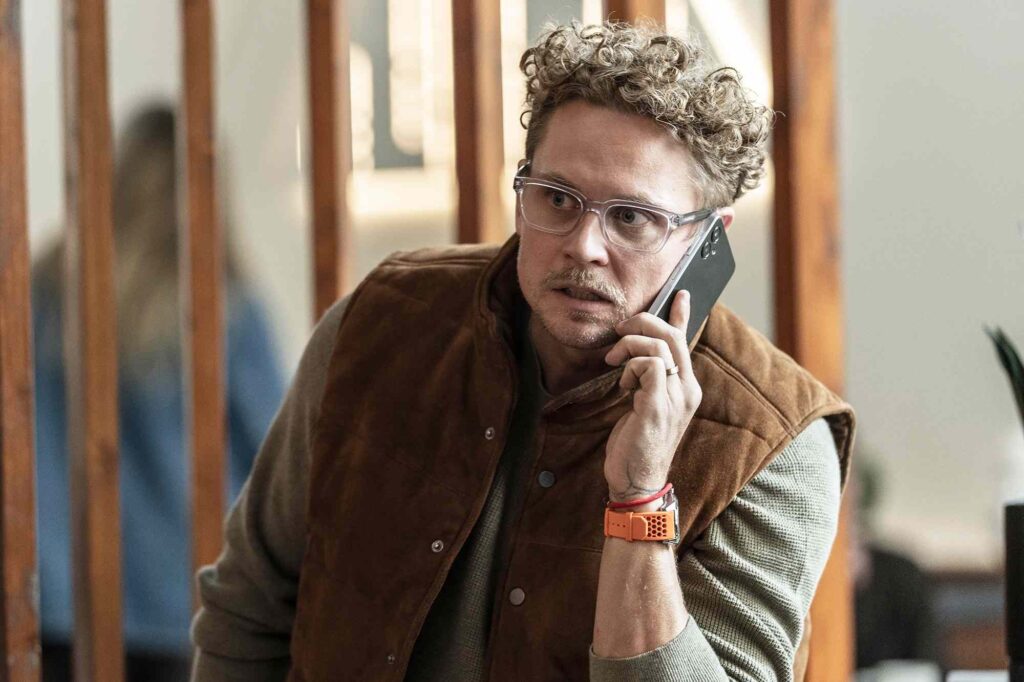
The show has a couple of mini-hooks. The first is that Duncan has access to a program that can access every single thing in the world. So he basically knows everything. And also, he blackmails his therapist (who’s a “therapist to the tech CEOs”) and forces her to give him information about his competition.
The show is a maddening watch. If you thought Succession was risky by making all of its characters unlikable, this writer, Jonathan Glatzer, seems to be conducting an experiment of just how unlikable an entire cast of characters can be and an audience will still watch them. I mean, Duncan alone is the most unlikable person on the planet. And the show cannot overcome that. It’s impossible. It’s one thing to be damaged and an asshole, which creates a small level of sympathy. It’s another to be a crazy asshole. And it doesn’t help that Duncan is played by Billy Magnussen, who’s probably the most unlikable character actor in his age range.
But what intrigued me about the show was that Glatzer seems to have read Scriptshadow and is using a lot of the screenwriting tools I espouse. But he’s using them like nuclear weapons as opposed to hand tools.
EVERY SINGLE SCENE has urgency behind it. We can never just sit in a scene between two characters. There’s always a ticking clock. There’s always somewhere someone has to be. If there’s a party scene, the countdown begins to when the guest of honor arrives and everyone is desperately rushing around to make sure the party is ready for their arrival.
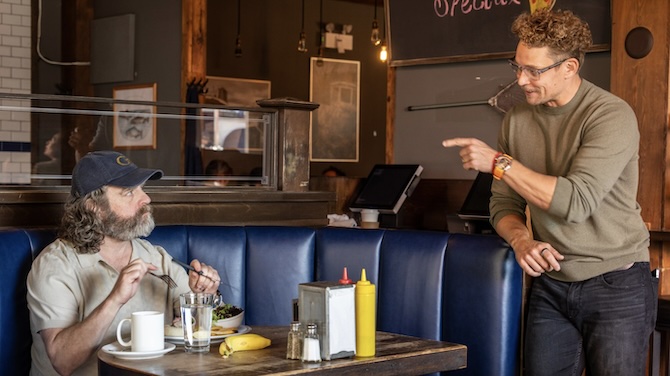
It’s strange because whenever I see the opposite — a lazy party scene where everyone is half-asleep and there’s no clear goal and we’re limping along through several character conversations, I say, “This scene needs urgency!” But Glatzer shows me that there is definitely a limit to how much urgency a scene can handle.
I also talk about “scene agitators” as a means to spice up a scene. Don’t just have two characters in a car talking. Have there be some third agitating variable to create conflict, like a cop car trailing them that may, at any moment, light up its lights and pull them over.
In the third episode, a looming brush fire is introduced. And I’m thinking, “Of course there’s a looming brush fire.” Cause it’s something that can provide this constant series of scene agitators wherever the characters go. We have to worry about that fire getting closer and destroying everything.
In the first three episodes, I’m guessing there are about 100 scenes. 80 of them have scene agitators. There is always something agitating the characters and it’s INSANELY ANXIETY-INDUCING. It’s not fun. That’s the thing you have to realize about these screenwriting tips. You don’t just use them to check a box. You use them specifically to make a scene more entertaining. If all you’re doing is creating more anxiety in the reader and making the scene needlessly messier, than don’t use the tool. The tool is hurting more than it’s helping.
I don’t know if I can finish this show. It creates too much anxiety in me and I hate everyone in it. But what I’ll give it is that it’s never boring. And since nearly every show I watch is boring, I’m inclined to see it to the end. I will say this. Most shows that start off with low episode IMDB ratings contain episodes that get lower and lower rated as the season goes on. But this is the rare show where the rating keeps getting higher and higher. So I’m wondering if Glatzer is just using these first four episodes for setup that he will pay off in an amazing way in the second half of the season.
What did you see (and not see) this weekend?
Give me your reviews!
This writer took over the town for a week. What can we learn from her?
Genre: Comedy
Premise: Two parents will do anything they can to help their son get into Yale, his dream college since he was a young child.
About: Sophie Fleur de Bruijn recently sold a romantic comedy spec that is said to be the best rom-com script in forever. I’m trying to get my hands on it (if you have it, please send it to me here: carsonreeves1@gmail.com). In the meantime, this is the script she wrote right before it, which appeared on last year’s Black List.
Writer: Sophie Fleur de Bruijn
Details: 111 pages
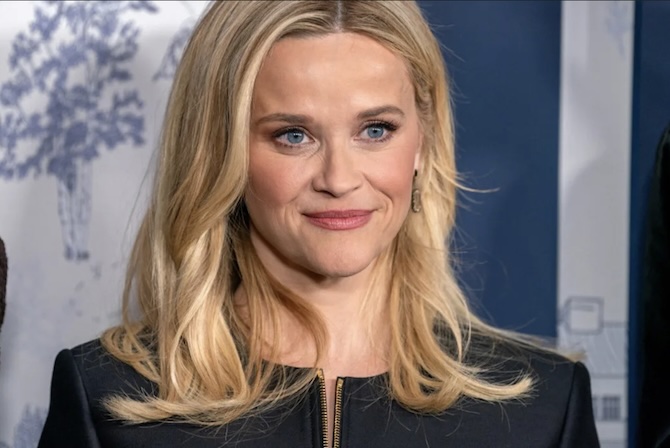 Reese for Heather?
The less glamorous but far more common path to success for screenwriters is this: they write a script that’s good enough to get noticed but not quite good enough to sell. That first script puts them on the industry’s radar. Then, when the next script arrives, people are already paying attention. And if that one delivers, everyone wants it.
That’s what’s happened with today’s screenwriter. She wrote today’s script, Early Action, that got her on the Black List. And then last week she went out with a romantic comedy spec that many are saying is the best romantic comedy script in five years. And 40 different companies wanted it. I didn’t even know there were 40 companies who could buy a script but much like a legitimate critique of Backrooms, let’s look past that detail.
Today, I want to take a look at the script that put Sophie on the map and got the industry paying attention. Attention that ultimately helped her sell her next script. By studying what worked, you can apply some of the same principles to your own writing. Let’s jump in, shall we?
Heather and Richard are young parents to Oliver, a kid who only wants one thing in life. To go to Yale for college. The barely middle class couple have secured a house in a really amazing neighborhood because the house had a gruesome murder in it. This has allowed them to get Oliver into the best schools in the country, which will bolster his chances of getting into Yale.
Cut to several years later and Oliver is in his senior year in high school. In an extremely confusing plot point that I still don’t understand, an angry teacher at the school released the GPAs and colleges that all of the kids in the school applied to, which has caused all of the parents to be really really angry.
As best as I can understand, this leads to Heather and Richard learning that five other seniors in the school are also applying to Yale. And apparently Yale only chooses one kid from this school, which means that Oliver’s application has to be better than those five kids. And since that teacher exposed all the students’ applications (I think), Heather and Richard are able to read the other five students’ applications and realize that their son’s application doesn’t measure up to them at all.
So they find Lance Latham, a guy whose only job is to get rich kids into prestige colleges. Lance tells them that there’s very little Oliver can do to beat these other kids. His only shot is writing an essay for the ages. He needs a story that will bowl the Yale admissions team over. So, Lance says to the parents, make sure he has a great story.
Heather and Richard take this to mean they need to create a series of crazy events (deliver a baby from an actor pretending to be in labor in a stuck elevator, have Richard pretend to be choking in a restaurant) that will give Oliver something to write about. But all of the staged events go wrong for one reason or another.
They finally go for the whopper — pay some people to kidnap their own son. This traumatic event will surely lead to the best essay of the six applicants and win Oliver his coveted dream spot at Yale University. Unless something goes wrong, of course.
Okay…
Where should I start?
Let’s start with the setup. If you have to move mountains to set up your story, then your idea is too complex. The amount of events that need to happen here (there’s a strange meltdown at the school as students’ info is leaked, the parents realize Oliver has a tougher road to get into Yale than they thought, they go to the fixer guy who explains to them how applications work and what they’re up against and what the best course of action is which eventually leads to him saying make sure he has a great essay, then they study all of his competitors essays, and then they sneak in and learn that Oliver only has two sentences so far in his essay, and then they start planning a series of faked events so their son has more material to write this essay) — The amount of shit we needed to trudge through just to start the movie was WAY WAY WAY TOO MUCH!
It reminded me of that dreadful screenplay for Will Ferrell’s and Amy Pohler’s movie, The House. I remember that script well because fifteen different things needed to be explained and connected in order to come up with a believable scenario by which the characters would open up a casino in their house. It was awful. And of course the movie was awful too.
Let me give you the setup for the hottest movie in town right now. A guy wishes the girl he’s in love with falls in love with him too and then she becomes obsessed with him. THAT’S IT. THAT’S THE SETUP.
Audiences don’t like to connect 82 dots just to get your movie started. If that’s what it takes to get to the meat of your story, you’ve got way too much going on and you need to seriously simplify it.
Then, after all that work just to set up the story, the faked events the parents come up with DON’T EVEN MAKE SENSE. They give an actress a balloon to put under her shirt and put her in an elevator with their son and have the elevator stopped and the girl pretend to be in labor so that Oliver will deliver a baby. BUT THERE’S NO BABY!!!! What happens when he actually tries to deliver it???? Of course the scene ends with him passing out before that truth can be revealed.
Then our writer creates this scene of the dad choking at a restaurant in the hopes that their son will give him the Heimlich and “save his life.” That’s your plan for writing a great essay on a Yale application??? I once gave my dad the Heimlich at a restaurant??? This movie doesn’t even make sense!!!
The problems with the script don’t stop there. We don’t even spend any time with Oliver! We spend all our time with the parents. Oliver is the one trying to get into school. He’s the reason we’re supposed to be rooting for everything here yet we barely know him. Literally the only thing we know about him is that he wants to get into Yale.
And on top of all this, this is a very weak premise. This movie idea doesn’t fit into any known lane that Hollywood makes movies in. I suppose it’s a comedy but it’s not a comedy lane that has ever been done before. So, why would people go watch this?
So, what’s going on? How is this writer getting so much heat? Well, despite all of this, the writing itself is amusing. It’s even occasionally funny. There’s a scene, for example, where they’re not-so-lightly encouraging their son to change his pronouns to they/them, pretending to have no ulterior motives at all, and a couldn’t-be-bothered Oliver insists he’s fine with his regular pronouns, irking his parents to no end, who continue to push their pronoun agenda all the while pretending they’re okay with whatever he decides. There’s a lot of stuff like that that definitely made me chuckle.
And I think that in spite of being really bad at the mechanics of writing a screenplay, the writing itself is very fluid and effortless and… it’s hard to quantify the last part but the best way to describe it is that I felt good while reading this script. There’s something very positive about the way Sophie writes that I liked.
There was a time on this site when I experimented with two ratings at the end of every script review, one for the script and one for the writer. The problem was that so many of the ratings were the same that I gave that up. But, for this script, I would give a worth the read to the writer and a wasn’t for me for the script.
And maybe what happened with this rom-com she later sold is Sophie just came up with a much simpler idea. The thing about writing screenplays is, each concept leads you down a new path that you haven’t experienced before. And you don’t know what kinds of concepts work best when writing screenplays until you’ve written a bunch of them. And one of the lessons you eventually learn is that simpler concepts work best. So maybe Sophie’s rom-com idea is just really simple. Maybe she learned that lesson after this. Or maybe she just got lucky and stumbled into it. It can happen.
I suppose if you average these two ratings (one for writer, one for script) together, they end up right between a ‘wasn’t for me’ and a ‘worth the read’. So I have to decide which rating to give and I think this writer is good enough that I can bump this up to a ‘worth the read.’ But it’s a very weak ‘worth the read.’
[ ] What the hell did I just read?
[ ] wasn’t for me
[x] worth the read
[ ] impressive
[ ] genius
What I learned: Good comedy writers use parentheticals strategically. I always tell writers to avoid parentheticals unless they genuinely add something to the line. This is a great example of one that earns its keep:
LUANN (CONT’D)
Thank you. Diane is gonna kick my ass. She teaches kickboxing on weekends.
(with profound importance)
The 9:00AM slot.
Notice that the joke isn’t actually in the words, “The 9:00AM slot.” On the page, that’s just a piece of information. The comedy comes from Luann treating that detail as if it’s the most important revelation imaginable, which comes from the parenthetical.
Jon Favreau swung for the fences with his first Star Wars movie and not a single person who’s watched the movie realizes it.
Genre: Sci-Fi Adventure
Premise: The Mandalorian and Grogu team up with Jabba the Hutt’s son to take down a local mob boss in the dangerous Outer Rim, then must battle a couple of gangsters who want this trio out of commission for good.
About: There has been much discussion about how this movie will do this weekend. Would it have the worst Disney Star Wars opening ever, besting Solo? Its 4-Day holiday weekend haul is looking to be just north of 100 million, which means it will come down to the wire with who takes the crown.
Writer: Jon Favreau, Dave Filoni, Noah Kloor
Details: 2 hours 12 minutes

Almost everyone you talk to who has seen The Mandalorian and Grogu gives the same review. “It was bland.” “It was vanilla.” “It was a side quest.” But what none of them realize is that Jon Favreau took a gigantic swing with this screenplay. He tried to make one of the best Star Wars movies ever. So, why is nobody acknowledging that? And did he actually… you know… succeed?
Before we get into that, let’s talk about Disney’s beautifully calibrated marketing campaign for our beloved Star Wars duo.
For starters, Star Wars has always gone to its secret bag of tricks in regards to its opening weekend box office. Their movies always come out on a big holiday weekend. Therefore, they get to report the non-official number for their movie’s opening weekend gross ($100 million??) instead of the actual number ($80 million??) for the Fri-Sun weekend.
The most egregious use of this was during The Last Jedi. If I remember correctly, they opened on Christmas, which was a Wednesday. So they counted Wednesday through Sunday for the opening weekend numbers and, as a result, were able to hyper-inflate how much money the movie made.
But that’s old school cheating. New School deceit is what Disney did Thursday, which is to pre-empt the expected backlash for the film by planting a story in The Hollywood Reporter where they claimed it was impossible for The Mandalorian and Grogu to lose money.
The theatrical box office for this film, they claim, is insignificant. The Mandalorian and Grogu is a commercial for Disney Plus and will therefore bring all sorts of new people to the service. In addition to that, Grogu is a super toy and worth a billion dollars all on his own. So, you see, it’s impossible for The Mandalorian and Grogu to not make money.
Look, I think there’s some truth to the fact that Disney Plus subscriber sign-ups and Grogu toys factored into Disney green-lighting this movie. But let’s be real here. The folks who went to see this movie are people who already had the service. And the Grogu toy sales are heavily weighted to that first season, when he became part of the zeitgeist. But come on. Grogu is not a hot toy anymore.
I think the bigger story here is why does Disney think they need to take over The Hollywood Reporter to defend a film before it’s even come out? If you think you’ve got a winning film, you don’t need to preemptively defend it. So, it’s a little suspicious.
The truth is that Disney has become hyperspace sensitive about Star Wars because they haven’t been able to figure it out. I don’t think the franchise is dead, like a lot of these doom and gloom influencers insist it is. But there’s no doubt it’s become “just another thing” rather than “THE thing.” And if they want to make it “THE” thing again, there’s a lot of course correcting that needs to go on.
Just like Han Solo said to Luke in the original Star Wars when Luke tried to jump to light speed, “Traveling through hyperspace ain’t like dusting crops, kid! Without precise calculations we could fly right through a star or bounce too close to a supernova, and that’d end your trip real quick, wouldn’t it?”
Now, here’s the irony. Jon Favreau attempted to enter the precise calculations with his first foray into feature film Star Wars. But the result is yet another example of how challenging screenwriting really is.
Mando and Grogu are helping the New Republic take down the bad guy terrorists in the outer rim, where lots of nefarious stuff happens. They’re tasked with finding the mysterious “top” terrorist, which will require them to help the Hutt Twins find their nephew, Rotta the Hutt, who has disappeared. Rotta is the son of dead mob kingpin, Jabba the Hutt.
They eventually find Rotta on some planet, where he’s been forced to fight gladiator battles to pay off a debt. When Mando shows up to rescue him, Rotta says he doesn’t want to be rescued. He’s only got one more fight anyway. Leave him alone.
After that final battle goes haywire, Mando learns that Rotta doesn’t want to go back to his aunt and uncle (the Hutt twins) because, as the son of Jabba the Hutt, he’s a threat to their throne. He’s pretty sure they’re going to kill him. But Mando, being a bounty hunter, emphasizes that he’s “just doing a job” and doesn’t care about any of that.
So, after some adventurous set pieces with Mando, Rotta, and Grogu, Rotta is returned to the twins. The twins then decide to kill Mando because…. Well just because. Mando survives their giant pet snake attack, but just barely, as he was poisoned during the battle.
As he and Grogu escape into the forest, Mando passes out due to the snake bite, and it looks like he’s going to die. This leaves Grogu all on his own and, for the first time, he will have to figure things out by himself. He ends up lucking out, as some local alien fish farmer gives him the snake antidote. So, Grogu is able to save Mando’s life.
Once he’s back on his feet, Mando decides they have to kill the Hutt twins and save their buddy, Rotta. So the two arm up and bombard the Hutt Twins’ swamp castle. I think you can all assume what happens next (they win). The End.
All right, let’s get to it.
Why am I saying that Jon Favreau tried to write the best Star Wars movie ever if everyone’s saying the movie is blander than unscented hand lotion?
Favreau tried to write an all-time great character in Rotta the Hutt. The fingerprints of it are everywhere. Rotta is his Michael Corleone. He’s the son of this great big powerful presence. He has no interest in working for the family. He just wants to go do his own thing and get out of his father’s shadow.
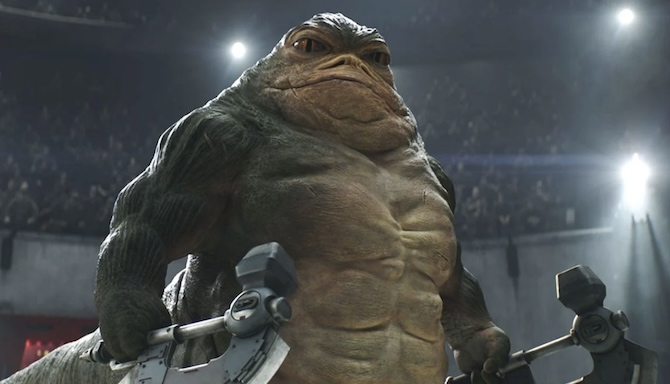
We’re talking about a Hutt as a key character in this movie. You could argue that he’s the main character. Mando has no personality and never changes. Grogu is too juvenile to arc in any compelling way. This leaves Rotta the Hutt as your major character arc in the movie. Which is why Favreau got the hottest actor in town, Jeremy Allen White, to play him. Cause he wanted to win an Oscar for this character.
So, why didn’t it work?
Well, part of the reason is that, on the page, you can make an alien work. Because nobody’s seeing any images yet. But, on screen, you have no idea how it will turn out. Hutts have notoriously just sat down in Star Wars movies. They don’t have to move which helps make them more believable. But once you start moving them around, especially as much as Favreau did, every bit of CGI weakness is amplified. There were basic close-up shots of Rotta in this movie where his eyes were warped in weird ways.
The reason this matters is because if things are even slightly off, the suspension of disbelief is broken and all those endless hours you spent creating this deep intense tragic character arc go out the window because we look at this creature and he looks dumb. He doesn’t look real.
But let’s say they somehow pulled off the technical side of this character. It still wouldn’t have worked because we don’t want a Hutt character arc. Hutts are meant to be simple creatures. I actually thought the Hutt twins were the best thing about this movie because they served that original purpose that Jabba the Hutt served. Which is that they were big, they were intimidating, and they instilled fear with their words. When those two spoke, it felt like old fashioned Star Wars.
But when Rotta is racing around in a hot rod car throwing out zingers like Adam Sandler, it totally betrays the original concept of these creatures. They were meant to be placed on big slabs of concrete, to tell people what to do, and to be evil. That’s it. No car races. And no arcing. Hutts don’t arc.
Not every character type is meant to have a redemption. Some are created to be one-dimensional and that’s fine! If you want a character arc in your movie, create better characters in Mando and Grogu. They’re the centerpieces. They’re the ones you want to arc. But because you screwed up their creation, you’re now hampered with these issues that can’t be overcome. And the feature treatment really puts a spotlight on that.
I mean, your main character WEARS A MASK. That doesn’t seem like a big deal but think about it for a second. We don’t get to see the expression of our main character for 99.9% of the running time! That’s INSANE. What other movie has done that? I don’t think any movie in history has done it. If you want to point to a reason why people aren’t connecting with this story… you don’t need to look much further than that!
Another big issue with the movie was the lack of stakes. The goal here is to save Rotta the Hutt. What happens to the galaxy if Mando and Grogu fail at this mission? Nothing! This is what I’ve been saying with Star Wars shows. They’re impossible to make work because the stakes are so low.
The Star Wars creative team will clap back, “No. These shows are exploring the characters. Making you care about these people and these aliens. They’re not about big stories. They’re about small intimate ones.” But the problem is that they’re *not* making us care. Mando is such a boring character. The only contribution to his character’s likability is that he takes action. But his personality is drier than a Tattooine beach. When has any well-liked main character throughout time had a weak personality?
The final big mistake the movie made was that the story engine dropped out for the last 30 minutes of the film. The Mandalorian is half-dead and Grogu is sitting around hoping that changes. It’s actually a very interesting sequence because we’ve had another similar sequence to compare it to early this year, in Project Hail Mary.
Nearly the exact same thing happens. In Mando and Grogu, Mando looks to be dead and Grogu has to wait and babysit him. And in Project Hail Mary, Rocky looks to be dead and Grace has to babysit him.
Despite both sequences stalling the movie at the same time, Project Hail Mary’s sequence is a highlight while Mando and Grogu’s sequence has the audience checking their watches. Why? What’s the difference if they’re the exact same plot development?
THE DIFFERENCE IS THE CHARACTERS.
Grace is full of personality and easy to love. Rocky has even MORE personality than Grace and is even EASIER to love. Not only that, but they did a great job carefully setting up that moment with Rocky being dead. They made a point to set up that this alien species looks the same whether they’re asleep or dead. So, we truly don’t know what’s happened to Rocky or if he’s going to survive. It’s a sequence where we’re all on the edge of our seats.
Mando is such a poorly conceived character (low vibration, no personality, always wears a mask so we can’t connect to him expressively) that it doesn’t affect us if he’s in danger. That’s why I always say, before you write your script, make sure your 2-3 major characters are very strong. Cause if they are, you can make a ton of script mistakes. But you can’t do the opposite. A good plot cannot survive weak characterization.
Another realization I had while watching this movie was how drawn out everything was. One of the many genius things about Star Wars was how punchy it was. It felt like the entire team would sit in the editing room and debate FRAMES. Not seconds, mind you. But, “Can we cut a frame here so we can move to the next scene faster?”
Go back and watch Star Wars. It’s extremely punchy. The end of every scene is almost like a cliffhanger that then JUMPS to the next scene. Luke spots Threepio in the back room and Threepio says R2 is gone. Lucas would just HOP right into tomorrow with Luke and Threepio shooting across the desert in their landspeeder. The scenes would pop into each other like that.
Here, it’s like somebody’s falling asleep in the editing bay every once in a while. We’ll linger on with a scene well after it’s finished. And those needlessly extended moments add up. It creates this lazy lingering feeling that a summer movie is not supposed to have.
What Favreau probably knows deep down is that these characters aren’t meant for a feature film. They’re not big enough. Because I was trying to think of what a better plot could’ve been. But then I realized, “It doesn’t matter.” You could write 100 different plots for these two and they’d all land somewhere in the middle. Cause the characters just aren’t big enough to carry the high stakes world of a feature film.
[ ] What the hell did I just watch?
[x] wasn’t for me
[ ] worth the price of admission
[ ] impressive
[ ] genius
What I learned: Don’t try to fit a square peg into a round hole. Trying to turn a Hutt into a tragic character was such a miscalculation on many levels. Hutts were literally designed to be bad. They look that way because they’re bad. I’m not saying that turning a Hutt tragic and giving him some big character arc is impossible. Anything is possible. But if a creative choice has a .01% chance of succeeding, here’s a tip: Don’t try it.