
Search Results for: F word
An amateur screenplay achieves the impossible and BLUDGEONS its way into my Top 25!
Genre: Period/Adventure
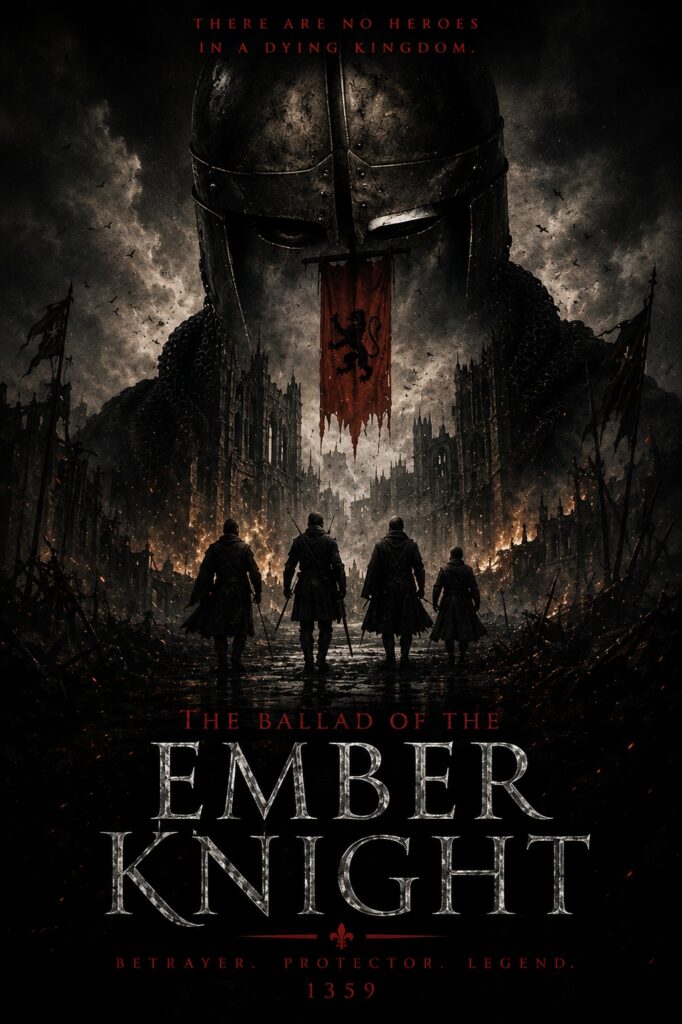
Premise: Amid the devastation of 14th century France’s war with England, a mysterious man on the run is forced to team up with a ragtag group of misfits who could be the key to restoring France to greatness.
About: A couple of weeks ago, I teased that I’d just read a 180 page amateur script that was so good, it was going into my Top 25 Screenplay List. Not the amateur list. But the big boy list. Since then, I asked the writers if I could review the script on the site and they said yes. So today… I’m reviewing it! How bout that! :)
Writers: Kieran and Brennan O’Dea
Details: 186 pages
(Note: I highly recommend reading this script BEFORE reading the review. A big part of what makes it so fun are the reveals. You’ve been warned!)
Pretty much every writer has a tough time getting their script read. I mean think about it. When was the last time you read some random person’s script? That’s a 2-3 hour commitment! 2-3 hours that you could use to do some errands you’ve been putting off, or catch up on some work, or clean your place, or go on that date with your wife you’ve been promising for weeks now.
Asking any grown adult to spend 2-3 hours of their time to not only read your script but think about it constructively and take down notes to give the writer? Good luck finding that person. Cause you’re here at Scriptshadow where you have the best chance of that happening of anywhere else on the internet and even here it’s tough.
But imagine that script you’re trying to get read isn’t 100 pages. It’s 180. That’s the problem Keiran and Brennan were running into with this script. It’s a tough pitch sending that script to a 2026 attention span-challenged Hollywood exec, especially if you’re not a produced screenwriter. And, by the way, the reason people in Hollywood will reject you for a 180 page script is not because they fear having to spend 4 hours reading your screenplay. They can stop reading your script any time they want. They reject you because they assume you don’t know what you’re doing if you’re writing something that long. Because the industry standard these days is 110 pages.
So after managing to get the script to a few people without any success, writers Kieran and Brennan came to me as sort of a Hail Mary. They paid for a consult. By the way, if anyone’s thinking of also sending me a long script for a consultation, my rule is that every extra page after 130 costs 2 extra bucks. So keep that in mind before sending me your 308 page sci-fi opus.
And look, I’m not going to lie. When I saw that page count, I took a deep breath then let out a long painful exhale. That’s because I don’t just read scripts when I consult. I have to think about every single page critically. Which is mentally taxing for even “regular” scripts. But 180 page period pieces? I was preparing for an extensive character list I would have to jot down. I would have to keep up with a potentially complex timeline. Surely there would be mythology to learn. And you figure that subplots and secondary character plotlines were going to make this one of those days where I would need every single neuron in my brain. To put it frankly, this was gonna suck.
However, the wonderful thing that I always love being reminded of is that when a writer is ready, when a writer understands the craft, when they understand how to create compelling characters, when they understand plotting, and they understand stakes, and they understand the specific challenges that the script they’re writing poses and they’ve been through the process enough times to know how to problem-solve those challenges, and on top of all that, they’ve come up with a really good idea for a story…. then none of the other stuff matters. And that’s what happened with this script.
The year is 1359. We’re in France.
If you don’t know what was going on in France in the 14th century, let me put it this way: seeing bodies hanging outside a town was as common then as seeing people staring at their phones while waiting for coffee at Starbucks is today. It was bleak shit, man. England had ravaged France and the leadership vacuum left behind opened the door to warlords, corruption, and chaos.
That chaos is embodied perfectly by our antihero, The Prisoner. Once a strong and imposing man, he’s now covered in rags and filth, wandering the countryside looking like someone who’s already lost the war inside himself. We don’t yet know why he’s traveling through France. We only know that he avoids others like the plague. This man is in some kind of serious danger.
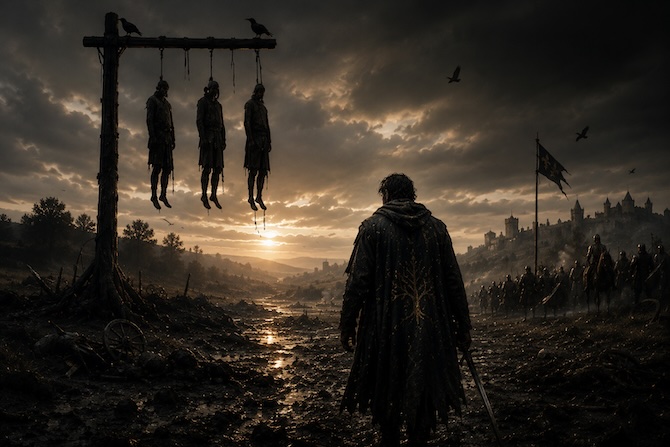
He arrives at an inn and, while paying to stable his horse, overhears a vicious royal named Sir Jean Devar informing the innkeeper’s daughter, Marie, that he’ll be raping her later that night. But don’t worry. He’ll compensate her employer generously for the inconvenience. Yup. That’s the kind of world 1359 France was operating in.
The Prisoner wants no part of any of this. His goal is simple. Sleep for the night and get the hell out of France as quickly as possible. But later, while hearing Marie being assaulted upstairs, something inside him snaps. Against his better judgment, he storms into Jean Devar’s room and beats the man to death.
The next morning, Jean’s young squire, Thomas, asks to become The Prisoner’s squire instead, despite The Prisoner insisting he’s not a knight. The Prisoner steals Jean’s royal clothing as well, realizing it’ll be easier getting through checkpoints disguised as royalty than as the man he really is: Roland Chandos, the king’s most trusted knight, the legendary Ember Knight, and the man rumored to have murdered the king and both his sons. Which means, yes, France may very well be collapsing because of him.
Meanwhile, we meet two monks traveling quietly through the countryside. Like many people in this story, they are hiding who they truly are. The younger monk, Charles, is actually the Prince of France. The older monk, Bernard, is his protector. And it turns out the rumors surrounding Roland’s massacre were only partially true. One son survived.
That survival creates a massive problem. France is now so unstable that multiple factions are maneuvering for the crown, including England, which is preparing to swallow the country whole. The second Charles learns his father and brother are dead, Bernard explains the horrifying reality: everyone will now want Charles dead as well. And almost immediately, they try.
A group of assassins descends upon them and Charles is seconds away from being slaughtered when Roland appears and single handedly destroys the attackers.
Bernard immediately realizes the situation. He must get Charles to Avignon before someone else kills him so the boy can claim the throne. But he can’t do it alone. He needs Roland. So he offers Roland and Thomas five grand to escort them across France. Roland accepts, seeing the money as his chance to disappear forever and start a new life. Along the way, the group picks up one more member, a bizarre old hermit who knows the backroads of France well enough to get them safely to Avignon.
Of course, the real journey isn’t physical. Because eventually Prince Charles is going to learn that the man protecting him is the same man who murdered his father and brother. And we still don’t know why Roland Chandos, the Ember Knight, the king’s most loyal confidant, betrayed the crown in the first place. Those answers slowly emerge during a brutal journey through a dying country tearing itself apart.
I think Netflix is going to make this movie one day.
Why Netflix?
Cause as much as the feel of this script is cinematic, the running time is too long for something that’s not proven IP. Or even known history. If this covered something we were all familiar with, like, say, the Salem Witch Trials, you could maybe justify the length. But nobody knows what was going on in France in the 14th century. I don’t even think the French could tell you.
When it comes to Netflix, however, running time doesn’t matter. That along with the fact that they’re flush with money makes them the best destination for this movie. So, hopefully some smart exec over at Netflix is reading this right now.
The thing I liked best about Ballad was that it brought us back to a true hero’s journey tale but within a world that is darker and less familiar. I grew up with the hero’s journey that was Star Wars. The next generation grew up with the hero’s journey that was Lord of the Rings.
And that’s it for consequential classic hero’s journey tales in cinema. I’m talking about where someone goes on a geographically long adventure and is joined by a group of characters, each unique in their own way, creating a fun little pack of people who we would follow anywhere.
Matrix is not that. Harry Potter is not that. Avatar isn’t. In those movies, we’re always staying in the same place. There’s something primal about an adventure where you go on this long journey to achieve a goal. It’s low-key the secret to Star Wars being iconic.
And what’s awesome about Ballad is that it’s the adult version of these stories. If a new Star Wars or Lord of the Rings came out today, I’d probably find them to be too juvenile. But the intensity of this story is consistent with the seriousness of the things I experience as an adult. It really is a movie for people who were kids when they watched Star Wars and can’t find movies in the same vein that resonate with them anymore. This is that movie.
Everybody talks about the main character’s introductory scene. And making sure that you introduce your hero in a way where we like them. And I agree that that’s important. But for truly memorable characters, I think you need an additional scene. And that’s the scene where your protagonist does something that makes the reader say, ‘I’m ride or die for this guy now.’
And while that sounds vague, it really isn’t. You simply say, “What scene can I write for my main character that is going to make the audience really get behind him?” And then write that scene! Because if you nail that scene, it’s like taking care of 75% of your screenplay right then and there. Seriously! Because if the audience now loves the hero, then they’re going to like almost every scene that hero is in. And assuming your hero is in most scenes, that’s a big percentage of your screenplay!
Here, we get that with Roland when he meets this sweet Inn assistant, Marie, and then he sees this awful French Duke dude straight up tell this woman that later, he’s coming to her room to rape her. And there’s nothing she can do about it. This world we’re living in, France in 1359, there are no police to call. There are no ghostbusters. Everybody is on their own. And that allows for people like this druid of a man to roam through the country like a 14th century Harvey Weinstein.
So when we see Roland barge into the attempted rape and beat Jean Devar to death, how could we not fall in love with him? And let me get a little deeper here because this script is so well written that even seemingly straightforward moments are doing multiple things at once. We’ve established The Prisoner as someone trying to escape. We don’t yet know who he is. But we know that he’s in danger if he’s discovered. So he needs to get away. If he saves this woman, and kills this man, that is going to severely hamper his chances of getting away. Because this rapist isn’t some nobody. He’s royalty. If he goes missing, people are going to come looking for him.
In other words, there’s a real choice here for your hero. Again, back then, assault like this happened all the time. And even the most altruistic person can’t save everyone. This is how compelling characters are born, when you give them difficult choices where every option comes with consequences. That’s the part amateur writers don’t understand. They think heroism is the act itself. But heroism only becomes compelling when it costs the hero something meaningful.
For example, if the writers had made The Prisoner a completely different character, Jean Devar’s head guard for example, then stopping him would cost way less. He’d still be doing the right thing. But dramatically, the moment wouldn’t hit as hard because he wouldn’t be sacrificing much. In this version, The Prisoner is risking his entire escape. He may be giving up his freedom and possibly his life for someone he just met. And that makes us like The Prisoner even more. Cause we understand exactly what this decision costs him.
There are so many cool things about this script. For example, when Roland kills this man, he realizes that the only way he’s going to get out of this country is if he disguises himself as royalty. So he steals the rapist’s uniform so he can move through all the checkpoints of the country without people questioning him.
But like any smart screenwriters, the writers understand that advantages in stories are more interesting when they come with complications attached. So Roland just happens to be disguising himself as one of the most vile men in the country. This evil royal rapist is known for doing terrible things to people everywhere he goes. So even though Roland supposedly just gained an advantage, that advantage comes with a massive tax.
What better way to embody that than having Roland, assumed to be Devar, get arrested, and have to fight the nation’s strongest man for his freedom? Lesser writers would’ve used the disguise purely as a convenient plot device so Roland could move through the country easily. But these writers keep squeezing drama out of the choice by repeatedly turning the disguise into a liability. That’s strong writing.
I’ve talked to you guys about the complexities of keeping the second act interesting. This is how you do it. Conflict. Conflict conflict conflict. Look for ways to disrupt your character’s journey. If you’re forced to wear a disguise that could get you in trouble, that will lead to conflict again and again. Conflict leads to drama. And drama is where the entertainment is. So just keep looking for ways to disrupt the overarching objective.
I have a lot more to say about this script but I’m already running up against a 3000 word review here. So maybe I’ll save some thoughts for the newsletter. In the meantime, some of you are probably wondering, “But Carson. Does it ever *feel* too long?” Honestly, there were a few places in the late second act that I felt lingered a bit. But, surprisingly, they were few and far between.
This is the power of having a good foundation for your script. A main character we love. A mission that feels important. A series of tasks that have high enough stakes that we’re always engaged. Whenever you get the important stuff right, just like I was talking about getting the important stuff right in Send Help (the main relationship) that gives you so much leeway with everything else.
The scripts that feel the longest, regardless of their page count, are the ones where they got the important stuff wrong. And when you get the important stuff wrong, every page reads like a chore. Cause we were never pulled into the story in the first place. This story, however, you’ll be pulled into.
If you like Gladiator. If you like Knight of the Seven Kingdoms. If you like The Lord of the Rings or even the original Star Wars, I would venture to say you’ll love this.
[ ] What the hell did I just read?
[ ] wasn’t for me
[ ] worth the read
[x] impressive (TOP 25!)
[ ] genius
What I learned: I was just talking with a really good director last week who said that he reads my site all the time and told me that the biggest lesson he learned from Scriptshadow was that when you have a good scene or a good sequence, milk it. Traditional screenwriting advice tells you to move the story along as quickly as possible. And so this director did that with every scene he wrote. He never considered that when you have a really juicy scene, you want to get the most out of it possible. That’s something that stuck out to me right away in The Ballad of the Ember Knight. In the sequence where The Prisoner kills the rapist, Sir Jean Devar, you could’ve easily had The Prisoner see Jean getting physical with Marie when he first sees her in the stable and had Roland act right there. You achieve what you want to achieve in making us like The Prisoner and you also keep the story moving quickly. But you lose the texture and the buildup that make a sequence like this resonate. The O’Dea brothers know that they have something here. So they let it sit. They let it build. They let us worry for Marie’s safety. They let us wonder if The Prisoner is going to help her. That’s exactly what you want to do if you’ve got something good. The times that you want to rush through things are when you have story exposition. That’s the stuff that you want to condense and move through quickly. Not when you have a really great dramatic situation like you have here.
The summer movie slate begins this weekend with The Mandalorian and Grogu. Over the course of two prime summer months, we’ll hit the finale of the summer season with The Odyssey.
Both of these movies are getting online pushback for different reasons. With The Mandalorian and Grogu, the pushback is, “Is this story worth telling?” And with The Odyssey it’s, “Does this story actually look good?”
Let’s start with The Odyssey because, of the two, it’s the movie that clearly has a better chance of connecting with audiences. But Nolan hasn’t made things easy for himself. The Odyssey is free IP and it’s been there for anyone to take and no one’s taken it. Why?
I’ll tell you why. Because the story is a post-adventure story rather than an adventure story. That’s the reason why The Odyssey never floated my boat. Because the important thing has already happened. Now, it’s just a matter of getting home so you can sleep in your own bed.
Psychologically, that’s not as exciting as going off on a traditional hero’s journey.
Nolan hasn’t helped his case because the trailers look pretty mid. Kinda cool stuff happens, like a cyclops peeking through the darkness in a cave. But there isn’t a single “holy shit” shot in a Christopher Nolan directed film’s trailer. I understand why that concerns people.
However, I think that Nolan’s purposefully holding back the good stuff. Remember that The Odyssey has the Lotus Eaters, who erase memory, seductive sirens luring sailors to their deaths, Circe the witch who turns men into animals, and the terrifying sea monsters Scylla and Charybdis. And let’s not forget one of the most famous revenge sequences that’s ever been put to paper.
Little known fact. That final revenge sequence is known as one of the first true representations of a payoff in writing history.
All this stuff about a black Helen of Troy and Elliot Page playing Achilles is theater. I don’t think anybody outside of “people who are way too online” give a crap about that. And I believe that, in the end, this movie is going to be a huge hit.
Now, as for The Mandalorian and Grogu? It’s looking bad folks. When you don’t get even a single “Holy shit this was great” tweet from a carefully curated group of reviewers after your film’s premiere, that’s concerning. To give you some perspective, 2015’s Fantastic Four, widely considered to be one of the worst superhero movies ever made, got around 50 “Holy shit this was great” tweets after their premiere.
It’s a huge moment for Star Wars. If it is the worst performing Star Wars film ever, which it’s projected to be, Lucas Arts is going to be in a very strange spot. Because they just finished putting a new group of people in charge, led by Dave Filoni. Dave Filoni has been doing interviews in anticipation of The Mandalorian’s release, and he claims he’s in the process of putting together a game plan for the next phase of Star Wars.
I’m going to explain how this makes me feel with an analogy.
As many of you know, I’m originally from Chicago. I grew up with Michael Jordan and the Chicago Bulls dominating basketball. I was young enough and dumb enough to think that that would last forever.
Cut to 20 years after that, in 2016, and the Bulls weren’t terrible but they weren’t good either. They were about the 8th best team in the league. And they were led by this egomaniac of a player named Jimmy Butler.
Butler had been with the team for six years and his antics were getting to the point where the organization wondered if he was worth the trouble. They decided he wasn’t and put him up for a trade. Their hope was to get back several young great players, be bad enough for a couple years to get a couple of high draft picks, then launch themselves back into one of the top 3 teams in the league.
But anybody who knew about the Bulls organization knew that it was run by a man, Jerry Reinsdorf, who didn’t care about basketball. He was also known as one of the worst owners in the league. His whole mantra was, “If the seats at the stadium are filled, that’s all that matters.”
So while I watched as everybody in my city celebrated what the trade of Jimmy Butler could become for the Bulls, I knew that dark days were ahead. The top of our organizational tree was a disaster. And he was going to figure out a way to make us even worse. And that’s exactly what happened. The Bulls immediately fell from the 8th best team in the league to the 20th best team. They squandered draft picks. Traded for terrible players. And for the last ten years, they’ve been irrelevant in the NBA.
I get the exact same feeling moving from Kathleen Kennedy to Dave Filoni. Kennedy is bad, no doubt. But Kennedy produced over a dozen of the greatest movies ever. She had an A+ producing resume. Her initial Star Wars instincts resulted in a 2 billion dollar movie. Her downfall was that she never really understood the mythos of the Star Wars universe. But to say she didn’t have any success is a lie.
Meanwhile, Dave Filoni has zero resume. In many ways, he’s the anti-Kathleen Kennedy. He’s someone with zero experience who understands every square inch of the Star Wars mythos. But is a Star Wars Encyclopedia Brittanica the solution for this franchise going forward? I don’t think it is. Because while he can tell you exactly how many Jawas can fit in a Sandcrawler, he doesn’t know the difference between a slugline and a description line.
In other words, Kathleen Kennedy was Jimmy Butler. She kept Star Wars up at that 8th place slot for franchises. But with Dave Filoni? We’re about to plummet to depths we didn’t even know were possible with a franchise that used to be the equivalent of Michael Jordan.
It really will be fascinating because there are some key dates here that nobody’s talking about. Dave Filoni became the top dog at Lucas Arts January 15th. Josh D’amro became the new CEO of Disney (which owns Lucas Arts) on March 18th. In other words, D’Amaro did not approve of this move. Therefore, if Mando does poorly, I wouldn’t be surprised if D’Amaro changes up the whole structure at Lucas Arts again. And I think he should. Cause if he doesn’t, all us Star Wars fans are going to experience what I’ve experienced for the past decade as a Bulls fan. Which is complete and utter irrelevance.
Over the weekend, I finally watched “Send Help.”
This is the movie where an asshole CEO of a company crash lands on a deserted island with the weirdo female accountant in his company who he was planning on firing right before the trip. He (Bradley) gets seriously injured and, therefore, must rely on her (Linda) to survive.
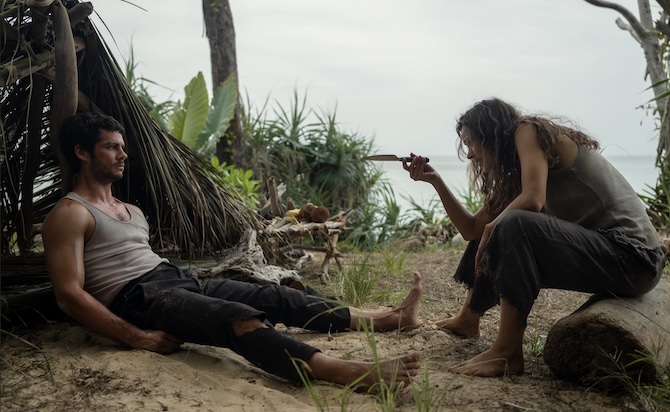
I can’t hide how much I adore these spec script setups. While this isn’t technically a spec script, it is a spec script. Producer Zainab Azizi found the script, brought it to Sam Raimi to produce, and he liked it enough to direct it.
So it’s a good example of what coming up with a charged spec-friendly concept can do for a writer. And by spec-friendly, I mean that it works as a script AND a movie. It reads really great on the page, which is what gets people excited and wanting to turn it into a movie.
A lot of scripts are written just for the screen. A script like Sinners with its 40 minute first act setup with tons of exposition is not spec friendly. Dune, with its laborious mythology, is the opposite of spec friendly. I’m guessing The Brutalist was the most difficult script to read of the year.
Meanwhile, Send Help is two people on an island trying to survive and also trying not to kill each other. That’s something that’s easy to follow on the page. You only have to remember two characters. Your mind can drift sometimes and you’re still able to keep up. The dialogue between the two keeps your eyes shooting down the page. The thriller genre is always one of the easiest genres to read. That’s spec-friendly.
And the script has a great ironic setup, which I always tell you guys is a huge bonus. This is a movie about a boss and subordinate who get into a situation where the subordinate becomes the boss and the boss the subordinate. That’s a great concept.
But I didn’t realize how tricky this script was to pull off until I watched the film. It’s kind of a miracle that it works. Cause they’re walking several tightropes at once and if the audience doesn’t buy into a single one, the film is screwed.
For example, one of the main plot points is that Linda found a knife. And because she has the knife, she’s in control. There are numerous scenes of Bradley staring at her using the knife to cut food, implying that “If he could just get a hold of that knife, he could kill her.”
Meanwhile, in the very same scenes that he’s staring at the knife, Bradley is putting together their shelter with a rock-hammer, lol. Linda has to go to sleep at some point, right? Pretty sure he could kill her with the rock hammer. He doesn’t need the knife.
And then the writers have to walk this line between the two hating each other but also falling for each other, since that’s an important plot point for the story to work. The idea is that Linda wants Bradley. But he’s the worst person ever so it doesn’t make sense that she wants him. And then Bradley has to like her for some late story twists to work, and so they have to make that plausible as well.
In many ways, Send Help is Misery but without the logic. The reason that Misery worked was because Paul Sheldon was helpless. He was literally stuck in a bed. Bradley can move around wherever he wants. So it doesn’t make nearly as much sense that Linda is in total control.
But I got to give it to these guys. They get the key thing about the story right – which is the chemistry between these characters. And that’s a great screenwriting tip to take away. You can’t write a perfect screenplay. It’s impossible. There will be tonal slip-ups. There will be plot holes. There will be character inconsistency. There will be plot sloppiness. But you want to figure out what the most important thing is for your script to work and make sure that’s as strong as possible. Because if you nail that, the audience will overlook the other things.
And you really wanted to see what was going to happen with this relationship between Bradley and Linda.
So I definitely think this movie is worth checking out. And one more point in the win column for the power of a good spec script.
Coming Wednesday: A review of the new AMATEUR Top 25 script which comes in at 180 pages. Get ready! And yes, I will be providing a script link so that you can read it yourself.
Best comedy script of the year??
Genre: Comedy/Action
Premise: After his beloved cow is senselessly killed, a peaceful dairy farmer becomes a vengeance-obsessed one-man wrecking crew, setting out through our modern, curdled world to take on a corrupt conglomerate and the violent enforcers who protect it.
About: This script was optioned by super production company, Davis Entertainment. They most recently produced Predator: Badlands. On the comedy side, they produced Game Night.
Writers: Lucas Kavner & Dylan Dawson
Details: 109 pages
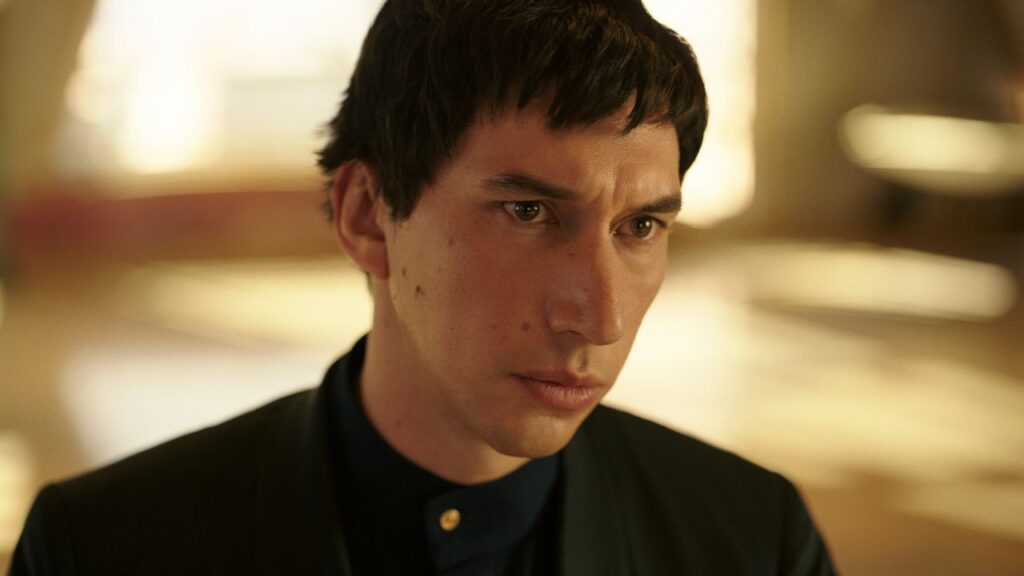 Driver for the Milkman?
Subconsciously, I’m always tracking HOW HARD THE WRITER’S WORKING.
Are they doing everything within their power to entertain you? Or are they taking large chunks of screenplay space for granted? Putting in a bunch of filler until they get to their next funny scene idea?
You know that, when a writer is working BEFORE HIS SCRIPT EVEN STARTS, that’s a writer you want to read. And here, we get the best use of the title page I’ve seen in years. Never have I seen a title page so accurately prepare you for the screenplay you’re about to read than this one.
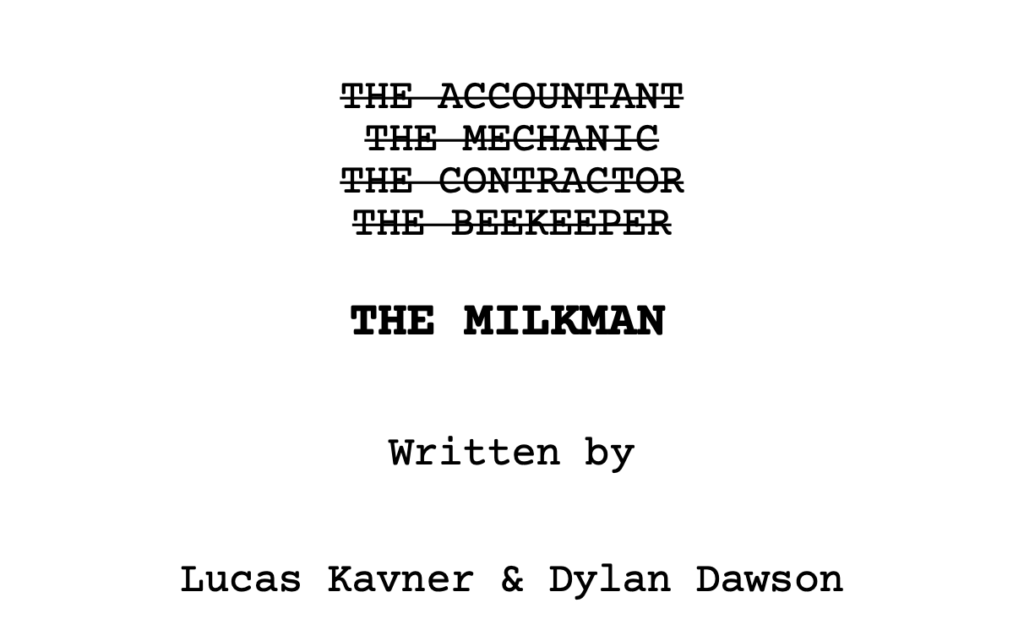
That made me smile. But what I was desperately hoping was that this title page wasn’t the best thing about the script. Let’s find out!
The Milkman is a pure soul in a dying age. He doesn’t know what TikTok is. He knows how to extract milk and deliver it. At that, he’s an expert.
But one day, when he’s delivering milk to a local diner, a giant influencer, Scronk, shows up and starts making fun of the diner’s waitress. The Milkman can’t take it and proceeds to beat the living hell out of the influencer’s posse. Then he utilizes a humiliating ritual, forcing Scronk to drink an entire glass of milk like a good boy.
A couple of days later, Scronk shows up to his farm with goons and they try to kill him. While the fight rages on inside, Scronk goes to the cow barn and kills the Milkman’s favorite cow, Dina! She’s named Dina after the Milkman’s dead wife. In many ways, the cow serves as his current wife. But now she’s dead too!
When the Milkman learns that Scronk is on his way to a big influencer conference in the city, he visits his old stew-obsessed mentor, Creech, and prepares for revenge. Going incognito as a Gez Z “wood milk” influencer at the conference, the Milkman inadvertently becomes the hit of the conference, with former music icon Moby offering 30 million dollars to buy the wood milk brand.
Milkman eventually locates Scronk and chases him through the conference. A misstep throws Scronk into a vegan shark tank. But the sharks break their vegan diet to devour poor Scronk straight into his expiration date.
Seemingly, this chapter in the Milkman’s life is over. But what we learn is that Scronk is the son of multi-billionaire online retailer, Benedict Valabont, THE ORIGINAL CREATOR OF THE MILKMAN DIRECTIVE. Benedict is determined to get revenge. So the Milkman goes on the run with the mysterious Cassie, a bean bag influencer, and try to hide from Benedict’s men. But that isn’t going to last long. Whether you like your milk straight, chocolate, or strawberry, there’s going to be a milk showdown. And only one man’s milkshake is going to bring all the boys to the yard!
This is how you write a parody script.
This was really funny. Right from the start, it had these little moments that made me giggle, such as the Milkman first revealing his shrine room to his dead wife.
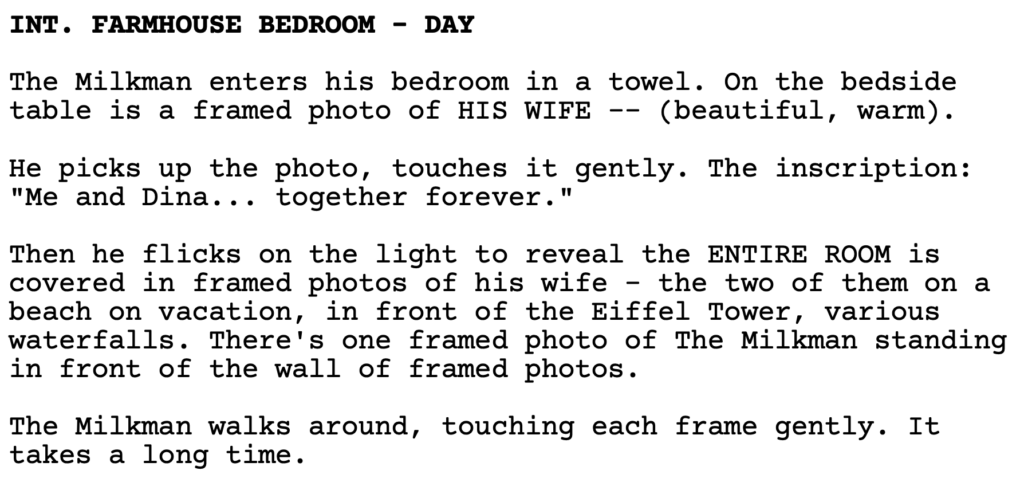
There’s also this hilarious moment where he runs to the dying cow after Scronk has attacked it and takes it in his arms. The cow’s face turns into his dead wife’s face briefly and she apologizes that she’s dying. And the Milkman starts making out with her and we briefly flash back to reality to show that he’s making out with a dying cow.
And yes, I know that some people will find that stupid. But what’s actually quite clever about it is that it’s a parody of the motivation in the original John Wick movie. The whole reason John Wick went after the Russian mob was not because they killed his dog. It’s because they killed the dog that his wife gave him before she died. And so these writers take that to the next level. So there’s some meta comedy going on here.
I always love when writers milk their concept for scenes and jokes, no pun intended. Later in the script, the Milkman meets Cassie. And there are clearly sparks flying. But then, a couple of scenes later, Cassie casually tells the Milkman that she’s lactose intolerant and you’ve never seen someone so devastated in his life, lol.
And then these writers go to town on all this acronym stuff. It’s one of the best running jokes in the script. Milkman and Cassie run into the “DELIVERY MAN,” (Deep Extraction Logistics, Intellect, Vigilance, Elimination, Reconnaissance, Yield – Mobile Assault Node). They run into ELEVATOR GUY (Elite Level Enhanced Vanguard Agent Trained for Operations, Recon, Guerrilla Undertakings, Yields). They run into a lady named DIANE who swears she’s innocent. BUT SHE’S NOT. She turns out to be D.I.A.N.E. (Distractingly Innocent And Normal, Evil).
They even make fun of those epigraph quotes writers put after their title pages. In this one we get, “Sometimes what I actually love to do is go to a farm and get fresh milk.” – Jake Gyllenhaal.
And then there’s just totally crazy batshit out there stuff that is hilarious. Like when Milkman goes to his old mentor’s excessively booby-trapped house in the forest and must navigate ten thousand traps before finally getting to Creech.
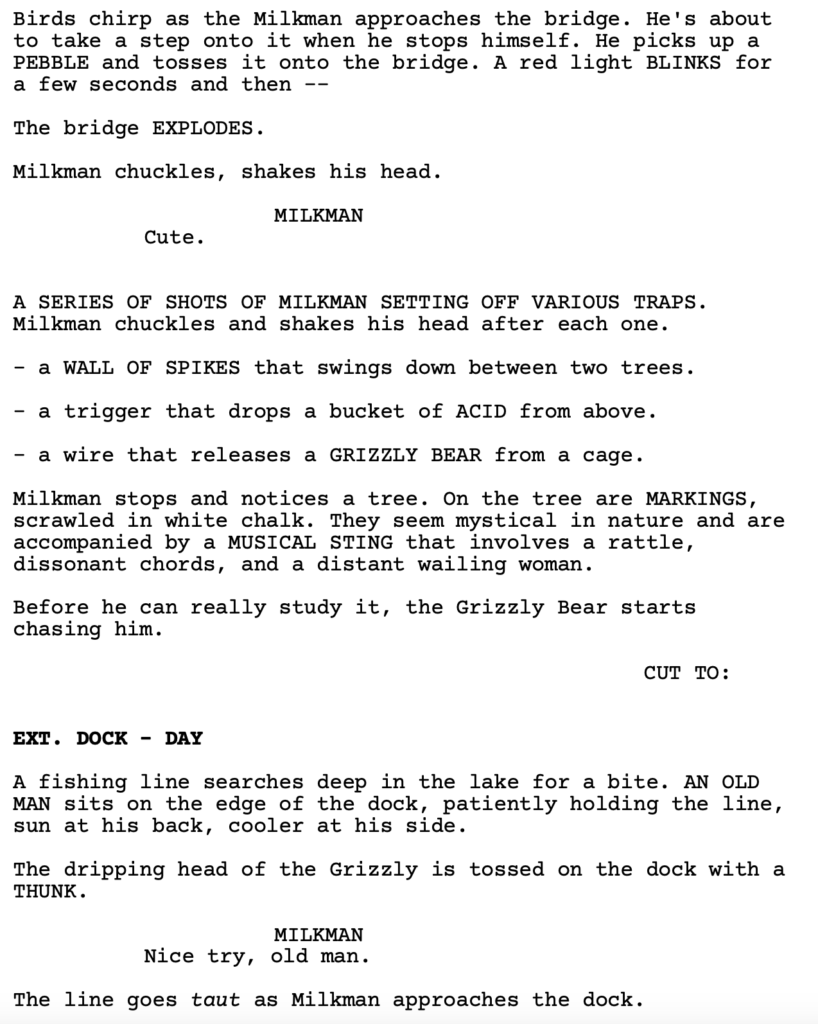
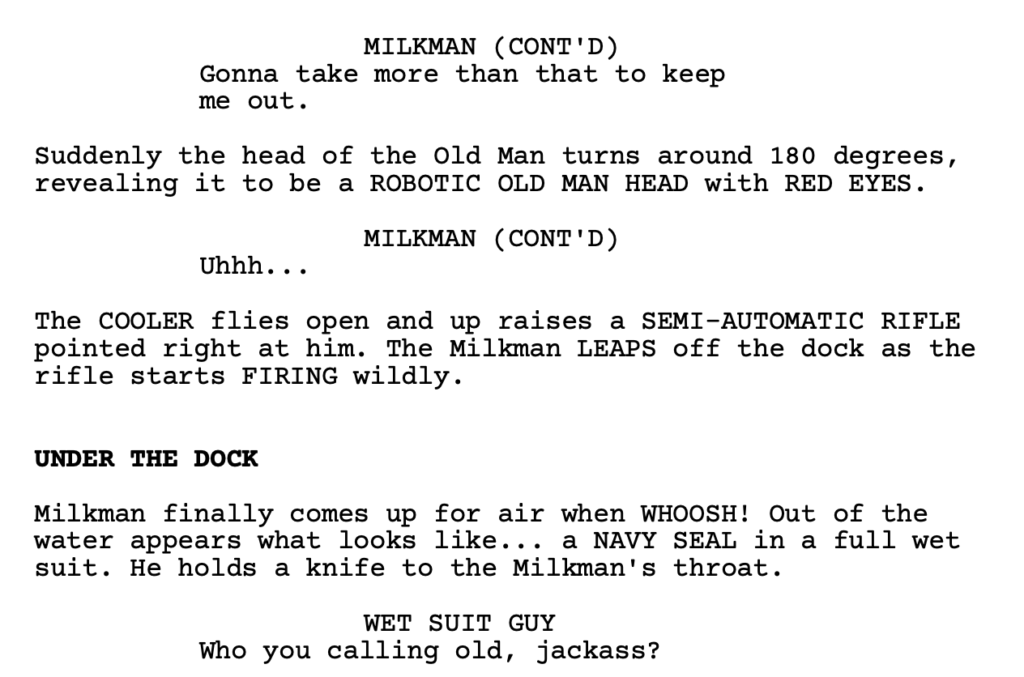
And it’s all done with love and humor. I thought The Beekeeper script was great. This totally makes fun of it. And I’m sure Kurt Wimmer, the writer of Beekeeper, who I’m friendly with, would think it’s hilarious as well. That’s the key with these scripts. If you write them with hate in your veins, they come off as bitter and unfunny. You gotta have that love if you’re going to write a comedy that actually makes the reader feel good.
And I loved the little touches here. As I noted above, at the influencer conference, Moby approaches the Milkman and tells him he wants to buy the wood milk brand. Milkman couldn’t care less. He’s trying to follow Scronk but the “surprisingly agile” Moby keeps getting in his way. It’s a fun little scene.
And then, later, when the Milkman almost gets to Scronk but has to battle a bunch of his bodyguards, we break into Moby’s big 2003 hit, “Porcelain,” and in this slow motion operatic ballet of a fight, we watch the Milkman take down the goons one by one.
That may seem like a small thing. But you have to understand that when I read scripts, I almost always read the most basic version of any scene that can happen. So, if a weaker writer is writing this scene, they’re just writing the Milkman fighting a bunch of goons. They’ll add some funny little moments in the fight here and there. But nothing about the sequence stands out.
When writers do little payoffs like this, it elevates the scene. It makes it different from what the reader usually reads. And that helps separate you, the writer, from everyone else. If you want to separate yourself, you gotta do something that other people don’t do!! And, often, that’s just taking a little extra time and trying to be creative. Like today’s writers did.
With comedy scripts, one of the big questions I ask is, “Do they understand the assignment?” Or, in other words, do the writers understand what their premise is and how to get the most out of it? And these writers ace that test. I mean, they freaking ace it.
This is a definite recommend. It didn’t quite get to “impressive” status mainly because the first half is funnier than the second half. If they would’ve kept up that same level of laughs throughout the whole thing, this becomes the best comedy script in the last five years. It may not be that but it’s still really funny.
[ ] What the hell did I just read?
[ ] wasn’t for me
[xx] worth the read
[ ] impressive
[ ] genius
What I learned: If you divide a script into four quarters, the quarter that writers have the most trouble with, by far, is the third quarter. It’s the quarter of the script that is least defined in the teachings of screenwriting. And there are legitimate reasons for that. The further into a script the story unfolds, the more unique to that specific story it is. So to try and turn that section into some “must follow” set of story beats would hurt more than it would help the screenplay. The way this bleeds into comedy screenplays is that this is always the section with the least amount of laughs. And I think that may be because the writers are so focused on plotting the story towards its climax. Just remember that if you’re writing a comedy, laughs are always the priority. They’re the priority over character. They’re the priority over plot. Never forget that you have to make people continually laugh in a comedy. If you go three or four scenes where there isn’t a good laugh, you’re going to lose the audience. I saw that a little bit here in Milkman’s third quarter. But, that’s what they made rewriting for. :)
Someone sent me a consultation script that was 180 pages. It was damn good. Now what!?
Telling a screenwriter they can’t write a script over 120 pages is the screenwriting equivalent of walking around Los Angeles in a MAGA hat. In other words, it’s gonna trigger some people. Never have I seen screenwriters react so passionately than when I tell them to get their scripts down to a more industry-friendly page count.
But Long Page Count Screenwriters rejoice! Because I have found your champion!
I just read an awesome 180 page script.
This script was a consultation script. It’s from an amateur screenwriter. I’m going to try and convince him to let me review the script on the site. I don’t know if he’s going to say yes. But, until then, I can’t speak about the specifics of the script. I can only speak in generalities.
Here’s what I can tell you.
It’s a classic hero’s journey tale. This writer goes right back to the heart of Joseph Campbell’s teachings.
How good are we talking? I think there’s been only one truly good hero’s journey piece of screenwriting in the last decade. And that was Knight of the Seven Kingdoms. This is on par with that.
This is great news for anyone who wants to write a long script. But, in order to do so, you must understand the single biggest roadblock to writing a long screenplay. And that is: It’s incredibly difficult to keep a reader’s interest over that many pages.
How difficult?
Think about how many times you’ve read the first five pages of amateur scripts I’ve posted on this site. Like for showdowns. I’ve seen so many of you post in the comments that you weren’t even able to get past the first page of those scripts.
ONE PAGE!
That’s all it took for you to lose interest. So, imagine how difficult it is to keep someone’s interest over 180 pages.
Obviously, I don’t expect the majority of you to ever write a 180 page script. You’re handicapping yourself if you do. I mean, the very first thing I did when I saw that this script was 180 pages, was say to myself, “Awwww shit.” I was pissed off, I’m not going to lie. Cause it almost always means a script that’s scattered and goes nowhere. Like receiving the script for Southland Tales. Try getting through that monstrosity without a fifth of whiskey.
But here’s the thing about writing a 180-page script: if you can make that work, you can make any script work. A 100-page screenplay is the same game, just tighter. The difference is that at 180 pages, the underlying fundamentals have to be rock solid. Starting with your characters.
When our 180 page script writer introduces his main character, he does something very smart. He creates a really really really really gnarly bad dude who does something really really really bad. And then he brings in his main character to take down this gnarly bad dude.
Boom.
We now love the hero.
This is something so many writers get wrong. Or they never think about it in the first place. But if you can just win us over right away with something your hero does? You’ve got us. We now love your hero.
The reason this is so important is because if you’re going to ask us to stick around for 180 pages, you have no chance of doing so if we don’t love your hero. I mean, look at what happened in the script I just reviewed, Leverage. That writer did the opposite. He created this money hungry lady who didn’t do anything to make us like her. If anything, we thought she was too greedy. Which means that you’re now asking me, the reader, to stay engaged for 118 pages, for someone I don’t even like.
By the way, most writers don’t make the mistake that the Leverage writer made. But they make a mistake that’s almost as bad. They don’t create a main character we dislike. But they create a main character we feel nothing for. We don’t feel good about them. We don’t feel bad about them. We feel neutral.
It’s better than the reader disliking your hero but it buys you, maybe, 10-20 more pages before the reader checks out. You want to create a very strong character in some capacity if you’re going to write a 180 page screenplay because you need us rooting for that character the whole way through if we’re going to stay engaged.
What’s great about this Hero’s Journey script is that the writer understands that, at 180 pages, giving us a scene where the hero takes down a bad guy isn’t enough. So, in addition to that, our main character is steeped in mystery. He has a very messy past, which gives us yet another reason to keep reading. We want to learn what happened to this guy to make him this way.
Honestly, if you can learn that one skill of making us fall in love with a character right away (or just be fascinated by them or super intrigued by them) — if you can do that? That will solve 80% of your script problems. Cause you don’t actually have to be a great screenwriter if you can write great characters. So, learn that skill first!
But, with that said, you still have to know how to plot if you’re going to keep our interest over a long period of time. And this writer is a master at plotting. No exaggeration. I was saying that to myself as I was reading the script. The way he pushed the plot forward, revealed key details (such as the main character’s mysterious past), mixed in overarching goals (the goal driving the entire story) and mixed in temporary goals (goals for the next 15-20 pages) — all of it was acutely constructed.
I remember thinking, “If he would’ve moved this reveal up one scene earlier or pushed it back one scene further, the script would’ve fallen apart.” That’s how precise his plotting was.
So, with plotting, there’s actually no end point to how long you can plot a story. We know this because of TV. Breaking Bad went on for six seasons. That’s far more screenplay pages than 180.
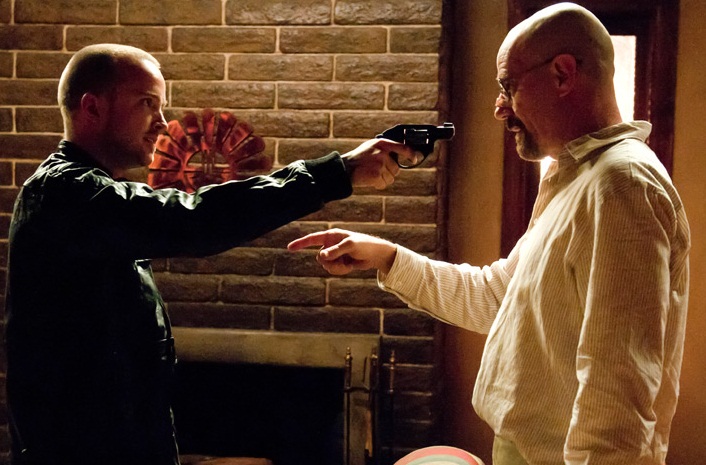
Ironically, I think this writer used that method of thinking to write his story. Instead of seeing the script as this giant never-ending piece of storytelling, he broke it into episodes. I believe it was six episodes of roughly 30 pages each. Each had its own title. And the goal for each of those episodes was different.
So, for example, one episode might be — we get stuck in this town and we need to get out. That doesn’t actually happen in the script. But that’s how you want to think as a writer. Your characters visit this town and something bad happens. Maybe one of them gets taken hostage or disappears. And now the goal is, find them and escape.
Again, the idea is that you want to break your giant story down into more manageable pieces. I can’t even imagine trying to write a straightforward story about a guy attempting to achieve something over 3 hours. But, if he only has to achieve something over 30 minutes, that’s doable. Then you just add the next 30 minute story. And then the next one.
So the idea is, come up with the overarching goal for the entire season (or, in this case, screenplay). For example, in Knight of the Seven Kingdoms, that’s for Dunk to become a knight. And then each episode has a goal unto himself. For example, for the second episode, after Dunk’s arrived in town, his goal is to simply sign up for the tournament. But he needs a sponsor. So he has to go find the sponsor and then go back and sign up before time runs out. That’s how you create an episode of TV. And you can mirror that writing strategy in long feature scripts.
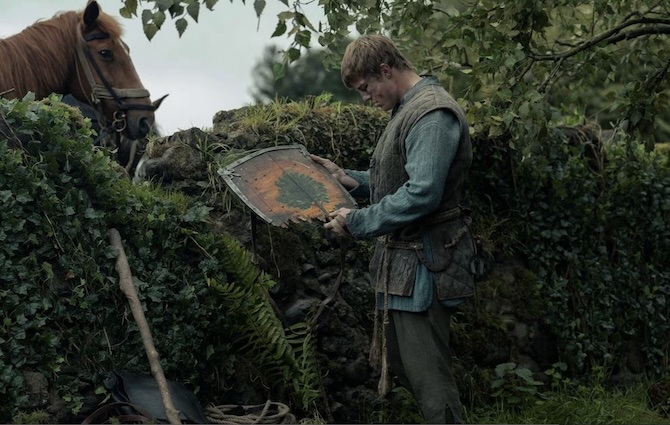
And that’s how this writer was able to write a 180 page screenplay without it ever slowing down.
Now, to be clear, writing a long script is still very hard. The act of creating a character that people love might as well be screenwriting’s version of the City of Atlantis. If doing so was easy, every movie we watched would be great. But even though Hollywood knows this is the most important rule, and puts all of its mental resources into figuring it out for each movie, we still have a lot of bland protagonists who we barely care about. So, obviously, skill is needed to achieve this feat.
And it also takes skill to write a 30 page goal-oriented sequence in a script. That doesn’t just flow off the fingertips. But at least you now have the knowledge that that’s what you need to do. Cause most aspiring screenwriters (and a fair amount of professionals) don’t even know that. They just write whatever’s coming to their head in the moment and pray that it’s all going to come together.
The other two areas where this writer separates himself are in his scene-writing and in his secondary character construction.
We’ve talked about scene-writing a ton on this site. But, despite that, most of the amateur scripts I receive may have a total of one or two genuinely good scenes. And that’s because most writers think of scenes as “segments of the script I have to cram all of my relevant plot and character information into.” It’s more about fitting in exposition than it is figuring out how to write the most entertaining scene possible.
In this 180 page script, 9 out of every 10 scenes are strong. Which is an insane ratio. It’s very rare that I see that kind of ratio. And it’s because the writer understands that each scene is its own little movie that needs to entertain. And therefore, he builds scenes around that mindset.
So, for example, instead of writing a scene where our primary group of characters trade dialogue as they walk down the road to their next destination, he’ll have them go into a bar and, just like Star Wars, this is not a pleasant bar. It’s dangerous in here. And we can see that, already, people don’t like them. The writer can then add any exposition he needs to during this scene, but now that exposition is happening in a situation that is worsening by the minute. There’s a threat looming, which adds so much more entertainment value to a scene over characters casually walking down a road chatting to each other.
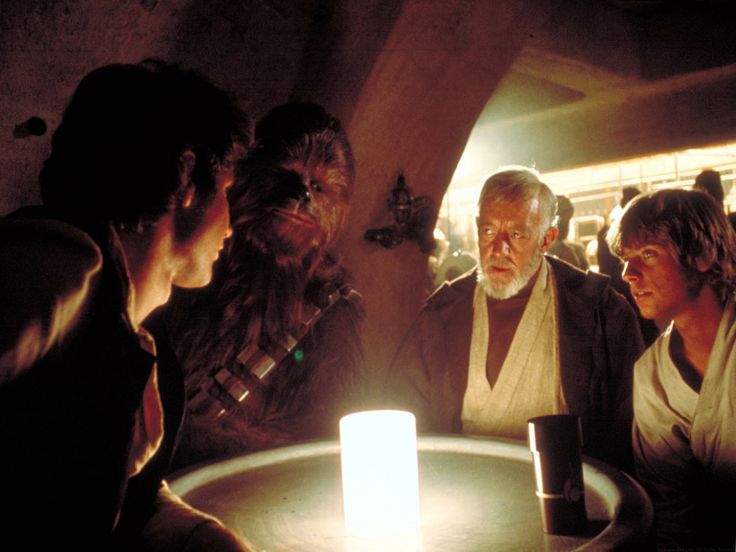
To be clear, that scene is not in the script. But there are similar scenes like that. That’s the mindset this writer has. Each scene needs to entertain all on its own. Each scene is driven by a situation occurring rather than people talking in random locations. That mindset ensures that the reader is always going to want to keep reading. Cause they know that each scene is being maximized for entertainment value.
And then finally, the writer REALLY FLESHES OUT all the secondary characters in this story. This isn’t just where advanced writers separate themselves from intermediates. This is where the super-advanced writers separate themselves from the advanced.
Cause nobody wants to do this extra work of making every character in the group interesting. That’s why we’re still getting Star Wars movies 50 years later. Because George Lucas made sure that every character in that original Hero’s Journey group rocked. Ironically, Lucasfilm can’t come up with a new great character to save their life. But that’s the power of doing that extra work. Is that it can literally pay dividends 50 years later.
I am going to do everything in my power to convince this writer to let me review his script. Because it would not only get an [x] impressive. It would probably end up somewhere in my Top 25. I don’t know how it would get made. I’m racking my brain about that cause it’s a period piece and it’s not IP and it would cost between 100-150 million. But who knows? If we can get some buzz building for it on this site, it just may happen.
In the meantime, if you’re looking to get feedback so that you can get your script up to this level, shoot me an e-mail (carsonreeves1@gmail.com) and we’ll get to work!
Is Beef officially Netflix’s White Lotus?
There isn’t a whole lot going on in the movie box office world at the moment. The kind of people who go to Super Mario Galaxy aren’t the types who run to movie websites and excitedly taunt how much money their favorite video game turned movie is making. Which has made box office talk pretty boring the last couple of weeks.
A couple of small notes are that horror is not bulletproof, despite being the only genre Hollywood has been able to bank on as of late. Lee Cronin’s The Mummy only took in 13 million bucks.
I liked the angle on Cronin’s script. I wrote about how, when you pitch major IP, or anything that’s been in Hollywood for a while, you need an angle to your pitch that’s going to stand out from everyone else who’s pitching. Shifting the mummy lore over to a little girl felt different and fresh and, no doubt, is the angle that got the movie greenlit.
But here’s the funny thing about this town. The thing that gets you greenlit isn’t always the thing the audience wants. Sometimes, audiences want a good old fashioned mummy movie. But, as a Hollywood producer, when you get pitched that, you think, “Been there, done that.” You’d feel like you failed at your job if you greenlit that take.
“Nobody knows anything,” right? The famous William Goldman quote.
Which is bullshit by the way.
The mantra is a useful myth. But it’s not literally true. Hollywood, as a system, understands a great deal, arguably 90% of what drives outcomes. There is deep institutional knowledge around story construction, star value, release strategy, and audience segmentation. These variables aren’t random.
What remains unpredictable is the final 10%, the intangible convergence of taste, timing, tone, cultural mood, and audience reception. That margin resists modeling. It is where otherwise well-calculated projects fail to connect, and where outliers like Iron Lung emerge and outperform their tracking.
In other words, the industry isn’t blind. It’s operating with high clarity right up to the point where clarity stops being possible.
I’m sad to see Normal do so terribly (3 million bucks). It probably signals the end of Bob Odenkirk’s unique leading man career. They should’ve limited that film to streaming and it probably wouldn’t have hurt him so much. But those are risks you take when you go theatrical! Somebody’s got to take the fall.
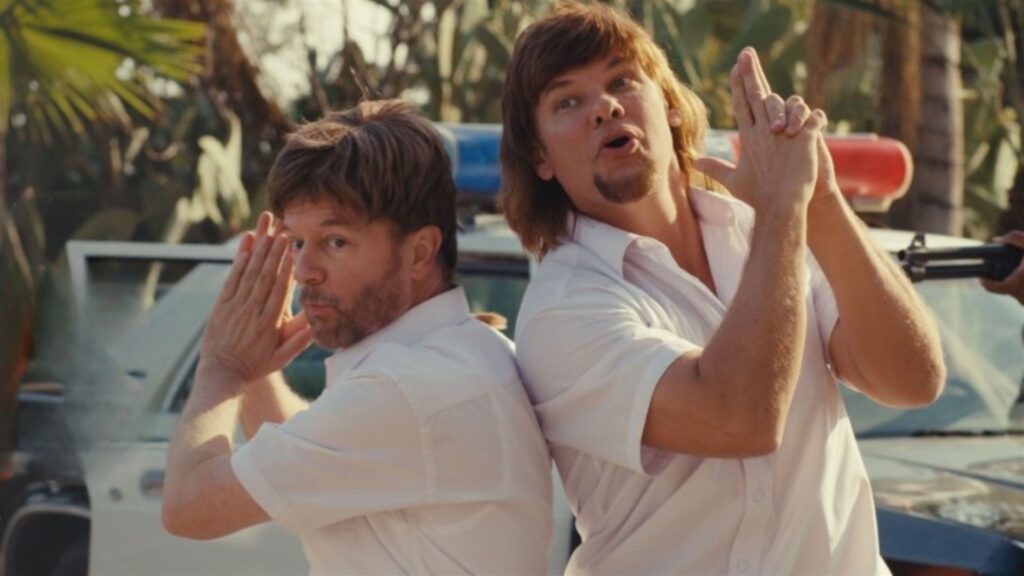
I was keeping an eye on the comedy, “Busboys,” starring Theo Vonn and David Spade. I was asking the question, could comedy podcasters usher in a new theatrical comedy renaissance? But the flick barely made a million bucks. The error with this one is pretty obvious. Why are you casting a third tier aging comic in a role that doesn’t even make sense (why is a 55 year old trying to become a busboy). For any comedic 2-hander, the audience has to look at the pairing and laugh even before they’ve seen a single second of footage. When you looked at this pairing, you thought, “Huh?”
Since there was nothing dragging me to the theater this weekend, I checked out the pilot for the second season of Beef. This is a powerhouse cast here, a creator with a lot of buzz, and a show with a lot more money. What has that resulted in?
A mixed bag.
The first thing I noticed is that Netflix is trying to make “Beef” its “White Lotus.” It’s a very specific voice that’s aggressively character-driven, built around strong filmmaking, an incredible cast, and an affecting score. And I don’t think it’s a coincidence that the main character, Joshua, runs a ritzy country club. The shades of Murray Bartlett’s “Armond” from season 1 of White Lotus are strong.
The writing here is quite awesome at times.
Early on, we see country club manager Joshua (Oscar Isaac) and his wife, Lindsay (Carey Mulligan) get home after working a long day at the club, and get into this big fight. Meanwhile, two young workers at the club, Ashley and Austin, are head over heels for each other. Every single moment for them is bliss. Just being around each other and getting to kiss makes their day.
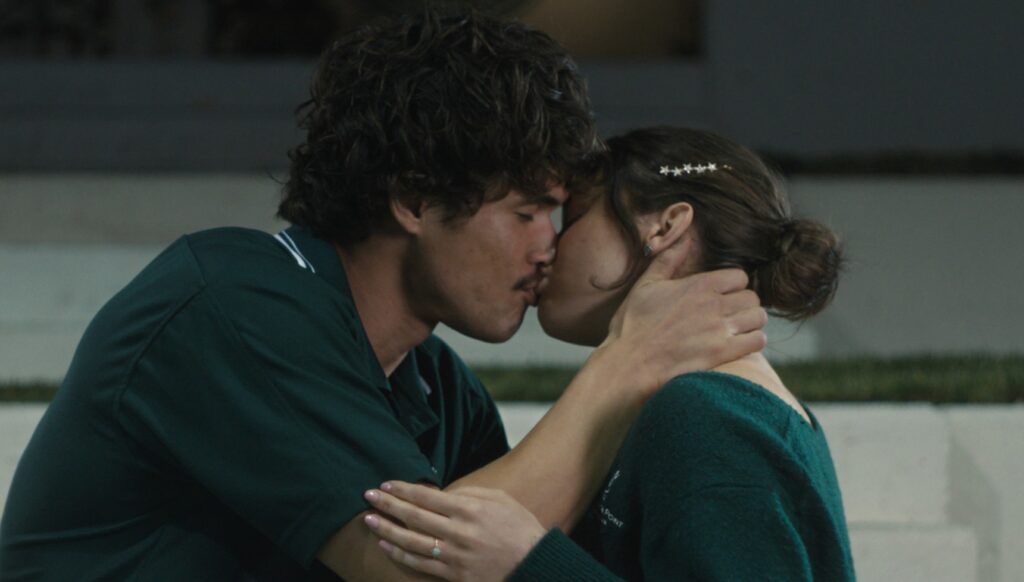
So, creator Lee Sung Jin does this really clever thing where he cuts back and forth between these two couples, one trying to rip each others’ heads off, the other trying to love each other as much as humanly possible. And the reason why this works, besides the fact that it creates a jarring juxtaposition, is that one of the strongest ways to reveal character is through comparison.
If you want to make it clear that one of your characters is a bad person, you can just show them doing bad things of course. But if you want to turbo-charge that message, put them in a scene with the nicest person possible. That way, their meanness will truly pop.
Why is this important? Because easily one of the biggest mistakes I see in screenwriting is writers not clearly conveying who their characters are right away. So you want to look for any tools you can that help you set up exactly who your character is. And comparison is one of those tools.
We leave this montage knowing, very overtly, that one of these couples has deep deep set problems and the other loves each other more than anything.
Despite this, there are a couple of things that keep this from becoming the prestige event that is White Lotus. The first is that the stakes here are low. The pilot is built around this moment where Joshua left his wallet at the club. Austin is asked to return it by the president, and Ashley comes with him.
The two go to their house at night just as Joshua and Lindsay are in that huge fight. Ashley starts recording it on her phone through the window (unbeknownst to Joshua and Lindsay) and even though Lindsay is the aggressor, Ashley starts recording at a moment where it looks like Joshua is the aggressor. Right then, Joshua and Lindsay spot the two outside, and Ashley and Austin run away.
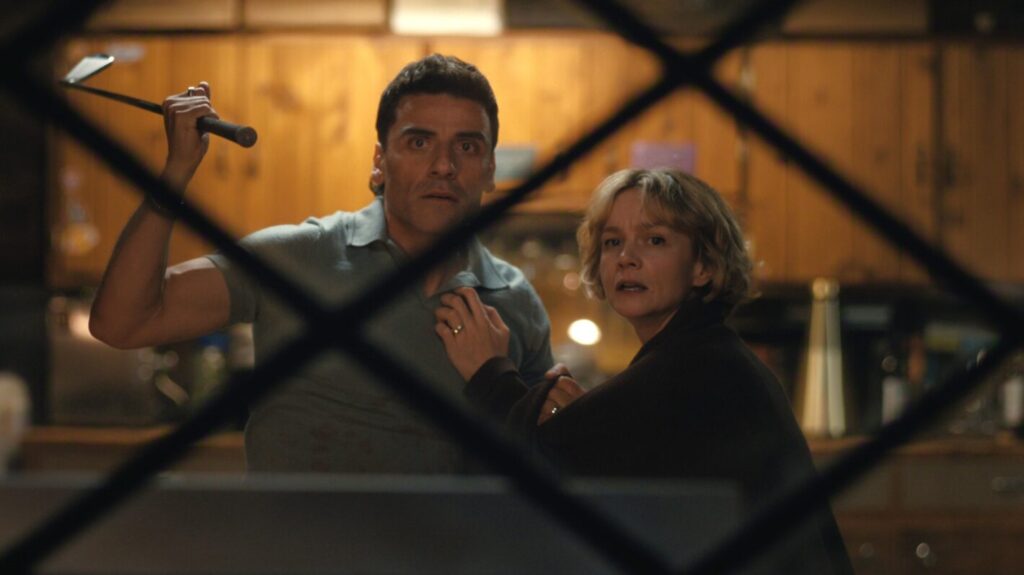
So, looming in the background of this story is Ashley’s possession of this video. And, presumably, she’s going to choose to show that to someone at the club, or post it online. And that will probably start the season’s “beef.”
Those stakes are pretty low. In real life, the insanity we’ve seen through peoples’ worst behaviors being published via video are way way worse than anything that happens here. So it doesn’t really feel like Ashley has that much on Joshua. I suppose it’s enough to get him fired. And it probably will get him fired. But just as the inciting incident of a show, it’s pretty tame.
Compare it to White Lotus, where the inciting incident is always a murder. Those are real stakes. A video of an aggressive fight where nobody’s technically done anything illegal is not a high stakes situation. It’s a medium stakes situation. And you don’t want to build 8 episodes on top of a medium stakes situation.
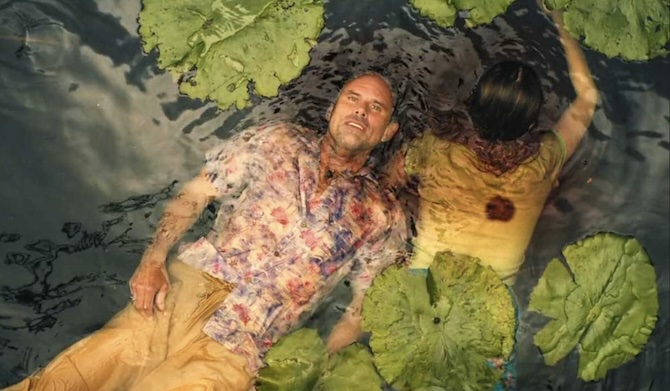
I suppose the stakes could grow. We’ll see. But, for your sakes, as screenwriters who’re writing pilot scripts, you want to set up your stakes in that very first episode. Cause that’s the one you send out to everyone. You don’t send episode 2 out to anybody.
That’s another thing I find kind of weird about Beef. Nobody dies in Beef. There’s all this threat but the threat is all bark and no bite. At least in the first season and I’m guessing this season as well. So, despite the darkness it touts as its calling card, it doesn’t actually go to the furthest depths it can (death). I find that strange.
One thing that separates White Lotus from Beef is how they manage the audience’s emotional experience: whether the show pays you back for what it puts you through.
Every movie or show asks something of you. Your time, your attention, your emotional energy. If it’s going to lean into discomfort, tension, or ugliness, it has to return something on the other side. That can be humor, insight, release, momentum, even just the pleasure of watching it all unfold.
White Lotus understands that. It gets dark (sometimes very dark), but it constantly offsets that with sharp humor, absurdity, and a kind of voyeuristic fun. You’re never stuck in the discomfort. You’re riding it like a wave.
Beef, on the other hand, often sits in the discomfort longer without giving you the same kind of release. The tension accumulates, the situations tighten, and the emotional experience starts to feel heavier than what you’re getting back.
And that’s where you start to lose people. Not because it’s too negative but because the exchange stops feeling balanced.
The difference isn’t that one show is darker than the other. It’s that one understands how to make the darkness enjoyable, and the other sometimes forgets to.
With that said, it’s by no means severe. I’d say White Lotus is 60% positive and 40% negative whereas Beef is 55% negative and 45% positive. Which is why it remains watchable. And why I will continue to watch this season. Because I like all the actors here and the acting between Isaac and Mulligan, in particular, is next level. And creator Lee Sung Jin is good with plotting. He knows how to weave things around in unexpected ways. So, we’ll see what happens.
What did you think of Beef or any of the movies that came out this weekend?